tow DODGE NEON 2000 Service Manual PDF
[x] Cancel search | Manufacturer: DODGE, Model Year: 2000, Model line: NEON, Model: DODGE NEON 2000Pages: 1285, PDF Size: 29.42 MB
Page 829 of 1285
FUEL TUBES/LINES/HOSES AND CLAMPS
OPERATION
Also refer to Quick-Connect Fittings.
WARNING: THE FUEL SYSTEM IS UNDER A CON-
STANT PRESSURE (EVEN WITH THE ENGINE OFF).
BEFORE SERVICING ANY FUEL SYSTEM HOSES,
FITTINGS OR LINES, THE FUEL SYSTEM PRES-
SURE MUST BE RELEASED. REFER TO THE FUEL
SYSTEM PRESSURE RELEASE PROCEDURE IN
THIS GROUP.
Inspect all hose connections such as clamps, cou-
plings and fittings to make sure they are secure and
leaks are not present. The component should be
replaced immediately if there is any evidence of deg-
radation that could result in failure.
Never attempt to repair a plastic fuel line/tube.
Replace as necessary.
Avoid contact of any fuel tubes/hoses with other
vehicle components that could cause abrasions or
scuffing. Be sure that the plastic fuel lines/tubes areproperly routed to prevent pinching and to avoid heat
sources.
The lines/tubes/hoses used on fuel injected vehicles
are of a special construction. This is due to the
higher fuel pressures and the possibility of contami-
nated fuel in this system. If it is necessary to replace
these lines/tubes/hoses, only those marked EFM/EFI
may be used.
If equipped:The hose clamps used to secure rub-
ber hoses on fuel injected vehicles are of a special
rolled edge construction. This construction is used to
prevent the edge of the clamp from cutting into the
hose. Only these rolled edge type clamps may be
used in this system. All other types of clamps may
cut into the hoses and cause high-pressure fuel leaks.
Use new original equipment type hose clamps.
Tighten hose clamps to 3 N´m (25 in. lbs.) torque.
SERVICE PROCEDURES
FUEL SYSTEM PRESSURE RELEASE
PROCEDURE
(1) Remove Fuel Pump relay from Power Distribu-
tion Center (PDC). For location of relay, refer to label
on underside of PDC cover.
(2) Start and run engine until it stalls.
(3) Attempt restarting engine until it will no
longer run.
(4) Turn ignition key to OFF position.
CAUTION: Steps 1, 2, 3 and 4 must be performed to
relieve high pressure fuel from within fuel rail. Do
not attempt to use following steps to relieve this
pressure as excessive fuel will be forced into a cyl-
inder chamber.
(5) Place a rag or towel below fuel line quick-con-
nect fitting at fuel rail.
(6) Return fuel pump relay to PDC.
(7) One or more Diagnostic Trouble Codes (DTC's)
may have been stored in PCM memory due to fuel
pump relay removal. The DRB IIItscan tool must be
used to erase a DTC.
INJECTOR CONNECTOR
REMOVAL
(1) Disconnect electrical connectors at the fuel
injectors. To remove connector refer to (Fig. 8). Pull
the red colored slider away from injector (1). While
pulling the slider, depress tab (2) and remove connec-
tor (3) from injector. The factory fuel injection wiring
harness is numerically tagged (INJ 1, INJ 2, etc.) for
injector position identification. If harness is not
tagged, make note of wiring location before removal.
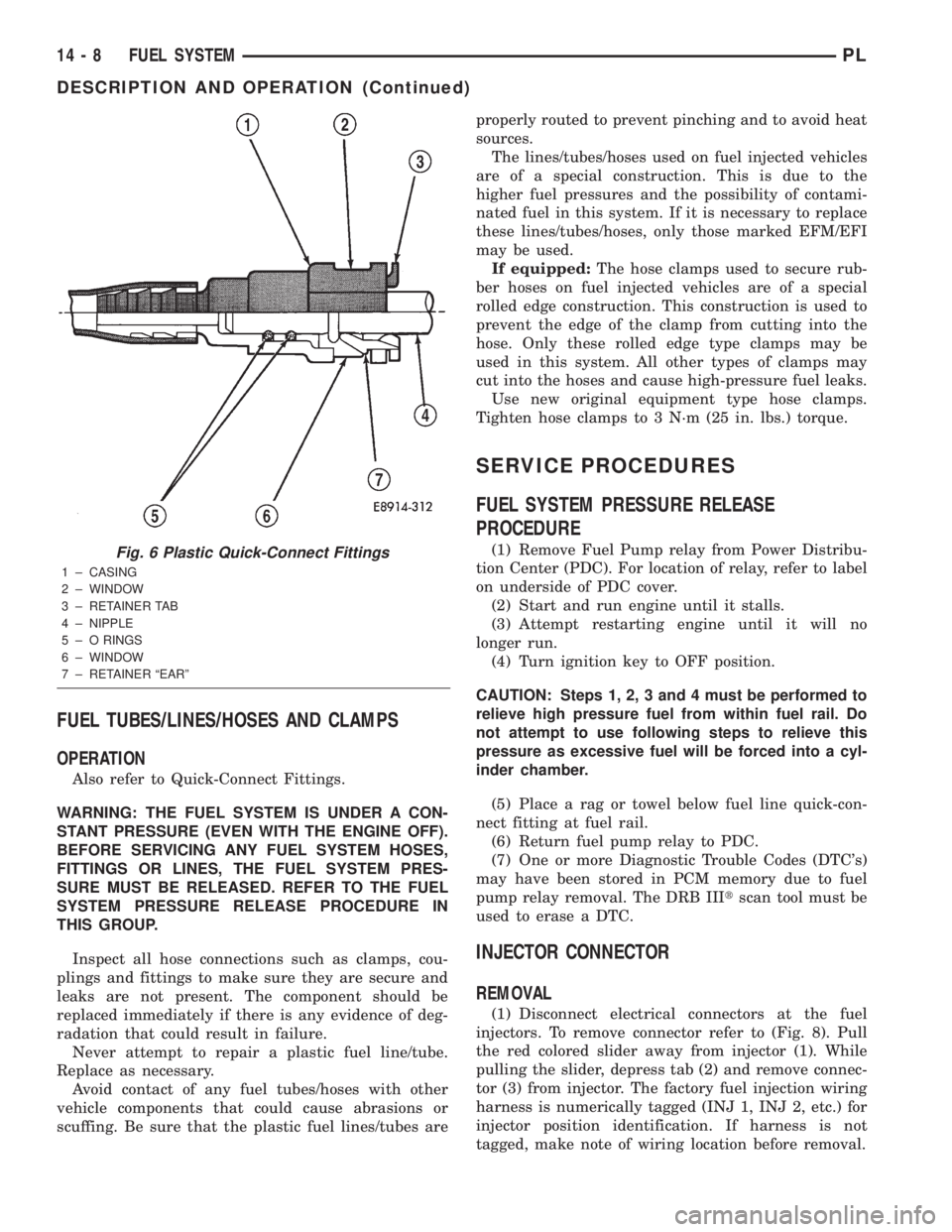
Fig. 6 Plastic Quick-Connect Fittings
1 ± CASING
2 ± WINDOW
3 ± RETAINER TAB
4 ± NIPPLE
5 ± O RINGS
6 ± WINDOW
7 ± RETAINER ªEARº
14 - 8 FUEL SYSTEMPL
DESCRIPTION AND OPERATION (Continued)
Page 832 of 1285
being serviced. The plastic retainer will remain on
component being serviced after fitting is discon-
nected. The O-rings and spacer will remain in quick-
connect fitting connector body.
(5) Inspect quick-connect fitting body and compo-
nent for damage. Replace as necessary.
CAUTION:
When the quick-connect fitting was dis-
connected, the plastic retainer will remain on the com-
ponent being serviced. If this retainer must be
removed, very carefully release the retainer from the
component with two small screwdrivers. After removal,
inspect the retainer for cracks or any damage.
(6) Prior to connecting quick-connect fitting to
component being serviced, check condition of fitting
and component. Clean parts with a lint-free cloth.
Lubricate with clean engine oil.
(7) Insert quick-connect fitting to component being
serviced and into plastic retainer. When a connection
is made, a click will be heard.
(8) Verify a locked condition by firmly pulling on
fuel tube and fitting (15-30 lbs.).
(9) Connect negative cable to battery or auxiliary
jumper terminal.
(10) Start engine and check for leaks.
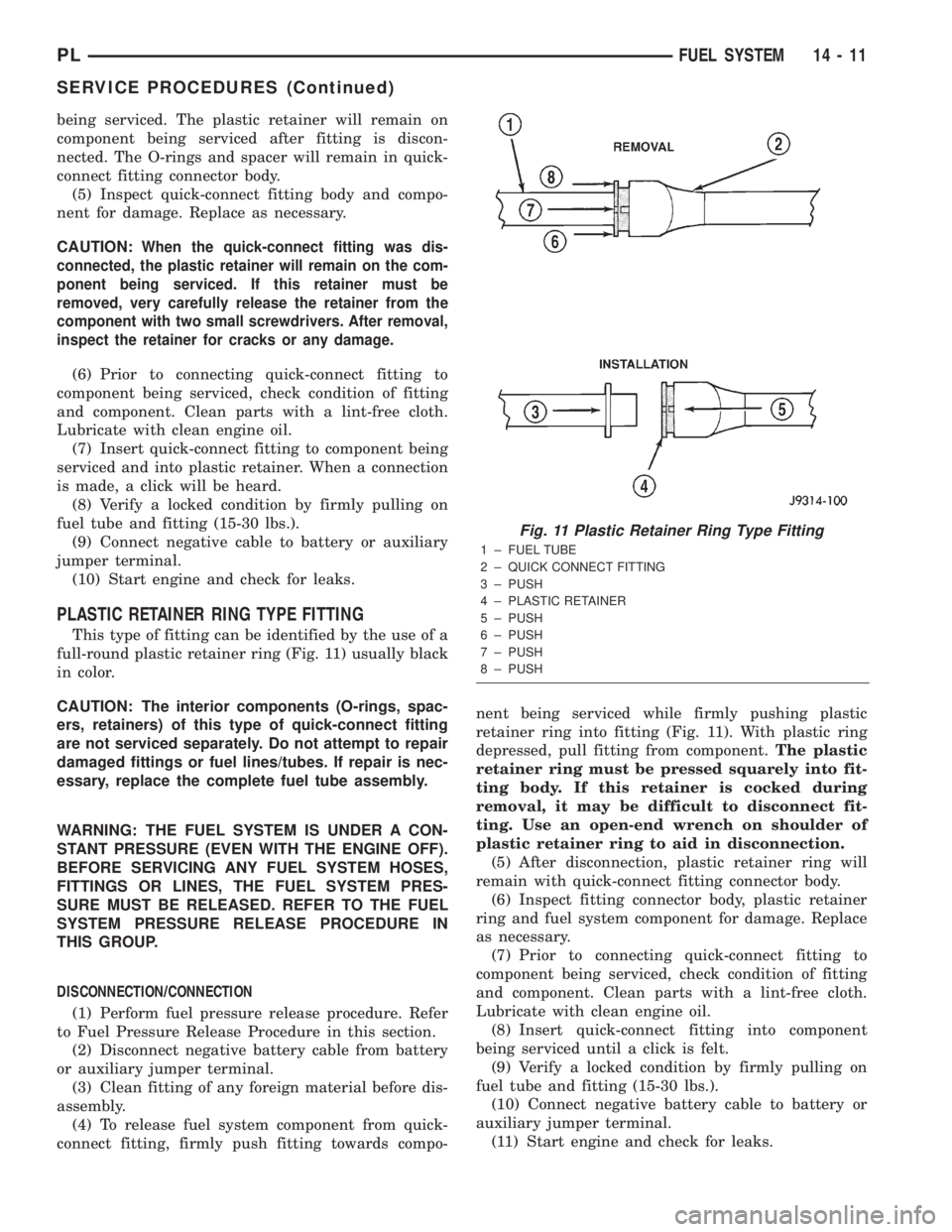
PLASTIC RETAINER RING TYPE FITTING
This type of fitting can be identified by the use of a
full-round plastic retainer ring (Fig. 11) usually black
in color.
CAUTION: The interior components (O-rings, spac-
ers, retainers) of this type of quick-connect fitting
are not serviced separately. Do not attempt to repair
damaged fittings or fuel lines/tubes. If repair is nec-
essary, replace the complete fuel tube assembly.
WARNING: THE FUEL SYSTEM IS UNDER A CON-
STANT PRESSURE (EVEN WITH THE ENGINE OFF).
BEFORE SERVICING ANY FUEL SYSTEM HOSES,
FITTINGS OR LINES, THE FUEL SYSTEM PRES-
SURE MUST BE RELEASED. REFER TO THE FUEL
SYSTEM PRESSURE RELEASE PROCEDURE IN
THIS GROUP.
DISCONNECTION/CONNECTION
(1) Perform fuel pressure release procedure. Refer
to Fuel Pressure Release Procedure in this section.
(2) Disconnect negative battery cable from battery
or auxiliary jumper terminal.
(3) Clean fitting of any foreign material before dis-
assembly.
(4) To release fuel system component from quick-
connect fitting, firmly push fitting towards compo-nent being serviced while firmly pushing plastic
retainer ring into fitting (Fig. 11). With plastic ring
depressed, pull fitting from component.The plastic
retainer ring must be pressed squarely into fit-
ting body. If this retainer is cocked during
removal, it may be difficult to disconnect fit-
ting. Use an open-end wrench on shoulder of
plastic retainer ring to aid in disconnection.
(5) After disconnection, plastic retainer ring will
remain with quick-connect fitting connector body.
(6) Inspect fitting connector body, plastic retainer
ring and fuel system component for damage. Replace
as necessary.
(7) Prior to connecting quick-connect fitting to
component being serviced, check condition of fitting
and component. Clean parts with a lint-free cloth.
Lubricate with clean engine oil.
(8) Insert quick-connect fitting into component
being serviced until a click is felt.
(9) Verify a locked condition by firmly pulling on
fuel tube and fitting (15-30 lbs.).
(10) Connect negative battery cable to battery or
auxiliary jumper terminal.
(11) Start engine and check for leaks.
Fig. 11 Plastic Retainer Ring Type Fitting
1 ± FUEL TUBE
2 ± QUICK CONNECT FITTING
3 ± PUSH
4 ± PLASTIC RETAINER
5 ± PUSH
6 ± PUSH
7 ± PUSH
8 ± PUSH
PLFUEL SYSTEM 14 - 11
SERVICE PROCEDURES (Continued)
Page 868 of 1285
(5) Install the wiring harness into the clips on the
side of the air cleaner box.
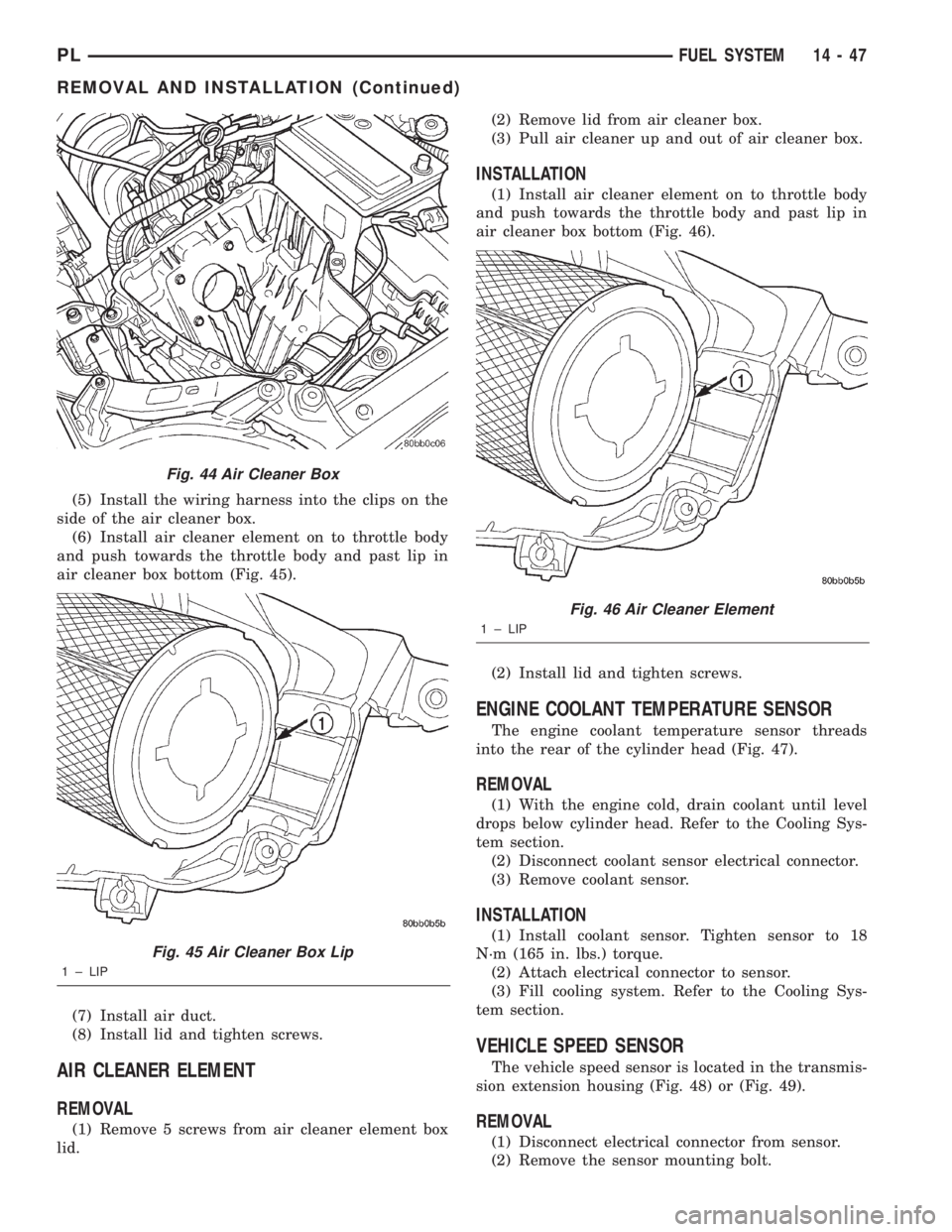
(6) Install air cleaner element on to throttle body
and push towards the throttle body and past lip in
air cleaner box bottom (Fig. 45).
(7) Install air duct.
(8) Install lid and tighten screws.
AIR CLEANER ELEMENT
REMOVAL
(1) Remove 5 screws from air cleaner element box
lid.(2) Remove lid from air cleaner box.
(3) Pull air cleaner up and out of air cleaner box.
INSTALLATION
(1) Install air cleaner element on to throttle body
and push towards the throttle body and past lip in
air cleaner box bottom (Fig. 46).
(2) Install lid and tighten screws.
ENGINE COOLANT TEMPERATURE SENSOR
The engine coolant temperature sensor threads
into the rear of the cylinder head (Fig. 47).
REMOVAL
(1) With the engine cold, drain coolant until level
drops below cylinder head. Refer to the Cooling Sys-
tem section.
(2) Disconnect coolant sensor electrical connector.
(3) Remove coolant sensor.
INSTALLATION
(1) Install coolant sensor. Tighten sensor to 18
N´m (165 in. lbs.) torque.
(2) Attach electrical connector to sensor.
(3) Fill cooling system. Refer to the Cooling Sys-
tem section.
VEHICLE SPEED SENSOR
The vehicle speed sensor is located in the transmis-
sion extension housing (Fig. 48) or (Fig. 49).
REMOVAL
(1) Disconnect electrical connector from sensor.
(2) Remove the sensor mounting bolt.
Fig. 44 Air Cleaner Box
Fig. 45 Air Cleaner Box Lip
1 ± LIP
Fig. 46 Air Cleaner Element
1 ± LIP
PLFUEL SYSTEM 14 - 47
REMOVAL AND INSTALLATION (Continued)
Page 875 of 1285
DIAGNOSIS AND TESTING
STEERING SYSTEM DIAGNOSIS CHARTS
POWER STEERING NOISE
CONDITION POSSIBLE CAUSES CORRECTION
OBJECTIONABLE HISS OR
WHISTLE*1. Damaged or mispositioned
steering column shaft/coupling dash
panel seal.1. Reposition or replace steering
column shaft/coupling dash panel
seal.
2. Noisy valve in power steering
gear.2. Replace power steering gear.
RATTLE OR CLUNK 1. Power steering gear loose on
front suspension crossmember.1. Inspect power steering gear
mounting bolts. Replace as
necessary. Tighten to the specified
torque.
2. Front suspension crossmember
mounting fasteners loose at frame.2. Tighten the front suspension
crossmember mounting fasteners to
the specified torque.
3. Loose tie rod (outer or inner). 3. Check tie rod pivot points for
wear. Replace worn/loose parts as
required.
4. Loose lower control arm mounting
bolts at front suspension
crossmember.4. Tighten control arm mounting
bolts to the specified torques.
5. Loose strut assembly mounting
fasteners at strut tower.5. Tighten strut assembly fasteners
to the specified torques.
6. Power steering fluid pressure
hose touching the body of the
vehicle.6. Adjust hose to proper position by
loosening, repositioning, and
tightening fitting to specified torque.
Do not bend tubing.
7. Internal power steering gear
noise.7. Replace power steering gear.
8. Damaged front suspension
crossmember.8. Replace front suspension
crossmember.
CHIRP OR SQUEAL (POWER
STEERING PUMP)1. Loose power steering pump drive
belt.1. Check and replace automatic belt
tensioner as necessary. Replace belt
if worn or glazed.
19 - 4 STEERINGPL
Page 883 of 1285
(4) Open the routing clips on the right side of the
power steering gear and remove the power steering
fluid pressure hose tube from the routing clips. At
the same time, remove the pressure hose tube from
the gear.
(5) Lower the vehicle.
(6) Remove the bolt securing the hose routing clip
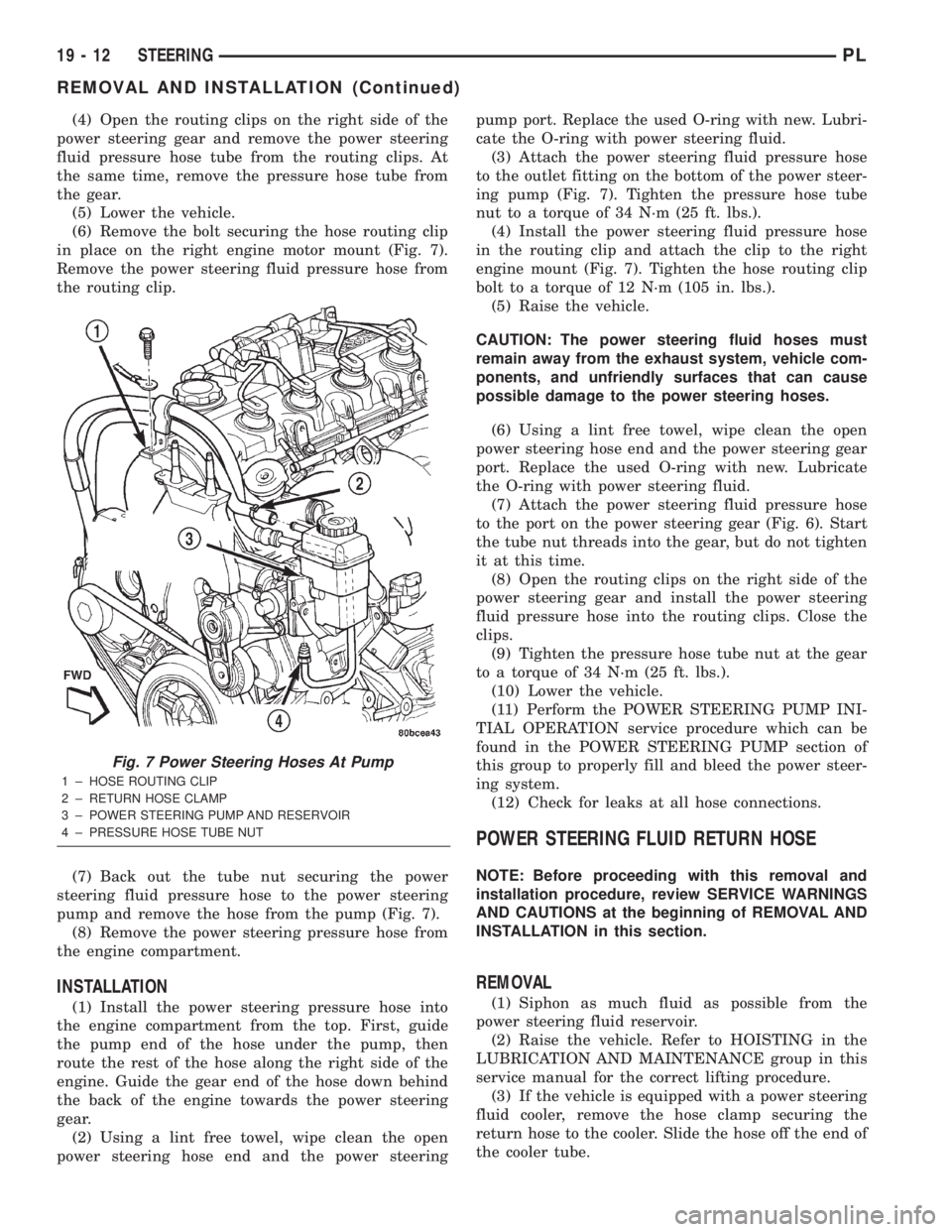
in place on the right engine motor mount (Fig. 7).
Remove the power steering fluid pressure hose from
the routing clip.
(7) Back out the tube nut securing the power
steering fluid pressure hose to the power steering
pump and remove the hose from the pump (Fig. 7).
(8) Remove the power steering pressure hose from
the engine compartment.
INSTALLATION
(1) Install the power steering pressure hose into
the engine compartment from the top. First, guide
the pump end of the hose under the pump, then
route the rest of the hose along the right side of the
engine. Guide the gear end of the hose down behind
the back of the engine towards the power steering
gear.
(2) Using a lint free towel, wipe clean the open
power steering hose end and the power steeringpump port. Replace the used O-ring with new. Lubri-
cate the O-ring with power steering fluid.
(3) Attach the power steering fluid pressure hose
to the outlet fitting on the bottom of the power steer-
ing pump (Fig. 7). Tighten the pressure hose tube
nut to a torque of 34 N´m (25 ft. lbs.).
(4) Install the power steering fluid pressure hose
in the routing clip and attach the clip to the right
engine mount (Fig. 7). Tighten the hose routing clip
bolt to a torque of 12 N´m (105 in. lbs.).
(5) Raise the vehicle.
CAUTION: The power steering fluid hoses must
remain away from the exhaust system, vehicle com-
ponents, and unfriendly surfaces that can cause
possible damage to the power steering hoses.
(6) Using a lint free towel, wipe clean the open
power steering hose end and the power steering gear
port. Replace the used O-ring with new. Lubricate
the O-ring with power steering fluid.
(7) Attach the power steering fluid pressure hose
to the port on the power steering gear (Fig. 6). Start
the tube nut threads into the gear, but do not tighten
it at this time.
(8) Open the routing clips on the right side of the
power steering gear and install the power steering
fluid pressure hose into the routing clips. Close the
clips.
(9) Tighten the pressure hose tube nut at the gear
to a torque of 34 N´m (25 ft. lbs.).
(10) Lower the vehicle.
(11) Perform the POWER STEERING PUMP INI-
TIAL OPERATION service procedure which can be
found in the POWER STEERING PUMP section of
this group to properly fill and bleed the power steer-
ing system.
(12) Check for leaks at all hose connections.
POWER STEERING FLUID RETURN HOSE
NOTE: Before proceeding with this removal and
installation procedure, review SERVICE WARNINGS
AND CAUTIONS at the beginning of REMOVAL AND
INSTALLATION in this section.
REMOVAL
(1) Siphon as much fluid as possible from the
power steering fluid reservoir.
(2) Raise the vehicle. Refer to HOISTING in the
LUBRICATION AND MAINTENANCE group in this
service manual for the correct lifting procedure.
(3) If the vehicle is equipped with a power steering
fluid cooler, remove the hose clamp securing the
return hose to the cooler. Slide the hose off the end of
the cooler tube.
Fig. 7 Power Steering Hoses At Pump
1 ± HOSE ROUTING CLIP
2 ± RETURN HOSE CLAMP
3 ± POWER STEERING PUMP AND RESERVOIR
4 ± PRESSURE HOSE TUBE NUT
19 - 12 STEERINGPL
REMOVAL AND INSTALLATION (Continued)
Page 884 of 1285
(4) If the vehicle is not equipped with a power
steering fluid cooler:
²Remove the hose clamp securing the return hose
to the steel fitting in the outlet port on the power
steering gear (Fig. 6).
²Slide the hose off the end of the steel fitting.
²Pull the hose loose from the C-clamps on the two
routing clips located on the front of the steering gear
(Fig. 6).
(5) Lower the vehicle.
(6) Remove the bolt securing the hose routing clip
in place on the right engine mount (Fig. 7). Remove
the power steering fluid return hose from the routing
clip.
(7) Remove the hose clamp securing the return
hose to the power steering fluid reservoir (Fig. 7).
Slide the hose off the end of the reservoir fitting.
(8) Remove the power steering return hose from
the engine compartment.
INSTALLATION
(1) Slide a hose clamp onto the power steering
pump end of the hose far enough to clear the fitting
on the power steering fluid reservoir once the hose is
installed.
(2) Install the power steering return hose into the
engine compartment from the top. First, guide the
pump end of the hose onto the fitting on the power
steering fluid reservoir, then route the rest of the
hose along the right side of the engine (Fig. 7). Guide
the gear end of the hose down behind the back of the
engine towards the power steering gear.
(3) Expand the hose clamp and slide it onto the
fluid reservoir fitting. Secure the clamp once it is
past the bead formed into the fluid reservoir fitting.
(4) Install the power steering fluid return hose in
the hose routing clip and attach the clip to the right
engine mount (Fig. 7). Tighten the hose routing clip
bolt to a torque of 12 N´m (105 in. lbs.).
(5) Raise the vehicle.
CAUTION: The power steering fluid hoses must
remain away from the exhaust system, vehicle com-
ponents, and unfriendly surfaces that can cause
possible damage to the power steering hoses.
(6) Using a lint free towel, wipe clean the open
power steering hose end and the power steering gear
port fitting or power steering fluid cooler port.
(7) Install a hose clamp onto the end of the hose
far enough to clear the fitting on the steering gear or
cooler once the hose is installed.
(8) If the vehicle is equipped with a power steering
fluid cooler, slide the hose onto the end of the cooler
tube. Install the hose clamp past the bead formed
into the cooler tube and secure in place.(9) If the vehicle is not equipped with a power
steering fluid cooler:
²Slide the hose onto the end of the steel fitting in
the steering gear outlet port (Fig. 6).
²Install the hose clamp past the bead formed into
the steel fitting and secure in place.
²Align and attach the hose to the C-clamps on
the two routing clips located on the front of the steer-
ing gear (Fig. 6).
(10) Lower the vehicle.
(11) Perform the POWER STEERING PUMP INI-
TIAL OPERATION service procedure which can be
found in the POWER STEERING PUMP section of
this group to properly fill and bleed the power steer-
ing system.
(12) Check for leaks at all hose connections.
POWER STEERING FLUID COOLER
NOTE: Before proceeding with this removal and
installation procedure, review SERVICE WARNINGS
AND CAUTIONS at the beginning of REMOVAL AND
INSTALLATION in this section.
REMOVAL
(1) Siphon as much fluid as possible from the
power steering fluid reservoir.
(2) Raise the vehicle. Refer to HOISTING in the
LUBRICATION AND MAINTENANCE group in this
service manual for the correct lifting procedure.
(3) Remove the hose clamp, attaching the power
steering fluid return hose to the power steering fluid
cooler. Remove the return hose from the cooler.
(4) Remove the hose clamp attaching the power
steering cooler fluid hose to the steel fitting in the
power steering gear outlet port (Fig. 8).
(5) Remove the two screws securing the cooler to
the front suspension crossmember. They are located
behind the cooler. They can be accessed from above.
(6) Open the routing clip on the right front of the
power steering gear housing and remove the cooler
tube from it.
(7) Remove the cooler from the vehicle.
INSTALLATION
(1) Slide a hose clamp onto the end of the power
steering cooler fluid hose far enough to clear the steel
fitting on the power steering gear once the hose is
installed.
(2) Slide the hose (with cooler attached) onto the
fitting on the steering gear, then align the tube on
back of the cooler with the open routing clip on the
right front of the power steering gear housing, and
snap it into place. Close the clip.
PLSTEERING 19 - 13
REMOVAL AND INSTALLATION (Continued)
Page 890 of 1285
SORY DRIVE BELTS in the COOLING SYSTEM
service manual group for the required removal and
installation procedure.
(6) Using a lint free towel, wipe clean all open
power steering hose ends and power steering pump
fittings.
(7) Install a new O-ring on the end of the power
steering pressure hose. Lubricate the O-ring using
clean power steering fluid.
(8) Attach the power steering fluid pressure hose
to the pressure fitting on the lower end of the power
steering pump (Fig. 2). Thread the tube nut securing
the power steering fluid pressure hose into the power
steering pump pressure fitting. Tighten the tube nut
to at torque of 34 N´m (25 ft. lbs.).
(9) Slide the power steering fluid return hose onto
the fluid reservoir fitting (Fig. 2). Position the hose
clamp so it is installed on the hose past the bead
formed into the fluid reservoir fitting.
(10) Perform the POWER STEERING PUMP INI-
TIAL OPERATION service procedure found in this
section of this group to properly fill and bleed the
power steering system.
(11) Check for leaks.
DISASSEMBLY AND ASSEMBLY
POWER STEERING PUMP (PULLEY)
The only serviceable part of the power steering
pump is the pulley. The following procedure is for the
removal and installation of the pulley from the
pump.
The power steering pump must be removed from
the vehicle for power steering pump pulley service.
Refer to POWER STEERING PUMP in REMOVAL
AND INSTALLATION for the required procedure.
CAUTION: Use care when removing and installing
the power steering pump pulley. It is made of plas-
tic composite, except for the center shank. The spe-
cial tools are to be used in the shank area only as
described in the following procedure.
DISASSEMBLY
CAUTION: Do not hammer on the power steering
pump pulley or shaft to remove the power steering
pump pulley. This will damage the pulley and the
power steering pump.
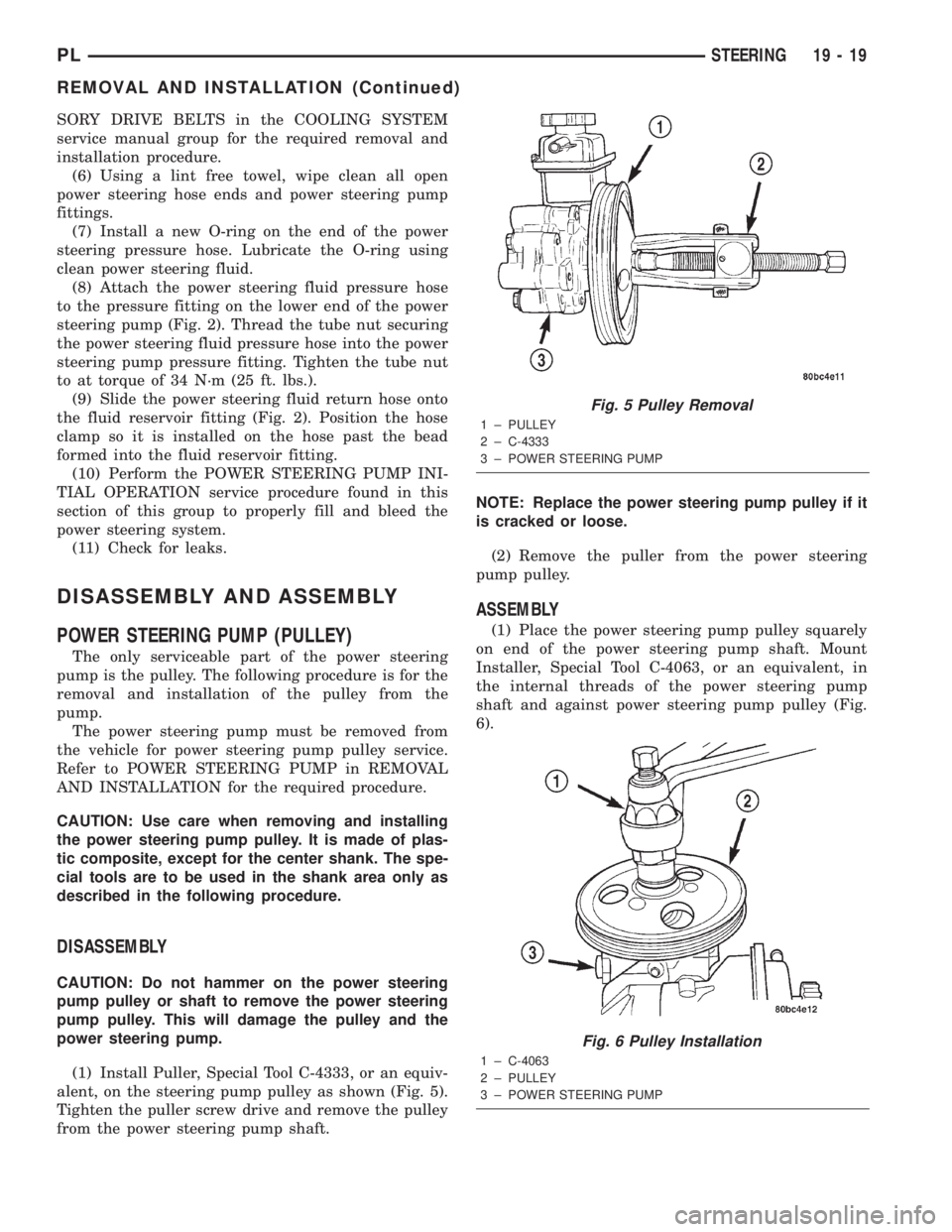
(1) Install Puller, Special Tool C-4333, or an equiv-
alent, on the steering pump pulley as shown (Fig. 5).
Tighten the puller screw drive and remove the pulley
from the power steering pump shaft.NOTE: Replace the power steering pump pulley if it
is cracked or loose.
(2) Remove the puller from the power steering
pump pulley.
ASSEMBLY
(1) Place the power steering pump pulley squarely
on end of the power steering pump shaft. Mount
Installer, Special Tool C-4063, or an equivalent, in
the internal threads of the power steering pump
shaft and against power steering pump pulley (Fig.
6).
Fig. 5 Pulley Removal
1 ± PULLEY
2 ± C-4333
3 ± POWER STEERING PUMP
Fig. 6 Pulley Installation
1 ± C-4063
2 ± PULLEY
3 ± POWER STEERING PUMP
PLSTEERING 19 - 19
REMOVAL AND INSTALLATION (Continued)
Page 897 of 1285
(7) Using a soft face hammer, tap the front suspen-
sion crossmember back-and-forth or side-to-side until
it is aligned with the previously scribed positioning
marks on the body of the vehicle (Fig. 9). Once the
front suspension crossmember is correctly positioned,
tighten the rear two crossmember (and rear lower
control arm) mounting bolts to a torque of 203 N´m
(150 ft. lbs.), then tighten the front two crossmember
mounting bolts to a torque of 142 N´m (105 ft. lbs.).
(8) Fasten the engine torque strut to the right for-
ward corner of the front suspension crossmember
using its mounting bolt (Fig. 8). Follow the procedure
described in the ENGINE service manual group to
properly align and tighten the torque strut and it's
mounting bolts.
(9) Using a lint free towel, wipe clean the open
power steering hose ends and the power steering
gear ports. Replace the pressure hose used O-ring
with new. Lubricate the O-ring with power steering
fluid.
(10) Attach the power steering fluid pressure hose
to it's port on the power steering gear (Fig. 7). Start
the tube nut threads into the gear, but do not tighten
them at this time. On vehicles equipped with a power
steering fluid cooler, reconnect the cooler line to the
gear in place of the power steering fluid return hose.
(11) Open the routing clips on the front of the
steering gear housing and install the power steering
fluid pressure hose into the routing clips.
(12) On vehicles equipped with a power steering
fluid cooler, place the cooler in mounting position and
snap the cooler tube going to the gear into the right
routing clip.
(13) Close both routing clips.
(14) Tighten the power steering fluid pressure
hose tube nut at the gear to a torque of 34 N´m (25
ft. lbs.).
(15) If the vehicle is equipped with a power steer-
ing fluid cooler, install the two screws securing the
cooler to the front suspension crossmember. They are
located behind the cooler.
(16) On vehicle's with a power steering fluid cooler,
place the hose clamp on the hose far enough from the
end to clear the steel fitting on the gear. Do the same
for the fluid return hose on a vehicle that is not
equipped with a cooler.
(17) Push either hose listed in the above step onto
the steel fitting, then move and secure the clamp on
the hose past the bead on the steel fitting in the
steering gears outlet port (Fig. 7).
(18) Route the fluid return hose along the front of
the steering gear, clipping it into place in the
C-clamps on the outside of the routing clips on the
front of the power steering gear housing.
(19) Reconnect the wiring harness connector from
the power steering fluid pressure switch (Fig. 6). Besure the locking tab on the wiring harness connector
is securely latched.
(20) Perform the following to each outer tie rod:
²Place the tie rod heat shield on the knuckle's
steering arm, aligning the hole in the shield with the
hole in the knuckle and the tangs on the outside of
the shield with the outside configuration of the steer-
ing arm. The shield should now be facing outboard,
away from the power steering gear and tie rod (Fig.
4).
²Attach the outer tie rod end to its steering
knuckle.
²Start the attaching nut onto the stud of the
outer tie rod.
²While holding the stud of the tie rod stationary
with a wrench, tighten the attaching nut (Fig. 4).
²Using a crowfoot wrench attached to a torque
wrench, tighten the attaching nut to 55 N´m (40 ft.
lbs.).
(21) Install the tire and wheel assemblies back on
vehicle. Tighten the wheel mounting nuts to 135 N´m
(100 ft. lbs.) torque.
(22) Lower the vehicle to ground level.
(23) Install the dash-to-lower coupling seal in
place over the lower coupling's plastic collar.
NOTE: Verify that grease is present on the lip of
the dash-to-coupling seal where it contacts the cou-
pling's plastic collar.
(24) Inside the passenger compartment, reconnect
the steering column lower coupling to the steering
column upper coupling (Fig. 3). Install the coupling
pinch bolt and tighten the pinch bolt nut to a torque
of 28 N´m (250 in. lbs.). Install the pinch bolt
retainer pin.
(25) Remove the steering wheel holder.
(26) While looking under the instrument panel at
the lower coupling, rotate the steering wheel back-
and-forth to verify that the lower coupling does not
squeak against the dash-to-coupling seal.
(27) Perform the POWER STEERING PUMP INI-
TIAL OPERATION service procedure which can be
found in the POWER STEERING PUMP section of
this group to properly fill and bleed the power steer-
ing system.
(28) Check for fluid leaks.
(29) Adjust the front toe setting on the vehicle.
Refer to WHEEL ALIGNMENT in the SUSPENSION
service manual group.
OUTER TIE ROD
REMOVAL
(1) Raise the vehicle. Refer to HOISTING in the
LUBRICATION AND MAINTENANCE group in this
service manual for the correct lifting procedure.
19 - 26 STEERINGPL
REMOVAL AND INSTALLATION (Continued)
Page 954 of 1285
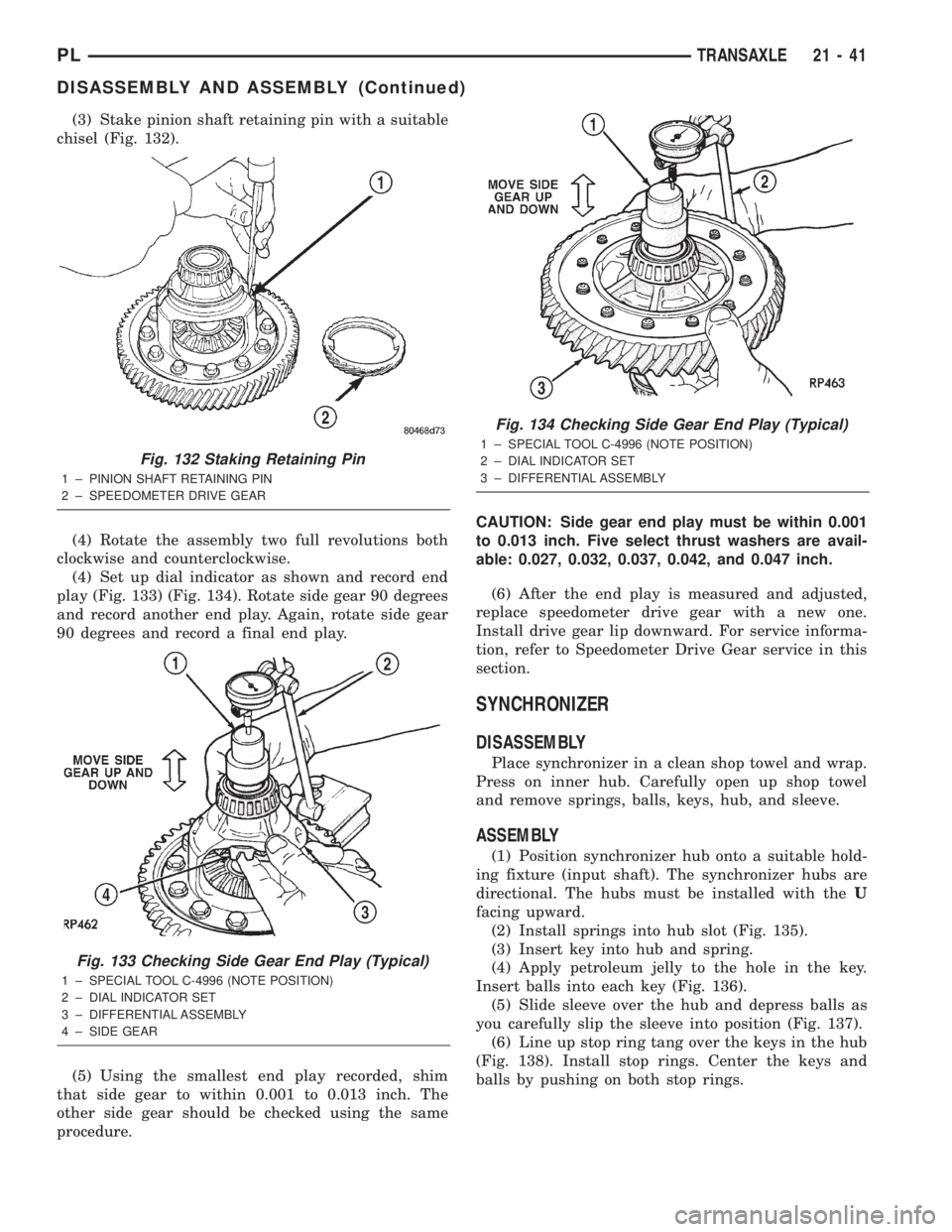
(3) Stake pinion shaft retaining pin with a suitable
chisel (Fig. 132).
(4) Rotate the assembly two full revolutions both
clockwise and counterclockwise.
(4) Set up dial indicator as shown and record end
play (Fig. 133) (Fig. 134). Rotate side gear 90 degrees
and record another end play. Again, rotate side gear
90 degrees and record a final end play.
(5) Using the smallest end play recorded, shim
that side gear to within 0.001 to 0.013 inch. The
other side gear should be checked using the same
procedure.CAUTION: Side gear end play must be within 0.001
to 0.013 inch. Five select thrust washers are avail-
able: 0.027, 0.032, 0.037, 0.042, and 0.047 inch.
(6) After the end play is measured and adjusted,
replace speedometer drive gear with a new one.
Install drive gear lip downward. For service informa-
tion, refer to Speedometer Drive Gear service in this
section.
SYNCHRONIZER
DISASSEMBLY
Place synchronizer in a clean shop towel and wrap.
Press on inner hub. Carefully open up shop towel
and remove springs, balls, keys, hub, and sleeve.
ASSEMBLY
(1) Position synchronizer hub onto a suitable hold-
ing fixture (input shaft). The synchronizer hubs are
directional. The hubs must be installed with theU
facing upward.
(2) Install springs into hub slot (Fig. 135).
(3) Insert key into hub and spring.
(4) Apply petroleum jelly to the hole in the key.
Insert balls into each key (Fig. 136).
(5) Slide sleeve over the hub and depress balls as
you carefully slip the sleeve into position (Fig. 137).
(6) Line up stop ring tang over the keys in the hub
(Fig. 138). Install stop rings. Center the keys and
balls by pushing on both stop rings.
Fig. 132 Staking Retaining Pin
1 ± PINION SHAFT RETAINING PIN
2 ± SPEEDOMETER DRIVE GEAR
Fig. 133 Checking Side Gear End Play (Typical)
1 ± SPECIAL TOOL C-4996 (NOTE POSITION)
2 ± DIAL INDICATOR SET
3 ± DIFFERENTIAL ASSEMBLY
4 ± SIDE GEAR
Fig. 134 Checking Side Gear End Play (Typical)
1 ± SPECIAL TOOL C-4996 (NOTE POSITION)
2 ± DIAL INDICATOR SET
3 ± DIFFERENTIAL ASSEMBLY
PLTRANSAXLE 21 - 41
DISASSEMBLY AND ASSEMBLY (Continued)
Page 961 of 1285
SHIFT CROSSOVER SHAFT BUSHING
REMOVAL
(1) Install slide hammer #3752 through the cross-
over bushing.
(2) Thread nut and washer onto slide hammer.
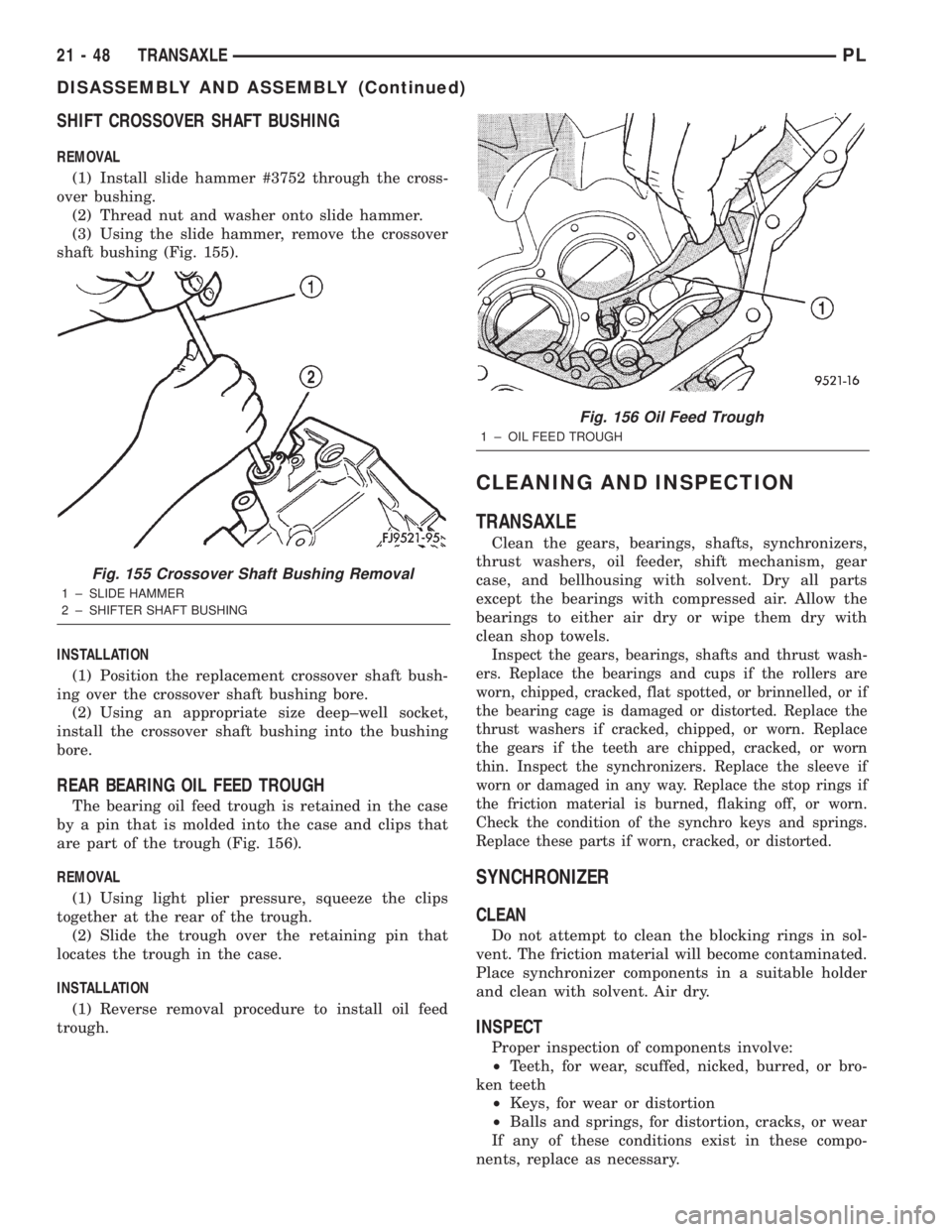
(3) Using the slide hammer, remove the crossover
shaft bushing (Fig. 155).
INSTALLATION
(1) Position the replacement crossover shaft bush-
ing over the crossover shaft bushing bore.
(2) Using an appropriate size deep±well socket,
install the crossover shaft bushing into the bushing
bore.
REAR BEARING OIL FEED TROUGH
The bearing oil feed trough is retained in the case
by a pin that is molded into the case and clips that
are part of the trough (Fig. 156).
REMOVAL
(1) Using light plier pressure, squeeze the clips
together at the rear of the trough.
(2) Slide the trough over the retaining pin that
locates the trough in the case.
INSTALLATION
(1) Reverse removal procedure to install oil feed
trough.
CLEANING AND INSPECTION
TRANSAXLE
Clean the gears, bearings, shafts, synchronizers,
thrust washers, oil feeder, shift mechanism, gear
case, and bellhousing with solvent. Dry all parts
except the bearings with compressed air. Allow the
bearings to either air dry or wipe them dry with
clean shop towels.
Inspect the gears, bearings, shafts and thrust wash-
ers. Replace the bearings and cups if the rollers are
worn, chipped, cracked, flat spotted, or brinnelled, or if
the bearing cage is damaged or distorted. Replace the
thrust washers if cracked, chipped, or worn. Replace
the gears if the teeth are chipped, cracked, or worn
thin. Inspect the synchronizers. Replace the sleeve if
worn or damaged in any way. Replace the stop rings if
the friction material is burned, flaking off, or worn.
Check the condition of the synchro keys and springs.
Replace these parts if worn, cracked, or distorted.
SYNCHRONIZER
CLEAN
Do not attempt to clean the blocking rings in sol-
vent. The friction material will become contaminated.
Place synchronizer components in a suitable holder
and clean with solvent. Air dry.
INSPECT
Proper inspection of components involve:
²Teeth, for wear, scuffed, nicked, burred, or bro-
ken teeth
²Keys, for wear or distortion
²Balls and springs, for distortion, cracks, or wear
If any of these conditions exist in these compo-
nents, replace as necessary.
Fig. 155 Crossover Shaft Bushing Removal
1 ± SLIDE HAMMER
2 ± SHIFTER SHAFT BUSHING
Fig. 156 Oil Feed Trough
1 ± OIL FEED TROUGH
21 - 48 TRANSAXLEPL
DISASSEMBLY AND ASSEMBLY (Continued)