wheel DODGE NEON 2000 Service Manual PDF
[x] Cancel search | Manufacturer: DODGE, Model Year: 2000, Model line: NEON, Model: DODGE NEON 2000Pages: 1285, PDF Size: 29.42 MB
Page 120 of 1285
(6) Lubricate both adapter caliper slide abutments
with a liberal amount of MopartMultipurpose Lubri-
cant, or an equivalent.
CAUTION: Use care when installing the caliper
assembly onto adapter so the guide pin bushings
and sleeves do not get damaged by the mounting
bosses on adapter.
(7) Starting with the lower end, carefully lower the
caliper and brake shoes over the brake rotor and
catch the caliper's bottom edge behind the caliper
slide abutment (Fig. 71). Rotate the top of the caliper
into mounting position on the adapter.
CAUTION: Extreme caution should be taken not to
cross thread the caliper guide pin bolts when they
are installed.
(8) Carefully install the caliper guide pin bolts
(Fig. 70), then tighten them to a torque of 22 N´m
(192 in. lbs.).
(9) Install the tire and wheel assembly. Tighten
the wheel mounting nuts to a torque of 135 N´m (100
ft. lbs.).
(10) Repeat the above procedure to the rear brakes
on the other side of the vehicle.
(11) Lower the vehicle.
(12) Pump the brake pedal several times to ensure
the vehicle has a firm brake pedal before moving the
vehicle.(13) Road test the vehicle and make several stops
to wear off any foreign material on the brakes and to
seat the brake shoes.
BRAKE ROTOR (REAR)
REMOVAL
(1) Raise the vehicle. Refer to HOISTING in the
LUBRICATION AND MAINTENANCE group for the
proper lifting procedure.
(2) Remove the rear tire and wheel assembly.
(3) Remove the rear disc brake caliper assembly
from the brake rotor and store it out of the way.
Refer to DISC BRAKE SHOES (REAR) in this
REMOVAL AND INSTALLATION section of this ser-
vice manual group.
(4) Remove any clips retaining the brake rotor
(Fig. 70).
(5) Remove the brake rotor by pulling it straight
off the wheel mounting studs.
INSTALLATION
NOTE: Inspect the disc brake shoes and parking
brake shoes before brake rotor installation.
(1) Install the rear brake rotor over the wheel
mounting studs and onto the hub (Fig. 70).
(2) Install rear disc brake caliper. Refer to DISC
BRAKE SHOES (REAR) in this REMOVAL AND
INSTALLATION section of this service manual
group.
(3) Install the tire and wheel assembly. Tighten
the wheel mounting nuts to a torque of 135 N´m (100
ft. lbs.).
(4) Adjust the parking brake shoes as necessary.
Refer to ADJUSTMENTS in this section of this ser-
vice manual group.
(5) Lower the vehicle.
(6) Pump the brake pedal before moving the vehi-
cle to set the brake shoes to the brake rotor.
DRUM BRAKE WHEEL CYLINDER (REAR)
NOTE: Before proceeding with this procedure,
review SERVICE WARNINGS AND CAUTIONS at the
beginning of REMOVAL AND INSTALLATION in this
section.
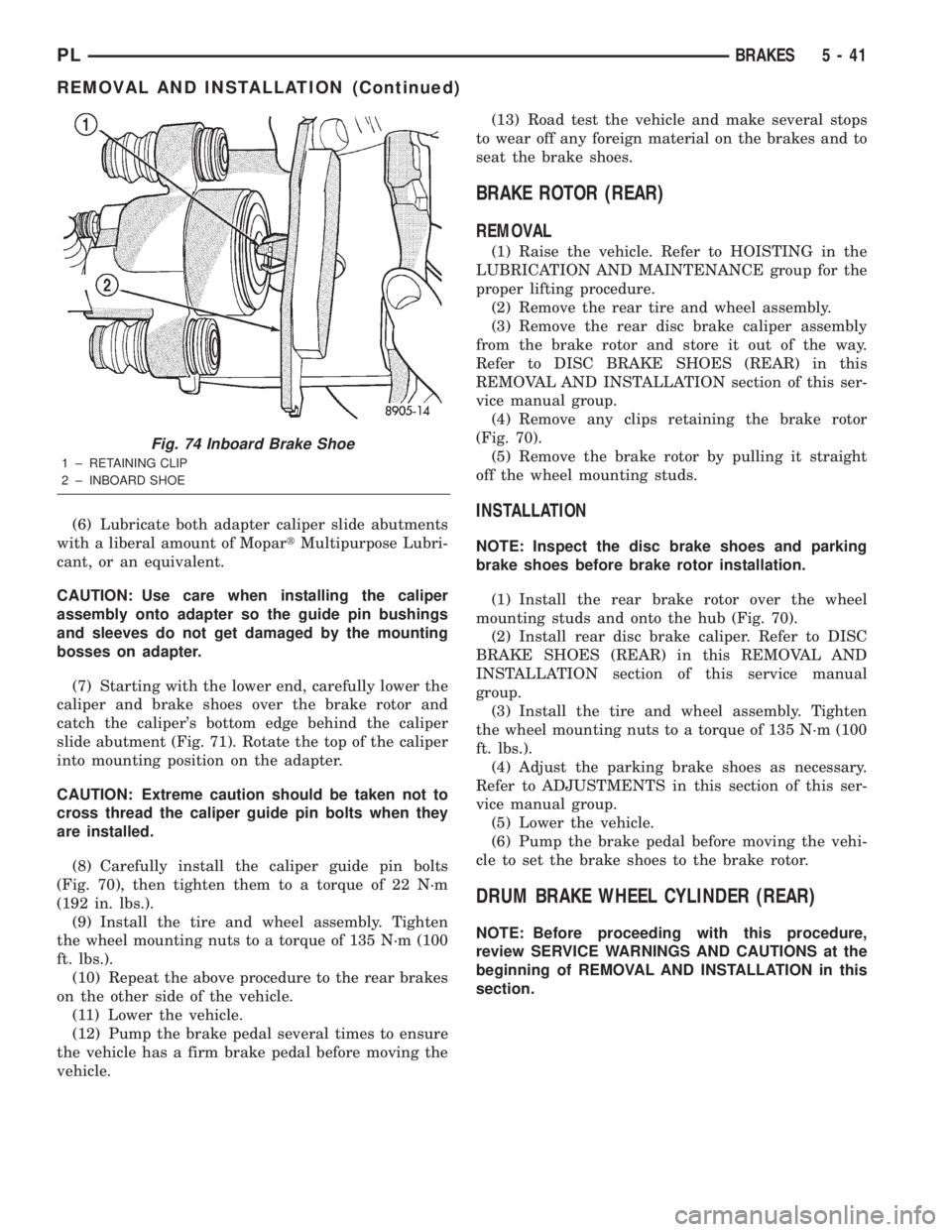
Fig. 74 Inboard Brake Shoe
1 ± RETAINING CLIP
2 ± INBOARD SHOE
PLBRAKES 5 - 41
REMOVAL AND INSTALLATION (Continued)
Page 121 of 1285
REMOVAL
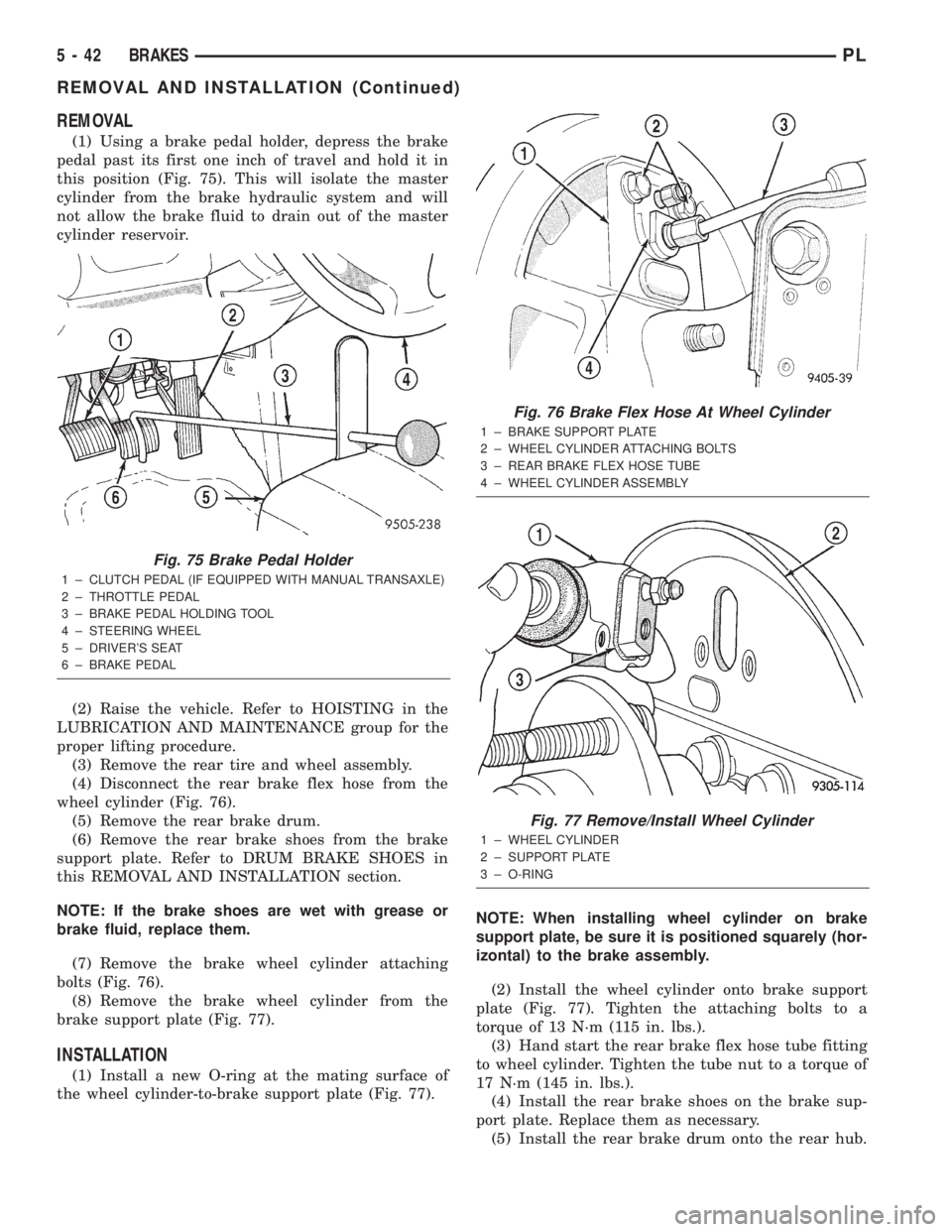
(1) Using a brake pedal holder, depress the brake
pedal past its first one inch of travel and hold it in
this position (Fig. 75). This will isolate the master
cylinder from the brake hydraulic system and will
not allow the brake fluid to drain out of the master
cylinder reservoir.
(2) Raise the vehicle. Refer to HOISTING in the
LUBRICATION AND MAINTENANCE group for the
proper lifting procedure.
(3) Remove the rear tire and wheel assembly.
(4) Disconnect the rear brake flex hose from the
wheel cylinder (Fig. 76).
(5) Remove the rear brake drum.
(6) Remove the rear brake shoes from the brake
support plate. Refer to DRUM BRAKE SHOES in
this REMOVAL AND INSTALLATION section.
NOTE: If the brake shoes are wet with grease or
brake fluid, replace them.
(7) Remove the brake wheel cylinder attaching
bolts (Fig. 76).
(8) Remove the brake wheel cylinder from the
brake support plate (Fig. 77).
INSTALLATION
(1) Install a new O-ring at the mating surface of
the wheel cylinder-to-brake support plate (Fig. 77).NOTE: When installing wheel cylinder on brake
support plate, be sure it is positioned squarely (hor-
izontal) to the brake assembly.
(2) Install the wheel cylinder onto brake support
plate (Fig. 77). Tighten the attaching bolts to a
torque of 13 N´m (115 in. lbs.).
(3) Hand start the rear brake flex hose tube fitting
to wheel cylinder. Tighten the tube nut to a torque of
17 N´m (145 in. lbs.).
(4) Install the rear brake shoes on the brake sup-
port plate. Replace them as necessary.
(5) Install the rear brake drum onto the rear hub.
Fig. 75 Brake Pedal Holder
1 ± CLUTCH PEDAL (IF EQUIPPED WITH MANUAL TRANSAXLE)
2 ± THROTTLE PEDAL
3 ± BRAKE PEDAL HOLDING TOOL
4 ± STEERING WHEEL
5 ± DRIVER'S SEAT
6 ± BRAKE PEDAL
Fig. 76 Brake Flex Hose At Wheel Cylinder
1 ± BRAKE SUPPORT PLATE
2 ± WHEEL CYLINDER ATTACHING BOLTS
3 ± REAR BRAKE FLEX HOSE TUBE
4 ± WHEEL CYLINDER ASSEMBLY
Fig. 77 Remove/Install Wheel Cylinder
1 ± WHEEL CYLINDER
2 ± SUPPORT PLATE
3 ± O-RING
5 - 42 BRAKESPL
REMOVAL AND INSTALLATION (Continued)
Page 122 of 1285
(6) Install the tire and wheel assembly. Tighten
the wheel mounting nuts to a torque of 135 N´m (100
ft. lbs.).
(7) Adjust the rear brakes. Refer to ADJUST-
MENTS in this section of this service manual group.
(8) Lower the vehicle.
(9) Remove the brake pedal holder.
(10) Bleed the wheel cylinder as necessary. Refer
to BASE BRAKE BLEEDING in the SERVICE PRO-
CEDURES section in this service manual group.
(11) Road test the vehicle to make sure the brakes
operate correctly.
DRUM BRAKE SHOES (REAR)
NOTE: Before proceeding with this removal and
installation procedure, review the SERVICE WARN-
INGS AND CAUTIONS at the beginning of REMOVAL
AND INSTALLATION in this section.
REMOVAL
(1) Raise the vehicle. Refer to HOISTING in the
LUBRICATION AND MAINTENANCE group for the
proper lifting procedure.
(2) Remove both rear tire and wheel assemblies
from the vehicle.
(3) Begin on one side of the vehicle.
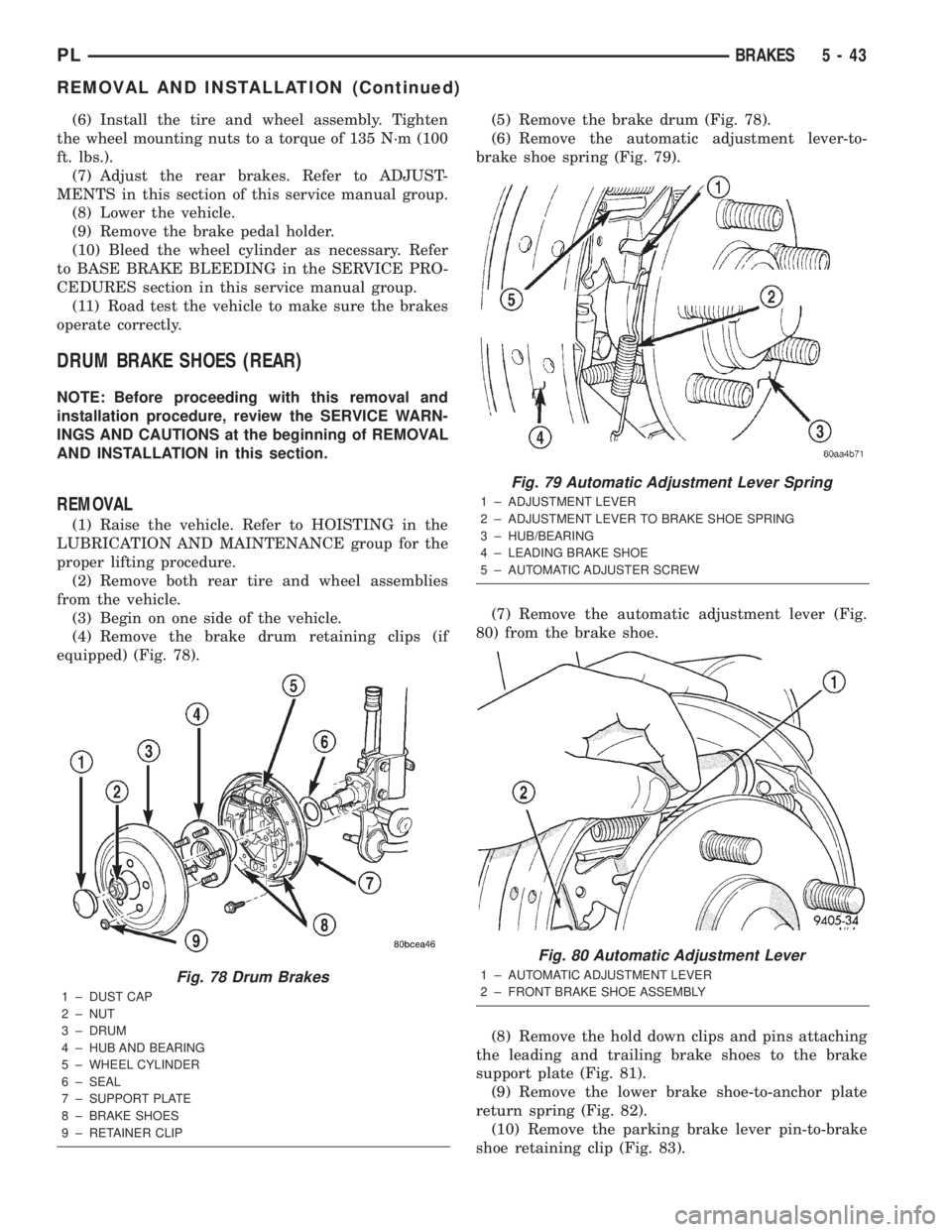
(4) Remove the brake drum retaining clips (if
equipped) (Fig. 78).(5) Remove the brake drum (Fig. 78).
(6) Remove the automatic adjustment lever-to-
brake shoe spring (Fig. 79).
(7) Remove the automatic adjustment lever (Fig.
80) from the brake shoe.
(8) Remove the hold down clips and pins attaching
the leading and trailing brake shoes to the brake
support plate (Fig. 81).
(9) Remove the lower brake shoe-to-anchor plate
return spring (Fig. 82).
(10) Remove the parking brake lever pin-to-brake
shoe retaining clip (Fig. 83).
Fig. 78 Drum Brakes
1 ± DUST CAP
2 ± NUT
3 ± DRUM
4 ± HUB AND BEARING
5 ± WHEEL CYLINDER
6 ± SEAL
7 ± SUPPORT PLATE
8 ± BRAKE SHOES
9 ± RETAINER CLIP
Fig. 79 Automatic Adjustment Lever Spring
1 ± ADJUSTMENT LEVER
2 ± ADJUSTMENT LEVER TO BRAKE SHOE SPRING
3 ± HUB/BEARING
4 ± LEADING BRAKE SHOE
5 ± AUTOMATIC ADJUSTER SCREW
Fig. 80 Automatic Adjustment Lever
1 ± AUTOMATIC ADJUSTMENT LEVER
2 ± FRONT BRAKE SHOE ASSEMBLY
PLBRAKES 5 - 43
REMOVAL AND INSTALLATION (Continued)
Page 123 of 1285
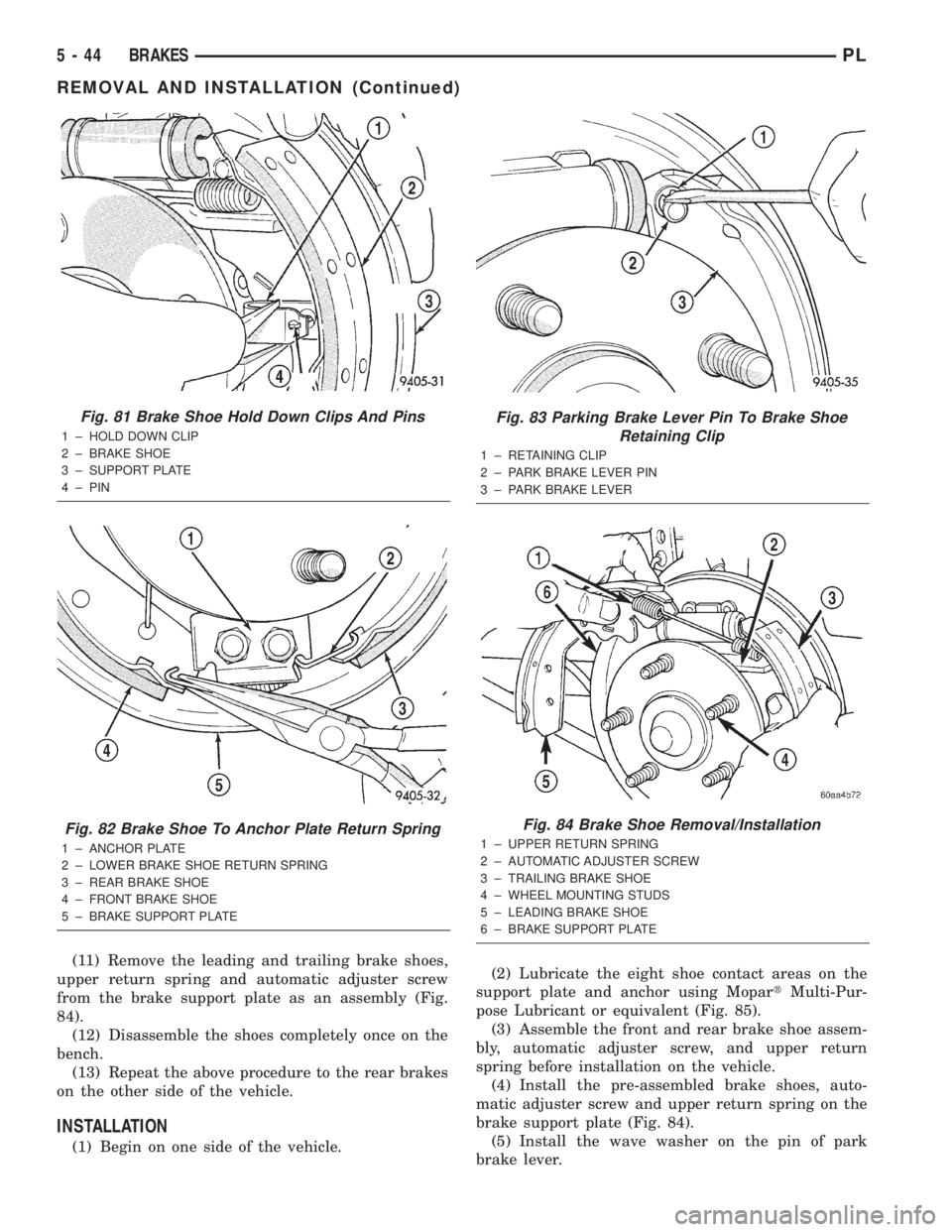
(11) Remove the leading and trailing brake shoes,
upper return spring and automatic adjuster screw
from the brake support plate as an assembly (Fig.
84).
(12) Disassemble the shoes completely once on the
bench.
(13) Repeat the above procedure to the rear brakes
on the other side of the vehicle.
INSTALLATION
(1) Begin on one side of the vehicle.(2) Lubricate the eight shoe contact areas on the
support plate and anchor using MopartMulti-Pur-
pose Lubricant or equivalent (Fig. 85).
(3) Assemble the front and rear brake shoe assem-
bly, automatic adjuster screw, and upper return
spring before installation on the vehicle.
(4) Install the pre-assembled brake shoes, auto-
matic adjuster screw and upper return spring on the
brake support plate (Fig. 84).
(5) Install the wave washer on the pin of park
brake lever.
Fig. 81 Brake Shoe Hold Down Clips And Pins
1 ± HOLD DOWN CLIP
2 ± BRAKE SHOE
3 ± SUPPORT PLATE
4 ± PIN
Fig. 82 Brake Shoe To Anchor Plate Return Spring
1 ± ANCHOR PLATE
2 ± LOWER BRAKE SHOE RETURN SPRING
3 ± REAR BRAKE SHOE
4 ± FRONT BRAKE SHOE
5 ± BRAKE SUPPORT PLATE
Fig. 83 Parking Brake Lever Pin To Brake Shoe
Retaining Clip
1 ± RETAINING CLIP
2 ± PARK BRAKE LEVER PIN
3 ± PARK BRAKE LEVER
Fig. 84 Brake Shoe Removal/Installation
1 ± UPPER RETURN SPRING
2 ± AUTOMATIC ADJUSTER SCREW
3 ± TRAILING BRAKE SHOE
4 ± WHEEL MOUNTING STUDS
5 ± LEADING BRAKE SHOE
6 ± BRAKE SUPPORT PLATE
5 - 44 BRAKESPL
REMOVAL AND INSTALLATION (Continued)
Page 124 of 1285
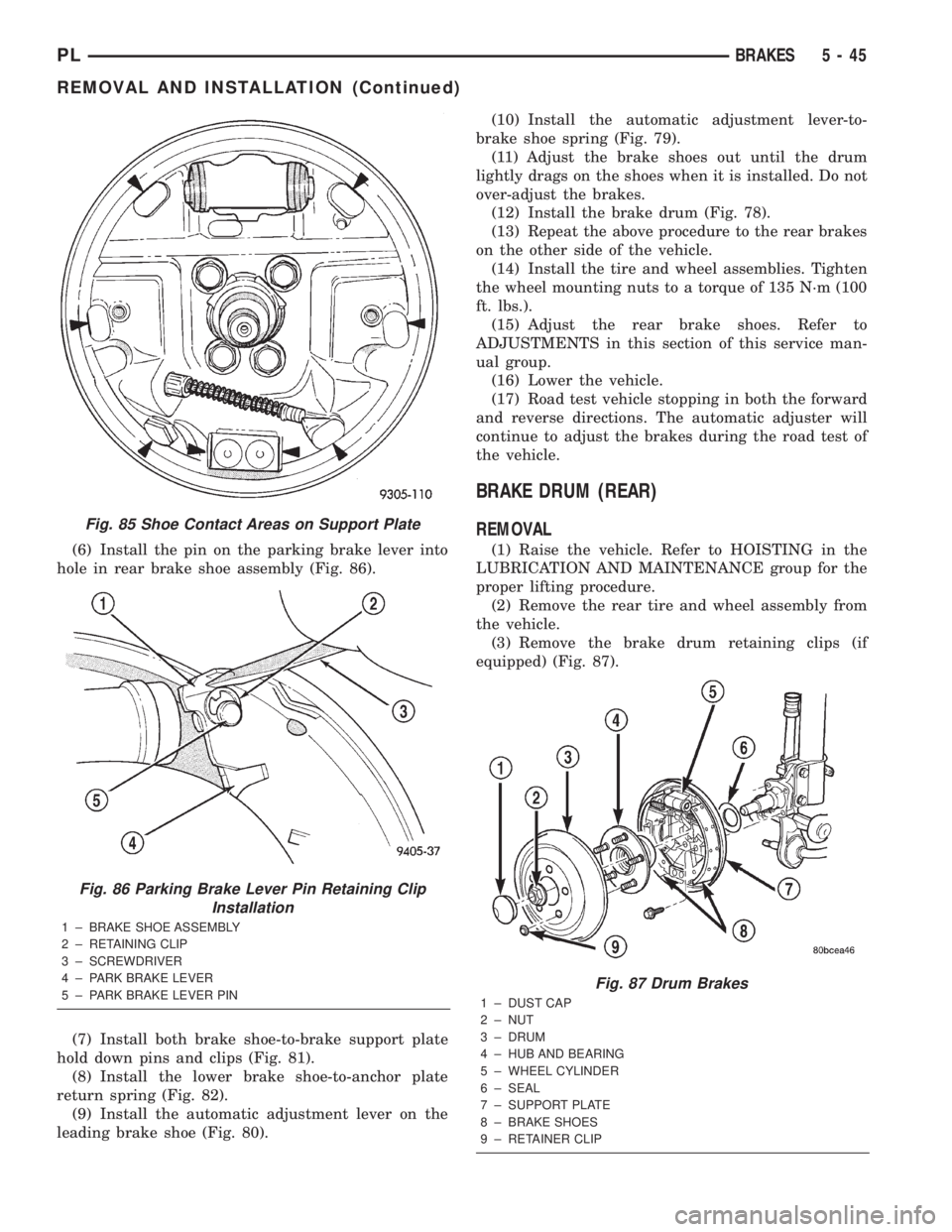
(6) Install the pin on the parking brake lever into
hole in rear brake shoe assembly (Fig. 86).
(7) Install both brake shoe-to-brake support plate
hold down pins and clips (Fig. 81).
(8) Install the lower brake shoe-to-anchor plate
return spring (Fig. 82).
(9) Install the automatic adjustment lever on the
leading brake shoe (Fig. 80).(10) Install the automatic adjustment lever-to-
brake shoe spring (Fig. 79).
(11) Adjust the brake shoes out until the drum
lightly drags on the shoes when it is installed. Do not
over-adjust the brakes.
(12) Install the brake drum (Fig. 78).
(13) Repeat the above procedure to the rear brakes
on the other side of the vehicle.
(14) Install the tire and wheel assemblies. Tighten
the wheel mounting nuts to a torque of 135 N´m (100
ft. lbs.).
(15) Adjust the rear brake shoes. Refer to
ADJUSTMENTS in this section of this service man-
ual group.
(16) Lower the vehicle.
(17) Road test vehicle stopping in both the forward
and reverse directions. The automatic adjuster will
continue to adjust the brakes during the road test of
the vehicle.
BRAKE DRUM (REAR)
REMOVAL
(1) Raise the vehicle. Refer to HOISTING in the
LUBRICATION AND MAINTENANCE group for the
proper lifting procedure.
(2) Remove the rear tire and wheel assembly from
the vehicle.
(3) Remove the brake drum retaining clips (if
equipped) (Fig. 87).
Fig. 85 Shoe Contact Areas on Support Plate
Fig. 86 Parking Brake Lever Pin Retaining Clip
Installation
1 ± BRAKE SHOE ASSEMBLY
2 ± RETAINING CLIP
3 ± SCREWDRIVER
4 ± PARK BRAKE LEVER
5 ± PARK BRAKE LEVER PIN
Fig. 87 Drum Brakes
1 ± DUST CAP
2 ± NUT
3 ± DRUM
4 ± HUB AND BEARING
5 ± WHEEL CYLINDER
6 ± SEAL
7 ± SUPPORT PLATE
8 ± BRAKE SHOES
9 ± RETAINER CLIP
PLBRAKES 5 - 45
REMOVAL AND INSTALLATION (Continued)
Page 125 of 1285
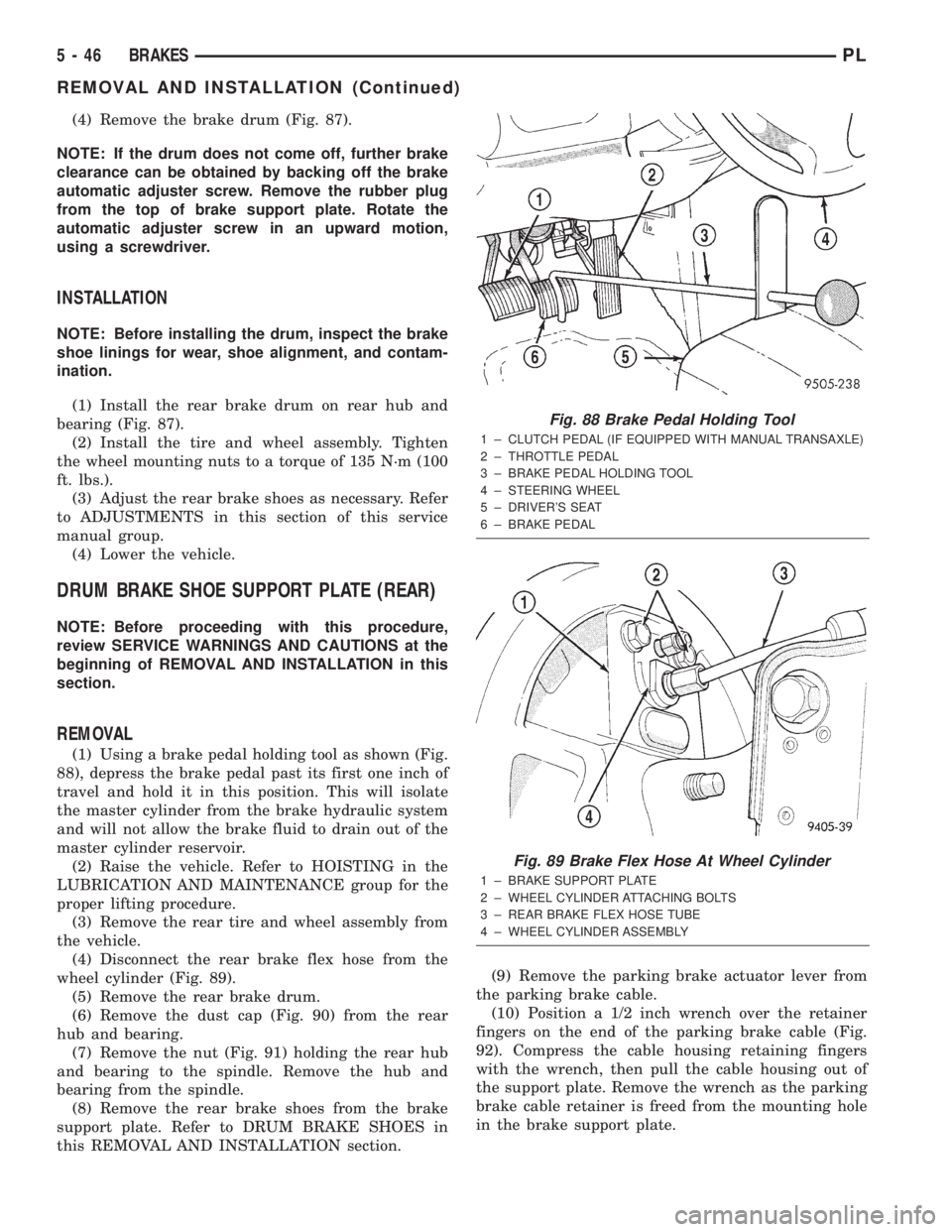
(4) Remove the brake drum (Fig. 87).
NOTE: If the drum does not come off, further brake
clearance can be obtained by backing off the brake
automatic adjuster screw. Remove the rubber plug
from the top of brake support plate. Rotate the
automatic adjuster screw in an upward motion,
using a screwdriver.
INSTALLATION
NOTE: Before installing the drum, inspect the brake
shoe linings for wear, shoe alignment, and contam-
ination.
(1) Install the rear brake drum on rear hub and
bearing (Fig. 87).
(2) Install the tire and wheel assembly. Tighten
the wheel mounting nuts to a torque of 135 N´m (100
ft. lbs.).
(3) Adjust the rear brake shoes as necessary. Refer
to ADJUSTMENTS in this section of this service
manual group.
(4) Lower the vehicle.
DRUM BRAKE SHOE SUPPORT PLATE (REAR)
NOTE: Before proceeding with this procedure,
review SERVICE WARNINGS AND CAUTIONS at the
beginning of REMOVAL AND INSTALLATION in this
section.
REMOVAL
(1) Using a brake pedal holding tool as shown (Fig.
88), depress the brake pedal past its first one inch of
travel and hold it in this position. This will isolate
the master cylinder from the brake hydraulic system
and will not allow the brake fluid to drain out of the
master cylinder reservoir.
(2) Raise the vehicle. Refer to HOISTING in the
LUBRICATION AND MAINTENANCE group for the
proper lifting procedure.
(3) Remove the rear tire and wheel assembly from
the vehicle.
(4) Disconnect the rear brake flex hose from the
wheel cylinder (Fig. 89).
(5) Remove the rear brake drum.
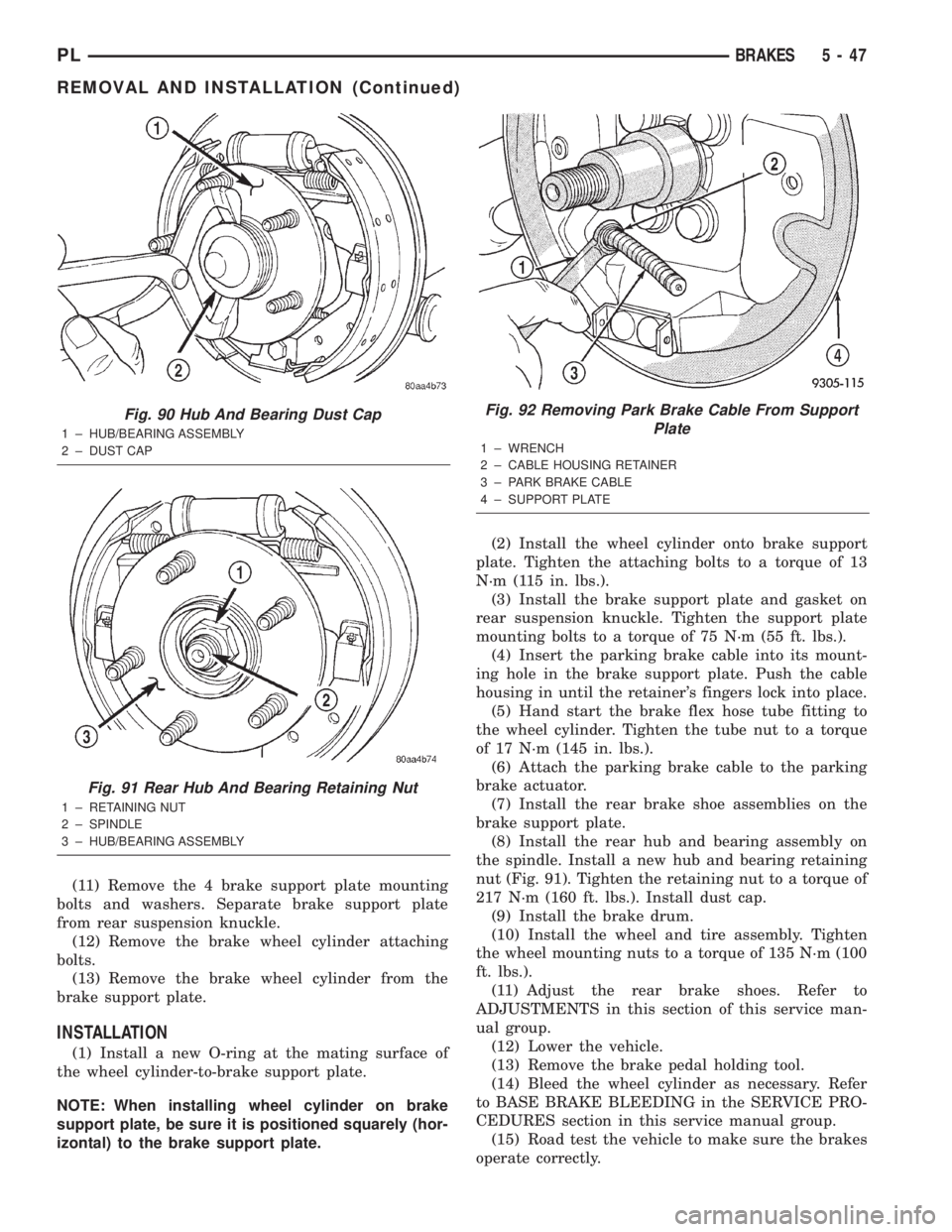
(6) Remove the dust cap (Fig. 90) from the rear
hub and bearing.
(7) Remove the nut (Fig. 91) holding the rear hub
and bearing to the spindle. Remove the hub and
bearing from the spindle.
(8) Remove the rear brake shoes from the brake
support plate. Refer to DRUM BRAKE SHOES in
this REMOVAL AND INSTALLATION section.(9) Remove the parking brake actuator lever from
the parking brake cable.
(10) Position a 1/2 inch wrench over the retainer
fingers on the end of the parking brake cable (Fig.
92). Compress the cable housing retaining fingers
with the wrench, then pull the cable housing out of
the support plate. Remove the wrench as the parking
brake cable retainer is freed from the mounting hole
in the brake support plate.
Fig. 88 Brake Pedal Holding Tool
1 ± CLUTCH PEDAL (IF EQUIPPED WITH MANUAL TRANSAXLE)
2 ± THROTTLE PEDAL
3 ± BRAKE PEDAL HOLDING TOOL
4 ± STEERING WHEEL
5 ± DRIVER'S SEAT
6 ± BRAKE PEDAL
Fig. 89 Brake Flex Hose At Wheel Cylinder
1 ± BRAKE SUPPORT PLATE
2 ± WHEEL CYLINDER ATTACHING BOLTS
3 ± REAR BRAKE FLEX HOSE TUBE
4 ± WHEEL CYLINDER ASSEMBLY
5 - 46 BRAKESPL
REMOVAL AND INSTALLATION (Continued)
Page 126 of 1285
(11) Remove the 4 brake support plate mounting
bolts and washers. Separate brake support plate
from rear suspension knuckle.
(12) Remove the brake wheel cylinder attaching
bolts.
(13) Remove the brake wheel cylinder from the
brake support plate.
INSTALLATION
(1) Install a new O-ring at the mating surface of
the wheel cylinder-to-brake support plate.
NOTE: When installing wheel cylinder on brake
support plate, be sure it is positioned squarely (hor-
izontal) to the brake support plate.(2) Install the wheel cylinder onto brake support
plate. Tighten the attaching bolts to a torque of 13
N´m (115 in. lbs.).
(3) Install the brake support plate and gasket on
rear suspension knuckle. Tighten the support plate
mounting bolts to a torque of 75 N´m (55 ft. lbs.).
(4) Insert the parking brake cable into its mount-
ing hole in the brake support plate. Push the cable
housing in until the retainer's fingers lock into place.
(5) Hand start the brake flex hose tube fitting to
the wheel cylinder. Tighten the tube nut to a torque
of 17 N´m (145 in. lbs.).
(6) Attach the parking brake cable to the parking
brake actuator.
(7) Install the rear brake shoe assemblies on the
brake support plate.
(8) Install the rear hub and bearing assembly on
the spindle. Install a new hub and bearing retaining
nut (Fig. 91). Tighten the retaining nut to a torque of
217 N´m (160 ft. lbs.). Install dust cap.
(9) Install the brake drum.
(10) Install the wheel and tire assembly. Tighten
the wheel mounting nuts to a torque of 135 N´m (100
ft. lbs.).
(11) Adjust the rear brake shoes. Refer to
ADJUSTMENTS in this section of this service man-
ual group.
(12) Lower the vehicle.
(13) Remove the brake pedal holding tool.
(14) Bleed the wheel cylinder as necessary. Refer
to BASE BRAKE BLEEDING in the SERVICE PRO-
CEDURES section in this service manual group.
(15) Road test the vehicle to make sure the brakes
operate correctly.
Fig. 90 Hub And Bearing Dust Cap
1 ± HUB/BEARING ASSEMBLY
2 ± DUST CAP
Fig. 91 Rear Hub And Bearing Retaining Nut
1 ± RETAINING NUT
2 ± SPINDLE
3 ± HUB/BEARING ASSEMBLY
Fig. 92 Removing Park Brake Cable From Support
Plate
1 ± WRENCH
2 ± CABLE HOUSING RETAINER
3 ± PARK BRAKE CABLE
4 ± SUPPORT PLATE
PLBRAKES 5 - 47
REMOVAL AND INSTALLATION (Continued)
Page 127 of 1285
PARKING BRAKE LEVER
WARNING: THE AUTOMATIC ADJUSTING FEATURE
OF THIS PARKING BRAKE LEVER CONTAINS A
CLOCK SPRING LOADED TO APPROXIMATELY 25
POUNDS. DO NOT RELEASE THE AUTOMATIC
ADJUSTER LOCKOUT DEVICE UNLESS THE REAR
PARKING BRAKE CABLES AND EQUALIZER ARE
CONNECTED TO THE LEVER OUTPUT CABLE.
KEEP HANDS OUT OF AUTOMATIC ADJUSTER
SECTOR AND PAWL AREA. FAILURE TO OBSERVE
CAUTION IN HANDLING THIS MECHANISM COULD
LEAD TO SERIOUS INJURY.
WARNING: WHEN REPAIRS TO THE PARKING
BRAKE LEVER OR CABLES ARE REQUIRED, THE
AUTOMATIC ADJUSTER MUST BE LOADED AND
LOCKED OUT TO AVOID POSSIBLE INJURY. THE
LEVER ADJUSTMENT MECHANISM CAN BE
LOADED AND LOCKED OUT AS OUTLINED IN THIS
PROCEDURE.
REMOVAL
(1) Block the tire and wheels so the vehicle does
not move once the vehicle parking brake lever is
released.
(2) Fully apply the parking brake lever, then shift
the transmission into neutral.
(3) Remove the screws attaching the center con-
sole, then remove the center console.
(4) Lower the parking brake lever handle to the
released position.
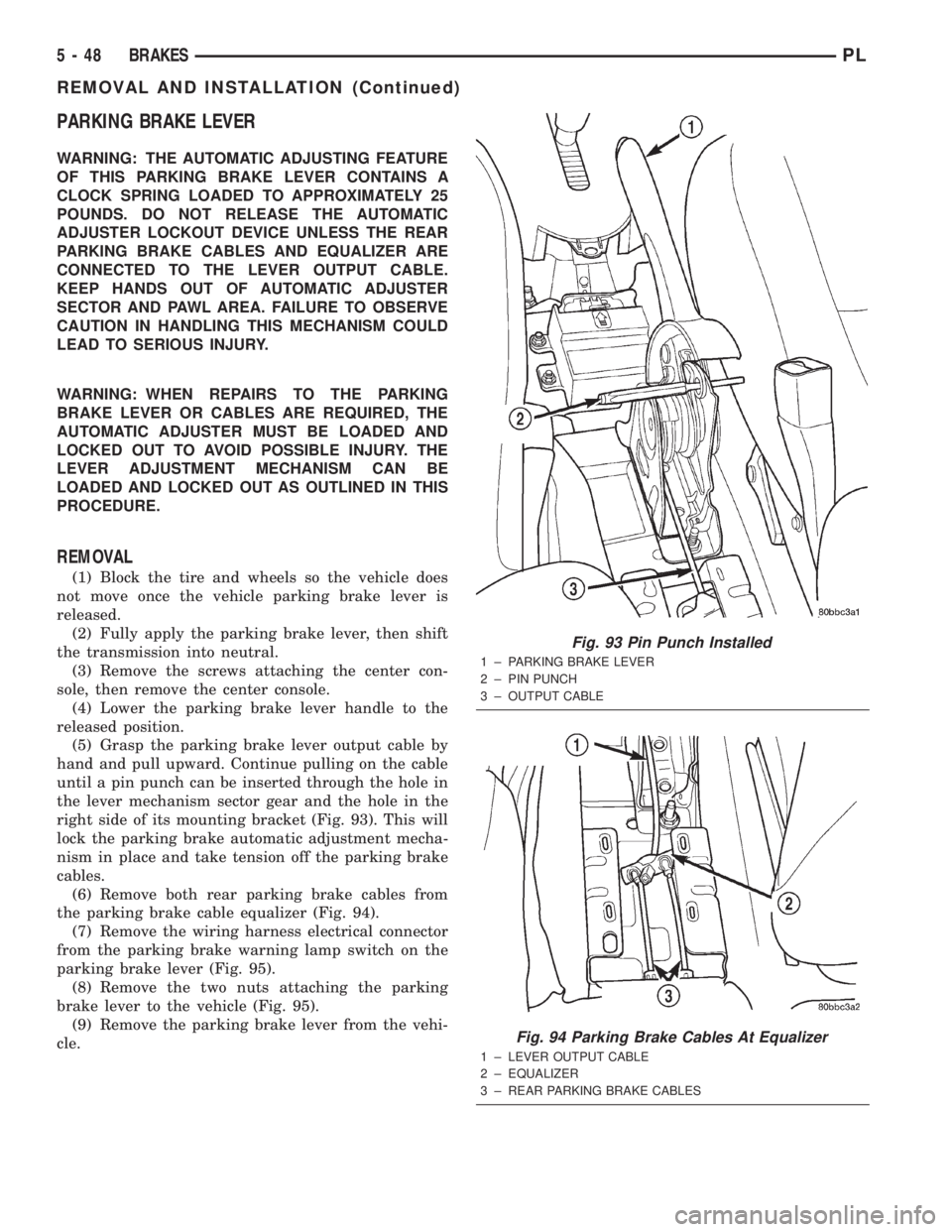
(5) Grasp the parking brake lever output cable by
hand and pull upward. Continue pulling on the cable
until a pin punch can be inserted through the hole in
the lever mechanism sector gear and the hole in the
right side of its mounting bracket (Fig. 93). This will
lock the parking brake automatic adjustment mecha-
nism in place and take tension off the parking brake
cables.
(6) Remove both rear parking brake cables from
the parking brake cable equalizer (Fig. 94).
(7) Remove the wiring harness electrical connector
from the parking brake warning lamp switch on the
parking brake lever (Fig. 95).
(8) Remove the two nuts attaching the parking
brake lever to the vehicle (Fig. 95).
(9) Remove the parking brake lever from the vehi-
cle.
Fig. 93 Pin Punch Installed
1 ± PARKING BRAKE LEVER
2 ± PIN PUNCH
3 ± OUTPUT CABLE
Fig. 94 Parking Brake Cables At Equalizer
1 ± LEVER OUTPUT CABLE
2 ± EQUALIZER
3 ± REAR PARKING BRAKE CABLES
5 - 48 BRAKESPL
REMOVAL AND INSTALLATION (Continued)
Page 128 of 1285
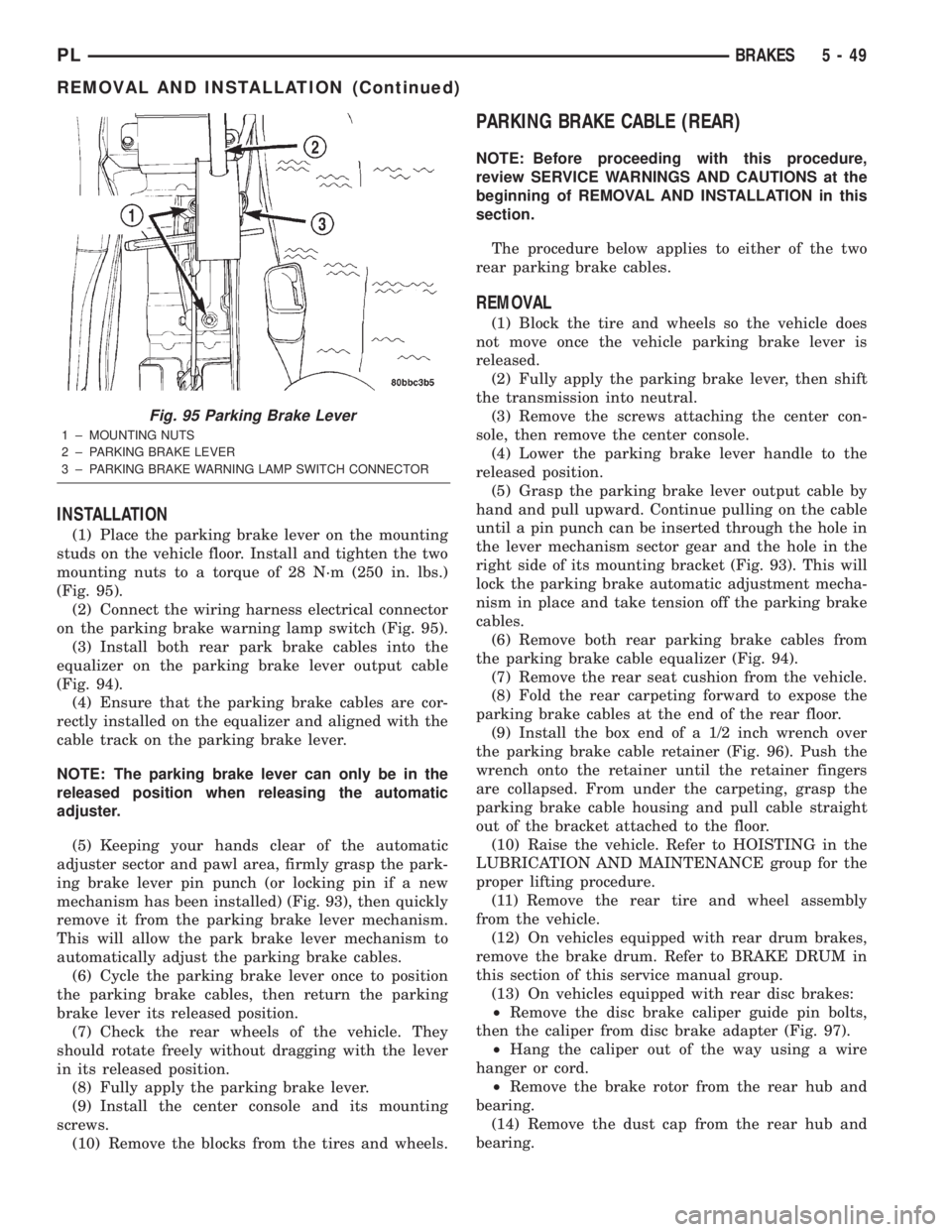
INSTALLATION
(1) Place the parking brake lever on the mounting
studs on the vehicle floor. Install and tighten the two
mounting nuts to a torque of 28 N´m (250 in. lbs.)
(Fig. 95).
(2) Connect the wiring harness electrical connector
on the parking brake warning lamp switch (Fig. 95).
(3) Install both rear park brake cables into the
equalizer on the parking brake lever output cable
(Fig. 94).
(4) Ensure that the parking brake cables are cor-
rectly installed on the equalizer and aligned with the
cable track on the parking brake lever.
NOTE: The parking brake lever can only be in the
released position when releasing the automatic
adjuster.
(5) Keeping your hands clear of the automatic
adjuster sector and pawl area, firmly grasp the park-
ing brake lever pin punch (or locking pin if a new
mechanism has been installed) (Fig. 93), then quickly
remove it from the parking brake lever mechanism.
This will allow the park brake lever mechanism to
automatically adjust the parking brake cables.
(6) Cycle the parking brake lever once to position
the parking brake cables, then return the parking
brake lever its released position.
(7) Check the rear wheels of the vehicle. They
should rotate freely without dragging with the lever
in its released position.
(8) Fully apply the parking brake lever.
(9) Install the center console and its mounting
screws.
(10) Remove the blocks from the tires and wheels.
PARKING BRAKE CABLE (REAR)
NOTE: Before proceeding with this procedure,
review SERVICE WARNINGS AND CAUTIONS at the
beginning of REMOVAL AND INSTALLATION in this
section.
The procedure below applies to either of the two
rear parking brake cables.
REMOVAL
(1) Block the tire and wheels so the vehicle does
not move once the vehicle parking brake lever is
released.
(2) Fully apply the parking brake lever, then shift
the transmission into neutral.
(3) Remove the screws attaching the center con-
sole, then remove the center console.
(4) Lower the parking brake lever handle to the
released position.
(5) Grasp the parking brake lever output cable by
hand and pull upward. Continue pulling on the cable
until a pin punch can be inserted through the hole in
the lever mechanism sector gear and the hole in the
right side of its mounting bracket (Fig. 93). This will
lock the parking brake automatic adjustment mecha-
nism in place and take tension off the parking brake
cables.
(6) Remove both rear parking brake cables from
the parking brake cable equalizer (Fig. 94).
(7) Remove the rear seat cushion from the vehicle.
(8) Fold the rear carpeting forward to expose the
parking brake cables at the end of the rear floor.
(9) Install the box end of a 1/2 inch wrench over
the parking brake cable retainer (Fig. 96). Push the
wrench onto the retainer until the retainer fingers
are collapsed. From under the carpeting, grasp the
parking brake cable housing and pull cable straight
out of the bracket attached to the floor.
(10) Raise the vehicle. Refer to HOISTING in the
LUBRICATION AND MAINTENANCE group for the
proper lifting procedure.
(11) Remove the rear tire and wheel assembly
from the vehicle.
(12) On vehicles equipped with rear drum brakes,
remove the brake drum. Refer to BRAKE DRUM in
this section of this service manual group.
(13) On vehicles equipped with rear disc brakes:
²Remove the disc brake caliper guide pin bolts,
then the caliper from disc brake adapter (Fig. 97).
²Hang the caliper out of the way using a wire
hanger or cord.
²Remove the brake rotor from the rear hub and
bearing.
(14) Remove the dust cap from the rear hub and
bearing.
Fig. 95 Parking Brake Lever
1 ± MOUNTING NUTS
2 ± PARKING BRAKE LEVER
3 ± PARKING BRAKE WARNING LAMP SWITCH CONNECTOR
PLBRAKES 5 - 49
REMOVAL AND INSTALLATION (Continued)
Page 131 of 1285
(3) Install the parking brake cable into the brake
support plate or the rear disc brake adapter. Be sure
the locking fingers on the cable retainer are
expanded once the cable is pushed all the way into
the support plate or brake adapter hole to ensure the
cable is securely held in place.
(4) On vehicles equipped with rear drum brakes:
²Install the parking brake cable on the parking
brake cable actuating lever (Fig. 99).
²Install the actuating spring to the brake shoe
and the brake adjustment lever (Fig. 100).
(5) On vehicles equipped with rear disc brakes:²Install the parking brake shoes actuator lever on
the parking brake cable (Fig. 102).
²Install the parking brake shoe assemblies on the
disc brake adapter (Fig. 98).
(6) Install the hub and bearing on the rear spin-
dle. Install a new hub and bearing retaining nut.
Tighten the retaining nut to a torque of 217 N´m
(160 ft. lbs.).
(7) Install the hub and bearing dust cap.
(8) On drum brake equipped vehicles, install the
rear brake drum.
(9) On vehicles equipped with rear disc brakes,
install the brake rotor, then the disc brake caliper
(Fig. 97). Install the two caliper guide pin bolts, then
tighten them to a torque of 22 N´m (192 in. lbs.).
(10) Install the rear tire and wheel assembly.
Tighten all wheel nuts to a torque of 135 N´m (100 ft.
lbs.).
(11) Lower the vehicle.
(12) Ensure that the seal grommet on the cable
that was installed from underneath is fully seated
into the floor pan.
(13) Route the parking brake cable under the car-
peting, up to parking brake cable retaining bracket
on floor pan. Install the parking brake cable through
the retaining bracket. Push the cable in until the
locking fingers on the cable retainer lock the cable
into place.
(14) Install the rear parking brake cables into the
equalizer on the parking brake lever output cable
(Fig. 94).
(15) Ensure that the parking brake cables are cor-
rectly installed on the equalizer and aligned with the
cable track on the parking brake lever.
NOTE: The parking brake lever can be in any posi-
tion when releasing the automatic adjuster.
(16) Keeping your hands clear of the automatic
adjuster sector and pawl area, firmly grasp the park-
ing brake lever pin punch (or locking pin if a new
mechanism has been installed) (Fig. 93), then quickly
remove it from the parking brake lever mechanism.
This will allow the park brake lever mechanism to
automatically adjust the parking brake cables.
(17) Cycle the parking brake lever once to position
the parking brake cables, then return the parking
brake lever its released position.
(18) Check the rear wheels of the vehicle. They
should rotate freely without dragging with the lever
in its released position.
(19) Reposition the rear carpeting into place.
(20) Install the rear seat cushion. Be sure the seat
cushion is fully installed in the retainers on the floor
pan of the vehicle.
(21) Fully apply the parking brake lever.
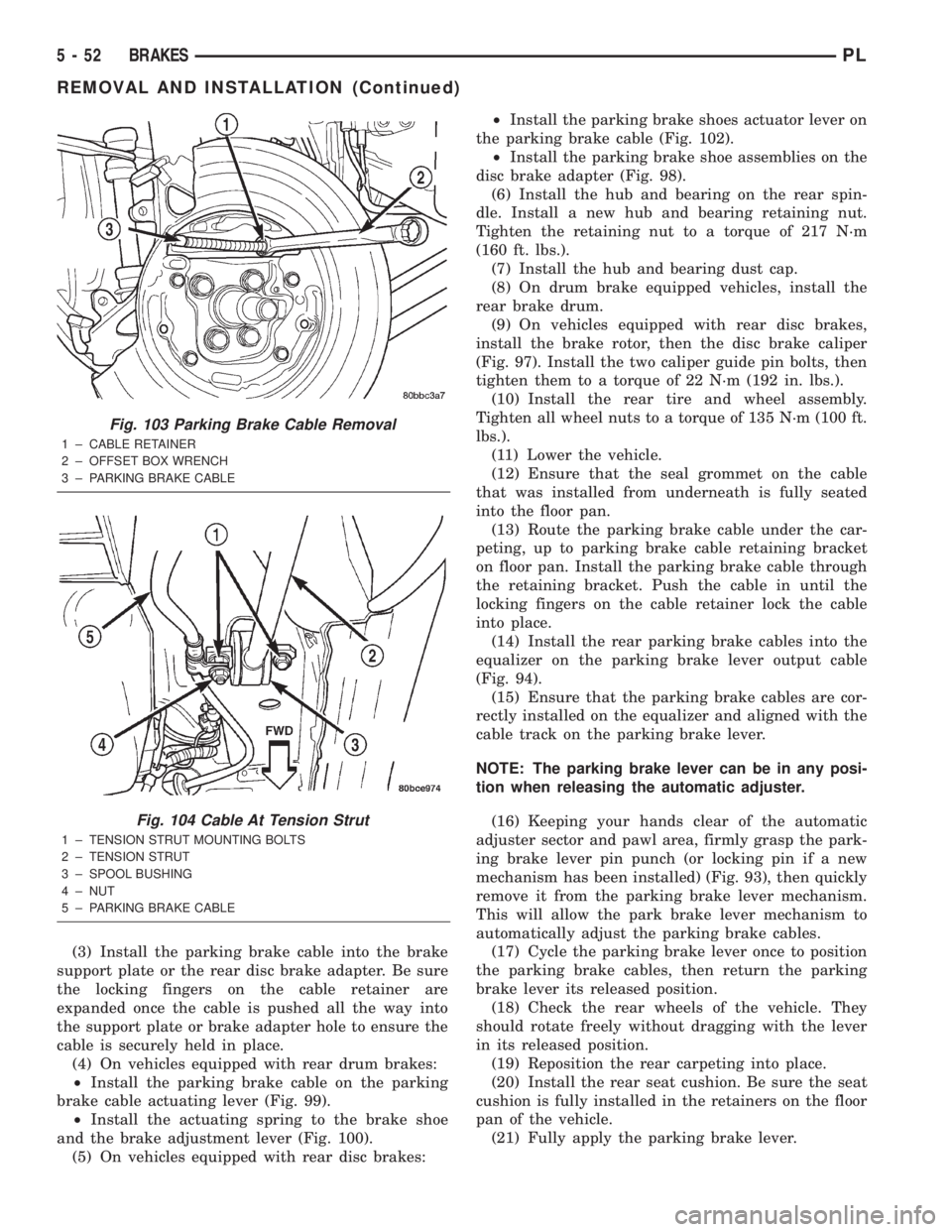
Fig. 103 Parking Brake Cable Removal
1 ± CABLE RETAINER
2 ± OFFSET BOX WRENCH
3 ± PARKING BRAKE CABLE
Fig. 104 Cable At Tension Strut
1 ± TENSION STRUT MOUNTING BOLTS
2 ± TENSION STRUT
3 ± SPOOL BUSHING
4 ± NUT
5 ± PARKING BRAKE CABLE
5 - 52 BRAKESPL
REMOVAL AND INSTALLATION (Continued)