light DODGE RAM 1999 Service Repair Manual
[x] Cancel search | Manufacturer: DODGE, Model Year: 1999, Model line: RAM, Model: DODGE RAM 1999Pages: 1691, PDF Size: 40.34 MB
Page 1461 of 1691
Two different module systems are used for powertrain control
of diesel engine. The Engine Control Module (ECM), located on left
side of engine, is used to control the fuel system. See Fig. 2. The
Fuel Pump Control Module (FPCM) located on pump, is a separate
component of ECM.
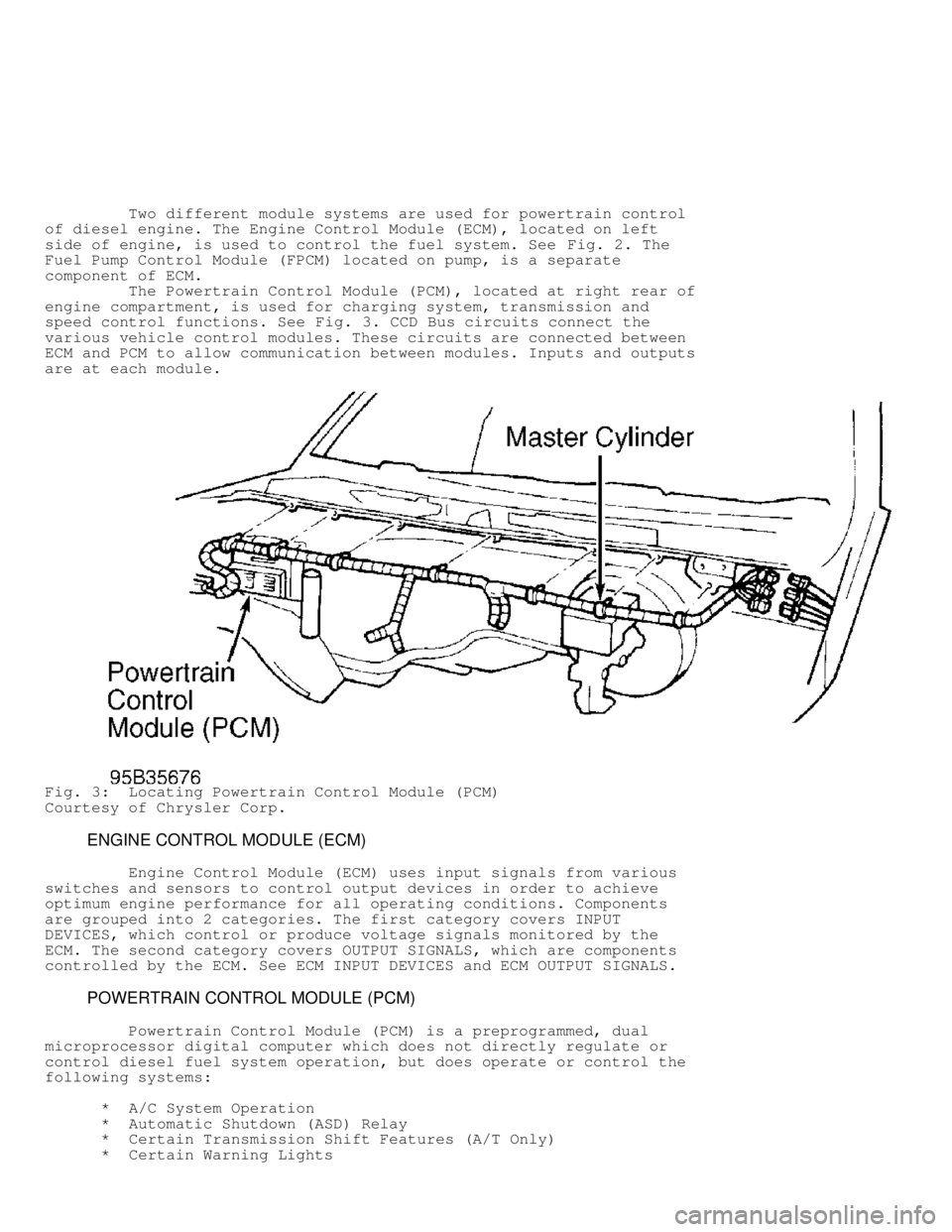
The Powertrain Control Module (PCM), located at right rear of\
engine compartment, is used for charging system, transmission and
speed control functions. See Fig. 3. CCD Bus circuits connect the
various vehicle control modules. These circuits are connected between
ECM and PCM to allow communication between modules. Inputs and outputs
are at each module.
Fig. 3: Locating Powertrain Control Module (PCM)
Courtesy of Chrysler Corp.
ENGINE CONTROL MODULE (ECM)
Engine Control Module (ECM) uses input signals from various
switches and sensors to control output devices in order to achieve
optimum engine performance for all operating conditions. Components
are grouped into 2 categories. The first category covers INPUT
DEVICES, which control or produce voltage signals monitored by the
ECM. The second category covers OUTPUT SIGNALS, which are components
controlled by the ECM. See ECM INPUT DEVICES and ECM OUTPUT SIGNALS.
POWERTRAIN CONTROL MODULE (PCM)
Powertrain Control Module (PCM) is a preprogrammed, dual
microprocessor digital computer which does not directly regulate or
control diesel fuel system operation, but does operate or control the
following systems:
* A/C System Operation
* Automatic Shutdown (ASD) Relay
* Certain Transmission Shift Features (A/T Only)
* Certain Warning Lights
Page 1464 of 1691

manifold, sends input signal to Engine Control Module (ECM). ECM uses
input signal for controlling fuel control, timing and engine
protection. ECM will lower engine power if boost is too high.
Oil Pressure Sensor
Oil pressure sensor signal is input to Engine Control Module
(ECM). ECM converts signal to pressure value. Value is sent on CCD Bus\
to instrument panel gauge/light. Oil pressure sensor is located on
side of engine block, below ECM. See Fig. 2.
Power Take Off (PTO)
This input is used on vehicles equipped with a Power Take Off
(PTO) unit. When PTO is engaged, Engine Control Module (ECM) will
disable some OBD-II functions.
Water-In-Fuel (WIF) Sensor
WIF sensor is located in bottom of fuel filter/water
separator. See Fig. 2. WIF sensor delivers input signal to Engine
Control Module (ECM) when water exists in the fuel filter/water
separator. As water level increases, resistance across WIF sensor
decreases. ECM compares decrease in resistance to a high water
standard value. When resistance is 30,000-40,000 ohms, ECM will turn
on WATER-IN-FUEL warning light. WATER-IN-FUEL warning light is located
on instrument panel, just below tachometer. ECM monitors input signal
when ignition switch is in the ON position and continues to monitor
input signal until intake manifold air heater post-heat cycle is
complete.
PCM INPUT SIGNALS
A/C Switch
When A/C switch is in ON position, an input signal is
delivered from A/C switch to Engine Control Module (ECM) to indicate
that A/C operation has been requested. Once A/C operation has been
requested, an A/C request signal is delivered to ECM from A/C high-
pressure switch and A/C low-pressure switch. The A/C request signal
indicates evaporator pressure is within proper range for A/C
operation. ECM uses A/C request signal to cycle A/C compressor clutch
by using an A/C clutch relay. A/C clutch relay may also be referred to
as A/C compressor clutch relay. If A/C high-pressure switch or A/C
low-pressure switch opens, A/C request signal will not be delivered to
the ECM. ECM will then open ground circuit for A/C clutch relay and
A/C compressor clutch will be disengaged.
The A/C clutch relay is located in power distribution center
at driver's side front corner of engine compartment, near the battery.
The A/C high-pressure switch is located on discharge line, near A/C
compressor. The A/C low-pressure switch is located on top of
accumulator.
Accelerator Pedal Position Sensor (APPS) Output From ECM
Accelerator Pedal Position Sensor (APPS) is mounted on top
left of engine. See Fig. 2. Sensor provides DC voltage input signal to
Engine Control Module (ECM) to indicate throttle position. On previous\
engines, there were linkages between accelerator pedal, throttle
position sensor and injection pump. On this engine, no linkage exists
between accelerator pedal and injection pump. APPS signal is sent on
CCD Bus circuit from ECM to PCM.
Automatic Shutdown (ASD) Relay
A 12-volt input signal is delivered from ASD relay to Engine
Control Module (ECM) when ASD relay is energized. If ECM does not
receive a 12-volt input signal when ASD relay is energized, a
Diagnostic Trouble Code (FTC) will be stored in ECM. ASD relay is
Page 1465 of 1691

located in power distribution center at driver's side front corner of
engine compartment, near the battery. Automatic Shutdown (ASD) relay
may also be referred to as Auto Shutdown (ASD) relay.
Battery Temperature Sensor
Battery temperature sensor delivers input signal to
Powertrain Control Module (PCM) to indicate the battery temperature.
PCM uses battery temperature input to modify rate of output from the
charging system. Battery temperature sensor is snapped into battery
tray below driver's side battery.
Battery Voltage
Battery voltage input signal provides operating voltage to
Powertrain Control Module (PCM). This input signal keeps PCM memory
alive and informs PCM what generator output voltage is when engine is
running. PCM memory is used to store Diagnostic Trouble Codes (DTCs),
store APPS sensor voltages from previous key cycles and provide a
speed control adaptive memory.
Brake Switch
Brake switch delivers input signal to Powertrain Control
Module (PCM) to indicate when brakes are applied. PCM uses input
signal for controlling cruise control system and transmission torque
converter clutch operation on A/T models. Brake switch is located near
top of brake pedal and may also be referred to as brakelight switch.
CKP Sensor
Crankshaft Position (CKP) sensor delivers input signal (35
tooth wheel with gap) to Engine Control Module (ECM) to indicate
engine speed and crankshaft position. ECM uses CKP signal along with
other input signals for controlling injector firing sequence and
timing. Sensor is located below fuel transfer pump, on side of engine
block. See Fig. 2.
Cruise Control System Switches
Cruise control system functions, controlled by momentary
contact switches, are monitored through multiplexed input signal to
Powertrain Control Module (PCM). Resistance monitored at this input
signal, in conjunction with the length of time the PCM measures the
resistance, determines which switch feature has been selected.
Data Link Connector (DLC)
Data Link Connector (DLC) provides an input signal to
Powertrain Control Module (PCM) when using scan tool to retrieve
Diagnostic Trouble Codes (DTCs) from PCM. Input signal may also be
used when performing various tests on the PCM and electronic control
system. DLC is a 16-pin connector located at lower edge of driver's
side of instrument panel, just above accelerator pedal.
Fuel Level Sensor
The Powertrain Control Module (PCM) sends a 5-volt signal to
the fuel level sensor. The fuel level sensor will return a signal to
PCM. This signal is used for fuel gauge operation and to prevent
setting a false misfire or fuel system trouble codes. If fuel level is
less than 15 percent, PCM will not set code.
Ignition Sense
Ignition switch position input to Powertrain Control Module
(PCM). PCM uses input to determine proper output functions, including
cruise control, generator output, sensor supply and transmission
functions.
Transmission Speed Sensor (A/T Models)
Page 1469 of 1691
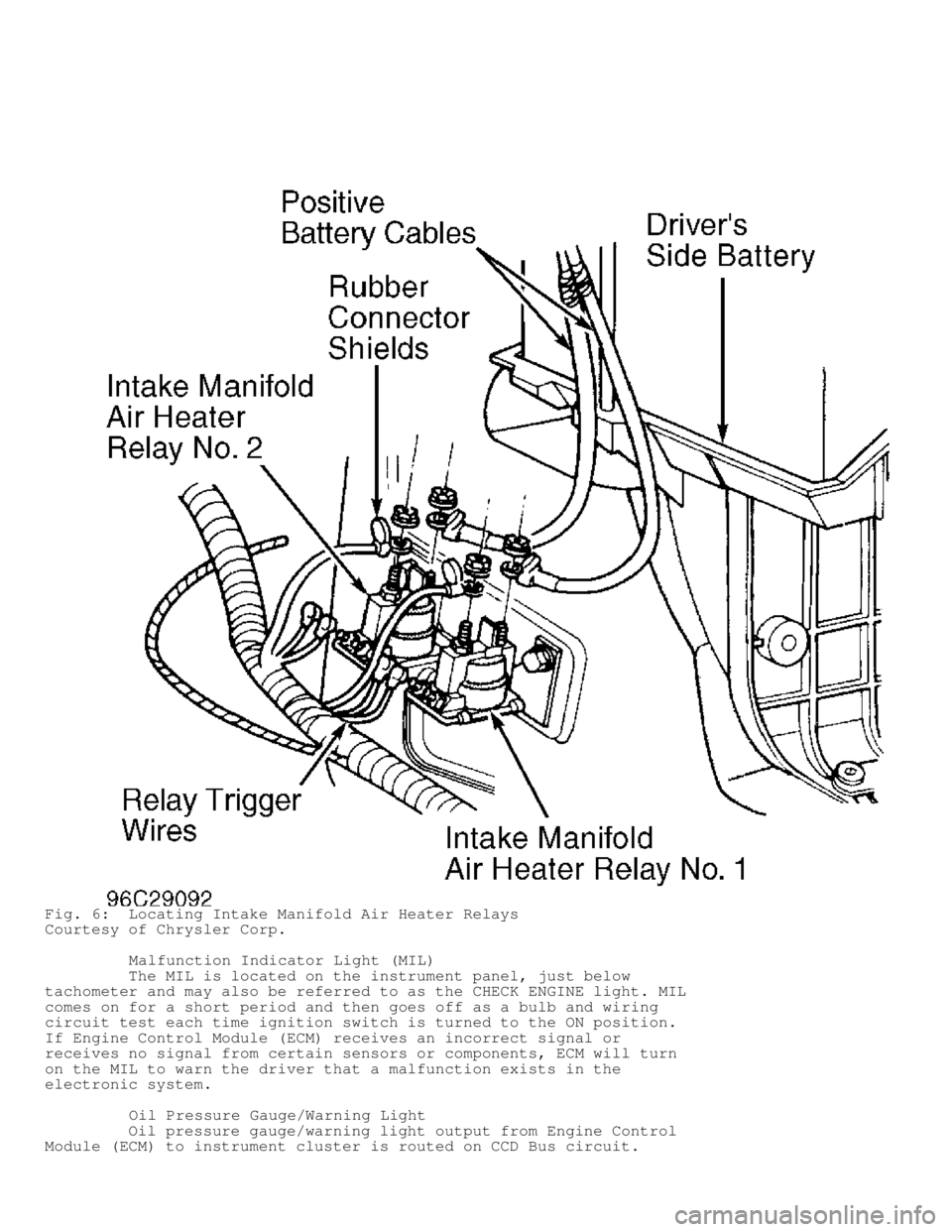
Fig. 6: Locating Intake Manifold Air Heater Relays
Courtesy of Chrysler Corp.
Malfunction Indicator Light (MIL)
The MIL is located on the instrument panel, just below
tachometer and may also be referred to as the CHECK ENGINE light. MIL
comes on for a short period and then goes off as a bulb and wiring
circuit test each time ignition switch is turned to the ON position.
If Engine Control Module (ECM) receives an incorrect signal or
receives no signal from certain sensors or components, ECM will turn
on the MIL to warn the driver that a malfunction exists in the
electronic system.
Oil Pressure Gauge/Warning Light
Oil pressure gauge/warning light output from Engine Control
Module (ECM) to instrument cluster is routed on CCD Bus circuit.
Page 1470 of 1691

WAIT-TO-START Warning Light
WAIT-TO-START warning light is located on instrument panel,
just below the speedometer. WAIT-TO-START warning light will come on
for a short period and then go off as a bulb and wiring circuit test
each time ignition switch is turned to the ON position. If Engine
Control Module (ECM) determines intake manifold air temperature is
less than 59
F (15C) by input signal received from intake manifold
air temperature sensor, ECM delivers output signal to operate WAIT-TO-
START warning light and intake manifold air heater for a preheat
cycle.
WAIT-TO-START warning light will remain on until intake
manifold air heater preheat cycle is complete. WAIT-TO-START warning
light will flash on and off if intake manifold air temperature sensor
signal to ECM is not within a specified value and Diagnostic Trouble
Code (FTC) will be stored in ECM memory.
WATER-IN-FUEL Warning Light
WATER-IN-FUEL warning light is located on instrument panel,
just below tachometer. WATER-IN-FUEL warning light will come on for a
short period and then go off as a bulb and wiring circuit test each
time ignition switch is turned to the ON position. If Engine Control
Module (ECM) determines water exists in fuel/water separator by input
signal from Water-In-Fuel (WIF) sensor, ECM will deliver output signal\
to turn on the WATER-IN-FUEL warning light.
ECM/PCM OUTPUT SIGNALS
A/C Clutch Relay
The Engine Control Module (ECM) controls A/C compressor
operation by controlling ground circuit for A/C clutch relay. ECM de-
energizes A/C clutch relay if engine coolant temperature is more than
257
F (125C). The A/C clutch relay is located in power distribution
center at driver's side front corner of engine compartment, near the
battery.
Automatic Shutdown (ASD) Relay
The Engine Control Module (ECM) controls ASD operation by
controlling ground circuit for ASD relay. ASD provides voltage to
operate generator field control for charging system. ASD relay is
located in power distribution center at driver's side front corner of
engine compartment, near the battery. Automatic Shutdown (ASD) relay
may also be referred to as Auto Shutdown (ASD) relay.
CCD Bus
These circuits are connected between Engine Control Module
(ECM) and Powertrain Control Module (PCM) to allow communication
between modules.
Cruise Control System
Engine Control Module (ECM) regulates cruise control system
operation by controlling vacuum at cruise control servo. Vacuum is
controlled by use of vacuum and vent solenoids in cruise control
servo.
Data Link Connector
Engine Control Module (ECM) provides output information at
Data Link Connector (DLC) when using scan tool to perform various
tests on the ECM and electronic control system. Data link connector is
a 16-pin connector located at lower edge of driver's side of
instrument panel, just above the accelerator pedal.
5-Volt Sensor Supply Output
Powertrain Control Module (PCM) supplies a 5-volt reference
Page 1471 of 1691

signal to the transmission solenoid assembly for transmission
temperature sensor.
Generator Field
Engine Control Module (ECM) provides output signals to
generator field for regulating charging system voltage at 12.9-15.0
volts. ECM contains an internal electronic voltage regulator for
controlling the charging system voltage.
Generator Light
If Engine Control Module (ECM) senses a low charging system
condition, generator light on instrument panel (if equipped) will be
turned on. Generator light may also come on momentarily at low idle
speed when all accessories are on.
Malfunction Indicator Light (MIL)
The MIL is located on the instrument panel, just below
tachometer and may also be referred to as the CHECK ENGINE light. MIL
comes on for a short period and then goes off as a bulb and wiring
circuit test each time ignition switch is turned to the ON position.
If Engine Control Module (ECM) receives an incorrect signal or
receives no signal from certain sensors or components, ECM will turn
on the MIL to warn the driver that a malfunction exists in the
electronic system.
Overdrive Indicator Light (A/T Models)
Engine Control Module (ECM) delivers output signal to operate\
transmission overdrive indicator (O/D OFF) light in accordance with
position of the transmission overdrive switch. If overdrive is turned
off with transmission overdrive switch, transmission overdrive
indicator light will be turned on. Transmission overdrive indicator
light is located on instrument panel, just below the speedometer.
Tachometer
Engine Control Module (ECM) delivers output signal to operate\
tachometer on instrument panel to indicate engine RPM.
Transmission Overdrive Solenoid (A/T Models)
Engine Control Module (ECM) delivers output signal to
transmission overdrive solenoid for controlling transmission overdrive
shifts. Transmission overdrive solenoid is located on transmission
valve body.
Transmission Relay (A/T Models)
Transmission relay may be referred to as transmission control
relay or transmission 12-volt supply relay. Transmission relay ground
circuit is controlled by the Engine Control Module (ECM). When ground
circuit is completed, transmission relay supplies voltage to solenoid
assembly on the transmission. Transmission relay is located in power
distribution center at driver's side front corner of engine
compartment, near the battery.
Transmission Temperature Warning Light (A/T Models With
Heavy-Duty Transmission)
Engine Control Module (ECM) delivers output signal to turn on\
transmission temperature warning light if transmission fluid
temperature is determined to be greater than 280
F (138C) by the
transmission temperature sensor. Transmission temperature warning
light is located on instrument panel, just below the tachometer.
Transmission Torque Converter Clutch Solenoid (A/T Models)
Engine Control Module (ECM) delivers an output signal to
operate transmission torque converter clutch solenoid for torque
Page 1473 of 1691

Module (FPCM). Because of electronic control, pump timing is not
adjustable. See ON-VEHICLE ADJUSTMENTS - TRUCKS - DIESEL article.
FUEL FILTER/WATER SEPARATOR
Fuel filter/water separator is located on left side of engine
and contains fuel heater, Water-In-Fuel (WIF) sensor and drain valve.
See Fig. 2 . The WIF sensor delivers an input signal to Engine Control
Module (ECM) when water exists in fuel filter/water separator. ECM
will then turn on WATER-IN-FUEL warning light. WATER-IN-FUEL warning
light is located on instrument panel, just below tachometer. The
WATER-IN-FUEL warning light informs the operator to drain water from
fuel filter/water separator to prevent damage to fuel system
components. Water may be drained from fuel filter/water separator by
using drain valve on fuel filter/water separator.
FUEL HEATER
Fuel heater is used to prevent diesel fuel from waxing during
cold temperatures. Fuel heater is located in fuel filter/water
separator. See Fig. 2. Fuel flows from fuel tank to fuel transfer pump
and then to fuel filter/water separator. Fuel heater contains a fuel
heater temperature sensor that senses the fuel temperature. When
temperature is less than 37-53
F (3-12C), fuel heater temperature
sensor allows current to flow to the fuel heater to warm the fuel.
When temperature is more than 67-83
F (19-28C), fuel heater
temperature sensor turns off the current flow to the fuel heater.
Voltage to operate fuel heater is provided from ignition switch,
through fuel heater relay and to fuel heater. Fuel heater and fuel
heater relay are not controlled by Engine Control Module (ECM).
EMISSION SYSTEMS
INTAKE MANIFOLD AIR HEATER SYSTEM
Intake manifold air heater is used to warm intake air during
cold starting conditions. Heater system consists of 2 relays and 2
grid heaters installed on top of intake manifold. See Fig. 5.
Engine Control Module (ECM) energizes intake manifold air
heater relays to provide voltage to intake manifold air heater before
and after starting depending on input signals from intake manifold air
temperature sensor, engine speed sensor and vehicle speed. Intake
manifold air heater relays are not energized when intake manifold air
temperature is greater than 59
F (15C) or during engine cranking.
Intake manifold air heater relays are mounted on left inner wheelwell,
below left side battery. See Fig. 6.
Intake manifold air temperature sensor monitors intake
manifold air temperature and delivers an input signal to ECM for
controlling intake manifold air heater. Intake manifold air
temperature sensor is located in intake manifold. See Figs. 2 and 4.
SELF-DIAGNOSTIC SYSTEM
DATA LINK CONNECTOR
The Data Link Connector (DLC) is a 16-pin connector located
at lower edge of driver's side of instrument panel, just above the
accelerator pedal. The Engine Control Module (ECM) contains a self-
diagnostic system which stores a Diagnostic Trouble Code (FTC) if an
incorrect signal or no signal is received from certain sensors or
components. FTC may be retrieved from ECM for system diagnosis by
Page 1474 of 1691

using DLC and a scan tool. The DLC also provides a means to
communicate with various vehicle control modules, check system
operating conditions and to operate various system components.
MALFUNCTION INDICATOR LIGHT (MIL)
The MIL is located on the instrument panel, just below
tachometer and may also be referred to as the CHECK ENGINE light. MIL
comes on for a short period and then goes off as a bulb and wiring
circuit test each time ignition switch is turned to the ON position.
If Engine Control Module (ECM) receives an incorrect signal or
receives no signal from certain sensors or components, ECM will turn
on the MIL to warn the driver that a malfunction exists in the
electronic system.
MISCELLANEOUS CONTROLS
TRANSMISSION
Transmission Overdrive Solenoid (A/T Models)
Engine Control Module (ECM) operates transmission overdrive
solenoid for controlling transmission overdrive shifts. Transmission
overdrive solenoid is located on transmission valve body.
Transmission Torque Converter Clutch Solenoid (A/T Models)
Engine Control Module (ECM) operates transmission torque
converter clutch solenoid for torque converter lock-up. ECM uses
various input signals such as transmission temperature, output shaft
speed, central module timer, engine speed, APPS and brake switch
position to determine operation of transmission torque converter
clutch solenoid. Torque converter clutch solenoid is located on
transmission valve body.
Page 1476 of 1691
(IAC) motor.
Battery Temperature Sensor
PCM uses sensor to determine battery temperature and to
control battery charging rate. Temperature data along with battery
voltage data, is used by PCM to vary charging rate. System voltage is
higher at colder temperatures and is gradually reduced at warmer
temperatures.
Battery Voltage
PCM monitors battery voltage to determine fuel injector pulse
width and generator field control. This is done to compensate for
reduced current flow through injector caused by lowered voltage.
Brake Switch
This switch may also be referred to as a brakelight switch.
PCM uses this switch input to maintain idle speed at a preprogrammed
RPM when brakes are applied. If PCM receives an input signal from
brake switch when speed control system is on, PCM will turn speed
control system off.
Camshaft Position (CMP) Sensor
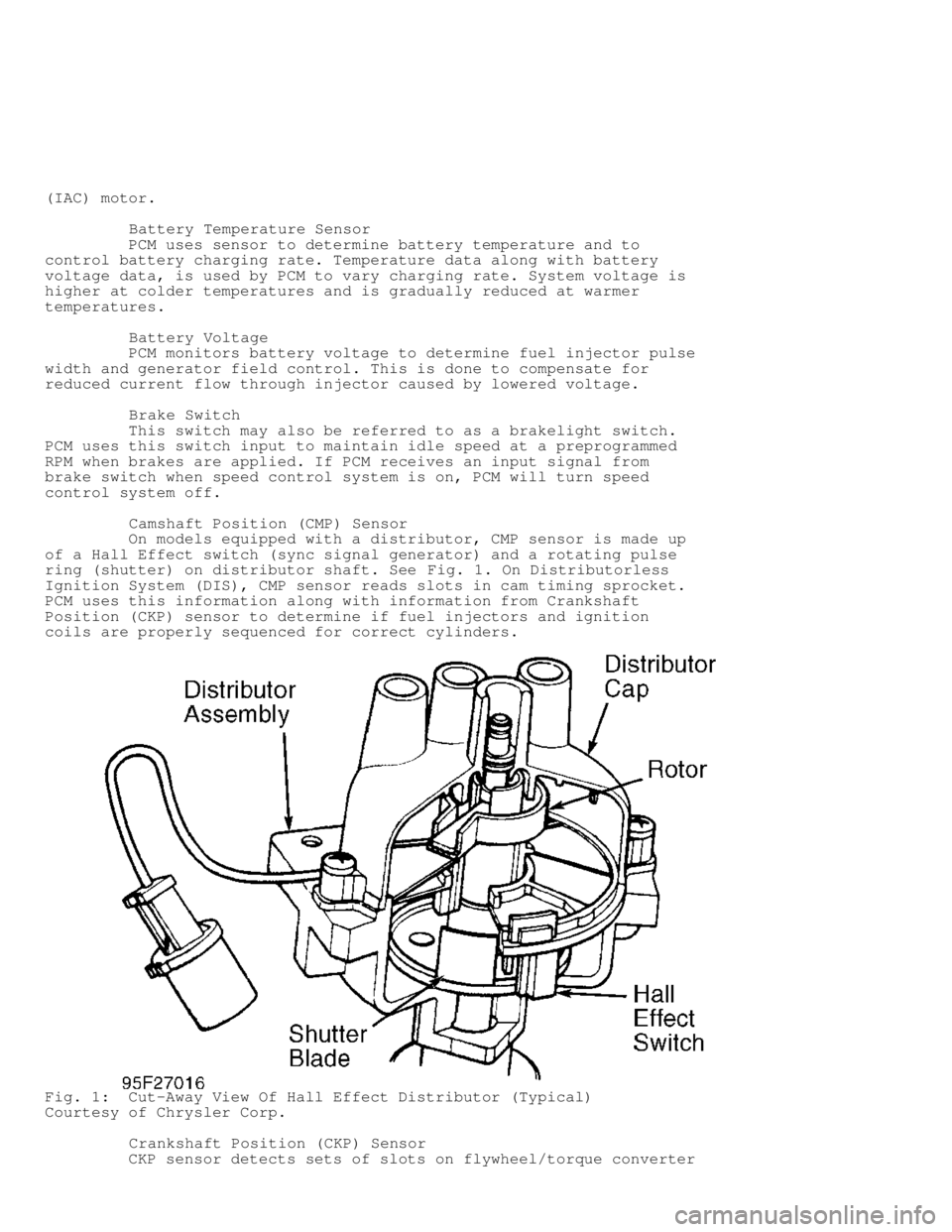
On models equipped with a distributor, CMP sensor is made up
of a Hall Effect switch (sync signal generator) and a rotating pulse
ring (shutter) on distributor shaft. See Fig. 1. On Distributorless
Ignition System (DIS), CMP sensor reads slots in cam timing sprocket.
PCM uses this information along with information from Crankshaft
Position (CKP) sensor to determine if fuel injectors and ignition
coils are properly sequenced for correct cylinders.
Fig. 1: Cut-Away View Of Hall Effect Distributor (Typical)
Courtesy of Chrysler Corp.
Crankshaft Position (CKP) Sensor
CKP sensor detects sets of slots on flywheel/torque converter
Page 1479 of 1691

diagram in appropriate WIRING DIAGRAMS article. For theory
and operation on each output component, refer to indicated
system.
A/C Clutch Relay
See A/C CLUTCH RELAY under MISCELLANEOUS CONTROLS.
Auto Shutdown (ASD) Relay
See AUTO SHUTDOWN (ASD) RELAY & FUEL PUMP RELAY under
MISCELLANEOUS CONTROLS.
Distributorless Ignition System (DIS)
See DISTRIBUTORLESS IGNITION SYSTEM (DIS) under IGNITION
SYSTEM.
Evaporative Canister Purge Control Solenoid (EVAP-CPCS)
See EVAPORATIVE (EVAP) EMISSIONS SYSTEM under EMISSION
SYSTEMS.
Fuel Injectors
See FUEL CONTROL under FUEL SYSTEM.
Fuel Pump Relay
See AUTO SHUTDOWN (ASD) RELAY & FUEL PUMP RELAY under
MISCELLANEOUS CONTROLS.
Generator
See GENERATOR under MISCELLANEOUS CONTROLS.
Idle Air Control (IAC) Motor
See IDLE SPEED under FUEL SYSTEM.
Ignition Coil
See IGNITION SYSTEM.
In-Tank Fuel Pump
See FUEL DELIVERY under FUEL SYSTEM.
Limp-In Mode
See LIMP-IN MODE under MISCELLANEOUS CONTROLS.
Malfunction Indicator Light (MIL)
See MALFUNCTION INDICATOR LIGHT under SELF-DIAGNOSTIC SYSTEM.
Radiator Fan Relay
See RADIATOR FAN RELAY under MISCELLANEOUS CONTROLS.
Serial Communications Interface (SCI) Transmit
See SERIAL COMMUNICATIONS INTERFACE (SCI) under SELF-
DIAGNOSTIC SYSTEM.
Shift Indicator Light
See SHIFT INDICATOR LIGHT under MISCELLANEOUS CONTROLS.
Speed Control Servo
See SPEED CONTROL SERVO under MISCELLANEOUS CONTROLS.
Tachometer
See TACHOMETER under MISCELLANEOUS CONTROLS.
Torque Converter Clutch (TCC) Solenoid
See TORQUE CONVERTER CLUTCH (TCC) SOLENOID under
MISCELLANEOUS CONTROLS.