ad blue DODGE RAM 2001 Service User Guide
[x] Cancel search | Manufacturer: DODGE, Model Year: 2001, Model line: RAM, Model: DODGE RAM 2001Pages: 2889, PDF Size: 68.07 MB
Page 581 of 2889
bol icon for ªHigh Beamº in the opaque layer of the
instrument cluster overlay. The dark outer layer of
the overlay prevents the indicator from being clearly
visible when it is not illuminated. A blue lens behind
the cutout in the opaque layer of the overlay causes
the icon to appear in blue through the translucent
outer layer of the overlay when it is illuminated from
behind by a replaceable incandescent bulb and bulb
holder unit located on the instrument cluster elec-
tronic circuit board. The high beam indicator is ser-
viced as a unit with the instrument cluster.
OPERATION
The high beam indicator gives an indication to the
vehicle operator when the headlamp high beams are
illuminated. This indicator is hard wired on the
instrument cluster electronic circuit board, and is
controlled by a headlamp beam select switch input to
the cluster. The headlamp high beam indicator bulb
receives battery current on the instrument cluster
electronic circuit board through a fused B(+) circuit
at all times; therefore, the indicator remains opera-
tional regardless of the ignition switch position. The
headlamp beam select switch is integral to the multi-
function switch on the left side of the steering col-
umn, and is connected in series between ground and
the headlamp high beam indicator. The indicator
bulb only illuminates when it is provided with a path
to ground through the high beam indicator driver cir-
cuit by the headlamp beam select switch. (Refer to 8
- ELECTRICAL/LAMPS/LIGHTING - EXTERIOR/
MULTI-FUNCTION SWITCH - OPERATION). The
high beam indicator can be diagnosed using conven-
tional diagnostic tools and methods.
DIAGNOSIS AND TESTING - HIGH BEAM
INDICATOR
The diagnosis found here addresses an inoperative
headlamp high beam indicator condition. If the prob-
lem being diagnosed is related to inoperative head-
lamp high beams, be certain to repair the headlamp
system before attempting to diagnose or repair the
high beam indicator. If no headlamp system problems
are found, the following procedure will help locate a
short or open in the high beam indicator circuit.
Refer to the appropriate wiring information. The wir-
ing information includes wiring diagrams, proper
wire and connector repair procedures, details of wire
harness routing and retention, connector pin-out
information and location views for the various wire
harness connectors, splices and grounds.
WARNING: ON VEHICLES EQUIPPED WITH AIR-
BAGS, DISABLE THE AIRBAG SYSTEM BEFORE
ATTEMPTING ANY STEERING WHEEL, STEERING
COLUMN, OR INSTRUMENT PANEL COMPONENTDIAGNOSIS OR SERVICE. DISCONNECT AND ISO-
LATE THE BATTERY NEGATIVE (GROUND) CABLE,
THEN WAIT TWO MINUTES FOR THE AIRBAG SYS-
TEM CAPACITOR TO DISCHARGE BEFORE PER-
FORMING FURTHER DIAGNOSIS OR SERVICE. THIS
IS THE ONLY SURE WAY TO DISABLE THE AIRBAG
SYSTEM. FAILURE TO TAKE THE PROPER PRE-
CAUTIONS COULD RESULT IN ACCIDENTAL AIR-
BAG DEPLOYMENT AND POSSIBLE PERSONAL
INJURY.
INDICATOR DOES NOT ILLUMINATE WITH HIGH BEAMS
SELECTED
(1) Check the fused B(+) fuse (Fuse 14 - 10
ampere) in the Junction Block (JB). If OK, go to Step
2. If not OK, repair the shorted circuit or component
as required and replace the faulty fuse.
(2) Check for battery voltage at the fused B(+) fuse
(Fuse 14 - 10 ampere) in the JB. If OK, go to Step 3.
If not OK, repair the open fused B(+) circuit between
the JB and the Power Distribution Center (PDC) as
required.
(3) Be certain that the headlamp high beams are
selected with the headlamp beam select switch by
turning the headlamp switch to the On position, pull-
ing the multi-function switch stalk toward the steer-
ing wheel, then inspecting the headlamps at the
front of the vehicle. Once the headlamp high beams
are selected, turn the headlamp switch to the Off
position.
(4) Disconnect and isolate the battery negative
cable. Remove the instrument cluster from the
instrument panel. Reconnect the battery negative
cable. Check for battery voltage at the fused B(+) cir-
cuit cavity of the instrument panel wire harness con-
nector (Connector C1) for the instrument cluster. If
OK, go to . If not OK, repair the open fused B(+) cir-
cuit between the instrument cluster and the JB as
required.
(5) Disconnect and isolate the battery negative
cable. Check for continuity between the high beam
indicator driver circuit cavity of the instrument panel
wire harness connector (Connector C2) for the instru-
ment cluster and a good ground. There should be
continuity. If OK, replace the faulty headlamp high
beam indicator bulb and bulb holder unit. If not OK,
repair the open high beam indicator driver circuit
between the instrument cluster and the headlamp
beam select (multi-function) switch as required.
INDICATOR STAYS ILLUMINATED WITH HIGH BEAMS NOT
SELECTED
(1) Be certain that the headlamp low beams are
selected with the headlamp beam select switch by
turning the headlamp switch to the On position, pull-
ing the multi-function switch stalk toward the steer-
8J - 22 INSTRUMENT CLUSTERBR/BE
HIGH BEAM INDICATOR (Continued)
Page 584 of 2889
The odometer can display values up to 499,999
kilometers (499,999 miles). The odometer latches at
these values, and will not roll over to zero. The trip
odometer can display values up to 999.9 kilometers
(999.9 miles) before it rolls over to zero. The odome-
ter display does not have a decimal point and will
not show values less than a full unit (kilometer or
mile), the trip odometer display does have a decimal
point and will show tenths of a unit (kilometer or
mile). The unit of measure (kilometers or miles) for
the odometer and trip odometer display is not shown
in the VFD. The unit of measure for the instrument
cluster odometer/trip odometer is selected at the time
that it is manufactured, and cannot be changed. Dur-
ing daylight hours (exterior lamps Off) the VFD is
illuminated at full brightness for clear visibility. At
night (exterior lamps are On) the VFD lighting level
is adjusted with the other cluster illumination lamps
using the panel lamps dimmer thumbwheel on the
headlamp switch. However, a ªParadeº mode position
of the panel lamps dimmer thumbwheel allows the
VFD to be illuminated at full brightness while the
exterior lamps are turned On during daylight hours.
The VFD, the trip odometer switch, and the trip
odometer switch button are serviced as a unit with
the instrument cluster.
OPERATION
The odometer and trip odometer give an indication
to the vehicle operator of the distance the vehicle has
traveled. This gauge is controlled by the instrument
cluster circuit board based upon the cluster program-
ming and electronic messages received by the cluster
from the Powertrain Control Module (PCM) over the
Chrysler Collision Detection (CCD) data bus. The
odometer and trip odometer information is displayed
by the instrument cluster Vacuum Fluorescent Dis-
play (VFD), and the VFD will not display odometer
or trip odometer information after the ignition switch
is turned to the Off position. The instrument cluster
circuitry controls the VFD and provides the following
features:
²Odometer/Trip Odometer Display Toggling-
Actuating the trip odometer reset switch momen-
tarily with the ignition switch in the On position will
toggle the VFD between the odometer and trip odom-
eter display. Each time the ignition switch is turned
to the On position the VFD will automatically return
to the mode (odometer or trip odometer) last dis-
played when the ignition switch was turned to the
Off position.
²Trip Odometer Reset- When the trip odome-
ter reset switch is pressed and held for longer than
about two seconds, the trip odometer will be reset to
000.0 kilometers (miles). The VFD must be display-ing the trip odometer information in order for the
trip odometer information to be reset.
²Message Failure- If the cluster fails to receive
a distance message during normal operation, it will
flash the odometer/trip odometer distance informa-
tion on and off repeatedly until a distance message is
received, or until the ignition switch is turned to the
Off position, whichever occurs first. If the cluster
does not receive a distance message within one sec-
ond after the ignition switch is turned to the On posi-
tion, it will display the last distance message stored
in the cluster memory. If the cluster is unable to dis-
play distance information due to an error internal to
the cluster, the VFD display will be blank.
²Actuator Test- Each time the cluster is put
through the actuator test, the VFD will display all of
its characters at once, then step through each char-
acter segment individually during the VFD portion of
the test to confirm the functionality of the VFD and
the cluster control circuitry.
The PCM continually monitors the vehicle speed
sensor, then sends the proper distance messages to
the instrument cluster. For further diagnosis of the
odometer/trip odometer or the instrument cluster cir-
cuitry that controls these functions, (Refer to 8 -
ELECTRICAL/INSTRUMENT CLUSTER - DIAGNO-
SIS AND TESTING). For proper diagnosis of the
vehicle speed sensor, the PCM, the CCD data bus, or
the message inputs to the instrument cluster that
control the odometer/trip odometer, a DRBIIItscan
tool is required. Refer to the appropriate diagnostic
information.
OIL PRESSURE GAUGE
DESCRIPTION
An oil pressure gauge is standard equipment on all
instrument clusters. The oil pressure gauge is located
in the upper right quadrant of the instrument clus-
ter, above the fuel gauge. The oil pressure gauge con-
sists of a movable gauge needle or pointer controlled
by the instrument cluster circuitry and a fixed 90
degree scale on the cluster overlay that reads left-to-
right either from 0 kPa (0 psi) to 758 kPa (110 psi).
An International Control and Display Symbol icon for
ªEngine Oilº is located on the cluster overlay, directly
below the highest graduation of the gauge scale. The
oil pressure gauge graphics are white against a black
field except for a single red graduation at the low
end of the gauge scale, making them clearly visible
within the instrument cluster in daylight. When illu-
minated from behind by the panel lamps dimmer
controlled cluster illumination lighting with the exte-
rior lamps turned On, the white graphics appear
blue-green and the red graphics appear red. The
BR/BEINSTRUMENT CLUSTER 8J - 25
ODOMETER (Continued)
Page 589 of 2889
(3) Turn the ignition switch to the Off position.
Disconnect and isolate the battery negative cable.
Remove the instrument cluster from the instrument
panel. Check for continuity between the 4WD switch
sense circuit cavities of the instrument panel wire
harness connector (Connector C2) for the instrument
cluster and the engine wire harness connector for the
four-wheel drive switch. There should be continuity.
If OK, replace the faulty instrument cluster. If not
OK, repair the open 4WD switch sense circuit
between the instrument cluster and the four-wheel
drive switch as required.
INDICATOR STAYS ILLUMINATED WITH FOUR-WHEEL DRIVE
MODE NOT SELECTED
(1) Disconnect and isolate the battery negative
cable. Disconnect the engine wire harness connector
for the four-wheel drive switch from the switch con-
nector receptacle. Check for continuity between the
ground circuit terminal and the 4WD switch sense
circuit terminal in the four-wheel drive switch con-
nector receptacle. There should be no continuity. If
OK, repair the shorted 4WD switch sense circuit
between the four-wheel drive switch and the instru-
ment cluster as required. If not OK, replace the
faulty four-wheel drive switch.
SPEEDOMETER
DESCRIPTION
A speedometer is standard equipment on all instru-
ment clusters. The speedometer is located just to the
right of the tachometer near the center of the instru-
ment cluster. The speedometer consists of a movable
gauge needle or pointer controlled by the instrument
cluster circuitry and a fixed 210 degree primary scale
on the gauge dial face that reads left-to-right either
from 0 to 120 mph, or from 0 to 200 km/h, depending
upon the market for which the vehicle is manufac-
tured. Each version also has a secondary inner scale
on the gauge dial face that provides the equivalent
opposite units from the primary scale. Text appearing
on the cluster overlay just below the hub of the
speedometer needle abbreviates the unit of measure
for the primary scale in all upper case letters (i.e.:
MPH or KM/H), followed by the unit of measure for
the secondary scale in all lower case letters (i.e.: mph
or km/h). The speedometer graphics are white (pri-
mary scale) and red (secondary scale) against a black
field, making them clearly visible within the instru-
ment cluster in daylight. When illuminated from
behind by the panel lamps dimmer controlled cluster
illumination lighting with the exterior lamps turned
On, the white graphics appear blue-green, while the
red graphics still appear red. The orange gauge nee-
dle is internally illuminated. Gauge illumination isprovided by replaceable incandescent bulb and bulb
holder units located on the instrument cluster elec-
tronic circuit board. The speedometer is serviced as a
unit with the instrument cluster.
OPERATION
The speedometer gives an indication to the vehicle
operator of the vehicle road speed. This gauge is con-
trolled by the instrument cluster circuit board based
upon the cluster programming and electronic mes-
sages received by the cluster from the Powertrain
Control Module (PCM) over the Chrysler Collision
Detection (CCD) data bus. The speedometer is an air
core magnetic unit that receives battery current on
the instrument cluster electronic circuit board
through the fused ignition switch output (st-run) cir-
cuit whenever the ignition switch is in the On or
Start positions. The cluster is programmed to move
the gauge needle back to the low end of the scale
after the ignition switch is turned to the Off position.
The instrument cluster circuitry controls the gauge
needle position and provides the following features:
²Message Failure- If the cluster fails to receive
a speedometer message, it will hold the gauge needle
at the last indication for about four seconds, or until
the ignition switch is turned to the Off position,
whichever occurs first. If a new speedometer message
is not received after about four seconds, the gauge
needle will return to the far left (low) end of the
scale.
²Actuator Test- Each time the cluster is put
through the actuator test, the gauge needle will be
swept to several calibration points on the gauge scale
in a prescribed sequence in order to confirm the func-
tionality of the gauge and the cluster control cir-
cuitry.
The PCM continually monitors the vehicle speed
sensor to determine the vehicle road speed, then
sends the proper vehicle speed messages to the
instrument cluster. For further diagnosis of the
speedometer or the instrument cluster circuitry that
controls the gauge, (Refer to 8 - ELECTRICAL/IN-
STRUMENT CLUSTER - DIAGNOSIS AND TEST-
ING). For proper diagnosis of the vehicle speed
sensor, the PCM, the CCD data bus, or the message
inputs to the instrument cluster that control the
speedometer, a DRBIIItscan tool is required. Refer
to the appropriate diagnostic information.
TACHOMETER
DESCRIPTION
A tachometer is standard equipment on all instru-
ment clusters. The tachometer is located just to the
left of the speedometer near the center of the instru-
8J - 30 INSTRUMENT CLUSTERBR/BE
SHIFT INDICATOR (TRANSFER CASE) (Continued)
Page 590 of 2889
ment cluster. The tachometer consists of a movable
gauge needle or pointer controlled by the instrument
cluster circuitry and a fixed 210 degree scale on the
gauge dial face that reads left-to-right either from 0
to 6 for gasoline engines, or from 0 to 4 for diesel
engines. The text ªRPM X 1000º imprinted on the
cluster overlay directly below the hub of the tachom-
eter needle identifies that each number on the
tachometer scale is to be multiplied times 1000 rpm.
The gauge scale of the gasoline engine tachometer is
red lined at 5000 rpm, while the diesel engine
tachometer is red lined at 3375 rpm. The diesel
engine tachometer also includes text that specifies
ªDIESEL FUEL ONLYº located just above the hub of
the tachometer needle. The tachometer graphics are
white and red against a black field, making them
clearly visible within the instrument cluster in day-
light. When illuminated from behind by the panel
lamps dimmer controlled cluster illumination lighting
with the exterior lamps turned On, the white graph-
ics appear blue-green, while the red graphics still
appear red. The orange gauge needle is internally
illuminated. Gauge illumination is provided by
replaceable incandescent bulb and bulb holder units
located on the instrument cluster electronic circuit
board. The tachometer is serviced as a unit with the
instrument cluster.
OPERATION
The tachometer gives an indication to the vehicle
operator of the engine speed. This gauge is controlled
by the instrument cluster circuit board based upon
the cluster programming and electronic messages
received by the cluster from the Powertrain Control
Module (PCM) over the Chrysler Collision Detection
(CCD) data bus. The tachometer is an air core mag-
netic unit that receives battery current on the instru-
ment cluster electronic circuit board through the
fused ignition switch output (st-run) circuit whenever
the ignition switch is in the On or Start positions.
The cluster is programmed to move the gauge needle
back to the low end of the scale after the ignition
switch is turned to the Off position. The instrument
cluster circuitry controls the gauge needle position
and provides the following features:
²Message Failure- If the cluster fails to receive
an engine speed message, it will hold the gauge nee-
dle at the last indication for about four seconds, or
until the ignition switch is turned to the Off position,
whichever occurs first. If a new engine speed mes-
sage is not received after about four seconds, the
gauge needle will return to the far left (low) end of
the scale.
²Actuator Test- Each time the cluster is put
through the actuator test, the gauge needle will be
swept to several calibration points on the gauge scalein a prescribed sequence in order to confirm the func-
tionality of the gauge and the cluster control cir-
cuitry.
The PCM continually monitors the crankshaft posi-
tion sensor to determine the engine speed, then
sends the proper engine speed messages to the
instrument cluster. For further diagnosis of the
tachometer or the instrument cluster circuitry that
controls the gauge, (Refer to 8 - ELECTRICAL/IN-
STRUMENT CLUSTER - DIAGNOSIS AND TEST-
ING). For proper diagnosis of the crankshaft position
sensor, the PCM, the CCD data bus, or the message
inputs to the instrument cluster that control the
tachometer, a DRBIIItscan tool is required. Refer to
the appropriate diagnostic information.
TRANSMISSION OVERTEMP
INDICATOR
DESCRIPTION
A transmission over-temperature indicator lamp is
standard equipment on all instrument clusters. How-
ever, on vehicles not equipped with the optional auto-
matic transmission, this indicator is electronically
disabled. The transmission over-temperature indica-
tor is located near the lower edge of the instrument
cluster overlay, to the left of center. The transmission
over-temperature indicator consists of a stencilled
cutout of the words ªTRANS TEMPº in the opaque
layer of the instrument cluster overlay. The dark
outer layer of the overlay prevents the indicator from
being clearly visible when it is not illuminated. A red
lens behind the cutout in the opaque layer of the
overlay causes the ªTRANS TEMPº text to appear in
red through the translucent outer layer of the over-
lay when the indicator is illuminated from behind by
a Light Emitting Diode (LED) soldered onto the
instrument cluster electronic circuit board. The
transmission over-temperature indicator is serviced
as a unit with the instrument cluster.
OPERATION
The transmission over-temperature indicator gives
an indication to the vehicle operator when the trans-
mission fluid temperature is excessive, which may
lead to accelerated transmission component wear or
failure. This indicator is controlled by a transistor on
the instrument cluster circuit board based upon the
cluster programming and electronic messages
received by the cluster from the Powertrain Control
Module (PCM) over the Chrysler Collision Detection
(CCD) data bus. The transmission over-temperature
indicator Light Emitting Diode (LED) receives bat-
tery current on the instrument cluster electronic cir-
cuit board through the fused ignition switch output
BR/BEINSTRUMENT CLUSTER 8J - 31
TACHOMETER (Continued)
Page 593 of 2889
above the temperature gauge. The voltage gauge con-
sists of a movable gauge needle or pointer controlled
by the instrument cluster circuitry and a fixed 90
degree scale on the cluster overlay that reads left-to-
right from 8 volts to 18 volts. An International Con-
trol and Display Symbol icon for ªBattery Charging
Conditionº is located directly below the lowest grad-
uation of the gauge scale. The voltage gauge graphics
are white against a black field except for a single red
graduation at each end of the gauge scale, making
them clearly visible within the instrument cluster in
daylight. When illuminated from behind by the panel
lamps dimmer controlled cluster illumination lighting
with the exterior lamps turned On, the white graph-
ics appear blue-green and the red graphics appear
red. The orange gauge needle is internally illumi-
nated. Gauge illumination is provided by replaceable
incandescent bulb and bulb holder units located on
the instrument cluster electronic circuit board. The
voltage gauge is serviced as a unit with the instru-
ment cluster.
OPERATION
The voltage gauge gives an indication to the vehi-
cle operator of the electrical system voltage. This
gauge is controlled by the instrument cluster circuit
board based upon the cluster programming and elec-
tronic messages received by the cluster from the
Powertrain Control Module (PCM) over the Chrysler
Collision Detection (CCD) data bus. The voltage
gauge is an air core magnetic unit that receives bat-
tery current on the instrument cluster electronic cir-
cuit board through the fused ignition switch output
(st-run) circuit whenever the ignition switch is in the
On or Start positions. The cluster is programmed to
move the gauge needle back to the low end of the
scale after the ignition switch is turned to the Off
position. The instrument cluster circuitry controls
the gauge needle position and provides the following
features:
²Charge Fail Message- Each time the cluster
receives a message from the PCM indicating a charge
fail condition (system voltage is 10.8 volts or lower),
the gauge needle is moved to the 8 volt graduation
on the gauge scale and the check gauges indicator is
illuminated. The gauge needle remains on the 8 volt
graduation and the check gauges indicator remains
illuminated until the cluster receives a message from
the PCM indicating there is no charge fail condition
(system voltage is 10.9 volts or higher, but lower
than 16.7 volts), or until the ignition switch is turned
to the Off position, whichever occurs first. On models
equipped with the optional diesel engine, the instru-
ment cluster is programmed to support the voltmeter
gauge needle above the low end of normal graduation
and suppress the check gauges indicator operationuntil ten seconds after the engine intake manifold air
heater has completed its cycle.
²Voltage High Message- Each time the cluster
receives a message from the PCM indicating a volt-
age high condition (system voltage is 16.7 volts or
higher), the gauge needle is moved to the 18 volt
graduation on the gauge scale and the check gauges
indicator is illuminated. The gauge needle remains
on the 18 volt graduation and the check gauges indi-
cator remains illuminated until the cluster receives a
message from the PCM indicating there is no voltage
high condition (system voltage is 16.6 volts or lower,
but higher than 10.9 volts), or until the ignition
switch is turned to the Off position, whichever occurs
first.
²Message Failure- If the cluster fails to receive
a system voltage message, it will hold the gauge nee-
dle at the last indication until a new message is
received, or until the ignition switch is turned to the
Off position, whichever occurs first.
²Actuator Test- Each time the cluster is put
through the actuator test, the gauge needle will be
swept to several calibration points on the gauge scale
in a prescribed sequence in order to confirm the func-
tionality of the gauge and the cluster control cir-
cuitry.
The PCM continually monitors the system voltage
to control the generator output. The PCM then sends
the proper system voltage messages to the instru-
ment cluster. For further diagnosis of the voltage
gauge or the instrument cluster circuitry that con-
trols the gauge, (Refer to 8 - ELECTRICAL/INSTRU-
MENT CLUSTER - DIAGNOSIS AND TESTING). If
the instrument cluster turns on the check gauges
indicator due to a charge fail or voltage high condi-
tion, it may indicate that the charging system
requires service. For proper diagnosis of the charging
system, the CCD data bus, or the message inputs to
the instrument cluster that control the voltage
gauge, a DRBIIItscan tool is required. Refer to the
appropriate diagnostic information.
WAIT-TO-START INDICATOR
DESCRIPTION
A wait-to-start indicator is standard equipment on
all instrument clusters, but is only functional in vehi-
cles equipped with an optional diesel engine. The
wait-to-start indicator is located near the lower edge
of the instrument cluster overlay, to the right of cen-
ter. The wait-to-start indicator consists of a stenciled
cutout of the text ªWAIT TO STARTº in the opaque
layer of the cluster overlay. The dark outer layer of
the overlay prevents the indicator from being clearly
visible when it is not illuminated. A red lens located
8J - 34 INSTRUMENT CLUSTERBR/BE
VOLTAGE GAUGE (Continued)
Page 1049 of 2889
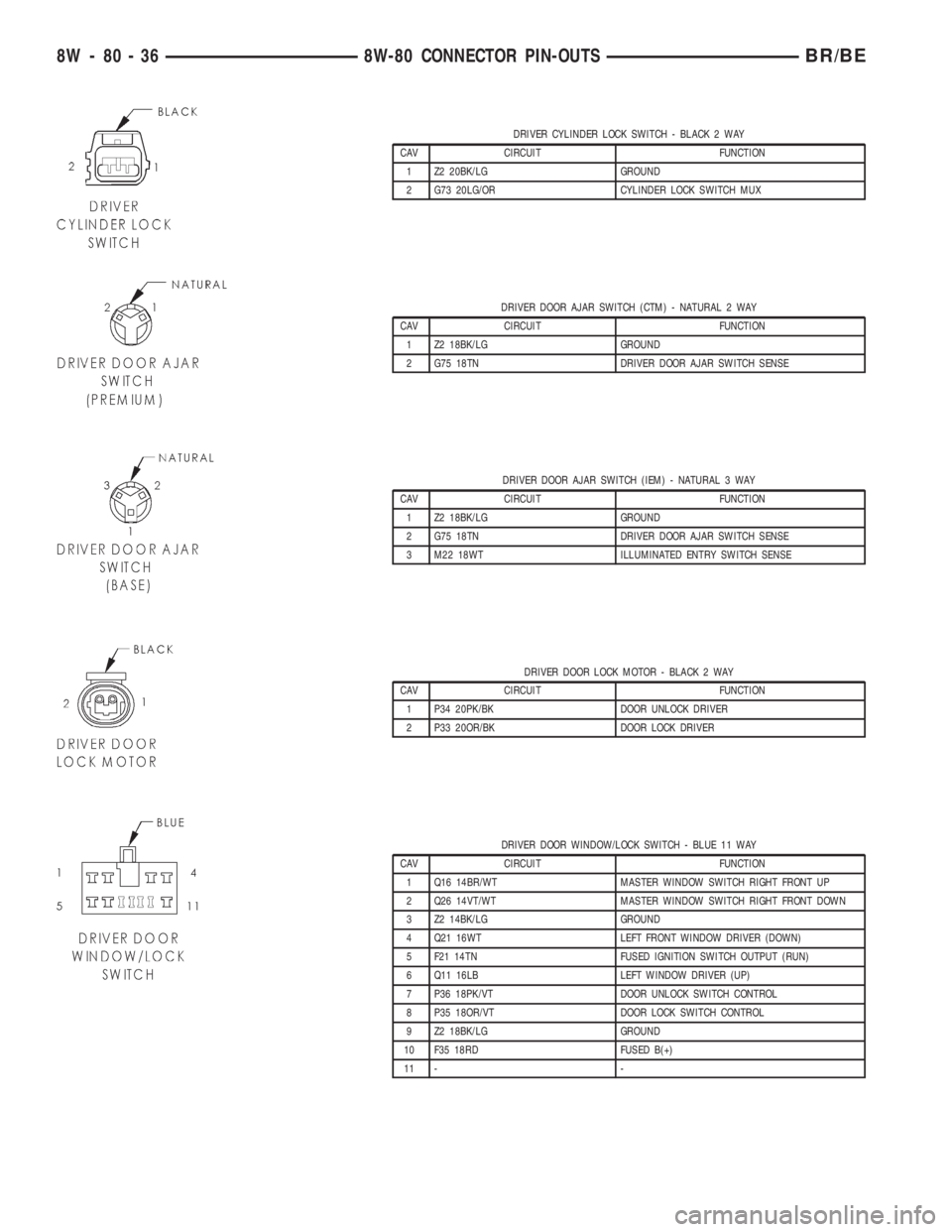
DRIVER CYLINDER LOCK SWITCH - BLACK 2 WAY
CAV CIRCUIT FUNCTION
1 Z2 20BK/LG GROUND
2 G73 20LG/OR CYLINDER LOCK SWITCH MUX
DRIVER DOOR AJAR SWITCH (CTM) - NATURAL 2 WAY
CAV CIRCUIT FUNCTION
1 Z2 18BK/LG GROUND
2 G75 18TN DRIVER DOOR AJAR SWITCH SENSE
DRIVER DOOR AJAR SWITCH (IEM) - NATURAL 3 WAY
CAV CIRCUIT FUNCTION
1 Z2 18BK/LG GROUND
2 G75 18TN DRIVER DOOR AJAR SWITCH SENSE
3 M22 18WT ILLUMINATED ENTRY SWITCH SENSE
DRIVER DOOR LOCK MOTOR - BLACK 2 WAY
CAV CIRCUIT FUNCTION
1 P34 20PK/BK DOOR UNLOCK DRIVER
2 P33 20OR/BK DOOR LOCK DRIVER
DRIVER DOOR WINDOW/LOCK SWITCH - BLUE 11 WAY
CAV CIRCUIT FUNCTION
1 Q16 14BR/WT MASTER WINDOW SWITCH RIGHT FRONT UP
2 Q26 14VT/WT MASTER WINDOW SWITCH RIGHT FRONT DOWN
3 Z2 14BK/LG GROUND
4 Q21 16WT LEFT FRONT WINDOW DRIVER (DOWN)
5 F21 14TN FUSED IGNITION SWITCH OUTPUT (RUN)
6 Q11 16LB LEFT WINDOW DRIVER (UP)
7 P36 18PK/VT DOOR UNLOCK SWITCH CONTROL
8 P35 18OR/VT DOOR LOCK SWITCH CONTROL
9 Z2 18BK/LG GROUND
10 F35 18RD FUSED B(+)
11 - -
8W - 80 - 36 8W-80 CONNECTOR PIN-OUTSBR/BE
Page 1050 of 2889
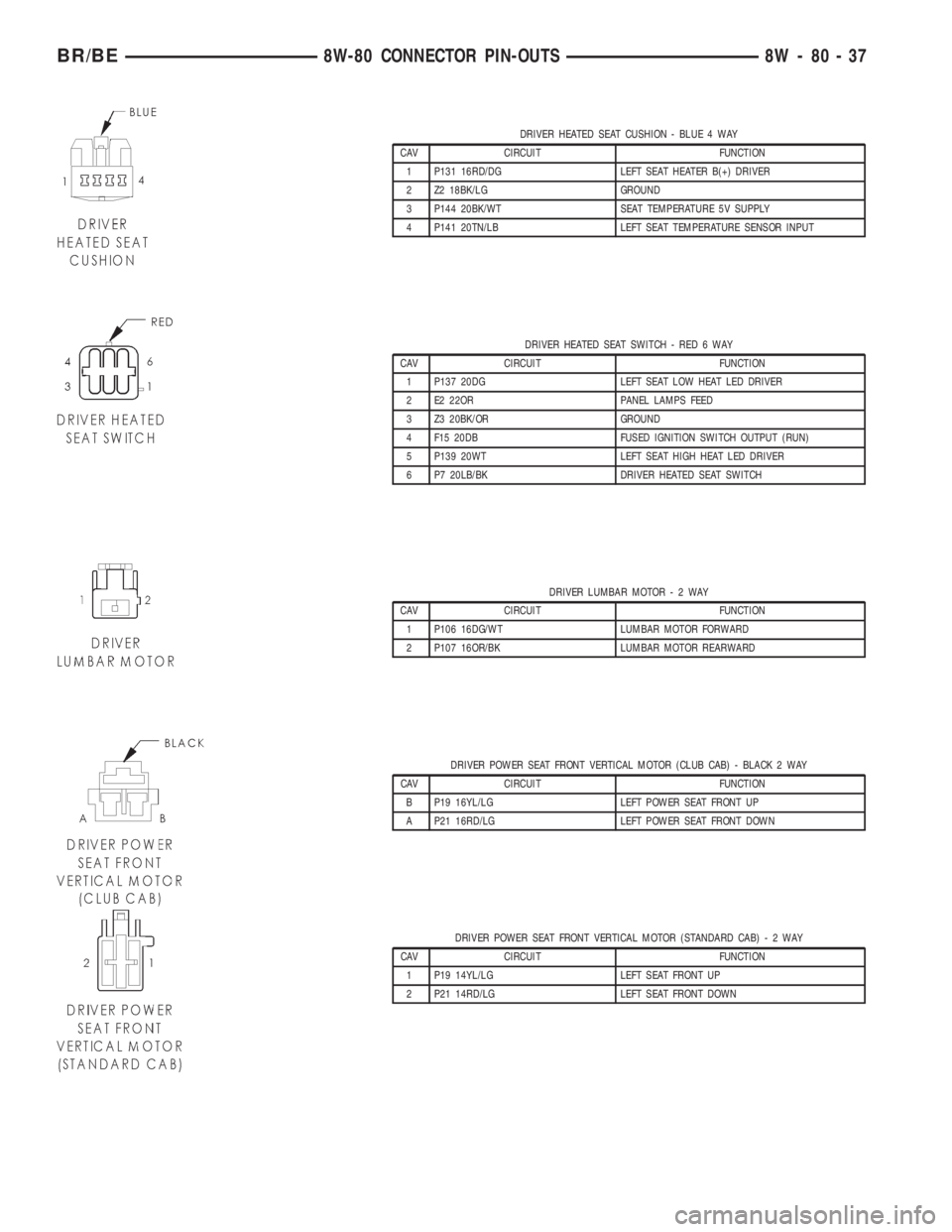
DRIVER HEATED SEAT CUSHION - BLUE 4 WAY
CAV CIRCUIT FUNCTION
1 P131 16RD/DG LEFT SEAT HEATER B(+) DRIVER
2 Z2 18BK/LG GROUND
3 P144 20BK/WT SEAT TEMPERATURE 5V SUPPLY
4 P141 20TN/LB LEFT SEAT TEMPERATURE SENSOR INPUT
DRIVER HEATED SEAT SWITCH - RED 6 WAY
CAV CIRCUIT FUNCTION
1 P137 20DG LEFT SEAT LOW HEAT LED DRIVER
2 E2 22OR PANEL LAMPS FEED
3 Z3 20BK/OR GROUND
4 F15 20DB FUSED IGNITION SWITCH OUTPUT (RUN)
5 P139 20WT LEFT SEAT HIGH HEAT LED DRIVER
6 P7 20LB/BK DRIVER HEATED SEAT SWITCH
DRIVER LUMBAR MOTOR-2WAY
CAV CIRCUIT FUNCTION
1 P106 16DG/WT LUMBAR MOTOR FORWARD
2 P107 16OR/BK LUMBAR MOTOR REARWARD
DRIVER POWER SEAT FRONT VERTICAL MOTOR (CLUB CAB) - BLACK 2 WAY
CAV CIRCUIT FUNCTION
B P19 16YL/LG LEFT POWER SEAT FRONT UP
A P21 16RD/LG LEFT POWER SEAT FRONT DOWN
DRIVER POWER SEAT FRONT VERTICAL MOTOR (STANDARD CAB)-2WAY
CAV CIRCUIT FUNCTION
1 P19 14YL/LG LEFT SEAT FRONT UP
2 P21 14RD/LG LEFT SEAT FRONT DOWN
BR/BE8W-80 CONNECTOR PIN-OUTS 8W - 80 - 37
Page 1065 of 2889
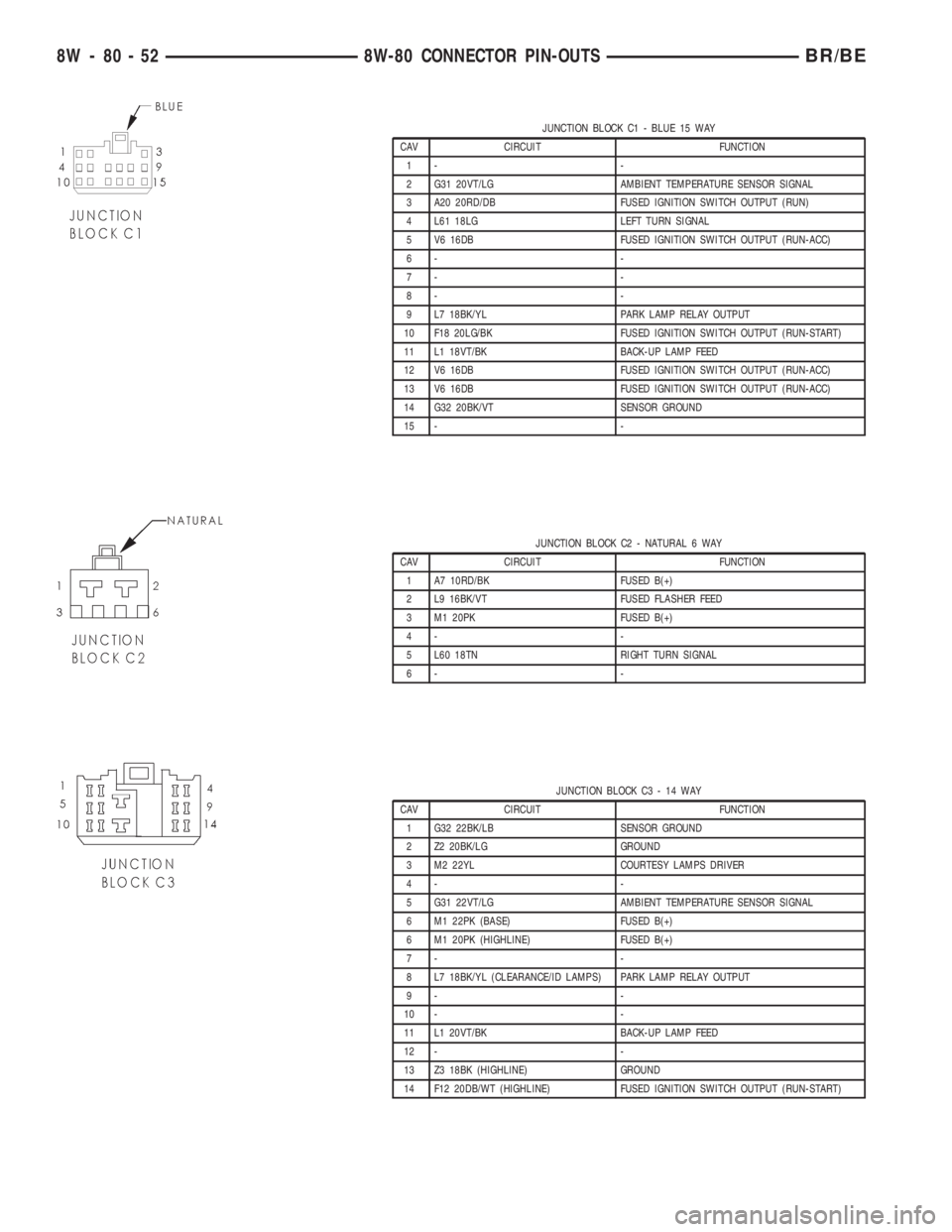
JUNCTION BLOCK C1 - BLUE 15 WAY
CAV CIRCUIT FUNCTION
1- -
2 G31 20VT/LG AMBIENT TEMPERATURE SENSOR SIGNAL
3 A20 20RD/DB FUSED IGNITION SWITCH OUTPUT (RUN)
4 L61 18LG LEFT TURN SIGNAL
5 V6 16DB FUSED IGNITION SWITCH OUTPUT (RUN-ACC)
6- -
7- -
8- -
9 L7 18BK/YL PARK LAMP RELAY OUTPUT
10 F18 20LG/BK FUSED IGNITION SWITCH OUTPUT (RUN-START)
11 L1 18VT/BK BACK-UP LAMP FEED
12 V6 16DB FUSED IGNITION SWITCH OUTPUT (RUN-ACC)
13 V6 16DB FUSED IGNITION SWITCH OUTPUT (RUN-ACC)
14 G32 20BK/VT SENSOR GROUND
15 - -
JUNCTION BLOCK C2 - NATURAL 6 WAY
CAV CIRCUIT FUNCTION
1 A7 10RD/BK FUSED B(+)
2 L9 16BK/VT FUSED FLASHER FEED
3 M1 20PK FUSED B(+)
4- -
5 L60 18TN RIGHT TURN SIGNAL
6- -
JUNCTION BLOCK C3 - 14 WAY
CAV CIRCUIT FUNCTION
1 G32 22BK/LB SENSOR GROUND
2 Z2 20BK/LG GROUND
3 M2 22YL COURTESY LAMPS DRIVER
4- -
5 G31 22VT/LG AMBIENT TEMPERATURE SENSOR SIGNAL
6 M1 22PK (BASE) FUSED B(+)
6 M1 20PK (HIGHLINE) FUSED B(+)
7- -
8 L7 18BK/YL (CLEARANCE/ID LAMPS) PARK LAMP RELAY OUTPUT
9- -
10 - -
11 L1 20VT/BK BACK-UP LAMP FEED
12 - -
13 Z3 18BK (HIGHLINE) GROUND
14 F12 20DB/WT (HIGHLINE) FUSED IGNITION SWITCH OUTPUT (RUN-START)
8W - 80 - 52 8W-80 CONNECTOR PIN-OUTSBR/BE
Page 1068 of 2889
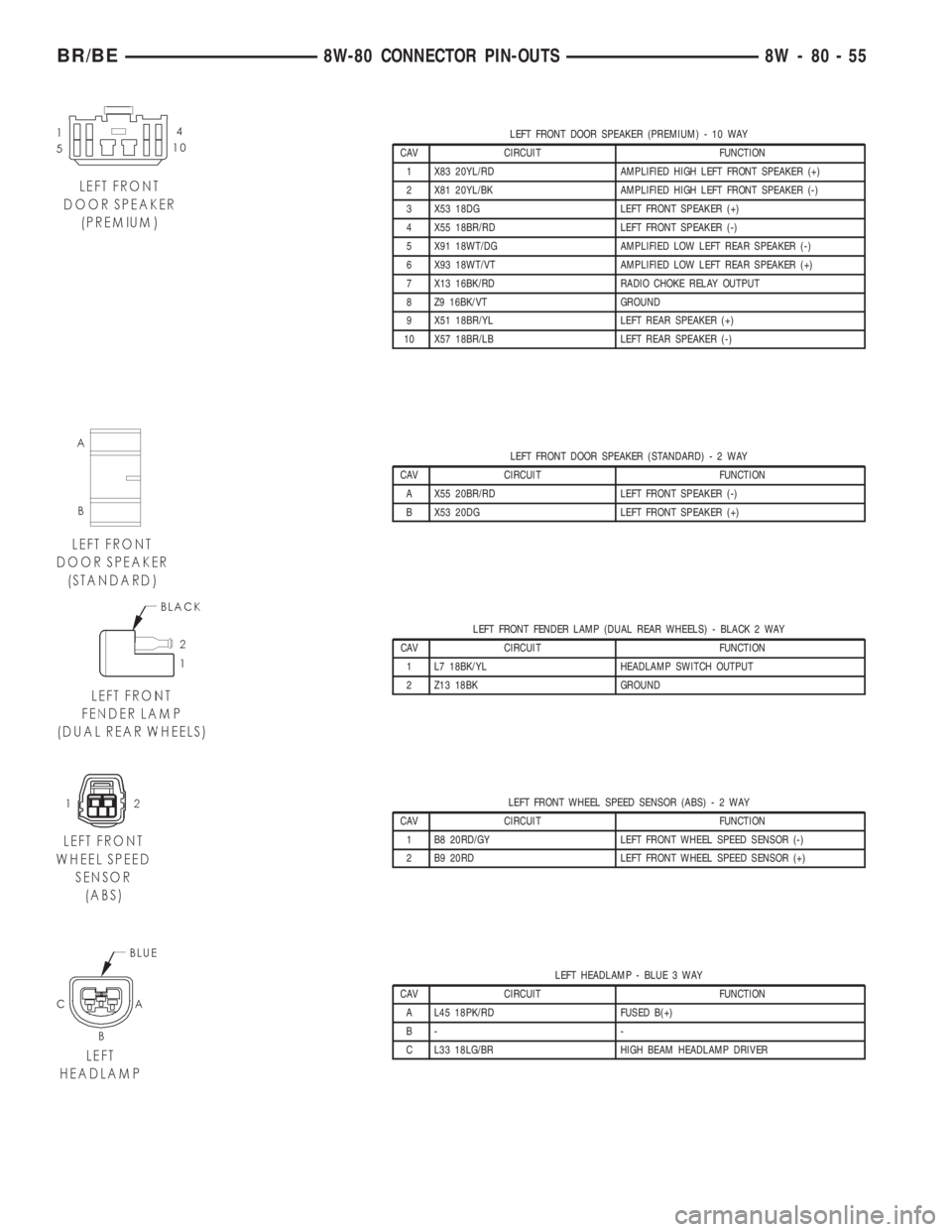
LEFT FRONT DOOR SPEAKER (PREMIUM) - 10 WAY
CAV CIRCUIT FUNCTION
1 X83 20YL/RD AMPLIFIED HIGH LEFT FRONT SPEAKER (+)
2 X81 20YL/BK AMPLIFIED HIGH LEFT FRONT SPEAKER (-)
3 X53 18DG LEFT FRONT SPEAKER (+)
4 X55 18BR/RD LEFT FRONT SPEAKER (-)
5 X91 18WT/DG AMPLIFIED LOW LEFT REAR SPEAKER (-)
6 X93 18WT/VT AMPLIFIED LOW LEFT REAR SPEAKER (+)
7 X13 16BK/RD RADIO CHOKE RELAY OUTPUT
8 Z9 16BK/VT GROUND
9 X51 18BR/YL LEFT REAR SPEAKER (+)
10 X57 18BR/LB LEFT REAR SPEAKER (-)
LEFT FRONT DOOR SPEAKER (STANDARD)-2WAY
CAV CIRCUIT FUNCTION
A X55 20BR/RD LEFT FRONT SPEAKER (-)
B X53 20DG LEFT FRONT SPEAKER (+)
LEFT FRONT FENDER LAMP (DUAL REAR WHEELS) - BLACK 2 WAY
CAV CIRCUIT FUNCTION
1 L7 18BK/YL HEADLAMP SWITCH OUTPUT
2 Z13 18BK GROUND
LEFT FRONT WHEEL SPEED SENSOR (ABS)-2WAY
CAV CIRCUIT FUNCTION
1 B8 20RD/GY LEFT FRONT WHEEL SPEED SENSOR (-)
2 B9 20RD LEFT FRONT WHEEL SPEED SENSOR (+)
LEFT HEADLAMP - BLUE 3 WAY
CAV CIRCUIT FUNCTION
A L45 18PK/RD FUSED B(+)
B- -
C L33 18LG/BR HIGH BEAM HEADLAMP DRIVER
BR/BE8W-80 CONNECTOR PIN-OUTS 8W - 80 - 55
Page 1069 of 2889
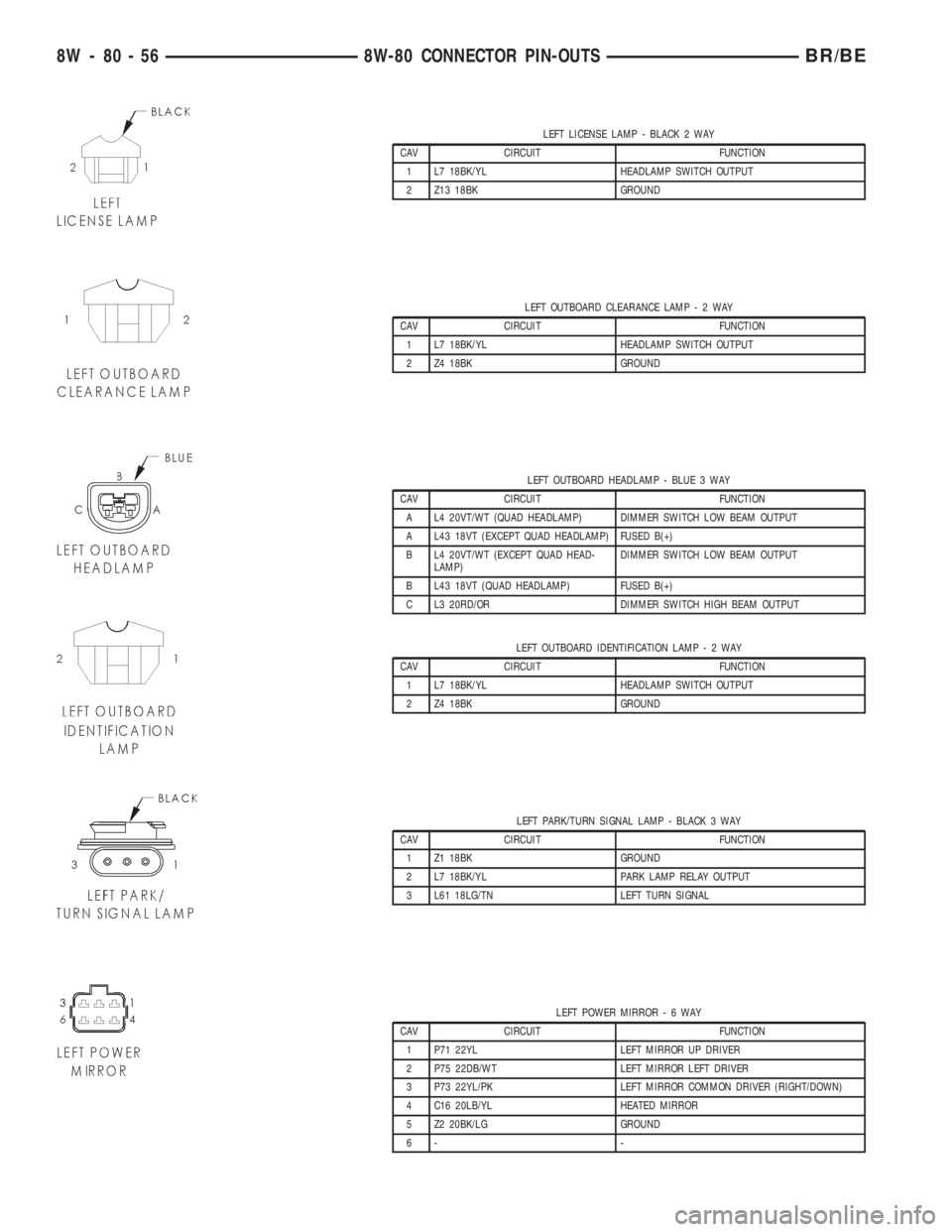
LEFT LICENSE LAMP - BLACK 2 WAY
CAV CIRCUIT FUNCTION
1 L7 18BK/YL HEADLAMP SWITCH OUTPUT
2 Z13 18BK GROUND
LEFT OUTBOARD CLEARANCE LAMP-2WAY
CAV CIRCUIT FUNCTION
1 L7 18BK/YL HEADLAMP SWITCH OUTPUT
2 Z4 18BK GROUND
LEFT OUTBOARD HEADLAMP - BLUE 3 WAY
CAV CIRCUIT FUNCTION
A L4 20VT/WT (QUAD HEADLAMP) DIMMER SWITCH LOW BEAM OUTPUT
A L43 18VT (EXCEPT QUAD HEADLAMP) FUSED B(+)
B L4 20VT/WT (EXCEPT QUAD HEAD-
LAMP)DIMMER SWITCH LOW BEAM OUTPUT
B L43 18VT (QUAD HEADLAMP) FUSED B(+)
C L3 20RD/OR DIMMER SWITCH HIGH BEAM OUTPUT
LEFT OUTBOARD IDENTIFICATION LAMP-2WAY
CAV CIRCUIT FUNCTION
1 L7 18BK/YL HEADLAMP SWITCH OUTPUT
2 Z4 18BK GROUND
LEFT PARK/TURN SIGNAL LAMP - BLACK 3 WAY
CAV CIRCUIT FUNCTION
1 Z1 18BK GROUND
2 L7 18BK/YL PARK LAMP RELAY OUTPUT
3 L61 18LG/TN LEFT TURN SIGNAL
LEFT POWER MIRROR-6WAY
CAV CIRCUIT FUNCTION
1 P71 22YL LEFT MIRROR UP DRIVER
2 P75 22DB/WT LEFT MIRROR LEFT DRIVER
3 P73 22YL/PK LEFT MIRROR COMMON DRIVER (RIGHT/DOWN)
4 C16 20LB/YL HEATED MIRROR
5 Z2 20BK/LG GROUND
6- -
8W - 80 - 56 8W-80 CONNECTOR PIN-OUTSBR/BE