seatbelt DODGE RAM 2002 Service Repair Manual
[x] Cancel search | Manufacturer: DODGE, Model Year: 2002, Model line: RAM, Model: DODGE RAM 2002Pages: 2255, PDF Size: 62.07 MB
Page 360 of 2255
CHIME/BUZZER
TABLE OF CONTENTS
page page
CHIME WARNING SYSTEM
DESCRIPTION..........................1
OPERATION............................1DIAGNOSIS AND TESTING - CHIME
WARNING SYSTEM.....................2
CHIME WARNING SYSTEM
DESCRIPTION
A chime warning system is standard factory-in-
stalled equipment on this model. The chime warning
system uses a single chime tone generator that is
integral to the Central Timer Module (CTM) to pro-
vide an audible indication of various vehicle condi-
tions that may require the attention of the vehicle
operator. The chime warning system includes the fol-
lowing major components, which are described in fur-
ther detail elsewhere in this service manual:
²Central Timer Module- The Central Timer
Module (CTM) is located under the driver side end of
the instrument panel, inboard of the instrument
panel steering column opening. The CTM contains an
integral chime tone generator to provide all of the
proper chime warning system features based upon
the monitored inputs.
²Door Ajar Switch- A door ajar switch is inte-
gral to the driver side front door latch. This switch
provides an input to the chime warning system indi-
cating whether the driver side front door is open or
closed.
²Headlamp Switch- The headlamp switch is
located on the instrument panel outboard of the
steering column. The headlamp switch provides an
input to the chime warning system indicating when
the exterior lamps are turned On or Off.
²Ignition Switch- A key-in ignition switch is
integral to the ignition switch. The key-in ignition
switch provides an input to the chime warning sys-
tem indicating whether a key is present in the igni-
tion lock cylinder.
²Seat Belt Switch- A seat belt switch is inte-
gral to the driver side front seat belt buckle unit. The
seat belt switch provides an input to the chime warn-
ing system indicating whether the driver side front
seat belt is fastened.
Hard wired circuitry connects many of the chime
warning system components to each other through
the electrical system of the vehicle. These hard wired
circuits are integral to several wire harnesses, which
are routed throughout the vehicle and retained bymany different methods. These circuits may be con-
nected to each other, to the vehicle electrical system
and to the chime warning system components
through the use of a combination of soldered splices,
splice block connectors, and many different types of
wire harness terminal connectors and insulators.
Refer to the appropriate wiring information. The wir-
ing information includes wiring diagrams, proper
wire and connector repair procedures, further details
on wire harness routing and retention, as well as
pin-out and location views for the various wire har-
ness connectors, splices and grounds.
The CTM chime warning system circuitry and the
integral chime tone generator cannot be adjusted or
repaired. If the CTM or the chime tone generator are
damaged or faulty, the CTM unit must be replaced.
OPERATION
The chime warning system is designed to provide an
audible output as an indication of various conditions
that may require the attention or awareness of the
vehicle operator. The chime warning system compo-
nents operate on battery current received through a
fused B(+) fuse in the Junction Block (JB) on a non-
switched fused B(+) circuit so that the system may
operate regardless of the ignition switch position.
The chime warning system provides an audible
indication to the vehicle operator under the following
conditions:
²Fasten Seat Belt Warning- The Central
Timer Module (CTM) chime tone generator will gen-
erate repetitive chime tones at a slow rate to
announce that a hard wired input from the seat belt
switch to the Electro-Mechanical Instrument Cluster
(EMIC) indicates that the driver side front seat belt
is not fastened with the ignition switch in the On
position. Unless the driver side front seat belt is fas-
tened, the chimes will continue to sound for a dura-
tion of about seven seconds each time the ignition
switch is turned to the On position or until the driver
side front seat belt is fastened, whichever occurs
first. This chime tone is based upon a hard wired
chime request input to the CTM from the EMIC, but
is not related to the operation of the EMIC ªSeatbeltº
indicator.
BR/BECHIME/BUZZER 8B - 1
Page 480 of 2255
INSTRUMENT CLUSTER
TABLE OF CONTENTS
page page
INSTRUMENT CLUSTER
DESCRIPTION..........................2
OPERATION............................3
DIAGNOSIS AND TESTING - INSTRUMENT
CLUSTER............................6
REMOVAL.............................10
DISASSEMBLY.........................10
ASSEMBLY............................12
INSTALLATION.........................13
ABS INDICATOR
DESCRIPTION.........................14
OPERATION...........................14
AIRBAG INDICATOR
DESCRIPTION.........................15
OPERATION...........................15
BRAKE/PARK BRAKE INDICATOR
DESCRIPTION.........................15
OPERATION...........................15
DIAGNOSIS AND TESTING - BRAKE
INDICATOR..........................16
CHECK GAUGES INDICATOR
DESCRIPTION.........................17
OPERATION...........................17
CRUISE INDICATOR
DESCRIPTION.........................18
OPERATION...........................18
ENGINE TEMPERATURE GAUGE
DESCRIPTION.........................18
OPERATION...........................19
FUEL GAUGE
DESCRIPTION.........................19
OPERATION...........................20
GEAR SELECTOR INDICATOR
DESCRIPTION.........................20
OPERATION...........................21
HIGH BEAM INDICATOR
DESCRIPTION.........................21
OPERATION...........................21
DIAGNOSIS AND TESTING - HIGH BEAM
INDICATOR..........................21
LOW FUEL INDICATOR
DESCRIPTION.........................22
OPERATION...........................22
MALFUNCTION INDICATOR LAMP MIL
DESCRIPTION.........................23
OPERATION...........................23
ODOMETER
DESCRIPTION.........................24
OPERATION...........................24OIL PRESSURE GAUGE
DESCRIPTION.........................25
OPERATION...........................25
OVERDRIVE OFF INDICATOR
DESCRIPTION.........................26
OPERATION...........................26
SEATBELT INDICATOR
DESCRIPTION.........................27
OPERATION...........................27
SERVICE REMINDER INDICATOR
DESCRIPTION.........................27
OPERATION...........................28
SHIFT INDICATOR (TRANSFER CASE)
DESCRIPTION.........................28
OPERATION...........................28
DIAGNOSIS AND TESTING - FOUR-WHEEL
DRIVE INDICATOR....................29
SPEEDOMETER
DESCRIPTION.........................29
OPERATION...........................30
TACHOMETER
DESCRIPTION.........................30
OPERATION...........................30
TRANS OVERTEMP INDICATOR
DESCRIPTION.........................31
OPERATION...........................31
TURN SIGNAL INDICATOR
DESCRIPTION.........................32
OPERATION...........................32
DIAGNOSIS AND TESTING - TURN SIGNAL
INDICATOR..........................32
UPSHIFT INDICATOR
DESCRIPTION.........................32
OPERATION...........................33
VOLTAGE GAUGE
DESCRIPTION.........................33
OPERATION...........................33
WAIT-TO-START INDICATOR
DESCRIPTION.........................34
OPERATION...........................34
WASHER FLUID INDICATOR
DESCRIPTION.........................35
OPERATION...........................35
DIAGNOSIS AND TESTING - WASHER FLUID
INDICATOR..........................35
WATER-IN-FUEL INDICATOR
DESCRIPTION.........................36
OPERATION...........................36
BR/BEINSTRUMENT CLUSTER 8J - 1
Page 482 of 2255
²Check Gauges Indicator
²Cruise Indicator (Odometer VFD)
²Four-Wheel Drive Indicator
²High Beam Indicator
²Low Fuel Indicator
²Washer Fluid Indicator
²Malfunction Indicator Lamp (MIL)
²Overdrive-Off Indicator
²Seatbelt Indicator
²Service Reminder Indicator (SRI)
²Transmission Overtemp Indicator
²Turn Signal (Right and Left) Indicators
²Upshift Indicator
²Wait-To-Start Indicator (Diesel Only)
²Water-In-Fuel Indicator (Diesel Only)
Some of these indicators are either programmable
or automatically configured when the EMIC is con-
nected to the vehicle electrical system. This feature
allows those indicators to be activated or deactivated
for compatibility with certain optional equipment.
The EMIC also includes a provision for mounting the
automatic transmission gear selector indicator in the
lower right corner of the cluster. The spring-loaded,
cable driven, mechanical gear selector indicator gives
an indication of the transmission gear that has been
selected with the automatic transmission gear selec-
tor lever. The gear selector indicator pointer is easily
visible through an opening provided in the front of
the cluster overlay, and is also lighted by the cluster
illumination lamps for visibility at night. Models
equipped with a manual transmission have a block-
out plate installed in place of the gear selector indi-
cator.
Cluster illumination is accomplished by adjustable
incandescent back lighting, which illuminates the
gauges for visibility when the exterior lighting is
turned on. The EMIC high beam indicator, turn sig-
nal indicators, and wait-to-start indicator are also
illuminated by dedicated incandescent bulbs. The
remaining indicators in the EMIC are each illumi-
nated by a dedicated Light Emitting Diode (LED)
that is soldered onto the electronic circuit board.
Each of the incandescent bulbs is secured by an inte-
gral bulb holder to the electronic circuit board from
the back of the cluster housing.
Hard wired circuitry connects the EMIC to the
electrical system of the vehicle. These hard wired cir-
cuits are integral to several wire harnesses, which
are routed throughout the vehicle and retained by
many different methods. These circuits may be con-
nected to each other, to the vehicle electrical system
and to the EMIC through the use of a combination of
soldered splices, splice block connectors, and many
different types of wire harness terminal connectors
and insulators. Refer to the appropriate wiring infor-
mation. The wiring information includes wiring dia-grams, proper wire and connector repair procedures,
further details on wire harness routing and reten-
tion, as well as pin-out and location views for the
various wire harness connectors, splices and grounds.
The EMIC modules for this model are serviced only
as complete units. The EMIC module cannot be
adjusted or repaired. If a gauge, an LED indicator,
the VFD, the electronic circuit board, the circuit
board hardware, the cluster overlay, or the EMIC
housing are damaged or faulty, the entire EMIC mod-
ule must be replaced. The cluster lens and hood unit,
the rear cluster housing cover, the automatic trans-
mission gear selector indicator, and the incandescent
lamp bulbs with holders are available for individual
service replacement.
OPERATION
The ElectroMechanical Instrument Cluster (EMIC)
is designed to allow the vehicle operator to monitor
the conditions of many of the vehicle components and
operating systems. The gauges and indicators in the
EMIC provide valuable information about the various
standard and optional powertrains, fuel and emis-
sions systems, cooling systems, lighting systems,
safety systems and many other convenience items.
The EMIC is installed in the instrument panel so
that all of these monitors can be easily viewed by the
vehicle operator when driving, while still allowing
relative ease of access for service. The microproces-
sor-based EMIC hardware and software uses various
inputs to control the gauges and indicators visible on
the face of the cluster. Some of these inputs are hard
wired, but most are in the form of electronic mes-
sages that are transmitted by other electronic mod-
ules over the Chrysler Collision Detection (CCD) data
bus network. (Refer to 8 - ELECTRICAL/ELEC-
TRONIC CONTROL MODULES/COMMUNICATION
- OPERATION).
The EMIC microprocessor smooths the input data
using algorithms to provide gauge readings that are
accurate, stable and responsive to operating condi-
tions. These algorithms are designed to provide
gauge readings during normal operation that are con-
sistent with customer expectations. However, when
abnormal conditions exist, such as low/high battery
voltage, low oil pressure, or high coolant tempera-
ture, the algorithm drives the gauge pointer to an
extreme position and the microprocessor turns on the
Check Gauges indicator to provide a distinct visual
indication of a problem to the vehicle operator. The
instrument cluster circuitry may also generate a
hard wired chime tone request to the Central Timer
Module (CTM) when it monitors certain conditions or
inputs, in order to provide the vehicle operator with
an audible alert.
BR/BEINSTRUMENT CLUSTER 8J - 3
INSTRUMENT CLUSTER (Continued)
Page 484 of 2255
trol some of the VFD functions requires the use of a
DRBIIItscan tool. Refer to the appropriate diagnos-
tic information. Specific operation details for the
odometer and trip odometer functions of the VFD
may be found elsewhere in this service manual.
INDICATORS
Indicators are located in various positions within
the EMIC and are all connected to the EMIC circuit
board. The four-wheel drive indicator, high beam
indicator, washer fluid indicator, turn signal indica-
tors, and wait-to-start indicator are hard wired. The
brake indicator is controlled by CCD data bus mes-
sages from the Controller Anti-lock Brake (CAB) and
the hard wired park brake switch input to the EMIC.
The seatbelt indicator is controlled by the EMIC pro-
gramming, CCD data bus messages from the Airbag
Control Module (ACM), and the hard wired seat belt
switch input to the EMIC. The Malfunction Indicator
Lamp (MIL) is normally controlled by CCD data bus
messages from the Powertrain Control Module
(PCM); however, if the EMIC loses CCD data bus
communications, the EMIC circuitry will automati-
cally turn the MIL on, and flash the odometer VFD
on and off repeatedly until CCD data bus communi-
cation is restored. The EMIC uses CCD data bus
messages from the Powertrain Control Module
(PCM), the diesel engine only Engine Control Module
(ECM), the ACM, and the CAB to control all of the
remaining indicators. Different indicators are con-
trolled by different strategies; some receive fused
ignition switch output from the EMIC circuitry clus-
ter and have a switched ground, while others are
grounded through the EMIC circuitry and have a
switched battery feed.
In addition, certain indicators in this instrument
cluster are programmable or configurable. This fea-
ture allows the programmable indicators to be acti-
vated or deactivated with a DRBIIItscan tool, while
the configurable indicators will be automatically
enabled or disabled by the EMIC circuitry for com-
patibility with certain optional equipment. The only
programmable indicator for this model is the upshift
indicator. The cruise indicator, four-wheel drive indi-
cator, overdrive-off indicator, service reminder indica-
tor, and the transmission overtemp indicator are
automatically configured, either electronically or
mechanically.
The hard wired indicators are diagnosed using con-
ventional diagnostic methods. The EMIC and CCD
bus message controlled indicator lamps are diagnosed
using the EMIC self-diagnostic actuator test. (Refer
to 8 - ELECTRICAL/INSTRUMENT CLUSTER -
DIAGNOSIS AND TESTING). Proper testing of the
CCD data bus and the data bus message inputs to
the EMIC that control each indicator lamp requirethe use of a DRBIIItscan tool. Refer to the appro-
priate diagnostic information. Specific operation
details for each indicator may be found elsewhere in
this service manual.
CLUSTER ILLUMINATION
The EMIC has several illumination lamps that are
illuminated when the exterior lighting is turned on
with the headlamp switch. The illumination bright-
ness of these lamps is adjusted by the panel lamps
dimmer rheostat when the headlamp switch thumb-
wheel is rotated (down to dim, up to brighten). The
illumination lamps receive battery current through
the panel lamps dimmer rheostat and a fuse in the
JB on a fused panel lamps dimmer switch signal cir-
cuit. The illumination lamps are grounded at all
times.
In addition, an analog/digital (A/D) converter in
the EMIC converts the analog panel lamps dimmer
rheostat input from the headlamp switch to a digital
dimming level signal for controlling the lighting level
of the VFD. The EMIC also broadcasts this digital
dimming information as a message over the CCD
data bus for use by the Compass Mini-Trip Computer
(CMTC) in synchronizing the lighting level of its
VFD with that of the EMIC. The headlamp switch
thumbwheel also has a Parade position to provide a
parade mode. The EMIC monitors the request for
this mode through a hard wired day brightness sense
circuit input from the headlamp switch. In this mode,
the EMIC will override the selected panel dimmer
switch signal and send a message over the CCD data
bus to illuminate all vacuum fluorescent displays at
full brightness for easier visibility when driving in
daylight with the exterior lighting turned on. The
parade mode has no effect on the incandescent bulb
illumination intensity.
The hard wired cluster illumination lamps are
diagnosed using conventional diagnostic methods.
Proper testing of the VFD dimming level and the
CCD data bus dimming level message functions
requires the use of a DRBIIItscan tool. Refer to the
appropriate diagnostic information.
CHIME WARNING REQUESTS
The EMIC is programmed to request chime service
from the Central Timer Module (CTM) when certain
indicator lamps are illuminated. When the pro-
grammed conditions are met, the EMIC generates a
chime request signal and sends it over a hard wired
tone request circuit to the CTM. Upon receiving the
proper chime request, the CTM activates an integral
chime tone generator to provide the audible chime
tone to the vehicle operator. (Refer to 8 - ELECTRI-
CAL/CHIME/BUZZER - OPERATION). Proper test-
ing of the CTM and the EMIC chime requests
BR/BEINSTRUMENT CLUSTER 8J - 5
INSTRUMENT CLUSTER (Continued)
Page 494 of 2255
AIRBAG INDICATOR
DESCRIPTION
An airbag indicator is standard equipment on all
instrument clusters. However, on vehicles not
equipped with airbags, this indicator is electronically
disabled. The airbag indicator is located near the
lower edge of the instrument cluster overlay, to the
right of center. The airbag indicator consists of a
stenciled cutout of the word ªAIRBAGº in the opaque
layer of the instrument cluster overlay. The dark
outer layer of the overlay prevents the indicator from
being clearly visible when it is not illuminated. A red
lens behind the cutout in the opaque layer of the
overlay causes the ªAIRBAGº text to appear in red
through the translucent outer layer of the overlay
when it is illuminated from behind by a Light Emit-
ting Diode (LED) soldered onto the instrument clus-
ter electronic circuit board. The airbag indicator is
serviced as a unit with the instrument cluster.
OPERATION
The airbag indicator gives an indication to the
vehicle operator when the airbag system is faulty or
inoperative. The airbag indicator is controlled by a
transistor on the instrument cluster circuit board
based upon cluster programming and electronic mes-
sages received by the cluster from the Airbag Control
Module (ACM) over the Chrysler Collision Detection
(CCD) data bus. The airbag indicator Light Emitting
Diode (LED) receives battery current on the instru-
ment cluster electronic circuit board through the
fused ignition switch output (st-run) circuit whenever
the ignition switch is in the On or Start positions;
therefore, the indicator will always be off when the
ignition switch is in any position except On or Start.
The LED only illuminates when it is provided a path
to ground by the instrument cluster transistor. The
instrument cluster will turn on the airbag indicator
for the following reasons:
²Bulb Test- Each time the ignition switch is
turned to the On position the airbag indicator is illu-
minated for about seven seconds. The first two sec-
onds is the cluster bulb test function, and the
remainder is the ACM bulb test function.
²ACM Lamp-On Message- Each time the clus-
ter receives a lamp-on message from the ACM, the
airbag indicator will be illuminated. The indicator
remains illuminated for about twelve seconds or until
the cluster receives a lamp-off message from the
ACM, whichever is longer.
²Communication Error- If the cluster receives
no airbag messages for three consecutive seconds, the
airbag indicator is illuminated. The indicator
remains illuminated for about twelve seconds or untilthe cluster receives a single lamp-off message from
the ACM, whichever is longer.
²Actuator Test- Each time the cluster is put
through the actuator test, the airbag indicator will be
turned on during the bulb check portion of the test to
confirm the functionality of the LED and the cluster
control circuitry.
The ACM continually monitors the airbag system
circuits and sensors to decide whether the system is
in good operating condition. The ACM then sends the
proper lamp-on or lamp-off messages to the instru-
ment cluster. If the ACM sends a lamp-on message
after the bulb test, it indicates that the ACM has
detected a system malfunction and/or that the air-
bags may not deploy when required, or may deploy
when not required. The ACM will store a Diagnostic
Trouble Code (DTC) for any malfunction it detects.
Each time the airbag indicator fails to illuminate due
to an open or short in the cluster airbag indicator cir-
cuit, the cluster sends a message notifying the ACM
of the condition, the ACM will store a DTC, and the
cluster begins blinking the seat belt indicator. (Refer
to 8 - ELECTRICAL/INSTRUMENT CLUSTER/
SEATBELT INDICATOR - OPERATION). For proper
diagnosis of the airbag system, the ACM, the CCD
data bus, or the message inputs to the instrument
cluster that control the airbag indicator, a DRBIIIt
scan tool is required. Refer to the appropriate diag-
nostic information.
BRAKE/PARK BRAKE
INDICATOR
DESCRIPTION
A brake indicator is standard equipment on all
instrument clusters. The brake indicator is located
near the lower edge of the instrument cluster overlay,
to the right of center. The brake indicator consists of
a stenciled cutout of the word ªBRAKEº in the
opaque layer of the instrument cluster overlay. The
dark outer layer of the overlay prevents the indicator
from being clearly visible when it is not illuminated.
A red lens behind the cutout in the opaque layer of
the overlay causes the ªBRAKEº text to appear in
red through the translucent outer layer of the over-
lay when it is illuminated from behind by a Light
Emitting Diode (LED) soldered onto the instrument
cluster electronic circuit board. The brake indicator is
serviced as a unit with the instrument cluster.
OPERATION
The brake indicator gives an indication to the vehi-
cle operator when the parking brake is applied, or
when there are certain brake hydraulic system mal-
functions. This indicator is controlled by a transistor
BR/BEINSTRUMENT CLUSTER 8J - 15
Page 506 of 2255
remains illuminated until the cluster receives an
overdrive off lamp-off message from the PCM, or
until the ignition switch is turned to the Off position,
whichever occurs first.
²Actuator Test- Each time the cluster is put
through the actuator test, the indicator will be
turned on during the bulb check portion of the test to
confirm the functionality of the LED and the cluster
control circuitry.
The PCM continually monitors the overdrive off
switch to determine the proper outputs to the auto-
matic transmission, then sends the proper messages
to the instrument cluster. For further diagnosis of
the overdrive off indicator or the instrument cluster
circuitry that controls the LED, (Refer to 8 - ELEC-
TRICAL/INSTRUMENT CLUSTER - DIAGNOSIS
AND TESTING). For proper diagnosis of the over-
drive control system, the PCM, the CCD data bus, or
the message inputs to the instrument cluster that
control the overdrive off indicator, a DRBIIItscan
tool is required. Refer to the appropriate diagnostic
information.
SEATBELT INDICATOR
DESCRIPTION
A seatbelt indicator is standard equipment on all
instrument clusters. The seatbelt indicator is located
near the lower edge of the instrument cluster overlay,
to the right of center. The seatbelt indicator consists
of a stencilled cutout of the International Control and
Display Symbol icon for ªSeat Beltº in the opaque
layer of the instrument cluster overlay. The dark
outer layer of the overlay prevents the indicator from
being clearly visible when it is not illuminated. A red
lens behind the cutout in the opaque layer of the
overlay causes the icon to appear in red through the
translucent outer layer of the overlay when the indi-
cator is illuminated from behind by a Light Emitting
Diode (LED) soldered onto the instrument cluster
electronic circuit board. The seatbelt indicator is ser-
viced as a unit with the instrument cluster.
OPERATION
The seatbelt indicator gives an indication to the
vehicle operator of the status of the driver side front
seatbelt buckle. This indicator is controlled by a tran-
sistor on the instrument cluster circuit board based
upon the cluster programming, and a hard wired
input from the seatbelt switch in the driver side front
seatbelt through the seat belt switch sense circuit.
The seatbelt indicator Light Emitting Diode (LED)
receives battery current on the instrument cluster
electronic circuit board through the fused ignition
switch output (st-run) circuit whenever the ignitionswitch is in the On or Start positions; therefore, the
indicator will always be off when the ignition switch
is in any position except On or Start. The LED only
illuminates when it is switched to ground by the
instrument cluster transistor. The instrument cluster
will turn on the seatbelt indicator for the following
reasons:
²Seatbelt Reminder Function- Each time the
cluster receives a battery current input on the fused
ignition switch output (st-run) circuit, the indicator
will be illuminated as a seatbelt reminder for about
seven seconds, or until the ignition switch is turned
to the Off position, whichever occurs first. This
reminder function will occur regardless of the status
of the seatbelt switch input to the cluster.
²Driver Side Front Seatbelt Not Buckled-
Following the seatbelt reminder function, each time
the cluster receives a ground input on the seat belt
switch sense circuit (seatbelt switch closed - seatbelt
unbuckled) with the ignition switch in the Start or
On positions, the indicator will be illuminated. The
seatbelt indicator remains illuminated until the seat
belt switch sense input to the cluster is an open cir-
cuit (seatbelt switch opened - seatbelt buckled), or
until the ignition switch is turned to the Off position,
whichever occurs first.
²Actuator Test- Each time the cluster is put
through the actuator test, the indicator will be
turned on during the bulb check portion of the test to
confirm the functionality of the LED and the cluster
control circuitry.
The seatbelt switch input to the instrument cluster
circuitry can be diagnosed using conventional diag-
nostic tools and methods. For further diagnosis of the
seatbelt indicator or the instrument cluster circuitry
that controls the LED, (Refer to 8 - ELECTRICAL/
INSTRUMENT CLUSTER - DIAGNOSIS AND
TESTING).
SERVICE REMINDER
INDICATOR
DESCRIPTION
A Service Reminder Indicator (SRI) is standard
equipment on all instrument clusters. However, on
vehicles not equipped with certain optional heavy
duty emission cycle gasoline engines, this indicator is
electronically disabled. The SRI is located near the
lower edge of the instrument cluster overlay, to the
left of center. The SRI consists of a stencilled cutout
of the words ªMAINT REQDº in the opaque layer of
the instrument cluster overlay. The dark outer layer
of the overlay prevents the indicator from being
clearly visible when it is not illuminated. An amber
lens behind the cutout in the opaque layer of the
BR/BEINSTRUMENT CLUSTER 8J - 27
OVERDRIVE OFF INDICATOR (Continued)
Page 621 of 2255
(1) Reach through the opening between the rear
seat back and the floor panel to position the rear seat
belt buckle/buckle unit (right side) or lap belt/buckle
unit (left side) onto the stud on the rear floor panel
(Fig. 24).
(2) Install and tighten the nut that secures the
rear seat belt buckle/buckle unit (right side) or lap
belt/buckle unit (left side) anchor plate to the stud on
the rear floor panel. Tighten the nut to 40 N´m (29 ft.
lbs.).
(3) Route the lap belt and buckles between the
rear seat back and rear seat cushion.
(4) Disengage the rear seat from its stowed posi-
tion by pulling the release handle on the underside of
the rear seat cushion.
(5) Fold the rear seat cushion down toward the
rear floor panel until the unit is latched in its open
position.
SEAT BELT SWITCH
DESCRIPTION
The seat belt switch is a small, normally closed,
single pole, single throw, leaf contact, momentary
switch. Only one seat belt switch is installed in the
vehicle, and it is integral to the buckle of the driver
seat belt buckle-half, located near the inboard side of
the driver side front seating position. The seat belt
switch is connected to the vehicle electrical system
through a two-wire pigtail wire and connector on the
seat belt buckle-half, which is connected to a wire
harness connector and take out of the body wire har-
ness.
The seat belt switch cannot be adjusted or repaired
and, if faulty or damaged, the entire driver seat belt
buckle-half unit must be replaced.
OPERATION
The seat belt switch is designed to control a path
to ground for the seat belt switch sense input of the
Electro-Mechanical Instrument Cluster (EMIC).
When the driver side seat belt tip-half is inserted in
the seat belt buckle, the switch opens the path to
ground; and, when the driver side seat belt tip-half is
removed from the seat belt buckle, the switch closes
the ground path. The switch is actuated by the latch
mechanism within the seat belt buckle. The EMIC
monitors the driver seat belt switch status, then con-
trols the seatbelt indicator and sends hard wired
chime requests to the Central Timer Module (CTM)
based upon that input.
The seat belt switch receives ground through its
pigtail wire connection to the body wire harness from
another take out of the body wire harness. An eyelet
terminal connector on that ground take out issecured under a nut to a ground stud on the left
lower B-pillar (standard cab models) or the left lower
cowl side inner panel (club cab and quad cab models).
The seat belt switch is connected in series between
ground and the seat belt switch sense input of the
EMIC.
DIAGNOSIS AND TESTING - SEAT BELT
SWITCH
Refer to the appropriate wiring information. The
wiring information includes wiring diagrams, proper
wire and connector repair procedures, details of wire
harness routing and retention, connector pin-out
information and location views for the various wire
harness connectors, splices and grounds.
WARNING: ON VEHICLES EQUIPPED WITH AIR-
BAGS, DISABLE THE AIRBAG SYSTEM BEFORE
ATTEMPTING ANY STEERING WHEEL, STEERING
COLUMN, OR INSTRUMENT PANEL COMPONENT
DIAGNOSIS OR SERVICE. DISCONNECT AND ISO-
LATE THE BATTERY NEGATIVE (GROUND) CABLE,
THEN WAIT TWO MINUTES FOR THE AIRBAG SYS-
TEM CAPACITOR TO DISCHARGE BEFORE PER-
FORMING FURTHER DIAGNOSIS OR SERVICE. THIS
IS THE ONLY SURE WAY TO DISABLE THE AIRBAG
SYSTEM. FAILURE TO TAKE THE PROPER PRE-
CAUTIONS COULD RESULT IN ACCIDENTAL AIR-
BAG DEPLOYMENT AND POSSIBLE PERSONAL
INJURY.
(1) Disconnect and isolate the battery negative
cable. Disconnect the body wire harness connector for
the seat belt switch from the seat belt switch pigtail
wire connector located near the floor panel under the
driver side front seat cushion. Check for continuity
between the seat belt switch sense circuit and the
ground circuit cavities in the seat belt switch pigtail
wire connector. There should be continuity with the
driver side seat belt tip-half and buckle-half unfas-
tened, and no continuity with tip-half and buckle-half
fastened. If OK, go to Step 2. If not OK, replace the
faulty driver side seat belt buckle-half unit.
(2) Check for continuity between the ground cir-
cuit cavity in the body wire harness connector for the
seat belt switch and a good ground. There should be
continuity. If OK, go to Step 3. If not OK, repair the
open ground circuit to ground (G301 - standard cab,
or G300 - club/quad cab) as required.
(3) Remove the instrument cluster from the instru-
ment panel. Check for continuity between the seat
belt switch sense circuit cavity in the instrument
panel wire harness connector (Connector C2) for the
instrument cluster and a good ground. There should
be no continuity. If OK, go to Step 4. If not OK,
repair the shorted seat belt switch sense circuit
8O - 28 RESTRAINTSBR/BE
REAR SEAT BELT BUCKLE (Continued)
Page 2233 of 2255
HIGH MOUNTED STOP LAMP -
INSTALLATION, CENTER................8L-6
HIGH MOUNTED STOP LAMP -
REMOVAL, CENTER....................8L-6
HIGH MOUNTED STOP LAMP UNIT -
INSTALLATION, CENTER................8L-6
HIGH MOUNTED STOP LAMP UNIT -
REMOVAL, CENTER....................8L-6
HIGH PRESSURE FUEL LINES -
DESCRIPTION.......................14-78
HIGH PRESSURE FUEL LINES -
OPERATION.........................14-78
HIGH PRESSURE RELIEF VALVE -
DESCRIPTION.......................24-46
HIGH PRESSURE RELIEF VALVE -
OPERATION.........................24-47
HIGH PRESSURE SWITCH -
DESCRIPTION, A/C...................24-20
HIGH PRESSURE SWITCH - DIAGNOSIS
AND TESTING, A/C...................24-20
HIGH PRESSURE SWITCH -
INSTALLATION, A/C...................24-20
HIGH PRESSURE SWITCH - OPERATION,
A/C................................24-20
HIGH PRESSURE SWITCH - REMOVAL,
A/C................................24-20
HIGH SPEEDS - DESCRIPTION, TIRE
PRESSURE..........................22-7
HIGH-PRESSURE FUEL LINE LEAKS -
DIAGNOSIS AND TESTING.............14-78
HINGE - INSTALLATION.....23-100,23-72,23-80
HINGE - REMOVAL........23-100,23-72,23-79
HITCH - INSTALLATION, TRAILER.........13-11
HITCH - REMOVAL, TRAILER...........13-11
HOISTING - STANDARD PROCEDURE.......0-9
HOLDDOWN - DESCRIPTION, BATTERY . . . 8F-17
HOLDDOWN - INSTALLATION, BATTERY . . . 8F-18
HOLDDOWN - OPERATION, BATTERY.....8F-17
HOLDDOWN - REMOVAL, BATTERY......8F-17
HOLDER - INSTALLATION, CUP........23-110
HOLDER - REMOVAL, CUP............23-109
HOLE REPAIR - DESCRIPTION,
THREADED........................Intro.-9
HONING - STANDARD PROCEDURE,
CYLINDER BORE..................9-11,9-65
HOOD - INSTALLATION...............23-101
HOOD - REMOVAL...................23-101
HOOK - INSTALLATION, COAT..........23-125
HOOK - INSTALLATION, FRONT TOW.....13-10
HOOK - REMOVAL, COAT.............23-124
HOOK - REMOVAL, FRONT TOW.........13-10
HORN - DESCRIPTION.............8H-1,8H-2
HORN - DIAGNOSIS AND TESTING.......8H-2
HORN - INSTALLATION.................8H-3
HORN - OPERATION...............8H-1,8H-2
HORN - REMOVAL....................8H-2
HORN RELAY - DESCRIPTION.......8W-97-12
HORN RELAY - DESCRIPTION...........8H-3
HORN RELAY - DIAGNOSIS AND
TESTING........................8W-97-12
HORN RELAY - DIAGNOSIS AND
TESTING............................8H-3
HORN RELAY - INSTALLATION.......8W-97-12
HORN RELAY - INSTALLATION...........8H-4
HORN RELAY - OPERATION.............8H-3
HORN RELAY - REMOVAL..........8W-97-12
HORN RELAY - REMOVAL..............8H-4
HORN SWITCH - DESCRIPTION..........8H-4
HORN SWITCH - DIAGNOSIS AND
TESTING............................8H-5
HORN SWITCH - OPERATION............8H-5
HORN SWITCH - REMOVAL.............8H-5
HOSE CLAMPS - DESCRIPTION...........7-4
HOSE CLAMPS - OPERATION.............7-4
HOSE WITH AIR CONDITIONING -
INSTALLATION, WATER PUMP BYPASS....7-76
HOSE WITH AIR CONDITIONING -
REMOVAL, WATER PUMP BYPASS........7-73
HOSE WITHOUT AIR CONDITIONING -
INSTALLATION, WATER PUMP BYPASS....7-77
HOSE WITHOUT AIR CONDITIONING -
REMOVAL, WATER PUMP BYPASS........7-76
HOSES - PRESSURE - DESCRIPTION
.....19-39
HOSES - PRESSURE - OPERATION
.......19-39
HOSES - RETURN - DESCRIPTION
.......19-39
HOSES - RETURN - OPERATION
.........19-39
HOSES/LINES/TUBES PRECAUTIONS -
CAUTION, REFRIGERANT
..............24-43HOSES/TUBES - DESCRIPTION, WASHER . . 8R-8
HOSES/TUBES - OPERATION, WASHER....8R-8
HOUSING - ASSEMBLY, HVAC...........24-36
HOUSING - DIAGNOSIS AND TESTING,
CLUTCH..............................6-9
HOUSING - DISASSEMBLY, HVAC........24-35
HOUSING - INSTALLATION, CLUTCH......6-11
HOUSING - INSTALLATION, GEAR........9-188
HOUSING - INSTALLATION, HVAC........24-36
HOUSING - REMOVAL, CLUTCH..........6-11
HOUSING - REMOVAL, GEAR...........9-187
HOUSING - REMOVAL, HVAC...........24-34
HOUSING BUSHING - INSTALLATION,
EXTENSION..................21-156,21-326
HOUSING BUSHING - REMOVAL,
EXTENSION..................21-156,21-326
HOUSING BUSHING AND SEAL -
INSTALLATION, EXTENSION.....21-460,21-497
HOUSING BUSHING AND SEAL -
REMOVAL, EXTENSION.........21-460,21-497
HOUSING COVER - INSTALLATION, GEAR . 9-190
HOUSING COVER - REMOVAL, GEAR.....9-189
HOUSING FLUID LEAK - DIAGNOSIS AND
TESTING, CONVERTER.........21-101,21-273
HOUSING INLET BAFFLE -
INSTALLATION, HVAC.................24-36
HOUSING INLET BAFFLE - REMOVAL,
HVAC..............................24-35
HOUSING PLUG - INSTALLATION,
STEERING GEAR.......................19-30
HOUSING PLUG - REMOVAL, STEERING
GEAR..............................19-29
HOUSING SEAL - INSTALLATION,
EXTENSION..................21-156,21-327
HOUSING SEAL - NV4500 -
INSTALLATION, ADAPTER..............21-42
HOUSING SEAL - NV4500 -
INSTALLATION, EXTENSION............21-42
HOUSING SEAL - NV4500 - REMOVAL,
ADAPTER...........................21-42
HOUSING SEAL - NV4500 - REMOVAL,
EXTENSION.........................21-42
HOUSING SEAL - NV5600 -
INSTALLATION, ADAPTER..............21-85
HOUSING SEAL - NV5600 -
INSTALLATION, EXTENSION............21-85
HOUSING SEAL - NV5600 - REMOVAL,
ADAPTER...........................21-85
HOUSING SEAL - NV5600 - REMOVAL,
EXTENSION.........................21-85
HOUSING SEAL - REMOVAL,
EXTENSION..................21-156,21-326
HUB / BEARING - INSTALLATION......2-17,2-9
HUB / BEARING - REMOVAL..........2-16,2-9
HVAC HOUSING - ASSEMBLY...........24-36
HVAC HOUSING - DISASSEMBLY........24-35
HVAC HOUSING - INSTALLATION........24-36
HVAC HOUSING - REMOVAL............24-34
HVAC HOUSING INLET BAFFLE -
INSTALLATION.......................24-36
HVAC HOUSING INLET BAFFLE -
REMOVAL..........................24-35
HVAC SYSTEM AIRFLOW - DESCRIPTION . 24-30
HYDRAULIC BOOSTER - DIAGNOSIS
AND TESTING........................5-18
HYDRAULIC LIFTERS - CLEANING
....9-37,9-92
HYDRAULIC LIFTERS - INSTALLATION
. 9-37,9-92
HYDRAULIC LIFTERS - REMOVAL
....9-37,9-92
HYDRAULIC PRESSURE TEST -
DIAGNOSIS AND TESTING
.......21-270,21-98
HYDRAULIC SCHEMATICS, SCHEMATICS
AND DIAGRAMS
..............21-132,21-302
HYDRAULIC TAPPETS - DIAGNOSIS AND
TESTING
........................9-36,9-91
HYDRAULIC/MECHANICAL -
DESCRIPTION
.........................5-4
HYDRAULIC/MECHANICAL - WARNING
.....5-4
HYDROMETER TEST - STANDARD
PROCEDURE
........................8F-11
HYDROSTATIC LOCK - STANDARD
PROCEDURE
................9-11,9-122,9-66
IDENTIFICATION - DESCRIPTION,
FASTENER
.........................Intro.-6
IDENTIFICATION AND INFORMATION -
DESCRIPTION, SECTION
.............8W-01-6
IDENTIFICATION LAMP - INSTALLATION,
OUTBOARD
.........................8L-29IDENTIFICATION LAMP - REMOVAL,
OUTBOARD.........................8L-28
IDENTIFICATION NUMBER -
DESCRIPTION, VEHICLE..............Intro.-1
IDENTIFICATION PLATE - DESCRIPTION,
EQUIPMENT.......................Intro.-3
IDLE AIR CONTROL MOTOR -
DESCRIPTION.......................14-40
IDLE AIR CONTROL MOTOR -
OPERATION.........................14-40
IGNITION - SPECIFICATIONS, TORQUE.....8I-2
IGNITION CIRCUIT SENSE -
DESCRIPTION.......................8E-17
IGNITION CIRCUIT SENSE - OPERATION . . 8E-19
IGNITION COIL RESISTANCE, 5.9L
ENGINES............................8I-3
IGNITION COIL RESISTANCE, 8.0L V-10
ENGINE..............................8I-4
IGNITION SWITCH - DESCRIPTION.......19-11
IGNITION SWITCH - DESCRIPTION,
KEY-IN..............................19-9
IGNITION SWITCH - DIAGNOSIS AND
TESTING...........................19-11
IGNITION SWITCH - INSTALLATION......19-12
IGNITION SWITCH - OPERATION........19-11
IGNITION SWITCH - REMOVAL..........19-12
IGNITION SWITCH AND KEY LOCK
CYLINDER - DIAGNOSIS AND TESTING....19-9
IGNITION TIMING, SPECIFICATIONS.......8I-4
IGNITION-OFF DRAW TEST - STANDARD
PROCEDURE........................8F-13
INDEPENDENT FRONT SUSPENSION,
SPECIAL TOOLS.......................2-9
INDICATOR - DESCRIPTION, ABS........8J-14
INDICATOR - DESCRIPTION, AIRBAG.....8J-15
INDICATOR - DESCRIPTION, BRAKE/
PARK BRAKE........................8J-15
INDICATOR - DESCRIPTION, CHECK
GAUGES............................8J-17
INDICATOR - DESCRIPTION, CRUISE.....8J-18
INDICATOR - DESCRIPTION, GEAR
SELECTOR..........................8J-20
INDICATOR - DESCRIPTION, HIGH BEAM . . 8J-21
INDICATOR - DESCRIPTION, LOW FUEL . . . 8J-22
INDICATOR - DESCRIPTION, OVERDRIVE
OFF ...............................8J-26
INDICATOR - DESCRIPTION, SEATBELT . . . 8J-27
INDICATOR - DESCRIPTION, SERVICE
REMINDER..........................8J-27
INDICATOR - DESCRIPTION, TRANS
OVERTEMP.........................8J-31
INDICATOR - DESCRIPTION, TURN
SIGNAL............................8J-32
INDICATOR - DESCRIPTION, UPSHIFT....8J-32
INDICATOR - DESCRIPTION, VTSS........8Q-3
INDICATOR - DESCRIPTION, WAIT-TO-
START .............................8J-34
INDICATOR - DESCRIPTION, WASHER
FLUID..............................8J-35
INDICATOR - DESCRIPTION, WATER-IN-
FUEL..............................8J-36
INDICATOR - DIAGNOSIS AND TESTING,
BRAKE.............................8J-16
INDICATOR - DIAGNOSIS AND TESTING,
FOUR-WHEEL DRIVE..................8J-29
INDICATOR - DIAGNOSIS AND TESTING,
HIGH BEAM.........................8J-21
INDICATOR - DIAGNOSIS AND TESTING,
TURN SIGNAL
.......................8J-32
INDICATOR - DIAGNOSIS AND TESTING,
VTSS
...............................8Q-4
INDICATOR - DIAGNOSIS AND TESTING,
WASHER FLUID
......................8J-35
INDICATOR - OPERATION, ABS
..........8J-14
INDICATOR - OPERATION, AIRBAG
.......8J-15
INDICATOR - OPERATION, BRAKE/PARK
BRAKE
.............................8J-15
INDICATOR - OPERATION, CHECK
GAUGES
............................8J-17
INDICATOR - OPERATION, CRUISE
.......8J-18
INDICATOR - OPERATION, GEAR
SELECTOR
..........................8J-21
INDICATOR - OPERATION, HIGH BEAM
....8J-21
INDICATOR - OPERATION, LOW FUEL
.....8J-22
INDICATOR - OPERATION, OVERDRIVE
OFF
...............................8J-26
INDICATOR - OPERATION, SEATBELT
.....8J-27
16 INDEXBR/BE
Description Group-Page Description Group-Page Description Group-Page
Page 2244 of 2255
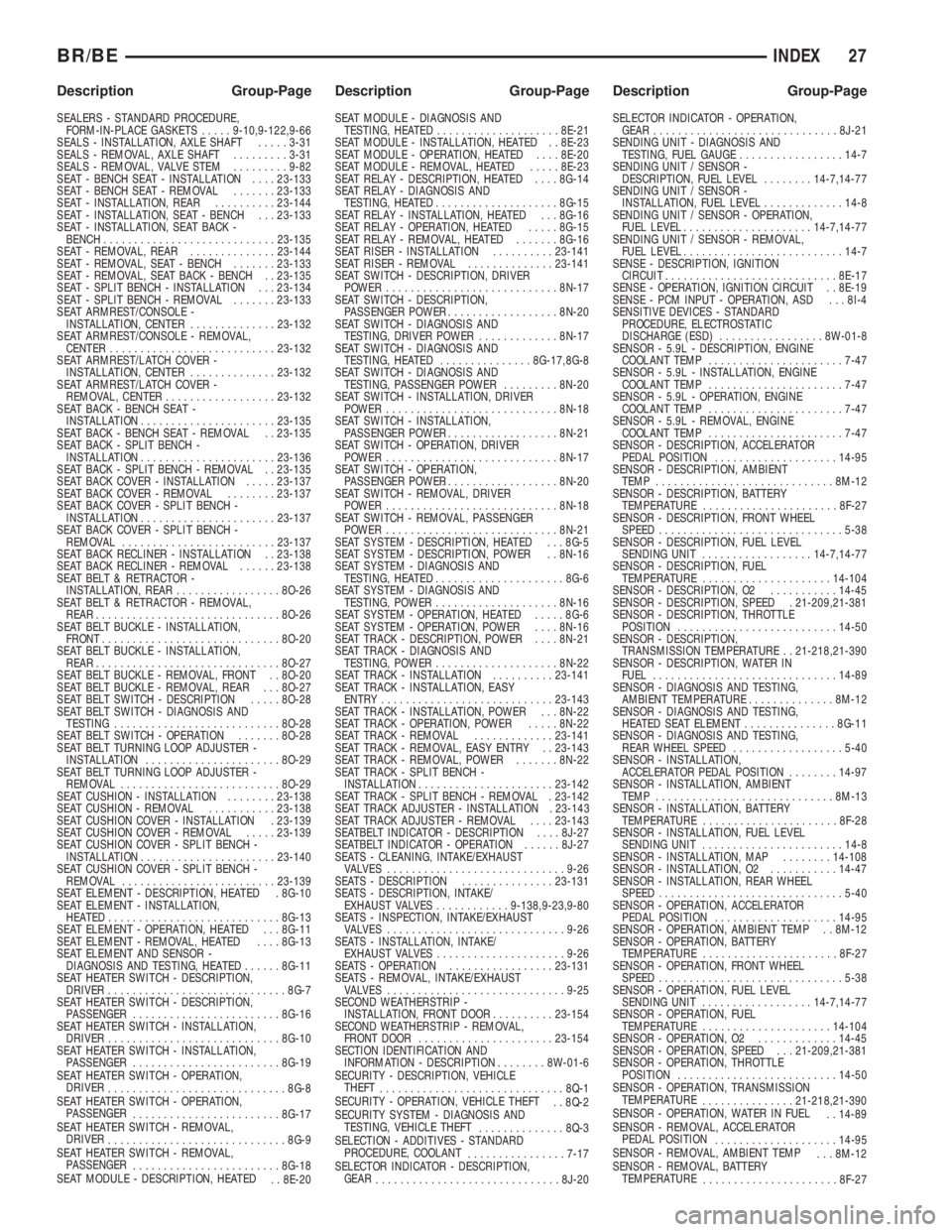
SEALERS - STANDARD PROCEDURE,
FORM-IN-PLACE GASKETS.....9-10,9-122,9-66
SEALS - INSTALLATION, AXLE SHAFT.....3-31
SEALS - REMOVAL, AXLE SHAFT.........3-31
SEALS - REMOVAL, VALVE STEM.........9-82
SEAT - BENCH SEAT - INSTALLATION....23-133
SEAT - BENCH SEAT - REMOVAL.......23-133
SEAT - INSTALLATION, REAR..........23-144
SEAT - INSTALLATION, SEAT - BENCH . . . 23-133
SEAT - INSTALLATION, SEAT BACK -
BENCH............................23-135
SEAT - REMOVAL, REAR..............23-144
SEAT - REMOVAL, SEAT - BENCH.......23-133
SEAT - REMOVAL, SEAT BACK - BENCH . . 23-135
SEAT - SPLIT BENCH - INSTALLATION . . . 23-134
SEAT - SPLIT BENCH - REMOVAL.......23-133
SEAT ARMREST/CONSOLE -
INSTALLATION, CENTER..............23-132
SEAT ARMREST/CONSOLE - REMOVAL,
CENTER...........................23-132
SEAT ARMREST/LATCH COVER -
INSTALLATION, CENTER..............23-132
SEAT ARMREST/LATCH COVER -
REMOVAL, CENTER..................23-132
SEAT BACK - BENCH SEAT -
INSTALLATION......................23-135
SEAT BACK - BENCH SEAT - REMOVAL . . 23-135
SEAT BACK - SPLIT BENCH -
INSTALLATION......................23-136
SEAT BACK - SPLIT BENCH - REMOVAL . . 23-135
SEAT BACK COVER - INSTALLATION.....23-137
SEAT BACK COVER - REMOVAL........23-137
SEAT BACK COVER - SPLIT BENCH -
INSTALLATION......................23-137
SEAT BACK COVER - SPLIT BENCH -
REMOVAL.........................23-137
SEAT BACK RECLINER - INSTALLATION . . 23-138
SEAT BACK RECLINER - REMOVAL......23-138
SEAT BELT & RETRACTOR -
INSTALLATION, REAR.................8O-26
SEAT BELT & RETRACTOR - REMOVAL,
REAR..............................8O-26
SEAT BELT BUCKLE - INSTALLATION,
FRONT.............................8O-20
SEAT BELT BUCKLE - INSTALLATION,
REAR..............................8O-27
SEAT BELT BUCKLE - REMOVAL, FRONT . . 8O-20
SEAT BELT BUCKLE - REMOVAL, REAR . . . 8O-27
SEAT BELT SWITCH - DESCRIPTION.....8O-28
SEAT BELT SWITCH - DIAGNOSIS AND
TESTING...........................8O-28
SEAT BELT SWITCH - OPERATION.......8O-28
SEAT BELT TURNING LOOP ADJUSTER -
INSTALLATION......................8O-29
SEAT BELT TURNING LOOP ADJUSTER -
REMOVAL..........................8O-29
SEAT CUSHION - INSTALLATION........23-138
SEAT CUSHION - REMOVAL...........23-138
SEAT CUSHION COVER - INSTALLATION . 23-139
SEAT CUSHION COVER - REMOVAL.....23-139
SEAT CUSHION COVER - SPLIT BENCH -
INSTALLATION......................23-140
SEAT CUSHION COVER - SPLIT BENCH -
REMOVAL.........................23-139
SEAT ELEMENT - DESCRIPTION, HEATED . 8G-10
SEAT ELEMENT - INSTALLATION,
HEATED............................8G-13
SEAT ELEMENT - OPERATION, HEATED . . . 8G-11
SEAT ELEMENT - REMOVAL, HEATED....8G-13
SEAT ELEMENT AND SENSOR -
DIAGNOSIS AND TESTING, HEATED......8G-11
SEAT HEATER SWITCH - DESCRIPTION,
DRIVER.............................8G-7
SEAT HEATER SWITCH - DESCRIPTION,
PASSENGER........................8G-16
SEAT HEATER SWITCH - INSTALLATION,
DRIVER............................8G-10
SEAT HEATER SWITCH - INSTALLATION,
PASSENGER........................8G-19
SEAT HEATER SWITCH - OPERATION,
DRIVER
.............................8G-8
SEAT HEATER SWITCH - OPERATION,
PASSENGER
........................8G-17
SEAT HEATER SWITCH - REMOVAL,
DRIVER
.............................8G-9
SEAT HEATER SWITCH - REMOVAL,
PASSENGER
........................8G-18
SEAT MODULE - DESCRIPTION, HEATED
. . 8E-20SEAT MODULE - DIAGNOSIS AND
TESTING, HEATED....................8E-21
SEAT MODULE - INSTALLATION, HEATED . . 8E-23
SEAT MODULE - OPERATION, HEATED....8E-20
SEAT MODULE - REMOVAL, HEATED.....8E-23
SEAT RELAY - DESCRIPTION, HEATED....8G-14
SEAT RELAY - DIAGNOSIS AND
TESTING, HEATED....................8G-15
SEAT RELAY - INSTALLATION, HEATED . . . 8G-16
SEAT RELAY - OPERATION, HEATED.....8G-15
SEAT RELAY - REMOVAL, HEATED.......8G-16
SEAT RISER - INSTALLATION..........23-141
SEAT RISER - REMOVAL..............23-141
SEAT SWITCH - DESCRIPTION, DRIVER
POWER............................8N-17
SEAT SWITCH - DESCRIPTION,
PASSENGER POWER..................8N-20
SEAT SWITCH - DIAGNOSIS AND
TESTING, DRIVER POWER.............8N-17
SEAT SWITCH - DIAGNOSIS AND
TESTING, HEATED...............8G-17,8G-8
SEAT SWITCH - DIAGNOSIS AND
TESTING, PASSENGER POWER.........8N-20
SEAT SWITCH - INSTALLATION, DRIVER
POWER............................8N-18
SEAT SWITCH - INSTALLATION,
PASSENGER POWER..................8N-21
SEAT SWITCH - OPERATION, DRIVER
POWER............................8N-17
SEAT SWITCH - OPERATION,
PASSENGER POWER...................8N-20
SEAT SWITCH - REMOVAL, DRIVER
POWER............................8N-18
SEAT SWITCH - REMOVAL, PASSENGER
POWER............................8N-21
SEAT SYSTEM - DESCRIPTION, HEATED . . . 8G-5
SEAT SYSTEM - DESCRIPTION, POWER . . 8N-16
SEAT SYSTEM - DIAGNOSIS AND
TESTING, HEATED.....................8G-6
SEAT SYSTEM - DIAGNOSIS AND
TESTING, POWER....................8N-16
SEAT SYSTEM - OPERATION, HEATED.....8G-6
SEAT SYSTEM - OPERATION, POWER....8N-16
SEAT TRACK - DESCRIPTION, POWER....8N-21
SEAT TRACK - DIAGNOSIS AND
TESTING, POWER....................8N-22
SEAT TRACK - INSTALLATION..........23-141
SEAT TRACK - INSTALLATION, EASY
ENTRY............................23-143
SEAT TRACK - INSTALLATION, POWER . . . 8N-22
SEAT TRACK - OPERATION, POWER.....8N-22
SEAT TRACK - REMOVAL.............23-141
SEAT TRACK - REMOVAL, EASY ENTRY . . 23-143
SEAT TRACK - REMOVAL, POWER.......8N-22
SEAT TRACK - SPLIT BENCH -
INSTALLATION......................23-142
SEAT TRACK - SPLIT BENCH - REMOVAL . 23-142
SEAT TRACK ADJUSTER - INSTALLATION . 23-143
SEAT TRACK ADJUSTER - REMOVAL....23-143
SEATBELT INDICATOR - DESCRIPTION....8J-27
SEATBELT INDICATOR - OPERATION......8J-27
SEATS - CLEANING, INTAKE/EXHAUST
VALVES .............................9-26
SEATS - DESCRIPTION...............23-131
SEATS - DESCRIPTION, INTAKE/
EXHAUST VALVES............9-138,9-23,9-80
SEATS - INSPECTION, INTAKE/EXHAUST
VALVES .............................9-26
SEATS - INSTALLATION, INTAKE/
EXHAUST VALVES.....................9-26
SEATS - OPERATION.................23-131
SEATS - REMOVAL, INTAKE/EXHAUST
VALVES .............................9-25
SECOND WEATHERSTRIP -
INSTALLATION, FRONT DOOR..........23-154
SECOND WEATHERSTRIP - REMOVAL,
FRONT DOOR......................23-154
SECTION IDENTIFICATION AND
INFORMATION - DESCRIPTION........8W-01-6
SECURITY - DESCRIPTION, VEHICLE
THEFT
..............................8Q-1
SECURITY - OPERATION, VEHICLE THEFT
. . 8Q-2
SECURITY SYSTEM - DIAGNOSIS AND
TESTING, VEHICLE THEFT
..............8Q-3
SELECTION - ADDITIVES - STANDARD
PROCEDURE, COOLANT
................7-17
SELECTOR INDICATOR - DESCRIPTION,
GEAR
..............................8J-20SELECTOR INDICATOR - OPERATION,
GEAR..............................8J-21
SENDING UNIT - DIAGNOSIS AND
TESTING, FUEL GAUGE.................14-7
SENDING UNIT / SENSOR -
DESCRIPTION, FUEL LEVEL........14-7,14-77
SENDING UNIT / SENSOR -
INSTALLATION, FUEL LEVEL.............14-8
SENDING UNIT / SENSOR - OPERATION,
FUEL LEVEL.....................14-7,14-77
SENDING UNIT / SENSOR - REMOVAL,
FUEL LEVEL..........................14-7
SENSE - DESCRIPTION, IGNITION
CIRCUIT............................8E-17
SENSE - OPERATION, IGNITION CIRCUIT . . 8E-19
SENSE - PCM INPUT - OPERATION, ASD . . . 8I-4
SENSITIVE DEVICES - STANDARD
PROCEDURE, ELECTROSTATIC
DISCHARGE (ESD).................8W-01-8
SENSOR - 5.9L - DESCRIPTION, ENGINE
COOLANT TEMP......................7-47
SENSOR - 5.9L - INSTALLATION, ENGINE
COOLANT TEMP......................7-47
SENSOR - 5.9L - OPERATION, ENGINE
COOLANT TEMP......................7-47
SENSOR - 5.9L - REMOVAL, ENGINE
COOLANT TEMP......................7-47
SENSOR - DESCRIPTION, ACCELERATOR
PEDAL POSITION....................14-95
SENSOR - DESCRIPTION, AMBIENT
TEMP.............................8M-12
SENSOR - DESCRIPTION, BATTERY
TEMPERATURE......................8F-27
SENSOR - DESCRIPTION, FRONT WHEEL
SPEED..............................5-38
SENSOR - DESCRIPTION, FUEL LEVEL
SENDING UNIT..................14-7,14-77
SENSOR - DESCRIPTION, FUEL
TEMPERATURE.....................14-104
SENSOR - DESCRIPTION, O2...........14-45
SENSOR - DESCRIPTION, SPEED . 21-209,21-381
SENSOR - DESCRIPTION, THROTTLE
POSITION..........................14-50
SENSOR - DESCRIPTION,
TRANSMISSION TEMPERATURE . . 21-218,21-390
SENSOR - DESCRIPTION, WATER IN
FUEL..............................14-89
SENSOR - DIAGNOSIS AND TESTING,
AMBIENT TEMPERATURE..............8M-12
SENSOR - DIAGNOSIS AND TESTING,
HEATED SEAT ELEMENT...............8G-11
SENSOR - DIAGNOSIS AND TESTING,
REAR WHEEL SPEED..................5-40
SENSOR - INSTALLATION,
ACCELERATOR PEDAL POSITION........14-97
SENSOR - INSTALLATION, AMBIENT
TEMP.............................8M-13
SENSOR - INSTALLATION, BATTERY
TEMPERATURE......................8F-28
SENSOR - INSTALLATION, FUEL LEVEL
SENDING UNIT.......................14-8
SENSOR - INSTALLATION, MAP........14-108
SENSOR - INSTALLATION, O2...........14-47
SENSOR - INSTALLATION, REAR WHEEL
SPEED..............................5-40
SENSOR - OPERATION, ACCELERATOR
PEDAL POSITION....................14-95
SENSOR - OPERATION, AMBIENT TEMP . . 8M-12
SENSOR - OPERATION, BATTERY
TEMPERATURE......................8F-27
SENSOR - OPERATION, FRONT WHEEL
SPEED..............................5-38
SENSOR - OPERATION, FUEL LEVEL
SENDING UNIT..................14-7,14-77
SENSOR - OPERATION, FUEL
TEMPERATURE.....................14-104
SENSOR - OPERATION, O2.............14-45
SENSOR - OPERATION, SPEED . . . 21-209,21-381
SENSOR - OPERATION, THROTTLE
POSITION..........................14-50
SENSOR - OPERATION, TRANSMISSION
TEMPERATURE
...............21-218,21-390
SENSOR - OPERATION, WATER IN FUEL
. . 14-89
SENSOR - REMOVAL, ACCELERATOR
PEDAL POSITION
....................14-95
SENSOR - REMOVAL, AMBIENT TEMP
. . . 8M-12
SENSOR - REMOVAL, BATTERY
TEMPERATURE
......................8F-27
BR/BEINDEX 27
Description Group-Page Description Group-Page Description Group-Page