warning DODGE RAM SRT-10 2006 Service Repair Manual
[x] Cancel search | Manufacturer: DODGE, Model Year: 2006, Model line: RAM SRT-10, Model: DODGE RAM SRT-10 2006Pages: 5267, PDF Size: 68.7 MB
Page 2165 of 5267
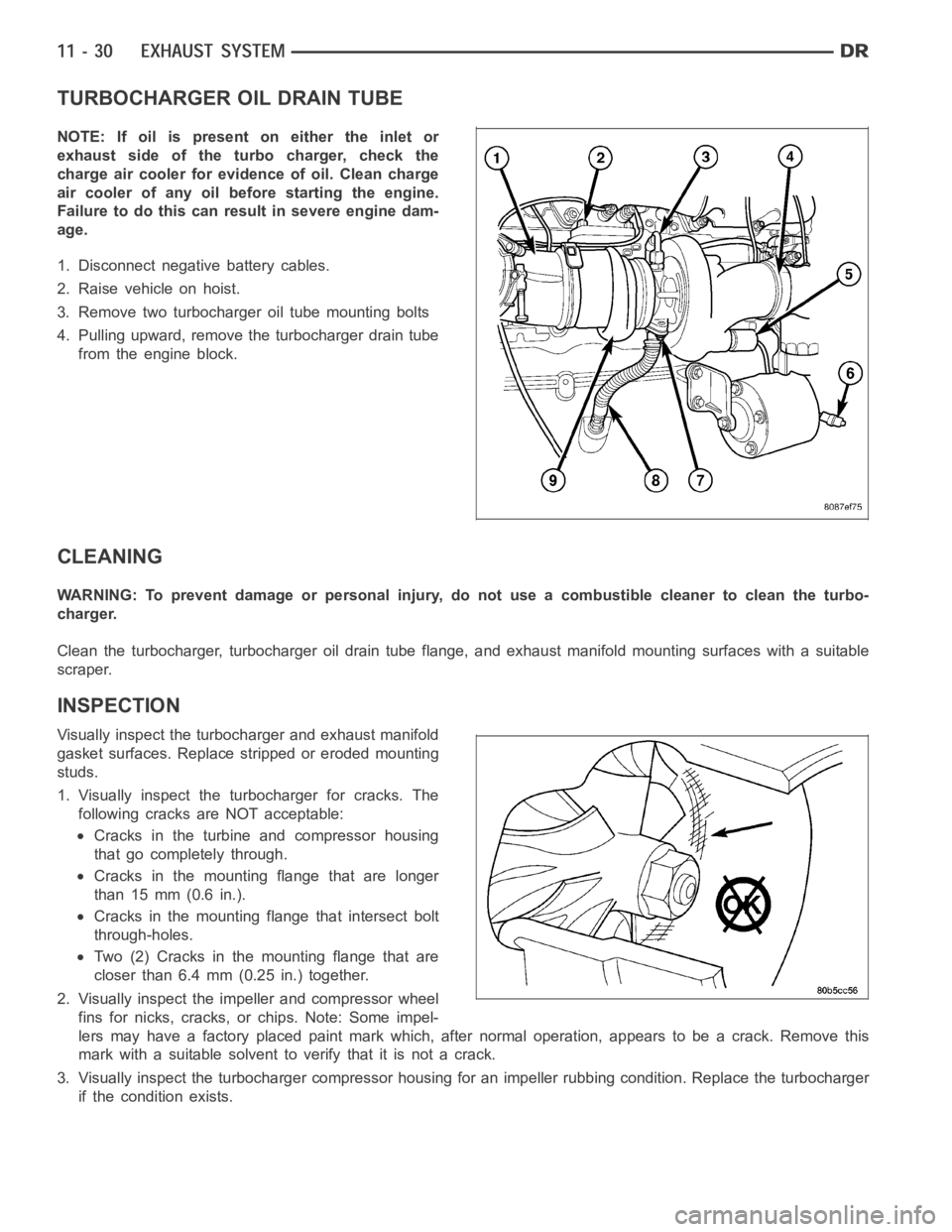
TURBOCHARGER OIL DRAIN TUBE
NOTE: If oil is present on either the inlet or
exhaust side of the turbo charger, check the
charge air cooler for evidence of oil. Clean charge
air cooler of any oil before starting the engine.
Failure to do this can result in severe engine dam-
age.
1. Disconnect negative battery cables.
2. Raise vehicle on hoist.
3. Remove two turbocharger oil tube mounting bolts
4. Pulling upward, remove the turbocharger drain tube
from the engine block.
CLEANING
WARNING: To prevent damage or personal injury, do not use a combustible cleaner to clean the turbo-
charger.
Clean the turbocharger, turbocharger oil drain tube flange, and exhaust manifold mounting surfaces with a suitable
scraper.
INSPECTION
Visually inspect the turbocharger and exhaust manifold
gasket surfaces. Replace stripped or eroded mounting
studs.
1. Visually inspect the turbocharger for cracks. The
following cracks are NOT acceptable:
Cracks in the turbine and compressor housing
that go completely through.
Cracks in the mounting flange that are longer
than 15 mm (0.6 in.).
Cracks in the mounting flange that intersect bolt
through-holes.
Two (2) Cracks in the mounting flange that are
closer than 6.4 mm (0.25 in.) together.
2. Visually inspect the impeller and compressor wheel
fins for nicks, cracks, or chips. Note: Some impel-
lers may have a factory placed paint mark which, after normal operation, appears to be a crack. Remove this
mark with a suitable solvent to verify that it is not a crack.
3. Visually inspect the turbocharger compressor housing for an impeller rubbing condition. Replace the turbocharger
if the condition exists.
Page 2170 of 5267
DIAGNOSIS AND TESTING
CHARGE AIR COOLER SYSTEM - LEAKS
Low turbocharger boost pressure and low engine per-
formance can be caused by leaks in the charge air
cooler or plumbing. Fuel staining on the exhaust man-
ifold can also be an indication that there are leaks in
the air system. The followingprocedure outlines how
to check for leaks in the charge air cooler system.
This procedure can also be used to check for leaks in
the wastegate signal line or the wastegate canister.
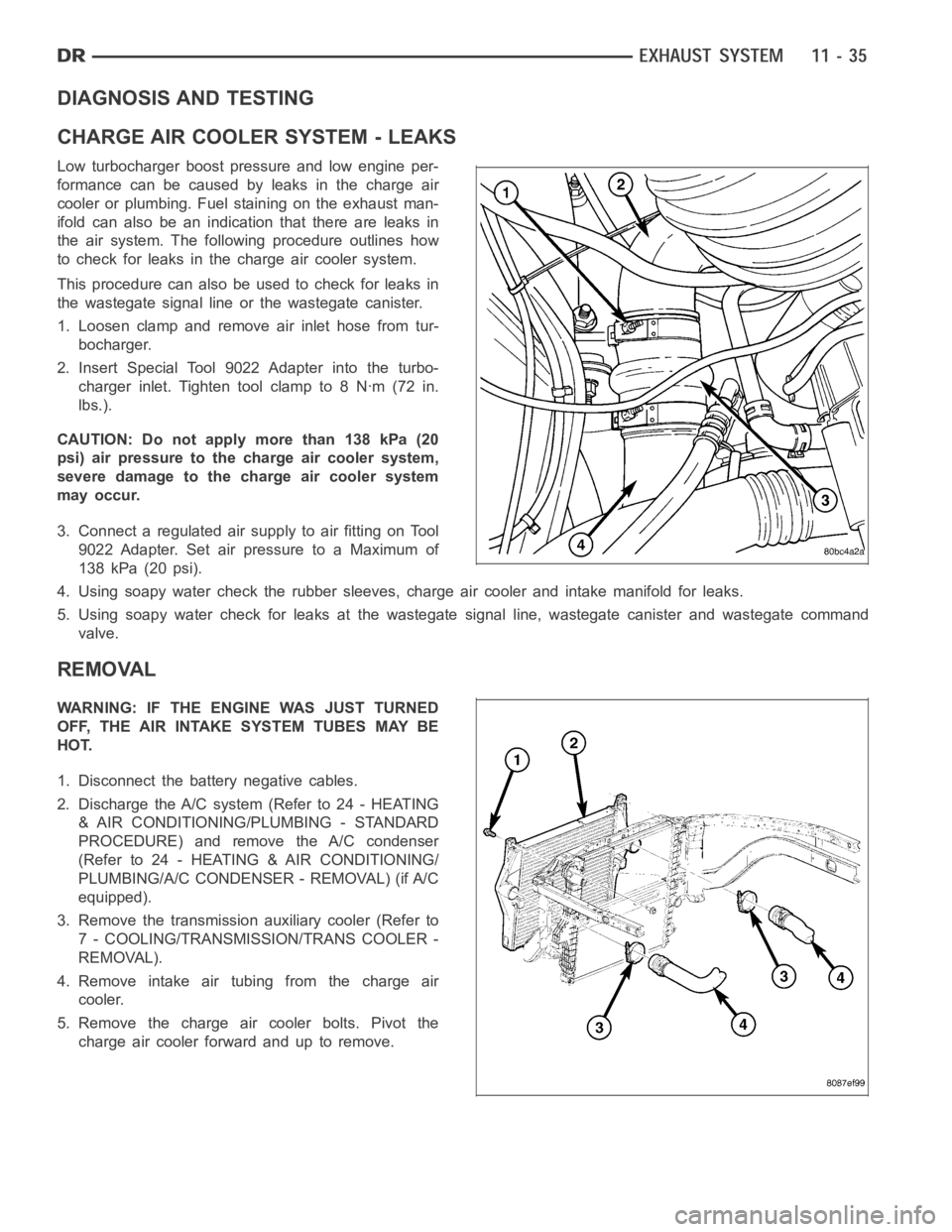
1. Loosen clamp and remove air inlet hose from tur-
bocharger.
2. Insert Special Tool 9022 Adapter into the turbo-
charger inlet. Tighten tool clamp to 8 Nꞏm (72 in.
lbs.).
CAUTION: Do not apply more than 138 kPa (20
psi) air pressure to the charge air cooler system,
severe damage to the charge air cooler system
may occur.
3. Connect a regulated air supply to air fitting on Tool
9022 Adapter. Set air pressure to a Maximum of
138 kPa (20 psi).
4. Using soapy water check the rubber sleeves, charge air cooler and intakemanifold for leaks.
5. Using soapy water check for leaks at the wastegate signal line, wastegate canister and wastegate command
valve.
REMOVAL
WARNING: IF THE ENGINE WAS JUST TURNED
OFF, THE AIR INTAKE SYSTEM TUBES MAY BE
HOT.
1. Disconnect the battery negative cables.
2. Discharge the A/C system (Refer to 24 - HEATING
& AIR CONDITIONING/PLUMBING - STANDARD
PROCEDURE) and remove the A/C condenser
(Refer to 24 - HEATING & AIR CONDITIONING/
PLUMBING/A/C CONDENSER - REMOVAL) (if A/C
equipped).
3. Remove the transmission auxiliary cooler (Refer to
7 - COOLING/TRANSMISSION/TRANS COOLER -
REMOVAL).
4. Remove intake air tubing from the charge air
cooler.
5. Remove the charge air cooler bolts. Pivot the
charge air cooler forward and up to remove.
Page 2174 of 5267
FRAME & BUMPERS
TABLE OF CONTENTS
page page
FRAMES & BUMPERS
SPECIFICATIONS
TORQUE .................................... 2
FRONT AIR DAM
REMOVAL ..................................... 3
INSTALLATION ................................ 3
FRONT BUMPER
REMOVAL ..................................... 4
INSTALLATION ................................ 4
FRONT FASCIA
REMOVAL ..................................... 5
INSTALLATION ................................ 6
REAR BUMPER
REMOVAL ..................................... 7
INSTALLATION ................................ 8
FASCIA-FRONT SRT-10
REMOVAL ..................................... 9
INSTALLATION ................................ 11
FASCIA-REAR SRT-10
REMOVAL .................................... 14
INSTALLATION ............................... 15
FRAME
WARNING
WARNINGS ................................ 17
STANDARD PROCEDURE
HYDROFORM FENDER RAIL REPAIR ........ 18REAR FRAME H-SECTION REPLACEMENT . . . 27
SPECIFICATIONS
WELD PROCESS ........................... 33
FRAME DIMENSIONS ....................... 34
TORQUE ................................... 45
FRONT CROSSMEMBER
REMOVAL .................................... 46
INSTALLATION ............................... 48
FRONT SKID PLATE
REMOVAL .................................... 50
INSTALLATION ............................... 51
FRONT TOW HOOK ASSEMBLY
REMOVAL .................................... 52
INSTALLATION ............................... 53
TRANSMISSION CROSSMEMBER
REMOVAL .................................... 54
INSTALLATION ............................... 56
TRAILER HITCH
REMOVAL .................................... 58
INSTALLATION ............................... 60
TRANSFER CASE SKID PLATE
REMOVAL .................................... 62
INSTALLATION ............................... 63
Page 2190 of 5267
FRAME
WARNING
WARNINGS
Use eye protection when grinding or welding metal. Failure to do this couldresult in serious personal injury
or death.
Before proceeding with frame repair involving grinding or welding, verify that the vehicle fuel system is not
leaking or in contact with the repair area. Failure to do this could result in serious personal injury or death.
Do not allow an open flame or heat and metal spatter from arc welding to contact plastic body panels. Fire,
explosion can result causing serious personal injury or death.
When welded frame components are replaced, ensure that a complete penetration weld is achieved during
installation. If not, dangerous operating conditions can result.
Stand clear of cables or chains on pulling equipment during frame straightening operations. Failure to do
this can result in serious personal injury or death.
Do not venture under a hoisted vehicle that is not supported on safety stands. Walking under an unsup-
ported vehicle can result in serious personal injury or death.
1500 series Dodge Ram Trucks (2002 and later) are not designed for snow plowequipment. The front col-
lision repair tips must not be installed on any truck equipped with a snow plow, or even intended to be
equipped with a snow plow.
Do not reuse damaged fasteners. The quality of repair would be suspect. Failure to use only production
fasteners or fasteners of equivalent hardness can result in loosening or failure of the part. Do not drill any
holes in the frame that are not specifically outlined in this, or in other DaimlerChrysler procedures as frame
rail failure can result causing serious personal injury or death. When using heat to straighten frame com-
ponents, do not exceed 566°C (1050°F). If temperature is exceeded, metal fatigue can happen and result in
serious personal injury or death.
Page 2191 of 5267
STANDARD PROCEDURE
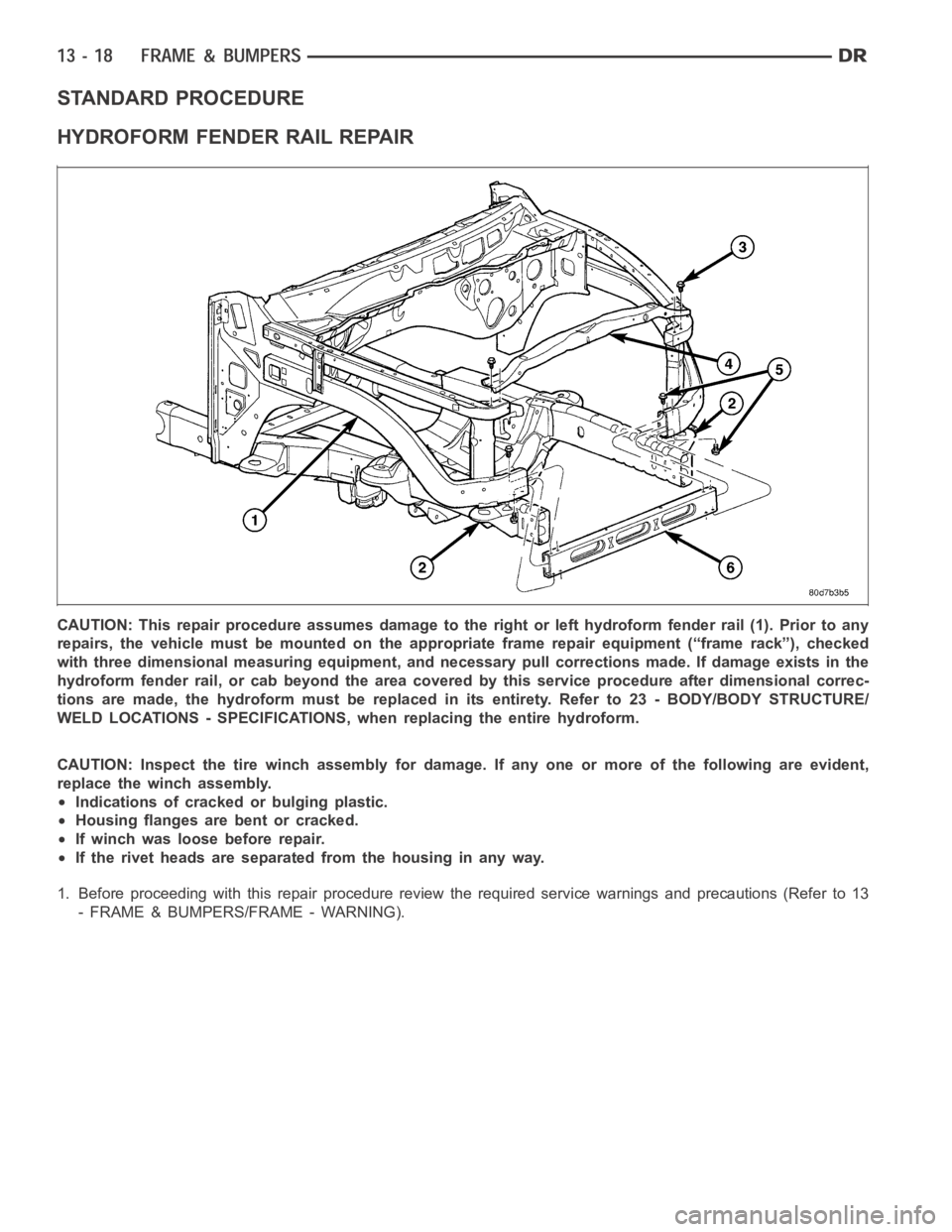
HYDROFORM FENDER RAIL REPAIR
CAUTION: This repair procedure assumes damage to the right or left hydroform fender rail (1). Prior to any
repairs, the vehicle must be mounted on the appropriate frame repair equipment (“frame rack”), checked
with three dimensional measuring equipment, and necessary pull corrections made. If damage exists in the
hydroform fender rail, or cab beyond the area covered by this service procedure after dimensional correc-
tions are made, the hydroform must be replaced in its entirety. Refer to 23 -BODY/BODY STRUCTURE/
WELD LOCATIONS - SPECIFICATIONS, when replacing the entire hydroform.
CAUTION: Inspect the tire winch assembly for damage. If any one or more of thefollowingareevident,
replace the winch assembly.
Indications of cracked or bulging plastic.
Housing flanges are bent or cracked.
If winch was loose before repair.
If the rivet heads are separated from the housing in any way.
1. Before proceeding with this repair procedure review the required service warnings and precautions (Refer to 13
- FRAME & BUMPERS/FRAME - WARNING).
Page 2200 of 5267
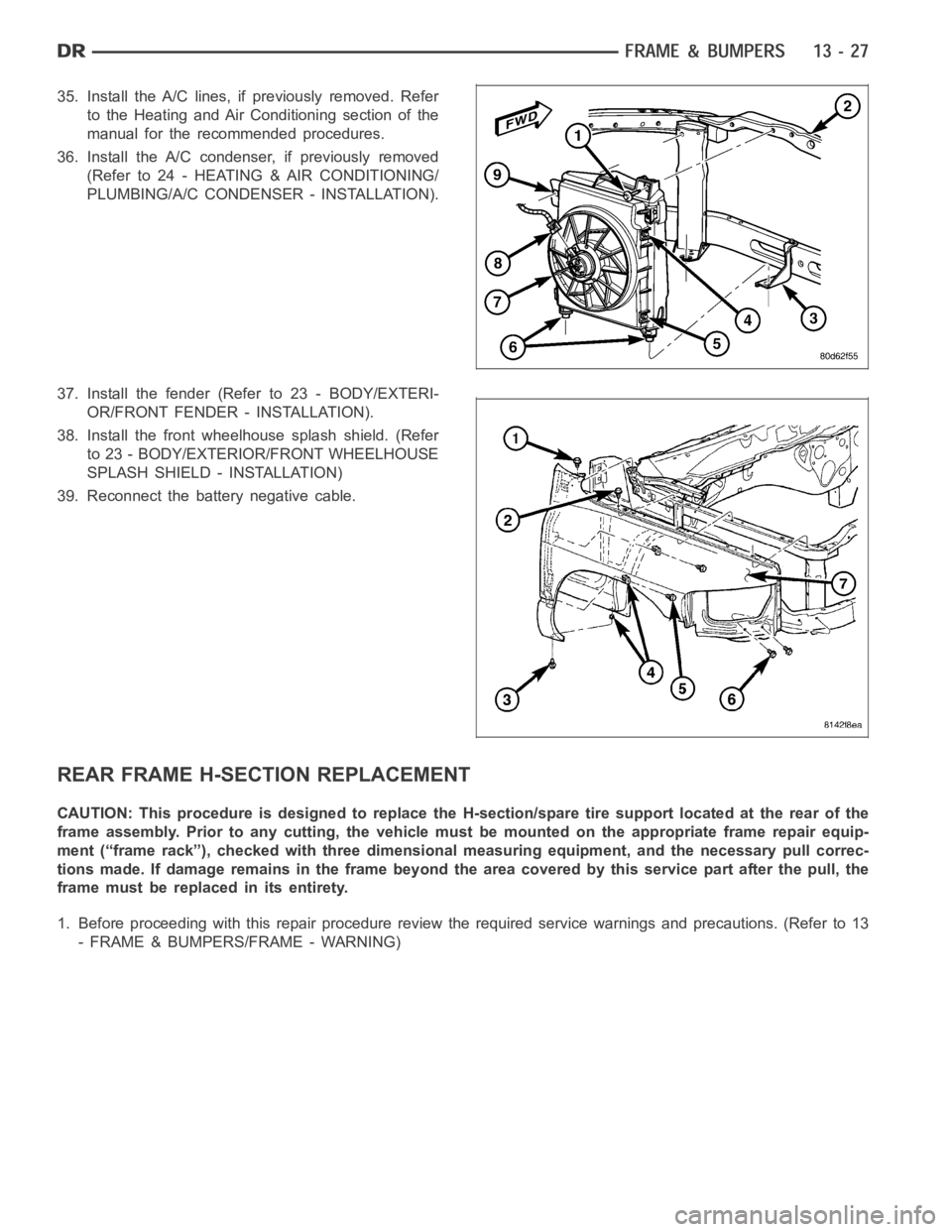
35. Install the A/C lines, if previously removed. Refer
to the Heating and Air Conditioning section of the
manual for the recommended procedures.
36. Install the A/C condenser, if previously removed
(Refer to 24 - HEATING & AIR CONDITIONING/
PLUMBING/A/C CONDENSER - INSTALLATION).
37. Install the fender (Refer to 23 - BODY/EXTERI-
OR/FRONT FENDER - INSTALLATION).
38. Install the front wheelhouse splash shield. (Refer
to 23 - BODY/EXTERIOR/FRONT WHEELHOUSE
SPLASH SHIELD - INSTALLATION)
39. Reconnect the battery negative cable.
REAR FRAME H-SECTION REPLACEMENT
CAUTION: This procedure is designed to replace the H-section/spare tire support located at the rear of the
frame assembly. Prior to any cutting, the vehicle must be mounted on the appropriate frame repair equip-
ment (“frame rack”), checked with three dimensional measuring equipment, and the necessary pull correc-
tions made. If damage remains in the frame beyond the area covered by this service part after the pull, the
frame must be replaced in its entirety.
1. Before proceeding with this repair procedure review the required service warnings and precautions. (Refer to 13
- FRAME & BUMPERS/FRAME - WARNING)
Page 2242 of 5267
8. Connect other end of jumper wire to positive side of battery.
9. Connect one end of a second jumper wire to remaining injector terminal.
CAUTION: Powering an injector for more than a few seconds will permanentlydamage the injector.
10. Momentarily touch other end of jumper wire to negative terminal of battery for no more than a few seconds.
11. Place a rag or towel below fuel line quick-connect fitting at fuel rail.
12. Disconnect quick-connect fitting at fuel rail. Refer to Quick-Connect Fittings.
13. Return fuel pump relay to PDC.
14. One or more Diagnostic Trouble Codes (DTC’s) may have been stored in PCMmemory due to fuel pump relay
removal. The DRB
scantoolmustbeusedtoeraseaDTC.
STANDARD PROCEDURE - DRAINING FUEL TANK - EXCEPT DIESEL
WARNING: The fuel system may be under constant fuel pressure even with the engine off. This pressure
must be released before servicing fuel tank.
Two different procedures may be used to drain fuel tank: through the fuel fill fitting on tank, or using a diagnostic
scan tool to activate the fuel pump relay. Due to a one-way check valve installed into the fuel fill opening fitting at
the tank, the tank cannot be drained conventionally at the fill cap.
The quickest draining procedure involves removing the rubber fuel fill hose at the fuel tank.
As an alternative procedure, the electric fuel pump may be activated allowingtanktobedrainedatfuelrailcon-
nection. Refer to diagnostic scan tool for fuel pump activation procedures. Before disconnecting fuel line at fuel rail,
release fuel pressure. Refer to the Fuel System Pressure Release Procedure for procedures. Attach end of special
test hose tool number 6631 or 6539 at fuel rail disconnection (tool number 6631isusedon5/16”fuellineswhile
tool number 6539 is used on 3/8” fuel lines). Position opposite end of this hose tool to an approved gasoline drain-
ing station. Activate fuel pump and drain tank until empty.
If electric fuel pump is not operating, fuel must be drained through fuel fill fitting at tank. Refer to following proce-
dures.
1. Release fuel system pressure.
2. Raise vehicle.
3. Thoroughly clean area around fuel fill fitting and rubber fuel fill hoseat tank.
4. If vehicle is equipped with 4 doors and a 6 foot (short) box, remove left-rear tire/wheel.
5. Loosen clamp and disconnect rubber fuel fill hose at tank fitting. Usingan approved gas holding tank, drain fuel
tank through this fitting.
SPECIFICATIONS
FUEL SYSTEM PRESSURE
58 psi +/- 2 psi
TORQUE - EXCEPT DIESEL
DESCRIPTION N-m Ft. Lbs. In. Lbs.
Accelerator Pedal Bracket
Mounting12 - 105
Accelerator Pedal Position
Sensor Bracket-to-Battery
Tray Bolts3-30
Crankshaft Position
Sensor - 3.7L28 21 -
Crankshaft Position
Sensor - 4.7L28 21 -
Page 2249 of 5267
LINES, FUEL
DESCRIPTION
Also refer to Quick-Connect Fittings.
WARNING: The fuel system may be under a constant pressure (even with the engine off). Before servicing
any fuel system hoses, fittings, lines, or most components, fuel system pressure must be released. Refer to
the fuel system pressure release procedure.
The lines/tubes/hoses used on fuel injected vehicles are of a special construction. This is due to the higher fuel
pressures and the possibility of contaminated fuel in this system. If it isnecessary to replace these lines/tubes/
hoses, only those marked EFM/EFI may be used.
If equipped:The hose clamps used to secure rubber hoses on fuel injected vehicles are ofa special rolled edge
construction. This construction is used to prevent the edge of the clamp from cutting into the hose. Only these rolled
edge type clamps may be used in this system. All other types of clamps may cutinto the hoses and cause high-
pressure fuel leaks.
Use new original equipment type hose clamps.
Page 2250 of 5267
FITTING-QUICK CONNECT
DESCRIPTION
Different types of quick-connect fittings are used to attach the various fuel system components, lines and tubes.
These are: a single-button type, a two-button type, a pinch type, a single-tab type, a two-tab type or a plastic
retainer ring type. Some are equipped with safety latch clips. Some may require the use of a special tool for dis-
connection and removal. (Refer to 14 - FUEL SYSTEM/FUEL DELIVERY/QUICK CONNECT FITTING - STANDARD
PROCEDURE)
CAUTION: Before separating a quick-connect fitting, pay attention to whattypeoffittingisbeingusedby
referring to Quick-Connect Fitting Removal. This will prevent unnecessary fitting or fitting latch breakage.
CAUTION: The interior components (O-rings, clips) of quick-connect fittings are not serviced separately, but
new plastic spacers and latches are available for some types. If service parts are not available, do not
attempt to repair the damaged fitting or fuel line (tube). If repair is necessary, replace the complete fuel line
(tube) assembly.
STANDARD PROCEDURE - QUICK-CONNECT FITTINGS
Different types of quick-connect fittings are used to attach the various fuel system components, lines and tubes.
These are: a single-button type, a two-button type, a pinch type, a single-tab type, a two-tab type or a plastic
retainer ring type. Some are equipped with safety latch clips. Some may require the use of a special tool for dis-
connection and removal.
DISCONNECTING
WARNING: The fuel system is under a constant pressure (even with engine off). Before servicing any fuel
system hose, fitting or line, fuel system pressure must be released. Referto fuel system pressure release
procedure.
CAUTION: Before separating a quick-connect fitting, pay attention to whattypeoffittingisbeingusedby
referring to Quick-Connect Fitting Removal. This will prevent unnecessary fitting or fitting latch breakage.
CAUTION: The interior components (O-rings, clips) of quick-connect fittings are not serviced separately, but
new plastic spacers and latches are available for some types. If service parts are not available, do not
attempt to repair the damaged fitting or fuel line (tube). If repair is necessary, replace the complete fuel line
(tube) assembly.
1. Perform fuel pressure release procedure. Refer to Fuel Pressure Release Procedure.
2. Disconnect negative battery cable from battery.
3. Clean fitting of any foreign material before disassembly.
Page 2257 of 5267
MODULE - FUEL PUMP
DESCRIPTION
The fuel pump module assembly is located on the top of the fuel tank. The complete assembly contains the fol-
lowing components:
A combination fuel filter/fuel pressure regulator
A separate fuel pick-up, or inlet filter
An electric fuel pump
Alockringtoretainpumpmoduletotank
A soft gasket between tank flange and module
A fuel gauge sending unit (fuel level sensor)
Fuel line connection
The fuel gauge sending unit may be serviced separately. If the electrical fuel pump, primary inlet filter, fuel filter or
fuel pressure regulator require service, the fuel pump module must be replaced.
OPERATION
Refer to Fuel Pump, Inlet Filter, Fuel Filter / Fuel Pressure Regulator andFuel Gauge Sending Unit.
REMOVAL
WARNING: The fuel system may be under a constant pressure (even with the engine off). Before servicing
the fuel pump module, the fuel system pressure must be released.
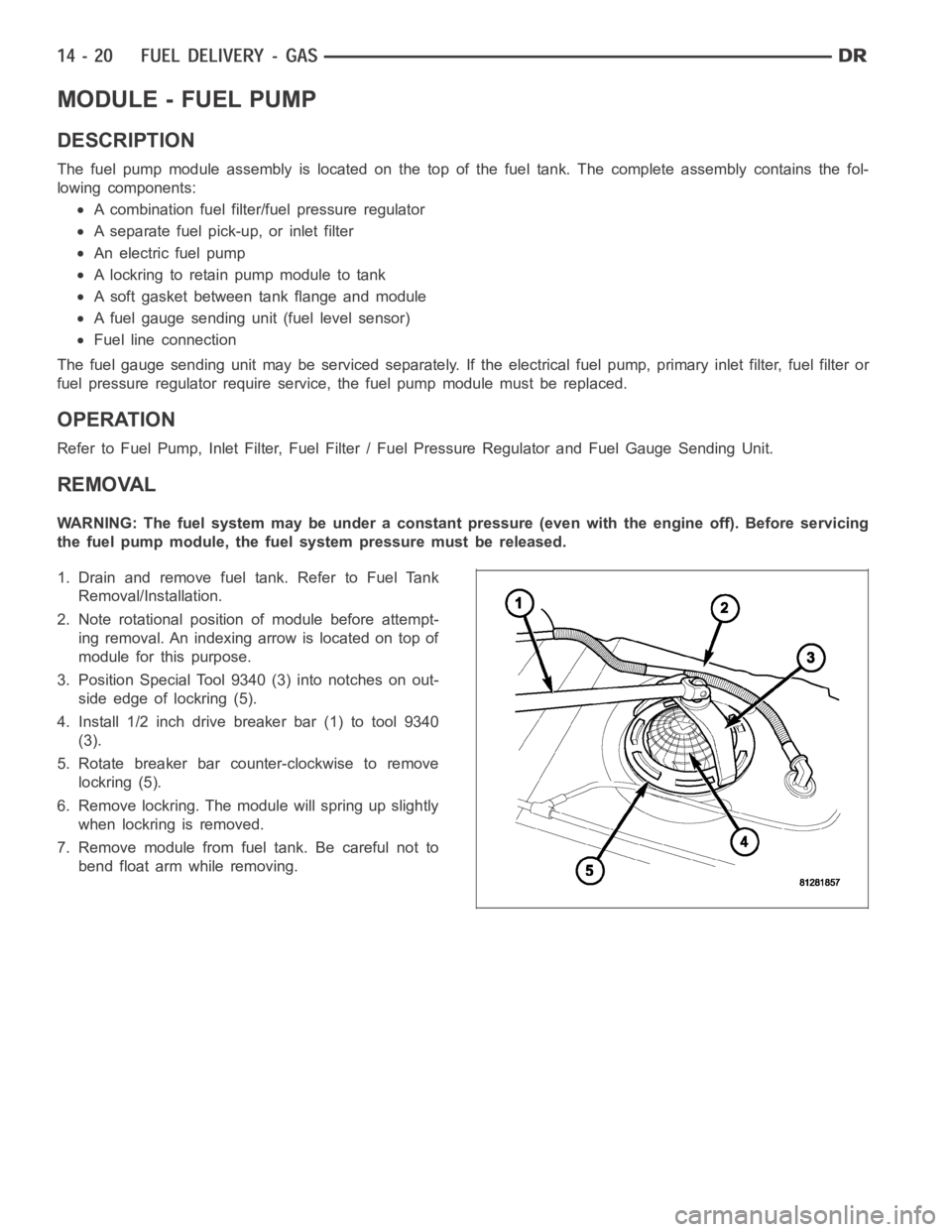
1. Drain and remove fuel tank. Refer to Fuel Tank
Removal/Installation.
2. Note rotational position of module before attempt-
ing removal. An indexing arrow is located on top of
module for this purpose.
3. Position Special Tool 9340 (3) into notches on out-
side edge of lockring (5).
4. Install 1/2 inch drive breaker bar (1) to tool 9340
(3).
5. Rotate breaker bar counter-clockwise to remove
lockring (5).
6. Remove lockring. The module will spring up slightly
when lockring is removed.
7. Remove module from fuel tank. Be careful not to
bend float arm while removing.