warning DODGE RAM SRT-10 2006 Service Repair Manual
[x] Cancel search | Manufacturer: DODGE, Model Year: 2006, Model line: RAM SRT-10, Model: DODGE RAM SRT-10 2006Pages: 5267, PDF Size: 68.7 MB
Page 2259 of 5267
RAIL - FUEL
DESCRIPTION
The fuel injector rail is used to mount the fuel injectors to the engine.
OPERATION
High pressure from the fuel pump is routed to the fuel rail. The fuel rail then supplies the necessary fuel to each
individual fuel injector.
A quick-connect fitting with a safety latch clip is used to attach the fuel linetothefuelrail.
The fuel rail is not repairable.
CAUTION: The left and right sections of the fuel rail are connected with either a flexible connecting hose, or
joints. Do not attempt to separate the rail halves at these connecting hoseor joints. Due to the design of
the connecting hose or joint, it does not use any clamps. Never attempt to install a clamping device of any
kind to the hose or joint. When removing the fuel rail assembly for any reason, be careful not to bend or
kink the connecting hose or joint.
REMOVAL
3.7L V-6
WARNING: The fuel system is under constant pressure even with engine off. Before servicing fuel rail, fuel
system pressure must be released.
CAUTION: The left and right fuel rails are replaced as an assembly. Do not attempt to separate rail halves
at connector tubes. Due to design of tubes, it does not use any clamps. Neverattempt to install a clamping
device of any kind to tubes. When removing fuel rail assembly for any reason, be careful not to bend or
kink tubes.
1. Remove fuel tank filler tube cap.
2. Perform Fuel System Pressure Release Procedure.
(Refer to 14 - FUEL SYSTEM/FUEL DELIVERY -
STANDARD PROCEDURE)
3. Remove negative battery cable at battery.
4. Remove air duct at throttle body air box.
5. Remove air box at throttle body.
6. Remove air resonator mounting bracket at front of
throttle body (2 bolts).
7. Disconnect fuel line latch clip and fuel line at fuel
rail. A special tool will be necessary for fuel line
disconnection. (Refer to 14 - FUEL SYSTEM/FUEL
DELIVERY/QUICK CONNECT FITTING - STAN-
DARD PROCEDURE)
8. Remove necessary vacuumlines at throttle body.
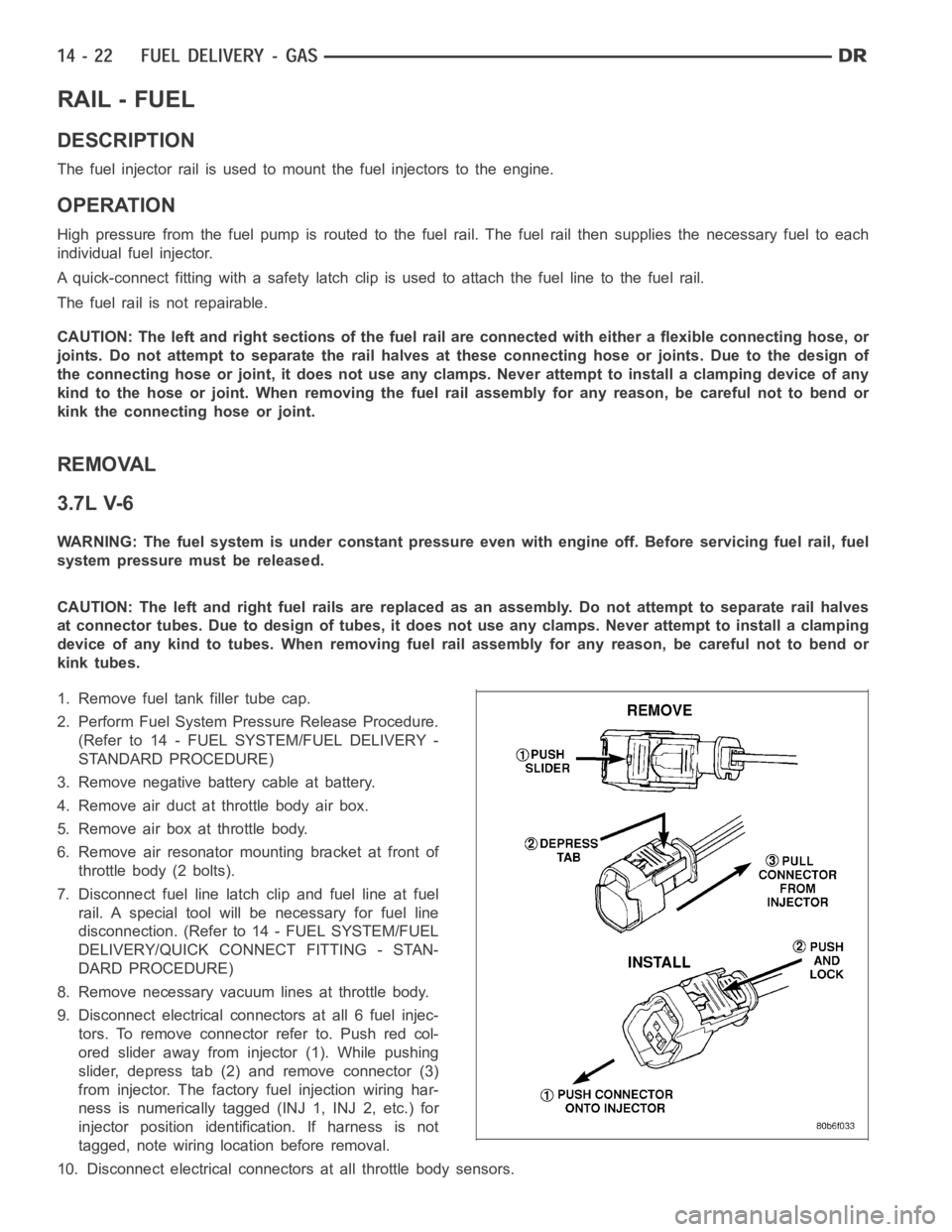
9. Disconnect electrical connectors at all 6 fuel injec-
tors. To remove connector refer to. Push red col-
ored slider away from injector (1). While pushing
slider, depress tab (2) and remove connector (3)
from injector. The factory fuel injection wiring har-
ness is numerically tagged (INJ 1, INJ 2, etc.) for
injector position identification. If harness is not
tagged, note wiring location before removal.
10. Disconnect electrical connectors at all throttle body sensors.
Page 2260 of 5267
11. Remove 6 ignition coils. (Refer to 8 - ELECTRICAL/IGNITION CONTROL/IGNITION COIL - REMOVAL)
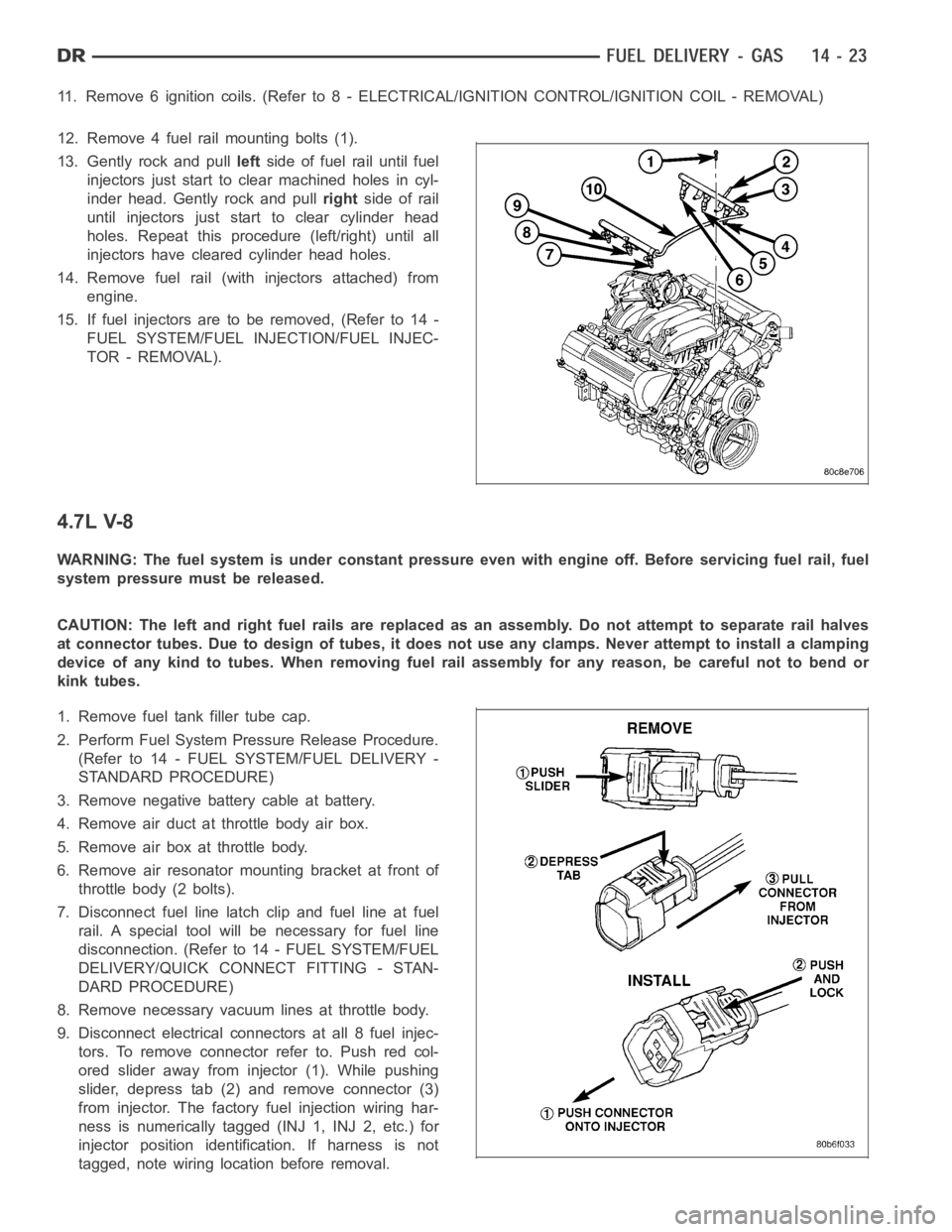
12. Remove 4 fuel rail mounting bolts (1).
13. Gently rock and pullleftside of fuel rail until fuel
injectors just start to clear machined holes in cyl-
inder head. Gently rock and pullrightside of rail
until injectors just start to clear cylinder head
holes. Repeat this procedure (left/right) until all
injectors have cleared cylinder head holes.
14. Remove fuel rail (with injectors attached) from
engine.
15. If fuel injectors are to be removed, (Refer to 14 -
FUEL SYSTEM/FUEL INJECTION/FUEL INJEC-
TOR - REMOVAL).
4.7L V-8
WARNING: The fuel system is under constant pressure even with engine off. Before servicing fuel rail, fuel
system pressure must be released.
CAUTION: The left and right fuel rails are replaced as an assembly. Do not attempt to separate rail halves
at connector tubes. Due to design of tubes, it does not use any clamps. Neverattempt to install a clamping
device of any kind to tubes. When removing fuel rail assembly for any reason, be careful not to bend or
kink tubes.
1. Remove fuel tank filler tube cap.
2. Perform Fuel System Pressure Release Procedure.
(Refer to 14 - FUEL SYSTEM/FUEL DELIVERY -
STANDARD PROCEDURE)
3. Remove negative battery cable at battery.
4. Remove air duct at throttle body air box.
5. Remove air box at throttle body.
6. Remove air resonator mounting bracket at front of
throttle body (2 bolts).
7. Disconnect fuel line latch clip and fuel line at fuel
rail. A special tool will be necessary for fuel line
disconnection. (Refer to 14 - FUEL SYSTEM/FUEL
DELIVERY/QUICK CONNECT FITTING - STAN-
DARD PROCEDURE)
8. Remove necessary vacuumlines at throttle body.
9. Disconnect electrical connectors at all 8 fuel injec-
tors. To remove connector refer to. Push red col-
ored slider away from injector (1). While pushing
slider, depress tab (2) and remove connector (3)
from injector. The factory fuel injection wiring har-
ness is numerically tagged (INJ 1, INJ 2, etc.) for
injector position identification. If harness is not
tagged, note wiring location before removal.
Page 2261 of 5267
10. Disconnect electrical connectors at all throttle body sensors.
11. Remove 8 ignition coils. (Refer to 8 - ELECTRICAL/IGNITION CONTROL/IGNITION COIL - REMOVAL)
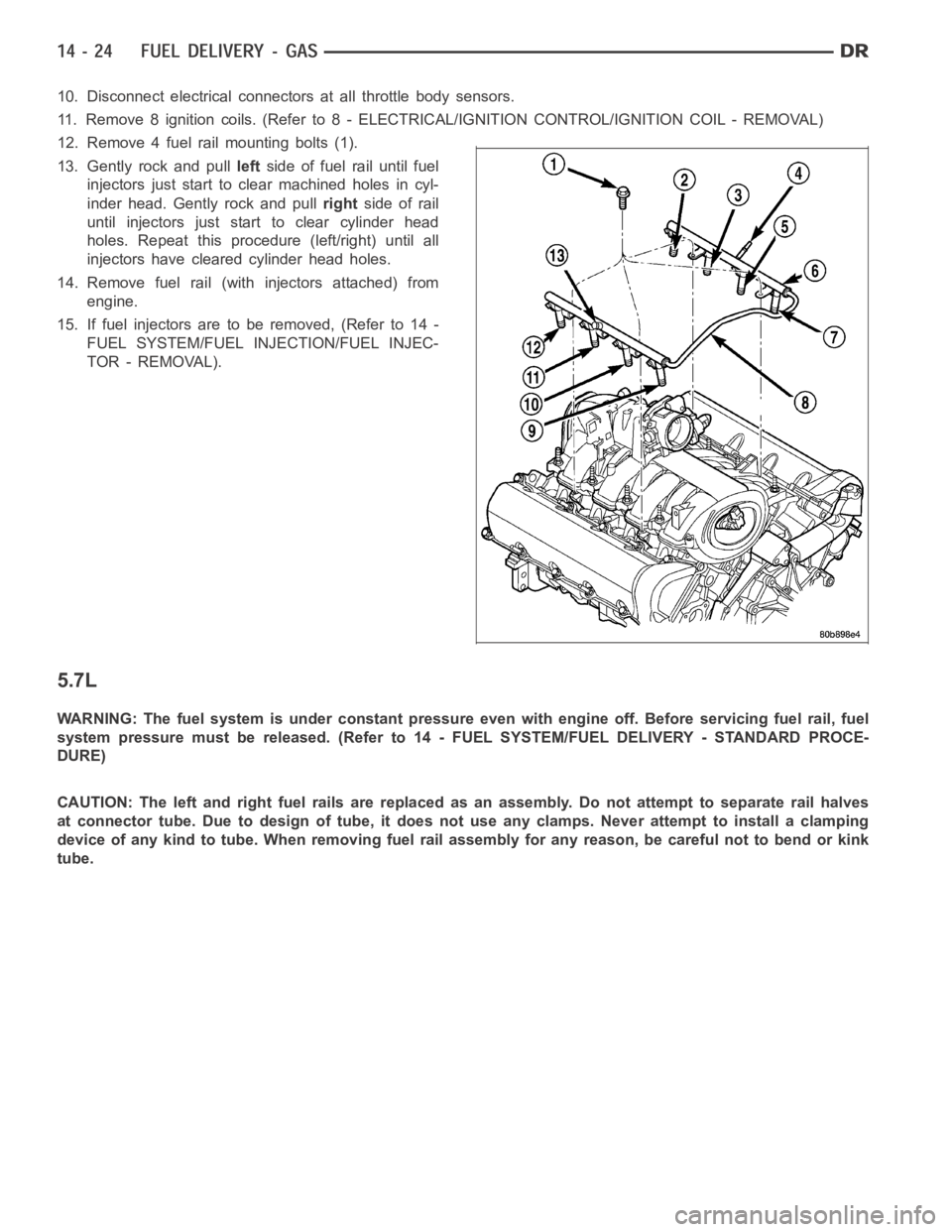
12. Remove 4 fuel rail mounting bolts (1).
13. Gently rock and pullleftside of fuel rail until fuel
injectors just start to clear machined holes in cyl-
inder head. Gently rock and pullrightside of rail
until injectors just start to clear cylinder head
holes. Repeat this procedure (left/right) until all
injectors have cleared cylinder head holes.
14. Remove fuel rail (with injectors attached) from
engine.
15. If fuel injectors are to be removed, (Refer to 14 -
FUEL SYSTEM/FUEL INJECTION/FUEL INJEC-
TOR - REMOVAL).
5.7L
WARNING: The fuel system is under constant pressure even with engine off. Before servicing fuel rail, fuel
system pressure must be released. (Refer to 14 - FUEL SYSTEM/FUEL DELIVERY- STANDARD PROCE-
DURE)
CAUTION: The left and right fuel rails are replaced as an assembly. Do not attempt to separate rail halves
at connector tube. Due to design of tube, it does not use any clamps. Never attempt to install a clamping
device of any kind to tube. When removing fuel rail assembly for any reason,be careful not to bend or kink
tube.
Page 2321 of 5267
SENSOR - OXYGEN
DESCRIPTION
The Oxygen Sensors (O2S) are attached to, and protrude into the vehicle exhaust system. Depending on the
engine or emission package, the vehicle may use a total of either 2 or 4 sensors.
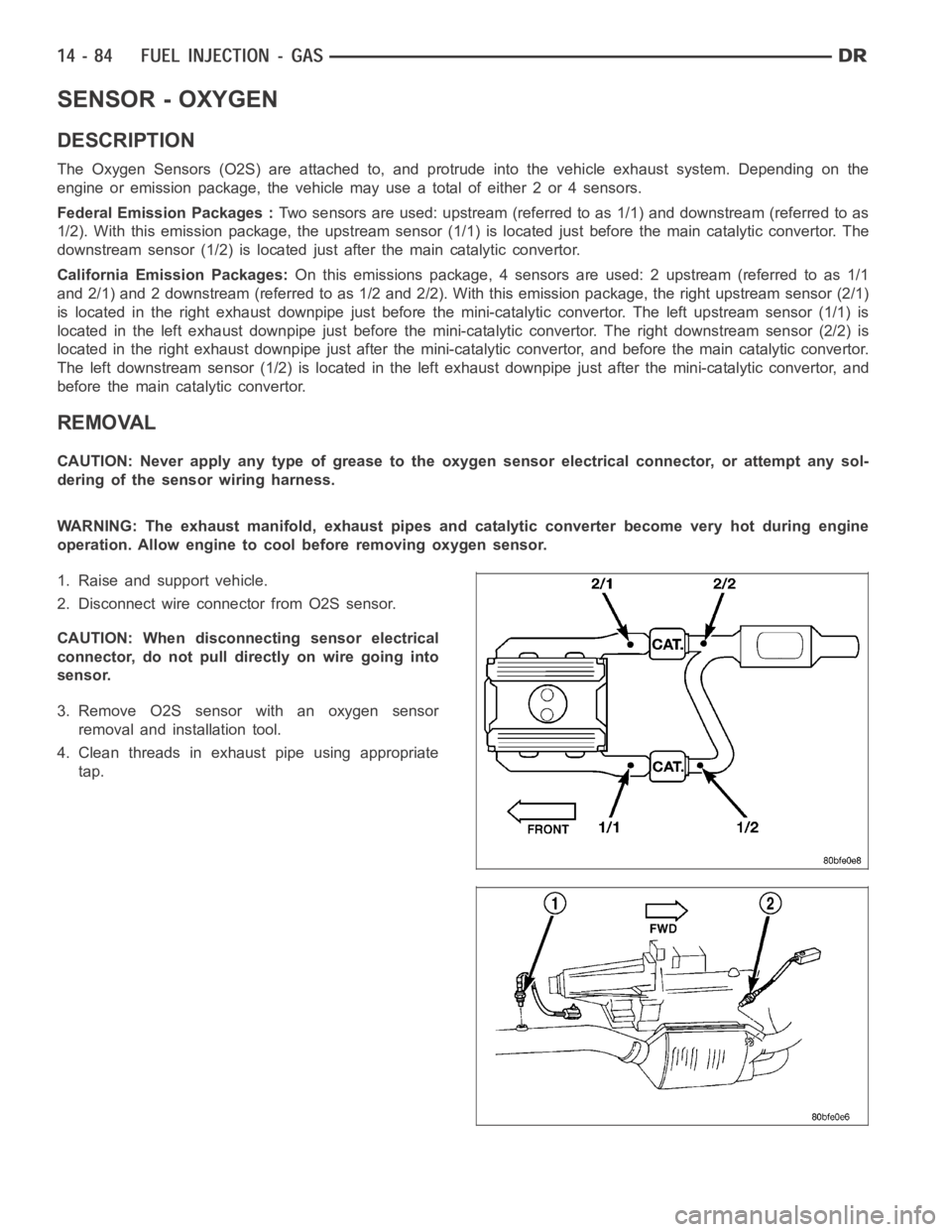
Federal Emission Packages :Two sensors are used: upstream (referred to as 1/1) and downstream (referred to as
1/2). With this emission package, the upstream sensor (1/1) is located just before the main catalytic convertor. The
downstream sensor (1/2) is located just after the main catalytic convertor.
California Emission Packages:On this emissions package, 4 sensors are used: 2 upstream (referred to as 1/1
and 2/1) and 2 downstream (referred to as 1/2 and 2/2). With this emission package, the right upstream sensor (2/1)
is located in the right exhaust downpipe just before the mini-catalytic convertor. The left upstream sensor (1/1) is
located in the left exhaust downpipe just before the mini-catalytic convertor. The right downstream sensor (2/2) is
located in the right exhaust downpipe just after the mini-catalytic convertor, and before the main catalytic convertor.
The left downstream sensor (1/2) is located in the left exhaust downpipe just after the mini-catalytic convertor, and
before the main catalytic convertor.
REMOVAL
CAUTION: Never apply any type of grease to the oxygen sensor electrical connector, or attempt any sol-
dering of the sensor wiring harness.
WARNING: The exhaust manifold, exhaust pipes and catalytic converter become very hot during engine
operation. Allow engine to cool before removing oxygen sensor.
1. Raise and support vehicle.
2. Disconnect wire connector from O2S sensor.
CAUTION: When disconnecting sensor electrical
connector, do not pull directly on wire going into
sensor.
3. Remove O2S sensor with an oxygen sensor
removal and installation tool.
4. Clean threads in exhaust pipe using appropriate
tap.
Page 2342 of 5267
FUEL DELIVERY - DIESEL
DESCRIPTION - DIESEL FUEL SYSTEM
WARNING: High-pressure fuel lines deliver diesel
fuel under extreme pressure from the injection
pump to the fuel injectors. This may be as high as
160,000 kpa (23,206 psi). Use extreme caution
when inspecting for high-pressure fuel leaks.
Inspect for high-pressure fuel leaks with a sheet of
cardboard. High fuel injection pressure can cause
personal injury if contact is made with the skin.
The fuel system used on the Cummins engine is an electronically controlled, Bosch HPCR (High-Pressure Common
Rail) system. The HPCR system consists of five main components:
Electric Fuel Transfer (lift) Pump Located in the Fuel Tank
Fuel Pump/Gear Pump (attached to fuel injection pump)
High-Pressure Fuel Injection Pump
Fuel Injection Rail
Fuel Injectors
Also to be considered as part of the overall fuel system are:
Accelerator Pedal
Air Cleaner Housing/Element
Check Valve Banjo Fitting at Rear of Cylinder Head
Fuel Connector Tubes
Fuel Drain Manifold (passage)
Fuel Drain Valve (at filter)
Fuel Filter/Water Separator
Fuel Heater
Fuel Heater Relay
Fuel Transfer Pump Relay
Fuel Level (gauge) Sending Unit
Fuel Pressure Limiting Valve
Fuel Tank
Fuel Tank Module (containing a fuel gauge sending unit, separate fuel filter located at bottom of tank module,
and fuel transfer pump)
Fuel Tank Filler/Vent Tube Assembly
Fuel Tank Filler Tube Cap
Fuel Tubes/Lines/Hoses
High-Pressure Fuel Injector Lines
In-Tank Fuel Filter (at bottom of fuel tank module)
Low-Pressure Fuel Supply Lines
Low-Pressure Fuel Return Lines
Overflow Valve
Quick-Connect Fuel Line Fittings
Accelerator Pedal Position Sensor (APPS) Located in Cab
Water Draining (maintenance)
Water-In-Fuel (WIF) Sensor
Screened Banjo Bolt (22)
The fuel injection pump supplies high pressure to the fuel rail independent of engine speed. This high pressure fuel
is then accumulated in the fuel rail. High pressure fuel is constantly supplied to the injectors by the fuel rail. The
Engine Control Module (ECM) controls the fueling and timing of the engine by actuating the injectors.
Page 2344 of 5267
WARNING: The fuel injection pump supplies extremely high fuel pressure toeach individual injector
through the high-pressure lines. Fuel under this amount of pressure can penetrate the skin and cause per-
sonal injury. Wear safety goggles and adequate protective clothing. Do not loosen fuel fittings while engine
is running.
WARNING: Engine may start while cranking starter motor.
DRAINING FUEL TANK - DIESEL
Due to a one-way check valve installed into the fuel fill opening fitting atthe tank, the tank cannot be drained con-
ventionally at the fill cap.
1. Raise vehicle.
2. If vehicle is equipped with 4 doors and a 6 foot (short) box, remove left-rear tire/wheel.
3. Thoroughly clean area at top of fuel tank around fuel tank module.
4. Loosen clamp and disconnect rubber fuel fill hose at tank.
5. Drain fuel tank by attaching drain hose from an approved diesel fuel draining station to the fuel fill fitting of tank.
SPECIFICATIONS
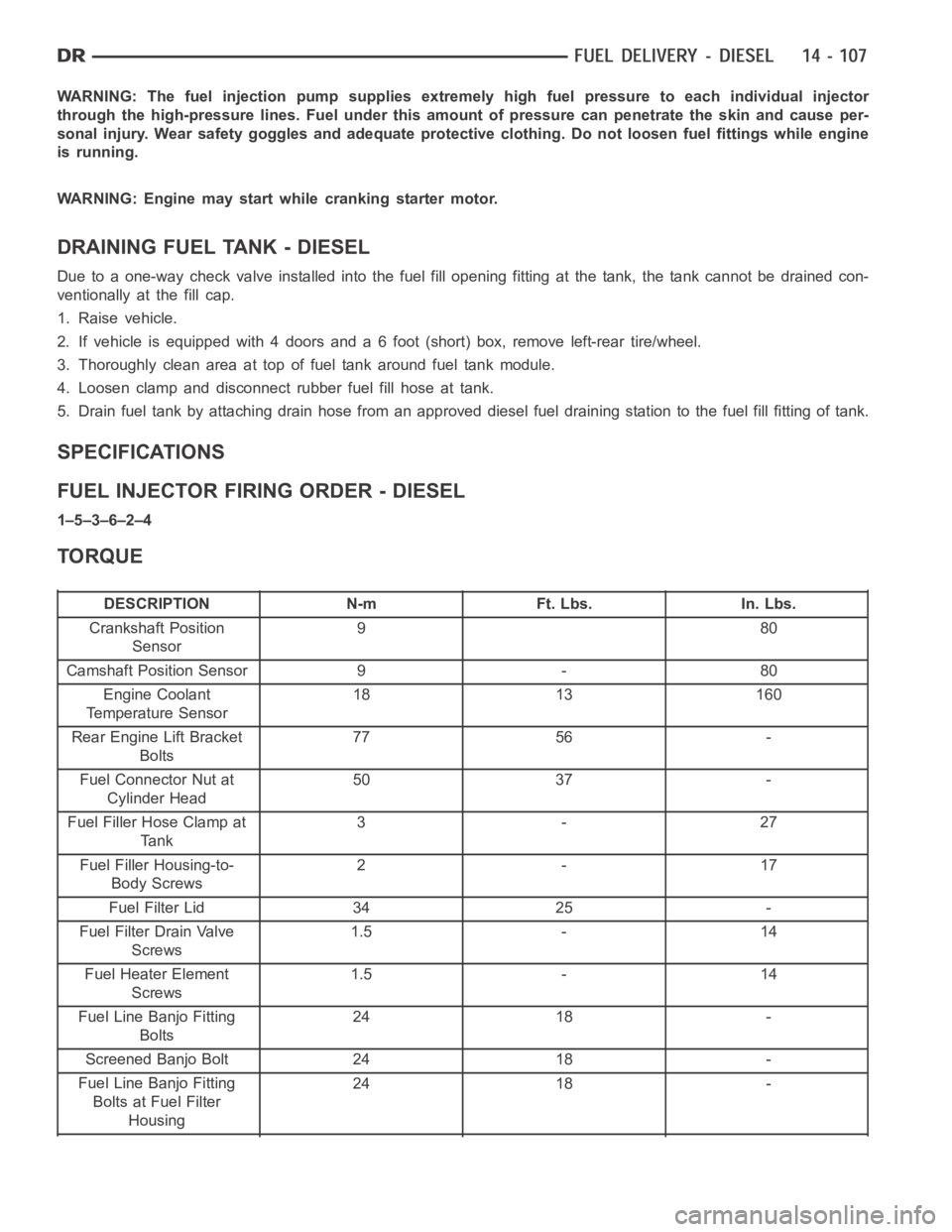
FUEL INJECTOR FIRING ORDER - DIESEL
1–5–3–6–2–4
TORQUE
DESCRIPTION N-m Ft. Lbs. In. Lbs.
Crankshaft Position
Sensor980
Camshaft Position Sensor 9 - 80
Engine Coolant
Temperature Sensor18 13 160
Rear Engine Lift Bracket
Bolts77 56 -
Fuel Connector Nut at
Cylinder Head50 37 -
Fuel Filler Hose Clamp at
Ta n k3-27
Fuel Filler Housing-to-
Body Screws2-17
Fuel Filter Lid 34 25 -
Fuel Filter Drain Valve
Screws1.5 - 14
Fuel Heater Element
Screws1.5 - 14
Fuel Line Banjo Fitting
Bolts24 18 -
Screened Banjo Bolt 24 18 -
Fuel Line Banjo Fitting
Bolts at Fuel Filter
Housing24 18 -
Page 2348 of 5267
FILTER - FUEL / WATER SEPARATOR
DESCRIPTION
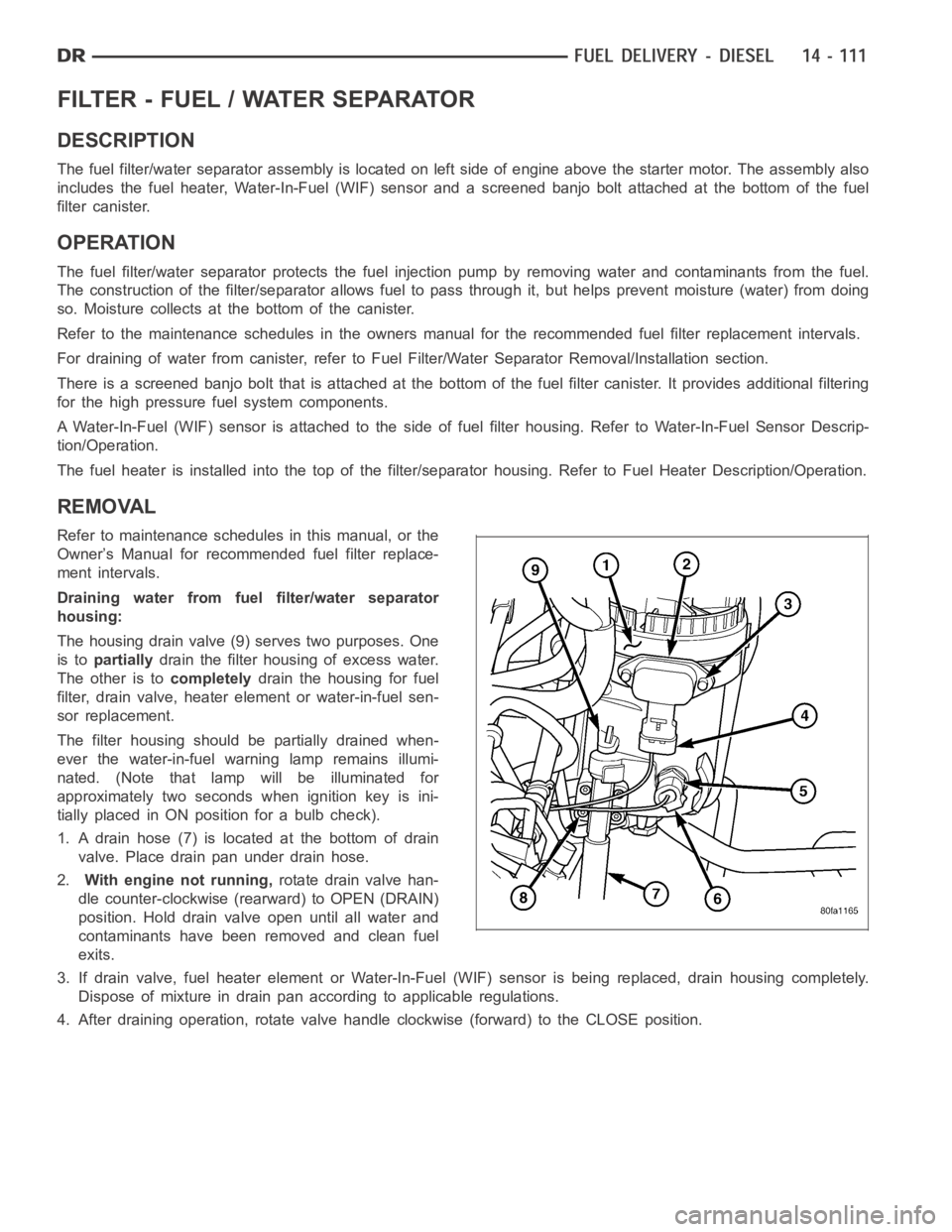
The fuel filter/water separator assembly is located on left side of engineabove the starter motor. The assembly also
includes the fuel heater, Water-In-Fuel (WIF) sensor and a screened banjobolt attached at the bottom of the fuel
filter canister.
OPERATION
The fuel filter/water separator protects the fuel injection pump by removing water and contaminants from the fuel.
The construction of the filter/separator allows fuel to pass through it, but helps prevent moisture (water) from doing
so. Moisture collects at the bottom of the canister.
Refer to the maintenance schedules in the owners manual for the recommended fuel filter replacement intervals.
For draining of water from canister, refer to Fuel Filter/Water SeparatorRemoval/Installation section.
There is a screened banjo bolt that is attached at the bottom of the fuel filter canister. It provides additional filtering
for the high pressure fuel system components.
A Water-In-Fuel (WIF) sensor is attached to the side of fuel filter housing. Refer to Water-In-Fuel Sensor Descrip-
tion/Operation.
The fuel heater is installed into the top of the filter/separator housing.Refer to Fuel Heater Description/Operation.
REMOVAL
Refer to maintenance schedules in this manual, or the
Owner’s Manual for recommended fuel filter replace-
ment intervals.
Draining water from fuel filter/water separator
housing:
The housing drain valve (9) serves two purposes. One
is topartiallydrain the filter housing of excess water.
The other is tocompletelydrain the housing for fuel
filter, drain valve, heater element or water-in-fuel sen-
sor replacement.
The filter housing should be partially drained when-
ever the water-in-fuel warning lamp remains illumi-
nated. (Note that lamp will be illuminated for
approximately two seconds when ignition key is ini-
tially placed in ON position for a bulb check).
1. A drain hose (7) is located at the bottom of drain
valve. Place drain pan under drain hose.
2.With engine not running,rotate drain valve han-
dle counter-clockwise (rearward) to OPEN (DRAIN)
position. Hold drain valve open until all water and
contaminants have been removed and clean fuel
exits.
3. If drain valve, fuel heater element or Water-In-Fuel (WIF) sensor is being replaced, drain housing completely.
Dispose of mixture in drain pan according to applicable regulations.
4. After draining operation, rotate valve handle clockwise (forward) to the CLOSE position.
Page 2362 of 5267
LINES - FUEL
DESCRIPTION
Low-Pressure Lines Are:
the fuel supply line from fuel tank to fuel filter housing.
the fuel return line back to fuel tank.
the fuel drain (manifold) line at rear of cylinder head.
the fuel supply line from fuel filter to fuel injection pump.
the fuel injection pump return line.
High-Pressure Lines Are:
the fuel line from fuel injection pump to fuel rail.
the 6 fuel lines from fuel rail up to injector connector tubes
WARNING: High-pressure fuel lines deliver diesel fuel under extreme pressure from the injection pump to
the fuel injectors. This may be as high as 160,000 kpa (23,206 psi). Use extreme caution when inspecting for
high-pressure fuel leaks. Inspect for high-pressure fuel leaks with a sheet of cardboard. High fuel injection
pressure can cause personal injury if contact is made with the skin.
OPERATION
High-Pressure Lines
CAUTION: The high-pressure fuel lines must be held securely in the brace. The lines cannot contact each
other or other components. Do not attempt to weld high-pressure fuel linesor to repair lines that are dam-
aged. If lines are ever kinked or bent, they must be replaced. Use only the recommended lines when
replacement of high-pressure fuel line is necessary.
High-pressure fuel lines deliver fuel (under pressure) of up to approximately 160,000 kPa (23,206 PSI) from the
injection pump to the fuel injectors. The lines expand and contract from the high-pressure fuel pulses generated
during the injection process. All high-pressure fuel lines are of the samelength and inside diameter. Correct high-
pressure fuel line usage and installation is critical to smooth engine operation.
WARNING: Use extreme caution when inspecting for high-pressure fuel leaks. Inspect for high-pressure fuel
leaks with a sheet of cardboard. High fuel injection pressure can cause personal injury if contact is made
with the skin.
DIAGNOSIS AND TESTING
HIGH-PRESSURE FUEL LINE LEAKS
High-pressure fuel line leaks can cause starting problems and poor engineperformance.
WARNING: Due to extreme fuel pressures of up to 160,000 kpa (23,206 psi), use extreme caution when
inspecting for high-pressure fuel leaks. Do not get your hand or a finger near a suspected leak. Inspect for
high-pressure fuel leaks with a sheet of cardboard. High fuel injection pressure can cause personal injury if
contact is made with the skin.
Start the engine. Move the cardboard over the suspected high-pressure fuel line leak, and check for fuel spray onto
the cardboard. If line is leaking, retorque line while engine is shutdown.Replace damaged, restricted or leaking
high-pressure fuel lines with the correct replacement line.
CAUTION: The high-pressure fuel lines must be clamped securely in place inthe brace. The lines cannot
contact each other or other components. Do not attempt to weld high-pressure fuel lines or to repair lines
that are damaged. Only use the recommended lines when replacement of high-pressure fuel line is neces-
sary.
Page 2375 of 5267
SENSOR-WATER IN FUEL
DESCRIPTION
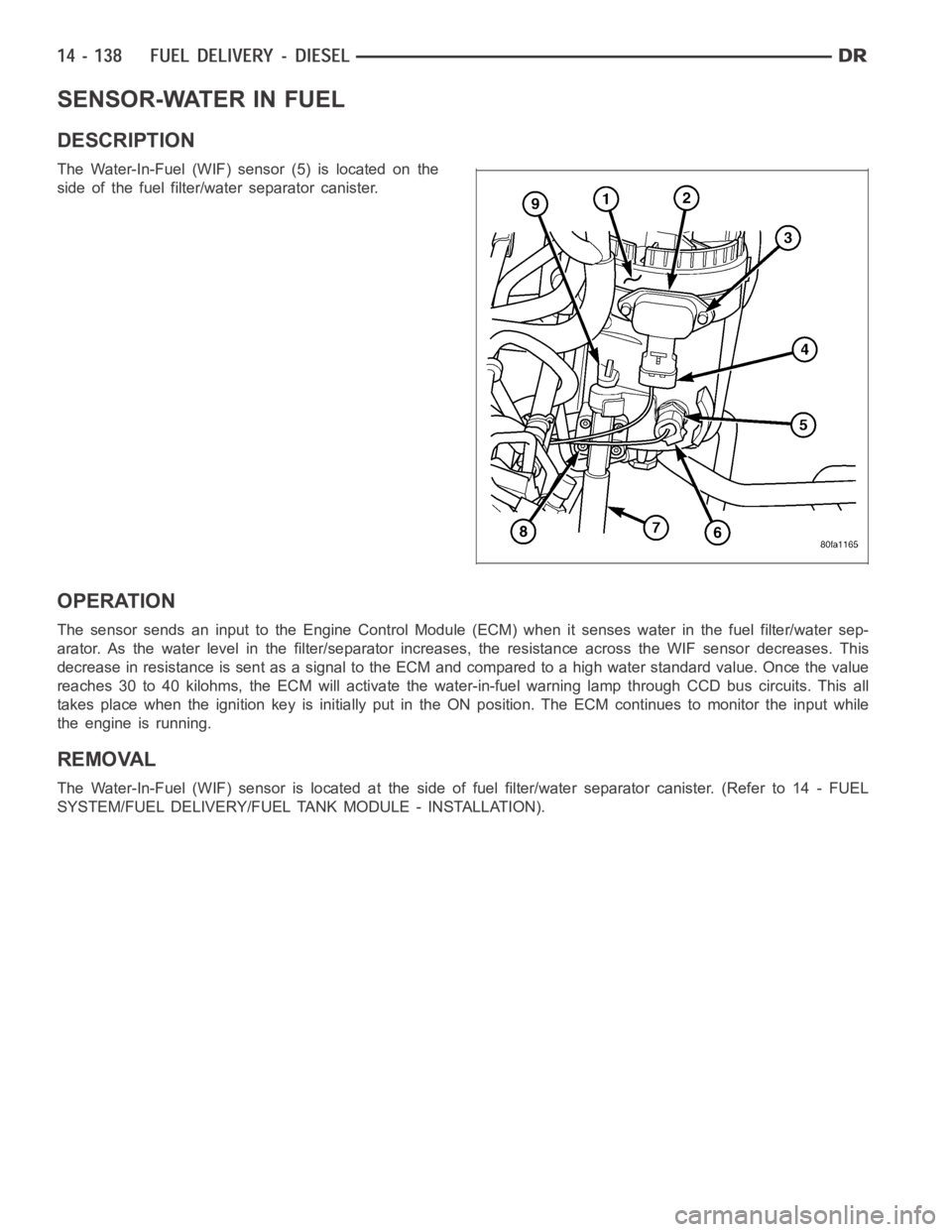
The Water-In-Fuel (WIF) sensor (5) is located on the
side of the fuel filter/water separator canister.
OPERATION
The sensor sends an input to the Engine Control Module (ECM) when it senses water in the fuel filter/water sep-
arator. As the water level in the filter/separator increases, the resistance across the WIF sensor decreases. This
decreaseinresistanceissentasasignaltotheECMandcomparedtoahighwater standard value. Once the value
reaches 30 to 40 kilohms, the ECM will activate the water-in-fuel warning lamp through CCD bus circuits. This all
takes place when the ignition key is initially put in the ON position. The ECM continues to monitor the input while
the engine is running.
REMOVAL
The Water-In-Fuel (WIF) sensor is located at the side of fuel filter/waterseparator canister. (Refer to 14 - FUEL
SYSTEM/FUEL DELIVERY/FUEL TANK MODULE - INSTALLATION).
Page 2413 of 5267
COLUMN
DESCRIPTION
DESCRIPTION
NOTE: The steering column on vehicles with an automatic transmission may not be equipped with an inter-
nal locking shaft that allows the ignition key cylinder to be locked with the key. Alternative methods of lock-
ing the steering wheel for service will have to be used.
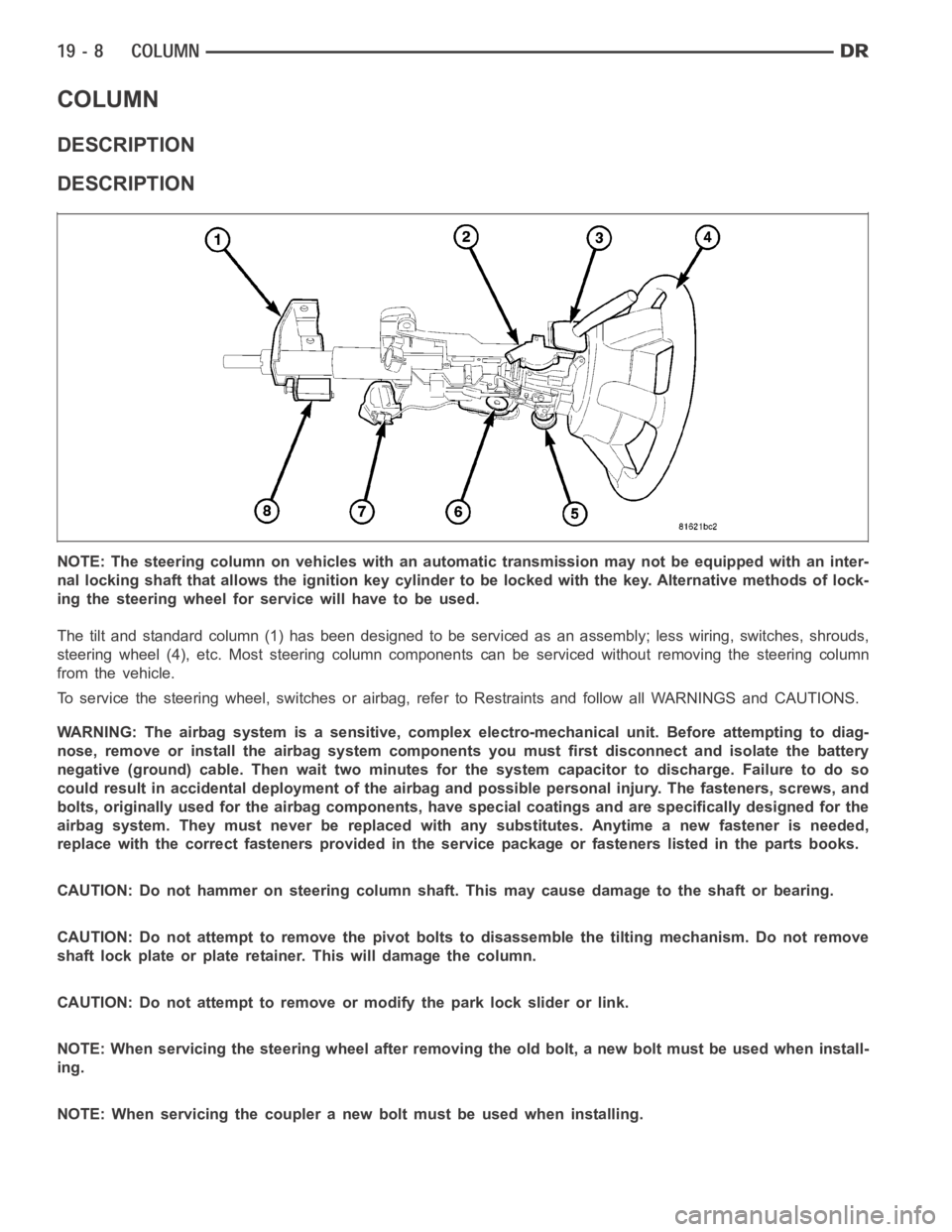
The tilt and standard column (1) has been designed to be serviced as an assembly; less wiring, switches, shrouds,
steering wheel (4), etc. Most steering column components can be serviced without removing the steering column
from the vehicle.
To service the steering wheel, switches or airbag, refer to Restraints andfollow all WARNINGS and CAUTIONS.
WARNING: The airbag system is a sensitive, complex electro-mechanical unit. Before attempting to diag-
nose, remove or install the airbag system components you must first disconnect and isolate the battery
negative (ground) cable. Then wait two minutes for the system capacitor todischarge. Failure to do so
could result in accidental deployment of the airbag and possible personalinjury. The fasteners, screws, and
bolts, originally used for the airbag components, have special coatings and are specifically designed for the
airbag system. They must never be replaced with any substitutes. Anytime anew fastener is needed,
replace with the correct fasteners provided in the service package or fasteners listed in the parts books.
CAUTION: Do not hammer on steering column shaft. This may cause damage to the shaft or bearing.
CAUTION: Do not attempt to remove the pivot bolts to disassemble the tilting mechanism. Do not remove
shaft lock plate or plate retainer. This will damage the column.
CAUTION: Do not attempt to remove or modify the park lock slider or link.
NOTE: When servicing the steering wheel after removing the old bolt, a new bolt must be used when install-
ing.
NOTE: When servicing the coupler a new bolt must be used when installing.