warning DODGE RAM SRT-10 2006 Service Repair Manual
[x] Cancel search | Manufacturer: DODGE, Model Year: 2006, Model line: RAM SRT-10, Model: DODGE RAM SRT-10 2006Pages: 5267, PDF Size: 68.7 MB
Page 2510 of 5267
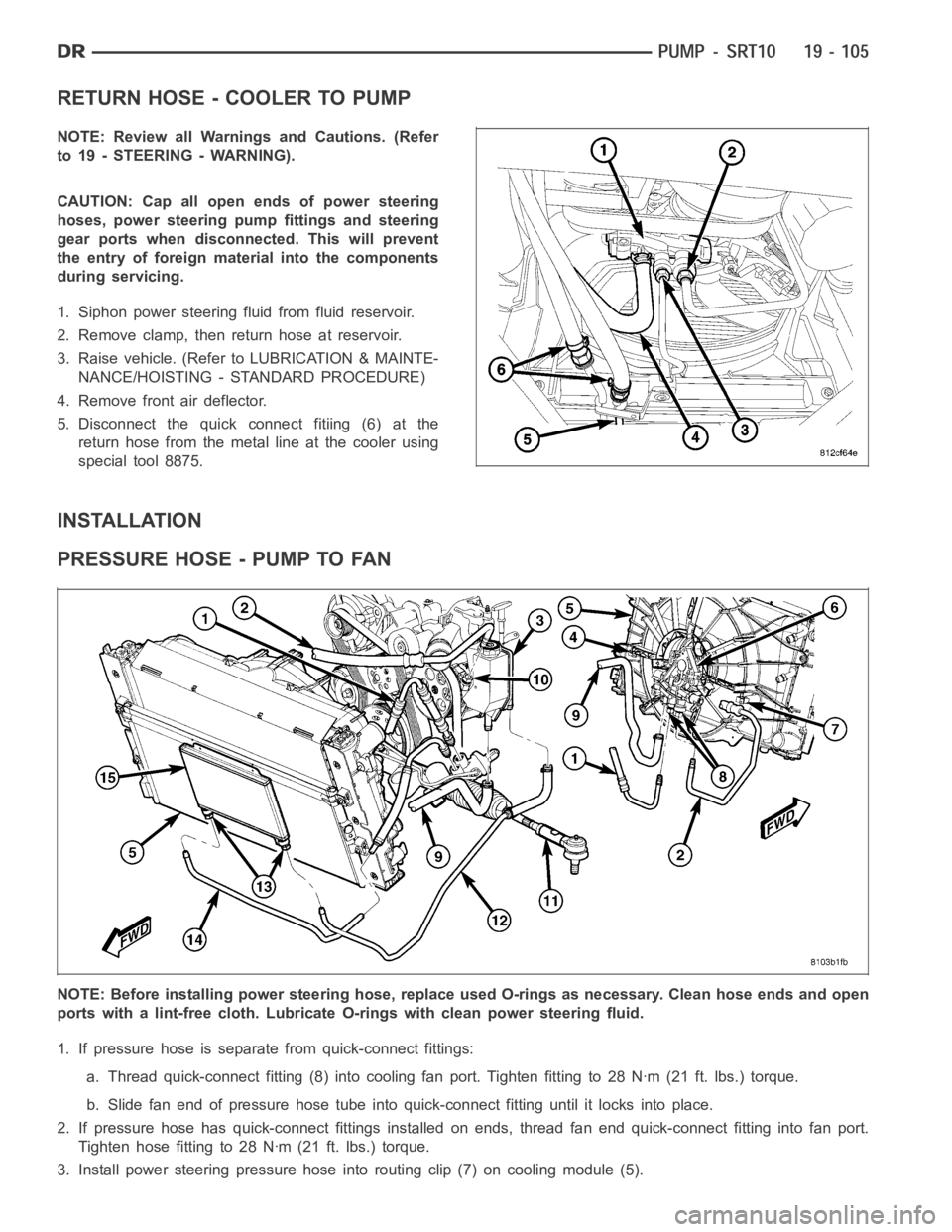
RETURN HOSE - COOLER TO PUMP
NOTE: Review all Warnings and Cautions. (Refer
to 19 - STEERING - WARNING).
CAUTION: Cap all open ends of power steering
hoses, power steering pump fittings and steering
gear ports when disconnected. This will prevent
the entry of foreign material into the components
during servicing.
1. Siphon power steering fluid from fluid reservoir.
2. Remove clamp, then return hose at reservoir.
3. Raise vehicle. (Refer to LUBRICATION & MAINTE-
NANCE/HOISTING - STANDARD PROCEDURE)
4. Remove front air deflector.
5. Disconnect the quick connect fitiing (6) at the
return hose from the metal line at the cooler using
special tool 8875.
INSTALLATION
PRESSURE HOSE - PUMP TO FAN
NOTE: Before installing power steering hose, replace used O-rings as necessary. Clean hose ends and open
ports with a lint-free cloth. Lubricate O-rings with clean power steeringfluid.
1. If pressure hose is separate from quick-connect fittings:
a. Thread quick-connect fitting (8) into cooling fan port. Tighten fittingto28Nꞏm(21ft.lbs.)torque.
b. Slide fan end of pressure hose tube into quick-connect fitting until it locks into place.
2. If pressure hose has quick-connect fittings installed on ends, thread fan end quick-connect fitting into fan port.
Tighten hose fitting to 28 Nꞏm (21 ft. lbs.) torque.
3. Install power steering pressure hose into routing clip (7) on cooling module (5).
Page 2550 of 5267
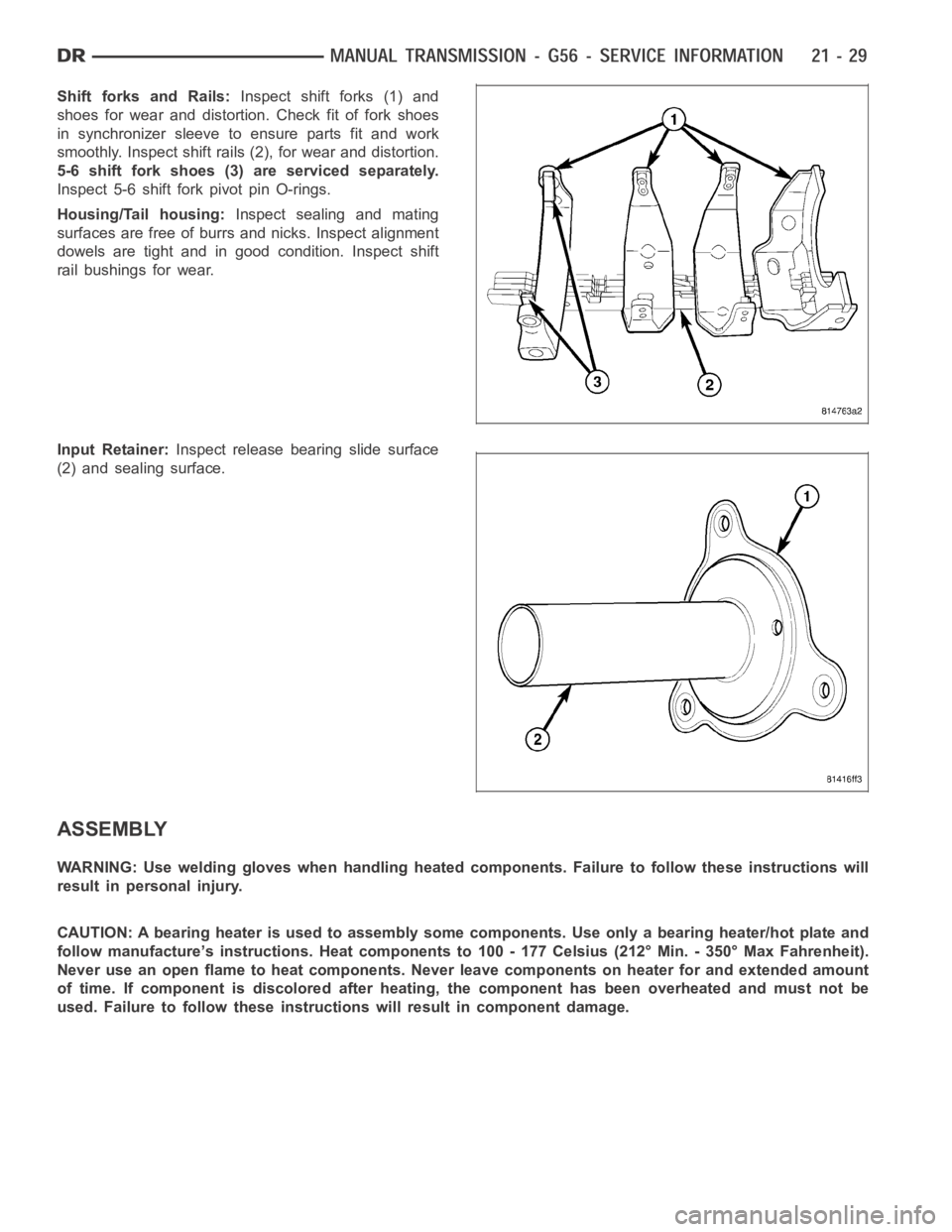
Shift forks and Rails:Inspect shift forks (1) and
shoes for wear and distortion. Check fit of fork shoes
in synchronizer sleeve to ensure parts fit and work
smoothly. Inspect shift rails(2), for wear and distortion.
5-6 shift fork shoes (3) are serviced separately.
Inspect 5-6 shift fork pivot pin O-rings.
Housing/Tail housing:Inspect sealing and mating
surfaces are free of burrs and nicks. Inspect alignment
dowels are tight and in good condition. Inspect shift
rail bushings for wear.
Input Retainer:Inspect release bearing slide surface
(2) and sealing surface.
ASSEMBLY
WARNING: Use welding gloves when handling heated components. Failure to follow these instructions will
result in personal injury.
CAUTION:Abearingheaterisusedtoassemblysomecomponents.Useonlyabearing heater/hot plate and
follow manufacture’s instructions. Heat components to 100 - 177 Celsius (212° Min. - 350° Max Fahrenheit).
Never use an open flame to heat components. Never leave components on heater for and extended amount
of time. If component is discolored after heating, the component has been overheated and must not be
used. Failure to follow these instructions will result in component damage.
Page 2636 of 5267
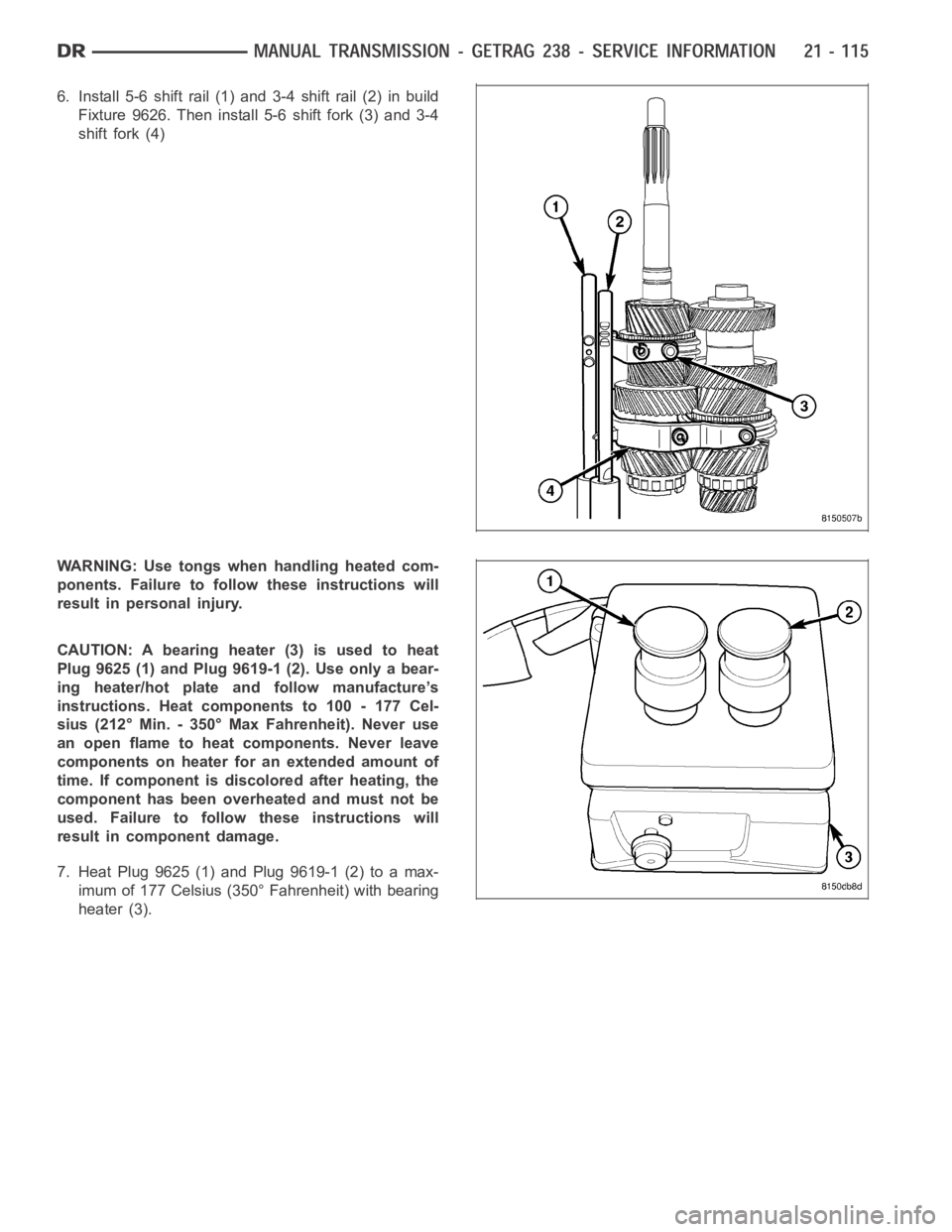
6. Install 5-6 shift rail (1) and 3-4 shift rail (2) in build
Fixture 9626. Then install 5-6 shift fork (3) and 3-4
shift fork (4)
WARNING: Use tongs when handling heated com-
ponents. Failure to follow these instructions will
result in personal injury.
CAUTION: A bearing heater (3) is used to heat
Plug 9625 (1) and Plug 9619-1 (2). Use only a bear-
ing heater/hot plate and follow manufacture’s
instructions. Heat components to 100 - 177 Cel-
sius (212° Min. - 350° Max Fahrenheit). Never use
an open flame to heat components. Never leave
components on heater for an extended amount of
time. If component is discolored after heating, the
component has been overheated and must not be
used. Failure to follow these instructions will
result in component damage.
7. Heat Plug 9625 (1) and Plug 9619-1 (2) to a max-
imum of 177 Celsius (350° Fahrenheit) with bearing
heater (3).
Page 2646 of 5267
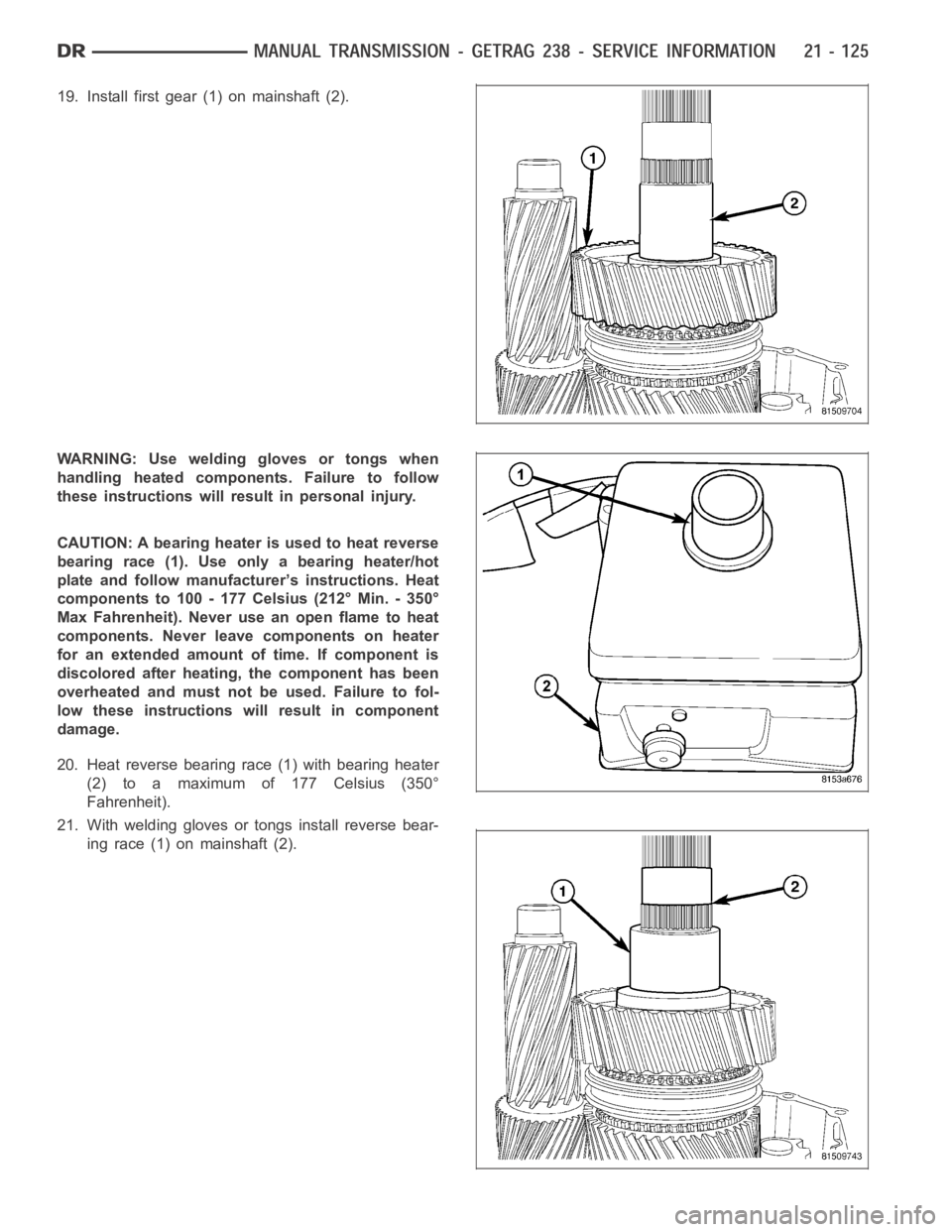
19. Install first gear (1) on mainshaft (2).
WARNING: Use welding gloves or tongs when
handling heated components. Failure to follow
these instructions will result in personal injury.
CAUTION: A bearing heater is used to heat reverse
bearing race (1). Use only a bearing heater/hot
plate and follow manufacturer’s instructions. Heat
components to 100 - 177 Celsius (212° Min. - 350°
Max Fahrenheit). Never use an open flame to heat
components. Never leave components on heater
for an extended amount of time. If component is
discolored after heating, the component has been
overheated and must not be used. Failure to fol-
low these instructions will result in component
damage.
20. Heat reverse bearing race (1) with bearing heater
(2) to a maximum of 177 Celsius (350°
Fahrenheit).
21. With welding gloves or tongs install reverse bear-
ing race (1) on mainshaft (2).
Page 2650 of 5267
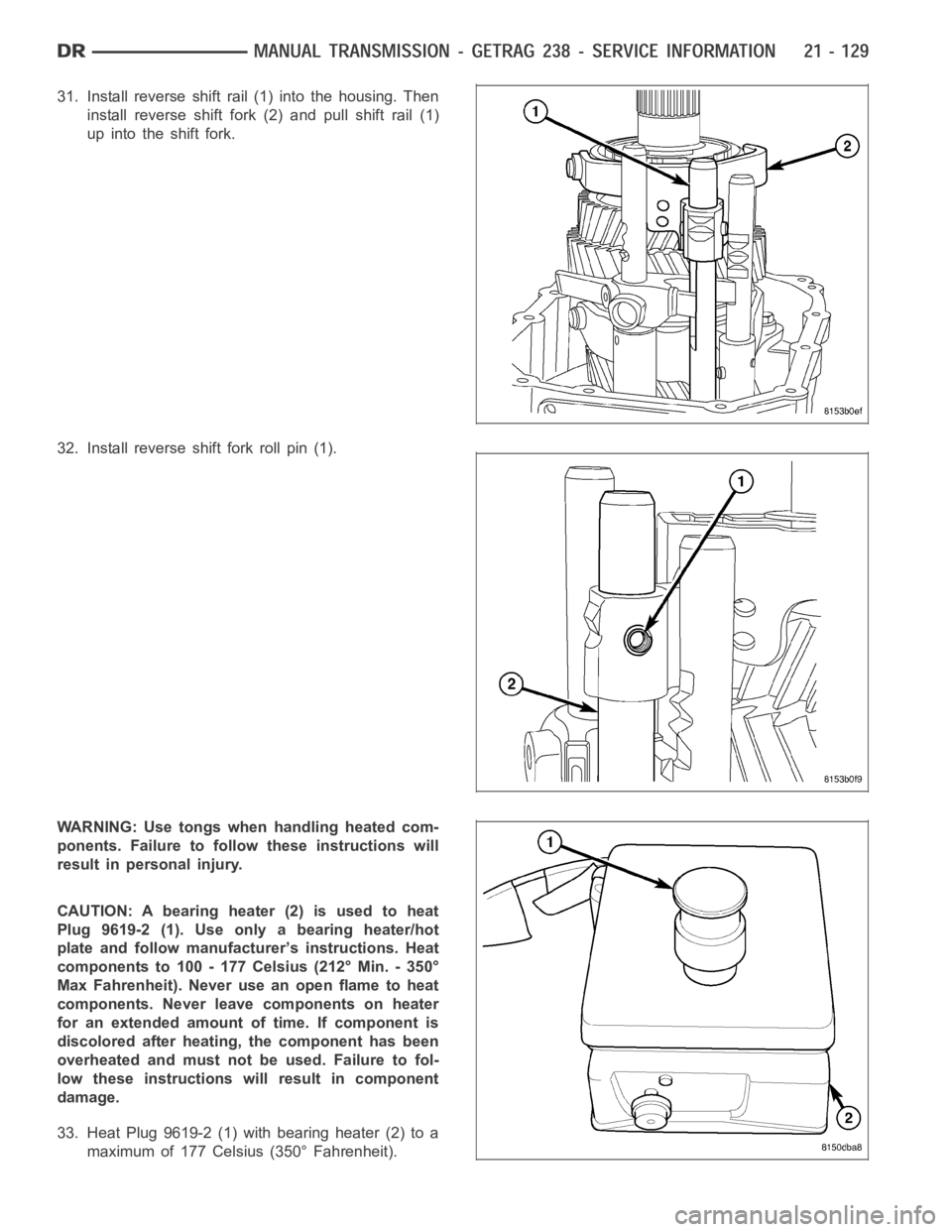
31. Install reverse shift rail (1) into the housing. Then
install reverse shift fork (2) and pull shift rail (1)
up into the shift fork.
32. Install reverse shift fork roll pin (1).
WARNING: Use tongs when handling heated com-
ponents. Failure to follow these instructions will
result in personal injury.
CAUTION: A bearing heater (2) is used to heat
Plug 9619-2 (1). Use only a bearing heater/hot
plate and follow manufacturer’s instructions. Heat
components to 100 - 177 Celsius (212° Min. - 350°
Max Fahrenheit). Never use an open flame to heat
components. Never leave components on heater
for an extended amount of time. If component is
discolored after heating, the component has been
overheated and must not be used. Failure to fol-
low these instructions will result in component
damage.
33. Heat Plug 9619-2 (1) with bearing heater (2) to a
maximum of 177 Celsius (350° Fahrenheit).
Page 2744 of 5267
2.CHECK THE TRANSMISSION SOLENOID/TRS ASSEMBLY
Turn the ignition off to the lock position.
Remove the Ignition Switch Feed fuse from the TIPM.
CAUTION: Removal of the Ignition Switch Feed fuse from the TIPM will prevent the vehicle from being
startedingear.
WARNING: The Ignition Switch Feed fuse must be removed from the TIPM. Failure to do so can result in
personal injury or death.
Install the Transmission Simulator,Miller tool #8333 and the ElectronicTransmission Adapter kit.
Ignition on, engine not running.
With the scan tool, perform the Shift Lever Position Test.
When the scan tool instructs you to put the Gear Selector in a particular position, you must do so using the selector
switch on the Transmission Simulator.
The LED for the gear position in question must be illuminated on the Transmission Simulator prior to pressing
ENTERon the scan tool.
NOTE: When the scan tool requests the O/D off button be depressed, you must use the O/D OFF button in
the vehicle or you will fail the Shift Lever Position Test with an error code11 or OD-TOW/HALL STUCK
OPEN.
NOTE: If the Shift Lever Position test fails, make sure to note the identification of the TRS Sense circuit for
future reference.
Did the Shift Lever Position test pass?
Ye s>>
Remove the Oil Pan and Main Valve Body Assembly per the Service Information. Check for metal debris
on top of the TRS Assembly. If debris is present, determine the cause of the debris and repair the trans-
mission as necessary. If no problems are found, replace the Transmission TRS Assembly per the Ser-
vice Information.
Perform the PRNDL Fault Clearing Procedure – Go To 7
No>>
Go To 3
3.TRS SENSE CIRCUIT OPEN
Turn the ignition off to the lock position.
Disconnect the Transmission Simulator, Miller tool #8333.
Disconnect the PCM harness connectors and install Miller tool #8815.
CAUTION: Do not probe the PCM harness connectors. Probing the PCM harness connectors will damage
the PCM terminals resulting in poor terminal to pin connection. Install Miller tool #8815 to perform diagno-
sis.
Measure the resistance of the identified (T1, T3, T41, or T42) TRS Sense circuit, from the Transmission Solenoid/
TRS Assembly harness connector to theappropriate terminal of Miller tool#8815.
Is the resistance above 5.0 ohms?
Ye s>>
Repair the identified (T1, T3, T41, or T42) TRS Sense circuit for an open.
Perform the PRNDL Fault Clearing Procedure – Go To 7
No>>
Go To 4
Page 2747 of 5267
When Monitored:
Continuously with the ignition on and engine running.
Set Condition:
DTC will set when the transmission temperature does not reach a normal operating temperature within a given
time frame. Time is variable due to ambient temperature. Approximate DTC set time is 10 to 35 minutes. The
following are starting temperature to warm up times to set this DTC: starting temperature -40° C (-40° F) warm
up time 35 minutes, starting temperature -28° C ( -20° F) 25 minutes, starting temperature -6.6° C (20° F) 20
minutes, starting temperature 15.5 ° C (60° F) 10 minutes. When the fault isset, calculated temperature is
substituted for measured temperature, however the DTC is stored only after three consecutive occurrences.
Possible Causes
RELATED TRANSMISSION TEMPERATURE DTC’S PRESENT
TRANSMISSION TEMPERATURE SENSOR
POWERTRAIN CONTROL MODULE
Always perform the Pre-Diagnostic Troubleshooting procedure before proceeding. (Refer to 21 - TRANSMIS-
SION/TRANSAXLE/AUTOMATIC - 42RLE - STANDARD PROCEDURE)
Theory of Operation
The temperature sensor is used to sense the temperature of the transmission fluid. Transmission fluid temperature
can affect shift quality, torque converter operation and when or if some diagnostics are run. A failed temperature
sensor could affect the OBD diagnostics. If a problem occurs in the transmission temperature sensor circuit, trans-
mission temperature will be based on a calculated value.
Diagnostic Test
1.DETERMINE IF RELATED TRANSMISSION TEMPERATURE DTCS ARE PRESENT
With the scan tool, check Transmission DTCs.
Are there any other Transmission Temperature Sensor related DTCs present?
Ye s>>
Refer to the Transmission category and perform the appropriate diagnostic procedure.
No>>
Go To 2
2.CHECK TO SEE IF DTC IS ACTIVE
With the scan tool, view DTCs.
Is the status Active for this DTC or is the STARTS SINCE SET counter 2 or less?
Ye s>>
Go To 3
No>>
Go To 4
3.PCM AND WIRING
Turn the ignition off to the lock position.
Remove the Ignition Switch Feed fuse from the TIPM.
CAUTION: Removal of the Ignition Switch Feed fuse from the TIPM will prevent the vehicle from being
startedingear.
WARNING: The Ignition Switch Feed fuse must be removed from the TIPM. Failure to do so can result in
personal injury or death.
Install the Transmission Simulator,Miller tool #8333 and the ElectronicTransmission Adapter kit.
Ignition on, engine not running.
With the Transmission Simulator, turn the Input/Output switch to OFF.
With the scan tool, monitor the TRANS TEMP VOLTS while turning the ThermistorVoltageswitchtoallthreeposi-
tions on the Transmission Simulator.
Page 2750 of 5267
When Monitored:
Continuously with the ignition on and engine running.
Set Condition:
The DTC will set when the monitored Temperature Sensor voltage drops below0.078 volts for the period of
1.45 seconds. When the fault is set, calculated temperature is substituted for measured temperature, however
the fault code is stored only after three consecutive occurrences of the fault.
Possible Causes
RELATED DTCS PRESENT
(T54) TRANSMISSION TEMPERATURE SENSOR SIGNAL CIRCUIT SHORT TO GROUND
TRANSMISSION TEMPERATURE SENSOR
POWERTRAIN CONTROL MODULE
Always perform the Pre-Diagnostic Troubleshooting procedure before proceeding. (Refer to 21 - TRANSMIS-
SION/TRANSAXLE/AUTOMATIC - 42RLE - STANDARD PROCEDURE)
Theory of Operation
The temperature sensor is used to sense the temperature of the transmission fluid. Transmission fluid temperature
can affect shift quality, torque converter operation and when or if some diagnostics are run. A failed temperature
sensor could affect the OBD diagnostics. If a problem occurs in the transmission temperature sensor circuit, trans-
mission temperature will be based on a calculated value.
Diagnostic Test
1.DETERMINE IF RELATED DTCS ARE PRESENT
With the scan tool, check Transmission DTCs.
Are there any Speed Sensor DTCs present?
Ye s>>
Refer to the Transmission category and perform the appropriate diagnostic procedure.
No>>
Go To 2
2.CHECK TO SEE IF DTC IS ACTIVE
With the scan tool, view DTCs.
Is the status Active for this DTC or is the STARTS SINCE SET counter 2 or less?
Ye s>>
Go To 3
No>>
Go To 5
3.CHECK THE PCM AND WIRING WITH THE TRANSMISSION SIMULATOR
Turn the ignition off to the lock position.
Remove the Ignition Switch Feed fuse from the TIPM.
CAUTION: Removal of the Ignition Switch Feed fuse from the TIPM will prevent the vehicle from being
startedingear.
WARNING: The Ignition Switch Feed fuse must be removed from the TIPM. Failure to do so can result in
personal injury or death.
Install the Transmission Simulator,Miller tool #8333 and the ElectronicTransmission Adapter kit.
Ignition on, engine not running.
With the Transmission Simulator, turn the Input/Output switch to OFF.
With the scan tool, monitor the TRANS TEMP VOLTS while turning the ThermistorVoltageswitchtoallthreeposi-
tions on the Transmission Simulator.
Page 2753 of 5267
When Monitored:
Continuously with the ignition on and engine running.
Set Condition:
The DTC will set when the monitored Temperature Sensor voltage rises above4.94 volts for the period of 1.45
seconds. When the fault is set, calculated temperature is substituted formeasured temperature, however the
fault code is stored only after three consecutive occurrences of the fault.
Possible Causes
(K900) SENSOR GROUND OPEN
(T54) TRANSMISSION TEMPERATURE SENSOR SIGNAL CIRCUIT OPEN
(T54) TRANSMISSION TEMPERATURE SENSOR SIGNAL CIRCUIT SHORT TO VOLTAGE
TRANSMISSION TEMPERATURE SENSOR
POWERTRAIN CONTROL MODULE
Always perform the Pre-Diagnostic Troubleshooting procedure before proceeding. (Refer to 21 - TRANSMIS-
SION/TRANSAXLE/AUTOMATIC - 42RLE - STANDARD PROCEDURE)
Theory of Operation
The temperature sensor is used to sense the temperature of the transmission fluid. Transmission fluid temperature
can affect shift quality, torque converter operation and when or if some diagnostics are run. A failed temperature
sensor could affect the OBD diagnostics. If a problem occurs in the transmission temperature sensor circuit, trans-
mission temperature will be based on a calculated value.
1.CHECK TO SEE IF DTC IS CURRENT
With the scan tool, view DTCs.
Is the status Active for this DTC or is STARTS SINCE SET counter 2 or less?
Ye s>>
Go To 2
No>>
Go To 6
2.CHECK THE PCM AND WIRING WITH THE TRANSMISSION SIMULATOR
Turn the ignition off to the lock position.
Remove the Ignition Switch Feed fuse from the TIPM.
CAUTION: Removal of the Ignition Switch Feed fuse from the TIPM will prevent the vehicle from being
startedingear.
WARNING: The Ignition Switch Feed fuse must be removed from the TIPM. Failure to do so can result in
personal injury or death.
Install the Transmission Simulator,Miller tool #8333 and the ElectronicTransmission Adapter kit 8333-1A.
Ignition on, engine not running.
With the Transmission Simulator, turn the Input/Output switch to OFF.
With the scan tool, monitor the TRANS TEMP VOLTS while turning the ThermistorVoltageswitchtoallthreeposi-
tions on the Transmission Simulator.
Compare the scan tool readings with the numbers listed on the TransmissionSimulator.
Do the readings on the Transmission Simulator match the scan tool readings± 0.2 volts?
Ye s>>
Replace Transmission Solenoid/Pressure Switch Assembly per the ServiceInformation.
Perform 42RLE TRANSMISSION VERIFICATION TEST - VER 1. (Refer to 21 - TRANSMISSION/
TRANSAXLE/AUTOMATIC - 42RLE - STANDARD PROCEDURE)
No>>
Go To 3
Page 2757 of 5267
When Monitored:
Continuously with the ignition on and engine running.
Set Condition:
The DTC will set when the monitored Temperature Sensor voltage fluctuatesor changes abruptly within a pre-
determined period of time.
Possible Causes
TRANSMISSION TEMPERATURE SENSOR
POWERTRAIN CONTROL MODULE
Always perform the Pre-Diagnostic Troubleshooting procedure before proceeding. (Refer to 21 - TRANSMIS-
SION/TRANSAXLE/AUTOMATIC - 42RLE - STANDARD PROCEDURE)
Theory of Operation
The temperature sensor is used to sense the temperature of the transmission fluid. Transmission fluid temperature
can affect shift quality, torque converter operation and when or if some diagnostics are run. A failed temperature
sensor could affect the OBD diagnostics. If a problem occurs in the transmission temperature sensor circuit, trans-
mission temperature will be based on a calculated value.
1.CHECK TO SEE IF DTC IS CURRENT
With the scan tool, view DTCs.
Is the status Active for this DTC or is the STARTS SINCE SET counter 2 or less?
Ye s>>
Go To 2
No>>
Go To 3
2.CHECK THE PCM AND WIRING WITH THE TRANSMISSION SIMULATOR
Turn the ignition off to the lock position.
Remove the Ignition Switch Feed fuse from the TIPM.
CAUTION: Removal of the Ignition Switch Feed fuse from the TIPM will prevent the vehicle from being
startedingear.
WARNING: The Ignition Switch Feed fuse must be removed from the TIPM. Failure to do so can result in
personal injury or death.
Install the Transmission Simulator,Miller tool #8333 and the ElectronicTransmission Adapter kit.
Ignition on, engine not running.
With the Transmission Simulator, turn the Input/Output switch to OFF.
With the scan tool , monitor the TRANS TEMP VOLTS while turning the ThermistorVoltageswitchtoallthreeposi-
tions on the Transmission Simulator.
Compare the scan tool readings with the numbers listed on the TransmissionSimulator.
Do the readings on the Transmission Simulator match a non-fluctuating scan tool reading ± 0.2 volts?
Ye s>>
Replace Transmission Solenoid/Pressure Switch Assembly per the ServiceInformation.
Perform 42RLE TRANSMISSION VERIFICATION TEST - VER 1. (Refer to 21 - TRANSMISSION/
TRANSAXLE/AUTOMATIC - 42RLE - STANDARD PROCEDURE)
No>>
Using the schematics as a guide, check the Powertrain Control Module (PCM)terminals for corrosion,
damage, or terminal push out. Pay particular attention to all power and ground circuits. Check for any
Service Information Tune-ups or Service Bulletins for any possible causes that may apply. If no prob-
lems are found, replace the PCM per the Service Information. With the scan tool, perform QUICK
LEARN.
Perform 42RLE TRANSMISSION VERIFICATION TEST - VER 1. (Refer to 21 - TRANSMISSION/
TRANSAXLE/AUTOMATIC - 42RLE - STANDARD PROCEDURE)