torque DODGE RAM SRT-10 2006 Service Repair Manual
[x] Cancel search | Manufacturer: DODGE, Model Year: 2006, Model line: RAM SRT-10, Model: DODGE RAM SRT-10 2006Pages: 5267, PDF Size: 68.7 MB
Page 3788 of 5267
CLEANING ................................. 1389
INSPECTION ............................... 1389
ASSEMBLY . ............................... 1390
INSTALLATION ............................. 1400
RETAINER-OVERRUNNING CLUTCH CAM/
OVERDRIVE PISTON
DESCRIPTION ............................. 1402
OPERATION ............................... 1402
DISASSEMBLY ............................. 1402
CLEANING ................................. 1403
INSPECTION ............................... 1403
ASSEMBLY . ............................... 1403
SHAFT-PLANETARY GEARTRAIN/OUTPUT
DESCRIPTION ............................. 1407
OPERATION ............................... 1407
DISASSEMBLY ............................. 1407
INSPECTION ............................... 1410
ASSEMBLY ................................ 1410
CLUTCH-REAR
DESCRIPTION ............................. 1416
OPERATION ............................... 1416
DISASSEMBLY ............................. 1417
CLEANING ................................. 1417
INSPECTION ............................... 1418
ASSEMBLY ................................ 1418
SERVO-REAR
DESCRIPTION ............................. 1421
OPERATION ............................... 1421
DISASSEMBLY ............................. 1421
CLEANING ................................. 1421
ASSEMBLY ................................ 1421
MECHANISM-SHIFT
DESCRIPTION ............................. 1422
OPERATION ............................... 1422
SENSOR-SPEED
DESCRIPTION ............................. 1423
OPERATION ............................... 1423
ACTUATOR-THROTTLE VALVE
DESCRIPTION ............................. 1424
REMOVAL ................................. 1424
INSTALLATION ............................. 1425
ADJUSTMENTS
ADJUSTMENT ............................ 1426
CABLE-THROTTLE VALVE
DESCRIPTION ............................. 1427ADJUSTMENTS - THROTTLE VALVE CABLE . . 1428
CONVERTER-TORQUE
DESCRIPTION ............................. 1431
OPERATION ............................... 1435
REMOVAL ................................. 1436
INSTALLATION ............................. 1437
VALVE-TORQUE CONVERTER DRAINBACK
DESCRIPTION
GAS ENGINES ........................... 1438
DIESEL ENGINE .......................... 1438
OPERATION
GAS ENGINES ........................... 1438
DIESEL ENGINE .......................... 1438
STANDARD PROCEDURE
GAS ENGINES ........................... 1438
DIESEL ENGINE .......................... 1438
SWITCH-TOW/HAUL OVERDRIVE
DESCRIPTION ............................. 1440
OPERATION ............................... 1440
DIAGNOSIS AND TESTING - OVERDRIVE
ELECTRICAL CONTROLS ................. 1440
REMOVAL ................................. 1440
INSTALLATION ............................. 1441
SENSOR-TRANSMISSION RANGE
DESCRIPTION ............................. 1442
OPERATION ............................... 1442
DIAGNOSIS AND TESTING - TRANSMISSION
RANGE SENSOR (TRS) ................... 1443
REMOVAL ................................. 1444
INSTALLATION ............................. 1445
SENSOR-TRANSMISSION TEMPERATURE
DESCRIPTION ............................. 1447
OPERATION ............................... 1447
BODY-VALVE
DESCRIPTION ............................. 1448
OPERATION ............................... 1451
REMOVAL ................................. 1471
DISASSEMBLY ............................. 1472
CLEANING ................................. 1485
INSPECTION ............................... 1485
ASSEMBLY................................ 1486
INSTALLATION ............................. 1497
ADJUSTMENTS - VALVE BODY .............. 1498
Page 3791 of 5267
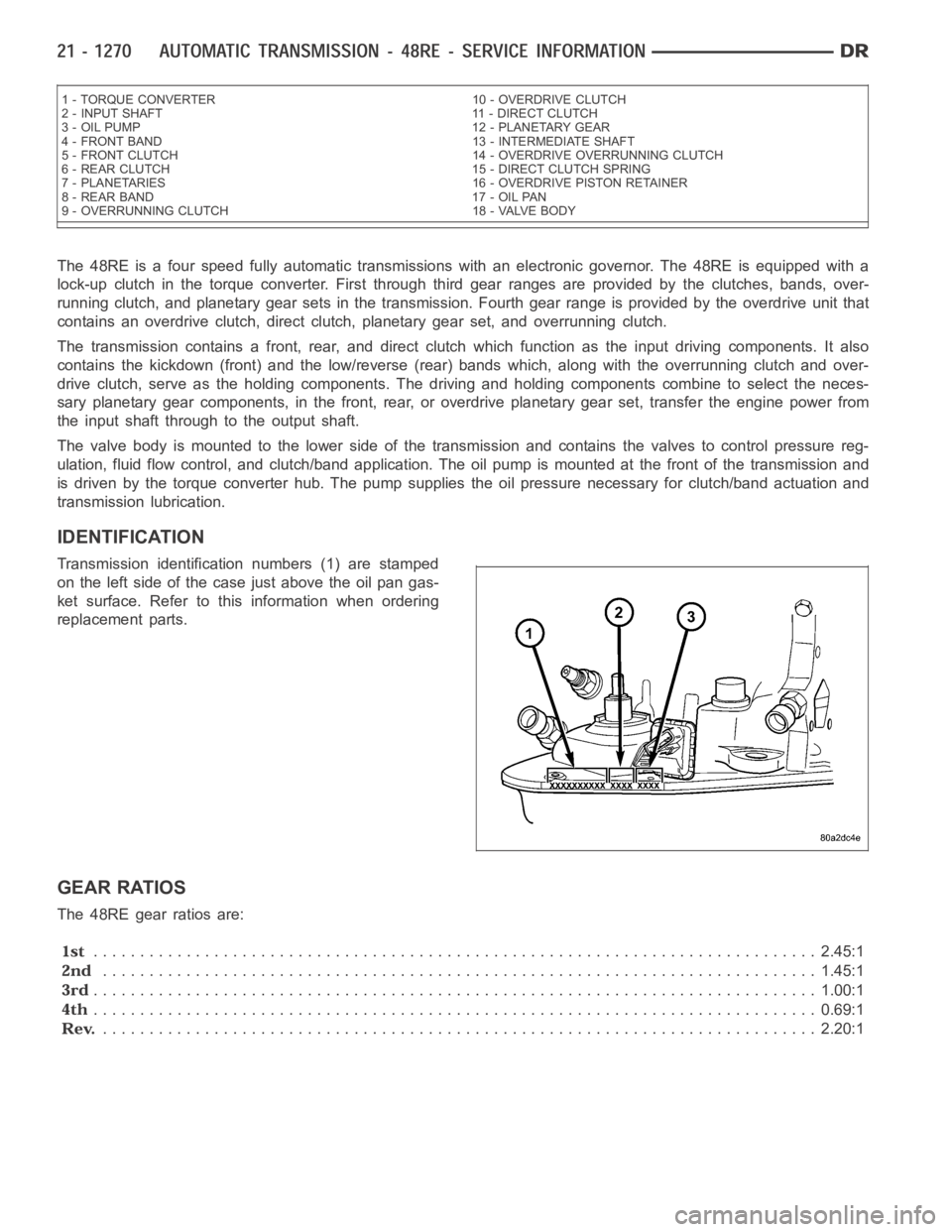
The 48RE is a four speed fully automatic transmissions with an electronic governor. The 48RE is equipped with a
lock-up clutch in the torque converter. First through third gear ranges are provided by the clutches, bands, over-
running clutch, and planetary gear sets in the transmission. Fourth gear range is provided by the overdrive unit that
contains an overdrive clutch, direct clutch, planetary gear set, and overrunning clutch.
The transmission contains a front, rear, and direct clutch which functionas the input driving components. It also
contains the kickdown (front) and the low/reverse (rear) bands which, along with the overrunning clutch and over-
drive clutch, serve as the holding components. The driving and holding components combine to select the neces-
sary planetary gear components, in the front, rear, or overdrive planetary gear set, transfer the engine power from
the input shaft through to the output shaft.
The valve body is mounted to the lower side of the transmission and containsthe valves to control pressure reg-
ulation, fluid flow control, and clutch/band application. The oil pump ismounted at the front of the transmission and
is driven by the torque converter hub. The pump supplies the oil pressure necessary for clutch/band actuation and
transmission lubrication.
IDENTIFICATION
Transmission identification numbers (1) are stamped
on the left side of the case just above the oil pan gas-
ket surface. Refer to this information when ordering
replacement parts.
GEAR RATIOS
The 48RE gear ratios are:
.............................................................................. 2.45:1
............................................................................. 1.45:1
.............................................................................. 1.00:1
.............................................................................. 0.69:1
............................................................................. 2.20:1
1 - TORQUE CONVERTER 10 - OVERDRIVE CLUTCH
2 - INPUT SHAFT 11 - DIRECT CLUTCH
3 - OIL PUMP 12 - PLANETARY GEAR
4 - FRONT BAND 13 - INTERMEDIATE SHAFT
5 - FRONT CLUTCH 14 - OVERDRIVE OVERRUNNING CLUTCH
6 - REAR CLUTCH 15 - DIRECT CLUTCH SPRING
7 - PLANETARIES 16 - OVERDRIVE PISTON RETAINER
8 - REAR BAND 17 - OIL PAN
9 - OVERRUNNING CLUTCH 18 - VALVE BODY
Page 3792 of 5267
OPERATION
The application of each driving or holding component is controlled by the valve body based upon the manual lever
position, throttle pressure, and governor pressure. The governor pressure is a variable pressure input to the valve
body and is one of the signals that a shift is necessary. First through fourth gear are obtained by selectively apply-
ing and releasing the different clutches and bands. Engine power is thereby routed to the various planetary gear
assemblies which combine with the overrunning clutch assemblies to generate the different gear ratios. The torque
converter clutch is hydraulically applied and is released when fluid is vented from the hydraulic circuit by the torque
converter control (TCC) solenoid on the valve body. The torque converter clutch is controlled by the Powertrain
Control Module (PCM). The torque converter clutch engages in fourth gear,and in third gear under various condi-
tions, such as when the O/D switch is OFF, when the vehicle is cruising on a level surface after the vehicle has
warmed up. The torque converter clutch can also be engaged in the MANUAL SECOND gear position if high trans-
mission temperatures are sensed by the PCM. The torque converter clutch will disengage momentarily when an
increase in engine load is sensed by the PCM, such as when the vehicle beginsto go uphill or the throttle pressure
is increased. The torque converter clutch feature increases fuel economyand reduces the transmission fluid tem-
perature.
Since the overdrive clutch is applied in fourth gear only and the direct clutch is applied in all ranges except fourth
gear, the transmission operation for park, neutral, and first through third gear will be described first. Once these
powerflows are described, the third to fourth shift sequence will be described.
PARK POWERFLOW
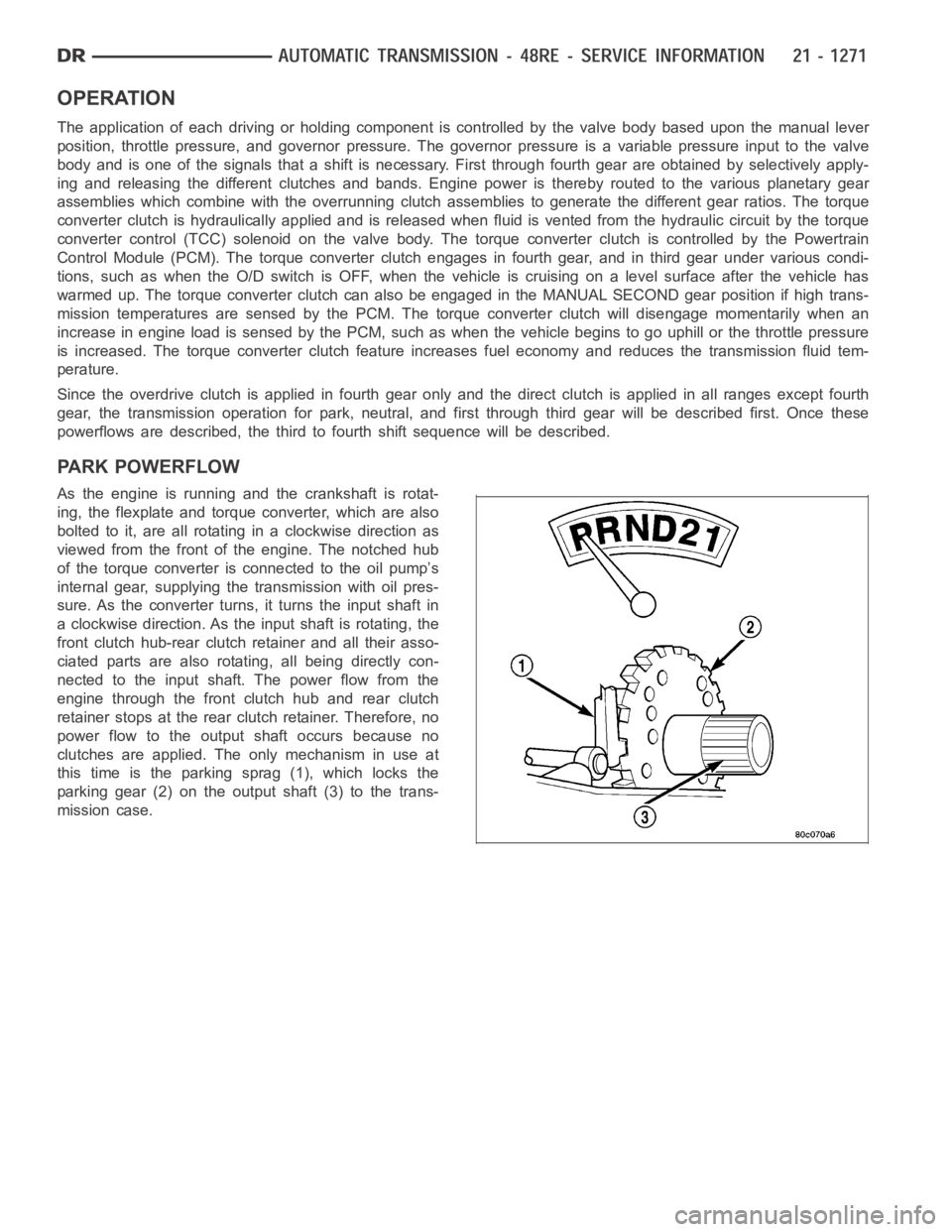
As the engine is running and the crankshaft is rotat-
ing, the flexplate and torque converter, which are also
bolted to it, are all rotating in a clockwise direction as
viewed from the front of the engine. The notched hub
of the torque converter is connected to the oil pump’s
internal gear, supplying the transmission with oil pres-
sure. As the converter turns, it turns the input shaft in
a clockwise direction. As the input shaft is rotating, the
front clutch hub-rear clutch retainer and all their asso-
ciated parts are also rotating, all being directly con-
nected to the input shaft. The power flow from the
engine through the front clutch hub and rear clutch
retainer stops at the rear clutch retainer. Therefore, no
power flow to the output shaft occurs because no
clutches are applied. The only mechanism in use at
this time is the parking sprag (1), which locks the
parking gear (2) on the output shaft (3) to the trans-
mission case.
Page 3794 of 5267
REVERSE POWERFLOW
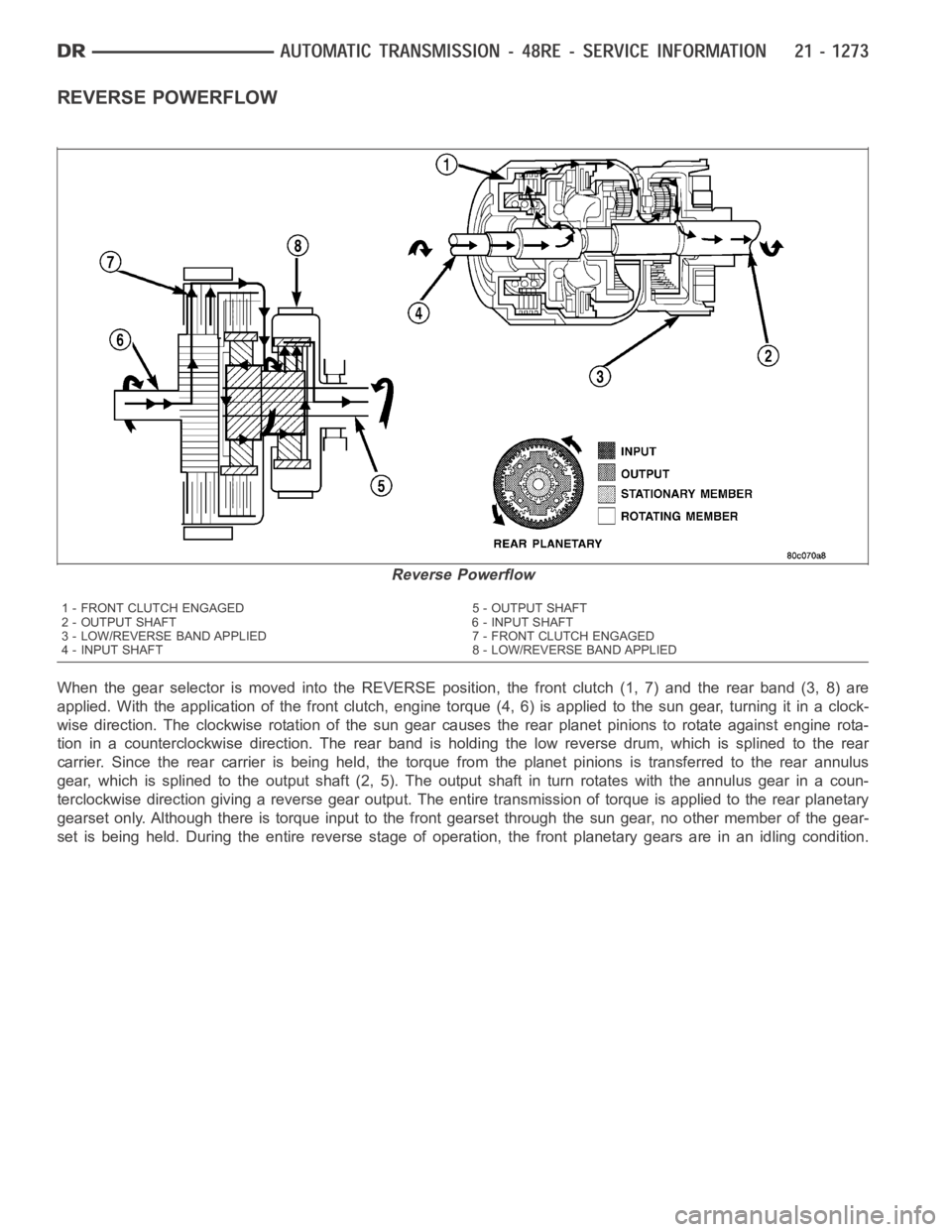
When the gear selector is moved into the REVERSE position, the front clutch(1, 7) and the rear band (3, 8) are
applied. With the application of the front clutch, engine torque (4, 6) is applied to the sun gear, turning it in a clock-
wise direction. The clockwise rotation of the sun gear causes the rear planet pinions to rotate against engine rota-
tion in a counterclockwise direction. The rear band is holding the low reverse drum, which is splined to the rear
carrier. Since the rear carrier is being held, the torque from the planet pinions is transferred to the rear annulus
gear, which is splined to the output shaft (2, 5). The output shaft in turn rotates with the annulus gear in a coun-
terclockwise direction giving a reverse gear output. The entire transmission of torque is applied to the rear planetary
gearset only. Although there is torque input to the front gearset through the sun gear, no other member of the gear-
set is being held. During the entire reverse stage of operation, the front planetary gears are in an idling condition.
Reverse Powerflow
1 - FRONT CLUTCH ENGAGED 5 - OUTPUT SHAFT
2 - OUTPUT SHAFT 6 - INPUT SHAFT
3 - LOW/REVERSE BAND APPLIED 7 - FRONT CLUTCH ENGAGED
4 - INPUT SHAFT 8 - LOW/REVERSE BAND APPLIED
Page 3795 of 5267
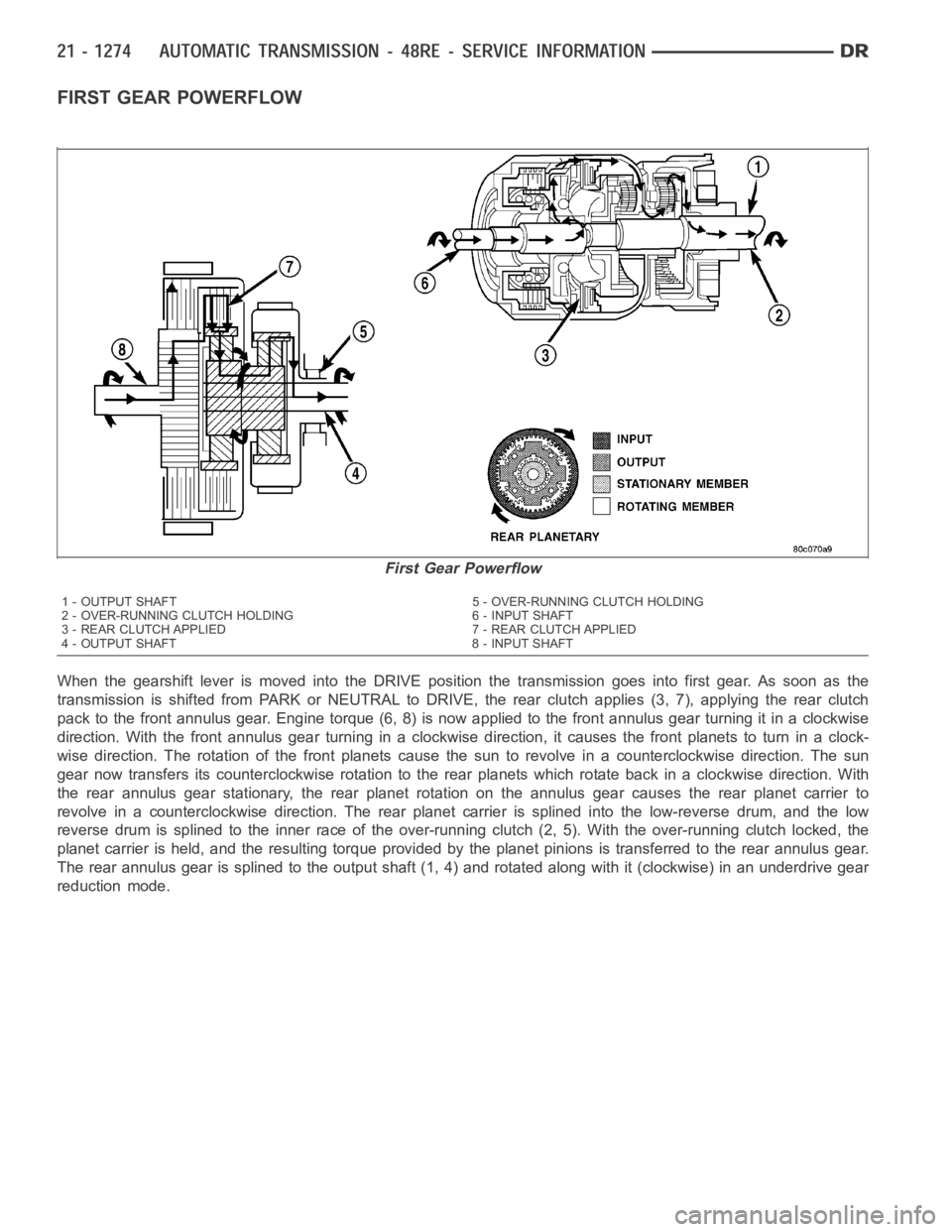
FIRST GEAR POWERFLOW
When the gearshift lever is moved into the DRIVE position the transmissiongoes into first gear. As soon as the
transmission is shifted from PARK or NEUTRAL to DRIVE, the rear clutch applies (3, 7), applying the rear clutch
pack to the front annulus gear. Engine torque (6, 8) is now applied to the front annulus gear turning it in a clockwise
direction. With the front annulus gear turning in a clockwise direction, it causes the front planets to turn in a clock-
wise direction. The rotation of the front planets cause the sun to revolve in a counterclockwise direction. The sun
gear now transfers its counterclockwise rotation to the rear planets which rotate back in a clockwise direction. With
the rear annulus gear stationary, the rear planet rotation on the annulus gear causes the rear planet carrier to
revolve in a counterclockwise direction. The rear planet carrier is splined into the low-reverse drum, and the low
reverse drum is splined to the inner race of the over-running clutch (2, 5).With the over-running clutch locked, the
planet carrier is held, and the resulting torque provided by the planet pinions is transferred to the rear annulus gear.
The rear annulus gear is splined to the output shaft (1, 4) and rotated alongwith it (clockwise) in an underdrive gear
reduction mode.
First Gear Powerflow
1 - OUTPUT SHAFT 5 - OVER-RUNNING CLUTCH HOLDING
2 - OVER-RUNNING CLUTCH HOLDING 6 - INPUT SHAFT
3 - REAR CLUTCH APPLIED 7 - REAR CLUTCH APPLIED
4 - OUTPUT SHAFT 8 - INPUT SHAFT
Page 3796 of 5267
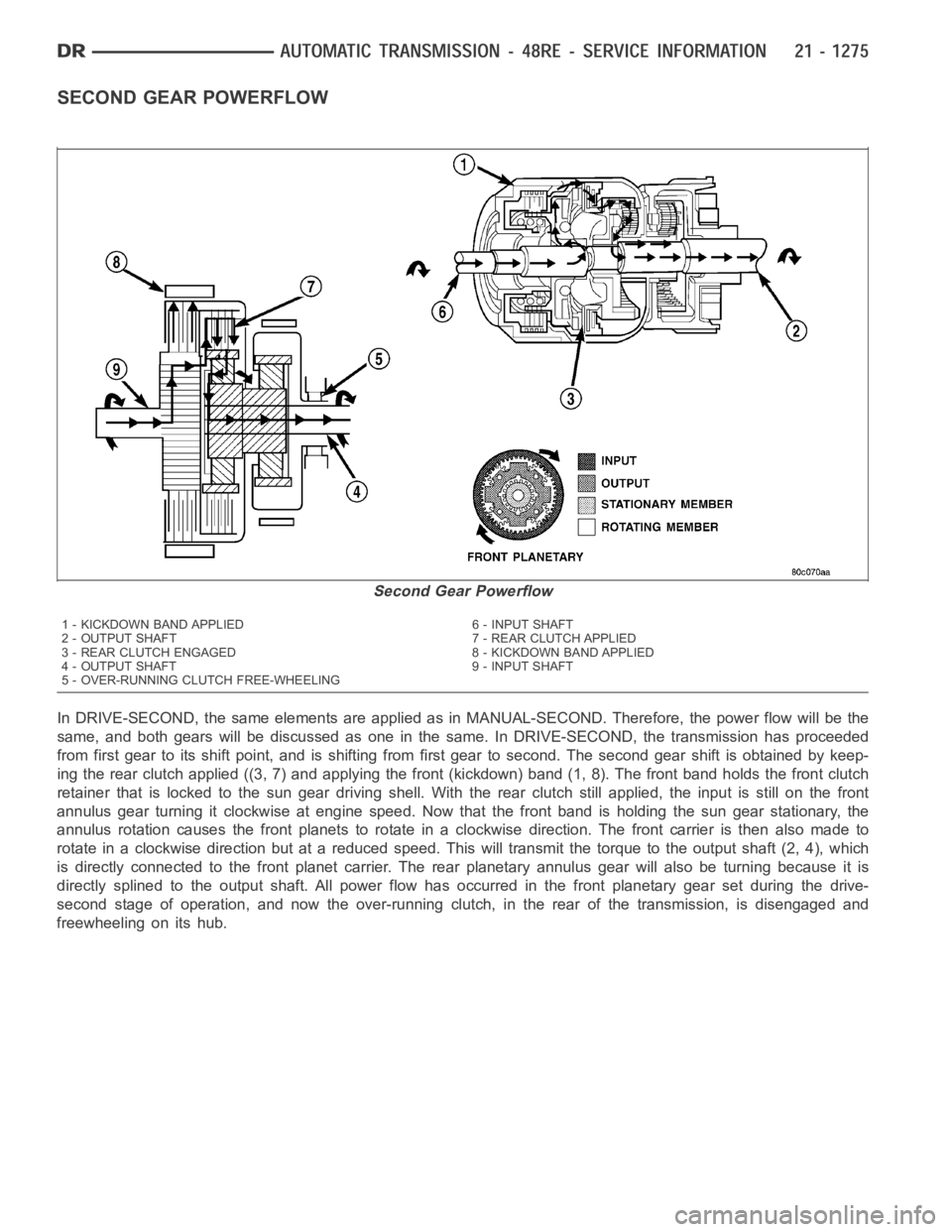
SECOND GEAR POWERFLOW
In DRIVE-SECOND, the same elements are applied as in MANUAL-SECOND. Therefore, the power flow will be the
same, and both gears will be discussed as one in the same. In DRIVE-SECOND, the transmission has proceeded
from first gear to its shift point, and is shifting from first gear to second. The second gear shift is obtained by keep-
ing the rear clutch applied ((3, 7) and applying the front (kickdown) band (1, 8). The front band holds the front clutch
retainer that is locked to the sun gear driving shell. With the rear clutch still applied, the input is still on the front
annulus gear turning it clockwise at engine speed. Now that the front band is holding the sun gear stationary, the
annulus rotation causes the front planets to rotate in a clockwise direction. The front carrier is then also made to
rotate in a clockwise direction but at a reduced speed. This will transmit the torque to the output shaft (2, 4), which
is directly connected to the front planet carrier. The rear planetary annulus gear will also be turning because it is
directly splined to the output shaft. All power flow has occurred in the front planetary gear set during the drive-
second stage of operation, and now the over-running clutch, in the rear of the transmission, is disengaged and
freewheeling on its hub.
Second Gear Powerflow
1 - KICKDOWN BAND APPLIED 6 - INPUT SHAFT
2 - OUTPUT SHAFT 7 - REAR CLUTCH APPLIED
3 - REAR CLUTCH ENGAGED 8 - KICKDOWN BAND APPLIED
4 - OUTPUT SHAFT 9 - INPUT SHAFT
5 - OVER-RUNNING CLUTCH FREE-WHEELING
Page 3797 of 5267
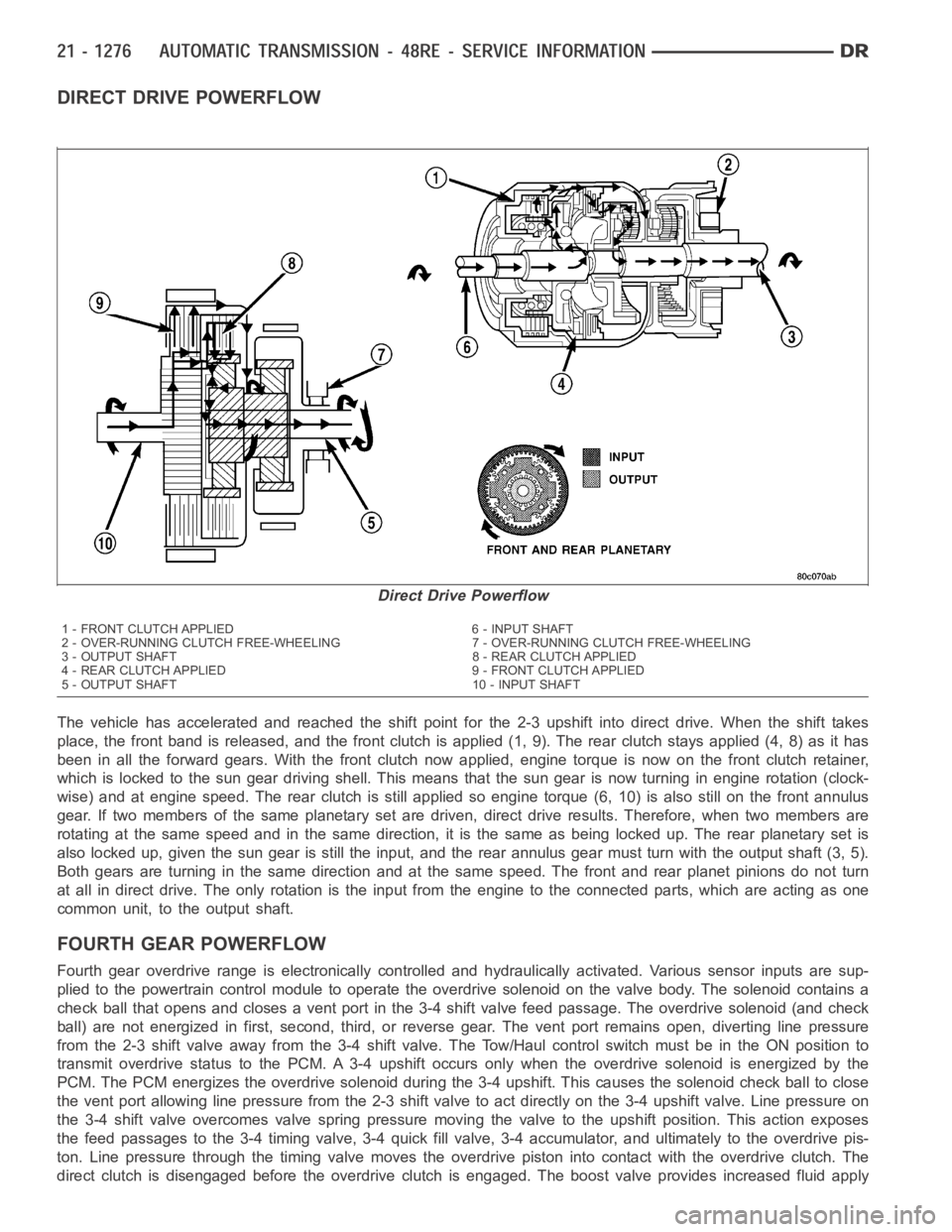
DIRECT DRIVE POWERFLOW
The vehicle has accelerated and reached the shift point for the 2-3 upshiftinto direct drive. When the shift takes
place, the front band is released, and the front clutch is applied (1, 9). The rear clutch stays applied (4, 8) as it has
been in all the forward gears. With the front clutch now applied, engine torque is now on the front clutch retainer,
which is locked to the sun gear drivingshell. This means that the sun gear isnow turning in engine rotation (clock-
wise) and at engine speed. The rear clutch is still applied so engine torque(6, 10) is also still on the front annulus
gear. If two members of the same planetary set are driven, direct drive results. Therefore, when two members are
rotating at the same speed and in the same direction, it is the same as being locked up. The rear planetary set is
also locked up, given the sun gear is still the input, and the rear annulus gear must turn with the output shaft (3, 5).
Both gears are turning in the same direction and at the same speed. The frontand rear planet pinions do not turn
at all in direct drive. The only rotation is the input from the engine to the connected parts, which are acting as one
common unit, to the output shaft.
FOURTHGEARPOWERFLOW
Fourth gear overdrive range is electronically controlled and hydraulically activated. Various sensor inputs are sup-
plied to the powertrain control module to operate the overdrive solenoid on the valve body. The solenoid contains a
check ball that opens and closes a vent port in the 3-4 shift valve feed passage. The overdrive solenoid (and check
ball) are not energized in first, second, third, or reverse gear. The vent port remains open, diverting line pressure
from the 2-3 shift valve away from the 3-4 shift valve. The Tow/Haul controlswitch must be in the ON position to
transmit overdrive status to the PCM. A 3-4 upshift occurs only when the overdrive solenoid is energized by the
PCM. The PCM energizes the overdrive solenoid during the 3-4 upshift. Thiscauses the solenoid check ball to close
the vent port allowing line pressure from the 2-3 shift valve to act directly on the 3-4 upshift valve. Line pressure on
the 3-4 shift valve overcomes valve spring pressure moving the valve to theupshift position. This action exposes
the feed passages to the 3-4 timing valve, 3-4 quick fill valve, 3-4 accumulator, and ultimately to the overdrive pis-
ton. Line pressure through the timing valve moves the overdrive piston into contact with the overdrive clutch. The
direct clutch is disengaged before the overdrive clutch is engaged. The boost valve provides increased fluid apply
Direct Drive Powerflow
1 - FRONT CLUTCH APPLIED 6 - INPUT SHAFT
2 - OVER-RUNNING CLUTCH FREE-WHEELING 7 - OVER-RUNNING CLUTCH FREE-WHEELING
3 - OUTPUT SHAFT 8 - REAR CLUTCH APPLIED
4 - REAR CLUTCH APPLIED 9 - FRONT CLUTCH APPLIED
5 - OUTPUT SHAFT 10 - INPUT SHAFT
Page 3803 of 5267
Front Clutch Air Test
Place one or two fingers on the clutch housing and apply air pressure through front clutch apply passage. Piston
movement can be felt and a soft thump heard as the clutch applies.
Rear Clutch Air Test
Place one or two fingers on the clutch housing and apply air pressure through rear clutch apply passage. Piston
movement can be felt and a soft thump heard as the clutch applies.
Front Servo Air Test
Apply air pressure to the front servo apply passage. The servo rod should extend and cause the band to tighten
around the drum. Spring pressure should release the servo when air pressure is removed.
Rear Servo Air Test
Apply air pressure to the rear servo apply passage. The servo rod should extend and cause the band to tighten
around the drum. Spring pressure should release the servo when air pressure is removed.
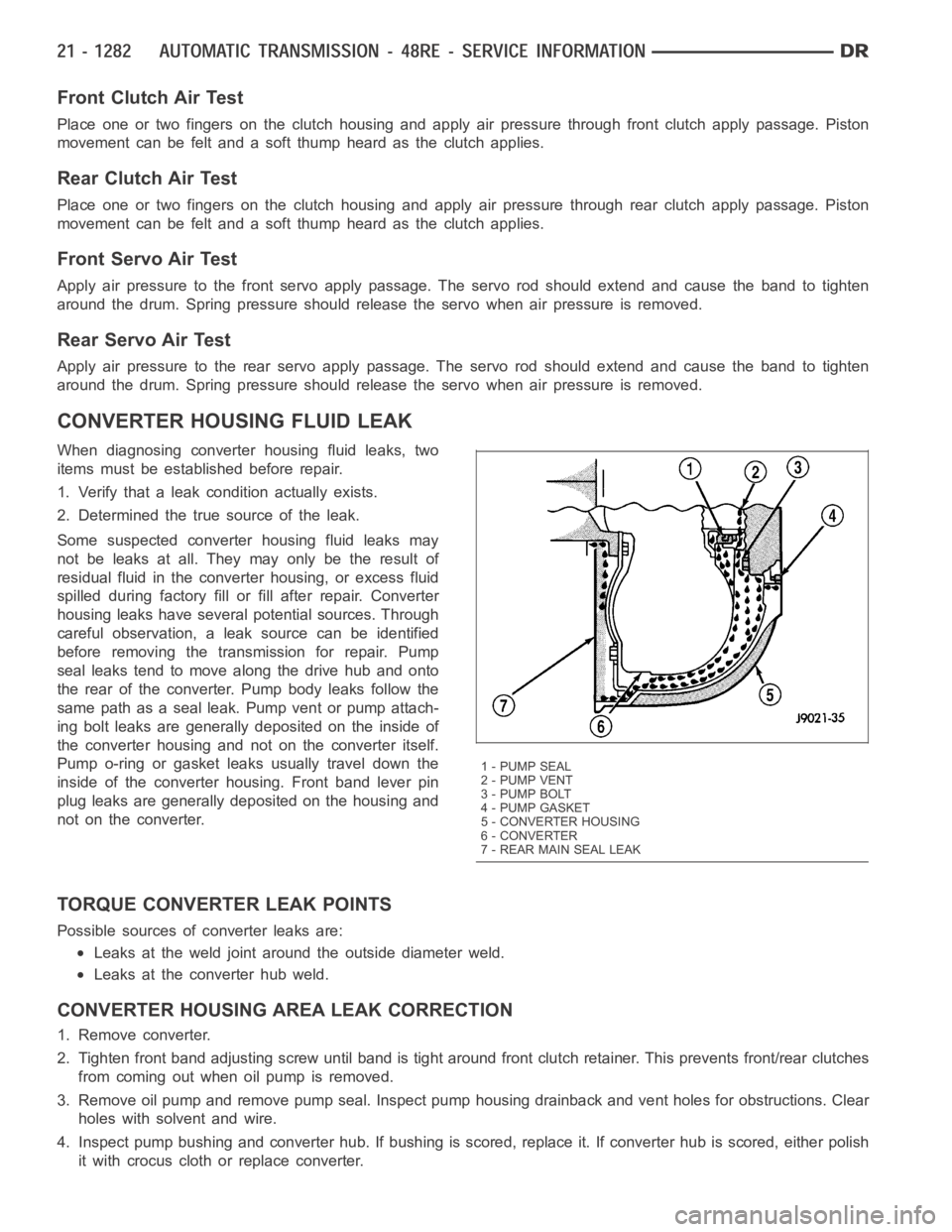
CONVERTER HOUSING FLUID LEAK
When diagnosing converter housing fluid leaks, two
items must be established before repair.
1. Verify that a leak condition actually exists.
2. Determined the true source of the leak.
Some suspected converter housing fluid leaks may
not be leaks at all. They may only be the result of
residual fluid in the converter housing, or excess fluid
spilled during factory fill or fill after repair. Converter
housing leaks have several potential sources. Through
careful observation, a leak source can be identified
before removing the transmission for repair. Pump
seal leaks tend to move along the drive hub and onto
the rear of the converter. Pump body leaks follow the
same path as a seal leak. Pump vent or pump attach-
ing bolt leaks are generally deposited on the inside of
the converter housing and not on the converter itself.
Pump o-ring or gasket leaks usually travel down the
inside of the converter housing. Front band lever pin
plug leaks are generally deposited on the housing and
not on the converter.
TORQUE CONVERTER LEAK POINTS
Possible sources of converter leaks are:
Leaks at the weld joint around the outside diameter weld.
Leaks at the converter hub weld.
CONVERTER HOUSING AREA LEAK CORRECTION
1. Remove converter.
2. Tighten front band adjusting screw until band is tight around front clutch retainer. This prevents front/rear clutches
from coming out when oil pump is removed.
3. Remove oil pump and remove pump seal. Inspect pump housing drainback andvent holes for obstructions. Clear
holes with solvent and wire.
4. Inspect pump bushing and converter hub. If bushing is scored, replace it. If converter hub is scored, either polish
it with crocus cloth or replace converter.
1 - PUMP SEAL
2-PUMPVENT
3-PUMPBOLT
4 - PUMP GASKET
5 - CONVERTER HOUSING
6 - CONVERTER
7 - REAR MAIN SEAL LEAK
Page 3804 of 5267
5. Install new pump seal, O-ring, and gasket. Replace oil pump if cracked, porous or damaged in any way. Be sure
to loosen the front band before installing the oil pump, damage to the oil pump seal may occur if the band is still
tightened to the frontclutch retainer.
6. Loosen kickdown lever pin access plug three turns. Apply Loctite™ 592, orPermatex
No. 2 to plug threads and
tightenplugto17Nꞏm(150in.lbs.)torque.
7. Adjust front band.
8. Lubricate pump seal and converter hub with transmission fluid or petroleum jelly and install converter.
9. Install transmission and converter housing dust shield.
10. Lower vehicle.
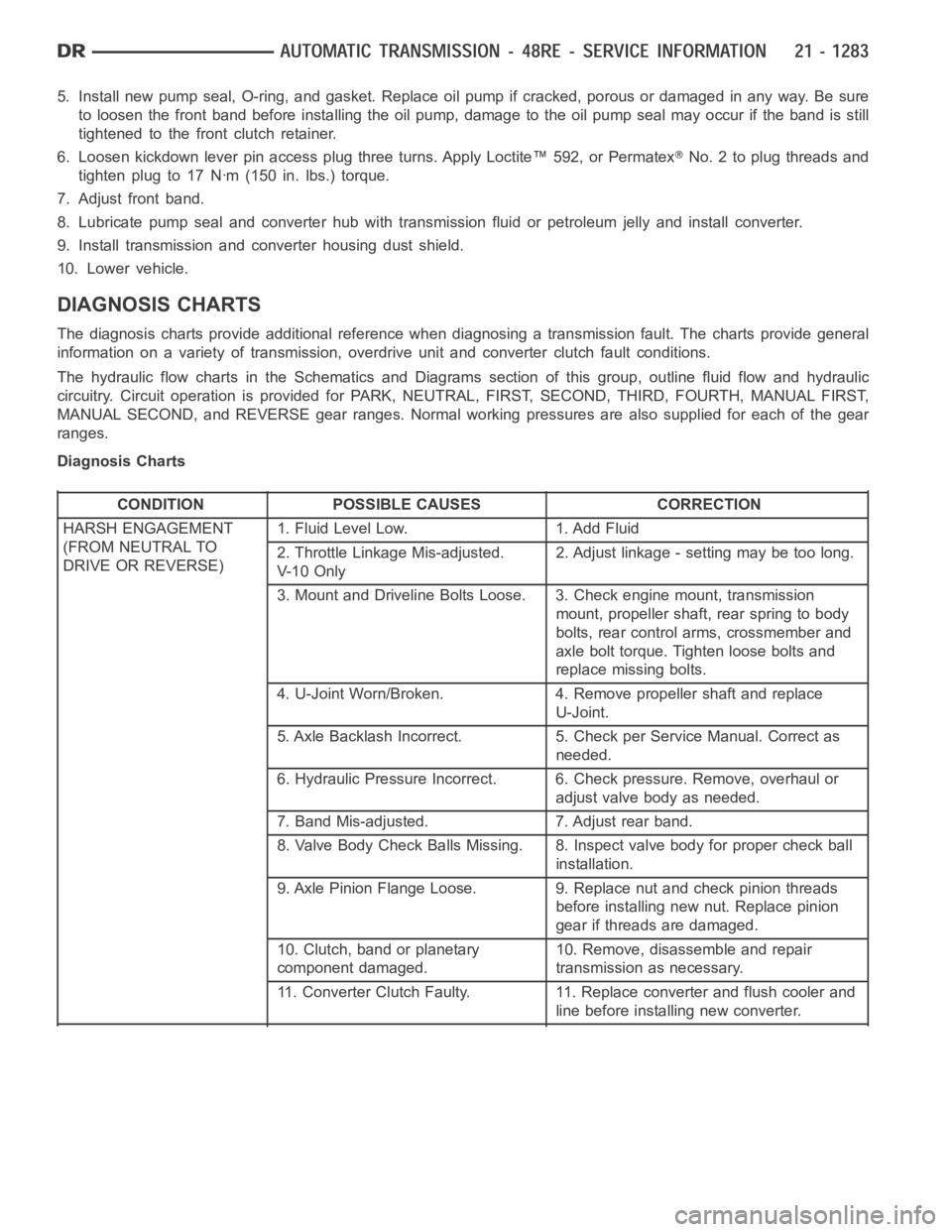
DIAGNOSIS CHARTS
The diagnosis charts provide additional reference when diagnosing a transmission fault. The charts provide general
information on a variety of transmission, overdrive unit and converter clutch fault conditions.
The hydraulic flow charts in the Schematics and Diagrams section of this group, outline fluid flow and hydraulic
circuitry. Circuit operation is provided for PARK, NEUTRAL, FIRST, SECOND, THIRD, FOURTH, MANUAL FIRST,
MANUAL SECOND, and REVERSE gear ranges. Normal working pressures are alsosupplied for each of the gear
ranges.
Diagnosis Charts
CONDITION POSSIBLE CAUSES CORRECTION
HARSH ENGAGEMENT
(FROM NEUTRAL TO
DRIVE OR REVERSE)1. Fluid Level Low. 1. Add Fluid
2. Throttle Linkage Mis-adjusted.
V- 1 0 O n l y2. Adjust linkage - setting may be too long.
3. Mount and Driveline Bolts Loose. 3. Check engine mount, transmission
mount, propeller shaft, rear spring to body
bolts, rear control arms, crossmember and
axle bolt torque. Tighten loose bolts and
replace missing bolts.
4. U-Joint Worn/Broken. 4. Remove propeller shaft and replace
U-Joint.
5. Axle Backlash Incorrect. 5. Check per Service Manual. Correct as
needed.
6. Hydraulic Pressure Incorrect. 6. Check pressure. Remove, overhaul or
adjust valve body as needed.
7. Band Mis-adjusted. 7. Adjust rear band.
8. Valve Body Check Balls Missing. 8. Inspect valve body for proper check ball
installation.
9. Axle Pinion Flange Loose. 9. Replace nut and check pinion threads
before installing new nut. Replace pinion
gear if threads are damaged.
10. Clutch, band or planetary
component damaged.10. Remove, disassemble and repair
transmission as necessary.
11. Converter Clutch Faulty. 11. Replace converter and flush cooler and
line before installing new converter.
Page 3805 of 5267
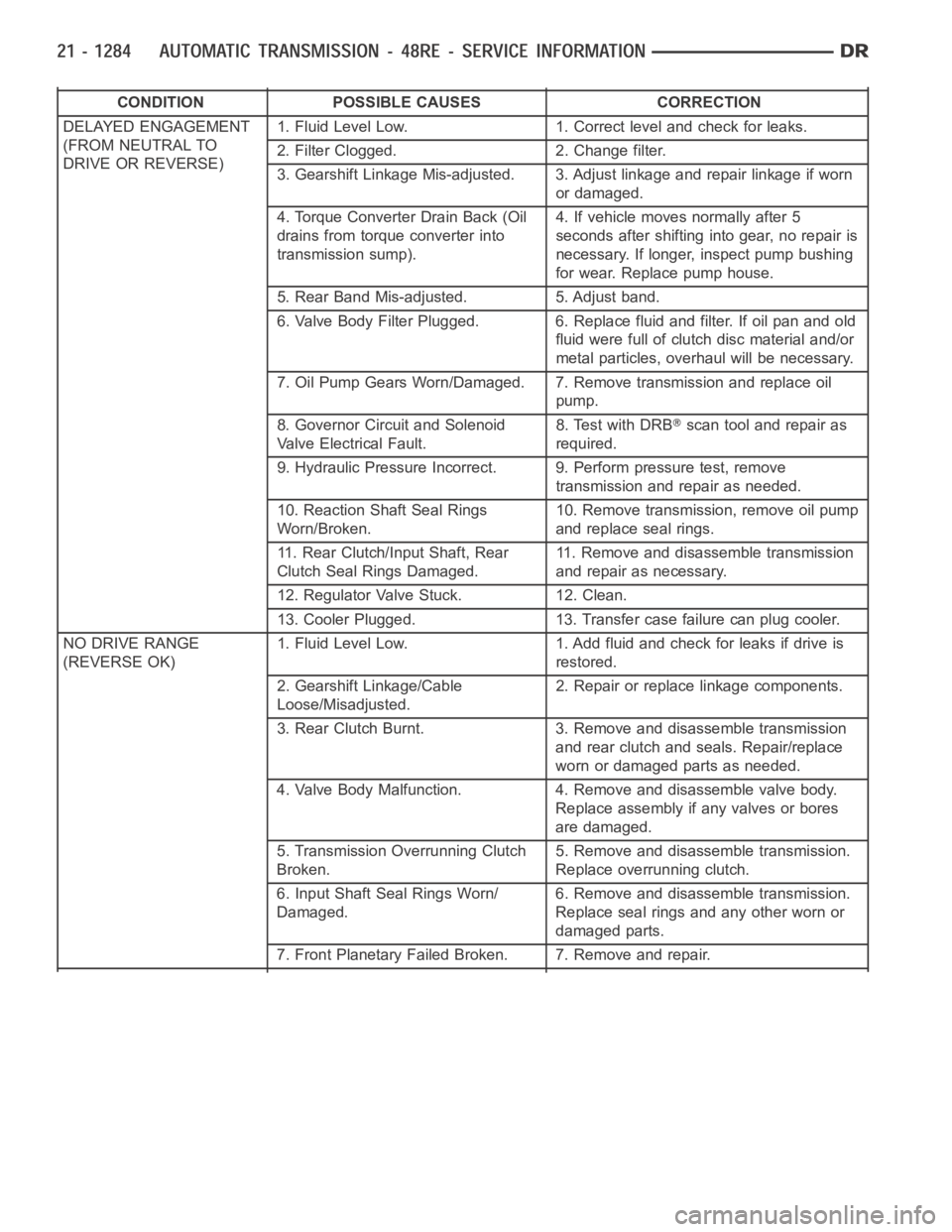
CONDITION POSSIBLE CAUSES CORRECTION
DELAYED ENGAGEMENT
(FROM NEUTRAL TO
DRIVE OR REVERSE)1. Fluid Level Low. 1. Correct level and check for leaks.
2. Filter Clogged. 2. Change filter.
3. Gearshift Linkage Mis-adjusted. 3. Adjust linkage and repair linkage ifworn
or damaged.
4. Torque Converter Drain Back (Oil
drains from torque converter into
transmission sump).4. If vehicle moves normally after 5
seconds after shifting into gear, no repair is
necessary. If longer, inspect pump bushing
for wear. Replace pump house.
5. Rear Band Mis-adjusted. 5. Adjust band.
6. Valve Body Filter Plugged. 6. Replace fluid and filter. If oil pan and old
fluid were full of clutch disc material and/or
metal particles, overhaul will be necessary.
7. Oil Pump Gears Worn/Damaged. 7. Remove transmission and replace oil
pump.
8. Governor Circuit and Solenoid
Valve Electrical Fault.8. Test with DRB
scan tool and repair as
required.
9. Hydraulic Pressure Incorrect. 9. Perform pressure test, remove
transmission and repair as needed.
10. Reaction Shaft Seal Rings
Worn/Broken.10. Remove transmission, remove oil pump
and replace seal rings.
11. Rear Clutch/Input Shaft, Rear
Clutch Seal Rings Damaged.11. Remove and disassemble transmission
and repair as necessary.
12. Regulator Valve Stuck. 12. Clean.
13. Cooler Plugged. 13. Transfer case failure can plug cooler.
NO DRIVE RANGE
(REVERSE OK)1. Fluid Level Low. 1. Add fluid and check for leaks if drive is
restored.
2. Gearshift Linkage/Cable
Loose/Misadjusted.2. Repair or replace linkage components.
3. Rear Clutch Burnt. 3. Removeand disassemble transmission
and rear clutch and seals. Repair/replace
worn or damaged parts as needed.
4. Valve Body Malfunction. 4. Remove and disassemble valve body.
Replace assembly if any valves or bores
are damaged.
5. Transmission Overrunning Clutch
Broken.5. Remove and disassemble transmission.
Replace overrunning clutch.
6. Input Shaft Seal Rings Worn/
Damaged.6. Remove and disassemble transmission.
Replace seal rings and any other worn or
damaged parts.
7. Front Planetary Failed Broken. 7. Remove and repair.