belt DODGE TRUCK 1993 Service User Guide
[x] Cancel search | Manufacturer: DODGE, Model Year: 1993, Model line: TRUCK, Model: DODGE TRUCK 1993Pages: 1502, PDF Size: 80.97 MB
Page 272 of 1502
COOLING SYSTEM
CONTENTS page
DIAGNOSIS
... 4
ENGINE
ACCESSORY
DRIVE BELTS
40
ENGINE
BLOCK HEATERS
48
GENERAL
INFORMATION
Throughout this group, references are made to partic
ular vehicle models by alphabetical designation or by
the particular vehicle nameplate. A chart showing a
breakdown of alphabetical designations is included in
the Introduction section at the beginning of this man
ual.
5.9L gas powered engines will be' referred to as ei
ther: LDC (Light Duty Cycle) or HDC (Heavy Duty
Cycle).
COOLING
SYSTEM
The cooling system regulates engine operating tem
perature. It allows the engine to reach normal oper-
page
SERVICE
PROCEDURES
15
SPECIFICATIONS
; 49
ating temperature as quickly as possible. It also
maintains normal operating temperature and pre
vents overheating.
The cooling system also provides a means of heat
ing the passenger compartment and cooling the auto
matic transmission fluid (if equipped). The cooling system is pressurized and uses a centrifugal water
pump to circulate coolant throughout the system.
An optional factory installed maximum duty cool
ing package is available on most models. This pack age will provide additional cooling capacity for
vehicles used under extreme conditions such as
trailer towing in high ambient temperatures.
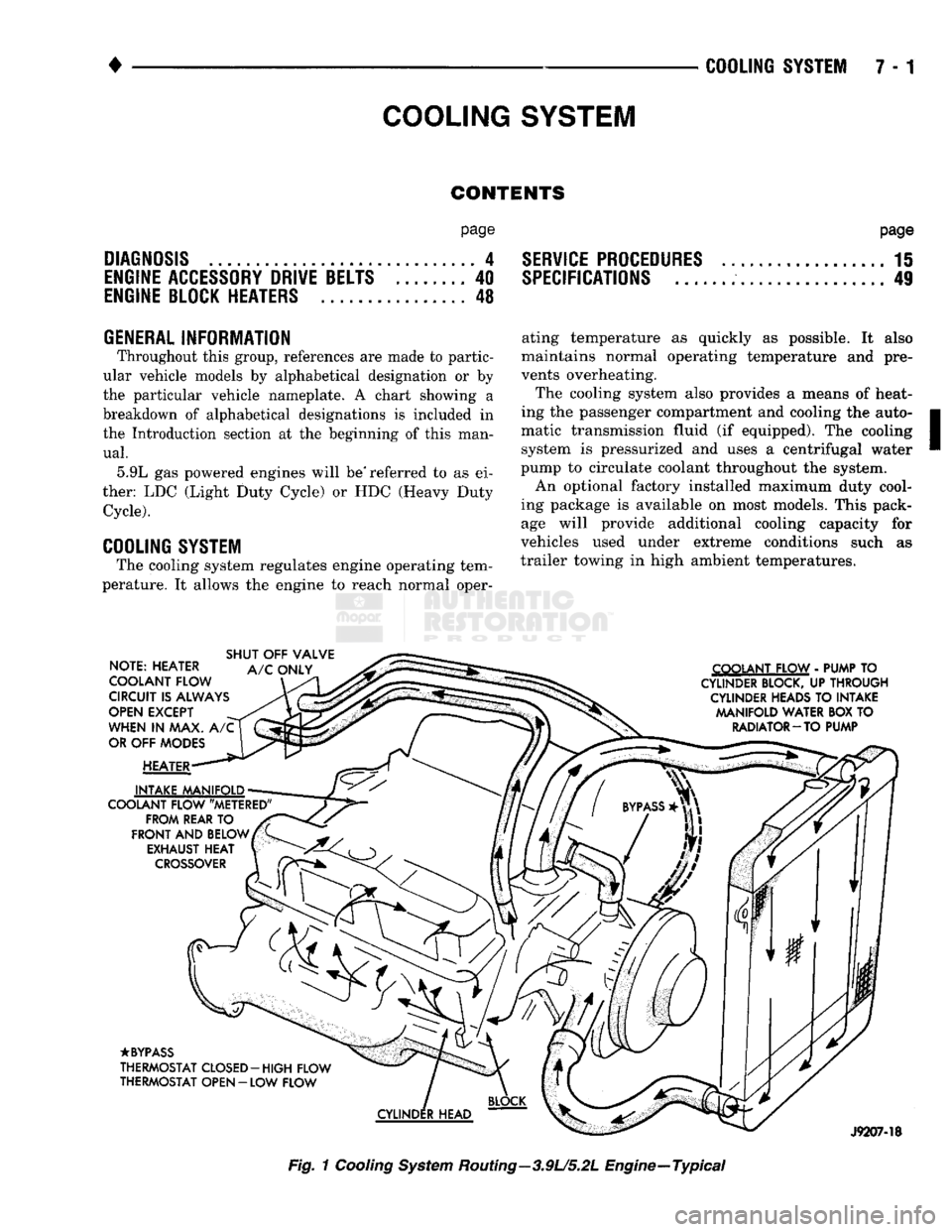
NOTE: HEATER
COOLANT FLOW
CIRCUIT
IS
ALWAYS
OPEN
EXCEPT
WHEN
IN MAX. A/C
OR
OFF
MODES
HEATER
INTAKE MANIFOLD
COOLANT FLOW "METERED" FROM REAR
TO
FRONT
AND
BELOW EXHAUST
HEAT
CROSSOVER
SHUT
OFF
VALVE
A/C
ONLY COOLANT FLOW
-
PUMP
TO
CYLINDER BLOCK,
UP
THROUGH CYLINDER HEADS
TO
INTAKE MANIFOLD WATER
BOX TO
RADIATOR-TO PUMP
•BYPASS
THERMOSTAT CLOSED-HIGH FLOW
THERMOSTAT OPEN
- LOW
FLOW
J9207-18
Fig.
1
Cooling
System
Routing—3.9U5.2L Engine—Typical
Page 275 of 1502
DIAGNOSIS
PRELIMINARY
CHECKS
ENGINE COOLING SYSTEM OVERHEATING Establish what driving conditions caused the com
plaint. Abnormal loads on the cooling system such as
the following may be the cause:
1.
PROLONGED IDLE, VERY HIGH AMBI
ENT TEMPERATURE, SLIGHT TAIL WIND AT
IDLE, SLOW TRAFFIC, TRAFFIC JAMS, HIGH SPEED OR STEEP GRADES.
Driving techniques that avoid overheating are:
• Idle with A/C off when temperature gauge is at
end of normal range. * Increasing engine speed for more air flow is recom
mended.
2.
TRAILER TOWING: Consult Trailer Towing section of owners manual.
Do not exceed limits.
3.
AIR CONDITIONING; ADD-ON OR AFTER
MARKET: A maximum cooling package should have been or
dered with vehicle if add-on or after market A/C is
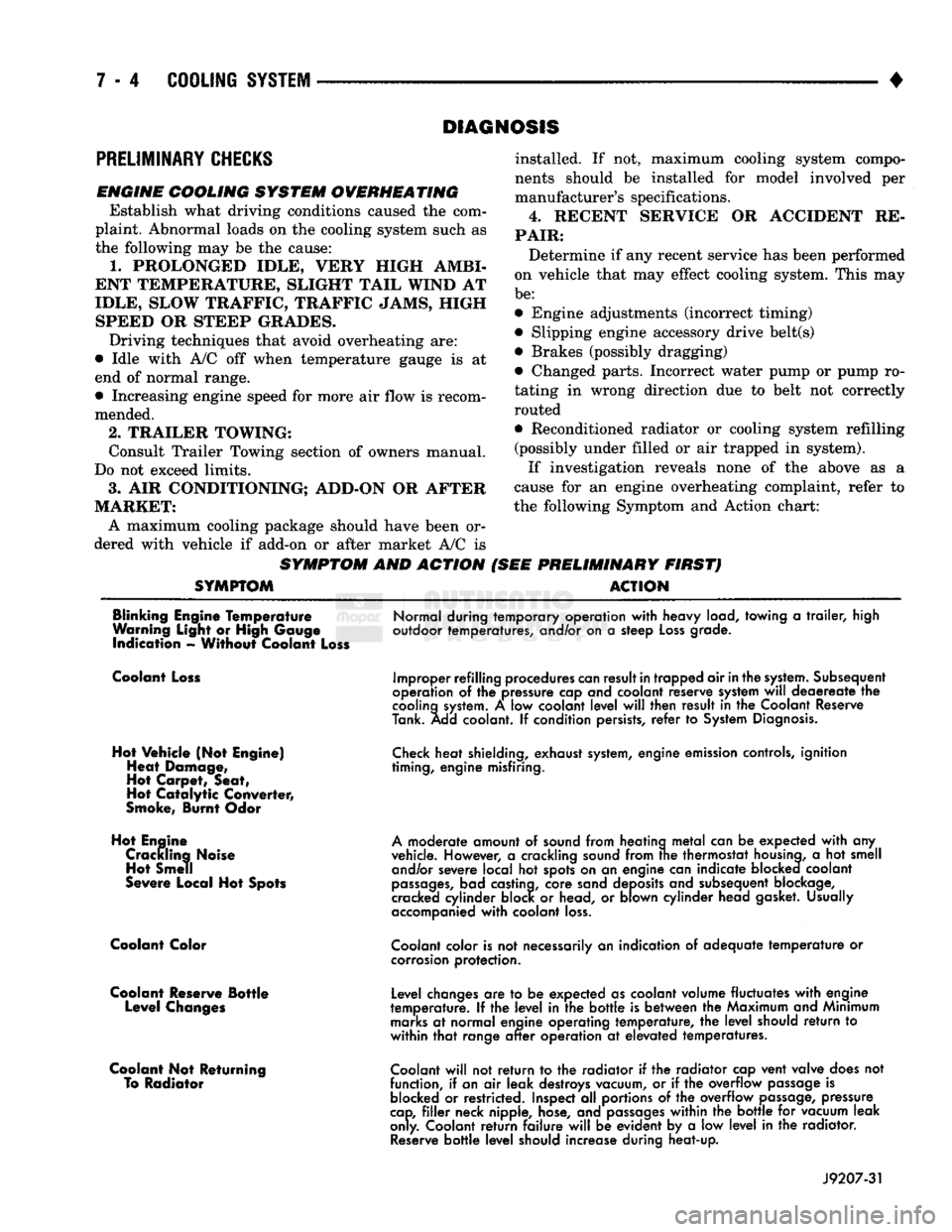
SYMPTOM AND ACTION
SYMPTOM
installed. If not, maximum cooling system compo
nents should be installed for model involved per
manufacturer's specifications.
4.
RECENT SERVICE OR ACCIDENT RE
PAIR:
Determine if any recent service has been performed
on vehicle that may effect cooling system. This may
be:
• Engine adjustments (incorrect timing)
• Slipping engine accessory drive belt(s) • Brakes (possibly dragging)
• Changed parts. Incorrect water pump or pump ro
tating in wrong direction due to belt not correctly
routed
• Reconditioned radiator or cooling system refilling (possibly under filled or air trapped in system).
If investigation reveals none of the above as a
cause for an engine overheating complaint, refer to
the following Symptom and Action chart:
PRELIMINARY FIRST) ACTION
Blinking Engine Temperature
Warning Light or High Gauge indication - Without Coolant Loss
Normal during temporary operation
with
heavy load, towing
a
trailer,
high
outdoor temperatures, and/or on
a
steep
Loss
grade.
Coolant Loss
Hot Vehicle (Not Engine) Heat Damage,
Hot Carpet, Seat,
Hot
Catalytic
Converter,
Smoke, Burnt Odor
Hot Engine Crackling Noise Hot Smell
Severe Local Hot Spots
Coolant Color
Coolant Reserve Bottle Level Changes
Coolant Not Returning To Radiator
Improper refilling procedures
can
result
in
trapped air
in
the
system.
Subsequent
operation
of the
pressure cap and coolant reserve system
will
deaereate
the
cooling
system.
A low
coolant
level
will
then result
in the
Coolant Reserve
Tank. Add coolant.
If
condition persists,
refer
to
System
Diagnosis.
Check
heat shielding, exhaust
system,
engine emission controls, ignition
timing, engine misfiring.
A
moderate amount
of
sound from heating
metal
can
be
expected
with
any
vehicle. However,
a
crackling sound from
trie
thermostat
housing,
a hot
smell and/or severe local
hot
spots on
an
engine can indicate blocked coolant
passages,
bad castina, core sand deposits and subsequent blockage,
cracked cylinder block
or
head,
or
blown cylinder head gasket. Usually
accompanied
with
coolant
loss.
Coolant
color is
not
necessarily
an
indication
of
adequate
temperature
or
corrosion
protection.
Level changes
are to be
expected as coolant volume fluctuates
with
engine
temperature.
If the
level
in the
bottle
is
between
the
Maximum and Minimum
marks
at
normal engine operating temperature,
the
level
should
return
to
within
that
range
after
operation
at
elevated temperatures.
Coolant
will
not
return
to the
radiator
if the
radiator cap vent valve does
not
function,
if
an
air
leak destroys vacuum,
or if the
overflow
passage
is
blocked
or
restricted. Inspect
all
portions
of the
overflow
passage,
pressure
cap,
filler
neck nipple, hose, and
passages
within
the
bottle
for
vacuum leak
only. Coolant
return
failure
will
be
evident
by a low
level
in the
radiator.
Reserve
bottle
level
should increase during heat-up.
J9207-31
Page 278 of 1502
•
COOLING
SYSTEM
7 - 7 COOLING SYSTEM DIAGNOSIS (EXCEPT DIESELJ-GONTINUED
CONDITION
AND
CHECKS
DIAGNOSIS
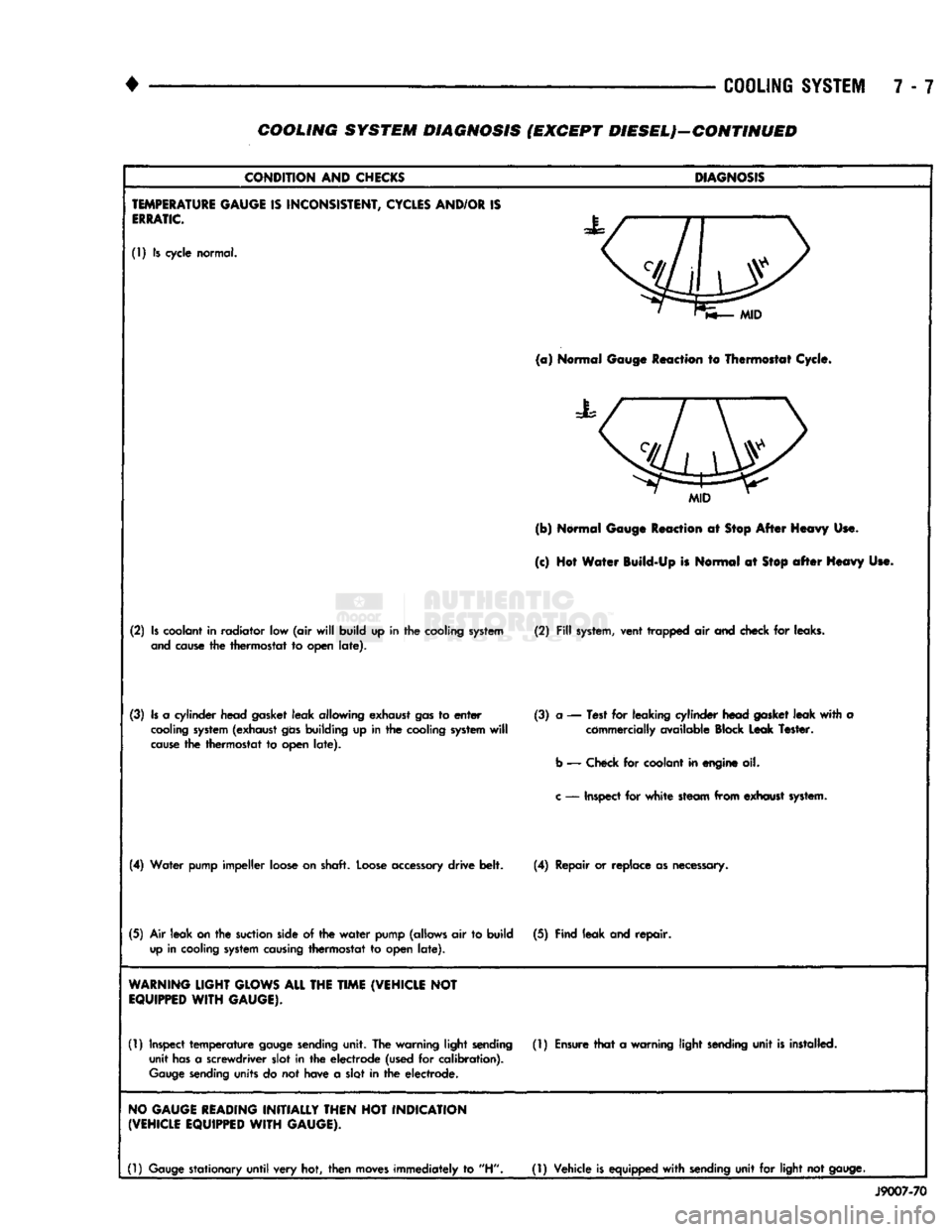
TEMPERATURE
GAUGE
IS
INCONSISTENT,
CYCLES
AND/OR
IS
ERRATIC.
(1) Is cycle normal.
MID
(a)
Normal Gauge Reaction to Thermostat Cycle.
MID
(b) Normal Gauge Reaction at Stop After Heavy Use.
(c) Hot Water Build-Up is Normal at
Stop
after
Heavy Use.
(2)
Is
coolant in radiator low (air
will
build up in the cooling
system
(2)
Fill
system,
vent trapped air and check for leaks,
and
cause
the thermostat to open
late).
(3)
Is
a cylinder head gasket leak allowing exhaust
gas
to
enter
(3) a — Test for leaking cylinder head
gasket
leak
with
a
cooling
system
(exhaust
gas
building up in the cooling
system
will
commercially available Block Leak Tester,
cause
the thermostat to open
late).
b
— Check for coolant in engine oil.
c
— Inspect for
white
steam from exhaust
system.
(4)
Water pump impeller loose on shaft.
Loose
accessory
drive belt. (4) Repair or replace as necessary.
(5)
Air leak
on
the
suction
side of the
water
pump (allows air to build (5) Find leak and repair,
up
in cooling
system
causing
thermostat to open
late).
WARNING
LIGHT
GLOWS
ALL
THE
TIME
(VEHICLE
NOT
EQUIPPED
WITH
GAUGE).
(1) Inspect
temperature
gauge
sending
unit. The warning light
sending
(1)
Ensure
that
a warning light
sending
unit
is
installed, unit
has
a screwdriver slot in the electrode (used for calibration).
Gauge
sending
units do not have a slot in the electrode.
NO
GAUGE
READING
INITIALLY
THEN
HOT
INDICATION
(VEHICLE
EQUIPPED
WITH
GAUGE).
(1)
Gauge
stationary
until
very hot, then
moves
immediately to "H"
(1)
Vehicle
is
equipped
with
sending
unit for light not
gauge.
J9007-70
Page 283 of 1502
7
- 12
COOLING
SYSTEM
• DIESEL COOLING SYSTEM DIAGNOSIS-CONTINUED
CONDITION
AND
CHECKS
DIAGNOSIS
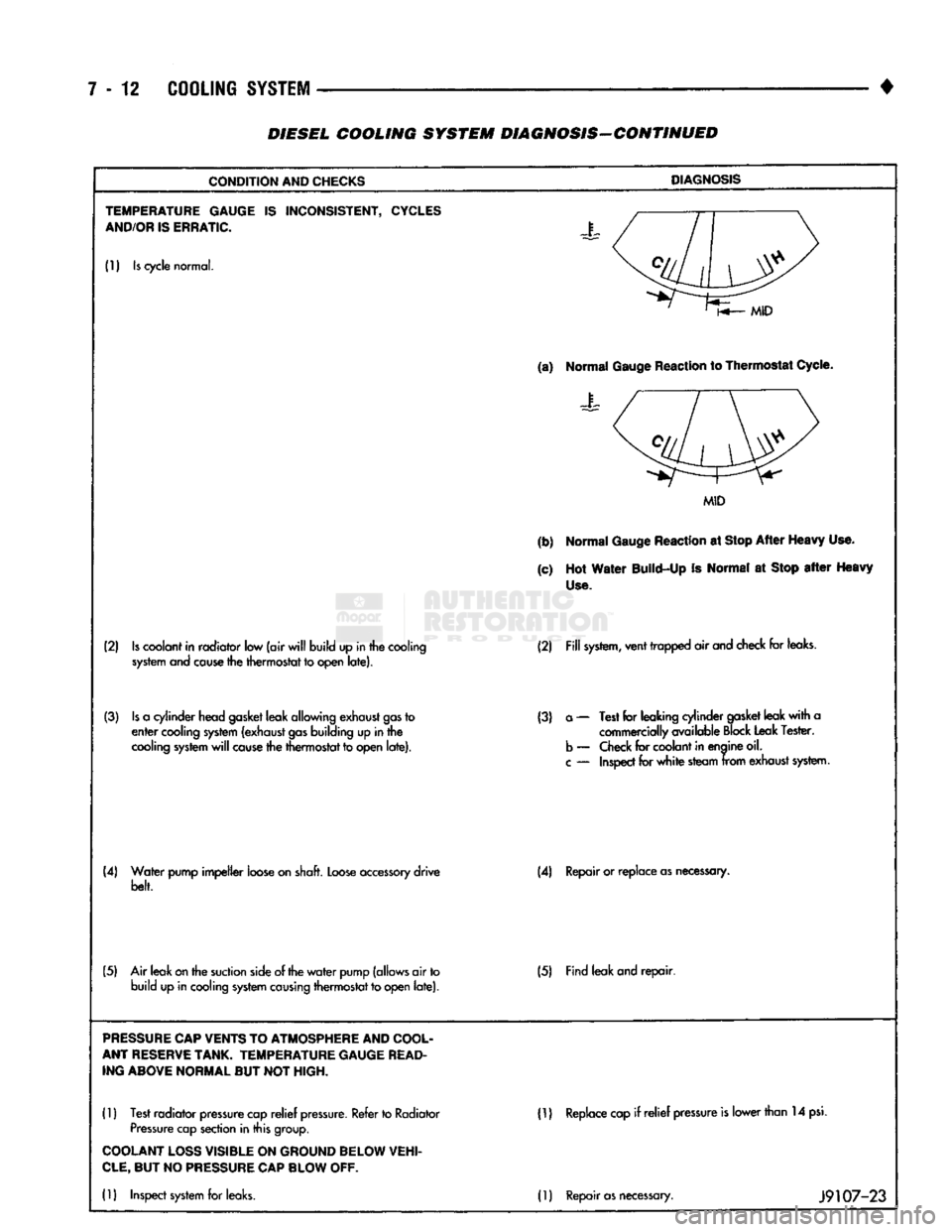
TEMPERATURE GAUGE
IS
INCONSISTENT,
CYCLES
AND/OR
IS
ERRATIC.
J
(1)
Is
cycle
normal.
(a)
Normal
Gauge
Reaction
to Thermostat
Cycle.
Normal
Gauge
Reaction
to Thermostat
Cycle.
MID
(b)
Normal
Gauge
Reaction
at
Stop
After
Heavy
Use.
(c)
Hot
Water
Build-Up
Is
Normal
at
Stop
after
Heavy
Use.
(2)
Is
coolant
in
radiator
low
(air
will
build
up in
the
cooling
system and cause
the
thermostat
to
open
late). (2)
Fill
system,
vent
trapped
air
and
check
for
leaks.
(3)
Is
a
cylinder
head
gasket
leak
allowing
exhaust
gas
to
enter
cooling
system
(exhaust
gas
building
up in
the
cooling
system
will
cause
the
thermostat
to
open
late).
(3)
a
—
Test
for
leaking
cylinder
gasket
leak
with
a
commercially
available
Block
Leak
Tester,
b
—
Check
for
coolant
in
enaine
oil.
c
—
Inspect
for
white
steam
from
exhaust
system.
(4)
Water
pump
impeller
loose
on
shaft.
Loose
accessory
drive
belt. (4)
Repair or
replace
as
necessary.
(5)
Air
leak
on
the
suction
side
of the
water
pump
(allows
air
to
build
up in
cooling
system causing
thermostat
to
open
late). (5)
Find
leak
and
repair.
PRESSURE
CAP
VENTS
TO
ATMOSPHERE
AND
COOL
ANT
RESERVE
TANK.
TEMPERATURE GAUGE
READ
ING ABOVE NORMAL
BUT NOT
HIGH.
(1)
Test
radiator
pressure
cap
relief
pressure.
Refer
to
Radiator
Pressure
cap
section
in
this
group.
ID
Replace
cap
if relief
pressure
is
lower
than
14
psi.
COOLANT
LOSS
VISIBLE
ON
GROUND BELOW VEHI
CLE,
BUT NO
PRESSURE
CAP
BLOW
OFF.
(1)
Inspect
system
for
leaks.
(1)
Repair
as
necessary.
J9107-23
Page 286 of 1502
•
COOLING SYSTEM
7 - 15
SERVICE
PROCEDURES
INDEX
page
Coolant
26
Coolant Reserve/Overflow System
30
Cooling System Cleaning/Reverse Flushing
28
Cooling System Fan—Diesel Engine
. 37
Cooling System
Fan—Gas
Engines
36
Cooling System
Hoses
34
Draining Cooling System
27
Pressure
Testing
Radiator
Caps
............. 32
Radiator Pressure
Cap 31
Radiators
32
Refilling
the
Cooling System
28
WATER PUMPS—EXCEPT DIESEL
A centrifugal water pump circulates coolant
through the water jackets, passages, intake manifold,
radiator core, cooling system hoses and heater core.
The pump is driven from the engine crankshaft by a drive belt. The water pump impeller is pressed onto the rear
of a shaft that rotates in a bearing pressed into the
water pump body. The body has a small hole for ven
tilation. The water pump seals are lubricated by an
tifreeze in the coolant mixture. Additional lubrication is not necessary. A quick test to determine if pump is working is to
check if heater warms properly. A defective water
pump will not be able to circulate heated coolant
through the long heater hose to the heater core. The water pump on all models can be removed
without discharging the air conditioning system (if equipped).
REMOVAL The water pump on all gas powered engines is
bolted directly to the engine timing chain case/cover.
A gasket is used as a seal between the water pump
and timing chain case/cover.
If water pump is replaced because of bearing/shaft
damage or leaking shaft seal, the mechanical cooling
fan assembly should also be inspected. Inspect for fa tigue cracks, loose blades or loose rivets that could
have resulted from excessive vibration. Replace fan if any of these conditions are found. Also check condi
tion of the thermal viscous fan drive. Refer to Vis
cous Fan Drive in this group. (1) Disconnect negative battery cable from battery.
(2) Drain cooling system. Refer to Draining Cool
ing System in this group. Do not waste reusable coolant. If solution is clean,
drain coolant into a clean container for reuse.
(3)
Disconnect throttle cable from clip at top of fan
shroud.
page
Testing
Cooling System
for
Leaks
. 29
Thermostat
22
Transmission
Oil
Cooler—Diesel
35
Transmission
Oil
Cooler—Except Diesel
35
Transmission Oil-To-Air Cooler
36
Viscous
Fan
Drive
38
Water
Pump
Bypass
Hose—All
Gas
Powered
Engines
.............................. 19
Water
Pumps—5.9L Diesel
18
Water
Pumps—Except Diesel
15
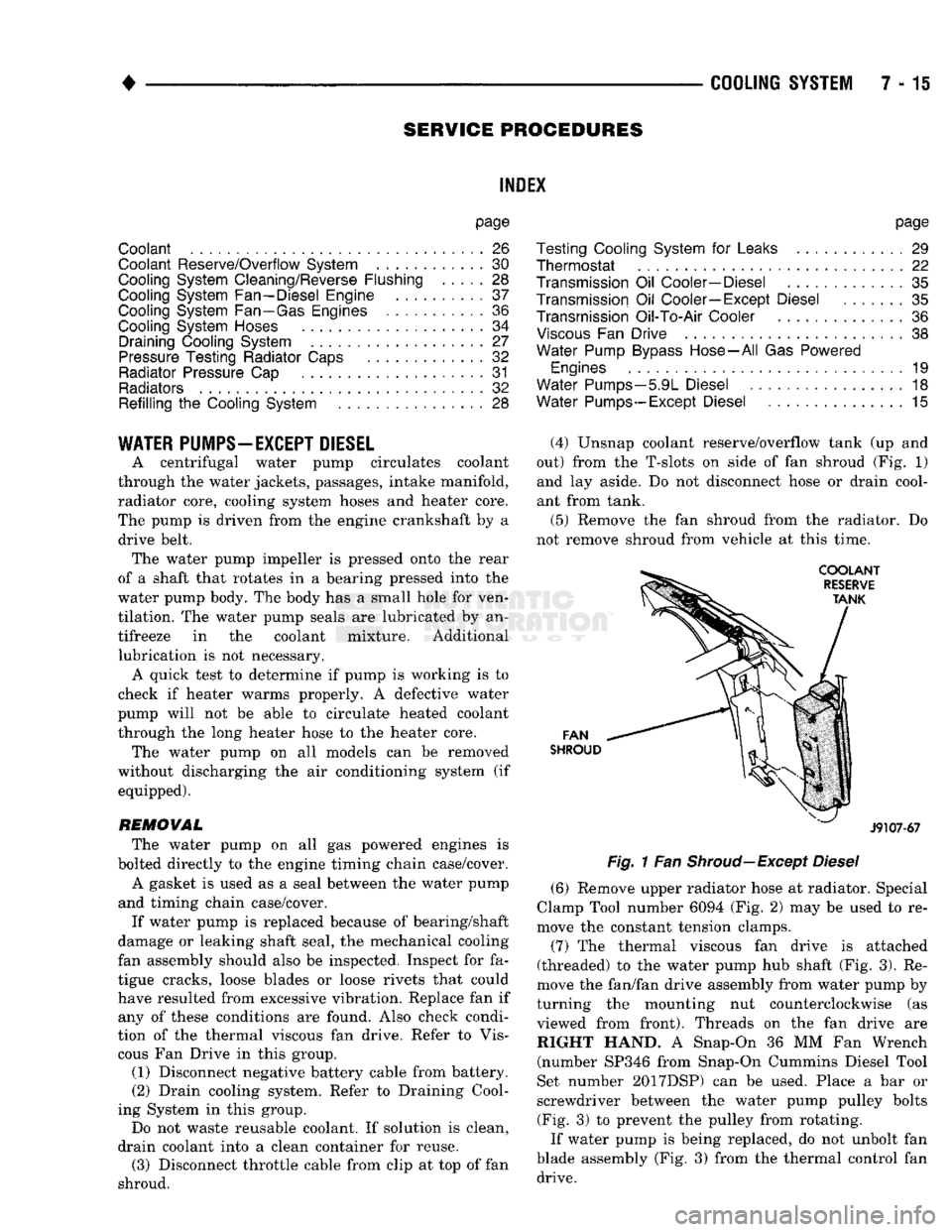
(4) Unsnap coolant reserve/overflow tank (up and
out) from the T-slots on side of fan shroud (Fig. 1) and lay aside. Do not disconnect hose or drain cool
ant from tank.
(5) Remove the fan shroud from the radiator. Do
not remove shroud from vehicle at this time.
FAN
SHROUD
J9107-67
Fig.
1 Fan
Shroud—Except
Diesel
(6) Remove upper radiator hose at radiator. Special
Clamp Tool number 6094 (Fig. 2) may be used to re
move the constant tension clamps.
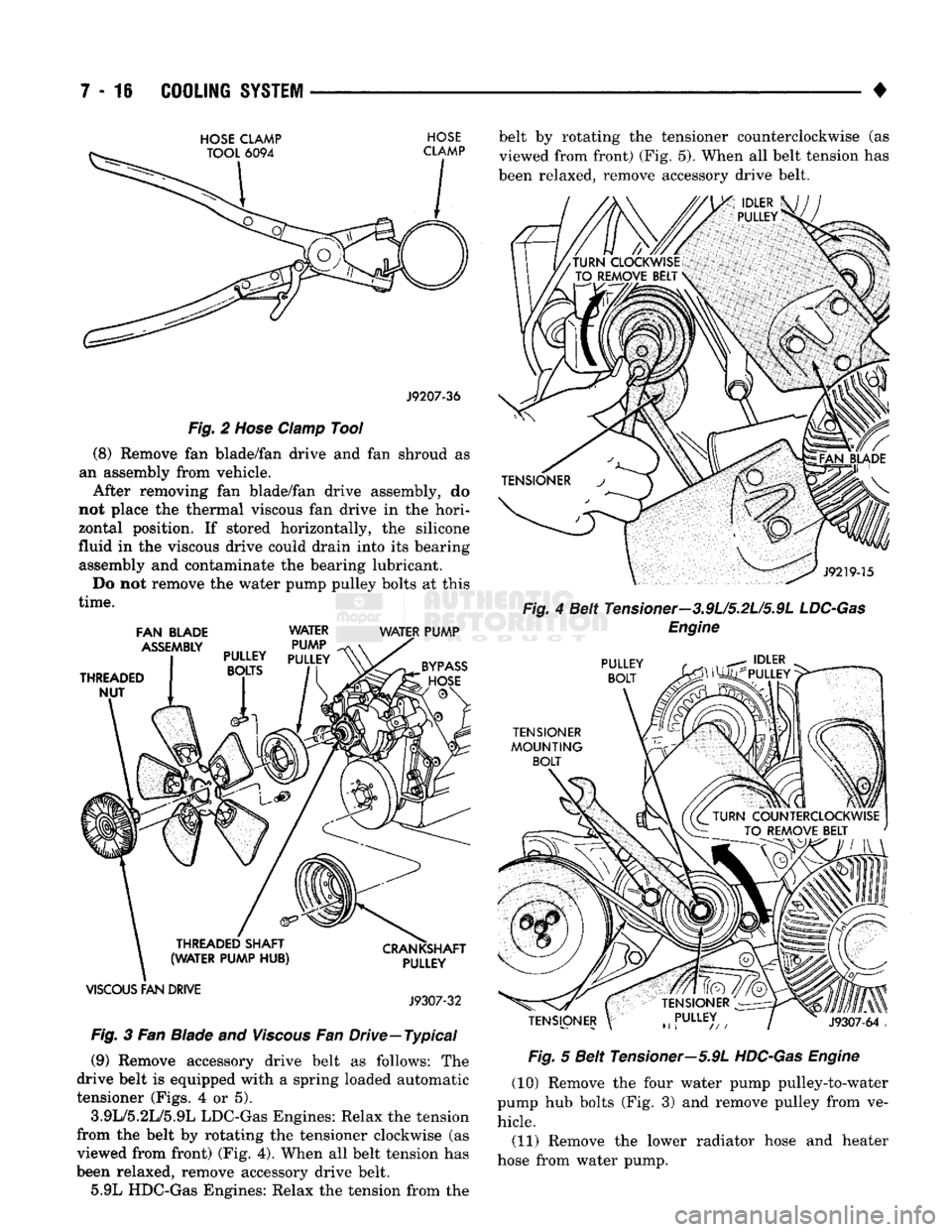
(7) The thermal viscous fan drive is attached
(threaded) to the water pump hub shaft (Fig. 3). Re
move the fan/fan drive assembly from water pump by
turning the mounting nut counterclockwise (as viewed from front). Threads on the fan drive are RIGHT HAND. A Snap-On 36 MM Fan Wrench (number SP346 from Snap-On Cummins Diesel Tool
Set number 2017DSP) can be used. Place a bar or
screwdriver between the water pump pulley bolts (Fig. 3) to prevent the pulley from rotating.
If water pump is being replaced, do not unbolt fan
blade assembly (Fig. 3) from the thermal control fan drive.
Page 287 of 1502
7 - 16
COOLING
SYSTEM
•
HOSE
CLAMP
HOSE
J9207-36
Fig.
2
Hose
Clamp
Tool
(8) Remove fan blade/fan drive and fan shroud as
an assembly from vehicle. After removing fan blade/fan drive assembly, do
not place the thermal viscous fan drive in the hori
zontal position. If stored horizontally, the silicone
fluid in the viscous drive could drain into its bearing assembly and contaminate the bearing lubricant.
Do not remove the water pump pulley bolts at this
time.
FAN
BLADE
WATER WATER
PUMP
VISCOUS
FAN
DRIVE
J9307-32
Fig.
3 Fan Blade and
Viscous
Fan Drive—Typical (9) Remove accessory drive belt as follows: The
drive belt is equipped with a spring loaded automatic
tensioner (Figs. 4 or 5).
3.9L/5.2L/5.9L LDC-Gas Engines: Relax the tension
from the belt by rotating the tensioner clockwise (as
viewed from front) (Fig. 4). When all belt tension has
been relaxed, remove accessory drive belt. 5.9L HDC-Gas Engines: Relax the tension from the belt by rotating the tensioner counterclockwise (as
viewed from front) (Fig. 5). When all belt tension has
been relaxed, remove accessory drive belt.
Fig.
4 Belt Tensioner—3.9L/5.2L/5.9L
LDC-Gas
Engine
Fig.
5 Belt Tensioner—5.9L
HDC-Gas
Engine
(10) Remove the four water pump pulley-to-water
pump hub bolts (Fig. 3) and remove pulley from ve hicle.
(11) Remove the lower radiator hose and heater
hose from water pump.
Page 289 of 1502
7 - 18
COOLING
SYSTEM
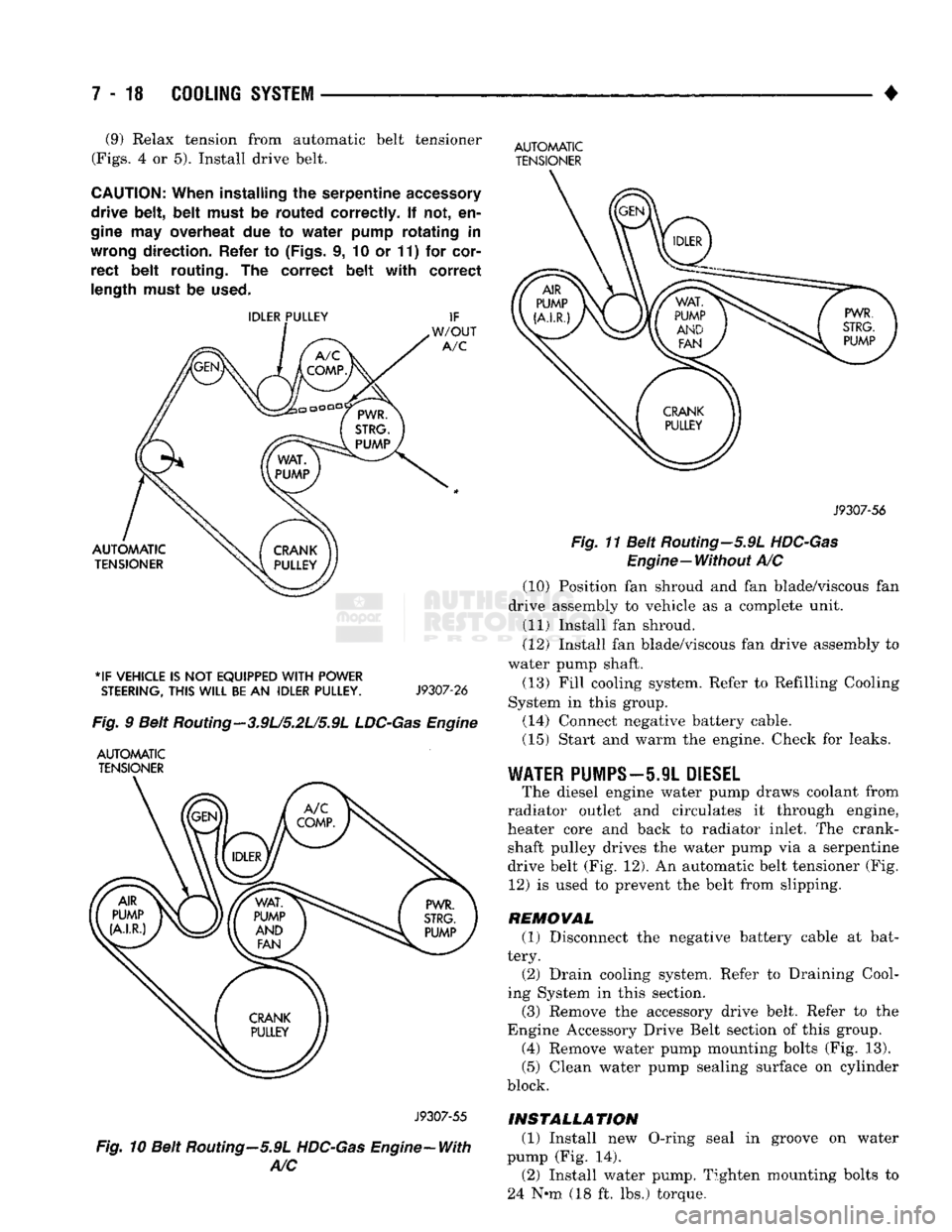
• (9) Relax tension from automatic belt tensioner
(Figs.
4 or 5). Install drive belt.
CAUTION:
When
installing
the
serpentine
accessory
drive
belt, belt
must
be
routed
correctly.
If not, en
gine
may
overheat
due to
water
pump
rotating
in
wrong
direction.
Refer
to
(Figs,
i, 10 or 11) for
cor
rect
belt
routing.
The
correct
belt with
correct
length
must
be
used.
*IF
VEHICLE
IS NOT
EQUIPPED
WITH
POWER
STEERING,
THIS
WILL
BE
AN
IDLER
PULLEY.
J9307-26
Fig.
9 Belt Routing—3.9U5.2L/5.9L
LDC-Gas
Engine
AUTOMATIC
TENSIONER
AUTOMATIC
TENSIONER
J9307-56
Fig.
11 Belt Routing—5.9L
HDC-Gas
Engine—Without
A/C (10) Position fan shroud and fan blade/viscous fan
drive assembly to vehicle as a complete unit. (11) Install fan shroud.
(12) Install fan blade/viscous fan drive assembly to
water pump shaft.
(13) Fill cooling system. Refer to Refilling Cooling
System in this group. (14) Connect negative battery cable.
(15) Start and warm the engine. Check for leaks.
WATER
PUMPS—5.9L
DIESEL
The diesel engine water pump draws coolant from
radiator outlet and circulates it through engine,
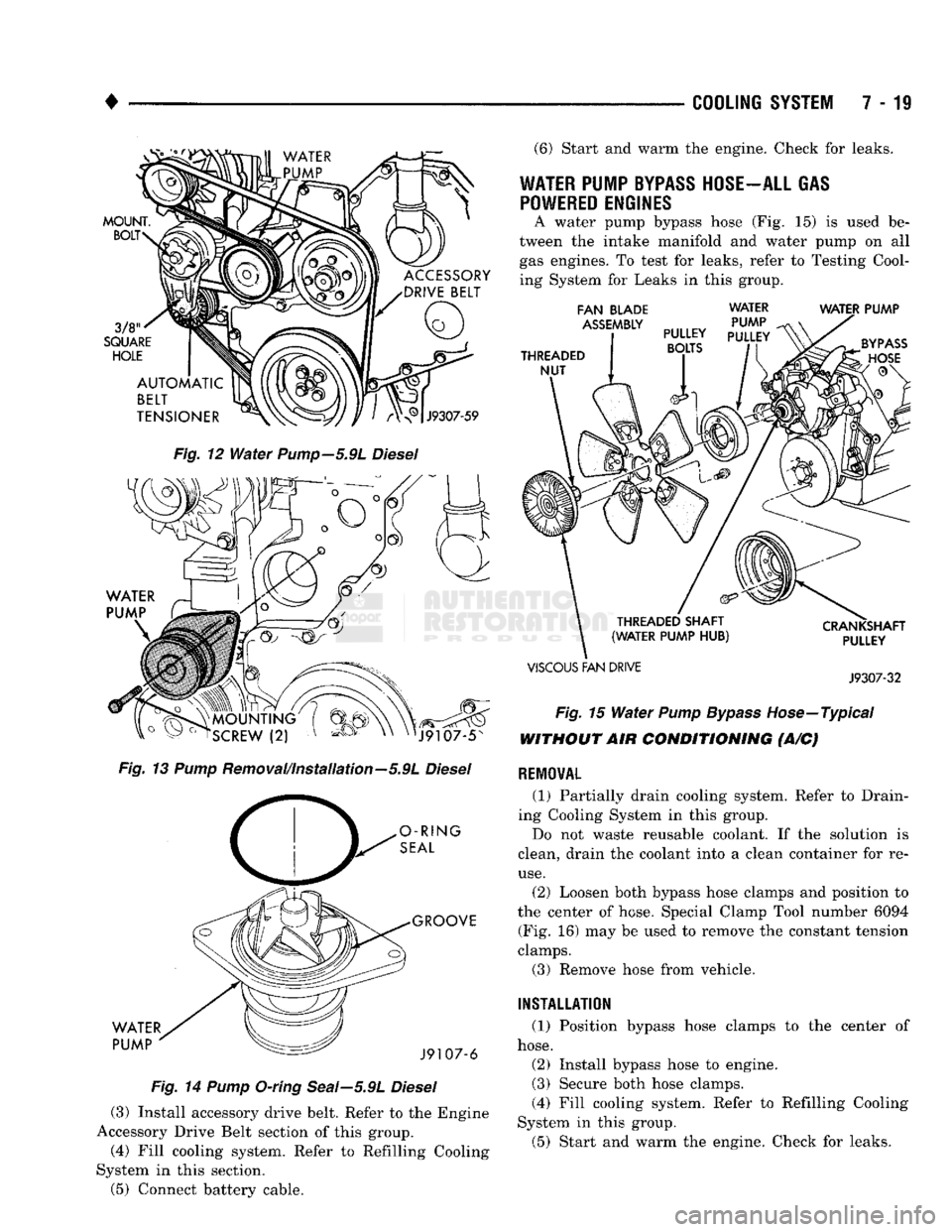
heater core and back to radiator inlet. The crank shaft pulley drives the water pump via a serpentine
drive belt (Fig. 12). An automatic belt tensioner (Fig. 12) is used to prevent the belt from slipping.
REMOVAL (1) Disconnect the negative battery cable at bat
tery. (2) Drain cooling system. Refer to Draining Cool
ing System in this section.
(3) Remove the accessory drive belt. Refer to the
Engine Accessory Drive Belt section of this group. (4) Remove water pump mounting bolts (Fig. 13).
(5) Clean water pump sealing surface on cylinder
block.
J9307-55
Fig.
10 Belt Routing—5.9L
HDC-Gas
Engine-With
A/C
INSTALLATION
(1) Install new O-ring seal in groove on water
pump (Fig. 14). (2) Install water pump. Tighten mounting bolts to
24 N-m (18 ft. lbs.) torque.
Page 290 of 1502
•
COOLING
SYSTEM
7-11
MOUNT.
BOLT
3/8
SQUARE
HOLE
ACCESSORY
DRIVE
BELT AUTOMATIC
BELT
TENSIONER
J9307-59
Fig.
12
Water
Pump—5.91
Diesel
o ~ " o
rSCREW
(2) v '^ov XN
nJ9107-5N
Fig.
13
Pump
Removal/Installation—5.9L
Diesel
O-RING
SEAL
WATER
PUMP
GROOVE
J9107-6
Fig.
14
Pump
O-ring Seal—5.9L
Diesel
(3) Install accessory drive belt. Refer to the Engine
Accessory Drive Belt section of this group.
(4) Fill cooling system. Refer to Refilling Cooling
System in this section.
(5) Connect battery cable. (6) Start and warm the engine. Check for leaks.
WATER PUMP
BYPASS
HOSE-ALL GAS POWERED ENGINES
A water pump bypass hose (Fig. 15) is used be
tween the intake manifold and water pump on all gas engines. To test for leaks, refer to Testing Cool
ing System for Leaks in this group.
FAN
BLADE
ASSEMBLY
THREADED
NUT
WATER
PUMP
PULLEY
PULLEY BOLTS WATER PUMP
THREADED SHAFT
(WATER PUMP
HUB)
VISCOUS
FAN DRIVE CRANKSHAFT
PULLEY
J9307-32
Fig.
15
Water
Pump Bypass
Hose—Typical
WITHOUT AIR CONDITIONING (A/C)
RE10WAL
(1) Partially drain cooling system. Refer to Drain
ing Cooling System in this group.
Do not waste reusable coolant. If the solution is
clean, drain the coolant into a clean container for re
use.
(2) Loosen both bypass hose clamps and position to
the center of hose. Special Clamp Tool number 6094 (Fig. 16) may be used to remove the constant tension
clamps.
(3) Remove hose from vehicle.
INSTALLATION
(1) Position bypass hose clamps to the center of
hose.
(2) Install bypass hose to engine.
(3) Secure both hose clamps.
(4) Fill cooling system. Refer to Refilling Cooling
System in this group.
(5) Start and warm the engine. Check for leaks.
Page 291 of 1502
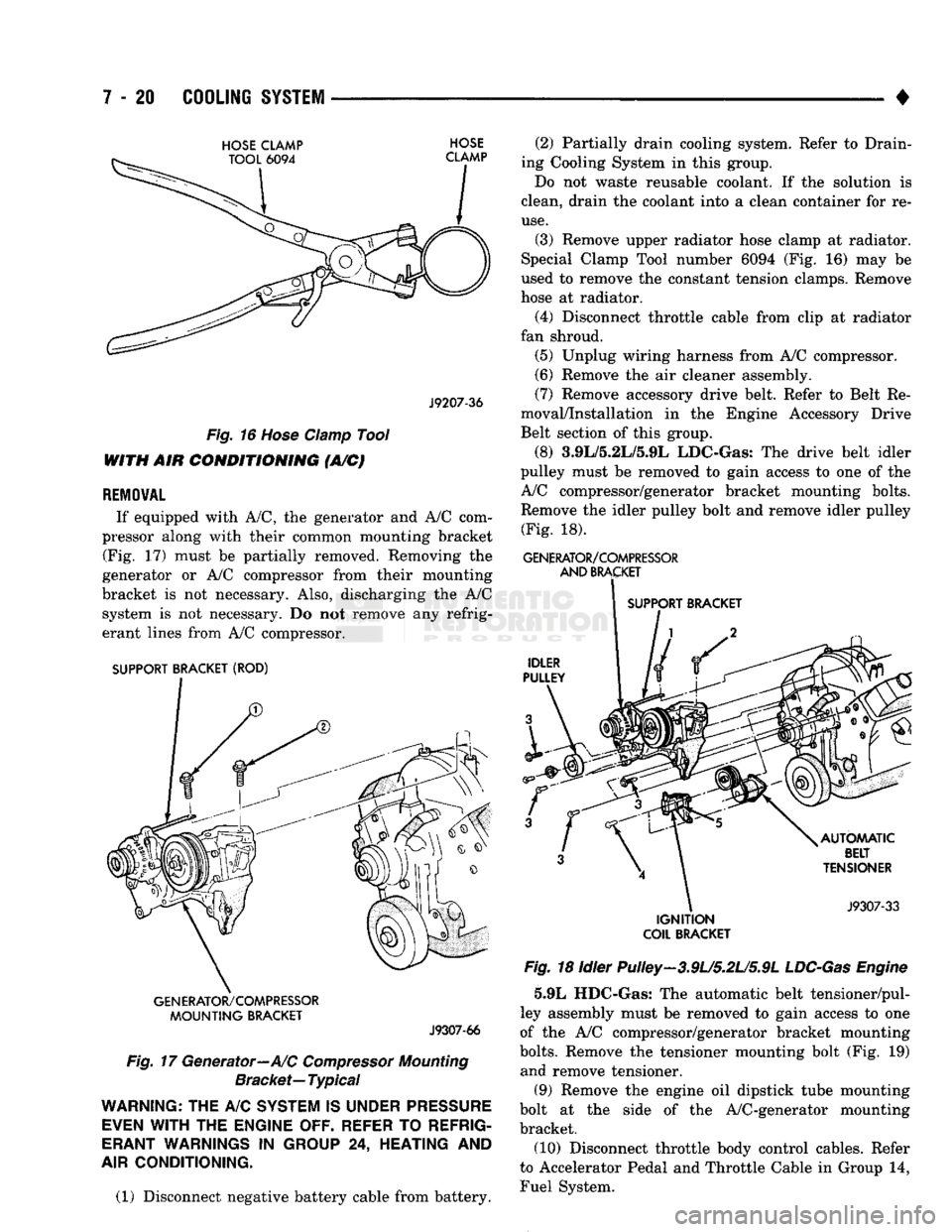
7 - 20
COOLING
SYSTEM
•
HOSE
CLAMP
HOSE
J9207-36
Fig.
16
Hose
Clamp
Tool
WITH AIR
CONDITIONING
(A/C)
REMOVAL
If equipped with A/C, the generator and A/C com
pressor along with their common mounting bracket (Fig. 17) must be partially removed. Removing the
generator or A/C compressor from their mounting
bracket is not necessary. Also, discharging the A/C system is not necessary. Do not remove any refrig
erant lines from A/C compressor.
SUPPORT BRACKET (ROD)
GENERATOR/COMPRESSOR
MOUNTING
BRACKET
J9307-66
Fig.
17 Generator—A/C
Compressor
Mounting
Bracket—
Typical
WARNING;
THE A/C
SYSTEM
IS
UNDER
PRESSURE
EVEN
WITH
THE
ENGINE OFF. REFER
TO
REFRIG
ERANT
WARNINGS
IN
GROUP
24,
HEATING
AND
AIR
CONDITIONING.
(1) Disconnect negative battery cable from battery. (2) Partially drain cooling system. Refer to Drain
ing Cooling System in this group.
Do not waste reusable coolant. If the solution is
clean, drain the coolant into a clean container for re
use.
(3) Remove upper radiator hose clamp at radiator.
Special Clamp Tool number 6094 (Fig. 16) may be
used to remove the constant tension clamps. Remove
hose at radiator.
(4) Disconnect throttle cable from clip at radiator
fan shroud. (5) Unplug wiring harness from A/C compressor.
(6) Remove the air cleaner assembly.
(7) Remove accessory drive belt. Refer to Belt Re
moval/Installation in the Engine Accessory Drive
Belt section of this group.
(8) 3.9L/5.2L/5.9L LDC-Gas: The drive belt idler
pulley must be removed to gain access to one of the
A/C compressor/generator bracket mounting bolts. Remove the idler pulley bolt and remove idler pulley (Fig. 18).
GENERATOR/COMPRESSOR
AND
BRACKET
SUPPORT BRACKET
IGNITION
COIL
BRACKET
Fig.
18 Idler Pulley-3.9U5.2U5.9L
LDC-Gas
Engine
5.9L HDC-Gas: The automatic belt tensioner/pul-
ley assembly must be removed to gain access to one
of the A/C compressor/generator bracket mounting
bolts.
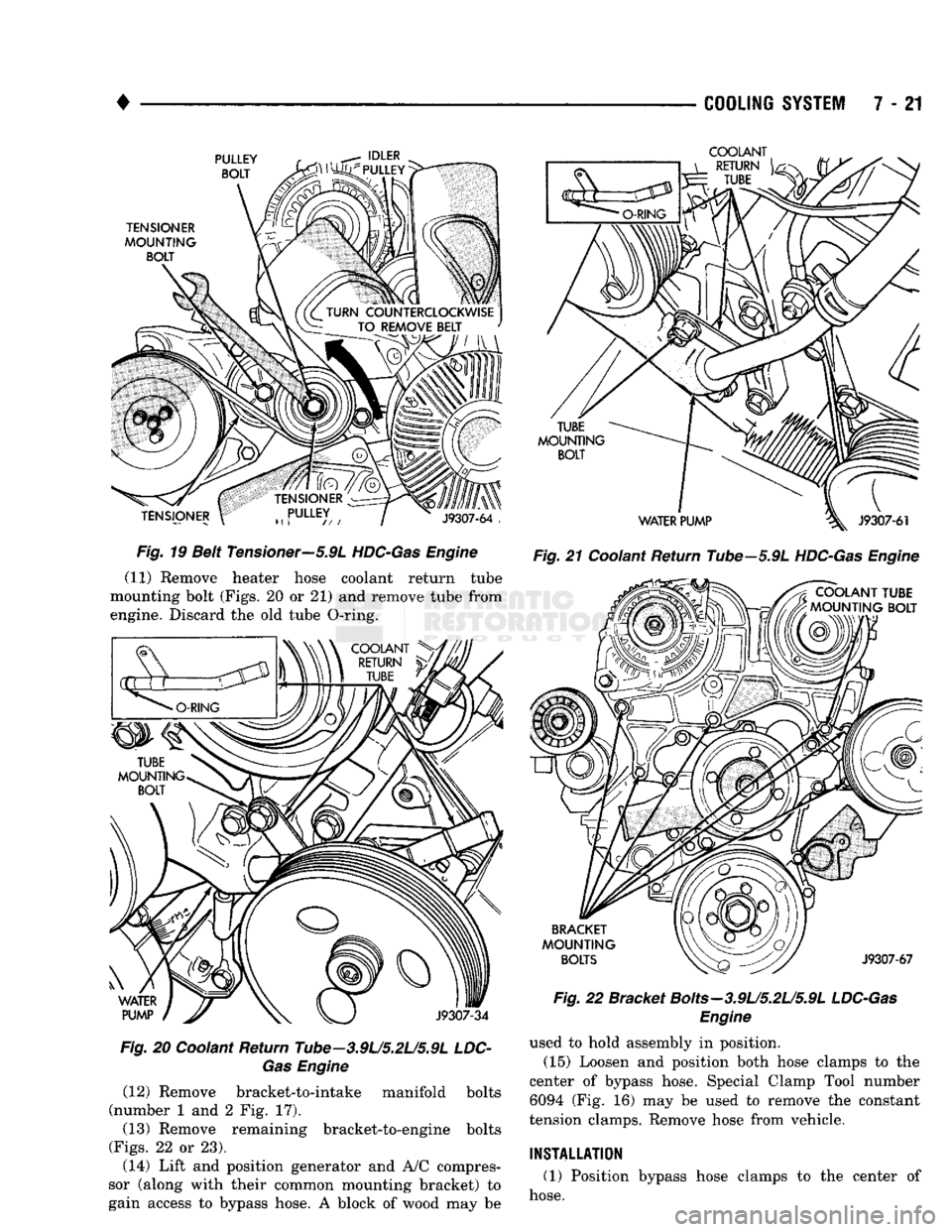
Remove the tensioner mounting bolt (Fig. 19) and remove tensioner.
(9) Remove the engine oil dipstick tube mounting
bolt at the side of the A/C-generator mounting
bracket.
(10) Disconnect throttle body control cables. Refer
to Accelerator Pedal and Throttle Cable in Group 14,
Fuel System.
Page 292 of 1502
•
COOLING
SYSTEM
7 - 21
Fig.
19 Belt Tensioner—5.9L
HDC-Gas
Engine
(11) Remove heater hose coolant return tube
mounting bolt (Figs. 20 or 21) and remove tube from
engine. Discard the old tube O-ring,
Fig.
20 Coolant Return Tube-3.9U5.2U5.9L LDC-
Gas
Engine
(12) Remove bracket-to-intake manifold bolts
(number 1 and 2 Fig. 17).
(13) Remove remaining bracket-to-engine bolts
(Figs.
22 or 23). (14) Lift and position generator and A/C compres
sor (along with their common mounting bracket) to
gain access to bypass hose. A block of wood may be
Fig.
21 Coolant Return Tube—5.9L
HDC-Gas
Engine
Fig.
22 Bracket Bolts-3.9U5.2U5.9L
LDC-Gas
Engine
used to hold assembly in position.
(15) Loosen and position both hose clamps to the
center of bypass hose. Special Clamp Tool number
6094 (Fig. 16) may be used to remove the constant
tension clamps. Remove hose from vehicle.
INSTALLATION
(1) Position bypass hose clamps to the center of
hose.