belt DODGE TRUCK 1993 Service Owner's Manual
[x] Cancel search | Manufacturer: DODGE, Model Year: 1993, Model line: TRUCK, Model: DODGE TRUCK 1993Pages: 1502, PDF Size: 80.97 MB
Page 293 of 1502
7 - 22
COOLING
SYSTEM
•
Fig.
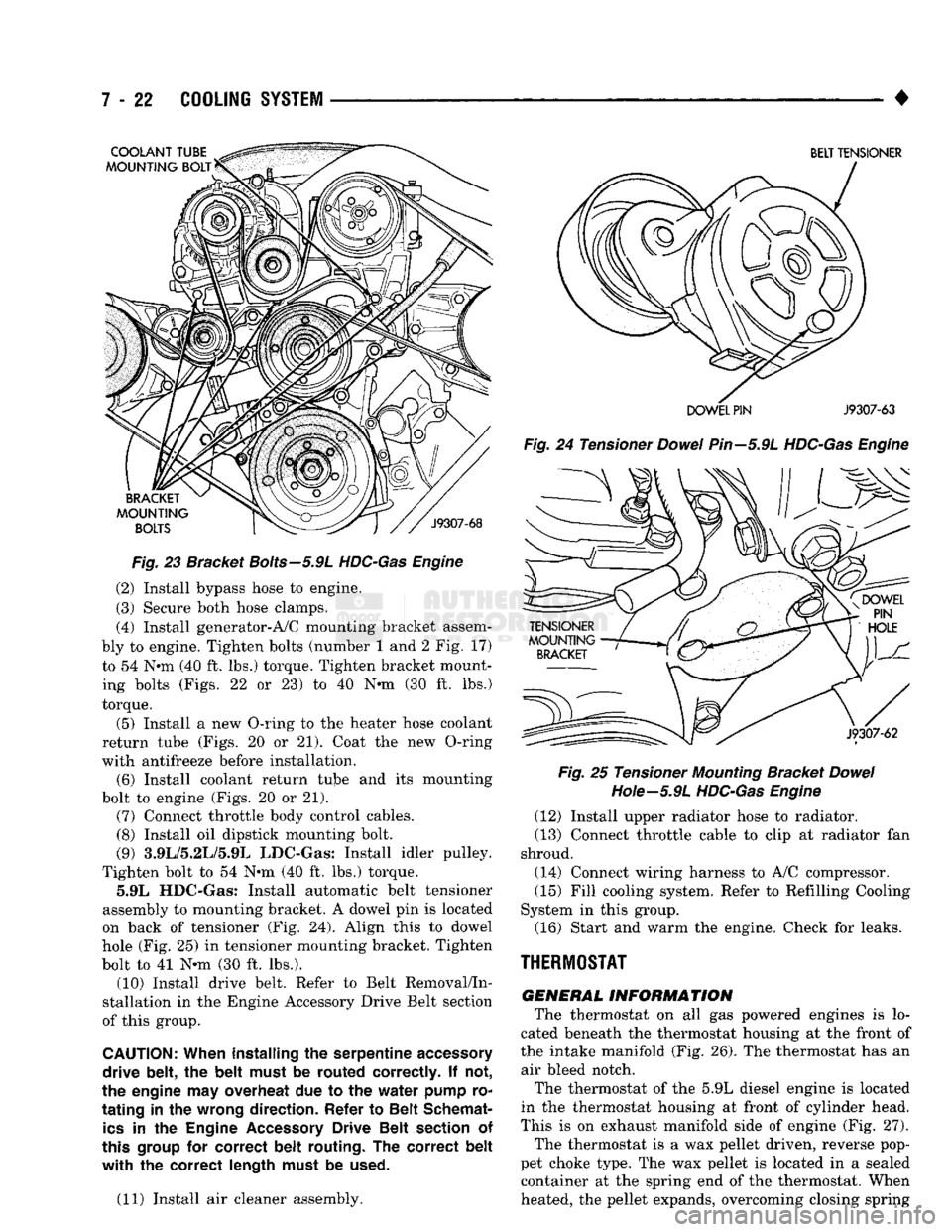
23 Bracket
Bolts—5.9L
HDC-Gas Engine
(2) Install bypass hose to engine.
(3) Secure both hose clamps.
(4) Install generator-A/C mounting bracket assem
bly to engine. Tighten bolts (number 1 and 2 Fig. 17)
to 54 Nnn (40 ft. lbs.) torque. Tighten bracket mount ing bolts (Figs. 22 or 23) to 40 N-m (30 ft. lbs.)
torque.
(5) Install a new O-ring to the heater hose coolant
return tube (Figs. 20 or 21). Coat the new O-ring
with antifreeze before installation. (6) Install coolant return tube and its mounting
bolt to engine (Figs. 20 or 21). (7) Connect throttle body control cables.
(8) Install oil dipstick mounting bolt.
(9) 3.9L/5.2L/5.9L LDC-Gas: Install idler pulley.
Tighten bolt to 54 Nnn (40 ft. lbs.) torque. 5.9L HDC-Gas: Install automatic belt tensioner
assembly to mounting bracket. A dowel pin is located
on back of tensioner (Fig. 24). Align this to dowel
hole (Fig. 25) in tensioner mounting bracket. Tighten
bolt to 41 N-m (30 ft. lbs.). (10) Install drive belt. Refer to Belt Removal/In
stallation in the Engine Accessory Drive Belt section
of this group.
CAUTION:
When installing
the
serpentine
accessory
drive belt,
the
belt must
be
routed correctly.
If not,
the engine
may
overheat
due to the
water pump
ro
tating
in the
wrong direction. Refer
to
Belt Schemat
ics
in the
Engine
Accessory
Drive Belt section
of
this
group
for
correct belt routing.
The
correct belt
with the
correct length must
be
used.
(11) Install air cleaner assembly.
BELT TENSIONER
DOWEL PIN
J9307-63
Fig.
24 Tensioner
Dowel
Pin—5.9L
HDC-Gas Engine Fig.
25 Tensioner
Mounting
Bracket
Dowel
Hote—5.9L
HDC-Gas Engine
(12) Install upper radiator hose to radiator.
(13) Connect throttle cable to clip at radiator fan
shroud.
(14) Connect wiring harness to A/C compressor. (15) Fill cooling system. Refer to Refilling Cooling
System in this group.
(16) Start and warm the engine. Check for leaks.
THERMOSTAT
GENERAL
INFORMATION
The thermostat on all gas powered engines is lo
cated beneath the thermostat housing at the front of
the intake manifold (Fig. 26). The thermostat has an air bleed notch.
The thermostat of the 5.9L diesel engine is located
in the thermostat housing at front of cylinder head.
This is on exhaust manifold side of engine (Fig. 27). The thermostat is a wax pellet driven, reverse pop
pet choke type. The wax pellet is located in a sealed container at the spring end of the thermostat. When
heated, the pellet expands, overcoming closing spring
Page 295 of 1502
7 - 24
COOLING SYSTEM
• If the thermostat is being replaced, be sure that
the replacement is the specified thermostat for the vehicle model and engine type. Factory installed thermostat housings on 3.9L/5.2L/
5.9L engines are installed on a gasket with an anti-
stick coating. This will aid in gasket removal and
clean-up.
(1) Disconnect negative battery cable at battery.
(2) Drain cooling system until coolant level is be
low thermostat. Refer to Draining Cooling System in
this group. If not equipped with air conditioning, pro ceed to step number 4.
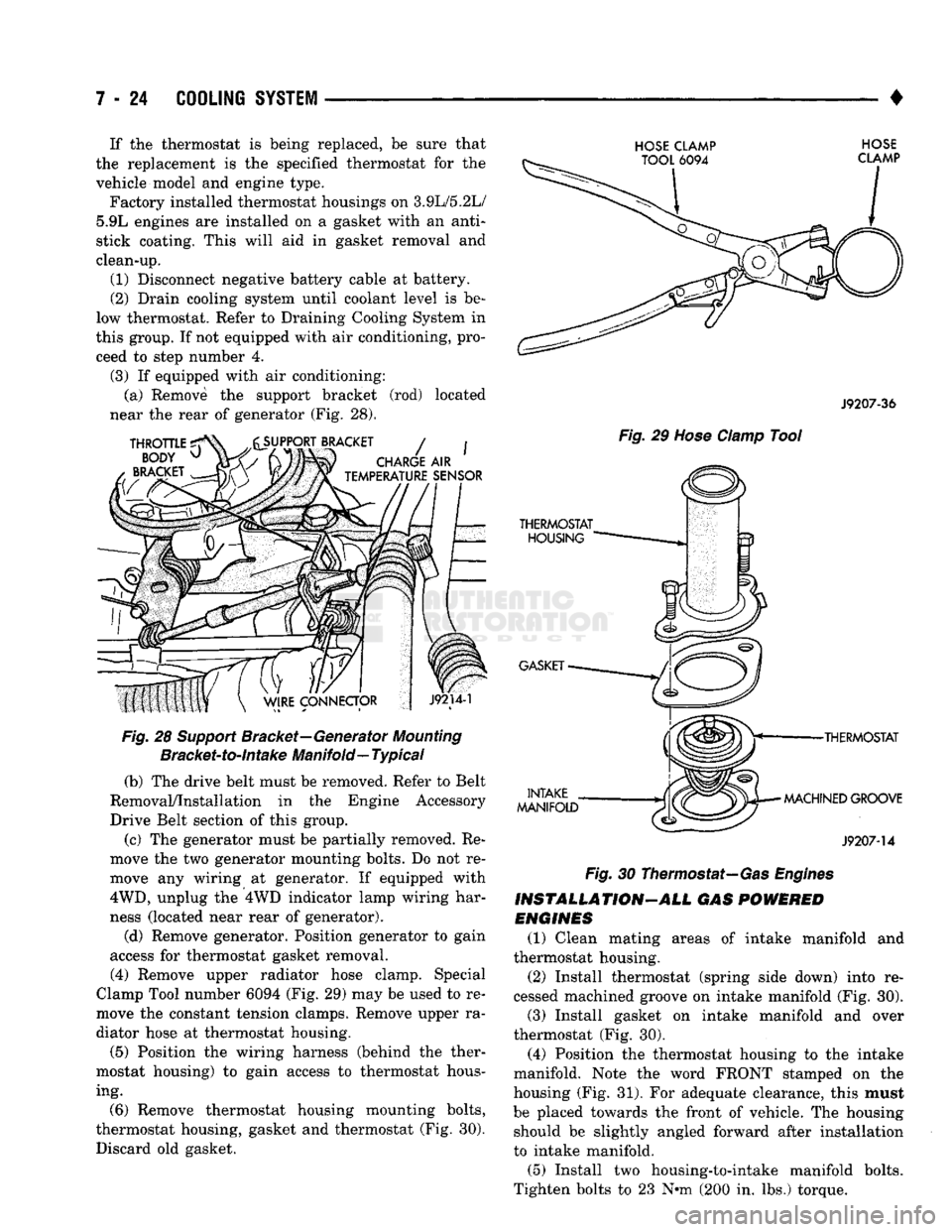
(3) If equipped with air conditioning: (a) Remove the support bracket (rod) located
near the rear of generator (Fig. 28).
Fig.
28
Support
Bracket—Generator
Mounting
Bracket-to-intake
Manifold—
Typical
(b) The drive belt must be removed. Refer to Belt
Removal/Installation in the Engine Accessory
Drive Belt section of this group.
(c) The generator must be partially removed. Re
move the two generator mounting bolts. Do not re
move any wiring at generator. If equipped with
4WD,
unplug the 4WD indicator lamp wiring har
ness (located near rear of generator).
(d) Remove generator. Position generator to gain
access for thermostat gasket removal.
(4) Remove upper radiator hose clamp. Special
Clamp Tool number 6094 (Fig. 29) may be used to re
move the constant tension clamps. Remove upper ra
diator hose at thermostat housing.
(5) Position the wiring harness (behind the ther
mostat housing) to gain access to thermostat hous ing.
(6) Remove thermostat housing mounting bolts,
thermostat housing, gasket and thermostat (Fig. 30). Discard old gasket.
HOSE CLAMP HOSE
J9207-36
Fig.
29
Hose
Clamp
Tool
•THERMOSTAT
MACHINED GROOVE
J9207-14
Fig.
30 Thermostat—Gas
Engines
INSTALLATION-ALL GAS
POWERED
ENGINES
(1) Clean mating areas of intake manifold and
thermostat housing. (2) Install thermostat (spring side down) into re
cessed machined groove on intake manifold (Fig. 30).
(3) Install gasket on intake manifold and over
thermostat (Fig. 30).
(4) Position the thermostat housing to the intake
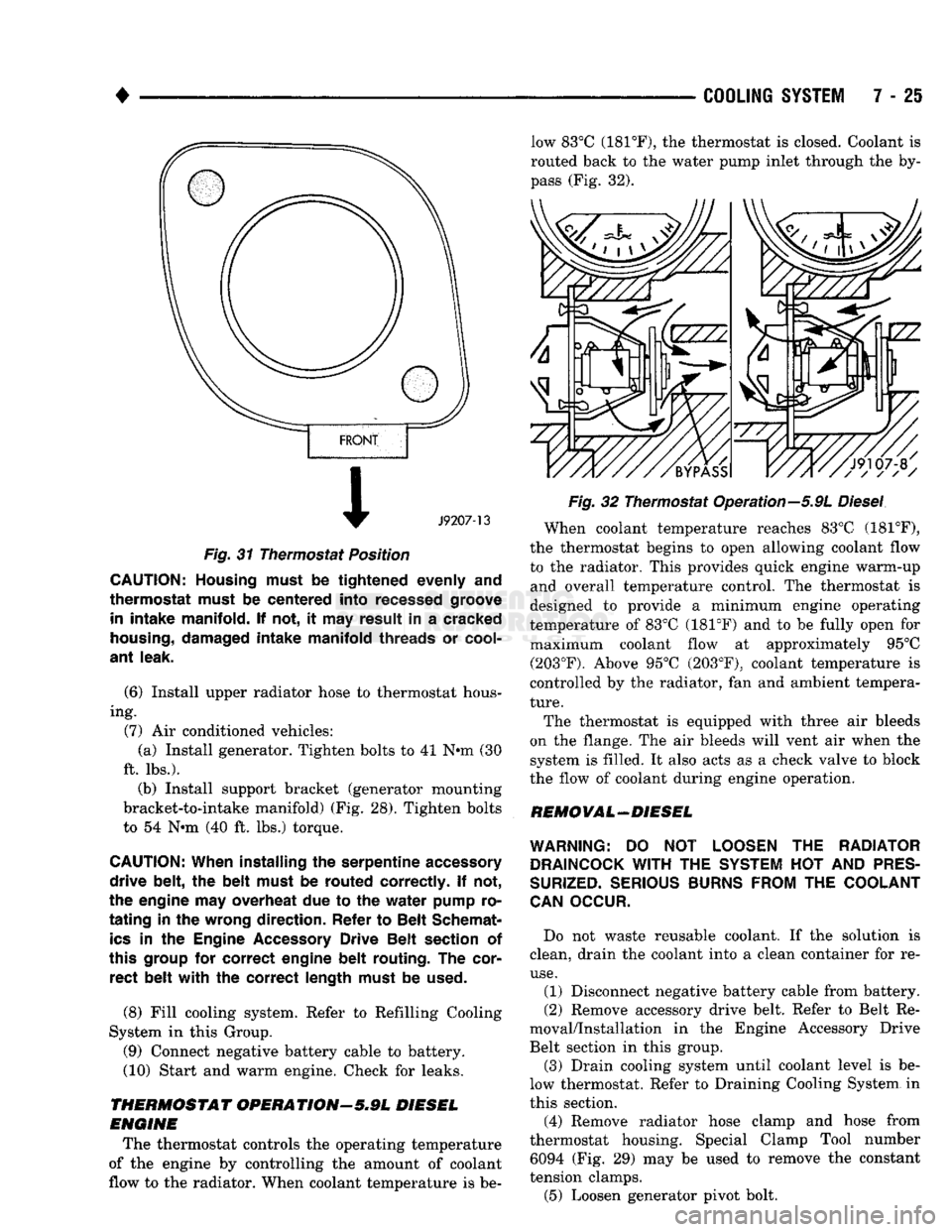
manifold. Note the word FRONT stamped on the
housing (Fig. 31). For adequate clearance, this must
be placed towards the front of vehicle. The housing should be slightly angled forward after installation
to intake manifold.
(5) Install two housing-to-intake manifold bolts.
Tighten bolts to 23 N-m (200 in. lbs.) torque.
Page 296 of 1502
•
COOLING
SYSTEM
7 - 25
Fig.
31 Thermostat Position
CAUTION; Housing must
be
tightened
evenly and
thermostat must
be
centered into recessed groove in
intake manifold. If not, it may
result
in a
cracked
housing,
damaged intake manifold threads
or
cool
ant
leak.
(6) Install upper radiator hose to thermostat hous
ing. (7) Air conditioned vehicles: (a) Install generator. Tighten bolts to 41 N-m (30
ft. lbs.). (b) Install support bracket (generator mounting
bracket-to-intake manifold) (Fig. 28). Tighten bolts
to 54 N-m (40 ft. lbs.) torque.
CAUTION:
When installing
the
serpentine accessory
drive belt,
the
belt must
be
routed correctly.
If not,
the engine
may overheat due to the
water pump
ro
tating in the
wrong direction. Refer
to
Belt Schemat
ics
in the
Engine
Accessory
Drive Belt section
of
this group
for
correct engine belt routing.
The
cor rect belt with
the
correct length must
be
used.
(8) Fill cooling system. Refer to Refilling Cooling
System in this Group. (9) Connect negative battery cable to battery.
(10) Start and warm engine. Check for leaks.
THERMOSTAT OPERATIONr-5.9L DIESEL
ENGINE
The thermostat controls the operating temperature
of the engine by controlling the amount of coolant
flow to the radiator. When coolant temperature is be low 83°C (181°F), the thermostat is closed. Coolant is
routed back to the water pump inlet through the by
pass (Fig. 32).
Fig.
32 Thermostat Operation—5.9L
Diesel
When coolant temperature reaches 83°C (181°F),
the thermostat begins to open allowing coolant flow
to the radiator. This provides quick engine warm-up and overall temperature control. The thermostat is
designed to provide a minimum engine operating
temperature of 83°C (181°F) and to be fully open for maximum coolant flow at approximately 95°C (203°F). Above 95°C (203°F), coolant temperature is
controlled by the radiator, fan and ambient tempera
ture.
The thermostat is equipped with three air bleeds
on the flange. The air bleeds will vent air when the system is filled. It also acts as a check valve to block
the flow of coolant during engine operation.
REMOVAL-DIESEL
WARNING:
DO NOT
LOOSEN
THE
RADIATOR
DRAINCOCK
WITH
THE
SYSTEM
HOT
AND
PRES
SURIZED.
SERIOUS
BURNS
FROM
THE
COOLANT
CAN
OCCUR.
Do not waste reusable coolant. If the solution is
clean, drain the coolant into a clean container for re
use.
(1) Disconnect negative battery cable from battery.
(2) Remove accessory drive belt. Refer to Belt Re
moval/Installation in the Engine Accessory Drive
Belt section in this group.
(3) Drain cooling system until coolant level is be
low thermostat. Refer to Draining Cooling System in
this section.
(4) Remove radiator hose clamp and hose from
thermostat housing. Special Clamp Tool number 6094 (Fig. 29) may be used to remove the constant
tension clamps.
(5) Loosen generator pivot bolt.
Page 297 of 1502
7 - 26
COOLING
SYSTEM
————
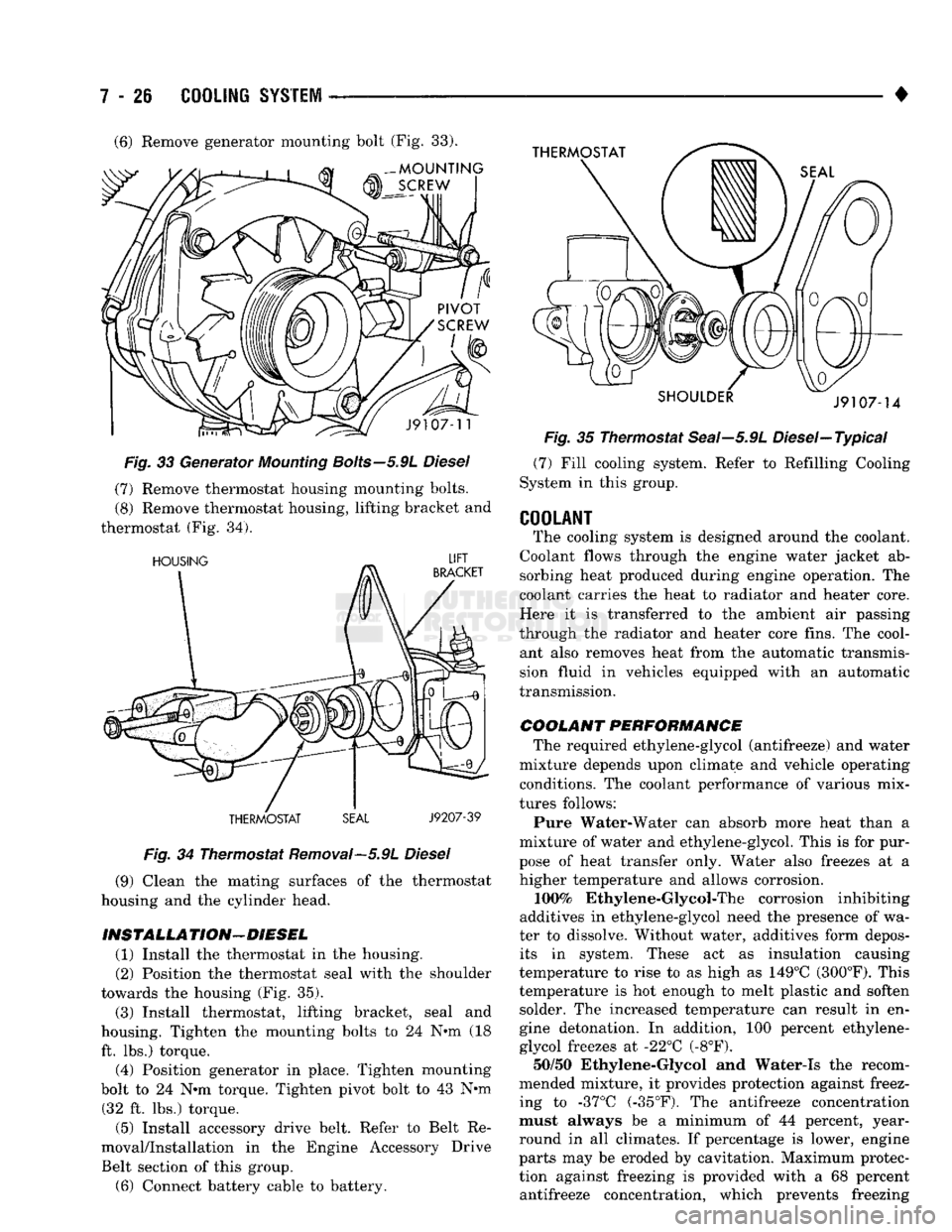
Fig. 33 Generator
Mounting
Bolts—5.9L
Diesel (7) Remove thermostat housing mounting bolts.
(8) Remove thermostat housing, lifting bracket and
thermostat (Fig. 34).
Fig.
34 Thermostat Removal—5.9L
Diesel
(9) Clean the mating surfaces of the thermostat
housing and the cylinder head.
INSTALLA TION—DIESEL (1) Install the thermostat in the housing.
(2) Position the thermostat seal with the shoulder
towards the housing (Fig. 35).
(3) Install thermostat, lifting bracket, seal and
housing. Tighten the mounting bolts to 24 N°m (18 ft. lbs.) torque. (4) Position generator in place. Tighten mounting
bolt to 24 N*m torque. Tighten pivot bolt to 43 N*m (32 ft. lbs.) torque.
(5) Install accessory drive belt. Refer to Belt Re
moval/Installation in the Engine Accessory Drive
Belt section of this group.
(6) Connect battery cable to battery. •
Fig.
35 Thermostat Seai—5.9L Diesel—Typical (7) Fill cooling system. Refer to Refilling Cooling
System in this group.
COOLANT
The cooling system is designed around the coolant.
Coolant flows through the engine water jacket ab sorbing heat produced during engine operation. The
coolant carries the heat to radiator and heater core.
Here it is transferred to the ambient air passing
through the radiator and heater core fins. The cool ant also removes heat from the automatic transmission fluid in vehicles equipped with an automatic
transmission.
COOLANT PERFORMANCE The required ethylene-glycol (antifreeze) and water
mixture depends upon climate and vehicle operating conditions. The coolant performance of various mix
tures follows:
Pure Water-Water can absorb more heat than a
mixture of water and ethylene-glycol. This is for pur
pose of heat transfer only. Water also freezes at a higher temperature and allows corrosion.
100%
Ethylene-Glycol-The corrosion inhibiting
additives in ethylene-glycol need the presence of wa
ter to dissolve. Without water, additives form depos its in system. These act as insulation causing
temperature to rise to as high as 149°C (300°F). This
temperature is hot enough to melt plastic and soften solder. The increased temperature can result in en
gine detonation. In addition, 100 percent ethylene-
glycol freezes at -22°C (-8°F). 50/50 Ethylene-Glycol and Water-Is the recom
mended mixture, it provides protection against freez
ing to -37°C (-35°F). The antifreeze concentration
must always be a minimum of 44 percent, year-
round in all climates. If percentage is lower, engine
parts may be eroded by cavitation. Maximum protec
tion against freezing is provided with a 68 percent antifreeze concentration, which prevents freezing (6) Remove generator mounting bolt (Fig. 33).
Page 301 of 1502
7 - 30
COOLING
SYSTEM
•
COOLING
SYSTEM
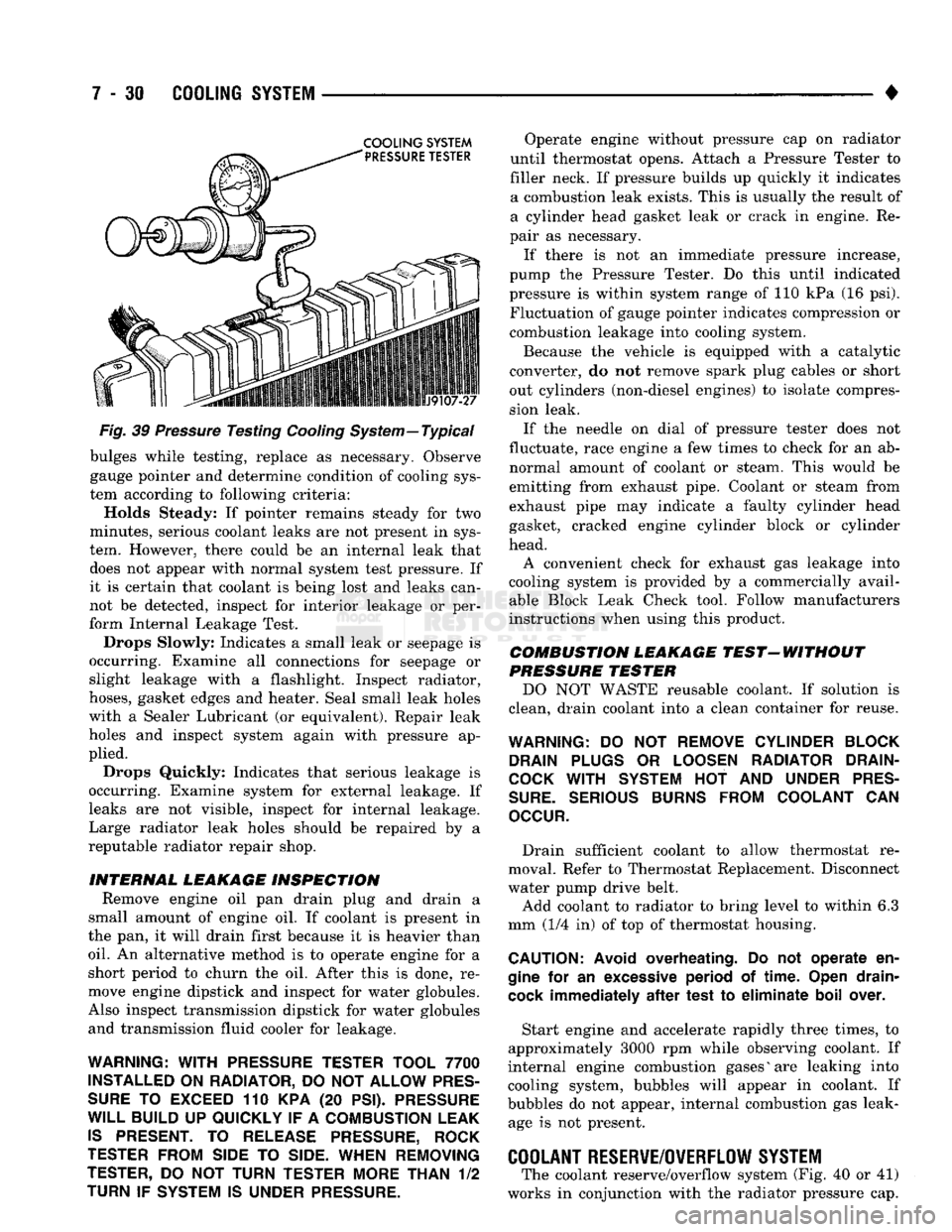
Fig.
39
Pressure
Testing
Cooling
System—Typical bulges while testing, replace as necessary. Observe
gauge pointer and determine condition of cooling sys
tem according to following criteria:
Holds Steady: If pointer remains steady for two
minutes, serious coolant leaks are not present in sys
tem. However, there could be an internal leak that does not appear with normal system test pressure. If
it is certain that coolant is being lost and leaks can
not be detected, inspect for interior leakage or per
form Internal Leakage Test.
Drops Slowly: Indicates a small leak or seepage is
occurring. Examine all connections for seepage or
slight leakage with a flashlight. Inspect radiator,
hoses,
gasket edges and heater. Seal small leak holes
with a Sealer Lubricant (or equivalent). Repair leak
holes and inspect system again with pressure ap
plied.
Drops Quickly: Indicates that serious leakage is
occurring. Examine system for external leakage. If
leaks are not visible, inspect for internal leakage.
Large radiator leak holes should be repaired by a
reputable radiator repair shop.
INTERNAL LEAKAGE INSPECTION Remove engine oil pan drain plug and drain a
small amount of engine oil. If coolant is present in
the pan, it will drain first because it is heavier than
oil.
An alternative method is to operate engine for a
short period to churn the oil. After this is done, re
move engine dipstick and inspect for water globules.
Also inspect transmission dipstick for water globules and transmission fluid cooler for leakage.
WARNING:
WITH
PRESSURE TESTER TOOL
7700
INSTALLED
ON
RADIATOR,
DO
NOT ALLOW
PRES
SURE
TO
EXCEED
110 KPA (20
PSI). PRESSURE
WILL
BUILD
UP
QUICKLY
IF A
COMBUSTION LEAK
IS
PRESENT.
TO
RELEASE
PRESSURE,
ROCK
TESTER
FROM SIDE
TO
SIDE. WHEN REMOVING
TESTER,
DO NOT
TURN TESTER MORE THAN
1/2
TURN
IF
SYSTEM
IS
UNDER
PRESSURE.
Operate engine without pressure cap on radiator
until thermostat opens. Attach a Pressure Tester to
filler neck. If pressure builds up quickly it indicates a combustion leak exists. This is usually the result of
a cylinder head gasket leak or crack in engine. Re
pair as necessary.
If there is not an immediate pressure increase,
pump the Pressure Tester. Do this until indicated
pressure is within system range of 110 kPa (16 psi). Fluctuation of gauge pointer indicates compression or
combustion leakage into cooling system.
Because the vehicle is equipped with a catalytic
converter, do not remove spark plug cables or short
out cylinders (non-diesel engines) to isolate compres
sion leak.
If the needle on dial of pressure tester does not
fluctuate, race engine a few times to check for an ab normal amount of coolant or steam. This would be
emitting from exhaust pipe. Coolant or steam from
exhaust pipe may indicate a faulty cylinder head
gasket, cracked engine cylinder block or cylinder
head. A convenient check for exhaust gas leakage into
cooling system is provided by a commercially avail able Block Leak Check tool. Follow manufacturers
instructions when using this product.
COMBUSTION LEAKAGE TEST-WITHOUT
PRESSURE TESTER DO NOT WASTE reusable coolant. If solution is
clean, drain coolant into a clean container for reuse.
WARNING:
DO NOT
REMOVE CYLINDER BLOCK DRAIN PLUGS
OR
LOOSEN RADIATOR DRAIN-
COCK
WITH
SYSTEM
HOT AND
UNDER PRES
SURE.
SERIOUS BURNS FROM COOLANT
CAN
OCCUR.
Drain sufficient coolant to allow thermostat re
moval. Refer to Thermostat Replacement. Disconnect
water pump drive belt. Add coolant to radiator to bring level to within 6.3
mm (1/4 in) of top of thermostat housing.
CAUTION:
Avoid
overheating.
Do not
operate
en
gine
for an
excessive
period
of
time.
Open
drain-
cock
immediately
after
test
to
eliminate
boil
over.
Start engine and accelerate rapidly three times, to
approximately 3000 rpm while observing coolant. If
internal engine combustion gases% are leaking into
cooling system, bubbles will appear in coolant. If
bubbles do not appear, internal combustion gas leak age is not present.
COOLANT
RESERVE/0WERFL0W
SYSTEM
The coolant reserve/overflow system (Fig. 40 or 41)
works in conjunction with the radiator pressure cap.
Page 311 of 1502
ENGINE ACCESSORY DRIVE BELTS
INDEX
page
Automatic Belt Tensioner
45
Belt Diagnosis
40
Belt Removal/Installation
. 40
page
Belt Schematics
40
Belt Tension
40
General
Information
40
GENERAL
INFORMATION
All vehicles are available with either
a
3.9L (V-6),
a 5.2L (V-8),
a
5.9L (gas V-8) or
a
5.9L (in-line 6 cyl
inder diesel) engine. The accessory drive components
are
operated
by a
single, crankshaft driven, serpentine drive belt on all
engines. An automatic belt tensioner
is
used to main
tain correct belt tension
at all
times. Refer
to
Auto matic Belt Tensioner proceeding
in
this group.
BELT DIAGNOSIS SERPENTINE DRIVE BELT DIAGNOSIS-ALL
ENGINES
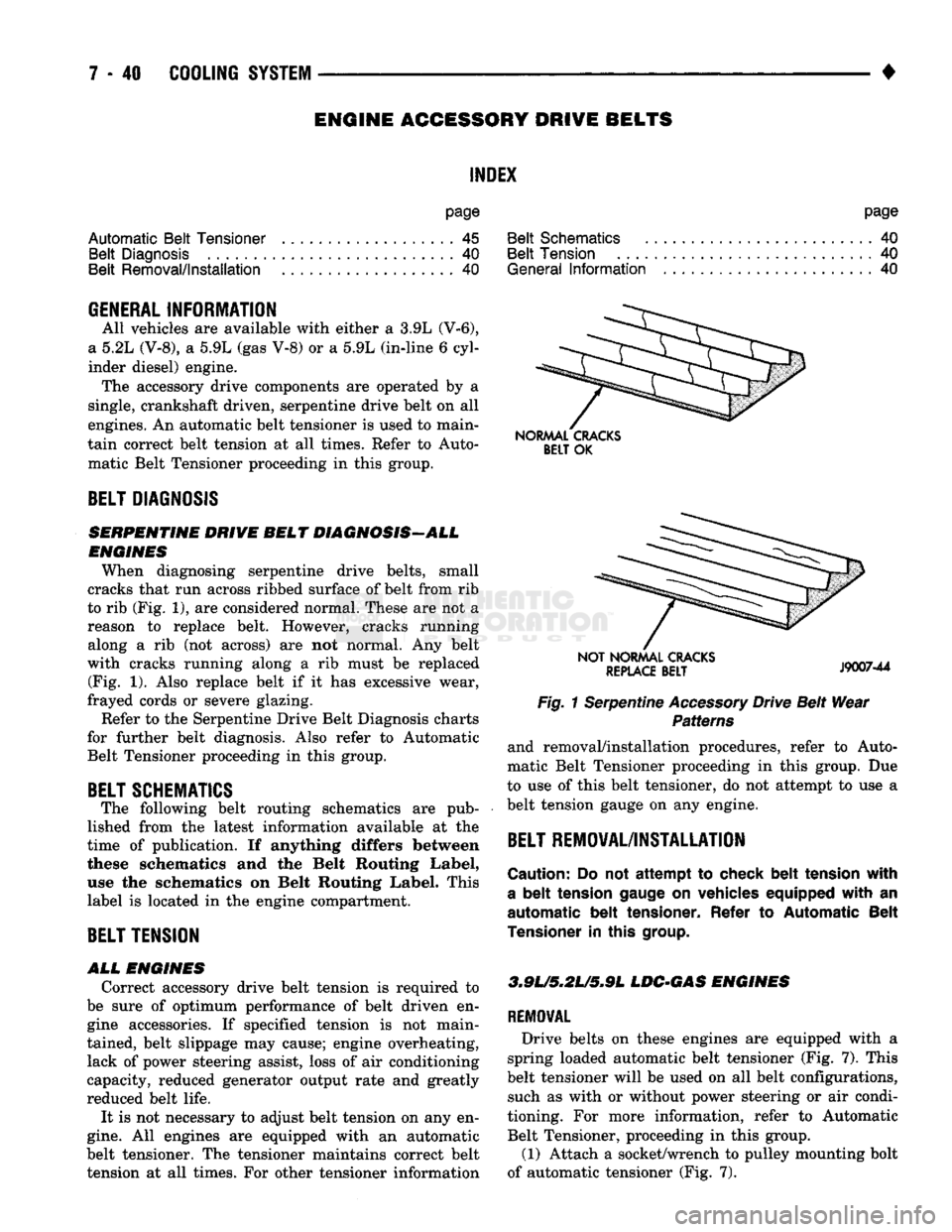
When diagnosing serpentine drive belts, small
cracks that run across ribbed surface of belt from rib
to rib (Fig. 1), are considered normal. These are not
a
reason
to
replace belt. However, cracks running along
a rib (not
across)
are not
normal.
Any
belt
with cracks running along
a rib
must
be
replaced (Fig.
1).
Also replace belt
if it has
excessive wear,
frayed cords
or
severe glazing.
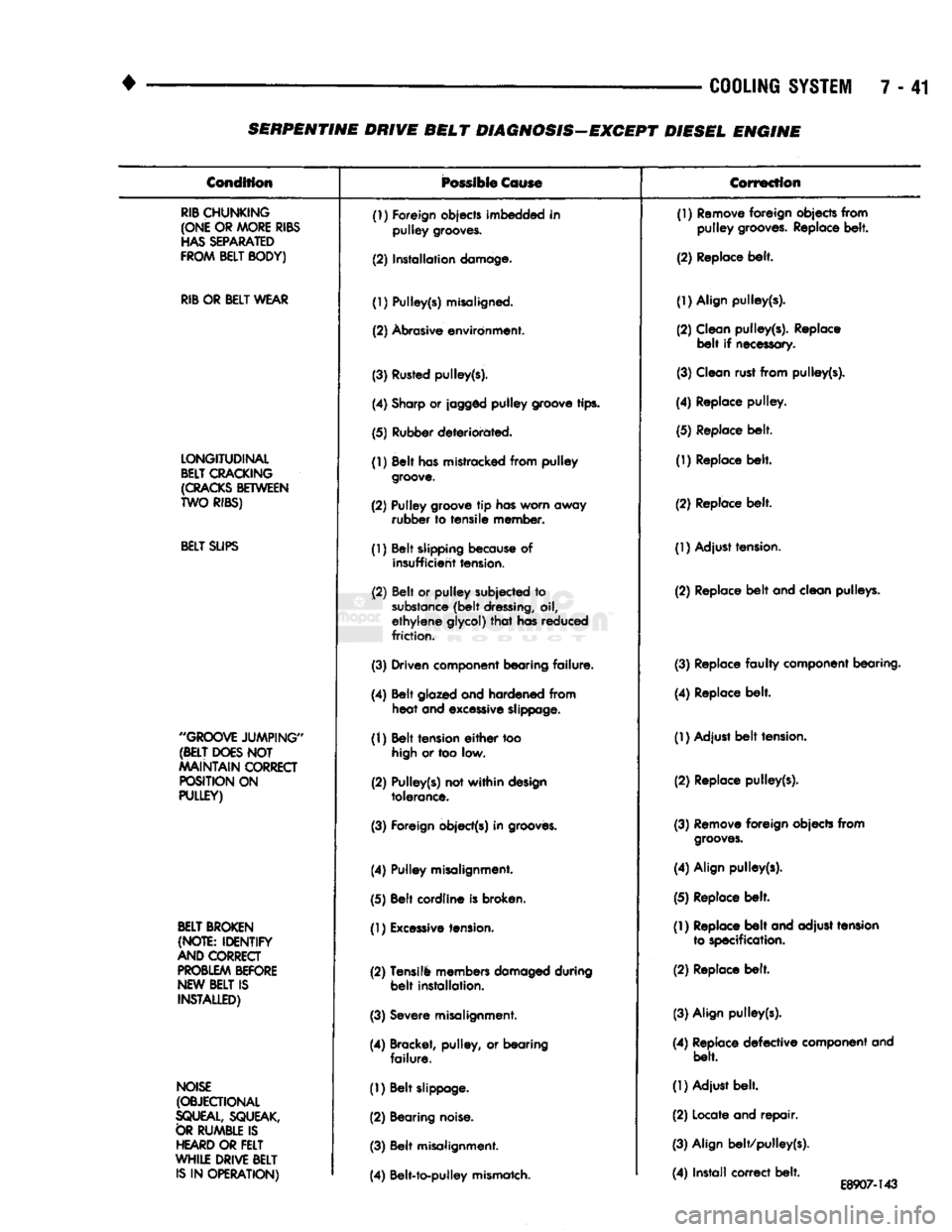
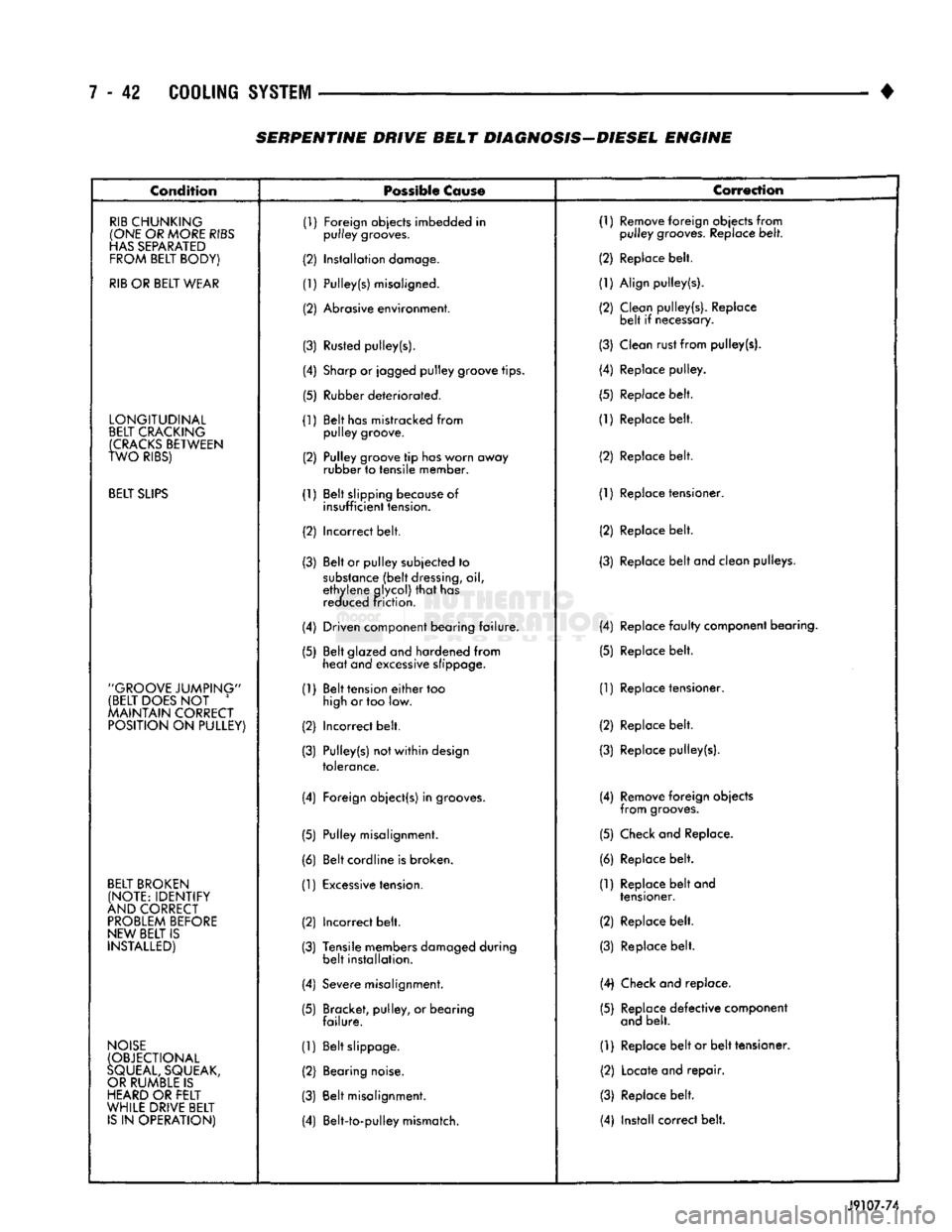
Refer to the Serpentine Drive Belt Diagnosis charts
for further belt diagnosis. Also refer
to
Automatic Belt Tensioner proceeding
in
this group.
BELT SCHEMATICS
The following belt routing schematics
are
pub
lished from
the
latest information available
at the
time
of
publication.
If
anything differs between
these schematics
and the
Belt Routing Label,
use
the
schematics
on
Belt Routing Label. This
label
is
located
in
the engine compartment.
BELT TENSION
ALL
ENGINES
Correct accessory drive belt tension
is
required
to
be sure
of
optimum performance
of
belt driven
en
gine accessories.
If
specified tension
is not
main
tained, belt slippage may cause; engine overheating, lack
of
power steering assist, loss
of
air conditioning
capacity, reduced generator output rate and greatly
reduced belt life.
It
is
not necessary
to
adjust belt tension on any en
gine.
All
engines
are
equipped with
an
automatic
belt tensioner. The tensioner maintains correct belt tension
at all
times. For other tensioner information
NORMAL CRACKS
BELT
OK
NOT NORMAL CRACKS
REPLACE
BELT
J9007-44
Fig. 1 Serpentine Accessory Drive Belt Wear Patterns
and removal/installation procedures, refer
to
Auto
matic Belt Tensioner proceeding
in
this group.
Due
to use
of
this belt tensioner, do not attempt
to
use
a
belt tension gauge
on
any engine.
BELT REMOVAL/INSTALLATION
Caution:
Do not
attempt
to
check belt tension with
a
belt
tension gauge
on
vehicles equipped with
an
automatic belt tensioner. Refer
to
Automatic Belt
Tensioner
in
this
group.
3.9L/5,2U5*9L
LDC-GAS ENGINES
REMOVAL
Drive belts
on
these engines
are
equipped with
a
spring loaded automatic belt tensioner (Fig.
7).
This
belt tensioner will
be
used on
all
belt configurations, such
as
with
or
without power steering
or
air condi
tioning.
For
more information, refer
to
Automatic Belt Tensioner, proceeding
in
this group.
(1) Attach
a
socket/wrench
to
pulley mounting bolt
of automatic tensioner (Fig.
7).
Page 312 of 1502
•
COOLING
SYSTEM
7 - 41 SERPENTINE DRIVE BELT DIAGNOSIS-EXCEPT DIESEL ENGINE
Condition
Possible
Cause
Correction
RIB
CHUNKING
(ONE
OR
MORE
RIBS
HAS
SEPARATED
FROM
BELT
BODY)
(1)
Foreign objects imbedded in
pulley
grooves.
(2) Installation damage. (1) Remove foreign objects from
pulley
grooves.
Replace belt.
(2) Replace belt.
RIB
OR
BELT
WEAR
(1)
Put ley
(s)
misaligned. (1) Align pulley(s).
(2) Abrasive environment. (2) Clean pulley(s). Replace
belt
if
necessary.
(3)
Rusted
pulley(s). (3) Clean rust from pulley(s).
(4)
Sharp
or jagged pulley groove tips. (4) Replace pulley.
(5) Rubber deteriorated. (5) Replace belt.
LONGITUDINAL
BELT
CRACKING
(CRACKS
BETWEEN
TWO
RIBS)
(1) Belt has mistracked from pulley
groove.
(2) Pulley groove tip
has
worn away rubber to tensile member. (1) Replace belt.
(2) Replace belt.
BELT
SLIPS
(1) Belt
slipping
because of
insufficient tension. (1) Adjust tension.
(2) Belt or pulley subjected to
substance
(belt
dressing,
oil,
ethylene glycol)
that
has
reduced
friction. (2) Replace
belt
and clean pulleys.
(3) Driven component bearing failure. (3) Replace faulty component bearing.
(4)
Belt glazed and hardened from heat and
excessive
slippage.
(4) Replace belt.
"GROOVE
JUMPING"
(BELT
DOES
NOT
MAINTAIN
CORRECT
POSITION
ON
PULLEY)
(1)
Belt tension
either
too
high
or too low.
(2) Pulley(s) not within design tolerance. (1) Adjust
belt
tension.
(2) Replace pulley(s).
(3) Foreign object(s) in
grooves.
(3) Remove foreign objects from
grooves.
(4) Pulley misalignment. (4)
Align
pulley(s).
(5) Belt cordline is broken. (5) Replace belt.
BELT
BROKEN
(NOTE:
IDENTIFY
AND
CORRECT
PROBLEM
BEFORE
NEW
BELT
IS
INSTALLED)
(1)
Excessive
tension.
(2) Tensile members damaged during
belt
installation.
(3) Severe misalignment. (1) Replace
belt
and adjust tension
to specification.
(2) Replace belt.
(3) Align pulley(s).
(4)
Bracket, pulley, or bearing failure. (4) Replace defective component and
belt.
NOISE
(OBJECTIONAL
SQUEAL,
SQUEAK,
bR
RUMBLE
IS
HEARD
OR
FELT
WHILE
DRIVE
BELT
IS
IN
OPERATION)
(1)
Belt
slippage.
(2) Bearing noise.
(3) Belt misalignment.
(4) Beit-to-pulley mismatch. (1) Adjust belt.
(2) Locate and repair.
(3)
Align
belt/pulley(s).
(4) Install correct belt. E8907-143
Page 313 of 1502
7 - 42 COOLING SYSTEM
• SERPENTINE DRIVE BELT DIAGNOSIS-DIESEL ENGINE
Condition
Possible
Cause
Correction
RIB
CHUNKING (1) Foreign objects imbedded in
(1) Remove foreign objects from
(ONE
OR
MORE
RIBS
(1)
pulley grooves.
pulley
grooves.
Replace
belt.
HAS
SEPARATED
pulley grooves.
Replace
belt.
FROM
BELT BODY) (2) Installation damage.
(2) Replace
belt.
RIB
OR
BELT
WEAR
(1) Pulley(s) misaligned.
(1)
Align
pulley(s).
(2) Abrasive environment.
(2)
Clean pulley(s). Replace
(2)
belt
if necessary.
(3)
Rusted
pulley(s).
(3) Clean rust from pulley(s).
(4)
Sharp
or jagged pulley groove tips.
(4)
Replace pulley.
(5) Rubber
deteriorated.
(5)
Replace
belt.
LONGITUDINAL
(1) Belt has mistracked from
(1)
Replace
belt.
BELT
CRACKING
(1)
pulley groove. Replace
belt.
(CRACKS
BETWEEN
TWO
RIBS)
pulley groove.
Replace
belt.
(CRACKS
BETWEEN
TWO
RIBS)
(2) Pulley groove tip has worn away
(2) Replace
belt.
(2)
rubber to tensile member.
BELT
SLIPS
(1) Belt slipping because of
0) Replace tensioner.
(1)
insufficient tension.
(2) Incorrect
belt.
(2)
Replace
belt.
(3) Belt or pulley subjected to
(3)
Replace
belt
and clean pulleys.
substance
(belt
dressing,
oil,
ethylene
glycol)
that
has reciuced friction.
(4) Driven component bearing
failure.
(4)
Replace
faulty
component bearing.
(5) Belt glazed and hardened from
(5)
Replace
belt.
(5)
heat
and excessive slippage.
"GROOVE
JUMPING" (1) Belt tension
either
too
(1) Replace tensioner.
(BELT
DOES
NOT 5 (1)
high
or too low. Replace tensioner.
MAINTAIN
CORRECT
high
or too low.
POSITION
ON PULLEY) (2) Incorrect
belt.
(2) Replace
belt.
(3) Pulley(s) not
within
design
(3)
Replace pulley(s).
tolerance.
(4) Foreign object(s) in grooves.
(4)
Remove foreign objects
from grooves.
(5) Pulley misalignment.
(5)
Check and Replace.
(6) Belt cordline is broken.
(6)
Replace
belt.
BELT
BROKEN
0)
Excessive
tension.
0) Replace
belt
and
(NOTE:
IDENTIFY 0)
tensioner.
AND
CORRECT
PROBLEM
BEFORE
(2) Incorrect
belt.
(2) Replace
belt.
NEW
BELT
IS (2)
Replace
belt.
INSTALLED)
(3) Tensile members damaged during
(3) Replace
belt.
(3)
belt
installation.
(4) Severe misalignment.
(4)
Check and replace.
(5) Bracket, pulley, or bearing
(5)
Replace
defective
component
(5)
failure.
ana
belt.
NOISE
0) Belt slippage.
(1) Replace
belt
or
belt
tensioner.
(OBJECTIONAL
0)
Belt slippage.
Replace
belt
or
belt
tensioner.
SQUEAL,
SQUEAK,
(2) Bearing noise.
(2) Locate and
repair.
OR
RUMBLE
IS (2)
Bearing noise.
HEARD
OR FELT (3) Belt misalignment.
(3) Replace
belt.
WHILE
DRIVE
BELT (3)
Belt misalignment.
Replace
belt.
IS
IN OPERATION) (4) Belt-to-pulley mismatch.
(4) Install correct
belt.
J9107-74
Page 314 of 1502
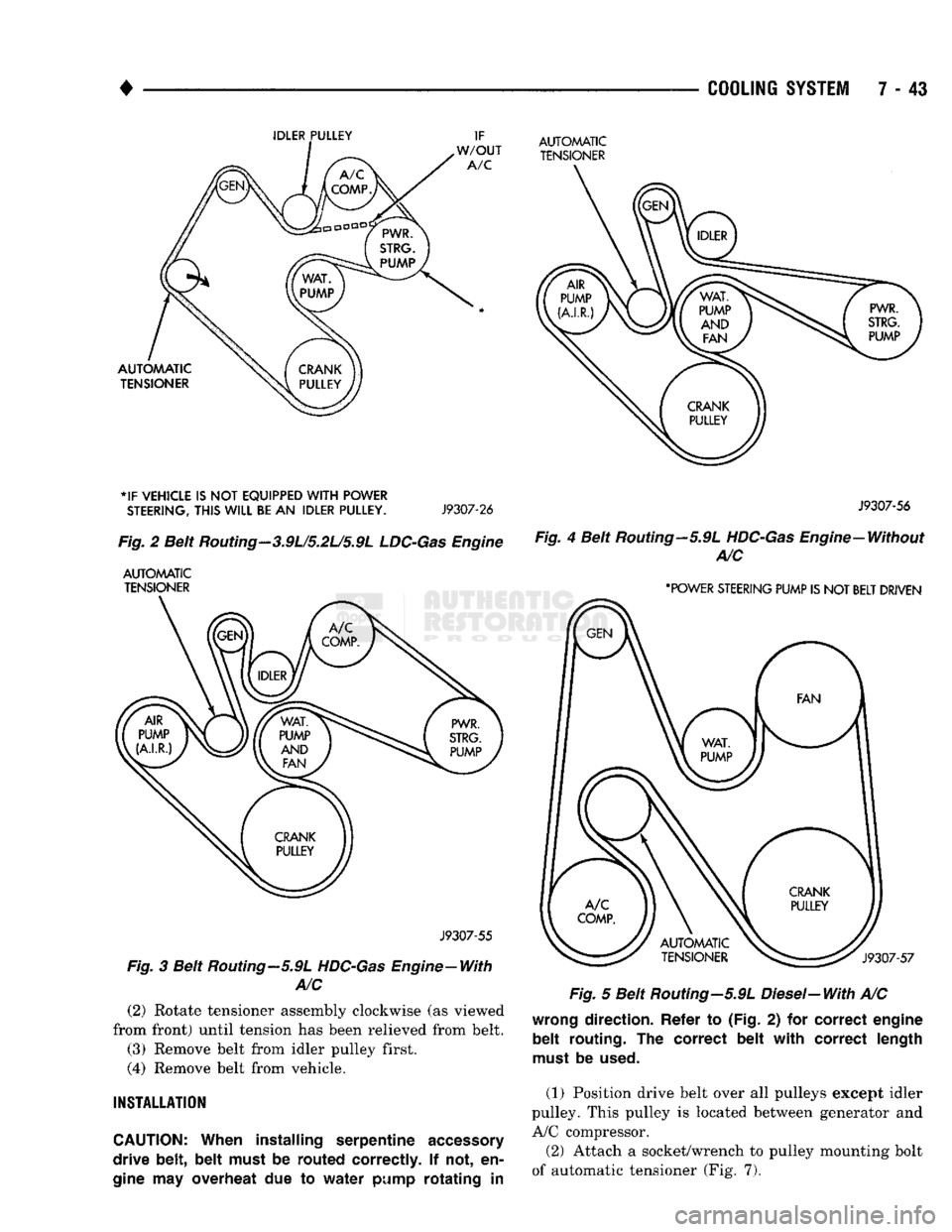
•
*IF VEHICLE IS NOT EQUIPPED
WITH
POWER
STEERING,
THIS
WILL
BE
AN
IDLER PULLEY.
J9307-26
Fig.
2 Beit
Routing
- 3.9U5.2L/5.9L
LDC-Gas
Engine
AUTOMATIC TENSIONER
J9307-55
Fig.
3 Beit Routing—5.9L HDC-Gas Engine—With
A/C
(2)
Rotate tensioner assembly clockwise (as viewed
from front) until tension has been relieved from belt.
(3) Remove belt from idler pulley first.
(4)
Remove belt from vehicle.
INSTALLATION
CAUTION:
When
installing
serpentine accessory
drive
belt, belt
must
be
routed
correctly.
If not, en
gine
may
overheat
due to
water
pump
rotating in
COOLING
SYSTEM
7 - 43
AUTOMATIC TENSIONER
J9307-56
Fig.
4 Belt Routing—5.9L
HDC-Gas
Engine—Without A/C
'POWER STEERING PUMP IS
NOT
BELT DRIVEN
Fig.
5 Belt Routing-5.9L Diesel-With A/C
wrong
direction. Refer
to
(Fig.
2) for
correct engine
belt routing.
The
correct belt with correct length
must
be
used.
(1) Position drive belt over all pulleys except idler
pulley. This pulley is located between generator and
A/C compressor.
(2) Attach a socket/wrench to pulley mounting bolt
of automatic tensioner (Fig. 7).
Page 315 of 1502
7 - 44
COOLING
SYSTEM
•
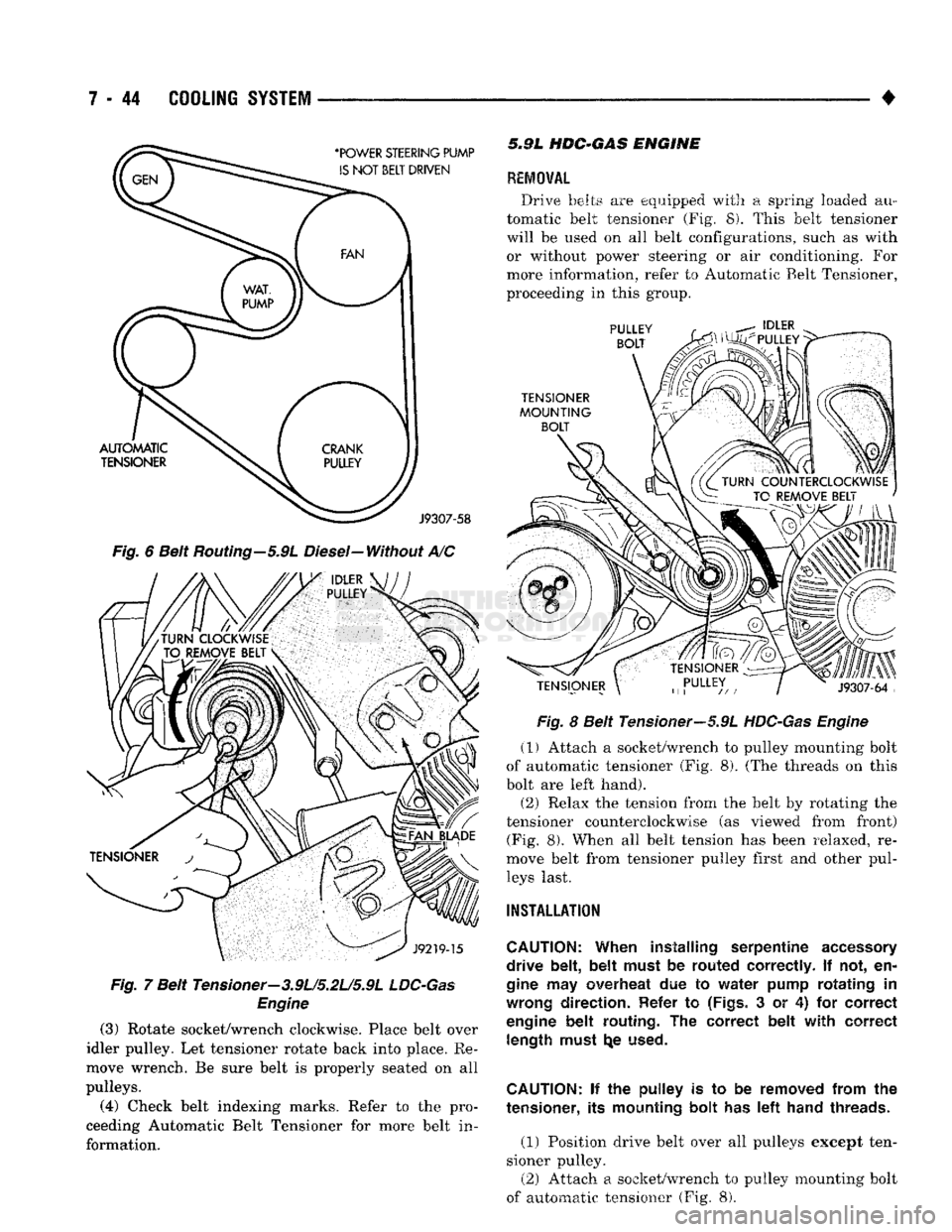
Fig.
6 Belt Routing-5.9L Diesel-Without A/C
Fig.
7 Belt Tensioner-3.9L/5.2U5.9L
LDC-Gas
Engine
(3)
Rotate socket/wrench clockwise. Place belt over
idler pulley. Let tensioner rotate back into place. Re
move wrench. Be sure belt is properly seated on all
pulleys.
(4)
Check belt indexing marks. Refer to the pro
ceeding Automatic Belt Tensioner for more belt in
formation. 5.9L
HDC-GAS
ENGINE
REMOVAL
Drive belts are equipped with a spring loaded au
tomatic belt tensioner (Fig. 8). This belt tensioner
will be used on all belt configurations, such as with or without power steering or air conditioning. For
more information, refer to Automatic Belt Tensioner,
proceeding in this group.
Fig.
8 Belt Tensioner—5.9L
HDC-Gas Engine
(1) Attach a socket/wrench to pulley mounting bolt
of automatic tensioner (Fig. 8). (The threads on this
bolt are left hand).
(2) Relax the tension from the belt by rotating the
tensioner counterclockwise (as viewed from front) (Fig. 8). When all belt tension has been relaxed, re
move belt from tensioner pulley first and other pul leys last.
INSTALLATION
CAUTION:
When installing serpentine
accessory
drive belt, belt must
be
routed correctly.
If not, en
gine
may
overheat
due to
water pump rotating
in
wrong
direction. Refer
to
(Figs.
3 or 4) for
correct
engine
belt routing.
The
correct belt with correct length must
t^e
used.
CAUTION:
if the
pulley
is to be
removed from
the
tensioner,
its
mounting bolt
has left
hand threads.
(1) Position drive belt over all pulleys except ten
sioner pulley. (2) Attach a socket/wrench to pulley mounting bolt
of automatic tensioner (Fig. 8).