belt DODGE TRUCK 1993 Service Owner's Guide
[x] Cancel search | Manufacturer: DODGE, Model Year: 1993, Model line: TRUCK, Model: DODGE TRUCK 1993Pages: 1502, PDF Size: 80.97 MB
Page 316 of 1502
•
COOLING
SYSTEM
7 - 45 (3) Rotate socket/wrench counterclockwise. Install
belt over tensioner pulley. Let tensioner rotate back into place. Remove wrench. Be sure belt is properly
seated on all pulleys.
5«9L
DIESEL ENGINE
REMOVAL
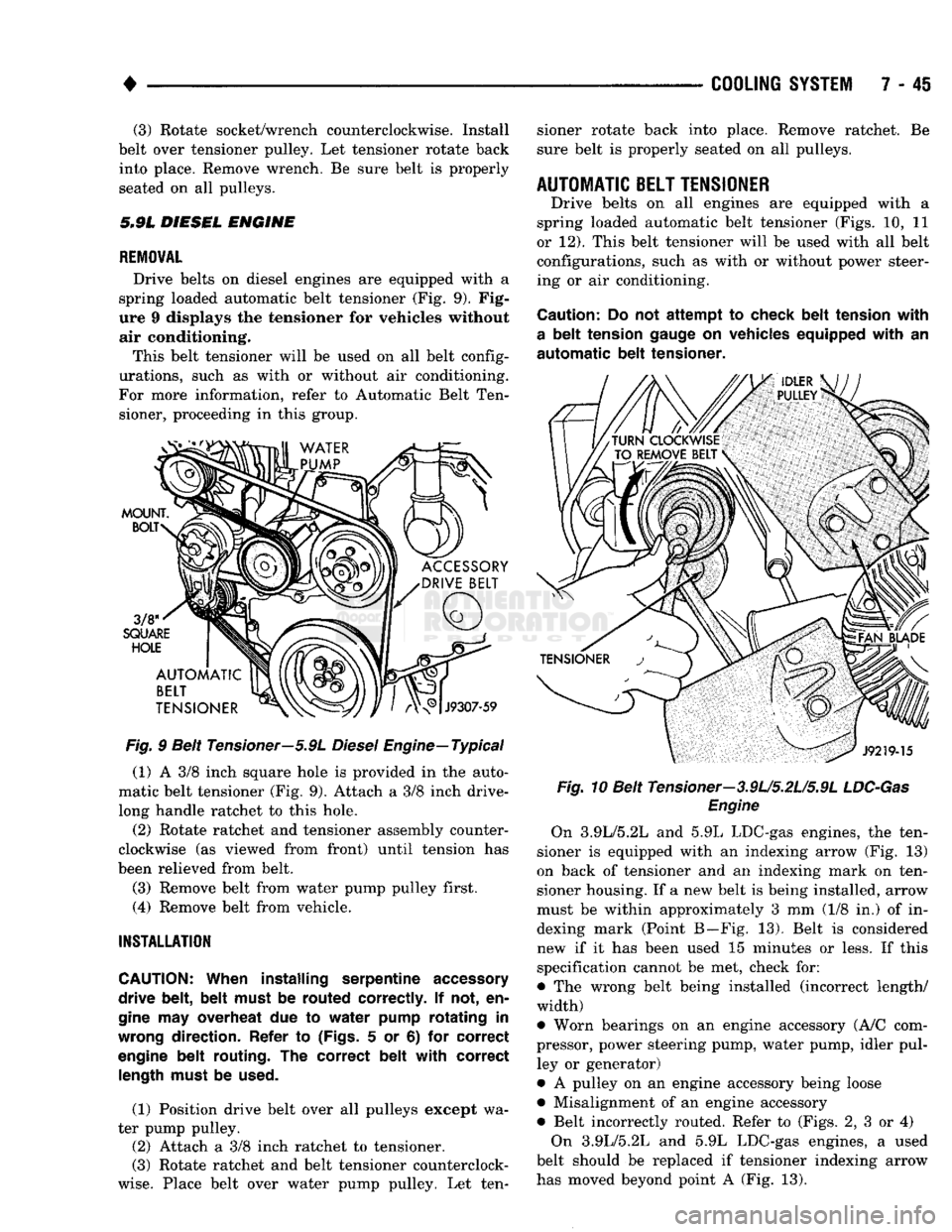
Drive belts on diesel engines are equipped with a
spring loaded automatic belt tensioner (Fig. 9). Fig
ure 9 displays the tensioner for vehicles without air conditioning.
This belt tensioner will be used on all belt config
urations, such as with or without air conditioning.
For more information, refer to Automatic Belt Ten sioner, proceeding in this group.
Fig.
9 Belt Tensioner—5.9L
Diesel
Engine—Typical
(1) A 3/8 inch square hole is provided in the auto
matic belt tensioner (Fig. 9). Attach a 3/8 inch drive-
long handle ratchet to this hole.
(2) Rotate ratchet and tensioner assembly counter
clockwise (as viewed from front) until tension has
been relieved from belt.
(3) Remove belt from water pump pulley first.
(4) Remove belt from vehicle.
INSTALLATION
CAUTION:
When installing serpentine
accessory
drive belt, belt must
be
routed correctly.
If not, en
gine
may
overheat
due to
water pump rotating
in
wrong
direction. Refer
to
(Figs.
5 or 6) for
correct
engine
belt routing.
The
correct belt with correct
length
must
be
used.
(1) Position drive belt over all pulleys except wa
ter pump pulley. (2) Attach a 3/8 inch ratchet to tensioner.
(3) Rotate ratchet and belt tensioner counterclock
wise.
Place belt over water pump pulley. Let ten sioner rotate back into place. Remove ratchet. Be
sure belt is properly seated on all pulleys.
AUTOMATIC
BELT
TENSIONER
Drive belts on all engines are equipped with a
spring loaded automatic belt tensioner (Figs. 10, 11
or 12). This belt tensioner will be used with all belt configurations, such as with or without power steer
ing or air conditioning.
Caution:
Do not
attempt
to
check belt tension with
a
belt tension
gauge
on
vehicles equipped with
an
automatic
belt tensioner. Fig.
10 Belt Tensioner—3.9U5.2U5.9L
LDC-Gas
Engine
On 3.9L/5.2L and 5.9L LDC-gas engines, the ten
sioner is equipped with an indexing arrow (Fig. 13)
on back of tensioner and an indexing mark on ten
sioner housing. If a new belt is being installed, arrow
must be within approximately 3 mm (1/8 in.) of in dexing mark (Point B—Fig. 13). Belt is considered
new if it has been used 15 minutes or less. If this
specification cannot be met, check for:
• The wrong belt being installed (incorrect length/
width)
• Worn bearings on an engine accessory (A/C com
pressor, power steering pump, water pump, idler pul ley or generator)
• A pulley on an engine accessory being loose
• Misalignment of an engine accessory
• Belt incorrectly routed. Refer to (Figs. 2, 3 or 4) On 3.9L/5.2L and 5.9L LDC-gas engines, a used
belt should be replaced if tensioner indexing arrow
has moved beyond point A (Fig. 13).
Page 317 of 1502

7
- 4S
COOLING
SYSTEM
•
PULLEY BOLT IDLER
iUlLTPULLEY-
TENSIONER
MOUNTING
BOLT TENSIONER
ASSEMBLY
TENSIONER \
rULLC,\
, / ^ J9307-64 ,
Fig.
11 Beit Tensioner—5.9L
HDC-Gas
Engine
MOUNT.
BOLT
3/8
SQUARE HOLE
ACCESSORY
DRIVE
BELT AUTOMATIC
BELT
TENSIONER
J9307-59
Fig.
12 Belt Tensioner—5.9L
Diesel
Engine—Typical
3MLm.2Lm.9L
LDG°GA8
ENGINES
REMOVAL
(1) Remove accessory drive belt. Refer to Belt Re
moval/Installation in this group. (2) Disconnect wiring and secondary cable from ig
nition coil.
(3) Remove ignition coil from coil mounting
bracket (two bolts). Do not remove coil mounting
bracket from cylinder head. (4) Remove tensioner assembly from mounting
bracket (one nut) (Fig. 13).
WARNING: BECAUSE
OF
HIGH
SPRING
PRES
SURE,
DO
NOT ATTEMPT
TO
DISASSEMBLE
AUTO
MATIC
TENSIONER.
UNIT
IS
SERVICED
AS AN
ASSEMBLY
(EXCEPT
FOR
PULLEY).
TENSIONER
MOUNTING NUT
INDEXING ARROW
INDEXING MARK
J9207-17
Fig.
13 indexing Marks-3.9L/5.2L/5.9L
LDC-Gas
Engine
(5) Remove pulley bolt. Remove pulley from ten
sioner.
INSTALLATION
(1) Install pulley and pulley bolt to tensioner.
Tighten bolt to 61 Nnn (45 ft. lbs.).
(2) Install tensioner assembly to mounting bracket.
An indexing tab is located on back of tensioner.
Align this tab to slot in mounting bracket. Tighten nut to 67 Nnn (50 ft. lbs.) torque.
(3) Connect all wiring to ignition coil. (4) Install coil to coil bracket. If nuts and bolts are
used to secure coil to coil bracket, tighten to 11 Nnn (100 in. lbs.) torque. If coil mounting bracket has
been tapped for coil mounting bolts, tighten bolts to 5 Nnn (50 in. lbs.) torque.
CAUTION:
To
prevent damage
to
coil case, coil mounting bolts must
be
torqued.
(5) Install drive belt. Refer to Belt Removal/Instal
lation in this group. (6) Check belt indexing marks (Fig. 13).
Page 318 of 1502
•
COOLING
SYSTEM
7 - 47 5.9L HDC'GAS ENGINE
REMOVAL
(1) Remove accessory drive belt. Refer to Belt Re
moval/Installation in this group. (2) Remove tensioner mounting bolt (Fig. 11) and
remove tensioner.
CAUTION:
If the
pulley
is to be
removed
from
the
tensioner,
its
mounting
bolt has
left
hand
threads.
WARNING:
BECAUSE
OF
HIGH SPRING
PRES
SURE,
DO
NOT ATTEMPT TO
DISASSEMBLE
AUTO MATIC TENSIONER. UNIT
IS
SERVICED
AS AN
ASSEMBLY
(EXCEPT FOR PULLEY).
INSTALLATION
(1) Install pulley and pulley bolt to tensioner (ob
serve the previous CAUTION). Tighten bolt to 88
N*m (65 ft. lbs.) torque.
(2) Install tensioner assembly to mounting bracket.
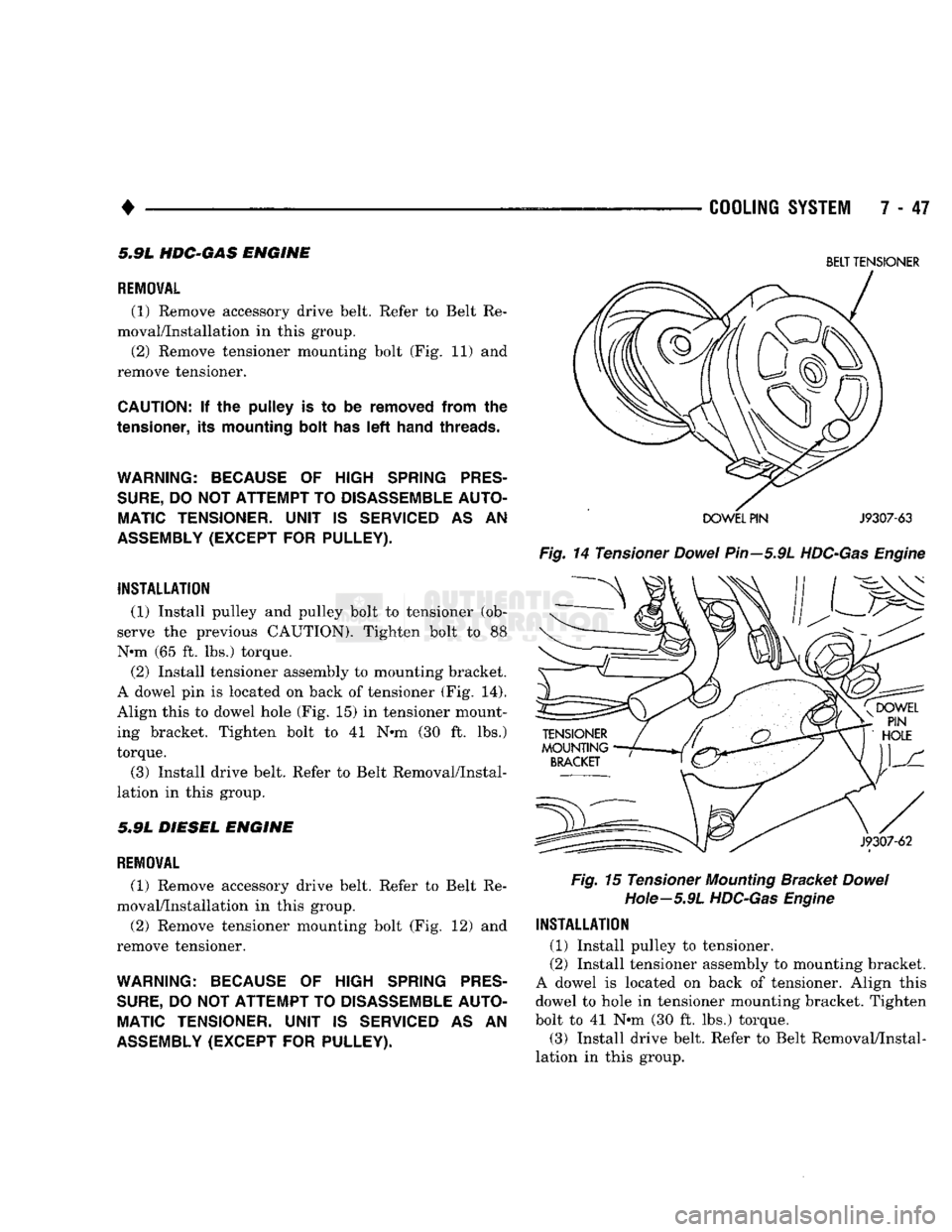
A dowel pin is located on back of tensioner (Fig. 14).
Align this to dowel hole (Fig. 15) in tensioner mount
ing bracket. Tighten bolt to 41 N-m (30 ft. lbs.)
torque.
(3) Install drive belt. Refer to Belt Removal/Instal
lation in this group.
5.9L DIESEL ENGINE
REMOVAL
(1) Remove accessory drive belt. Refer to Belt Re
moval/Installation in this group. (2) Remove tensioner mounting bolt (Fig. 12) and
remove tensioner.
WARNING:
BECAUSE
OF
HIGH SPRING
PRES
SURE,
DO
NOT ATTEMPT
TO
DISASSEMBLE
AUTO MATIC TENSIONER. UNIT
IS
SERVICED
AS AN
ASSEMBLY
(EXCEPT FOR PULLEY).
BELT
TENSIONER
DOWEL
PIN
J9307-63
Fig.
14 Tensioner
Dowel
Pin—5.9L
HDC-Gas
Engine
Fig.
15 Tensioner
Mounting
Bracket
Dowel
Hole—5.9L
HDC-Gas
Engine
INSTALLATION
(1) Install pulley to tensioner.
(2) Install tensioner assembly to mounting bracket.
A dowel is located on back of tensioner. Align this
dowel to hole in tensioner mounting bracket. Tighten
bolt to 41 N*m (30 ft. lbs.) torque.
(3) Install drive belt. Refer to Belt Removal/Instal
lation in this group.
Page 320 of 1502
SPECIFICATIONS
GENERAL
INFORMATION
The following specifications are published from the
latest information available at the time of publica
tion. If anything differs between the specifica
tions found on the Vehicle Emission Control
Information (VECI) label and the following spec
ifications, use specifications on VECI label. The
VECI label is located in the engine compartment.
DRIVE
BELT
TENSION
All engines are equipped with a spring loaded au
tomatic belt tensioner. Do not attempt to check belt
tension with a belt tension gauge on vehicles
equipped with an automatic belt tensioner. Refer to
Automatic Belt Tensioner in this group.
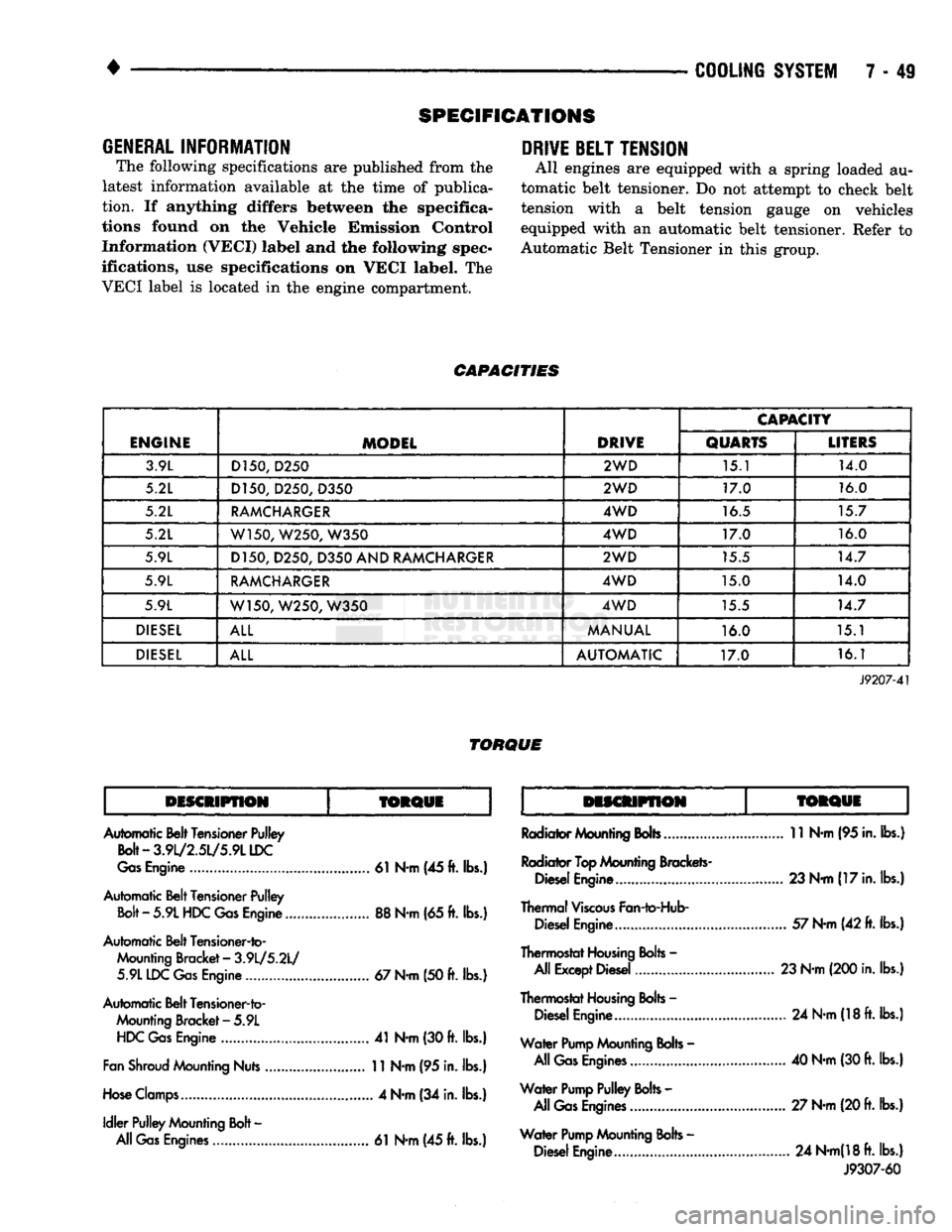
CAPACITIES
ENGINE
MODEL
DRIVE
CAPACITY
ENGINE
MODEL
DRIVE
QUARTS
LITERS
3.9L D150,
D250
2WD
15.1 14.0
5.2L D150, D250,
D350
2WD
17.0 16.0
5.2L
RAMCHARGER
4WD
16.5 15.7
5.2L W150, W250,
W350
4WD
17.0 16.0
5.9L D150, D250,
D350
AND
RAMCHARGER
2WD
15.5 14.7
5.9L
RAMCHARGER
4WD
15.0 14.0
5.9L W150, W250,
W350
4WD
15.5 14.7
DIESEL
ALL
MANUAL
16.0 15.1
DIESEL
ALL
AUTOMATIC
17.0 16.1
J9207-41
TORQUE
DISCMPflON
TORQUE
TORQUi
Automatic Belt Tensioner Pulley
Bolt-3.9l/2.5L/5.9LLDC
Gas
Engine
61
N-m (45
ft.
lbs.)
Automatic Belt Tensioner Pulley
Bolt
-
5.9L
HDC
Gas
Engine
88
N-m
(65
ft.
lbs.)
Automatic Belt Tensioner-to- Mounting Bracket
-
3.9L/5.2L/ 5.9L IDC
Gas
Engine
67
N-m
(50
ft.
lbs.)
Automatic Belt Tensioner-to- Mounting Bracket
-
5.9L
HDC
Gas
Engine
41
N-m
(30
ft.
lbs.)
Fan
Shroud
Mounting Nuts
11
N-m
(95
in. lbs.)
Hose
Clamps
4
N-m
(34
in. lbs.)
Idler
Pulley Mounting
Bolt
-
All
Gas
Engines
61
N-m
(45
ft.
lbs.)
Radiator Mounting
Bobs
11
N-m
(95
in. lbs.)
Radiator
Top
Mounting Brackets- Diesel Engine...... 23 N-m
(17
in. lbs.)
Thermal
Viscous
Fan-to-Hub- Diesel Engine
57
N-m
(42
ft.
lbs.)
Thermostat
Housing
Bolts
-
All Except Diesel 23 N-m (200 in. lbs.)
Thermostat
Housing
Bolts
-
Diesel Engine
24
N-m
(18
ft.
lbs.)
Water
Pump
Mounting
Bolts
-
All
Gas
Engines
40
N-m
(30
ft.
lbs.)
Water
Pump
Pulley
Bolts
-
All
Gas
Engines
27 N-m (20
ft.
lbs.)
Water
Pump
Mounting
Bolts
-
Diesel Engine
24
N-m(18ft.
lbs.) J9307-60
Page 324 of 1502
•
ELECTRICAL
8A - 3
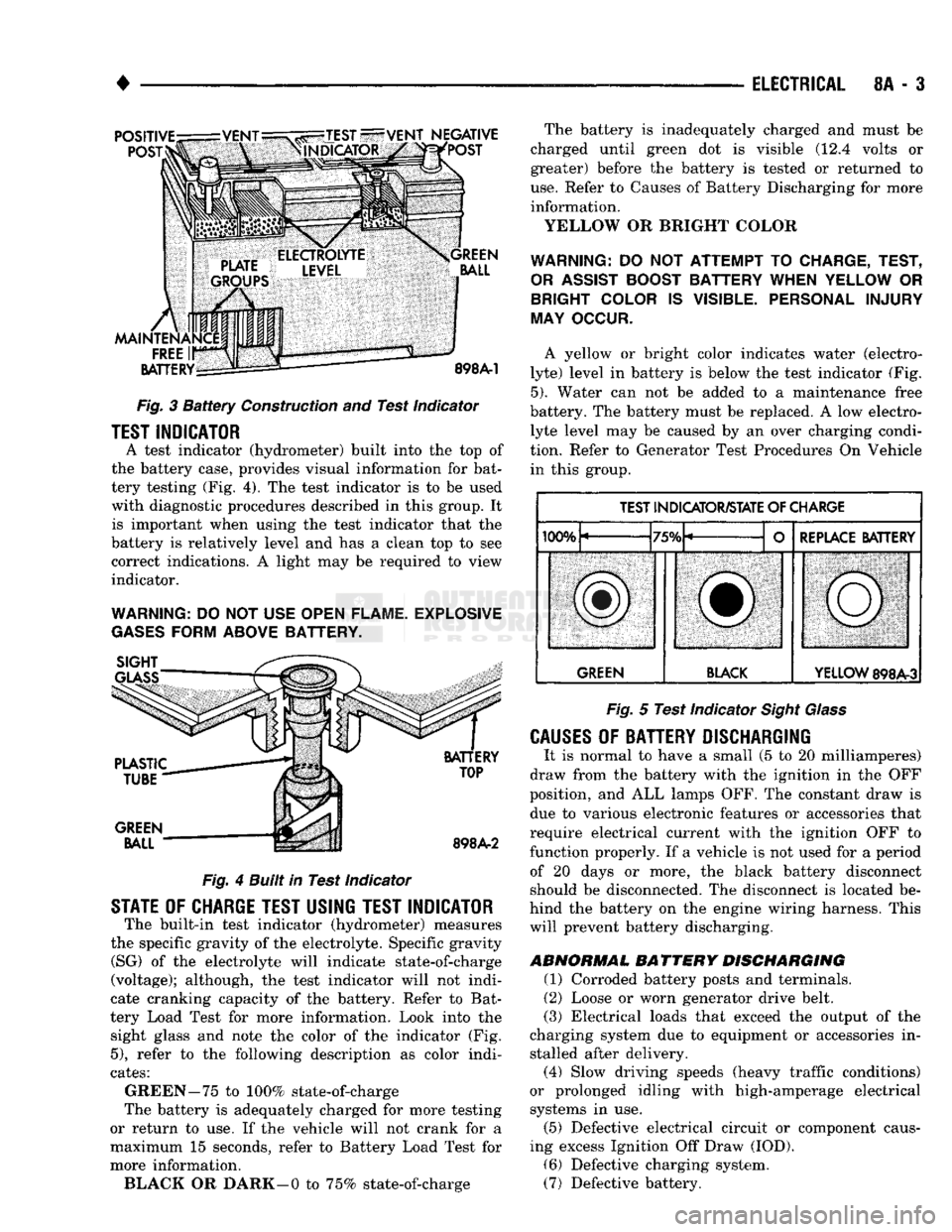
Fig.
3
Battery
Construction
and
Test Indicator
TEST INDICATOR
A test indicator (hydrometer) built into
the top of
the battery case, provides visual information
for
bat
tery testing (Fig.
4). The
test indicator
is to be
used with diagnostic procedures described
in
this group.
It
is important when using
the
test indicator that
the
battery
is
relatively level
and has a
clean
top to see
correct indications.
A
light
may be
required
to
view
indicator.
WARNING:
DO
NOT USE
OPEN FLAME. EXPLOSIVE
GASES
FORM ABOVE BATTERY.
Fig.
4
Built in Test Indicator
STATE
OF
CHARGE TEST USING TEST INDICATOR
The built-in test indicator (hydrometer) measures
the specific gravity
of
the electrolyte. Specific gravity (SG)
of the
electrolyte will indicate state-of-charge
(voltage); although,
the
test indicator will
not
indi
cate cranking capacity
of the
battery. Refer
to
Bat
tery Load Test
for
more information. Look into
the
sight glass
and
note
the
color
of the
indicator
(Fig.
5),
refer
to the
following description
as
color indi
cates:
GREEN-75
to
100% state-of-charge
The battery
is
adequately charged
for
more testing
or return
to use. If the
vehicle will
not
crank
for a
maximum
15
seconds, refer
to
Battery Load Test
for
more information. BLACK
OR
DARK—0
to
75% state-of-charge The battery
is
inadequately charged
and
must
be
charged until green
dot is
visible
(12.4
volts
or
greater) before
the
battery
is
tested
or
returned
to
use.
Refer
to
Causes
of
Battery Discharging
for
more information.
YELLOW
OR
BRIGHT COLOR
WARNING:
DO NOT
ATTEMPT
TO
CHARGE, TEST,
OR
ASSIST
BOOST BATTERY WHEN YELLOW
OR
BRIGHT COLOR
IS
VISIBLE. PERSONAL INJURY
MAY OCCUR.
A yellow
or
bright color indicates water (electro
lyte) level
in
battery
is
below
the
test indicator
(Fig.
5).
Water
can not be
added
to a
maintenance free
battery.
The
battery must
be
replaced.
A low
electro lyte level
may be
caused
by an
over charging condi
tion. Refer
to
Generator Test Procedures
On
Vehicle in this group.
TEST INDICATOR/STATE
OF
CHARGE
IfVW,
"TCfV
REPLACE BATTERY
lUUTu
/Otu L
f
REPLACE BATTERY
SBl
ill,
iMMiMMMMSMM^MM
GREEN BLACK
YELLOW
898A-3
Fig.
5
Test Indicator
Sight Glass
CAUSES
OF
BATTERY DISCHARGING
It
is
normal
to
have
a
small
(5 to 20
milliamperes)
draw from
the
battery with
the
ignition
in the OFF
position,
and ALL
lamps OFF.
The
constant draw
is
due
to
various electronic features
or
accessories that
require electrical current with
the
ignition
OFF to
function properly.
If a
vehicle
is not
used
for a
period of
20
days
or
more,
the
black battery disconnect
should
be
disconnected.
The
disconnect
is
located
be
hind
the
battery
on the
engine wiring harness. This will prevent battery discharging.
ABNORMAL
BATTERY
DISCHARGING
(1) Corroded battery posts
and
terminals.
(2) Loose
or
worn generator drive belt.
(3) Electrical loads that exceed
the
output
of the
charging system
due to
equipment
or
accessories
in
stalled after delivery. (4) Slow driving speeds (heavy traffic conditions)
or prolonged idling with high-amperage electrical systems
in use.
(5) Defective electrical circuit
or
component caus
ing excess Ignition
Off
Draw (IOD).
(6) Defective charging system.
(7) Defective battery.
Page 331 of 1502
8A
- 10
ELECTRICAL
•
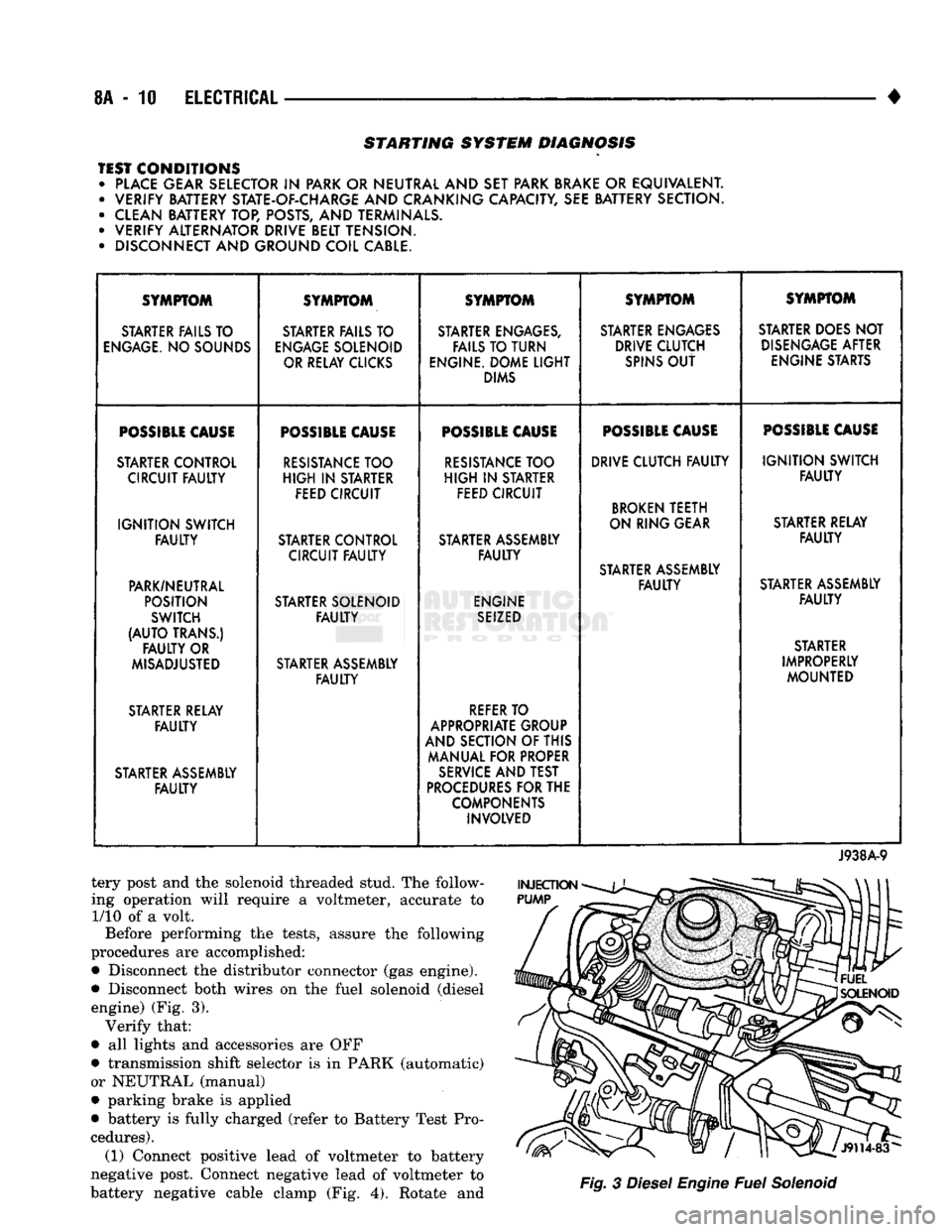
STARTING SYSTEM DIAGNOSIS
TEST CONDITIONS • PLACE GEAR SELECTOR
IN
PARK OR NEUTRAL AND SET PARK BRAKE
OR
EQUIVALENT. • VERIFY BATTERY STATE-OF-CHARGE AND CRANKING CAPACITY, SEE BATTERY SECTION.
• CLEAN BATTERY TOP, POSTS, AND TERMINALS.
• VERIFY ALTERNATOR DRIVE BELT TENSION.
• DISCONNECT AND GROUND COIL CABLE. SYMPTOM
SYMPTOM SYMPTOM SYMPTOM SYMPTOM
STARTER FAILS TO STARTER FAILS TO STARTER ENGAGES, STARTER ENGAGES STARTER DOES NOT
ENGAGE.
NO SOUNDS
ENGAGE
SOLENOID FAILS TO TURN DRIVE CLUTCH
DISENGAGE
AFTER
OR RELAY CLICKS ENGINE. DOME
LIGHT
SPINS
OUT
ENGINE STARTS
DIMS
POSSIBLE
CAUSE
POSSIBLE
CAUSE
POSSIBLE
CAUSE
POSSIBLE
CAUSE
POSSIBLE
CAUSE
STARTER CONTROL
RESISTANCE
TOO
RESISTANCE
TOO DRIVE CLUTCH
FAULTY
IGNITION
SWITCH
CIRCUIT
FAULTY
HIGH
IN
STARTER
HIGH
IN
STARTER
FAULTY
FEED CIRCUIT FEED CIRCUIT
BROKEN
TEETH
IGNITION
SWITCH ON RING GEAR
STARTER RELAY
FAULTY
STARTER CONTROL STARTER ASSEMBLY
FAULTY
CIRCUIT
FAULTY FAULTY
STARTER ASSEMBLY
PARK/NEUTRAL
FAULTY
STARTER ASSEMBLY
POSITION STARTER SOLENOID ENGINE
FAULTY
SWITCH
FAULTY
SEIZED
(AUTO
TRANS.) STARTER
FAULTY
OR STARTER
MISADJUSTED STARTER ASSEMBLY IMPROPERLY
FAULTY
MOUNTED
STARTER RELAY
REFER
TO
FAULTY
APPROPRIATE GROUP
AND SECTION OF THIS
MANUAL FOR PROPER
STARTER ASSEMBLY
SERVICE
AND TEST
FAULTY
PROCEDURES
FOR THE
COMPONENTS INVOLVED
J938A-9
tery post and the solenoid threaded stud. The follow
ing operation will require a voltmeter, accurate to 1/10 of a volt.
Before performing the tests, assure the following
procedures are accomplished:
•
Disconnect the distributor connector (gas engine).
•
Disconnect both wires on the fuel solenoid (diesel engine) (Fig. 3). Verify that:
•
all lights and accessories are OFF
•
transmission shift selector is in PARK (automatic)
or NEUTRAL (manual)
•
parking brake is applied
•
battery is fully charged (refer to Battery Test Pro
cedures). (1) Connect positive lead of voltmeter to battery
negative post. Connect negative lead of voltmeter to
battery negative cable clamp (Fig. 4). Rotate and
Fig.
3
Diesel
Engine
Fuel
Solenoid
Page 334 of 1502
•
ELECTRICAL
8A - 13 GENERATOR TEST PROCEDURES ON
VEHICLE
INDEX
page
Current
Output
Test
......................
14
Diagnostic Procedures
13
General
Information
13
Generator
Output
Wire Resistance Test
.......
13
page
How
to
Use
Malfunction
Indicator
(Check Engine) Lamp
for
Fault
Codes
17
Operational Check
with
Voltmeter
............
13
Using
On-Board Diagnostic System
15
GENERAL
INFORMATION
The generator
is
belt-driven
by the
engine.
All en
gines
use
serpentine drive. The amount
of DC
current produced
by the
gener
ator
is
controlled
by the
Powertrain Control Module (PCM).
All vehicles
are
equipped with
On
Board Diagnos
tics (OBD).
All OBD
sensing systems
are
monitored
by
the PCM. The PCM
will store
in
electronic mem ory
any
detectable failure within
the
monitored cir
cuits.
Refer
to
USING ON-BOARD DIAGNOSTIC SYSTEM
in
this group
for
more information.
OPERATIONAL CHECK
WITH
VOLTMETER
When
the
ignition switch
is
turned
to the RUN po
sition, battery potential will register
on the
voltme
ter. During engine cranking
a
lower voltage will appear
on the
meter. With
the
engine running,
a
voltage reading higher than
the
first reading (igni
tion
in RUN)
should register.
DIAGNOSTIC PROCEDURES
If
the
indicator does
not
operate properly,
or if an
undercharged
or
overcharged battery condition
oc
curs,
the
following procedures
may be
used
to
diag
nose
the
charging system. Remember that
an
undercharged battery
is
often
caused
by:
• accessories being left
on
overnight
•
or by a
defective switch which allows
a
bulb, such
as a
trunk
or
glove
box
light,
to
stay
on
(refer
to
Ignition
Off
Draw).
WISUAL
INSPECTION
• Inspect condition
of
battery cable terminals, bat
tery posts, connections
at
engine block, starter motor solenoid
and
relay. They should
be
clean
and
tight.
Repair
as
required.
• Inspect
all
fuses
in the
fuse block
for
tightness
in
receptacles. They should
be
properly installed
and
tight. Repair
or
replace
as
required.
• Inspect generator mounting bolts
for
tightness.
Re
place
or
torque bolt
as
required (refer
to
Torque Specifications).
• Inspect generator drive belt condition
and
tension.
Tension
or
replace belt
as
required. Refer
to
Belt
Tension Specifications. • Inspect connection
at
generator
B+
output.
It
should
be
clean
and
tight. Repair
as
required.
GENERATOR
OUTPUT
WIRE RESISTANCE TEST
(FIG.
1)
Generator output wire resistance test will show
amount
of
voltage drop across generator output wire
between generator
BAT
terminal
and
battery posi tive post.
PREPARATION
(1) Before starting test make sure vehicle
has a
fully charged battery. Test
and
procedures
on how to
check
for a
fully charged battery
are
shown
in
Bat
tery section
of
this Group.
(2) Turn
OFF
ignition switch.
(3)
Disconnect negative cable from battery.
(4)
Disconnect generator output wire from genera
tor output Battery terminal. (5) Connect
a 0-150
ampere scale
D.C.
ammeter
in
series between generator
BAT
terminal
and
discon
nected generator output wire. Connect Positive lead
to generator
BAT
terminal
and
Negative lead
to
dis connected generator output wire. (6) Connect Positive lead
of a
test voltmeter
(Range
0-18
volts minimum)
to
disconnected genera
tor output wire. Connect negative lead
of
test voltme
ter
to
battery positive cable
at
positive post. (7) Connect
one end of a
Jumper Wire
to
ground
and with other
end
probe green
K20
lead wire
at
back
of
generator
(Fig. 1).
(This will generate
a
fault
code).
CAUTION:
Do not
connect blue
A142
lead
of
wiring
to ground. Refer
to
Group
8W
-
Wiring Diagrams
for
more information.
(8) Connect
an
engine tachometer
and
connect neg
ative cable
to
battery.
(9) Connect
a
variable carbon pile rheostat
be
tween battery terminals.
Be
sure carbon pile
is in
"Open"
or "Off
position before connecting leads.
See
Battery Section, Load Testing
for
instructions.
TEST
(1) Start engine. Immediately after starting,
re
duce engine speed
to
idle.
Page 337 of 1502
8A
- 16
ELECTRICAL
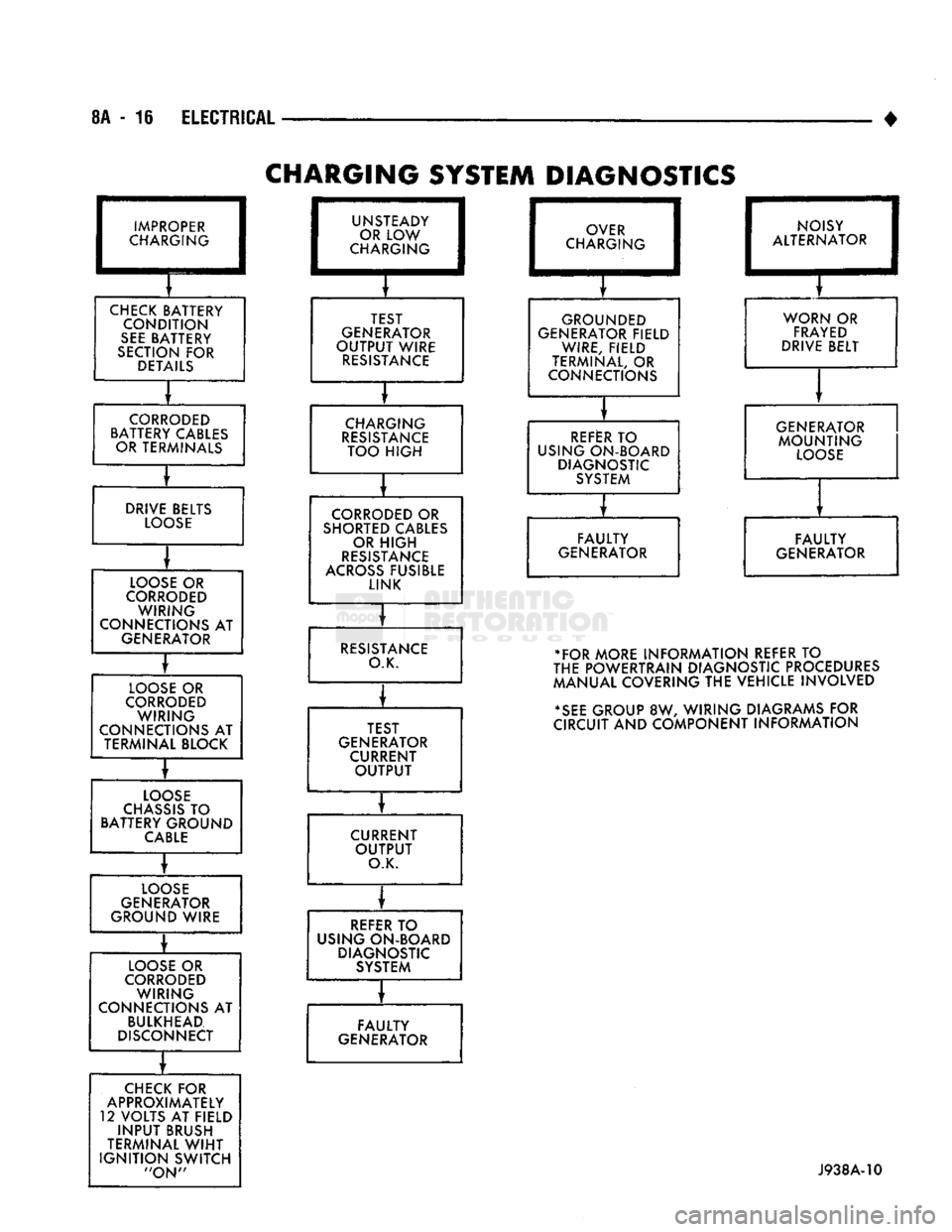
CHARGING
SYSTEM DIAGNOSTICS
IMPROPER
CHARGING
CHECK
BATTERY CONDITION
SEE
BATTERY
SECTION
FOR
DETAILS
CORRODED
BATTERY CABLES OR TERMINALS
DRIVE BELTS
LOOSE
LOOSE
OR
CORRODED
WIRING
CONNECTIONS
AT
GENERATOR
LOOSE
OR
CORRODED
WIRING
CONNECTIONS
AT
TERMINAL BLOCK
LOOSE
CHASSIS
TO
BATTERY GROUND
CABLE
LOOSE
GENERATOR
GROUND WIRE
LOOSE
OR
CORRODED
WIRING
CONNECTIONS
AT
BULKHEAD
DISCONNECT
CHECK
FOR
APPROXIMATELY
12 VOLTS
AT
FIELD
INPUT
BRUSH
TERMINAL
WIHT
IGNITION
SWITCH
"ON"
UNS'
OR
CHAF rEADY
LOW
K3ING
TEST
GENERATOR
OUTPUT
WIRE
RESISTANCE
CHARGING
RESISTANCE
TOO
HIGH
CORRODED
OR
SHORTED CABLES OR
HIGH
RESISTANCE
ACROSS
FUSIBLE LINK
RESISTANCE
O.K.
TEST
GENERATOR CURRENT
OUTPUT
CURRENT
OUTPUT
O.K.
REFER
TO
USING ON-BOARD DIAGNOSTIC SYSTEM
o
CHAR
/ER
.GING
GROUNDED
GENERATOR FIELD WIRE, FIELD
TERMINAL,
OR
CONNECTIONS
1 NO
1
ALTERf
ISY
MATOR
WORN
OR
FRAYED
DRIVE BELT
REFER
TO
USING ON-BOARD DIAGNOSTIC SYSTEM GENERATOR
MOUNTING
LOOSE
FAULTY
GENERATOR
FAULTY
GENERATOR •FOR MORE INFORMATION REFER
TO
THE POWERTRAIN DIAGNOSTIC PROCEDURES
MANUAL COVERING
THE
VEHICLE INVOLVED
*SEE
GROUP
8W,
WIRING DIAGRAMS
FOR
CIRCUIT
AND
COMPONENT INFORMATION
FAULTY
GENERATOR
J938A-V0
Page 347 of 1502
8B
- 6
BATTERY/STARTER/GENERATOR
SERVICE
•
GENERATOR SERVICE
CONTENTS
page
GENERATOR
REPLACEMENT-
DIESEL
ENGINE
8
GENERAL
INFORMATION
6
GENERAL
INFORMATION This section will cover generator removal
and in
stallation.
The
generator
is not
serviceable. Informa
tion covering on-vehicle testing
can be
found
in
Group
8A -
Battery/Starting/Charging/System Diag
nostics. The standard equipment generator
on the D and W
bodies
is the 75 amp
generator.
The
Ramcharger
is
equipped with
the 90 amp
generator. When
a
vehicle
is equipped with
a
heavy duty package
or
diesel
en
gine,
a 120 amp
generator
is
used.
GENERATOR
REPLACEMENT
-3.9L/5.2L/5.9L-LDC
GAS
ENGINE
Drive belts
on
these engines
are
equipped with
a
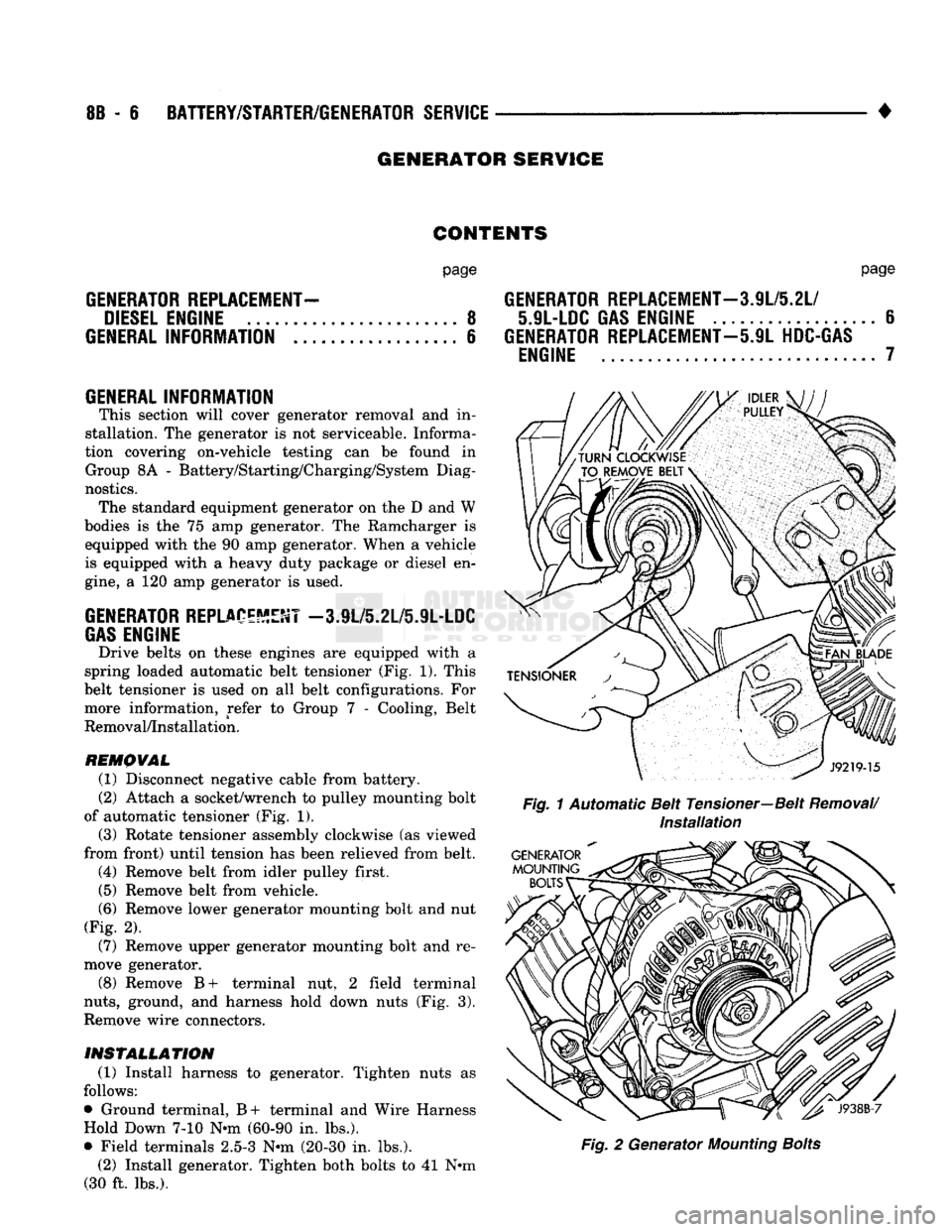
spring loaded automatic belt tensioner
(Fig. 1).
This
belt tensioner
is
used
on all
belt configurations.
For
more information, refer
to
Group
7 -
Cooling, Belt
Removal/Installation.
REMOVAL
(1) Disconnect negative cable from battery.
(2) Attach
a
socket/wrench
to
pulley mounting bolt
of automatic tensioner
(Fig. 1).
(3) Rotate tensioner assembly clockwise
(as
viewed
from front) until tension
has
been relieved from belt. (4) Remove belt from idler pulley first.
(5) Remove belt from vehicle.
(6)
Remove lower generator mounting bolt
and nut
(Fig.
2).
(7) Remove upper generator mounting bolt
and re
move generator.
(8) Remove
B+
terminal
nut, 2
field terminal
nuts,
ground,
and
harness hold down nuts
(Fig. 3).
Remove wire connectors.
INSTALLATION
(1) Install harness
to
generator. Tighten nuts
as
follows:
• Ground terminal,
B+
terminal
and
Wire Harness Hold Down
7-10 N*m
(60-90
in.
lbs.).
• Field terminals
2.5-3 N-m
(20-30
in.
lbs.). (2) Install generator. Tighten both bolts
to 41 N»m
(30
ft.
lbs.).
page
GENERATOR
REPLACEMENT—3.9L/5.2L/
5.9L-LDC
GAS
ENGINE
6
GENERATOR
REPLACEMENT—5.9L
HDC-GAS
ENGINE
7
Fig.
1 Automatic Belt Tensioner—Belt
Removal/
Installation
Fig.
2
Generator
Mounting
Bolts
Page 348 of 1502
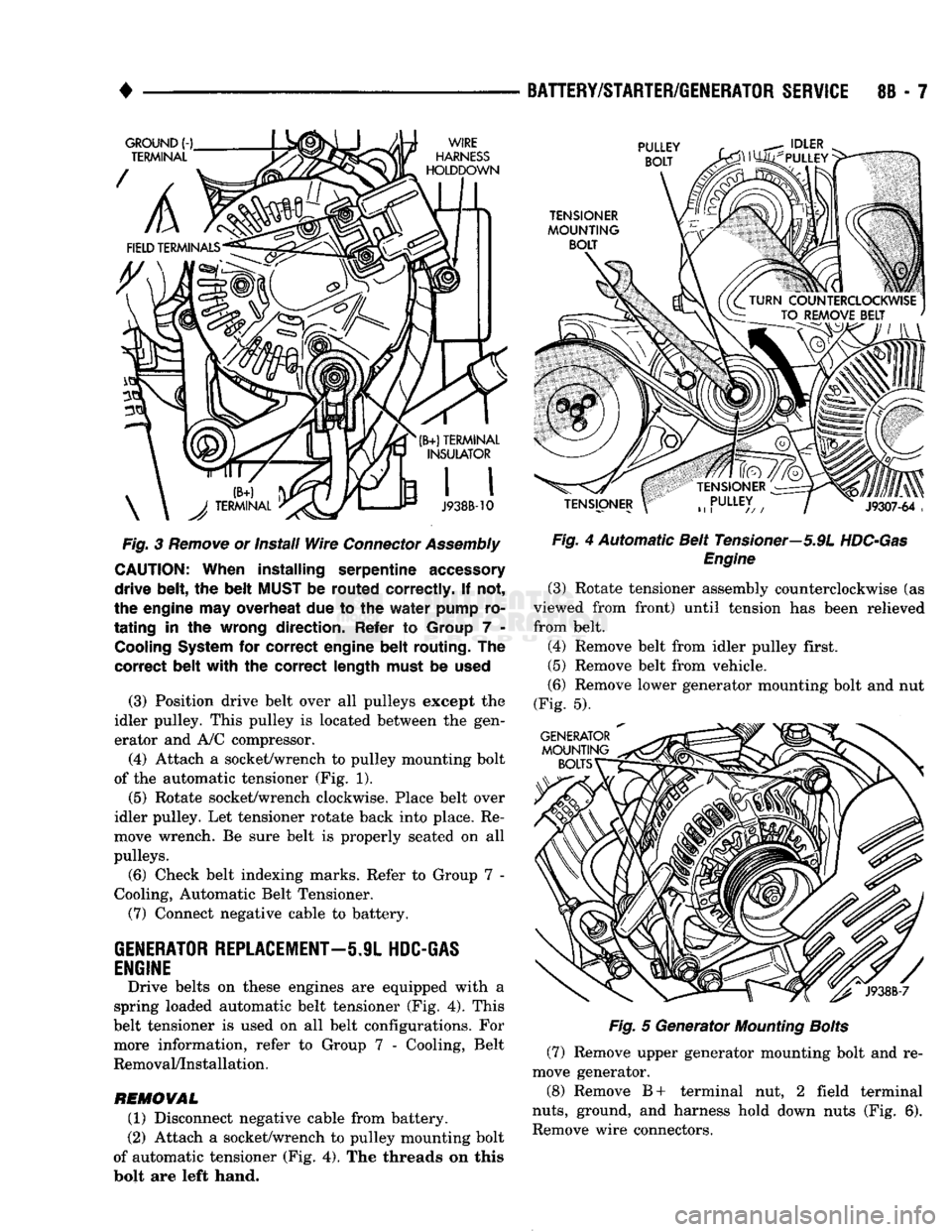
•
Fig.
3
Remove
or install
Wire
Connector
Assembly
CAUTION:
When
installing
serpentine
accessory
drive
belt,
the
belt
MUST
be
routed
correctly.
If not,
the engine may overheat due to the
water
pump ro
tating
in the wrong
direction.
Refer to Group 7 -
Cooling
System
for
correct
engine
belt
routing.
The
correct
belt
with
the
correct
length
must be
used
(3) Position drive belt over all pulleys except the
idler pulley. This pulley is located between the gen
erator and A/C compressor.
(4) Attach a socket/wrench to pulley mounting bolt
of the automatic tensioner (Fig. 1).
(5)
Rotate socket/wrench clockwise. Place belt over
idler pulley. Let tensioner rotate back into place. Re
move wrench. Be sure belt is properly seated on all
pulleys.
(6) Check belt indexing marks. Refer to Group 7 -
Cooling, Automatic Belt Tensioner.
(7) Connect negative cable to battery.
GENERATOR
REPLACEMENT—5.9L
HDC-GAS
ENGINE
Drive belts on these engines are equipped with a
spring loaded automatic belt tensioner (Fig. 4). This
belt tensioner is used on all belt configurations. For more information, refer to Group 7 - Cooling, Belt
Removal/Installation.
REMOVAL
(1) Disconnect negative cable from battery.
(2) Attach a socket/wrench to pulley mounting bolt
of automatic tensioner (Fig. 4). The threads on this
bolt are left hand.
BATTERY/STARTER/GENERATOR
SERVICE
8B - 7
Fig.
4 Automatic Belt Tensioner—5.9L
HDC-Gas
Engine
(3) Rotate tensioner assembly counterclockwise (as
viewed from front) until tension has been relieved
from belt.
(4) Remove belt from idler pulley first.
(5) Remove belt from vehicle.
(6) Remove lower generator mounting bolt and nut
(Fig. 5).
Fig.
5 Generator
Mounting
Bolts
(7) Remove upper generator mounting bolt and re
move generator.
(8) Remove B+ terminal nut, 2 field terminal
nuts,
ground, and harness hold down nuts (Fig. 6).
Remove wire connectors.