tow DODGE TRUCK 1993 Service Manual PDF
[x] Cancel search | Manufacturer: DODGE, Model Year: 1993, Model line: TRUCK, Model: DODGE TRUCK 1993Pages: 1502, PDF Size: 80.97 MB
Page 597 of 1502
SW - 122
WIRING
DIAGRAMS
PART OF
CHASSIS
WIRING
(SEE
SH 80) Zl 18BK-
f~L7 18BK/YL•
5~L62 18BR/RD
5—L1 18VT/BK- 1
OO -L7 18BK/YL-
-D7 18BK/LG—
X2
18GY- X2 18GY- RIGHT
TAIL,STOP &
TURN SIGNAL
LAMP
X2 18GY B2 18VT/BK- RIGHT
BACK-UP LAMP
J2-SL
OOh
OQ
L62
18BR
R0
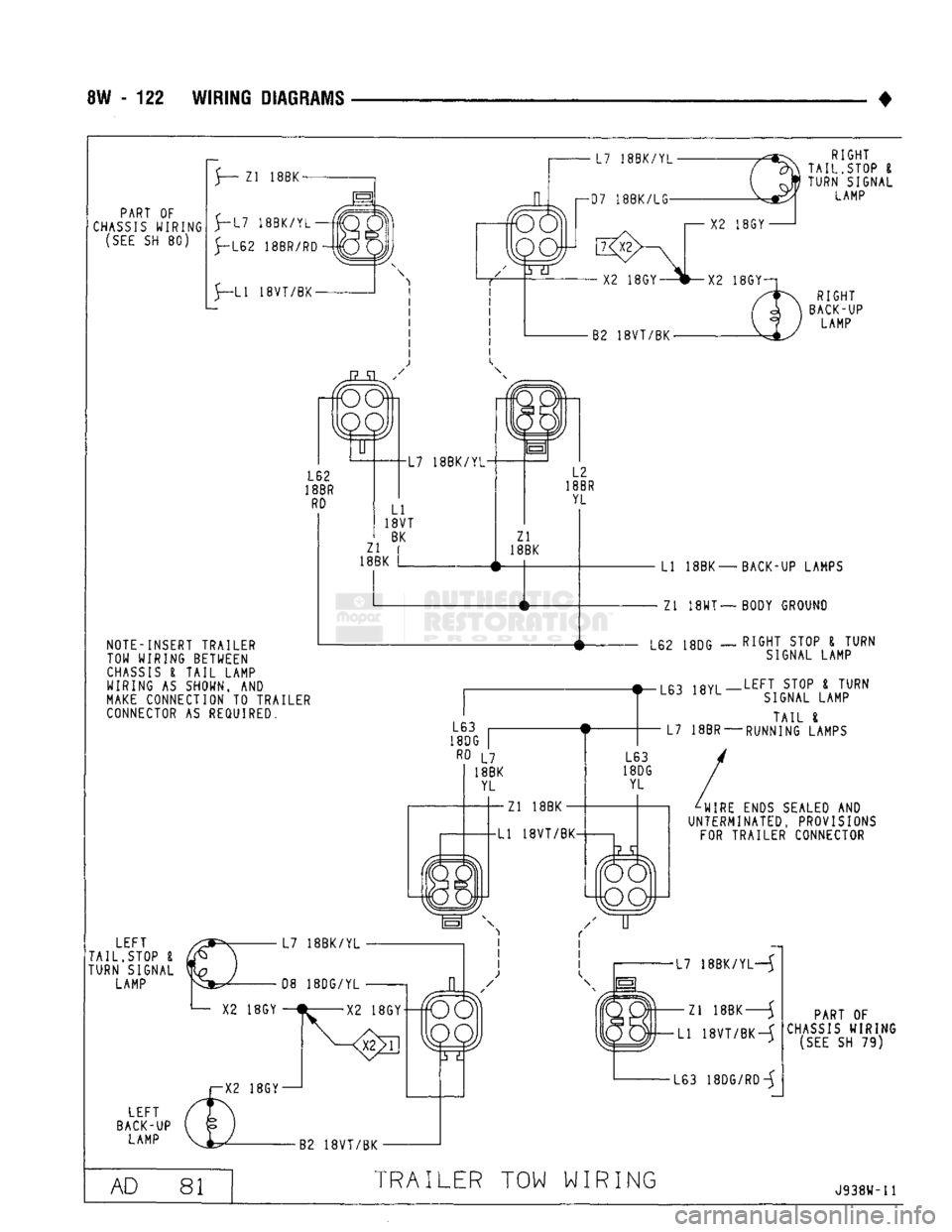
NOTE-INSERT TRAILER TOW WIRING BETWEEN
CHASSIS
I
TAIL
LAMP
WIRING AS SHOWN, AND
MAKE
CONNECTION TO TRAILER
CONNECTOR AS REQUIRED. •L7 18BK/YL-
Zl
18BK LI
18VT BK L2
18BR YL
Zl
18BK LEFT
TAIL,STOP ft
TURN SIGNAL LAMP
LEFT
BACK-UP LAMP - LI 18BK— BACK-UP LAMPS
- Zl
18WT—
BODY GROUND
62 18DG — RIGHT STOP ft TURN SIGNAL LAMP
• r7 1PY. LEFT STOP ft TURN
L63 18YL SIGNAL LAMP L7 18BR-
TAIL
I
•RUNNING LAMPS WIRE
ENDS
SEALED AND
UNTERMINATED, PROVISIONS
FOR
TRAILER CONNECTOR
L7
18BK/YL—5
Zl
18BK—^
LI
18VT/BK-J
L63
18DG/RD-5
PART OF
CHASSIS
WIRING
(SEE
SH 79) B2 18VT/BK
AD 81
TRAILER TOW WIRING
J938W-11
Page 606 of 1502
•
ENGINES ENGINES
9 - 1
CONTENTS
page page
3.9L
ENGINE SERVICE PROCEDURES
17 5.9L
ENGINE SERVICE PROCEDURES
77
5.2L
ENGINE SERVICE PROCEDURES
47
ENGINE DIAGNOSIS
5
5.9L
(DIESEL) ENGINE SERVICE PROCEDURES
. 107
STANDARD SERVICE PROCEDURES
1
STANDARD SERVICE PROCEDURES INDEX
page
Engine
Performance 2
Form-ln-Place
Gaskets
1
Honing
Cylinder
Bores
2
FORM-IN-PLACE GASKETS
There are several places where form-in-place gas
kets are used on the engine. DO NOT use form-in-
place gasket material unless specified. Care must
be taken when applying form-in-place gaskets. Bead
size,
continuity and location are of great importance.
Too thin a bead can result in leakage while too much can result in spill-over. A continuous bead of the
proper width is essential to obtain a leak-free joint. Two types of form-in-place gasket materials are
used in the engine area (Mopar Silicone Rubber Ad
hesive Sealant and Mopar Gasket Maker). Each have different properties and cannot be used interchange ably.
MOPAR SILICONE RUBBER ADHESIWE
SEALANT
Mopar Silicone Rubber Adhesive Sealant, normally
black in color, is available in 3 ounce tubes. Moisture in the air causes the sealant material to cure. This
material is normally used on flexible metal flanges.
It has a shelf life of 1 year and will not properly cure
if over aged. Always inspect the package for the ex
piration date before use.
MOPAR
GASKET MAKER Mopar Gasket Maker, normally red in color, is
available in 6 cc tubes. This anaerobic type gasket
material cures in the absence of air when squeezed
between smooth machined metallic surfaces. It will not cure if left in the uncovered tube. DO NOT use on flexible metal flanges.
page
Hydrostatic
Lock
4
Measuring
with
Plastigage 3
Repair
Damaged
or Worn
Threads
. 4
SURFACE PREPARA
TION
Parts assembled with form-in-place gaskets may be
disassembled without unusual effort. In some in
stances, it may be necessary to lightly tap the part
with a mallet or other suitable tool to break the seal
between the mating surfaces. A flat gasket scraper may also be lightly tapped into the joint but care
must be taken not to damage the mating surfaces.
Scrape or wire brush all gasket surfaces to remove
all loose material. Inspect stamped parts to ensure
gasket rails are flat. Flatten rails with a hammer on a flat plate, if required. Gasket surfaces must be free
of oil and dirt. Make sure the old gasket material is
removed from blind attaching holes.
GASKET
APPLICATION
Assembling parts using a form-in-place gasket re
quires care.
Mopar Silicone Rubber Adhesive Sealant should be
applied in a continuous bead approximately 3 mm (0.12 inch) in diameter. All mounting holes must be
circled. For corner sealing, a 3 or 6 mm (1/8 or 1/4
inch) drop is placed in the center of the gasket con
tact area. Uncured sealant may be removed with a shop towel. Components should be torqued in place
while the sealant is still wet to the touch (within 10
minutes). The use of a locating dowel is recom
mended during assembly to prevent smearing the
material off location.
Mopar Gasket Maker should be applied sparingly
to one gasket surface. The sealant diameter should
be 1.Q0 mm (0.04 inch) or less. Be certain the mate-
Page 607 of 1502
9
- 2
ENGINES
rial surrounds each mounting hole. Excess material
can easily be wiped off. Components should be
torqued in place within 15 minutes. The use of a lo cating dowel is recommended during assembly to pre
vent smearing the material off location.
ENGINE PERFORMANCE
To provide best vehicle performance and lowest ve
hicle emissions, it is most important that the tune-up
be done accurately. Use the specifications listed on
the Vehicle Emission Control Information label found on the engine compartment hood.
(1) Test cranking amperage draw (refer to Group
8B,
Battery/Starter/Generator Service for the proper
procedures).
(2) Tighten the intake manifold bolts (refer to
Group 11, Exhaust System and Intake Manifold for
the proper specifications). (3) Perform cylinder compression test:
(a) Check engine oil level and add oil, if neces
sary.
(b) Drive the vehicle until engine reaches normal
operating temperature. (c) Select a route free from traffic and other
forms of congestion, observe all traffic laws and
briskly accelerate through the gears several times. The higher engine speed may help clean out valve seat deposits which can prevent accurate compres
sion readings.
CAUTION:
DO NOT
overspeed
the
engine.
(d) Remove all spark plugs from engine. As
spark plugs are being removed, check electrodes for
abnormal firing indicators - fouled, hot, oily, etc.
Record cylinder number of spark plug for future
reference.
(e) Disconnect coil wire from distributor and se
cure to good ground to prevent a spark from start
ing a fire.
(f) Be sure throttle blades are fully open during
the compression check. (g) Insert compression gage adaptor into the
No.l spark plug hole. Crank engine until maxi
mum pressure is reached on gauge. Record this
pressure as No.l cylinder pressure.
(h) Repeat Step 3g for all remaining cylinders.
(i) Compression should not be less than 689 kPa
(100 psi) and not vary more than 172 kPa (25 psi)
from cylinder to cylinder.
(j) If cylinder(s) have abnormally low compres
sion pressures, repeat steps 3a through 3h. (k) If the same cylinder(s) repeat an abnormally
low reading, it could indicate the existence of a
problem in the cylinder.
The recommended compression pressures are
to be used only as a guide to diagnosing engine
problems. An engine should NOT be disassem bled to determine the cause of low compression
unless some malfunction is present. (4) Clean or replace spark plugs as necessary. Ad
just gap (refer to Group 8D, Ignition System for gap adjustment and torque).
(5) Test resistance of spark plug cables (refer to
Group 8D, Ignition System.
(6) Inspect the primary wire. Test coil output volt
age,
primary and secondary resistance. Replace parts as necessary (refer to Group 8D, Ignition System and
make necessary adjustment).
(7) Set ignition timing to specifications (refer to
Specification Label on engine compartment hood).
(8) Perform a combustion analysis.
(9) Test fuel pump for pressure and vacuum (refer
to Group 14, Fuel System for the proper specifica
tions).
(10) Inspect air filter element (refer to Group 0,
Lubrication and Maintenance for the proper proce
dure).
(11) Inspect crankcase ventilation system (refer to
Group 0, Lubrication and Maintenance for the proper
procedure).
(12) For emission controls refer to Group 25, Emis
sion Controls System for service procedures.
(13) Inspect and adjust accessory belt drives (refer
to Group 7, Cooling System for the proper adjust
ments).
(14) Road test vehicle as a final test.
H0NIN6
CYLINDER
BORES
Before honing, stuff plenty of clean shop towels un
der the bores and over the crankshaft to keep abra sive materials from entering the crankshaft area.
(1) Used carefully, the Cylinder Bore Sizing Hone
C-823 equipped with 220 grit stones, is the best tool
for this job. In addition to deglazing, it will reduce
taper and out-of-round as well as removing light scuffing, scoring or scratches. Usually a few strokes
will clean up a bore and maintain the required lim
its.
CAUTION:
DO NOT use rigid type
hones
to remove
cylinder
wall
glaze.
(2) Deglazing of the cylinder walls may be done if
the cylinder bore is straight and round. Use a cylin
der surfacing hone, Honing Tool C-3501, equipped
with 280 grit stones (C-3501-3810). 20-60 strokes, de
pending on the bore condition, will be sufficient to
provide a satisfactory surface. Using honing oil C-3501-3880 or a light honing oil available from ma
jor oil distributors.
CAUTION:
DO NOT use engine or
transmission
oil, mineral
spirits
or
kerosene.
Page 609 of 1502
9
- 4 ENGINES
•
RN861
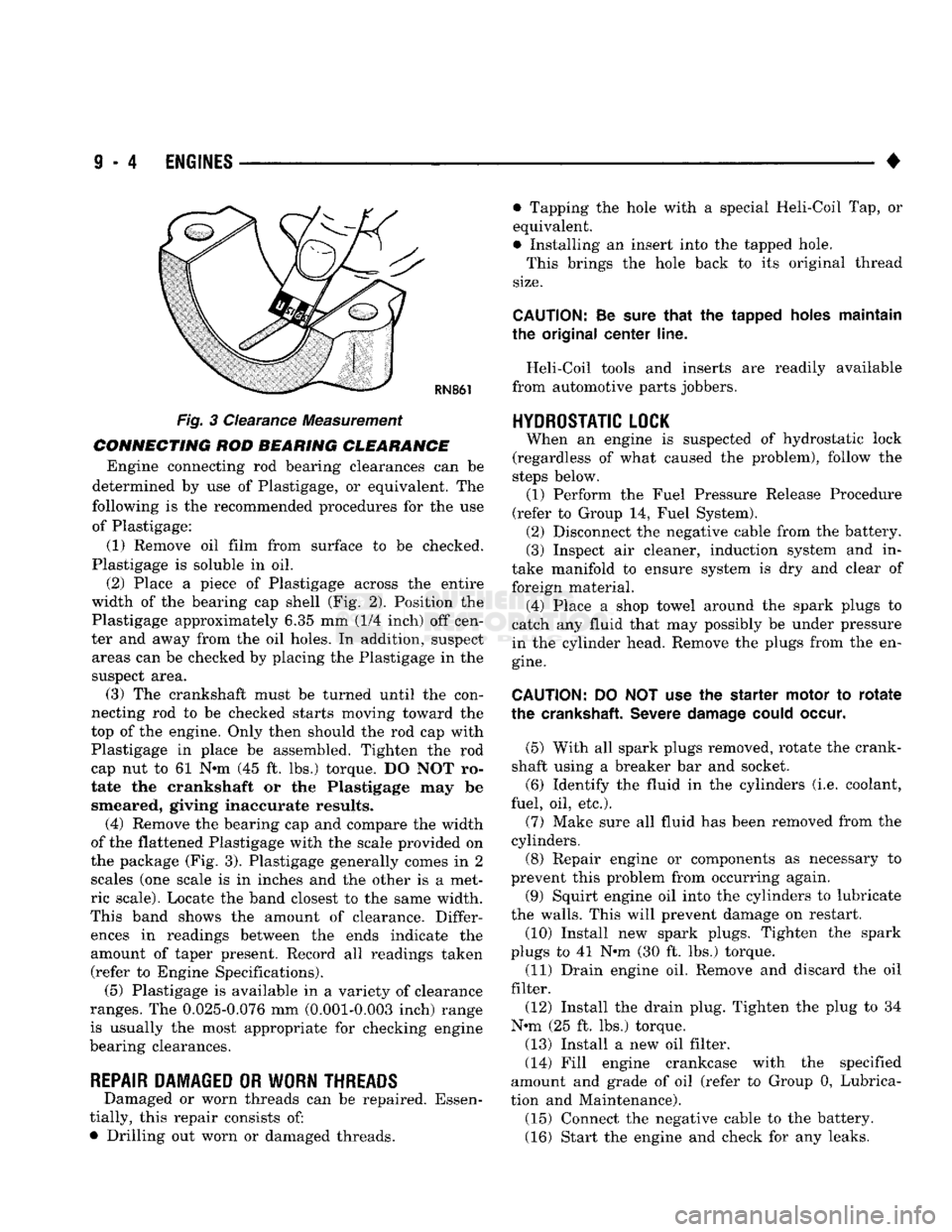
Fig. 3 Clearance Measurement
CONNECTING ROD BEARING CLEARANCE Engine connecting rod bearing clearances can be
determined by use of Plastigage, or equivalent. The
following is the recommended procedures for the use of Plastigage:
(1) Remove oil film from surface to be checked.
Plastigage is soluble in oil.
(2) Place a piece of Plastigage across the entire
width of the bearing cap shell (Fig. 2). Position the
Plastigage approximately 6.35 mm (1/4 inch) off cen
ter and away from the oil holes. In addition, suspect areas can be checked by placing the Plastigage in the
suspect area. (3) The crankshaft must be turned until the con
necting rod to be checked starts moving toward the
top of the engine. Only then should the rod cap with
Plastigage in place be assembled. Tighten the rod
cap nut to 61 Nnn (45 ft. lbs.) torque. DO NOT ro
tate the crankshaft or the Plastigage may be smeared, giving inaccurate results. (4) Remove the bearing cap and compare the width
of the flattened Plastigage with the scale provided on
the package (Fig. 3). Plastigage generally comes in 2 scales (one scale is in inches and the other is a met
ric scale). Locate the band closest to the same width.
This band shows the amount of clearance. Differ ences in readings between the ends indicate the
amount of taper present. Record all readings taken (refer to Engine Specifications). (5) Plastigage is available in a variety of clearance
ranges. The 0.025-0.076 mm (0.001-0.003 inch) range
is usually the most appropriate for checking engine
bearing clearances.
REPAIR DAMAGED OR WORN THREADS Damaged or worn threads can be repaired. Essen
tially, this repair consists of:
• Drilling out worn or damaged threads. • Tapping the hole with a special Heli-Coil Tap, or
equivalent.
• Installing an insert into the tapped hole.
This brings the hole back to its original thread
size.
CAUTION:
Be
sure
that
the tapped holes maintain
the original
center
line.
Heli-Coil tools and inserts are readily available
from automotive parts jobbers.
HYDROSTATIC
LOCK
When an engine is suspected of hydrostatic lock
(regardless of what caused the problem), follow the
steps below. (1) Perform the Fuel Pressure Release Procedure
(refer to Group 14, Fuel System). (2) Disconnect the negative cable from the battery.
(3) Inspect air cleaner, induction system and in
take manifold to ensure system is dry and clear of
foreign material. (4) Place a shop towel around the spark plugs to
catch any fluid that may possibly be under pressure
in the cylinder head. Remove the plugs from the en
gine.
CAUTION:
DO NOT use the starter motor to
rotate
the
crankshaft.
Severe
damage
could
occur.
(5) With all spark plugs removed, rotate the crank
shaft using a breaker bar and socket.
(6) Identify the fluid in the cylinders (i.e. coolant,
fuel, oil, etc.).
(7) Make sure all fluid has been removed from the
cylinders. (8) Repair engine or components as necessary to
prevent this problem from occurring again.
(9) Squirt engine oil into the cylinders to lubricate
the walls. This will prevent damage on restart.
(10) Install new spark plugs. Tighten the spark
plugs to 41 N#m (30 ft. lbs.) torque. (11) Drain engine oil. Remove and discard the oil
filter.
(12) Install the drain plug. Tighten the plug to 34
N-m (25 ft. lbs.) torque.
(13) Install a new oil filter.
(14) Fill engine crankcase with the specified
amount and grade of oil (refer to Group 0, Lubrica
tion and Maintenance). (15) Connect the negative cable to the battery.
(16) Start the engine and check for any leaks.
Page 633 of 1502
9
- 28 3.9L
ENGINE
•
accompanied by excessive clearance between the
valve stem and rocker arm as valve closes. In either
case,
tappet assembly should be removed for inspec
tion and cleaning.
The valve train generates a noise very much like a
light tappet noise during normal operation. Care
must be taken to ensure that tappets are making the
noise. In general, if more than one tappet seems to
be noisy, its probably not the tappets.
REMOVAL
(1) Remove the air cleaner.
(2) Remove cylinder head cover.
(3) Remove rocker assembly and push rods. Iden
tify push rods to ensure installation in original loca
tion.
(4) Remove intake manifold.
(5) Remove yoke retainer and aligning yokes.
(6) Slide Hydraulic Tappet Remover/Installer Tool
C-4129-A
through opening in cylinder head and seat
tool firmly in the head of tappet.
(7) Pull tappet out of bore with a twisting motion.
If all tappets are to be removed, identify tappets to
ensure installation in original location. (8) If the tappet or bore in cylinder block is scored,
scuffed, or shows signs of sticking, ream the bore to
next oversize. Replace with oversize tappet.
CAUTION:
The
plunger
and
tappet bodies
are not
interchangeable.
The
plunger
and
valve must
al
ways
be fitted to the
original body.
It is
advisable
to
work
on one
tappet
at a
time
to
avoid mixing
of
parts.
Mixed parts
are not
compatible.
DO NOT
dis
assemble
a
tappet
on a
dirty
work bench.
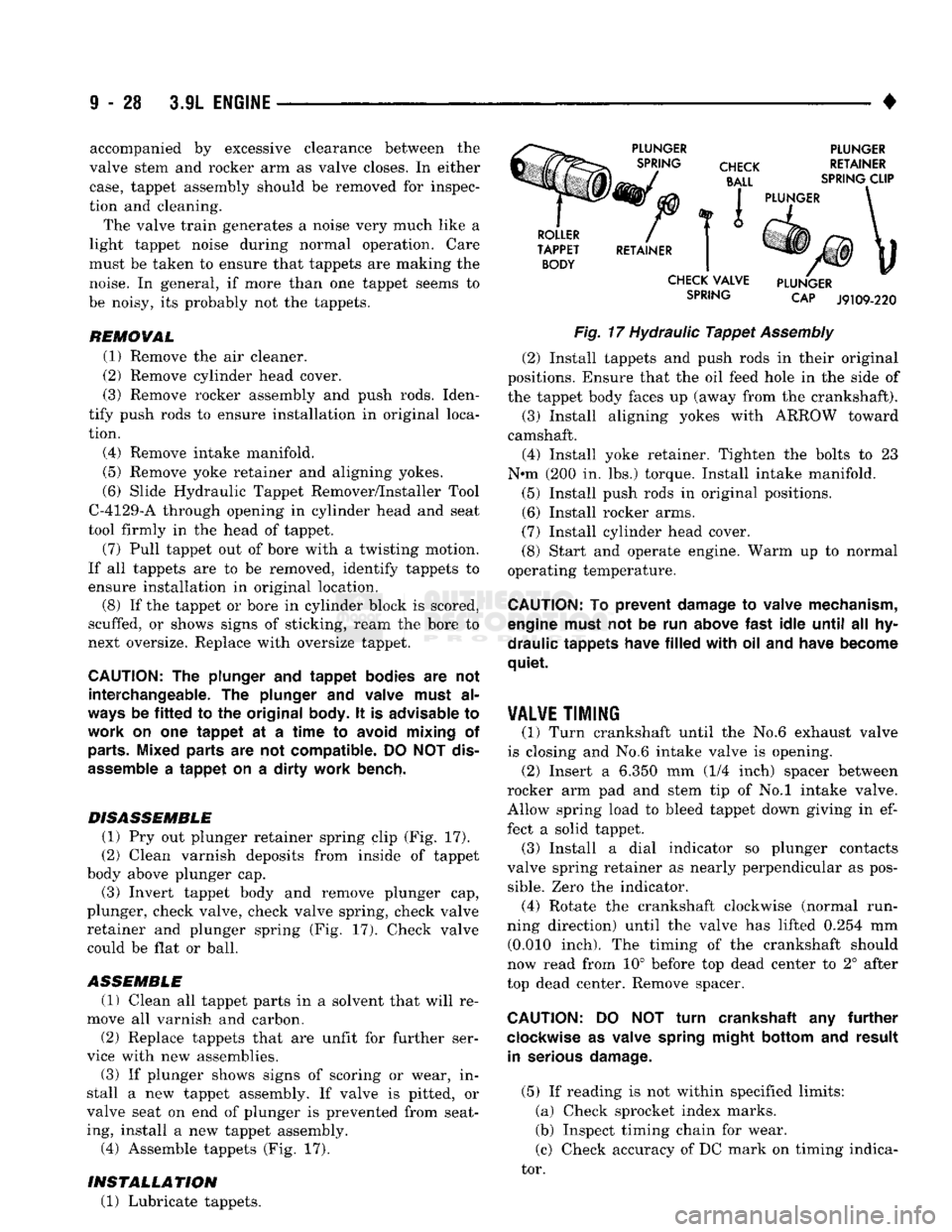
DISASSEMBLE (1) Pry out plunger retainer spring clip (Fig. 17).
(2) Clean varnish deposits from inside of tappet
body above plunger cap.
(3) Invert tappet body and remove plunger cap,
plunger, check valve, check valve spring, check valve retainer and plunger spring (Fig. 17). Check valve
could be flat or ball.
ASSEMBLE (1) Clean all tappet parts in a solvent that will re
move all varnish and carbon.
(2) Replace tappets that are unfit for further ser
vice with new assemblies. (3) If plunger shows signs of scoring or wear, in
stall a new tappet assembly. If valve is pitted, or
valve seat on end of plunger is prevented from seat ing, install a new tappet assembly.
(4) Assemble tappets (Fig. 17).
INSTALLATION
(1) Lubricate tappets.
PLUNGER
SPRING CHECK
BALL PLUNGER
RETAINER
SPRING CLIP
ROLLER
TAPPET
BODY RETAINER
I
PLUNGER
CHECK VALVE
SPRING PLUNGER
CAP
J9109-220
Fig.
17 Hydraulic
Tappet
Assembly
(2) Install tappets and push rods in their original
positions. Ensure that the oil feed hole in the side of
the tappet body faces up (away from the crankshaft).
(3) Install aligning yokes with ARROW toward
camshaft.
(4) Install yoke retainer. Tighten the bolts to 23
N*m (200 in. lbs.) torque. Install intake manifold.
(5) Install push rods in original positions. (6) Install rocker arms.
(7) Install cylinder head cover.
(8) Start and operate engine. Warm up to normal
operating temperature.
CAUTION:
To
prevent damage
to
valve mechanism,
engine must
not be run
above fast idle
until
all hy
draulic tappets have
filled
with
oil and
have become
quiet.
VALVE
TIMING
(1) Turn crankshaft until the No.6 exhaust valve
is closing and No.6 intake valve is opening. (2) Insert a 6.350 mm (1/4 inch) spacer between
rocker arm pad and stem tip of No.l intake valve.
Allow spring load to bleed tappet down giving in ef fect a solid tappet. (3) Install a dial indicator so plunger contacts
valve spring retainer as nearly perpendicular as pos sible. Zero the indicator. (4) Rotate the crankshaft clockwise (normal run
ning direction) until the valve has lifted 0.254 mm (0.010 inch). The timing of the crankshaft should
now read from 10° before top dead center to 2° after
top dead center. Remove spacer.
CAUTION:
DO NOT
turn
crankshaft
any
further
clockwise
as
valve spring might bottom
and
result in serious damage.
(5) If reading is not within specified limits: (a) Check sprocket index marks.
(b) Inspect timing chain for wear. (c) Check accuracy of DC mark on timing indica
tor.
Page 638 of 1502
•
3.9L
ENGINE
9 - 33
Fig. 13 Alignment of Timing Marks (12) Each tappet reused must be installed in the
same position from which it was removed.
When
camshaft
Is replaced, all of the tappets must be
replaced.
DISTRIBUTOR
REMOVAL
Refer to Group 8D, Ignition Systems for the proper
procedure.
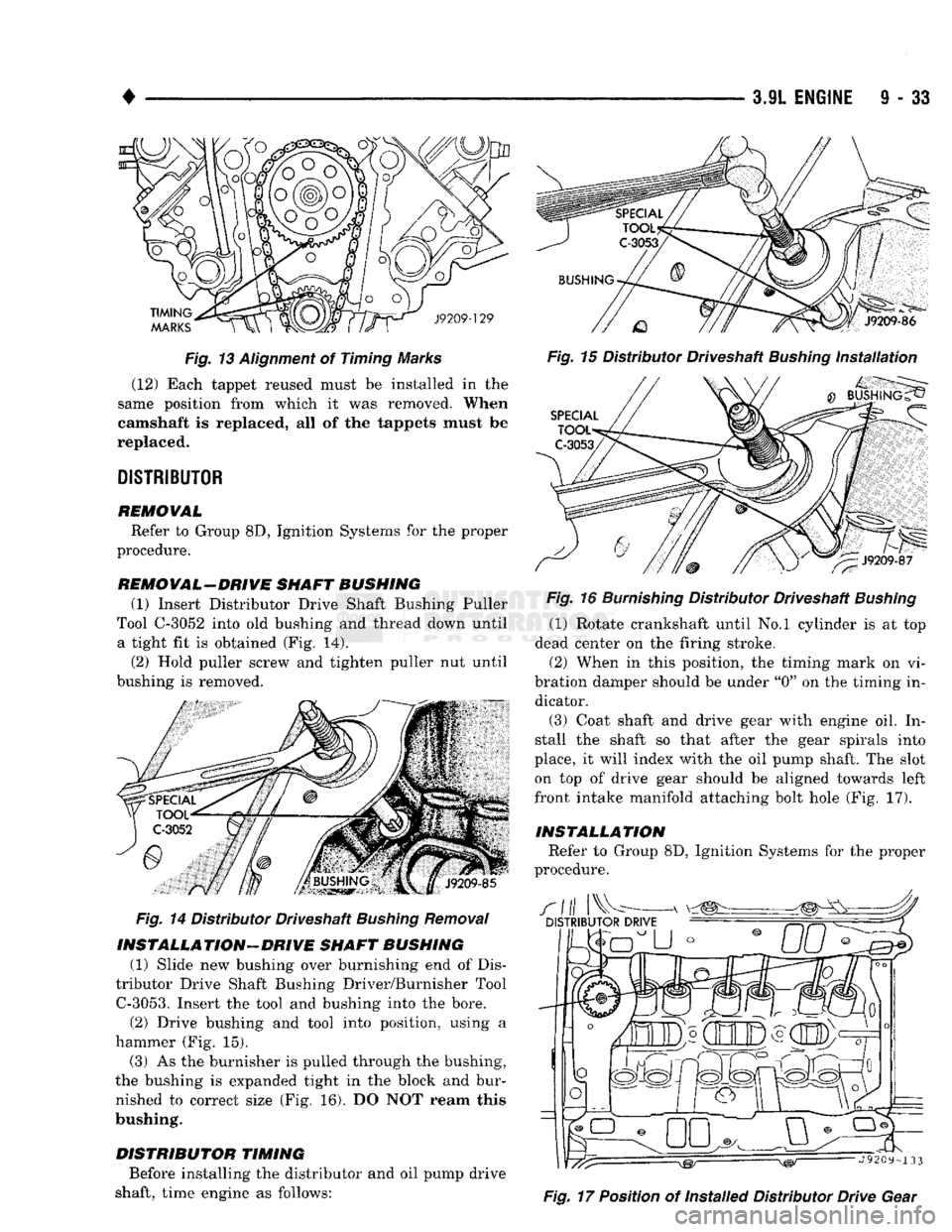
REMOVAL-DRIVE SHAFT BUSHING (1)
Insert Distributor Drive Shaft Bushing Puller
Tool C-3052 into old bushing and thread down until a tight fit is obtained (Fig. 14).
(2)
Hold puller screw and tighten puller nut until
bushing is removed.
Fig.
14 Distributor Driveshaft Bushing Removal
INSTALLATION-DRIVE
SHAFT BUSHING (1) Slide new bushing over burnishing end of Dis
tributor Drive Shaft Bushing Driver/Burnisher Tool
C-3053.
Insert the tool and bushing into the bore. (2) Drive bushing and tool into position, using a
hammer (Fig. 15).
(3) As the burnisher is pulled through the bushing,
the bushing is expanded tight in the block and bur nished to correct size (Fig. 16). DO NOT ream this
bushing.
DISTRIBUTOR
TIMING
Before installing the distributor and oil pump drive
shaft, time engine as follows:
Fig.
16
Burnishing
Distributor Driveshaft
Bushing
(1) Rotate crankshaft until No.l cylinder is at top
dead center on the firing stroke. (2) When in this position, the timing mark on vi
bration damper should be under "0" on the timing in dicator.
(3) Coat shaft and drive gear with engine oil. In
stall the shaft so that after the gear spirals into
place, it will index with the oil pump shaft. The slot on top of drive gear should be aligned towards left
front intake manifold attaching bolt hole (Fig. 17).
INSTALLATION
Refer to Group 8D, Ignition Systems for the proper
procedure.
Fig.
17 Position of Installed Distributor Drive Gear
Page 642 of 1502
(5) Be sure the connecting rod and connecting rod
cap are identified with the cylinder number. Remove
connecting rod cap. Install connecting rod bolt guide
set on connecting rod bolts.
(6) Pistons and connecting rods must be removed
from top of cylinder block. When removing piston and connecting rod assemblies from the engine, ro
tate crankshaft so that the connecting rod is centered in cylinder bore and at BDC. Be careful not to nick
crankshaft journals.
(7) After removal, install bearing cap on the mat
ing rod.
INSPECTION
Check the crankshaft connecting rod journal for ex
cessive wear, taper and scoring. Check the cylinder block bore for out-of-round,
taper, scoring and scuffing.
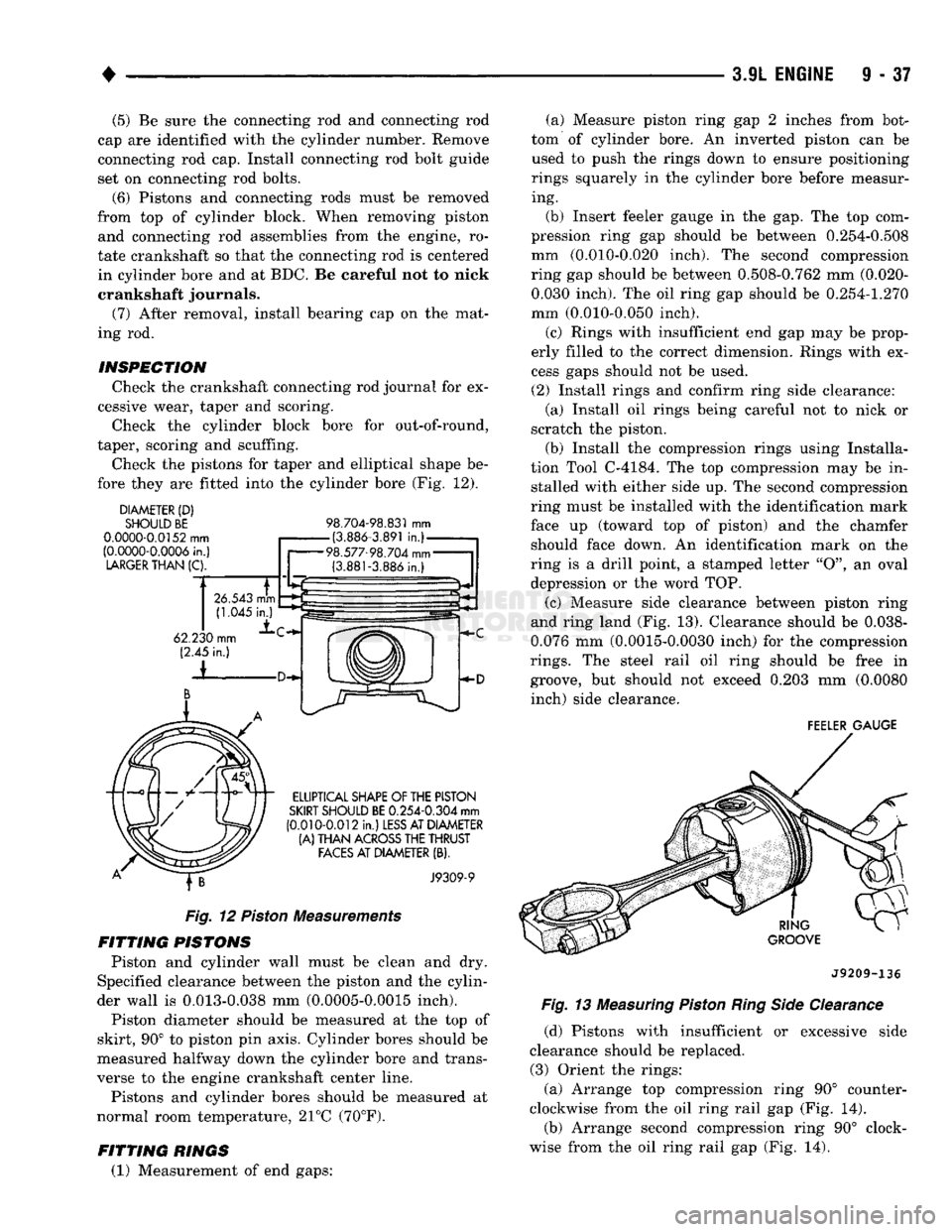
Check the pistons for taper and elliptical shape be
fore they are fitted into the cylinder bore (Fig. 12).
DIAMETER
(D)
SHOULD BE
0.0000-0.0152
mm
(0.0000-0.0006
in.)
LARGER
THAN
(C).
98.704-98.831
mm
-(3.886-3.891
in.)-
98.577-98.704
mm-
(3.881-3.886
in.) (a) Measure piston ring gap 2 inches from bot
tom of cylinder bore. An inverted piston can be used to push the rings down to ensure positioning
rings squarely in the cylinder bore before measur ing.
(b) Insert feeler gauge in the gap. The top com
pression ring gap should be between 0.254-0.508
mm (0.010-0.020 inch). The second compression
ring gap should be between 0.508-0.762 mm (0.020- 0.030 inch). The oil ring gap should be 0.254-1.270
mm (0.010-0.050 inch).
(c) Rings with insufficient end gap may be prop
erly filled to the correct dimension. Rings with ex
cess gaps should not be used.
(2) Install rings and confirm ring side clearance: (a) Install oil rings being careful not to nick or
scratch the piston.
(b) Install the compression rings using Installa
tion Tool C-4184. The top compression may be in stalled with either side up. The second compression
ring must be installed with the identification mark
face up (toward top of piston) and the chamfer should face down. An identification mark on the
ring is a drill point, a stamped letter "O", an oval
depression or the word TOP.
(c) Measure side clearance between piston ring
and ring land (Fig. 13). Clearance should be 0.038-
0.076 mm (0.0015-0.0030 inch) for the compression
rings.
The steel rail oil ring should be free in groove, but should not exceed 0.203 mm (0.0080 inch) side clearance.
FEELER
GAUGE
ELLIPTICAL SHAPE
OF
THE PISTON
SKIRT
SHOULD
BE
0.254-0.304
mm
(0.010-0.012
in.)
LESS
AT DIAMETER
(A)
THAN
ACROSS
THE THRUST
FACES
AT DIAMETER
(B).
J9309-9
Fig.
12
Piston
Measurements
FITTING
PISTONS
Piston and cylinder wall must be clean and dry.
Specified clearance between the piston and the cylin
der wall is 0.013-0.038 mm (0.0005-0.0015 inch). Piston diameter should be measured at the top of
skirt, 90° to piston pin axis. Cylinder bores should be
measured halfway down the cylinder bore and trans
verse to the engine crankshaft center line.
Pistons and cylinder bores should be measured at
normal room temperature, 21°C (70°F).
FITTING
RINGS
(1) Measurement of end gaps: J9209-136
Fig.
13
Measuring
Piston
Ring Side
Clearance (d) Pistons with insufficient or excessive side
clearance should be replaced. (3) Orient the rings:
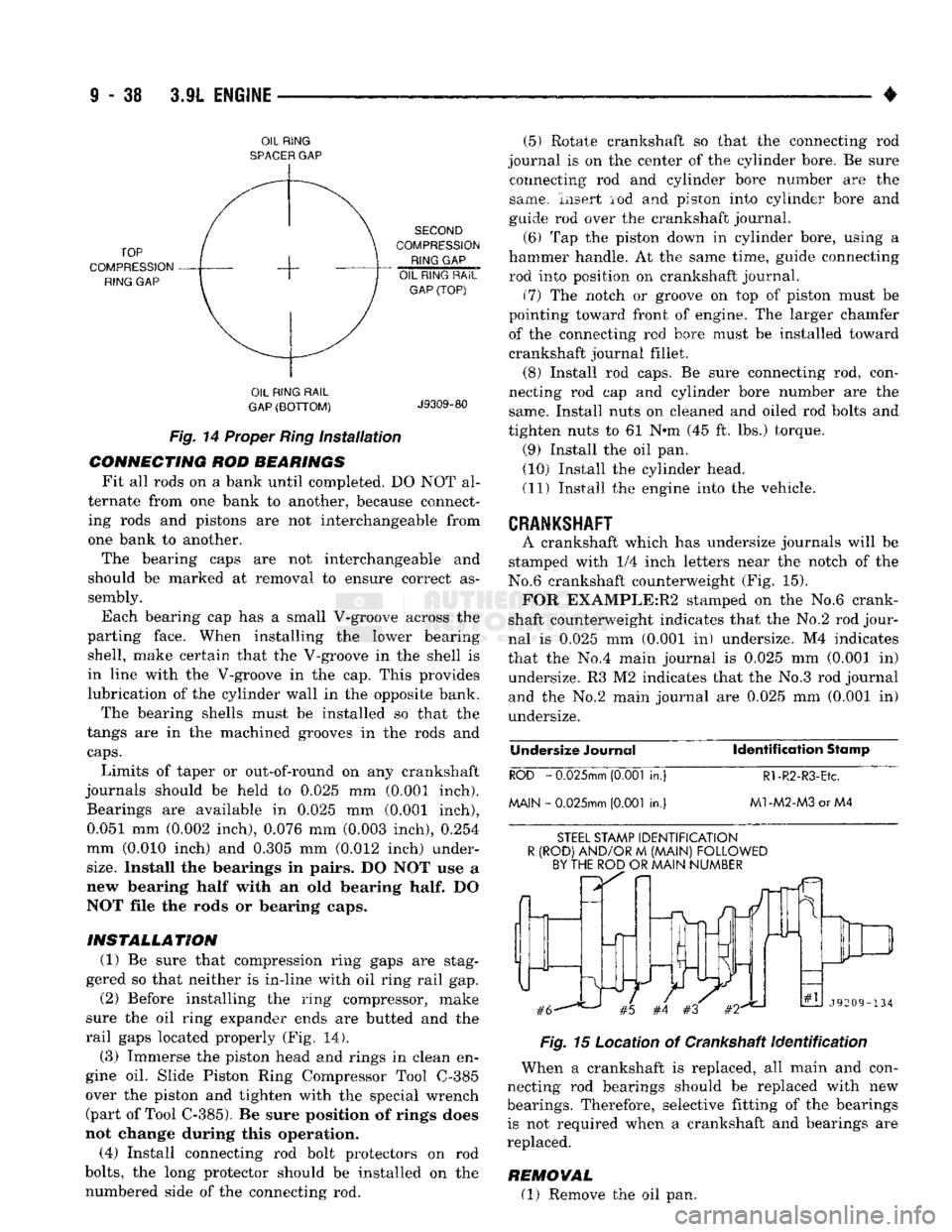
(a) Arrange top compression ring 90° counter
clockwise from the oil ring rail gap (Fig. 14). (b) Arrange second compression ring 90° clock
wise from the oil ring rail gap (Fig. 14).
Page 643 of 1502
9
- 38 3.9L
ENGINE
•
OIL
RING
SPACER
GAP
TOP
COMPRESSION
RING
GAP
SECOND
COMPRESSION
RING
GAP
OIL
RING
RAiL
GAP (TOP) OIL
RING
RAIL
GAP
(BOTTOM)
J9309-80
Fig.
14 Proper
Ring
Installation
CONNECTING ROD BEARINGS Fit all rods on a bank until completed. DO NOT al
ternate from one bank to another, because connect ing rods and pistons are not interchangeable from
one bank to another.
The bearing caps are not interchangeable and
should be marked at removal to ensure correct as sembly.
Each bearing cap has a small V-groove across the
parting face. When installing the lower bearing shell, make certain that the V-groove in the shell is
in line with the V-groove in the cap. This provides
lubrication of the cylinder wall in the opposite bank.
The bearing shells must be installed so that the
tangs are in the machined grooves in the rods and
caps.
Limits of taper or out-of-round on any crankshaft
journals should be held to 0.025 mm (0.001 inch). Bearings are available in 0.025 mm (0.001 inch), 0.051 mm (0.002 inch), 0.076 mm (0.003 inch), 0.254
mm (0.010 inch) and 0.305 mm (0.012 inch) under-
size.
Install the bearings in pairs. DO NOT use a
new bearing half with an old bearing
half.
DO
NOT file the rods or bearing caps.
INSTALLATION (1) Be sure that compression ring gaps are stag
gered so that neither is in-line with oil ring rail gap. (2) Before installing the ring compressor, make
sure the oil ring expander ends are butted and the
rail gaps located properly (Fig. 14).
(3) Immerse the piston head and rings in clean en
gine oil. Slide Piston Ring Compressor Tool C-385
over the piston and tighten with the special wrench (part of Tool C-385). Be sure position of rings does
not change during this operation.
(4) Install connecting rod bolt protectors on rod
bolts,
the long protector should be installed on the numbered side of the connecting rod. (5) Rotate crankshaft so that the connecting rod
journal is on the center of the cylinder bore. Be sure connecting rod and cylinder bore number are the
same. Insert rod and piston into cylinder bore and
guide rod over the crankshaft journal.
(6) Tap the piston down in cylinder bore, using a
hammer handle. At the same time, guide connecting
rod into position on crankshaft journal.
(7) The notch or groove on top of piston must be
pointing toward front of engine. The larger chamfer
of the connecting rod bore must be installed toward
crankshaft journal fillet.
(8) Install rod caps. Be sure connecting rod, con
necting rod cap and cylinder bore number are the same. Install nuts on cleaned and oiled rod bolts and
tighten nuts to 61 N»m (45 ft. lbs.) torque.
(9) Install the oil pan. (10) Install the cylinder head.
(11) Install the engine into the vehicle.
CRANKSHAFT
A crankshaft which has undersize journals will be
stamped with 1/4 inch letters near the notch of the
No.6 crankshaft counterweight (Fig. 15). FOR EXAMPLE:R2 stamped on the No.6 crank
shaft counterweight indicates that the No.2 rod jour
nal is 0.025 mm (0.001 in) undersize. M4 indicates
that the No.4 main journal is 0.025 mm (0.001 in) undersize. R3 M2 indicates that the No.3 rod journal
and the No.2 main journal are 0.025 mm (0.001 in) undersize.
Undersize
Journal Identification
Stamp
ROD
-
0.025mm
(0.001
in.)
Rl-R2-R3-Etc.
MAIN -
0.025mm
(0.001
in.)
M1-M2-M3
or M4
STEEL
STAMP
IDENTIFICATION
R
(ROD)
AND/OR
M
(MAIN)
FOLLOWED
BY THE ROD
OR
MAIN
NUMBER
Fig.
15 Location of Crankshaft
Identification
When a crankshaft is replaced, all main and con
necting rod bearings should be replaced with new
bearings. Therefore, selective fitting of the bearings is not required when a crankshaft and bearings are
replaced.
REMOVAL (1) Remove the oil pan.
Page 644 of 1502
•
3.9L
ENGINE
9 - 39 (2) Remove the oil pump from the rear main bear
ing cap.
(8)
Identify bearing caps before removal. Remove
bearing caps and bearings one at a time.
(4) Lift the crankshaft out of the block.
(5) Remove and discard the crankshaft rear oil
seals.
(6)
Remove and discard the front crankshaft oil
seal.
INSPECTION OF JOURNALS The crankshaft connecting rod and main journals
should be checked for excessive wear, taper and scor
ing. The maximum taper or out-of-round on any
crankshaft journal is 0.025 mm (0.001 inch).
Journal grinding should not exceed 0.305 mm
(0.012 inch) under the standard journal diameter. DO
NOT grind thrust faces of No.3 main bearing. DO
NOT nick crank pin or bearing fillets. After grind
ing, remove rough edges from crankshaft oil holes and clean out all oil passages.
CAUTION:
After any journal
grind,
it is important
that
the
final
paper or cloth
polish
be in the
same
direction as the engine rotates.
INSTALLATION (1) Lightly oil the new upper seal lips with engine
oil.
(2) Install the new upper rear bearing oil seal with
the yellow paint facing towards the rear of the en
gine.
(3) Position the crankshaft into the cylinder block.
(4) Lightly oil the new lower seal lips with engine
oil.
(5) Install the new lower rear bearing oil seal into
the bearing cap with the yellow paint facing towards the rear of the engine.
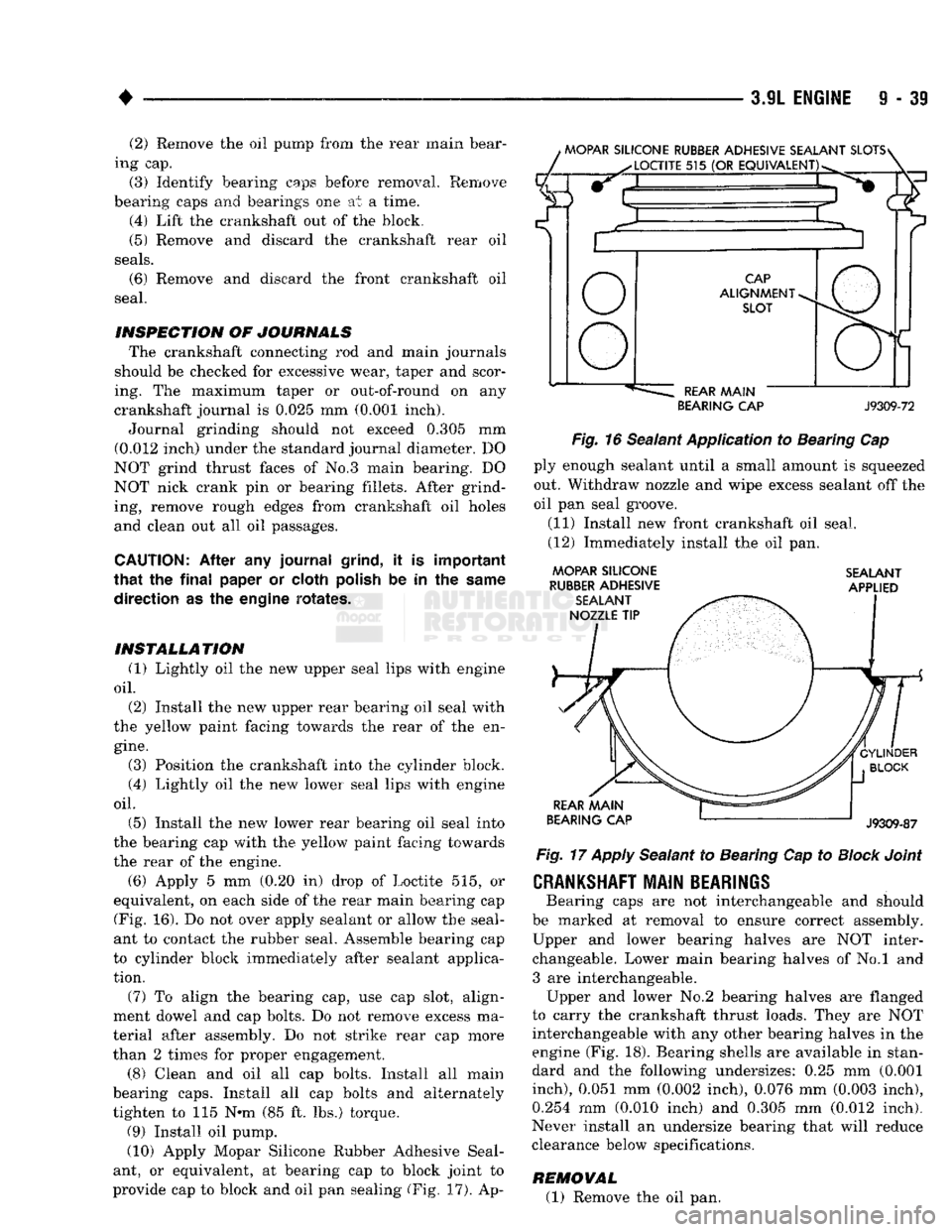
(6) Apply 5 mm (0.20 in) drop of Loctite 515, or
equivalent, on each side of the rear main bearing cap (Fig. 16). Do not over apply sealant or allow the seal
ant to contact the rubber seal. Assemble bearing cap
to cylinder block immediately after sealant applica tion.
(7) To align the bearing cap, use cap slot, align
ment dowel and cap bolts. Do not remove excess ma
terial after assembly. Do not strike rear cap more
than 2 times for proper engagement.
(8) Clean and oil all cap bolts. Install all main
bearing caps. Install all cap bolts and alternately
tighten to 115 N»m (85 ft. lbs.) torque.
(9)
Install oil pump.
(10) Apply Mopar Silicone Rubber Adhesive Seal
ant, or equivalent, at bearing cap to block joint to
provide cap to block and oil pan sealing (Fig. 17). Ap-
BEARING CAP
J9309-72
Fig.
16 Sealant Application to Bearing Cap ply enough sealant until a small amount is squeezed
out. Withdraw nozzle and wipe excess sealant off the
oil pan seal groove.
(11) Install new front crankshaft oil seal. (12) Immediately install the oil pan.
MOPAR SILICONE SEALANT
RUBBER
ADHESIVE APPLIED
Fig.
17
Apply
Sealant to Bearing Cap to
Block
Joint
CRANKSHAFT MAIN BEARINGS
Bearing caps are not interchangeable and should
be marked at removal to ensure correct assembly.
Upper and lower bearing halves are NOT inter changeable. Lower main bearing halves of No.l and
3 are interchangeable. Upper and lower No.2 bearing halves are flanged
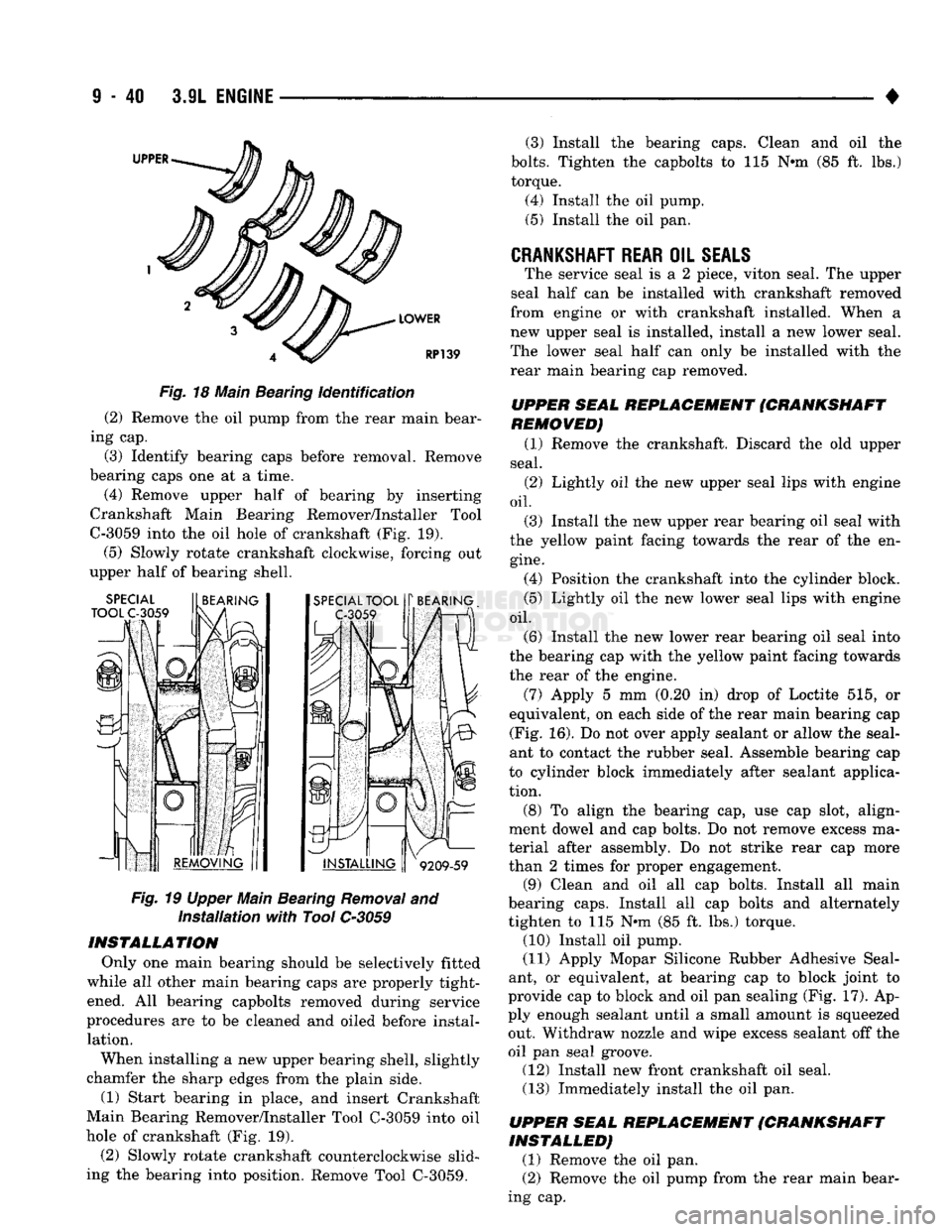
to carry the crankshaft thrust loads. They are NOT interchangeable with any other bearing halves in the
engine (Fig. 18). Bearing shells are available in stan
dard and the following undersizes: 0.25 mm (0.001
inch),
0.051 mm (0.002 inch), 0.076 mm (0.003 inch),
0.254 mm (0.010 inch) and 0.305 mm (0.012 inch).
Never install an undersize bearing that will reduce
clearance below specifications.
REMOVAL (1) Remove the oil pan.
Page 645 of 1502
S
- 40 3.9L
ENGINE
39 Fig.
18 Main Bearing identification
(2) Remove the oil pump from the rear main bear
ing cap.
(3) Identify bearing caps before removal. Remove
bearing caps one at a time.
(4) Remove upper half of bearing by inserting
Crankshaft Main Bearing Remover/Installer Tool
C-3059 into the oil hole of crankshaft (Fig. 19).
(5)
Slowly rotate crankshaft clockwise, forcing out
upper half of bearing shell.
Fig.
19 Upper Main Bearing Removal and installation with Tool
C-3059
INSTALLATION Only one main bearing should be selectively fitted
while all other main bearing caps are properly tight ened. All bearing capbolts removed during service
procedures are to be cleaned and oiled before instal lation.
When installing a new upper bearing shell, slightly
chamfer the sharp edges from the plain side.
(1) Start bearing in place, and insert Crankshaft
Main Bearing Remover/Installer Tool C-3059 into oil
hole of crankshaft (Fig. 19).
(2) Slowly rotate crankshaft counterclockwise slid
ing the bearing into position. Remove Tool C-3059. (3) Install the bearing caps. Clean and oil the
bolts.
Tighten the capbolts to 115 N*m (85 ft. lbs.)
torque.
(4) Install the oil pump. (5) Install the oil pan.
CRANKSHAFT REAR
OIL
SEALS
The service seal is a 2 piece, viton seal. The upper
seal half can be installed with crankshaft removed
from engine or with crankshaft installed. When a
new upper seal is installed, install a new lower seal.
The lower seal half can only be installed with the
rear main bearing cap removed.
UPPER SEAL REPLACEMENT (CRANKSHAFT
REMOVED)
(1) Remove the crankshaft. Discard the old upper
seal.
(2) Lightly oil the new upper seal lips with engine
oil.
(3) Install the new upper rear bearing oil seal with
the yellow paint facing towards the rear of the en
gine.
(4) Position the crankshaft into the cylinder block.
(5) Lightly oil the new lower seal lips with engine
oil.
(6) Install the new lower rear bearing oil seal into
the bearing cap with the yellow paint facing towards the rear of the engine.
(7) Apply 5 mm (0.20 in) drop of Loctite 515, or
equivalent, on each side of the rear main bearing cap (Fig. 16). Do not over apply sealant or allow the seal
ant to contact the rubber seal. Assemble bearing cap
to cylinder block immediately after sealant applica
tion.
(8) To align the bearing cap, use cap slot, align
ment dowel and cap bolts. Do not remove excess ma
terial after assembly. Do not strike rear cap more
than 2 times for proper engagement. (9) Clean and oil all cap bolts. Install all main
bearing caps. Install all cap bolts and alternately
tighten to 115 N*m (85 ft. lbs.) torque. (10) Install oil pump.
(11) Apply Mopar Silicone Rubber Adhesive Seal
ant, or equivalent, at bearing cap to block joint to
provide cap to block and oil pan sealing (Fig. 17). Ap
ply enough sealant until a small amount is squeezed out. Withdraw nozzle and wipe excess sealant off the
oil pan seal groove. (12) Install new front crankshaft oil seal.
(13) Immediately install the oil pan.
UPPER SEAL REPLACEMENT (CRANKSHAFT
INSTALLED)
(1) Remove the oil pan. (2) Remove the oil pump from the rear main bear
ing cap.