tow DODGE TRUCK 1993 Service Manual Online
[x] Cancel search | Manufacturer: DODGE, Model Year: 1993, Model line: TRUCK, Model: DODGE TRUCK 1993Pages: 1502, PDF Size: 80.97 MB
Page 743 of 1502
9
- 138 5.9L
(DIESEL)
ENGINE
J9109-84
Fig.
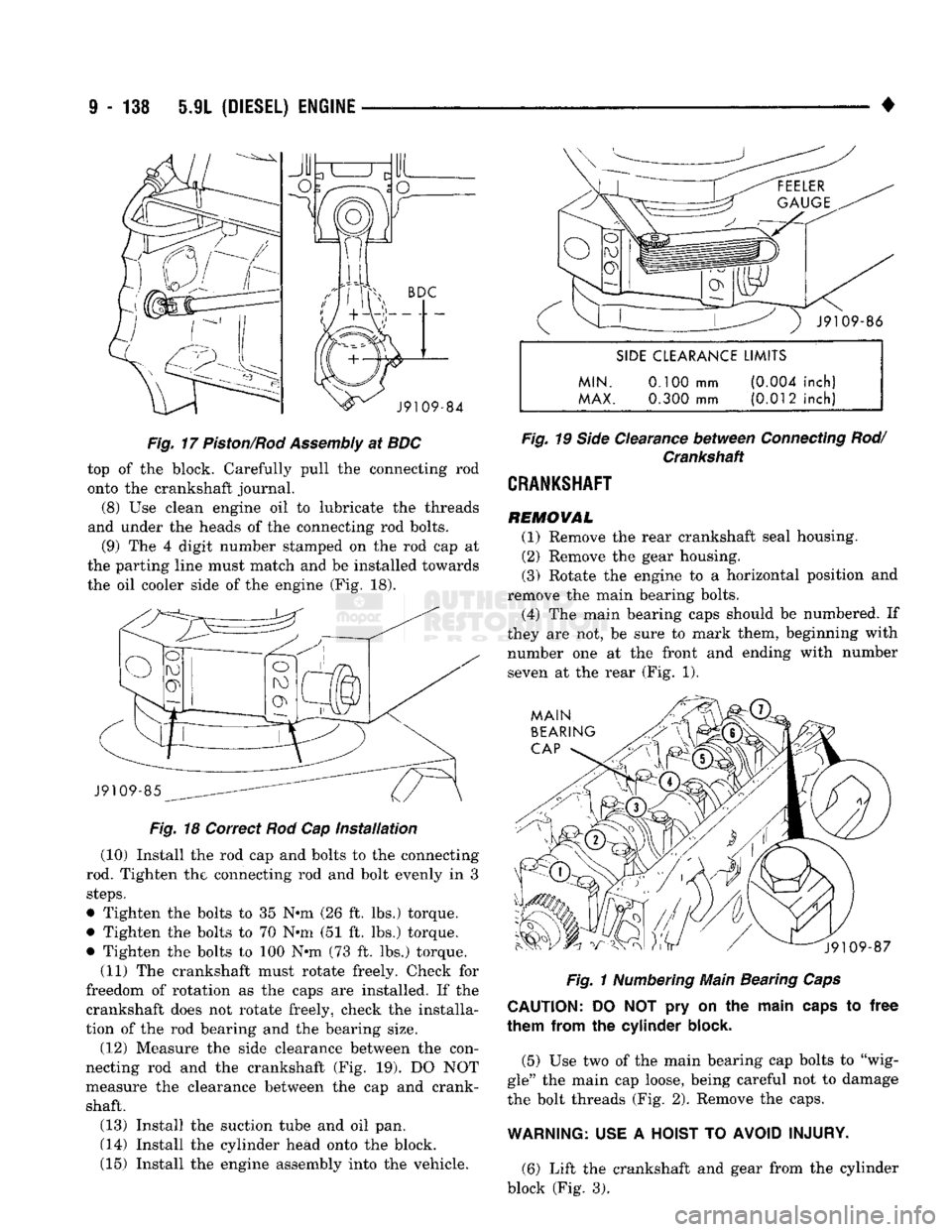
17
Piston/Rod
Assembly
at BDC
top
of the
block. Carefully pull
the
connecting
rod
onto
the
crankshaft journal.
(8)
Use
clean engine
oil to
lubricate
the
threads
and under
the
heads
of the
connecting
rod
bolts. (9)
The 4
digit number stamped
on the rod cap at
the parting line must match
and be
installed towards
the
oil
cooler side
of the
engine
(Fig. 18).
O
o
-—-—.—
f
'
-
ro o
O —
—"k
J9109-85
Fig.
18
Correct
Rod
Cap
Installation
(10) Install
the rod cap and
bolts
to the
connecting
rod. Tighten
the
connecting
rod and
bolt evenly
in 3
steps.
• Tighten
the
bolts
to 35 Nun (26 ft. lbs.)
torque. • Tighten
the
bolts
to 70 N*m (51 ft. lbs.)
torque.
• Tighten
the
bolts
to 100 Nun (73 ft. lbs.)
torque. (11)
The
crankshaft must rotate freely. Check
for
freedom
of
rotation
as the
caps
are
installed.
If the
crankshaft does
not
rotate freely, check
the
installa
tion
of the rod
bearing
and the
bearing size.
(12) Measure
the
side clearance between
the
con
necting
rod and the
crankshaft
(Fig. 19). DO NOT
measure
the
clearance between
the cap and
crank shaft.
(13) Install
the
suction tube
and oil pan.
(14) Install
the
cylinder head onto
the
block.
(15) Install
the
engine assembly into
the
vehicle.
SIDE
CLEARANCE
LIMITS
MIN.
MAX. 0.100
mm
0.300
mm
(0.004 inch)
(0.012 inch)
Fig.
19
Side
Clearance between
Connecting
Rod/
Crankshaft
CRANKSHAFT
REMOVAL (1) Remove
the
rear crankshaft seal housing.
(2) Remove
the
gear housing.
(3) Rotate
the
engine
to a
horizontal position
and
remove
the
main bearing bolts. (4)
The
main bearing caps should
be
numbered.
If
they
are not, be
sure
to
mark them, beginning with
number
one at the
front
and
ending with number seven
at the
rear
(Fig. 1).
MAIN BEARING
CAP
J9109-87
Fig.
1
Numbering
Main Bearing
Caps
CAUTION:
DO NOT pry on the
main
caps
to free
them from
the
cylinder
block.
(5)
Use two of the
main bearing
cap
bolts
to
"wig
gle"
the
main
cap
loose, being careful
not to
damage
the bolt threads
(Fig. 2).
Remove
the
caps.
WARNING:
USE
A
HOIST
TO
AVOID
INJURY.
(6) Lift
the
crankshaft
and
gear from
the
cylinder
block
(Fig. 3).
Page 748 of 1502
•
5.9L
(DIESEL)
ENGINE
9 - 143
ALIGNMENT
AND
INSTALLATION TOOL
J9109-102
Fig.
16 Crankshaft Rear
Seal
Alignment/Installation
Tool
CRANKSHAFT REAR SEAL
REMOVAL
(1) Remove
the
transmission (refer
to
Group
21,
Transmission
for the
proper procedure). (2) Remove
the
clutch cover.
(3) Remove
the
clutch plate. (4) Remove
the
flywheel.
(5) Drill holes
180°
apart into
the
seal.
Be
careful
not
to get the
drill against
the
crankshaft. (6) Install
#10
sheet metal screws
in the
drilled
holes
and
remove
the
rear seal with
a
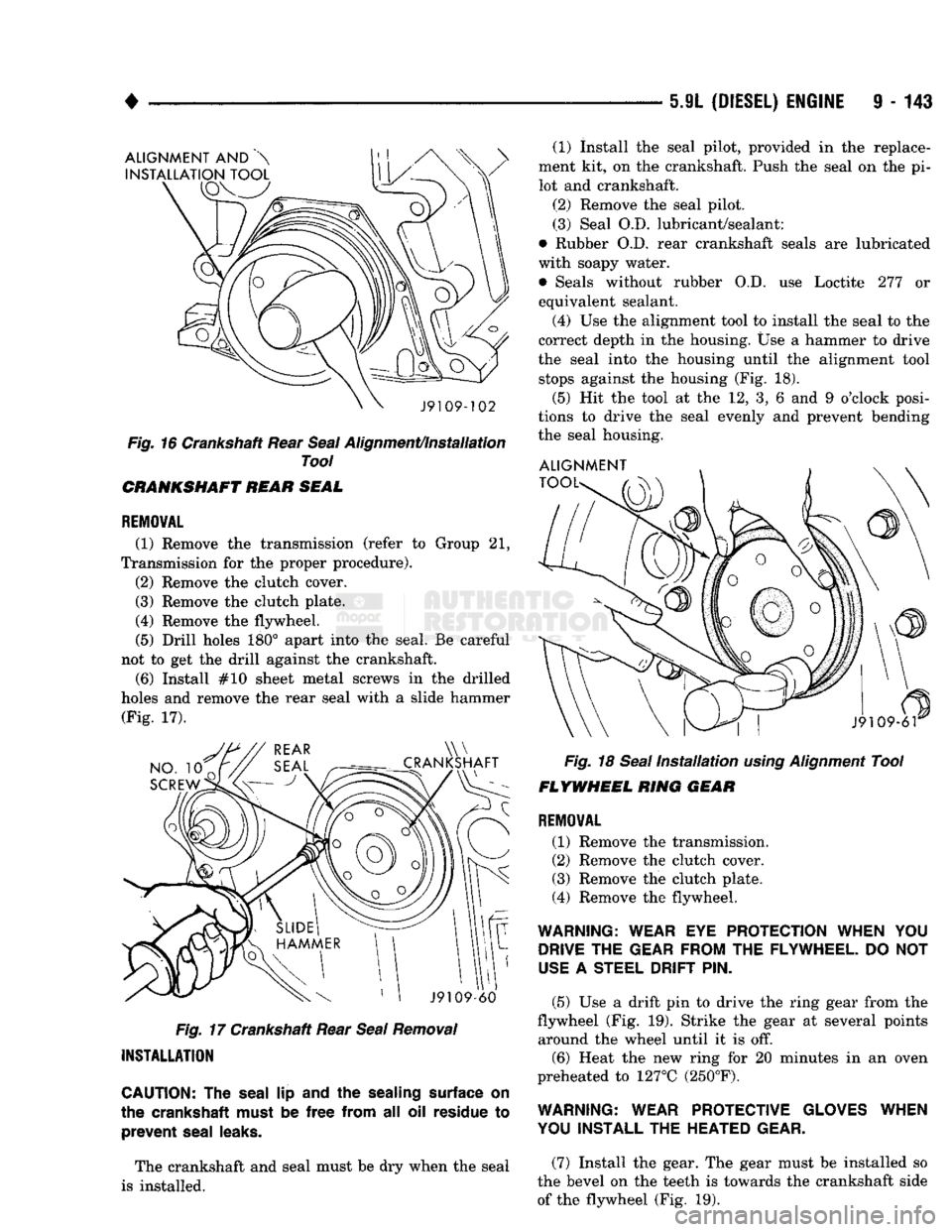
slide hammer (Fig.
17).
NO.
10
SCREW
\W
CRANKSHAFT
J9109-60
Fig.
17 Crankshaft Rear
Seal
Removal
INSTALLATION
CAUTION:
The
seal
lip
and
the
sealing surface
on
the crankshaft must
be
free
from
all oil
residue
to
prevent
seal leaks.
The crankshaft
and
seal must
be dry
when
the
seal
is installed. (1) Install
the
seal pilot, provided
in the
replace
ment
kit, on the
crankshaft. Push
the
seal
on the pi
lot
and
crankshaft.
(2) Remove
the
seal pilot. (3) Seal
O.D.
lubricant/sealant:
• Rubber
O.D,
rear crankshaft seals
are
lubricated
with soapy water.
• Seals without rubber
O.D. use
Loctite
277 or
equivalent sealant.
(4)
Use the
alignment tool
to
install
the
seal
to the
correct depth
in the
housing.
Use a
hammer
to
drive
the seal into
the
housing until
the
alignment tool stops against
the
housing
(Fig. 18).
(5)
Hit the
tool
at the 12, 3, 6 and 9
o'clock posi
tions
to
drive
the
seal evenly
and
prevent bending
the seal housing. ALIGNMENT
TOOL-
J9109-6T
Fig.
18
Seal
Installation
using
Alignment
Tool
FLYWHEEL
RING GEAR
REMOVAL
(1) Remove
the
transmission.
(2) Remove
the
clutch cover.
(3) Remove
the
clutch plate.
(4) Remove
the
flywheel.
WARNING: WEAR
EYE
PROTECTION WHEN
YOU
DRIVE
THE
GEAR FROM
THE
FLYWHEEL.
DO NOT
USE
A
STEEL DRIFT
PIN.
(5)
Use a
drift
pin to
drive
the
ring gear from
the
flywheel
(Fig. 19).
Strike
the
gear
at
several points around
the
wheel until
it is off.
(6) Heat
the new
ring
for 20
minutes
in an
oven
preheated
to
127°C (250°F).
WARNING: WEAR PROTECTIVE GLOVES WHEN
YOU INSTALL
THE
HEATED GEAR.
(7) Install
the
gear.
The
gear must
be
installed
so
the bevel
on the
teeth
is
towards
the
crankshaft side of
the
flywheel
(Fig. 19).
Page 782 of 1502
•
EXHAUST
SYSTEM
AND
INTAKE MANIFOLD
11 - 23
HEAT
SHIELD
OUTER RETAINER
RINGS
BREAKING,
HOUSING
J9111-18
Fig.
24 Turbine Shaft/Heat
Shield
to Bearing
Housing
INNER
RETAINING
RINGS
INNER
RETAINING RING
J9111-14
Fig.
22
Snap Rings
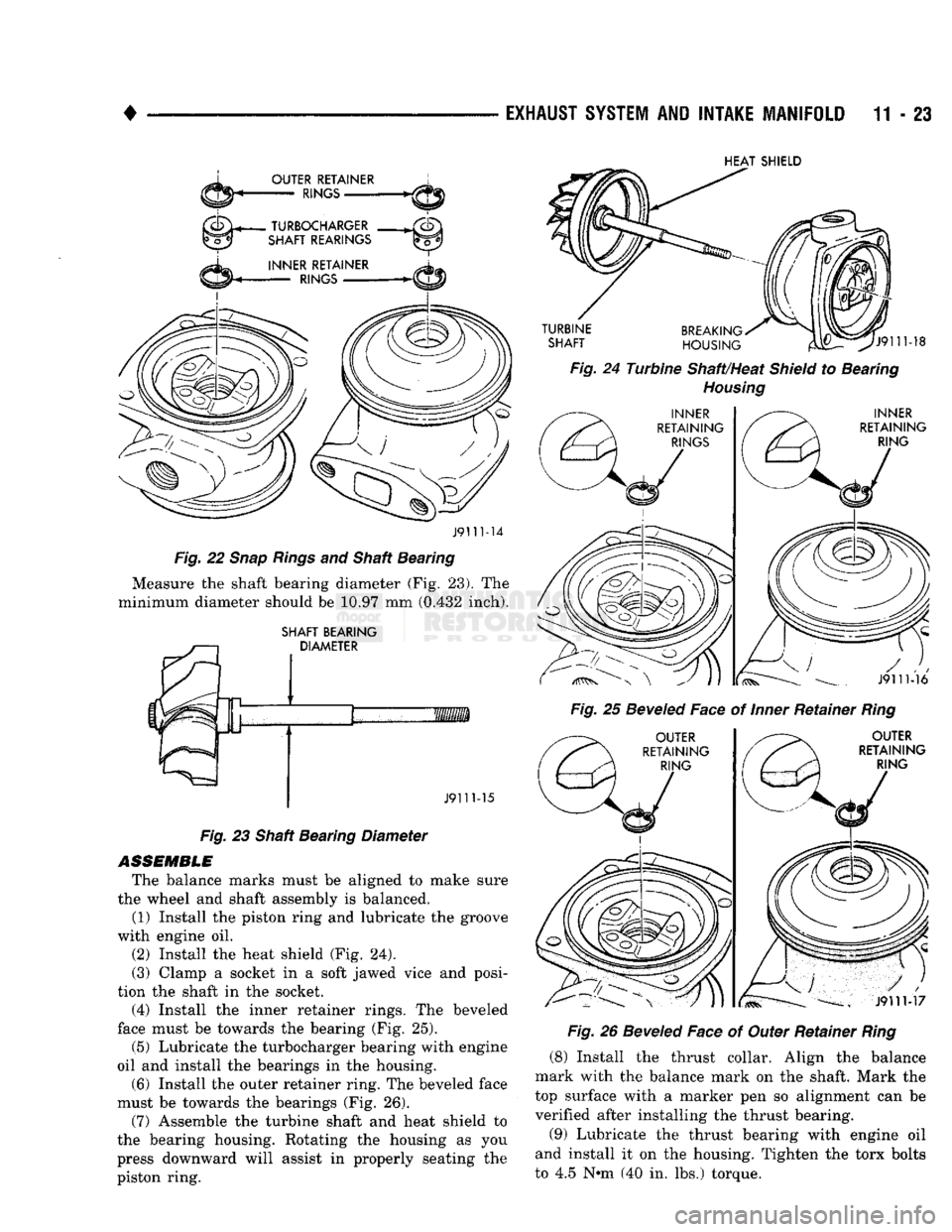
and Shaft Bearing Measure the shaft bearing diameter (Fig. 23). The
minimum diameter should be 10.97 mm (0.432 inch).
SHAFT BEARING DIAMETER Fig.
25
Beveled
Face of
Inner
Retainer
Ring
J911M6
OUTER
RETAINING RING
J9111-15
Fig.
23 Shaft Bearing Diameter
ASSEMBLE
The balance marks must be aligned to make sure
the wheel and shaft assembly is balanced. (1) Install the piston ring and lubricate the groove
with engine oil.
(2) Install the heat shield (Fig. 24).
(3) Clamp a socket in a soft jawed vice and posi
tion the shaft in the socket. (4) Install the inner retainer rings. The beveled
face must be towards the bearing (Fig. 25).
(5) Lubricate the turbocharger bearing with engine
oil and install the bearings in the housing.
(6) Install the outer retainer ring. The beveled face
must be towards the bearings (Fig. 26).
(7) Assemble the turbine shaft and heat shield to
the bearing housing. Rotating the housing as you
press downward will assist in properly seating the
piston ring.
OUTER
RETAINING RING
J9111-17
Fig.
26
Beveled
Face of Outer Retainer
Ring
(8) Install the thrust collar. Align the balance
mark with the balance mark on the shaft. Mark the
top surface with a marker pen so alignment can be verified after installing the thrust bearing.
(9) Lubricate the thrust bearing with engine oil
and install it on the housing. Tighten the torx bolts
to 4.5 N»m (40 in. lbs.) torque.
Page 821 of 1502
14
- 2
FUEL SYSTEM
•
GASOLINE/OXYGENATE
BLENDS
Some fuel suppliers blend unleaded gasoline with
materials that contain oxygen such as alcohol, MTBE and ETBE. The type and amount of oxygenate used
in the blend is important. The following are gener
ally used in gasoline blends:
ETHANOL
Ethanol (Ethyl or Grain Alcohol) properly blended,
is used as a mixture of 10 percent ethanol and 90
percent gasoline. Gasoline with ethanol may be
used in your vehicle.
METHANOL
CAUTION:
DO NOT USE
GASOLINES CONTAINING
METHANOL.
Use of methanol/gasoline blends may re
sult in starting and driveability problems. In addition,
damage may be done to critical fuel system compo
nents.
Methanol (Methyl or Wood Alcohol) is used in a va
riety of concentrations blended with unleaded gaso
line.
You may encounter fuels containing 3 percent
or more methanol along with other alcohols called co-
solvents.
Problems that are the result of using methanol/gas
oline blends are not the responsibility of Chrysler Corporation. They may not be covered by the vehicle
warranty.
MTBE/ETBE
Gasoline and MTBE (Methyl Tertiary Butyl Ether)
blends are a mixture of unleaded gasoline and up to 15 percent
MTBE.
Gasoline and
ETBE
(Ethyl
Ter
tiary Butyl Ether) are blends of gasoline and up to 17 percent ETBE. Gasoline blended with MTBE or
ETBE may be used in your vehicle.
CLEAN
AIR GASOLINE Many gasolines are now being blended that con
tribute to cleaner air, especially in those areas of the
country where air pollution levels are high. These
new blends provide a cleaner burning fuel and some are referred to as Reformulated Gasoline.
In areas of the country where carbon monoxide lev
els are high, gasolines are being treated with oxy
genated materials such as MTBE, ETBE and ethanol.
Chrysler Corporation supports these efforts toward
cleaner air and recommends that you use these gas
olines as they become available.
FUEL
REQUIREMENTS-DIESEL ENGINE
Use good quality diesel fuel from a reputable sup
plier in your Chrysler Corporation vehicle. For most
year-round service, number 2 (two) diesel fuel meet ing ASTM specification D-975 will provide good per
formance. If the vehicle is exposed to extreme cold (below -18°C - 0°F), or for any reason is required to
operate at colder than normal conditions for pro longed periods, then dilution of the 2D fuel with 50
percent kerosine or number ID diesel fuel will pro
vide better protection from fuel gelling or wax-plug ging of the fuel filters. Diesel fuel is seldom
completely free of water. To prevent fuel system
trouble, including fuel tube (line) freezing in winter, drain the accumulated water using the drain pro
vided. If you buy good quality fuel and follow the cold weather advice above, fuel conditioners should
not be required in your vehicle.
Page 824 of 1502
•
FUEL SYSTEM
14-5
FUEL PUMP CONTROL
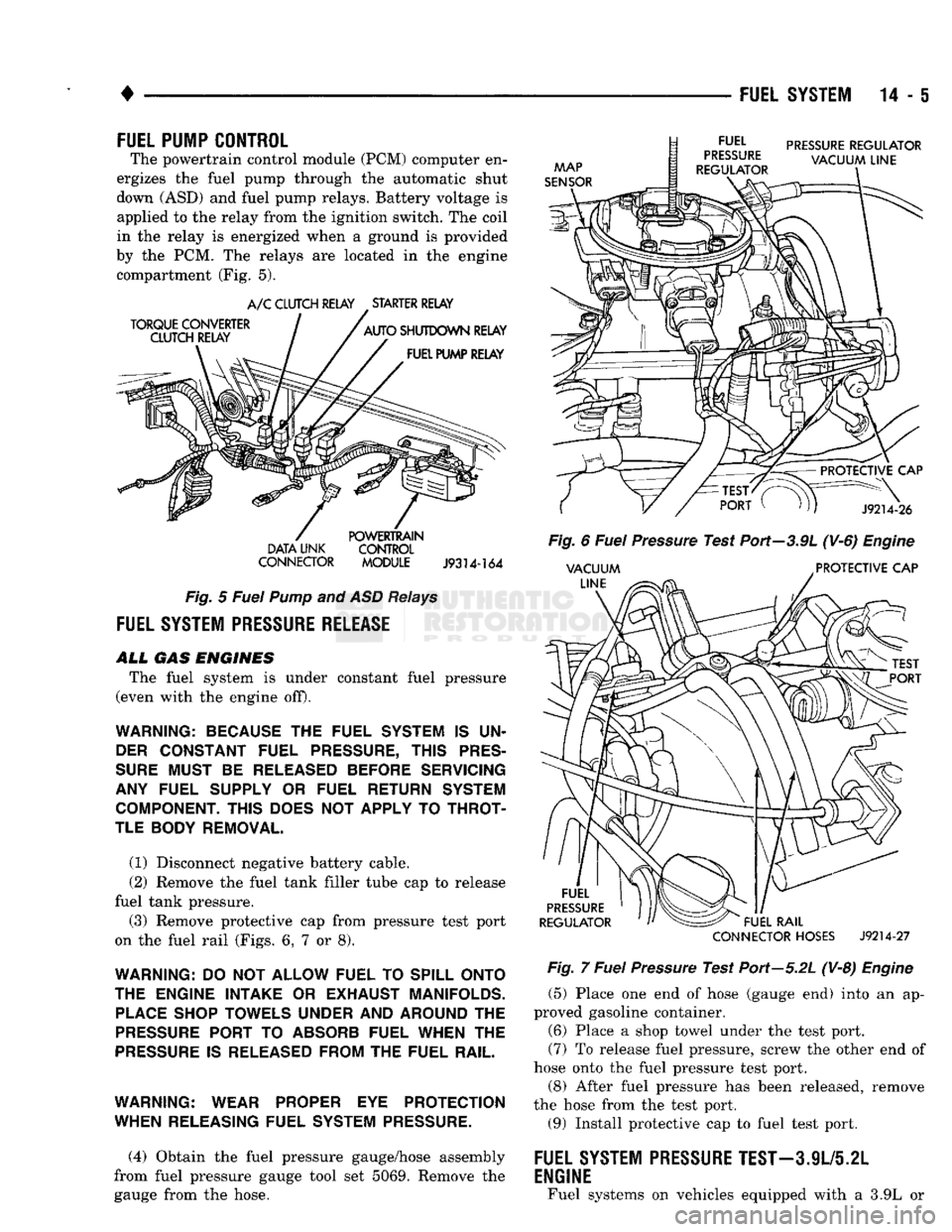
The powertrain control module (PCM) computer en
ergizes the fuel pump through the automatic shut
down (ASD) and fuel pump relays. Battery voltage is applied to the relay from the ignition switch. The coil
in the relay is energized when a ground is provided
by the PCM. The relays are located in the engine compartment (Fig. 5).
DATA
UNK
CONTROL
CONNECTOR
MODULE
J9314-164
Fig.
5
Fuel
Pump
and ASD
Relays
FUEL
SYSTEM
PRESSURE
RELEASE
ALL
GAS
ENGINES
The fuel system is under constant fuel pressure
(even with the engine off).
WARNING: BECAUSE THE FUEL SYSTEM IS UN DER CONSTANT FUEL PRESSURE, THIS PRES
SURE MUST BE RELEASED BEFORE SERVICING
ANY FUEL SUPPLY OR FUEL RETURN SYSTEM COMPONENT. THIS DOES NOT APPLY TO THROT
TLE BODY REMOVAL.
(1) Disconnect negative battery cable.
(2) Remove the fuel tank filler tube cap to release
fuel tank pressure. (3) Remove protective cap from pressure test port
on the fuel rail (Figs. 6, 7 or 8).
WARNING: DO NOT ALLOW FUEL TO SPILL ONTO
THE ENGINE INTAKE OR EXHAUST MANIFOLDS. PLACE SHOP TOWELS UNDER AND AROUND THE
PRESSURE PORT TO ABSORB FUEL WHEN THE
PRESSURE IS RELEASED FROM THE FUEL RAIL.
WARNING: WEAR PROPER EYE PROTECTION
WHEN RELEASING FUEL SYSTEM PRESSURE.
(4) Obtain the fuel pressure gauge/hose assembly
from fuel pressure gauge tool set 5069. Remove the
gauge from the hose.
CONNECTOR
HOSES
J9214-27
Fig.
7
Fuel
Pressure
Test Port—5.2L (V-8)
Engine
(5) Place one end of hose (gauge end) into an ap
proved gasoline container. (6) Place a shop towel under the test port.
(7) To release fuel pressure, screw the other end of
hose onto the fuel pressure test port.
(8) After fuel pressure has been released, remove
the hose from the test port. (9) Install protective cap to fuel test port.
FUEL SYSTEM
PRESSURE
TEST-3.9L/5.2L
ENGINE
Fuel systems on vehicles equipped with a 3.9L or
Page 829 of 1502
FUEL
TUBE
REMOVAL
QUICK
CONNECT
FITTING
PUSH
PUSH PUSH
INSTALLATION
X
PUSH
/
•PUSH
PLASTIC
RETAINER
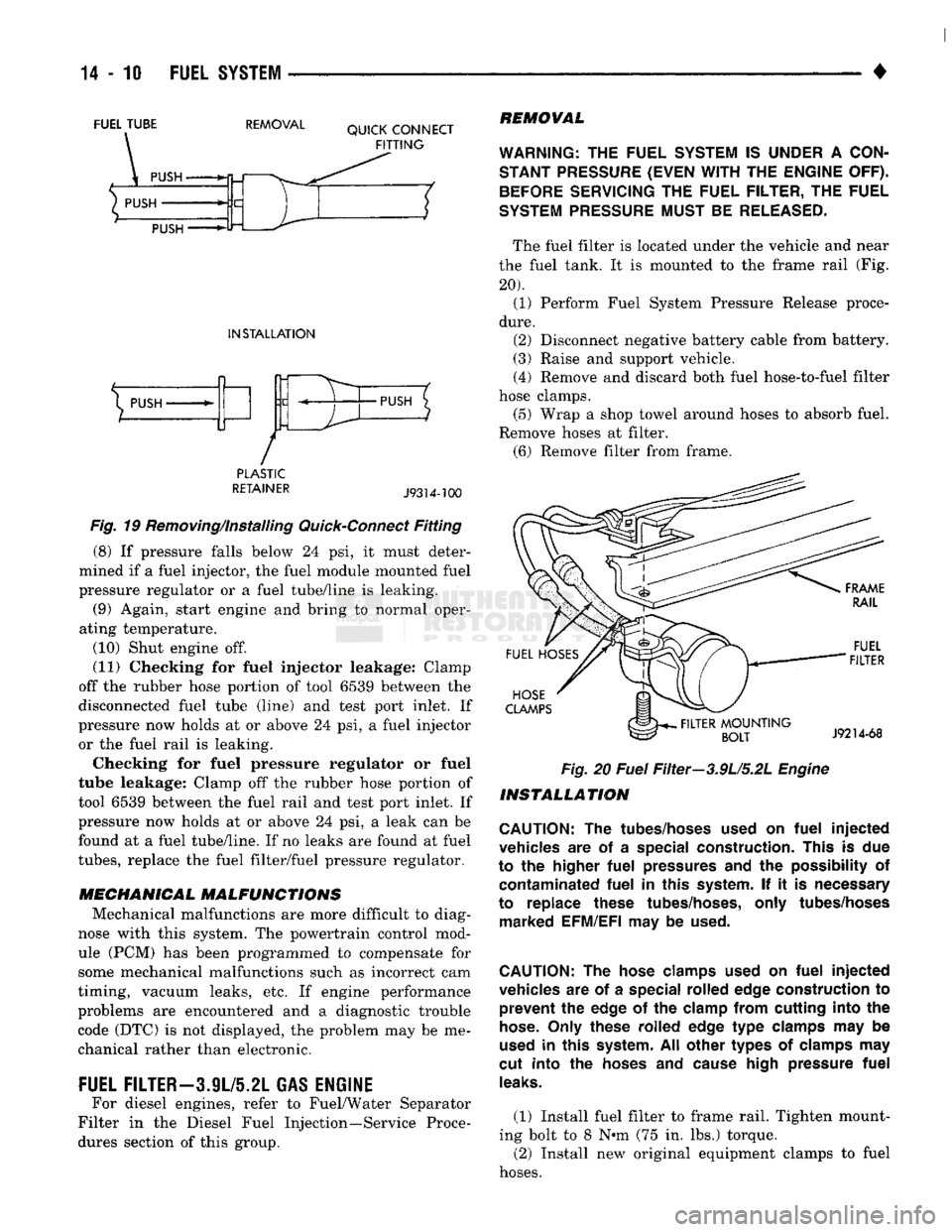
J9314-100
Fig. 19 Removing/Installing Quick-Connect Fitting (8) If pressure falls below 24 psi, it must deter
mined if a fuel injector, the fuel module mounted fuel
pressure regulator or a fuel tube/line is leaking. (9) Again, start engine and bring to normal oper
ating temperature.
(10) Shut engine off.
(11) Checking for fuel injector leakage: Clamp
off the rubber hose portion of tool 6539 between the
disconnected fuel tube (line) and test port inlet. If
pressure now holds at or above 24 psi, a fuel injector or the fuel rail is leaking.
Checking for fuel pressure regulator or fuel
tube leakage: Clamp off the rubber hose portion of
tool 6539 between the fuel rail and test port inlet. If
pressure now holds at or above 24 psi, a leak can be
found at a fuel tube/line. If no leaks are found at fuel
tubes,
replace the fuel filter/fuel pressure regulator.
MECHANICAL MALFUNCTIONS
Mechanical malfunctions are more difficult to diag
nose with this system. The powertrain control mod
ule (PCM) has been programmed to compensate for
some mechanical malfunctions such as incorrect cam
timing, vacuum leaks, etc. If engine performance
problems are encountered and a diagnostic trouble code (DTC) is not displayed, the problem may be me
chanical rather than electronic.
FUEL FILTER-3.9L/5.2L GAS ENGINE
For diesel engines, refer to Fuel/Water Separator
Filter in the Diesel Fuel Injection—Service Proce
dures section of this group.
REMOVAL
WARNING:
THE
FUEL
SYSTEM
IS
UNDER
A
CON
STANT
PRESSURE
(EVEN
WITH
THE
ENGINE
OFF).
BEFORE
SERVICING
THE
FUEL FILTER,
THE
FUEL
SYSTEM
PRESSURE
MUST
BE
RELEASED.
The fuel filter is located under the vehicle and near
the fuel tank. It is mounted to the frame rail (Fig.
20). (1) Perform Fuel System Pressure Release proce
dure.
(2) Disconnect negative battery cable from battery.
(3) Raise and support vehicle.
(4) Remove and discard both fuel hose-to-fuel filter
hose clamps. (5) Wrap a shop towel around hoses to absorb fuel.
Remove hoses at filter. (6) Remove filter from frame.
FUEL
HOSES
HOSE
CLAMPS
.
FILTER
MOUNTING
BOLT
FUEL
FILTER
J9214-68
Fig.
20
Fuel
Filter—3.9U5.2L
Engine
INSTALLATION
CAUTION:
The
tubes/hoses used
on
fuel
injected
vehicles
are of a
special construction. This
is due
to
the
higher
fuel
pressures
and the
possibility
of
contaminated
fuel
in
this system.
If it is
necessary
to replace these tubes/hoses, only tubes/hoses marked EFM/EFI
may be
used.
CAUTION:
The
hose clamps used
on
fuel
injected
vehicles
are of a
special rolled edge construction
to
prevent
the
edge
of the
clamp from cutting into
the
hose.
Only these rolled edge
type
clamps
may be
used
in
this system.
All
other types
of
clamps
may
cut into
the
hoses
and
cause high pressure
fuel
leaks.
(1) Install fuel filter to frame rail. Tighten mount
ing bolt to 8 N»m (75 in. lbs.) torque. (2) Install new original equipment clamps to fuel
hoses.
Page 840 of 1502
•
FUEL
SYSTEM
14-21
FRAME
RAIL
SKID
PLATE
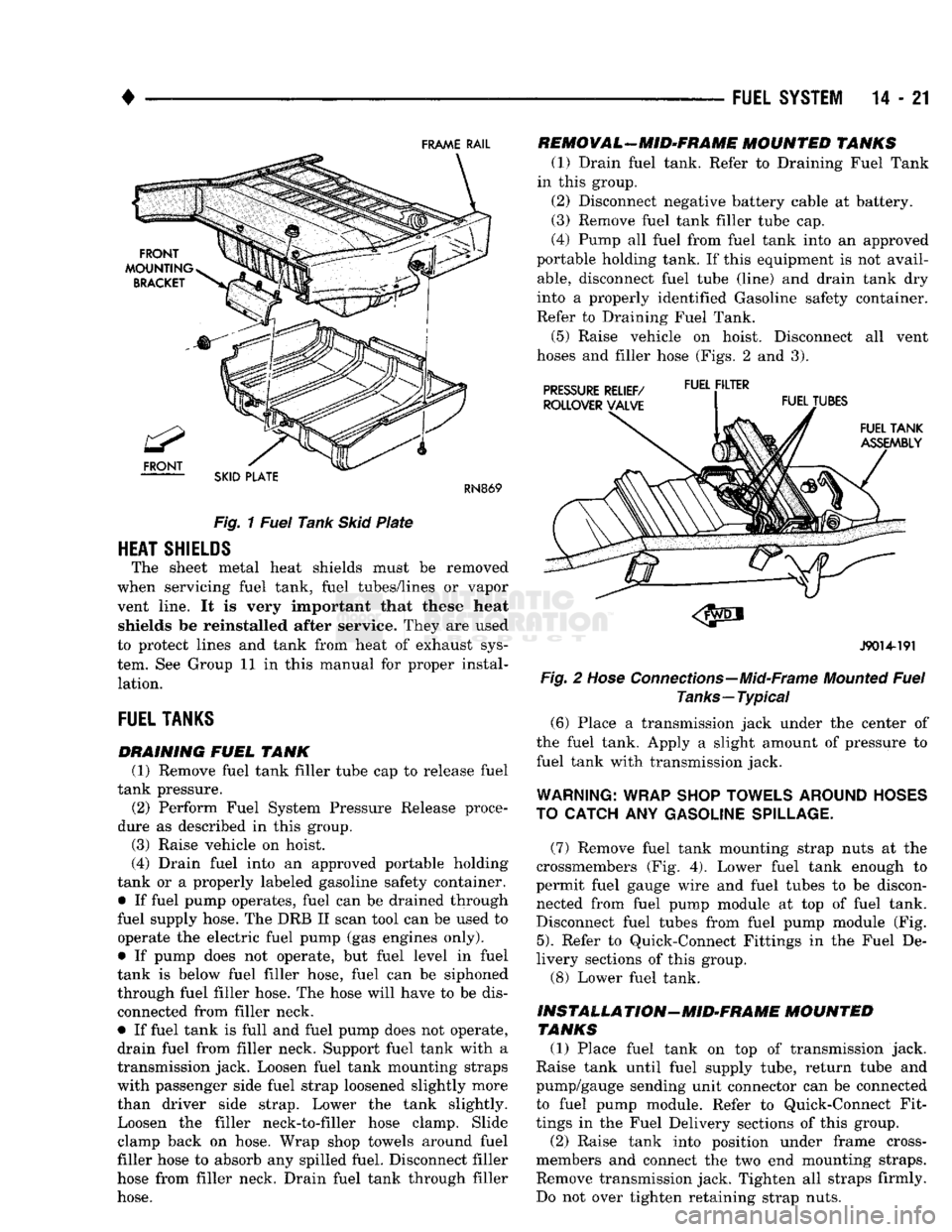
RN869
Fig.
1
Fuel
Tank
Skid
Plate
HEAT
SHIELDS
The sheet metal heat shields must be removed
when servicing fuel tank, fuel tubes/lines or vapor
vent line. It is very important that these heat shields be reinstalled after service. They are used
to protect lines and tank from heat of exhaust sys
tem. See Group 11 in this manual for proper instal lation.
FUEL
TANKS
DRAINING
FUEL
TANK
(1) Remove fuel tank filler tube cap to release fuel
tank pressure. (2) Perform Fuel System Pressure Release proce
dure as described in this group.
(3) Raise vehicle on hoist.
(4) Drain fuel into an approved portable holding
tank or a properly labeled gasoline safety container.
• If fuel pump operates, fuel can be drained through
fuel supply hose. The DRB II scan tool can be used to operate the electric fuel pump (gas engines only).
• If pump does not operate, but fuel level in fuel
tank is below fuel filler hose, fuel can be siphoned
through fuel filler hose. The hose will have to be dis connected from filler neck.
• If fuel tank is full and fuel pump does not operate,
drain fuel from filler neck. Support fuel tank with a
transmission jack. Loosen fuel tank mounting straps with passenger side fuel strap loosened slightly more
than driver side strap. Lower the tank slightly. Loosen the filler neck-to-filler hose clamp. Slide
clamp back on hose. Wrap shop towels around fuel
filler hose to absorb any spilled fuel. Disconnect filler
hose from filler neck. Drain fuel tank through filler
hose.
REMOVAL-MID-FRAME
MOUNTED
TANKS
(1) Drain fuel tank. Refer to Draining Fuel Tank
in this group. (2) Disconnect negative battery cable at battery.
(3) Remove fuel tank filler tube cap.
(4) Pump all fuel from fuel tank into an approved
portable holding tank. If this equipment is not avail
able,
disconnect fuel tube (line) and drain tank dry
into a properly identified Gasoline safety container.
Refer to Draining Fuel Tank.
(5) Raise vehicle on hoist. Disconnect all vent
hoses and filler hose (Figs. 2 and 3).
PRESSURE
RELIEF/
FUEL F,LTER
J9014-191
Fig.
2
Hose
Connections—Mid-Frame
Mounted
Fuel
Tanks—Typical (6) Place a transmission jack under the center of
the fuel tank. Apply a slight amount of pressure to fuel tank with transmission jack.
WARNING:
WRAP
SHOP
TOWELS
AROUND
HOSES
TO
CATCH
ANY
GASOLINE
SPILLAGE.
(7) Remove fuel tank mounting strap nuts at the
crossmembers (Fig. 4). Lower fuel tank enough to
permit fuel gauge wire and fuel tubes to be discon nected from fuel pump module at top of fuel tank.
Disconnect fuel tubes from fuel pump module (Fig.
5).
Refer to Quick-Connect Fittings in the Fuel De
livery sections of this group.
(8) Lower fuel tank.
INSTALLA
TION—MID-FRAME
MOUNTED
TANKS (1) Place fuel tank on top of transmission jack.
Raise tank until fuel supply tube, return tube and
pump/gauge sending unit connector can be connected to fuel pump module. Refer to Quick-Connect Fit
tings in the Fuel Delivery sections of this group.
(2) Raise tank into position under frame cross-
members and connect the two end mounting straps.
Remove transmission jack. Tighten all straps firmly.
Do not over tighten retaining strap nuts.
Page 930 of 1502
•
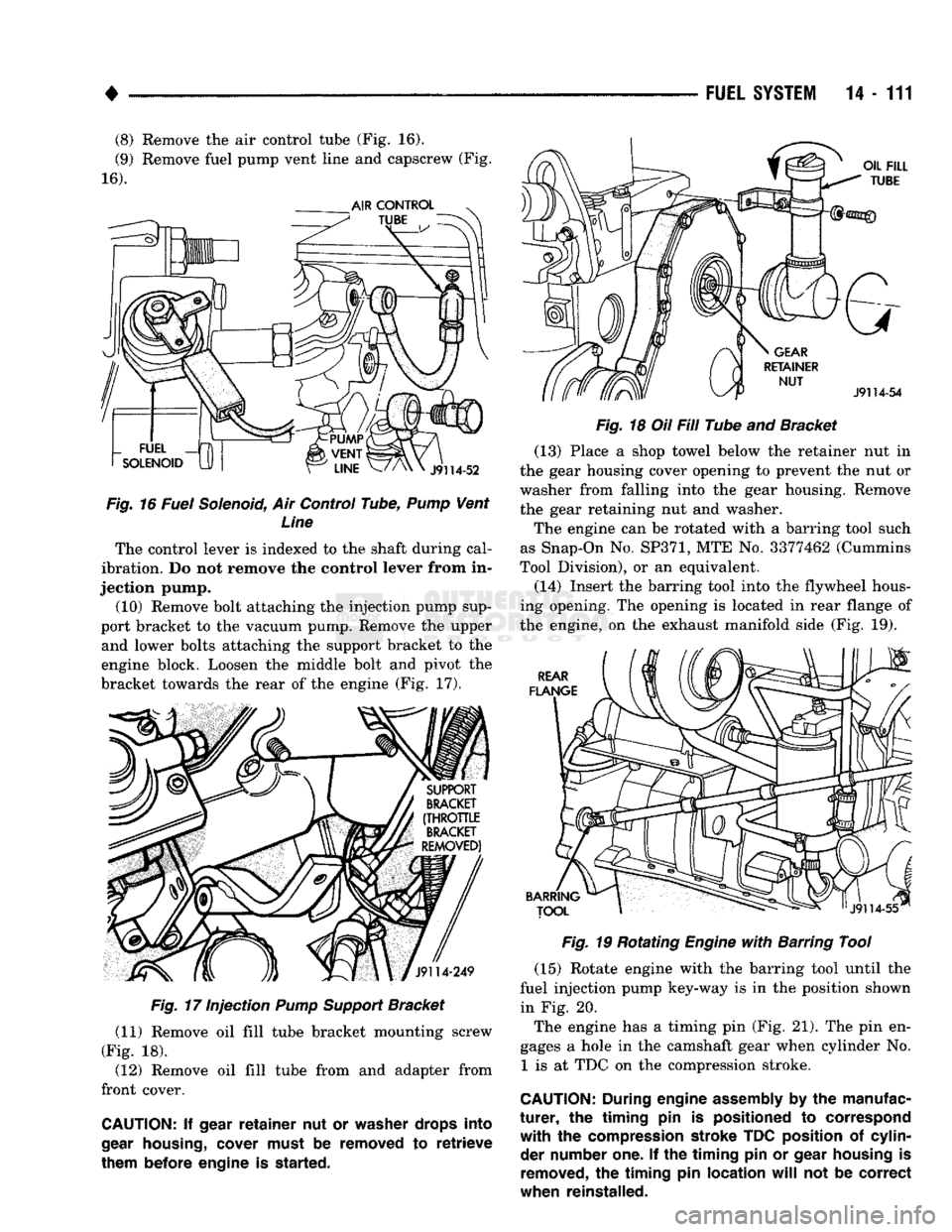
(8) Remove the air control tube (Fig. 16).
(9) Remove fuel pump vent line and capscrew (Fig.
16).
Fig.
16 Fuel Solenoid, Air Control Tube,
Pump
Vent Line
The control lever is indexed to the shaft during cal
ibration. Do not remove the control lever from in
jection pump. (10) Remove bolt attaching the injection pump sup
port bracket to the vacuum pump. Remove the upper and lower bolts attaching the support bracket to the
engine block. Loosen the middle bolt and pivot the
bracket towards the rear of the engine (Fig. 17).
Fig.
17 Injection
Pump
Support
Bracket
(11) Remove oil fill tube bracket mounting screw
(Fig. 18). (12) Remove oil fill tube from and adapter from
front cover.
CAUTION:
If
gear
retainer
nut or
washer drops into
gear
housing,
cover must
be
removed
to
retrieve
them before engine
is
started. FUEL
SYSTEM
14-111
Fig.
18 Oil Fill Tube and Bracket (13) Place a shop towel below the retainer nut in
the gear housing cover opening to prevent the nut or
washer from falling into the gear housing. Remove
the gear retaining nut and washer.
The engine can be rotated with a barring tool such
as Snap-On No.
SP371,
MTE No. 3377462 (Cummins
Tool Division), or an equivalent.
(14) Insert the barring tool into the flywheel hous
ing opening. The opening is located in rear flange of
the engine, on the exhaust manifold side (Fig. 19).
Fig.
19 Rotating
Engine
with
Barring Tool
(15) Rotate engine with the barring tool until the
fuel injection pump key-way is in the position shown in Fig. 20.
The engine has a timing pin (Fig. 21). The pin en
gages a hole in the camshaft gear when cylinder No. 1 is at TDC on the compression stroke.
CAUTION:
During
engine
assembly
by the
manufac
turer,
the
timing
pin is
positioned
to
correspond
with
the
compression stroke TDC position
of
cylin der number one.
If the
timing
pin or
gear housing
is
removed,
the
timing
pin
location
will
not be
correct
when reinstalled.
Page 932 of 1502
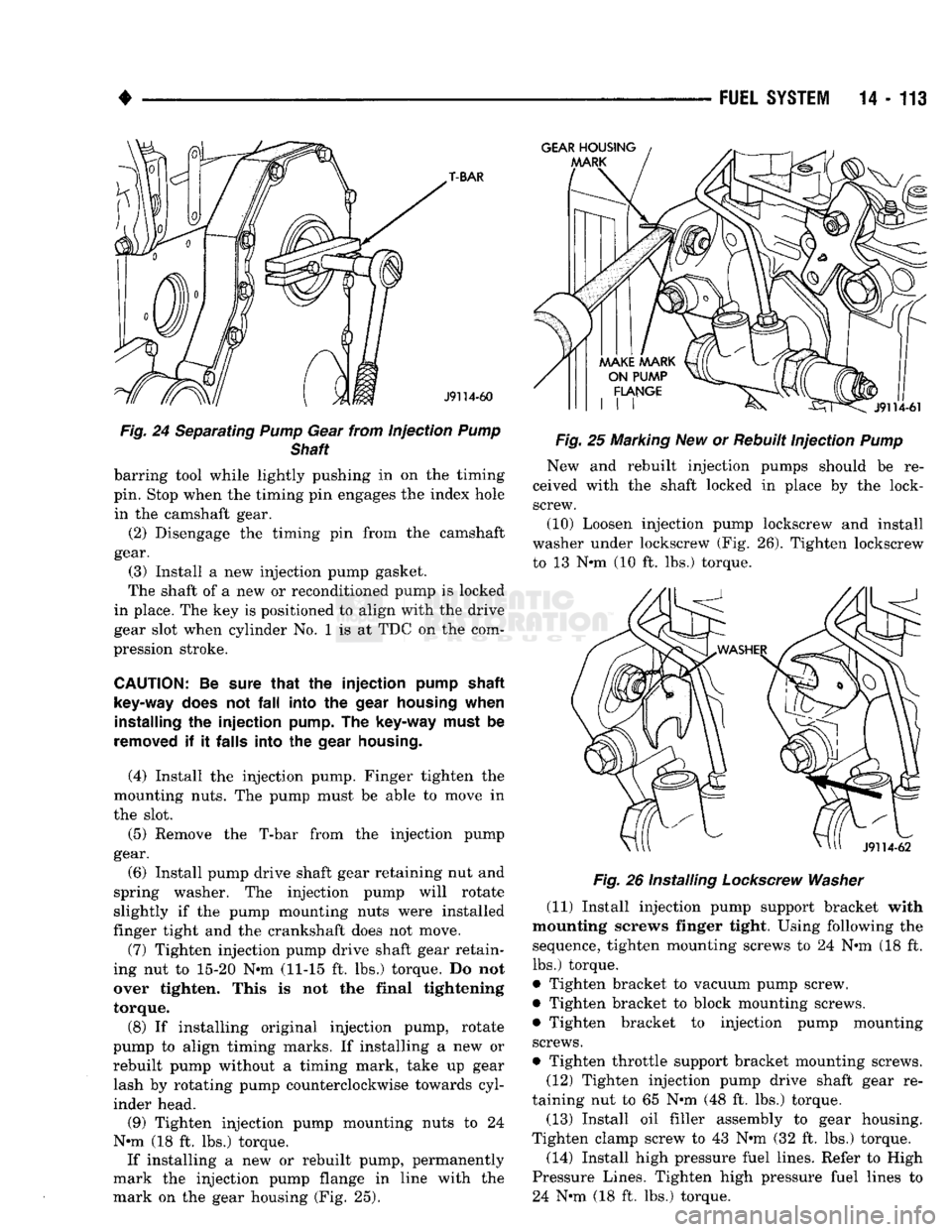
•
Fig.
24 Separating
Pump
Gear from injection
Pump
Shaft
barring tool while lightly pushing in on the timing
pin. Stop when the timing pin engages the index hole
in the camshaft gear.
(2) Disengage the timing pin from the camshaft
gear. (3) Install a new injection pump gasket.
The shaft of a new or reconditioned pump is locked
in place. The key is positioned to align with the drive
gear slot when cylinder No. 1 is at TDC on the com
pression stroke.
CAUTION:
Be
sure
that
the injection
pump
shaft
key-way
does
not
fall
into the
gear
housing
when
installing
the injection
pump.
The
key-way
must
be
removed
if it
falls
into the
gear
housing.
(4) Install the injection pump. Finger tighten the
mounting nuts. The pump must be able to move in
the slot.
(5) Remove the T-bar from the injection pump
gear.
(6) Install pump drive shaft gear retaining nut and
spring washer. The injection pump will rotate
slightly if the pump mounting nuts were installed
finger tight and the crankshaft does not move.
(7) Tighten injection pump drive shaft gear retain
ing nut to 15-20
Nth
(11-15 ft. lbs.) torque. Do not
over tighten. This is not the final tightening
torque.
(8) If installing original injection pump, rotate
pump to align timing marks. If installing a new or
rebuilt pump without a timing mark, take up gear lash by rotating pump counterclockwise towards cyl
inder head.
(9) Tighten injection pump mounting nuts to 24
Nnn (18 ft. lbs.) torque. If installing a new or rebuilt pump, permanently
mark the injection pump flange in line with the
mark on the gear housing (Fig. 25).
FUEL
SYSTEM
14 - 113
Fig.
25 Marking New or Rebuilt Injection
Pump
New and rebuilt injection pumps should be re
ceived with the shaft locked in place by the lock- screw.
(10) Loosen injection pump lockscrew and install
washer under lockscrew (Fig. 26). Tighten lockscrew to 13 Nnn (10 ft. lbs.) torque.
Fig.
26 Installing
Lockscrew
Washer
(11) Install injection pump support bracket with
mounting screws finger tight. Using following the sequence, tighten mounting screws to 24 Nnn (18 ft.
lbs.) torque.
• Tighten bracket to vacuum pump screw.
• Tighten bracket to block mounting screws. • Tighten bracket to injection pump mounting
screws.
• Tighten throttle support bracket mounting screws. (12) Tighten injection pump drive shaft gear re
taining nut to 65 N*m (48 ft. lbs.) torque.
(13) Install oil filler assembly to gear housing.
Tighten clamp screw to 43 Nnn (32 ft. lbs.) torque.
(14) Install high pressure fuel lines. Refer to High
Pressure Lines. Tighten high pressure fuel lines to 24 Nnn (18 ft. lbs.) torque.
Page 938 of 1502
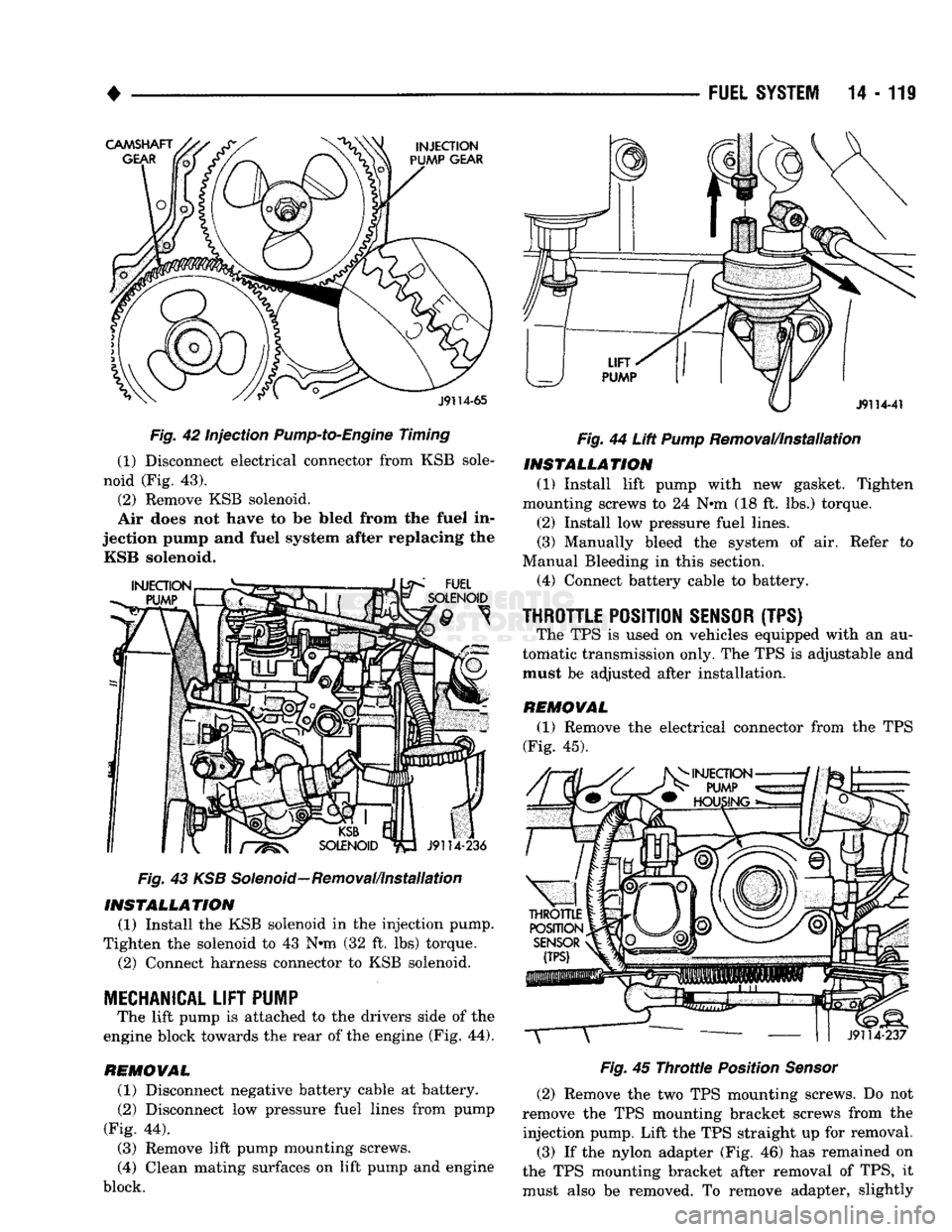
•
Fig. 42 Injection
Pump-to-Engine
Timing
(1) Disconnect electrical connector from KSB sole
noid (Fig. 43).
(2) Remove KSB solenoid.
Air does not have to be Med from the fuel in
jection pump and fuel system after replacing the KSB solenoid.
Fig. 43 KSB Solenoid—Removal/installation INSTALLATION
(1) Install the KSB solenoid in the injection pump.
Tighten the solenoid to 43 N*m (32 ft. lbs) torque. (2) Connect harness connector to KSB solenoid.
MECHANICAL
LIFT
PUMP
The lift pump is attached to the drivers side of the
engine block towards the rear of the engine (Fig. 44).
REMOVAL (1) Disconnect negative battery cable at battery.
(2) Disconnect low pressure fuel lines from pump
(Fig. 44).
(3) Remove lift pump mounting screws.
(4) Clean mating surfaces on lift pump and engine
block.
FUEL
SYSTEM
14 - 119
Fig.
44 Lift
Pump
Removal/Installation INSTALLATION
(1) Install lift pump with new gasket. Tighten
mounting screws to 24 N#m (18 ft. lbs.) torque.
(2) Install low pressure fuel lines.
(3) Manually bleed the system of air. Refer to
Manual Bleeding in this section. (4) Connect battery cable to battery.
THROTTLE
POSITION
SENSOR
(TPS) The TPS is used on vehicles equipped with an au
tomatic transmission only. The TPS is adjustable and
must be adjusted after installation.
REMOVAL (1) Remove the electrical connector from the TPS
(Fig. 45).
Fig.
45
Throttle
Position
Sensor
(2) Remove the two TPS mounting screws. Do not
remove the TPS mounting bracket screws from the injection pump. Lift the TPS straight up for removal. (3) If the nylon adapter (Fig. 46) has remained on
the TPS mounting bracket after removal of TPS, it
must also be removed. To remove adapter, slightly