wheel bolt torque DODGE TRUCK 1993 Service Repair Manual
[x] Cancel search | Manufacturer: DODGE, Model Year: 1993, Model line: TRUCK, Model: DODGE TRUCK 1993Pages: 1502, PDF Size: 80.97 MB
Page 54 of 1502
•
FRONT SUSPENSION
AND
AXLE
2 - 1
CONTENTS
page
FRONT SUSPENSION—2WD VEHICLES
......
7
FRONT SUSPENSION—4WD VEHICLES
14
FRONT WHEEL
ALIGNMENT
...............
3
GENERAL INFORMATION
1
page
MODEL
44
FRONT AXLE
17
MODEL
80
FRONT AXLE
49
TORQUE SPECIFICATIONS
75
GENERAL
INFORMATION
FRONT SUSPENSION—2WD VEHICLES
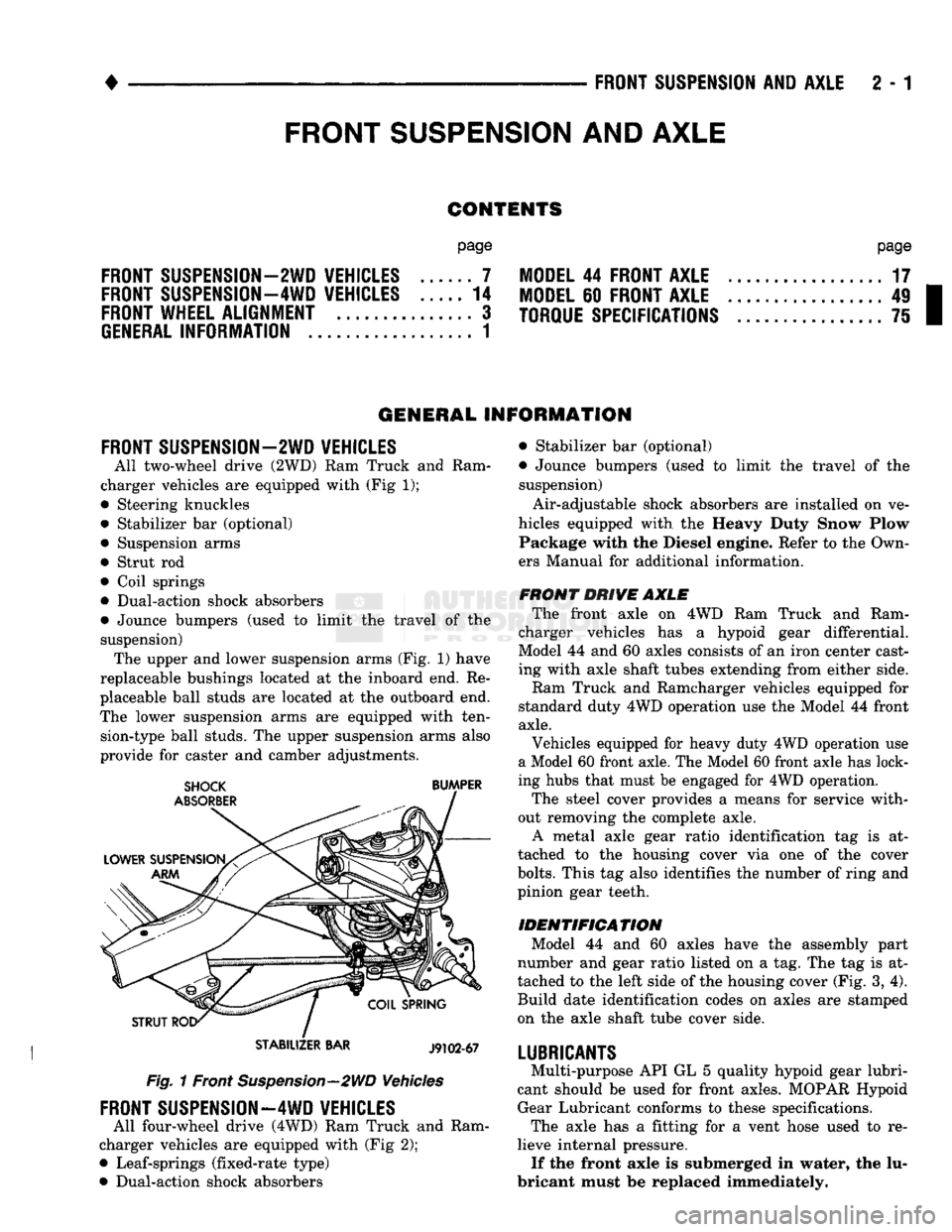
All two-wheel drive (2WD)
Ram
Truck
and
Ram
charger vehicles
are
equipped with (Fig
1);
• Steering knuckles
• Stabilizer
bar
(optional) • Suspension arms
• Strut
rod
• Coil springs
• Dual-action shock absorbers
• Jounce bumpers (used
to
limit
the
travel
of the
suspension) The upper and lower suspension arms (Fig.
1)
have
replaceable bushings located
at the
inboard end.
Re
placeable ball studs
are
located
at
the
outboard end.
The lower suspension arms
are
equipped with ten sion-type ball studs. The upper suspension arms also
provide
for
caster
and
camber adjustments.
STABILIZER
BAR
J9102-67
Fig. 1 Front Suspension—2WD Vehicles
FRONT SUSPENSION—4WD VEHICLES
All four-wheel drive (4WD) Ram Truck
and
Ram
charger vehicles
are
equipped with (Fig
2);
• Leaf-springs (fixed-rate type)
• Dual-action shock absorbers • Stabilizer
bar
(optional)
• Jounce bumpers (used
to
limit
the
travel
of the
suspension)
Air-adjustable shock absorbers
are
installed
on
ve
hicles equipped with
the
Heavy Duty Snow Plow Package with
the
Diesel engine. Refer
to
the Own
ers Manual
for
additional information.
FRONT DRIVE AXLE The front axle
on 4WD Ram
Truck
and
Ram
charger vehicles
has a
hypoid gear differential.
Model
44
and
60
axles consists
of
an iron center cast
ing with axle shaft tubes extending from either side.
Ram Truck
and
Ramcharger vehicles equipped
for
standard duty 4WD operation use
the
Model
44
front
axle.
Vehicles equipped
for
heavy duty 4WD operation
use
a Model 60 front axle. The Model 60 front axle has lock
ing hubs that must
be
engaged
for
4WD operation.
The steel cover provides
a
means
for
service with
out removing
the
complete axle. A metal axle gear ratio identification
tag is at
tached
to the
housing cover
via one of the
cover
bolts.
This
tag
also identifies
the
number
of
ring and
pinion gear teeth.
IDENTIFICATION Model
44 and 60
axles have
the
assembly part
number
and
gear ratio listed
on a
tag. The
tag
is at
tached
to
the
left side
of
the housing cover (Fig.
3,
4).
Build date identification codes
on
axles
are
stamped
on
the
axle shaft tube cover side.
LUBRICANTS
Multi-purpose API
GL
5
quality hypoid gear lubri
cant should
be
used
for
front axles. MOPAR Hypoid Gear Lubricant conforms
to
these specifications. The axle
has a
fitting
for a
vent hose used
to re
lieve internal pressure. If the front axle
is
submerged
in
water,
the
lu
bricant must
be
replaced immediately.
FRONT
SUSPENSION
AND
AXLE
Page 58 of 1502
•
FRONT
SUSPENSION
AND
AXLE
2 - 5 (4) Front wheels for excessive radial, lateral
runout and unbalance. Refer to Group 22, Wheels and Tires for diagnosis information.
(5) Suspension components for wear and noise. Check
components for correct torque. Refer to Groups 2 and 3, Suspension and Axle for additional information.
WHEEL
ALIGNMENT
MEASUREMENTS/ADJUSTMENTS
The front wheel alignment positions must be set to
the specified limits. This will prevent abnormal tire
tread wear. The equipment manufacturer's recommenda
tions for use of their
equipment
should always
be followed. All
damaged
front suspension sys
tem components
should
be replaced. Do not at tempt to straighten any
bent
component.
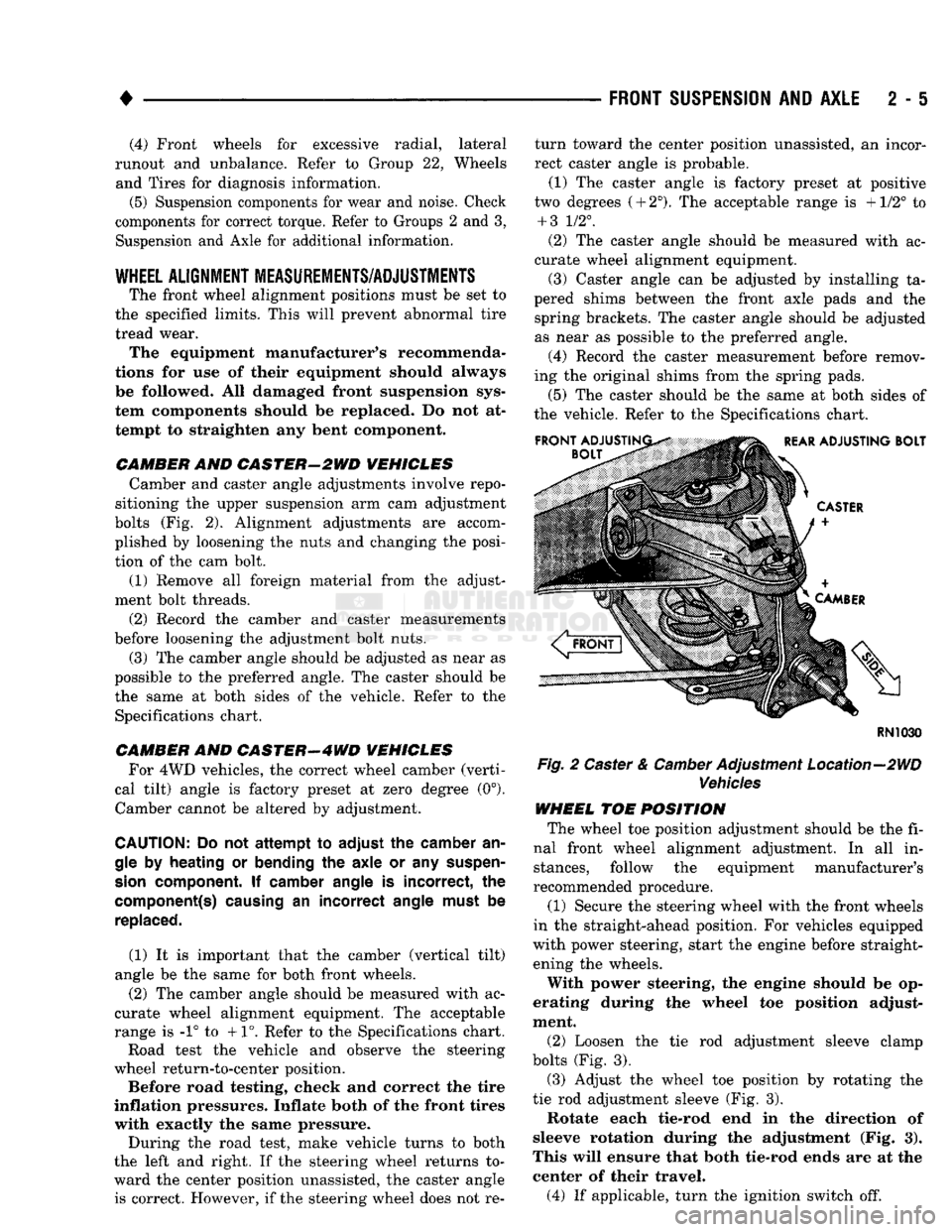
CAMBER AND CASTER-2WD VEHICLES Camber and caster angle adjustments involve repo
sitioning the upper suspension arm cam adjustment
bolts (Fig. 2). Alignment adjustments are accom
plished by loosening the nuts and changing the posi
tion of the cam bolt.
(1) Remove all foreign material from the adjust
ment bolt threads.
(2) Record the camber and caster measurements
before loosening the adjustment bolt nuts.
(3) The camber angle should be adjusted as near as
possible to the preferred angle. The caster should be
the same at both sides of the vehicle. Refer to the Specifications chart.
CAMBER AND CASTER—4WD VEHICLES For 4WD vehicles, the correct wheel camber (verti
cal tilt) angle is factory preset at zero degree (0°).
Camber cannot be altered by adjustment.
CAUTION: Do not attempt to
adjust
the
camber
an
gle by
heating
or bending the axle or any
suspen
sion
component. If camber angle is
incorrect,
the
component(s)
causing
an
incorrect
angle must be replaced.
(1) It is important that the camber (vertical tilt)
angle be the same for both front wheels.
(2) The camber angle should be measured with ac
curate wheel alignment equipment. The acceptable
range is -1° to +1°. Refer to the Specifications chart.
Road test the vehicle and observe the steering
wheel return-to-center position. Before road testing,
check
and
correct
the tire
inflation pressures. Inflate
both
of the front tires
with exactly the
same
pressure.
During the road test, make vehicle turns to both
the left and right. If the steering wheel returns to
ward the center position unassisted, the caster angle is correct. However, if the steering wheel does not re turn toward the center position unassisted, an incor
rect caster angle is probable.
(1) The caster angle is factory preset at positive
two degrees
(
+
2°).
The acceptable range is +1/2° to +
3
1/2°.
(2) The caster angle should be measured with ac
curate wheel alignment equipment.
(3) Caster angle can be adjusted by installing ta
pered shims between the front axle pads and the spring brackets. The caster angle should be adjusted
as near as possible to the preferred angle.
(4) Record the caster measurement before remov
ing the original shims from the spring pads.
(5) The caster should be the same at both sides of
the vehicle. Refer to the Specifications chart.
RN1030
Fig.
2 Caster &
Camber
Adjustment Location—2WD
Vehicles
WHEEL TOE POSITION The wheel toe position adjustment should be the fi
nal front wheel alignment adjustment. In all in stances, follow the equipment manufacturer's
recommended procedure.
(1) Secure the steering wheel with the front wheels
in the straight-ahead position. For vehicles equipped
with power steering, start the engine before straight ening the wheels.
With power steering, the engine should be op
erating during the wheel toe position adjust
ment.
(2) Loosen the tie rod adjustment sleeve clamp
bolts (Fig. 3).
(3) Adjust the wheel toe position by rotating the
tie rod adjustment sleeve (Fig. 3). Rotate each tie-rod end in the direction of
sleeve rotation during the adjustment (Fig. 3).
This will ensure that both tie-rod ends are at the center of their travel.
(4) If applicable, turn the ignition switch off.
Page 61 of 1502
2
- 8
FRONT SUSPENSION
AND
AXLE
• INSTALLATION
(1) If a bearing and cup must be replaced, remove
the cup from the wheel hub/rotor bore (Fig. 1). Use a
brass drift or an appropriate removal tool to tap out
the cup.
(2) Install the replacement bearing cup(s) with an
appropriate installation tool. (3) Apply lubricant to surface area of the wheel
hub/rotor bore. Install the inner wheel bearing in the
hub/rotor. Install a replacement bearing seal with an appropriate seal installation tool. (4) Inspect the bearing and seal contact surfaces on
the steering knuckle spindle for burrs and/or rough ness (Fig. 1).
(5) Remove all the rough contact surfaces from the
spindle. Apply a coating of multi-purpose NLGI,
grade 2, EP-type lubricant to the spindle surface.
CAUTION: Us© care to prevent the inner
wheel
bear
ing
and bearing
seal
from contacting the steering
knuckle
spindle
threads during removal (Fig. 1).
Otherwise,
the threads, bearing, and
seal
could
be
damaged.
(6) Carefully slide the wheel hub/rotor onto the
spindle.
Install the outer wheel bearing, the washer and
nut.
(7) Tighten the nut to 41 to 54 Nnn (30 to 40 ft.
lbs.) torque while rotating the wheel hub/rotor. Stop
the hub/rotor and loosen the nut to completely re
lease the bearing preload torque. Next, tighten the
nut finger-tight, install the nut lock. Install a re
placement cotter pin.
(8) The wheel bearing adjustment (above) should
have 0.001 to 0.003 inch (0.254 to 0.0762 mm) end
play.
(9) Clean the dust cap. Apply a coating of multi
purpose NLGI, grade 2, EP-type lubricant to internal surface. Install the cap. Do not fill the dust cap with lubricant. (10) Install the brake caliper, refer to Group 5,
Brakes. (11) Install the wheel and tire, refer to Wheel and
Tire Installation in this section. Lower the vehicle.
LOWER SUSPENSION ARM STRUT
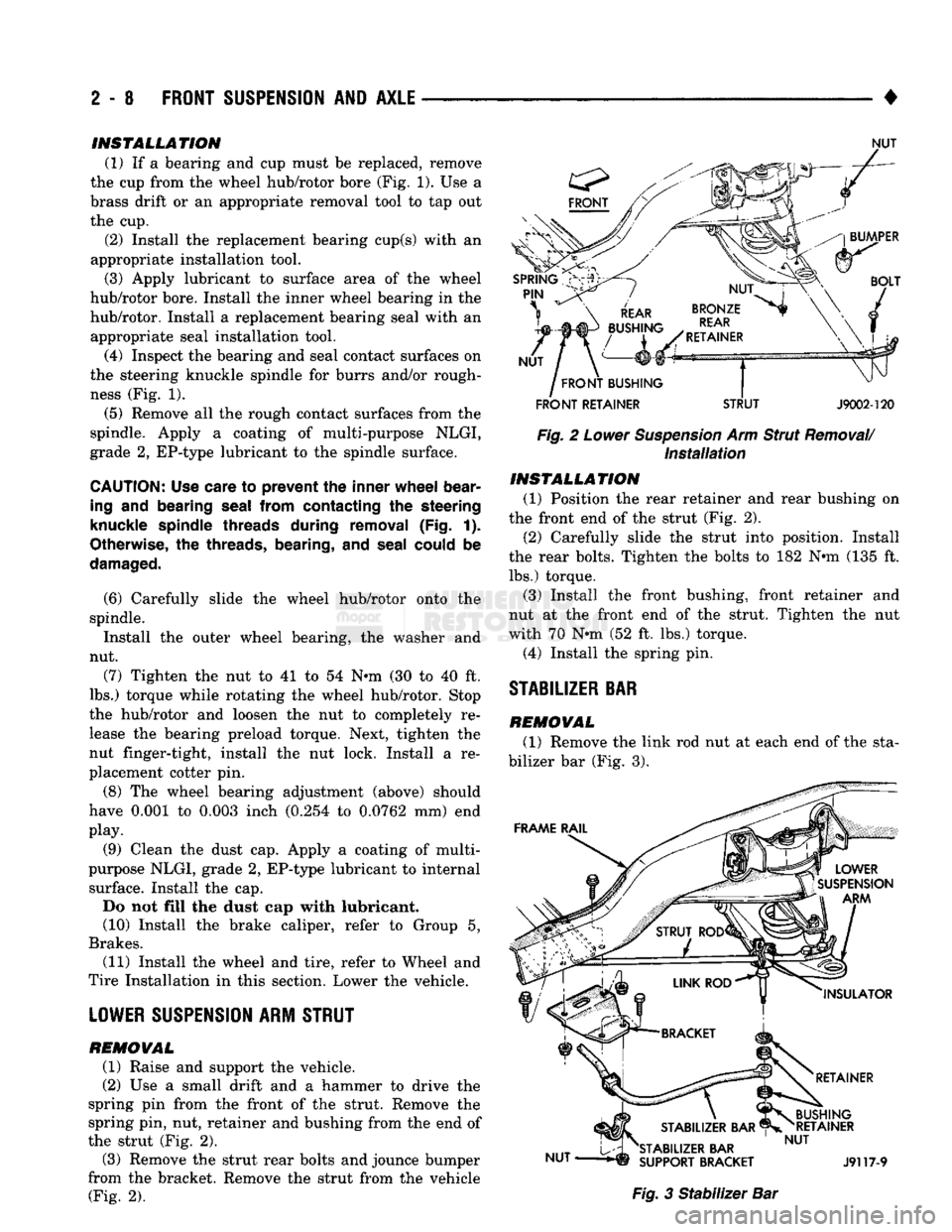
REMOVAL (1) Raise and support the vehicle.
(2) Use a small drift and a hammer to drive the
spring pin from the front of the strut. Remove the
spring pin, nut, retainer and bushing from the end of
the strut (Fig. 2).
(3) Remove the strut rear bolts and jounce bumper
from the bracket. Remove the strut from the vehicle (Fig. 2).
NUT
FRONT
RETAINER
STRUT
J9002-120
Fig. 2 Lower Suspension Arm Strut Removal/ Installation INSTALLATION
(1) Position the rear retainer and rear bushing on
the front end of the strut (Fig. 2).
(2) Carefully slide the strut into position. Install
the rear bolts. Tighten the bolts to 182 Nnn (135 ft. lbs.) torque.
(3) Install the front bushing, front retainer and
nut at the front end of the strut. Tighten the nut
with 70 Nnn (52 ft. lbs.) torque.
(4) Install the spring pin.
STABILIZER
BAR
REMOVAL
(1) Remove the link rod nut at each end of the sta
bilizer bar (Fig. 3). Fig. 3 Stabilizer Bar
Page 63 of 1502
2
- 10
FRONT SUSPENSION
AND
AXLE
• INSTALLATION
(1) Position the spring and isolation pad on the
suspension arm. Install the spring compressor tool.
Compress the spring until the lower suspension arm
can be properly positioned in the steering knuckle.
(2) Install the nuts on the ball studs. Tighten the
upper nut to 142 Nnn (105 ft. lbs.) torque. Tighten
the lower nut.
* 11/16-16 bolt, to 183 Nnn (135 ft. lbs.) torque
• 3/4-16 bolt, to 237 Nnn (175 ft. lbs.) torque Install replacement cotter pins.
(3) Install the strut.
(4) Connect the stabilizer bar.
(5) Install the shock absorber.
(6) Install the brake splash shield on the steering
knuckle. Tighten the screws to 23 Nnn (200 in. lbs.)
torque.
(7) Carefully install the hub/rotor and bearings.
(8) Install the brake caliper, refer to Group 5, Brakes.
(9) Install the wheel and tire, refer to Wheel and Tire
Installation within this section. Lower the vehicle. (10) Test the vehicle brakes and the suspension for
proper operation.
LOWER SUSPENSION
ARM
REMOVAL
(1) Follow procedure under Coil Spring Removal.
(2) Remove hex-head mounting bolt from the cross-
member. (3) Remove the lower suspension arm from vehicle.
INSTALLATION (1) Position lower suspension arm on vehicle.
(2) Install mounting bolt, tighten finger-tight.
(3) Follow procedure under Coil Spring Installa
tion.
(4) Lower the vehicle to the surface with the
wheels/tires supporting the vehicle weight. Tighten
the lower suspension arm mounting bolt to 305 Nnn (225 ft. lbs.) torque.
LOWER
BALL
STUD
INSPECTION
(1) Raise the front of the vehicle. Install safety
floor stands under both lower suspension arms as far outboard as possible. The upper suspension arms
must not contact the rebound bumpers. (2) Install a dial indicator and clamp assembly to
the lower suspension arm. (3) Position indicator plunger against knuckle arm
and zero indicator. (4) Raise and lower the wheel with a pry bar under
the center of the tire. Measure the axial movement of
the knuckle with respect to the suspension arm.
(5) If the travel of the suspension arm is 0.020
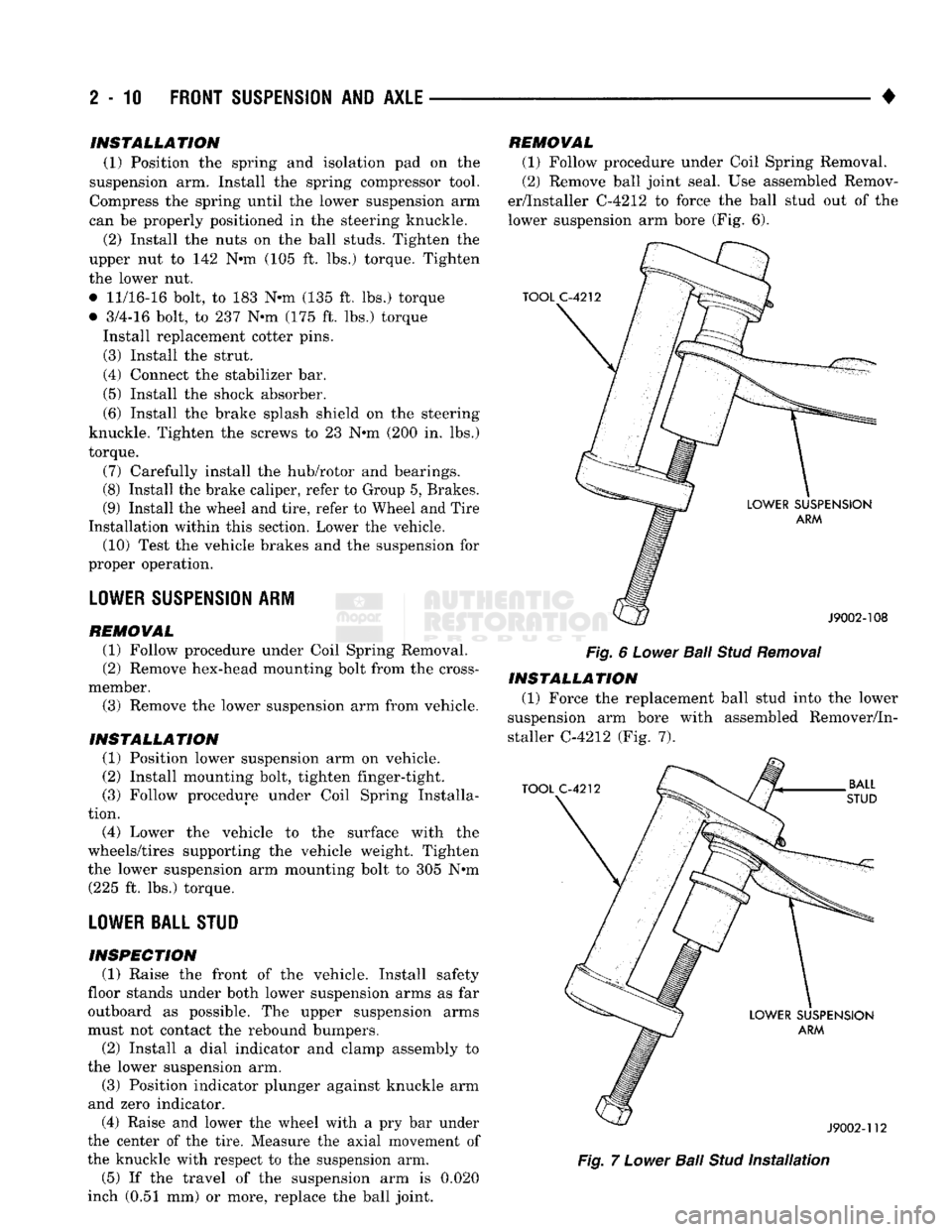
inch (0.51 mm) or more, replace the ball joint. REMOVAL
(1) Follow procedure under Coil Spring Removal.
(2) Remove ball joint seal. Use assembled Remov
er/Installer C-4212 to force the ball stud out of the
lower suspension arm bore (Fig. 6).
Fig.
6
Lower
Bail
Stud
Removal
INSTALLATION (1) Force the replacement ball stud into the lower
suspension arm bore with assembled Remover/In
staller C-4212 (Fig. 7).
Fig.
7
Lower
Ball
Stud
Installation
Page 64 of 1502
•
FRONT
SUSPENSION
AND
AXLE
2 - 11 (2) Position the seal over the ball stud (if neces
sary, use a replacement seal). Force portion of the
seal downward on the ball stud housing with an ap
propriate size socket wrench until it is securely locked in place.
(3) Install lower suspension arm using procedure
under Lower Suspension Arm Installation.
LOWER SUSPENSION
ARM
BUSHING
REMOVAL (1) Follow procedure under Coil Spring and Lower
Suspension Arm Removal.
(2) Use an arbor press and an appropriate size
sleeve to force the original bushing from the lower
suspension arm bore.
INSTALLATION (1) Use an arbor press and an appropriate size
sleeve to force the replacement bushing into the
lower suspension arm bore. Ensure that it is com
pletely seated in the bore.
(2) Install the lower suspension arm according to in
structions provided within the installation procedure.
UPPER SUSPENSION
ARM REMOVAL (1) Raise the vehicle. Position support stands un
der the frame rail and lower the front of the hoist.
Remove the wheel/tire.
(2) Remove shock absorber, refer to above proce
dures.
(3) Install Spring Compressor DD-1278 (Fig. 5).
Tighten the nut finger-tight and then loosen it 1/2 of- a-turn.
(4) Remove the cotter pins and the ball stud nuts.
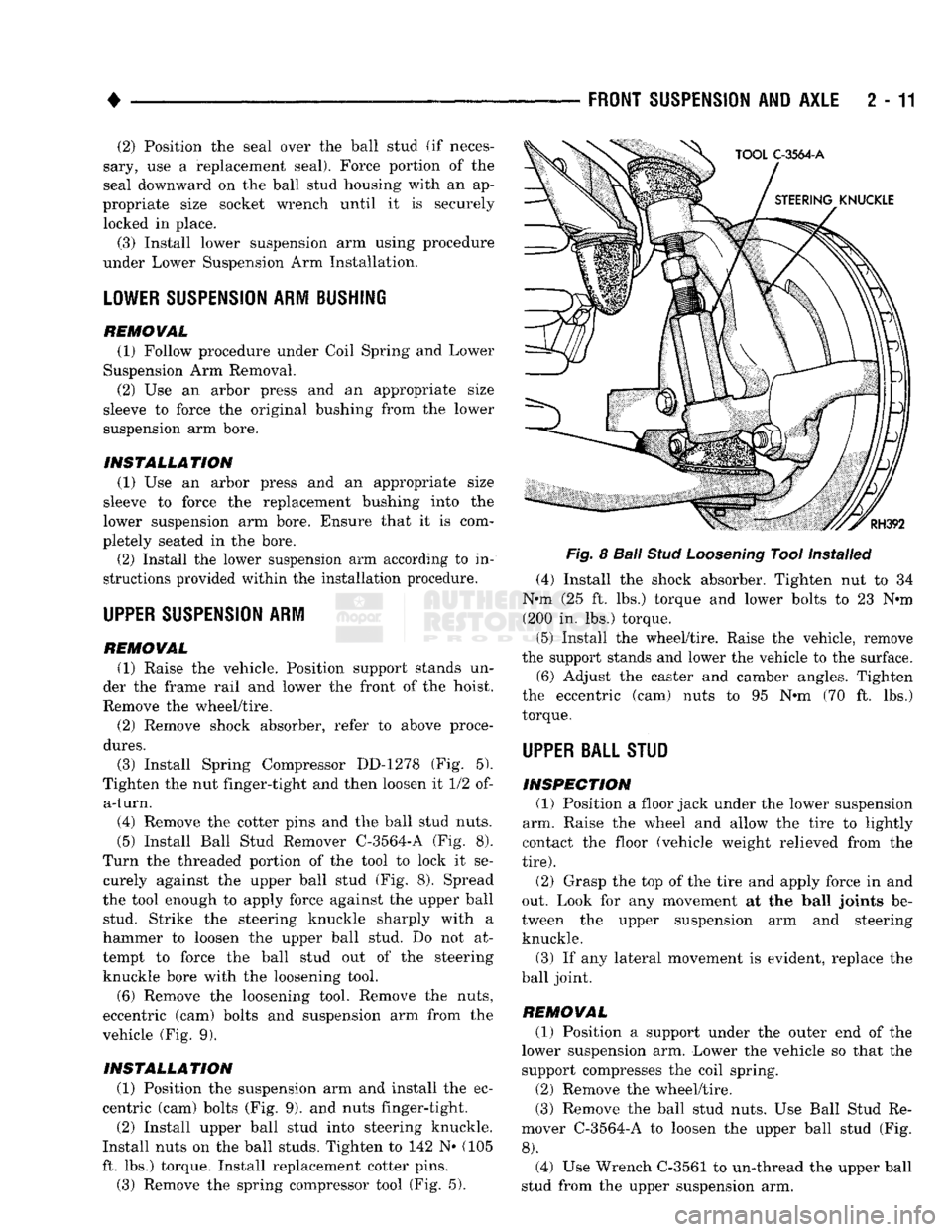
(5) Install Ball Stud Remover C^3564-A (Fig. 8).
Turn the threaded portion of the tool to lock it se curely against the upper ball stud (Fig. 8). Spread
the tool enough to apply force against the upper ball stud. Strike the steering knuckle sharply with a
hammer to loosen the upper ball stud. Do not at
tempt to force the ball stud out of the steering knuckle bore with the loosening tool.
(6) Remove the loosening tool. Remove the nuts,
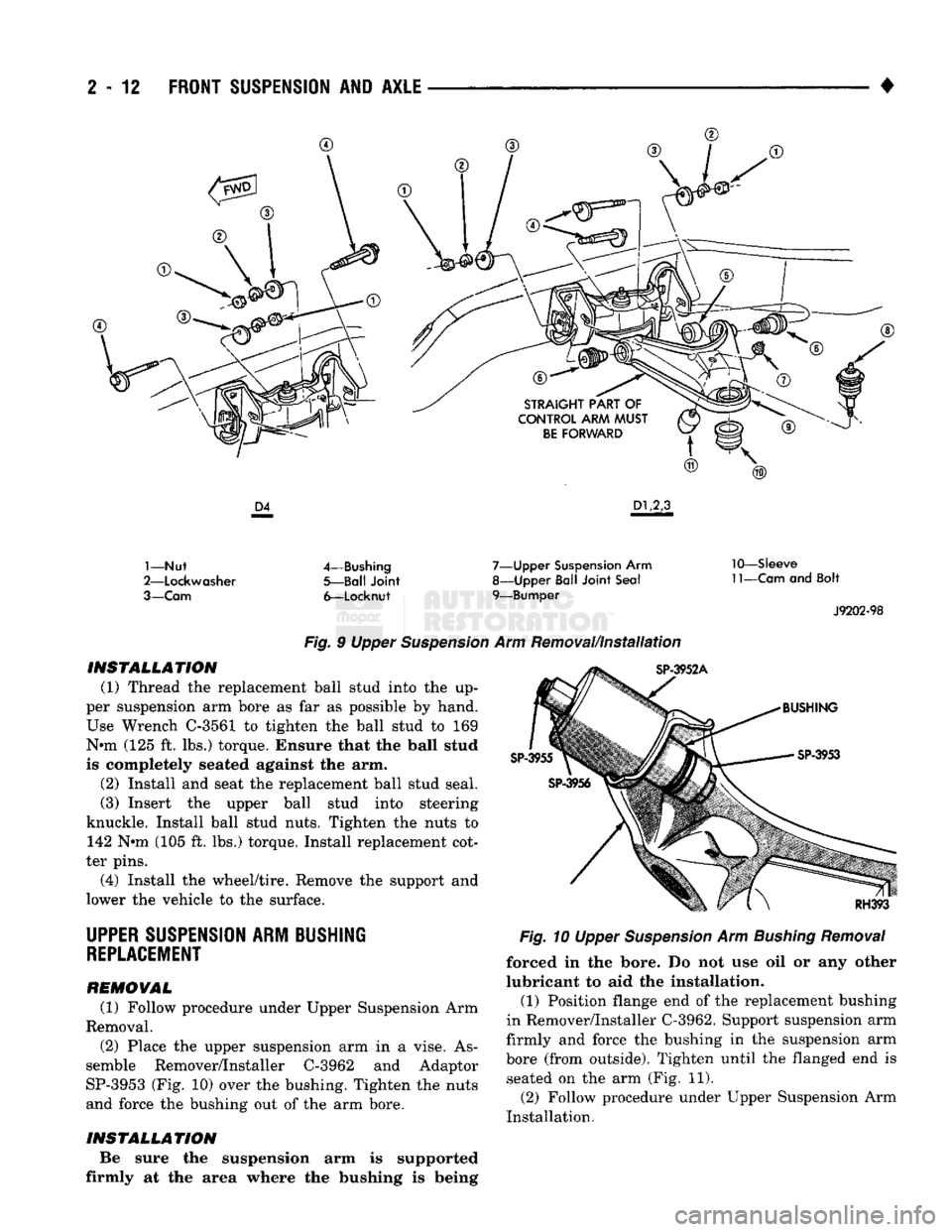
eccentric (cam) bolts and suspension arm from the
vehicle (Fig. 9).
INSTALLATION (1) Position the suspension arm and install the ec
centric (cam) bolts (Fig. 9). and nuts finger-tight.
(2) Install upper ball stud into steering knuckle.
Install nuts on the ball studs. Tighten to 142 N« (105
ft. lbs.) torque. Install replacement cotter pins.
(3) Remove the spring compressor tool (Fig. 5).
Fig.
8
Ball
Stud
Loosening
Tool Installed
(4) Install the shock absorber. Tighten nut to 34
N*m (25 ft. lbs.) torque and lower bolts to 23 N*m (200 in. lbs.) torque.
(5) Install the wheel/tire. Raise the vehicle, remove
the support stands and lower the vehicle to the surface.
(6) Adjust the caster and camber angles. Tighten
the eccentric (cam) nuts to 95 N*m (70 ft. lbs.)
torque.
UPPER BALL STUD
INSPECTION (1) Position a floor jack under the lower suspension
arm. Raise the wheel and allow the tire to lightly
contact the floor (vehicle weight relieved from the
tire).
(2) Grasp the top of the tire and apply force in and
out. Look for any movement at the ball joints be
tween the upper suspension arm and steering knuckle.
(3) If any lateral movement is evident, replace the
ball joint.
REMOVAL (1) Position a support under the outer end of the
lower suspension arm. Lower the vehicle so that the
support compresses the coil spring.
(2) Remove the wheel/tire.
(3) Remove the ball stud nuts. Use Ball Stud Re
mover C-3564-A to loosen the upper ball stud (Fig.
8).
(4) Use Wrench C-3561 to un-thread the upper ball
stud from the upper suspension arm.
Page 65 of 1502
2
- 12
FRONT
SUSPENSION
AND
AXLE
•
1—Nut
2—Lockwasher
3—Cam
4—Bushing
5—Ball Joint
6—Locknut
7—Upper
Suspension
Arm
8—Upper Ball Joint Seal
9—Bumper
10—Sleeve
11—Cam
and Bolt
J9202-98
SP-3952A
Fig.
9 Upper
Suspension
Arm Removal/Installation
INSTALLATION
(1) Thread the replacement ball stud into the up
per suspension arm bore as far as possible by hand.
Use Wrench C-3561 to tighten the ball stud to 169
N«m (125 ft. lbs.) torque. Ensure that the ball stud
is completely seated against the arm.
(2) Install and seat the replacement ball stud seal.
(3) Insert the upper ball stud into steering
knuckle. Install ball stud nuts. Tighten the nuts to 142 N#m (105 ft. lbs.) torque. Install replacement cot
ter pins.
(4) Install the wheel/tire. Remove the support and
lower the vehicle to the surface.
BUSHING
SP-3953
RH393
UPPER
SUSPENSION
ARM BUSHING
REPLACEMENT
REMOVAL
(1) Follow procedure under Upper Suspension Arm
Removal.
(2) Place the upper suspension arm in a vise. As
semble Remover/Installer C-3962 and Adaptor
SP-3953 (Fig. 10) over the bushing. Tighten the nuts and force the bushing out of the arm bore.
INSTALLATION
Be sure the suspension arm is supported
firmly at the area where the bushing is being
Fig.
10 Upper
Suspension
Arm
Bushing
Removal
forced in the bore. Do not use oil or any other
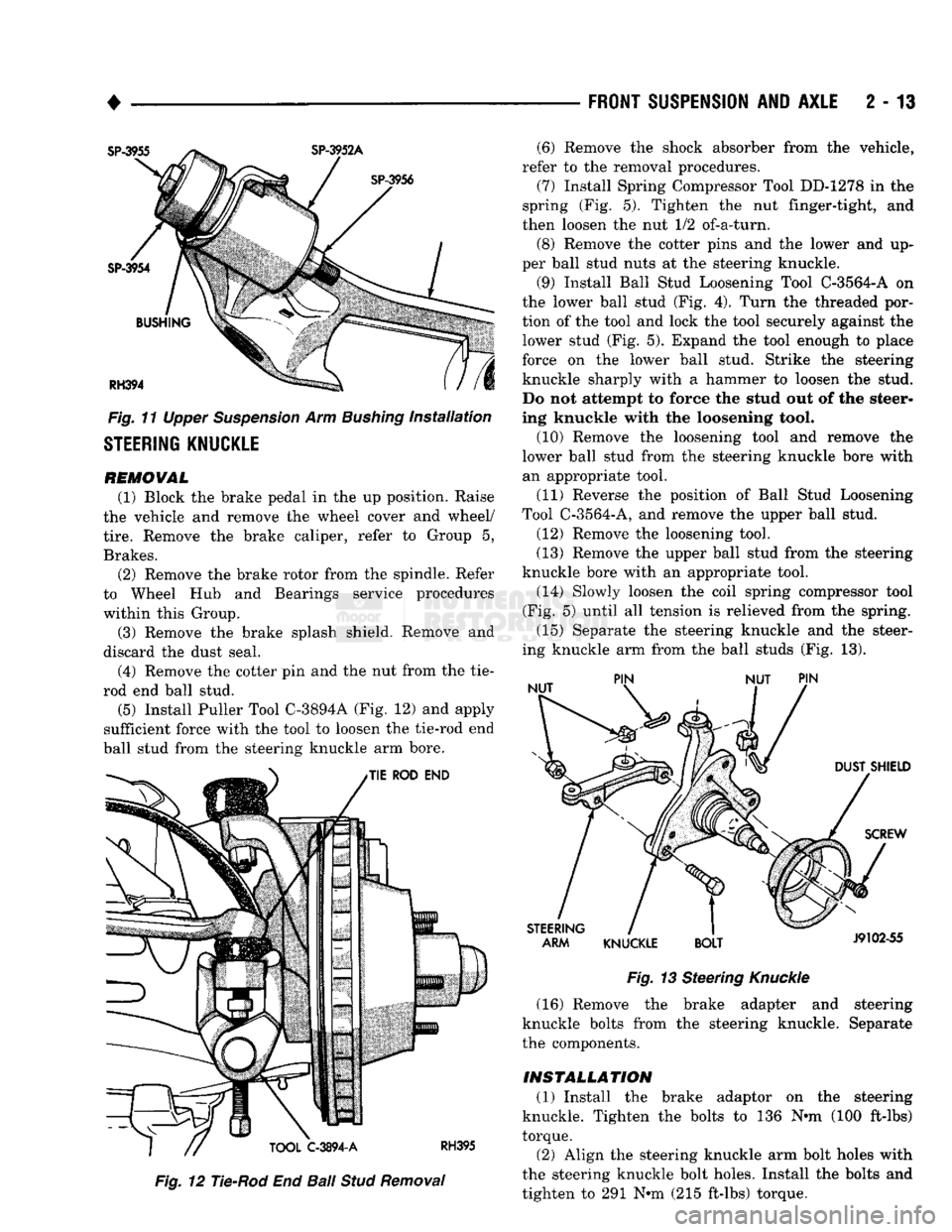
lubricant to aid the installation. (1) Position flange end of the replacement bushing
in Remover/Installer C-3962. Support suspension arm
firmly and force the bushing in the suspension arm
bore (from outside). Tighten until the flanged end is seated on the arm (Fig. 11).
(2) Follow procedure under Upper Suspension Arm
Installation.
Page 66 of 1502
•
Fig.
11 Upper Suspension Arm Bushing installation
STEERING KNUCKLE
REMOVAL
(1) Block the brake pedal in the up position. Raise
the vehicle and remove the wheel cover and wheel/
tire.
Remove the brake caliper, refer to Group 5,
Brakes. (2) Remove the brake rotor from the spindle. Refer
to Wheel Hub and Bearings service procedures
within this Group.
(3) Remove the brake splash shield. Remove and
discard the dust seal.
(4) Remove the cotter pin and the nut from the tie-
rod end ball stud.
(5)
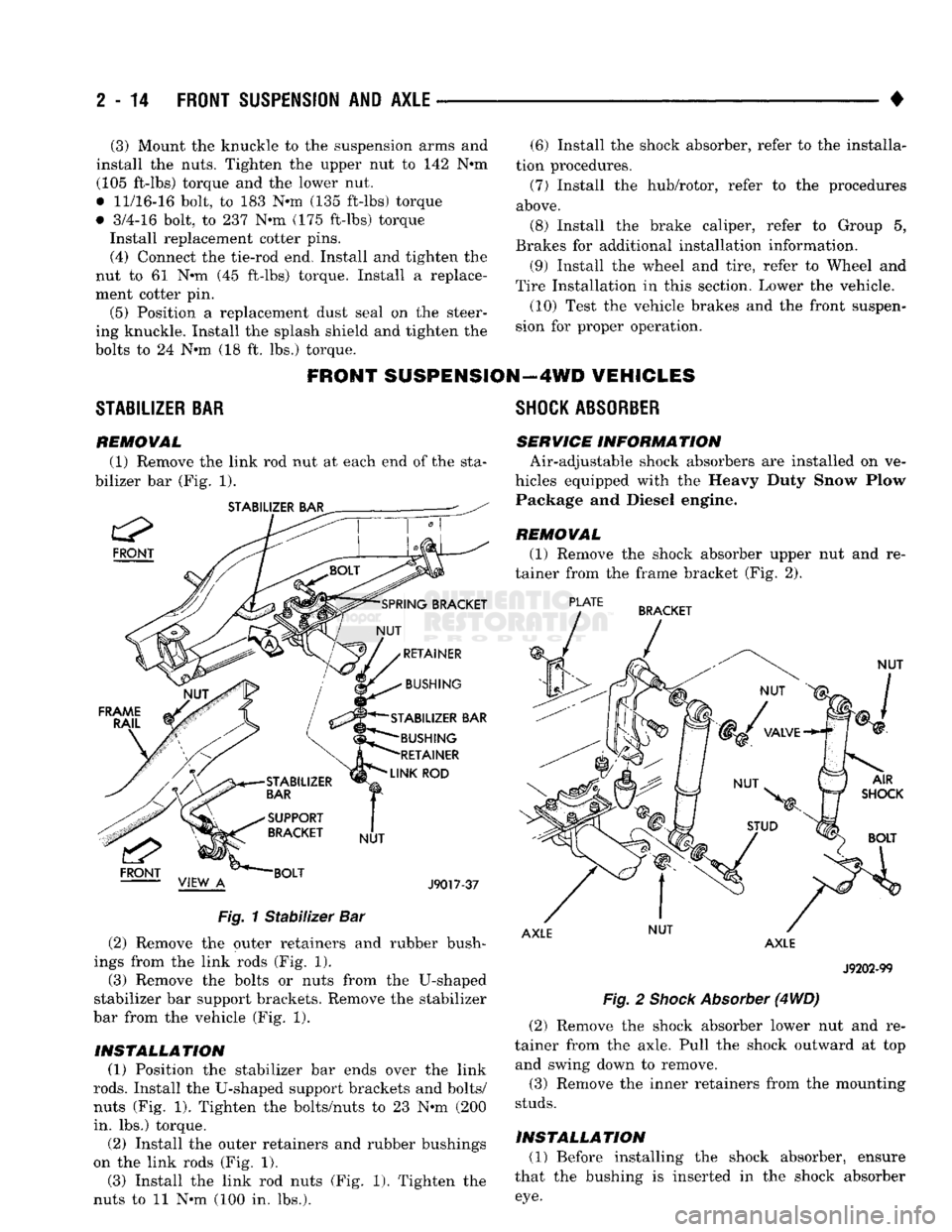
Install Puller Tool C-3894A (Fig. 12) and apply
sufficient force with the tool to loosen the tie-rod end
ball stud from the steering knuckle arm bore.
Fig.
12 Tie-Rod End
Ball
Stud
Removal
FRONT SUSPENSION
AND
AXLE
2 - 13
Fig.
13 Steering
Knuckle
(16) Remove the brake adapter and steering
knuckle bolts from the steering knuckle. Separate
the components.
INSTALLATION (1) Install the brake adaptor on the steering
knuckle. Tighten the bolts to 136 Nnn (100 ft-lbs)
torque.
(2) Align the steering knuckle arm bolt holes with
the steering knuckle bolt holes. Install the bolts and
tighten to 291 Nnn (215 ft-lbs) torque. (6) Remove the shock absorber from the vehicle,
refer to the removal procedures. (7) Install Spring Compressor Tool DD-1278 in the
spring (Fig. 5). Tighten the nut finger-tight, and
then loosen the nut 1/2 of-a-turn.
(8) Remove the cotter pins and the lower and up
per ball stud nuts at the steering knuckle.
(9) Install Ball Stud Loosening Tool C-3564-A on
the lower ball stud (Fig. 4). Turn the threaded por
tion of the tool and lock the tool securely against the lower stud (Fig. 5). Expand the tool enough to place
force on the lower ball stud. Strike the steering
knuckle sharply with a hammer to loosen the stud.
Do not attempt to force the stud out of the steer
ing knuckle with the loosening tool.
(10) Remove the loosening tool and remove the
lower ball stud from the steering knuckle bore with an appropriate tool.
(11) Reverse the position of Ball Stud Loosening
Tool C-3564-A, and remove the upper ball stud.
(12) Remove the loosening tool.
(13) Remove the upper ball stud from the steering
knuckle bore with an appropriate tool. (14) Slowly loosen the coil spring compressor tool
(Fig. 5) until all tension is relieved from the spring.
(15) Separate the steering knuckle and the steer
ing knuckle arm from the ball studs (Fig. 13).
Page 67 of 1502
2
- 14
FRONT SUSPENSION
AND
AXLE
• (3) Mount the knuckle to the suspension arms and
install the nuts. Tighten the upper nut to 142 Nnn (105 ft-lbs) torque and the lower nut.
• 11/16-16 bolt, to 183 Nnn (135 ft-lbs) torque
• 3/4-16 bolt, to 237 Nnn (175 ft-lbs) torque Install replacement cotter pins. (4) Connect the tie-rod end. Install and tighten the
nut to 61 Nnn (45 ft-lbs) torque. Install a replace
ment cotter pin. (5) Position a replacement dust seal on the steer
ing knuckle. Install the splash shield and tighten the
bolts to 24 Nnn (18 ft. lbs.) torque. (6) Install the shock absorber, refer to the installa
tion procedures.
(7) Install the hub/rotor, refer to the procedures
above.
(8) Install the brake caliper, refer to Group 5,
Brakes for additional installation information.
(9)
Install the wheel and tire, refer to Wheel and
Tire Installation in this section. Lower the vehicle.
(10) Test the vehicle brakes and the front suspen
sion for proper operation.
FRONT
SUSPENSION—4WD VEHICLES
STABILIZER
BAR REMOVAL
(1) Remove the link rod nut at each end of the sta
bilizer bar (Fig. 1).
STABILIZER BAR
FRONT
STABILIZER BAR BUSHING
RETAINER
LINK
ROD
J9017-37
Fig.
1
Stabilizer
Bar (2) Remove the outer retainers and rubber bush
ings from the link rods (Fig. 1). (3) Remove the bolts or nuts from the U-shaped
stabilizer bar support brackets. Remove the stabilizer
bar from the vehicle (Fig. 1).
INSTALLATION (1) Position the stabilizer bar ends over the link
rods.
Install the U-shaped support brackets and bolts/
nuts (Fig. 1). Tighten the bolts/nuts to 23 Nnn (200
in. lbs.) torque.
(2) Install the outer retainers and rubber bushings
on the link rods (Fig. 1). (3) Install the link rod nuts (Fig. 1). Tighten the
nuts to 11 Nnn (100 in. lbs.).
SHOCK
ABSORBER
SERVICE INFORM
A TION Air-adjustable shock absorbers are installed on ve
hicles equipped with the Heavy Duty Snow Plow Package and Diesel engine.
REMOVAL
(1) Remove the shock absorber upper nut and re
tainer from the frame bracket (Fig. 2).
PLATE
BRACKET
NUT
AXLE NUT
AXLE
J9202-99
Fig.
2
Shock
Absorber
(4
WD)
(2) Remove the shock absorber lower nut and re
tainer from the axle. Pull the shock outward at top and swing down to remove.
(3) Remove the inner retainers from the mounting
studs.
INSTALLATION (1) Before installing the shock absorber, ensure
that the bushing is inserted in the shock absorber
eye.
Page 74 of 1502
•
Fig.
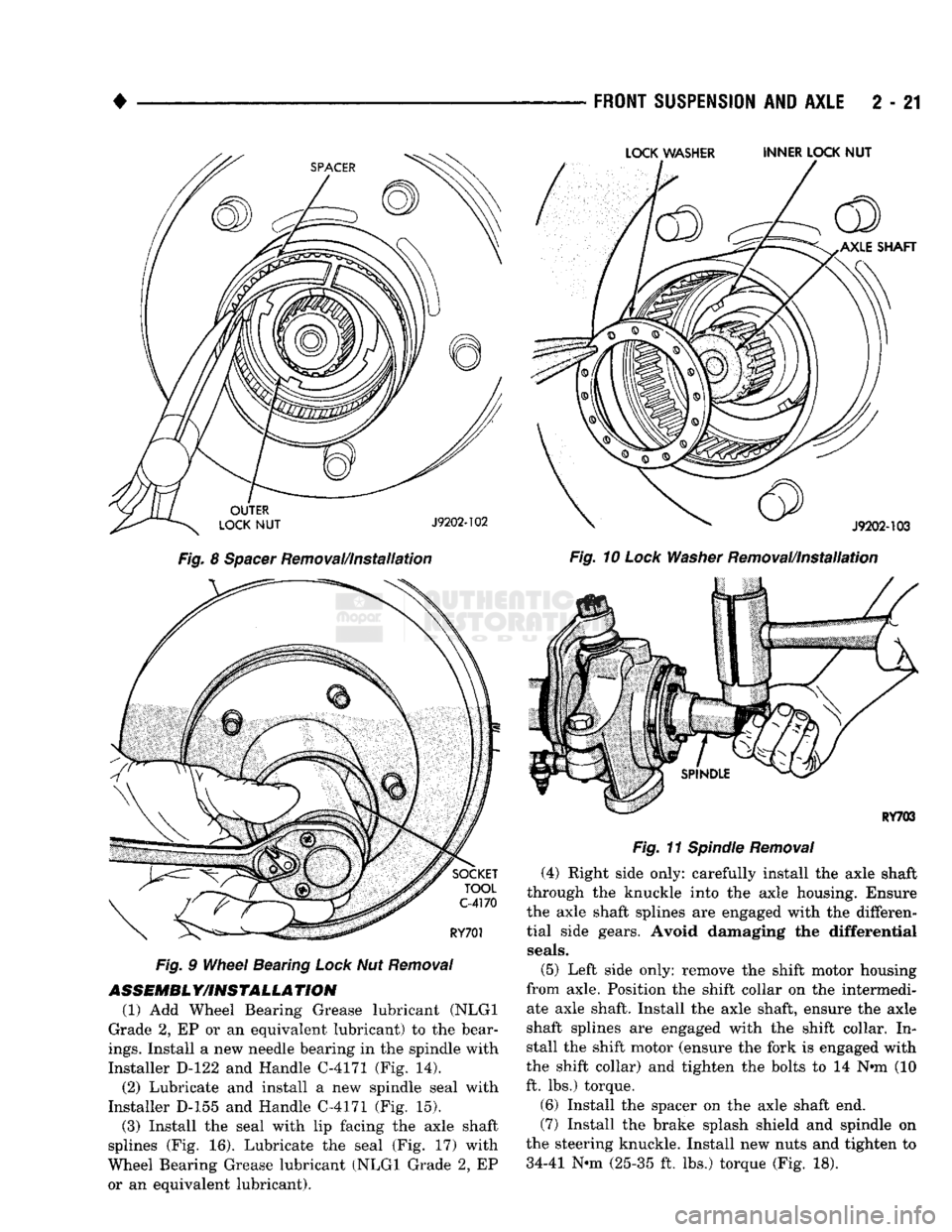
8
Spacer
Removal/Installation
Fig.
9
Wheel
Bearing
Lock
Nut
Removal
ASSEMBL
Y/INSTALLA
TION
(1) Add Wheel Bearing Grease lubricant (NLGI
Grade 2, EP or an equivalent lubricant) to the bear
ings.
Install a new needle bearing in the spindle with
Installer D-122 and Handle C-4171 (Fig. 14).
(2) Lubricate and install a new spindle seal with
Installer D-155 and Handle C-4171 (Fig. 15).
(3) Install the seal with lip facing the axle shaft
splines (Fig. 16). Lubricate the seal (Fig. 17) with
Wheel Bearing Grease lubricant (NLGI Grade 2, EP or an equivalent lubricant).
FRONT
SUSPENSION
AND
AXLE
2 - 21
LOCK
WASHER INNER LOCK
NUT
Fig.
10
Lock
Washer
Removal/Installation
Fig.
11
Spindle
Removal
(4) Right side only: carefully install the axle shaft
through the knuckle into the axle housing. Ensure
the axle shaft splines are engaged with the differen
tial side gears. Avoid damaging the differential
seals.
(5) Left side only: remove the shift motor housing
from axle. Position the shift collar on the intermedi ate axle shaft. Install the axle shaft, ensure the axle
shaft splines are engaged with the shift collar. In stall the shift motor (ensure the fork is engaged with
the shift collar) and tighten the bolts to 14 Nnn (10
ft. lbs.) torque.
(6) Install the spacer on the axle shaft end.
(7) Install the brake splash shield and spindle on
the steering knuckle. Install new nuts and tighten to 34-41 Nnn (25-35 ft. lbs.) torque (Fig. 18).
Page 112 of 1502
•
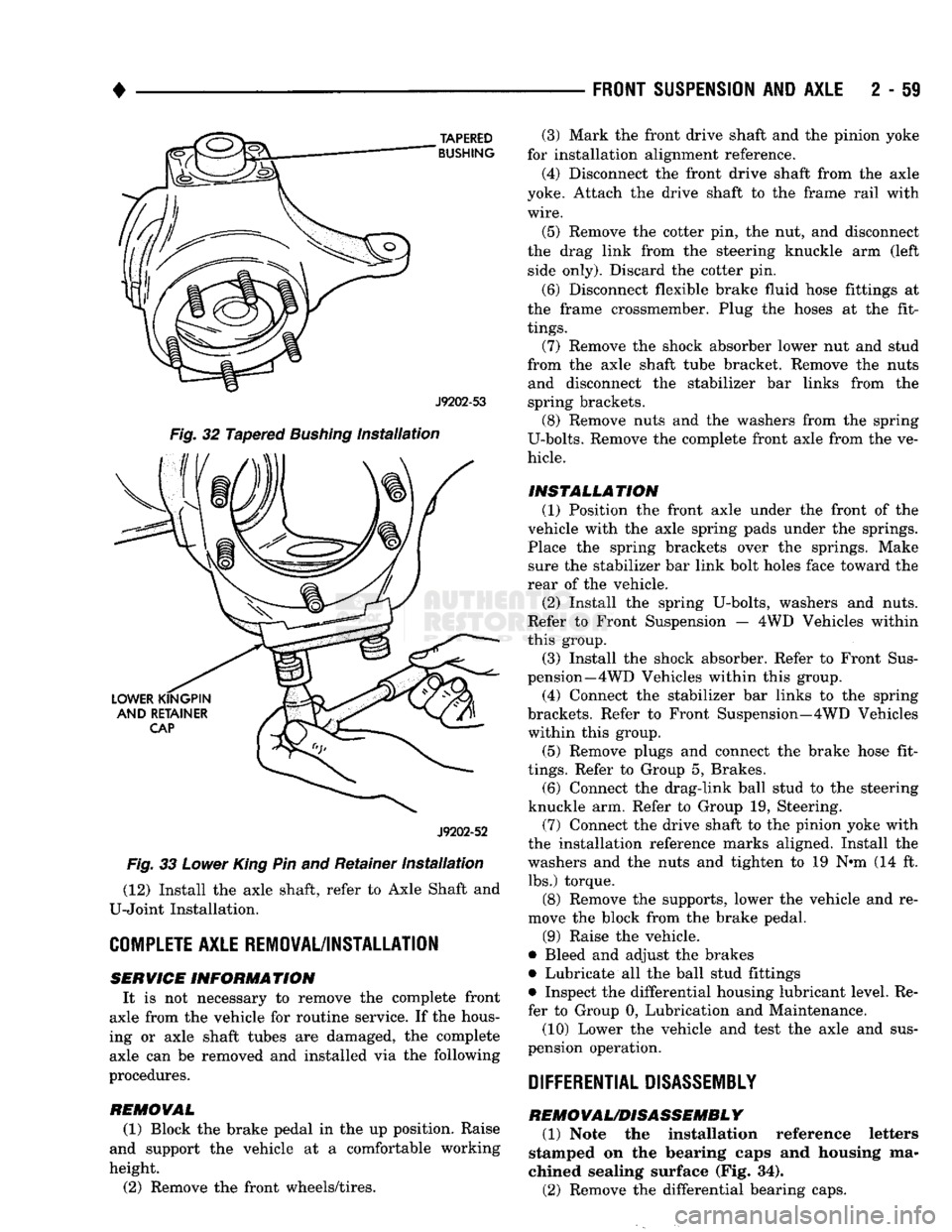
TAPERED
BUSHING
J9202-53
Fig.
32 Tapered
Bushing
Installation
J9202-52
Fig.
33
Lower
King
Pin and Retainer
Installation
(12) Install the axle shaft, refer to Axle Shaft and
U-Joint Installation.
COMPLETE
AXLE REMOVAL/INSTALLATION SERVICE
INFORMATION
It is not necessary to remove the complete front
axle from the vehicle for routine service. If the hous
ing or axle shaft tubes are damaged, the complete axle can be removed and installed via the following
procedures.
REMOVAL
(1) Block the brake pedal in the up position. Raise
and support the vehicle at a comfortable working
height.
(2) Remove the front wheels/tires.
FRONT SUSPENSION
AND
AXLE
2 - 59
(3) Mark the front drive shaft and the pinion yoke
for installation alignment reference.
(4) Disconnect the front drive shaft from the axle
yoke. Attach the drive shaft to the frame rail with
wire.
(5) Remove the cotter pin, the nut, and disconnect
the drag link from the steering knuckle arm (left side only). Discard the cotter pin.
(6) Disconnect flexible brake fluid hose fittings at
the frame crossmember. Plug the hoses at the fit
tings.
(7) Remove the shock absorber lower nut and stud
from the axle shaft tube bracket. Remove the nuts and disconnect the stabilizer bar links from the
spring brackets. (8) Remove nuts and the washers from the spring
U-bolts. Remove the complete front axle from the ve
hicle.
INSTALLATION (1) Position the front axle under the front of the
vehicle with the axle spring pads under the springs.
Place the spring brackets over the springs. Make sure the stabilizer bar link bolt holes face toward the
rear of the vehicle.
(2) Install the spring U-bolts, washers and nuts.
Refer to Front Suspension — 4WD Vehicles within
this group. (3) Install the shock absorber. Refer to Front Sus
pension—4 WD Vehicles within this group.
(4) Connect the stabilizer bar links to the spring
brackets. Refer to Front Suspension—4WD Vehicles within this group.
(5) Remove plugs and connect the brake hose fit
tings.
Refer to Group 5, Brakes. (6) Connect the drag-link ball stud to the steering
knuckle arm. Refer to Group 19, Steering. (7) Connect the drive shaft to the pinion yoke with
the installation reference marks aligned. Install the
washers and the nuts and tighten to 19 N-m (14 ft. lbs.) torque.
(8) Remove the supports, lower the vehicle and re
move the block from the brake pedal.
(9) Raise the vehicle.
• Bleed and adjust the brakes
• Lubricate all the ball stud fittings
• Inspect the differential housing lubricant level. Re
fer to Group 0, Lubrication and Maintenance.
(10) Lower the vehicle and test the axle and sus
pension operation.
DIFFERENTIAL DISASSEMBLY
REMOVAL/DISASSEMBLY
(1) Note the installation reference letters
stamped on the bearing caps and housing ma
chined sealing surface (Fig. 34).
(2) Remove the differential bearing caps.