wheel bolt torque DODGE TRUCK 1993 Service Service Manual
[x] Cancel search | Manufacturer: DODGE, Model Year: 1993, Model line: TRUCK, Model: DODGE TRUCK 1993Pages: 1502, PDF Size: 80.97 MB
Page 817 of 1502
13
- 30 FRAME AND BUMPERS
ATTACHED COMPONENTS
SKID
PLATES
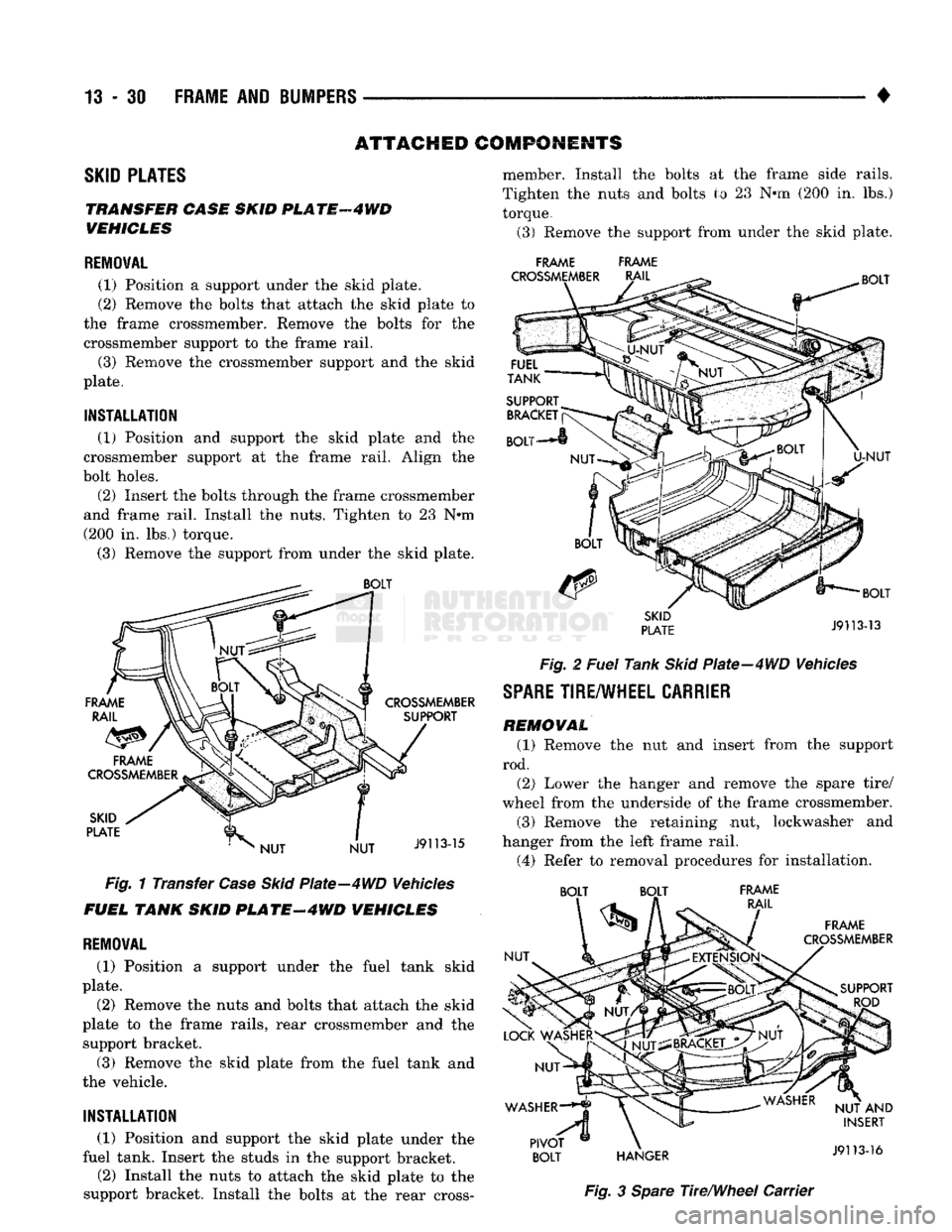
TRANSFER CASE SKID
PL
ATF
4 WD
VEHICLES
REMOVAL
(1) Position
a
support under
the
skid plate.
(2) Remove
the
bolts that attach
the
skid plate
to
the frame crossmember. Remove
the
bolts
for the
crossmember support
to the
frame rail.
(3) Remove
the
crossmember support
and the
skid
plate.
INSTALLATION
(1) Position
and
support
the
skid plate
and the
crossmember support
at the
frame rail. Align
the
bolt holes.
(2) Insert
the
bolts through
the
frame crossmember
and frame rail. Install
the
nuts. Tighten
to 23 N*m
(200
in. lbs.)
torque.
(3) Remove
the
support from under
the
skid plate.
Fig.
1
Transfer
Case Skid
Plate—4WD Vehicles
FUEL TANK SKID
PLATE-4WD
VEHICLES
REMOVAL
(1) Position
a
support under
the
fuel tank skid
plate.
(2) Remove
the
nuts
and
bolts that attach
the
skid
plate
to the
frame rails, rear crossmember
and the
support bracket.
(3) Remove
the
skid plate from
the
fuel tank
and
the vehicle.
INSTALLATION
(1) Position
and
support
the
skid plate under
the
fuel tank. Insert
the
studs
in the
support bracket.
(2) Install
the
nuts
to
attach
the
skid plate
to the
support bracket. Install
the
bolts
at the
rear cross- member. Install
the
bolts
at the
frame side rails.
Tighten
the
nuts
and
bolts
to 23 N*m (200 in. lbs.)
torque.
(3) Remove
the
support from under
the
skid plate.
FRAME FRAME
Fig.
2
Fuel
Tank
Skid
Plate-4WD Vehicles
SPARE
TIRE/WHEEL
CARRIER
REMOVAL
(1) Remove
the nut and
insert from
the
support
rod. (2) Lower
the
hanger
and
remove
the
spare tire/
wheel from
the
underside
of the
frame crossmember.
(3) Remove
the
retaining
nut,
lockwasher
and
hanger from
the
left frame rail.
(4) Refer
to
removal procedures
for
installation. BOLT BOLT FRAME
Fig.
3
Spare
The/Wheel Carrier
Page 927 of 1502
(10) Install air intake heater (with new gasket) in
reverse order of removal.
AIR
INTAKE
HE
A TER
RELA YS
(1) Disconnect negative cable from battery.
(2) Disconnect electrical connections from relays
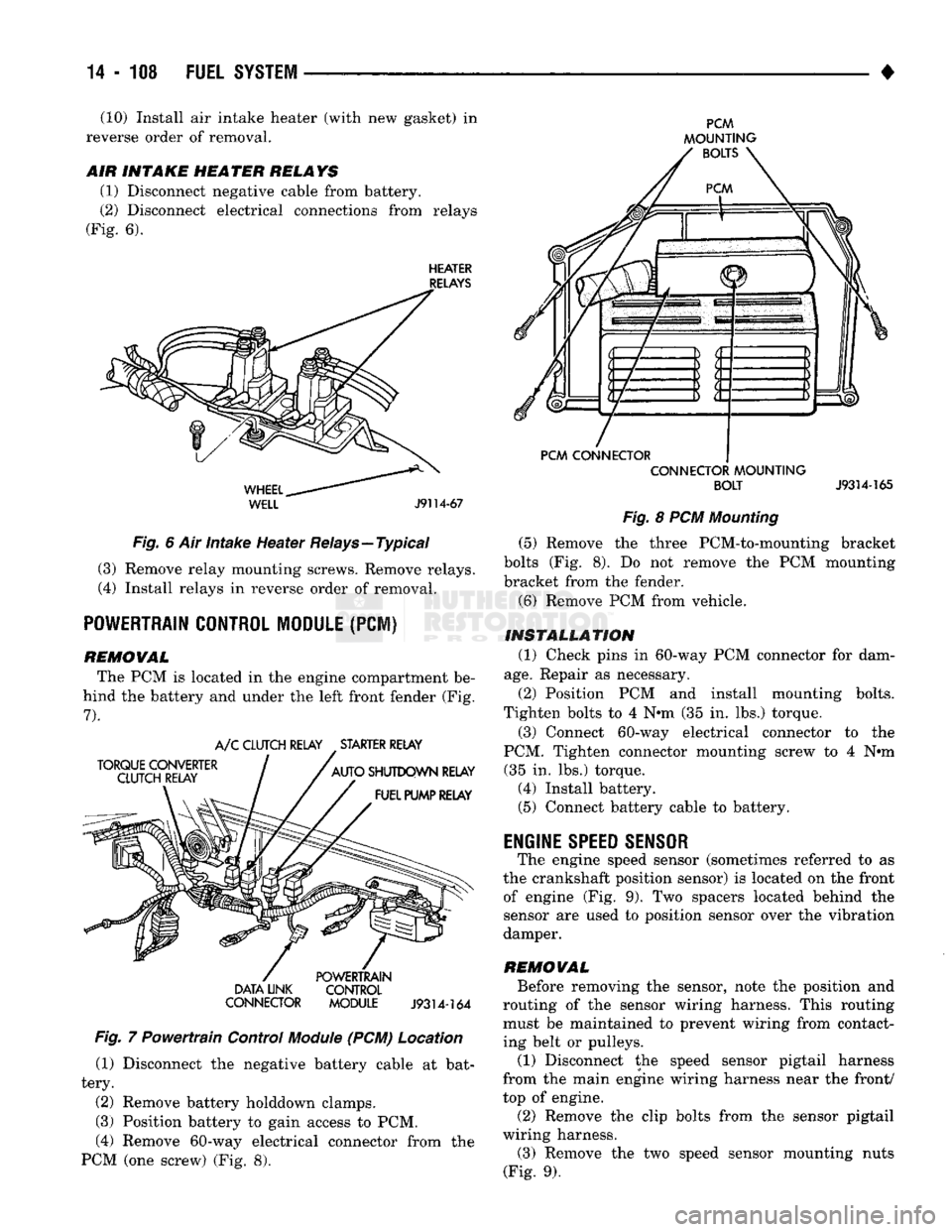
(Fig. 6).
HEATER
RELAYS
WHEEL..
WELL
J9114-67
Fig. 6 Air intake Heater Relays—Typical (3) Remove relay mounting screws. Remove relays.
(4) Install relays in reverse order of removal.
POWERTRAIN CONTROL MODULE
(PCI)
REMOWAL The PCM is located in the engine compartment be
hind the battery and under the left front fender (Fig.
7).
TORQUE CONVERTER
CLUTCH RELAY A/C CLUTCH RELAY STARTER RELAY
AUTO SHUTDOWN RELAY FUEL PUMP RELAY DATA LINK
CONNECTOR POWERTRAIN
CONTROL
MODULE
J9314-164
Fig. 7 Powertrain Control
Module
(PCM) Location (1) Disconnect the negative battery cable at bat
tery.
(2) Remove battery holddown clamps.
(3) Position battery to gain access to PCM,
(4) Remove 60-way electrical connector from the
PCM (one screw) (Fig. 8).
PCM
MOUNTING BOLTS
PCM CONNECTOR CONNECTOR MOUNTING
BOLT
J9314-165
Fig. 8 PCM Mounting (5) Remove the three PCM-to-mounting bracket
bolts (Fig. 8). Do not remove the PCM mounting
bracket from the fender.
(6) Remove PCM from vehicle.
INSTALLATION (1) Check pins in 60-way PCM connector for dam
age.
Repair as necessary.
(2) Position PCM and install mounting bolts.
Tighten bolts to 4 N*m (35 in. lbs.) torque.
(3) Connect 60-way electrical connector to the
PCM. Tighten connector mounting screw to 4 N#m (35 in. lbs.) torque. (4) Install battery. (5) Connect battery cable to battery.
ENGINE
SPEED SENSOR
The engine speed sensor (sometimes referred to as
the crankshaft position sensor) is located on the front of engine (Fig. 9). Two spacers located behind the
sensor are used to position sensor over the vibration
damper.
REMOWAL Before removing the sensor, note the position and
routing of the sensor wiring harness. This routing must be maintained to prevent wiring from contact
ing belt or pulleys.
(1) Disconnect the speed sensor pigtail harness
from the main engine wiring harness near the front/
top of engine.
(2) Remove the clip bolts from the sensor pigtail
wiring harness. (3) Remove the two speed sensor mounting nuts
(Fig. 9).
Page 948 of 1502
•
PROPELLER SHAFTS
16 - 3
SERVICE
DIAGNOSIS/PROCEDURES
INDEX
page page
Precautions . 3 Universal
Joint
Angle Measurement ............ 4
Runout
4
Vibration
3
Unbalance
3
PRECAUTIONS
Propeller shafts are balanced by the manufacturer
to prevent vibration. Before undercoating a vehicle, the propeller shaft and the U-joints should be covered. This will prevent the undercoating from caus
ing an unbalanced condition and vibration. Use exact replacement hardware for attaching the
propeller shafts. Exact replacement will ensure safe operation. The specified torque must always be ap
plied when tightening the fasteners.
VIBRATION
Tires that are out-of-round or wheels that are un
balanced will cause a low frequency vibration. Refer to Group 22, Tires And Wheels for service informa
tion. Brake drums that are unbalanced will cause harsh,
low frequency vibration. Refer to Group 5, Brakes for
service information. Driveline vibration can also result from loose or
damaged engine mounts. Refer to Group 21, Trans
missions for additional information. Propeller shaft vibration will increase as the vehi
cle speed is increased. A vibration that occurs within a specific speed range is not caused by propeller
shaft unbalance. Defective U-joints or an incorrect
propeller shaft angle are usually the cause.
UNBALANCE
If propeller shaft unbalance is suspected, it can be
verified with the following procedure. Removing and re-indexing the propeller shaft
180° may eliminate some vibrations. (1) Raise and support the vehicle.
(2) Clean all foreign material from propeller shaft
and U-joints. (3) Inspect propeller shaft for missing balance
weights, broken welds, and bent areas. If the pro
peller shaft is bent, it must be replaced. (4) Ensure the U-joints are not worn and are prop
erly installed. (5) Check the U-joint clamp screws torque.
(6) Remove wheels and tires. Install wheel lug
nuts to retain brake drums in place. (7) Mark and number the shaft at four positions
90° apart, six inches from the yoke weld end.
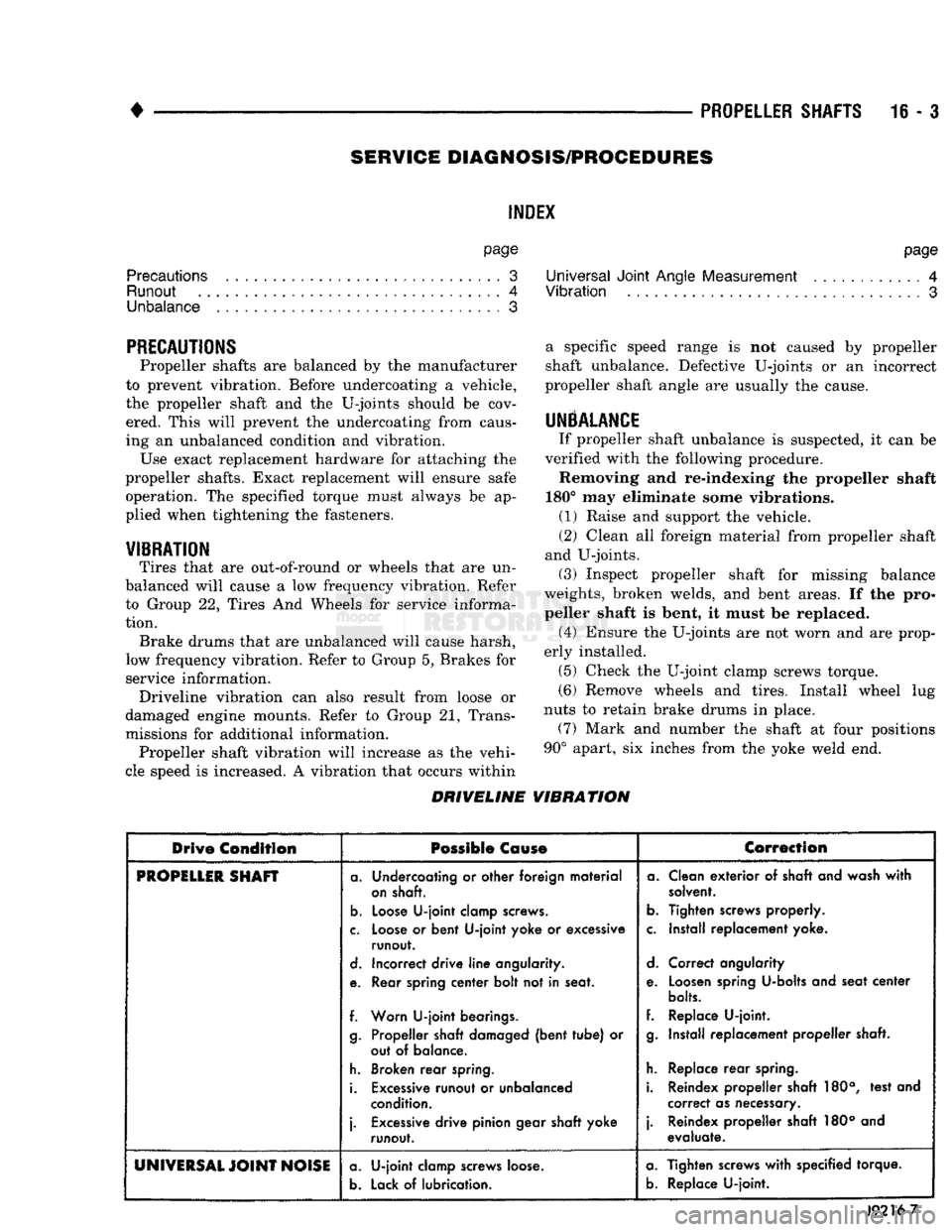
DRIVELINE VIBRATION
Drive
Condition
Possible Cause
Correction
PROPiLLlR
SHAFT
a. Undercoating or other foreign material
on shaft.
b.
Loose U-joint clamp screws.
c. Loose or bent U-joint yoke or excessive runout.
d. Incorrect drive line angularity.
e. Rear spring center bolt not in seat.
f. Worn U-joint bearings. g. Propeller shaft damaged (bent tube) or out of balance.
h. Broken rear spring.
i. Excessive runout or unbalanced condition.
j.
Excessive drive pinion gear shaft yoke runout. a. Clean exterior of shaft and wash with
solvent.
b.
Tighten screws properly.
c. Install replacement yoke.
d. Correct angularity
e. Loosen spring U-bolts and seat center
bolts.
f. Replace U-joint. g. Install replacement propeller shaft.
h. Replace rear spring.
i. Reindex propeller shaft 180°, test and correct as necessary.
j.
Reindex propeller shaft 180° and evaluate.
UNIVERSAL
JOINT
NOISE a. U-joint clamp screws loose.
b.
Lack of lubrication. a. Tighten screws with specified torque.
b.
Replace U-joint.
J9216-7
Page 962 of 1502
•
STEERING STEERING
19-1
CONTENTS
page
GENERAL INFORMATION
1
POWER STEERING PUMP
11
POWER STEERING SYSTEM DIAGNOSIS
..... 2
RECIRCULATING
BALL
POWER STEERING GEAR
. 20
page
STEERING COLUMN
3i
STEERING LINKAGE
17
TORQUE SPECIFICATIONS
40
GENERAL
INFORMATION
STEERING SYSTEM COMPONENTS
Dodge Trucks
use a
power
assisted recirculating-
ball
type steering gear
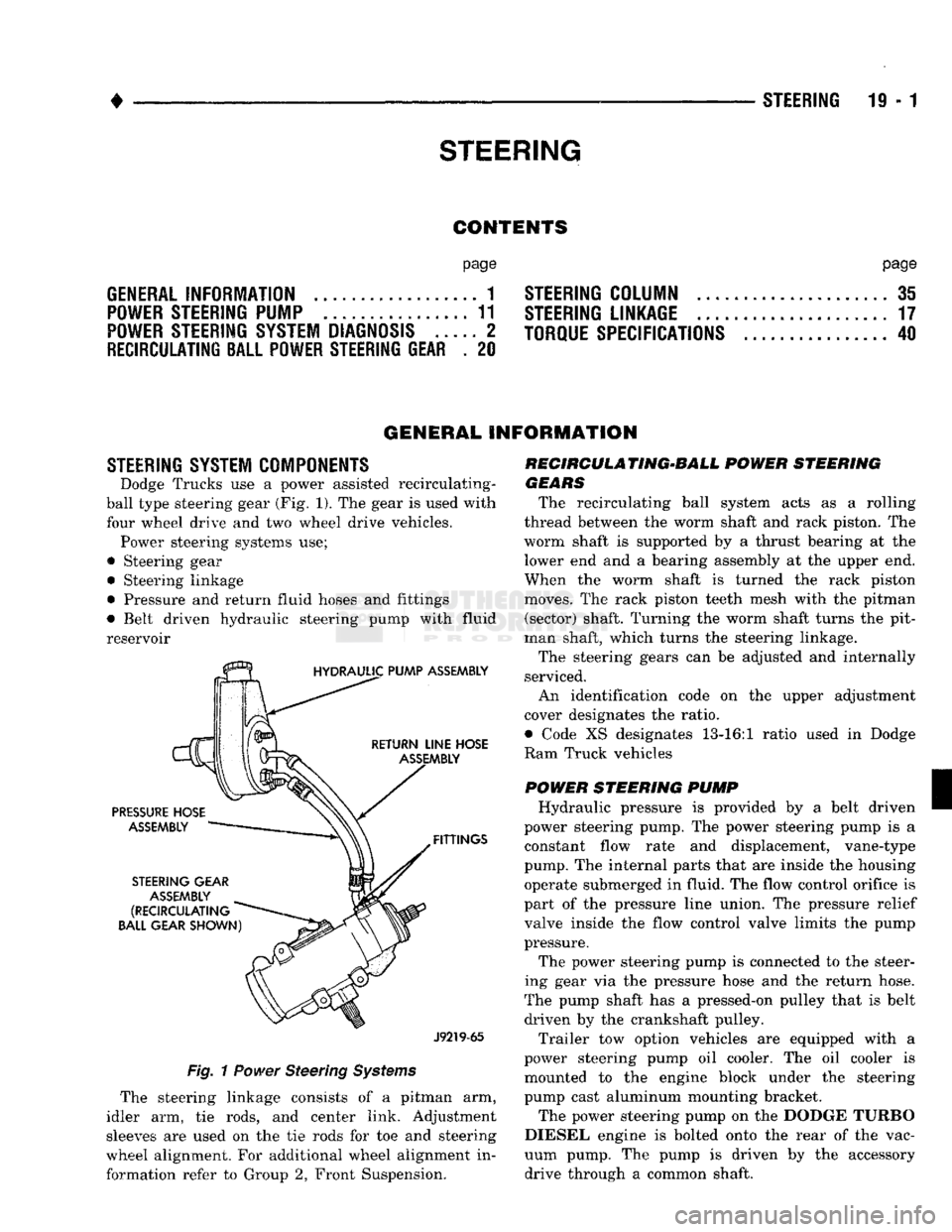
(Fig.
1). The
gear
is
used with
four
wheel drive
and two
wheel
drive
vehicles. Power steering systems
use;
•
Steering
gear • Steering linkage
• Pressure
and
return fluid hoses
and
fittings
• Belt driven hydraulic steering pump with
fluid
reservoir
J9219-65
Fig.
1
Power
Steering
Systems
The steering linkage consists
of a
pitman
arm,
idler
arm, tie
rods,
and
center link. Adjustment
sleeves
are
used
on the tie
rods
for toe and
steering
wheel alignment.
For
additional wheel alignment
in
formation refer
to
Group
2,
Front Suspension. RECIRCULA TING-BALL
POWER
STEERING
GEARS
The recirculating ball system acts
as a
rolling
thread between
the
worm shaft
and
rack piston.
The
worm shaft
is
supported
by a
thrust bearing
at the
lower
end
and a
bearing assembly
at
the
upper
end.
When
the
worm shaft
is
turned
the
rack piston
moves.
The
rack piston teeth mesh with
the
pitman (sector) shaft. Turning
the
worm shaft turns
the
pit
man shaft, which turns
the
steering linkage.
The steering gears
can be
adjusted
and
internally
serviced.
An identification code
on the
upper adjustment
cover designates
the
ratio.
• Code
XS
designates 13-16:1 ratio used
in
Dodge
Ram Truck vehicles
POWER
STEERING
PUMP
Hydraulic pressure
is
provided
by a
belt driven
power steering pump.
The
power steering pump
is a
constant flow rate
and
displacement, vane-type
pump.
The
internal parts that
are
inside
the
housing operate submerged
in
fluid.
The
flow control orifice
is
part
of
the
pressure line union.
The
pressure relief
valve inside
the
flow control valve limits
the
pump
pressure.
The power steering pump
is
connected
to
the
steer
ing gear
via the
pressure hose
and the
return hose.
The pump shaft
has
a
pressed-on pulley that
is
belt driven
by the
crankshaft pulley.
Trailer
tow
option vehicles
are
equipped with
a
power steering pump
oil
cooler.
The oil
cooler
is
mounted
to the
engine block under
the
steering
pump cast aluminum mounting bracket.
The power steering pump
on
the
DODGE TURBO
DIESEL engine
is
bolted onto
the
rear
of
the
vac
uum pump.
The
pump
is
driven
by the
accessory drive through
a
common shaft.
Page 965 of 1502
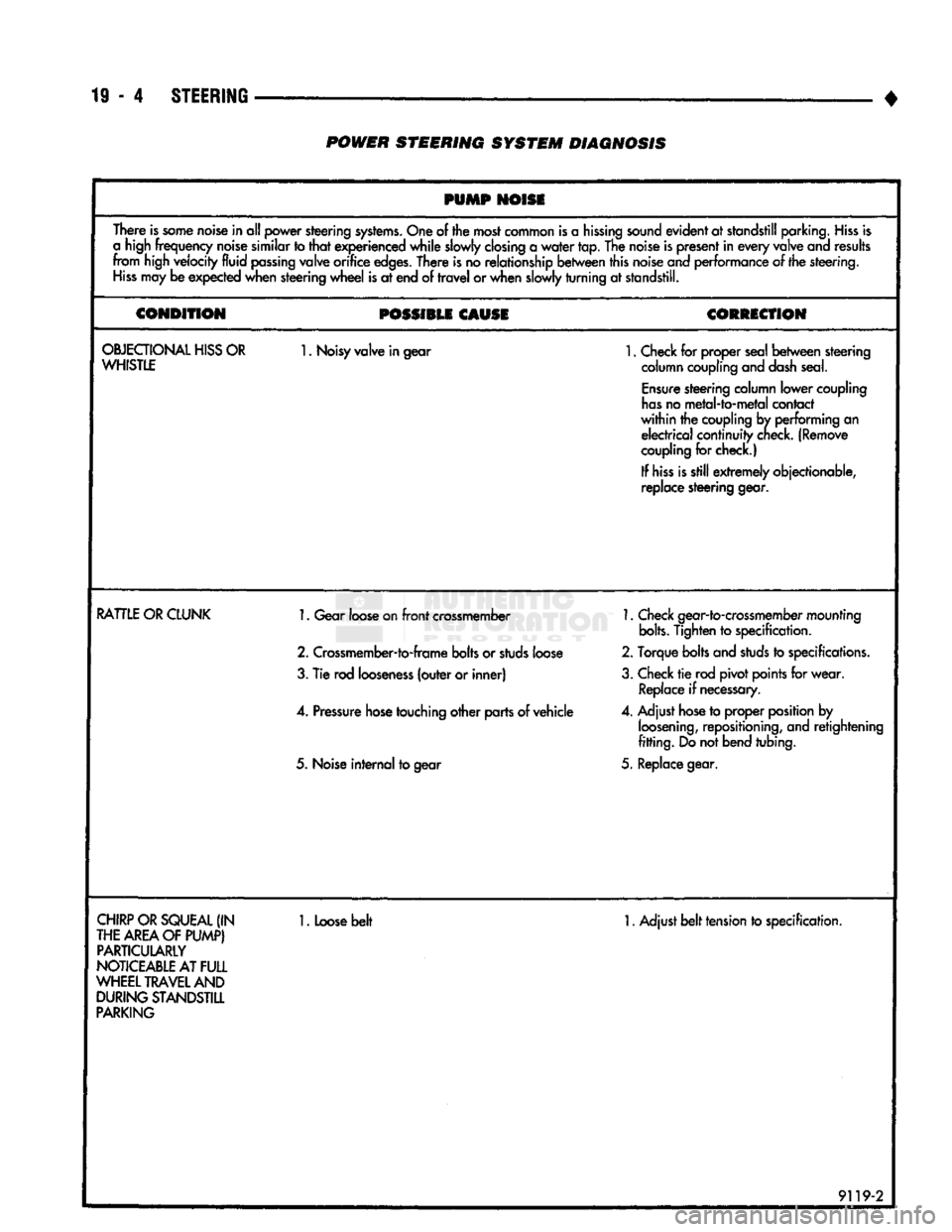
19
- 4
STEERING
POWER STEERING SYSTEM DIAGNOSIS
PUMP
NOISI
There is some noise in all power steering systems. One of the most common is a hissing sound evident at standstill parking. Hiss is
a high frequency noise similar to that experienced while slowly closing a water tap. The noise is present in every valve and results
from high velocity
fluid
passing valve orifice edges. There is no relationship between this noise and performance of the steering. Hiss may be expected when steering wheel is at end of travel or when slowly turning at standstill.
CONDITION
POSSIBU CAUSI
CORRICriON
OBJECTIONALHISSOR
WHISTLE 1.
Noisy valve in gear
1.
Check for proper seal between steering
column coupling and dash seal.
Ensure steering column lower coupling
has no metal-to-metal contact
within the coupling by performing an electrical continuity check. (Remove
coupling for check.)
If hiss is still extremely objectionable,
replace steering gear.
RATTLE
OR CLUNK
1.
Gear loose on front crossmember
2.
Crossmember-to-frame bolts or studs loose
3.
Tie rod looseness (outer or inner)
4.
Pressure hose touching other parts of vehicle
5.
Noise internal to gear
1.
Check gear-to-crossmember mounting
bolts.
Tighten to specification.
2.
Torque bolts and studs to specifications.
3.
Check tie rod pivot points for wear. Replace if necessary.
4.
Adjust hose to proper position by loosening, repositioning, and retightening
fitting. Do not bend tubing.
5.
Replace gear.
CHIRP OR SQUEAL (IN
THE AREA OF PUMP) PARTICULARLY
NOTICEABLE AT
FULL
WHEEL TRAVEL AND DURING STANDSTILL
PARKING
1.
Loose belt
1.
Adjust belt tension to specification.
9119-2
Page 976 of 1502
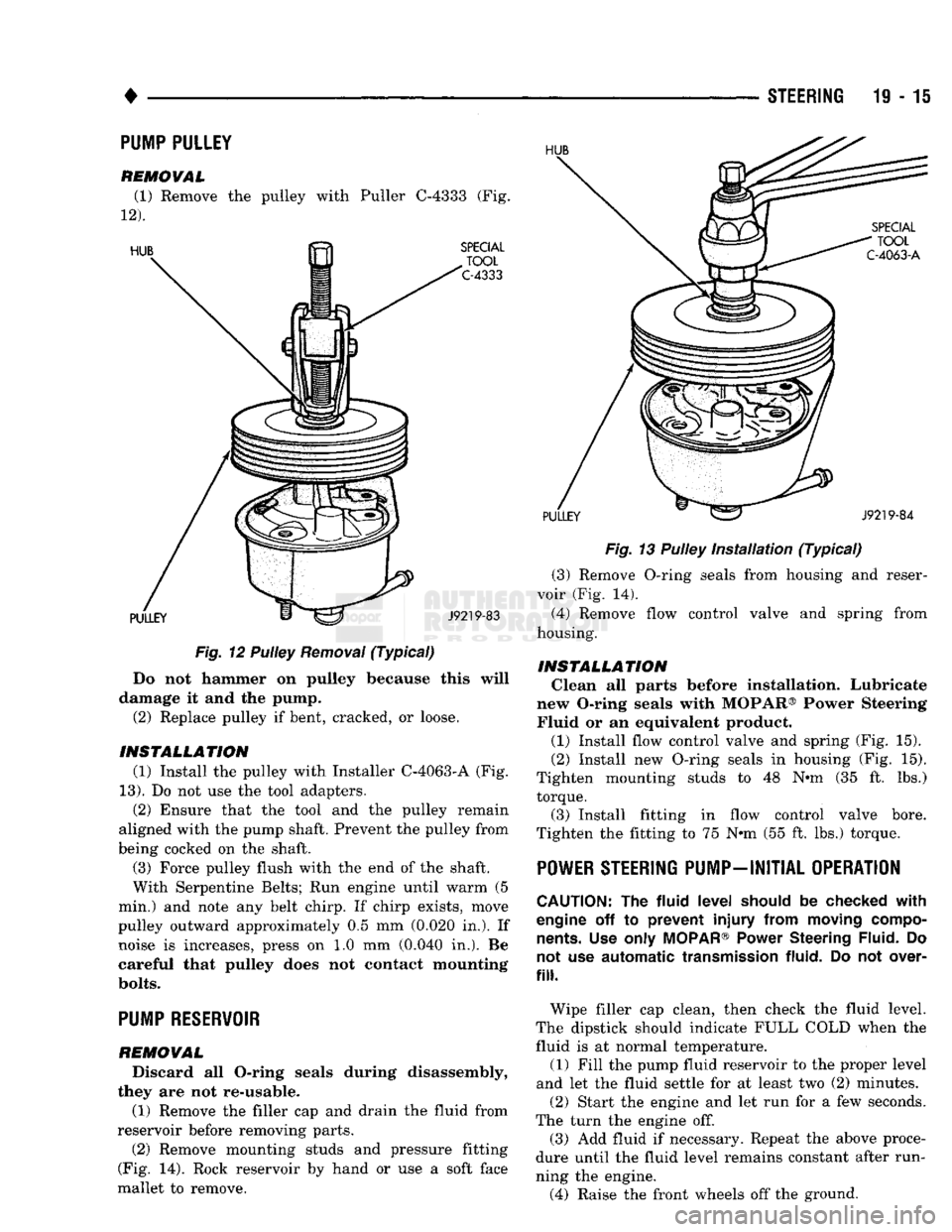
#
_ ,
Fig.
12 Pulley
Removal
(Typical)
Do not hammer on pulley because this will
damage it and the pump. (2) Replace pulley if bent, cracked, or loose.
INSTALLATION (1) Install the pulley with Installer C-4063-A (Fig.
13).
Do not use the tool adapters. (2) Ensure that the tool and the pulley remain
aligned with the pump shaft. Prevent the pulley from
being cocked on the shaft.
(3) Force pulley flush with the end of the shaft.
With Serpentine Belts; Run engine until warm (5
min.) and note any belt chirp. If chirp exists, move
pulley outward approximately 0.5 mm (0.020 in.). If noise is increases, press on 1.0 mm (0.040 in.). Be
careful that pulley does not contact mounting
bolts.
PUMP RESERVOIR
REMOVAL
Discard all O-ring seals during disassembly,
they are not re-usable.
(1) Remove the filler cap and drain the fluid from
reservoir before removing parts. (2) Remove mounting studs and pressure fitting
(Fig. 14). Rock reservoir by hand or use a soft face
mallet to remove. STEERING 19-15
Fig.
13 Pulley
Installation
(Typical)
(3) Remove O-ring seals from housing and reser
voir (Fig. 14). (4) Remove flow control valve and spring from
housing.
INSTALLATION Clean all parts before installation. Lubricate
new O-ring seals with MOPAR® Power Steering Fluid or an equivalent product.
(1) Install flow control valve and spring (Fig. 15).
(2) Install new O-ring seals in housing (Fig. 15).
Tighten mounting studs to 48 N«m (35 ft. lbs.) torque.
(3) Install fitting in flow control valve bore.
Tighten the fitting to 75 N-m (55 ft. lbs.) torque.
POWER STEERING PUMP-INITIAL OPERATION
CAUTION:
The
fluid
level
should
be
checked
with
engine
off to
prevent
injury
from
moving
compo
nents.
Use
only
MOPAR®
Power
Steering
Fluid.
Do
not
use
automatic
transmission
fluid.
Do not
over
fill.
Wipe filler cap clean, then check the fluid level.
The dipstick should indicate FULL COLD when the fluid is at normal temperature. (1) Fill the pump fluid reservoir to the proper level
and let the fluid settle for at least two (2) minutes. (2) Start the engine and let run for a few seconds.
The turn the engine off. (3) Add fluid if necessary. Repeat the above proce
dure until the fluid level remains constant after run
ning the engine. (4) Raise the front wheels off the ground.
PUMP PULLEY
REMOVAL
(1) Remove the pulley with Puller C-4333 (Fig.
12).
Page 979 of 1502
19
- 18
STEERING
•
CAUTION:
It is
possible
to install the
center
link
re
versed
position.
This
will
result
in
incorrect
geome
try and interferences during vehicle jounce. Viewed
from the
front
of the vehicle, the
center
link
ends
should
turn
upward. Viewed
from
the side of the ve
hicle,
the
ends
should
turn
toward
the
front
of the
vehicle. The
tie-rod
ball
studs
enter
the
center
link
bores
from
the
rear.
(5) Install tie-rod ends into center link (Fig. 2).
Tighten the nuts to 54 N»m (40 ft. lbs.) torque. In stall new cotter pins.
(6) Insert tie-rod ends into steering knuckle arm
(Fig. 2). Tighten the nuts to 54 N-m (40 ft. lbs.)
torque. Install new cotter pins. (7) Remove the supports and lower the vehicle to
the surface. Adjust the wheel toe position (refer to
the Alignment Specifications chart within Group 2,
Front Suspension).
Position the clamp on the sleeve so retaining
bolt is located on the bottom side of the sleeve.
(8) After adjustment, tighten the tie-rod adjust
ment sleeve clamp bolt;
• Standard Duty— 25.4 N-m (225 in. lbs.) torque
• Heavy Duty- 34 N-m (25 ft. lbs.) torque
STEERING
LINKAGE—4WD
VEHICLES
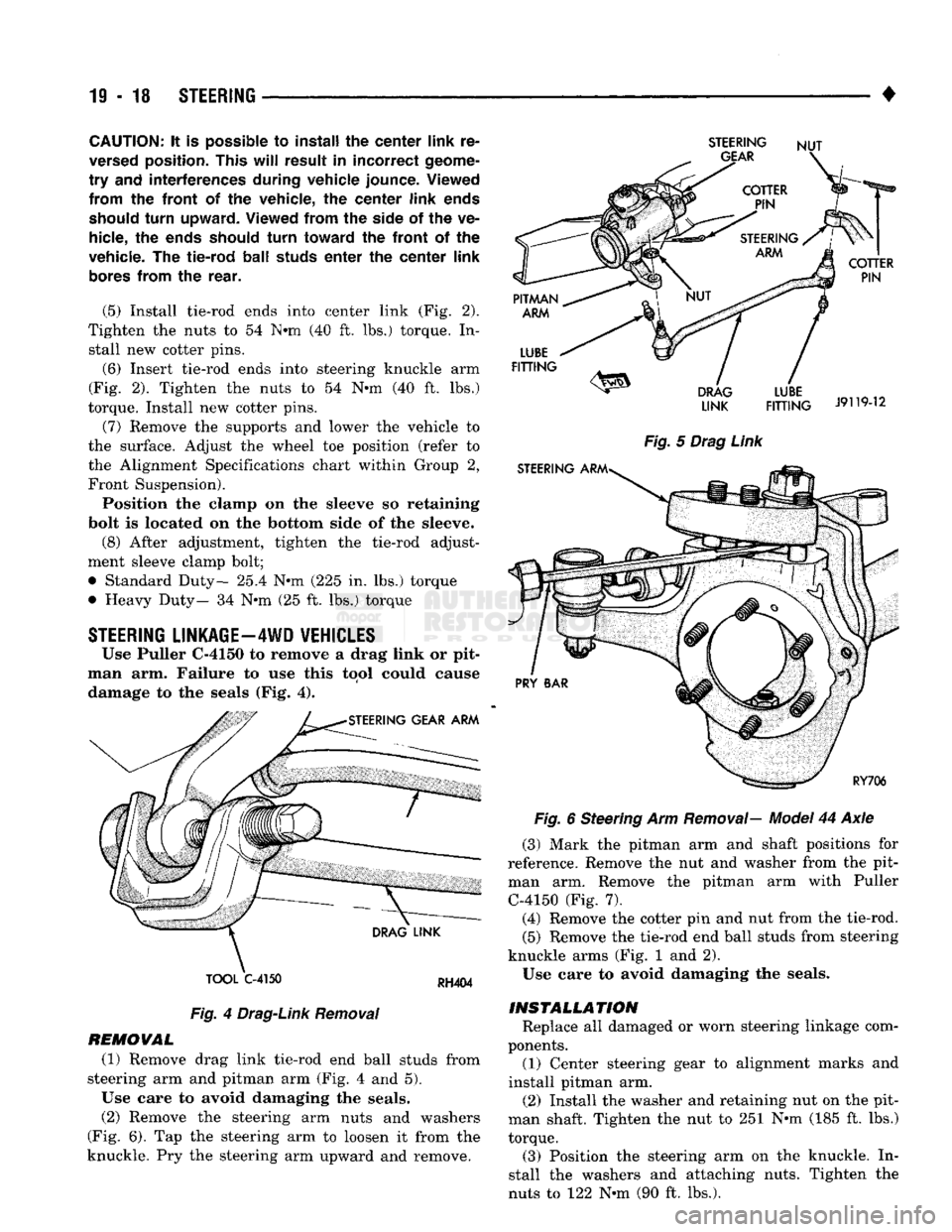
Use Puller C-4150 to remove a drag link or pit
man arm. Failure to use this tool could cause damage to the seals (Fig. 4).
TOOL
C-4150
RH404
Fig.
4
Drag-Link
Removal
REMOVAL (1) Remove drag link tie-rod end ball studs from
steering arm and pitman arm (Fig. 4 and 5).
Use care to avoid damaging the seals. (2) Remove the steering arm nuts and washers
(Fig. 6). Tap the steering arm to loosen it from the
knuckle. Pry the steering arm upward and remove.
STEERING
NUT
LINK
FITTING
J9119-12
Fig.
5
Drag
Link
Fig.
6 Steering Arm
Removal—
Model
44 Axle
(3) Mark the pitman arm and shaft positions for
reference. Remove the nut and washer from the pit
man arm. Remove the pitman arm with Puller C-4150 (Fig. 7). (4) Remove the cotter pin and nut from the tie-rod.
(5) Remove the tie-rod end ball studs from steering
knuckle arms (Fig. 1 and 2).
Use care to avoid damaging the seals.
INSTALLATION
Replace all damaged or worn steering linkage com
ponents. (1) Center steering gear to alignment marks and
install pitman arm.
(2) Install the washer and retaining nut on the pit
man shaft. Tighten the nut to 251 N-m (185 ft. lbs.)
torque. (3) Position the steering arm on the knuckle. In
stall the washers and attaching nuts. Tighten the
nuts to 122 N-m (90 ft. lbs.).
Page 980 of 1502
•
STEERING
19 - 19
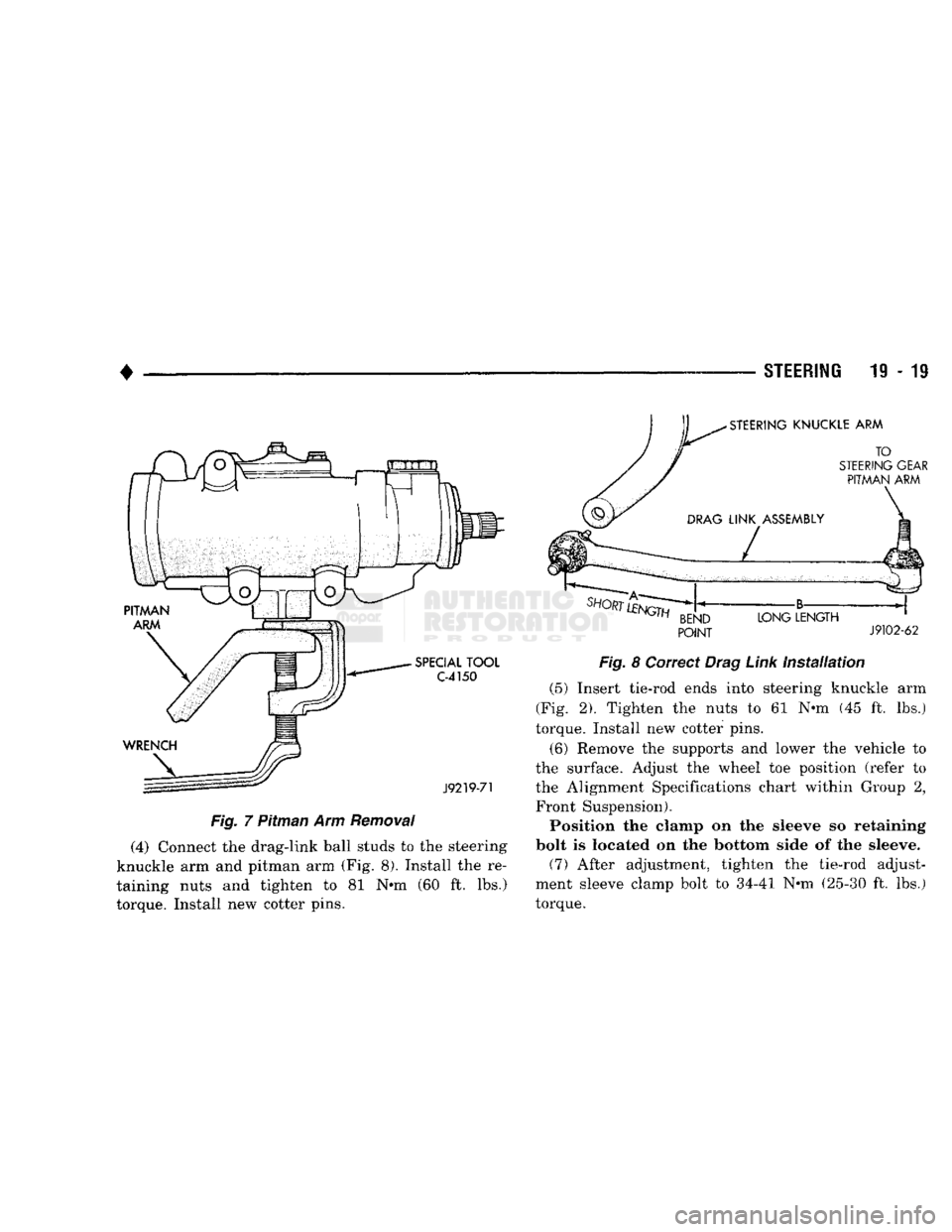
Fig.
7 Pitman Arm
Removal
(4) Connect the drag-link ball studs to the steering
knuckle arm and pitman arm (Fig. 8). Install the re
taining nuts and tighten to 81 N»m (60 ft. lbs.)
torque. Install new cotter pins.
POINT
J9102-62
Fig.
8 Correct
Drag
Link
installation
(5) Insert tie-rod ends into steering knuckle arm
(Fig. 2). Tighten the nuts to 61 N-m (45 ft. lbs.)
torque. Install new cotter pins.
(6) Remove the supports and lower the vehicle to
the surface. Adjust the wheel toe position (refer to the Alignment Specifications chart within Group 2, Front Suspension). Position the clamp on the sleeve so retaining
bolt is located on the bottom side of the sleeve. (7) After adjustment, tighten the tie-rod adjust
ment sleeve clamp bolt to 34-41 N-m (25-30 ft. lbs.)
torque.
Page 1001 of 1502
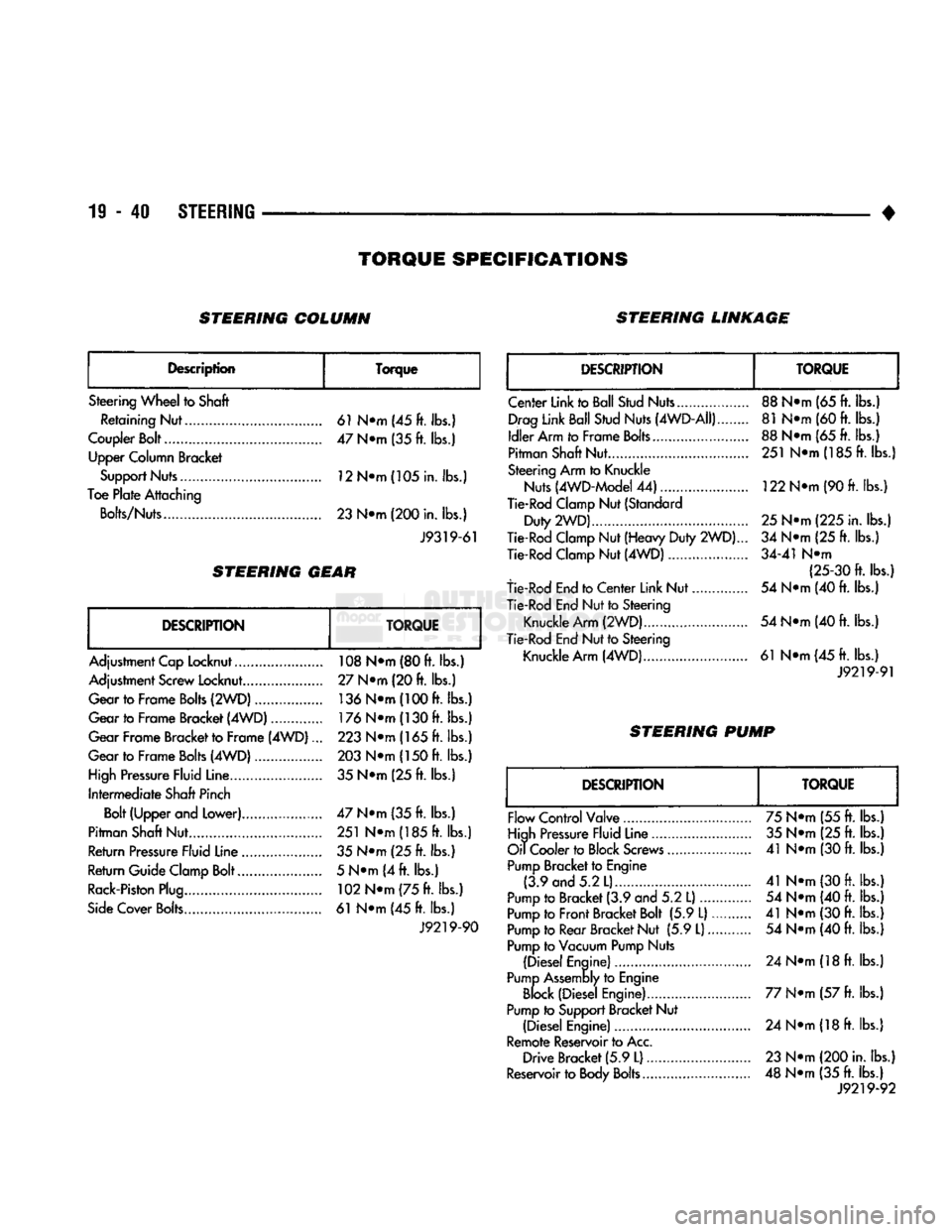
19-40
STEERING
•
TORQUE
SPECIFICATIONS
STEERING COLUMN STEERING LINKAGE
Description Torque
Steering Wheel to Shaft Retaining Nut 61 N»m (45 ft. lbs.)
Coupler Bolt 47 N»m (35 ft. lbs.) Upper Column Bracket
Support Nuts 12N*m(105in. lbs.)
Toe Plate Attaching
Bolts/Nuts 23 N«m (200 in. lbs.)
J9319-61
STEERING
GEAR
DESCRIPTION
TORQUE
Adjustment Cap Locknut 108 N»m (80 ft. lbs.)
Adjustment Screw Locknut.... 27 N®m (20 ft. lbs.)
Gear to Frame Bolts (2WD) 136
N®m
(100 ft. lbs.)
Gear to Frame Bracket (4WD) 176
N®m
(130 ft. lbs.)
Gear Frame Bracket to Frame (4WD)... 223 N*m (165 ft. lbs.)
Gear to Frame Bolts (4WD) 203 N*m (150 ft. lbs.)
High Pressure Fluid Line. 35 N*m (25 ft. lbs.)
Intermediate Shaft Pinch Bolt (Upper and Lower) 47 N»m (35 ft. lbs.)
Pitman Shaft Nut 251 N»m (185 ft. lbs.)
Return Pressure Fluid Line 35 N*m (25 ft. lbs.)
Return Guide Clamp Bolt 5 N*m (4 ft. lbs.)
Rack-Piston Plug 102
N®m
(75 ft. lbs.)
Side Cover Bolts 61 N*m (45 ft. lbs.) J9219-90
DESCRIPTION
TORQUE
Center Link to Ball Stud Nuts..., Drag Link Ball Stud Nuts (4WD-AII)
Idler Arm to Frame Bolts...
Pitman Shaft Nut
Steering Arm to Knuckle Nuts (4WD-Model 44)
Tie-Rod Clamp Nut (Standard
Duty 2WD)....
Tie-Rod Clamp Nut (Heavy Duty
2WD).
Tie-Rod Clamp Nut (4WD)
tie-Rod End to Center Link Nut.
Tie-Rod End Nut to Steering
Knuckle
Arm
(2WD)..
Tie-Rod End Nut to Steering Knuckle Arm (4WD) 88 N®m (65 ft. lbs.)
81 N®m (60 ft. lbs.)
88 N*m (65
ft.
lbs.) 251 NTn(185ft. lbs.)
122 N*m (90
ft.
lbs.)
25
N^m (225 in. lbs.)
34 N«m (25
ft.
lbs.)
34-41 N«m (25-30 ft. lbs.)
54 N«m (40
ft.
lbs.)
54 N*m (40
ft.
lbs.)
61 N«m(45ft. lbs.)
J9219-91
STEERING PUMP
DESCRIPTION
TORQUE
Flow Control Valve
High Pressure Fluid Line
Oil Cooler to Block Screws
Pump Bracket to Engine (3.9 and 5.2 L)..
Pump to Bracket (3.9 and 5.2
L)....
Pump to Front Bracket Bolt (5.9 L).
Pump to Rear Bracket Nut (5.9
L)
Pump to Vacuum Pump Nuts
(Diesel Engine)
Pump Assembly to Engine Block (Diesel Engine)
Pump to Support Bracket Nut (Diesel Engine)
Remote Reservoir to Acc, Drive Bracket (5.9
L)
Reservoir to Body Bolts 75 N®m (55
ft.
lbs.)
35 N«*m (25 ft. lbs.)
41 N*m (30
ft.
lbs.)
41 N*m (30
ft.
lbs.) 54 N®m (40
ft.
lbs.)
41 N*m (30
ft.
lbs.) 54 N*m (40
ft.
lbs.)
24 N®m
(18
ft.
lbs.)
77 N*m (57
ft.
lbs.) 24 NTH (18
ft.
lbs.)
23 N*m (200 in. lbs.)
48 N«m (35
ft.
lbs.) J9219-92
Page 1005 of 1502
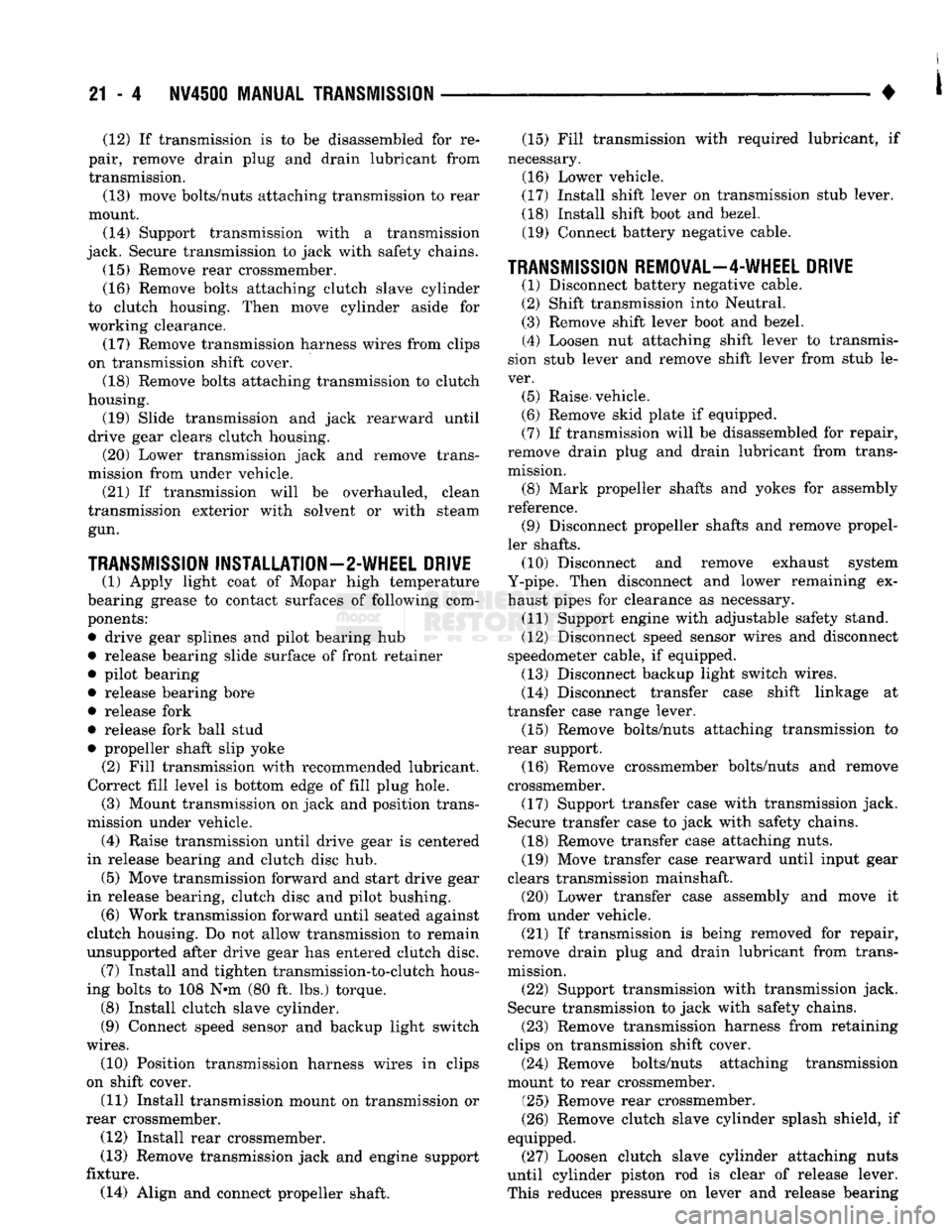
21
- 4
NV4500 MANUAL TRANSMISSION
(12) If transmission is to be disassembled for re
pair, remove drain plug and drain lubricant from transmission.
(13) move bolts/nuts attaching transmission to rear
mount.
(14) Support transmission with a transmission
jack. Secure transmission to jack with safety chains.
(15) Remove rear crossmember,
(16) Remove bolts attaching clutch slave cylinder
to clutch housing. Then move cylinder aside for
working clearance.
(17) Remove transmission harness wires from clips
on transmission shift cover. (18) Remove bolts attaching transmission to clutch
housing. (19) Slide transmission and jack rearward until
drive gear clears clutch housing. (20) Lower transmission jack and remove trans
mission from under vehicle. (21) If transmission will be overhauled, clean
transmission exterior with solvent or with steam gun.
TRANSMISSION
INSTALLATION—2-WHEEL DRIVE
(1) Apply light coat of Mopar high temperature
bearing grease to contact surfaces of following com
ponents: • drive gear splines and pilot bearing hub
• release bearing slide surface of front retainer
• pilot bearing • release bearing bore
• release fork
• release fork ball stud
• propeller shaft slip yoke (2) Fill transmission with recommended lubricant.
Correct fill level is bottom edge of fill plug hole. (3) Mount transmission on jack and position trans
mission under vehicle. (4) Raise transmission until drive gear is centered
in release bearing and clutch disc hub. (5) Move transmission forward and start drive gear
in release bearing, clutch disc and pilot bushing. (6) Work transmission forward until seated against
clutch housing. Do not allow transmission to remain
unsupported after drive gear has entered clutch disc. (7) Install and tighten transmission-to-clutch hous
ing bolts to 108 N*m (80 ft. lbs.) torque. (8) Install clutch slave cylinder. (9) Connect speed sensor and backup light switch
wires.
(10) Position transmission harness wires in clips
on shift cover. (11) Install transmission mount on transmission or
rear crossmember. (12) Install rear crossmember.
(13) Remove transmission jack and engine support
fixture. (14) Align and connect propeller shaft. (15) Fill transmission with required lubricant, if
necessary. (16) Lower vehicle.
(17) Install shift lever on transmission stub lever.
(18) Install shift boot and bezel. (19) Connect battery negative cable.
TRANSMISSION REMOVAL—4-WHEEL DRIVE
(1) Disconnect battery negative cable.
(2) Shift transmission into Neutral.
(3) Remove shift lever boot and bezel. (4) Loosen nut attaching shift lever to transmis
sion stub lever and remove shift lever from stub le
ver. (5) Raise- vehicle.
(6) Remove skid plate if equipped.
(7) If transmission will be disassembled for repair,
remove drain plug and drain lubricant from trans
mission. (8) Mark propeller shafts and yokes for assembly
reference. (9) Disconnect propeller shafts and remove propel
ler shafts. (10) Disconnect and remove exhaust system
Y-pipe. Then disconnect and lower remaining ex
haust pipes for clearance as necessary. (11) Support engine with adjustable safety stand.
(12) Disconnect speed sensor wires and disconnect
speedometer cable, if equipped. (13) Disconnect backup light switch wires.
(14) Disconnect transfer case shift linkage at
transfer case range lever. (15) Remove bolts/nuts attaching transmission to
rear support. (16) Remove crossmember bolts/nuts and remove
crossmember. (17) Support transfer case with transmission jack.
Secure transfer case to jack with safety chains. (18) Remove transfer case attaching nuts.
(19) Move transfer case rearward until input gear
clears transmission mainshaft. (20) Lower transfer case assembly and move it
from under vehicle. (21) If transmission is being removed for repair,
remove drain plug and drain lubricant from trans mission.
(22) Support transmission with transmission jack.
Secure transmission to jack with safety chains.
(23) Remove transmission harness from retaining
clips on transmission shift cover. (24) Remove bolts/nuts attaching transmission
mount to rear crossmember.
(25) Remove rear crossmember.
(26) Remove clutch slave cylinder splash shield, if
equipped.
(27) Loosen clutch slave cylinder attaching nuts
until cylinder piston rod is clear of release lever.
This reduces pressure on lever and release bearing