warning FIAT BARCHETTA 2003 1.G User Guide
[x] Cancel search | Manufacturer: FIAT, Model Year: 2003, Model line: BARCHETTA, Model: FIAT BARCHETTA 2003 1.GPages: 170, PDF Size: 3.55 MB
Page 23 of 170
22
GENERAL INSTRUCTIONS
FOR THE USE OF THE SEAT
BELTS
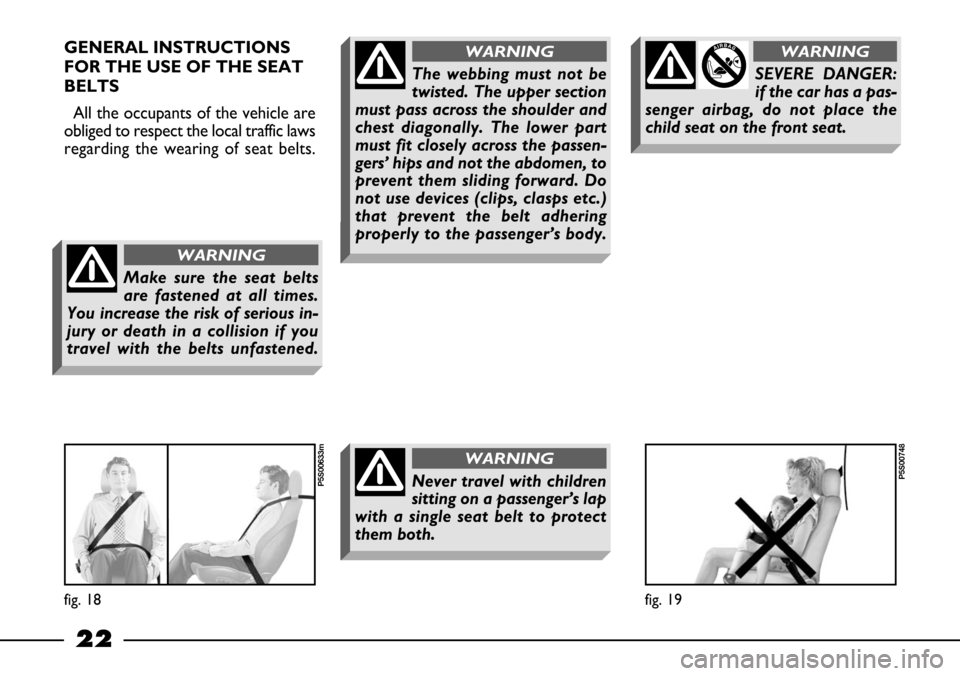
All the occupants of the vehicle are
obliged to respect the local traffic laws
regarding the wearing of seat belts.
Make sure the seat belts
are fastened at all times.
You increase the risk of serious in-
jury or death in a collision if you
travel with the belts unfastened.
WARNING
fig. 18
P5S00633m
fig. 19
P5S00748
The webbing must not be
twisted. The upper section
must pass across the shoulder and
chest diagonally. The lower part
must fit closely across the passen-
gers’ hips and not the abdomen, to
prevent them sliding forward. Do
not use devices (clips, clasps etc.)
that prevent the belt adhering
properly to the passenger’s body.
WARNING
Never travel with children
sitting on a passenger’s lap
with a single seat belt to protect
them both.
WARNING
SEVERE DANGER:
if the car has a pas-
senger airbag, do not place the
child seat on the front seat.
WARNING
Page 26 of 170
25
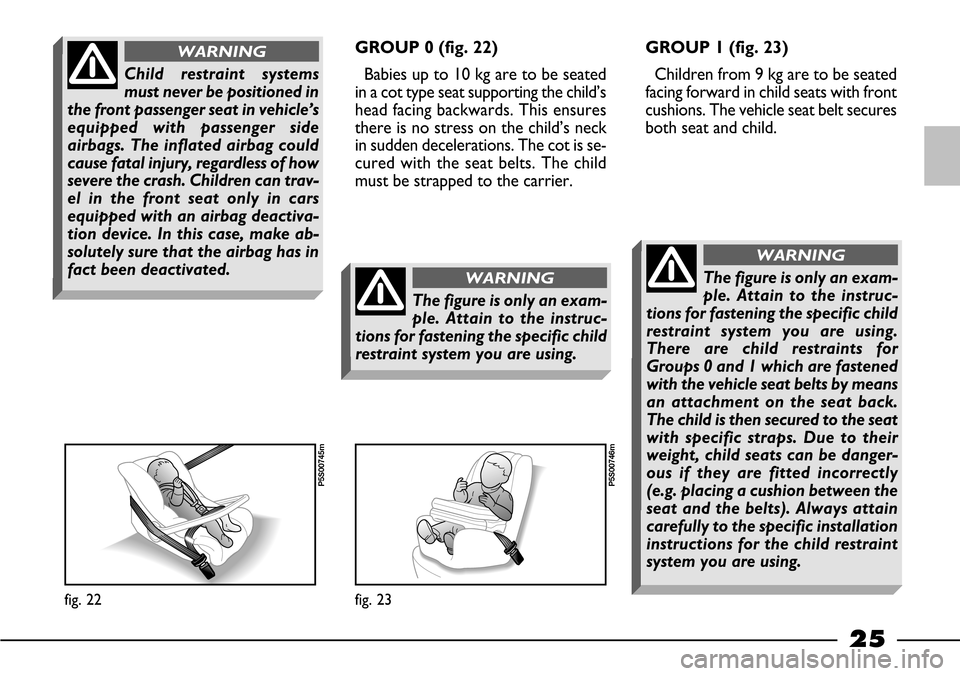
GROUP 0 (fig. 22)
Babies up to 10 kg are to be seated
in a cot type seat supporting the child’s
head facing backwards. This ensures
there is no stress on the child’s neck
in sudden decelerations. The cot is se-
cured with the seat belts. The child
must be strapped to the carrier.GROUP 1 (fig. 23)
Children from 9 kg are to be seated
facing forward in child seats with front
cushions. The vehicle seat belt secures
both seat and child.
fig. 22
P5S00745m
fig. 23
P5S00746m
Child restraint systems
must never be positioned in
the front passenger seat in vehicle’s
equipped with passenger side
airbags. The inflated airbag could
cause fatal injury, regardless of how
severe the crash. Children can trav-
el in the front seat only in cars
equipped with an airbag deactiva-
tion device. In this case, make ab-
solutely sure that the airbag has in
fact been deactivated.
WARNING
The figure is only an exam-
ple. Attain to the instruc-
tions for fastening the specific child
restraint system you are using.
WARNINGThe figure is only an exam-
ple. Attain to the instruc-
tions for fastening the specific child
restraint system you are using.
There are child restraints for
Groups 0 and 1 which are fastened
with the vehicle seat belts by means
an attachment on the seat back.
The child is then secured to the seat
with specific straps. Due to their
weight, child seats can be danger-
ous if they are fitted incorrectly
(e.g. placing a cushion between the
seat and the belts). Always attain
carefully to the specific installation
instructions for the child restraint
system you are using.
WARNING
Page 27 of 170
26
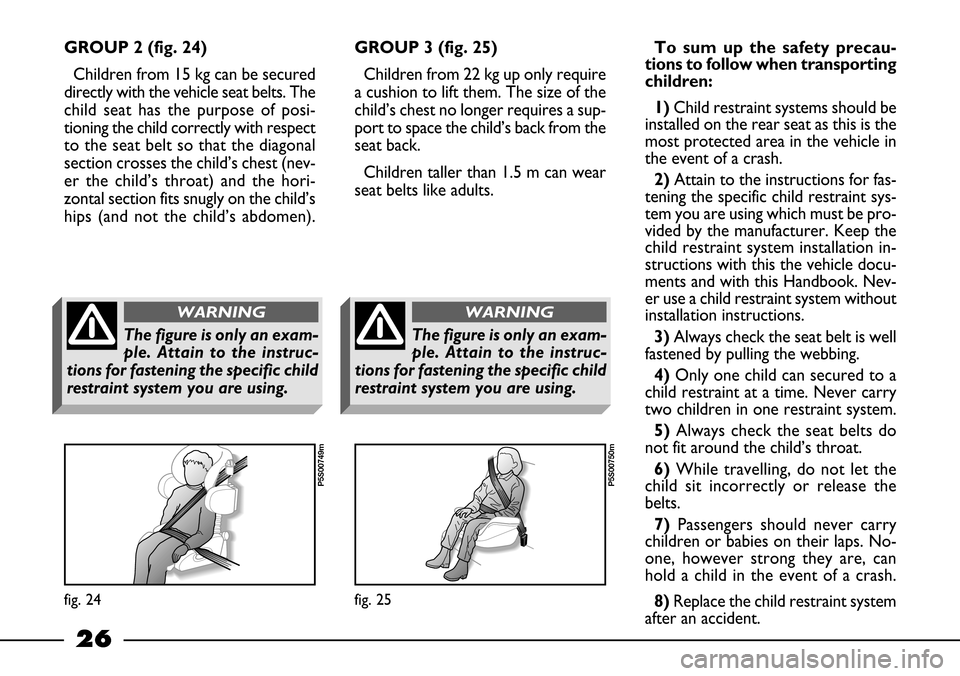
GROUP 2 (fig. 24)
Children from 15 kg can be secured
directly with the vehicle seat belts. The
child seat has the purpose of posi-
tioning the child correctly with respect
to the seat belt so that the diagonal
section crosses the child’s chest (nev-
er the child’s throat) and the hori-
zontal section fits snugly on the child’s
hips (and not the child’s abdomen). GROUP 3 (fig. 25)
Children from 22 kg up only require
a cushion to lift them. The size of the
child’s chest no longer requires a sup-
port to space the child’s back from the
seat back.
Children taller than 1.5 m can wear
seat belts like adults.To sum up the safety precau-
tions to follow when transporting
children:
1) Child restraint systems should be
installed on the rear seat as this is the
most protected area in the vehicle in
the event of a crash.
2) Attain to the instructions for fas-
tening the specific child restraint sys-
tem you are using which must be pro-
vided by the manufacturer. Keep the
child restraint system installation in-
structions with this the vehicle docu-
ments and with this Handbook. Nev-
er use a child restraint system without
installation instructions.
3) Always check the seat belt is well
fastened by pulling the webbing.
4) Only one child can secured to a
child restraint at a time. Never carry
two children in one restraint system.
5) Always check the seat belts do
not fit around the child’s throat.
6) While travelling, do not let the
child sit incorrectly or release the
belts.
7)Passengers should never carry
children or babies on their laps. No-
one, however strong they are, can
hold a child in the event of a crash.
8) Replace the child restraint system
after an accident.
fig. 24
P5S00749m
fig. 25
P5S00750m
The figure is only an exam-
ple. Attain to the instruc-
tions for fastening the specific child
restraint system you are using.
WARNING
The figure is only an exam-
ple. Attain to the instruc-
tions for fastening the specific child
restraint system you are using.
WARNING
Page 28 of 170
27
PRETENSIONERS
To render the protective action of
the seat belts even more effective, Fi-
at barchetta is fitted with pretension-
ers. These devices “feel” that a violent
collision is in progress via a sensor, and
pull back a few inches of webbing. In
this way the pretensioner ensures that
the belt is adhering perfectly to the
body before the belt begins to hold
back the wearer. When the preten-
sioner has been triggered the retrac-
tor will lock. The seat belt cannot be
drawn back up even when guiding it
manually.
When the pretensioner is triggered
as small amount of smoke will be pro-
duced. This smoke is not harmful and
does not indicate the principle of fire.The pretensioner does not require
any maintenance or lubrication. Any
modification of its original state inval-
idates its efficiency. If, as the result of
exceptional natural occurrences
(floods, sea storms etc.), the device is
soaked through with water and mud,
it must be replaced.
The pretensioner will give maximum
protection when the seat belt adheres
snugly to the wearer’s chest and hips.
Operations involving
banging, vibrations or
heating (exceeding 100°C
for a maximum of 6 hours) in the
area around the pretensioner
may trigger or damage the de-
vice. Vibrations from rough road
surfaces or accidental jolting
caused by mounting pavements
etc. do not have any effect on the
pretensioner. If, however, you
need any assistance, go to a Fiat
Dealership.
The pretensioner can only
be used once. After a colli-
sion that has triggered it, have it re-
placed at a Fiat Dealership. The de-
vice will last for 10 years from the
date of production given on the ad-
hesive label: the pretensioner must
be replaced when this date is
reached.
WARNING
Pretensioners do not re-
quire lubrication or main-
tenance. Under no circumstances
should the components of the pre-
tensioner be tampered with as this
could affect the correct operation
of these devices. If any interven-
tions are necessary, contact your Fi-
at Dealership.
WARNING
Page 30 of 170
29
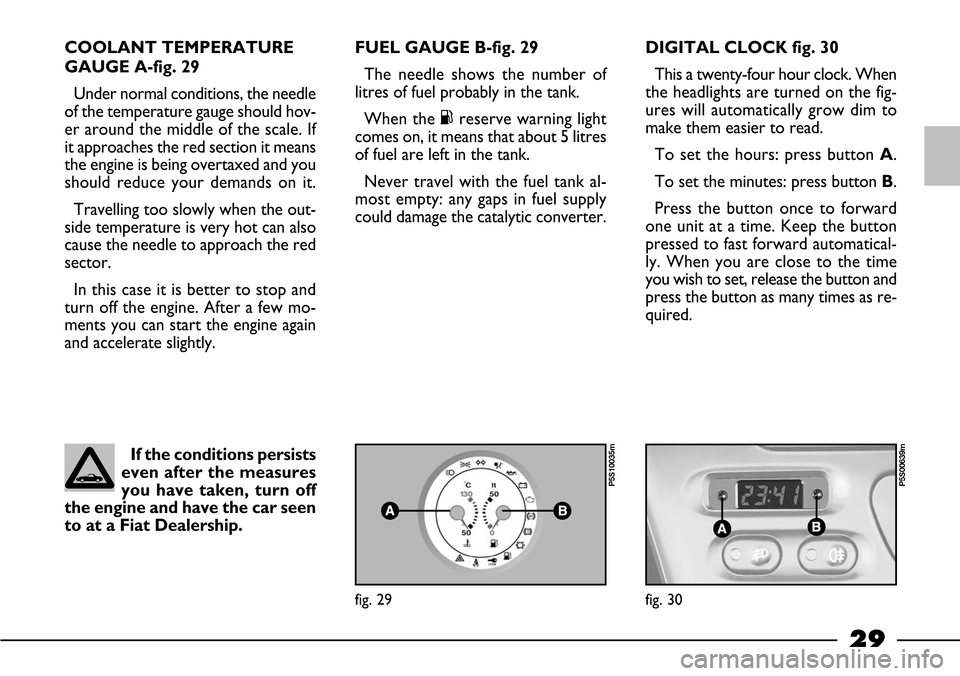
COOLANT TEMPERATURE
GAUGE A-fig. 29
Under normal conditions, the needle
of the temperature gauge should hov-
er around the middle of the scale. If
it approaches the red section it means
the engine is being overtaxed and you
should reduce your demands on it.
Travelling too slowly when the out-
side temperature is very hot can also
cause the needle to approach the red
sector.
In this case it is better to stop and
turn off the engine. After a few mo-
ments you can start the engine again
and accelerate slightly.FUEL GAUGE B-fig. 29
The needle shows the number of
litres of fuel probably in the tank.
When the Kreserve warning light
comes on, it means that about 5 litres
of fuel are left in the tank.
Never travel with the fuel tank al-
most empty: any gaps in fuel supply
could damage the catalytic converter.DIGITAL CLOCK fig. 30
This a twenty-four hour clock. When
the headlights are turned on the fig-
ures will automatically grow dim to
make them easier to read.
To set the hours: press button A.
To set the minutes: press button B.
Press the button once to forward
one unit at a time. Keep the button
pressed to fast forward automatical-
ly. When you are close to the time
you wish to set, release the button and
press the button as many times as re-
quired.
If the conditions persists
even after the measures
you have taken, turn off
the engine and have the car seen
to at a Fiat Dealership.
fig. 29
P5S10035m
fig. 30
P5S00639m
Page 31 of 170
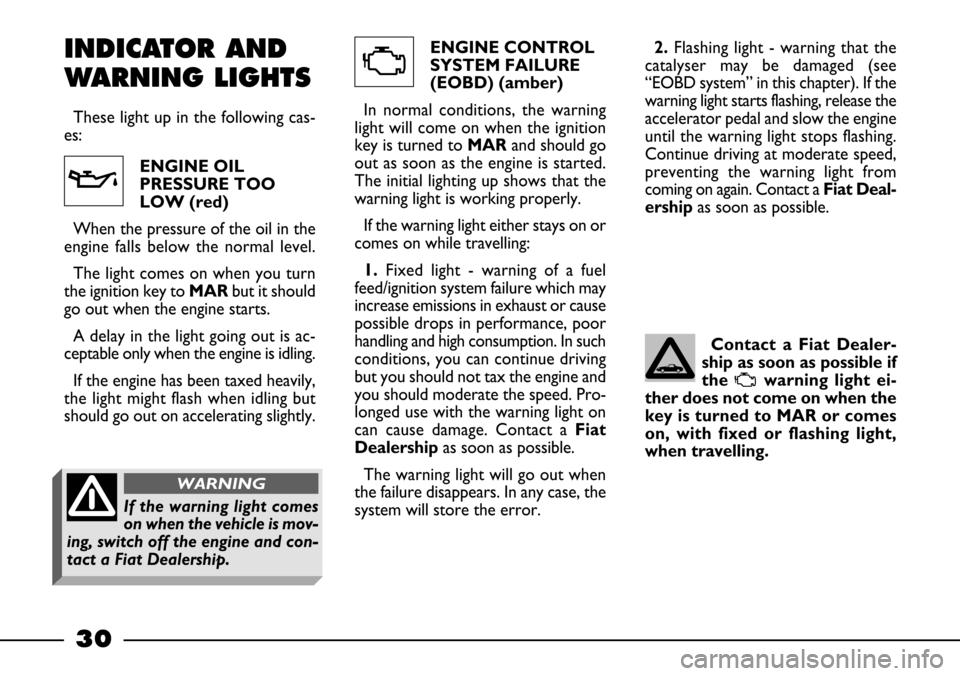
ENGINE CONTROL
SYSTEM FAILURE
(EOBD) (amber)
In normal conditions, the warning
light will come on when the ignition
key is turned to MARand should go
out as soon as the engine is started.
The initial lighting up shows that the
warning light is working properly.
If the warning light either stays on or
comes on while travelling:
1.Fixed light - warning of a fuel
feed/ignition system failure which may
increase emissions in exhaust or cause
possible drops in performance, poor
handling and high consumption. In such
conditions, you can continue driving
but you should not tax the engine and
you should moderate the speed. Pro-
longed use with the warning light on
can cause damage. Contact aFiat
Dealershipas soon as possible.
The warning light will go out when
the failure disappears. In any case, the
system will store the error. ENGINE OIL
PRESSURE TOO
LOW (red)
When the pressure of the oil in the
engine falls below the normal level.
The light comes on when you turn
the ignition key to MARbut it should
go out when the engine starts.
A delay in the light going out is ac-
ceptable only when the engine is idling.
If the engine has been taxed heavily,
the light might flash when idling but
should go out on accelerating slightly.
30
v
U
INDICATOR AND
WARNING LIGHTS
These light up in the following cas-
es:2.Flashing light - warning that the
catalyser may be damaged (see
“EOBD system” in this chapter). If the
warning light starts flashing, release the
accelerator pedal and slow the engine
until the warning light stops flashing.
Continue driving at moderate speed,
preventing the warning light from
coming on again. Contact a Fiat Deal-
ership as soon as possible.
Contact a Fiat Dealer-
ship as soon as possible if
the
Uwarning light ei-
ther does not come on when the
key is turned to MAR or comes
on, with fixed or flashing light,
when travelling.
If the warning light comes
on when the vehicle is mov-
ing, switch off the engine and con-
tact a Fiat Dealership.
WARNING
Page 32 of 170
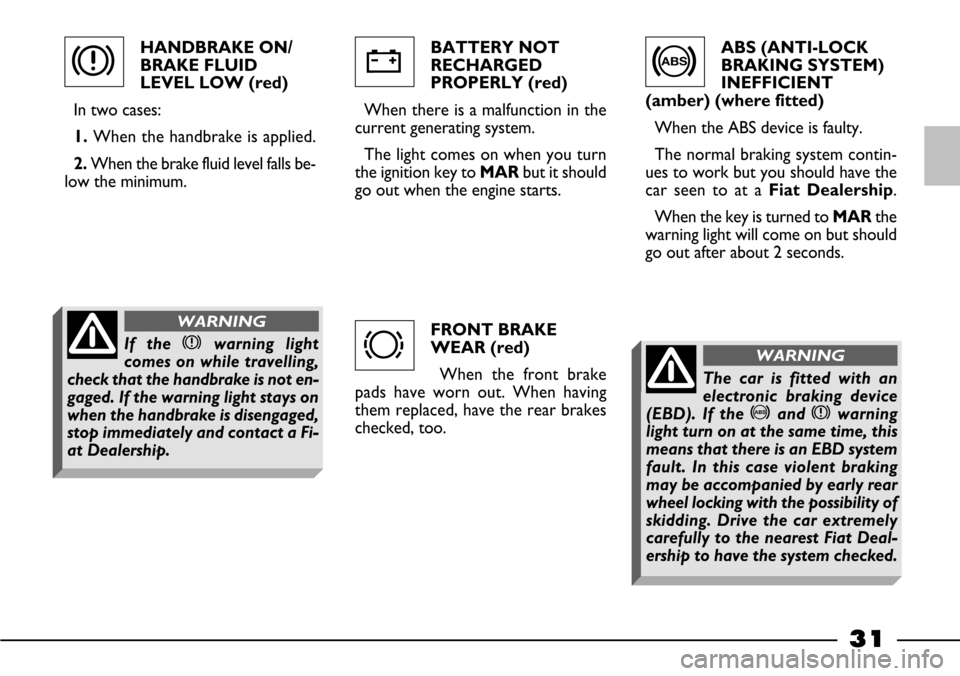
ABS (ANTI-LOCK
BRAKING SYSTEM)
INEFFICIENT
(amber) (where fitted)
When the ABS device is faulty.
The normal braking system contin-
ues to work but you should have the
car seen to at a Fiat Dealership.
When the key is turned toMARthe
warning light will come on but should
go out after about 2 seconds. HANDBRAKE ON/
BRAKE FLUID
LEVEL LOW (red)
In two cases:
1. When the handbrake is applied.
2. When the brake fluid level falls be-
low the minimum.BATTERY NOT
RECHARGED
PROPERLY (red)
When there is a malfunction in the
current generating system.
The light comes on when you turn
the ignition key to MARbut it should
go out when the engine starts.
FRONT BRAKE
WEAR (red)
When the front brake
pads have worn out. When having
them replaced, have the rear brakes
checked, too.
31
w>
d
x
If the xwarning light
comes on while travelling,
check that the handbrake is not en-
gaged. If the warning light stays on
when the handbrake is disengaged,
stop immediately and contact a Fi-
at Dealership.
WARNING
The car is fitted with an
electronic braking device
(EBD). If the >and xwarning
light turn on at the same time, this
means that there is an EBD system
fault. In this case violent braking
may be accompanied by early rear
wheel locking with the possibility of
skidding. Drive the car extremely
carefully to the nearest Fiat Deal-
ership to have the system checked.
WARNING
Page 33 of 170
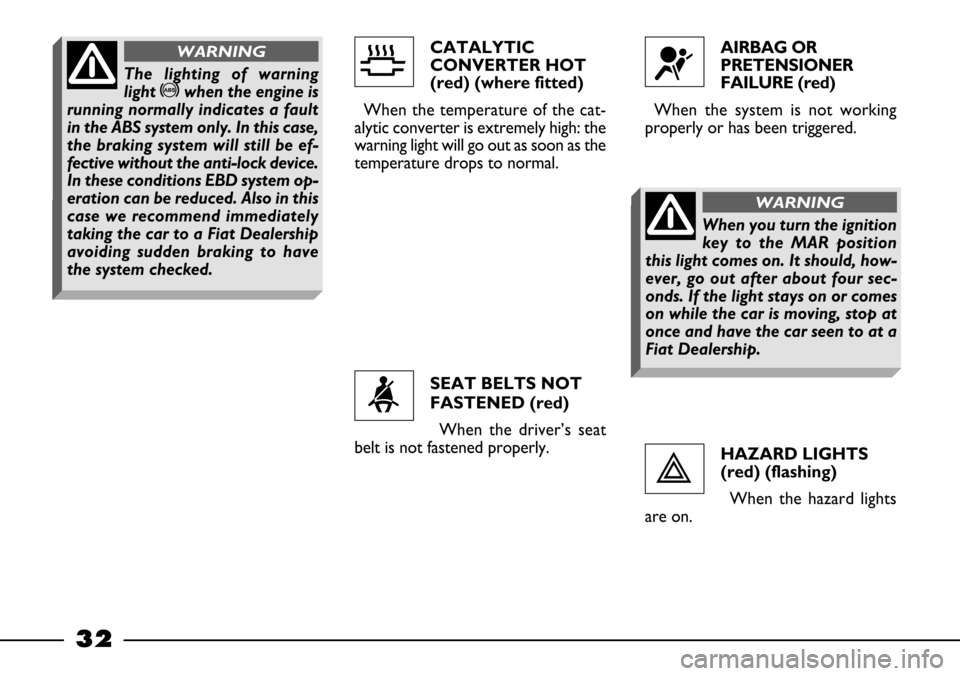
HAZARD LIGHTS
(red) (flashing)
When the hazard lights
are on.AIRBAG OR
PRETENSIONER
FAILURE (red)
When the system is not working
properly or has been triggered.
SEAT BELTS NOT
FASTENED (red)
When the driver’s seat
belt is not fastened properly. CATALYTIC
CONVERTER HOT
(red) (where fitted)
When the temperature of the cat-
alytic converter is extremely high: the
warning light will go out as soon as the
temperature drops to normal.
32
<
f¬
r
When you turn the ignition
key to the MAR position
this light comes on. It should, how-
ever, go out after about four sec-
onds. If the light stays on or comes
on while the car is moving, stop at
once and have the car seen to at a
Fiat Dealership.
WARNING
The lighting of warning
light >when the engine is
running normally indicates a fault
in the ABS system only. In this case,
the braking system will still be ef-
fective without the anti-lock device.
In these conditions EBD system op-
eration can be reduced. Also in this
case we recommend immediately
taking the car to a Fiat Dealership
avoiding sudden braking to have
the system checked.
WARNING
Page 41 of 170
40
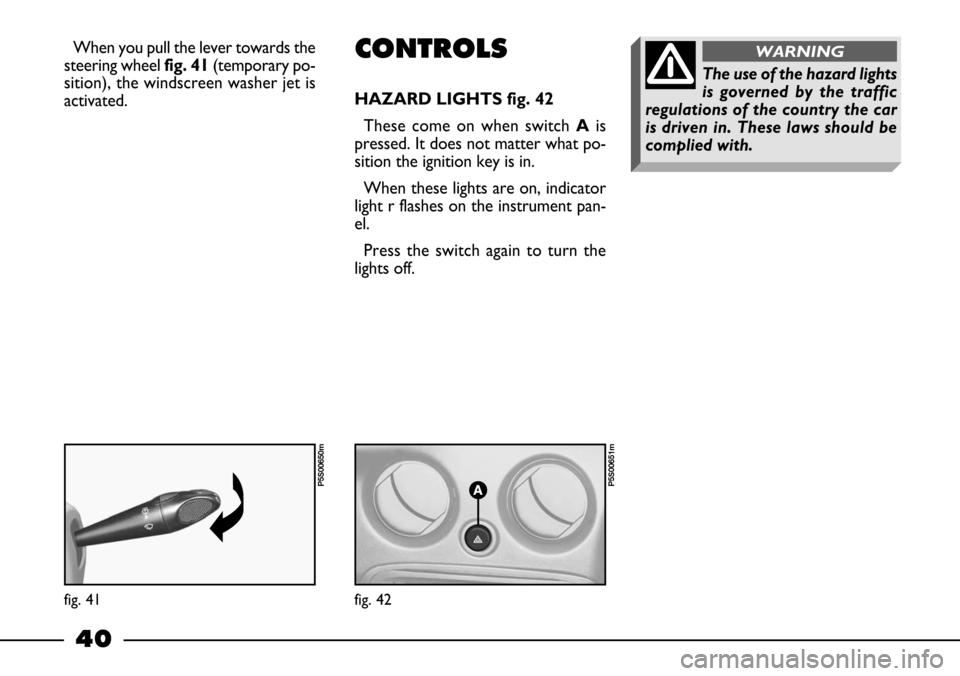
When you pull the lever towards the
steering wheel fig. 41(temporary po-
sition), the windscreen washer jet is
activated. CONTROLS
HAZARD LIGHTS fig. 42
These come on when switch Ais
pressed. It does not matter what po-
sition the ignition key is in.
When these lights are on, indicator
light r flashes on the instrument pan-
el.
Press the switch again to turn the
lights off.
fig. 41
P5S00650m
fig. 42
P5S00651m
The use of the hazard lights
is governed by the traffic
regulations of the country the car
is driven in. These laws should be
complied with.
WARNING
Page 42 of 170
41
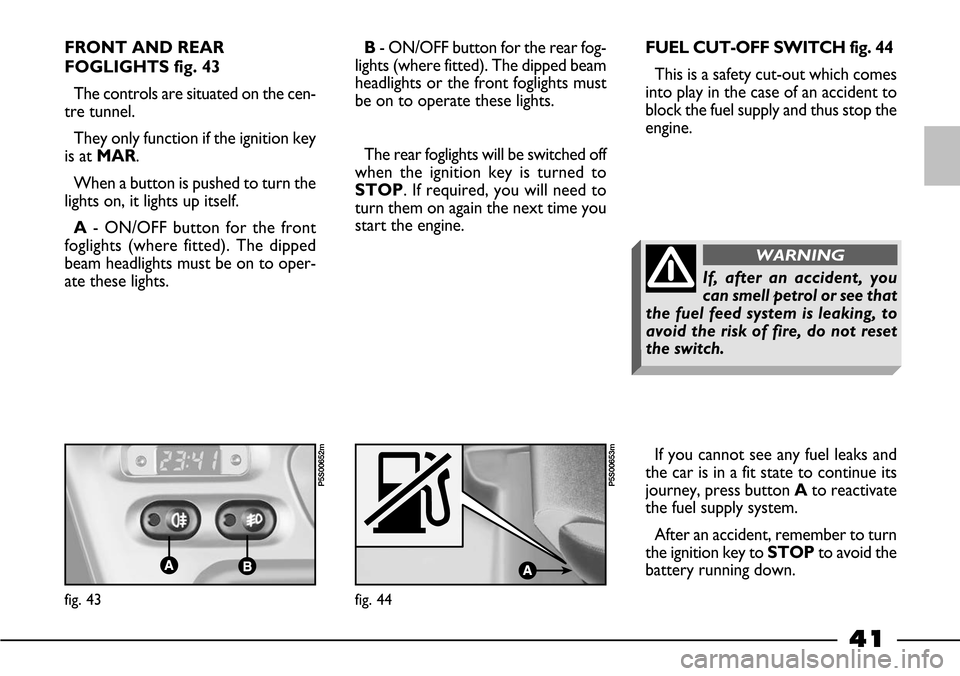
FRONT AND REAR
FOGLIGHTS fig. 43
The controls are situated on the cen-
tre tunnel.
They only function if the ignition key
is at MAR.
When a button is pushed to turn the
lights on, it lights up itself.
A- ON/OFF button for the front
foglights (where fitted). The dipped
beam headlights must be on to oper-
ate these lights.B- ON/OFF button for the rear fog-
lights (where fitted). The dipped beam
headlights or the front foglights must
be on to operate these lights.
The rear foglights will be switched off
when the ignition key is turned to
STOP. If required, you will need to
turn them on again the next time you
start the engine.FUEL CUT-OFF SWITCH fig. 44
This is a safety cut-out which comes
into play in the case of an accident to
block the fuel supply and thus stop the
engine.
If you cannot see any fuel leaks and
the car is in a fit state to continue its
journey, press button Ato reactivate
the fuel supply system.
After an accident, remember to turn
the ignition key toSTOPto avoid the
battery running down.
fig. 44
P5S00653m
fig. 43
P5S00652m
If, after an accident, you
can smell petrol or see that
the fuel feed system is leaking, to
avoid the risk of fire, do not reset
the switch.
WARNING