fig 36 FIAT DUCATO 244 2005 3.G Repair Manual
[x] Cancel search | Manufacturer: FIAT, Model Year: 2005, Model line: DUCATO 244, Model: FIAT DUCATO 244 2005 3.GPages: 258, PDF Size: 4.05 MB
Page 80 of 258
79GETTING TO KNOW YOUR VEHICLE
IMPORTANT NOTES
Do not use abrasive detergents or
solvents to clean the device. To clean
its external surface, use a wet cloth or
special products for cleaning synthet-
ic materials.
The multimeter is installed and
sealed with lead by authorised per-
sonnel: access to the device and rele-
vant power and recording cables is
forbidden.
The vehicle owner is responsible for
governing the instrument use. The in-
spection must be carried out at least
every two years and will include a test
to confirm correct operation.
After the inspection, check that the
plate is updated with specified data.DRIVER’S CAB DOORS
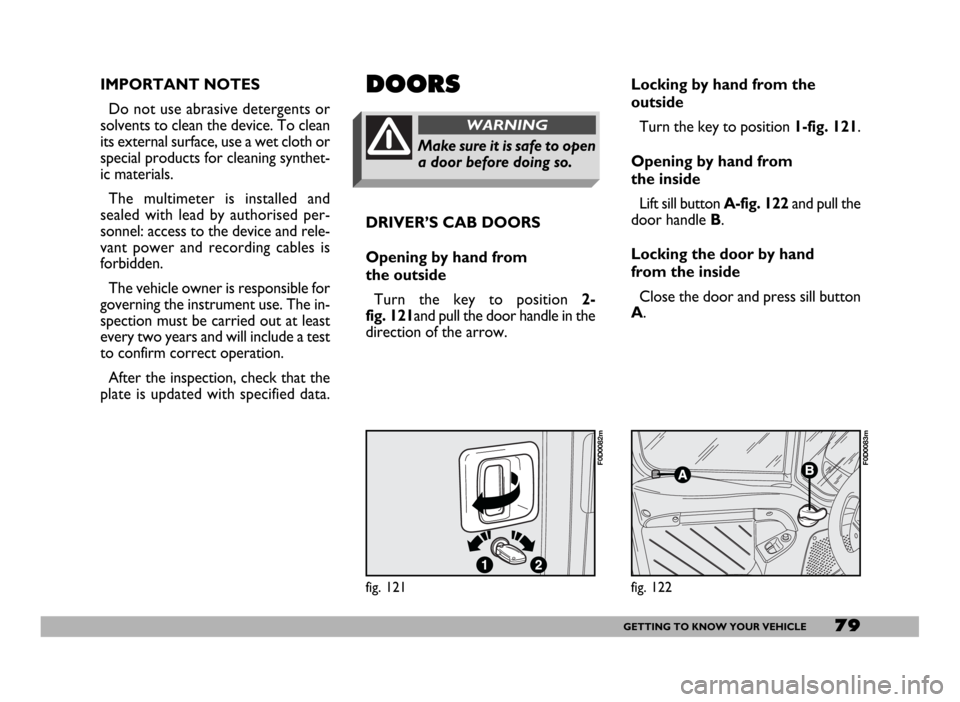
Opening by hand from
the outside
Turn the key to position 2-
fig. 121and pull the door handle in the
direction of the arrow.DOORS
Make sure it is safe to open
a door before doing so.
WARNING
Locking by hand from the
outside
Turn the key to position 1-fig. 121.
Opening by hand from
the inside
Lift sill button A-fig. 122and pull the
door handle B.
Locking the door by hand
from the inside
Close the door and press sill button
A.
fig. 121
F0D0082m
fig. 122
F0D0083m
Page 81 of 258
80GETTING TO KNOW YOUR VEHICLE
SIDE SLIDING DOOR
When leaving the vehicle
parked with the sliding
doors open, always check that the
door hooks are properly fastened
into the retaining device.
WARNING
fig. 123
F0D0084m
Do not move the vehicle
with side doors open.
WARNING
The sliding door opens in the same
way as the driver’s cab door.
The side sliding door is equipped
with a lock that stops it at the end of
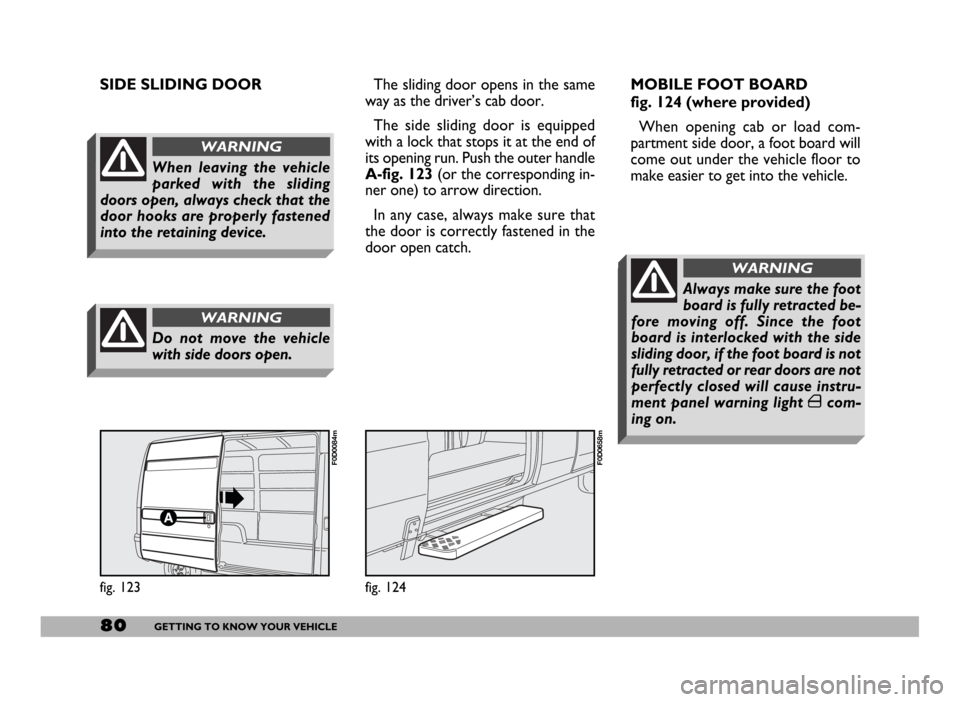
its opening run. Push the outer handle
A-fig. 123(or the corresponding in-
ner one) to arrow direction.
In any case, always make sure that
the door is correctly fastened in the
door open catch.
fig. 124
F0D0658m
MOBILE FOOT BOARD
fig. 124 (where provided)
When opening cab or load com-
partment side door, a foot board will
come out under the vehicle floor to
make easier to get into the vehicle.
Always make sure the foot
board is fully retracted be-
fore moving off. Since the foot
board is interlocked with the side
sliding door, if the foot board is not
fully retracted or rear doors are not
perfectly closed will cause instru-
ment panel warning light ´com-
ing on.
WARNING
Page 82 of 258
81GETTING TO KNOW YOUR VEHICLE
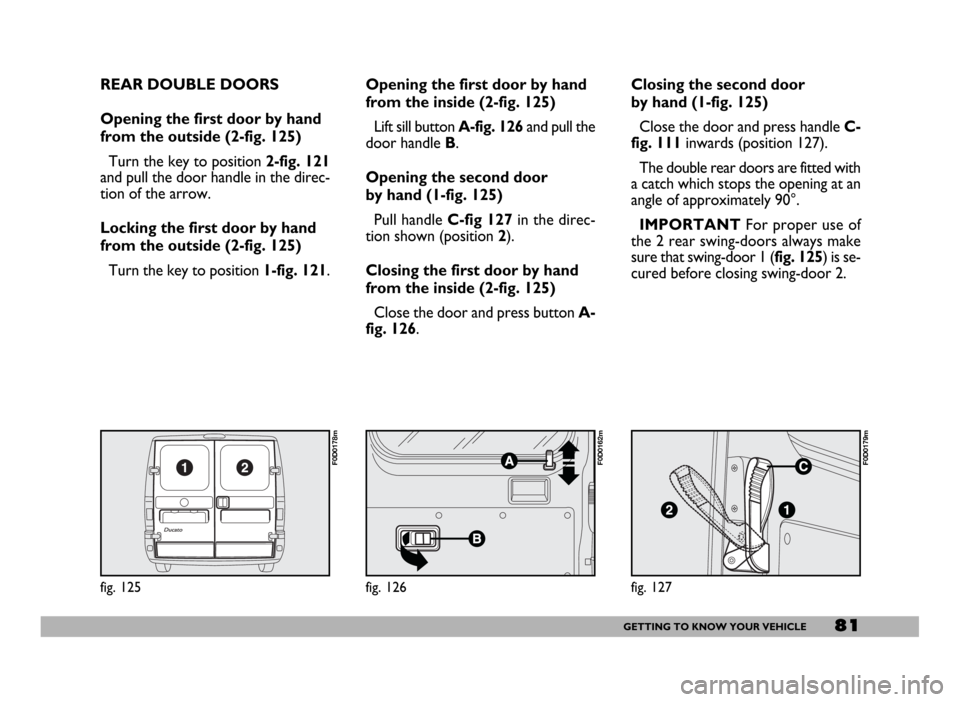
REAR DOUBLE DOORS
Opening the first door by hand
from the outside (2-fig. 125)
Turn the key to position 2-fig. 121
and pull the door handle in the direc-
tion of the arrow.
Locking the first door by hand
from the outside (2-fig. 125)
Turn the key to position 1-fig. 121.
fig. 125
F0D0178m
Opening the first door by hand
from the inside (2-fig. 125)
Lift sill button A-fig. 126and pull the
door handle B.
Opening the second door
by hand (1-fig. 125)
Pull handle C-fig 127in the direc-
tion shown (position2).
Closing the first door by hand
from the inside (2-fig. 125)
Close the door and press button A-
fig. 126.Closing the second door
by hand (1-fig. 125)
Close the door and press handle C-
fig. 111inwards (position 127).
The double rear doors are fitted with
a catch which stops the opening at an
angle of approximately 90°.
IMPORTANTFor proper use of
the 2 rear swing-doors always make
sure that swing-door 1 (fig. 125) is se-
cured before closing swing-door 2.
fig. 127
F0D0179m
fig. 126
F0D0162m
Page 83 of 258
82GETTING TO KNOW YOUR VEHICLE
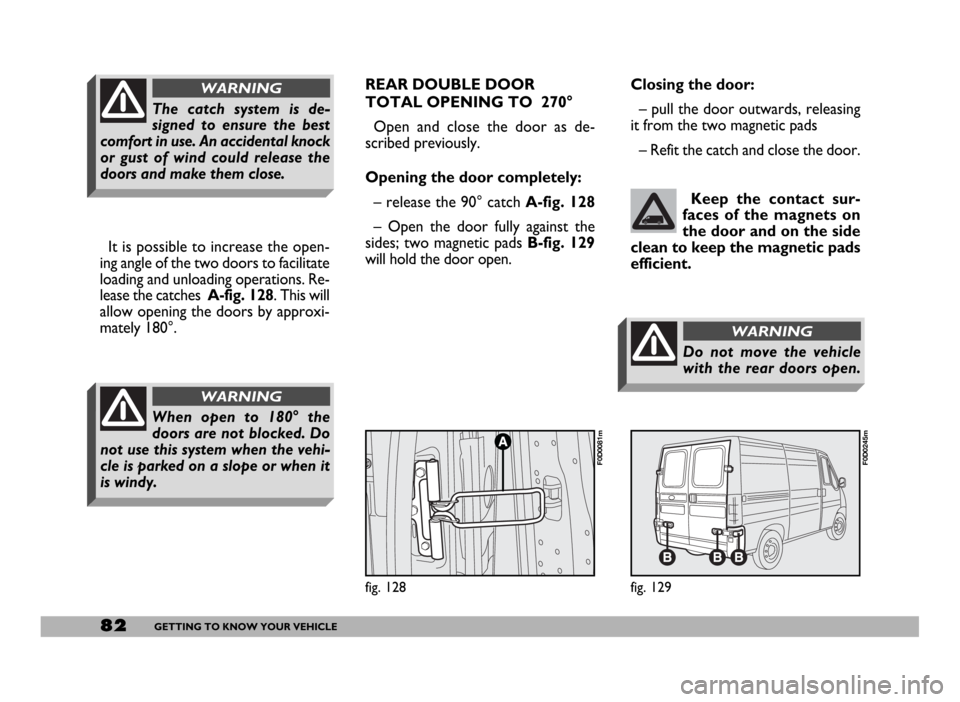
It is possible to increase the open-
ing angle of the two doors to facilitate
loading and unloading operations. Re-
lease the catches A-fig. 128. This will
allow opening the doors by approxi-
mately 180°.
When open to 180° the
doors are not blocked. Do
not use this system when the vehi-
cle is parked on a slope or when it
is windy.
WARNING
The catch system is de-
signed to ensure the best
comfort in use. An accidental knock
or gust of wind could release the
doors and make them close.
WARNINGREAR DOUBLE DOOR
TOTAL OPENING TO 270°
Open and close the door as de-
scribed previously.
Opening the door completely:
– release the 90° catch A-fig. 128
– Open the door fully against the
sides; two magnetic pads B-fig. 129
will hold the door open. Closing the door:
– pull the door outwards, releasing
it from the two magnetic pads
– Refit the catch and close the door.
Keep the contact sur-
faces of the magnets on
the door and on the side
clean to keep the magnetic pads
efficient.
fig. 129
F0D0245m
fig. 128
F0D0081m
Do not move the vehicle
with the rear doors open.
WARNING
Page 84 of 258
83GETTING TO KNOW YOUR VEHICLE
CENTRAL DOOR LOCKING
IMPORTANTCentral door locking
is active on all doors if front doors (cab
doors) are used for opening/closing.
When operating one of the rear or
side door lock, only that door will be
locked/unlocked.
From the outside
When the doors are closed, insert
and turn the key in the lock of one of
the driver’s cab doors.
From the inside
When the doors are closed, press
(to lock) or lift (to unlock) one of the
driver’s cab door safety sill buttons.
IMPORTANT If one of the cab
doors is not shut properly or there is
a failure in the system, the central
locking feature will not work and, af-
ter some attempts, the device will stop
working for about 2 minutes. In these
two minutes, the doors can be locked
or unlocked manually without the
electrical system coming into play.After the two minutes, the control
unit is ready to receive commands
once more. If the reason for the mal-
functioning has been removed, the de-
vice will start to work properly again.
If not, it will cut once more.
FRONT DOOR WINDOW
REGULATORS
Manual control
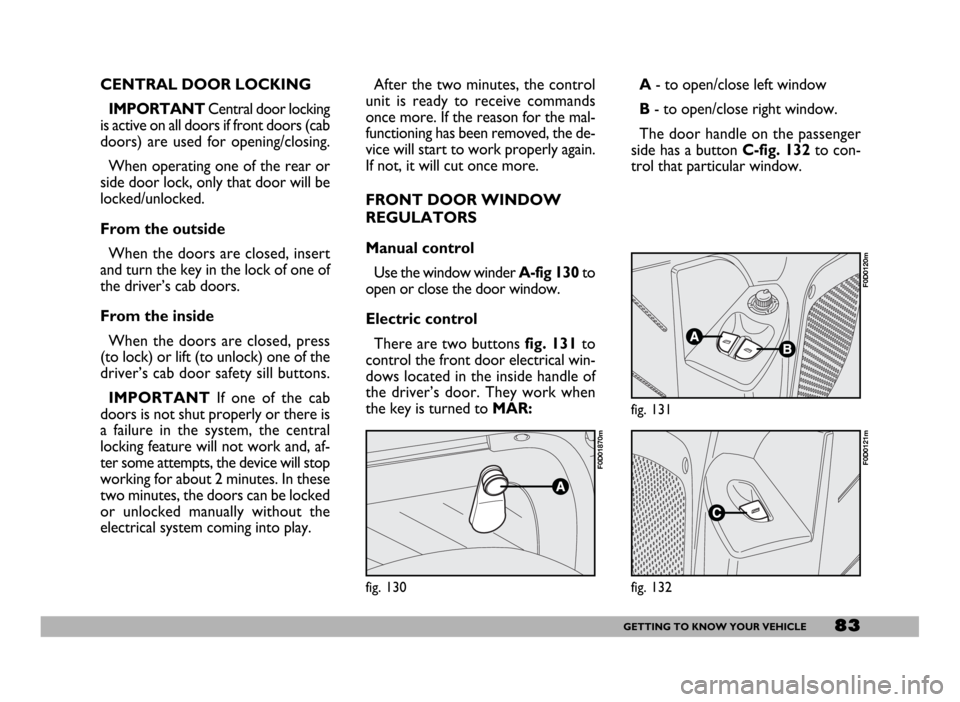
Use the window winderA-fig 130to
open or close the door window.
Electric control
There are two buttons fig. 131to
control the front door electrical win-
dows located in the inside handle of
the driver’s door. They work when
the key is turned to MAR:A- to open/close left window
B- to open/close right window.
The door handle on the passenger
side has a button C-fig. 132to con-
trol that particular window.
fig. 130
F0D01870m
fig. 131
F0D0120m
fig. 132
F0D0121m
Page 85 of 258
84GETTING TO KNOW YOUR VEHICLE
Improper use of the electri-
cal windows can be danger-
ous. Before and during their oper-
ation ensure that any passengers in
the vehicle are not at risk from the
moving glass either by personal ob-
jects getting caught in the mecha-
nism or by being injured by it di-
rectly.
WARNING
Always remove the ignition
key when you get out of the
vehicle to prevent the electric win-
dows being operated accidentally
and constituting a danger to the
people left in the vehicle
WARNING
BONNET
OPENING
Proceed as follows:
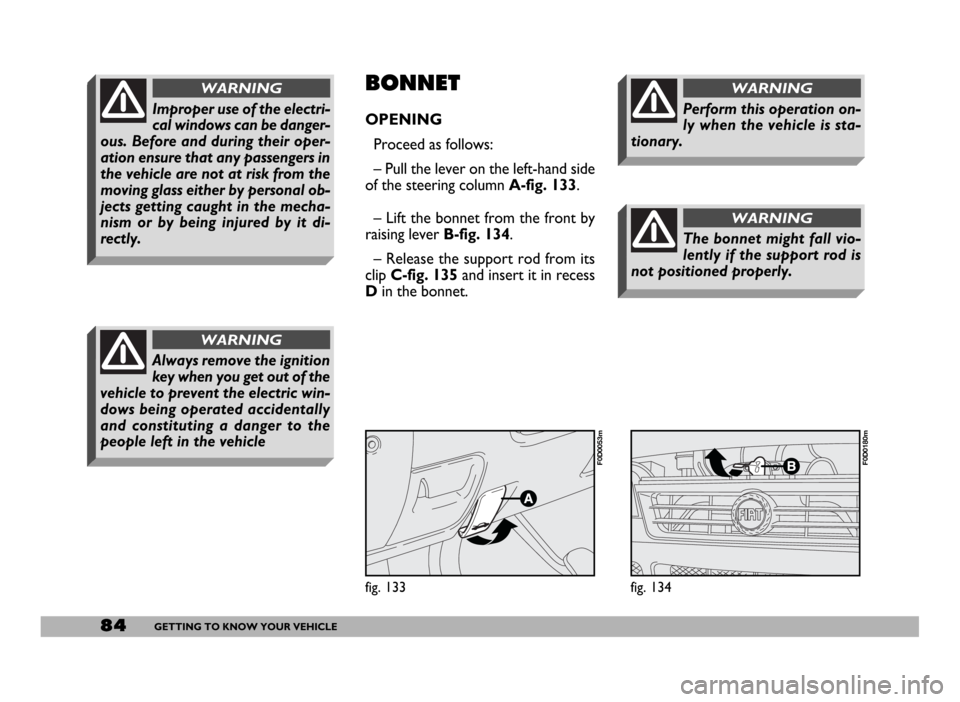
– Pull the lever on the left-hand side
of the steering column A-fig. 133.
– Lift the bonnet from the front by
raising lever B-fig. 134.
– Release the support rod from its
clipC-fig. 135and insert it in recess
Din the bonnet.
fig. 133
F0D0053m
fig. 134
F0D0180m
The bonnet might fall vio-
lently if the support rod is
not positioned properly.
WARNING
Perform this operation on-
ly when the vehicle is sta-
tionary.
WARNING
Page 86 of 258
85GETTING TO KNOW YOUR VEHICLE
Be very cautious operating
the engine compartment
when the engine is hot - danger of
burns! Wait until the engine cools.
WARNING
Scarves, ties and other
loose articles of clothing
could easily get caught up in mov-
ing parts. This can be extremely
dangerous for the wearer.
WARNINGCLOSING
Proceed as follows:
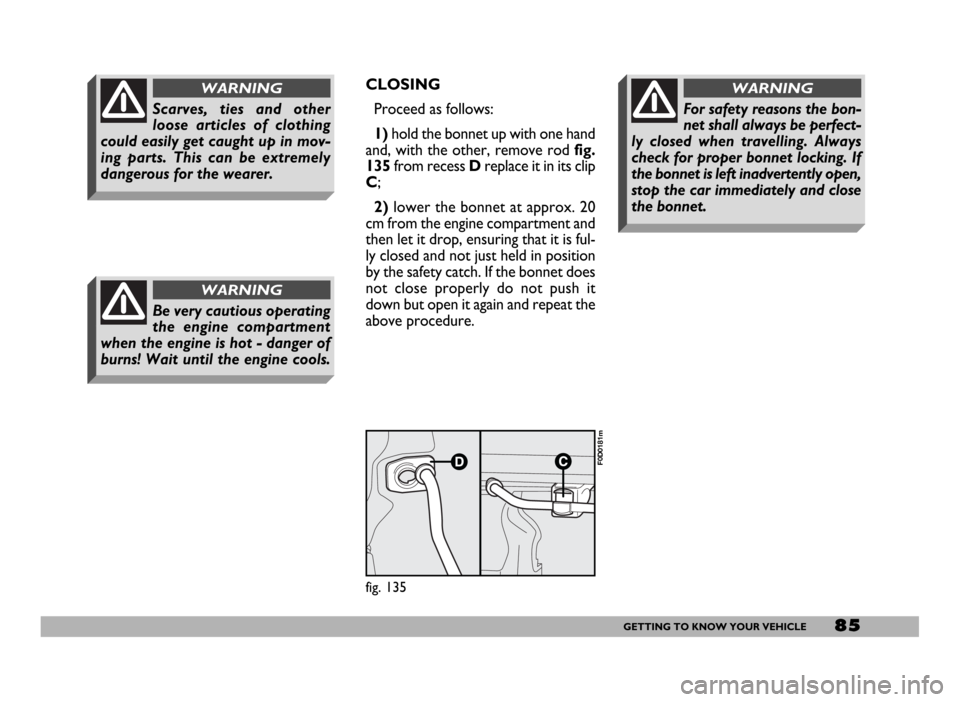
1)hold the bonnet up with one hand
and, with the other, remove rodfig.
135from recess Dreplace it in its clip
C;
2)lower the bonnet at approx. 20
cm from the engine compartment and
then let it drop, ensuring that it is ful-
ly closed and not just held in position
by the safety catch. If the bonnet does
not close properly do not push it
down but open it again and repeat the
above procedure.
For safety reasons the bon-
net shall always be perfect-
ly closed when travelling. Always
check for proper bonnet locking. If
the bonnet is left inadvertently open,
stop the car immediately and close
the bonnet.
WARNING
fig. 135
F0D0181m
Page 87 of 258
86GETTING TO KNOW YOUR VEHICLE
HEADLIGHTS
ADJUSTING THE FRONT
HEADLIGHT BEAM
The correct positioning of the head-
light beams is very important for the
comfort and safety, not only of the
person driving the vehicle but also all
other road users.
This is also covered by a specific law.
To ensure you and other drivers
have the best visibility conditions when
travelling with the headlights on, the
headlights must be set properly.
fig. 136
F0D00043m
Check the positioning of
the headlight beams every
time you change the load to be car-
ried.
WARNINGHave the headlight positioning
checked at aFiat Dealership and
adjusted if necessary.
When the vehicle is loaded, it
“slopes” backwards. This means that
the headlight beam rises. In this case,
it is necessary to return it to the cor-
rect position.
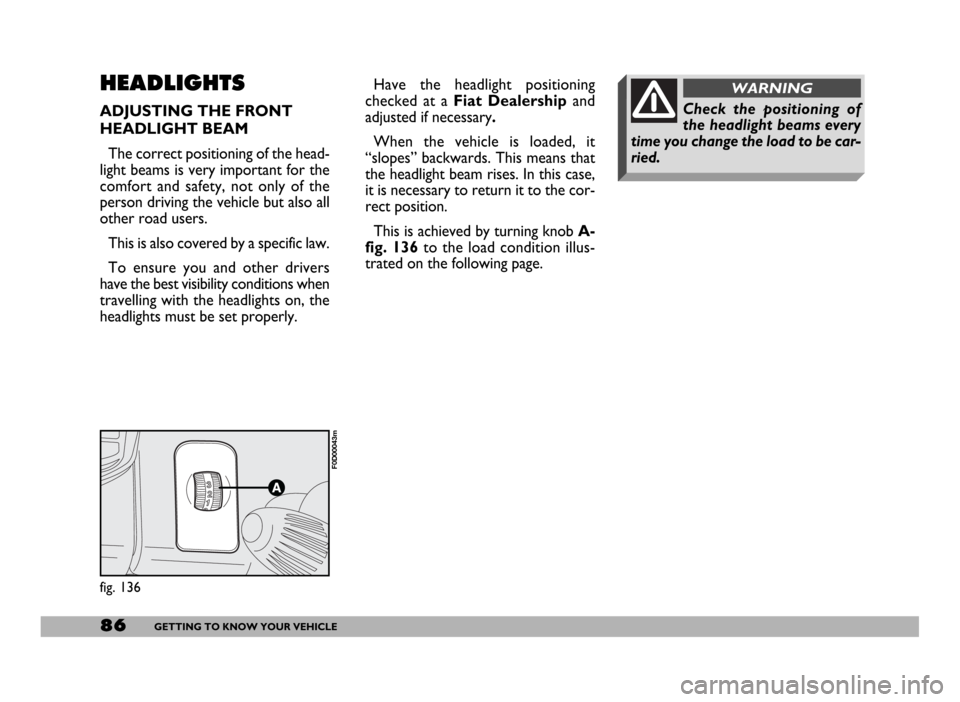
This is achieved by turning knob A-
fig. 136to the load condition illus-
trated on the following page.
Page 91 of 258
90GETTING TO KNOW YOUR VEHICLE
FRONT AND SIDE
AIRBAGS
FRONT AIRBAGS
Description and operation
The front airbag (driver’s and passen-
ger’s) is a safety device which comes in-
to action in the event of a head-on col-
lision.
It consists of a cushion that inflates
instantaneously contained in a special
recess:
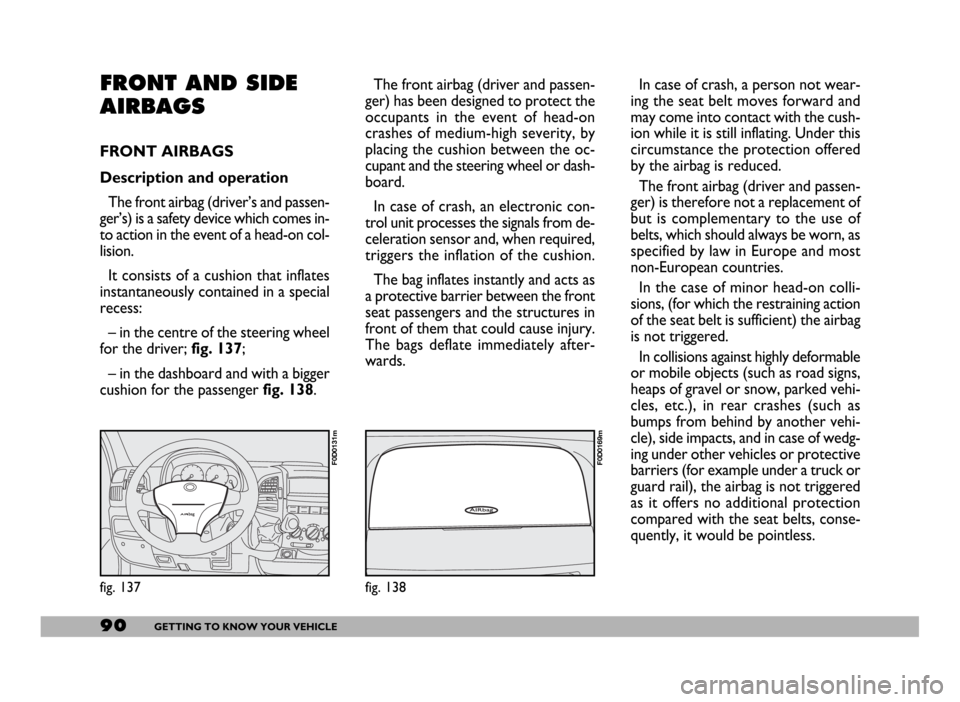
– in the centre of the steering wheel
for the driver; fig. 137;
– in the dashboard and with a bigger
cushion for the passenger fig. 138.The front airbag (driver and passen-
ger) has been designed to protect the
occupants in the event of head-on
crashes of medium-high severity, by
placing the cushion between the oc-
cupant and the steering wheel or dash-
board.
In case of crash, an electronic con-
trol unit processes the signals from de-
celeration sensor and, when required,
triggers the inflation of the cushion.
The bag inflates instantly and acts as
a protective barrier between the front
seat passengers and the structures in
front of them that could cause injury.
The bags deflate immediately after-
wards.
fig. 137
F0D0131m
fig. 138
F0D0169m
In case of crash, a person not wear-
ing the seat belt moves forward and
may come into contact with the cush-
ion while it is still inflating. Under this
circumstance the protection offered
by the airbag is reduced.
The front airbag (driver and passen-
ger) is therefore not a replacement of
but is complementary to the use of
belts, which should always be worn, as
specified by law in Europe and most
non-European countries.
In the case of minor head-on colli-
sions, (for which the restraining action
of the seat belt is sufficient) the airbag
is not triggered.
In collisions against highly deformable
or mobile objects (such as road signs,
heaps of gravel or snow, parked vehi-
cles, etc.), in rear crashes (such as
bumps from behind by another vehi-
cle), side impacts, and in case of wedg-
ing under other vehicles or protective
barriers (for example under a truck or
guard rail), the airbag is not triggered
as it offers no additional protection
compared with the seat belts, conse-
quently, it would be pointless.
Page 92 of 258
91GETTING TO KNOW YOUR VEHICLE
Therefore, failure to come into ac-
tion in the above circumstances does
not mean that the system is not work-
ing properly.
Airbag system efficiency is constant-
ly monitored by an electronic control
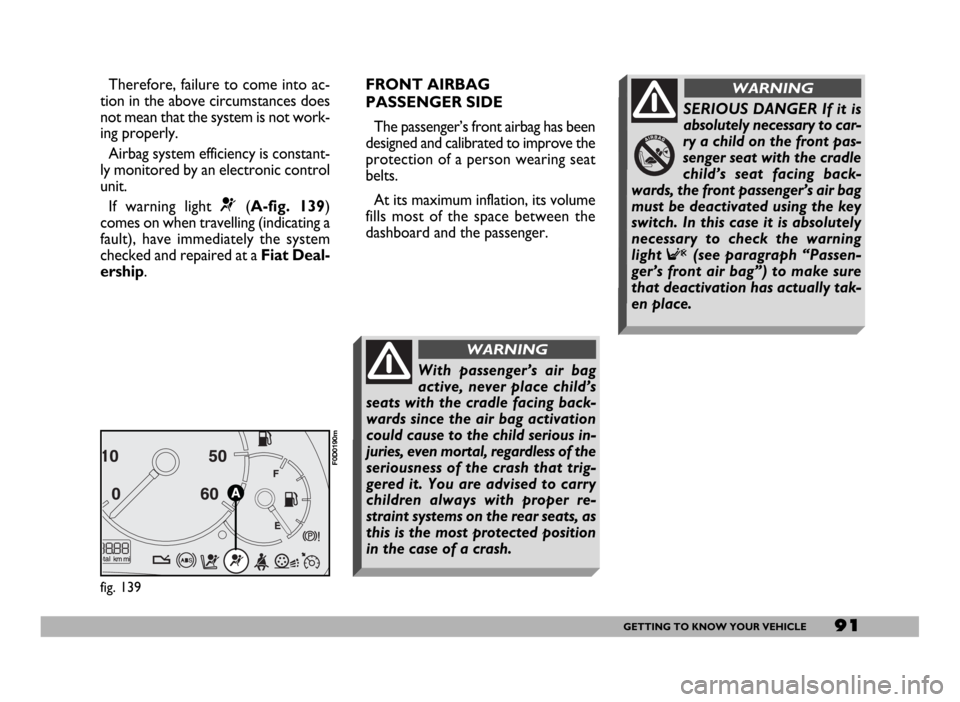
unit.
If warning light
¬(A-fig. 139)
comes on when travelling (indicating a
fault), have immediately the system
checked and repaired at a Fiat Deal-
ership.FRONT AIRBAG
PASSENGER SIDE
The passenger’s front airbag has been
designed and calibrated to improve the
protection of a person wearing seat
belts.
At its maximum inflation, its volume
fills most of the space between the
dashboard and the passenger.
fig. 139
F0D0190m
SERIOUS DANGER If it is
absolutely necessary to car-
ry a child on the front pas-
senger seat with the cradle
child’s seat facing back-
wards, the front passenger’s air bag
must be deactivated using the key
switch. In this case it is absolutely
necessary to check the warning
light
F(see paragraph “Passen-
ger’s front air bag”) to make sure
that deactivation has actually tak-
en place.
WARNING
With passenger’s air bag
active, never place child’s
seats with the cradle facing back-
wards since the air bag activation
could cause to the child serious in-
juries, even mortal, regardless of the
seriousness of the crash that trig-
gered it. You are advised to carry
children always with proper re-
straint systems on the rear seats, as
this is the most protected position
in the case of a crash.
WARNING