warning FIAT FULLBACK 2016 1.G Owners Manual
[x] Cancel search | Manufacturer: FIAT, Model Year: 2016, Model line: FULLBACK, Model: FIAT FULLBACK 2016 1.GPages: 312, PDF Size: 13.67 MB
Page 248 of 312
The engine oil used has a significant
effect on the engine’s performance,
service life and startability. Be sure to
use oil of the recommended quality and
appropriate viscosity. All engines
consume a certain amount of oil during
normal operation. Therefore, it is
important to check the oil level at
regular intervals or before starting a
long trip.
1. Park the car on a horizontal surface.
2. Switch off the engine.
3.Wait a few minutes.
4. Remove the dipstick and wipe it with
a clean cloth.
5. Reinsert the dipstick as far as it
goes.
6. Remove the dipstick and read the oil
level, which should always be within the
range indicated.
7. If the oil level is below the specified
limit, remove the cap located on the
cylinder head cover and add enough oilto raise the level to within the specified
range. Do not overfill to avoid engine
damage. Be sure to use the specified
engine oil and do not mix various types
of oil.
8. After adding oil, close the cap
securely.
9. Confirm the oil level by repeating
step 4 to 6.
NOTE Check or refill the oil according
to the following manner.
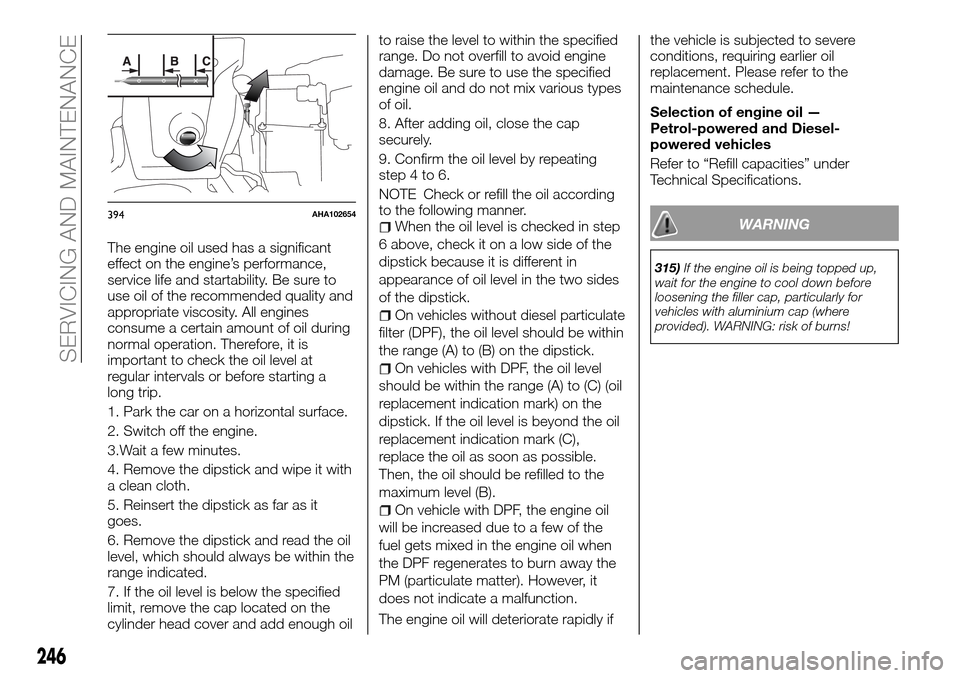
When the oil level is checked in step
6 above, check it on a low side of the
dipstick because it is different in
appearance of oil level in the two sides
of the dipstick.
On vehicles without diesel particulate
filter (DPF), the oil level should be within
the range (A) to (B) on the dipstick.
On vehicles with DPF, the oil level
should be within the range (A) to (C) (oil
replacement indication mark) on the
dipstick. If the oil level is beyond the oil
replacement indication mark (C),
replace the oil as soon as possible.
Then, the oil should be refilled to the
maximum level (B).
On vehicle with DPF, the engine oil
will be increased due to a few of the
fuel gets mixed in the engine oil when
the DPF regenerates to burn away the
PM (particulate matter). However, it
does not indicate a malfunction.
The engine oil will deteriorate rapidly ifthe vehicle is subjected to severe
conditions, requiring earlier oil
replacement. Please refer to the
maintenance schedule.
Selection of engine oil —
Petrol-powered and Diesel-
powered vehicles
Refer to “Refill capacities” under
Technical Specifications.
WARNING
315)If the engine oil is being topped up,
wait for the engine to cool down before
loosening the filler cap, particularly for
vehicles with aluminium cap (where
provided). WARNING: risk of burns!
394AHA102654
246
SERVICING AND MAINTENANCE
Page 250 of 312
Ambient temperature
(minimum) °CPetrol-powered vehicles
Anti-freeze concentration %Diesel-powered vehicles
Anti-freeze concentration %
-15 30
50 -20 35
-25 40
-30 45
-35 50
-50 60 60
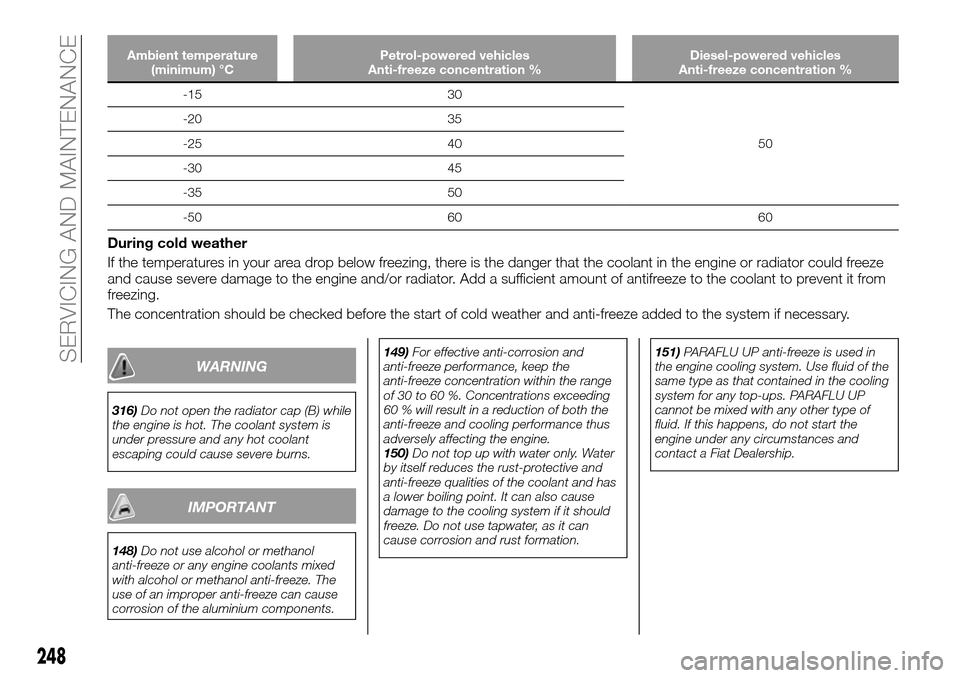
During cold weather
If the temperatures in your area drop below freezing, there is the danger that the coolant in the engine or radiator could freeze
and cause severe damage to the engine and/or radiator. Add a sufficient amount of antifreeze to the coolant to prevent it from
freezing.
The concentration should be checked before the start of cold weather and anti-freeze added to the system if necessary.
WARNING
316)Do not open the radiator cap (B) while
the engine is hot. The coolant system is
under pressure and any hot coolant
escaping could cause severe burns.
IMPORTANT
148)Do not use alcohol or methanol
anti-freeze or any engine coolants mixed
with alcohol or methanol anti-freeze. The
use of an improper anti-freeze can cause
corrosion of the aluminium components.149)For effective anti-corrosion and
anti-freeze performance, keep the
anti-freeze concentration within the range
of 30 to 60 %. Concentrations exceeding
60 % will result in a reduction of both the
anti-freeze and cooling performance thus
adversely affecting the engine.
150)Do not top up with water only. Water
by itself reduces the rust-protective and
anti-freeze qualities of the coolant and has
a lower boiling point. It can also cause
damage to the cooling system if it should
freeze. Do not use tapwater, as it can
cause corrosion and rust formation.151)PARAFLU UP anti-freeze is used in
the engine cooling system. Use fluid of the
same type as that contained in the cooling
system for any top-ups. PARAFLU UP
cannot be mixed with any other type of
fluid. If this happens, do not start the
engine under any circumstances and
contact a Fiat Dealership.
248
SERVICING AND MAINTENANCE
Page 251 of 312
WASHER FLUID
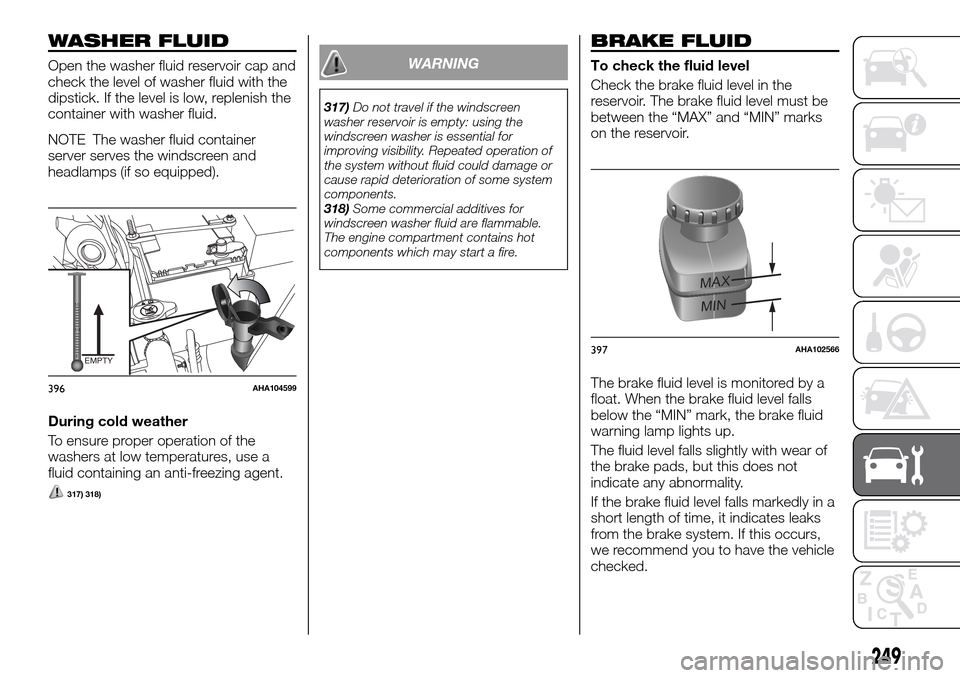
Open the washer fluid reservoir cap and
check the level of washer fluid with the
dipstick. If the level is low, replenish the
container with washer fluid.
NOTE The washer fluid container
server serves the windscreen and
headlamps (if so equipped).
During cold weather
To ensure proper operation of the
washers at low temperatures, use a
fluid containing an anti-freezing agent.
317) 318)
WARNING
317)Do not travel if the windscreen
washer reservoir is empty: using the
windscreen washer is essential for
improving visibility. Repeated operation of
the system without fluid could damage or
cause rapid deterioration of some system
components.
318)Some commercial additives for
windscreen washer fluid are flammable.
The engine compartment contains hot
components which may start a fire.
BRAKE FLUID
To check the fluid level
Check the brake fluid level in the
reservoir. The brake fluid level must be
between the “MAX” and “MIN” marks
on the reservoir.
The brake fluid level is monitored by a
float. When the brake fluid level falls
below the “MIN” mark, the brake fluid
warning lamp lights up.
The fluid level falls slightly with wear of
the brake pads, but this does not
indicate any abnormality.
If the brake fluid level falls markedly in a
short length of time, it indicates leaks
from the brake system. If this occurs,
we recommend you to have the vehicle
checked.
108kPa
EMPTYE 1/4 1/2
396AHA104599
MAX
MIN
397AHA102566
249
Page 252 of 312
Fluid type
Use brake fluid conforming to DOT3 or
DOT4. The brake fluid is hygroscopic.
Too much moisture in the brake fluid will
adversely affect the brake system,
reducing the brake performance.
In addition, the brake fluid reservoir is
equipped with a special cap to prevent
the entrance of air, and this cap should
not be removed.
319) 320) 321) 322)
152) 153) 154)
WARNING
319)Take care in handling brake fluid as it
is harmful to the eyes, may irritate your skin
and also damage to painted surfaces.
320)Use only the specified brake fluid. Do
not mix or add different brand of brake fluid
to prevent chemical reaction. Do not let
any petroleum-based fluid touch, mix with,
or get into the brake fluid. This will damage
the seals.
321)Clean the filler cap before removing
and close the cap securely after
maintenance.
322)Brake fluid is poisonous and highly
corrosive. In the event of accidental
contact, immediately wash the affected
parts with water and mild soap. Then rinse
thoroughly. Call a doctor immediately if
swallowed.
IMPORTANT
152)Keep the reservoir tank cap closed to
prevent the brake fluid from deteriorating
except maintenance.
153)Prevent brake fluid, which is highly
corrosive, from coming into contact with
painted parts. Should it happen,
immediately wash with water.
154)The symbol
, on the brake fluid
container indicates if a brake fluid is
synthetic or mineral-based. Use of mineral
type fluids will damage the special rubber
seals of the braking system beyond repair.
CLUTCH FLUID
To check the fluid level
The clutch fluid in the master cylinder
should be checked when performing
other underhood service. In addition,
the system should be checked for
leakage at the same time.
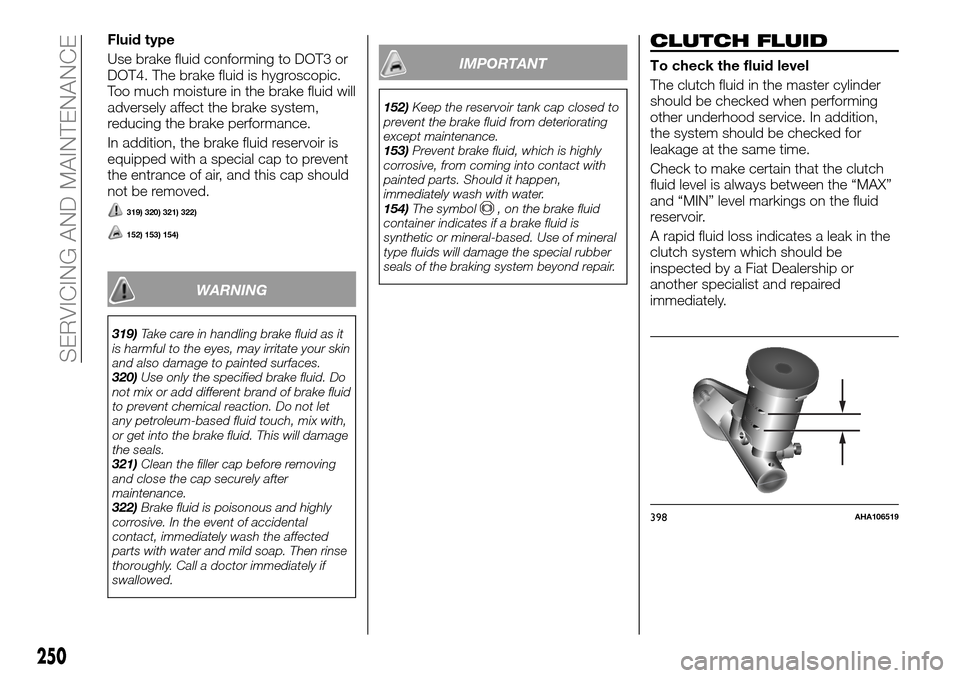
Check to make certain that the clutch
fluid level is always between the “MAX”
and “MIN” level markings on the fluid
reservoir.
A rapid fluid loss indicates a leak in the
clutch system which should be
inspected by a Fiat Dealership or
another specialist and repaired
immediately.
MAX
MIN
398AHA106519
250
SERVICING AND MAINTENANCE
Page 253 of 312
Fluid type
Brake fluid conforming to DOT 3 or
DOT 4 should be used. The reservoir
cap must be fully tightened to avoid
contamination from foreign matter or
moisture. DO NOT ALLOW
PETROLEUM- BASED FLUID TO
CONTACT, MIX WITH, OR OTHERWISE
CONTAMINATE THE BRAKE FLUID.
SEAL DAMAGE WILL RESULT.
323)
WARNING
323)Clutch fluid is poisonous and highly
corrosive. In the event of accidental
contact, immediately wash the affected
parts with water and mild soap. Then rinse
thoroughly. Call a doctor immediately if
swallowed.
POWER STEERING
FLUID
324)
3)
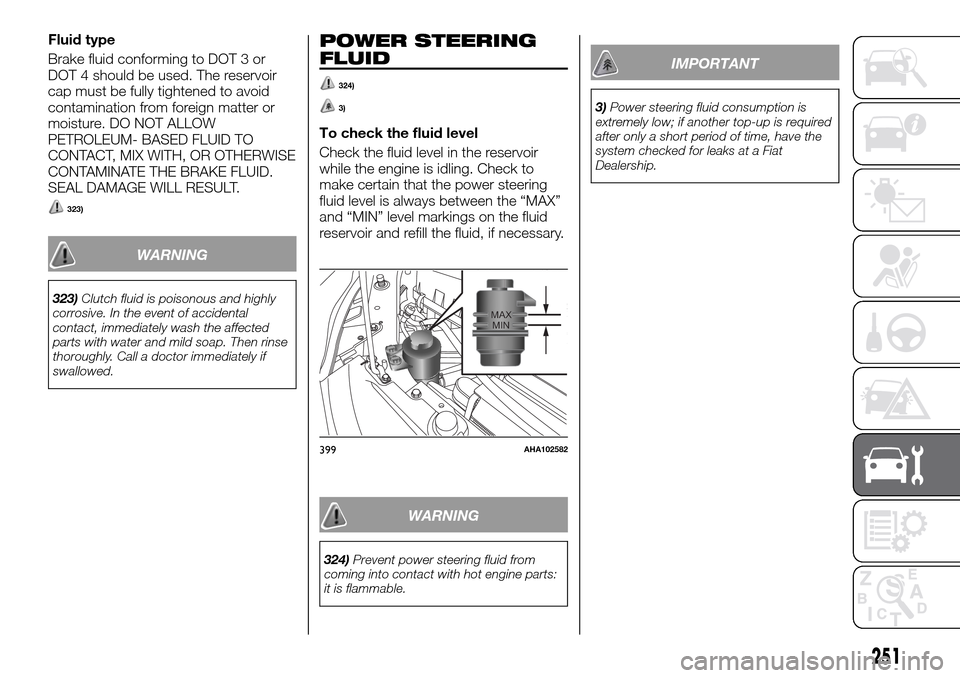
To check the fluid level
Check the fluid level in the reservoir
while the engine is idling. Check to
make certain that the power steering
fluid level is always between the “MAX”
and “MIN” level markings on the fluid
reservoir and refill the fluid, if necessary.
WARNING
324)Prevent power steering fluid from
coming into contact with hot engine parts:
it is flammable.
IMPORTANT
3)Power steering fluid consumption is
extremely low; if another top-up is required
after only a short period of time, have the
system checked for leaks at a Fiat
Dealership.
MAX
MIN
399AHA102582
251
Page 255 of 312
WARNING
325)Keep sparks, cigarettes, and flames
away from the battery because the battery
could explode.
326)The battery electrolyte is extremely
caustic. Do not allow it to come in contact
with your eyes, skin, clothing, or the
painted surfaces of the vehicle. Spilt
electrolyte should be flushed immediately
with ample amounts of water. Irritation to
eyes or skin from contact with electrolyte
requires immediate medical attention.
327)Ventilate when charging or using the
battery in an enclosed space.
328)Always wear protective eye goggles
when working near the battery.
329)Keep it out of reach of children.
330)When you handle the battery, carefully
observe the following cautions for safety.
331)Keep sparks, cigarettes, and flames
away from the battery because the battery
could explode. Also, do not short-circuit
the battery terminals. Doing so could
create sparks.
332)Always wear protective eye goggles
when working near the battery. Battery
electrolyte contains sulphuric acid, so
getting it in your eyes is dangerous.
333)Battery electrolyte contains sulphuric
acid, so you must wear gloves and eye
protection when handling the battery. If
battery electrolyte gets in your eyes or on
your skin, rinse it away with clean water
and immediately see a doctor. If you
accidentally swallow battery electrolyte,
immediately see a doctor. If battery
electrolyte splashes on your clothing or on
the vehicle, rinse it off with lots of water.334)The battery emits highly explosive
hydrogen gas. Ventilate when charging the
battery in an enclosed space.
335)Using the battery with insufficient fluid
irreparably damages the battery and may
cause an explosion.
IMPORTANT
155)Do not bring the nearby parts, the
plastic parts and so on into contact with
sulphuric acid (battery electrolyte) which
may crack, stain or discolour them. If they
are in contact, wipe off with soft cloth,
chamois or the like and an aqueous
solution of neutral detergent then
immediately rinse the affected parts with
plenty of water.
156)If the vehicle must remain unused for
a long time at a very low temperature,
remove the battery and take it to a warm
place, to avoid freezing.
157)Never disconnect the battery when
the ignition switch or the operation mode is
in the “ON” position; doing so could
damage the vehicle’s electrical
components.
158)Never short-circuit the battery. This
could cause it to overheat and be
damaged.
159)If the battery is to be quick-charged,
first disconnect the battery cables.
160)In order to prevent a short circuit, be
sure to disconnect the negative (-) terminal
first.
IMPORTANT
4)Batteries contain substances which are
very dangerous for the environment. For
battery replacement, contact a Fiat
Dealership.
253
Page 256 of 312
WIPER BLADE
RUBBER
REPLACEMENT
336)
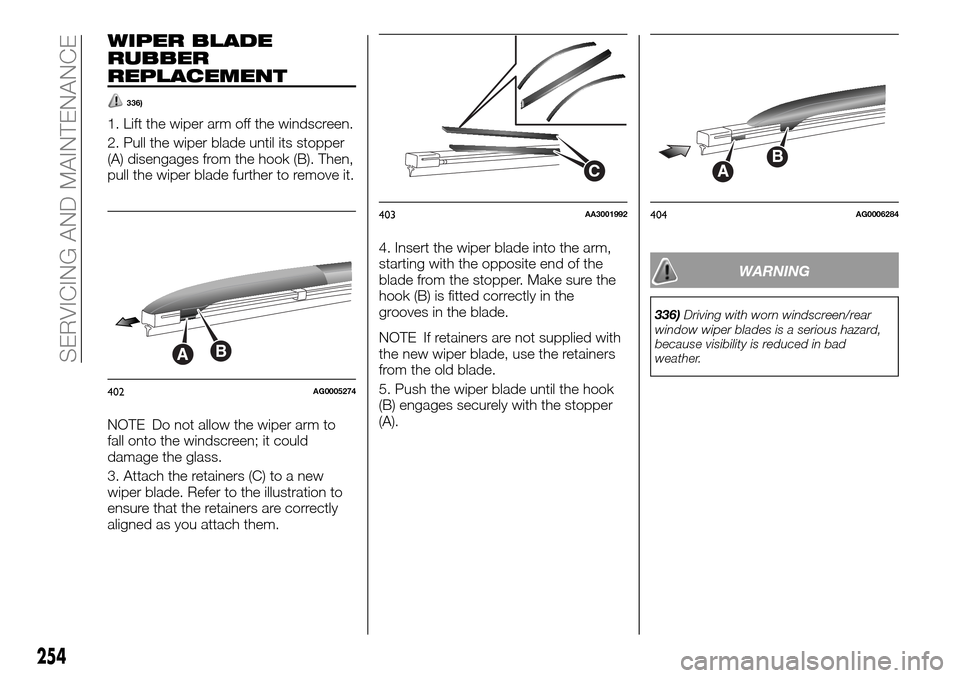
1. Lift the wiper arm off the windscreen.
2. Pull the wiper blade until its stopper
(A) disengages from the hook (B). Then,
pull the wiper blade further to remove it.
NOTE Do not allow the wiper arm to
fall onto the windscreen; it could
damage the glass.
3. Attach the retainers (C) to a new
wiper blade. Refer to the illustration to
ensure that the retainers are correctly
aligned as you attach them.4. Insert the wiper blade into the arm,
starting with the opposite end of the
blade from the stopper. Make sure the
hook (B) is fitted correctly in the
grooves in the blade.
NOTE If retainers are not supplied with
the new wiper blade, use the retainers
from the old blade.
5. Push the wiper blade until the hook
(B) engages securely with the stopper
(A).
WARNING
336)Driving with worn windscreen/rear
window wiper blades is a serious hazard,
because visibility is reduced in bad
weather.
AB
402AG0005274
C
403AA3001992
AB
404AG0006284
254
SERVICING AND MAINTENANCE
Page 257 of 312
GENERAL
MAINTENANCE
Fuel, engine coolant, oil and
exhaust gas leakage
Look under the body of your vehicle to
check for fuel, engine coolant, oil and
exhaust gas leaks.
Exterior and interior lamp operation
Operate the combination lamp switch
to check that all lamps are functioning
properly. If the lamps do not illuminate,
the probable cause is a blown fuse or
defective lamp bulb. Check the fuses
first. If there is no blown fuses, check
the lamp bulbs. For information
regarding the inspection and
replacement of the fuses and the bulbs,
refer to “Fuses” and “Replacement of
lamp bulbs”. If the fuses and bulbs are
all OK, we recommend you to have
your vehicle checked and repaired.
Meter, gauge and indicator/
warning lamps operation
Start the engine to check the operation
of all instruments, gauges, and indicator
and warning lamps. If there is anything
wrong, we recommend you to have
your vehicle inspected.
Hinges and latches lubrication
Check all latches and hinges, and, if
necessary, have them lubricated.
VEHICLE CARE
PRECAUTIONS
337)
161)
5)
In order to maintain the value of your
vehicle, it is necessary to perform
regular maintenance using the proper
procedures.
Always maintain your vehicle in
compliance with any environmental
pollution control regulations.
Carefully select the materials used for
washing, etc., to be sure that they do
not contain corrosives. If in doubt, we
recommend you to consult a specialist
for the selection of these materials.
WARNING
337)Cleaning products can be dangerous.
Always follow the instructions of the
cleaning product supplier.
IMPORTANT
161)To avoid damage, never use the
following to clean your vehicle: Petrol; Paint
Thinner; Benzine; Kerosene; Turpentine;
Naphtha; Lacquer Thinner; Carbon
Tetrachloride; Nail Polish Remover;
Acetone.
IMPORTANT
5)Detergents pollute the environment. Only
wash your vehicle in areas equipped to
collect and treat wastewater from this type
of activity.
255
Page 258 of 312
CLEANING THE
INTERIOR OF YOUR
VEHICLE
After cleaning the interior of your vehicle
with water, cleaner or similar, wipe and
dry in a shady, well-ventilated area.
To clean the inside of the rear window,
always use a soft cloth and wipe the
window glass along the demister heater
element so as not to cause damage.
338)
162)
Plastic, fabric and flocked parts
1. Lightly wipe these off with a soft
cloth soaked in a mild soap and water
solution.
2. Dip cloth in fresh water and wring it
out well. Using this cloth, wipe off the
detergent thoroughly.
Do not use cleaners, conditioners, and
protectants containing silicones or wax.
Such products, when applied to the
instrument panels or other parts, may
cause reflections on the windscreen
and obscure vision. Also, if such
products get on the switches of the
electrical accessories, it may lead to
failure of these accessories.
Upholstery
1. To maintain the value of your new
vehicle, handle the upholstery carefully
and keep the interior clean. Use a
vacuum cleaner and brush to clean theseats. If stained, synthetic leather
should be cleaned with an appropriate
cleaner. Cloth fabrics can be cleaned
with either upholstery cleaner or a mild
soap and water solution.
2. Clean the carpeting with a vacuum
cleaner and remove any stains with
carpet cleaner. Oil and grease can be
removed by lightly dabbing with a clean
colourfast cloth and stain remover.
Genuine leather
1. To clean, lightly wipe the leather with
a soft cloth soaked in a mild soap and
water solution.
2. Dip cloth in fresh water and wring it
out well. Using this cloth, wipe off the
detergent thoroughly.
3. Apply leather protecting agent to the
genuine leather surface.
If genuine leather is wet with water or is
washed in water, wipe off water as
quickly as possible with a dry, soft
cloth. If left damp, mildew may grow.
Organic solvents such as benzine,
kerosene, alcohol and petrol, acid or
alkaline solvents may discolour the
genuine leather surface. Be sure to use
neutral detergents.
Remove dirty patches or oil substances
quickly as they can stain genuine
leather.
The genuine leather surface may
harden and shrink if it is exposed todirect rays of the sun for long hours.
When your vehicle is parked, place it in
the shade as much as possible.
When the temperature of the vehicle
interior rises in summer, vinyl products
left on the genuine leather seat may
deteriorate and stick to the seat.
WARNING
338)Never use flammable products, such
as petrol ether or rectified petrol to clean
the inside of the car. The electrostatic
charges which are generated by rubbing
during the cleaning operation may cause a
fire.
IMPORTANT
162)Do not use organic substances
(solvents, benzine, kerosene, alcohol,
petrol, etc.) or alkaline or acidic solutions.
These chemicals can cause discolouring,
staining or cracking of the surface. If you
use cleaners or polishing agents, make
sure their ingredients do not include the
substances mentioned above.
256
SERVICING AND MAINTENANCE
Page 265 of 312
Snow tyres
183)
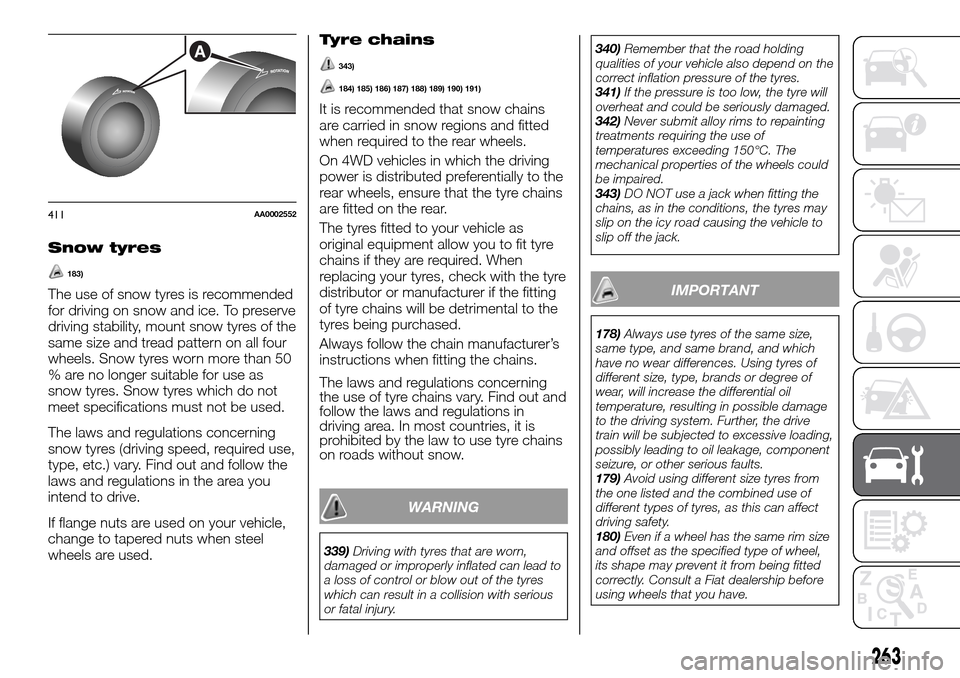
The use of snow tyres is recommended
for driving on snow and ice. To preserve
driving stability, mount snow tyres of the
same size and tread pattern on all four
wheels. Snow tyres worn more than 50
% are no longer suitable for use as
snow tyres. Snow tyres which do not
meet specifications must not be used.
The laws and regulations concerning
snow tyres (driving speed, required use,
type, etc.) vary. Find out and follow the
laws and regulations in the area you
intend to drive.
If flange nuts are used on your vehicle,
change to tapered nuts when steel
wheels are used.
Tyre chains
343)
184) 185) 186) 187) 188) 189) 190) 191)
It is recommended that snow chains
are carried in snow regions and fitted
when required to the rear wheels.
On 4WD vehicles in which the driving
power is distributed preferentially to the
rear wheels, ensure that the tyre chains
are fitted on the rear.
The tyres fitted to your vehicle as
original equipment allow you to fit tyre
chains if they are required. When
replacing your tyres, check with the tyre
distributor or manufacturer if the fitting
of tyre chains will be detrimental to the
tyres being purchased.
Always follow the chain manufacturer’s
instructions when fitting the chains.
The laws and regulations concerning
the use of tyre chains vary. Find out and
follow the laws and regulations in
driving area. In most countries, it is
prohibited by the law to use tyre chains
on roads without snow.
WARNING
339)Driving with tyres that are worn,
damaged or improperly inflated can lead to
a loss of control or blow out of the tyres
which can result in a collision with serious
or fatal injury.340)Remember that the road holding
qualities of your vehicle also depend on the
correct inflation pressure of the tyres.
341)If the pressure is too low, the tyre will
overheat and could be seriously damaged.
342)Never submit alloy rims to repainting
treatments requiring the use of
temperatures exceeding 150°C. The
mechanical properties of the wheels could
be impaired.
343)DO NOT use a jack when fitting the
chains, as in the conditions, the tyres may
slip on the icy road causing the vehicle to
slip off the jack.
IMPORTANT
178)Always use tyres of the same size,
same type, and same brand, and which
have no wear differences. Using tyres of
different size, type, brands or degree of
wear, will increase the differential oil
temperature, resulting in possible damage
to the driving system. Further, the drive
train will be subjected to excessive loading,
possibly leading to oil leakage, component
seizure, or other serious faults.
179)Avoid using different size tyres from
the one listed and the combined use of
different types of tyres, as this can affect
driving safety.
180)Even if a wheel has the same rim size
and offset as the specified type of wheel,
its shape may prevent it from being fitted
correctly. Consult a Fiat dealership before
using wheels that you have.
A
411AA0002552
263