lock FIAT FULLBACK 2017 Owner handbook (in English)
[x] Cancel search | Manufacturer: FIAT, Model Year: 2017, Model line: FULLBACK, Model: FIAT FULLBACK 2017Pages: 312, PDF Size: 12.31 MB
Page 236 of 312
Fuse replacement
332) 333) 334) 335) 336) 337)
179)
1. Before replacing a fuse, always turn
off the electrical circuit concerned and
place the ignition switch in the “LOCK”
position or put the operation mode in
OFF.
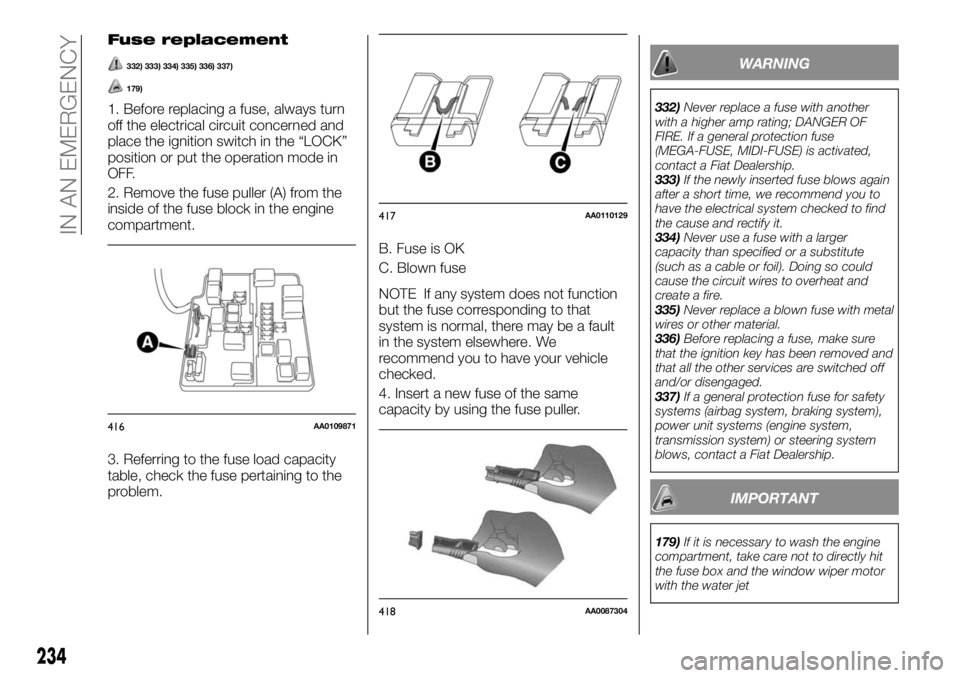
2. Remove the fuse puller (A) from the
inside of the fuse block in the engine
compartment.
3. Referring to the fuse load capacity
table, check the fuse pertaining to the
problem.B. Fuse is OK
C. Blown fuse
NOTE If any system does not function
but the fuse corresponding to that
system is normal, there may be a fault
in the system elsewhere. We
recommend you to have your vehicle
checked.
4. Insert a new fuse of the same
capacity by using the fuse puller.
WARNING
332)Never replace a fuse with another
with a higher amp rating; DANGER OF
FIRE. If a general protection fuse
(MEGA-FUSE, MIDI-FUSE) is activated,
contact a Fiat Dealership.
333)If the newly inserted fuse blows again
after a short time, we recommend you to
have the electrical system checked to find
the cause and rectify it.
334)Never use a fuse with a larger
capacity than specified or a substitute
(such as a cable or foil). Doing so could
cause the circuit wires to overheat and
create a fire.
335)Never replace a blown fuse with metal
wires or other material.
336)Before replacing a fuse, make sure
that the ignition key has been removed and
that all the other services are switched off
and/or disengaged.
337)If a general protection fuse for safety
systems (airbag system, braking system),
power unit systems (engine system,
transmission system) or steering system
blows, contact a Fiat Dealership.
IMPORTANT
179)If it is necessary to wash the engine
compartment, take care not to directly hit
the fuse box and the window wiper motor
with the water jet
416AA0109871
417AA0110129
418AA0087304
234
IN AN EMERGENCY
Page 239 of 312
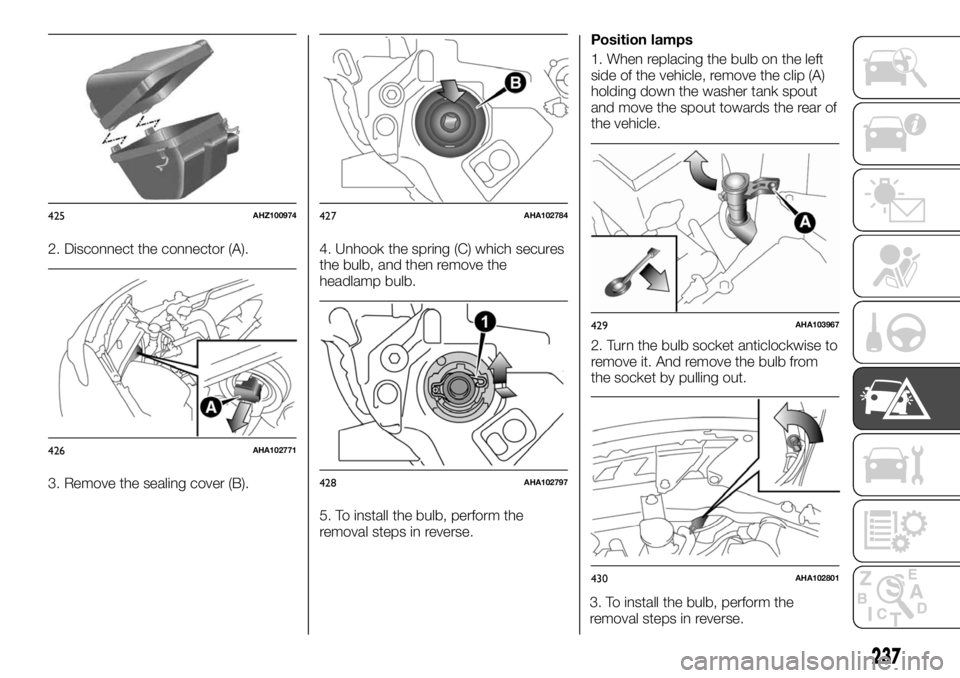
2. Disconnect the connector (A).
3. Remove the sealing cover (B).4. Unhook the spring (C) which secures
the bulb, and then remove the
headlamp bulb.
5. To install the bulb, perform the
removal steps in reverse.Position lamps
1. When replacing the bulb on the left
side of the vehicle, remove the clip (A)
holding down the washer tank spout
and move the spout towards the rear of
the vehicle.
2. Turn the bulb socket anticlockwise to
remove it. And remove the bulb from
the socket by pulling out.
425AHZ100974
426AHA102771
427AHA102784
428AHA102797
429AHA103967
430AHA102801
237
3. To install the bulb, perform the
removal steps in reverse.
Page 240 of 312
Front turn-signal lamps
Except for vehicles with high
intensity discharge headlamps
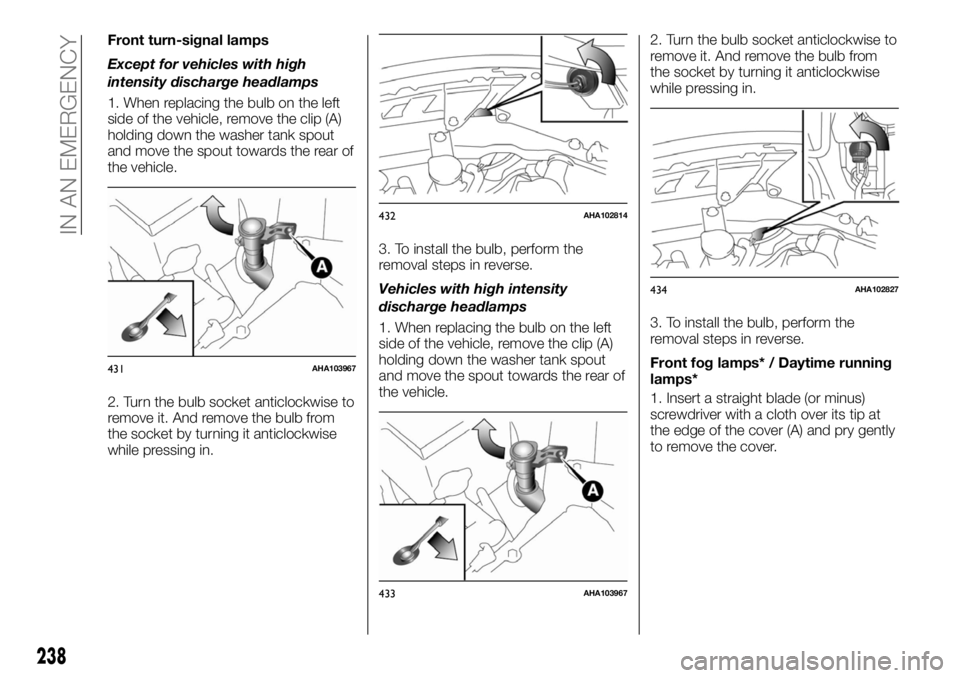
1. When replacing the bulb on the left
side of the vehicle, remove the clip (A)
holding down the washer tank spout
and move the spout towards the rear of
the vehicle.
2. Turn the bulb socket anticlockwise to
remove it. And remove the bulb from
the socket by turning it anticlockwise
while pressing in.3. To install the bulb, perform the
removal steps in reverse.
Vehicles with high intensity
discharge headlamps
1. When replacing the bulb on the left
side of the vehicle, remove the clip (A)
holding down the washer tank spout
and move the spout towards the rear of
the vehicle.2. Turn the bulb socket anticlockwise to
remove it. And remove the bulb from
the socket by turning it anticlockwise
while pressing in.
3. To install the bulb, perform the
removal steps in reverse.
Front fog lamps* / Daytime running
lamps*
1. Insert a straight blade (or minus)
screwdriver with a cloth over its tip at
the edge of the cover (A) and pry gently
to remove the cover.
431AHA103967
432AHA102814
433AHA103967
434AHA102827
238
IN AN EMERGENCY
Page 241 of 312
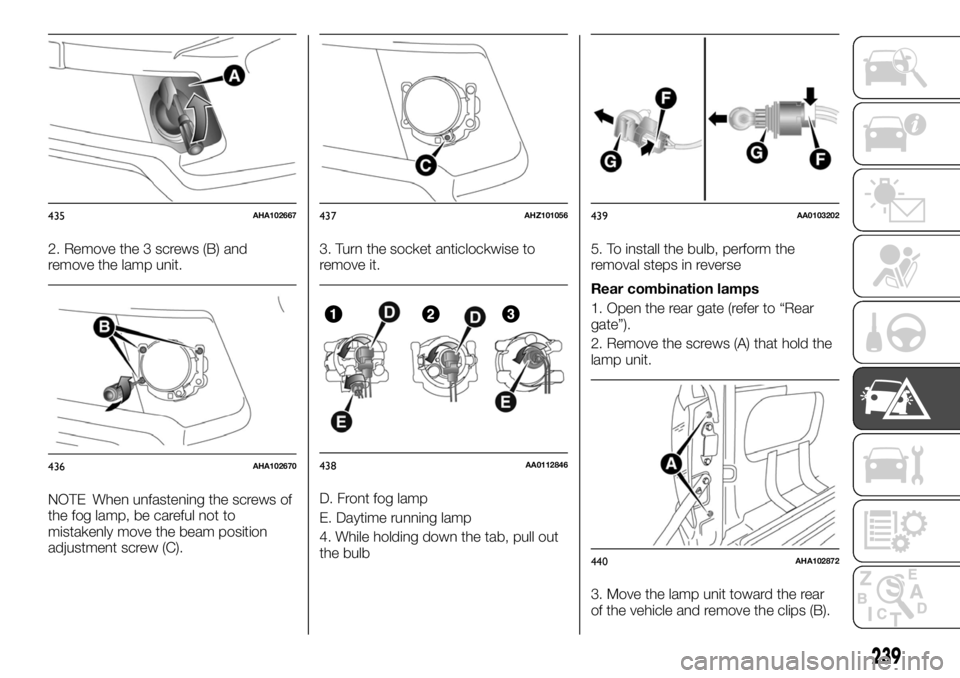
2. Remove the 3 screws (B) and
remove the lamp unit.
NOTE When unfastening the screws of
the fog lamp, be careful not to
mistakenly move the beam position
adjustment screw (C).3. Turn the socket anticlockwise to
remove it.
D. Front fog lamp
E. Daytime running lamp
4. While holding down the tab, pull out
the bulb5. To install the bulb, perform the
removal steps in reverse
Rear combination lamps
1. Open the rear gate (refer to “Rear
gate”).
2. Remove the screws (A) that hold the
lamp unit.
3. Move the lamp unit toward the rear
of the vehicle and remove the clips (B).
435AHA102667
436AHA102670
437AHZ101056
438AA0112846
439AA0103202
440AHA102872
239
Page 242 of 312
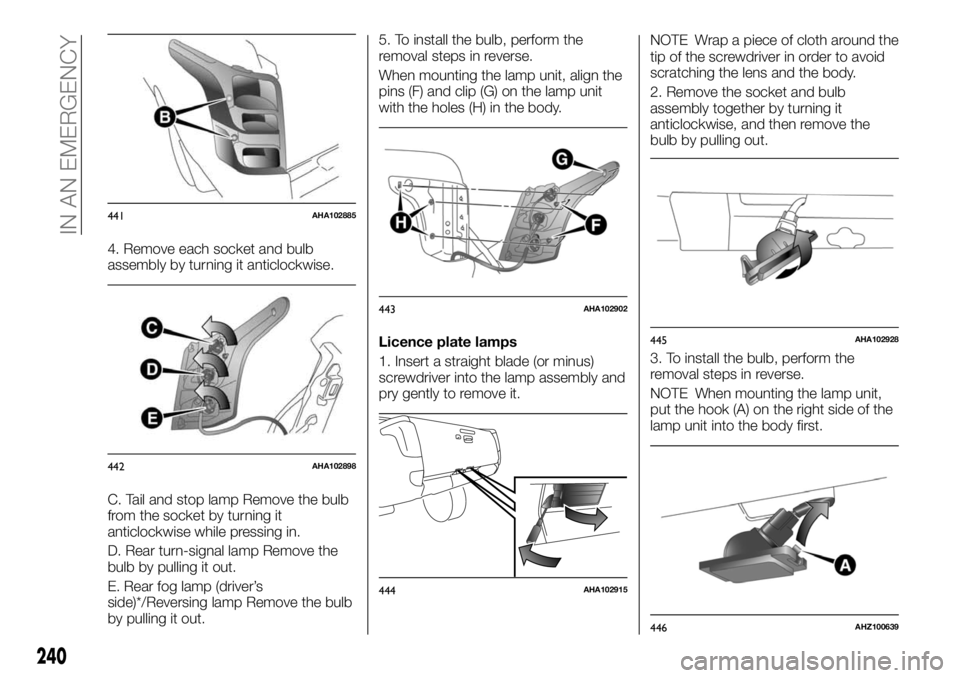
4. Remove each socket and bulb
assembly by turning it anticlockwise.
C. Tail and stop lamp Remove the bulb
from the socket by turning it
anticlockwise while pressing in.
D. Rear turn-signal lamp Remove the
bulb by pulling it out.
E. Rear fog lamp (driver’s
side)*/Reversing lamp Remove the bulb
by pulling it out.5. To install the bulb, perform the
removal steps in reverse.
When mounting the lamp unit, align the
pins (F) and clip (G) on the lamp unit
with the holes (H) in the body.
Licence plate lamps
1. Insert a straight blade (or minus)
screwdriver into the lamp assembly and
pry gently to remove it.NOTE Wrap a piece of cloth around the
tip of the screwdriver in order to avoid
scratching the lens and the body.
2. Remove the socket and bulb
assembly together by turning it
anticlockwise, and then remove the
bulb by pulling out.
3. To install the bulb, perform the
removal steps in reverse.
NOTE When mounting the lamp unit,
put the hook (A) on the right side of the
lamp unit into the body first.
441AHA102885
442AHA102898
443AHA102902
444AHA102915
445AHA102928
446AHZ100639
240
IN AN EMERGENCY
Page 246 of 312
SERVICE
PRECAUTIONS
346) 347) 348) 349) 350) 351) 352) 353)
Adequate care of your vehicle at regular
intervals serves to preserve the value
and appearance as long as possible.
Maintenance items as described in this
owner’s manual can be performed by
the owner.
We recommend you to have the
periodic inspection and maintenance
performed by a Fiat dealership.
In the event a malfunction or a problem
is discovered, we recommend you to
have it checked and repaired. This
section contains information on
inspection maintenance procedures
that you can do yourself. Follow the
instructions and cautions for each of
the various procedures.
WARNING
346)When checking or servicing the inside
of the engine compartment, make sure the
engine is switched off and has had a
chance to cool down.
347)If it is necessary to do work in the
engine compartment with the engine
running, be especially careful that your
clothing, hair, etc., does not become
caught by the cooling fan, drive belts, or
other moving parts.348)After performing the maintenance
work, make sure that no tools or cloths are
left behind in the engine compartment. If
they are left behind, a fire or damage to the
vehicle may occur.
349)The cooling fan can turn on
automatically even if the engine is not
running. Turn the ignition switch to “LOCK”
position or put the operation mode in OFF
to be safe while you work in the engine
compartment.
350)Do not smoke, cause sparks or allow
open flames around fuel or battery. The
fumes are flammable.
351)Be extremely cautious when working
around the battery. It contains poisonous
and corrosive sulphuric acid.
352)Do not get under your vehicle with
just the body jack supporting it. Always use
automotive jack stands.
353)Improper handling of components
and materials used in the vehicle can
endanger your personal safety. We
recommend you to consult a specialist for
necessary information.
244
SERVICING AND MAINTENANCE
Page 248 of 312
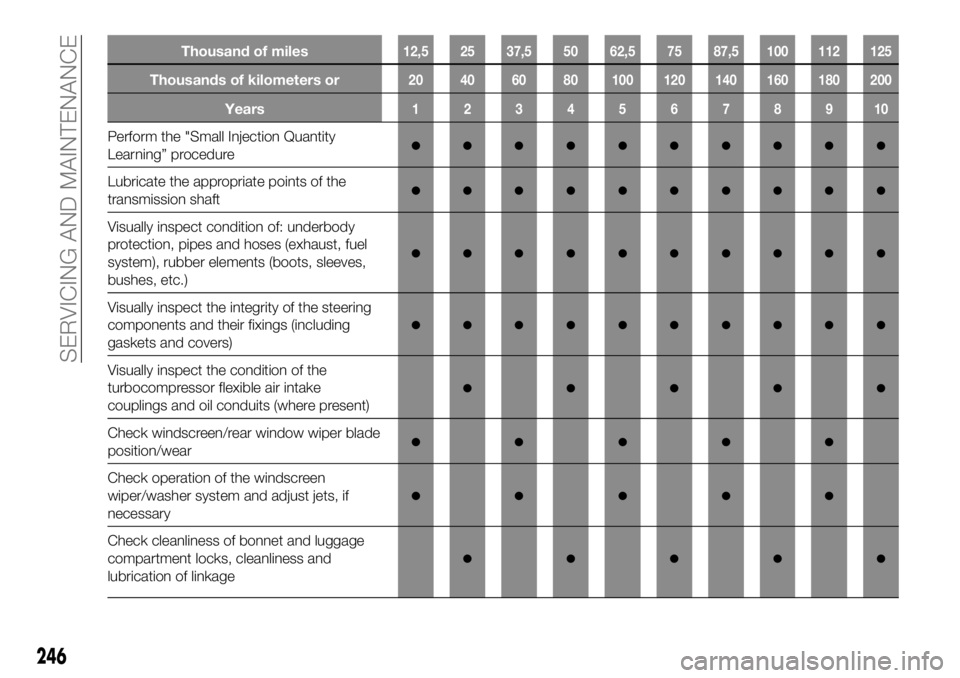
Thousand of miles12,5 25 37,5 50 62,5 75 87,5 100 112 125
Thousands of kilometers or20 40 60 80 100 120 140 160 180 200
Years12345678910
Perform the "Small Injection Quantity
Learning” procedure●●●●●●●●●●
Lubricate the appropriate points of the
transmission shaft●●●●●●●●●●
Visually inspect condition of: underbody
protection, pipes and hoses (exhaust, fuel
system), rubber elements (boots, sleeves,
bushes, etc.)
●●●●●●●●●●
Visually inspect the integrity of the steering
components and their fixings (including
gaskets and covers)
●●●●●●●●●●
Visually inspect the condition of the
turbocompressor flexible air intake
couplings and oil conduits (where present)
●●●●●
Check windscreen/rear window wiper blade
position/wear●●●●●
Check operation of the windscreen
wiper/washer system and adjust jets, if
necessary
●●●●●
Check cleanliness of bonnet and luggage
compartment locks, cleanliness and
lubrication of linkage
●●●●●
246
SERVICING AND MAINTENANCE
Page 252 of 312
PERIODIC CHECKS
Before long journeys, check and, if
necessary, restore:
engine coolant level;
brake fluid level;
windscreen washer fluid level;
operation of lighting system
(headlamps, direction indicators, hazard
warning lights, etc.);
tyre inflation pressure and condition;
tyre alignment;
operation of screen washer/wiper
system and positioning/wear of
windscreen/rear window wiper blades.
To ensure that the vehicle is always
efficient and well maintained, it is
advisable to make sure that you carry
out the above operations regularly
(approximately every 1000 km and
every 3000 km for checking and
topping up engine oil is advisable).
DEMANDING
VEHICLE USE
If the vehicle is mostly used in one of
the following conditions:
towing a trailer or caravan;
dusty roads;
short, repeated journeys (less than
7-8 km) at sub-zero outside
temperatures;
engine often idling or driving long
distances at low speeds or long periods
of inactivity;
the following checks must be carried
out more often than indicated in the
Scheduled Servicing Plan:
check front disc brake pad
conditions and wear;
check cleanliness of bonnet and
boot locks, cleanliness and lubrication
of linkage;
visually inspect conditions of: engine,
gearbox, transmission, pipes and hoses
(exhaust - fuel system - brakes) and
rubber elements (boots - sleeves -
bushes - etc.);
check battery charge and battery
fluid level (electrolyte);
visually inspect condition of the
accessory drive belts;
check and, if necessary, change
engine oil and replace oil filter;
check and, if necessary, replace
pollen filter.
250
SERVICING AND MAINTENANCE
Page 256 of 312
To add coolant
The cooling system is a closed system
and normally the loss of coolant should
be very slight. A noticeable drop in the
coolant level could indicate leakage. If
this occurs, we recommend you to
have the system checked as soon as
possible. If the level should drop below
the “L” (LOW) level on the reserve tank,
open the lid and add coolant.
Also, if the reserve tank is completely
empty, remove the radiator cap (B) and
add coolant until the level reaches the
filler neck.
361) 362)
Anti-freeze
The engine coolant contains an
ethylene glycol anti-corrosion agent.
Some parts of the engine are cast
aluminium alloy, and periodic changing
of the engine coolant is necessary to
prevent corrosion of these parts.
Use the recommended coolant by Fiat
or equivalent (similar high quality
ethylene glycol based non-silicate,
non-amine, nonnitrate and nonborate
coolant with long life hybrid organic
acid technology).
Fiat genuine coolant has excellent
protection against corrosion and rust
formation of all metals including
aluminium and can avoid blockages in
the radiator, heater, cylinder head,
engine block, etc.Because of the necessity of this
anti-corrosion agent, the coolant must
not be replaced with plain water even in
summer. The required concentration of
anti-freeze differs depending on the
expected ambient temperature.
Above -35 °C: 50 % concentration of
antifreeze
Below -35 °C: 60 % concentration of
antifreeze
180) 181) 182) 183) 184)
During cold weather
If the temperatures in your area drop
below freezing, there is the danger that
the coolant in the engine or radiator
could freeze and cause severe damage
to the engine and/or radiator. Add a
sufficient amount of antifreeze to the
coolant to prevent it from freezing.
The concentration should be checked
before the start of cold weather and
anti-freeze added to the system if
necessary.
WARNING
361)The used engine oil and the filter that
has been replaced contain substances that
are harmful to the environment. To change
the oil and filters, we advise you to contact
a Fiat Dealership.
362)Do not open the radiator cap (B) while
the engine is hot. The coolant system is
under pressure and any hot coolant
escaping could cause severe burns.
IMPORTANT
180)Do not use alcohol or methanol
anti-freeze or any engine coolants mixed
with alcohol or methanol anti-freeze. The
use of an improper anti-freeze can cause
corrosion of the aluminium components.
181)Concentrations exceeding 60 % will
result in a reduction of both the anti-freeze
and cooling performance thus adversely
affecting the engine.
182)Do not top up with water only.
183)PARAFLU UP anti-freeze is used in
the engine cooling system. Use fluid of the
same type as that contained in the cooling
system for any top-ups. PARAFLU UP
cannot be mixed with any other type of
fluid. If this happens, do not start the
engine under any circumstances and
contact a Fiat Dealership.
184)Do not use water to adjust the
concentration of coolant.
254
SERVICING AND MAINTENANCE
Page 264 of 312
CLEANING THE
INTERIOR OF YOUR
VEHICLE
After cleaning the interior of your vehicle
with water, cleaner or similar, wipe and
dry in a shady, well-ventilated area.
NOTE If your vehicle has the demister
heater element of the rear window, to
clean the inside of the rear window,
always use a soft cloth and wipe the
window glass along the demister heater
element so as not to cause damage.
385) 386)
198)
Plastic, fabric and flocked parts
1. Lightly wipe these off with a soft
cloth soaked in a mild soap and water
solution.
2. Dip cloth in fresh water and wring it
out well. Using this cloth, wipe off the
detergent thoroughly.
NOTE Do not use cleaners,
conditioners, and protectants
containing silicones or wax. Such
products, when applied to the
instrument panels or other parts, may
cause reflections on the windscreen
and obscure vision. Also, if such
products get on the switches of the
electrical accessories, it may lead to
failure of these accessories.NOTE Do not use synthetic fiber or dry
cloth. They can cause discolouring or
damaging the surface.
NOTE Do not place a deodorizer on
the instrument panel or near lamps and
instruments. The ingredients for
deodorizer can cause discolouring or
cracking.
Upholstery
1. To maintain the value of your new
vehicle, handle the upholstery carefully
and keep the interior clean. Use a
vacuum cleaner and brush to clean the
seats. If stained, synthetic leather
should be cleaned with an appropriate
cleaner. Cloth fabrics can be cleaned
with either upholstery cleaner or a mild
soap and water solution.
2. Clean the carpeting with a vacuum
cleaner and remove any stains with
carpet cleaner. Oil and grease can be
removed by lightly dabbing with a clean
colourfast cloth and stain remover.
Genuine leather
1. To clean, lightly wipe the leather with
a soft cloth soaked in a mild soap and
water solution.
2. Dip cloth in fresh water and wring it
out well. Using this cloth, wipe off the
detergent thoroughly.
3. Apply leather protecting agent to the
genuine leather surface.NOTE If genuine leather is wet with
water or is washed in water, wipe off
water as quickly as possible with a dry,
soft cloth. If left damp, mildew may
grow.
NOTE Organic solvents such as
benzine, kerosene, alcohol and petrol,
acid or alkaline solvents may discolour
the genuine leather surface. Be sure to
use neutral detergents.
NOTE Remove oil substances quickly
as they can stain genuine leather.
NOTE The genuine leather surface may
harden and shrink if it is exposed to
direct rays of the sun for long hours.
When your vehicle is parked, place it in
the shade as much as possible.
NOTE When the temperature of the
vehicle interior rises in summer, vinyl
products left on the genuine leather
seat may deteriorate and stick to the
seat.
WARNING
385)Do not keep aerosol cans in the
vehicle: they might explode. Aerosol cans
must not be exposed to a temperature
exceeding 50°C. When the vehicle is
exposed to sunlight, the internal
temperature can greatly exceed this value.
262
SERVICING AND MAINTENANCE