lock FIAT FULLBACK 2017 Owner handbook (in English)
[x] Cancel search | Manufacturer: FIAT, Model Year: 2017, Model line: FULLBACK, Model: FIAT FULLBACK 2017Pages: 312, PDF Size: 12.31 MB
Page 178 of 312
The ESC and ABS functions are
suspended while the rear differential
lock is activated. ESC indicator lamp,
ESC OFF indicator lamp and ABS
warning lamp are illuminated while
these functions are suspended. It does
not indicate a problem. When the rear
differential lock is disengaged, these
lamps go out and function again. Refer
to “ABS warning lamp”, “ESC indicator
lamp, ESC OFF indicator lamp”.
If the indicator lamp continues blinking
after the switch has been pressed to
deactivate the rear differential lock, hold
the steering wheel in the straight ahead
position then slowly depress and
release the accelerator pedal several
times.
If the indicator lamp continues blinking
after the switch has been pressed to
activate the rear differential lock, bear in
mind the following instructions:
If the vehicle speed is 12 km/h or
higher, decelerate to a speed of
2.5 km/h or lower. The indicator lamp
will illuminate steadily and the rear
differential lock will be activated.
If the vehicle speed is 12 km/h or lower,
turn the steering wheel from side to
side until the indicator lamp illuminates
steadily. If the vehicle is stuck in soft
ground, make sure the area around the
vehicle is clear then repeatedly attempt
to drive forward and backward. The
indicator lamp will illuminate steadily
and the rear differential lock will be
activated.
138)
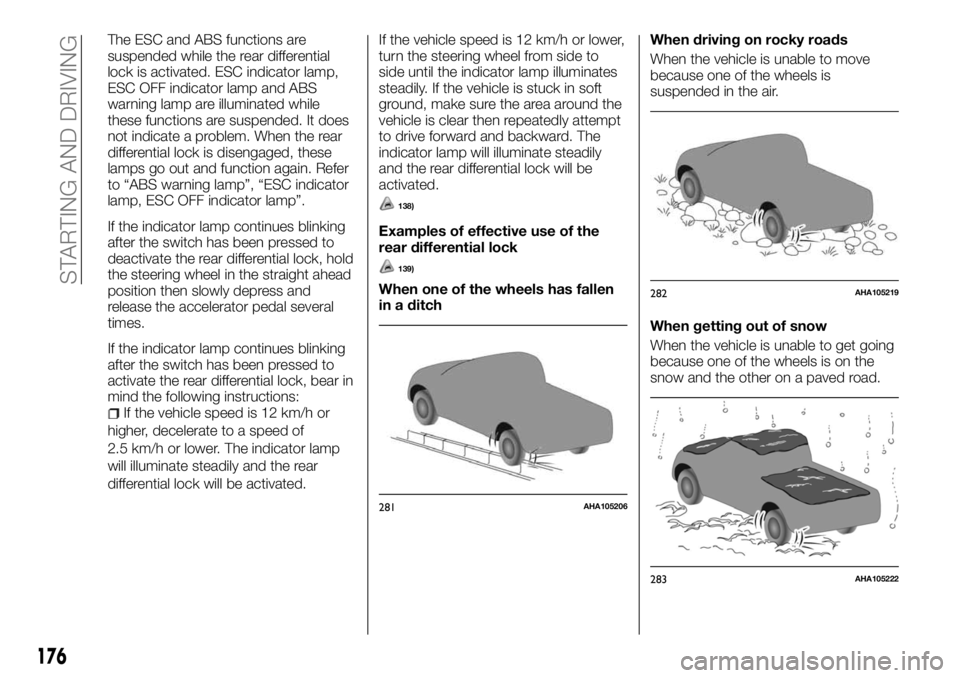
Examples of effective use of the
rear differential lock
139)
When one of the wheels has fallen
in a ditchWhen driving on rocky roads
When the vehicle is unable to move
because one of the wheels is
suspended in the air.
When getting out of snow
When the vehicle is unable to get going
because one of the wheels is on the
snow and the other on a paved road.
281AHA105206
282AHA105219
283AHA105222
176
STARTING AND DRIVING
Page 179 of 312
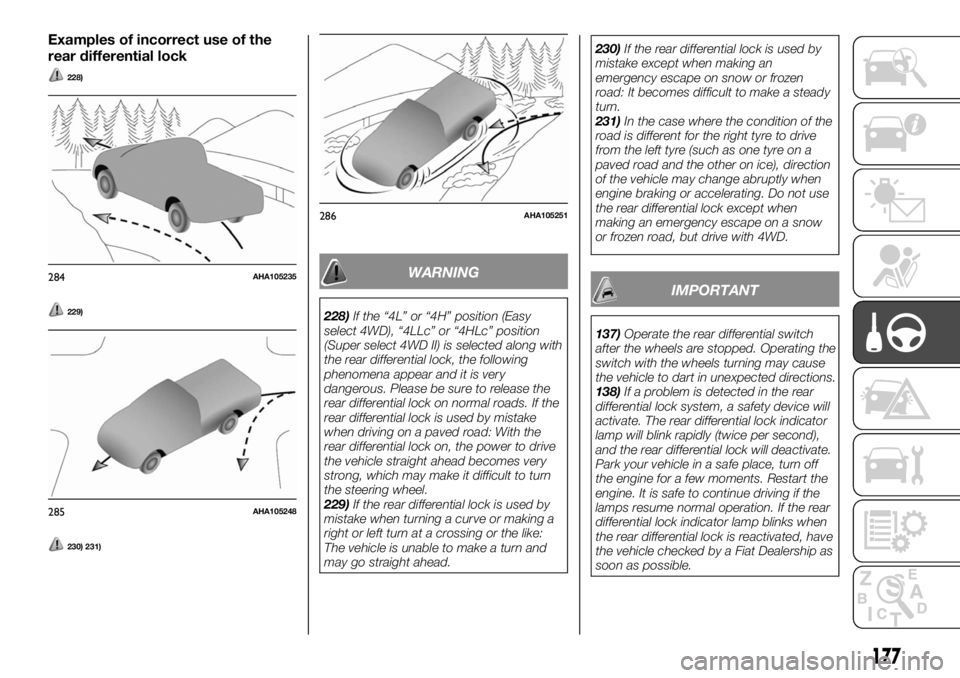
Examples of incorrect use of the
rear differential lock
228)
229)
230) 231)
WARNING
228)If the “4L” or “4H” position (Easy
select 4WD), “4LLc” or “4HLc” position
(Super select 4WD II) is selected along with
the rear differential lock, the following
phenomena appear and it is very
dangerous. Please be sure to release the
rear differential lock on normal roads. If the
rear differential lock is used by mistake
when driving on a paved road: With the
rear differential lock on, the power to drive
the vehicle straight ahead becomes very
strong, which may make it difficult to turn
the steering wheel.
229)If the rear differential lock is used by
mistake when turning a curve or making a
right or left turn at a crossing or the like:
The vehicle is unable to make a turn and
may go straight ahead.230)If the rear differential lock is used by
mistake except when making an
emergency escape on snow or frozen
road: It becomes difficult to make a steady
turn.
231)In the case where the condition of the
road is different for the right tyre to drive
from the left tyre (such as one tyre on a
paved road and the other on ice), direction
of the vehicle may change abruptly when
engine braking or accelerating. Do not use
the rear differential lock except when
making an emergency escape on a snow
or frozen road, but drive with 4WD.
IMPORTANT
137)Operate the rear differential switch
after the wheels are stopped. Operating the
switch with the wheels turning may cause
the vehicle to dart in unexpected directions.
138)If a problem is detected in the rear
differential lock system, a safety device will
activate. The rear differential lock indicator
lamp will blink rapidly (twice per second),
and the rear differential lock will deactivate.
Park your vehicle in a safe place, turn off
the engine for a few moments. Restart the
engine. It is safe to continue driving if the
lamps resume normal operation. If the rear
differential lock indicator lamp blinks when
the rear differential lock is reactivated, have
the vehicle checked by a Fiat Dealership as
soon as possible.
284AHA105235
285AHA105248
286AHA105251
177
Page 180 of 312
139)Use the rear differential lock only as an
emergency measure when the vehicle is
stuck and cannot be freed with the drive
mode-selector in “4L” or “4H” position
(Easy select 4WD) or in “4LLc” or “4HLc”
position (Super select 4WD II). Deactivate
the rear differential lock immediately after
using it.4 WHEEL DRIVE
OPERATION
By selecting 4-wheel drive, both axles
of the vehicle are rigidly connected with
each other. This improves the traction
characteristics. When turning sharp
corners or moving forward and
backward repeatedly, however, the
drive line is stressed, which is felt as a
braking effect. A 4-wheel drive vehicle
can accelerate more quickly and
smoothly.
However, note that the braking distance
is not shorter than that of a rear-wheel
drive vehicle.
When using 4-wheel drive on rough
roads (snow, mud, sand, etc.), it is
important to operate the vehicle
correctly.
NOTE The driving posture should be
more upright and closer to the wheel
than usual; adjust the seat to a good
position for easy steering and pedal
operation. Be sure to wear the seat
belt.
NOTE After driving on rough roads,
check each part of the vehicle and
wash it thoroughly with water. Refer to
“Vehicle care” and “Inspection and
maintenance following rough road
operation”.Driving on dry paved road and
highway
Select “2H” position (Easy select 4WD),
“2H” or “4H” position (Super select
4WD II) to drive on the dry paved road.
Especially on dry highway, never select
the “4H” or “4L” position (Easy select
4WD), “4HLc” or “4LLc” position (Super
select 4WD II).
140)
Driving on snowy or icy roads
Set the drive mode-selector to “4H”
position (Easy select 4WD), “4H” or
“4HLc” position in accordance with the
road conditions (Super select 4WD II)
and then gradually depress the
accelerator pedal for a smooth start.
Keep the pressure on the accelerator
pedal as constant as possible, and
drive at low speed.
NOTE The use of snow tyres and/or
tyre chains is recommended.
NOTE Maintain a safe distance
between vehicles, avoid sudden
braking, and use engine braking
(downshifting).
141)
Driving on sandy or muddy roads
Set the drive mode-selector to “4H” or
“4L” position (Easy select 4WD), “4HLc”
or “4LLc” position (Super select 4WD II)
and then gradually depress the
accelerator pedal for a smooth start.
Keep the pressure on the accelerator
178
STARTING AND DRIVING
Page 211 of 312
EMERGENCY
STARTING
267) 268) 269) 270) 271) 272) 273) 274) 275) 276) 277) 278)
279) 280) 281) 282) 283)
If the engine cannot be started because
the battery is weak or dead, the battery
from another vehicle can be used with
jumper cables to start the engine.
1. Get the vehicles close enough so the
jumper cables can reach, but be sure
the vehicles aren’t touching each other.
2. Turn off all lamps, heater and other
electrical loads.
3. Set the parking brake firmly on each
vehicle. Put an automatic transmission
in “P” (PARK) or a manual transmission
in “N” (Neutral). Stop the engine.
4. Make sure battery electrolyte is at the
proper level. Refer to “Battery”.
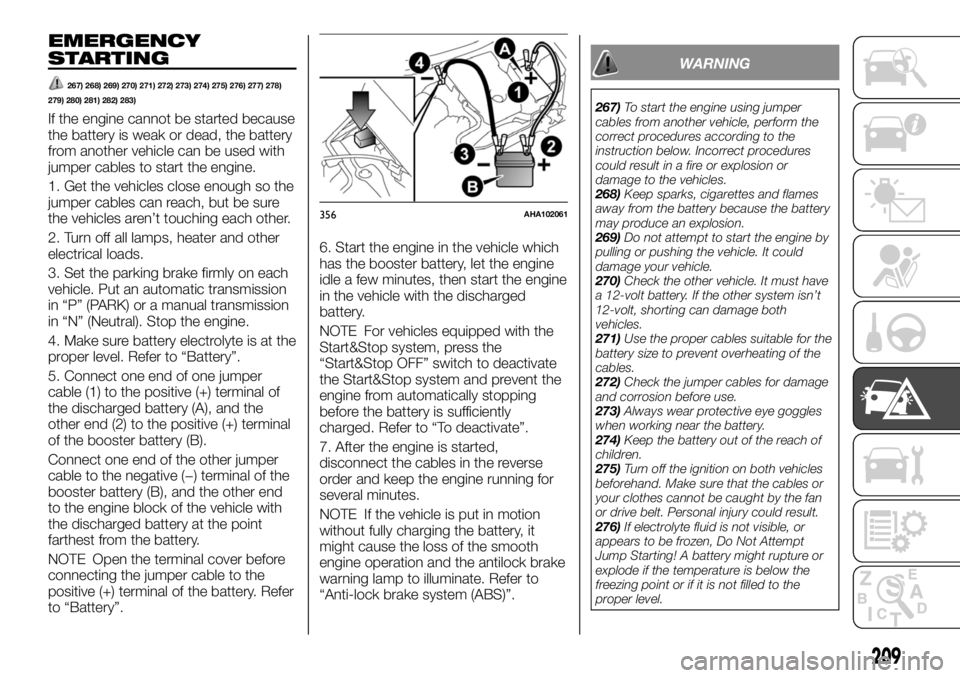
5. Connect one end of one jumper
cable (1) to the positive (+) terminal of
the discharged battery (A), and the
other end (2) to the positive (+) terminal
of the booster battery (B).
Connect one end of the other jumper
cable to the negative (−) terminal of the
booster battery (B), and the other end
to the engine block of the vehicle with
the discharged battery at the point
farthest from the battery.
NOTE Open the terminal cover before
connecting the jumper cable to the
positive (+) terminal of the battery. Refer
to “Battery”.6. Start the engine in the vehicle which
has the booster battery, let the engine
idle a few minutes, then start the engine
in the vehicle with the discharged
battery.
NOTE For vehicles equipped with the
Start&Stop system, press the
“Start&Stop OFF” switch to deactivate
the Start&Stop system and prevent the
engine from automatically stopping
before the battery is sufficiently
charged. Refer to “To deactivate”.
7. After the engine is started,
disconnect the cables in the reverse
order and keep the engine running for
several minutes.
NOTE If the vehicle is put in motion
without fully charging the battery, it
might cause the loss of the smooth
engine operation and the antilock brake
warning lamp to illuminate. Refer to
“Anti-lock brake system (ABS)”.
WARNING
267)To start the engine using jumper
cables from another vehicle, perform the
correct procedures according to the
instruction below. Incorrect procedures
could result in a fire or explosion or
damage to the vehicles.
268)Keep sparks, cigarettes and flames
away from the battery because the battery
may produce an explosion.
269)Do not attempt to start the engine by
pulling or pushing the vehicle. It could
damage your vehicle.
270)Check the other vehicle. It must have
a 12-volt battery. If the other system isn’t
12-volt, shorting can damage both
vehicles.
271)Use the proper cables suitable for the
battery size to prevent overheating of the
cables.
272)Check the jumper cables for damage
and corrosion before use.
273)Always wear protective eye goggles
when working near the battery.
274)Keep the battery out of the reach of
children.
275)Turn off the ignition on both vehicles
beforehand. Make sure that the cables or
your clothes cannot be caught by the fan
or drive belt. Personal injury could result.
276)If electrolyte fluid is not visible, or
appears to be frozen, Do Not Attempt
Jump Starting! A battery might rupture or
explode if the temperature is below the
freezing point or if it is not filled to the
proper level.
356AHA102061
209
Page 217 of 312
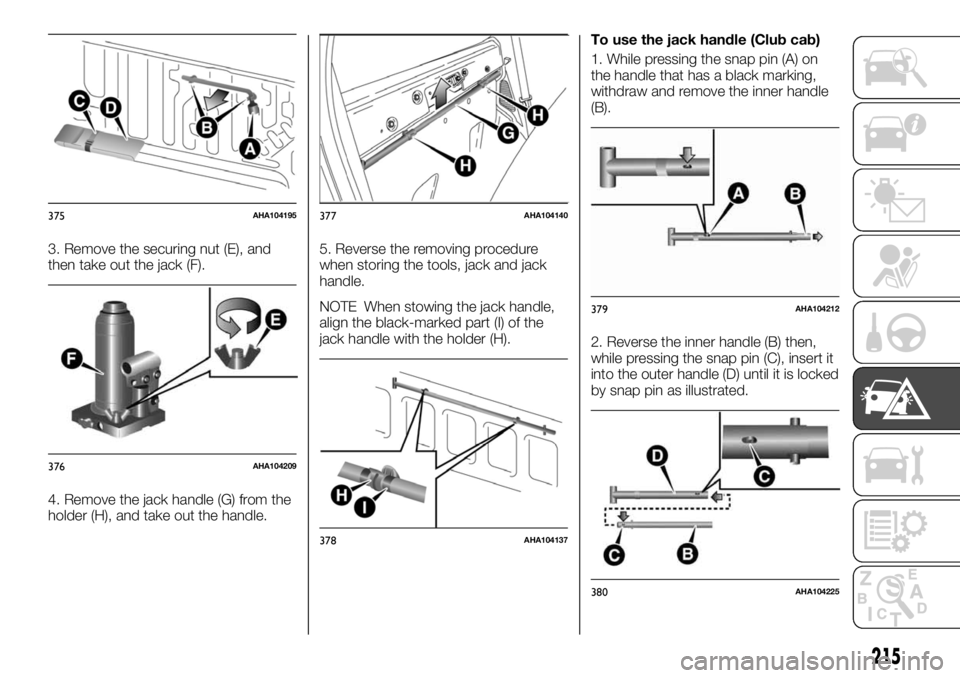
3. Remove the securing nut (E), and
then take out the jack (F).
4. Remove the jack handle (G) from the
holder (H), and take out the handle.5. Reverse the removing procedure
when storing the tools, jack and jack
handle.
NOTE When stowing the jack handle,
align the black-marked part (I) of the
jack handle with the holder (H).To use the jack handle (Club cab)
1. While pressing the snap pin (A) on
the handle that has a black marking,
withdraw and remove the inner handle
(B).
2. Reverse the inner handle (B) then,
while pressing the snap pin (C), insert it
into the outer handle (D) until it is locked
by snap pin as illustrated.
375AHA104195
376AHA104209
377AHA104140
378AHA104137
379AHA104212
380AHA104225
215
Page 218 of 312
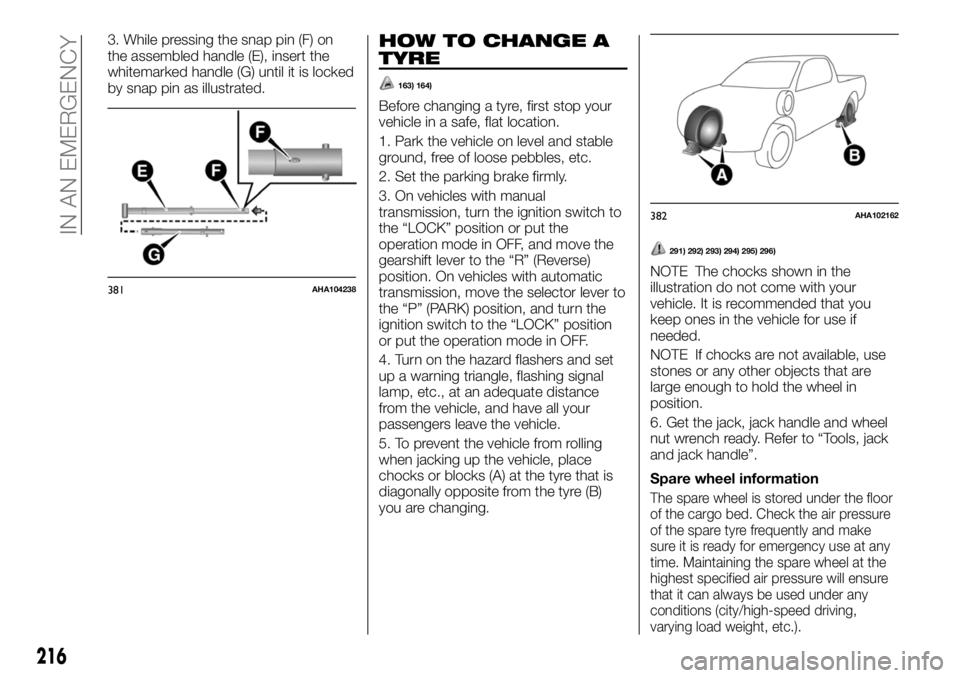
3. While pressing the snap pin (F) on
the assembled handle (E), insert the
whitemarked handle (G) until it is locked
by snap pin as illustrated.HOW TO CHANGE A
TYRE
163) 164)
Before changing a tyre, first stop your
vehicle in a safe, flat location.
1. Park the vehicle on level and stable
ground, free of loose pebbles, etc.
2. Set the parking brake firmly.
3. On vehicles with manual
transmission, turn the ignition switch to
the “LOCK” position or put the
operation mode in OFF, and move the
gearshift lever to the “R” (Reverse)
position. On vehicles with automatic
transmission, move the selector lever to
the “P” (PARK) position, and turn the
ignition switch to the “LOCK” position
or put the operation mode in OFF.
4. Turn on the hazard flashers and set
up a warning triangle, flashing signal
lamp, etc., at an adequate distance
from the vehicle, and have all your
passengers leave the vehicle.
5. To prevent the vehicle from rolling
when jacking up the vehicle, place
chocks or blocks (A) at the tyre that is
diagonally opposite from the tyre (B)
you are changing.
291) 292) 293) 294) 295) 296)
NOTE The chocks shown in the
illustration do not come with your
vehicle. It is recommended that you
keep ones in the vehicle for use if
needed.
NOTE If chocks are not available, use
stones or any other objects that are
large enough to hold the wheel in
position.
6. Get the jack, jack handle and wheel
nut wrench ready. Refer to “Tools, jack
and jack handle”.
Spare wheel information
The spare wheel is stored under the floor
of the cargo bed. Check the air pressure
of the spare tyre frequently and make
sure it is ready for emergency use at any
time. Maintaining the spare wheel at the
highest specified air pressure will ensure
that it can always be used under any
conditions (city/high-speed driving,
varying load weight, etc.).
381AHA104238
382AHA102162
216
IN AN EMERGENCY
Page 219 of 312
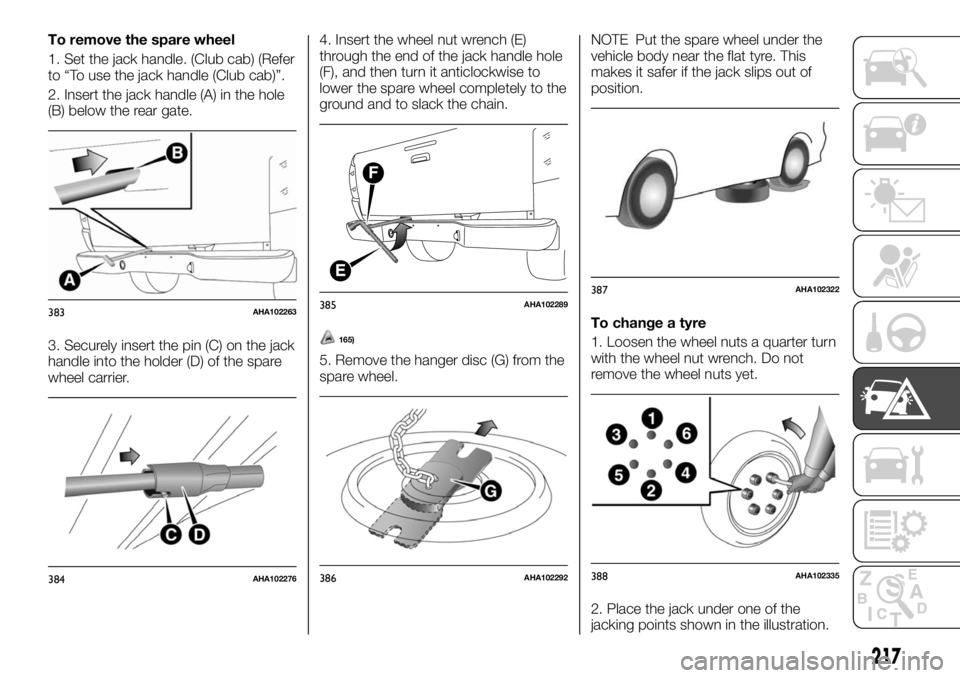
To remove the spare wheel
1. Set the jack handle. (Club cab) (Refer
to “To use the jack handle (Club cab)”.
2. Insert the jack handle (A) in the hole
(B) below the rear gate.
3. Securely insert the pin (C) on the jack
handle into the holder (D) of the spare
wheel carrier.4. Insert the wheel nut wrench (E)
through the end of the jack handle hole
(F), and then turn it anticlockwise to
lower the spare wheel completely to the
ground and to slack the chain.
165)
5. Remove the hanger disc (G) from the
spare wheel.NOTE Put the spare wheel under the
vehicle body near the flat tyre. This
makes it safer if the jack slips out of
position.
To change a tyre
1. Loosen the wheel nuts a quarter turn
with the wheel nut wrench. Do not
remove the wheel nuts yet.
2. Place the jack under one of the
jacking points shown in the illustration.
383AHA102263
384AHA102276
385AHA102289
386AHA102292
387AHA102322
388AHA102335
217
Page 220 of 312
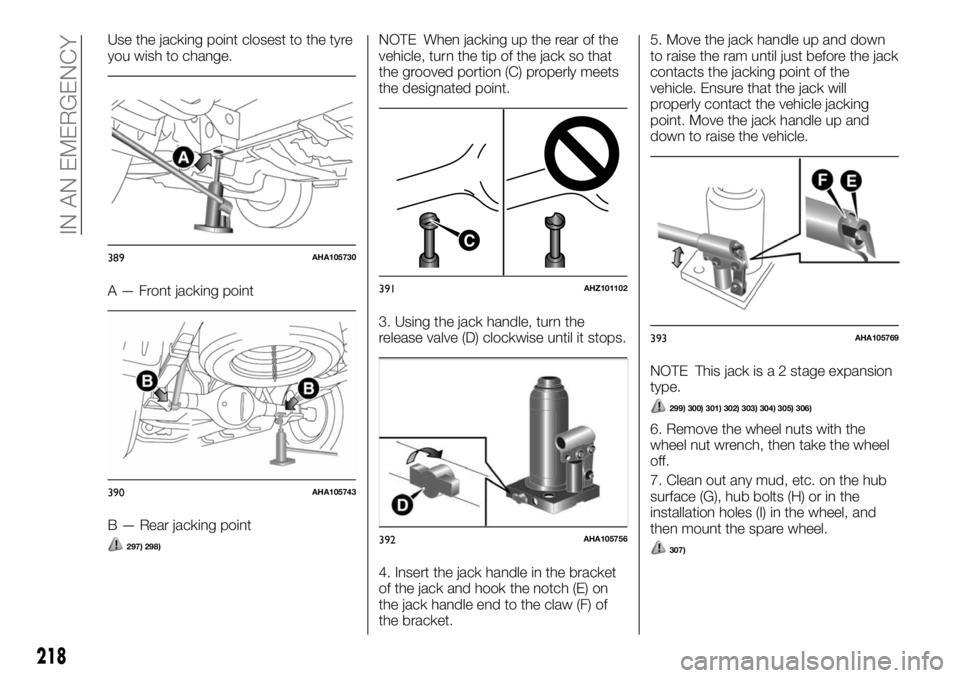
Use the jacking point closest to the tyre
you wish to change.
A — Front jacking point
B — Rear jacking point
297) 298)
NOTE When jacking up the rear of the
vehicle, turn the tip of the jack so that
the grooved portion (C) properly meets
the designated point.
3. Using the jack handle, turn the
release valve (D) clockwise until it stops.
4. Insert the jack handle in the bracket
of the jack and hook the notch (E) on
the jack handle end to the claw (F) of
the bracket.5. Move the jack handle up and down
to raise the ram until just before the jack
contacts the jacking point of the
vehicle. Ensure that the jack will
properly contact the vehicle jacking
point. Move the jack handle up and
down to raise the vehicle.
NOTE This jack is a 2 stage expansion
type.
299) 300) 301) 302) 303) 304) 305) 306)
6. Remove the wheel nuts with the
wheel nut wrench, then take the wheel
off.
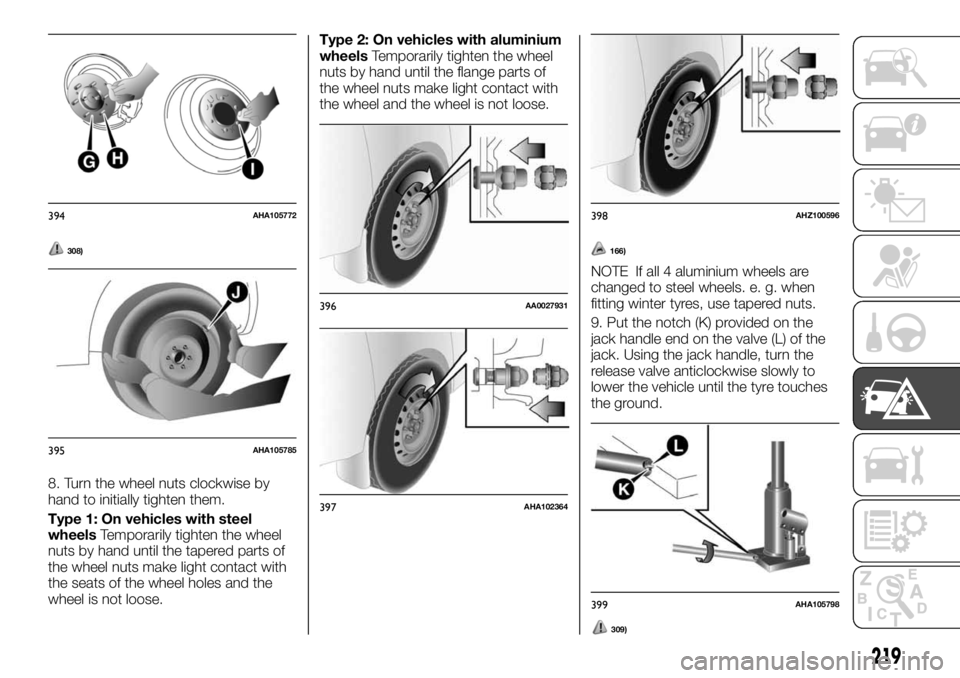
7. Clean out any mud, etc. on the hub
surface (G), hub bolts (H) or in the
installation holes (I) in the wheel, and
then mount the spare wheel.
307)
389AHA105730
390AHA105743
C
391AHZ101102
392AHA105756
393AHA105769
218
IN AN EMERGENCY
Page 221 of 312
308)
8. Turn the wheel nuts clockwise by
hand to initially tighten them.
Type 1: On vehicles with steel
wheelsTemporarily tighten the wheel
nuts by hand until the tapered parts of
the wheel nuts make light contact with
the seats of the wheel holes and the
wheel is not loose.Type 2: On vehicles with aluminium
wheelsTemporarily tighten the wheel
nuts by hand until the flange parts of
the wheel nuts make light contact with
the wheel and the wheel is not loose.
166)
NOTE If all 4 aluminium wheels are
changed to steel wheels. e. g. when
fitting winter tyres, use tapered nuts.
9. Put the notch (K) provided on the
jack handle end on the valve (L) of the
jack. Using the jack handle, turn the
release valve anticlockwise slowly to
lower the vehicle until the tyre touches
the ground.
394AHA105772
395AHA105785
396AA0027931
397AHA102364
398AHZ100596
399AHA105798
219
309)
Page 222 of 312
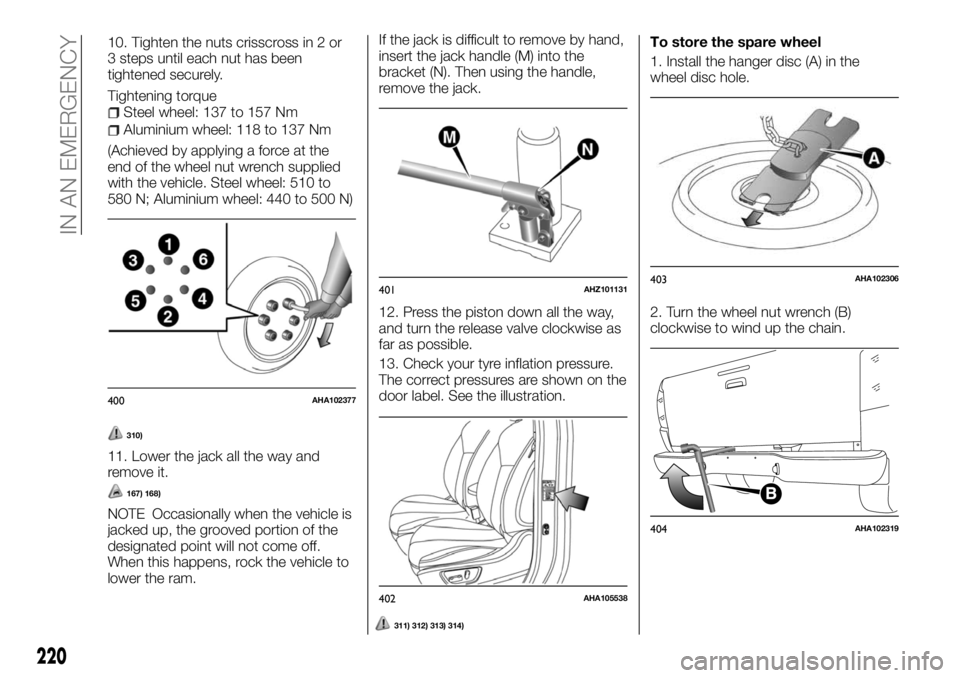
10. Tighten the nuts crisscross in 2 or
3 steps until each nut has been
tightened securely.
Tightening torque
Steel wheel: 137 to 157 Nm
Aluminium wheel: 118 to 137 Nm
(Achieved by applying a force at the
end of the wheel nut wrench supplied
with the vehicle. Steel wheel: 510 to
580 N; Aluminium wheel: 440 to 500 N)
310)
11. Lower the jack all the way and
remove it.
167) 168)
NOTE Occasionally when the vehicle is
jacked up, the grooved portion of the
designated point will not come off.
When this happens, rock the vehicle to
lower the ram.If the jack is difficult to remove by hand,
insert the jack handle (M) into the
bracket (N). Then using the handle,
remove the jack.
12. Press the piston down all the way,
and turn the release valve clockwise as
far as possible.
13. Check your tyre inflation pressure.
The correct pressures are shown on the
door label. See the illustration.
311) 312) 313) 314)
To store the spare wheel
1. Install the hanger disc (A) in the
wheel disc hole.
2. Turn the wheel nut wrench (B)
clockwise to wind up the chain.
400AHA102377
401AHZ101131
402AHA105538
403AHA102306
404AHA102319
220
IN AN EMERGENCY