lock FIAT FULLBACK 2017 Owner handbook (in English)
[x] Cancel search | Manufacturer: FIAT, Model Year: 2017, Model line: FULLBACK, Model: FIAT FULLBACK 2017Pages: 312, PDF Size: 12.31 MB
Page 113 of 312
“ON” position or the operation mode is
put in ON while a seat belt is not
fastened, the warning lamp comes on
for approximately 30 seconds to remind
the rear passenger to fasten the seat
belt.
If the vehicle is driven with the seat belt
still unfastened, the warning lamps
come on for approximately another
30 seconds. (This illumination happens
only the first time the vehicle starts
moving with the seat belt still
unfastened.)
The warning lamps go off when the
seat belt is fastened.
NOTE The warning lamp comes on
even if no one is sitting on the rear
seats.
NOTE If a seat belt is unfastened while
the vehicle is being driven, the tone
sounds for approximately 1 second and
the warning lamp comes on for
approximately 30 seconds. At the same
time, the warning lamp for the seat
where the seat belt is not fastened
comes on.
NOTE If the seat belts are initially
fastened but a seat belt is unfastened
while the vehicle is stationary and the
vehicle is then driven with the seat belt
still unfastened, the warning lamp
comes on again for approximately
30 seconds.Adjustable seat belt anchor (front
seats of Club cab and Double cab)
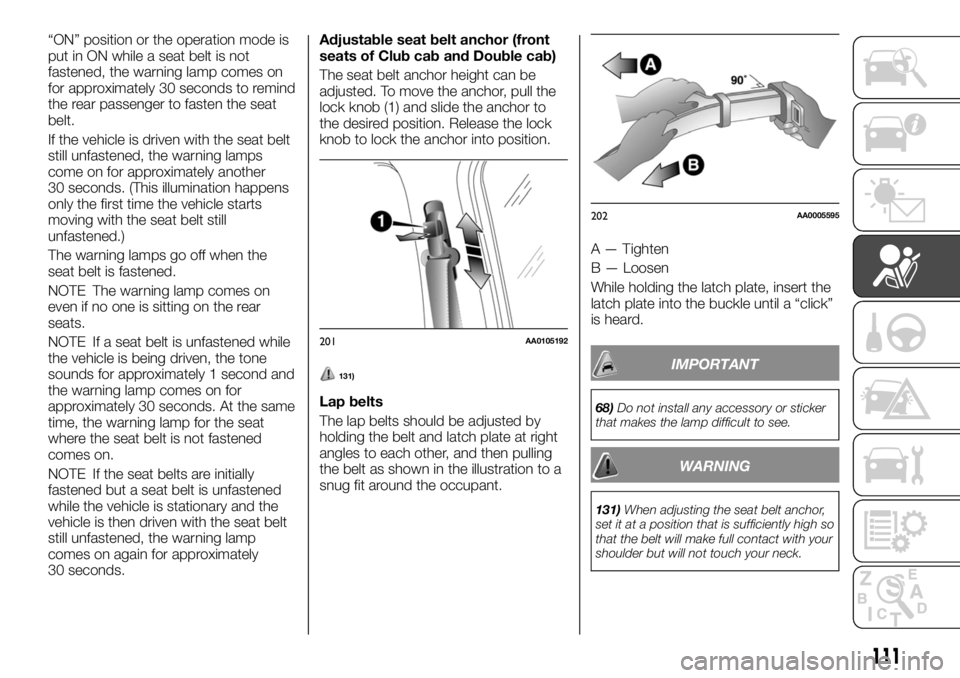
The seat belt anchor height can be
adjusted. To move the anchor, pull the
lock knob (1) and slide the anchor to
the desired position. Release the lock
knob to lock the anchor into position.
131)
Lap belts
The lap belts should be adjusted by
holding the belt and latch plate at right
angles to each other, and then pulling
the belt as shown in the illustration to a
snug fit around the occupant.A — Tighten
B — Loosen
While holding the latch plate, insert the
latch plate into the buckle until a “click”
is heard.
IMPORTANT
68)Do not install any accessory or sticker
that makes the lamp difficult to see.
WARNING
131)When adjusting the seat belt anchor,
set it at a position that is sufficiently high so
that the belt will make full contact with your
shoulder but will not touch your neck.
201AA0105192
202AA0005595
111
Page 128 of 312
To remove
Remove the child restraint system in
accordance with the instructions
provided by the child restraint system’s
manufacturer.
Installing a child restraint system to
a 3-point type seat belt (with
emergency locking mechanism)
Installation
1. Put a child restraint system on the
seat in which you wish to install it and
remove the head restraint from the seat.
Refer to “Head restraints”.
2. When installing a child restraint
system in the front passenger seat,
adjust seat slide to its most rearward
position.
3. Route the belt through the child
restraint according to the child restraint
system manufacturer’s instructions,
then insert the latch plate into the
buckle.
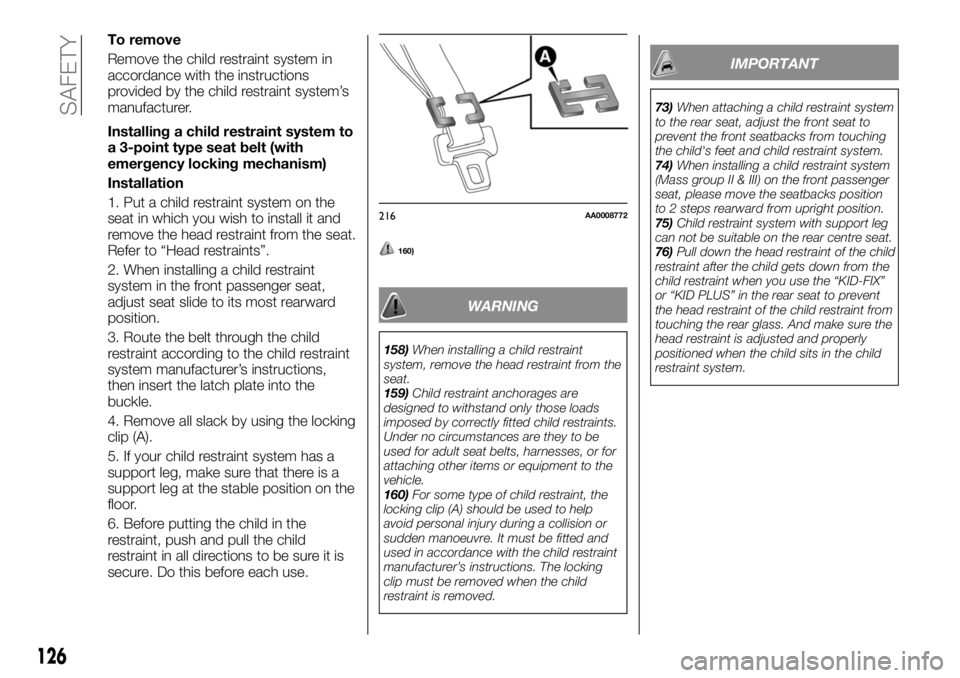
4. Remove all slack by using the locking
clip (A).
5. If your child restraint system has a
support leg, make sure that there is a
support leg at the stable position on the
floor.
6. Before putting the child in the
restraint, push and pull the child
restraint in all directions to be sure it is
secure. Do this before each use.
160)
WARNING
158)When installing a child restraint
system, remove the head restraint from the
seat.
159)Child restraint anchorages are
designed to withstand only those loads
imposed by correctly fitted child restraints.
Under no circumstances are they to be
used for adult seat belts, harnesses, or for
attaching other items or equipment to the
vehicle.
160)For some type of child restraint, the
locking clip (A) should be used to help
avoid personal injury during a collision or
sudden manoeuvre. It must be fitted and
used in accordance with the child restraint
manufacturer’s instructions. The locking
clip must be removed when the child
restraint is removed.
IMPORTANT
73)When attaching a child restraint system
to the rear seat, adjust the front seat to
prevent the front seatbacks from touching
the child's feet and child restraint system.
74)When installing a child restraint system
(Mass group II & III) on the front passenger
seat, please move the seatbacks position
to 2 steps rearward from upright position.
75)Child restraint system with support leg
can not be suitable on the rear centre seat.
76)Pull down the head restraint of the child
restraint after the child gets down from the
child restraint when you use the “KID-FIX”
or “KID PLUS” in the rear seat to prevent
the head restraint of the child restraint from
touching the rear glass. And make sure the
head restraint is adjusted and properly
positioned when the child sits in the child
restraint system.
216AA0008772
126
SAFETY
Page 137 of 312
168)Do not sit on the edge of the seat, or
sit with your lower legs too close to the
instrument panel, or lean head or chest
close to the steering wheel or instrument
panel. Do not put feet or legs on or against
the instrument panel.
169)Always drive with your hands on the
rim of the steering wheel so that the airbag
can inflate freely if required. Do not drive
with your body bent forward. Keep your
back straight against the backrest.
170)Place all infants and small children in
the rear seat and properly restrained using
an appropriate child restraint system. The
rear seat is the safest for infants and
children.
171)Infants and small children should
never be unrestrained, stand up against
the instrument panel or held in your arms
or on your lap. They could be seriously
injured or killed in a collision, including
when the airbag inflates. They should be
properly seated in an appropriate child
restraint system. See the “Child restraint”
section of this owner’s manual.
172)When there is an active passenger
airbag, DO NOT install rearward facing
child restraint systems on the front seat.
Deployment of the airbag in an accident
could cause fatal injuries to the child
regardless of the severity of the impact.
Therefore, always deactivate the passenger
side airbag when a rearward facing child
restraint system is installed on the front
passenger seat. The front passenger seat
must also be positioned back as far as
possible in order to prevent the child
restraint system from coming into contact
with the dashboard. Immediately reactivate
the passenger airbag as soon as the child
restraint system has been removed.173)Older children should be seated,
properly wearing the seat belt, with an
appropriate booster seat if needed.
174)Extreme Hazard! NEVER use a
rearward facing child restraint on a seat
protected by an ACTIVE AIRBAG in front of
it, DEATH or SERIOUS INJURY to the
CHILD can occur.
175)Do not fit any accessory that makes
the indicator impossible to see, and do not
cover the indicator with a sticker. You
would not be able to verify the status of the
passenger airbag system.176)To reduce risk of serious or fatal
injury: always turn the ignition switch to the
“LOCK” position or put the operation mode
in OFF, before operating the front
passenger’s airbag ON-OFF switch. Failure
to do so could adversely affect the airbag
performance; Wait at least 60 seconds to
operate the front passenger’s airbag
ON-OFF switch after turning the ignition
switch to the “LOCK” position or putting
the operation mode in OFF. The SRS
airbag system is designed to retain enough
voltage to deploy the airbag; Always
remove the key from the front passenger’s
airbag ON-OFF switch after operating that
switch. Failure to do so could lead to
improper position of the front passenger’s
airbag ON-OFF switch; Do not turn OFF
the front passenger’s airbag ON-OFF
switch except when a child restraint
system is fitted to the front passenger seat;
If the OFF indicator does not come on
when the front passenger’s airbag ONOFF
switch is turned OFF, do not fit a child
restraint system to the front passenger
seat. We recommend you to have the
system inspected by a Fiat Dealership; if
the OFF indicator remains on when the
front passenger’s airbag ON-OFF switch is
turned ON, do not allow anyone to sit on
the front passenger seat. We recommend
you to have the system inspected by a Fiat
Dealership.
177)Do not apply stickers or other objects
to the steering wheel, the dashboard in the
passenger side airbag area and the seats.
Never put objects (e.g. mobile phones) on
the passenger side of the dashboard since
they could interfere with correct inflation of
the passenger airbag and also cause
serious injury to the passengers.
135
Page 139 of 312
198)If your vehicle has received any
damage, we recommend you to have the
SRS inspected to ensure it is in proper
working order.
199)On vehicles with the side airbag, do
not modify your front seats, centre pillar
and centre console. It can adversely affect
SRS performance and lead to possible
injury.
200)If you found any tear, scratch, crack
or damage to the portion where the airbag
is stored, you should have the SRS
inspected by a Fiat Dealership.ACTIVE SAFETY
SYSTEMS
Brake assist system (where
provided)
The brake assist system is a device
assisting drivers who cannot depress
the brake pedal firmly such as in
emergency stop situations and provides
greater braking force.
If the brake pedal is depressed
suddenly, the brakes will be applied
with more force than usual.
201)
NOTE Once the brake assist system is
operational, it maintains great braking
force even if the brake pedal is lightly
released. To stop its operation,
completely remove your foot from the
brake pedal.
NOTE When the brake assist system is
in use while driving, you may feel the
brake pedal attempt to resist, the pedal
moves in small motions in conjunction
with the operation noise, or the vehicle
body and the steering wheel vibrate.
This occurs when the brake assist
system is operating normally and does
not indicate faulty operation. Continue
to depress the brake pedal.
NOTE When the Electronic Stability
Control (ESC) indicator lamp is
illuminated, the brake assist system
may not function.Emergency stop signal system
(where provided)
This is a device that reduces the
possibility of rear end collisions by the
rapid and automatic blinking of the
hazard warning lamps to alert vehicles
approaching from behind during
sudden braking. When the emergency
brake system operates, the hazard
warning indicator lamp in the
instrument cluster blinks rapidly at the
same time.
NOTE Activating condition for the
emergency brake system > It activates
when all of the following conditions are
met.
The vehicle speed is approximately
55 km/h or higher.
The brake pedal has been
depressed, and the system judges that
it was sudden braking from the vehicle
deceleration and the operating
condition of the anti-lock brake system
(ABS).
Deactivating condition for the
emergency brake system > It
deactivates when one of the following
conditions is met.
The brake pedal is released.
The hazard warning flasher switch is
pressed.
The system judges that it was not
sudden braking from the vehicle
deceleration and the operating
137
condition of the anti-lock brake system
(ABS).
Page 140 of 312
Anti-lock brake system (ABS)
(where provided)
The anti-lock brake system (ABS) helps
prevent the wheels from locking up
when braking. This helps maintain
vehicle drivability and steering wheel
handling.
Driving hints
Always keep a safe distance from the
vehicle in front of you. Even if your
vehicle is equipped with the ABS, leave
a greater braking distance when:
Driving on gravel or snow-covered
roads.
Driving with tyre chains installed.
Driving on roads where the road
surface is pitted or has other
differences in surface height.
Driving on uneven road surfaces.
Operation of ABS is not restricted
situations where brakes are applied
suddenly. This system may also prevent
the wheels from locking when you drive
over manholes, steel roadwork plates,
road markings, or any uneven road
surface.
When the ABS is in use, you may feel
the brake pedal pulsation and the
vibrations of the vehicle body and
steering wheel. It may also feel as if the
pedal resists being pressed.In this situation, simply hold the brake
pedal down firmly. Do not pump the
brake, which will result in reduced
braking performance.
An operation noise is emitted from the
engine compartment or feel a shock
from the brake pedal when start driving
immediately after starting the engine.
These are normal sound or operation
that the ABS makes when performing a
self-check. It does not indicate a
malfunction.
The ABS can be used after the vehicle
has reached a speed over
approximately 10 km/h. It stops
working when the vehicle slows below
7 km/h.
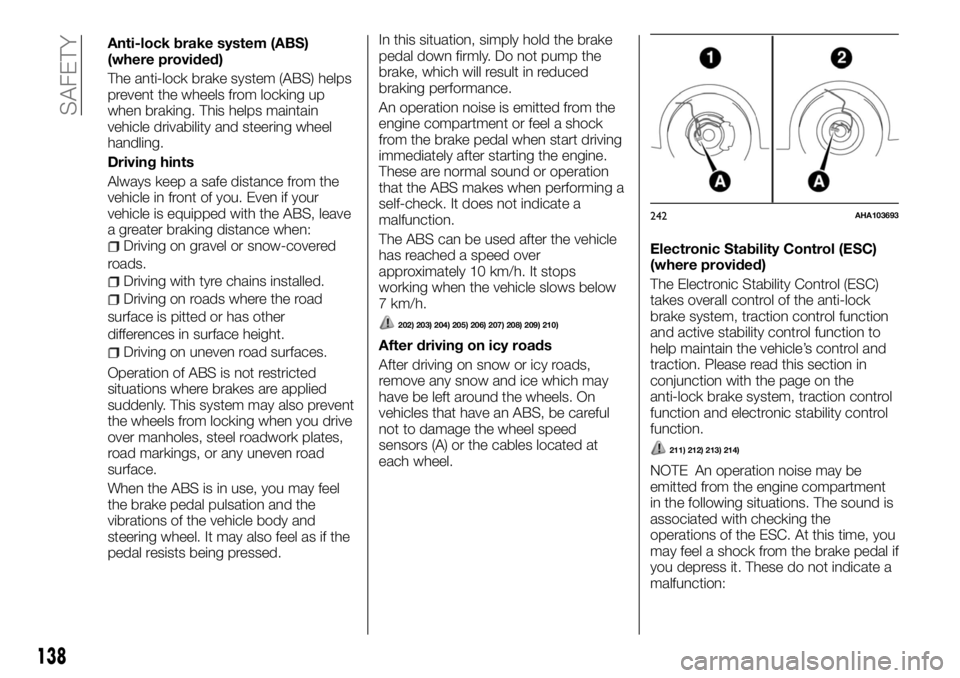
202) 203) 204) 205) 206) 207) 208) 209) 210)
After driving on icy roads
After driving on snow or icy roads,
remove any snow and ice which may
have be left around the wheels. On
vehicles that have an ABS, be careful
not to damage the wheel speed
sensors (A) or the cables located at
each wheel.Electronic Stability Control (ESC)
(where provided)
The Electronic Stability Control (ESC)
takes overall control of the anti-lock
brake system, traction control function
and active stability control function to
help maintain the vehicle’s control and
traction. Please read this section in
conjunction with the page on the
anti-lock brake system, traction control
function and electronic stability control
function.
211) 212) 213) 214)
NOTE An operation noise may be
emitted from the engine compartment
in the following situations. The sound is
associated with checking the
operations of the ESC. At this time, you
may feel a shock from the brake pedal if
you depress it. These do not indicate a
malfunction:
242AHA103693
138
SAFETY
Page 141 of 312
When the ignition switch is set to the
“ON” position or the operation mode is
put in ON.
When the vehicle is driven for a while
after the engine is turned on.
NOTE When the ESC is activated, you
may feel a vibration in the vehicle body
or hear a whining sound from the
engine compartment. This indicates
that the system is operating normally. It
does not indicate a malfunction.
NOTE When the anti-lock brake
system warning lamp is illuminated, the
ESC is not active.
NOTE On vehicles with the rear
differential lock, the ESC and ABS
functions are suspended while the rear
differential lock is activated. ESC
indicator lamp, ESC OFF indicator lamp
and ABS warning lamp are illuminated
while these functions are suspended. It
does not indicate a problem. When the
rear differential lock is disengaged,
these lamps go out and function again.
Refer to “ABS warning lamp” and “ESC
indicator lamp, ESC OFF indicator
lamp”.
Electronic Stability Control function
The electronic stability control function
is designed to help the driver maintain
control of the vehicle on slippery roads
or during rapid steering maneuvers. It
works by controlling the engine output
and the brake on each wheel.NOTE The electronic stability control
function does not operate when the
drive mode-selector is in the “4L”
position (Easy select 4WD), “4LLc”
position (Super select 4WD II). When
the electronic stability control function is
operating with the drive mode-selector
in the “2H” or “4H” position (Easy select
4WD), “2H”, “4H” or “4HLc” position
(Super select 4WD II), setting the drive
mode-selector to the “4L” (Easy select
4WD), “4LLc” position (Super select
4WD II) position makes the electronic
stability control function deactivate
automatically.
NOTE The electronic stability control
function operates at speeds of about
15 km/h or higher.
NOTE On vehicles with the rear
differential lock, the electronic stability
control function does not operate when
the rear differential lock is activated.
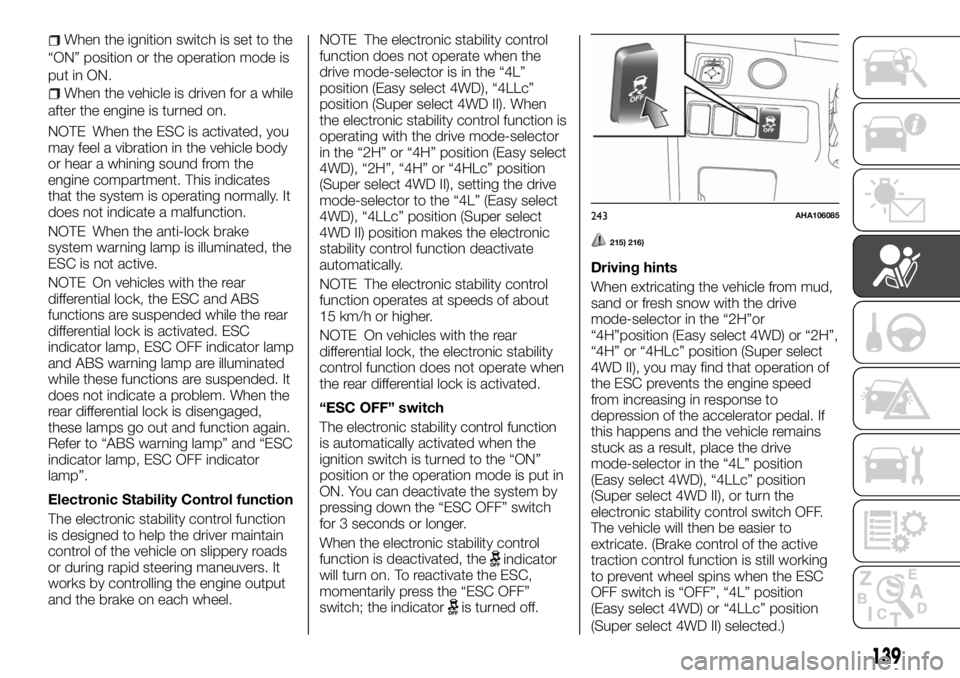
“ESC OFF” switch
The electronic stability control function
is automatically activated when the
ignition switch is turned to the “ON”
position or the operation mode is put in
ON. You can deactivate the system by
pressing down the “ESC OFF” switch
for 3 seconds or longer.
When the electronic stability control
function is deactivated, the
indicator
will turn on. To reactivate the ESC,
momentarily press the “ESC OFF”
switch; the indicator
is turned off.
215) 216)
Driving hints
When extricating the vehicle from mud,
sand or fresh snow with the drive
mode-selector in the “2H”or
“4H”position (Easy select 4WD) or “2H”,
“4H” or “4HLc” position (Super select
4WD II), you may find that operation of
the ESC prevents the engine speed
from increasing in response to
depression of the accelerator pedal. If
this happens and the vehicle remains
stuck as a result, place the drive
mode-selector in the “4L” position
(Easy select 4WD), “4LLc” position
(Super select 4WD II), or turn the
electronic stability control switch OFF.
The vehicle will then be easier to
extricate. (Brake control of the active
traction control function is still working
to prevent wheel spins when the ESC
OFF switch is “OFF”, “4L” position
(Easy select 4WD) or “4LLc” position
243AHA106085
139
(Super select 4WD II) selected.)
Page 144 of 312
When the trailer stability assist system
operates the brakes, the brake lamp
turns on. About the towing of the trailer,
refer to “Trailer towing”.
83) 84)
NOTE When TSA system operates, the
vehicle body may vibrate and the
operating sounds from the engine
compartment may be heard. These
motions indicate normal operation of
the system, not abnormal operation.
NOTE TSA system operates when the
vehicle speed is about 55 km/h or
higher.
NOTE When TSA system operates, the
ESC operation indicator lamp blinks on
and off.
NOTE When ESC does not work, TSA
system does not operate.
WARNING
218)When facing uphill, do not rely on
using the hill start assist to maintain a
stopped position as an alternative to
depressing the brake pedal. Doing so
could cause an accident.
219)Do not turn the ignition switch to the
“LOCK” or “ACC” position or the operation
mode in ACC or OFF while the hill start
assist is operating. The hill start assist
could stop operating, which could result in
an accident.
IMPORTANT
77)Do not overly rely on the hill start assist
to prevent backwards movement of the
vehicle. Under certain circumstances, even
when hill start assist is activated, the
vehicle may move backwards if the brake
pedal is not sufficiently depressed, if the
vehicle is heavily loaded, if the road is very
steep or slippery or if the vehicle tows a
trailer, etc.
78)The hill start assist is not designed to
keep the vehicle stopped in place on uphill
slopes for more than 2 seconds.
79)If the warning is turn on, the hill start
assist will not operate. Start off carefully.
80)Park your vehicle in a safe place and
stop the engine. Restart the engine and
check whether the warning indicator went
out, in which case the hill start assist is
again working normally. If they warning
remains displayed or reappear frequently, it
is not necessary to stop the vehicle
immediately, but the vehicle should be
inspected by a Fiat Dealership.
81)Do not stop the engine while the
vehicle is moving. Stopping the engine
would make the steering wheel extremely
hard to turn, possibly resulting in an
accident.
82)Do not leave the steering wheel turned
all the way in one direction. This can cause
damage to the power steering system.83)Do not over-rely on TSA system. Due to
the slippery road surface, heavy side wind,
inappropriate weight and positioning of
luggage, and/or driving at high speed, TSA
system may fail to secure the stability.
Always drive appropriately in accordance
with the condition of traffic, road surface
condition, weather, and the weight and
positioning of luggage.
84)The trailer stability assist system does
not operate in case as follows: 1 – When
sudden braking and braking while driving
downhill cause an abrupt motion of the
vehicle which makes the vehicle and the
trailer form a dogleg shape. 2 – When a
sideslip occurs by sudden steering.
142
SAFETY
Page 145 of 312
STARTING AND DRIVING
Let’s get to the "heart" of the vehicle:
seeing how you can exploit all of its
potential to the full.
We’ll look at how to drive it safely in any
situation, so that it can be a welcome
companion, with our comfort and our
wallets in mind.ECONOMICAL DRIVING........144
DRIVING, ALCOHOL AND DRUGS .145
SAFE DRIVING TECHNIQUES. . . .145
RUNNING-IN
RECOMMENDATIONS.........146
PARKING BRAKE............148
PARKING.................149
STARTING AND STOPPING THE
ENGINE..................150
TURBOCHARGER OPERATION . . .153
START&STOP SYSTEM........154
MANUAL TRANSMISSION......157
AUTOMATIC TRANSMISSION SPORTS
MODE 5A/T...............159
EASY SELECT 4WD..........164
SUPER SELECT 4WD II........169
REAR DIFFERENTIAL LOCK.....174
4 WHEEL DRIVE OPERATION. . . .178
CAUTIONS ON HANDLING OF
4 WHEEL DRIVE VEHICLES.....181
BRAKING SYSTEM...........182
CRUISE CONTROL...........183
SPEED LIMITER.............189
LANE DEPARTURE WARNING . . .195
REAR VIEW CAMERA.........199
143
Page 150 of 312
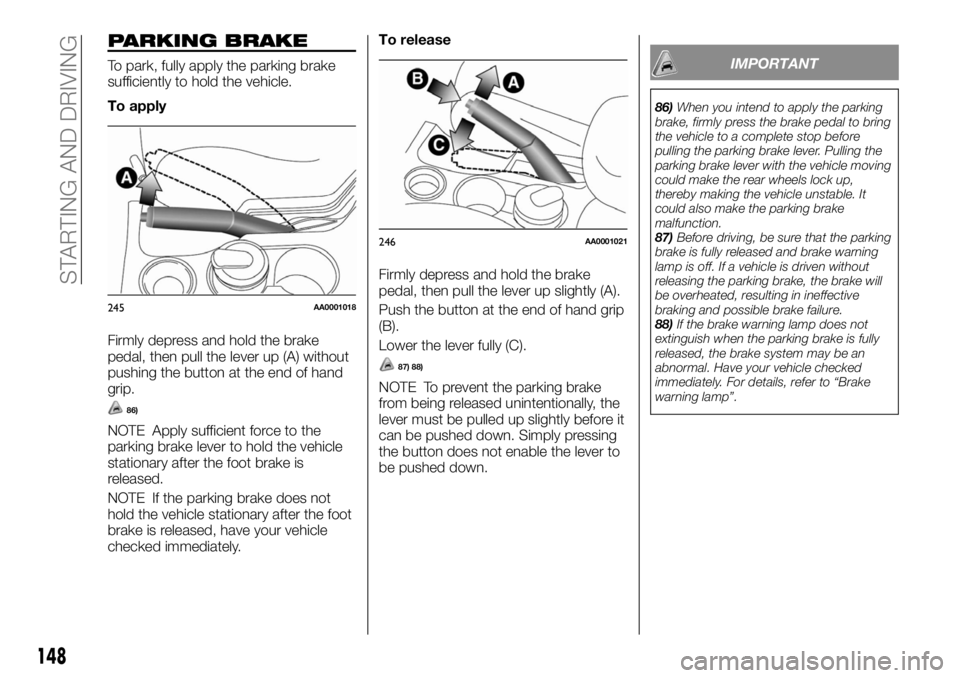
PARKING BRAKE
To park, fully apply the parking brake
sufficiently to hold the vehicle.
To apply
Firmly depress and hold the brake
pedal, then pull the lever up (A) without
pushing the button at the end of hand
grip.
86)
NOTE Apply sufficient force to the
parking brake lever to hold the vehicle
stationary after the foot brake is
released.
NOTE If the parking brake does not
hold the vehicle stationary after the foot
brake is released, have your vehicle
checked immediately.To release
Firmly depress and hold the brake
pedal, then pull the lever up slightly (A).
Push the button at the end of hand grip
(B).
Lower the lever fully (C).
87) 88)
NOTE To prevent the parking brake
from being released unintentionally, the
lever must be pulled up slightly before it
can be pushed down. Simply pressing
the button does not enable the lever to
be pushed down.
IMPORTANT
86)When you intend to apply the parking
brake, firmly press the brake pedal to bring
the vehicle to a complete stop before
pulling the parking brake lever. Pulling the
parking brake lever with the vehicle moving
could make the rear wheels lock up,
thereby making the vehicle unstable. It
could also make the parking brake
malfunction.
87)Before driving, be sure that the parking
brake is fully released and brake warning
lamp is off. If a vehicle is driven without
releasing the parking brake, the brake will
be overheated, resulting in ineffective
braking and possible brake failure.
88)If the brake warning lamp does not
extinguish when the parking brake is fully
released, the brake system may be an
abnormal. Have your vehicle checked
immediately. For details, refer to “Brake
warning lamp”.
245AA0001018
246AA0001021
148
STARTING AND DRIVING
Page 151 of 312
PARKING
To park the vehicle, stop the engine,
fully engage the parking brake and then
move the gearshift lever to 1st or “R”
(Reverse) position for vehicles equipped
with M/T, or set the selector lever to “P”
(PARK) position for vehicles equipped
with A/T.
Parking on a hill
To prevent the vehicle from rolling,
follow these procedures:
Parking on a downhill slope
Turn the front wheels towards the kerb
and move the vehicle forward until the
kerb side wheel gently touches the
kerb.
On vehicles equipped with M/T, apply
the parking brake and place the
gearshift lever into the “R” (Reverse)
position.
On vehicles equipped with A/T, apply
the parking brake and place the
selector lever into the “P” (PARK)
position. If necessary, apply chocks to
wheels.
Parking on a uphill slope
Turn the front wheels away from the
kerb and move the vehicle back until
the kerb side wheel gently touches the
kerb.
On vehicles equipped with M/T, apply
the parking brake and place the
gearshift lever into the 1st position.On vehicles equipped with A/T, apply
the parking brake and place the
selector lever into the “P” (PARK)
position. If necessary, apply chocks to
wheels.
NOTE If your vehicle is equipped with
A/T, be sure to apply the parking brake
before moving selector lever to the “P”
(PARK) position. If you move selector
lever to the “P” (PARK) position before
applying the parking brake, it may be
difficult to disengage selector lever from
the “P” (PARK) position when next you
drive the vehicle, requiring application of
a strong force the selector lever to
move from the “P” (PARK) position.
NOTE IMPORTANT: NEVER leave the
car with the gearbox in neutral or, on
versions equipped with A/T, before
placing the gear lever in the “P” (PARK)
position.
Parking with the engine running
Never leave the engine running while
you take a short sleep/rest. Also, never
leave the engine running in a closed or
poorly ventilated place.
When leaving the vehicle
Always carry the key and lock all doors
when leaving the vehicle unattended.
Always try to park your vehicle in a well
lit area.
222) 223) 224)
WARNING
222)Leaving the engine running risks injury
or death from accidentally moving the
gearshift lever (with M/T) or the selector
lever (with A/T) or the accumulation of toxic
exhaust fumes on the passenger
compartment.
223)Never leave children unattended in
the vehicle. Always remove the ignition key
when leaving the vehicle and take it out
with you.
224)Do not park your vehicle in areas
where combustible materials such as dry
grass or leaves can come in contact with a
hot exhaust, since a fire could occur.
149