Air con FIAT PANDA 2009 169 / 2.G User Guide
[x] Cancel search | Manufacturer: FIAT, Model Year: 2009, Model line: PANDA, Model: FIAT PANDA 2009 169 / 2.GPages: 226, PDF Size: 5.29 MB
Page 46 of 226
45KNOW YOUR
VEHICLESAFETY
CORRECT USE
OF THE CAR
WARNING LIGHTS
AND MESSAGES
IN
AN EMERGENCY
CAR
MAINTENANCE
TECHNICAL
SPECIFICATIONS
INDEX
Button
T
– D
Air recirculation on/off
It is advisable to switch the internal air recirculation on
while standing in queues or in tunnels to prevent the in-
troduction of polluted air.
Led on button ON = recirculation ON.
Led on button OFF = recirculation OFF.
At low temperatures or if the compressor is off, the re-
circulation is forced to off to avoid misting.
IMPORTANT It is inadvisable to use air recirculation on
cold days as it would considerably increase the possibility
of windows misting up inside.
During
AUTO
operation, due to safety reasons and to refresh
air flow, after long recirculation activation (over 25 minutes)
the system will deactivate automatically air recirculation for
1 minute.
Buttons
ÕÔ
– E
Temperature setting
Pressing the button
Õ
the temperature in the passen-
ger compartment will rise until the value HI is reached
(maximum heating).
Pressing the button
Ô
the temperature in the passenger
compartment will decrease until the value LO is reached
(maximum cooling).
HI function
This function can be switched on to heat the passenger
compartment as quickly as possible; air distribution and fan
speed are controlled by the system.
To turn this function off, set the required temperature.
❒
it is not possible to convey air to the passenger com-
partment with a temperature below the outside tem-
perature (the displayed temperature value will flash
when the system cannot guarantee the required com-
fort conditions);
❒
the fan speed can be manually reset (with compressor
enabled, ventilation cannot go below a bar shown on
the display).
Button OFF – C
System switching off
Pressing the
OFF
button the system is switched off.
With the system off, the climate control system conditions
are as follows:
❒
all LEDs off;
❒
set temperature display off;
❒
air recirculation off;
❒
compressor off;
❒
fan off.
Under this condition, air recirculation can be turned on
or off without activating the system.
IMPORTANT The system will store the settings (except
recirculation) performed before turning off and will re-
sume them when pressing any button (if the function cor-
responding to the button pressed is off, it will be turned
on; if on it will be kept active). Press
AUTO
to start the
system automatically.
031-064 PANDA EN 7-10-2009 13:43 Pagina 45
Page 47 of 226
μ
air flow towards the front seat feet area. Due to the
natural tendency of heat to spread upwards, this type
of distribution warms the passenger compartment
up as quickly as possible, providing an immediate
feeling of warmth.
w+μ
distribution between feet area vents (warmest air)
and dashboard vents (coolest air).
¥+μ
distribution between feet area vents and wind-
screen/side front window vents. This type of distri-
bution achieves an adequate warming of the pas-
senger compartment and prevents the windows
from misting up.
The set air distribution is shown by the LEDs on the
selected buttons.
To restore the automatic air distribution control, press
the AUTO button.
During automatic operation, under particular climate con-
ditions, the system can send air to the windscreen although
the relevant LED does not turn on.
Button
-
- L
Fast front window demisting/defrosting
Pressing the button
-
the system activates all the functions
required for fast demisting/defrosting, that is:
❒
compressor switching-on (if the weather conditions are
suitable);
❒
air recirculation switching-off;
❒
maximum air temperature setting (HI); IMPORTANT If the heating fluid is not sufficiently hot, max-
imum fan speed will not be activated immediately to pre-
vent air not warm enough from entering the passenger
compartment.
LO function
This function can be switched on to cool the passenger
compartment as quickly as possible; with this function
switched on the compressor will be engaged whereas air
distribution and fan speed are controlled by the system.
To turn this function off, set the required temperature.
IMPORTANT With the function switched on, however, all
the manual settings can be made.
Buttons
ÕÔ
– F
Fan speed adjustment
Pressing the buttons
Õ
or
Ôrespectively, the fan speed
shown on the display bars increases or decreases.
The fan can be cut off only if the compressor has been
switched off (B button).
To restore automatic fan speed control, press the
AUTO
button.
Buttons
¥wμ
– G H I
Air distribution manual selection
Pressing the buttons, one of the five possible air flow
distribution patterns can be selected:
¥
air flow to the windscreen and front side window
vents to demist or defrost them.
w
air flow to the central and side dashboard vents to ven-
tilate the chest and the face during the hot season.
46
KNOW YOUR
VEHICLE
SAFETY
CORRECT USE
OF THE CAR
WARNING LIGHTS
AND MESSAGES
IN
AN EMERGENCY
CAR
MAINTENANCE
TECHNICAL
SPECIFICATIONS
INDEX
031-064 PANDA EN 7-10-2009 13:43 Pagina 46
Page 48 of 226
47KNOW YOUR
VEHICLESAFETY
CORRECT USE
OF THE CAR
WARNING LIGHTS
AND MESSAGES
IN
AN EMERGENCY
CAR
MAINTENANCE
TECHNICAL
SPECIFICATIONS
INDEX
❒
fan speed enabling depending on the coolant
temperature;
❒
air flow conveying to the windscreen and front side win-
dows;
❒
heated rear window switching-on.
IMPORTANT This function stays on for about 3 minutes,
since engine coolant temperature exceeds 50 °C (petrol
versions) or 35 °C (Diesel versions).
When the function is on, the LEDs on button
-
and those
on the heated rear window button
(
turn on, whereas
the AUTO button LED will turn off; when this function is
on, the only operations possible are fan speed adjustment
and heated rear window switching-off.
To turn the function off, press the button
-
again or
the AUTO button.
USING THE CLIMATE CONTROL SYSTEM The system can be turned on in different ways, it is how-
ever advisable to set the required temperature and then
to press the AUTO button. In this way, the system starts
to work fully automatically to reach the required com-
fort conditions as soon as possible.
During automatic operation it is possible:❒
to select the required temperature (buttons
ÔÕ
– E);
❒
to activate or deactivate air recirculation
(button
T
– D);
❒
to activate fast window demisting/defrosting
(button
-
– L);
❒
to select air distribution (buttons
¥wμ
– G H I);
❒
to select the fan speed (buttons
ÕÔ
– F).
The system will automatically modify its settings accord-
ing to set changes and the button LED will turn off.
To restore automatic operation press again the
AUTO
button.
SYSTEM SERVICING
In winter, the climate control system must be turned on
at least once a month for about 10 minutes.
Before summer, have the system inspected at a Fiat
Dealership.
The system uses R134a refrigerant fluid
which does not pollute the environment in
the event of accidental leakage. Under no
circumstances should R12 fluid be used as it is in-
compatible with the system components.
031-064 PANDA EN 7-10-2009 13:43 Pagina 47
Page 82 of 226
F0Z0163m
fig. 92
It is absolutely forbidden to carry out
whatever after-market operation involv-
ing steering system or steering column modifica-
tions (e.g.: installation of anti-theft device) that
could badly affect performance and safety, cause
the lapse of warranty and also result in non-com-
pliance of the car with type approval require-
ments.
WARNING
Before starting any servicing operation,
stop the engine and remove the key from
the ignition switch to operate the steering lock,
particularly when the wheels do not touch the
ground. If this is not possible (i.e. if the key must
be kept in the MAR position or the engine must
be kept running), remove the electric power steer-
ing system main fuse.
WARNING
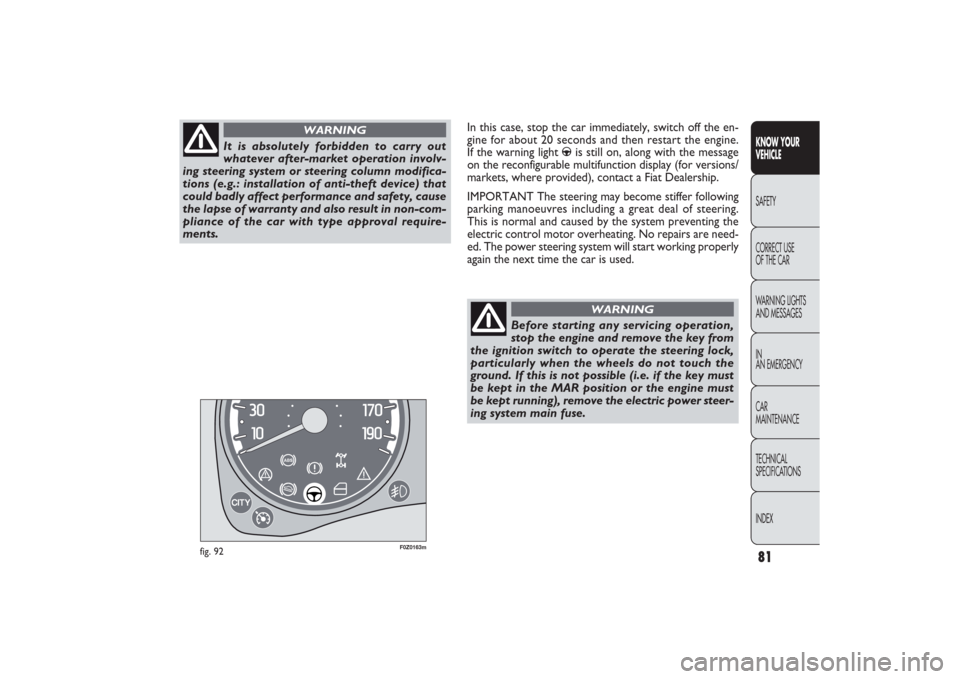
In this case, stop the car immediately, switch off the en-
gine for about 20 seconds and then restart the engine.
If the warning light
g
is still on, along with the message
on the reconfigurable multifunction display (for versions/
markets, where provided), contact a Fiat Dealership.
IMPORTANT The steering may become stiffer following
parking manoeuvres including a great deal of steering.
This is normal and caused by the system preventing the
electric control motor overheating. No repairs are need-
ed. The power steering system will start working properly
again the next time the car is used.
81KNOW YOUR
VEHICLESAFETY
CORRECT USE
OF THE CAR
WARNING LIGHTS
AND MESSAGES
IN
AN EMERGENCY
CAR
MAINTENANCE
TECHNICAL
SPECIFICATIONS
INDEX
065-090 PANDA EN 7-10-2009 13:45 Pagina 81
Page 88 of 226
RADIO TRANSMITTERS AND MOBILE
PHONES
Radio transceivers (e.g.: CB radio systems and the like)
should not be used inside the vehicle unless a separate
aerial is mounted on the roof.
IMPORTANT The use of similar devices inside the pas-
senger compartment (without an external aerial) may, in
addition to potential damage to the health of the passen-
gers, cause malfunctions in the vehicle electronic systems,
compromising the safety of the vehicle.
In addition, transmission and reception of these devices
may be affected by the shielding effect of the vehicle body.
As far as the use of EC-approved mobile phones is con-
cerned (GSM, GPRS, UMTS), follow the instructions for
use provided by the mobile phone manufacturer.
AT THE FILLING STATIONPETROL ENGINES
Use only unleaded petrol.
To avoid mistakes, the diameter of the fuel filler is too
small to introduce the bit of a leaded petrol pumps.
The petrol octane rating (RON) must not be lower than 95.
IMPORTANT An inefficient catalytic converter leads
to harmful exhaust emissions, thus contributing to air
pollution.
IMPORTANT Never use leaded petrol, even in small
amount or in an emergency, as this would damage the cat-
alytic converter beyond repair.
87KNOW YOUR
VEHICLESAFETY
CORRECT USE
OF THE CAR
WARNING LIGHTS
AND MESSAGES
IN
AN EMERGENCY
CAR
MAINTENANCE
TECHNICAL
SPECIFICATIONS
INDEX
065-090 PANDA EN 7-10-2009 13:45 Pagina 87
Page 89 of 226
88
REFUELLING CAPACITY
To fill the tank completely, top-up twice after the first click
of the fuel delivery gun. Further top-ups could cause faults
in the fuel feeding system.
KNOW YOUR
VEHICLE
SAFETY
CORRECT USE
OF THE CAR
WARNING LIGHTS
AND MESSAGES
IN
AN EMERGENCY
CAR
MAINTENANCE
TECHNICAL
SPECIFICATIONS
INDEX
The car must only be filled with diesel fuel
for motor vehicles, in compliance with Eu-
ropean Standard EN590. The use of other
products or mixtures may damage the engine
beyond repair and consequently invalidate the war-
ranty, due to the damage caused. If you acciden-
tally introduce other types of fuel into the tank,
do not start the engine and empty the tank. If the
engine has been run, even for only a very short time,
you will need to have the entire fuel system emp-
tied in addition to the tank.
DIESEL ENGINES
Operation at low temperatures
If the outside temperature is very low, diesel thickens due
to the formation of paraffin clots with consequent defec-
tive operation of the fuel supply system.
In order to avoid these problems, different types of diesel
are distributed according to the season: summer type, win-
ter type and arctic type (cold/mountain areas). If refuelling
with diesel fuel whose specifications are not suitable for
the current temperature, it is advisable to mix TUTELA
DIESEL ART additive in the proportions shown on the con-
tainer with the fuel. Pour the additive into the tank before
the diesel fuel.
When using or parking the vehicle for a long time in the
mountains or cold areas, it is advisable to refuel using
locally available diesel fuel.
In this case, it is also advisable to keep the tank over
50% full.
065-090 PANDA EN 7-10-2009 13:45 Pagina 88
Page 91 of 226
90
DIESEL PARTICULATE FILTER (DPF)
(for 1.3 Multijet 75 HP versions)
The Diesel Particulate Filter is a mechanical filter, inte-
gral with the exhaust system, that physically traps partic-
ulates present in the exhaust gases of diesel engines.
The diesel particulate filter has been adopted to eliminate
almost all particulates in compliance with current/future
legal regulations.
During normal use of the vehicle, the engine control unit
records a set of data (e.g.: travel time, type of route, tem-
peratures, etc.) and it will then calculate how much par-
ticulates has been trapped by the filter.
Since this filter physically traps particulate, it should be re-
generated (cleaned) at regular intervals by burning carbon
particles.
The regeneration procedure is controlled automatically by
the engine management control unit according to the fil-
ter conditions and vehicle use conditions.
There may be a limited increase in the engine idle speed
during the regeneration, a limited increase in fumes and
high temperatures at the exhaust. These are not faults;
they do not impair vehicle performance or damage the
environment.
If the dedicated message is displayed, refer to paragraph
“Warning lights and messages”.
KNOW YOUR
VEHICLE
SAFETY
CORRECT USE
OF THE CAR
WARNING LIGHTS
AND MESSAGES
IN
AN EMERGENCY
CAR
MAINTENANCE
TECHNICAL
SPECIFICATIONS
INDEX
PROTECTING THE ENVIRONMENTThe following devices are used for reducing petrol fuel
engine emissions:❒
three-way catalytic converter;
❒
oxygen sensors;
❒
evaporation control system.
In addition, do not let the engine run, even for a test, with
one or more spark plugs disconnected.
The following devices are used for reducing diesel fuel en-
gine emissions:
❒
oxidising catalytic converter;
❒
exhaust gas recirculation system (E.G.R.);
❒
diesel particulate filter (DPF).
The catalytic converter develops high tem-
perature during operation. Do not park
the car on grass, dry leaves, pine needles or oth-
er flammable material: fire hazard.
WARNING
065-090 PANDA EN 7-10-2009 13:45 Pagina 90
Page 99 of 226
98
KNOW YOUR
VEHICLE
SAFETY
CORRECT USE
OF THE CAR
WARNING LIGHTS
AND MESSAGES
IN AN EMERGENCY
CAR
MAINTENANCE
TECHNICAL
SPECIFICATIONS
INDEX
CARRYING CHILDREN SAFELYFor optimal protection in the event of a collision, all pas-
sengers must be seated and wearing adequate restraint
systems.
This is even more important for children.
This prescription is compulsory in all EC countries ac-
cording to EC Directive 2003/20/EC.
Compared with adults, a child’s head is proportionally larg-
er and heavier than the rest of the body, while muscles and
bone structure are not fully developed.
Therefore, correct restraint systems are necessary other
than adult seat belts.
The results of research on the best child restraint system
are contained in the European Standard ECE-R44, which
enforces the use of restraint systems classified into five
groups:
Group 0 0 – 10 kg in weight
Group 0+ 0 – 13 kg in weight
Group 1 9 – 18 kg in weight
Group 2 15 – 25 kg in weight
Group 3 22 – 36 kg in weight
SERIOUS DANGER: never place cradle
child’s seats facing backwards on the front
passenger’s seat of cars fitted with pas-
senger’s air bag. Deployment of the airbag
in an accident could cause fatal injuries
to the baby. It is advisable to carry children always
on the rear seat which is the most protected po-
sition in the event of an accident. Never fit child
seats systems on the front seat if the car is pro-
vided with passenger’s air bag: as the airbag could
cause even fatal injury independently from the
severity of the collision which caused its deploy-
ment. If necessary, children can stay on the front
seat, only if the passenger’s airbag can be disabled.
It is absolutely necessary to check the warning
light
F
on the dashboard to make sure that the
deactivation has actually taken place (see “Pas-
senger’s front air bag”, paragraph “Front air
bags”). Move the passenger’s seat as far back as
possible to avoid contact between the child seat
and the dashboard.
WARNING
All child restraint devices must bear the certification da-
ta, together with the control brand, on a solidly fixed la-
bel which must absolutely never be removed.
091-110 PANDA EN 7-10-2009 13:46 Pagina 98
Page 103 of 226
102
KNOW YOUR
VEHICLE
SAFETY
CORRECT USE
OF THE CAR
WARNING LIGHTS
AND MESSAGES
IN AN EMERGENCY
CAR
MAINTENANCE
TECHNICAL
SPECIFICATIONS
INDEX
Below is a summary of the safety rules to be followed for
carrying children.❒
Install the child seats on the rear seat, which is the most
protected position in the event of an accident.
❒
If the passenger’s air bag is deactivated always check the
amber warning light
F
on the instrument panel to
make sure that it has actually been deactivated.
❒
Carefully follow the instructions supplied with the child
restraint system which are mandatory by law. Keep the
instructions in the car along with the other papers and
this handbook. Do not use second-hand child seats with-
out instructions.
❒
Always check the seat belt is well fastened by pulling the
webbing.
❒
Only one child is to be strapped to each retaining system.
❒
Always check the seat belts do not fit around the child’s
throat.
❒
While travelling, do not let the child sit incorrectly or
release the belts.
❒
Never carry children on your lap, even newborns. No-one
can hold a child in the event of an accident.
❒
In case of an accident, replace the child seat with a new
one.
In cars fitted with passenger’s air bag nev-
er place child restraint systems on the front
seat, since children must never travel on the
front seat.
WARNING
091-110 PANDA EN 7-10-2009 13:46 Pagina 102
Page 105 of 226
104
KNOW YOUR
VEHICLE
SAFETY
CORRECT USE
OF THE CAR
WARNING LIGHTS
AND MESSAGES
IN AN EMERGENCY
CAR
MAINTENANCE
TECHNICAL
SPECIFICATIONS
INDEX
AIR BAGThe car is fitted with front air bags (for versions/markets
where provided) for the driver and the passenger and front
side bags (side bag – window bag).
FRONT AIR BAGS
The front driver/passenger air bags have been designed to
protect the occupants in the event of head-on crashes of
medium-high severity, by placing the cushion between the
occupant and the steering wheel or dashboard.
Front air bags are designed to protect car’s passengers in
head-on crashes and therefore non-activation in other
types of collisions (side collisions, rear shunts, roll-overs,
etc.) is not a system malfunction.
An electronic control unit will make the bag inflate in the
event of a front crash.
The bag will inflate instantaneously placing itself between
the front passengers’ body and the structures which could
cause injury. It will deflate immediately afterwards.
Driver and passenger front airbags are not a replacement
of but complementary to the seat belts, which should al-
ways be worn, as specified by law in Europe and most non-
European countries.
In the event of an impact, those not wearing a seat belt will
move forward and come into contact with the bag which
is still inflating. The protection offered by the air bag cush-
ion is reduced in such a case.Front air bags may not be activated in the following situ-
ations:
❒
in collisions against highly deformable objects not af-
fecting the car front surface (e.g. bumper collision against
guard rail, etc.);
❒
car wedging under other vehicles or protective barri-
ers (e.g. trucks or guard rails);
they could not provide any additional protection compared
with seat belts, so their activation would be improper.
Therefore, failure to come into action in the above cir-
cumstances does not mean that the system is not work-
ing properly.
Do not apply stickers or other objects to
the steering wheel, to the passenger’s side
air bag cover side or on the side roof lining. Nev-
er put objects (e.g. mobile phones) on the pas-
senger’s side dashboard since they could interfere
with proper air bag inflation and also cause seri-
ous injury to the passengers.
WARNING
091-110 PANDA EN 7-10-2009 13:46 Pagina 104