tyre FIAT PANDA 2009 169 / 2.G User Guide
[x] Cancel search | Manufacturer: FIAT, Model Year: 2009, Model line: PANDA, Model: FIAT PANDA 2009 169 / 2.GPages: 226, PDF Size: 5.29 MB
Page 146 of 226
145KNOW
YOUR VEHICLE
SAFETY
CORRECT USE
OF THE CAR
WARNING LIGHTS
AND MESSAGESIN
AN EMERGENCYCAR
MAINTENANCE
TECHNICAL
SPECIFICATIONS
INDEX
Tyre side wall holes and punctures cannot
be repaired. Do not use the quick repair
kit if the tyre is damaged as the vehicle has run on
a flat tyre.
WARNING
If the wheel rim is damaged (bad groove
distortion causing air leakage) it cannot
be repaired. Do not remove the foreign body
(screws or nails) from the tyre.
WARNING
PLEASE REMEMBER THAT:
The sealing fluid of the quick tyre repair kit is effective with
external temperatures between −20 °C and +50 °C.
The sealing fluid has a limited life.
Never not operate the compressor for
longer than 20 consecutive minutes. Risk
of overheating. The quick repair kit is not suitable
for definitive repairs. Tyres may only be repaired
temporarily.
WARNING
The bottle contains ethylene glycol. It con-
tains latex that might cause allergic reac-
tions. It is harmful if swallowed. It is irritant for the
eyes in case of contact. It may cause sensitisation
by inhalation or contact. Avoid contact with your
eyes, skin and clothes. In the event of contact, wash
immediately with plenty of water. Do not induce
vomit if swallowed. Rinse your mouth and drink
plenty of water. Call a doctor immediately. Keep
away from children. The product must not be used
by asthmatics. Do not inhale the vapours during in-
sertion and suction. Call a doctor immediately if al-
lergic reactions are noted. Store the bottle in the
specific compartment, away from sources of heat.
The sealant fluid has a limited life.
WARNING
135-168 PANDA EN 7-10-2009 14:07 Pagina 145
Page 147 of 226
146KNOW
YOUR VEHICLE
SAFETY
CORRECT USE
OF THE CAR
WARNING LIGHTS
AND MESSAGES
IN
AN EMERGENCYCAR
MAINTENANCE
TECHNICAL
SPECIFICATIONS
INDEX
F0Z0697m
fig. 134
F0Z0672m
fig. 135
❒
make sure that the compressor switch D-fig. 135 is in
position 0 (off), start the engine, fit the plug E-fig. 136
in the 12 V-socket in the central tunnel and operate the
compressor turning the switch D-fig. 135 to position I
(on). Inflate the tyre at the pressure value specified in
paragraph “Inflation pressure” in chapter “Technical
specifications”.
For a more accurate reading, check pressure gauge
F-fig. 135 with the compressor off;
❒
if after five minutes it is still impossible to reach at least
1.5 bar, disengage the compressor from the valve and
current socket, then move the car forth for approx. ten
metres in order to distribute the sealing fluid inside
the tyre evenly, then repeat the inflation operation;
INFLATING PROCEDURE
Replace the bottle containing out of date
sealant fluid. Dispose of the bottle and the
sealant liquid properly. Dispose according
to the national and local regulations in force.Put on the protection gloves provided to-
gether with quick tyre repair kit.
WARNING
❒
Ensure that the handbrake is engaged. Remove the tyre
valve cap, extract the flexible filler tube A-fig. 134 and
fasten the ring B onto the tyre valve;
135-168 PANDA EN 7-10-2009 14:07 Pagina 146
Page 148 of 226
147KNOW
YOUR VEHICLE
SAFETY
CORRECT USE
OF THE CAR
WARNING LIGHTS
AND MESSAGESIN
AN EMERGENCYCAR
MAINTENANCE
TECHNICAL
SPECIFICATIONS
INDEX
F0Z0673m
fig. 136
F0Z0698m
fig. 137
❒
if after this operation it is still not possible to reach at
least 1.8 bar after five minutes, do not start driving since
the tyre is excessively damaged and the fast tyre re-
pair kit cannot guarantee suitable sealing. Contact
a Fiat Dealership;
❒
if the tyre reaches the pressure specified in “Inflation
pressure” paragraph in the “Technical Specifications”
chapter, start driving immediately;
Apply the adhesive label in a position
clearly visible by the driver as a reminder
that the tyre has been treated with the quick re-
pair kit. Drive carefully, particularly on bends. Do
not exceed 80 km/h. Do not accelerate and brake
suddenly.
WARNING
❒
after driving for about 10 minutes stop and check the
tyre pressure again; remember to engage the handbrake;
If the pressure falls below 1.8 bar, do not
drive any further: the quick tyre repair kit
Fix & Go automatic cannot guarantee proper hold
because the tyre is too much damaged. Contact
a Fiat Dealership.
WARNING
❒
if at least 1.8 bar pressure is read, restore proper pres-
sure (with engine running and handbrake on) and
restart;
❒
drive with the utmost care to the nearest Fiat Dealer-
ship.
135-168 PANDA EN 7-10-2009 14:07 Pagina 147
Page 149 of 226
148KNOW
YOUR VEHICLE
SAFETY
CORRECT USE
OF THE CAR
WARNING LIGHTS
AND MESSAGES
IN
AN EMERGENCYCAR
MAINTENANCE
TECHNICAL
SPECIFICATIONS
INDEX
F0Z0699m
fig. 138
F0Z0676m
fig. 139
BOTTLE REPLACEMENT PROCEDURE
To replace the bottle, proceed as follows:❒
disconnect the connection A-fig. 139;
❒
turn the bottle counter-clockwise to replace and raise
it;
❒
fit the new bottle and turn it clockwise;
❒
secure the connection A to the bottle and fit the trans-
parent tube B in the relevant compartment.
Absolutely inform the dealership that the
tyre has been repaired using the quick tyre
repair kit. Hand the instruction brochure over to
the personnel charged with treating the tyre re-
paired with the kit.
WARNING
FOR CHECKING AND RESTORING PRESSURE
ONLYThe compressor can be also used just for restoring pres-
sure. Release the bottle connection A-fig. 139 and connect
it directly to the tyre valve fig. 138; in this way the bottle
is not connected to the compressor anymore and the seal-
ing fluid will not flow into the tyre.
135-168 PANDA EN 7-10-2009 14:07 Pagina 148
Page 164 of 226
163KNOW
YOUR VEHICLE
SAFETY
CORRECT USE
OF THE CAR
WARNING LIGHTS
AND MESSAGESIN
AN EMERGENCYCAR
MAINTENANCE
TECHNICAL
SPECIFICATIONS
INDEX
5
7,5
7,5
10
7,5
15
15
7,5
7,5
7,5
7,5
5
5
15
–
–
7,5
7,5
7,5
20
10
10
10
10
F31
F35
F35
F37
F41
F45
F46
F49
F49
F49
F50
F51
F51
F54
FA
FB
F12
F13
F13
F38
F39
F39
F39
F39
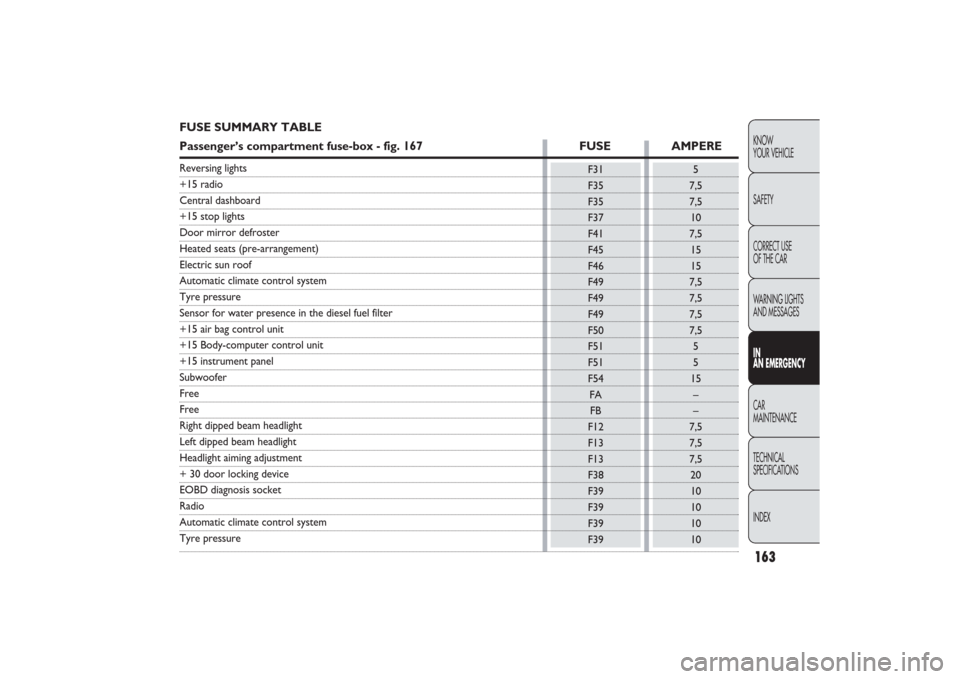
FUSE SUMMARY TABLEPassenger’s compartment fuse-box - fig. 167 FUSE AMPEREReversing lights+15 radioCentral dashboard+15 stop lightsDoor mirror defroster Heated seats (pre-arrangement)Electric sun roofAutomatic climate control systemTyre pressureSensor for water presence in the diesel fuel filter +15 air bag control unit+15 Body-computer control unit+15 instrument panelSubwooferFreeFreeRight dipped beam headlightLeft dipped beam headlightHeadlight aiming adjustment+ 30 door locking deviceEOBD diagnosis socketRadioAutomatic climate control systemTyre pressure
135-168 PANDA EN 7-10-2009 14:07 Pagina 163
Page 170 of 226
169KNOW
YOUR VEHICLE
SAFETY
WARNING LIGHTS
AND MESSAGES
IN
AN EMERGENCYCAR
MAINTENANCETECHNICAL
SPECIFICATIONS
INDEX
CAR MAINTENANCE
SCHEDULED SERVICINGCorrect servicing is essential in guaranteeing a long life for
the car under the best conditions.
This is why Fiat has programmed a series of checks and
servicing operations every 20,000 km.
It is however important to remember that scheduled ser-
vicing does not completely cover all the car’s requirements:
also in the initial run-in period before 20,000 km service
coupon and later, between each servicing interval, ordi-
nary care is still required, such as for example routine
check and topping-up the level of fluids, tyre pressure
check, etc...
CORRECT USE
OF THE CAR
IMPORTANT Scheduled Servicing coupons are specified
by the Manufacturer. Failure to have them carried out may
invalidate the warranty.
Schedule servicing can be carried out by any Fiat Dealership,
at pre-established times.
If during each operation, in addition to the ones pro-
grammed, the need arises for further replacements or re-
pairs, these may only be carried out with the express
agreement of the Customer.
IMPORTANT It is advisable to contact a Fiat Dealership
in the event of any minor operating failure, without wait-
ing for the next service coupon.
If the car is used frequently for towing a trailer, the inter-
val between services should be reduced.
169-190 PANDA EN 7-10-2009 14:14 Pagina 169
Page 171 of 226
●●●● ● ●●●●
●●●● ● ●●●●
●●●● ● ●●●●
●●●● ● ●●●●
●●●● ● ●●●●
●●●
●●●● ● ●●●●
●●●● ● ●●●●
●
●● ●●
●● ●●
●● ●●
●●20 40 60 80 100 120 140 160 180
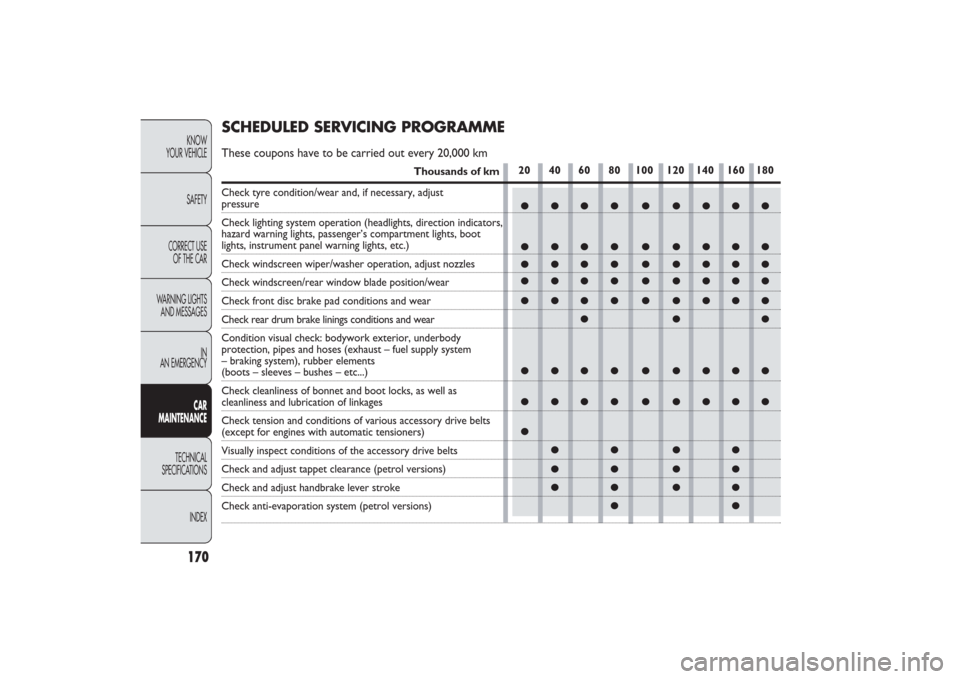
SCHEDULED SERVICING PROGRAMMEThese coupons have to be carried out every 20,000 km
Thousands of km
Check tyre condition/wear and, if necessary, adjust
pressure
Check lighting system operation (headlights, direction indicators,
hazard warning lights, passenger’s compartment lights, boot lights, instrument panel warning lights, etc.)Check windscreen wiper/washer operation, adjust nozzlesCheck windscreen/rear window blade position/wearCheck front disc brake pad conditions and wearCheck rear drum brake linings conditions and wear
Condition visual check: bodywork exterior, underbody
protection, pipes and hoses (exhaust – fuel supply system
– braking system), rubber elements (boots – sleeves – bushes – etc...)
Check cleanliness of bonnet and boot locks, as well as cleanliness and lubrication of linkages
Check tension and conditions of various accessory drive belts (except for engines with automatic tensioners)Visually inspect conditions of the accessory drive beltsCheck and adjust tappet clearance (petrol versions)Check and adjust handbrake lever stroke Check anti-evaporation system (petrol versions)
INDEX TECHNICAL
SPECIFICATIONSCAR
MAINTENANCEIN
AN EMERGENCY WARNING LIGHTS
AND MESSAGESCORRECT USE
OF THE CARSAFETYKNOW
YOUR VEHICLE
170
169-190 PANDA EN 7-10-2009 14:14 Pagina 170
Page 173 of 226
YEARLY INSPECTION SCHEDULEFor cars with an annual mileage of below 20,000 km (for
example about 15,000 km) the following yearly inspec-
tion schedule is advised:❒
check conditions/wear of tyres and adjust pressure if
necessary (including spare wheel);
❒
check lighting system operation (headlights, direction
indicators, hazard warning lights, boot light, passenger’s
compartment, instrument panel warning lights, etc...);
❒
check wiper/washer system operation, adjust nozzles;
❒
check windscreen/rear window blade position/wear;
❒
check front disc brake pad conditions and wear;
❒
check cleanliness of bonnet and boot locks and lever
cleanliness and lubrication;
❒
sight inspect the conditions of: engine, gearbox, trans-
mission, pipes and hoses (exhaust – fuel supply – brak-
ing system) rubber parts (boots – sleeves – bushes etc.),
fuel and brake system hoses;
❒
check battery charge;
❒
visually check the various drive belt conditions;
❒
check and top-up liquids if required (engine coolant,
brakes, windscreen washer, battery, etc.);
❒
change engine oil;
❒
change engine oil filter;
❒
change pollen filter (for versions/markets where pro-
vided).
ADDITIONAL INTERVENTIONSEvery 1,000 km or before long journeys, check and, if nec-
essary, top-up the following:❒
engine coolant fluid level;
❒
brake fluid level;
❒
battery fluid level;
❒
windscreen washer fluid level;
❒
tyre pressure and conditions.
Every 3,000 km check the following and top-up, if required:
❒
engine oil level.
You are recommended to use FL Selenia products de-
signed and produced specifically for Fiat cars (see table
“Capacities” in chapter “Technical specifications”).
IMPORTANT – Engine oil
Should prevailing use of the car be under one of the fol-
lowing specially heavy conditions:
❒
trailer or caravan towing;
❒
dusty roads;
❒
short distances (less than 7–8 km) and with external
temperatures below zero;
INDEX TECHNICAL
SPECIFICATIONSCAR
MAINTENANCEIN
AN EMERGENCY WARNING LIGHTS
AND MESSAGESCORRECT USE
OF THE CARSAFETYKNOW
YOUR VEHICLE
172
169-190 PANDA EN 7-10-2009 14:14 Pagina 172
Page 184 of 226
183KNOW
YOUR VEHICLE
SAFETY
CORRECT USE
OF THE CAR
WARNING LIGHTS
AND MESSAGES
IN
AN EMERGENCYCAR
MAINTENANCETECHNICAL
SPECIFICATIONS
INDEX
F0Z0112m
fig. 185
WHEELS AND TYRESCheck the pressure of each tyre, including the space-saver
wheel, approximately every two weeks and before long
journeys: the pressure should be checked with the tyre
rested and cold.
While driving the car, the pressure increases under stan-
dard conditions: for the correct tyre inflation pressure, see
“Wheels” in “Technical specifications” chapter.
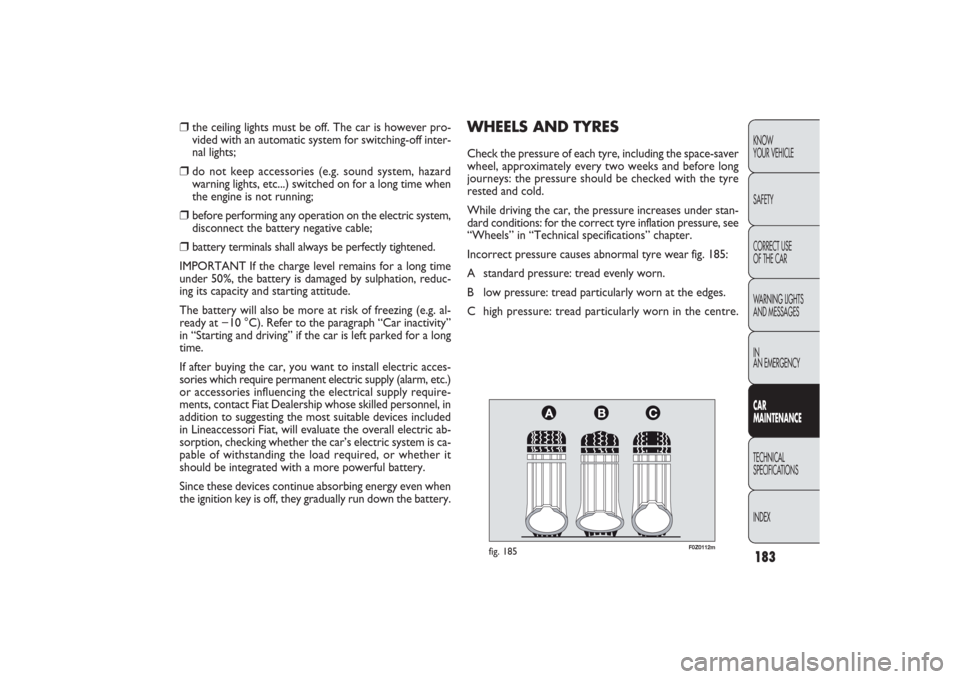
Incorrect pressure causes abnormal tyre wear fig. 185:
A standard pressure: tread evenly worn.
B low pressure: tread particularly worn at the edges.
C high pressure: tread particularly worn in the centre.
❒
the ceiling lights must be off. The car is however pro-
vided with an automatic system for switching-off inter-
nal lights;
❒
do not keep accessories (e.g. sound system, hazard
warning lights, etc...) switched on for a long time when
the engine is not running;
❒
before performing any operation on the electric system,
disconnect the battery negative cable;
❒
battery terminals shall always be perfectly tightened.
IMPORTANT If the charge level remains for a long time
under 50%, the battery is damaged by sulphation, reduc-
ing its capacity and starting attitude.
The battery will also be more at risk of freezing (e.g. al-
ready at −10 °C). Refer to the paragraph “Car inactivity”
in “Starting and driving” if the car is left parked for a long
time.
If after buying the car, you want to install electric acces-
sories which require permanent electric supply (alarm, etc.)
or accessories influencing the electrical supply require-
ments, contact Fiat Dealership whose skilled personnel, in
addition to suggesting the most suitable devices included
in Lineaccessori Fiat, will evaluate the overall electric ab-
sorption, checking whether the car’s electric system is ca-
pable of withstanding the load required, or whether it
should be integrated with a more powerful battery.
Since these devices continue absorbing energy even when
the ignition key is off, they gradually run down the battery.
169-190 PANDA EN 7-10-2009 14:15 Pagina 183
Page 185 of 226
184KNOW
YOUR VEHICLE
SAFETY
CORRECT USE
OF THE CAR
WARNING LIGHTS
AND MESSAGES
IN
AN EMERGENCYCAR
MAINTENANCE
TECHNICAL
SPECIFICATIONS
INDEX
❒
to allow even wear between the front and rear tyres,
it is advisable to change them over every 10–15 thou-
sand kilometres, keeping them on the same side of the
car so as not to reverse the direction of rotation. The tyres must be replaced when the tread is less than
1.6 mm thick. In all cases, follow the laws in force in the
country where you are driving.
IMPORTANT NOTES
❒
Avoid braking suddenly, burning starts and violent
knocks against curbs, potholes or other obstacles if pos-
sible. Driving for long stretches over bumpy roads can
damage the tyres;
❒
check the tyres regularly for cuts on the sides, swelling
or irregular tread wear. Contact a Fiat Dealership if re-
quired;
❒
avoid overloading the car when travelling: this may cause
serious damage to the wheels and tyres;
❒
if a tyre is punctured, stop the vehicle immediately
and change it to avoid damage to the tyre, the rim, the
suspensions and the steering system;
❒
a tyre will age even if it is not used much. Cracks in
the tread and on the sidewalls are a sign of ageing. Have
the tyres checked by skilled personnel if they have been
fitted for longer than six years. Remember to check
also the space-saver wheel very carefully;
❒
in case of replacement, always fit new tyres, avoiding
those with an unknown origin;
❒
if a tyre is replaced, also change the inflation valve;
Remember that the road holding qualities
of your car also depend on the correct in-
flation pressure of the tyres.
WARNING
If the pressure is too low the tyre will
get overheated, with the risk of serious
damage.
WARNING
Avoid moving the tyres from the right side
of the car to the left side and vice versa.
WARNING
Never submit alloy rims to repainting
treatments requiring to use temperatures
exceeding 150 °C. The mechanical properties of
the wheels could be impaired.
WARNING
169-190 PANDA EN 7-10-2009 14:15 Pagina 184