tyre FIAT PANDA 2009 169 / 2.G Owners Manual
[x] Cancel search | Manufacturer: FIAT, Model Year: 2009, Model line: PANDA, Model: FIAT PANDA 2009 169 / 2.GPages: 226, PDF Size: 5.29 MB
Page 75 of 226
When the ABS cuts in and you feel the
brake pedal pulsating, do not raise foot,
but keep it pressed; in doing so you will stop in the
shortest amount of space possible depending on
the current road conditions.
WARNING
If the ABS system cuts in, it means that the
grip between the tyre and the road surface
is close to its limit: you must slow down to match
the speed to the road grip available.
WARNING
The ABS make the best use of the avail-
able grip but cannot increase it. You
should always drive carefully on slippery surfaces
and avoid any unnecessary risks.
WARNING
ABS SYSTEM (for versions/markets, where provided)
This system, which is an integral part of the braking sys-
tem, prevents one or more wheels from locking and slip-
ping in all road surface conditions, irrespective of the
intensity of the braking action, ensuring that the vehicle can
be controlled even during emergency braking.
The EBD system (Electronic Braking Force Distribution)
completes the system allowing the brake force to be dis-
tributed between the front and rear wheels.
IMPORTANT To get the maximum efficiency of the brak-
ing system, a bedding-in period of about 500 km is need-
ed: during this period it is better to avoid sharp, repeat-
ed and prolonged braking.
SYSTEM INTERVENTION
The driver can feel the ABS system has come into action
because the brake pedal pulsates slightly and the system gets
noisier: it means that the car speed should be altered to suit
the type of road surface.
74
KNOW YOUR
VEHICLE
SAFETY
CORRECT USE
OF THE CAR
WARNING LIGHTS
AND MESSAGES
IN
AN EMERGENCY
CAR
MAINTENANCE
TECHNICAL
SPECIFICATIONS
INDEX
065-090 PANDA EN 7-10-2009 13:45 Pagina 74
Page 77 of 226
Do not take unnecessary risks, even if your
vehicle is fitted with an ESP system. Your
driving style must always be suited to the road
conditions, visibility and traffic. The driver is ulti-
mately responsible for road safety.
WARNING
Failure indications
In the event of a failure, the ESP system will be automati-
cally switched off and warning light
á
will appear on
the instrument panel along with a message on the recon-
figurable multifunction display (where provided). The LED
on the button ASR OFF will light up (see “Warning lights
and messages”) In this case, contact a Fiat Dealership.
HILL HOLDER SYSTEM
(for versions/markets, where provided)
This system is integral part of the ESP system and it is pro-
vided to facilitate starting on slopes. It is automatically ac-
tivated in the following conditions:
❒
uphill: car at a standstill on a road with a gradient high-
er than 2%, engine running, clutch and brake pedal
pressed, gearbox in neutral or engaged gear other than
reverse.
ESP SYSTEM
(Electronic Stability Program) (for versions/markets where provided)
GENERAL INFORMATION
This is an electronic system controlling car stability in
the event of tyre grip loss, helping to maintain direction-
al control.
The ESP system is therefore particularly useful when grip
conditions of road surfaces change.
Besides the ESP, the car is provided with ASR (traction
control with interventions on brakes and engine), HILL
HOLDER (device for start on gradient without using
the brakes), MSR (control of engine braking torque when
shifting gear down) and HBA (automatic increase of brak-
ing pressure in case of emergency braking).
SYSTEM INTERVENTION
It is signalled by the blinking of the warning light
á
on the
instrument panel, to inform the driver that the car is in
critical stability and grip conditions.
System engagement
The ESP system comes on automatically when the vehi-
cle is started and cannot be turned off.
76
KNOW YOUR
VEHICLE
SAFETY
CORRECT USE
OF THE CAR
WARNING LIGHTS
AND MESSAGES
IN
AN EMERGENCY
CAR
MAINTENANCE
TECHNICAL
SPECIFICATIONS
INDEX
065-090 PANDA EN 7-10-2009 13:45 Pagina 76
Page 78 of 226
If the space-saver wheel is used, the ESP
system keeps operating. Always remind
that the space-saver wheel, being smaller than
the original wheel provides less grip.
WARNING
For the correct operation of the ESP and
ASR systems, the tyres must absolutely be
the same make and type on all wheels, in perfect
conditions and, above all, of the type, make
and size specified.
WARNING
ASR SYSTEM (Antislip Regulation)
This is integral part of the ESP system and controls the car,
intervening automatically automatically every time one or
both driving wheels slip.
Depending on the slipping conditions, two different con-
trol systems are activated:❒
if the slipping involves both drive wheels, the ASR func-
tion intervenes by reducing the power transmitted by the
engine;
❒
if the slipping involves only one driving wheel, the ASR
system cuts in automatically braking the wheel that is
slipping.
❒
downhill: car at a standstill on a road with a gradient
higher than 2%, engine running, clutch and brake pedal
pressed and reverse gear engaged.
At pickup, the ESP system control unit will keep braking
pressure on the wheels until reaching the required torque
for starting or, in any case, for a maximum of 2 seconds
in order to move easily the right foot from the brake ped-
al to the accelerator pedal.
When two seconds have elapsed, without starting, the sys-
tem is automatically deactivated, gradually releasing the
braking pressure. During this release stage, the typical me-
chanical brake release noise can be heard, indicating that
the car is about to move.
Failure indications
A possible system failure is indicated by the *warning
light on the instrument panel – together with the dedicated
message in the reconfigurable multifunction display
(for versions/markets, where provided) – coming on
(see “Warning lights and messages” chapter).
IMPORTANT The Hill Holder system is not a parking
brake; therefore, never leave the car without having
engaged the handbrake, turned the engine off and engaged
first gear.
77KNOW YOUR
VEHICLESAFETY
CORRECT USE
OF THE CAR
WARNING LIGHTS
AND MESSAGES
IN
AN EMERGENCY
CAR
MAINTENANCE
TECHNICAL
SPECIFICATIONS
INDEX
065-090 PANDA EN 7-10-2009 13:45 Pagina 77
Page 116 of 226
115KNOW
YOUR VEHICLE
SAFETYCORRECT USE
OF THE CARWARNING LIGHTS
AND MESSAGES
IN
AN EMERGENCY
CAR
MAINTENANCE
TECHNICAL
SPECIFICATIONS
INDEX
CONTAINING RUNNING COSTSSome useful tips are given below for fuel saving and re-
ducing harmful emissions of CO
2and other pollutants
(nitrogen oxides, unburnt hydrocarbons, Particulate
Matter (PM) etc.).
GENERAL CONSIDERATIONS
Car maintenance
Have checks and adjustments carried out in accordance
with the “Scheduled servicing plan.”
Tyres
Check the pressure of the tyres routinely at an interval
of no more than 4 weeks: if the pressure is too low, con-
sumption levels increase as resistance to rolling is higher.
Unnecessary loads
Do not travel with an overloaded boot. The weight of
the car (especially when driving in town) and its trim great-
ly affects consumption and stability.
Accessories installed on longitudinal bars
Remove accessories like: roof racks, ski racks, luggage con-
tainer, etc. from the roof as soon as they are no longer
used. These accessories lower air penetration and ad-
versely affect consumption levels. When needing to
carry particularly voluminous objects, preferably use
a trailer.
To change gears properly you must push
the clutch pedal fully down. For this rea-
son, there must be no obstacles on the floor un-
der the pedals: ensure that rubber mats (if any)
are lying flat and do not interfere with the pedals.
WARNING
Do not drive with your hand resting on the
shifting lever, because this pressure, even
if light, over time can wear out the gearbox
internal components.
111-122 PANDA EN 7-10-2009 15:01 Pagina 115
Page 122 of 226
121KNOW
YOUR VEHICLE
SAFETYCORRECT USE
OF THE CARWARNING LIGHTS
AND MESSAGES
IN
AN EMERGENCY
CAR
MAINTENANCE
TECHNICAL
SPECIFICATIONS
INDEX
SNOW TYRESUse snow tyres of the same size as the normal tyres pro-
vided with the car.
Fiat Dealership will be happy to provide advice concern-
ing the most suitable type of tyres for the customer’s re-
quirements.
For the type of tyre to be used, inflation pressures and the
specifications of snow tyres, follow the instructions given
in paragraph “Wheels” in section “Technical specifica-
tions”.
The winter features of these tyres are reduced consider-
ably when the tread depth is below 4 mm. Replace them
in this case.
Due to snow tyre features, under normal conditions of
use or on long motorway journeys, the performance of
these tyres is much lower than that of standard tyres. Lim-
it performance according to the use for which they were
certified.
IMPORTANT When snow tyres are used with a max.
speed index below the one that can be reached by the
car (increased by 5%), place a notice in the passenger’s
compartment, plainly in the driver’s view which states the
max. permissible speed of the snow tyres (as per EC
Directive).
The max. speed of snow tyres with “Q”
marking is 160 km/h. The Highway Code
speed limits must however be always complied
with.
WARNING
All four tyres should be the same (brand and track) to
ensure greater safety when driving and braking and bet-
ter driveability.
Remember that it is inappropriate to change the rotation
direction of tyres.
111-122 PANDA EN 7-10-2009 15:01 Pagina 121
Page 123 of 226
122
KNOW YOUR
VEHICLE
SAFETYCORRECT USE
OF THE CARWARNING LIGHTS
AND MESSAGESI
IN
AN EMERGENCY
CAR
MAINTENANCE
TECHNICAL
SPECIFICATIONS
INDEX
CAR INACTIVITYIf the car is to be left inactive for longer than a month,
the following precautions should be followed:❒
park the car in covered, dry and if possible well-venti-
lated premises;
❒
engage one gear;
❒
check that the handbrake is not engaged;
❒
disconnect the negative battery terminal and check bat-
tery charge. Repeat this check once every three months
during storage. Recharge if the optical indicator shows
a dark colour without the central green area;
❒
clean and protect the painted parts using protective
wax;
❒
clean and protect the shiny metal parts using special
compounds readily available;
❒
sprinkle talcum powder on the rubber windscreen and
rear window wiper blades and lift them off the glass;
❒
slightly open the windows;
❒
cover the car with a cloth or perforated plastic sheet.
Do not use sheets of non-perforated plastic as they do
not allow moisture on the car body to evaporate;
❒
inflate tyres to 0.5 bar above the standard specified pres-
sure and check it at intervals;
❒
if you don’t disconnect the battery from the electric sys-
tem, check its charge every month and recharge it if the
optical indicator shows a dark colour without the central
green area;
❒
do not drain the engine cooling system.
SNOW CHAINSThe use of snow chains should be in compliance with lo-
cal regulations.
The snow chains may be applied only onto the front wheel
tyres (drive wheels).
Check the tension of the snow chains after the first few
metres have been driven.
IMPORTANT Snow chains cannot be fitted to the space-
saver spare wheel. So, if a front (drive) wheel is punctured
and chains are needed, a rear wheel should be fitted to the
front of the car and the space-saving spare wheel should
be fitted to the rear. This way with two normal drive
wheels, snow chains can be fitted to them to solve an
emergency.
Keep your speed down when snow chains
are fitted. Do not exceed 50 km/h. Avoid
potholes, steps and pavements and also
avoid driving long distances on roads not covered
with snow in order to prevent damaging the car and
the roadbed.
111-122 PANDA EN 7-10-2009 15:01 Pagina 122
Page 138 of 226
137KNOW
YOUR VEHICLE
SAFETY
CORRECT USE
OF THE CAR
WARNING LIGHTS
AND MESSAGESIN
AN EMERGENCYCAR
MAINTENANCE
TECHNICAL
SPECIFICATIONS
INDEX
REPLACING A WHEELGENERAL INSTRUCTIONS
The car can be delivered (upon request/where provided)
with standard spare wheel or space-saver wheel; see
changing instructions on the following paragraphs. Wheel
changing and correct use of the jack and spare wheel call
for some precautions as listed below.
The space-saver wheel (where provided) is
specific to your car, do not use it on other
models, nor use the spare wheel of other models
on your car. The space-saver wheel must only be
used in case of emergency. It shall only be used for
the distance necessary to reach a service point and
the car speed shall not exceed 80 km/h. The spare
wheel has an orange sticker that summarises the
main cautions for use and limitations. The sticker
should never be removed or covered. Never apply
a wheel cup on a space-saver wheel. The sticker
gives the following information in four languages:
Caution! For temporary use only! 80 km/h max.!
Replace by standard wheel as soon as possible. Do
not cover this label in use. If you change the type
of wheel (alloy rims instead of steel rims) you will
have to change the entire set of fastening bolts with
another set of suitably sized bolts.
WARNING
Alert other drivers that the car is station-
ary in compliance with local regulations:
hazard warning lights, warning triangle, etc. Any
passengers on board should leave the car, espe-
cially if it is heavily laden. Passengers should stay
away from on-coming traffic while the wheel is
being changed. If parked on a slope or rough sur-
face, chock the wheels with wedges or other suit-
able devices.
WARNING
The driving features of the car may change
when a space-saver wheel is fitted. Avoid
sudden acceleration and braking, sudden steering
and fast cornering. The total life of a space-saver
wheel is approximately 3000 km, after which it
must be replaced by another wheel of the same
type. Never attempt to fit a conventional tyre on
a rim designed for use as a space-saver wheel.
Have the punctured wheel repaired and replaced
as soon as possible. Two or more space-saver
wheels should never be used together. Do not
grease the threads of bolts before installing them:
they might slip out.
WARNING
135-168 PANDA EN 7-10-2009 14:06 Pagina 137
Page 139 of 226
138KNOW
YOUR VEHICLE
SAFETY
CORRECT USE
OF THE CAR
WARNING LIGHTS
AND MESSAGES
IN
AN EMERGENCYCAR
MAINTENANCE
TECHNICAL
SPECIFICATIONS
INDEX
F0Z0171m
fig. 121
Please note that:❒
the jack weights 1.76 kg;
❒
the jack requires no adjustment;
❒
the jack cannot be repaired. If it breaks it must be re-
placed with a new jack;
❒
no tool other than its cranking device may be fitted on
the jack.
To change a wheel proceed as follows:
❒
stop the car in a position so that it is not a danger for
on-coming traffic and where you can replace the wheel
safely. The ground must be flat and compact;
❒
turn the engine off and pull up the handbrake.
❒
engage the first gear or reverse;
❒
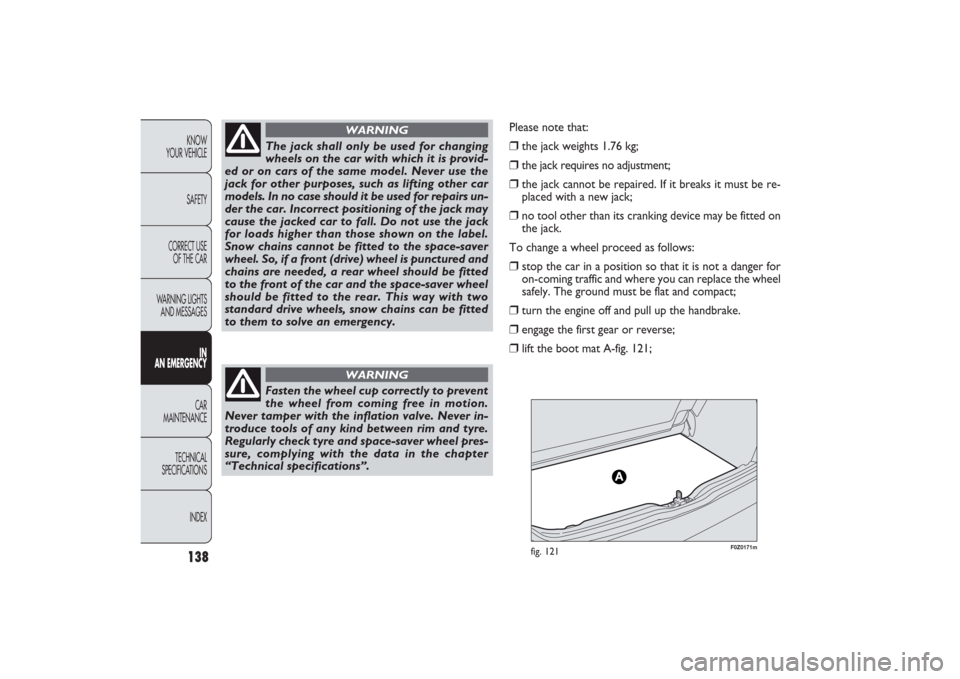
lift the boot mat A-fig. 121;
Fasten the wheel cup correctly to prevent
the wheel from coming free in motion.
Never tamper with the inflation valve. Never in-
troduce tools of any kind between rim and tyre.
Regularly check tyre and space-saver wheel pres-
sure, complying with the data in the chapter
“Technical specifications”.
WARNING
The jack shall only be used for changing
wheels on the car with which it is provid-
ed or on cars of the same model. Never use the
jack for other purposes, such as lifting other car
models. In no case should it be used for repairs un-
der the car. Incorrect positioning of the jack may
cause the jacked car to fall. Do not use the jack
for loads higher than those shown on the label.
Snow chains cannot be fitted to the space-saver
wheel. So, if a front (drive) wheel is punctured and
chains are needed, a rear wheel should be fitted
to the front of the car and the space-saver wheel
should be fitted to the rear. This way with two
standard drive wheels, snow chains can be fitted
to them to solve an emergency.
WARNING
135-168 PANDA EN 7-10-2009 14:06 Pagina 138
Page 144 of 226
143KNOW
YOUR VEHICLE
SAFETY
CORRECT USE
OF THE CAR
WARNING LIGHTS
AND MESSAGESIN
AN EMERGENCYCAR
MAINTENANCE
TECHNICAL
SPECIFICATIONS
INDEX
At the end of the procedure❒
stow the space-saving wheel D-fig. 122 in the space pro-
vided in the boot;
❒
fit the partially-open jack in its box C by forcing it slight-
ly to prevent it from vibrating when travelling;
❒
put the tools back into their locations;
❒
arrange the container and tools in the spare wheel and
secure the clamping device B;
❒
correctly reposition the boot stiff cover.
IMPORTANT Do not use inner tubes with tubeless tyres.
Check the inflation pressure of the tyres and the space-
saving wheel regularly.
IMPORTANT You will need to change the set of bolts if
you want to change the type of wheels fitted (alloy rims
instead of steel rims, and vice versa).The whole set of fas-
tening bolts must be replaced by another set of suitably
sized bolts and use a special space-saving wheel having dif-
ferent building characteristics.
You should keep the bolts and space-saving wheel in case
you decide to use the original type of wheel later on.
F0Z0607m
fig. 131
QUICK TYRE REPAIR KIT FIX & GO
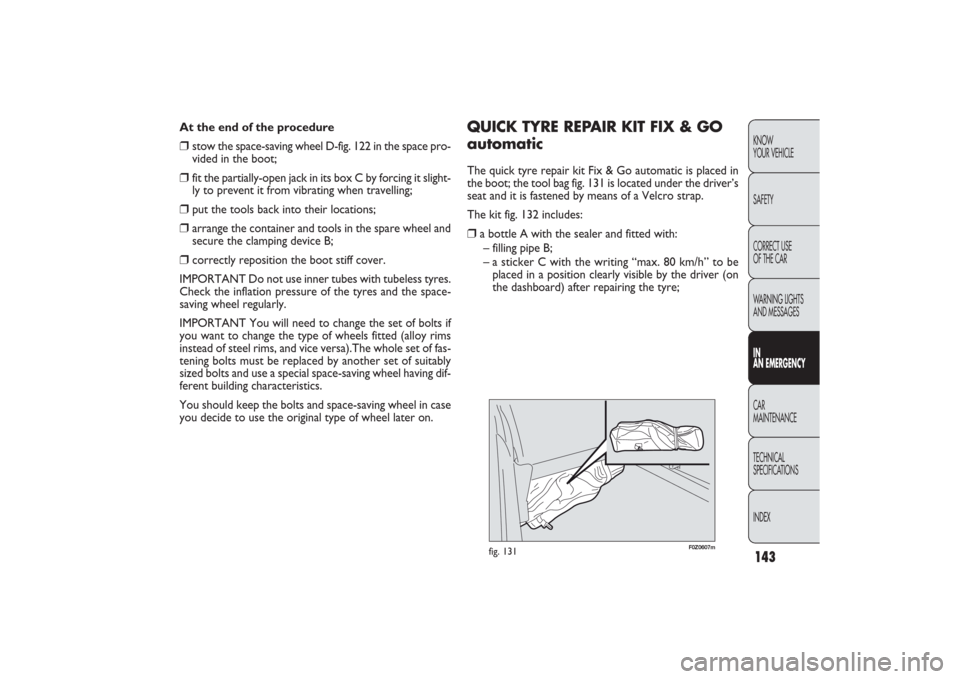
automaticThe quick tyre repair kit Fix & Go automatic is placed in
the boot; the tool bag fig. 131 is located under the driver’s
seat and it is fastened by means of a Velcro strap.
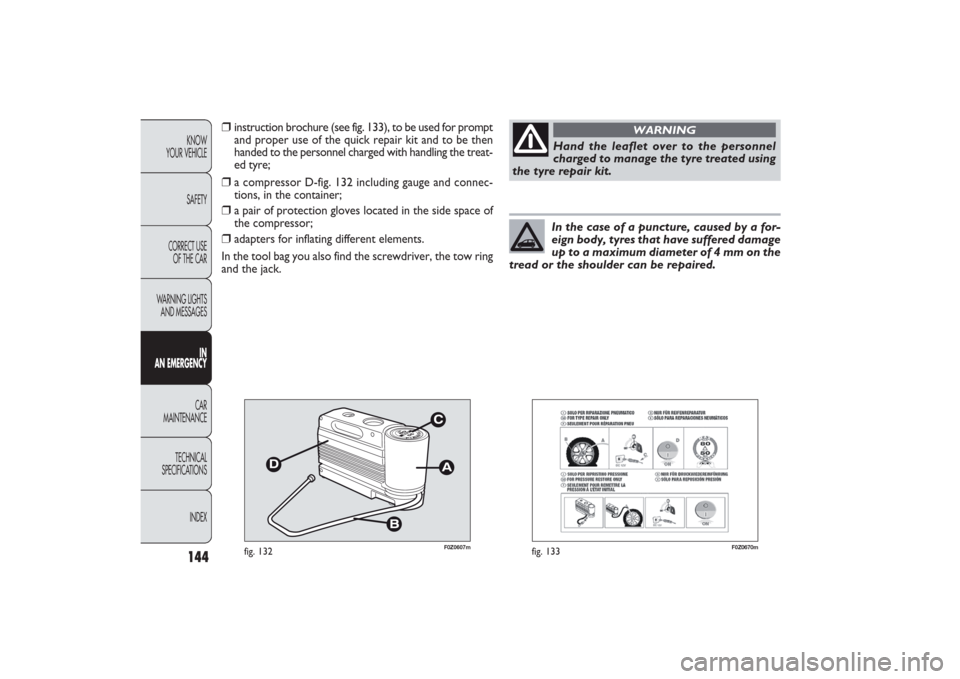
The kit fig. 132 includes:❒
a bottle A with the sealer and fitted with:
– filling pipe B;
– a sticker C with the writing “max. 80 km/h” to be
placed in a position clearly visible by the driver (on
the dashboard) after repairing the tyre;
135-168 PANDA EN 7-10-2009 14:06 Pagina 143
Page 145 of 226
144KNOW
YOUR VEHICLE
SAFETY
CORRECT USE
OF THE CAR
WARNING LIGHTS
AND MESSAGES
IN
AN EMERGENCYCAR
MAINTENANCE
TECHNICAL
SPECIFICATIONS
INDEX
F0Z0670m
fig. 133
Hand the leaflet over to the personnel
charged to manage the tyre treated using
the tyre repair kit.
WARNING
In the case of a puncture, caused by a for-
eign body, tyres that have suffered damage
up to a maximum diameter of 4 mm on the
tread or the shoulder can be repaired.
❒
instruction brochure (see fig. 133), to be used for prompt
and proper use of the quick repair kit and to be then
handed to the personnel charged with handling the treat-
ed tyre;
❒
a compressor D-fig. 132 including gauge and connec-
tions, in the container;
❒
a pair of protection gloves located in the side space of
the compressor;
❒
adapters for inflating different elements.
In the tool bag you also find the screwdriver, the tow ring
and the jack.
F0Z0607m
fig. 132
135-168 PANDA EN 7-10-2009 14:06 Pagina 144