wheel FIAT PANDA 2009 169 / 2.G User Guide
[x] Cancel search | Manufacturer: FIAT, Model Year: 2009, Model line: PANDA, Model: FIAT PANDA 2009 169 / 2.GPages: 226, PDF Size: 5.29 MB
Page 78 of 226
If the space-saver wheel is used, the ESP
system keeps operating. Always remind
that the space-saver wheel, being smaller than
the original wheel provides less grip.
WARNING
For the correct operation of the ESP and
ASR systems, the tyres must absolutely be
the same make and type on all wheels, in perfect
conditions and, above all, of the type, make
and size specified.
WARNING
ASR SYSTEM (Antislip Regulation)
This is integral part of the ESP system and controls the car,
intervening automatically automatically every time one or
both driving wheels slip.
Depending on the slipping conditions, two different con-
trol systems are activated:❒
if the slipping involves both drive wheels, the ASR func-
tion intervenes by reducing the power transmitted by the
engine;
❒
if the slipping involves only one driving wheel, the ASR
system cuts in automatically braking the wheel that is
slipping.
❒
downhill: car at a standstill on a road with a gradient
higher than 2%, engine running, clutch and brake pedal
pressed and reverse gear engaged.
At pickup, the ESP system control unit will keep braking
pressure on the wheels until reaching the required torque
for starting or, in any case, for a maximum of 2 seconds
in order to move easily the right foot from the brake ped-
al to the accelerator pedal.
When two seconds have elapsed, without starting, the sys-
tem is automatically deactivated, gradually releasing the
braking pressure. During this release stage, the typical me-
chanical brake release noise can be heard, indicating that
the car is about to move.
Failure indications
A possible system failure is indicated by the *warning
light on the instrument panel – together with the dedicated
message in the reconfigurable multifunction display
(for versions/markets, where provided) – coming on
(see “Warning lights and messages” chapter).
IMPORTANT The Hill Holder system is not a parking
brake; therefore, never leave the car without having
engaged the handbrake, turned the engine off and engaged
first gear.
77KNOW YOUR
VEHICLESAFETY
CORRECT USE
OF THE CAR
WARNING LIGHTS
AND MESSAGES
IN
AN EMERGENCY
CAR
MAINTENANCE
TECHNICAL
SPECIFICATIONS
INDEX
065-090 PANDA EN 7-10-2009 13:45 Pagina 77
Page 79 of 226
F0Z0267m
fig. 88
When the ASR is switched off whilst driving, the next time
the car is started up the ASR is automatically switched
on by the system. When travelling on snowy roads with
snow chains, it may be helpful to turn the ASR off: in fact,
in these conditions, slipping of the drive wheels when mov-
ing off makes it possible to obtain better traction. The action of the ASR system is particularly helpful in
the following circumstances:
❒
slipping of the inner wheel when cornering due to the
effect of dynamic load changes or excessive accelera-
tion;
❒
too much power transmitted to the wheels also in re-
lation to the conditions of the road surface;
❒
acceleration on slippery, snowy or icy surfaces;
❒
in the event of loss of grip on a wet surface
(aquaplaning).
MSR system (engine drive regulation)
This is integral part of the ASR system that, in the event
of a sudden gear downshifting, cuts in and provides torque
to the engine thus preventing excessive drive wheel dri-
ve which, especially in poor grip conditions, can lead to
loss of stability.
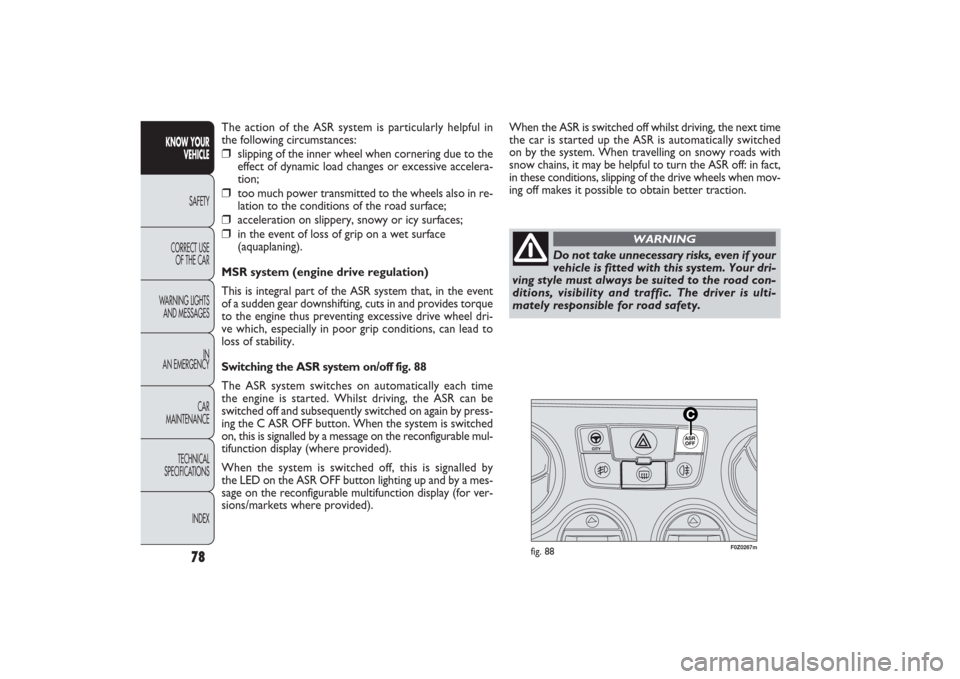
Switching the ASR system on/off fig. 88
The ASR system switches on automatically each time
the engine is started. Whilst driving, the ASR can be
switched off and subsequently switched on again by press-
ing the C ASR OFF button. When the system is switched
on, this is signalled by a message on the reconfigurable mul-
tifunction display (where provided).
When the system is switched off, this is signalled by
the LED on the ASR OFF button lighting up and by a mes-
sage on the reconfigurable multifunction display (for ver-
sions/markets where provided).
Do not take unnecessary risks, even if your
vehicle is fitted with this system. Your dri-
ving style must always be suited to the road con-
ditions, visibility and traffic. The driver is ulti-
mately responsible for road safety.
WARNING
78
KNOW YOUR
VEHICLE
SAFETY
CORRECT USE
OF THE CAR
WARNING LIGHTS
AND MESSAGES
IN
AN EMERGENCY
CAR
MAINTENANCE
TECHNICAL
SPECIFICATIONS
INDEX
065-090 PANDA EN 7-10-2009 13:45 Pagina 78
Page 81 of 226
F0Z0145m
fig. 90
F0Z0162m
fig. 91
When the CITY function is on, the steering wheel effort
is lighter and thus parking operations are easier: there-
fore this function is particularly useful for driving in city
centres.
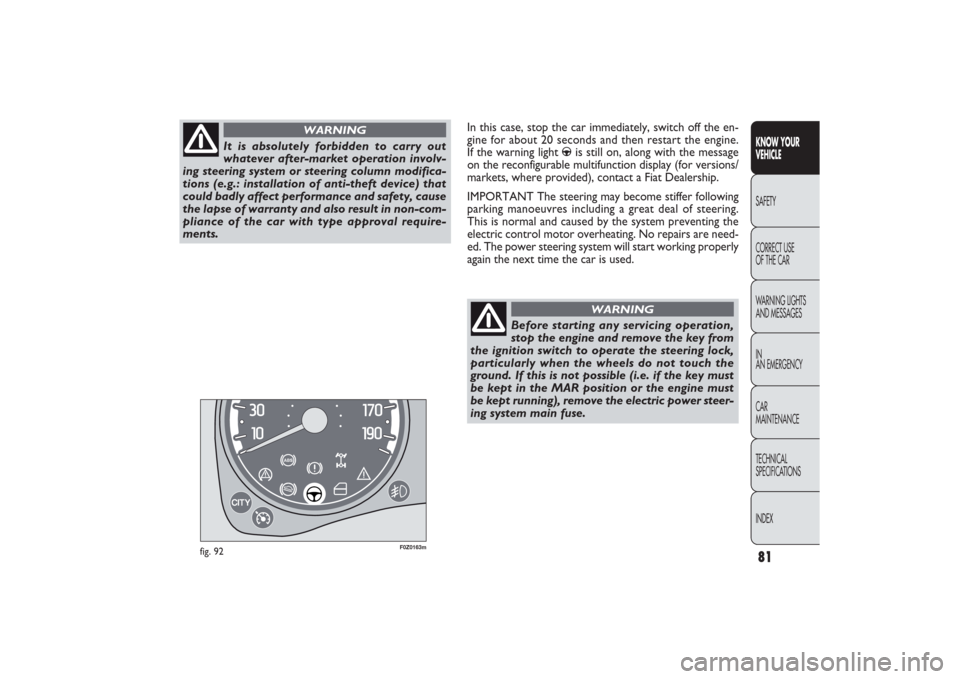
FAILURE INDICATIONS fig. 92
Possible power steering system failures are indicated by
the
g
warning light on the instrument panel – together
with the dedicated message in the reconfigurable multi-
function display (for versions/markets, where provided)
– coming on (see “Warning lights and messages” chapter).
In the event of electric power steering system failure,
the car can be driven with mechanical steering.
IMPORTANT In some circumstances, factors independent
of the electric power steering could cause the warning light
g
on the instrument panel to come on.
“DUALDRIVE” ELECTRIC POWER
STEERING SYSTEM (for versions/markets, where provided)
Some versions feature an electric power steering system
which only works with the key at MAR and the engine run-
ning; this system, system called “Dualdrive” can be cus-
tomised by the driver according to the driving conditions.
IMPORTANT When turning quickly the ignition key,
power steering full functionality can be achieved after
1-2 seconds.
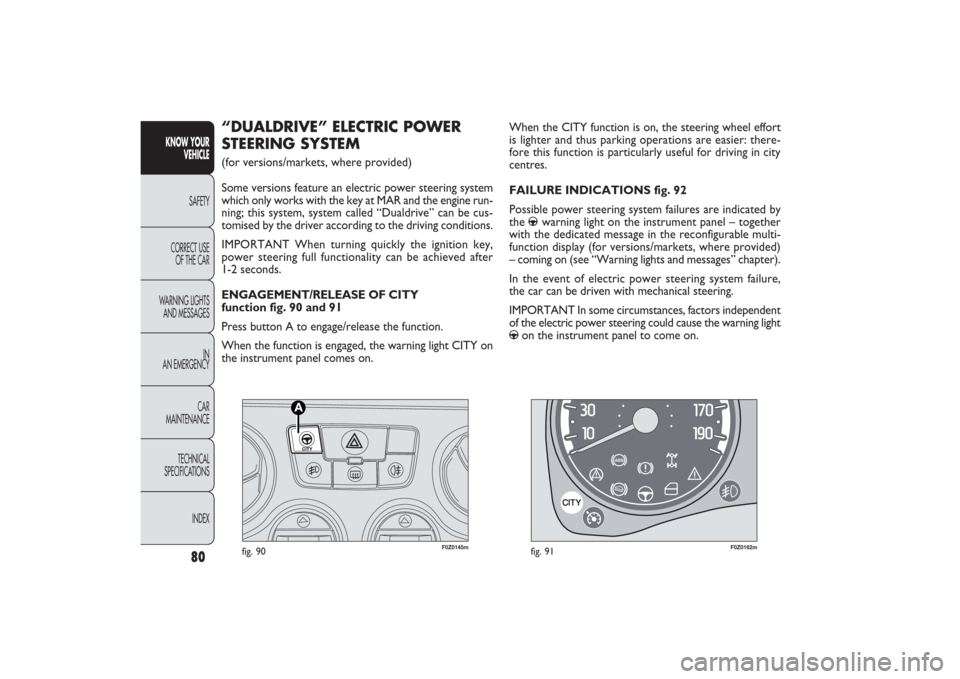
ENGAGEMENT/RELEASE OF CITY
function fig. 90 and 91
Press button A to engage/release the function.
When the function is engaged, the warning light CITY on
the instrument panel comes on.
80
KNOW YOUR
VEHICLE
SAFETY
CORRECT USE
OF THE CAR
WARNING LIGHTS
AND MESSAGES
IN
AN EMERGENCY
CAR
MAINTENANCE
TECHNICAL
SPECIFICATIONS
INDEX
065-090 PANDA EN 7-10-2009 13:45 Pagina 80
Page 82 of 226
F0Z0163m
fig. 92
It is absolutely forbidden to carry out
whatever after-market operation involv-
ing steering system or steering column modifica-
tions (e.g.: installation of anti-theft device) that
could badly affect performance and safety, cause
the lapse of warranty and also result in non-com-
pliance of the car with type approval require-
ments.
WARNING
Before starting any servicing operation,
stop the engine and remove the key from
the ignition switch to operate the steering lock,
particularly when the wheels do not touch the
ground. If this is not possible (i.e. if the key must
be kept in the MAR position or the engine must
be kept running), remove the electric power steer-
ing system main fuse.
WARNING
In this case, stop the car immediately, switch off the en-
gine for about 20 seconds and then restart the engine.
If the warning light
g
is still on, along with the message
on the reconfigurable multifunction display (for versions/
markets, where provided), contact a Fiat Dealership.
IMPORTANT The steering may become stiffer following
parking manoeuvres including a great deal of steering.
This is normal and caused by the system preventing the
electric control motor overheating. No repairs are need-
ed. The power steering system will start working properly
again the next time the car is used.
81KNOW YOUR
VEHICLESAFETY
CORRECT USE
OF THE CAR
WARNING LIGHTS
AND MESSAGES
IN
AN EMERGENCY
CAR
MAINTENANCE
TECHNICAL
SPECIFICATIONS
INDEX
065-090 PANDA EN 7-10-2009 13:45 Pagina 81
Page 105 of 226
104
KNOW YOUR
VEHICLE
SAFETY
CORRECT USE
OF THE CAR
WARNING LIGHTS
AND MESSAGES
IN AN EMERGENCY
CAR
MAINTENANCE
TECHNICAL
SPECIFICATIONS
INDEX
AIR BAGThe car is fitted with front air bags (for versions/markets
where provided) for the driver and the passenger and front
side bags (side bag – window bag).
FRONT AIR BAGS
The front driver/passenger air bags have been designed to
protect the occupants in the event of head-on crashes of
medium-high severity, by placing the cushion between the
occupant and the steering wheel or dashboard.
Front air bags are designed to protect car’s passengers in
head-on crashes and therefore non-activation in other
types of collisions (side collisions, rear shunts, roll-overs,
etc.) is not a system malfunction.
An electronic control unit will make the bag inflate in the
event of a front crash.
The bag will inflate instantaneously placing itself between
the front passengers’ body and the structures which could
cause injury. It will deflate immediately afterwards.
Driver and passenger front airbags are not a replacement
of but complementary to the seat belts, which should al-
ways be worn, as specified by law in Europe and most non-
European countries.
In the event of an impact, those not wearing a seat belt will
move forward and come into contact with the bag which
is still inflating. The protection offered by the air bag cush-
ion is reduced in such a case.Front air bags may not be activated in the following situ-
ations:
❒
in collisions against highly deformable objects not af-
fecting the car front surface (e.g. bumper collision against
guard rail, etc.);
❒
car wedging under other vehicles or protective barri-
ers (e.g. trucks or guard rails);
they could not provide any additional protection compared
with seat belts, so their activation would be improper.
Therefore, failure to come into action in the above cir-
cumstances does not mean that the system is not work-
ing properly.
Do not apply stickers or other objects to
the steering wheel, to the passenger’s side
air bag cover side or on the side roof lining. Nev-
er put objects (e.g. mobile phones) on the pas-
senger’s side dashboard since they could interfere
with proper air bag inflation and also cause seri-
ous injury to the passengers.
WARNING
091-110 PANDA EN 7-10-2009 13:46 Pagina 104
Page 106 of 226
105KNOW YOUR
VEHICLESAFETYCORRECT USE
OF THE CAR
WARNING LIGHTS
AND MESSAGES
IN AN EMERGENCY
CAR
MAINTENANCE
TECHNICAL
SPECIFICATIONS
INDEX
F0Z0693m
fig. 111
F0Z0057m
fig. 112
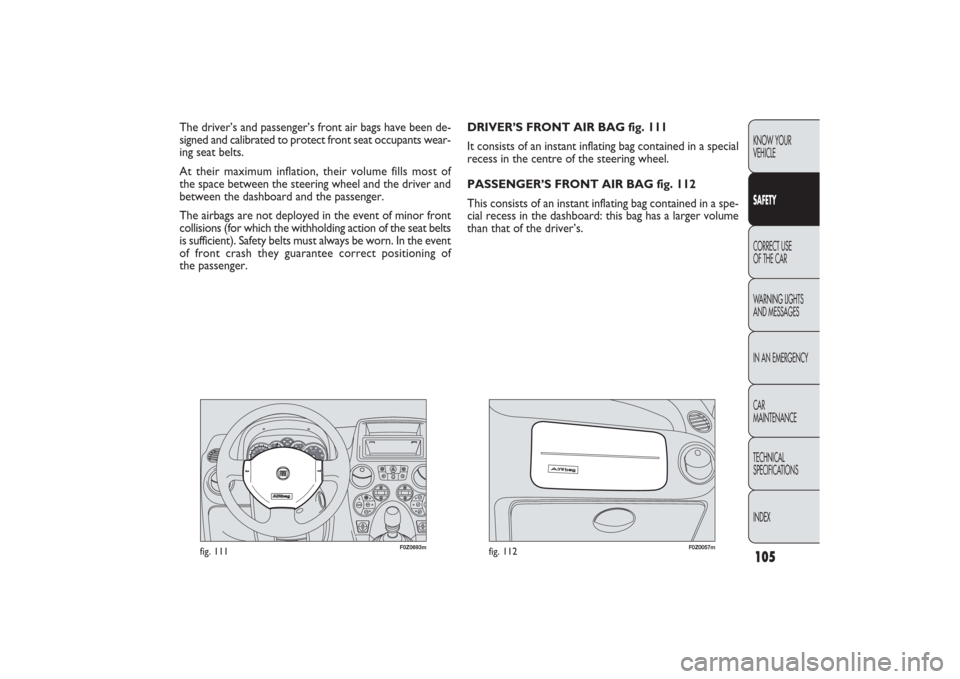
DRIVER’S FRONT AIR BAG fig. 111
It consists of an instant inflating bag contained in a special
recess in the centre of the steering wheel.
PASSENGER’S FRONT AIR BAG fig. 112
This consists of an instant inflating bag contained in a spe-
cial recess in the dashboard: this bag has a larger volume
than that of the driver’s. The driver’s and passenger’s front air bags have been de-
signed and calibrated to protect front seat occupants wear-
ing seat belts.
At their maximum inflation, their volume fills most of
the space between the steering wheel and the driver and
between the dashboard and the passenger.
The airbags are not deployed in the event of minor front
collisions (for which the withholding action of the seat belts
is sufficient). Safety belts must always be worn. In the event
of front crash they guarantee correct positioning of
the passenger.
091-110 PANDA EN 7-10-2009 13:46 Pagina 105
Page 110 of 226
109KNOW YOUR
VEHICLESAFETYCORRECT USE
OF THE CAR
WARNING LIGHTS
AND MESSAGES
IN AN EMERGENCY
CAR
MAINTENANCE
TECHNICAL
SPECIFICATIONS
INDEX
GENERAL WARNINGS
If when turning the key to MAR the warn-
ing light
¬
does not turn on or if it stays
on when travelling, there could be a failure in safe-
ty systems; in this event air bags or pretensioners
may not be deployed in case of impact or, in a mi-
nor number of cases, they deploy accidentally.
Contact a Fiat Dealership immediately to have
the system checked.
WARNING
Do not cover the backrest of front seats
with trims or covers that are not suitable
to be used with side bags.
WARNING
Never travel with objects on your lap, in
front of your chest or with a pipe, pencil,
etc. between your lips; injury may result in the
event of the air bag being triggered.
WARNING
Always drive keeping your hands on the
steering wheel rim so that the air bag can
inflate freely in the case of need. Do not drive with
your body bent forward. Keep your back straight
against the backrest.
WARNING
Air bags may be deployed if another vehi-
cle crashes into the car, if the key is insert-
ed and at MAR also if the engine is not running and
the car is stationary. For this reason, children must
never sit on the front seat, even if the car is not
moving. On the other hand, whenever the key is
positioned on STOP, the safety devices (air bags or
pretensioners) do not deploy after a collision. In
this case non-deployment of these devices does not
indicate a system malfunction.
WARNING
091-110 PANDA EN 7-10-2009 13:46 Pagina 109
Page 112 of 226
111KNOW
YOUR VEHICLE
SAFETY
WARNING LIGHTS
AND MESSAGES
IN
AN EMERGENCY
CAR
MAINTENANCE
TECHNICAL
SPECIFICATIONS
INDEX
CORRECT USE OF THE CAR
STARTING PROCEDURE FOR PETROL
VERSIONS
Proceed as follows:❒
engage the handbrake;
❒
place the gearshifting lever in neutral;
❒
press the clutch pedal all the way down without touch-
ing the accelerator;
❒
turn the ignition key to
AVV
and let it go as soon as
the engine starts.
If the engine does not start at the first attempt, return
the ignition key to
STOP
before repeating starting.
STARTING THE ENGINEThe car is fitted with an electronic engine lock device:
if the engine fails to start, see the paragraph “The Fiat
CODE system” in section “Know your vehicle”.
The engine may be noisier during the first few seconds of
operation, especially after a long period of inactivity. This
characteristic feature of the hydraulic tappet system does
not compromise functionality or reliability: the system de-
vised for your car was designed to limit maintenance
interventions.
It is dangerous to let the engine run in en-
closed spaces. The engine consumes oxy-
gen and engine exhaust contains carbon dioxide,
carbon monoxide and other toxic gasses.
WARNING
CORRECT USE
OF THE CAR
We recommend that during the initial pe-
riod you do not drive to full car perfor-
mance (e.g.: excessive acceleration, long
journeys at top speed, sharp braking, etc.).When the engine is switched off never leave
the key into the ignition switch to prevent
useless current absorption from draining the
battery.
Remember that the servo-brake and pow-
er steering are not operational until the
engine has been started, therefore much effort
than usual is required on the brake pedal
and teering wheel.
WARNING
111-122 PANDA EN 7-10-2009 15:01 Pagina 111
Page 114 of 226
113KNOW
YOUR VEHICLE
SAFETYCORRECT USE
OF THE CARWARNING LIGHTS
AND MESSAGES
IN
AN EMERGENCY
CAR
MAINTENANCE
TECHNICAL
SPECIFICATIONS
INDEX
F0Z0037m
fig. 116
PARKING THE VEHICLEProceed as follows:❒
stop the engine and engage the handbrake;
❒
engage a gear (on a slope, engage first gear if the vehi-
cle is parked uphill or reverse if it is parked downhill)
and leave the wheels steered.
Block the wheels with a wedge or a stone if the car is
parked on a steep slope.
Do not leave the key in the ignition switch at MAR to pre-
vent draining the battery. Always remove the key when
leaving the car. Never leave children unattended in the car.
Always remove the ignition key when leaving the car
and take it out with you.
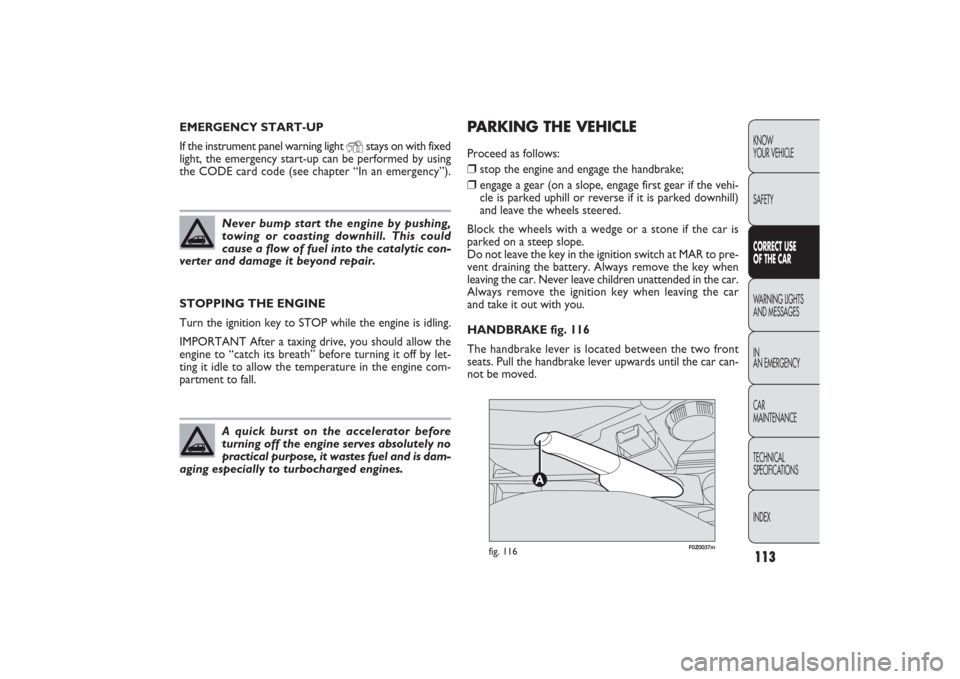
HANDBRAKE fig. 116
The handbrake lever is located between the two front
seats. Pull the handbrake lever upwards until the car can-
not be moved. STOPPING THE ENGINE
Turn the ignition key to STOP while the engine is idling.
IMPORTANT After a taxing drive, you should allow the
engine to “catch its breath” before turning it off by let-
ting it idle to allow the temperature in the engine com-
partment to fall.
Never bump start the engine by pushing,
towing or coasting downhill. This could
cause a flow of fuel into the catalytic con-
verter and damage it beyond repair.A quick burst on the accelerator before
turning off the engine serves absolutely no
practical purpose, it wastes fuel and is dam-
aging especially to turbocharged engines.
EMERGENCY START-UP
If the instrument panel warning light
Y
stays on with fixed
light, the emergency start-up can be performed by using
the CODE card code (see chapter “In an emergency”).
111-122 PANDA EN 7-10-2009 15:01 Pagina 113
Page 120 of 226
119KNOW
YOUR VEHICLE
SAFETYCORRECT USE
OF THE CARWARNING LIGHTS
AND MESSAGES
IN
AN EMERGENCY
CAR
MAINTENANCE
TECHNICAL
SPECIFICATIONS
INDEX
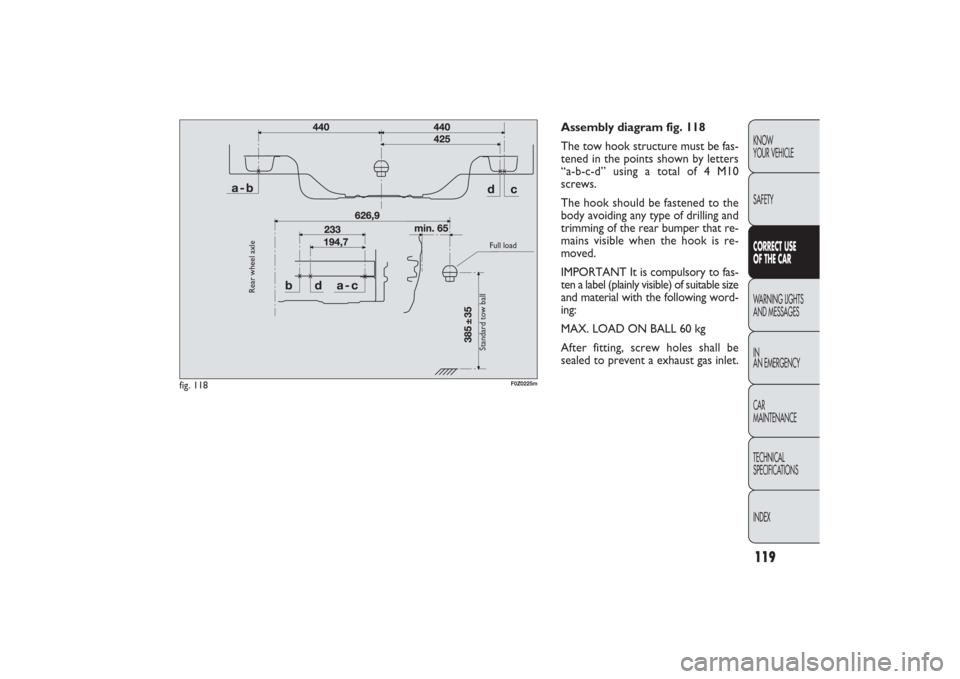
Assembly diagram fig. 118
The tow hook structure must be fas-
tened in the points shown by letters
“a-b-c-d” using a total of 4 M10
screws.
The hook should be fastened to the
body avoiding any type of drilling and
trimming of the rear bumper that re-
mains visible when the hook is re-
moved.
IMPORTANT It is compulsory to fas-
ten a label (plainly visible) of suitable size
and material with the following word-
ing:
MAX. LOAD ON BALL 60 kg
After fitting, screw holes shall be
sealed to prevent a exhaust gas inlet.
fig. 118
F0Z0225m
Rear wheel axle
Standard tow ball
Full load
111-122 PANDA EN 7-10-2009 15:01 Pagina 119