Wheel FIAT PANDA 2009 169 / 2.G Owner's Manual
[x] Cancel search | Manufacturer: FIAT, Model Year: 2009, Model line: PANDA, Model: FIAT PANDA 2009 169 / 2.GPages: 226, PDF Size: 5.29 MB
Page 122 of 226
121KNOW
YOUR VEHICLE
SAFETYCORRECT USE
OF THE CARWARNING LIGHTS
AND MESSAGES
IN
AN EMERGENCY
CAR
MAINTENANCE
TECHNICAL
SPECIFICATIONS
INDEX
SNOW TYRESUse snow tyres of the same size as the normal tyres pro-
vided with the car.
Fiat Dealership will be happy to provide advice concern-
ing the most suitable type of tyres for the customer’s re-
quirements.
For the type of tyre to be used, inflation pressures and the
specifications of snow tyres, follow the instructions given
in paragraph “Wheels” in section “Technical specifica-
tions”.
The winter features of these tyres are reduced consider-
ably when the tread depth is below 4 mm. Replace them
in this case.
Due to snow tyre features, under normal conditions of
use or on long motorway journeys, the performance of
these tyres is much lower than that of standard tyres. Lim-
it performance according to the use for which they were
certified.
IMPORTANT When snow tyres are used with a max.
speed index below the one that can be reached by the
car (increased by 5%), place a notice in the passenger’s
compartment, plainly in the driver’s view which states the
max. permissible speed of the snow tyres (as per EC
Directive).
The max. speed of snow tyres with “Q”
marking is 160 km/h. The Highway Code
speed limits must however be always complied
with.
WARNING
All four tyres should be the same (brand and track) to
ensure greater safety when driving and braking and bet-
ter driveability.
Remember that it is inappropriate to change the rotation
direction of tyres.
111-122 PANDA EN 7-10-2009 15:01 Pagina 121
Page 123 of 226
122
KNOW YOUR
VEHICLE
SAFETYCORRECT USE
OF THE CARWARNING LIGHTS
AND MESSAGESI
IN
AN EMERGENCY
CAR
MAINTENANCE
TECHNICAL
SPECIFICATIONS
INDEX
CAR INACTIVITYIf the car is to be left inactive for longer than a month,
the following precautions should be followed:❒
park the car in covered, dry and if possible well-venti-
lated premises;
❒
engage one gear;
❒
check that the handbrake is not engaged;
❒
disconnect the negative battery terminal and check bat-
tery charge. Repeat this check once every three months
during storage. Recharge if the optical indicator shows
a dark colour without the central green area;
❒
clean and protect the painted parts using protective
wax;
❒
clean and protect the shiny metal parts using special
compounds readily available;
❒
sprinkle talcum powder on the rubber windscreen and
rear window wiper blades and lift them off the glass;
❒
slightly open the windows;
❒
cover the car with a cloth or perforated plastic sheet.
Do not use sheets of non-perforated plastic as they do
not allow moisture on the car body to evaporate;
❒
inflate tyres to 0.5 bar above the standard specified pres-
sure and check it at intervals;
❒
if you don’t disconnect the battery from the electric sys-
tem, check its charge every month and recharge it if the
optical indicator shows a dark colour without the central
green area;
❒
do not drain the engine cooling system.
SNOW CHAINSThe use of snow chains should be in compliance with lo-
cal regulations.
The snow chains may be applied only onto the front wheel
tyres (drive wheels).
Check the tension of the snow chains after the first few
metres have been driven.
IMPORTANT Snow chains cannot be fitted to the space-
saver spare wheel. So, if a front (drive) wheel is punctured
and chains are needed, a rear wheel should be fitted to the
front of the car and the space-saving spare wheel should
be fitted to the rear. This way with two normal drive
wheels, snow chains can be fitted to them to solve an
emergency.
Keep your speed down when snow chains
are fitted. Do not exceed 50 km/h. Avoid
potholes, steps and pavements and also
avoid driving long distances on roads not covered
with snow in order to prevent damaging the car and
the roadbed.
111-122 PANDA EN 7-10-2009 15:01 Pagina 122
Page 128 of 226
127KNOW
YOUR VEHICLE
SAFETY
CORRECT USE
OF THE CARWARNING LIGHTS
AND MESSAGESIN
AN EMERGENCY
CAR
MAINTENANCE
TECHNICAL
SPECIFICATIONS
INDEX
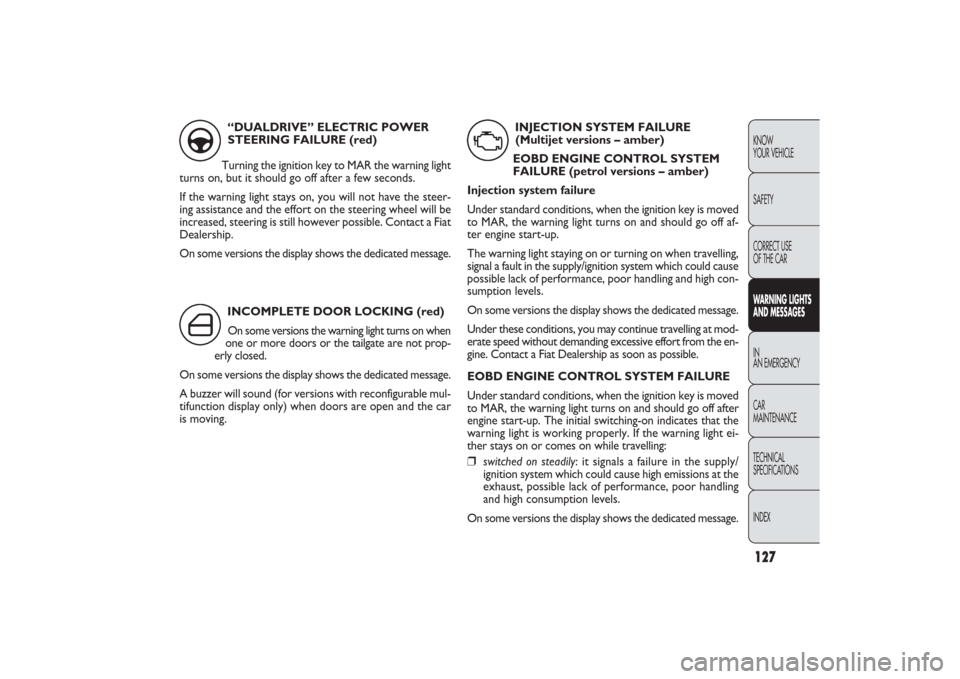
INJECTION SYSTEM FAILURE
(Multijet versions – amber)
EOBD ENGINE CONTROL SYSTEM
FAILURE (petrol versions – amber)
Injection system failure
Under standard conditions, when the ignition key is moved
to MAR, the warning light turns on and should go off af-
ter engine start-up.
The warning light staying on or turning on when travelling,
signal a fault in the supply/ignition system which could cause
possible lack of performance, poor handling and high con-
sumption levels.
On some versions the display shows the dedicated message.
Under these conditions, you may continue travelling at mod-
erate speed without demanding excessive effort from the en-
gine. Contact a Fiat Dealership as soon as possible.
EOBD ENGINE CONTROL SYSTEM FAILURE
Under standard conditions, when the ignition key is moved
to MAR, the warning light turns on and should go off after
engine start-up. The initial switching-on indicates that the
warning light is working properly. If the warning light ei-
ther stays on or comes on while travelling:
❒switched on steadily: it signals a failure in the supply/
ignition system which could cause high emissions at the
exhaust, possible lack of performance, poor handling
and high consumption levels.
On some versions the display shows the dedicated message. “DUALDRIVE” ELECTRIC POWER
STEERING FAILURE (red)
Turning the ignition key to MAR the warning light
turns on, but it should go off after a few seconds.
If the warning light stays on, you will not have the steer-
ing assistance and the effort on the steering wheel will be
increased, steering is still however possible. Contact a Fiat
Dealership.
On some versions the display shows the dedicated message.
g
INCOMPLETE DOOR LOCKING (red)
On some versions the warning light turns on when
one or more doors or the tailgate are not prop-
erly closed.
On some versions the display shows the dedicated message.
A buzzer will sound (for versions with reconfigurable mul-
tifunction display only) when doors are open and the car
is moving.
´
U
123-134 PANDA EN 7-10-2009 13:49 Pagina 127
Page 129 of 226
128
KNOW YOUR
VEHICLE
SAFETY
CORRECT USE
OF THE CAR
WARNING LIGHTS
AND MESSAGES
IN
AN EMERGENCY
CAR
MAINTENANCE
TECHNICAL
SPECIFICATIONS
INDEX
INCOMPLETE DOOR LOCKING
(red)
On some versions the warning light turns on
when one or more doors or the tailgate are not
properly closed.
On some versions the display shows the dedicated message.
A buzzer will sound (for versions with reconfigurable mul-
tifunction display only) when doors are open and the car
is moving.
´
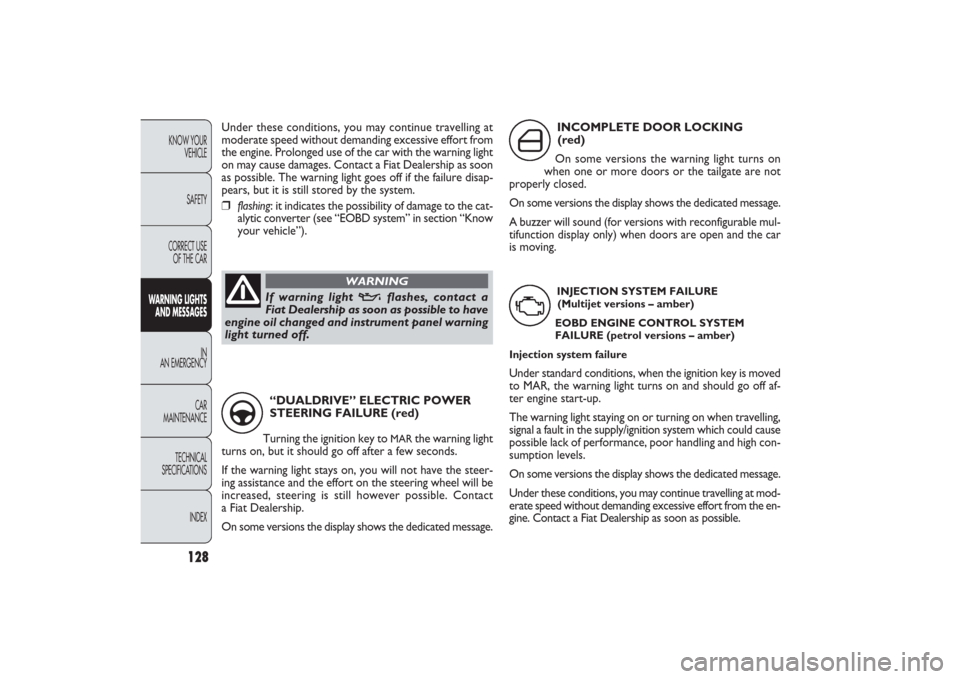
INJECTION SYSTEM FAILURE
(Multijet versions – amber)
EOBD ENGINE CONTROL SYSTEM
FAILURE (petrol versions – amber)
Injection system failure
Under standard conditions, when the ignition key is moved
to MAR, the warning light turns on and should go off af-
ter engine start-up.
The warning light staying on or turning on when travelling,
signal a fault in the supply/ignition system which could cause
possible lack of performance, poor handling and high con-
sumption levels.
On some versions the display shows the dedicated message.
Under these conditions, you may continue travelling at mod-
erate speed without demanding excessive effort from the en-
gine. Contact a Fiat Dealership as soon as possible.U
Under these conditions, you may continue travelling at
moderate speed without demanding excessive effort from
the engine. Prolonged use of the car with the warning light
on may cause damages. Contact a Fiat Dealership as soon
as possible. The warning light goes off if the failure disap-
pears, but it is still stored by the system.
❒flashing: it indicates the possibility of damage to the cat-
alytic converter (see “EOBD system” in section “Know
your vehicle”).
If warning light
v
flashes, contact a
Fiat Dealership as soon as possible to have
engine oil changed and instrument panel warning
light turned off.
WARNING
“DUALDRIVE” ELECTRIC POWER
STEERING FAILURE (red)
Turning the ignition key to
MAR
the warning light
turns on, but it should go off after a few seconds.
If the warning light stays on, you will not have the steer-
ing assistance and the effort on the steering wheel will be
increased, steering is still however possible. Contact
a Fiat Dealership.
On some versions the display shows the dedicated message.
g
123-134 PANDA EN 7-10-2009 13:49 Pagina 128
Page 137 of 226
136KNOW
YOUR VEHICLE
SAFETY
CORRECT USE
OF THE CAR
WARNING LIGHTS
AND MESSAGES
IN
AN EMERGENCYCAR
MAINTENANCE
TECHNICAL
SPECIFICATIONS
INDEX
Never use a fast battery-charger to start the
engine as this could damage the electron-
ic systems of your car, particularly the ig-
nition and fuel supply control units.This procedure must be performed by qual-
ified personnel as incorrect actions may
cause high-intensity electrical discharge. Further-
more, battery fluid is poisonous and corrosive: avoid
contact with your skin and eyes. Keep naked flames
away from the battery. No smoking. Do not cause
sparks.
WARNING
If after a few attempts the engine does not start, do not
insist rather contact the nearest Fiat Dealership.
IMPORTANT Do not directly connect the negative ter-
minals of the two batteries: any sparks may ignite the det-
onating gas which could come out of the battery. If the aux-
iliary battery is installed on another car, prevent any contact
between metal parts of the cars and the flat battery.
BUMP STARTING
Never bump start the engine by pushing, towing or driving
downhill.
This could cause a flow of fuel into the catalytic convert-
er and damage it beyond repair.
IMPORTANT Remember that the servo-brake and elec-
trical power steering system (for versions/markets where
provided) are not operating until the engine is started, a
greater effort will therefore be required to press the brake
pedal or turn the steering wheel. Proceed as follows to start the car:
❒
connect the positive terminals (+ sign close to the ter-
minal) of both batteries using a lead;
❒
with a second lead, connect the negative terminal − of
the auxiliary battery to an earthing point
E
on the en-
gine or the gearbox of the car to be started;
❒
start the engine;
❒
when the engine has been started, follow the sequence
above in reverse order to remove the leads.
135-168 PANDA EN 7-10-2009 14:06 Pagina 136
Page 138 of 226
137KNOW
YOUR VEHICLE
SAFETY
CORRECT USE
OF THE CAR
WARNING LIGHTS
AND MESSAGESIN
AN EMERGENCYCAR
MAINTENANCE
TECHNICAL
SPECIFICATIONS
INDEX
REPLACING A WHEELGENERAL INSTRUCTIONS
The car can be delivered (upon request/where provided)
with standard spare wheel or space-saver wheel; see
changing instructions on the following paragraphs. Wheel
changing and correct use of the jack and spare wheel call
for some precautions as listed below.
The space-saver wheel (where provided) is
specific to your car, do not use it on other
models, nor use the spare wheel of other models
on your car. The space-saver wheel must only be
used in case of emergency. It shall only be used for
the distance necessary to reach a service point and
the car speed shall not exceed 80 km/h. The spare
wheel has an orange sticker that summarises the
main cautions for use and limitations. The sticker
should never be removed or covered. Never apply
a wheel cup on a space-saver wheel. The sticker
gives the following information in four languages:
Caution! For temporary use only! 80 km/h max.!
Replace by standard wheel as soon as possible. Do
not cover this label in use. If you change the type
of wheel (alloy rims instead of steel rims) you will
have to change the entire set of fastening bolts with
another set of suitably sized bolts.
WARNING
Alert other drivers that the car is station-
ary in compliance with local regulations:
hazard warning lights, warning triangle, etc. Any
passengers on board should leave the car, espe-
cially if it is heavily laden. Passengers should stay
away from on-coming traffic while the wheel is
being changed. If parked on a slope or rough sur-
face, chock the wheels with wedges or other suit-
able devices.
WARNING
The driving features of the car may change
when a space-saver wheel is fitted. Avoid
sudden acceleration and braking, sudden steering
and fast cornering. The total life of a space-saver
wheel is approximately 3000 km, after which it
must be replaced by another wheel of the same
type. Never attempt to fit a conventional tyre on
a rim designed for use as a space-saver wheel.
Have the punctured wheel repaired and replaced
as soon as possible. Two or more space-saver
wheels should never be used together. Do not
grease the threads of bolts before installing them:
they might slip out.
WARNING
135-168 PANDA EN 7-10-2009 14:06 Pagina 137
Page 139 of 226
138KNOW
YOUR VEHICLE
SAFETY
CORRECT USE
OF THE CAR
WARNING LIGHTS
AND MESSAGES
IN
AN EMERGENCYCAR
MAINTENANCE
TECHNICAL
SPECIFICATIONS
INDEX
F0Z0171m
fig. 121
Please note that:❒
the jack weights 1.76 kg;
❒
the jack requires no adjustment;
❒
the jack cannot be repaired. If it breaks it must be re-
placed with a new jack;
❒
no tool other than its cranking device may be fitted on
the jack.
To change a wheel proceed as follows:
❒
stop the car in a position so that it is not a danger for
on-coming traffic and where you can replace the wheel
safely. The ground must be flat and compact;
❒
turn the engine off and pull up the handbrake.
❒
engage the first gear or reverse;
❒
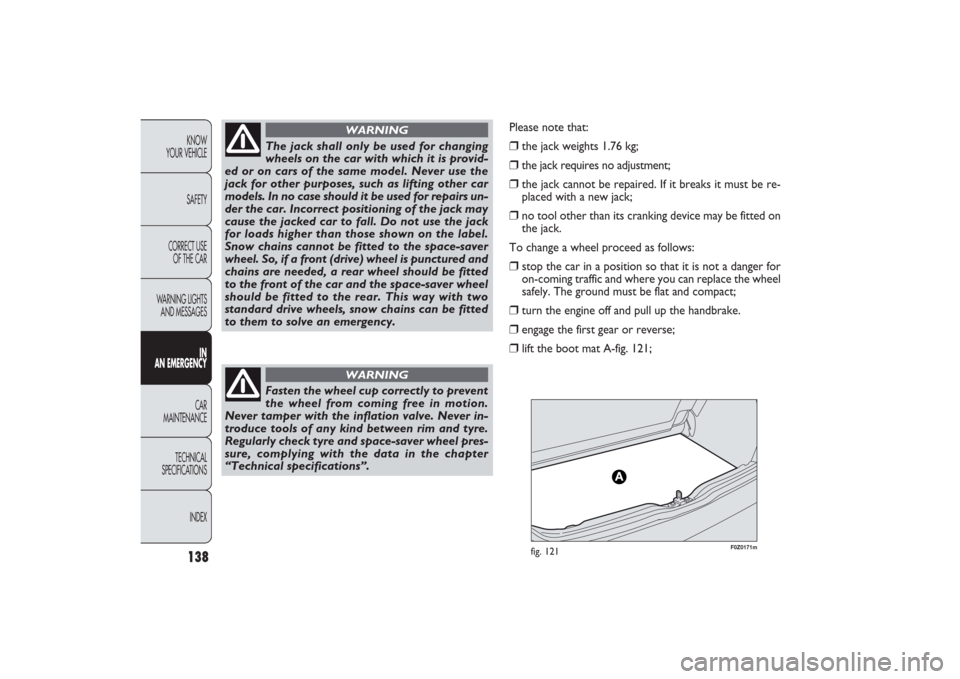
lift the boot mat A-fig. 121;
Fasten the wheel cup correctly to prevent
the wheel from coming free in motion.
Never tamper with the inflation valve. Never in-
troduce tools of any kind between rim and tyre.
Regularly check tyre and space-saver wheel pres-
sure, complying with the data in the chapter
“Technical specifications”.
WARNING
The jack shall only be used for changing
wheels on the car with which it is provid-
ed or on cars of the same model. Never use the
jack for other purposes, such as lifting other car
models. In no case should it be used for repairs un-
der the car. Incorrect positioning of the jack may
cause the jacked car to fall. Do not use the jack
for loads higher than those shown on the label.
Snow chains cannot be fitted to the space-saver
wheel. So, if a front (drive) wheel is punctured and
chains are needed, a rear wheel should be fitted
to the front of the car and the space-saver wheel
should be fitted to the rear. This way with two
standard drive wheels, snow chains can be fitted
to them to solve an emergency.
WARNING
135-168 PANDA EN 7-10-2009 14:06 Pagina 138
Page 140 of 226
139KNOW
YOUR VEHICLE
SAFETY
CORRECT USE
OF THE CAR
WARNING LIGHTS
AND MESSAGESIN
AN EMERGENCYCAR
MAINTENANCE
TECHNICAL
SPECIFICATIONS
INDEX
F0Z0078m
fig. 122
F0Z0695m
fig. 123
❒
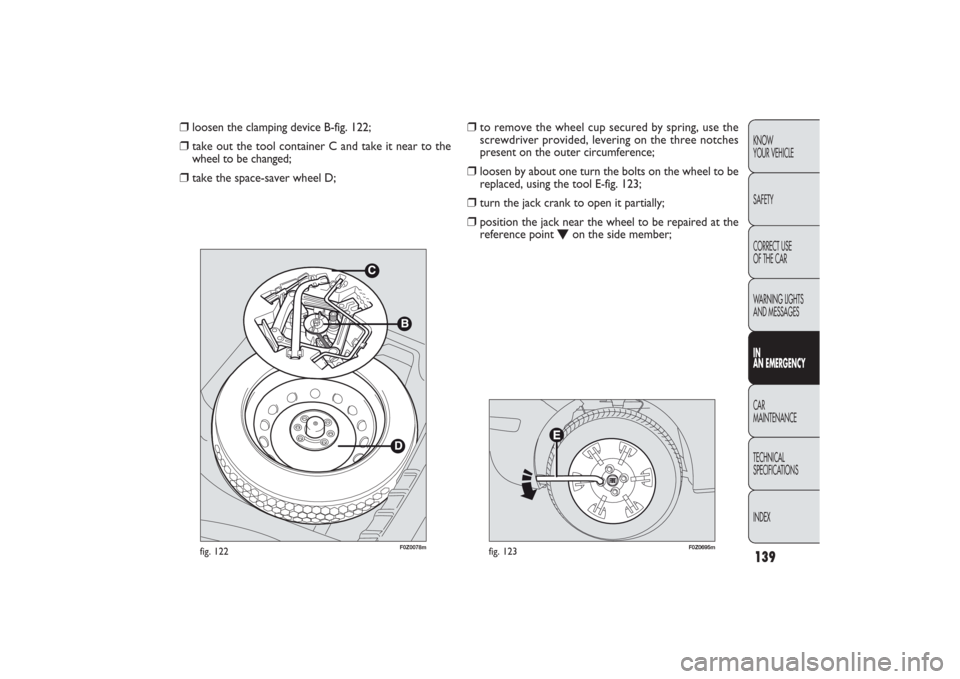
to remove the wheel cup secured by spring, use the
screwdriver provided, levering on the three notches
present on the outer circumference;
❒
loosen by about one turn the bolts on the wheel to be
replaced, using the tool E-fig. 123;
❒
turn the jack crank to open it partially;
❒
position the jack near the wheel to be repaired at the
reference point
O
on the side member;
❒
loosen the clamping device B-fig. 122;
❒
take out the tool container C and take it near to the
wheel to be changed;
❒
take the space-saver wheel D;
135-168 PANDA EN 7-10-2009 14:06 Pagina 139
Page 141 of 226
140KNOW
YOUR VEHICLE
SAFETY
CORRECT USE
OF THE CAR
WARNING LIGHTS
AND MESSAGES
IN
AN EMERGENCYCAR
MAINTENANCE
TECHNICAL
SPECIFICATIONS
INDEX
F0Z0173m
fig. 124
F0Z0233m
fig. 125
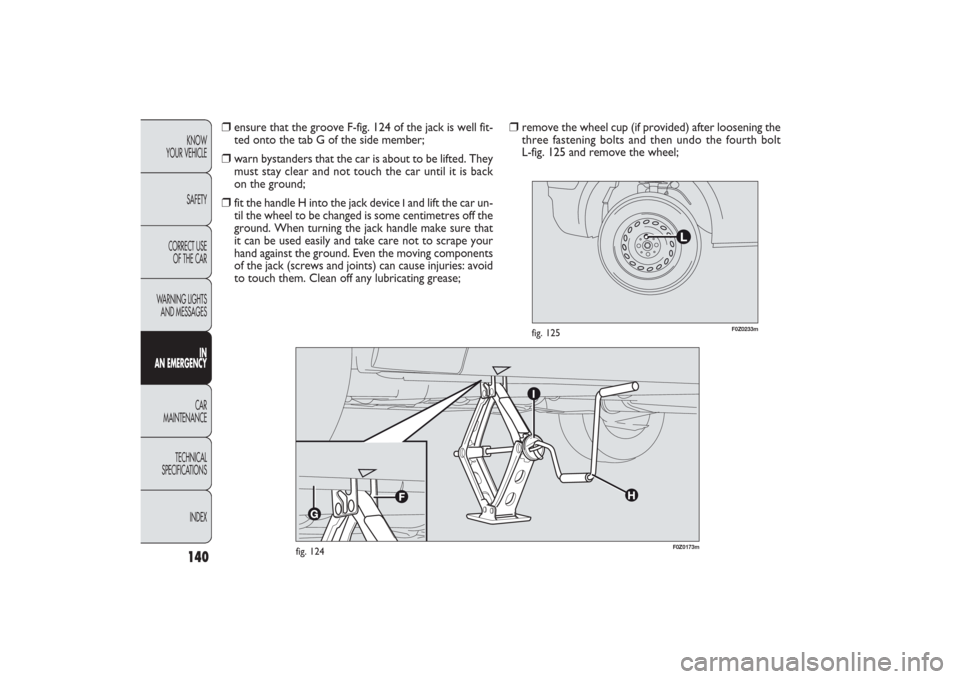
❒
remove the wheel cup (if provided) after loosening the
three fastening bolts and then undo the fourth bolt
L-fig. 125 and remove the wheel;
❒
ensure that the groove F-fig. 124 of the jack is well fit-
ted onto the tab G of the side member;
❒
warn bystanders that the car is about to be lifted. They
must stay clear and not touch the car until it is back
on the ground;
❒
fit the handle H into the jack device
Iand lift the car un-
til the wheel to be changed is some centimetres off the
ground. When turning the jack handle make sure that
it can be used easily and take care not to scrape your
hand against the ground. Even the moving components
of the jack (screws and joints) can cause injuries: avoid
to touch them. Clean off any lubricating grease;
135-168 PANDA EN 7-10-2009 14:06 Pagina 140
Page 142 of 226
141KNOW
YOUR VEHICLE
SAFETY
CORRECT USE
OF THE CAR
WARNING LIGHTS
AND MESSAGESIN
AN EMERGENCYCAR
MAINTENANCE
TECHNICAL
SPECIFICATIONS
INDEX
F0Z0204m
fig. 126
F0Z0206m
fig. 127
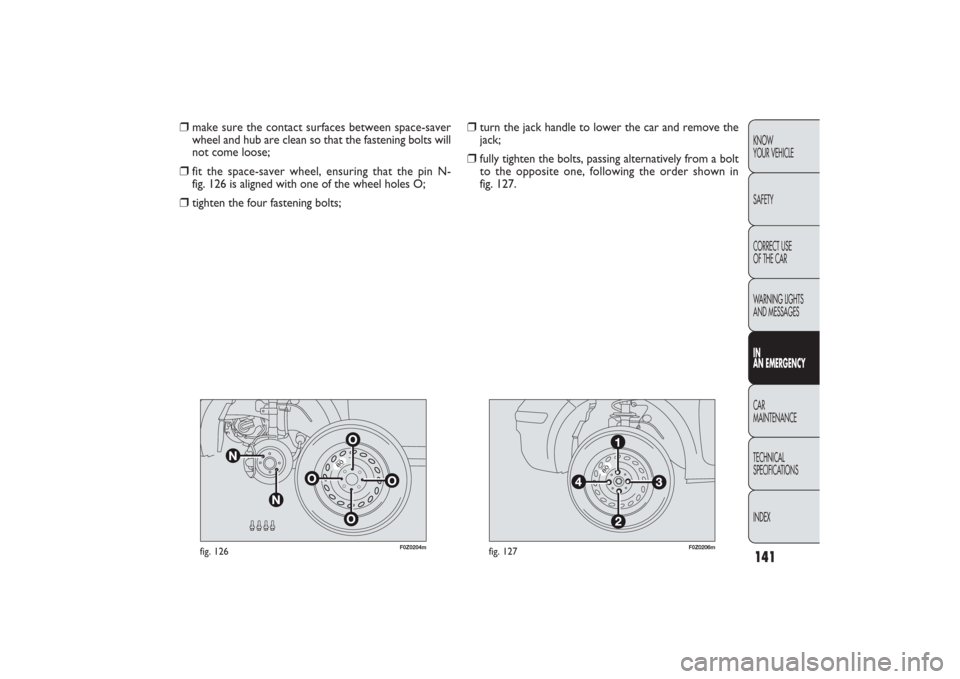
❒
turn the jack handle to lower the car and remove the
jack;
❒
fully tighten the bolts, passing alternatively from a bolt
to the opposite one, following the order shown in
fig. 127.
❒
make sure the contact surfaces between space-saver
wheel and hub are clean so that the fastening bolts will
not come loose;
❒
fit the space-saver wheel, ensuring that the pin N-
fig. 126 is aligned with one of the wheel holes O;
❒
tighten the four fastening bolts;
135-168 PANDA EN 7-10-2009 14:06 Pagina 141