temperature FIAT PANDA 2009 169 / 2.G Owner's Manual
[x] Cancel search | Manufacturer: FIAT, Model Year: 2009, Model line: PANDA, Model: FIAT PANDA 2009 169 / 2.GPages: 226, PDF Size: 5.29 MB
Page 113 of 226
112
KNOW YOUR
VEHICLE
SAFETYCORRECT USE
OF THE CARWARNING LIGHTS
AND MESSAGESI
IN
AN EMERGENCY
CAR
MAINTENANCE
TECHNICAL
SPECIFICATIONS
INDEX
If, when the ignition key is at MAR, warning light
Y
re-
mains lit together with warning light
U
turn the key to
STOP and then back to MAR; if the warning light remains
on, try with the other keys provided with the car.
If you are still unable to start the engine, perform the emer-
gency start-up procedure (see “Emergency start-up” in “In
an emergency” chapter) and contact a Fiat Dealership.
STARTING PROCEDURE FOR DIESEL
VERSIONS
Proceed as follows:
❒
engage the handbrake;
❒
put the gearshifting lever into neutral;
❒
turn the ignition key at MAR: the warning lights
m
and
Y
on the instrument panel will turn on;
❒
wait for the warning lights
Y
and
m
to turn off.
The hotter the engine is, the quicker this will happen;
❒
press the clutch pedal all the way down without touch-
ing the accelerator;
❒
turn the ignition key to AVV as soon as the warning lightm
turns off. Waiting too long will waste the work
done by the glow plugs.
Release the key as soon as the engine starts.
IMPORTANT With cold engine, the accelerator must
be entirely released when turning the ignition key to
position AVV.If the engine does not start at the first attempt, return
the ignition key to STOP before repeating starting.
If, when the ignition key is at MAR, the instrument panel
warning light
Y
remains lit, turn the key to STOP
and then back to MAR; if the warning lights remain on,
try with the other keys provided with the car.
If you still cannot start the engine, contact a Fiat Dealership.
Warning light
m
will flash for 60 seconds
after starting or during prolonged cranking
to indicate a fault to the glow plug heating
system. You can use the car as usual if the engine
starts but you should contact a Fiat Dealership as
soon as possible.
HOW TO WARM UP THE ENGINE AFTER IT
HAS JUST STARTED
Proceed as follows:❒
drive off slowly, letting the engine turn at medium speed.
Do not accelerate abruptly;
❒
do not demand maximum performance for the first few
kilometres. Wait until the engine temperature coolant
gauge starts moving.
111-122 PANDA EN 7-10-2009 15:01 Pagina 112
Page 114 of 226
113KNOW
YOUR VEHICLE
SAFETYCORRECT USE
OF THE CARWARNING LIGHTS
AND MESSAGES
IN
AN EMERGENCY
CAR
MAINTENANCE
TECHNICAL
SPECIFICATIONS
INDEX
F0Z0037m
fig. 116
PARKING THE VEHICLEProceed as follows:❒
stop the engine and engage the handbrake;
❒
engage a gear (on a slope, engage first gear if the vehi-
cle is parked uphill or reverse if it is parked downhill)
and leave the wheels steered.
Block the wheels with a wedge or a stone if the car is
parked on a steep slope.
Do not leave the key in the ignition switch at MAR to pre-
vent draining the battery. Always remove the key when
leaving the car. Never leave children unattended in the car.
Always remove the ignition key when leaving the car
and take it out with you.
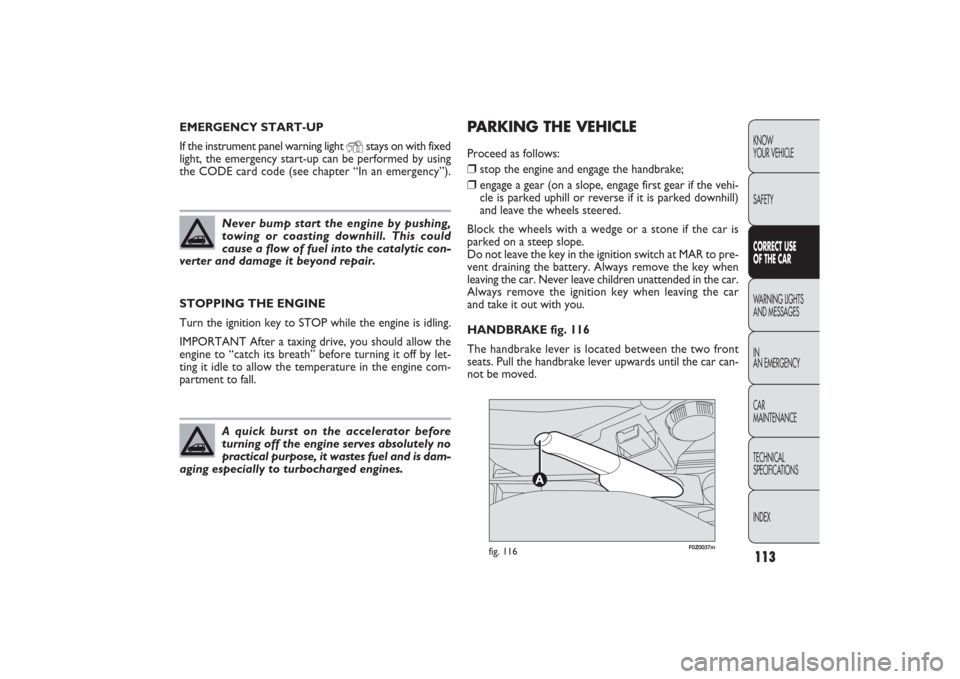
HANDBRAKE fig. 116
The handbrake lever is located between the two front
seats. Pull the handbrake lever upwards until the car can-
not be moved. STOPPING THE ENGINE
Turn the ignition key to STOP while the engine is idling.
IMPORTANT After a taxing drive, you should allow the
engine to “catch its breath” before turning it off by let-
ting it idle to allow the temperature in the engine com-
partment to fall.
Never bump start the engine by pushing,
towing or coasting downhill. This could
cause a flow of fuel into the catalytic con-
verter and damage it beyond repair.A quick burst on the accelerator before
turning off the engine serves absolutely no
practical purpose, it wastes fuel and is dam-
aging especially to turbocharged engines.
EMERGENCY START-UP
If the instrument panel warning light
Y
stays on with fixed
light, the emergency start-up can be performed by using
the CODE card code (see chapter “In an emergency”).
111-122 PANDA EN 7-10-2009 15:01 Pagina 113
Page 117 of 226
116
KNOW YOUR
VEHICLE
SAFETYCORRECT USE
OF THE CARWARNING LIGHTS
AND MESSAGESI
IN
AN EMERGENCY
CAR
MAINTENANCE
TECHNICAL
SPECIFICATIONS
INDEX
clutching is absolutely pointless on modern cars and also
increases consumption and pollution.
Gear selection
As soon as the conditions of the traffic and road allow, use
a higher gear. Using a low gear for faster acceleration will
increase consumption.
In the same way improper use of a high gear increases con-
sumption, emissions an engine wear.
Top speed
Fuel consumption considerably increases with speed.
Avoiding unnecessary braking and acceleration, which cost
in terms of both fuel and emissions.
Acceleration
Accelerating violently increasing the revs will greatly af-
fect consumption and emissions: acceleration should be
gradual.
CONDITIONS OF USE
Cold starting
Short journeys and frequent cold starts will prevent the en-
gine from reaching optimal running temperature. This re-
sults in a significant increase in consumption levels (from
+15 to +30% on the urban cycle) and emission of harmful
substances. Electric devices
Use electric devices only for the amount of time needed.
Rear heated window, additional headlights, windscreen
wipers and heater fan need a considerable amount of en-
ergy, therefore a higher requirement of current involves
and increase of fuel consumption (up to +25% in the
urban cycle).
Climate control system
The climate control system is an additional load which
greatly affects the engine leading to higher consumption
(on average up to +20%): when the temperature outside
the car permits it, use the air vents where possible.
Devices for aerodynamic control
The use of non-certified devices for aerodynamic control
may adversely affect air drag and consumption levels.
DRIVING STYLE
Starting
Do not warm the engine with the car at a standstill or at
idle or high speed: under these conditions the engine
warms up much more slowly, increasing electrical con-
sumption and emissions. It is therefore advisable to move
off immediately, slowly, avoiding high speeds: in this way
the engine will warm faster.
Unnecessary actions
Avoid accelerating when starting at traffic lights or be-
fore switching off the engine. This and also double de-
111-122 PANDA EN 7-10-2009 15:01 Pagina 116
Page 127 of 226
126
KNOW YOUR
VEHICLE
SAFETY
CORRECT USE
OF THE CAR
WARNING LIGHTS
AND MESSAGES
IN
AN EMERGENCY
CAR
MAINTENANCE
TECHNICAL
SPECIFICATIONS
INDEX
CONTINUOUSLY ON: LOW ENGINE
OIL PRESSURE (red)
FLASHING: EXHAUSTED ENGINE OIL
(only Multijet versions with DPF – red)
When the key is turned to MAR the warning light comes
on, but should go out as soon as the engine is started.
Low engine oil pressure
The warning light will turn on constantly together with the
message on the display (for versions/markets where pro-
vided) when the system detects that the engine oil pres-
sure is too low.If the warning light
v
turns on when the
car is travelling (on certain versions to-
gether with the message on the display) stop the
engine immediately and contact a Fiat Dealership.
WARNING
Exhausted engine oil
(Multijet versions with DPF only)
The warning light will turn on flashing together with the
message on the display (for versions/markets where pro-
vided). Depending on the versions, the warning light flash-
ing modes are as follows:
– one minute every two hours;
– cycles of three minutes with intervals with the warning
light off for five seconds until the oil is changed.v
If the warning light comes on, the ex-
hausted engine oil should be changed as
soon as possible, never drive more than 500 km
from the first switching-on of this warning light.
If the above instructions are not complied with,
the engine could be severely damaged and the
warranty may decay. Please note also that the
switching on of this warning light does not depend
on the oil quantity in the engine; when the warn-
ing light flashes, never add oil.
WARNING
After the first indication, at each engine start up the warn-
ing light will continue flashing as above described until the
oil is changed. For those versions/markets where provid-
ed, the display shows a dedicated message together with
the warning light.
The flashing of the warning light should not be consid-
ered as as fault, rather simply informs the customer that
oil needs to be changed after a standard period of car util-
isation.
Remember that the deterioration of the engine oil is ac-
celerated by:
– mainly town use of the car which makes the DPF re-
generation process more frequent;
– use of the car for short journeys, preventing the engine
from reaching operating temperature;
– repeated interruptions to the regeneration process sig-
nalled by the DPF warning light coming on.
123-134 PANDA EN 7-10-2009 13:49 Pagina 126
Page 132 of 226
131KNOW
YOUR VEHICLE
SAFETY
CORRECT USE
OF THE CARWARNING LIGHTS
AND MESSAGESIN
AN EMERGENCY
CAR
MAINTENANCE
TECHNICAL
SPECIFICATIONS
INDEX
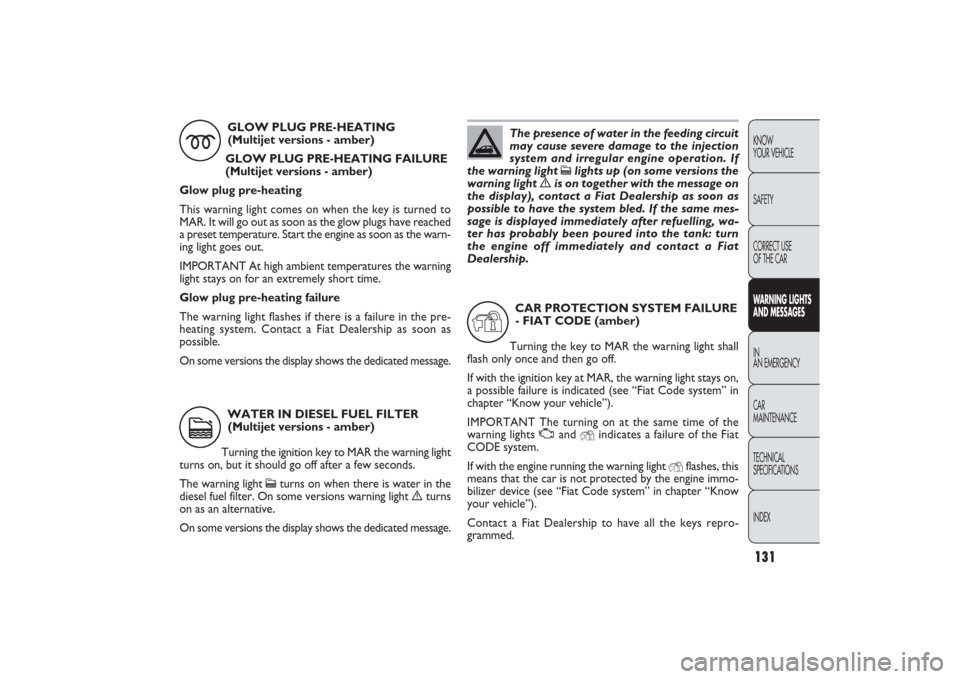
CAR PROTECTION SYSTEM FAILURE
- FIAT CODE (amber)
Turning the key to MAR the warning light shall
flash only once and then go off.
If with the ignition key at MAR, the warning light stays on,
a possible failure is indicated (see “Fiat Code system” in
chapter “Know your vehicle”).
IMPORTANT The turning on at the same time of the
warning lights
U
and
Y
indicates a failure of the Fiat
CODE system.
If with the engine running the warning light
Y
flashes, this
means that the car is not protected by the engine immo-
bilizer device (see “Fiat Code system” in chapter “Know
your vehicle”).
Contact a Fiat Dealership to have all the keys repro-
grammed. WATER IN DIESEL FUEL FILTER
(Multijet versions - amber)
Turning the ignition key to MAR the warning light
turns on, but it should go off after a few seconds.
The warning light
c
turns on when there is water in the
diesel fuel filter. On some versions warning light èturns
on as an alternative.
On some versions the display shows the dedicated message.
The presence of water in the feeding circuit
may cause severe damage to the injection
system and irregular engine operation. If
the warning light
c
lights up (on some versions the
warning light èis on together with the message on
the display), contact a Fiat Dealership as soon as
possible to have the system bled. If the same mes-
sage is displayed immediately after refuelling, wa-
ter has probably been poured into the tank: turn
the engine off immediately and contact a Fiat
Dealership.
c
Y
GLOW PLUG PRE-HEATING
(Multijet versions - amber)
GLOW PLUG PRE-HEATING FAILURE
(Multijet versions - amber)
Glow plug pre-heating
This warning light comes on when the key is turned to
MAR. It will go out as soon as the glow plugs have reached
a preset temperature. Start the engine as soon as the warn-
ing light goes out.
IMPORTANT At high ambient temperatures the warning
light stays on for an extremely short time.
Glow plug pre-heating failure
The warning light flashes if there is a failure in the pre-
heating system. Contact a Fiat Dealership as soon as
possible.
On some versions the display shows the dedicated message.
m
123-134 PANDA EN 7-10-2009 13:49 Pagina 131
Page 135 of 226
134
KNOW YOUR
VEHICLE
SAFETY
CORRECT USE
OF THE CAR
WARNING LIGHTS
AND MESSAGES
IN
AN EMERGENCY
CAR
MAINTENANCE
TECHNICAL
SPECIFICATIONS
INDEX
LIMITED RANGE (versions with reconfigurable
multifunction display)
The display will show the dedicated message to warn the
driver that the driving range is less than 50 km.
ASR SYSTEM (versions with reconfigurable mul-
tifunction display)
The ASR system can be turned off by pressing the button
ASR OFF.
The display will show the dedicated message to warn the
driver that the system is off; at the same time the button
LED will come on.
Pressing again the button ASR OFF, the button LED will
turn off and the display will show the dedicated message
to warn the driver that the system is on again. POSSIBLE PRESENCE OF ICE ON THE ROAD
(versions with reconfigurable multifunction
display)
When the outside temperature reaches or falls below
3 °C the outside temperature indication flashes to warn
the driver about the possible presence of ice on the road.
The display shows the dedicated message.
SPEED LIMIT EXCEEDED
The display will show the dedicated message when the car
exceeds the set speed limit (see “Multifunction Display” in
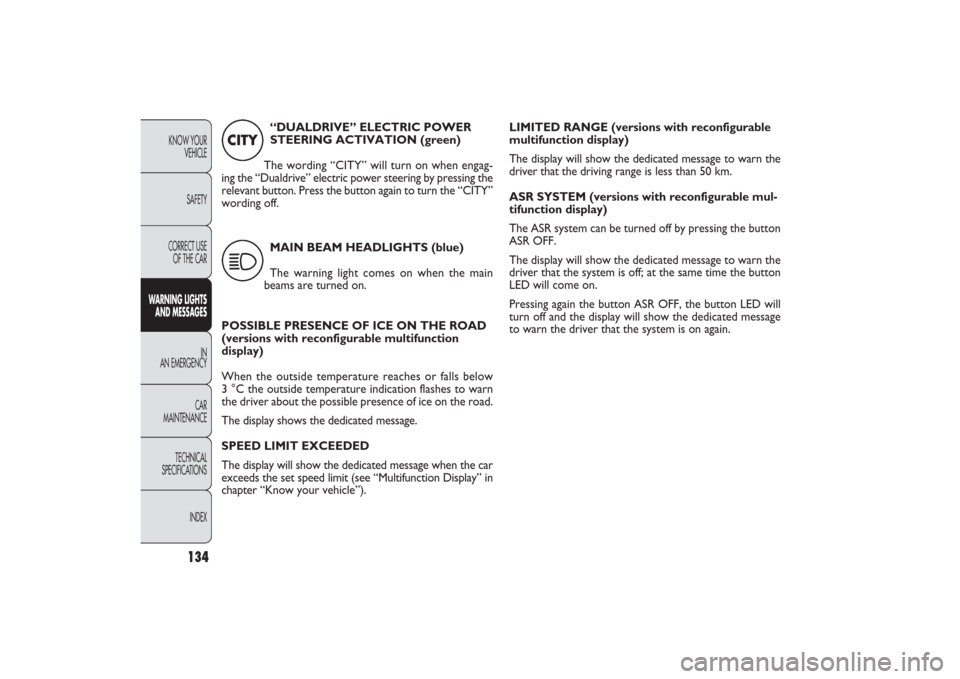
chapter “Know your vehicle”).“DUALDRIVE” ELECTRIC POWER
STEERING ACTIVATION (green)
The wording “CITY” will turn on when engag-
ing the “Dualdrive” electric power steering by pressing the
relevant button. Press the button again to turn the “CITY”
wording off.
MAIN BEAM HEADLIGHTS (blue)
The warning light comes on when the main
beams are turned on.
CITY1
123-134 PANDA EN 7-10-2009 13:49 Pagina 134
Page 146 of 226
145KNOW
YOUR VEHICLE
SAFETY
CORRECT USE
OF THE CAR
WARNING LIGHTS
AND MESSAGESIN
AN EMERGENCYCAR
MAINTENANCE
TECHNICAL
SPECIFICATIONS
INDEX
Tyre side wall holes and punctures cannot
be repaired. Do not use the quick repair
kit if the tyre is damaged as the vehicle has run on
a flat tyre.
WARNING
If the wheel rim is damaged (bad groove
distortion causing air leakage) it cannot
be repaired. Do not remove the foreign body
(screws or nails) from the tyre.
WARNING
PLEASE REMEMBER THAT:
The sealing fluid of the quick tyre repair kit is effective with
external temperatures between −20 °C and +50 °C.
The sealing fluid has a limited life.
Never not operate the compressor for
longer than 20 consecutive minutes. Risk
of overheating. The quick repair kit is not suitable
for definitive repairs. Tyres may only be repaired
temporarily.
WARNING
The bottle contains ethylene glycol. It con-
tains latex that might cause allergic reac-
tions. It is harmful if swallowed. It is irritant for the
eyes in case of contact. It may cause sensitisation
by inhalation or contact. Avoid contact with your
eyes, skin and clothes. In the event of contact, wash
immediately with plenty of water. Do not induce
vomit if swallowed. Rinse your mouth and drink
plenty of water. Call a doctor immediately. Keep
away from children. The product must not be used
by asthmatics. Do not inhale the vapours during in-
sertion and suction. Call a doctor immediately if al-
lergic reactions are noted. Store the bottle in the
specific compartment, away from sources of heat.
The sealant fluid has a limited life.
WARNING
135-168 PANDA EN 7-10-2009 14:07 Pagina 145
Page 150 of 226
149KNOW
YOUR VEHICLE
SAFETY
CORRECT USE
OF THE CAR
WARNING LIGHTS
AND MESSAGESIN
AN EMERGENCYCAR
MAINTENANCE
TECHNICAL
SPECIFICATIONS
INDEX
CHANGING A BULBGENERAL INSTRUCTIONS❒
Before changing a bulb check the contacts for oxidation;
❒
burnt bulbs must be replaced by others of the same type
and power;
❒
always check the headlight beam aiming after changing
a bulb;
❒
when a light is not working, check that the corre-
sponding fuse is intact before changing a bulb. For the
location of fuses, refer to the paragraph “Replacing fus-
es” in this chapter.
Modifications or repairs to the electric sys-
tem that are not carried out properly or
do not take the system technical specifications in-
to account can cause malfunctions leading to the
risk of fire.
WARNING
Halogen bulbs contain gas under pressure;
if they break, glass fragments may be dis-
persed.
WARNING
When handling halogen bulbs, only touch
the metal part. If the transparent bulb is
touched with the fingers, its lighting inten-
sity is reduced and life of the bulb may be com-
promised. In the event of accidental contact, wipe
the bulb with a cloth moistened with alcohol
and leave it to dry.
IMPORTANT The headlight inner surface might be slight-
ly misted: this should not be considered irregular rather
a natural phenomenon due to low temperature and the air
humidity level. Misting will disappear as soon as the head-
lights are turned on. The presence of drops inside the
headlights indicates infiltration of water. Contact a Fiat
Dealership.
Where possible, it is advisable to have bulbs
changed at a Fiat Dealership. The correct
operation and aiming of the outer lights are
absolutely important to the safety of the car and
its passengers and the subject of specific laws about
road traffic.
135-168 PANDA EN 7-10-2009 14:07 Pagina 149
Page 173 of 226
YEARLY INSPECTION SCHEDULEFor cars with an annual mileage of below 20,000 km (for
example about 15,000 km) the following yearly inspec-
tion schedule is advised:❒
check conditions/wear of tyres and adjust pressure if
necessary (including spare wheel);
❒
check lighting system operation (headlights, direction
indicators, hazard warning lights, boot light, passenger’s
compartment, instrument panel warning lights, etc...);
❒
check wiper/washer system operation, adjust nozzles;
❒
check windscreen/rear window blade position/wear;
❒
check front disc brake pad conditions and wear;
❒
check cleanliness of bonnet and boot locks and lever
cleanliness and lubrication;
❒
sight inspect the conditions of: engine, gearbox, trans-
mission, pipes and hoses (exhaust – fuel supply – brak-
ing system) rubber parts (boots – sleeves – bushes etc.),
fuel and brake system hoses;
❒
check battery charge;
❒
visually check the various drive belt conditions;
❒
check and top-up liquids if required (engine coolant,
brakes, windscreen washer, battery, etc.);
❒
change engine oil;
❒
change engine oil filter;
❒
change pollen filter (for versions/markets where pro-
vided).
ADDITIONAL INTERVENTIONSEvery 1,000 km or before long journeys, check and, if nec-
essary, top-up the following:❒
engine coolant fluid level;
❒
brake fluid level;
❒
battery fluid level;
❒
windscreen washer fluid level;
❒
tyre pressure and conditions.
Every 3,000 km check the following and top-up, if required:
❒
engine oil level.
You are recommended to use FL Selenia products de-
signed and produced specifically for Fiat cars (see table
“Capacities” in chapter “Technical specifications”).
IMPORTANT – Engine oil
Should prevailing use of the car be under one of the fol-
lowing specially heavy conditions:
❒
trailer or caravan towing;
❒
dusty roads;
❒
short distances (less than 7–8 km) and with external
temperatures below zero;
INDEX TECHNICAL
SPECIFICATIONSCAR
MAINTENANCEIN
AN EMERGENCY WARNING LIGHTS
AND MESSAGESCORRECT USE
OF THE CARSAFETYKNOW
YOUR VEHICLE
172
169-190 PANDA EN 7-10-2009 14:14 Pagina 172
Page 179 of 226
The engine cooling system is pressurised.
If necessary, only replace the cap with an-
other genuine one or the operation of the system
may be adversely affected. Do not remove the cap
from the reservoir when the engine is hot: dan-
ger of scalding.
WARNING
The engine cooling system uses protective
antifreeze fluid PARAFLU
UP. Use the same
fluid as in the cooling system when topping
up. PARAFLU
UP
fluid cannot be mixed with any oth-
er type of fluid. If this accidentally occurs, do not
start the engine and contact a Fiat Dealership.
Do not travel with the windscreen wash-
er reservoir empty: the windscreen
washer is fundamental for improving visibility.
WARNING
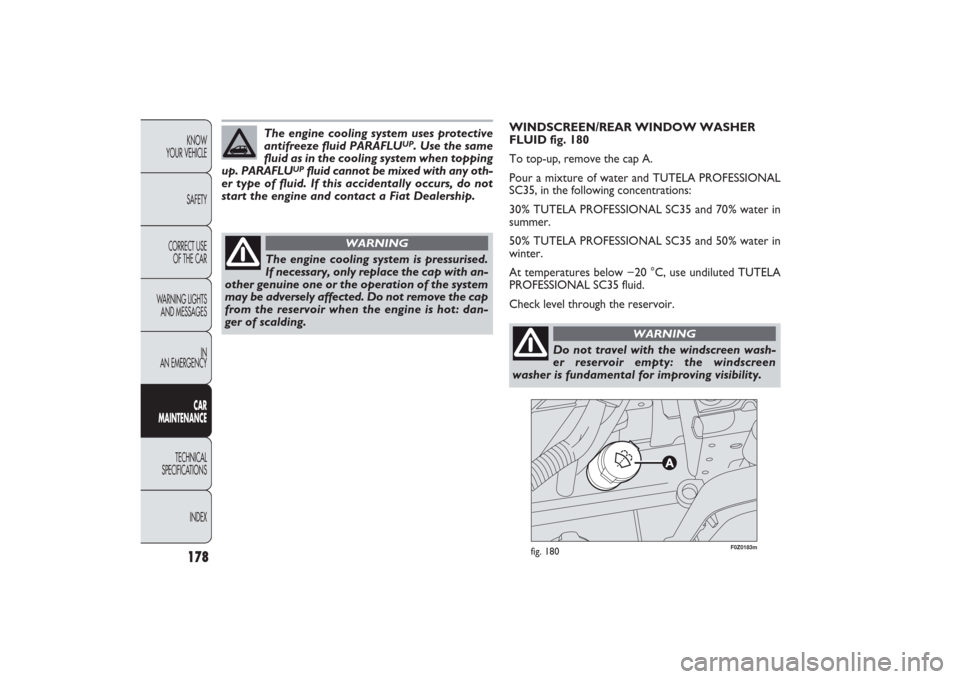
WINDSCREEN/REAR WINDOW WASHER
FLUID fig. 180
To top-up, remove the cap A.
Pour a mixture of water and TUTELA PROFESSIONAL
SC35, in the following concentrations:
30% TUTELA PROFESSIONAL SC35 and 70% water in
summer.
50% TUTELA PROFESSIONAL SC35 and 50% water in
winter.
At temperatures below −20 °C, use undiluted TUTELA
PROFESSIONAL SC35 fluid.
Check level through the reservoir.
fig. 180
F0Z0183m
INDEX TECHNICAL
SPECIFICATIONSCAR
MAINTENANCEIN
AN EMERGENCY WARNING LIGHTS
AND MESSAGESCORRECT USE
OF THE CARSAFETYKNOW
YOUR VEHICLE
178
169-190 PANDA EN 7-10-2009 14:14 Pagina 178