temperature FIAT PANDA 2009 169 / 2.G Owner's Guide
[x] Cancel search | Manufacturer: FIAT, Model Year: 2009, Model line: PANDA, Model: FIAT PANDA 2009 169 / 2.GPages: 226, PDF Size: 5.29 MB
Page 183 of 226
182KNOW
YOUR VEHICLE
SAFETY
CORRECT USE
OF THE CAR
WARNING LIGHTS
AND MESSAGES
IN
AN EMERGENCYCAR
MAINTENANCE
TECHNICAL
SPECIFICATIONS
INDEX
Using the battery when the fluid is too low
can damage it irreparably and generate
a risk of explosion.
WARNING
CHANGING THE BATTERY
If required, replace the battery with a genuine spare part
having the same specifications.
If a battery with different specifications is fitted, the ser-
vice intervals given in the “Scheduled Servicing Pro-
gramme” in this chapter will no longer be valid.
Follow the battery manufacturer’s instructions for main-
tenance.
Incorrect assembly of electric and electronic
devices may cause severe damage to your
car. Contact a Fiat Dealership if you want
to install accessories (alarms, mobile phone, etc...):
they will suggest the most suitable devices and ad-
vise you if a higher capacity battery needs to be
installed.
If the car must remain unused for a long
time at very low temperature, remove the
battery and carry it to a warm place, to avoid
freezing.
WARNING
Batteries contain substances that can be
very dangerous for the environment. It is
advisable to have battery replaced by a
Fiat Dealership where it will be disposed respecting
the environment and according to law prescription.
USEFUL ADVICE FOR EXTENDING
THE LIFE OF YOUR BATTERY
To avoid draining your battery and make it last longer, ob-
serve the following instructions:❒
when you park the car, ensure the doors, tailgate and
bonnet are closed properly, to prevent any light switch-
ing-on inside the passenger’s compartment;
When you must perform any operation on
the battery or near it, always protect your
eyes with the special goggles.
WARNING
169-190 PANDA EN 7-10-2009 14:15 Pagina 182
Page 185 of 226
184KNOW
YOUR VEHICLE
SAFETY
CORRECT USE
OF THE CAR
WARNING LIGHTS
AND MESSAGES
IN
AN EMERGENCYCAR
MAINTENANCE
TECHNICAL
SPECIFICATIONS
INDEX
❒
to allow even wear between the front and rear tyres,
it is advisable to change them over every 10–15 thou-
sand kilometres, keeping them on the same side of the
car so as not to reverse the direction of rotation. The tyres must be replaced when the tread is less than
1.6 mm thick. In all cases, follow the laws in force in the
country where you are driving.
IMPORTANT NOTES
❒
Avoid braking suddenly, burning starts and violent
knocks against curbs, potholes or other obstacles if pos-
sible. Driving for long stretches over bumpy roads can
damage the tyres;
❒
check the tyres regularly for cuts on the sides, swelling
or irregular tread wear. Contact a Fiat Dealership if re-
quired;
❒
avoid overloading the car when travelling: this may cause
serious damage to the wheels and tyres;
❒
if a tyre is punctured, stop the vehicle immediately
and change it to avoid damage to the tyre, the rim, the
suspensions and the steering system;
❒
a tyre will age even if it is not used much. Cracks in
the tread and on the sidewalls are a sign of ageing. Have
the tyres checked by skilled personnel if they have been
fitted for longer than six years. Remember to check
also the space-saver wheel very carefully;
❒
in case of replacement, always fit new tyres, avoiding
those with an unknown origin;
❒
if a tyre is replaced, also change the inflation valve;
Remember that the road holding qualities
of your car also depend on the correct in-
flation pressure of the tyres.
WARNING
If the pressure is too low the tyre will
get overheated, with the risk of serious
damage.
WARNING
Avoid moving the tyres from the right side
of the car to the left side and vice versa.
WARNING
Never submit alloy rims to repainting
treatments requiring to use temperatures
exceeding 150 °C. The mechanical properties of
the wheels could be impaired.
WARNING
169-190 PANDA EN 7-10-2009 14:15 Pagina 184
Page 186 of 226
185KNOW
YOUR VEHICLE
SAFETY
CORRECT USE
OF THE CAR
WARNING LIGHTS
AND MESSAGES
IN
AN EMERGENCYCAR
MAINTENANCETECHNICAL
SPECIFICATIONS
INDEX
WINDSCREEN/REAR WINDOW
WIPER/WASHERBLADES
Periodically clean the rubber part using special products;
TUTELA PROFESSIONAL SC 35 is recommended.
Replace the blades if the rubber edge is deformed or worn.
In all cases, it is advisable to replace them approximately once
a year.
A few simple precautions can reduce the possibility of dam-
age to the blades:❒
make sure that the rubber part is not stuck to the wind-
screen at sub-zero temperatures. Use an antifreeze
product to release it if required;
❒
remove any snow from the glass: in addition to pro-
tecting the blades, this prevents effort on the motor
and overheating;
❒
do not operate the windscreen and the rear screen
wipers on dry glass.
RUBBER HOSESAs far as the brake system and fuel rubber hoses are concerned,
follow the “Scheduled Servicing Programme” in this chapter care-
fully.
Ozone, high temperatures and prolonged lack of fluid in the sys-
tem may cause hardening and cracking of the hoses, with pos-
sible leaks. Careful control is therefore necessary.
Driving with worn wiper blades is a serious
hazard, because visibility is reduced in bad
weather.
WARNING
169-190 PANDA EN 7-10-2009 14:15 Pagina 185
Page 191 of 226
190KNOW
YOUR VEHICLE
SAFETY
CORRECT USE
OF THE CAR
WARNING LIGHTS
AND MESSAGES
IN
AN EMERGENCYCAR
MAINTENANCE
TECHNICAL
SPECIFICATIONS
INDEX
INTERIORSRegularly check that water is not trapped under the mats
(due to water dripping off shoes, umbrellas, etc.), as this
would cause oxidation of the sheet metal.
Never use flammable products, such as
petrol ether or rectified petrol to clean the
car inside. The electrostatic charges which are
generated by rubbing during the cleaning opera-
tion may cause a fire.
WARNING
Do not keep aerosol bottles in the vehicle:
risk of bursting. Aerosol bottles must not
be exposed to a temperature exceeding 50 °C.
When the car is exposed to sunlight, inner tem-
perature can greatly exceed this value.
WARNING
SEATS AND FABRIC PARTS
Remove dust with a soft brush or a vacuum cleaner. It is
advisable to use a moist brush on velvet upholstery.
Rub the seats with a sponge moistened with a solution of
water and neutral detergent.
INTERIOR PLASTIC PARTS
It is advisable to clean interior parts with a moist cloth and
a solution of water and mild soap. Use specific products
for cleaning plastic, without solvents and specifically de-
signed to prevent damage to the appearance and colour
of the treated parts to remove grease and tough stains.
IMPORTANT Never use alcohol or petroleum to clean
the instrument panel.
CLEANING SEAT PROTECTORS
In order to clean/remove stains from the
seat protectors, it is not advisable to use
alcohol or alcohol based products (e.g. solvents).
WARNING
169-190 PANDA EN 7-10-2009 14:15 Pagina 190
Page 218 of 226
217KNOW
YOUR VEHICLE
SAFETY
CORRECT USE
OF THE CAR
WARNING LIGHTS
AND MESSAGES
IN
AN EMERGENCY
CAR
MAINTENANCE
TECHNICAL
SPECIFICATIONSINDEX
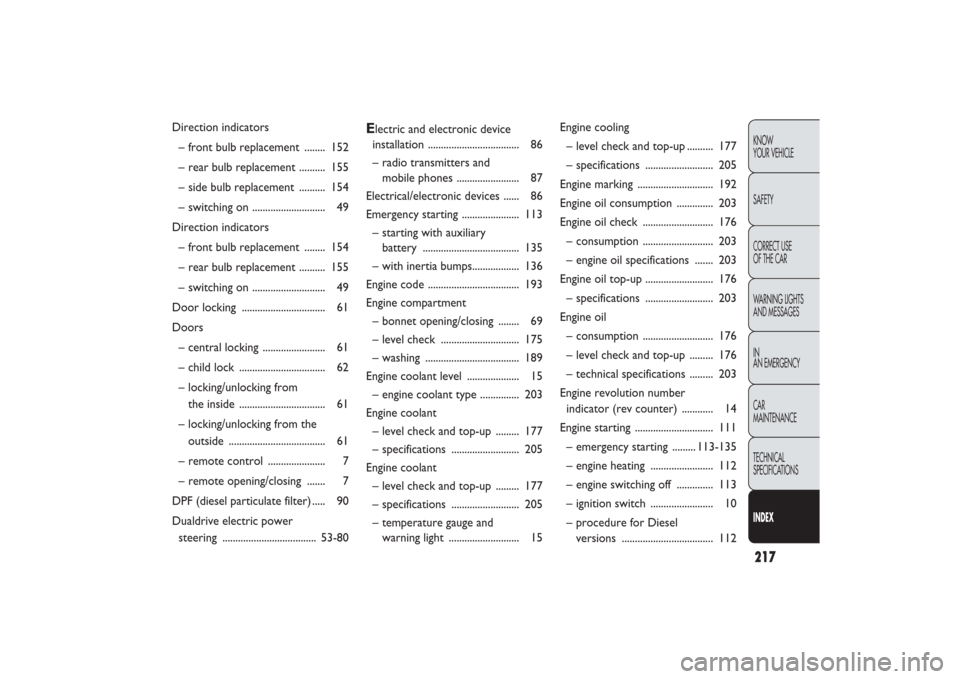
Electric and electronic device
installation ................................... 86
– radio transmitters and
mobile phones ........................ 87
Electrical/electronic devices ...... 86
Emergency starting ...................... 113
– starting with auxiliary
battery ..................................... 135
– with inertia bumps.................. 136
Engine code ................................... 193
Engine compartment
– bonnet opening/closing ........ 69
– level check .............................. 175
– washing .................................... 189
Engine coolant level .................... 15
– engine coolant type ............... 203
Engine coolant
– level check and top-up ......... 177
– specifications .......................... 205
Engine coolant
– level check and top-up ......... 177
– specifications .......................... 205
– temperature gauge and
warning light ........................... 15Engine cooling
– level check and top-up .......... 177
– specifications .......................... 205
Engine marking ............................. 192
Engine oil consumption .............. 203
Engine oil check ........................... 176
– consumption ........................... 203
– engine oil specifications ....... 203
Engine oil top-up .......................... 176
– specifications .......................... 203
Engine oil
– consumption ........................... 176
– level check and top-up ......... 176
– technical specifications ......... 203
Engine revolution number
indicator (rev counter) ............ 14
Engine starting .............................. 111
– emergency starting ......... 113-135
– engine heating ........................ 112
– engine switching off .............. 113
– ignition switch ........................ 10
– procedure for Diesel
versions ................................... 112 Direction indicators
– front bulb replacement ........ 152
– rear bulb replacement .......... 155
– side bulb replacement .......... 154
– switching on ............................ 49
Direction indicators
– front bulb replacement ........ 154
– rear bulb replacement .......... 155
– switching on ............................ 49
Door locking ................................ 61
Doors
– central locking ........................ 61
– child lock ................................. 62
– locking/unlocking from
the inside ................................. 61
– locking/unlocking from the
outside ..................................... 61
– remote control ...................... 7
– remote opening/closing ....... 7
DPF (diesel particulate filter) ..... 90
Dualdrive electric power
steering .................................... 53-80
215-224 PANDA EN 7-10-2009 15:09 Pagina 217
Page 224 of 226
223KNOW
YOUR VEHICLE
SAFETY
CORRECT USE
OF THE CAR
WARNING LIGHTS
AND MESSAGES
IN
AN EMERGENCY
CAR
MAINTENANCE
TECHNICAL
SPECIFICATIONSINDEX
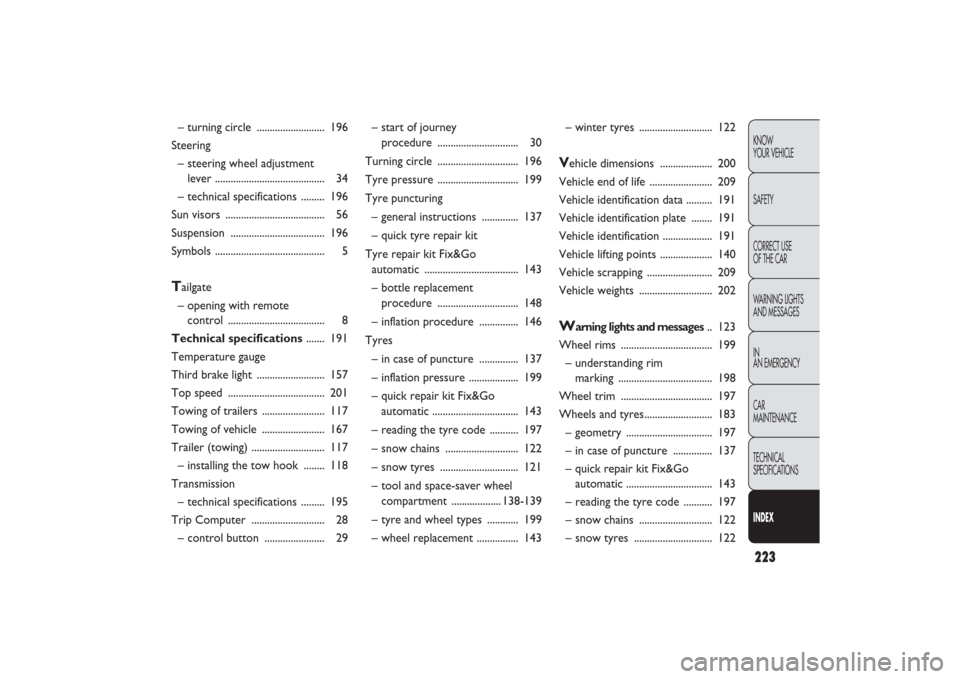
– turning circle .......................... 196
Steering
– steering wheel adjustment
lever .......................................... 34
– technical specifications ......... 196
Sun visors ...................................... 56
Suspension .................................... 196
Symbols .......................................... 5Tailgate
– opening with remote
control ..................................... 8
Technical specifications....... 191
Temperature gauge
Third brake light .......................... 157
Top speed ..................................... 201
Towing of trailers ........................ 117
Towing of vehicle ........................ 167
Trailer (towing) ............................ 117
– installing the tow hook ........ 118
Transmission
– technical specifications ......... 195
Trip Computer ............................ 28
– control button ....................... 29– start of journey
procedure ............................... 30
Turning circle ............................... 196
Tyre pressure ............................... 199
Tyre puncturing
– general instructions .............. 137
– quick tyre repair kit
Tyre repair kit Fix&Go
automatic .................................... 143
– bottle replacement
procedure ............................... 148
– inflation procedure ............... 146
Tyres
– in case of puncture ............... 137
– inflation pressure ................... 199
– quick repair kit Fix&Go
automatic ................................. 143
– reading the tyre code ........... 197
– snow chains ............................ 122
– snow tyres .............................. 121
– tool and space-saver wheel
compartment ................... 138-139
– tyre and wheel types ............ 199
– wheel replacement ................ 143– winter tyres ............................ 122
Vehicle dimensions .................... 200
Vehicle end of life ........................ 209
Vehicle identification data .......... 191
Vehicle identification plate ........ 191
Vehicle identification ................... 191
Vehicle lifting points .................... 140
Vehicle scrapping ......................... 209
Vehicle weights ............................ 202W
arning lights and messages
.. 123
Wheel rims ................................... 199
– understanding rim
marking .................................... 198
Wheel trim ................................... 197
Wheels and tyres.......................... 183
– geometry ................................. 197
– in case of puncture ............... 137
– quick repair kit Fix&Go
automatic ................................. 143
– reading the tyre code ........... 197
– snow chains ............................ 122
– snow tyres .............................. 122
215-224 PANDA EN 7-10-2009 15:09 Pagina 223