eco FIAT PANDA 2009 169 / 2.G Workshop Manual
[x] Cancel search | Manufacturer: FIAT, Model Year: 2009, Model line: PANDA, Model: FIAT PANDA 2009 169 / 2.GPages: 226, PDF Size: 5.29 MB
Page 136 of 226
135KNOW
YOUR VEHICLE
SAFETY
WARNING LIGHTS
AND MESSAGESIN
AN EMERGENCYCAR
MAINTENANCE
TECHNICAL
SPECIFICATIONS
INDEX
IN AN EMERGENCY
STARTING THE ENGINEEMERGENCY START-UP
If the Fiat CODE system fails to deactivate engine immo-
bilising system the instrument panel warning lights
Y
and
U
stay on and the engine cannot be started.
To start the engine the emergency start-up can be per-
formed.
Read the whole procedure carefully before trying to car-
ry it out: if you make a mistake, you need to turn the ig-
nition key back to STOP and repeat the whole operation
from the beginning.
Proceed as follows:
❒
read the five-digit electronic code from the CODE card;
❒
turn the ignition key to MAR;
❒
press and hold down the accelerator pedal: the warn-
ing light
U
turns on for about 8 seconds, and then goes
off;
❒
release the accelerator pedal and count the flashes of
the warning light
U
;
❒
count the number of flashes that corresponds to the
first digit of the code on the CODE card, then press the
accelerator pedal and hold it there until the warning
light
U
comes on (for 4 seconds) and then goes off. Re-
lease the accelerator pedal;
CORRECT USE
OF THE CAR
❒
the warning light
U
will start flashing again: after it has
flashed the number of times corresponding to the
second digit on the CODE card, fully depress the ac-
celerator pedal and hold it there;
❒
do the same for the remaining digits on the CODE card;
❒
once the last digit has been entered, hold the acceler-
ator pedal pressed. The warning light
U
will light up for
four seconds and then go out. Release the accelerator
pedal;
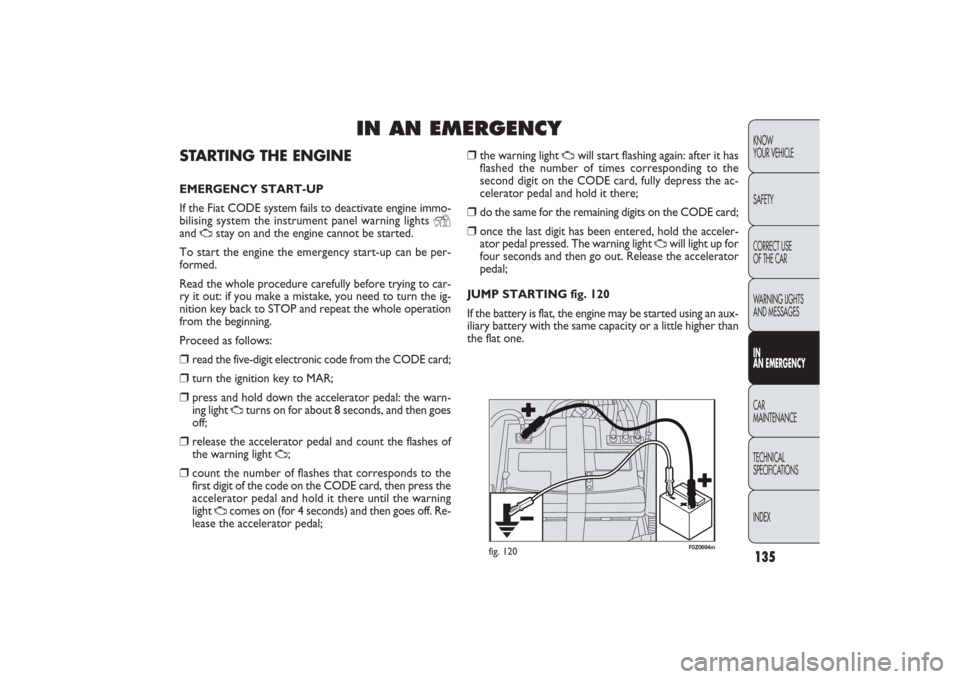
JUMP STARTING fig. 120
If the battery is flat, the engine may be started using an aux-
iliary battery with the same capacity or a little higher than
the flat one.
F0Z0694m
fig. 120
135-168 PANDA EN 7-10-2009 14:06 Pagina 135
Page 137 of 226
136KNOW
YOUR VEHICLE
SAFETY
CORRECT USE
OF THE CAR
WARNING LIGHTS
AND MESSAGES
IN
AN EMERGENCYCAR
MAINTENANCE
TECHNICAL
SPECIFICATIONS
INDEX
Never use a fast battery-charger to start the
engine as this could damage the electron-
ic systems of your car, particularly the ig-
nition and fuel supply control units.This procedure must be performed by qual-
ified personnel as incorrect actions may
cause high-intensity electrical discharge. Further-
more, battery fluid is poisonous and corrosive: avoid
contact with your skin and eyes. Keep naked flames
away from the battery. No smoking. Do not cause
sparks.
WARNING
If after a few attempts the engine does not start, do not
insist rather contact the nearest Fiat Dealership.
IMPORTANT Do not directly connect the negative ter-
minals of the two batteries: any sparks may ignite the det-
onating gas which could come out of the battery. If the aux-
iliary battery is installed on another car, prevent any contact
between metal parts of the cars and the flat battery.
BUMP STARTING
Never bump start the engine by pushing, towing or driving
downhill.
This could cause a flow of fuel into the catalytic convert-
er and damage it beyond repair.
IMPORTANT Remember that the servo-brake and elec-
trical power steering system (for versions/markets where
provided) are not operating until the engine is started, a
greater effort will therefore be required to press the brake
pedal or turn the steering wheel. Proceed as follows to start the car:
❒
connect the positive terminals (+ sign close to the ter-
minal) of both batteries using a lead;
❒
with a second lead, connect the negative terminal − of
the auxiliary battery to an earthing point
E
on the en-
gine or the gearbox of the car to be started;
❒
start the engine;
❒
when the engine has been started, follow the sequence
above in reverse order to remove the leads.
135-168 PANDA EN 7-10-2009 14:06 Pagina 136
Page 161 of 226
160KNOW
YOUR VEHICLE
SAFETY
CORRECT USE
OF THE CAR
WARNING LIGHTS
AND MESSAGES
IN
AN EMERGENCYCAR
MAINTENANCE
TECHNICAL
SPECIFICATIONS
INDEX
F0Z0087m
fig. 165
Refer to the tables on the following pages to identify the
protection fuse.
If a general fuse (MEGA-FUSE, MIDI-
FUSE, MAXI-FUSE) cuts in, do not at-
tempt any repair and contact a Fiat Dealership.
WARNING
Before replacing a fuse, make sure the ig-
nition key has been removed and that all
the other services are switched off and/or
disengaged.If the replaced fuse blows again, contact
a Fiat Dealership.
WARNING
Never replace a blown fuse with metal
wires or other recovered material.
WARNING
Never replace a fuse with another of high-
er power: FIRE HAZARD.
WARNING
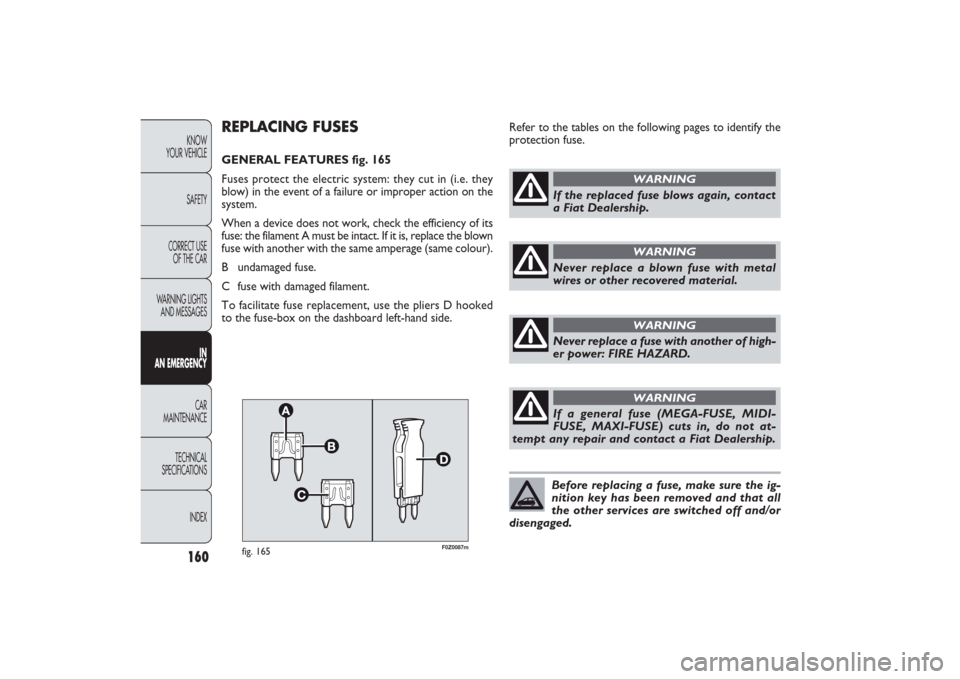
REPLACING FUSESGENERAL FEATURES fig. 165
Fuses protect the electric system: they cut in (i.e. they
blow) in the event of a failure or improper action on the
system.
When a device does not work, check the efficiency of its
fuse: the filament A must be intact. If it is, replace the blown
fuse with another with the same amperage (same colour).
B undamaged fuse.
C fuse with damaged filament.
To facilitate fuse replacement, use the pliers D hooked
to the fuse-box on the dashboard left-hand side.
135-168 PANDA EN 7-10-2009 14:07 Pagina 160
Page 163 of 226
162KNOW
YOUR VEHICLE
SAFETY
CORRECT USE
OF THE CAR
WARNING LIGHTS
AND MESSAGES
IN
AN EMERGENCYCAR
MAINTENANCE
TECHNICAL
SPECIFICATIONS
INDEX
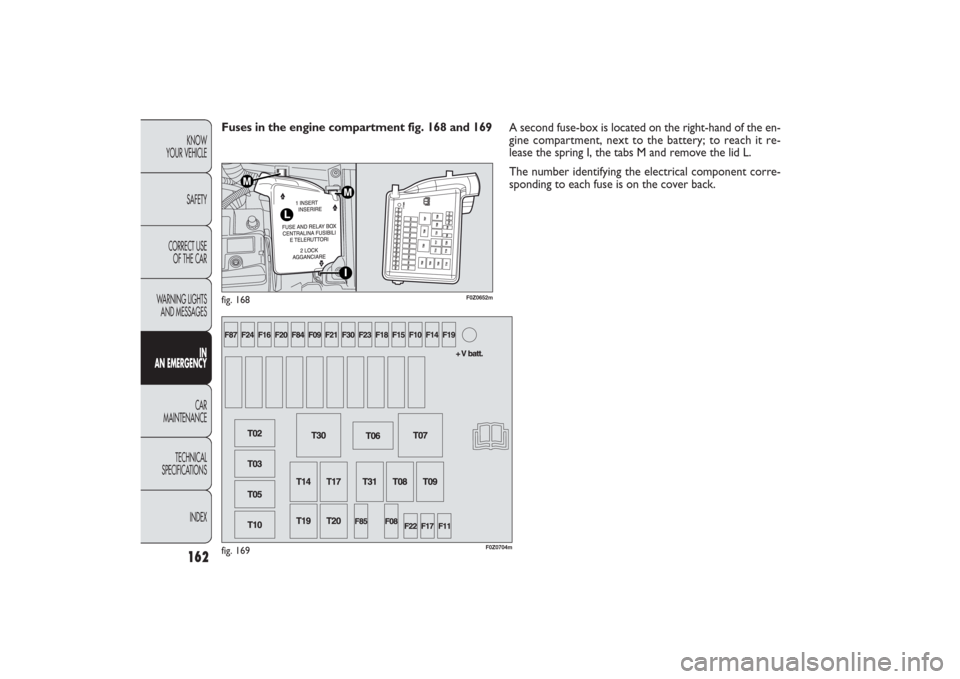
A second fuse-box is located on the right-hand of the en-
gine compartment, next to the battery; to reach it re-
lease the spring I, the tabs M and remove the lid L.
The number identifying the electrical component corre-
sponding to each fuse is on the cover back.
fig. 168
fig. 169
F0Z0652m
F0Z0704m
Fuses in the engine compartment fig. 168 and 169
135-168 PANDA EN 7-10-2009 14:07 Pagina 162
Page 165 of 226
164KNOW
YOUR VEHICLE
SAFETY
CORRECT USE
OF THE CAR
WARNING LIGHTS
AND MESSAGES
IN
AN EMERGENCYCAR
MAINTENANCE
TECHNICAL
SPECIFICATIONS
INDEX
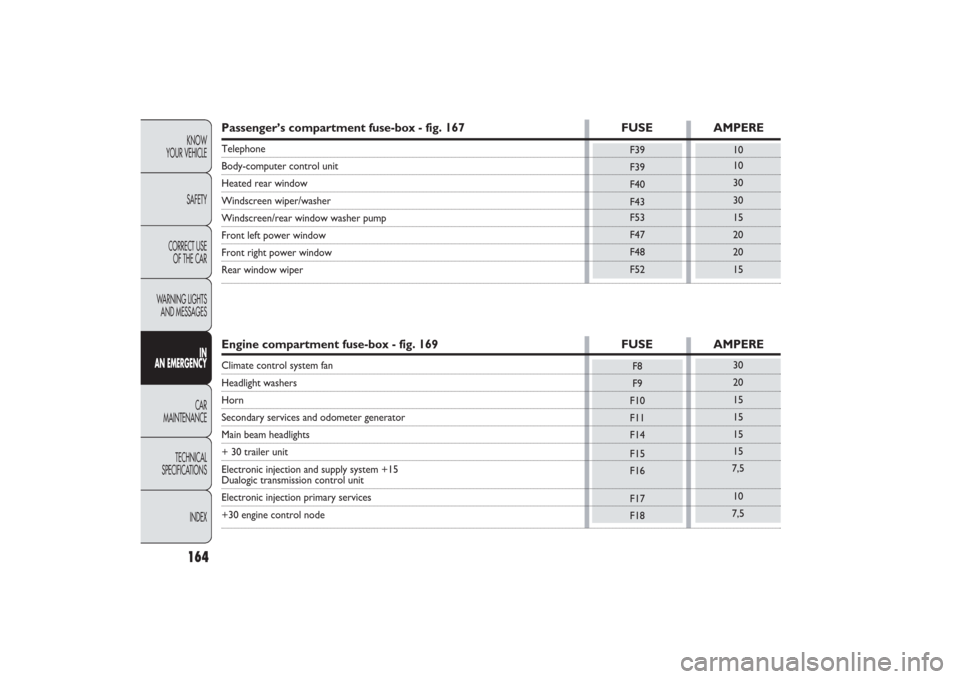
10
10
30
30
15
20
20
15
F39
F39
F40
F43
F53
F47
F48
F52
Passenger’s compartment fuse-box - fig. 167 FUSE AMPERETelephoneBody-computer control unitHeated rear windowWindscreen wiper/washerWindscreen/rear window washer pumpFront left power windowFront right power windowRear window wiper
30
20
15
15
15
15
7,5
10
7,5
F8
F9
F10
F11
F14
F15
F16
F17
F18
Engine compartment fuse-box - fig. 169 FUSE AMPEREClimate control system fanHeadlight washersHornSecondary services and odometer generatorMain beam headlights+ 30 trailer unit
Electronic injection and supply system +15 Dualogic transmission control unitElectronic injection primary services+30 engine control node
135-168 PANDA EN 7-10-2009 14:07 Pagina 164
Page 167 of 226
166KNOW
YOUR VEHICLE
SAFETY
CORRECT USE
OF THE CAR
WARNING LIGHTS
AND MESSAGES
IN
AN EMERGENCYCAR
MAINTENANCE
TECHNICAL
SPECIFICATIONS
INDEX
BATTERY RECHARGINGIMPORTANT Battery recharging procedure is given as in-
formation only. This operation shall be performed at a Fiat
Dealership .
Charging should be slow at a low ampere rating for ap-
proximately 24 hours. Charging for a longer time may dam-
age the battery.
Charge the battery as follows:❒
disconnect the battery negative terminal;
❒
connect the charger cables to the battery terminals, ob-
serving the poles;
❒
turn on the battery charger;
❒
after recharging, turn the battery charger off before dis-
connecting the battery itself;
❒
reconnect the battery negative terminal.
Battery fluid is poisonous and corrosive:
avoid contact with your skin and eyes. The
battery should be charged in a well ventilated
place, away from naked flames or possible sources
of sparks: danger of explosion and fire.
WARNING
Do not attempt to charge a frozen bat-
tery: it must firstly be thawed, otherwise
it may burst. If the battery was frozen, have it in-
spected by skilled personnel before recharging to
check that the internal elements are not damaged
and that the casing is not cracked, which causes
the risk of leakage of poisonous, corrosive acid.
WARNING
135-168 PANDA EN 7-10-2009 14:07 Pagina 166
Page 173 of 226
YEARLY INSPECTION SCHEDULEFor cars with an annual mileage of below 20,000 km (for
example about 15,000 km) the following yearly inspec-
tion schedule is advised:❒
check conditions/wear of tyres and adjust pressure if
necessary (including spare wheel);
❒
check lighting system operation (headlights, direction
indicators, hazard warning lights, boot light, passenger’s
compartment, instrument panel warning lights, etc...);
❒
check wiper/washer system operation, adjust nozzles;
❒
check windscreen/rear window blade position/wear;
❒
check front disc brake pad conditions and wear;
❒
check cleanliness of bonnet and boot locks and lever
cleanliness and lubrication;
❒
sight inspect the conditions of: engine, gearbox, trans-
mission, pipes and hoses (exhaust – fuel supply – brak-
ing system) rubber parts (boots – sleeves – bushes etc.),
fuel and brake system hoses;
❒
check battery charge;
❒
visually check the various drive belt conditions;
❒
check and top-up liquids if required (engine coolant,
brakes, windscreen washer, battery, etc.);
❒
change engine oil;
❒
change engine oil filter;
❒
change pollen filter (for versions/markets where pro-
vided).
ADDITIONAL INTERVENTIONSEvery 1,000 km or before long journeys, check and, if nec-
essary, top-up the following:❒
engine coolant fluid level;
❒
brake fluid level;
❒
battery fluid level;
❒
windscreen washer fluid level;
❒
tyre pressure and conditions.
Every 3,000 km check the following and top-up, if required:
❒
engine oil level.
You are recommended to use FL Selenia products de-
signed and produced specifically for Fiat cars (see table
“Capacities” in chapter “Technical specifications”).
IMPORTANT – Engine oil
Should prevailing use of the car be under one of the fol-
lowing specially heavy conditions:
❒
trailer or caravan towing;
❒
dusty roads;
❒
short distances (less than 7–8 km) and with external
temperatures below zero;
INDEX TECHNICAL
SPECIFICATIONSCAR
MAINTENANCEIN
AN EMERGENCY WARNING LIGHTS
AND MESSAGESCORRECT USE
OF THE CARSAFETYKNOW
YOUR VEHICLE
172
169-190 PANDA EN 7-10-2009 14:14 Pagina 172
Page 177 of 226
176KNOW
YOUR VEHICLE
SAFETY
CORRECT USE
OF THE CAR
WARNING LIGHTS
AND MESSAGES
IN
AN EMERGENCYCAR
MAINTENANCE
TECHNICAL
SPECIFICATIONS
INDEX
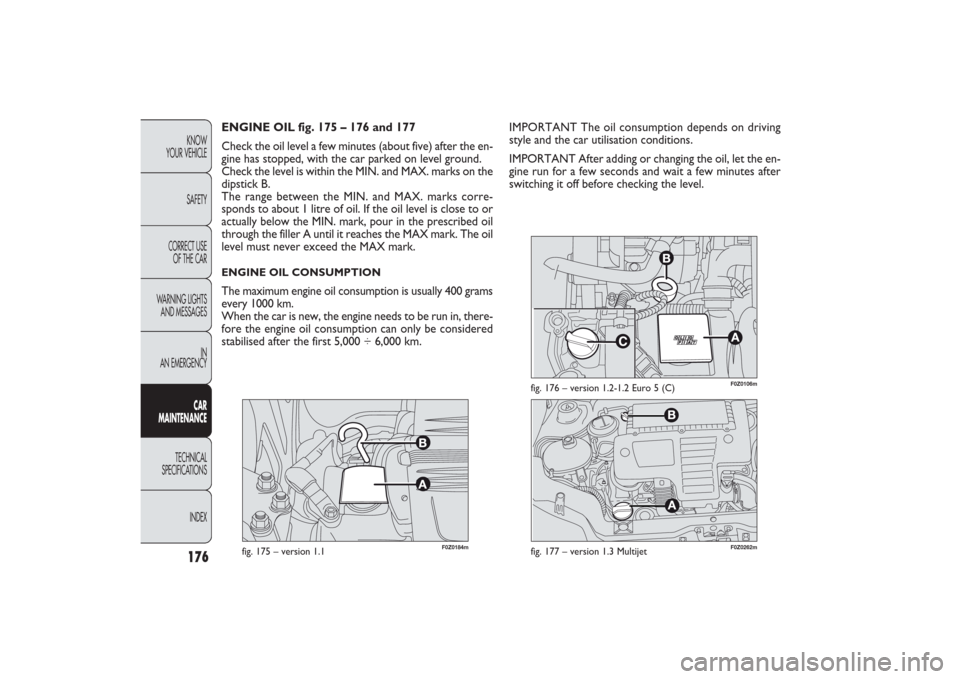
F0Z0184m
fig. 175 – version 1.1
F0Z0262m
fig. 177 – version 1.3 Multijet
F0Z0106m
fig. 176 – version 1.2-1.2 Euro 5 (C)
IMPORTANT The oil consumption depends on driving
style and the car utilisation conditions.
IMPORTANT After adding or changing the oil, let the en-
gine run for a few seconds and wait a few minutes after
switching it off before checking the level. ENGINE OIL fig. 175 – 176 and 177
Check the oil level a few minutes (about five) after the en-
gine has stopped, with the car parked on level ground.
Check the level is within the MIN. and MAX. marks on the
dipstick B.
The range between the MIN. and MAX. marks corre-
sponds to about 1 litre of oil. If the oil level is close to or
actually below the MIN. mark, pour in the prescribed oil
through the filler A until it reaches the MAX mark. The oil
level must never exceed the MAX mark.
ENGINE OIL CONSUMPTIONThe maximum engine oil consumption is usually 400 grams
every 1000 km.
When the car is new, the engine needs to be run in, there-
fore the engine oil consumption can only be considered
stabilised after the first 5,000 ÷ 6,000 km.
169-190 PANDA EN 7-10-2009 14:14 Pagina 176
Page 178 of 226
177KNOW
YOUR VEHICLE
SAFETY
CORRECT USE
OF THE CAR
WARNING LIGHTS
AND MESSAGES
IN
AN EMERGENCYCAR
MAINTENANCETECHNICAL
SPECIFICATIONS
INDEX
F0Z0182m
fig. 179
F0Z0107m
fig. 178
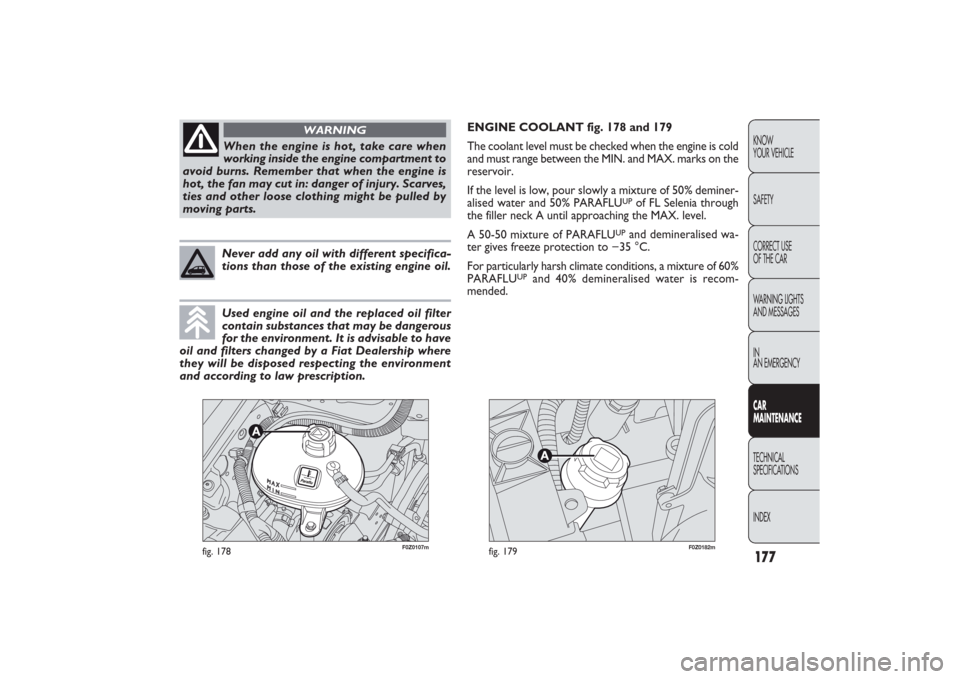
ENGINE COOLANT fig. 178 and 179
The coolant level must be checked when the engine is cold
and must range between the MIN. and MAX. marks on the
reservoir.
If the level is low, pour slowly a mixture of 50% deminer-
alised water and 50% PARAFLU
UP
of FL Selenia through
the filler neck A until approaching the MAX. level.
A 50-50 mixture of PARAFLU
UP
and demineralised wa-
ter gives freeze protection to −35 °C.
For particularly harsh climate conditions, a mixture of 60%
PARAFLU
UP
and 40% demineralised water is recom-
mended.
When the engine is hot, take care when
working inside the engine compartment to
avoid burns. Remember that when the engine is
hot, the fan may cut in: danger of injury. Scarves,
ties and other loose clothing might be pulled by
moving parts.
WARNING
Never add any oil with different specifica-
tions than those of the existing engine oil. Used engine oil and the replaced oil filter
contain substances that may be dangerous
for the environment. It is advisable to have
oil and filters changed by a Fiat Dealership where
they will be disposed respecting the environment
and according to law prescription.
169-190 PANDA EN 7-10-2009 14:14 Pagina 177
Page 186 of 226
185KNOW
YOUR VEHICLE
SAFETY
CORRECT USE
OF THE CAR
WARNING LIGHTS
AND MESSAGES
IN
AN EMERGENCYCAR
MAINTENANCETECHNICAL
SPECIFICATIONS
INDEX
WINDSCREEN/REAR WINDOW
WIPER/WASHERBLADES
Periodically clean the rubber part using special products;
TUTELA PROFESSIONAL SC 35 is recommended.
Replace the blades if the rubber edge is deformed or worn.
In all cases, it is advisable to replace them approximately once
a year.
A few simple precautions can reduce the possibility of dam-
age to the blades:❒
make sure that the rubber part is not stuck to the wind-
screen at sub-zero temperatures. Use an antifreeze
product to release it if required;
❒
remove any snow from the glass: in addition to pro-
tecting the blades, this prevents effort on the motor
and overheating;
❒
do not operate the windscreen and the rear screen
wipers on dry glass.
RUBBER HOSESAs far as the brake system and fuel rubber hoses are concerned,
follow the “Scheduled Servicing Programme” in this chapter care-
fully.
Ozone, high temperatures and prolonged lack of fluid in the sys-
tem may cause hardening and cracking of the hoses, with pos-
sible leaks. Careful control is therefore necessary.
Driving with worn wiper blades is a serious
hazard, because visibility is reduced in bad
weather.
WARNING
169-190 PANDA EN 7-10-2009 14:15 Pagina 185