time FIAT PUNTO EVO 2010 1.G Workshop Manual
[x] Cancel search | Manufacturer: FIAT, Model Year: 2010, Model line: PUNTO EVO, Model: FIAT PUNTO EVO 2010 1.GPages: 270, PDF Size: 8.34 MB
Page 129 of 270
128
KNOWING
YOUR
VEHICLE
SAFETY
STARTING
AND DRIVING
WARNING LIGHTS
AND MESSAGES
IN AN
EMERGENCY
SERVICING
AND CARE
TECHNICAL
SPECIFICATIONS
CONTENTS
DIESEL PARTICULATE FILTER (DPF)
(for versions/markets where provided)
The Diesel Particulate Filter is a mechanical filter, inte-
gral to the exhaust system, that physically traps particu-
lates present in the exhaust gases of diesel engines.
It is needed to eliminate almost all particulates in compli-
ance with current/future legislation.
During normal use of the vehicle, the engine control unit
records a set of data (e.g. travel time, type of route, tem-
peratures, etc.) and it will then calculate how much par-
ticulate has been trapped by the filter.
Since this filter physically traps particulate, it should be re-
generated (cleaned) at regular intervals by burning the car-
bon particles.
The regeneration procedure is handled automatically by
the engine control unit according to the filter conditions
and vehicle use conditions.
During regeneration, the following may occur: a limited in-
crease in the engine speed, activation of the fan, a limited
increase in fumes and high temperatures at the exhaust.
These are not faults; they do not impair vehicle perfor-
mance or damage the environment.
If the dedicated message is displayed, refer to the “Warn-
ing lights and messages” section.
The diesel particulate filter (DPF) (for ver-
sions/markets where required) reaches
high temperatures during normal operation.
Therefore do not therefore park the vehicle on in-
flammable materials (grass, dry leaves, pine nee-
dles, etc.): fire hazard.
WARNING
The catalytic converter also reaches high
temperatures during normal operation.
Do not park the vehicle on grass, dry leaves, pine
needles or other flammable material: fire hazard.
WARNING
082-128 PUNTO FL EN 4ed 20-01-2010 15:07 Pagina 128
Page 132 of 270
131
CONOSCENZA
DELLA
VETTURA
AVVIAMENTO
E GUIDA
SPIE E
MESSAGGI
IN EMERGENZA
MANUTENZIONE
E CURA
DATI TECNICI
INDICE
PRETENSIONERS
To increase the efficiency of the seat belts, the car is fit-
ted with front pretensioners. These devices, in the event
of a violent crash, rewind the seat belts by a few cen-
timetres. In this way, they ensure that the seat belt adheres
perfectly to the wearer before the restraining action be-
gins.
The seat belt reel locks to indicate that the pretension-
ers have intervened; the seat belt cannot be drawn back
up even when guiding it manually.
This car is equipped with a second pretensioner (in the
kick plate area). Its activation is signalled by the shorten-
ing of the metal cable.
IMPORTANT To obtain the highest degree of protection
from the action of the pretensioning device, wear the seat
so it fits snugly over the chest and hips.
A slight amount of smoke may be detected during opera-
tion of the pretensioners. This smoke is not harmful and
does not indicate a fire.
The pretensioner does not require any maintenance or lu-
brication.
Anything that modifies its original conditions invalidates its
efficiency.
If, due to unusual natural events (floods, sea storms, etc.),
the device has been affected by water and mud, it must
be replaced.
KNOWING
YOUR
VEHICLE
SAFETY
STARTING
AND DRIVING
WARNING LIGHTS
AND MESSAGES
IN AN
EMERGENCY
SERVICING
AND CARE
TECHNICAL
SPECIFICATIONS
CONTENTS
The pretensioner can be used only once.
Go to a Fiat Dealership to have it replaced
after it has been deployed. Consult the label in
the glove box to check the status of the preten-
sioners. Go to a Fiat Dealership to have the de-
vice replaced when the expiration date ap-
proaches.
WARNING
Operations which lead to knocks, vibrations
or localised heating (over 100°C for a max-
imum of 6 hours) in the area around the
pretensioners may cause damage or trigger them.
These devices are not affected by vibrations caused
by irregularities of the road surface or low obsta-
cles such as kerbs, etc. Contact a Fiat Dealership
for any assistance.
LOAD LIMITERS
To increase passenger safety, the front seat belt reels con-
tain a load limiter which controls the force acting on the
chest and shoulders during the belt restraining action in
the event of a head-on collision.
129-148 PUNTO FL EN 4ed 18-01-2010 12:25 Pagina 131
Page 142 of 270
141
Front airbags may not be activated in the following situa-
tions:
❒in collisions against very strangely shaped objects that
do not affect the front surface of the car (e.g. mudguard
collision against guard rail, piles of gravel etc.);
❒jamming of the car underneath other vehicles or pro-
tective barriers (e.g. underneath a truck or a guard rail);
in this case, the bags would offer no additional pro-
tection with respect to the seat belt and their deploy-
ment is unnecessary. In these cases, non-deployment
of the airbag does not necessarily indicate a system mal-
function.FRONT AIRBAGS
The car is fitted with front airbags for the driver and the
passenger, and with a knee bag on the driver’s side (where
provided).
The front driver/passenger airbags and the driver’s knee
bag (where provided) have been designed to protect the
occupants in the event of head-on crashes of medium/high
severity, by placing the cushion between the occupant and
the steering wheel or dashboard.
Non-activation in other types of crash (side-on collisions,
rear shunts, roll-overs, etc.) is therefore not a sign of sys-
tem malfunction.
An electronic control unit causes the bag to inflate, if nec-
essary, in the event of a head-on crash. The bag will inflate
instantaneously, placing itself between the front occupant’s
body and the structures which could cause injury. It will
deflate immediately afterwards.
The front driver/passenger airbags and the driver’s knee
bag (where provided) are not a replacement for, but rather
complement the use of, belts, which should always be
worn, as specified by law in Europe and most non-Euro-
pean countries.
The volume of the front airbags at maximum inflation fills
most of the space between the steering wheel and the dri-
ver and between the dashboard and the passenger.
In the event of an impact, someone not wearing a seat belt
could move forward and come into contact with a bag
which is still in the opening phase. The protection offered
by the bag is reduced in such a case.
KNOWING
YOUR
VEHICLE
SAFETY
STARTING
AND DRIVING
WARNING LIGHTS
AND MESSAGES
IN AN
EMERGENCY
SERVICING
AND CARE
TECHNICAL
SPECIFICATIONS
CONTENTS
Do not apply stickers or other objects on
the steering wheel, passenger side airbag
cover or upper side upholstery. Do not place ob-
jects (e.g. mobile phones) on the passenger side
dashboard because these could interfere with the
correct opening of the airbag and cause severe in-
jury to occupants.
WARNING
The airbags are not deployed in the event of minor colli-
sions (for which the withholding action of the seat belts is
sufficient). For this reason, the seat belt must be worn at
all times. In the case of side-on collisions, the seat belts hold
occupants in the correct position and prevent them from
being thrown out of the car by a very violent impact.
129-148 PUNTO FL EN 4ed 18-01-2010 12:26 Pagina 141
Page 145 of 270
144
KNOWING
YOUR
VEHICLE
SAFETY
STARTING
AND DRIVING
WARNING LIGHTS
AND MESSAGES
IN AN
EMERGENCY
SERVICING
AND CARE
TECHNICAL
SPECIFICATIONS
CONTENTS
To manually deactivate the passenger’s
front and side chest/pelvis airbags (for ver-
sions/markets where provided), refer to para-
graphs “Digital display” and “Multifunction dis-
play” in the section “Dashboard and controls”.
WARNINGSIDE AIRBAGS
The car is fitted with front side airbags for driver and pas-
senger (for versions/markets where provided) for pro-
tecting the chest and pelvis, and window bags (for ver-
sions/markets where provided) for protecting the heads
of front and rear occupants.
Side airbags (for versions/markets where provided) pro-
tect car occupants from side-on crashes of medium/high
severity by placing the bag between the occupant and the
internal parts of the side structure of the car. Non-acti-
vation of side bags in other types of collisions (head-on
collisions, rear shunts, roll-overs, etc...) is not an indica-
tion of system malfunction. In the event of a side-on crash,
an electronic control unit triggers the inflation of the bag
if required. The cushion immediately inflates, placing it-
self between the occupant’s body and structures that could
cause injuries, the cushion deflates Immediately afterwards.
Side bags (for versions/markets where provided) are not
a replacement for, but rather a complement to, the seat
belts, which should be worn at all times as specified by law
in Europe and most non-European countries.
129-148 PUNTO FL EN 4ed 18-01-2010 12:26 Pagina 144
Page 149 of 270
148
KNOWING
YOUR
VEHICLE
SAFETY
STARTING
AND DRIVING
WARNING LIGHTS
AND MESSAGES
IN AN
EMERGENCY
SERVICING
AND CARE
TECHNICAL
SPECIFICATIONS
CONTENTS
If the key is turned to MAR, even if the en-
gine is switched off, airbags may be de-
ployed when the car is stationary and hit by an-
other vehicle. For this reason, young children must
never sit on the front seat, even if the car is not
moving. We remind you that if the key is turned
to the STOP position, no safety device (airbag or
pretensioner) activates following a collision. Non-
deployment in such cases should not be consid-
ered as the sign of a malfunction.
WARNING
If the car has been stolen or has been the
subject of an attempted theft, if it has
been vandalised or flooded, have the airbag sys-
tem checked at a Fiar Dealership.
WARNING
When the ignition key is turned to MAR,
the warning light “turns on (with front
airbag on passenger’s side enabled) and blinks for
a few seconds to remind you that the passenger
airbag will activate in the event of a collision. Then
it turns off.
WARNING
Do not pressure wash the seats with steam
or water (either by hand or at automatic
seat washing stations).
WARNING
The front airbags deploy in the event of
more severe collisions than those required
for deploying the pretensioners. For collisions in
the range between the two activation thresholds,
pretensioner activation alone is normal.
WARNING
Do not hook rigid objects to clothes hang-
ers and support handles.
WARNING
The airbag does not replace seat belts; it
increases their effectiveness. Furthermore,
since front airbags are not deployed in low speed
collisions, side-on collisions, rear-end shunts or
roll-overs, the passengers are protected only by
the seat belts which must therefore be fastened
at all times.
WARNING
129-148 PUNTO FL EN 4ed 18-01-2010 12:26 Pagina 148
Page 154 of 270
153
KNOWING
YOUR
VEHICLE
SAFETY
STARTING
AND DRIVING
WARNING LIGHTS
AND MESSAGES
IN AN
EMERGENCY
SERVICING
AND CARE
TECHNICAL
SPECIFICATIONS
CONTENTS
F0U0130mfig. 148
USING THE MANUAL GEARBOX
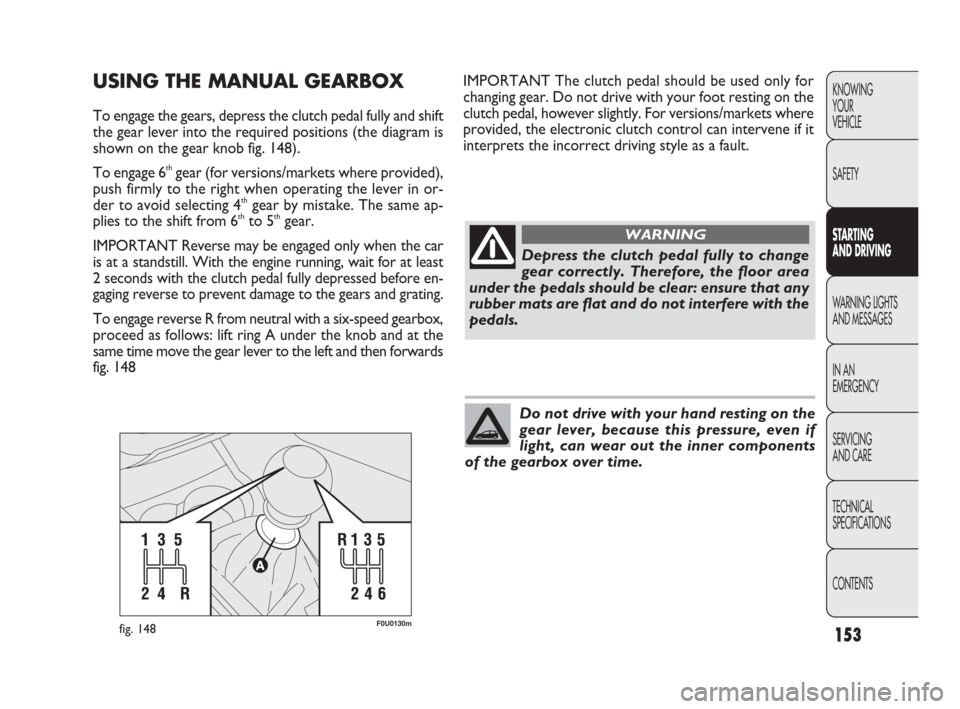
To engage the gears, depress the clutch pedal fully and shift
the gear lever into the required positions (the diagram is
shown on the gear knob fig. 148).
To engage 6
thgear (for versions/markets where provided),
push firmly to the right when operating the lever in or-
der to avoid selecting 4
thgear by mistake. The same ap-
plies to the shift from 6thto 5thgear.
IMPORTANT Reverse may be engaged only when the car
is at a standstill. With the engine running, wait for at least
2 seconds with the clutch pedal fully depressed before en-
gaging reverse to prevent damage to the gears and grating.
To engage reverse R from neutral with a six-speed gearbox,
proceed as follows: lift ring A under the knob and at the
same time move the gear lever to the left and then forwards
fig. 148
Depress the clutch pedal fully to change
gear correctly. Therefore, the floor area
under the pedals should be clear: ensure that any
rubber mats are flat and do not interfere with the
pedals.
WARNING
Do not drive with your hand resting on the
gear lever, because this pressure, even if
light, can wear out the inner components
of the gearbox over time.
IMPORTANT The clutch pedal should be used only for
changing gear. Do not drive with your foot resting on the
clutch pedal, however slightly. For versions/markets where
provided, the electronic clutch control can intervene if it
interprets the incorrect driving style as a fault.
149-160 PUNTO FL EN 4ed 20-01-2010 14:37 Pagina 153
Page 155 of 270
154
KNOWING
YOUR
VEHICLE
SAFETY
STARTING
AND DRIVING
WARNING LIGHTS
AND MESSAGES
IN AN
EMERGENCY
SERVICING
AND CARE
TECHNICAL
SPECIFICATIONS
CONTENTS
SAVING FUEL
Here are some suggestions which may help you to save fu-
el and reduce the amount of toxic emissions released in-
to the atmosphere.
GENERAL CONSIDERATIONS
Car maintenance
Have checks and adjustments carried out in accordance
with the “Scheduled Servicing Plan”.
Tyres
Check the tyre pressures at least once every 4 weeks: if
the pressure is too low, consumption levels increase as re-
sistance to rolling is higher.
Unnecessary loads
Do not travel with an overloaded boot. The weight of
the car (especially when driving in town) and its arrange-
ment greatly affect fuel consumption and stability.
Roof rack/ski rack
Remove the roof rack or ski rack from the roof after use.
These accessories decrease aerodynamic penetration and
have a negative effect on fuel consumption. It is better to
use a trailer to transport particularly bulky objects.Electrical devices
Use electrical devices only for the amount of time need-
ed. The heated rear window, auxiliary headlights, wind-
screen wipers and fan heater use up a considerable amount
of current, causing increased fuel consumption (up to
+25% in the urban cycle).
Air conditioning
Air conditioning leads to higher fuel consumption (on av-
erage up to +20%). If the temperature outside is not too
extreme, try and use the air vents.
Spoilers
The use of non-certified spoilers may adversely affect aero-
dynamics and fuel consumption.
DRIVING STYLE
Starting
Do not warm up the engine at low or high revs when the
vehicle is stationary; this causes the engine to warm up more
slowly, thereby increasing fuel consumption and emissions.
It is advisable to set off immediately and slowly, avoiding high
revs: this allows the engine to warm up more quickly.
Unnecessary actions
Avoid revving up when stationary at traffic lights or before
stopping the engine. The latter action, like double de-
clutching, is entirely unnecessary and causes increased fu-
el consumption and pollution.
149-160 PUNTO FL EN 4ed 20-01-2010 14:37 Pagina 154
Page 157 of 270
156
TOWING TRAILERS
IMPORTANT NOTES
The car must be equipped with an approved tow hook and
adequate electrical system to tow caravans or trailers. In-
stallation must be performed by specialised personnel who
will issue the required papers for travelling on roads.
Install any specific and/or additional rear-view mirrors in
accordance with the highway code of the country in which
you are travelling.
Remember that, when towing a trailer, steep hills are hard-
er to climb, braking distances increase and overtaking takes
longer relative to the overall weight of the trailer.
Engage a low gear when driving downhill, rather than con-
stantly using the brake.
The weight of the trailer on the car’s tow hook will re-
duce the load capacity of the car by the same amount. Con-
sider the weight of the trailer fully laden, including acces-
sories and luggage, to make sure you do not exceed the
maximum towable weight (shown on the vehicle regis-
tration document).
Respect each country’s speed limits for vehicles towing
trailers. The top speed must not exceed 100 km/h at any
time.
You should fit a suitable stabiliser to the trailer.
KNOWING
YOUR
VEHICLE
SAFETY
STARTING
AND DRIVING
WARNING LIGHTS
AND MESSAGES
IN AN
EMERGENCY
SERVICING
AND CARE
TECHNICAL
SPECIFICATIONS
CONTENTS
The ABS with which the car may be
equipped will not control the braking sys-
tem of the trailer. Particular caution is therefore
required on slippery roads.
WARNING
Never modify the braking system of the
car to control the trailer brake. The trail-
er braking system must be fully independent from
the hydraulic system of the car.
WARNING
149-160 PUNTO FL EN 4ed 20-01-2010 14:37 Pagina 156
Page 164 of 270
163
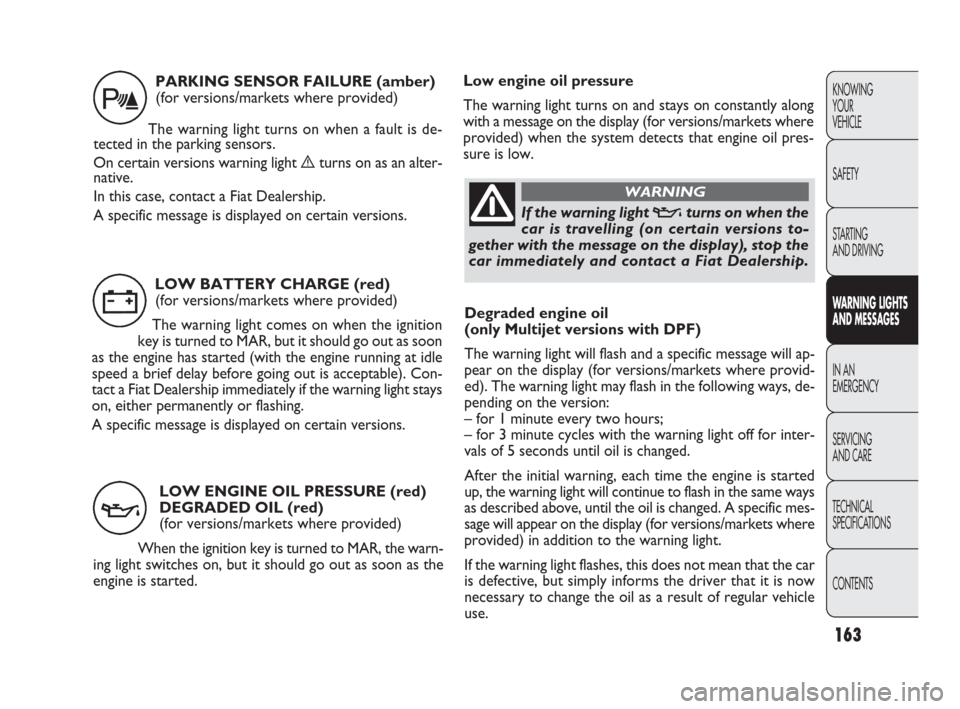
Degraded engine oil
(only Multijet versions with DPF)
The warning light will flash and a specific message will ap-
pear on the display (for versions/markets where provid-
ed). The warning light may flash in the following ways, de-
pending on the version:
– for 1 minute every two hours;
– for 3 minute cycles with the warning light off for inter-
vals of 5 seconds until oil is changed.
After the initial warning, each time the engine is started
up, the warning light will continue to flash in the same ways
as described above, until the oil is changed. A specific mes-
sage will appear on the display (for versions/markets where
provided) in addition to the warning light.
If the warning light flashes, this does not mean that the car
is defective, but simply informs the driver that it is now
necessary to change the oil as a result of regular vehicle
use.
KNOWING
YOUR
VEHICLE
SAFETY
STARTING
AND DRIVING
WARNING LIGHTS
AND MESSAGES
IN AN
EMERGENCY
SERVICING
AND CARE
TECHNICAL
SPECIFICATIONS
CONTENTS
LOW BATTERY CHARGE (red)
(for versions/markets where provided)
The warning light comes on when the ignition
key is turned to MAR, but it should go out as soon
as the engine has started (with the engine running at idle
speed a brief delay before going out is acceptable). Con-
tact a Fiat Dealership immediately if the warning light stays
on, either permanently or flashing.
A specific message is displayed on certain versions.
w
LOW ENGINE OIL PRESSURE (red)
DEGRADED OIL (red)
(for versions/markets where provided)
When the ignition key is turned to MAR, the warn-
ing light switches on, but it should go out as soon as the
engine is started.
v
If the warning light vturns on when the
car is travelling (on certain versions to-
gether with the message on the display), stop the
car immediately and contact a Fiat Dealership.
WARNING
PARKING SENSOR FAILURE (amber)
(for versions/markets where provided)
The warning light turns on when a fault is de-
tected in the parking sensors.
On certain versions warning light èturns on as an alter-
native.
In this case, contact a Fiat Dealership.
A specific message is displayed on certain versions.
t
Low engine oil pressure
The warning light turns on and stays on constantly along
with a message on the display (for versions/markets where
provided) when the system detects that engine oil pres-
sure is low.
161-174 PUNTO FL EN 4ed 18-01-2010 12:27 Pagina 163
Page 165 of 270
164
KNOWING
YOUR
VEHICLE
SAFETY
STARTING
AND DRIVING
WARNING LIGHTS
AND MESSAGES
IN AN
EMERGENCY
SERVICING
AND CARE
TECHNICAL
SPECIFICATIONS
CONTENTS
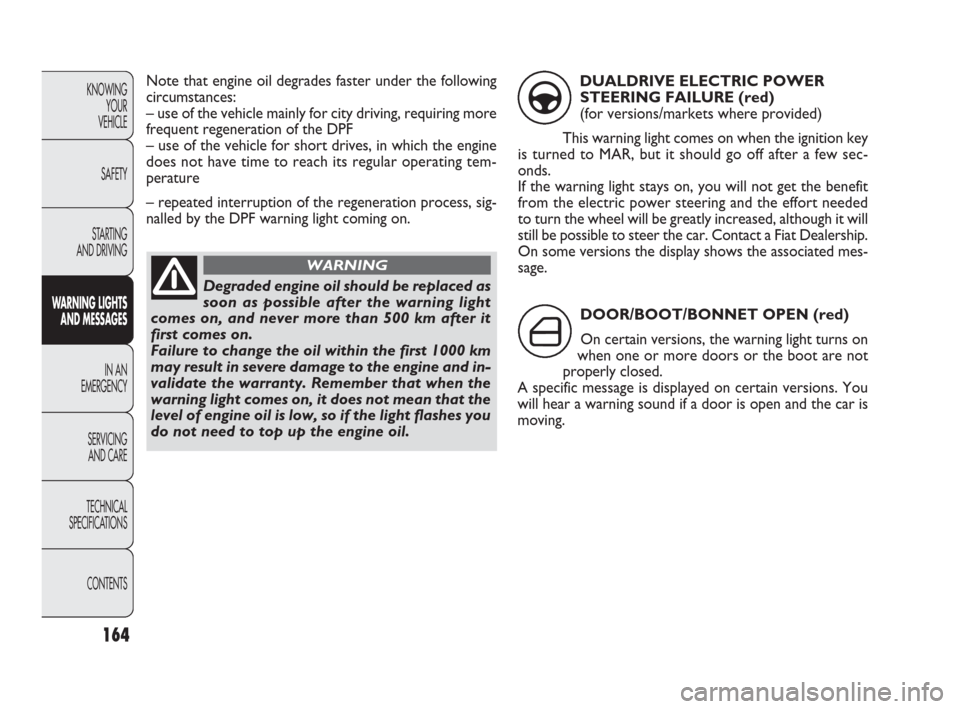
Degraded engine oil should be replaced as
soon as possible after the warning light
comes on, and never more than 500 km after it
first comes on.
Failure to change the oil within the first 1000 km
may result in severe damage to the engine and in-
validate the warranty. Remember that when the
warning light comes on, it does not mean that the
level of engine oil is low, so if the light flashes you
do not need to top up the engine oil.
WARNING
DOOR/BOOT/BONNET OPEN (red)
On certain versions, the warning light turns on
when one or more doors or the boot are not
properly closed.
A specific message is displayed on certain versions. You
will hear a warning sound if a door is open and the car is
moving.
´
DUALDRIVE ELECTRIC POWER
STEERING FAILURE (red)
(for versions/markets where provided)
This warning light comes on when the ignition key
is turned to MAR, but it should go off after a few sec-
onds.
If the warning light stays on, you will not get the benefit
from the electric power steering and the effort needed
to turn the wheel will be greatly increased, although it will
still be possible to steer the car. Contact a Fiat Dealership.
On some versions the display shows the associated mes-
sage.
g
Note that engine oil degrades faster under the following
circumstances:
– use of the vehicle mainly for city driving, requiring more
frequent regeneration of the DPF
– use of the vehicle for short drives, in which the engine
does not have time to reach its regular operating tem-
perature
– repeated interruption of the regeneration process, sig-
nalled by the DPF warning light coming on.
161-174 PUNTO FL EN 4ed 18-01-2010 12:27 Pagina 164