fuel FIAT SCUDO 2016 Owner handbook (in English)
[x] Cancel search | Manufacturer: FIAT, Model Year: 2016, Model line: SCUDO, Model: FIAT SCUDO 2016Pages: 227, PDF Size: 4.46 MB
Page 70 of 227
If, after a crash no fuel leaks are found and
the vehicle can be started again, reset the
fuel cut-off switch as follows: ❒
turn the key to S;
❒
remove the ignition key; refit the key
into the ignition switch and then start
the engine.
FUEL CUT-OFF SWITCHIt is a safety switch controlled by air bag
electronic control unit that in the event of
a serious crash (in any direction) comes
into operation by cutting off fuel and turn-
ing off the engine as a consequence.
Fuel cut-off switch activation is indicated
by a dedicated message on the reconfig-
urable multifunction display.
If, after a crash, you smell fu-
el or see leaks from the fuel
system, do not reset the switch to
avoid fire risk.
WARNING
66SAFETY
DEVICESCORRECT USE
OF THE VEHICLE
WARNING
LIGHTS AND
MESSAGESIN AN
EMERGENCYVEHICLE
MAINTENANCETECHNICAL
SPECIFICATIONSINDEX
DASHBOARD
AND
CONTROLS
020-082 SCUDO LUM GB 19/11/13 09.54 Pagina 66
Page 75 of 227
71
SAFETY
DEVICESCORRECT USE
OF THE VEHICLE WARNING
LIGHTS AND
MESSAGESIN AN
EMERGENCYVEHICLE
MAINTENANCETECHNICAL
SPECIFICATIONSINDEX DASHBOARD
AND CONTROLS
DOORSMANUAL OPENING/CLOSURE
fig. 91
F0P0083m
fig. 90
F0P0082m
Make sure it is safe to open
a door before doing so.
WARNING
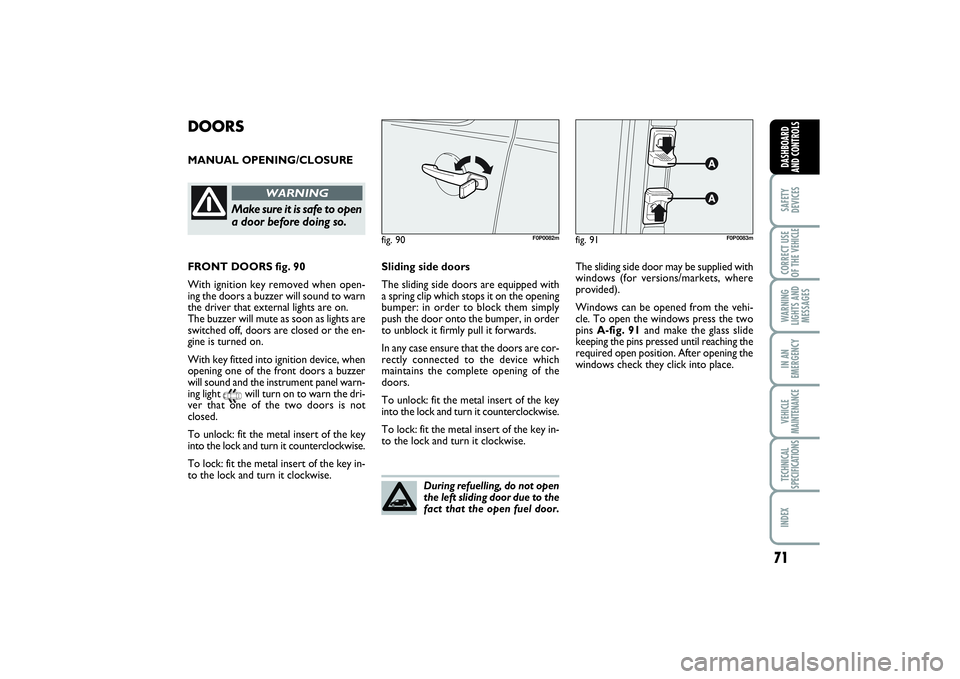
FRONT DOORS fig. 90
With ignition key removed when open-
ing the doors a buzzer will sound to warn
the driver that external lights are on.
The buzzer will mute as soon as lights are
switched off, doors are closed or the en-
gine is turned on.
With key fitted into ignition device, when
opening one of the front doors a buzzer
will sound and the instrument panel warn-
ing light
9
will turn on to warn the dri-
ver that one of the two doors is not
closed.
To unlock: fit the metal insert of the key
into the lock and turn it counterclockwise.
To lock: fit the metal insert of the key in-
to the lock and turn it clockwise.Sliding side doors
The sliding side doors are equipped with
a spring clip which stops it on the opening
bumper: in order to block them simply
push the door onto the bumper, in order
to unblock it firmly pull it forwards.
In any case ensure that the doors are cor-
rectly connected to the device which
maintains the complete opening of the
doors.
To unlock: fit the metal insert of the key
into the lock and turn it counterclockwise.
To lock: fit the metal insert of the key in-
to the lock and turn it clockwise.The sliding side door may be supplied with
windows (for versions/markets, where
provided).
Windows can be opened from the vehi-
cle. To open the windows press the two
pins A-fig. 91and make the glass slide
keeping the pins pressed until reaching the
required open position. After opening the
windows check they click into place.
During refuelling, do not open
the left sliding door due to the
fact that the open fuel door.
020-082 SCUDO LUM GB 19/11/13 09.54 Pagina 71
Page 92 of 227
88SAFETY
DEVICESCORRECT USE
OF THE VEHICLE
WARNING
LIGHTS AND
MESSAGESIN AN
EMERGENCYVEHICLE
MAINTENANCETECHNICAL
SPECIFICATIONSINDEXDASHBOARD
AND CONTROLS
MSR system
(engine braking torque control)
It is an integral part of the ASR system that
in case of sudden gear shifting, cuts in pro-
viding torque to the engine thus prevent-
ing excessive driving wheel drive that, spe-
cially in poor grip conditions, can lead to
loss of stability.
GRIP CONTROLThis system increases the traction in poor
road grip conditions (e.g. snow, mud,
sand).
The accelerator pedal must be pressed
sufficiently for the engine power to man-
age the various parameters in the best
way.
The vehicle is designed mainly for as-
phalted roads but can occasionally be dri-
ven on rough roads.
If the vehicle is heavily loaded, it cannot be
used for off-road activities, such as:❒
crossing and driving grounds that
could damage the underbody or de-
tach parts such as fuel pipes, fuel cool-
er, etc., because of obstacles or
stones;
❒
travelling on steep gradients with re-
duced grip;
❒
fording a stream.
The performance of the sys-
tem, in terms of active safe-
ty should not induce the driver to take
pointless and unnecessary risks.
The style of driving must in any case
always be adapted to the conditions
of the road surface, visibility and traf-
fic. Road safety is always the driver’s
responsibility.
WARNING
For correct operation of the ASR system,
the tyres must absolutely be of the same
brand and type on all wheels, in perfect
conditions and, above all, of type, brand
and size specified.
FAILURE INDICATIONS
In the event of malfunctioning, the ASR
system is automatically disconnected and
the warning light will come with fixed
light on the instrument panel, (see section
“Warning lights and messages”).
In this case contact Fiat Dealership as soon
as possible.
083-096 SCUDO LUM GB 27/03/14 10:22 Pagina 88
Page 94 of 227
90SAFETY
DEVICESCORRECT USE
OF THE VEHICLE
WARNING
LIGHTS AND
MESSAGESIN AN
EMERGENCYVEHICLE
MAINTENANCETECHNICAL
SPECIFICATIONSINDEXDASHBOARD
AND CONTROLS
iTPMS SYSTEM(for versions/markets
where provided)
DESCRIPTION
The vehicle can be equipped with the
iTPMS (indirect Tire Pressure Monitor-
ing System) which monitors the tyre in-
flation status thanks to wheel speed sen-
sors.
The system comprises a radio-frequency
transmitter sensor fitted to each wheel
(on the rim inside the tyre), which is able
to send information on the inflation pres-
sure of each tyre to the control unit.
The system warns the driver if one or
more tyres are flat by switching on the
dedicated warning light
n
and a warning
message on the display.
If one tyre only is flat, the system can in-
dicate its position: it is in any case rec-
ommended to check the pressure on all
four tyres.
WARNING
If the system signals a pres-
sure decrease on a specific
tyre, it is recommended to check the
pressure on all four tyres.
WARNING
iTPMS does not relieve the
driver from the obligation to
check the tyre pressure every month;
it is not to be considered a system to
replace maintenance or a safety sys-
tem.
WARNING
Tyre pressure must be
checked with tyres cold.
Should it become necessary for what-
ever reason to check pressure with
warm tyres, do not reduce pressure
even if it is higher than the prescribed
value, but repeat the check when tyres
are cold.
WARNING
The iTPMS cannot indicate
sudden tyre pressure drops
(for example when a tyre bursts). In
this event, brake the vehicle cautious-
ly and avoid sudden steering.
WARNING
The system only warns that
the tyre pressure is low: it is
not able to inflate them.
WARNING
Insufficient tyre inflation in-
creases fuel consumption, re-
duces the tread duration and may af-
fect the capacity to drive safely.
083-096 SCUDO LUM GB 27/03/14 10:22 Pagina 90
Page 95 of 227
91
SAFETY
DEVICESCORRECT USE
OF THE VEHICLE WARNING
LIGHTS AND
MESSAGESIN AN
EMERGENCYVEHICLE
MAINTENANCETECHNICAL
SPECIFICATIONSINDEX DASHBOARD
AND CONTROLS
Insufficient tyre pressure
The warning light
n
switches on, to-
gether with a dedicated message on the
display, to indicate that the tyre pressure
is lower than the recommended value
and/or that slow pressure loss is occur-
ring. In these circumstances, optimal tyre
duration and fuel consumption may not be
guaranteed.
Should two or more tyres be in the con-
dition mentioned above, the display will
show the indications corresponding to each
tyre in sequence.
❒
Slow down immediately, avoid sudden
braking and steering.
❒
Stop as soon as traffic conditions al-
low.
❒
In the event of a puncture, use the
quick tyre repair kit or fit the spare
wheel (for versions/markets, where
provided);
or
❒
if you have a compressor, for example
the one of the quick tyre repair kit,
check the pressure of the four tyres
when cold;or
❒
if you cannot check the pressure im-
mediately, drive very carefully and slow-
ly.
The alarm is active until the next inflation,
repair or replacement of the tyre involved.
The spare wheel (space-saver wheel or
steel rim) does not have sensors.
The detected pressure loss does not al-
ways involve visible deformation of the
tyre. Therefore, do not rely on the visual
check only.iTPMS failure
When a fault in the iT.P.M.S. is detected,
the warning light
n
switches on and flash-
es, the warning light è
switches on as
well and a dedicated message is displayed.
In this case, the monitoring of the tyre
pressure is no longer guaranteed.
This alarm is displayed also when at least
one of the wheels is not equipped with
sensor (e.g. with spare wheel, space-saver
or steel type).
Contact a Fiat Dealership to have the sys-
tem checked or, after a puncture, refit a
tyre equipped with sensor on the origi-
nal rim.
083-096 SCUDO LUM GB 27/03/14 10:22 Pagina 91
Page 99 of 227
95
SAFETY
DEVICESCORRECT USE
OF THE VEHICLE WARNING
LIGHTS AND
MESSAGESIN AN
EMERGENCYVEHICLE
MAINTENANCETECHNICAL
SPECIFICATIONSINDEX DASHBOARD
AND CONTROLS
Refuelling
To guarantee full tank filling, carry out two
refuelling operations after the first click of
the fuel delivery gun. Avoid further top-
ping up operations that could cause dam-
ages to the fuel system.
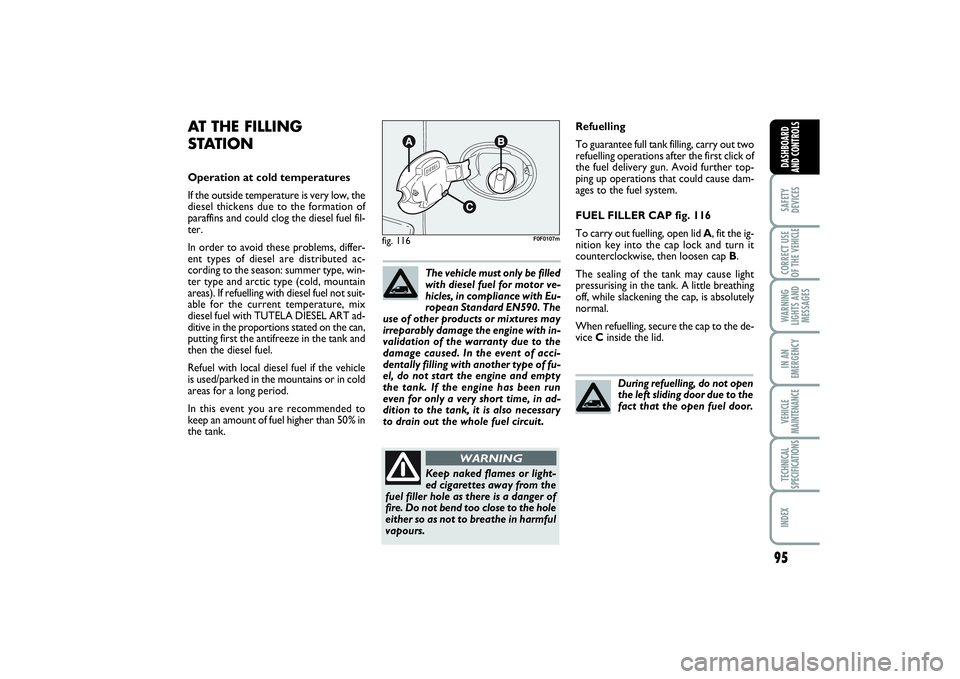
FUEL FILLER CAP fig. 116
To carry out fuelling, open lid A, fit the ig-
nition key into the cap lock and turn it
counterclockwise, then loosen cap B.
The sealing of the tank may cause light
pressurising in the tank. A little breathing
off, while slackening the cap, is absolutely
normal.
When refuelling, secure the cap to the de-
vice Cinside the lid.
fig. 116
F0F0107m
AT THE FILLING
STATIONOperation at cold temperatures
If the outside temperature is very low, the
diesel thickens due to the formation of
paraffins and could clog the diesel fuel fil-
ter.
In order to avoid these problems, differ-
ent types of diesel are distributed ac-
cording to the season: summer type, win-
ter type and arctic type (cold, mountain
areas). If refuelling with diesel fuel not suit-
able for the current temperature, mix
diesel fuel with TUTELA DIESEL ART ad-
ditive in the proportions stated on the can,
putting first the antifreeze in the tank and
then the diesel fuel.
Refuel with local diesel fuel if the vehicle
is used/parked in the mountains or in cold
areas for a long period.
In this event you are recommended to
keep an amount of fuel higher than 50% in
the tank.The vehicle must only be filled
with diesel fuel for motor ve-
hicles, in compliance with Eu-
ropean Standard EN590. The
use of other products or mixtures may
irreparably damage the engine with in-
validation of the warranty due to the
damage caused. In the event of acci-
dentally filling with another type of fu-
el, do not start the engine and empty
the tank. If the engine has been run
even for only a very short time, in ad-
dition to the tank, it is also necessary
to drain out the whole fuel circuit.
Keep naked flames or light-
ed cigarettes away from the
fuel filler hole as there is a danger of
fire. Do not bend too close to the hole
either so as not to breathe in harmful
vapours.
WARNING
During refuelling, do not open
the left sliding door due to the
fact that the open fuel door.
083-096 SCUDO LUM GB 27/03/14 10:22 Pagina 95
Page 100 of 227
96SAFETY
DEVICESCORRECT USE
OF THE VEHICLE
WARNING
LIGHTS AND
MESSAGESIN AN
EMERGENCYVEHICLE
MAINTENANCETECHNICAL
SPECIFICATIONSINDEXDASHBOARD
AND CONTROLS
DIESEL PARTICULATE FILTER
(DPF)
(for versions/markets, where provided)
The Diesel Particulate Filter is a mechan-
ical filter, integral with the exhaust system,
that physically traps particulates present
in the exhaust gases of Diesel engine.
The diesel particulate filter has been
adopted to eliminate almost totally par-
ticulates in compliance with current / fu-
ture law regulations.
During normal use of the vehicle, the en-
gine control unit records a set of data (e.g.:
travel time, type of route, temperatures,
etc.) and it will then calculate how much
particulates has been trapped by the filter.
Since this filter physically traps particulates,
it shall be cleaned (reclaimed) at regular
intervals by burning carbon particles.
Reclaiming procedure is controlled auto-
matically by the engine control unit ac-
cording to the filter conditions and the
conditions of use of the vehicle.
During reclaiming the following phenom-
ena could take place: idling slight increase,
fan activation, slight smoke increase, high
exhaust temperatures. These situations
shall not be considered as faults and they
do not affect vehicle performance and en-
vironment.
During normal service the
diesel particulate filter (DPF)
reaches high temperatures. Do not
therefore park the vehicle over in-
flammable materials (grass, dry leaves,
pine needles, etc.): fire hazard.
WARNING
During normal service the
catalyst reaches high tem-
peratures. Do not therefore park the
vehicle over inflammable materials
(grass, dry leaves, pine needles, etc.):
fire hazard.
WARNING
PROTECTING
THE ENVIRONMENTThe devices for curtailing diesel engine
emissions are:❒
oxidising catalytic converter;
❒
exhaust gas recirculation system
(E.G.R.);
❒
diesel particulate filter (DPF) (for ver-
sions/markets, where provided).
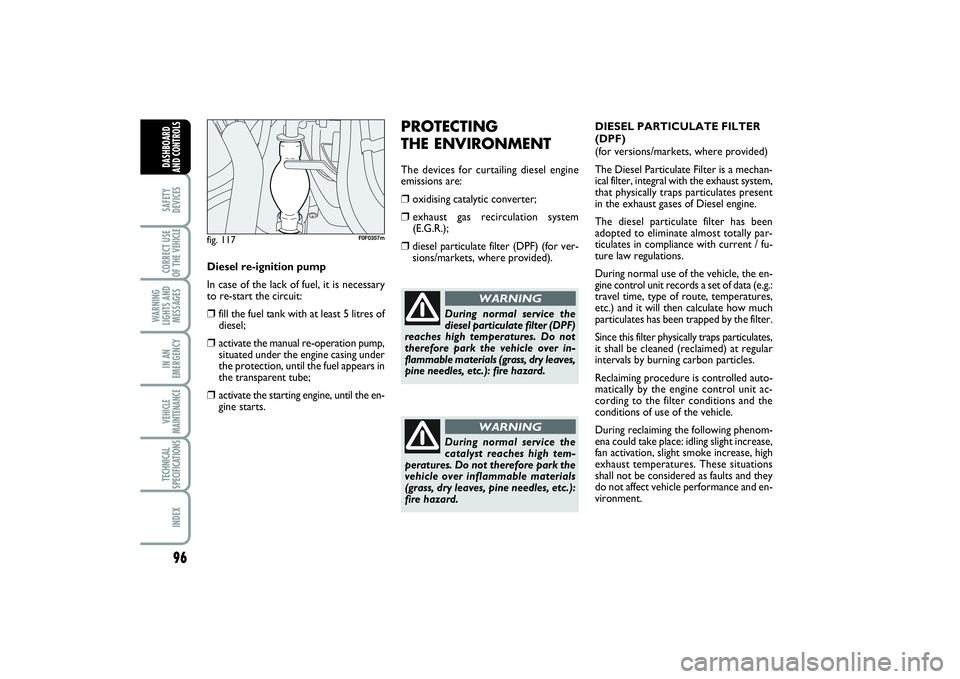
Diesel re-ignition pump
In case of the lack of fuel, it is necessary
to re-start the circuit:
❒
fill the fuel tank with at least 5 litres of
diesel;
❒
activate the manual re-operation pump,
situated under the engine casing under
the protection, until the fuel appears in
the transparent tube;
❒
activate the starting engine, until the en-
gine starts.
fig. 117
F0F0357m
083-096 SCUDO LUM GB 27/03/14 10:22 Pagina 96
Page 125 of 227
121
WARNING
LIGHTS AND
MESSAGESIN AN
EMERGENCYVEHICLE
MAINTENANCETECHNICAL
SPECIFICATIONSINDEXDASHBOARD
AND CONTROLSSAFETY
DEVICESCORRECT USE
OF THE VEHICLE
If the engine does not start at the first at-
tempt, return the ignition key to Sbefore
repeating starting.
If, when the ignition key is at M, the dis-
play warning light
m
remains lit, turn the
key to Sand then back to M; if the warn-
ing lights remain on, try with the other
keys provided with the vehicle.
IMPORTANT Never leave the ignition key
to Mwhen the engine is off.
The warning light m will flash
for 60 seconds at start-up or
during prolonged cranking to
indicate a fault in the glow
plug heating system. You can use the
vehicle as usual if the engine starts but
you should contact Fiat Dealership as
soon as possible.
HOW TO WARM UP THE
ENGINE AFTER IT HAS JUST
STARTED
Proceed as follows:❒
Drive off slowly, letting the engine turn
at medium revs. Do not accelerate
abruptly;
❒
Do not drive at full performance for the
initial kilometres. Wait until the coolant
temperature gauge starts moving.
Remember that the servo-
brake and power steering are
not operational until the en-
gine has been started, there-
fore much effort than usual is required
on the brake pedal and steering wheel.
Never bump start the engine
by pushing, towing or coast-
ing downhill as this could
cause fuel to flow into the
catalytic exhaust system and damage
it beyond repair.
STOPPING THE ENGINE
Turn the ignition key to Swhile the en-
gine is idling.
IMPORTANT After a taxing drive, you
should allow the engine to “catch its
breath” before turning it off by letting it
idle to allow the temperature in the en-
gine compartment to fall.
A quick burst on the acceler-
ator before turning off the en-
gine serves absolutely no
practical purpose, it wastes
fuel and is damaging especially to tur-
bocharged engines.
119-128 SCUDO LUM GB 18/11/13 14.26 Pagina 121
Page 128 of 227
124WARNING
LIGHTS AND
MESSAGESIN AN
EMERGENCYVEHICLE
MAINTENANCETECHNICAL
SPECIFICATIONSINDEXDASHBOARD
AND CONTROLSSAFETY
DEVICESCORRECT USE
OF THE VEHICLE
Roof rack/ski rack
Remove the roof rack or the ski rack from
the roof as soon as they are no longer
used. These accessories lower air pene-
tration and adversely affect consumption
levels. When needing to carry particular-
ly voluminous objects, preferably use a
trailer.
Electric devices
Use electric devices only for the amount
of time needed. Rear heated window, ad-
ditional headlights, windscreen wipers and
heater fan need a considerable amount of
energy, therefore increasing the require-
ment of current increases fuel consump-
tion (up to +25% in the urban cycle).
Climate control
The air conditioner is an additional load
which greatly affects the engine leading to
higher consumption (on average up to
+20%). When the temperature outside
the vehicle permits it, use the air vents
where possible.
Spoilers
The use of non-certified aerodynamic
items may adversely affect air drag and
consumption levels.DRIVING STYLE
Starting
Do not warm the engine when the vehi-
cle is stationary or at high or low speed:
in this way the engine will warm up grad-
ually increasing consumption and emis-
sions. You should drive off slowly straight
away avoiding high revs so that the engine
will warm up more quickly.
Unnecessary actions
Avoid accelerating when waiting at traffic
lights or before switching off the engine.
This and also double declutching is ab-
solutely pointless on modern vehicles and
also increase consumption and pollution.
Gear selections
As soon as the conditions of the traffic and
road allow, use a higher gear. Using a low
gear to obtain brilliant performance in-
creases consumption.
In the same way improper use of a high
gear increases consumption, emissions an
engine wear.
CONTAINING
RUNNING COSTSSome suggestions which may help you to
keep the running costs of the vehicle
down and lower the amount of toxic emis-
sions released into the atmosphere are
given below.
GENERAL CONSIDERATIONS
Vehicle maintenance
Carry out the checks and adjustments/reg-
ulations specified in the “Service Sched-
ule”.
Tyres
Check tyre inflation pressure regularly.
Tyres should be checked at least once
every four weeks: if the pressure is too
low, fuel consumption increases as the re-
sistance to the rolling movement of the
tyre is greater.
Unnecessary loads
Do not travel with too much load.
The weight of the vehicle (specially in ur-
ban traffic) and its trim greatly effects con-
sumption and stability.
119-128 SCUDO LUM GB 18/11/13 14.26 Pagina 124
Page 129 of 227
125
WARNING
LIGHTS AND
MESSAGESIN AN
EMERGENCYVEHICLE
MAINTENANCETECHNICAL
SPECIFICATIONSINDEXDASHBOARD
AND CONTROLSSAFETY
DEVICESCORRECT USE
OF THE VEHICLE
CONDITIONS OF USE
Cold starting
Short journeys and frequent cold starts do
not allow the engine to reach optimum op-
erating temperature. This results in a sig-
nificant increase in consumption levels
(from +15 to +30% on the urban cycle)
and emission of harmful substances.
Traffic and road conditions
Rather high consumption levels are tied to
situations with heavy traffic, for example
in queues with frequent use of the lower
gears or in cities with many traffic lights.
Also winding mountain roads and rough
road surfaces adversely affect consump-
tion.
Enforced halts
During prolonged hold-ups (level crossings)
the engine should be switched off. Top speed
Fuel consumption increases considerably
as speed increases. Your speed should be
kept as even as possible and superfluous
braking and acceleration avoided as this
increases both consumption and emis-
sions.
Acceleration
Accelerating violently increasing the revs
will greatly affect consumption and emis-
sions: acceleration should be gradual and
should not exceed the maximum torque.TOWING TRAILERS
IMPORTANTS
For towing caravans or trailers the vehi-
cle must be fitted with a certified tow
hook and an adequate electric system.
To prevent damages to the vehicle elec-
tric system, adopt an electronic control
unit specially designed and dedicated to
the trailer.
Installation should be carried out by spe-
cialised personnel who release a special
document for circulation on the road.
Install any specific and/or additional rear-
view mirrors as specified by law.
Remember that when towing a trailer,
steep hills are harder to climb, the brak-
ing spaces increase and overtaking takes
longer depending on the overall weight.
119-128 SCUDO LUM GB 18/11/13 14.26 Pagina 125