display FORD F450 SUPER DUTY 2017 Repair Manual
[x] Cancel search | Manufacturer: FORD, Model Year: 2017, Model line: F450 SUPER DUTY, Model: FORD F450 SUPER DUTY 2017Pages: 642, PDF Size: 12.35 MB
Page 162 of 642
You can enable or disable this featurethrough the information display. SeeInformation Displays (page 111).
REAR SEATS
Folding Up the Rear Seat Cushion
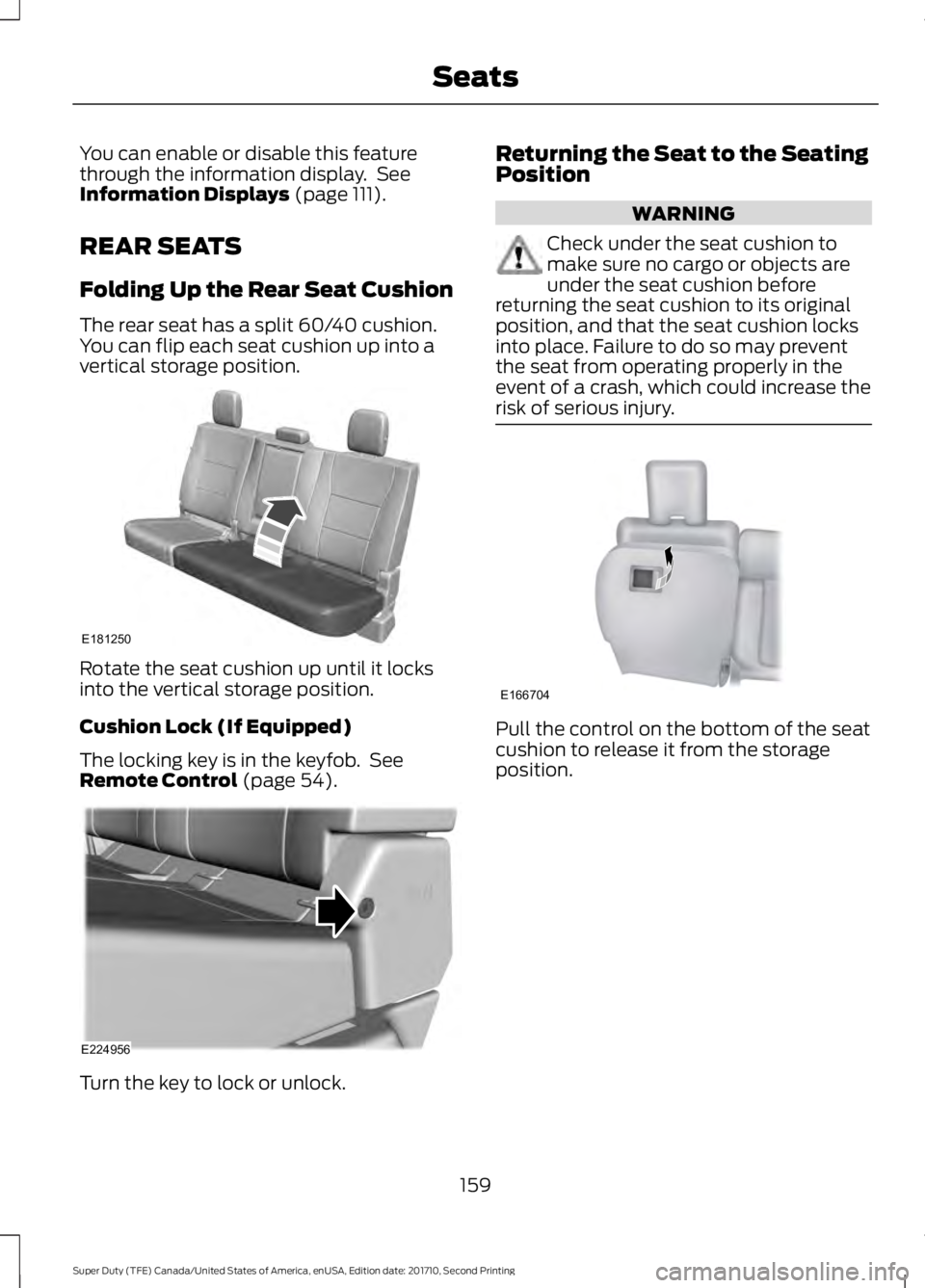
The rear seat has a split 60/40 cushion.You can flip each seat cushion up into avertical storage position.
Rotate the seat cushion up until it locksinto the vertical storage position.
Cushion Lock (If Equipped)
The locking key is in the keyfob. SeeRemote Control (page 54).
Turn the key to lock or unlock.
Returning the Seat to the SeatingPosition
WARNING
Check under the seat cushion tomake sure no cargo or objects areunder the seat cushion beforereturning the seat cushion to its originalposition, and that the seat cushion locksinto place. Failure to do so may preventthe seat from operating properly in theevent of a crash, which could increase therisk of serious injury.
Pull the control on the bottom of the seatcushion to release it from the storageposition.
159
Super Duty (TFE) Canada/United States of America, enUSA, Edition date: 201710, Second Printing
SeatsE181250 E224956 E166704
Page 179 of 642
Guarding Against Exhaust Fumes
WARNING
Exhaust leaks may result in entry ofharmful and potentially lethal fumesinto the passenger compartment. Ifyou smell exhaust fumes inside yourvehicle, have your vehicle inspectedimmediately. Do not drive if you smellexhaust fumes.
Important Ventilating Information
If you stop your vehicle and then leave theengine idling for long periods of time, werecommend that you do one of thefollowing:
•Open the windows at least 1 inch (2.5centimeters).
•Set your climate control to outside air.
STARTING A DIESEL ENGINE -
6.7L DIESEL
Read all starting instructions carefullybefore you start your vehicle.
For temperatures below 32°F (0°C), theuse of the correct grade engine oil isessential for proper operation. Refer toengine oil specifications for moreinformation. See Capacities andSpecifications (page 427).
Your vehicle may have a cold weatherstarting strategy that prevents severeengine damage by assisting in enginelubrication warm-up. In extremely coldambient temperatures, this strategyactivates and prevents the acceleratorpedal from being used for 30 seconds afteryou start your vehicle. A message appearsin the information display as your vehiclewarms up. By not allowing the acceleratorpedal to be used, the engine oil is allowedto properly lubricate the bearings
preventing engine damage due to lack ofproper lubrication. After the 30 secondwarm-up period, the accelerator pedal willbe operational again and a messageappears informing you the vehicle is ok todrive.
When you start the engine in extremelycold temperatures -15°F (-26°C), werecommend that you allow the engine toidle for several minutes before you drivethe vehicle.
Before starting the engine check thefollowing:
•Make sure all occupants have fastenedtheir seatbelts.
•Make sure the headlamps andelectrical accessories are off.
•Make sure the parking brake is on.
•Make sure the transmission is in park(P).
Note:Do not press the accelerator duringstarting.
Diesel Engine Fast Start Glow PlugSystem
The diesel engine glow system consists of:
•Eight glow plugs (one per cylinder)
•Glow Plug Control Module
•Engine Coolant Temperature sensor
•Barometric pressure sensor
•Environmental temperature sensor
The powertrain and glow plug controlmodules electronically control the glowplug system. After you switch the ignitionon, the glow plug control moduleimmediately energizes the glow plugs. Theglow plug control module uses the enginecoolant temperature, barometric pressuresensor and environmental temperature
176
Super Duty (TFE) Canada/United States of America, enUSA, Edition date: 201710, Second Printing
Starting and Stopping the Engine
Page 184 of 642
To help prolong engine life, werecommended you allow the engine to idlefor three to five minutes, especially afterany of the following:
•Continuous engine speed.
•High ambient temperature.
•High GVW or GCW operation, forexample heavy loads or trailers.
This allows the turbo charged engine tocool down.
ENGINE IDLE SHUTDOWN (If
Equipped)
Your vehicle may be equipped with anengine idle shutdown system. This systemautomatically shuts down your enginewhen it has been idling in P (Park) or N(Neutral) for five minutes (parking brakeset) or 15 minutes (parking brake not set).When the engine idle shutdown processhas started:
•A chime sounds and the informationdisplay will show ENGINE TURNS OFFIN 30 (seconds) and start countingdown
•You can restart the five or 15-minutetimer by changing the position of theaccelerator pedal, brake pedal or thepark brake within the final 30 seconds
•When the timer reaches zero, theengine shuts down and this messagewill appear in your information displayENGINE TURNED OFF
•One minute after the engine has shutdown, the electrical system simulateskey off, even though the ignition is stillin the on position, initiating normalaccessory delay period
•You must move the ignition to the offposition to reset the system beforerestarting your vehicle.
The engine idle shutdown idle timer doesnot start if:
•The engine is operating in powertake-off mode.
•The engine coolant temperature isbelow 60°F (16°C).
•The exhaust emission control device isregenerating.
ENGINE BLOCK HEATER (If
Equipped)
WARNINGS
Failure to follow engine block heaterinstructions could result in propertydamage or serious personal injury.
Do not use your heater withungrounded electrical systems ortwo-pronged adapters. There is a riskof electrical shock.
Note:The heater is most effective whenoutdoor temperatures are below 0°F(-18°C).
The heater acts as a starting aid bywarming the engine coolant. This allowsthe climate control system to respondquickly. The equipment includes a heaterelement (installed in the engine block) anda wire harness. You can connect thesystem to a grounded 120-volt ACelectrical source.
181
Super Duty (TFE) Canada/United States of America, enUSA, Edition date: 201710, Second Printing
Starting and Stopping the Engine
Page 191 of 642
•Fuels containing methanol.
•Fuels containing metallic-basedadditives, including manganese-basedcompounds.
•Fuels containing the octane boosteradditive, methylcyclopentadienylmanganese tricarbonyl (MMT).
•Leaded fuel (using leaded fuel isprohibited by law).
The use of fuels with metallic compoundssuch as methylcyclopentadienylmanganese tricarbonyl (commonly knownas MMT), which is a manganese-basedfuel additive, will impair engineperformance and affect the emissioncontrol system.
Do not be concerned if the enginesometimes knocks lightly. However, if theengine knocks heavily while using fuel withthe recommended octane rating, contactan authorized dealer to prevent any enginedamage.
RUNNING OUT OF FUEL
Avoid running out of fuel because thissituation may have an adverse effect onengine components.
If you have run out of fuel:
•You may need to cycle the ignition fromoff to on several times after refuelingto allow the fuel system to pump thefuel from the tank to the engine. Onrestarting, cranking time will take a fewseconds longer than normal. Withkeyless ignition, just start the engine.Crank time will be longer than usual.
•Normally, adding 1.06 gal (4 L) of fuelis enough to restart the engine. If thevehicle is out of fuel and on a steepgrade, more than 1.06 gal (4 L) may berequired.
SELECTIVE CATALYTIC
REDUCTION SYSTEM - DIESEL
Your vehicle may have a selective catalyticreduction system. The system helps reduceemission levels of oxides of nitrogen fromthe exhaust system. The systemautomatically injects diesel exhaust fluidinto the exhaust system to enable correctselective catalytic reduction systemfunction.
Note:Selective catalytic reduction systemsare not fitted to vehicles in markets whereonly high-sulfur diesel fuel is available.
Diesel Exhaust Fluid Level
In order for the system to operate correctlyyou must maintain the diesel exhaust fluidlevel.
A warning message appears in theinformation display when the dieselexhaust fluid level is low. If a warningmessage appears, refill the diesel exhaustfluid tank as soon as possible. SeeInformation Messages (page 128).
Filling the Diesel Exhaust FluidTank
WARNINGS
Keep diesel exhaust fluid out ofreach of children. Avoid contact withskin, eyes or clothing. In case ofcontact with your eyes, flush immediatelywith water and get prompt medicalattention. In case of contact with your skin,clean immediately with soap and water. Ifyou swallow any diesel exhaust fluid, drinkplenty of water, call a physicianimmediately.
188
Super Duty (TFE) Canada/United States of America, enUSA, Edition date: 201710, Second Printing
Fuel and Refueling
Page 193 of 642
2. Remove the diesel exhaust fluid tankfiller cap.
3.Insert the spout in to the filler neck untilthe seal on the spout seats on to thefiller neck. Pour the fluid in to the tank.When the tank is full the fluid will stopflowing automatically.
4. Return the container to the verticalposition slightly below the dieselexhaust fluid filler neck. Allow any fluidremaining in the spout to drain back into the container.
5. Remove the spout from the dieselexhaust fluid filler neck. Replace thediesel exhaust fluid tank cap.
6. Remove the spout from the dieselexhaust fluid container and replace thecap.
Note:If there is diesel exhaust fluid left inthe container retain it for later use. Thespout is re-useable. Wash the spout withclean water prior to storage. Do not use thediesel exhaust fluid spout with any otherfluid.
Filling the Diesel Exhaust Fluid Tank inCold Climates
Diesel exhaust fluid may freeze if theambient temperature is below 12°F (-11°C).Your vehicle has a preheating systemwhich allows diesel exhaust fluid tooperate below 12°F (-11°C). If you do notuse your vehicle for an extended periodwhen the ambient temperature is below12°F (-11°C), the fluid in the tank mayfreeze. If the tank is overfilled and the fluidfreezes it may damage the tank. This is notcovered by the vehicle warranty.
Diesel Exhaust Fluid WarningMessages and Vehicle Operations
WARNINGS
Diesel exhaust fluid must be refilledwhen low or replaced whencontaminated or your vehicle speedbecomes limited to 50 mph (80 km/h). Inthese conditions, drive with caution andrefill diesel exhaust fluid immediately. Ifthe diesel exhaust fluid becomes emptyor contaminated and fluid is not replaced,your vehicle becomes limited to engine idleonly once stopped. In these conditions, becautious where you stop your vehiclebecause you may not be able to drive longdistances or maintain highway speeds untilyou refill or replace the diesel exhaust fluid.
Tampering with or disabling selectivecatalytic reduction system results insevere vehicle performancelimitation including eventual speed limitingto 5 mph (5 km/h).
The information display shows a series ofmessages about the amount of dieselexhaust fluid available. A systems checkdisplays messages indicating the amountof diesel exhaust fluid available or displaysa warning message indicating theapproximate distance remaining as thefluid in the diesel exhaust fluid tank nearsempty. See Information Messages(page 128).
As the diesel exhaust fluid levelnears empty, the warningsymbol displays and a series oftones and messages starting at 500 mi(800 km) remaining before diesel exhaustfluid is depleted. The warning symbol andmessages continue until you refill thediesel exhaust fluid tank.
190
Super Duty (TFE) Canada/United States of America, enUSA, Edition date: 201710, Second Printing
Fuel and RefuelingE163176
Page 194 of 642
Continued driving without refilling resultsin the following actions as required by theCalifornia Air Resources Board (CARB) andthe U.S. Environmental Protection Agency(EPA):
•Within a preset distance to empty,speed is limited upon vehicle restart.Prior to this occurring a messageappears in the information display.
•Further vehicle operation withoutrefilling the diesel exhaust fluid tankcauses the engine to enter an idle-onlycondition. This only occurs upon vehiclerefueling or at an extended idle. Amessage indicates the required actionsto resume normal operation. It isrequired to add a minimum of 1.0 gal(3.8 L) of diesel exhaust fluid to thetank to exit the idle-only condition, butyour vehicle is still in the speed-limitingmode until you refill the tankcompletely.
Note:For either vehicle speed limiting oridle-only condition, normal vehicle operationresumes when you refill the diesel exhaustfluid tank.
Note:When filling the diesel exhaust fluidtank from empty, there may be a short delaybefore detecting the increased level of fluid.The increased level detection must occurbefore your vehicle returns to full power.
Diesel Exhaust Fluid Guidelinesand Information
•Use only diesel exhaust fluid thatcarries the American PetroleumInstitute (API) certified diesel exhaustfluid trademark or ISO 22241.
•Do not put diesel exhaust fluid in thediesel fuel tank.
•Do not overfill the diesel exhaust fluidtank.
•Diesel exhaust fluid is corrosive.
•Do not re-use the diesel exhaust fluidcontainer once it is emptied.
•Avoid spilling diesel exhaust fluid onpainted surfaces, carpeting or plasticcomponents. Immediately wipe awayany diesel exhaust fluid that has spilledwith a damp cloth and water. If it hasalready crystallized, use warm waterand a sponge.
•Store diesel exhaust fluid out of directsunlight and in temperatures between23°F (-5°C) and 68°F (20°C).
•Diesel exhaust fluid freezes below 12°F(-11°C).
•Do not store the diesel exhaust fluidbottle in your vehicle. If it leaks it couldcause damage to interior componentsor release an ammonia odor inside yourvehicle.
•Diesel exhaust fluid is non-flammable,non-toxic, colorless and water-solubleliquid.
•The system has a diesel exhaust fluidquality sensor. Dilution of dieselexhaust fluid or use of any other liquidin the SCR system leads to a dieselexhaust fluid system fault, eventuallyleading to the vehicle only operating inidle-only mode.
•Do not dilute diesel exhaust fluid withwater or any other liquid.
•An ammonia odor may be smelledwhen the cap is removed or duringrefill. Refill diesel exhaust fluid in a wellventilated area.
191
Super Duty (TFE) Canada/United States of America, enUSA, Edition date: 201710, Second Printing
Fuel and Refueling
Page 195 of 642
Typical Diesel Exhaust Fluid UsageWhen Using the Power Take Off (PTO)
Continuous PTO use—Minimal PTO use
0–7,800 mi (0–12,550 km)
Contaminated Diesel ExhaustFluid or Inoperative SelectiveCatalytic Reduction System
Selective catalytic reduction systems aresensitive to contamination of the dieselexhaust fluid. Maintaining the purity of thefluid is important to avoid systemmalfunctions. If you remove or drain thediesel exhaust fluid tank, do not use thesame fluid to refill the tank. The systemhas a sensor to monitor fluid quality.
A warning lamp illuminates anda message appears in theinformation display if the systembecomes contaminated or inoperative.
Continued driving without replacing dieselexhaust fluid or having the selectivecatalytic reduction system repaired resultsin the following actions as required by theCalifornia Air Resources Board (CARB) andU.S. Environmental Protection Agency(EPA):
•Within a preset distance to empty,speed is limited upon vehicle restart.Prior to this occurring a messageappears in the information display.
•Further vehicle operation withoutreplacing contaminated diesel exhaustfluid causes the engine to enter anidle-only condition. This only occursupon vehicle refueling, vehicle idling inpark for 1 hour, or engine shutdown for10 minutes or more and is indicated bya message in the information displayindicating required actions to resumenormal operation.
Note:For vehicle speed limiting or idle-onlycondition, normal vehicle operation resumeswhen you repair the contaminated system.To service a contaminated or inoperativesystem, see an authorized dealer.
REFUELING - GASOLINE
WARNINGS
Fuel vapor burns violently and a fuelfire can cause severe injuries.
Read and follow all the instructionson the pump island.
Turn off your engine when you arerefueling.
Do not smoke if you are near fuel orrefueling your vehicle.
Keep sparks, flames and smokingmaterials away from fuel.
Stay outside your vehicle and do notleave the fuel pump unattendedwhen refueling your vehicle. This isagainst the law in some places.
Keep children away from the fuelpump; never let children pump fuel.
Do not use personal electronicdevices while refueling.
Wait at least 10 seconds beforeremoving the fuel pump nozzle toallow any residual fuel to drain intothe fuel tank.
Stop refueling after the fuel pumpnozzle automatically shuts off for thesecond time. Failure to follow thiswill fill the expansion space in the fuel tankand could lead to fuel overflowing.
Do not remove the fuel pump nozzlefrom its fully inserted position whenrefueling.
192
Super Duty (TFE) Canada/United States of America, enUSA, Edition date: 201710, Second Printing
Fuel and RefuelingE163176
Page 202 of 642
EMISSION CONTROL SYSTEM
- DIESEL
Oxidation Catalytic Converter andDiesel Particulate Filter System (If
Equipped)
WARNING
The normal operating temperatureof the exhaust system is very high.Never work around or attempt torepair any part of the exhaust system untilit has cooled. Use special care whenworking around the diesel oxidationcatalytic converter or the diesel particulatefilter. The diesel oxidation catalyticconverter and the diesel particulate filterheat up to very high temperatures afteronly a short period of engine operation andremain hot after you switch the engine off.
Your vehicle has a diesel particulate filter.The diesel particulate filter is an inline filterin the exhaust system that reduces carbonemissions by trapping exhaust particlesbefore they reach the tailpipe. The dieselparticulate filter looks similar to atraditional exhaust catalyst and is part ofthe exhaust system under your vehicle. Thefilter couples to a diesel oxidation catalystthat reduces the amount of harmfulexhaust emitted from the tailpipe. As sootgathers in the system, it begins to restrictthe filter. The system must periodicallyclean the soot that gathers inside the filter.This is carried out in two ways, passiveregeneration and active regeneration. Bothmethods occur automatically and requireno actions from the driver. During eitherone of these regeneration methods,although you may notice a change inexhaust tone. At certain times, theinformation display shows variousmessages related to the diesel particulatefilter. See Information Messages (page128).
Diesel Particulate Filter Maintenance
You must properly maintain your vehicle'sdiesel particulate filter in order for it tofunction properly.
Do not disregard maintenance messagesthat appear in the information display.Failure to follow the instructions of aninformation message may degrade vehicleperformance and could lead to enginedamage that may not be covered by thevehicle Warranty.
Failure to perform active or operatorcommanded regeneration when instructedcould result in a clogged diesel particulatefilter. If the diesel particulate filter fillsbeyond the regeneration threshold, yourvehicle disables the ability for active andoperator commanded regeneration. Thiscould result in irreversible damage to thediesel particulate filter requiringreplacement that may not be covered bythe vehicle Warranty.
Passive Regeneration
In passive regeneration, the exhaustsystem temperature and constituentsautomatically clean the filter by oxidizingthe soot. Cleaning automatically occursduring normal vehicle operating conditionsdue to driving patterns.
Active Regeneration
Once the diesel particulate filter is full ofexhaust particles, the engine controlmodule commands the exhaust system toclean the filter through active regeneration.Active regeneration requires the enginecomputer to raise the exhaust temperatureto eliminate the particles. During cleaning,the particles convert to harmless gasses.Once cleaned the diesel particulate filtercontinues trapping exhaust particles.
199
Super Duty (TFE) Canada/United States of America, enUSA, Edition date: 201710, Second Printing
Fuel and Refueling
Page 203 of 642
The regeneration process operates moreefficiently when you drive your vehicle ata constant speed above 30 mph(48 km/h) and at a steady engine speedfor approximately 20 minutes. Thefrequency and duration of regenerationfluctuates by how you drive your vehicle,outside air temperature and altitude. Formost driving, regeneration frequency variesfrom 100–500 mi (160–805 km) betweenoccurrences and each occurrence lasts9–35 minutes. You can usually reduce theduration of regeneration if you maintain aconstant speed above 30 mph (48 km/h).
When the engine control module detectsthat the diesel particulate filter is nearlyfull of particulates and you are notoperating your vehicle in a manner to alloweffective automatic regeneration,messages appear in the informationdisplay as a reminder for you to drive yourvehicle in order to clean the dieselparticulate filter. If you drive your vehiclein a manner to allow effective automaticregeneration, the information displayshows a cleaning exhaust filter message,which is the normal regeneration process.You can also choose operator commandedregeneration to clean the exhaust systemat this point. See Information Messages(page 128).
If you are not able to drive in a manner thatallows effective automatic activeregeneration or you choose to performregeneration of the diesel particulate filterwhile at idle, then operator commandedregeneration would need to be performed.
Operator Commanded Regeneration(If Equipped)
If your vehicle is operated with significantstationary operation, low speed drivecycles less than 25 mph (40 km/h), shortdrive cycles, a drive time is less than 10 -15 minutes or the vehicle does not fullywarm up, passive and active regenerationmay not sufficiently clean the diesel
particulate filter system. Operatorcommanded regeneration allows you tomanually start regeneration of the dieselparticulate filter at idle to clean the filter.If you are not sure whether your vehicle hasthis feature, contact an authorized dealer.
When to Carry Out Operator CommandedRegeneration
You can use the operator commandedregeneration feature when a messageappears in the information display and youare not able to drive in a manner thatallows effective automatic activeregeneration or if you choose to manuallystart the regeneration of the dieselparticulate filter manually while the vehicleis idle. See Information Messages (page128).
Operator Commanded RegenerationPrecautions and Safe Exhaust Position
WARNING
Failure to comply with the followinginstructions for OperatorCommanded Regeneration mayresult in fire, serious injury, death orproperty damage.
Make sure that the louvers located at thetip of the exhaust are clear of anyobstructions as they are used to introducefresh air into the tailpipe to cool theexhaust gases as they leave the exhaustsystem.
Before you start operator commandedregeneration, do the following:
•Shift into park (P) and apply theparking brake on stable, level ground.
•Park your vehicle outside of anystructure.
200
Super Duty (TFE) Canada/United States of America, enUSA, Edition date: 201710, Second Printing
Fuel and Refueling
Page 204 of 642
•Park your vehicle 10–15 ft (3–5 m)away from any obstructions and awayfrom materials that can easily combustor melt, for example paper, leaves,petroleum products, fuels, plastics andother dry organic material.
•Make sure there is a minimum of 1/8tank of fuel.
•Make sure all fluids are at proper levels.
How to Start Operator CommandedRegeneration
WARNING
Stay clear of the exhaust tailpipeduring regeneration. Hot exhaustgases can burn you badly.
Note:You cannot use the operatorcommanded regeneration until the dieselparticulate filter load percentage hasreached 100%. The diesel particulate filterload percentage fluctuates up and downwhen driving your vehicle due to active andpassive regenerations.
Note:During the use of operatorcommanded regeneration, you may observea light amount of white smoke. This isnormal.
You may not be able to useoperator commandedregeneration if the service enginesoon warning lamp appears in theinformation display
Information Display Procedure
Start with your vehicle engine and when ithas reached the normal operatingtemperature, press the information displaycontrol button on the steering wheel. SeeGeneral Information (page 111). If amessage advising that the exhaust filter isfull appears in the information display,press the OK button to set the display toY. Answer yes to this prompt and then
follow the next prompts regarding exhaustposition required to initiate operatorcommanded regeneration. Be sure tounderstand each prompt. If you are notsure what is being asked by each prompt,contact an authorized dealer. The displayconfirms the operation has started andwhen it has finished.
If the diesel particulate filter is near or atsaturation, a message requestingpermission to initiate filter cleaningappears in the information display. SeeInformation Messages (page 128).Answer yes to this prompt and then followthe next prompts regarding exhaustposition required to initiate operatorcommanded regeneration. Be sure tounderstand each prompt. If you are notsure what is being asked by each prompt,contact an authorized dealer. The displayconfirms the operation has started andwhen it has finished. You can also drive toclean the filter.
When the system is at the pointof oversaturation, the serviceengine warning lamp illuminatesand a message appears in the informationdisplay. You cannot initiate filter cleaning.You must have your vehicle checked assoon as possible.
Once operator commanded regenerationstarts, engine speed increases toapproximately 2000–2500 rpm and thecooling fan speed increases. You will heara change in audible sound due to enginespeed and cooling fan speed increases.
It is not necessary to open the hood on theengine compartment. Once operatorcommanded regeneration completes, theengine speed returns to normal idling. Theexhaust system remains very hot forseveral minutes even after regeneration iscomplete. Do not reposition the vehicleover materials that could burn until the
201
Super Duty (TFE) Canada/United States of America, enUSA, Edition date: 201710, Second Printing
Fuel and Refueling