check oil FORD MUSTANG 1969 Volume One Chassis
[x] Cancel search | Manufacturer: FORD, Model Year: 1969, Model line: MUSTANG, Model: FORD MUSTANG 1969Pages: 413, PDF Size: 75.81 MB
Page 216 of 413
04-02-19
Rear Axle — Removable Carrier Type
04-02-19
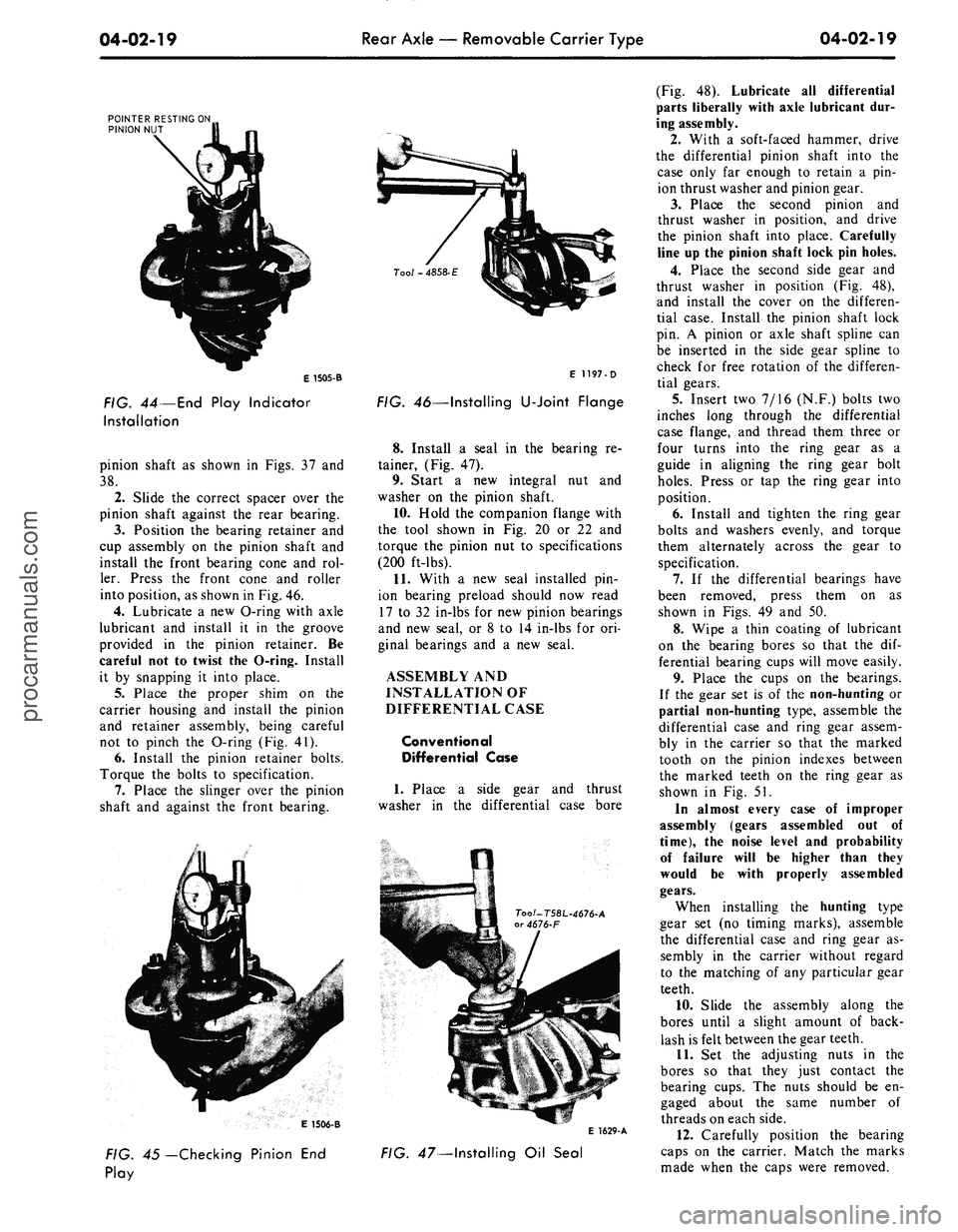
POINTER RESTING ON
PINION NUT
E 1505-B
FIG.
44
— End Play Indicator
Installation
pinion shaft as shown in Figs. 37 and
38.
2.
Slide the correct spacer over the
pinion shaft against the rear bearing.
3.
Position the bearing retainer and
cup assembly on the pinion shaft and
install the front bearing cone and rol-
ler. Press the front cone and roller
into position, as shown in Fig. 46.
4.
Lubricate a new O-ring with axle
lubricant and install it in the groove
provided in the pinion retainer. Be
careful not to twist the O-ring. Install
it by snapping it into place.
5.
Place the proper shim on the
carrier housing and install the pinion
and retainer assembly, being careful
not to pinch the O-ring (Fig. 41).
6. Install the pinion retainer bolts.
Torque the bolts to specification.
7.
Place the slinger over the pinion
shaft and against the front bearing.
Tool - 4858-
E
E 1197-D
FIG. 46—Installing
U-Joint
Flange
8. Install a seal in the bearing re-
tainer, (Fig. 47).
9. Start a new integral nut and
washer on the pinion shaft.
10.
Hold the companion flange with
the tool shown in Fig. 20 or 22 and
torque the pinion nut to specifications
(200 ft-lbs).
11.
With a new seal installed pin-
ion bearing preload should now read
17 to 32 in-lbs for new pinion bearings
and new seal, or 8 to 14 in-lbs for ori-
ginal bearings and a new seal.
ASSEMBLY AND
INSTALLATION OF
DIFFERENTIAL CASE
Conventional
Differential Case
1.
Place a side gear and thrust
washer in the differential case bore
E 1506-B
E 1629-A
FIG. 45— Checking Pinion End
Play
FIG. 47—Installing Oil Seal
(Fig. 48). Lubricate all differential
parts liberally with axle lubricant dur-
ing assembly.
2.
With a soft-faced hammer, drive
the differential pinion shaft into the
case only far enough to retain a pin-
ion thrust washer and pinion gear.
3.
Place the second pinion and
thrust washer in position, and drive
the pinion shaft into place. Carefully
line up the pinion shaft lock pin holes.
4.
Place the second side gear and
thrust washer in position (Fig. 48),
and install the cover on the differen-
tial case. Install the pinion shaft lock
pin. A pinion or axle shaft spline can
be inserted in the side gear spline to
check for free rotation of the differen-
tial gears.
5.
Insert two 7/16 (N.F.) bolts two
inches long through the differential
case flange, and thread them three or
four turns into the ring gear as a
guide in aligning the ring gear bolt
holes.
Press or tap the ring gear into
position.
6. Install and tighten the ring gear
bolts and washers evenly, and torque
them alternately across the gear to
specification.
7.
If the differential bearings have
been removed, press them on as
shown in Figs. 49 and 50.
8. Wipe a thin coating of lubricant
on the bearing bores so that the dif-
ferential bearing cups will move easily.
9. Place the cups on the bearings.
If the gear set is of the non-hunting or
partial non-hunting type, assemble the
differential case and ring gear assem-
bly in the carrier so that the marked
tooth on the pinion indexes between
the marked teeth on the ring gear as
shown in Fig. 51.
In almost every case of improper
assembly (gears assembled out of
time),
the noise level and probability
of failure will be higher than they
would be with properly assembled
gears.
When installing the hunting type
gear set (no timing marks), assemble
the differential case and ring gear as-
sembly in the carrier without regard
to the matching of any particular gear
teeth.
10.
Slide the assembly along the
bores until a slight amount of back-
lash is felt between the gear teeth.
11.
Set the adjusting nuts in the
bores so that they just contact the
bearing cups. The nuts should be en-
gaged about the same number of
threads on each side.
12.
Carefully position the bearing
caps on the carrier. Match the marks
made when the caps were removed.procarmanuals.com
Page 224 of 413
04-03-04
Rear Axles — Integral Carrier Type
04-03-04
1.
Remove the wheel cover, wheel
and tire from the brake drum.
2.
Remove the Tinnerman nuts that
secure the brake drum to the axle
housing flange, and then remove the
drum from the flange.
3.
Working through the hole pro-
vided in each axle shaft flange, re-
move the nuts that secure the wheel
bearing retainer plate. Then pull the
axle shaft assembly out of the axle
housing (Fig. 2). The brake backing
plate must, not be dislodged. Install
one nut to hold the plate in place after
the axle shaft is removed.
4.
If the rear wheel bearing is to be
replaced, loosen the inner retainer
ring by nicking it deeply with a cold
chisel in several places (Fig. 3). It will
then slide off easily.
5.
Remove the bearing from the
axle shaft with the tool shown in Fig.
4 or 5. If the push-puller operation
shown in Fig. 5 is used, be sure that
the puller arms contact the flat sur-
face of the axle shaft flange rather
than the bolt heads. Also with this
method, be careful not to damage or
burr the oil seal journal as the bearing
breaks loose.
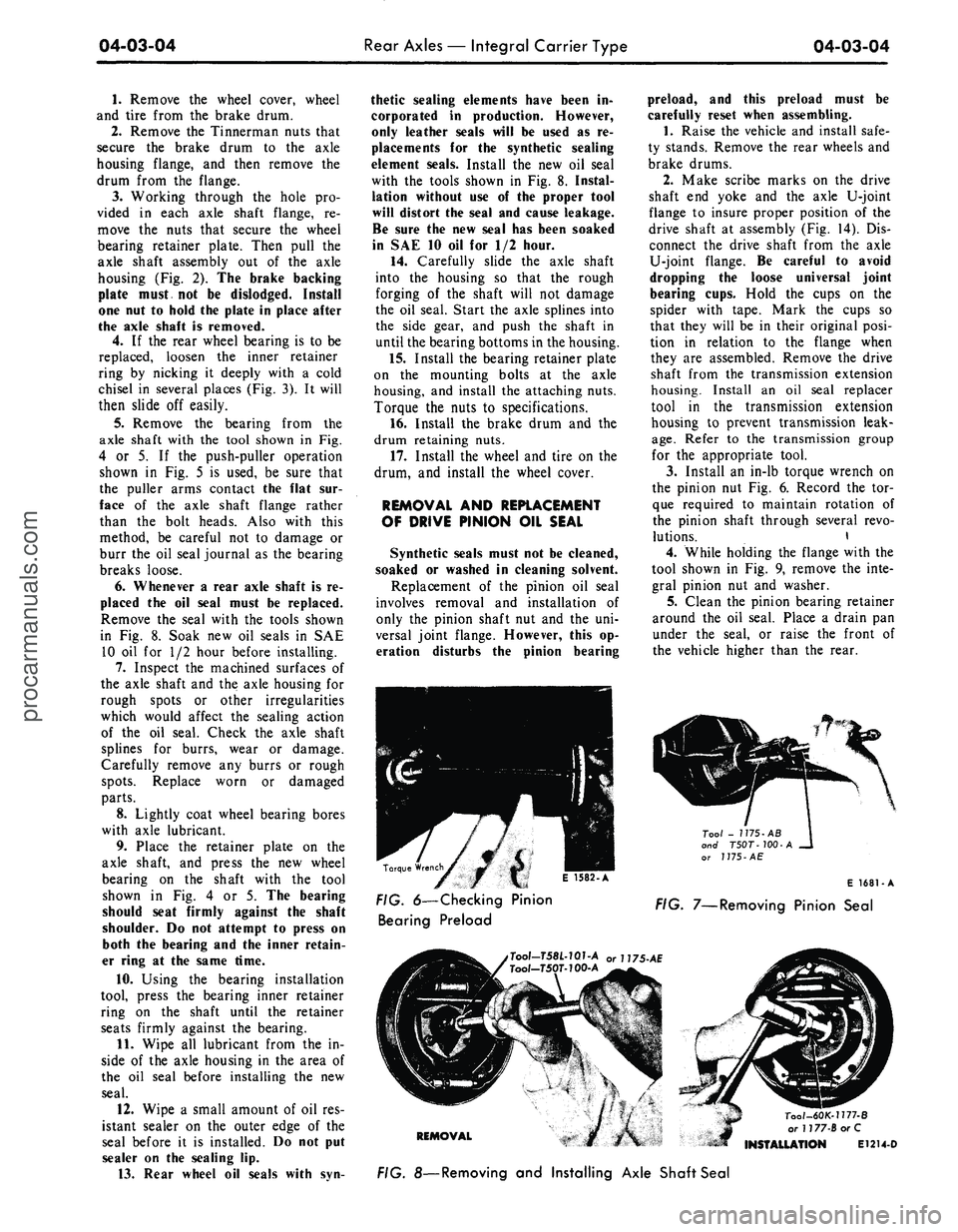
6. Whenever a rear axle shaft is re-
placed the oil seal must be replaced.
Remove the seal with the tools shown
in Fig. 8. Soak new oil seals in SAE
10 oil for 1/2 hour before installing.
7.
Inspect the machined surfaces of
the axle shaft and the axle housing for
rough spots or other irregularities
which would affect the sealing action
of the oil seal. Check the axle shaft
splines for burrs, wear or damage.
Carefully remove any burrs or rough
spots.
Replace worn or damaged
parts.
8. Lightly coat wheel bearing bores
with axle lubricant.
9. Place the retainer plate on the
axle shaft, and press the new wheel
bearing on the shaft with the tool
shown in Fig. 4 or 5. The bearing
should seat firmly against the shaft
shoulder. Do not attempt to press on
both the bearing and the inner retain-
er ring at the same time.
10.
Using the bearing installation
tool, press the bearing inner retainer
ring on the shaft until the retainer
seats firmly against the bearing.
11.
Wipe all lubricant from the in-
side of the axle housing in the area of
the oil seal before installing the new
seal.
12.
Wipe a small amount of oil res-
istant sealer on the outer edge of the
seal before it is installed. Do not put
sealer on the sealing lip.
13.
Rear wheel oil seals with syn-
thetic sealing elements have been in-
corporated in production. However,
only leather seals will be used as re-
placements for the synthetic sealing
element seals. Install the new oil seal
with the tools shown in Fig. 8. Instal-
lation without use of the proper tool
will distort the seal and cause leakage.
Be sure the new seal has been soaked
in SAE 10 oil for 1/2 hour.
14.
Carefully slide the axle shaft
into the housing so that the rough
forging of the shaft will not damage
the oil seal. Start the axle splines into
the side gear, and push the shaft in
until the bearing bottoms in the housing.
15.
Install the bearing retainer plate
on the mounting bolts at the axle
housing, and install the attaching nuts.
Torque the nuts to specifications.
16.
Install the brake drum and the
drum retaining nuts.
17.
Install the wheel and tire on the
drum, and install the wheel cover.
REMOVAL AND REPLACEMENT
OF DRIVE PINION OIL SEAL
Synthetic seals must not be cleaned,
soaked or washed in cleaning solvent.
Replacement of the pinion oil seal
involves removal and installation of
only the pinion shaft nut and the uni-
versal joint flange. However, this op-
eration disturbs the pinion bearing
preload, and this preload must be
carefully reset when assembling.
1.
Raise the vehicle and install safe-
ty stands. Remove the rear wheels and
brake drums.
2.
Make scribe marks on the drive
shaft end yoke and the axle U-joint
flange to insure proper position of the
drive shaft at assembly (Fig. 14). Dis-
connect the drive shaft from the axle
U-joint flange. Be careful to avoid
dropping the loose universal joint
bearing cups. Hold the cups on the
spider with tape. Mark the cups so
that they will be in their original posi-
tion in relation to the flange when
they are assembled. Remove the drive
shaft from the transmission extension
housing. Install an oil seal replacer
tool in the transmission extension
housing to prevent transmission leak-
age.
Refer to the transmission group
for the appropriate tool.
3.
Install an in-lb torque wrench on
the pinion nut Fig. 6. Record the tor-
que required to maintain rotation of
the pinion shaft through several revo-
lutions. \
4.
While holding the flange with the
tool shown in Fig. 9, remove the inte-
gral pinion nut and washer.
5.
Clean the pinion bearing retainer
around the oil seal. Place a drain pan
under the seal, or raise the front of
the vehicle higher than the rear.
KJ
E
I582-A
Tool - 1175-AB
and T50T-100-A
^___ or
J
775-
AE
Torque Wrench
^ mm i e
icot
A
E 1681-A
FIG. 6—Checking Pinion FiG 7_Removing
pjnjon
Sea,
Bearing Preload
,Tool-T58L-101-A or U75-AE
Tool-T50T-100-A
REMOVAL
Tool-60K-1177-B
or 1177-BorC
INSTALLATION E1214-D
FIG. 8—Removing and Installing Axle Shaft Sealprocarmanuals.com
Page 225 of 413
04-03-05
Rear Axles — Integral Carrier Type
04-03-05
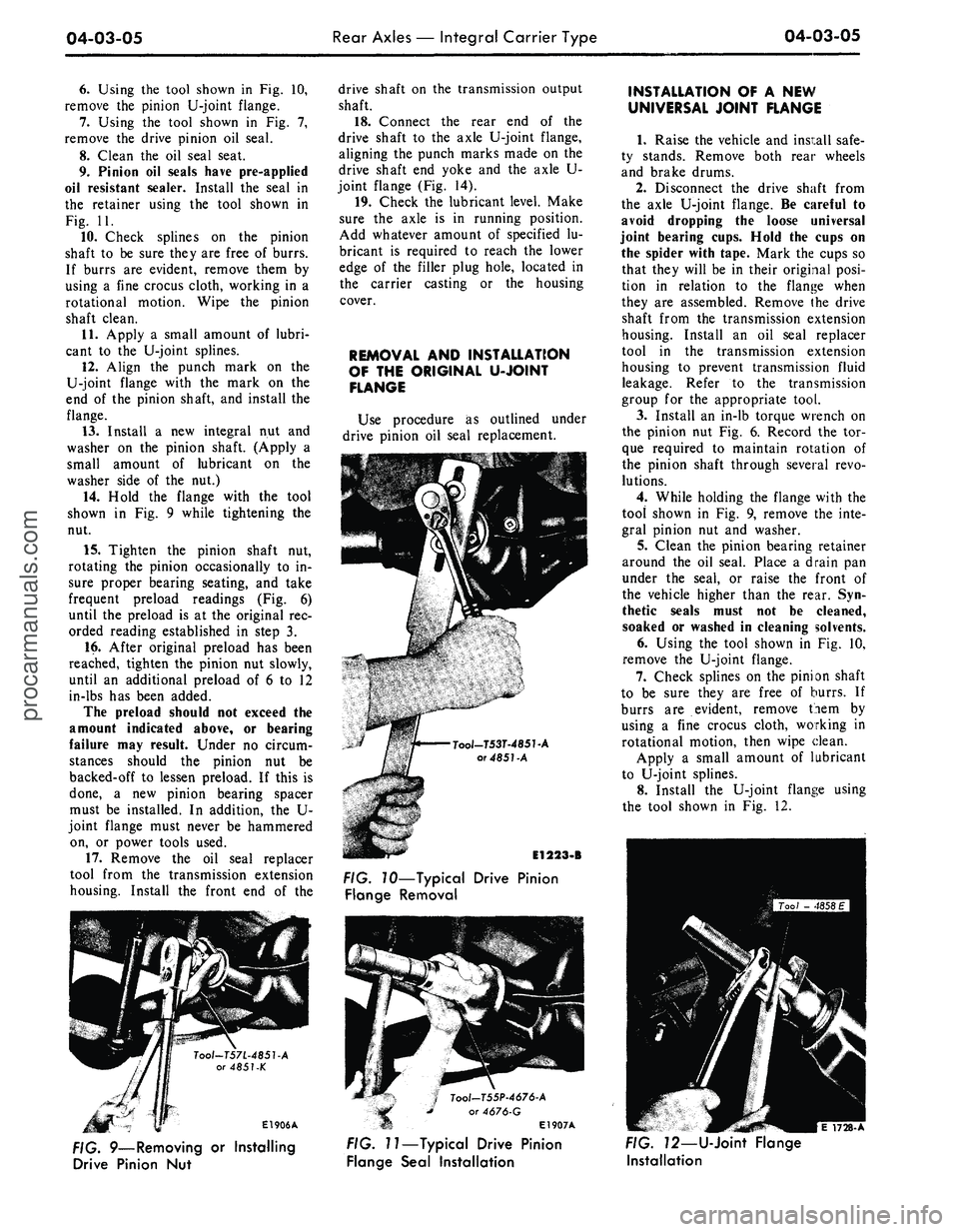
6. Using the tool shown in Fig. 10,
remove the pinion U-joint flange.
7.
Using the tool shown in Fig. 7,
remove the drive pinion oil seal.
8. Clean the oil seal seat.
9. Pinion oil seals have pre-applied
oil resistant sealer. Install the seal in
the retainer using the tool shown in
Fig. 11.
10.
Check splines on the pinion
shaft to be sure they are free of burrs.
If burrs are evident, remove them by
using a fine crocus cloth, working in a
rotational motion. Wipe the pinion
shaft clean.
11.
Apply a small amount of lubri-
cant to the U-joint splines.
12.
Align the punch mark on the
U-joint flange with the mark on the
end of the pinion shaft, and install the
flange.
13.
Install a new integral nut and
washer on the pinion shaft. (Apply a
small amount of lubricant on the
washer side of the nut.)
14.
Hold the flange with the tool
shown in Fig. 9 while tightening the
nut.
15.
Tighten the pinion shaft nut,
rotating the pinion occasionally to in-
sure proper bearing seating, and take
frequent preload readings (Fig. 6)
until the preload is at the original rec-
orded reading established in step 3.
16.
After original preload has been
reached, tighten the pinion nut slowly,
until an additional preload of 6 to 12
in-lbs has been added.
The preload should not exceed the
amount indicated above, or bearing
failure may result. Under no circum-
stances should the pinion nut be
backed-off to lessen preload. If this is
done, a new pinion bearing spacer
must be installed. In addition, the U-
joint flange must never be hammered
on, or power tools used.
17.
Remove the oil seal replacer
tool from the transmission extension
housing. Install the front end of the
drive shaft on the transmission output
shaft.
18.
Connect the rear end of the
drive shaft to the axle U-joint flange,
aligning the punch marks made on the
drive shaft end yoke and the axle U-
joint flange (Fig. 14).
19.
Check the lubricant level. Make
sure the axle is in running position.
Add whatever amount of specified lu-
bricant is required to reach the lower
edge of the filler plug hole, located in
the carrier casting or the housing
cover.
REMOVAL AND INSTALLATION
OF THE ORIGINAL U-JOINT
FLANGE
Use procedure as outlined under
drive pinion oil seal replacement.
Tool-T53T-4857-A
or
4851 -A
E1223-B
FIG. 10—Typical Drive Pinion
Flange Removal
El 906A
Tool-T55P-4676-A
or 4676-G
E1907A
INSTALLATION OF A NEW
UNIVERSAL JOINT FLANGE
1.
Raise the vehicle and install safe-
ty stands. Remove both rear wheels
and brake drums.
2.
Disconnect the drive shaft from
the axle U-joint flange. Be careful to
avoid dropping the loose universal
joint bearing cups. Hold the cups on
the spider with tape. Mark the cups so
that they will be in their original posi-
tion in relation to the flange when
they are assembled. Remove the drive
shaft from the transmission extension
housing. Install an oil seal replacer
tool in the transmission extension
housing to prevent transmission fluid
leakage. Refer to the transmission
group for the appropriate tool.
3.
Install an in-lb torque wrench on
the pinion nut Fig. 6. Record the tor-
que required to maintain rotation of
the pinion shaft through several revo-
lutions.
4.
While holding the flange with the
tool shown in Fig. 9, remove the inte-
gral pinion nut and washer.
5.
Clean the pinion bearing retainer
around the oil seal. Place a drain pan
under the seal, or raise the front of
the vehicle higher than the rear. Syn-
thetic seals must not be cleaned,
soaked or washed in cleaning solvents.
6. Using the tool shown in Fig. 10,
remove the U-joint flange.
7.
Check splines on the pinion shaft
to be sure they are free of burrs. If
burrs are evident, remove them by
using a fine crocus cloth, working in
rotational motion, then wipe clean.
Apply a small amount of lubricant
to U-joint splines.
8. Install the U-joint flange using
the tool shown in Fig. 12.
FIG. 9—Removing or Installing
Drive Pinion Nut
FIG.
11
— Typical Drive Pinion
Flange Seal Installation
FIG. 12—U-Joint Flange
Installationprocarmanuals.com
Page 226 of 413
04-03-06
Rear Axles — Integral Carrier Type
04-03-06
9. Install a new integral nut and
ivasher on the pinion shaft. (Apply a
small amount of lubricant on the
washer side of the nut.)
10.
Hold the flange with the tool
shown in Fig. 9 while the nut is being
tightened.
11.
Tighten the pinion shaft nut,
rotating the pinion occasionally to in-
sure proper bearing seating, (Fig. 6)
and take frequent preload readings
until the preload is at the original rec-
orded reading established in step 3.
12.
After original preload has been
reached, tighten the pinion nut slowly,
until an additional preload of 6 to 12
in-lbs has been added.
The preload should not exceed the
amount shown above, or bearing fail-
ure may result.
Under no circumstances should the
pinion nut be backed off to lessen pre-
load. If this is done, a new pinion
bearing spacer must be installed. (In
addition, the U-joint flange must
never be hammered on, or pneumatic-
-tools used.)
13.
Remove the oil seal replacer
tool from the transmission extension
housing. Install the front end of the
drive shaft on the transmission output
shaft.
14.
Connect the rear end of the
drive shaft to the axle U-joint flange,
aligning the scribe marks made on the
drive shaft end yoke and the axle U-
joint flange (Fig. 14).
15.
Check the lubricant level. Make
sure the axle is in running position.
Add whatever amount of specified lu-
bricant is required to reach the lower
edge of the filler plug hole, located in
the carrier casting or housing cover.
REMOVAL AND INSTALLATION
REAR AXLE HOUSING
REMOVAL
1.
Raise the vehicle and support it
with safety stands under the rear
frame member.
2.
Drain the lubricant from the
axle.
3.
Make scribe marks on the drive
shaft end yoke and the axle U-joint
flange to insure proper position of the
drive shaft at assembly (Fig. 14). Dis-
connect the drive shaft at the drive
pinion flange.
4.
Disconnect the lower end of the
shock absorbers.
5.
Remove the wheels, brake drums
and both axle shafts as outlined in the
foregoing Section 2.
6. Remove vent hose front vent
tube (Corbin clamp) and remove vent
tube from brake tube junction and
axle housing.
7.
Remove the hydraulic brake T-
fitting from the axle housing. Do not
open the hydraulic brake system lines.
Remove the hydraulic brake line from
its retaining clip on the axle housing.
8. Remove both axle shaft oil seals
with the tools shown in Fig. 8.
9. Remove both brake backing
plates from the axle housing and sus-
pend them above the housing with me-
chanic's wire. The hydraulic brake
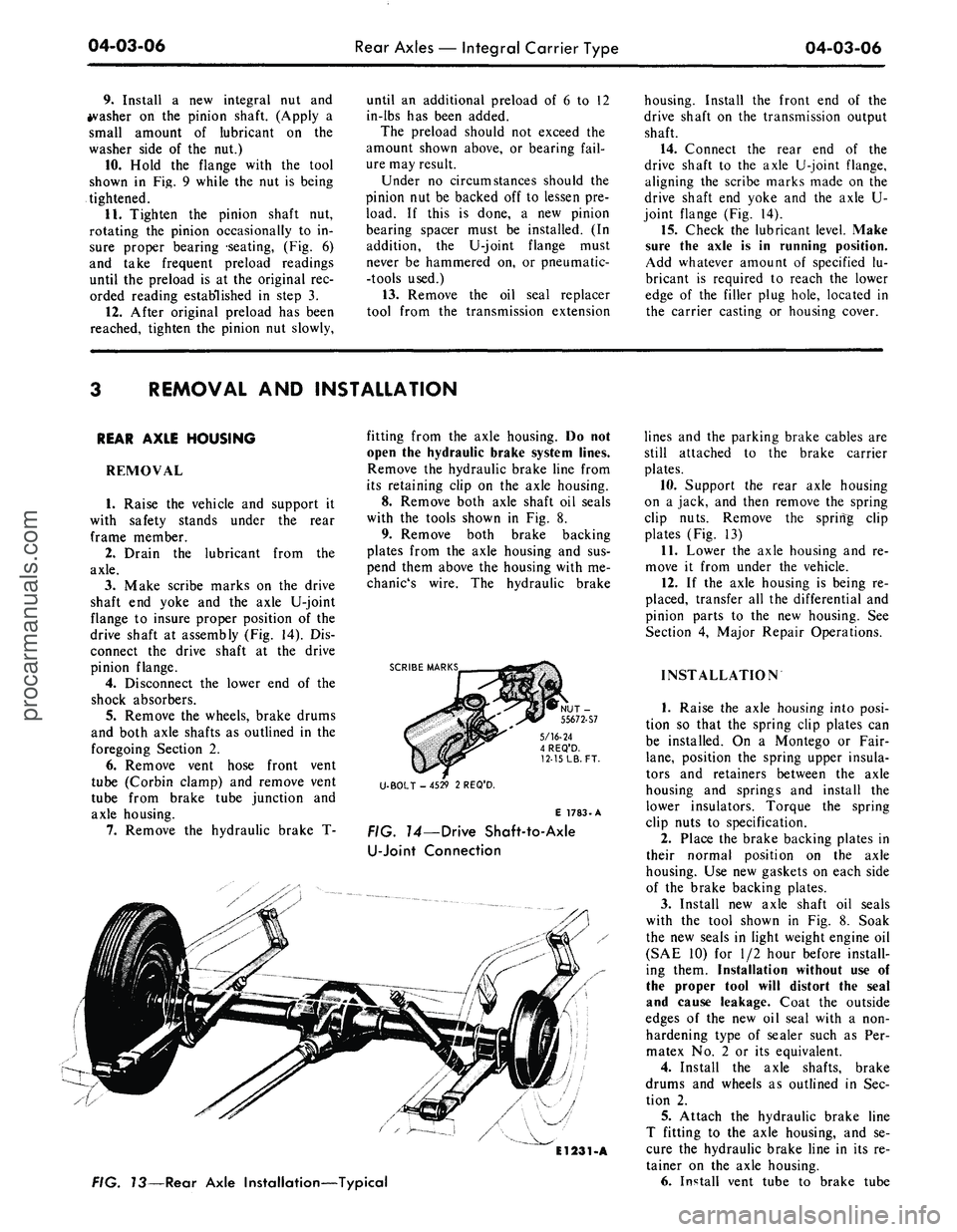
SCRIBE MARKS
5/16-24
4 REQ'D.
12-15
LB.
FT.
U-BOLT - 4529 2 REQ'D.
E 1783-A
FIG. 14—Drive Shaft-to-Axle
U-Joint
Connection
El231-A
FIG. 73—Rear Axle Installation—Typical
lines and the parking brake cables are
still attached to the brake carrier
plates.
10.
Support the rear axle housing
on a jack, and then remove the spring
clip nuts. Remove the spring clip
plates (Fig. 13)
11.
Lower the axle housing and re-
move it from under the vehicle.
12.
If the axle housing is being re-
placed, transfer all the differential and
pinion parts to the new housing. See
Section 4, Major Repair Operations.
INSTALLATION
1.
Raise the axle housing into posi-
tion so that the spring clip plates can
be installed. On a Montego or Fair-
lane,
position the spring upper insula-
tors and retainers between the axle
housing and springs and install the
lower insulators. Torque the spring
clip nuts to specification.
2.
Place the brake backing plates in
their normal position on the axle
housing. Use new gaskets on each side
of the brake backing plates.
3.
Install new axle shaft oil seals
with the tool shown in Fig. 8. Soak
the new seals in light weight engine oil
(SAE 10) for 1/2 hour before install-
ing them. Installation without use of
the proper tool will distort the seal
and cause leakage. Coat the outside
edges of the new oil seal with a non-
hardening type of sealer such as Per-
matex No. 2 or its equivalent.
4.
Install the axle shafts, brake
drums and wheels as outlined in Sec-
tion 2.
5.
Attach the hydraulic brake line
T fitting to the axle housing, and se-
cure the hydraulic brake line in its re-
tainer on the axle housing.
6. Install vent tube to brake tubeprocarmanuals.com
Page 230 of 413
04-03-10
Rear Axles
—
Integral Carrier Type
04-03-10
in
the
case. Drive
the
shaft into place
and install
the
lock
pin
(Fig.
21).
6. Place
the
ring gear
on the
differ-
ential case
and
install
the
bolts.
Tor-
que
the
bolts
to
specification.
7.
If the
differential bearings have
been removed, press them
on as
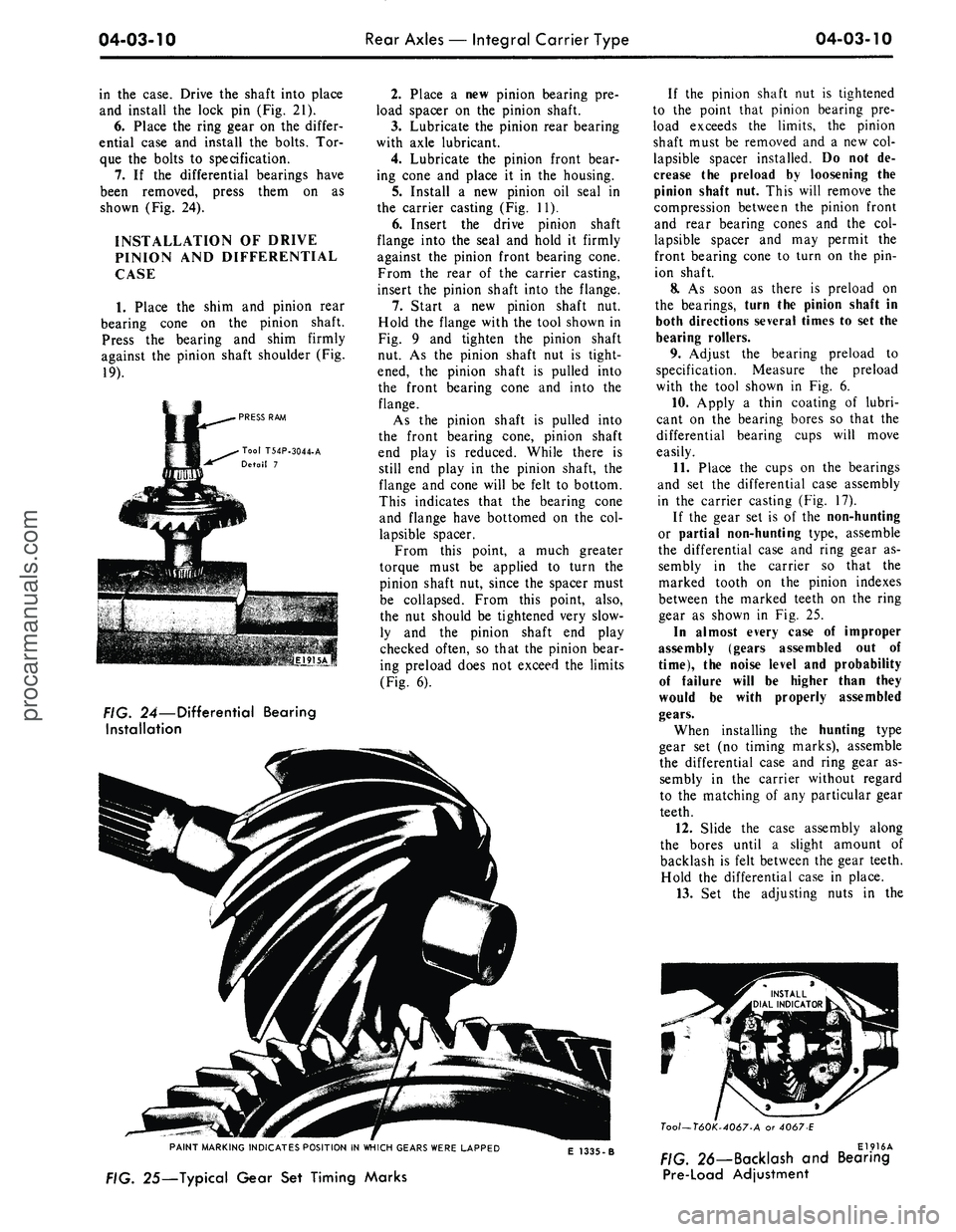
shown (Fig.
24).
INSTALLATION
OF
DRIVE
PINION
AND
DIFFERENTIAL
CASE
1.
Place
the
shim
and
pinion rear
bearing cone
on the
pinion shaft.
Press
the
bearing
and
shim firmly
against
the
pinion shaft shoulder (Fig.
19).
PRESS RAM
Tool T54P-3044-A
Detail
7
2.
Place
a new
pinion bearing
pre-
load spacer
on the
pinion shaft.
3.
Lubricate
the
pinion rear bearing
with axle lubricant.
4.
Lubricate
the
pinion front bear-
ing cone
and
place
it in the
housing.
5.
Install
a new
pinion
oil
seal
in
the carrier casting (Fig.
11).
6. Insert
the
drive pinion shaft
flange into
the
seal
and
hold
it
firmly
against
the
pinion front bearing cone.
From
the
rear
of the
carrier casting,
insert
the
pinion shaft into
the
flange.
7.
Start
a new
pinion shaft
nut.
Hold
the
flange with
the
tool shown
in
Fig.
9 and
tighten
the
pinion shaft
nut.
As the
pinion shaft
nut is
tight-
ened,
the
pinion shaft
is
pulled into
the front bearing cone
and
into
the
flange.
As
the
pinion shaft
is
pulled into
the front bearing cone, pinion shaft
end play
is
reduced. While there
is
still
end
play
in the
pinion shaft,
the
flange
and
cone will
be
felt
to
bottom.
This indicates that
the
bearing cone
and flange have bottomed
on the col-
lapsible spacer.
From this point,
a
much greater
torque must
be
applied
to
turn
the
pinion shaft
nut,
since
the
spacer must
be collapsed. From this point, also,
the
nut
should
be
tightened very slow-
ly
and the
pinion shaft
end
play
checked often,
so
that
the
pinion bear-
ing preload does
not
exceed
the
limits
(Fig.
6).
FIG. 24—Differential Bearing
Installation
If
the
pinion shaft
nut is
tightened
to
the
point that pinion bearing
pre-
load exceeds
the
limits,
the
pinion
shaft must
be
removed
and a
new
col-
lapsible spacer installed.
Do not de-
crease
the
preload
by
loosening
the
pinion shaft
nut.
This will remove
the
compression between
the
pinion front
and rear bearing cones
and the col-
lapsible spacer
and may
permit
the
front bearing cone
to
turn
on the pin-
ion shaft.
&
As
soon
as
there
is
preload
on
the bearings, turn
the
pinion shaft
in
both directions several times
to set the
bearing rollers.
9. Adjust
the
bearing preload
to
specification. Measure
the
preload
with
the
tool shown
in Fig. 6.
10.
Apply
a
thin coating
of
lubri-
cant
on the
bearing bores
so
that
the
differential bearing cups will move
easily.
11.
Place
the
cups
on the
bearings
and
set the
differential case assembly
in
the
carrier casting (Fig.
17).
If
the
gear
set is of the
non-hunting
or partial non-hunting type, assemble
the differential case
and
ring gear
as-
sembly
in the
carrier
so
that
the
marked tooth
on the
pinion indexes
between
the
marked teeth
on the
ring
gear
as
shown
in Fig. 25.
In almost every case
of
improper
assembly (gears assembled
out of
time),
the
noise level
and
probability
of failure will
be
higher than they
would
be
with properly assembled
gears.
When installing
the
hunting type
gear
set (no
timing marks), assemble
the differential case
and
ring gear
as-
sembly
in the
carrier without regard
to
the
matching
of any
particular gear
teeth.
12.
Slide
the
case assembly along
the bores until
a
slight amount
of
backlash
is
felt between
the
gear teeth.
Hold
the
differential case
in
place.
13.
Set the
adjusting nuts
in the
PAINT MARKING INDICATES POSITION
IN
WHICH GEARS WERE LAPPED
E 1335-B
FIG. 25—Typical Gear
Set
Timing Marks
7oo/—T60K-4067-A or 4067 E
E1916A
FIG. 26—Backlash
and
Bearing
Pre-Load Adjustmentprocarmanuals.com
Page 233 of 413
04-04-02
Rear Axle
—
Ford Light-Duty (WER)
04-04-02
DIFFERENTIAL
PINION-4215
RING GEAR
-
4209
LEFT AXLE
SHAFT
-
4235
1
DRIVE PINION
-
4209
SEAL
-
4676
FLANGE-4851
DEFLECTOR -4859
SEAL-
1177
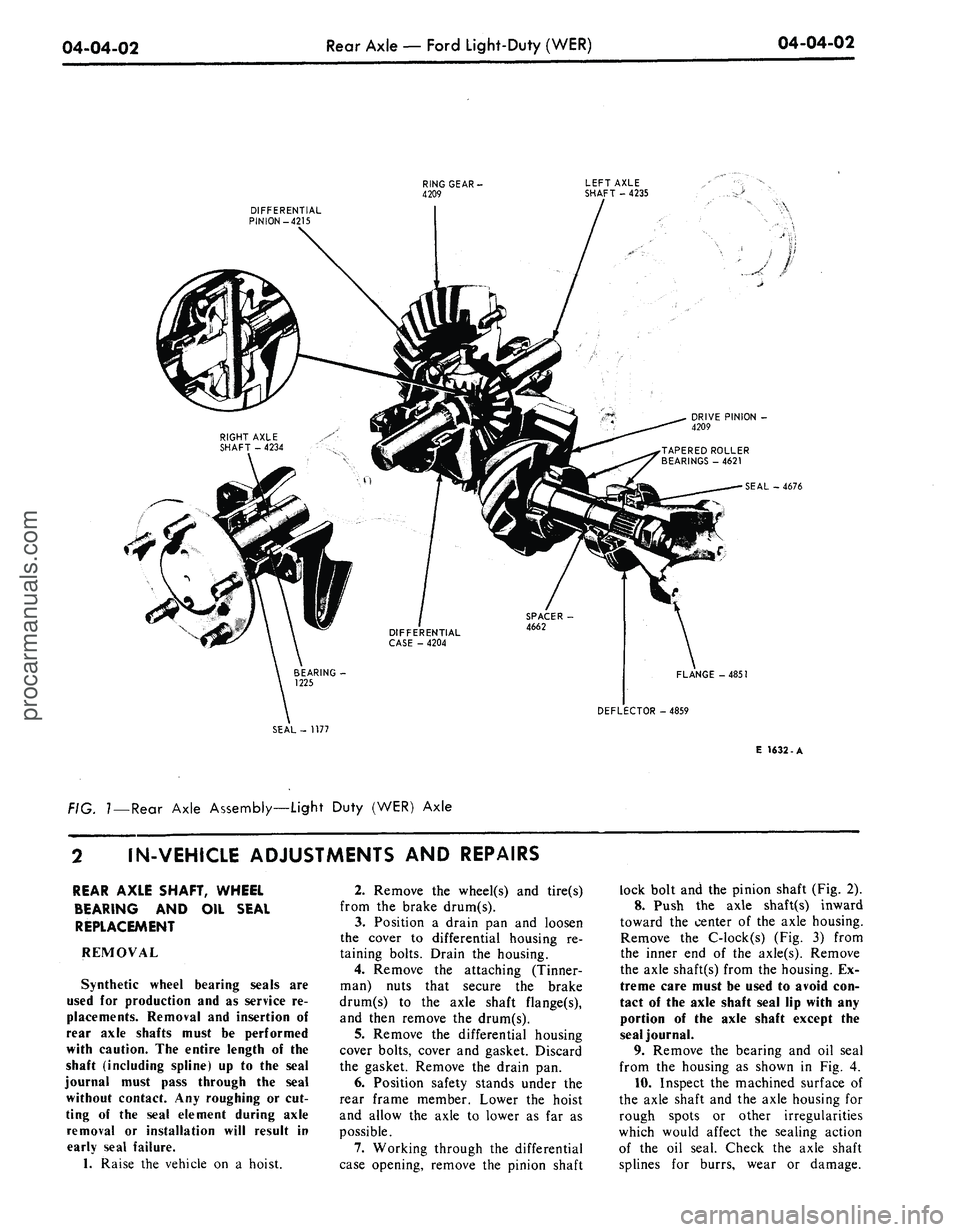
f\G.
7
—Rear Axle Assembly—Light Duty
(WER)
Axle
E 1632-A
IN-VEHICLE ADJUSTMENTS AND REPAIRS
REAR AXLE SHAFT, WHEEL
BEARING
AND OIL
SEAL
REPLACEMENT
REMOVAL
Synthetic wheel bearing seals
are
used
for
production
and as
service
re-
placements. Removal
and
insertion
of
rear axle shafts must
be
performed
with caution.
The
entire length
of the
shaft (including spline)
up to the
seal
journal must pass through
the
seal
without contact.
Any
roughing
or cut-
ting
of the
seal element during axle
removal
or
installation will result
in
early seal failure.
1.
Raise
the
vehicle
on a
hoist.
2.
Remove
the
wheel(s)
and
tire(s)
from
the
brake drum(s).
3.
Position
a
drain
pan and
loosen
the cover
to
differential housing
re-
taining bolts. Drain
the
housing.
4.
Remove
the
attaching (Tinner-
man) nuts that secure
the
brake
drum(s)
to the
axle shaft flange(s),
and then remove
the
drum(s).
5.
Remove
the
differential housing
cover bolts, cover
and
gasket. Discard
the gasket. Remove
the
drain
pan.
6. Position safety stands under
the
rear frame member. Lower
the
hoist
and allow
the
axle
to
lower
as far as
possible.
7.
Working through
the
differential
case opening, remove
the
pinion shaft
lock bolt
and the
pinion shaft
(Fig. 2).
8. Push
the
axle shaft(s) inward
toward
the
center
of the
axle housing.
Remove
the
C-lock(s)
(Fig. 3)
from
the inner
end of the
axle(s). Remove
the axle shaft(s) from
the
housing.
Ex-
treme care must
be
used
to
avoid
con-
tact
of the
axle shaft seal
lip
with
any
portion
of the
axle shaft except
the
seal journal.
9. Remove
the
bearing
and oil
seal
from
the
housing
as
shown
in Fig. 4.
10.
Inspect
the
machined surface
of
the axle shaft
and the
axle housing
for
rough spots
or
other irregularities
which would affect
the
sealing action
of
the oil
seal. Check
the
axle shaft
splines
for
burrs, wear
or
damage.procarmanuals.com
Page 238 of 413
04-04-07
Rear Axle — Ford Light-Duty (WER)
04-04-07
RUNOUT CHECK
E 1573-A
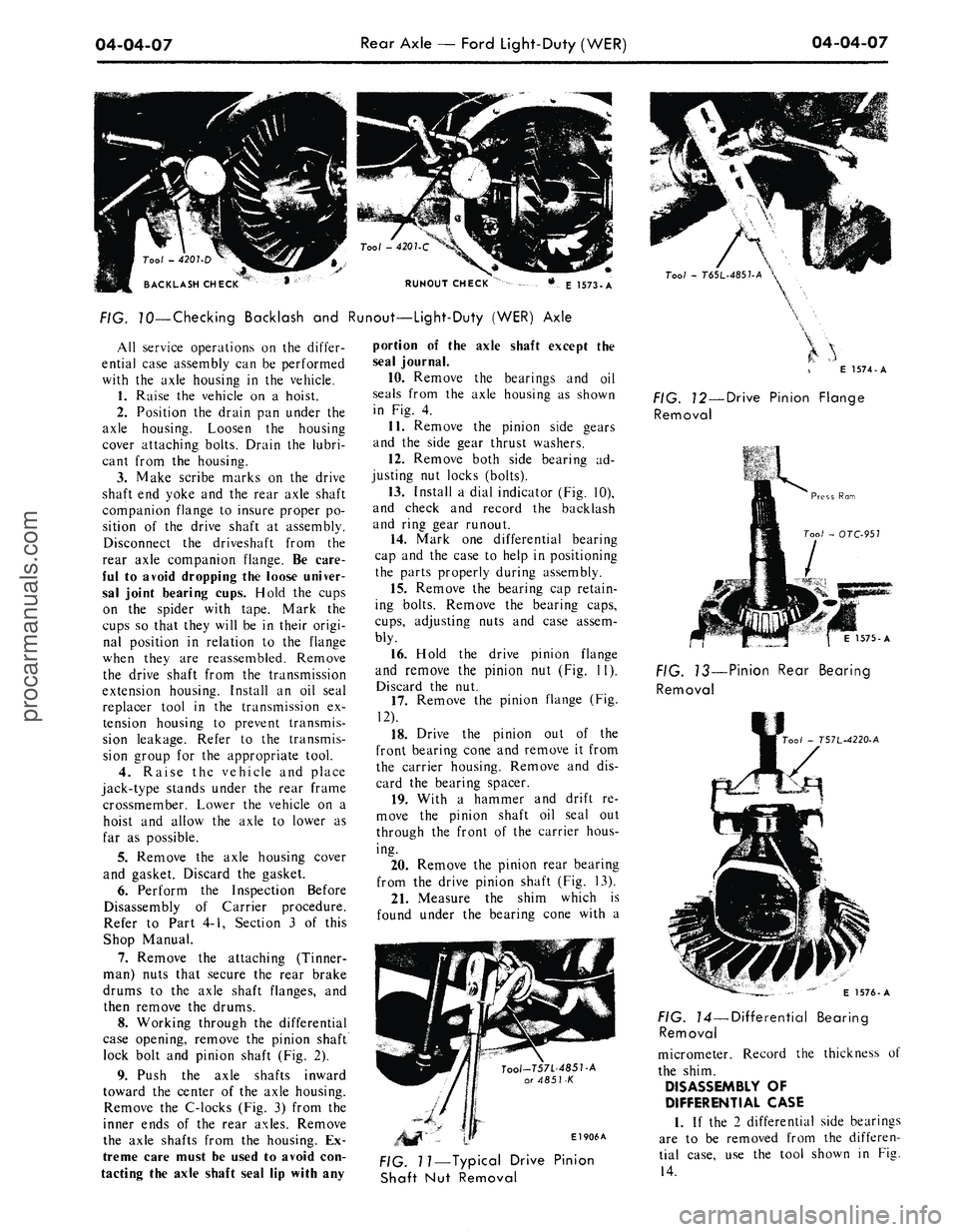
FIG. 70—Checking Backlash and Runout—Light-Duty (WER) Axle
All service operations on the differ-
ential case assembly can be performed
with the axle housing in the vehicle.
1.
Raise the vehicle on a hoist.
2.
Position the drain pan under the
axle housing. Loosen the housing
cover attaching bolts. Drain the lubri-
cant from the housing.
3.
Make scribe marks on the drive
shaft end yoke and the rear axle shaft
companion flange to insure proper po-
sition of the drive shaft at assembly.
Disconnect the driveshaft from the
rear axle companion flange. Be care-
ful to avoid dropping the loose univer-
sal joint bearing cups. Hold the cups
on the spider with tape. Mark the
cups so that they will be in their origi-
nal position in relation to the flange
when they are reassembled. Remove
the drive shaft from the transmission
extension housing. Install an oil seal
replacer tool in the transmission ex-
tension housing to prevent transmis-
sion leakage. Refer to the transmis-
sion group for the appropriate tool.
4.
Raise the vehicle and place
jack-type stands under the rear frame
crossmember. Lower the vehicle on a
hoist and allow the axle to lower as
far as possible.
5.
Remove the axle housing cover
and gasket. Discard the gasket.
6. Perform the Inspection Before
Disassembly of Carrier procedure.
Refer to Part 4-1, Section 3 of this
Shop Manual.
7.
Remove the attaching (Tinner-
man) nuts that secure the rear brake
drums to the axle shaft flanges, and
then remove the drums.
8. Working through the differential
case opening, remove the pinion shaft
lock bolt and pinion shaft (Fig. 2).
9. Push the axle shafts inward
toward the center of the axle housing.
Remove the C-locks (Fig. 3) from the
inner ends of the rear axles. Remove
the axle shafts from the housing. Ex-
treme care must be used to avoid con-
tacting the axle shaft seal lip with any
portion of the axle shaft except the
seal journal.
10.
Remove the bearings and oil
seals from the axle housing as shown
in Fig. 4.
11.
Remove the pinion side gears
and the side gear thrust washers.
12.
Remove both side bearing ad-
justing nut locks (bolts).
13.
Install a dial indicator (Fig. 10),
and check and record the backlash
and ring gear runout.
14.
Mark one differential bearing
cap and the case to help in positioning
the parts properly during assembly.
15.
Remove the bearing cap retain-
ing bolts. Remove the bearing caps,
cups,
adjusting nuts and case assem-
bly.
16.
Hold the drive pinion flange
and remove the pinion nut (Fig. 11).
Discard the nut.
17.
Remove the pinion flange (Fig.
12).
18.
Drive the pinion out of the
front bearing cone and remove it from
the carrier housing. Remove and dis-
card the bearing spacer.
19.
With a hammer and drift re-
move the pinion shaft oil seal out
through the front of the carrier hous-
ing.
20.
Remove the pinion rear bearing
from the drive pinion shaft (Fig. 13).
21.
Measure the shim which is
found under the bearing cone with a
Tool-T57L-485T-A
or 4851-K
El 906A
Tool
-
T6SL-485UA
\
E 1574-A
FIG. 12—Drive Pinion Flange
Removal
1575-A
FIG. 13—Pinion Rear Bearing
Removal
00/
- T57L-4220-A
FIG. 11—Typical Drive Pinion
Shaft Nut Removal
E 1576-A
FIG. 14—Differential Bearing
Removal
micrometer. Record the thickness of
the shim.
DISASSEMBLY OF
DIFFERENTIAL CASE
1.
If the 2 differential side bearings
are to be removed from the differen-
tial case, use the tool shown in Fig.
14.procarmanuals.com
Page 240 of 413
04-04-09
Rear Axle — Ford Light-Duty (WER)
04-04-09
case several revolutions in each direc-
tion while the bearings are loaded to
seat the bearings in their cups. This
step is important.
5. Again loosen the right nut to re-
lease the preload. Check to see that
the left nut contacts the bearing cup.
Using the dial indicator set-up shown
in Fig. 13, Part 4-1, adjust the preload
to 0.008 to 0.012 case spread for new
bearings or 0.005 to 0.008 for the
original bearings, if re-used.
6. Check the runout of the differen-
tial case flange with a dial indicator.
If the runout does not now exceed
specifications, install a new ring gear,
if the runout still exceeds specifica-
tions,
the ring gear is true and the
trouble is due to either a defective
casting or worn bearings.
7.
Remove the differential case
from the carrier and remove the side
bearings from the case.
8. Install new bearings on the case
hubs,
and again install the differential
assembly in the carrier without the
ring gear.
9. Check the case runout again with
the new bearings. If the runout is now
within limits, the old bearings were
excessively worn. Use the new bear-
ings for assembly. If the runout is still
excessive, the case is defective and
should be replaced.
ASSEMBLY OF AXLE
Refer to Part 4-1 of this Shop
Manual for Cleaning and Inspection
procedures before starting assembly
operations.
ASSEMBLY OF
DIFFERENTIAL CASE
1.
Place the ring gear on the differ-
ential case. Install the retaining bolts
and torque them to specification.
2.
If the differential bearings were
removed, press them on as shown in
Fig. 17.
3.
Insert the pinion gear shaft lock
bolt into the case (loosely).
INSTALLATION OF DRIVE
PINION AND
DIFFERENTIAL CASE
1.
Place the shim(s) and pinion rear
bearing cone on the pinion shaft.
Press the bearing and shim(s) firmly
against the pinion shaft shoulder (Fig.
18).
2.
Place a new pinion bearing pre-
load (collapsible) spacer on the pinion
shaft.
REAR BEARING
CONE AND
ROLLER
Press Ram
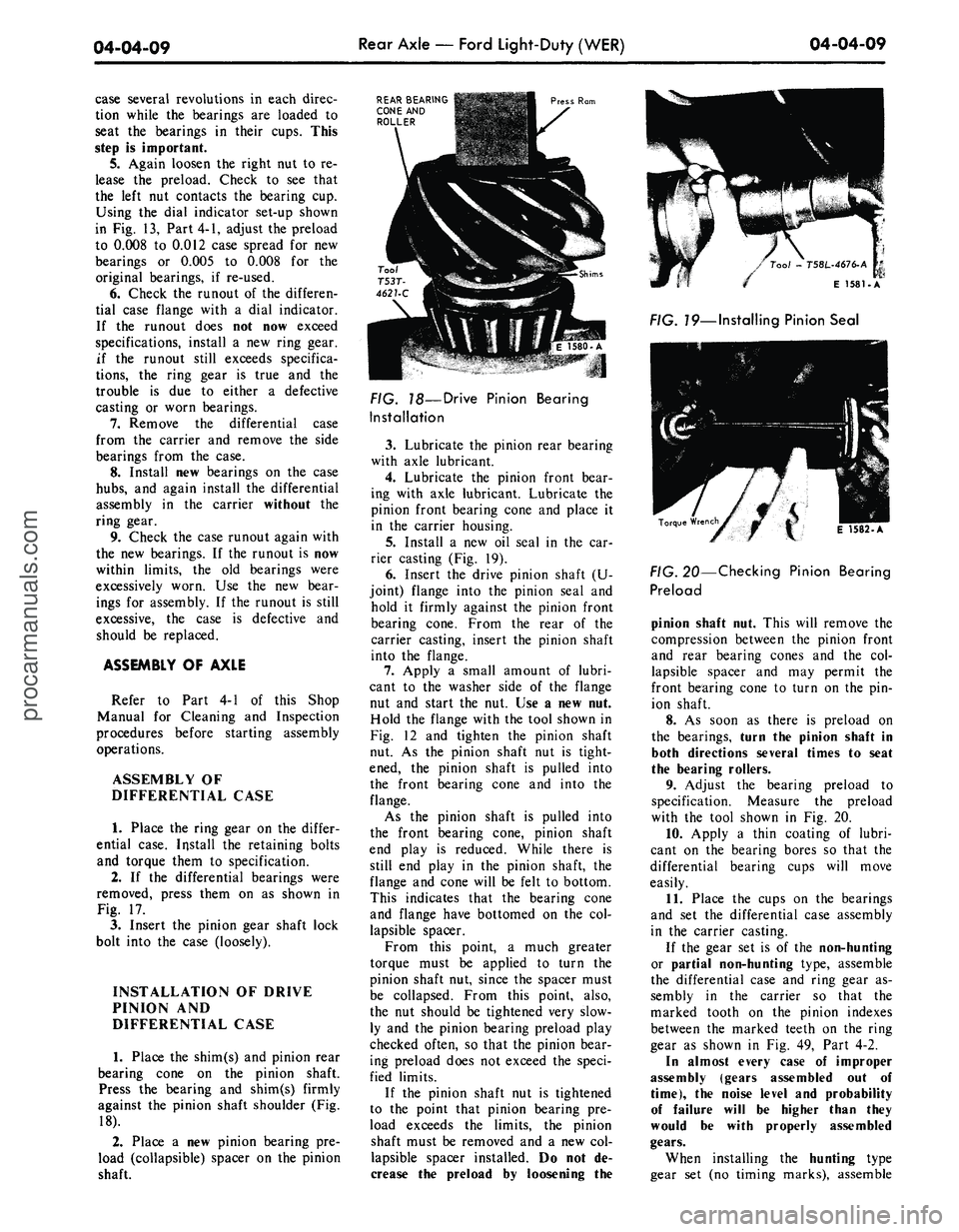
FIG. 18—Drive Pinion Bearing
Installation
3.
Lubricate the pinion rear bearing
with axle lubricant.
4.
Lubricate the pinion front bear-
ing with axle lubricant. Lubricate the
pinion front bearing cone and place it
in the carrier housing.
5.
Install a new oil seal in the car-
rier casting (Fig. 19).
6. Insert the drive pinion shaft (U-
joint) flange into the pinion seal and
hold it firmly against the pinion front
bearing cone. From the rear of the
carrier casting, insert the pinion shaft
into the flange.
7.
Apply a small amount of lubri-
cant to the washer side of the flange
nut and start the nut. Use a new nut.
Hold the flange with the tool shown in
Fig. 12 and tighten the pinion shaft
nut. As the pinion shaft nut is tight-
ened, the pinion shaft is pulled into
the front bearing cone and into the
flange.
As the pinion shaft is pulled into
the front bearing cone, pinion shaft
end play is reduced. While there is
still end play in the pinion shaft, the
flange and cone will be felt to bottom.
This indicates that the bearing cone
and flange have bottomed on the col-
lapsible spacer.
From this point, a much greater
torque must be applied to turn the
pinion shaft nut, since the spacer must
be collapsed. From this point, also,
the nut should be tightened very slow-
ly and the pinion bearing preload play
checked often, so that the pinion bear-
ing preload does not exceed the speci-
fied limits.
If the pinion shaft nut is tightened
to the point that pinion bearing pre-
load exceeds the limits, the pinion
shaft must be removed and a new col-
lapsible spacer installed. Do not de-
crease the preload by loosening the
/
Tool
-
T58L-4676-A
/ E
1581-A
FIG. 19—Installing Pinion Seal
E 1582-A
FIG. 20—Checking Pinion Bearing
Preload
pinion shaft nut. This will remove the
compression between the pinion front
and rear bearing cones and the col-
lapsible spacer and may permit the
front bearing cone to turn on the pin-
ion shaft.
8. As soon as there is preload on
the bearings, turn the pinion shaft in
both directions several times to seat
the bearing rollers.
9. Adjust the bearing preload to
specification. Measure the preload
with the tool shown in Fig. 20.
10.
Apply a thin coating of lubri-
cant on the bearing bores so that the
differential bearing cups will move
easily.
11.
Place the cups on the bearings
and set the differential case assembly
in the carrier casting.
If the gear set is of the non-hunting
or partial non-hunting type, assemble
the differential case and ring gear as-
sembly in the carrier so that the
marked tooth on the pinion indexes
between the marked teeth on the ring
gear as shown in Fig. 49, Part 4-2.
In almost every case of improper
assembly (gears assembled out of
time),
the noise level and probability
of failure will be higher than they
would be with properly assembled
gears.
When installing the hunting type
gear set (no timing marks), assembleprocarmanuals.com
Page 244 of 413
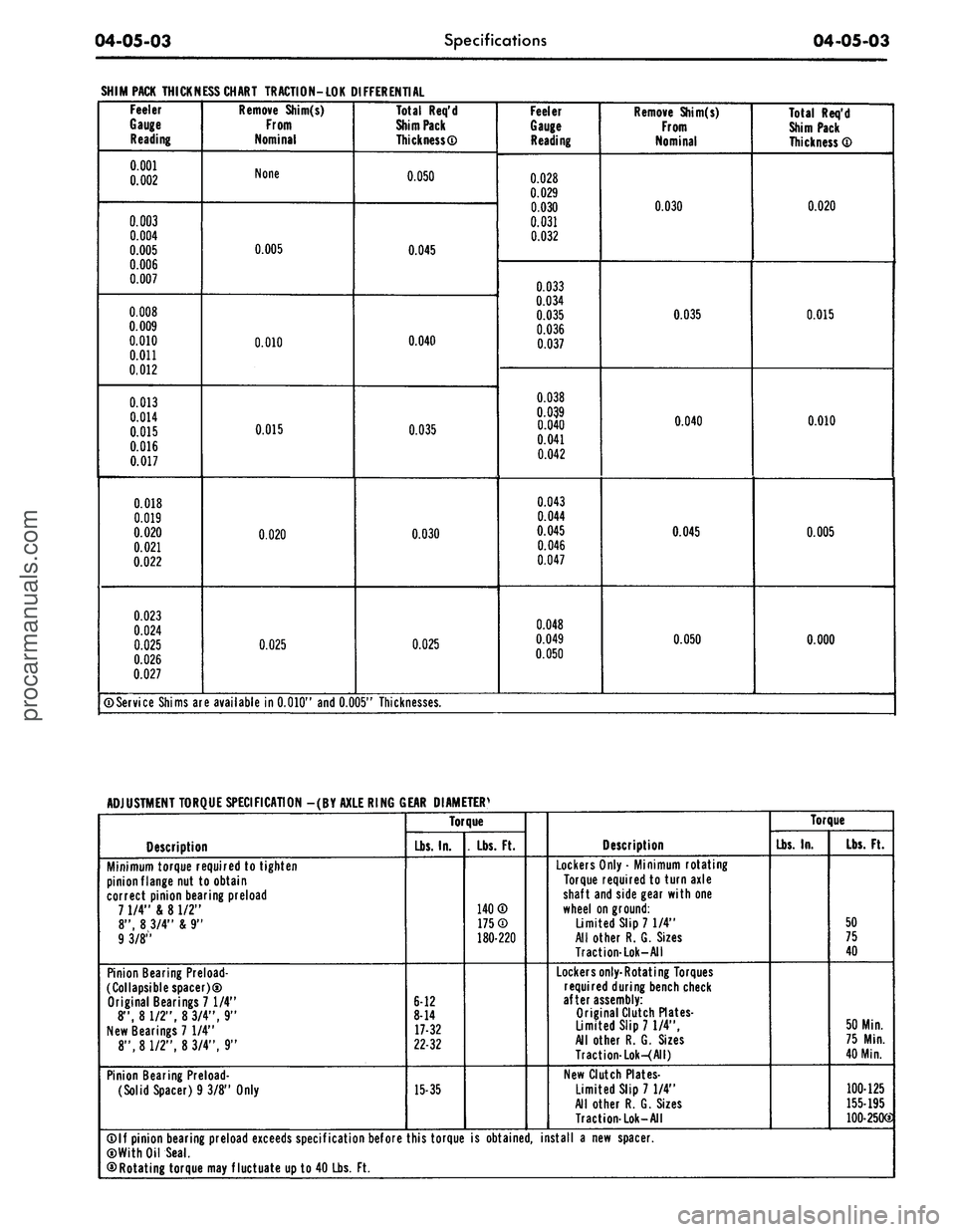
04-05-03
Specifications
04-05-03
SHIM PACK THICKNESS CHART TRACTION-LOK DIFFERENTIAL
Feeler
Gauge
Reading
0.001
0.002
0.003
0.004
0.005
0.006
0.007
0.008
0.009
0.010
0.011
0.012
0.013
0.014
0.015
0.016
0.017
0.018
0.019
0.020
0.021
0.022
0.023
0.024
0.025
0.026
0.027
Remove Shim(s)
From
Nominal
None
0.005
0.010
0.015
0.020
0.025
Total Req'd
Shim Pack
Thickness®
0.050
0.045
0.040
0.035
0.030
0.025
Feeler
Gauge
Reading
0.028
0.029
0.030
0.031
0.032
0.033
0.034
0.035
0.036
0.037
0.038
0.039
0.040
0.041
0.042
0.043
0.044
0.045
0.046
0.047
0.048
0.049
0.050
Remove Shim(s)
From
Nominal
0.030
0.035
0.040
0.045
0.050
Total Req'd
Shim Pack
Thickness ®
0.020
0.015
0.010
0.005
0.000
©Service Shims are available in 0.010" and 0.005" Thicknesses.
ADJUSTMENT TORQUE SPECIFICATION -(BY AXLE RING GEAR DIAMETERS
Description
Minimum torque required to tighten
pinion flange nut to obtain
correct pinion bearing preload
7 1/4" & 8 1/2"
8", 8 3/4" & 9"
9 3/8"
Pinion Bearing Preload-
collapsible spacer)®
Original Bearings 7 1/4"
8", 8 1/2", 8 3/4", 9"
New Bearings 7 1/4"
8", 8 1/2", 8 3/4", 9"
Pinion Bearing Preload-
(Solid Spacer) 9 3/8" Only
Torque
Lbs.
In.
6-12
8-14
17-32
22-32
15-35
. Lbs. Ft.
140®
175®
180-220
Description
Lockers Only • Minimum rotating
Torque required to turn axle
shaft and side gear with one
wheel on ground:
Limited Slip 7 1/4"
All other R. G. Sizes
Traction-Lok-All
Lockers only-Rotating Torques
required during bench check
after assembly:
Original Clutch Plates-
Limited Slip 71/4",
All other R. G. Sizes
Traction-Lok-(All)
New Clutch Plates-
Limited Slip 7 1/4"
All other R. G. Sizes
Traction-Lok-All
Torque
Lbs.
In.
Lbs.
Ft.
50
75
40
50 Min.
75 Min.
40 Min.
100-125
155-195
100-250G
©If pinion bearing preload exceeds specification before this torque is obtained, install a new spacer.
©With Oil Seal.
©Rotating torque may fluctuate up to 40 Lbs. Ft.procarmanuals.com
Page 245 of 413
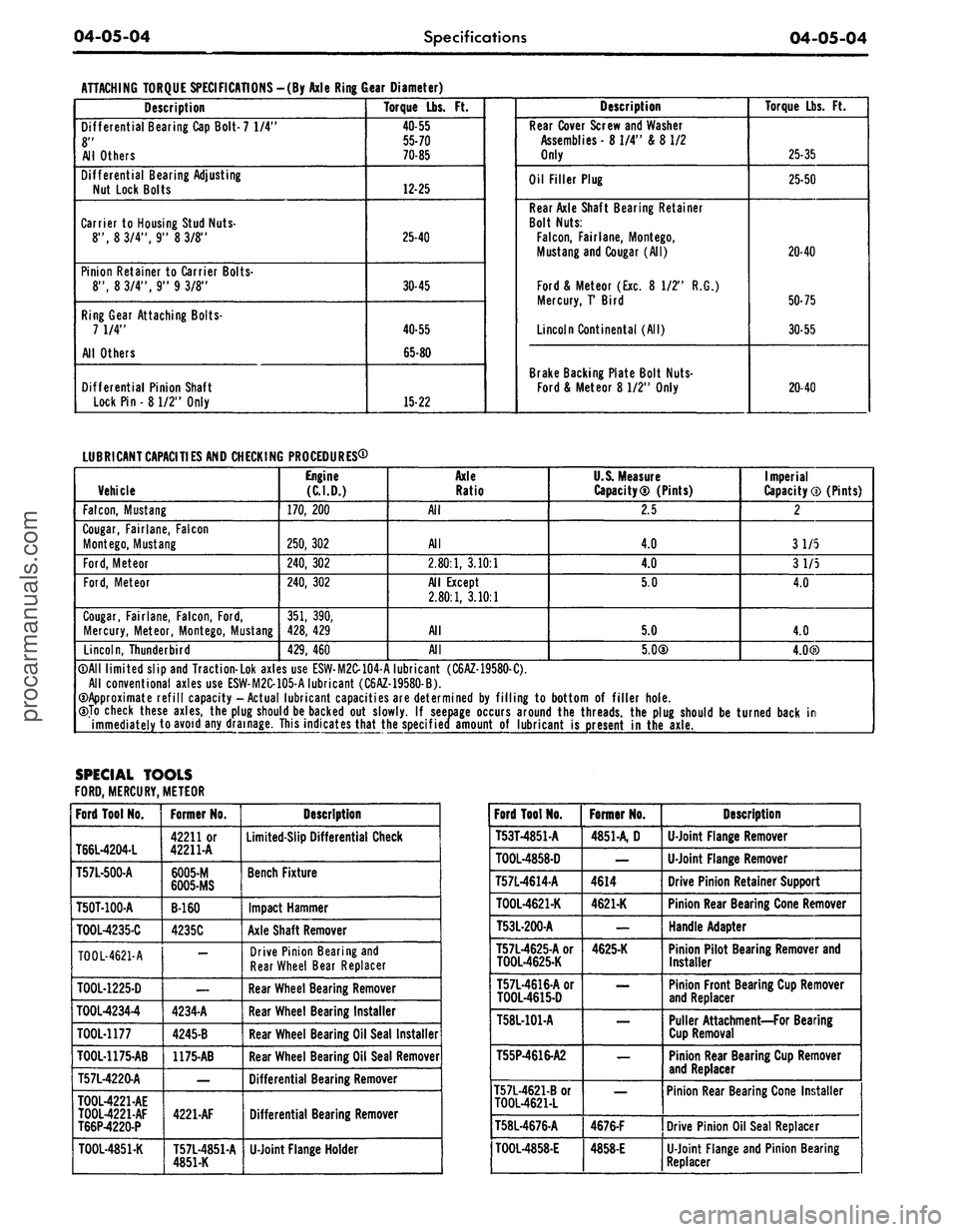
04-05-04
Specifications
04-05-04
ATTACHING TORQUE SPECIFICATIONS -(By Axle Ring Gear Diameter)
Description
Differential Bearing Cap Bolt- 7 1/4"
8"
All Others
Differential Bearing Adjusting
Nut Lock Bolts
Carrier
to
Housing Stud Nuts-
8", 8 3/4", 9" 8 3/8"
Pinion Retainer
to
Carrier Bolts-
8", 8 3/4", 9" 9 3/8"
Ring Gear Attaching Bolts-
7 1/4"
All Others
Differential Pinion Shaft
Lock Pin
•
8 1/2" Only
Torque Lbs.
Ft.
40-55
55-70
70-85
12-25
25-40
30-45
40-55
65-80
15-22
Description
Rear Cover Screw and Washer
Assemblies
-8
1/4" &
8
1/2
Only
Oil Filler Plug
Rear Axle Shaft Bearing Retainer
Bolt Nuts:
Falcon,
Fairlane, Montego,
Mustang and Cougar (All)
Ford & Meteor (Exc.
8 1/2" R.G.)
Mercury,
T
Bird
Lincoln Continental (All)
Brake Backing Plate Bolt Nuts-
Ford & Meteor
8
1/2" Only
Torque Lbs.
Ft.
25-35
25-50
20-40
50-75
30-55
20-40
LUBRICANT
CAPACITIES
AND CHECKING PROCEDURES®
Vehicle
Falcon,
Mustang
Cougar, Fairlane, Falcon
Montego, Mustang
Ford,
Meteor
Ford,
Meteor
Cougar, Fairlane, Falcon, Ford,
Mercury, Meteor, Montego, Mustang
Lincoln,
Thunderbird
Engine
(C.I.D.)
170,
200
250,
302
240,
302
240,
302
351,
390,
428,
429
429,
460
Axle
Ratio
All
All
2.80:1,
3.10:1
All Except
2.80:1,
3.10:1
All
All
U.S. Measure
Capacity® (Pints)
2.5
4.0
4.0
5.0
5.0
5.0©
Imperial
Capacity
CD
(Pints)
2
31/5
3 1/5
4.0
4.0
4.0©
©All limited slip and Traction-Lok axles use ESW-M2C-104-A lubricant (C6AZ-19580-C).
All conventional axles use ESW-M2C-105-A lubricant (C6AZ-19580-B).
©Approximate refill capacity-Actual lubricant capacities are determined
by
filling
to
bottom
of
filler hole.
©To check these axles, the plug should be backed
out
slowly.
If
seepage occurs around the threads, the plug should
be
turned back
in
immediately to avoid any drainage. This indicates that the specified amount
of
lubricant
is
present
in
the axle.
SPECIAL TOOLS
FORD,
MERCURY, METEOR
Ford Tool No.
T66L-4204-L
T57L-500-A
T50T-100-A
TOOL-4235-C
T00L-4621-A
TOOL-1225-D
T00L42344
TOOL-1177
TOOL-U75-AB
T57L4220-A
T00L4221-AE
T00L-4221-AF
T66P-4220-P
TOOL-4851-K
Former No.
42211 or
42211-A
6005-M
6005-MS
B-160
4235C
—
—
4234-A
4245-B
1175-AB
—
4221-AF
T57L-4851-A
4851-K
Description
Limited-Slip Differential Check
Bench Fixture
Impact Hammer
Axle Shaft Remover
Drive Pinion Bearing and
Rear Wheel Bear Replacer
Rear Wheel Bearing Remover
Rear Wheel Bearing Installer
Rear Wheel Bearing Oil Seal Installer
Rear Wheel Bearing Oil Seal Remover
Differential Bearing Remover
Differential Bearing Remover
U-Joint
Flange Holder
Ford Tool No.
T53T4851-A
T00L4858-D
T57L4614-A
T00L4621-K
T53L-200-A
T57L-4625-A or
T00L4625-K
T57L4616-A or
T00L4615-D
T58L-101-A
T55P4616-A2
T57L4621-B or
T00L4621-L
T58L4676-A
T00L4858-E
Former No.
4851-A, D
—
4614
4621-K
—
4625-K
—
—
—
—
4676-F
4858-E
Description
U-Joint
Flange Remover
U-Joint
Flange Remover
Drive Pinion Retainer Support
Pinion Rear Bearing Cone Remover
Handle Adapter
Pinion Pilot Bearing Remover and
Installer
Pinion Front Bearing Cup Remover
and Replacer
Puller Attachment—For Bearing
Cup Removal
Pinion Rear Bearing Cup Remover
and Replacer
Pinion Rear Bearing Cone Installer
Drive Pinion Oil Seal Replacer
U-Joint
Flange and Pinion Bearing
Replacerprocarmanuals.com