ECU FORD MUSTANG 1969 Volume One Chassis
[x] Cancel search | Manufacturer: FORD, Model Year: 1969, Model line: MUSTANG, Model: FORD MUSTANG 1969Pages: 413, PDF Size: 75.81 MB
Page 158 of 413
03-09-06
Saginaw Design Integral Power Steering Gear
03-09-06
ADJUSTER
PLUG
DUST
SEAL
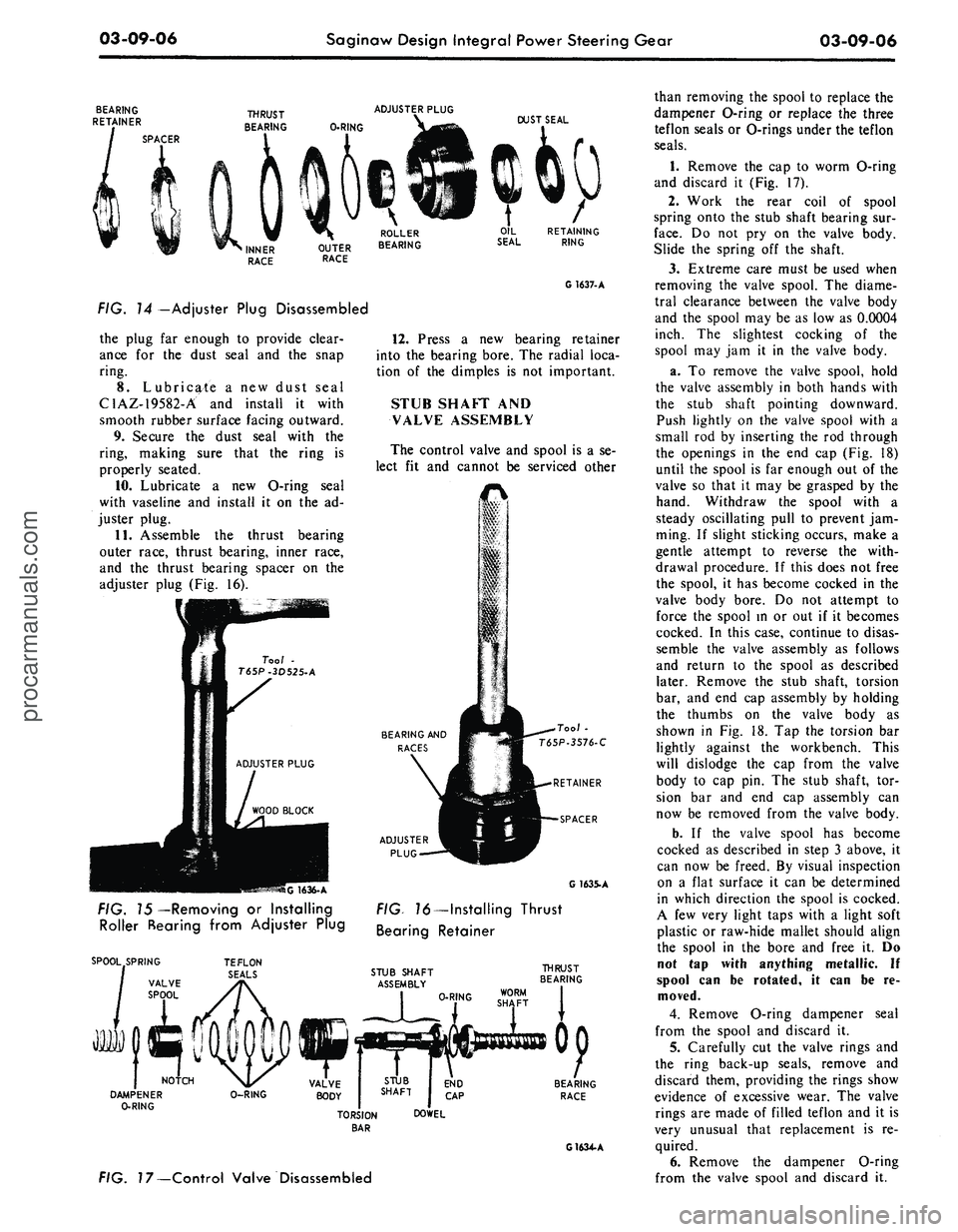
FIG. 14 —Adjuster Plug Disassembled
the plug far enough to provide clear-
ance for the dust seal and the snap
ring.
8. Lubricate a new dust seal
C1AZ-19582-A and install it with
smooth rubber surface facing outward.
9. Secure the dust seal with the
ring, making sure that the ring is
properly seated.
10.
Lubricate a new O-ring seal
with vaseline and install it on the ad-
juster plug.
11.
Assemble the thrust bearing
outer race, thrust bearing, inner race,
and the thrust bearing spacer on the
adjuster plug (Fig. 16).
OIL
RETAINING
SEAL
RING
G
1637-A
12.
Press a new bearing retainer
into the bearing bore. The radial loca-
tion of the dimples is not important.
STUB SHAFT AND
VALVE ASSEMBLY
The control valve and spool is a se-
lect fit and cannot be serviced other
BEARING
AND
RACES
1636-A
FIG. 15 —Removing or Installing
Roller Rearing from Adjuster Plug
G
1635-A
FIG.
76
—Installing Thrust
Bearing Retainer
SPOOL
SPRING
DOWEL
BEARING
RACE
G1634-A
FIG. 77—Control Valve Disassembled
than removing the spool to replace the
dampener O-ring or replace the three
teflon seals or O-rings under the teflon
seals.
1.
Remove the cap to worm O-ring
and discard it (Fig. 17).
2.
Work the rear coil of spool
spring onto the stub shaft bearing sur-
face.
Do not pry on the valve body.
Slide the spring off the shaft.
3.
Extreme care must be used when
removing the valve spool. The diame-
tral clearance between the valve body
and the spool may be as low as 0.0004
inch. The slightest cocking of the
spool may jam it in the valve body.
a. To remove the valve spool, hold
the valve assembly in both hands with
the stub shaft pointing downward.
Push lightly on the valve spool with a
small rod by inserting the rod through
the openings in the end cap (Fig. 18)
until the spool is far enough out of the
valve so that it may be grasped by the
hand. Withdraw the spool with a
steady oscillating pull to prevent jam-
ming. If slight sticking occurs, make a
gentle attempt to reverse the with-
drawal procedure. If this does not free
the spool, it has become cocked in the
valve body bore. Do not attempt to
force the spool in or out if it becomes
cocked. In this case, continue to disas-
semble the valve assembly as follows
and return to the spool as described
later. Remove the stub shaft, torsion
bar, and end cap assembly by holding
the thumbs on the valve body as
shown in Fig. 18. Tap the torsion bar
lightly against the workbench. This
will dislodge the cap from the valve
body to cap pin. The stub shaft, tor-
sion bar and end cap assembly can
now be removed from the valve body.
b.
If the valve spool has become
cocked as described in step 3 above, it
can now be freed. By visual inspection
on a flat surface it can be determined
in which direction the spool is cocked.
A few very light taps with a light soft
plastic or raw-hide mallet should align
the spool in the bore and free it. Do
not tap with anything metallic. If
spool can be rotated, it can be re-
moved.
4.
Remove O-ring dampener seal
from the spool and discard it.
5.
Carefully cut the valve rings and
the ring back-up seals, remove and
discard them, providing the rings show
evidence of excessive wear. The valve
rings are made of filled teflon and it is
very unusual that replacement is re-
quired.
6. Remove the dampener O-ring
from the valve spool and discard it.procarmanuals.com
Page 160 of 413
03-09-08
Saginaw Design Integral Power Steering Gear
03-09-08
Code
Size
6
7
8
9
10
11
Diameter
Mean
0.28117
0.28125
0.28133
0.28141
0.28149
0.28157
Size Range of Ball
(Inch)
0.28112-0.28122
0.28120-0.28130
0.28128-0.28138
0.28136-0.28146
0.28144-0.28154
0.28152-0.28162
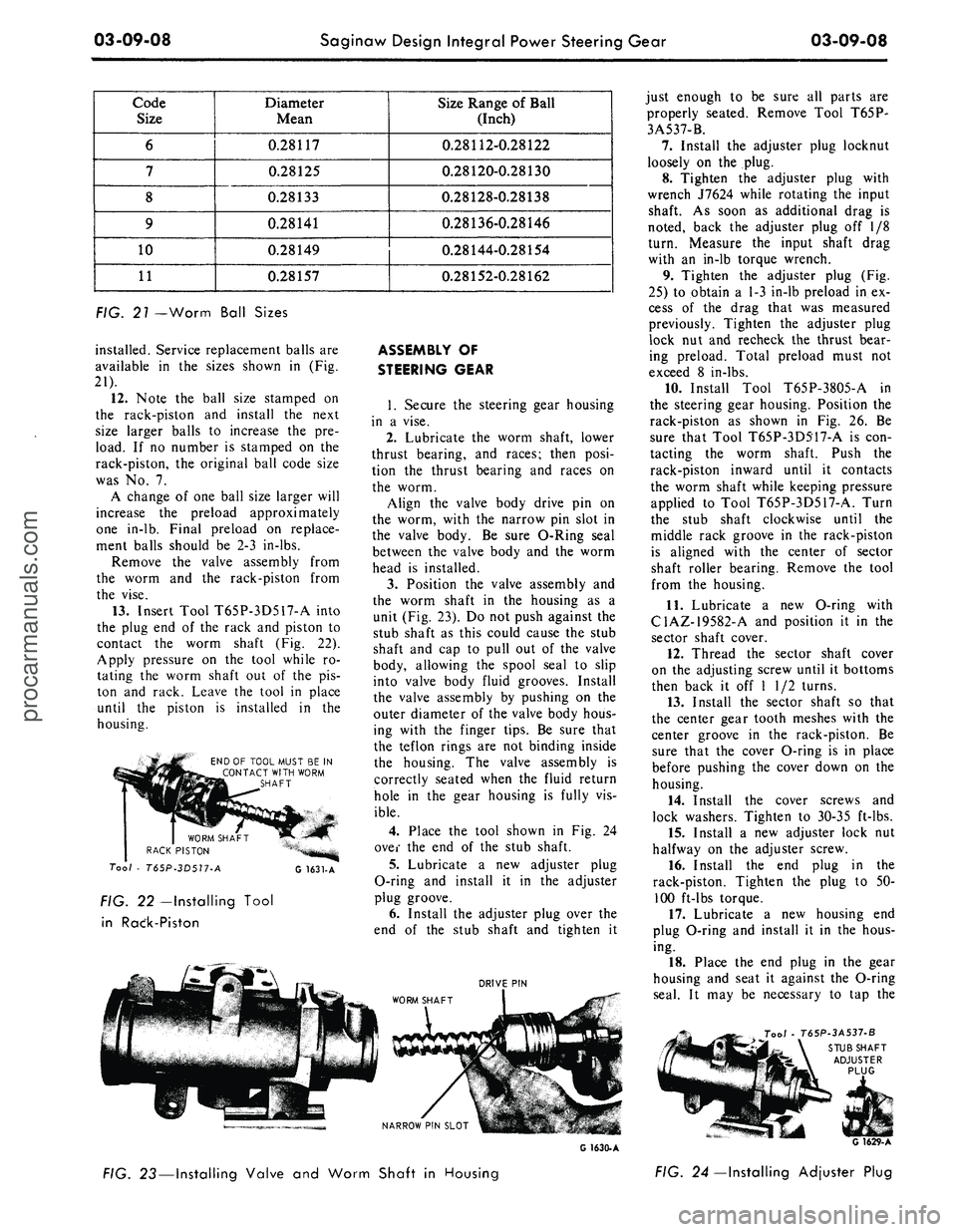
FIG. 21 —Worm Ball Sizes
installed. Service replacement balls are
available in the sizes shown in (Fig.
21).
12.
Note the ball size stamped on
the rack-piston and install the next
size larger balls to increase the pre-
load. If no number is stamped on the
rack-piston, the original ball code size
was No. 7.
A change of one ball size larger will
increase the preload approximately
one in-lb. Final preload on replace-
ment balls should be 2-3 in-lbs.
Remove the valve assembly from
the worm and the rack-piston from
the vise.
13.
Insert Tool T65P-3D517-A into
the plug end of the rack and piston to
contact the worm shaft (Fig. 22).
Apply pressure on the tool while ro-
tating the worm shaft out of the pis-
ton and rack. Leave the tool in place
until the piston is installed in the
housing.
END OF TOOL MUST BE IN
CONTACT WITH WORM
SHAFT
Tool * T65P-3D517-A
FIG. 22—Installing Tool
in Raek-Piston
G 1631-A
ASSEMBLY OF
STEERING GEAR
1.
Secure the steering gear housing
in a vise.
2.
Lubricate the worm shaft, lower
thrust bearing, and races; then posi-
tion the thrust bearing and races on
the worm.
Align the valve body drive pin on
the worm, with the narrow pin slot in
the valve body. Be sure O-Ring seal
between the valve body and the worm
head is installed.
3.
Position the valve assembly and
the worm shaft in the housing as a
unit (Fig. 23). Do not push against the
stub shaft as this could cause the stub
shaft and cap to pull out of the valve
body, allowing the spool seal to slip
into valve body fluid grooves. Install
the valve assembly by pushing on the
outer diameter of the valve body hous-
ing with the finger tips. Be sure that
the teflon rings are not binding inside
the housing. The valve assembly is
correctly seated when the fluid return
hole in the gear housing is fully vis-
ible.
4.
Place the tool shown in Fig. 24
over the end of the stub shaft.
5.
Lubricate a new adjuster plug
O-ring and install it in the adjuster
plug groove.
6. Install the adjuster plug over the
end of the stub shaft and tighten it
DRIVE PIN
just enough to be sure all parts are
properly seated. Remove Tool T65P-
3A537-B.
7.
Install the adjuster plug locknut
loosely on the plug.
8. Tighten the adjuster plug with
wrench J7624 while rotating the input
shaft. As soon as additional drag is
noted, back the adjuster plug off 1/8
turn. Measure the input shaft drag
with an in-lb torque wrench.
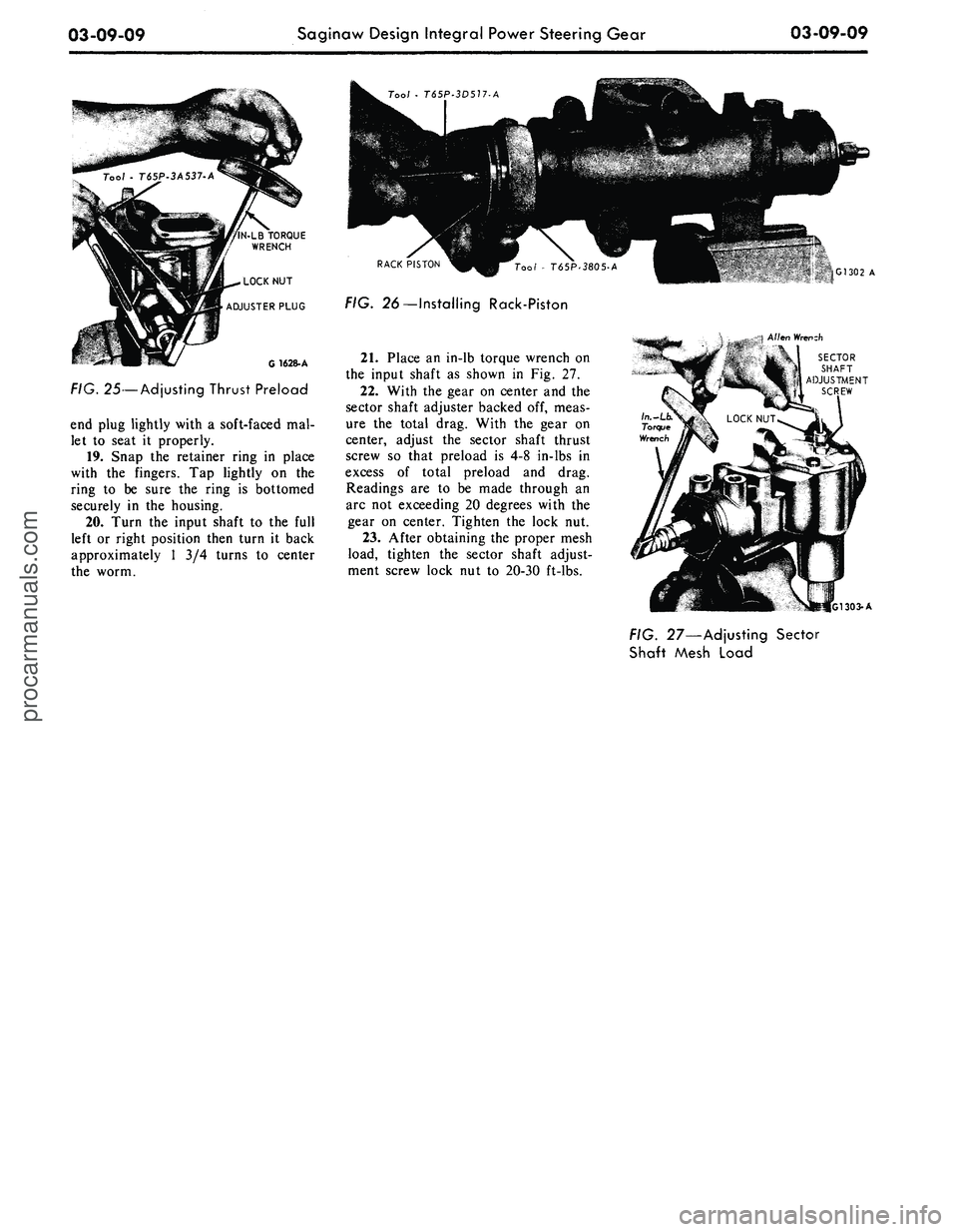
9. Tighten the adjuster plug (Fig.
25) to obtain a 1-3 in-lb preload in ex-
cess of the drag that was measured
previously. Tighten the adjuster plug
lock nut and recheck the thrust bear-
ing preload. Total preload must not
exceed 8 in-lbs.
10.
Install Tool T65P-3805-A in
the steering gear housing. Position the
rack-piston as shown in Fig. 26. Be
sure that Tool T65P-3D517-A is con-
tacting the worm shaft. Push the
rack-piston inward until it contacts
the worm shaft while keeping pressure
applied to Tool T65P-3D517-A. Turn
the stub shaft clockwise until the
middle rack groove in the rack-piston
is aligned with the center of sector
shaft roller bearing. Remove the tool
from the housing.
11.
Lubricate a new O-ring with
C1AZ-19582-A and position it in the
sector shaft cover.
12.
Thread the sector shaft cover
on the adjusting screw until it bottoms
then back it off 1 1/2 turns.
13.
Install the sector shaft so that
the center gear tooth meshes with the
center groove in the rack-piston. Be
sure that the cover O-ring is in place
before pushing the cover down on the
housing.
14.
Install the cover screws and
lock washers. Tighten to 30-35 ft-lbs.
15.
Install a new adjuster lock nut
halfway on the adjuster screw.
16.
Install the end plug in the
rack-piston. Tighten the plug to 50-
100 ft-lbs torque.
17.
Lubricate a new housing end
plug O-ring and install it in the hous-
ing.
18.
Place the end plug in the gear
housing and seat it against the O-ring
seal. It may be necessary to tap the
Tool
T65P-3A537-B
STUB SHAFT
ADJUSTER
PLUG
G 1630-A
FIG. 23—Installing Valve and Worm Shaft in Housing
G 1629-A
FIG. 24 —Installing Adjuster Plugprocarmanuals.com
Page 161 of 413
03-09-09
Saginaw Design Integral Power Steering Gear
03-09-09
Tool • T65P-3D517-A
LOCK NUT
ADJUSTER PLUG
G1628-A
FIG. 25
—
Adjusting Thrust Preload
end plug lightly with
a
soft-faced mal-
let
to
seat
it
properly.
19.
Snap
the
retainer ring
in
place
with
the
fingers.
Tap
lightly
on the
ring
to be
sure
the
ring
is
bottomed
securely
in the
housing.
20.
Turn
the
input shaft
to the
full
left
or
right position then turn
it
back
approximately
1 3/4
turns
to
center
the worm.
RACK PISTON
Tool - T65P.3805-A
FIG. 26—Installing Rack-Piston
21.
Place
an
in-lb torque wrench
on
the input shaft
as
shown
in Fig. 27.
22.
With
the
gear
on
center
and the
sector shaft adjuster backed
off,
meas-
ure
the
total drag. With
the
gear
on
center, adjust
the
sector shaft thrust
screw
so
that preload
is 4-8
in-lbs
in
excess
of
total preload
and
drag.
Readings
are to be
made through
an
arc
not
exceeding
20
degrees with
the
gear
on
center. Tighten
the
lock
nut.
23.
After obtaining
the
proper mesh
load, tighten
the
sector shaft adjust-
ment screw lock
nut to
20-30 ft-lbs.
jG1302
A
G1303-A
FIG. 27—Adjusting Sector
Shaft Mesh Loadprocarmanuals.com
Page 189 of 413
04-01-02
General Axle Service
04-01-02
COMPONENT INDEX
MODEL APPLICATION
o
3
I
i
Ji
LUBRICANT LEVEL CHECK
01-10
PINION RETAINER
01-10
Cleaning and Inspection
01-10
SHIM AND BACKLASH CHANGES
01-03
Integral Carrier
Removable Carrier
01-04
N/A
01-04
01-04
01-04
01-04
01-04
01-04
N/A
N/A
N/A
U-JOINT FLANGE
01-10
Cleaning and Inspection
01-10
A page number indicates that the item is for the vehicle listed at the head of the column.
N/A indicates that the item is not applicable to the vehicle listed.
1
COMMON ADJUSTMENTS
AND
REPAIRS
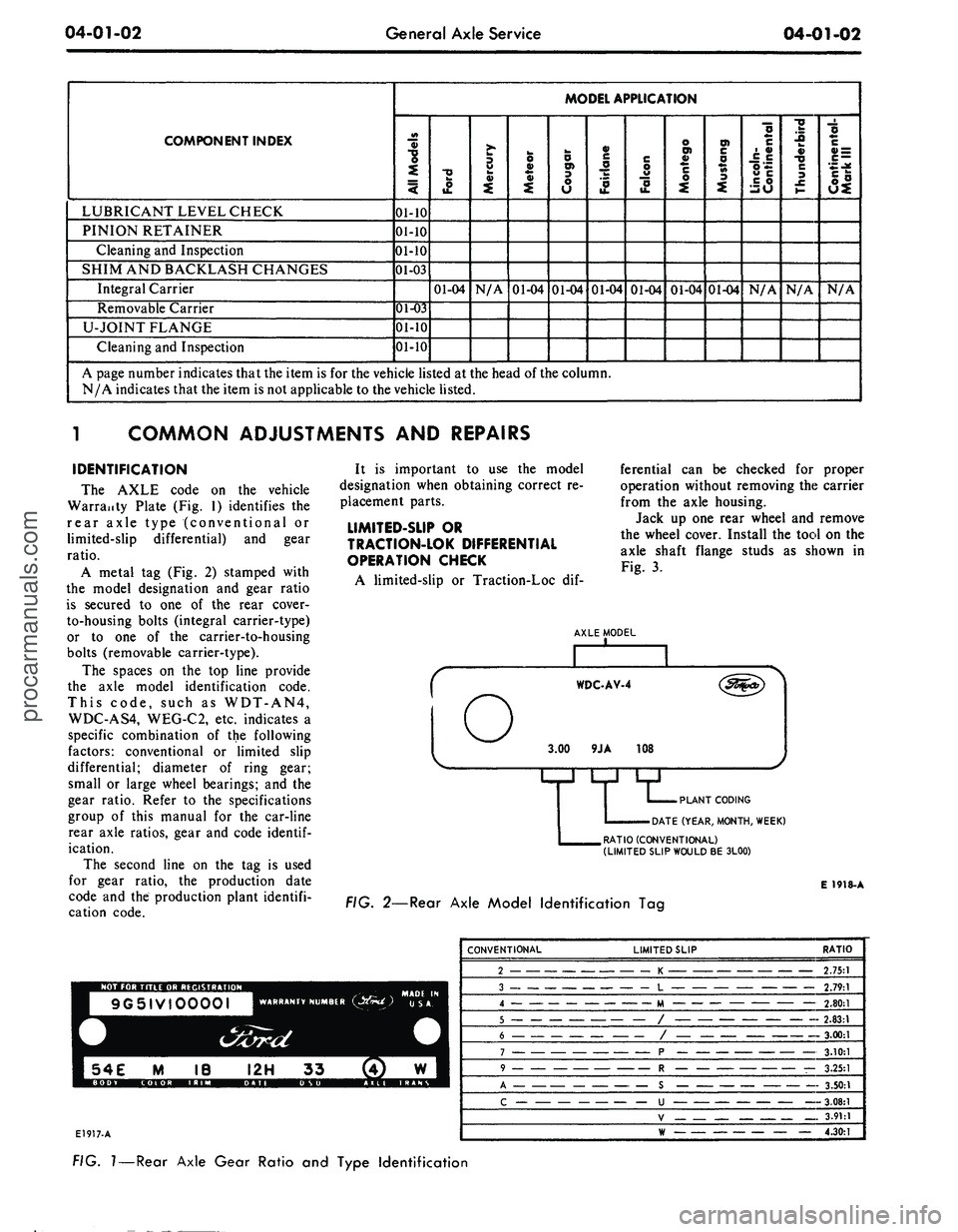
IDENTIFICATION
The AXLE code on the vehicle
Warranty Plate (Fig. 1) identifies the
rear axle type (conventional or
limited-slip differential) and gear
ratio.
A metal tag (Fig. 2) stamped with
the model designation and gear ratio
is secured to one of the rear cover-
to-housing bolts (integral carrier-type)
or to one of the carrier-to-housing
bolts (removable carrier-type).
The spaces on the top line provide
the axle model identification code.
This code, such as WDT-AN4,
WDC-AS4, WEG-C2, etc. indicates a
specific combination of the following
factors: conventional or limited slip
differential; diameter of ring gear;
small or large wheel bearings; and the
gear ratio. Refer to the specifications
group of this manual for the car-line
rear axle ratios, gear and code
identif-
ication.
The second line on the tag is used
for gear ratio, the production date
code and the production plant identifi-
cation code.
It is important to use the model
designation when obtaining correct re-
placement parts.
LIMITED-SUP
OR
TRACTION-LOK DIFFERENTIAL
OPERATION CHECK
A limited-slip or Traction-Loc dif-
ferential can be checked for proper
operation without removing the carrier
from the axle housing.
Jack up one rear wheel and remove
the wheel cover. Install the tool on the
axle shaft flange studs as shown in
Fig. 3.
AXLE MODEL
PLANT CODING
DATE (YEAR, MONTH, WEEK)
RATIO (CONVENTIONAL)
(LIMITED SLIP WOULD
BE
3L00)
E 1918-A
FIG.
2—Rear
Axle Model Identification
Tag
NOT
FOR
TITLE
OR
REGISTRATION
9G5IVI0000I
WARRANTY NUMBER
E1917-A
CONVENTIONAL
2
3
4
.
5
6
7
A
c
LIMITED SLIP
K
L
M
/
/
p
_ —
R
— —
c
—
u
V
RATIO
2.75:1
2.79:1
— 2.80:1
2.83:1
-
3.00:1
3.10:1
—
3.25:1
3.50:1
3.08:1
3.91:1
— 4.30:1
FIG.
1
— Rear Axle Gear Ratio
and
Type Identificationprocarmanuals.com
Page 194 of 413
04-01-07
General Axle Service
04-01-07
Tool-4201-
C
Tool-6565 USED WITH BRACKET
FROM Too/^*207-C
FLANGE
E1743-A
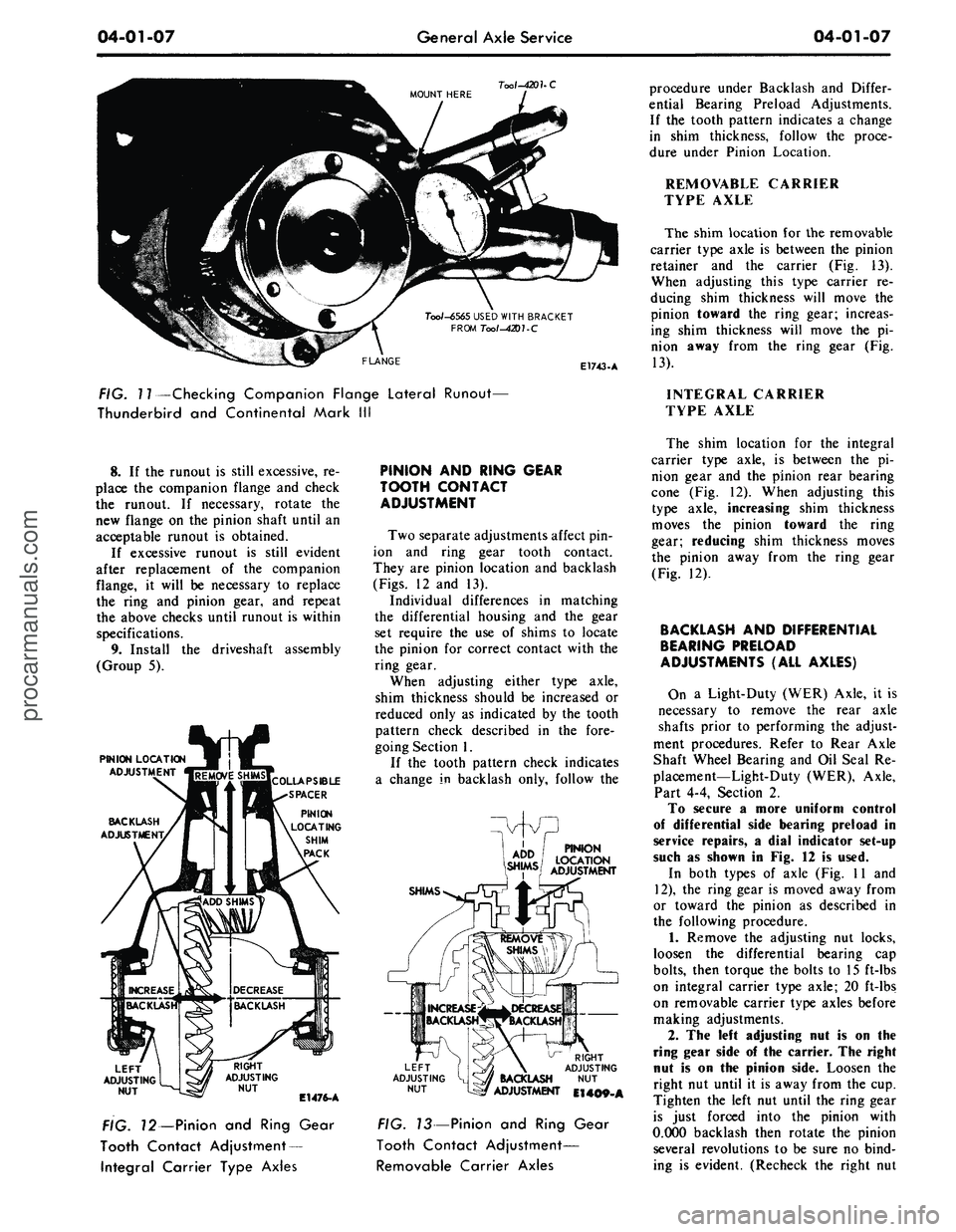
procedure under Backlash and Differ-
ential Bearing Preload Adjustments.
If the tooth pattern indicates a change
in shim thickness, follow the proce-
dure under Pinion Location.
REMOVABLE CARRIER
TYPE AXLE
The shim location for the removable
carrier type axle is between the pinion
retainer and the carrier (Fig. 13).
When adjusting this type carrier re-
ducing shim thickness will move the
pinion toward the ring gear; increas-
ing shim thickness will move the pi-
nion away from the ring gear (Fig.
13).
FIG. 11—Checking Companion Flange Lateral Runout—
Thunderbird and Continental Mark III
INTEGRAL CARRIER
TYPE AXLE
8. If the runout is still excessive, re-
place the companion flange and check
the runout. If necessary, rotate the
new flange on the pinion shaft until an
acceptable runout is obtained.
If excessive runout is still evident
after replacement of the companion
flange, it will be necessary to replace
the ring and pinion gear, and repeat
the above checks until runout is within
specifications.
9. Install the driveshaft assembly
(Group 5).
PINION LOCATION
ADJUSTMENT
BACKLASH
ADJUSTMENT,
LEFT
ADJUSTING
NUT
E1476-A
FIG. 12—Pinion and Ring Gear
Tooth Contact Adjustment
—
Integral Carrier Type Axles
PINION AND RING GEAR
TOOTH CONTACT
ADJUSTMENT
Two separate adjustments affect pin-
ion and ring gear tooth contact.
They are pinion location and backlash
(Figs.
12 and 13).
Individual differences in matching
the differential housing and the gear
set require the use of shims to locate
the pinion for correct contact with the
ring gear.
When adjusting either type axle,
shim thickness should be increased or
reduced only as indicated by the tooth
pattern check described in the fore-
going Section 1.
If the tooth pattern check indicates
a change in backlash only, follow the
PINION
LOCATION
ADJUSTMENT
SHIMS
LEFT
ADJUSTING
NUT
RIGHT
ADJUSTING
BACKLASH NUT
ADJUSTMENT El 409-A
FIG. 13—Pinion and Ring Gear
Tooth Contact Adjustment—
Removable Carrier Axles
The shim location for the integral
carrier type axle, is between the pi-
nion gear and the pinion rear bearing
cone (Fig. 12). When adjusting this
type axle, increasing shim thickness
moves the pinion toward the ring
gear; reducing shim thickness moves
the pinion away from the ring gear
(Fig. 12).
BACKLASH AND DIFFERENTIAL
BEARING PRELOAD
ADJUSTMENTS (ALL AXLES)
On a Light-Duty (WER) Axle, it is
necessary to remove the rear axle
shafts prior to performing the adjust-
ment procedures. Refer to Rear Axle
Shaft Wheel Bearing and Oil Seal Re-
placement—Light-Duty (WER), Axle,
Part 4-4, Section 2.
To secure a more uniform control
of differential side bearing preload in
service repairs, a dial indicator set-up
such as shown in Fig. 12 is used.
In both types of axle (Fig. 11 and
12),
the ring gear is moved away from
or toward the pinion as described in
the following procedure.
1.
Remove the adjusting nut locks,
loosen the differential bearing cap
bolts,
then torque the bolts to 15 ft-lbs
on integral carrier type axle; 20 ft-lbs
on removable carrier type axles before
making adjustments.
2.
The left adjusting nut is on the
ring gear side of the carrier. The right
nut is on the pinion side. Loosen the
right nut until it is away from the cup.
Tighten the left nut until the ring gear
is just forced into the pinion with
0.000 backlash then rotate the pinion
several revolutions to be sure no bind-
ing is evident. (Recheck the right nutprocarmanuals.com
Page 201 of 413
04-02-04
Rear Axle — Removable Carrier Type
04-02-04
IN-VEHICLE ADJUSTMENTS AND REPAIRS
REAR AXLE SHAFT, WHEEL
BEARING AND OIL SEAL
REPLACEMENT
The rear axle shafts, wheel bear-
ings,
and oil seal can be replaced
without removing the differential as-
sembly from the axle housing.
REMOVAL OF
AXLE SHAFT
Synthetic wheel bearing seals are
used in production only. Removal and
insertion of rear axle shafts must be
performed with caution. The entire
length of the shaft (including spline)
up to the seal journal must pass
through the seal without cutting of the
seal element during axle removal or
installation will result in early seal fai-
lure.
Leather seals only will be used as
service replacement for synthetic
wheel bearing seals.
1.
Remove the wheel cover, wheel
and tire from the brake drum.
2.
Remove the nuts that secure the
brake drum to the axle shaft flange,
then remove the drum from flange.
3.
Working through the hole pro-
vided in each axle shaft flange, re-
move the nuts that secure the wheel
bearing retainer plate. Then pull the
axle shaft assembly out of the axle
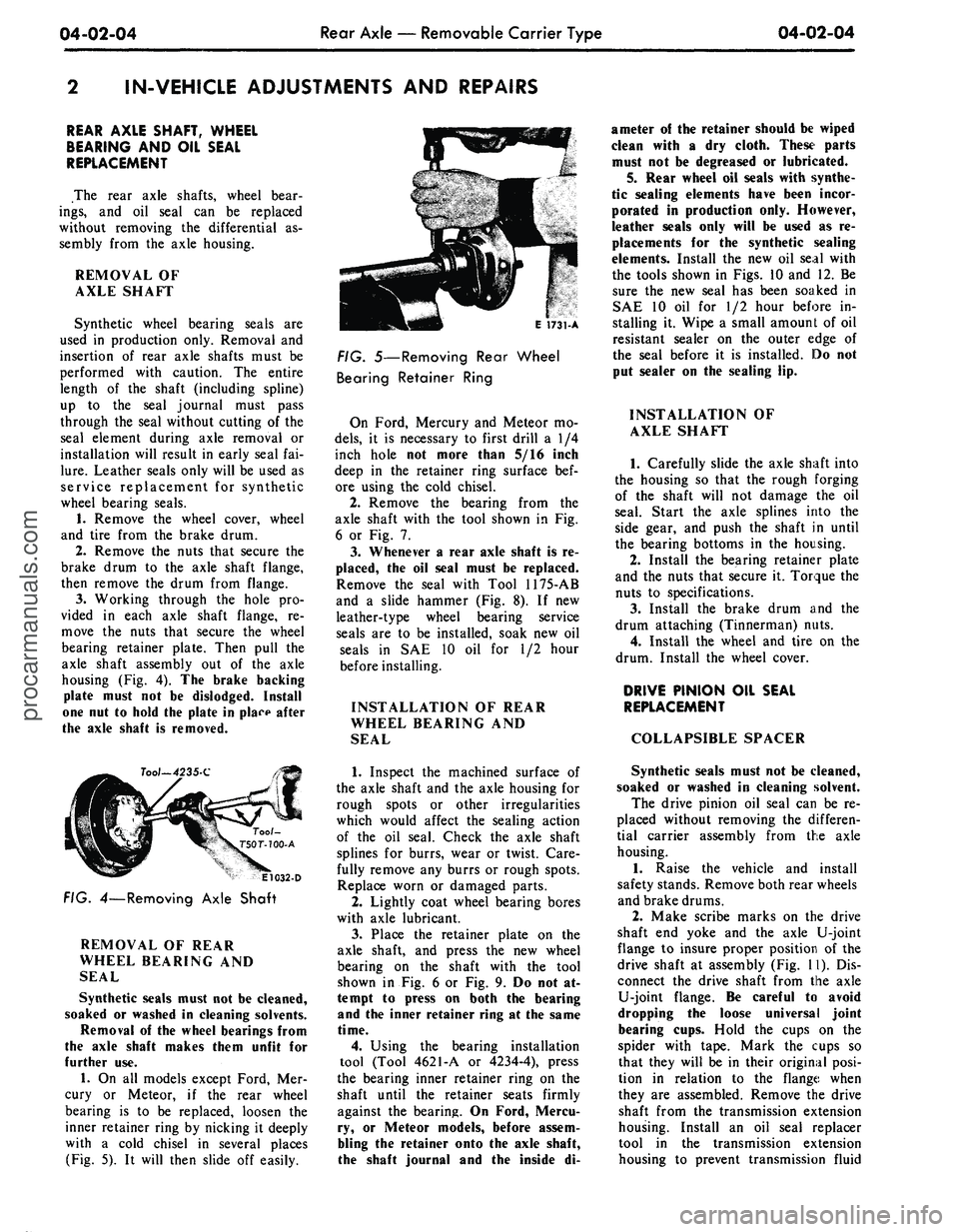
housing (Fig. 4). The brake backing
plate must not be dislodged. Install
one nut to hold the plate in place after
the axle shaft is removed.
Too/-4235-C
E1032-D
FIG. 4—Removing Axle Shaft
REMOVAL OF REAR
WHEEL BEARING AND
SEAL
Synthetic seals must not be cleaned,
soaked or washed in cleaning solvents.
Removal of the wheel bearings from
the axle shaft makes them unfit for
further use.
1.
On all models except Ford, Mer-
cury or Meteor, if the rear wheel
bearing is to be replaced, loosen the
inner retainer ring by nicking it deeply
with a cold chisel in several places
(Fig. 5). It will then slide off easily.
E 1731-A
FIG. 5—Removing Rear Wheel
Bearing Retainer Ring
On Ford, Mercury and Meteor mo-
dels,
it is necessary to first drill a 1/4
inch hole not more than 5/16 inch
deep in the retainer ring surface bef-
ore using the cold chisel.
2.
Remove the bearing from the
axle shaft with the tool shown in Fig.
6 or Fig. 7.
3.
Whenever a rear axle shaft is re-
placed, the oil seal must be replaced.
Remove the seal with Tool 1175-AB
and a slide hammer (Fig. 8). If new
leather-type wheel bearing service
seals are to be installed, soak new oil
seals in SAE 10 oil for 1/2 hour
before installing.
INSTALLATION OF REAR
WHEEL BEARING AND
SEAL
1.
Inspect the machined surface of
the axle shaft and the axle housing for
rough spots or other irregularities
which would affect the sealing action
of the oil seal. Check the axle shaft
splines for burrs, wear or twist. Care-
fully remove any burrs or rough spots.
Replace worn or damaged parts.
2.
Lightly coat wheel bearing bores
with axle lubricant.
3.
Place the retainer plate on the
axle shaft, and press the new wheel
bearing on the shaft with the tool
shown in Fig. 6 or Fig. 9. Do not at-
tempt to press on both the bearing
and the inner retainer ring at the same
time.
4.
Using the bearing installation
tool (Tool 4621-A or 4234-4), press
the bearing inner retainer ring on the
shaft until the retainer seats firmly
against the bearing. On Ford, Mercu-
ry, or Meteor models, before assem-
bling the retainer onto the axle shaft,
the shaft journal and the inside di-
ameter of the retainer should be wiped
clean with a dry cloth. These parts
must not be degreased or lubricated.
5. Rear wheel oil seals with synthe-
tic sealing elements have been incor-
porated in production only. However,
leather seals only will be used as re-
placements for the synthetic sealing
elements. Install the new oil seal with
the tools shown in Figs. 10 and 12. Be
sure the new seal has been soaked in
SAE 10 oil for 1/2 hour before in-
stalling it. Wipe a small amount of oil
resistant sealer on the outer edge of
the seal before it is installed. Do not
put sealer on the sealing lip.
INSTALLATION OF
AXLE SHAFT
1.
Carefully slide the axle shaft into
the housing so that the rough forging
of the shaft will not damage the oil
seal. Start the axle splines into the
side gear, and push the shaft in until
the bearing bottoms in the housing.
2.
Install the bearing retainer plate
and the nuts that secure it. Torque the
nuts to specifications.
3.
Install the brake drum and the
drum attaching (Tinnerman) nuts.
4.
Install the wheel and tire on the
drum. Install the wheel cover.
DRIVE PINION OIL SEAL
REPLACEMENT
COLLAPSIBLE SPACER
Synthetic seals must not be cleaned,
soaked or washed in cleaning solvent.
The drive pinion oil seal can be re-
placed without removing the differen-
tial carrier assembly from the axle
housing.
1.
Raise the vehicle and install
safety stands. Remove both rear wheels
and brake drums.
2.
Make scribe marks on the drive
shaft end yoke and the axle U-joint
flange to insure proper position of the
drive shaft at assembly (Fig. 11). Dis-
connect the drive shaft from the axle
U-joint flange. Be careful to avoid
dropping the loose universal joint
bearing cups. Hold the cups on the
spider with tape. Mark the cups so
that they will be in their original posi-
tion in relation to the flange when
they are assembled. Remove the drive
shaft from the transmission extension
housing. Install an oil seal replacer
tool in the transmission extension
housing to prevent transmission fluidprocarmanuals.com
Page 205 of 413
04-02-08
Rear Axle — Removable Carrier Type
04-02-08
REMOVAL AND INSTALLATION
CARRIER ASSEMBLY
REMOVAL
1.
Raise the vehicle on a hoist and
remove the two rear wheels and tires.
2.
Remove the two brake drums (3
Tinnerman nuts at each drum) from
the axle shaft flange studs. If diffi-
culty is experienced in removing the
drums, remove the brake adjuster
knockout slug or rubber plug (if so
equipped) and back off the brake
shoes.
3.
Working through the hole pro-
vided in each axle shaft flange, re-
move the nuts that secure the rear
wheel bearing retainer plate. Pull each
axle shaft assembly out of the axle
housing using axle shaft remover,
Tool 4235-C. (Fig. 4). Care must be
exercised to prevent damage to the
production-type synthetic oil seal, if so
equipped. Any roughing or cutting of
the seal element during removal or in-
stallation can result in early seal fail-
ure.
Install a nut on one of the brake
backing plate attaching bolts to hold
the plate to the axle housing after the
shaft has been removed. Whenever a
rear axle shaft is replaced, the wheel
bearing oil seals must be replaced.
Remove the seals with tool 1175AB.
4.
Make scribe marks on the drive
shaft end yoke and the axle U-joint
flange to insure proper position at as-
sembly. Disconnect the drive shaft at
the rear axle U-joint. Hold the cups
on the spider with tape. Mark the
cups so that they will be in their orig-
inal position relative to the flange
when they are assembled. Remove the
drive shaft from the transmission ex-
tension housing. Install an oil seal re-
placer tool in the housing to prevent
transmission leakage. Refer to the
transmission group for the appropriate
tool.
5.
Clean area around carrier to
housing surfaced with a wire brush and
wipe clean, to prevent dirt entry into
the housing. Place a drain pan under
the carrier and housing, remove the
carrier attaching nuts, and drain the
axle.
Remove the carrier assembly
from the axle housing.
INSTALLATION
Synthetic production-type wheel
bearing seals must not be cleaned,
soaked or washed in cleaning solvent.
1.
Clean the axle housing and
shafts using kerosene and swabs. To
avoid contamination of the grease in
the sealed ball bearings, do not allow
any quantity of solvent directly on the
wheel bearings. Clean the mating sur-
faces of the axle housing and carrier.
2.
Position the differential carrier
on the studs in the axle housing using
a new gasket between carrier and
housing. Install the carrier-to-housing
attaching nuts, and torque them to
specifications.
3.
Remove the oil seal replacer tool
from the transmission extension hous-
ing. Position the drive shaft so that
the front U-joint slip yoke splines to
the transmission output shaft.
4.
Connect the drive shaft to the
axle U-joint flange, aligning the scribe
marks made on the drive shaft end
yoke and the axle U-joint flange dur-
ing the removal procedure. Install the
U-bolts and nuts and torque to speci-
fications.
5.
If the synthetic, production-type
wheel bearing seals were replaced with
service-type leather seals, soak the
new rear wheel bearing oil seals in
SAE 10 oil for 1/2 hour before instal-
lation. Wipe a small amount of an oil
resistant sealer on the outer edge of
each seal before it is installed. Do not
put any of the sealer on the sealing
lip.
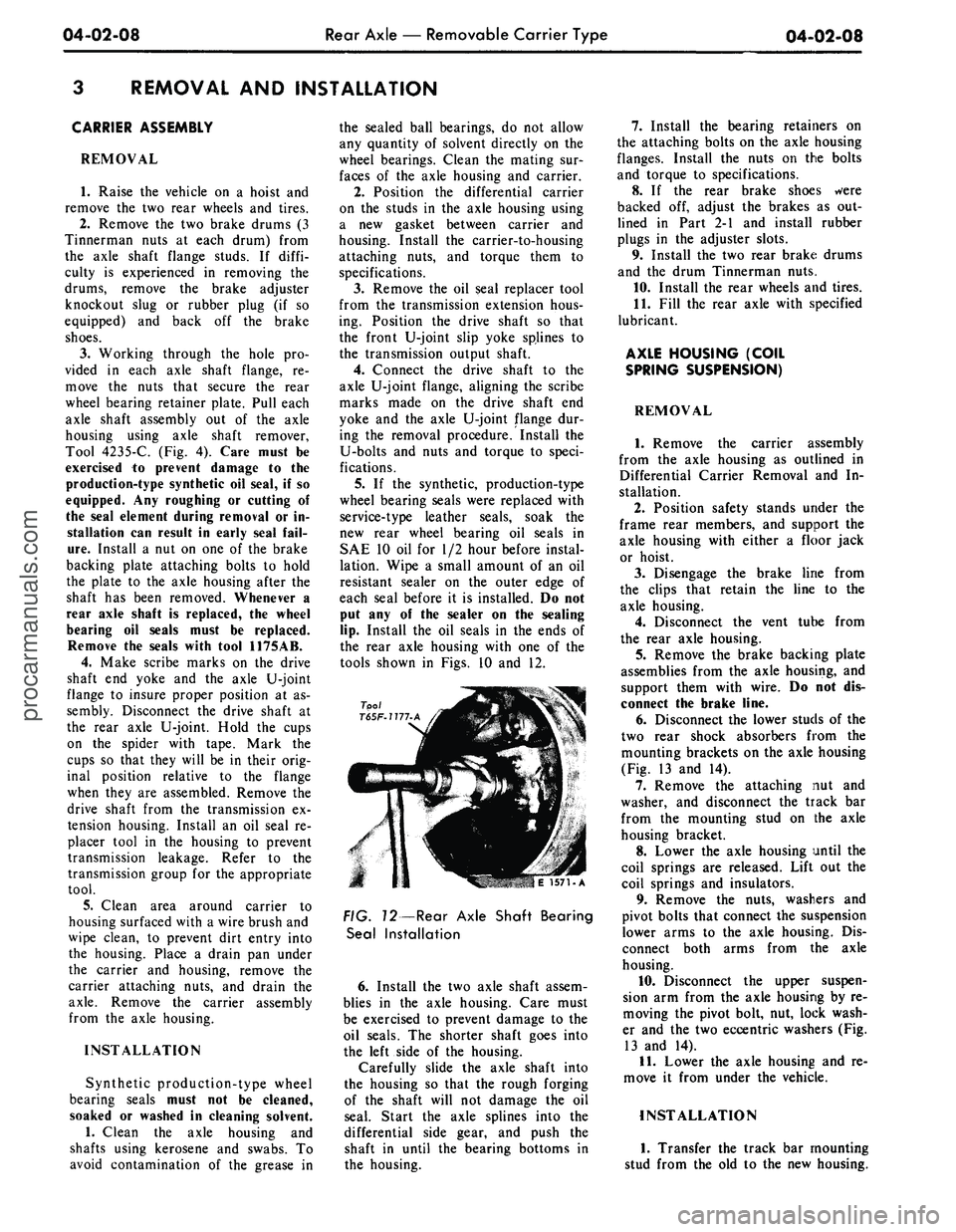
Install the oil seals in the ends of
the rear axle housing with one of the
tools shown in Figs. 10 and 12.
Tool
T65F-1177.A
E 1571-A
FIG. 12—Rear Axle Shaft Bearing
Seal Installation
6. Install the two axle shaft assem-
blies in the axle housing. Care must
be exercised to prevent damage to the
oil seals. The shorter shaft goes into
the left side of the housing.
Carefully slide the axle shaft into
the housing so that the rough forging
of the shaft will not damage the oil
seal. Start the axle splines into the
differential side gear, and push the
shaft in until the bearing bottoms in
the housing.
7.
Install the bearing retainers on
the attaching bolts on the axle housing
flanges. Install the nuts on the bolts
and torque to specifications.
8. If the rear brake shoes were
backed off, adjust the brakes as out-
lined in Part 2-1 and install rubber
plugs in the adjuster slots.
9. Install the two rear brake drums
and the drum Tinnerman nuts.
10.
Install the rear wheels and tires.
11.
Fill the rear axle with specified
lubricant.
AXLE HOUSING (COIL
SPRING SUSPENSION)
REMOVAL
1.
Remove the carrier assembly
from the axle housing as outlined in
Differential Carrier Removal and In-
stallation.
2.
Position safety stands under the
frame rear members, and support the
axle housing with either a floor jack
or hoist.
3.
Disengage the brake line from
the clips that retain the line to the
axle housing.
4.
Disconnect the vent tube from
the rear axle housing.
5.
Remove the brake backing plate
assemblies from the axle housing, and
support them with wire. Do not dis-
connect the brake line.
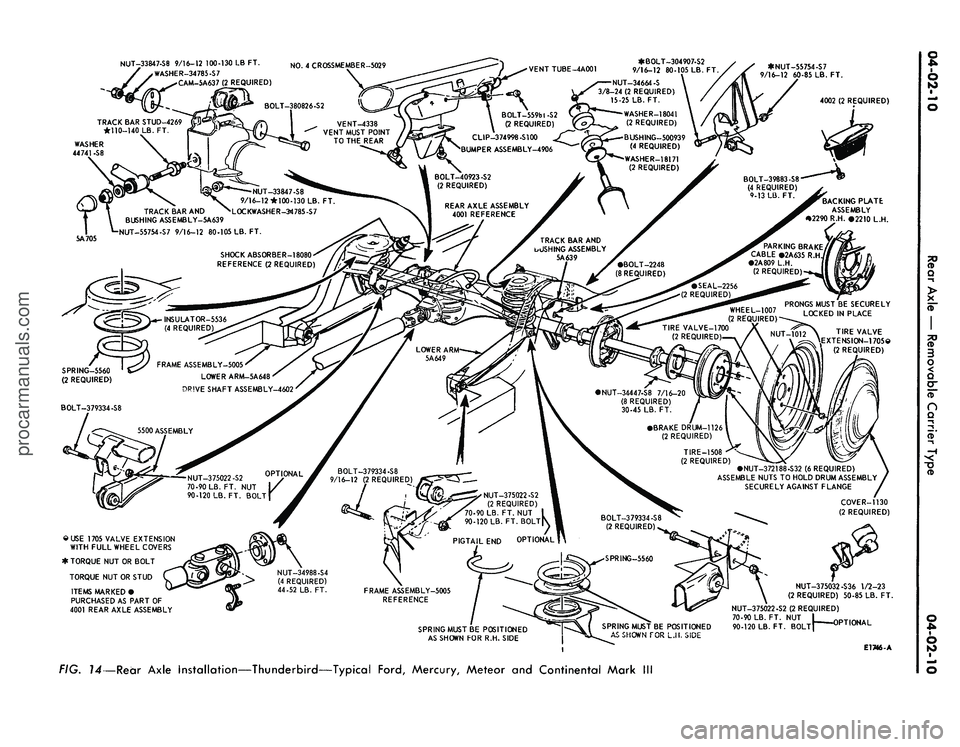
6. Disconnect the lower studs of the
two rear shock absorbers from the
mounting brackets on the axle housing
(Fig. 13 and 14).
7.
Remove the attaching nut and
washer, and disconnect the track bar
from the mounting stud on the axle
housing bracket.
8. Lower the axle housing until the
coil springs are released. Lift out the
coil springs and insulators.
9. Remove the nuts, washers and
pivot bolts that connect the suspension
lower arms to the axle housing. Dis-
connect both arms from the axle
housing.
10.
Disconnect the upper suspen-
sion arm from the axle housing by re-
moving the pivot bolt, nut, lock wash-
er and the two eccentric washers (Fig.
13 and 14).
11.
Lower the axle housing and re-
move it from under the vehicle.
INSTALLATION
1.
Transfer the track bar mounting
stud from the old to the new housing.procarmanuals.com
Page 207 of 413
NUT-33847-S8
9/16-12
100-130 LB FT.
*-34785-S7
-CAM-5A637 (2 REQUIRED)
• NUT-55754-S7
9/16-12
60-85 LB. FT.
4002 (2 REQUIRED)
• BOLT-304907-S2
9/16-12
80-105 LB. FT.
NO.
4 CROSSMEMBER-5029
VENT TUBE-4A001
NUT-34664-S
3/8-24
(2 REQUIRED)
15-25 LB. FT.
WASHER-18041
(2 REQUIRED)
BOLT-559bl-S2
(2 REQUIRED)
TRACK BAR STUD-4269
•110-140 LB. FT.
VENT-4338
VENT MUST POINT
TO THE REAR
CLIP-374998-S100
BUMPER ASSEMBLY-4906
BUSHING-500939
(4 REQUIRED)
WASHER-18171
(2 REQUIRED)
BOLT-40923-S2
(2 REQUIRED)
BOLT-39883-S8
(4 REQUIRED)
9-13 LB. FT.
NUT-33847-
9/16-12*100-130
LB. FT
L
OC
KWASHE R -34
785
-S 7
BACKING PLATE
ASSEMBLY
*2290 R.H. #2210 L.H.
REAR AXLE ASSEMBLY
4001 REFERENCE
TRACK BAR AND
BUSHING ASSEMBLY-5A639
NUT-55754-S7
9/16-12
80-105 LB. FT.
TRACK BAR AND
oJSHfNG ASSEMBLY
5A639
PARKING BRAKE
CABLE »2A635 R.H
•2A809 L.H.
(2 REQUIRED)
SHOCK ABSORBER-18080'
REFERENCE (2 REQUIRED)
•BOLT-2248
(8 REQUIRED)
• SEAL-2256
(2 REQUIRED)
PRONGS MUST BE SECURELY
LOCKED IN PLACE
WHEEL-1007
(2 REQUIRED)
INSULATOR-5536
(4 REQUIRED)
TIRE VALVE-1700
(2 REQUIRED
TIRE VALVE
XTENSION-1705©
(2 REQUIRED)
FRAME ASSEMBLY-5005
LOWER ARM-5A648
DRIVE SHAFT ASSEMBLY-4602
SPRING-5560
(2 REQUIRED)
• NUT-34447-S8
7/16-20
(8 REQUIRED)
30-45 LB. FT.
•BRAKE DRUM-1126
(2 REQUIRED)
TIRE-1508
(2 REQUIRED)
• NUT-372188-S32 (6 REQUIRED)
ASSEMBLE NUTS TO HOLD DRUM ASSEMBLY
SECURELY AGAINST FLANGE
BOLT-379334-S8
9/16-12
(2 REQUIRED)
NUT-375022-S2
70-90 LB. FT. NUT
90-120 LB. FT. BOLT
NUT-375022-S2
(2 REQUIRED)
-90 LB. FT. NUT
90-120 LB. FT. BOLT
BOLT-3 79334-S8
(2 REQUIRED)
NUT-34988-S4
(4 REQUIRED)
44-52 LB. FT.
FRAME ASSEMBLY-5005
REFERENCE
2
o
i
O
TO
Q
>
X
TO
O
3
n
Q
©USE 1705 VALVE EXTENSION
WITH FULL WHEEL COVERS
* TORQUE NUT OR BOLT
TORQUE NUT OR STUD
ITEMS MARKED •
PURCHASED AS PART OF
4001 REAR AXLE ASSEMBLY
NUT-375032-S36
1/2-23
(2 REQUIRED) 50-85 LB. FT.
SPRING MUST BE POSITIONED
AS SHOWN FOR R.H. SIDE
SPRING MUST BE POSITIONED
AS SHOWN FOR L.H. SiDE
NUT-375022-S2 (2 REQUIRED)
70-90 LB. FT. NUT
90-120 LB. FT. BOLTl
TIONAL
El 746-A
?
6
FIG. 14—Redr Axle Installation—Thunderbird—Typical Ford, Mercury, Meteor and Continental Markprocarmanuals.com
Page 208 of 413
04-02-11
Rear Axle — Removable Carrier Type
04-02-11
If the axle housing is new, install a
new vent. The hose attaching portion
must face toward the front of the ve-
hicle.
2.
If leather-type wheel bearing ser-
vice seals are to be installed, soak the
new rear wheel bearing oil seals in
SAE 10 oil for 1/2 hour before instal-
lation. Wipe a small amount of an oil
resistant sealer on the outer edge of
each seal before it is installed. Do not
put any of the sealer on the sealing
lip.
Install the oil seals in the ends of
the axle housing with one of the tools
shown in Fig. 10 and 12.
3.
Position the replacement axle
housing under the vehicle, and raise
the axle with a hoist or floor jack.
Connect the suspension lower arms to
their mounting brackets on the axle
housing with pivot bolts and nuts. Do
not tighten the bolts and nuts at this
point.
4.
Position the suspension upper
arm in its mounting bracket on the
axle housing, and install the adjusting
bolt, eccentric washers, lock washer
and nut. Leave the bolt and nut loose
at this point.
5.
Position the brake lines to the
axle housing, and secure with the re-
taining clips.
6. Install the brake backing plates
on the axle housing flanges.
7.
Connect the track bar to the
mounting stud, install the washer and
attaching nut, and torque to specifica-
tions.
8. Position the rear coil springs and
insulators in the pockets provided.
9. Connect the lower studs of the
two rear shock absorbers to the
mounting brackets on the axle hous-
ing. Install the attaching nuts, and
torque to specifications.
10.
Connect the vent tube to the
vent on the housing. If axle housing is
new, install a new vent.
11.
Clean the mating surfaces of
the axle housing and differential car-
rier. Position the carrier on the
mounting studs on the housing using a
new gasket between carrier and hous-
ing. Install the copper washers and the
carrier-to-housing attaching nuts, and
torque to specifications.
12.
Make sure that both the front
and rear pivot bolts of the upper and
the two lower arms are loose, and
then raise the axle assembly to con-
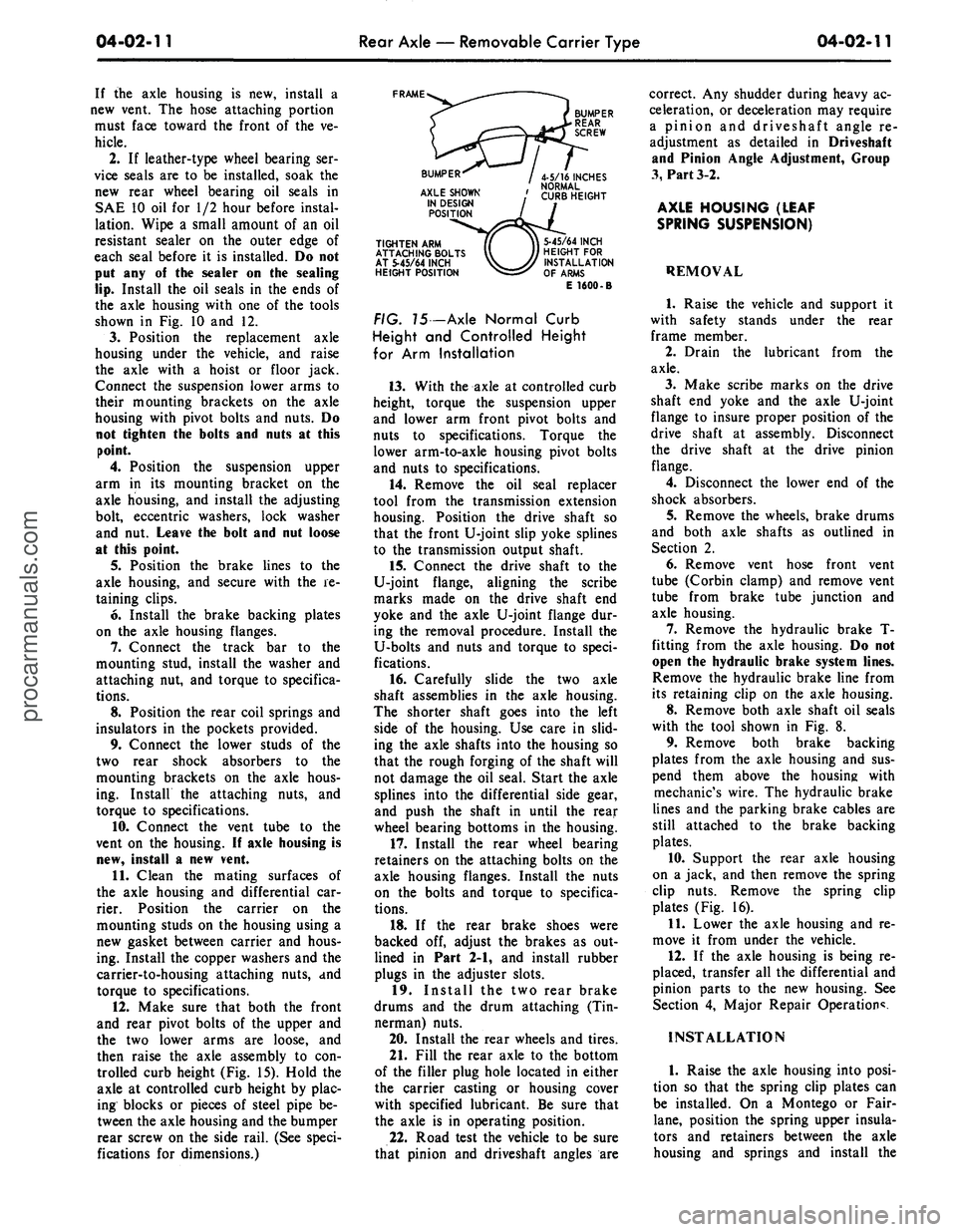
trolled curb height (Fig. 15). Hold the
axle at controlled curb height by plac-
ing blocks or pieces of steel pipe be-
tween the axle housing and the bumper
rear screw on the side rail. (See speci-
fications for dimensions.)
FRAME
TIGHTEN ARM
ATTACHING BOLTS
AT 5-45/64 INCH
HEIGHT POSITION
5-45/64 INCH
HEIGHT FOR
INSTALLATION
OF ARMS
E 1600-B
FIG. 75 -Axle Normal Curb
Height and Controlled Height
for Arm Installation
13.
With the axle at controlled curb
height, torque the suspension upper
and lower arm front pivot bolts and
nuts to specifications. Torque the
lower arm-to-axle housing pivot bolts
and nuts to specifications.
14.
Remove the oil seal replacer
tool from the transmission extension
housing. Position the drive shaft so
that the front U-joint slip yoke splines
to the transmission output shaft.
15.
Connect the drive shaft to the
U-joint flange, aligning the scribe
marks made on the drive shaft end
yoke and the axle U-joint flange dur-
ing the removal procedure. Install the
U-bolts and nuts and torque to speci-
fications.
16.
Carefully slide the two axle
shaft assemblies in the axle housing.
The shorter shaft goes into the left
side of the housing. Use care in slid-
ing the axle shafts into the housing so
that the rough forging of the shaft will
not damage the oil seal. Start the axle
splines into the differential side gear,
and push the shaft in until the rear
wheel bearing bottoms in the housing.
17.
Install the rear wheel bearing
retainers on the attaching bolts on the
axle housing flanges. Install the nuts
on the bolts and torque to specifica-
tions.
18.
If the rear brake shoes were
backed off, adjust the brakes as out-
lined in Part 2-1, and install rubber
plugs in the adjuster slots.
19.
Install the two rear brake
drums and the drum attaching (Tin-
nerman) nuts.
20.
Install the rear wheels and tires.
21.
Fill the rear axle to the bottom
of the filler plug hole located in either
the carrier casting or housing cover
with specified lubricant. Be sure that
the axle is in operating position.
22.
Road test the vehicle to be sure
that pinion and driveshaft angles are
correct. Any shudder during heavy ac-
celeration, or deceleration may require
a pinion and driveshaft angle re-
adjustment as detailed in Driveshaft
and Pinion Angle Adjustment, Group
3,
Part 3-2.
AXLE HOUSING (LEAF
SPRING SUSPENSION)
REMOVAL
1.
Raise the vehicle and support it
with safety stands under the rear
frame member.
2.
Drain the lubricant from the
axle.
3.
Make scribe marks on the drive
shaft end yoke and the axle U-joint
flange to insure proper position of the
drive shaft at assembly. Disconnect
the drive shaft at the drive pinion
flange.
4.
Disconnect the lower end of the
shock absorbers.
5.
Remove the wheels, brake drums
and both axle shafts as outlined in
Section 2.
6. Remove vent hose front vent
tube (Corbin clamp) and remove vent
tube from brake tube junction and
axle housing.
7.
Remove the hydraulic brake T-
fitting from the axle housing. Do not
open the hydraulic brake system lines.
Remove the hydraulic brake line from
its retaining clip on the axle housing.
8. Remove both axle shaft oil seals
with the tool shown in Fig. 8.
9. Remove both brake backing
plates from the axle housing and sus-
pend them above the housing with
mechanic's wire. The hydraulic brake
lines and the parking brake cables are
still attached to the brake backing
plates.
10.
Support the rear axle housing
on a jack, and then remove the spring
clip nuts. Remove the spring clip
plates (Fig. 16).
11.
Lower the axle housing and re-
move it from under the vehicle.
12.
If the axle housing is being re-
placed, transfer all the differential and
pinion parts to the new housing. See
Section 4, Major Repair Operation*.
INSTALLATION
1.
Raise the axle housing into posi-
tion so that the spring clip plates can
be installed. On a Montego or Fair-
lane,
position the spring upper insula-
tors and retainers between the axle
housing and springs and install theprocarmanuals.com
Page 211 of 413
04-02-14
Rear Axle
—
Removable Carrier Type
04-02-14
DIFFERENTIAL
BEARING
Tool—
7
571-4220-A
T66P°4220-P
E1015-B
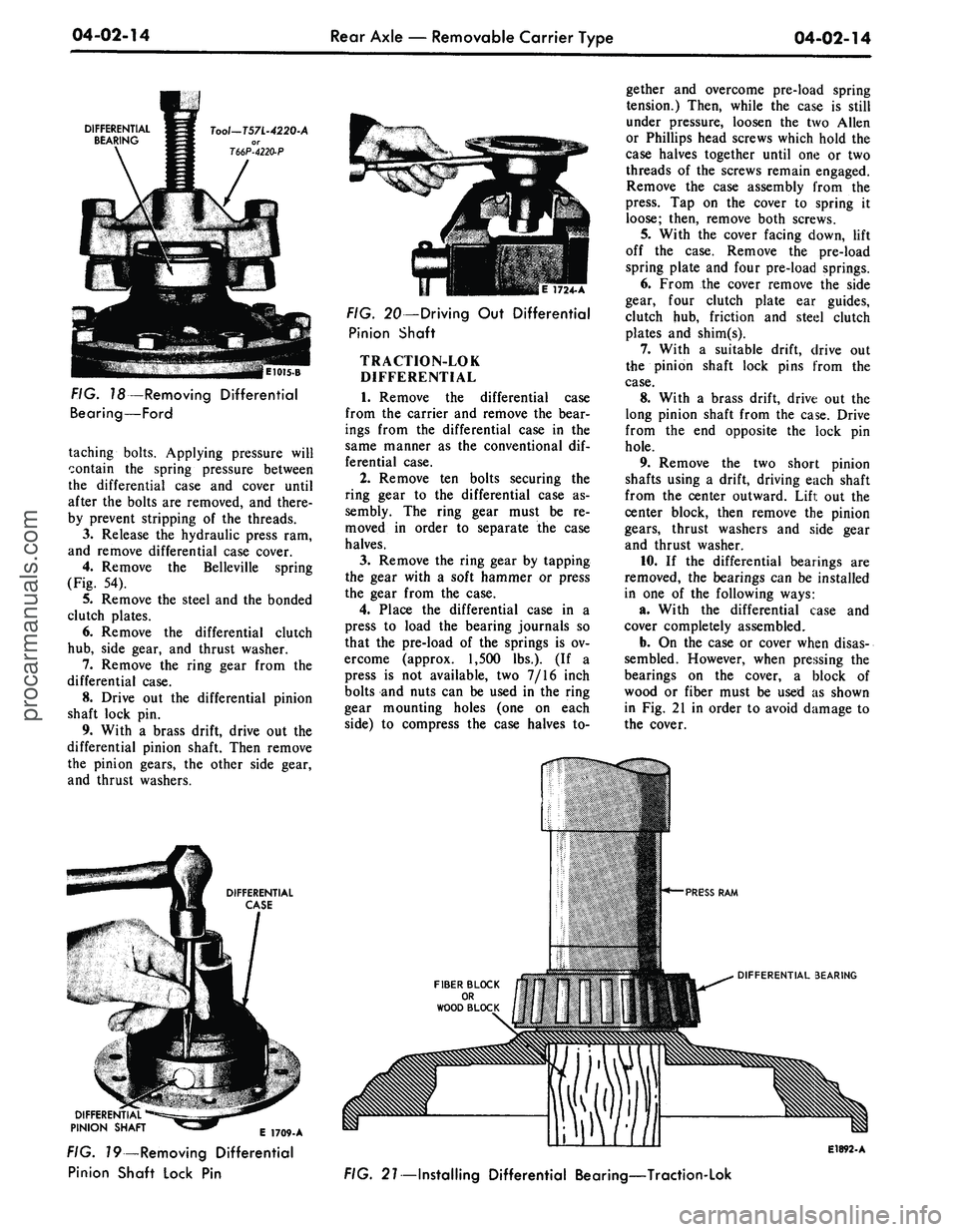
FIG. 18—Removing Differential
Bearing—Ford
taching bolts. Applying pressure will
contain
the
spring pressure between
the differential case
and
cover until
after
the
bolts
are
removed,
and
there-
by prevent stripping
of the
threads.
3.
Release
the
hydraulic press
ram,
and remove differential case cover.
4.
Remove
the
Belleville spring
(Fig.
54).
5.
Remove
the
steel
and the
bonded
clutch plates.
6. Remove
the
differential clutch
hub,
side gear,
and
thrust washer.
7.
Remove
the
ring gear from
the
differential case.
8. Drive
out the
differential pinion
shaft lock
pin.
9. With
a
brass drift, drive
out the
differential pinion shaft. Then remove
the pinion gears,
the
other side gear,
and thrust washers.
E 1724-A
FIG. 20—Driving
Out
Differential
Pinion Shaft
TRACTION-LOK
DIFFERENTIAL
1.
Remove
the
differential case
from
the
carrier
and
remove
the
bear-
ings from
the
differential case
in the
same manner
as the
conventional
dif-
ferential case.
2.
Remove
ten
bolts securing
the
ring gear
to the
differential case
as-
sembly.
The
ring gear must
be re-
moved
in
order
to
separate
the
case
halves.
3.
Remove
the
ring gear
by
tapping
the gear with
a
soft hammer
or
press
the gear from
the
case.
4.
Place
the
differential case
in a
press
to
load
the
bearing journals
so
that
the
pre-load
of the
springs
is ov-
ercome (approx.
1,500
lbs.).
(If a
press
is not
available,
two 7/16
inch
bolts
and
nuts
can be
used
in the
ring
gear mounting holes
(one on
each
side)
to
compress
the
case halves
to-
gether
and
overcome pre-load spring
tension.) Then, while
the
case
is
still
under pressure, loosen
the two
Allen
or Phillips head screws which hold
the
case halves together until
one or two
threads
of the
screws remain engaged.
Remove
the
case assembly from
the
press.
Tap on the
cover
to
spring
it
loose; then, remove both screws.
5.
With
the
cover facing down, lift
off
the
case. Remove
the
pre-load
spring plate
and
four pre-load springs.
6. From
the
cover remove
the
side
gear, four clutch plate
ear
guides,
clutch
hub,
friction
and
steel clutch
plates
and
shim(s).
7.
With
a
suitable drift, drive
out
the pinion shaft lock pins from
the
case.
8. With
a
brass drift, drive
out the
long pinion shaft from
the
case. Drive
from
the end
opposite
the
lock
pin
hole.
9. Remove
the two
short pinion
shafts using
a
drift, driving each shaft
from
the
center outward. Lift
out the
center block, then remove
the
pinion
gears,
thrust washers
and
side gear
and thrust washer.
10.
If the
differential bearings
are
removed,
the
bearings
can be
installed
in
one of the
following ways:
a. With
the
differential case
and
cover completely assembled.
b.
On the
case
or
cover when disas-
sembled. However, when pressing
the
bearings
on the
cover,
a
block
of
wood
or
fiber must
be
used
as
shown
in Fig.
21 in
order
to
avoid damage
to
the cover.
E 1709-A
FIG. 79—Removing Differential
Pinion Shaft Lock
Pin
DIFFERENTIAL BEARING
E1892-A
FIG. 21—Installing Differential Bearing—Traction-Lokprocarmanuals.com