ECU FORD MUSTANG 1969 Volume One Chassis
[x] Cancel search | Manufacturer: FORD, Model Year: 1969, Model line: MUSTANG, Model: FORD MUSTANG 1969Pages: 413, PDF Size: 75.81 MB
Page 55 of 413
02-02-36
Brake System
02-02-36
locating stripe on the cable is midway
between the retaining clips and tighten
all retaining clip screws.
4.
Position the left cable, retaining
clip and screw on the left lower sus-
pension arm. Compress the prongs on
the left cable and position the cable
through the frame side-member. The
prongs must be securely locked in
place.
5.
Insert the ball ends of the cables
into the equalizer assembly.
6. Install the rear drum(s) and
tighten the three Tinnerman nuts and
secure the drum. Install the wheel and
tire and the wheel cover.
7.
Adjust the parking brake linkage
as outlined in Part 2-1, Section 2. Ad-
just the rear brakes, as required (Part
2-1,
Section 2).
FAIRLANE, MONTEGO,
MUSTANG AND COUGAR—
EXCEPT STATION WAGON
Removal
1.
Remove the equalizer lock nut
and adjusting nut, equalizer, spring
and spring seat.
2.
With the cables slack, discon-
nect the ball-ends from the connector
(Figs.
35 and 36).
3.
Remove the cable from the re-
tainer hooks (station wagon models)
and the underbody guide (convertible
models) if required.
4.
Remove the hairpin lock retain-
ing the cable housing to the side rail
bracket.
5.
Remove the wheel cover, wheel
and tire and the rear brake drum as
outlined in Section 2.
6. Remove self-adjuster springs to
allow clearance to remove cable re-
tainer from the backing plate. Discon-
nect the rear end of the cable from the
parking brake lever on the brake shoe.
Disengage the cable housing retaining
grommet or steel-pronged Hi-Hat
from the backing plate and withdraw
the cable and housing from the in-
board side of the backing plate.
7.
Slide the cable and housing out
of the side rail bracket.
Installation
1.
Insert the rear end of the cable
through the side rail bracket and pull
the cable and housing into position.
2.
Insert the rear end of the cable
and housing through the hole in the
backing plate from the inboard side.
3.
Connect the cable to the parking
brake lever on the brake shoe and in-
stall the cable housing retaining grom-
met or steel-pronged Hi-Hat in the
backing plate.
4.
Install the self-adjuster springs.
Position the cable housing in the side
rail bracket and install the hairpin
type retainer.
5.
Install rear hub and drum as-
sembly, wheel and tire assemblies and
wheel cover as outlined in Section 2.
6. Position the cable retainer hooks
(station wagon models) in the under-
body guide (convertible models) and
install the connector, thus hooking the
two cables together.
7.
Insert the cable into the equaliz-
er and install the equalizer, spring
seat, spring, adjusting nut and lock
nut to the front, parking brake control
cable.
8. Adjust the parking brake^as di-
rected in Part 2-1, Section 2.
FAIRLANE AND MONTEGO
STATION WAGONS AND
FALCON PASSENGER
MODELS
Removal and Installation
Refer to Fig. 35.
Generally follow the procedure
given above, omitting separation of
the cables, since the parking brake
rear cable assemblies supplied for
these models is in one piece. Removal
and installation of both rear wheels,
tires and drums will also be required.
LINCOLN CONTINENTAL
Removal
1.
Raise the car. Remove the rear
wheel cover. Remove the wheel and
tire as an assembly.
2.
Remove the three Tinnerman
nuts that hold the brake drum in
place, and remove the drum.
3.
Remove the brake shoe retract-
ing springs.
4.
Loosen the equalizer rod adjust-
ing nut and disconnect the cable from
the equalizer (Fig. 38).
5.
Remove the hairpin-type retainer
clip that secures the cable housing to
the body bracket, and pull the cable
and housing out of the bracket (Fig.
38).
6. Remove the cable to underbody
clamp attaching nuts and the clamp.
Disengage the cable housing from the
hook-type retainer at the spring U-
bolt.
7.
Working on the wheel side of the
backing plate (Fig. 38), compress the
prongs on the cable retainer so that it
can pass through the hole in the back-
ing plate. Draw the cable retainer out
of the hole.
8. With the spring tension off the
parking brake lever, lift the cable out
of the slot in the lever and remove it
through the backing plate hols.
Installation
1.
Pull enough of the cable through
the cable housing so that the end of
the cable may be inserted through the
backing plate hole from the inner side
and engage the cable end with the slot
in the parking brake lever.
2.
Pull the excess slack from the
cable and insert the cable housing into
the backing plate access hole (Fig.
38).
The prongs must be securely
locked in place.
3.
Install the brake shoe retracting
springs.
4.
Position the cable to the under-
body and install the retaining clamp
so that the cable conduit armor ex-
tends forward of the clamp as shown
in Fig. 38. Install the clamp retaining
nuts.
5.
Hook the cable housing to the
retainer at the spring U-bolt.
6. Engage the forward end of the
cable housing with the frame bracket
and secure it with the hairpin-type
clip.
7.
Insert the ball end of the cable
into the equalizer.
8. Make a preliminary brake ad-
justment with the use of Tool HRA-
8650 (Fig. 11).
9. Install the rear drum. Tighten
the three Tinnerman nuts that secure
the drum. Install the wheel and wheel
cover.
10.
Adjust the parking brake link-
age.
11.
Lower the vehicle.
ANTI-SKID CONTROL
ACTUATOR
REMOVAL
Refer to Fig. 39.
1.
Working in the passenger com-
partment, under the glove box, remove
the screw that attaches the forward
end of the control module retainer to
the support assembly. Lower the for-
ward end of the control module re-
tainer and remove the module assem-
bly.procarmanuals.com
Page 57 of 413
02-02-38
Brake System
02-02-38
2.
Disconnect the actuator solenoid
and warning switch harness connectors
from the control module.
3.
Remove the two wiring harness
grommets from the dash panel and
push the wiring harness and connec-
tors through the openings in the dash
panel.
4.
Working in the engine compart-
ment loosen the hose clamp and re-
move the air hose from the air filter.
5.
Remove the engine air cleaner-
Loosen the hose clamp and remove
the vacuum hose from the vacuum
manifold fitting.
6. Raise the vehicle on a hoist.
7.
Disconnect the exhaust pipes
from the exhaust manifold and sup-
port with wire to provide access to the
actuator assembly.
8. Remove the bolt retaining the
actuator ground wire to the rear outer
corner of the engine right bank.
9. Loosen the tube nuts and discon-
nect the brake system hydraulic tubes
from the hydraulic valve housing.
10.
Remove the three nuts retaining
the actuator assembly to the actuator
support bracket.
11.
Remove the three bolts that re-
tain the actuator mounting bracket to
the side rail and remove the mounting
bracket.
12.
Remove the actuator assembly
from the vehicle and place it on a
bench.
13.
Remove the air and vacuum
hoses from the actuator.
INSTALLATION
1.
Install the air and vacuum hoses
on the new actuator.
2.
Place the actuator assembly into
position under the vehicle, routing the
air and vacuum hoses up between the
engine and fender apron and inserting
the solenoid leads through the holes in
the firewall.
3.
Position the ground wire to the
rear of the engine block and install re-
taining bolt.
4.
Position the actuator mounting
bracket to the frame side rail and in-
stall the three retaining bolts.
5.
Position the actuator assembly
to the mounting bracket and install
the three retaining nuts.
6. Connect the hydraulic tubes to
the hydraulic valve assembly and
tighten the tube nuts to specifications.
7.
Connect the exhaust pipes to the
exhaust manifolds.
8. Lower the vehicle.
9. Pull the actuator solenoid and
brake warning switch wiring harness
through the two holes in the dash
panel from inside the car. Seat the
wiring harness grommets in the dash
panel.
10.
Connect the actuator solenoid
and brake warning switch wiring har-
ness connectors to the control mo-
dules.
'
11.
Position the control module in
the bracket under the glove box and
install the retaining screw.
12.
In the engine compartment con-
nect the air hose to the air filter and
position the hose clamp.
13.
Connect the vacuum hose to the
engine vacuum manifold fitting. In-
stall the engine air cleaner.
14.
Bleed the rear brake system and
centralize the pressure differential
valve.
15.
Raise the rear wheels. Apply
the brakes with the rear wheels turn-
ing to verify proper operation of the
anti-skid control system.
ANTI-SKID CONTROL MODULE
REMOVAL
Refer to Fig. 39.
1.
Remove the retaining strap hold-
ing the harnesses.
2.
Remove the screw that attaches
the forward end of the control module
retainer to the support assembly.
3.
Lower the forward end of the
control module and retainer from the
support assembly; move the module
and retainer forward slightly until the
flange clears the slot in the support
assembly.
4.
Disconnect the five wiring har-
ness plugs from the control module.
5.
Remove the control module from
the vehicle.
INSTALLATION
1.
Connect the five wiring harness
plugs to the control module. Only one
arrangement is possible.
2.
Position the control module in
the retainer, orienting the module per
the markings on it, and insert the re-
tainer flange into the slot at the rear
of the support assembly.
3.
Pivot the retainer and control
module upward and align the screw
hole in the forward end of the retainer
with the hole in the support bracket
assembly. Install the retaining screw.
4.
Test the vehicle on the hoist to
verify correct operation of the skid
control system.
5.-
Secure the wiring to the module
support extension with the retaining
strap.
ANTI-SKID CONTROL SENSOR
REMOVAL
Refer to Fig. 39.
1.
Raise the vehicle on a hoist.
2.
Remove the rear wheel and tire
assembly.
3.
Remove the three Tinnerman
nuts (3) and remove the brake drum.
4.
Disconnect the sensor lead from
the rear wiring harness.
5.
Unseat the sensor lead grommet
pushing it to the inside of the brake
assembly.
6. Remove the four nuts that retain
the sensor to the backing plate and
pull the axle shaft, sensor assembly
and wheel bearing assembly from the
axle housing.
7.
Press the wheel bearing retainer
and wheel bearing off the axle shaft
(Refer to Part 4-2).
8. Remove the sensor assembly and
press the rotor off the shaft with tool
T69P-2B384-A Detail 2 and TOOL
1225-DA.
INSTALLATION
1.
Press a new rotor onto the axle
shaft. Install a new sensor assembly
on the shaft with tool T69P-
2B384-ADetail 1 and TOOL 1225-
DA, and press the bearing and bear-
ing retainer onto the shaft (Refer to
Part 4-2).
2.
Insert the axle shaft assembly in
the rear axle housing onto the four
backing plate retaining bolts, feeding
the sensor lead through the hole in the
backing plate.
3.
Seat the sensor lead grommet in
the backing plate.
4.
Install the four nuts on the re-
taining bolts and tighten to specifica-
tions.
5.
Connect the sensor lead to the
rear wiring harness and install two re-
taining straps.
6. Install the rear brake drum and
retain with the Tinnerrhan drum re-
taining nuts.
7.
Install the rear wheel and tire as-
sembly and tighten the wheel nuts to
specifications.
8. Test the vehicle on the hoist to
verify proper operation of the skid
control system.procarmanuals.com
Page 58 of 413
02-02-39
Brake System
02-02-39
MAJOR REPAIR OPERATIONS
BRAKE DRUM REFINISHING
Minor scores on a brake drum can
be removed with sandpaper. A drum
that is excessively scored or shows a
total indicator runout of over 0.007
inch should be turned down. Remove
only enough stock to eliminate the
scores and true up the drum. The refi-
nished diameter must not exceed 0.060
inch oversize.
Check the inside diameter of the
brake drum with a brake drum mi-
crometer (Tool FRE-14^1).
If the drum diameter is less than
0.030 inch oversize after refinishing^
standard lining may be installed. If
the drum diameter is 0.030—0.060
inch oversize after refinishing, oversize
lining must be installed.
After a drum is turned down, wipe
the refinished surface with a cloth
soaked in clean denatured alcohol. If
one drum is turned down, the opposite
drum on the same axle should also be
cut down to the same size.
ROTOR REFINISHING
Rotunda Disc Brake Attachment,
FRE-2249-2, is the only recommended
tool to refinish the disc brake rotors.
The step-by-step resurfacing procedure
provided with the tool must be ad-
hered to.
The finished braking surfaces of the
rotor must be flat and parallel within
0.0007 inch; lateral runout must not
exceed 0.003 inch total indicator read-
ing, and the surface finish of the brak-
ing surfaces are to be 80/15 micro
inches. The minimum limiting dimen-
sions (Figs. 11 and 12, Part 2-1) from
the inboard bearing cup to the out-
board rotor face and from the inboard
bearing cup to the inboard rotor face
must be observed when removing ma-
terial from the rotor braking surfaces.
On all models except Lincoln Con-
tinental, the limiting dimensions are to
be measured with a ball and gage bar
(Rotunda Kit FRE-70160).
BRAKE SHOE RELINING
Brake linings that are worn to with-
in 1/32 inch of the rivet head or are
less than 0.030 inch thick (bonded lin-
ing) or have been contaminated with
brake fluid, grease or oil must be re-
placed. Failure to replace worn linings
will result in a scored drum. When it
is necessary to replace linings, they
must also be replaced on the wheel on
the opposite side of the vehicle.
Inspect brake shoes for distortion,
cracks, or looseness. If this condition
exists,
the shoe must be discarded. Do
not attempt to repair a defective brake
shoe.
1.
Wash the brake shoes thoroughly
in a clean solvent. Remove all burrs
or rough spots from the shoes.
2.
Check the inside diameter of the
brake drum with a brake drum mi-
crometer (tool FRE-1431). If the di-
ameter is less than 0.030 inches over-
size,
standard lining may be installed.
If the diameter is 0.030—0.060 inches
oversize, oversize lining should be in-
stalled.
3.
Position the new lining on the
shoe.
Starting in the center, insert and
secure the rivets, working alternately
towards each end. Replacement lin-
ings are ground and no further grind-
ing is required.
4.
Check the clearance between the
shoe and lining. The lining must seat
tightly against the shoe with not more
than 0.008 inch clearance between any
two rivets.
RETAINER - 2B245
DUAL MASTER CYLINDER
DISASSEMBLY
1.
Clean the outside of the master
cylinder and remove the filler cover
and diaphragm. Pour out any brake
fluid that remains in the cylinder. Dis-
card the old brake fluid.
2.*
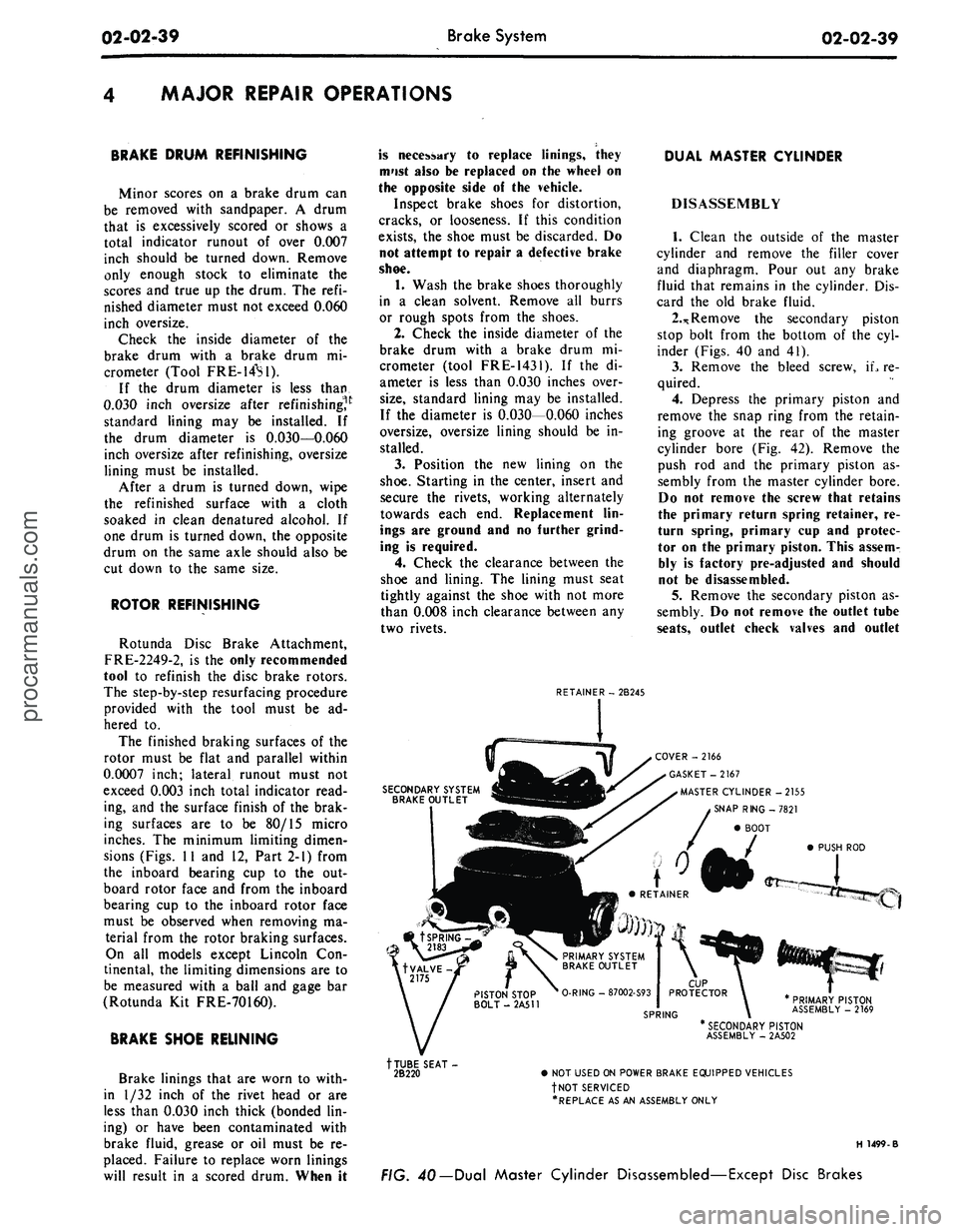
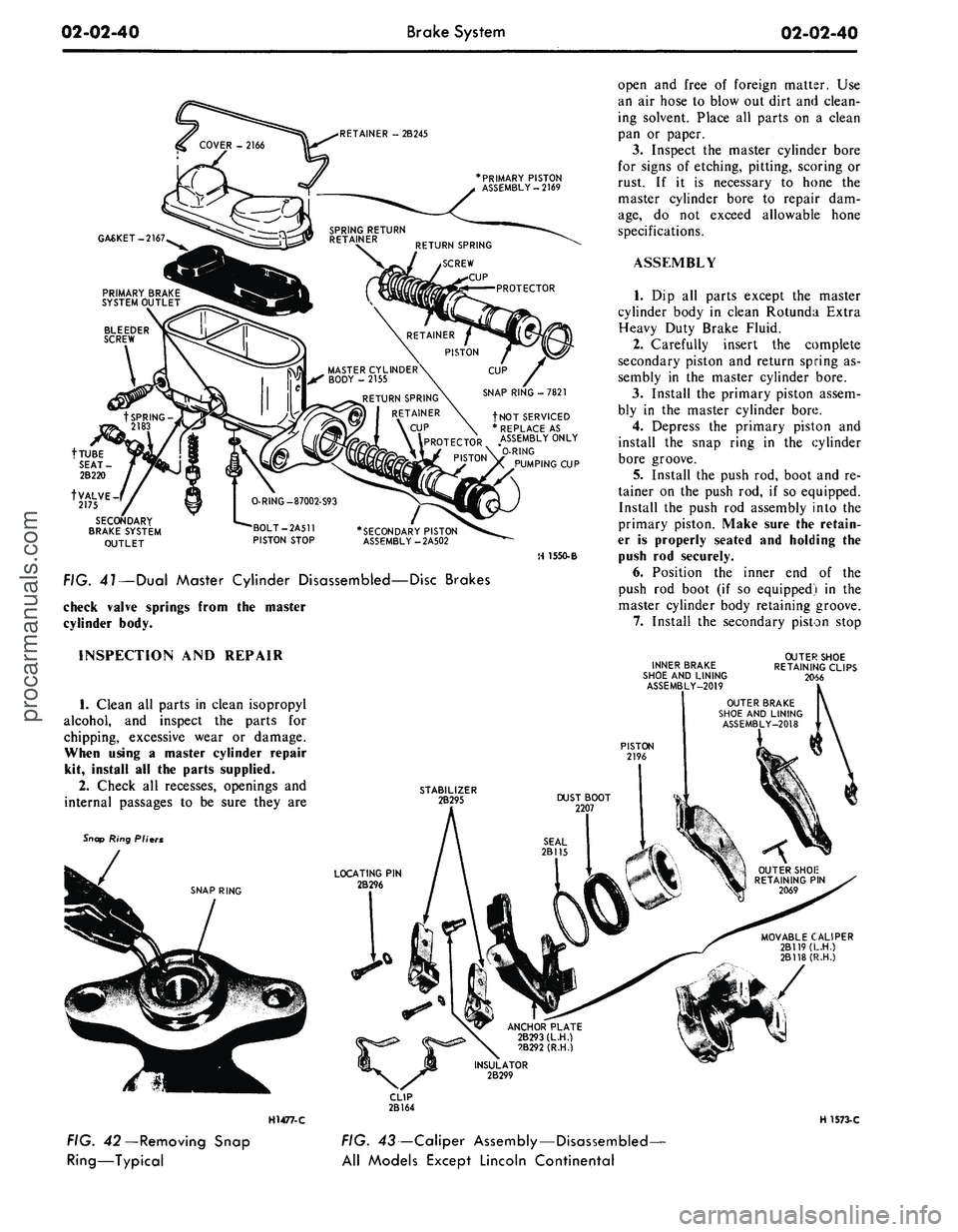
Remove the secondary piston
stop bolt from the bottom of the cyl-
inder (Figs. 40 and 41).
3.
Remove the bleed screw, iL re-
quired.
4.
Depress the primary piston and
remove the snap ring from the retain-
ing groove at the rear of the master
cylinder bore (Fig. 42). Remove the
push rod and the primary piston as-
sembly from the master cylinder bore.
Do not remove the screw that retains
the primary return spring retainer, re-
turn spring, primary cup and protec-
tor on the primary piston. This assem-
bly is factory pre-adjusted and should
not be disassembled.
5.
Remove the secondary piston as-
sembly. Do not remove the outlet tube
seats,
outlet check valves and outlet
SECONDARY SYSTEM
BRAKE OUTLET
COVER -2166
GASKET-2167
MASTER CYLINDER -2155
SNAP RING -7821
BOOT
PUSH ROD
PRIMARY PISTON
ASSEMBLY - 2169
tTUBE SEAT-
2B220
* SECONDARY PISTON
ASSEMBLY - 2A502
• NOT USED ON POWER BRAKE EQUIPPED VEHICLES
fNOT SERVICED
•REPLACE AS AN ASSEMBLY ONLY
H 1499-B
FIG. 40— Dual Master Cylinder Disassembled—Except Disc Brakesprocarmanuals.com
Page 59 of 413
02-02-40
Brake System
02-02-40
RETAINER - 2B245
PRIMARY PISTON
ASSEMBLY-2169
GASKET-2167
RETURN SPRING
RETAINER
\ CUP
\\PROTECTOR
^\i # PISTON
fNOT SERVICED
* REPLACE AS
ASSEMBLY ONLY
*O-RING
PUMPING CUP
tVALVE
2175
SECONDARY
BRAKE SYSTEM
OUTLET
*SECONDARY PISTON
ASSEMBLY-2A502
H 1550-B
FIG. 41—Dual Master Cylinder Disassembled—Disc Brakes
check valve springs from the master
cylinder body.
open and free of foreign matter. Use
an air hose to blow out dirt and clean-
ing solvent. Place all parts on a clean
pan or paper.
3.
Inspect the master cylinder bore
for signs of etching, pitting, scoring or
rust. If it is necessary to hone the
master cylinder bore to repair dam-
age,
do not exceed allowable hone
specifications.
ASSEMBLY
1.
Dip all parts except the master
cylinder body in clean Rotunda Extra
Heavy Duty Brake Fluid.
2.
Carefully insert the complete
secondary piston and return spring as-
sembly in the master cylinder bore.
3.
Install the primary piston assem-
bly in the master cylinder bore.
4.
Depress the primary piston and
install the snap ring in the cylinder
bore groove.
5.
Install the push rod, boot and re-
tainer on the push rod, if so equipped.
Install the push rod assembly into the
primary piston. Make sure the retain-
er is properly seated and holding the
push rod securely.
6. Position the inner end of the
push rod boot (if so equipped) in the
master cylinder body retaining groove.
7.
Install the secondary piston stop
INSPECTION AND REPAIR
1.
Clean all parts in clean isopropyl
alcohol, and inspect the parts for
chipping, excessive wear or damage.
When using a master cylinder repair
kit, install all the parts supplied.
2.
Check all recesses, openings and
internal passages to be sure they are
Snap Ring Pliers
SNAP RING
H1477-C
FIG. 42—Removing Snap
Ring—Typical
INNER BRAKE
SHOE AND LINING
ASSEMBLY-2019
OUTER SHOE
RETAINING CLIPS
2066
STABILIZER
2B295
LOCATING PIN
2B296
ANCHOR PLATE
2B293(L.H.)
2B292 (R.H.)
MOVABLE CALIPER
2B119(L.H.)
2B118(R.H.)
H 1573-C
FIG. 43—Caliper Assembly—Disassembled-
All Models Except Lincoln Continentalprocarmanuals.com
Page 60 of 413
02-02-41
Brake System
02-02-41
bolt and G-ring in the bottom of the
master cylinder.
8. Install the bleed screw (if so
equipped). Install the gasket (dia-
phragm) in the master cylinder filler
cover. Position the gasket as shown in
Figs.
40 and 41. Make sure the gasket
is securely seated.
9. Install the cover and gasket on
the master cylinder and secure the
cover into position with the retainer.
DISC BRAKE CALIPER
ALL MODELS EXCEPT
LINCOLN CONTINENTAL
Disassembly
1.
Remove the caliper assembly
from the vehicle as outlined in Section
2.
2.
Remove the caliper locating pins
from the caliper assembly and lift the
anchor plate from the caliper.
3.
Slide the two outer shoe retain-
ing clips off the retaining pins (Fig.
43).
4.
Remove the two retaining pins,
then remove the outer brake shoe
from the caliper.
5.
Slide the inner brake shoe out-
ward until it is free of the hold-down
springs, then remove the brake shoe.
6. Apply air pressure to the fluid
port in the caliper with a rubber
tipped nozzle (Tool 7000-DD) as
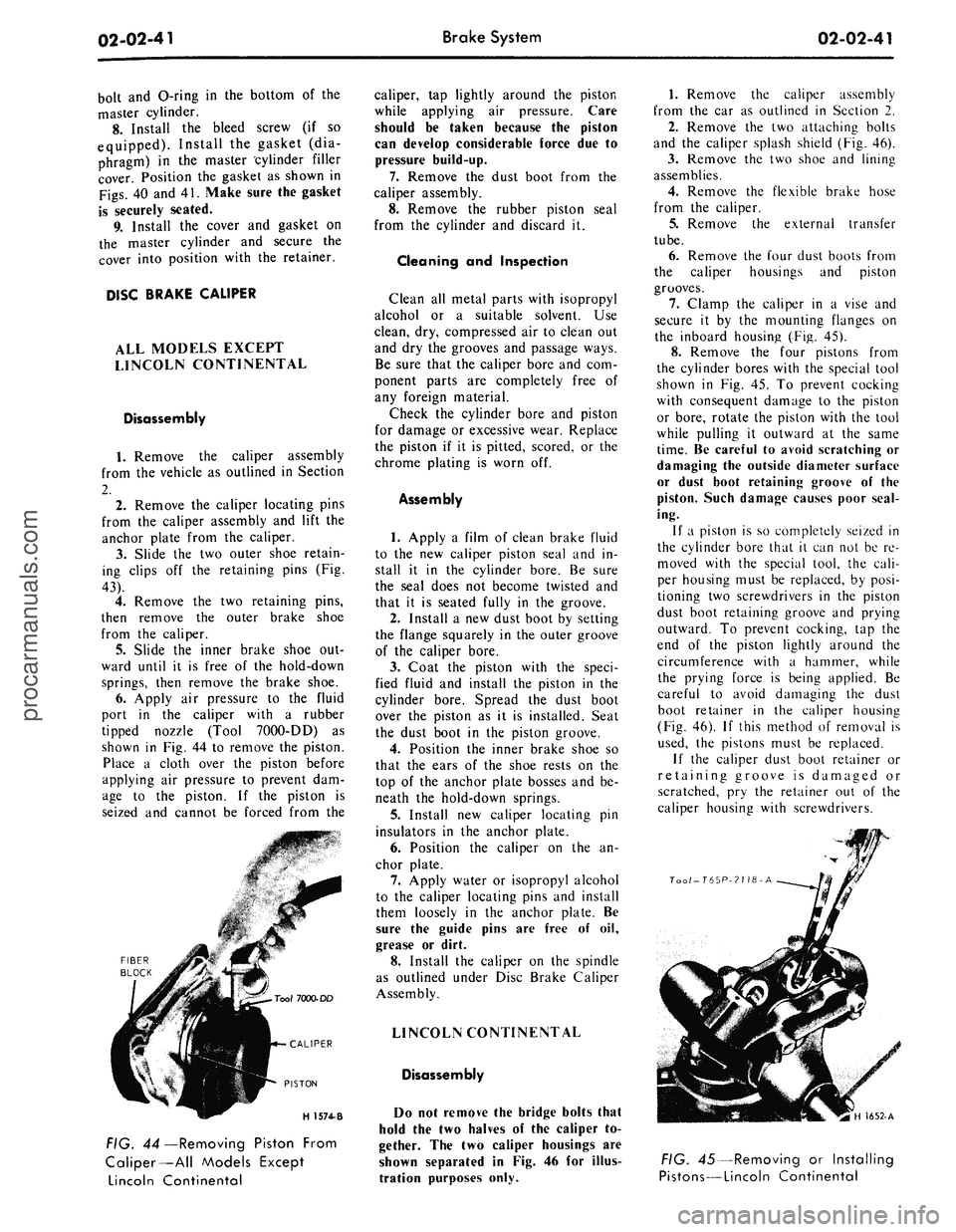
shown in Fig. 44 to remove the piston.
Place a cloth over the piston before
applying air pressure to prevent dam-
age to the piston. If the piston is
seized and cannot be forced from the
FIBER
BLOCK
CALIPER
PISTON
H 1574-B
FIG. 44 —Removing Piston From
Caliper —
All
Models Except
Lincoln Continental
caliper, tap lightly around the piston
while applying air pressure. Care
should be taken because the piston
can develop considerable force due to
pressure build-up.
7.
Remove the dust boot from the
caliper assembly.
8. Remove the rubber piston seal
from the cylinder and discard it.
Cleaning and Inspection
Clean all metal parts with isopropyl
alcohol or a suitable solvent. Use
clean, dry, compressed air to clean out
and dry the grooves and passage ways.
Be sure that the caliper bore and com-
ponent parts are completely free of
any foreign material.
Check the cylinder bore and piston
for damage or excessive wear. Replace
the piston if it is pitted, scored, or the
chrome plating is worn off.
Assembly
1.
Apply a film of clean brake fluid
to the new caliper piston seal and in-
stall it in the cylinder bore. Be sure
the seal does not become twisted and
that it is seated fully in the groove.
2.
Install a new dust boot by setting
the flange squarely in the outer groove
of the caliper bore.
3.
Coat the piston with the speci-
fied fluid and install the piston in the
cylinder bore. Spread the dust boot
over the piston as it is installed. Seat
the dust boot in the piston groove.
4.
Position the inner brake shoe so
that the ears of the shoe rests on the
top of the anchor plate bosses and be-
neath the hold-down springs.
5.
Install new caliper locating pin
insulators in the anchor plate.
6. Position the caliper on the an-
chor plate.
7.
Apply water or isopropyl alcohol
to the caliper locating pins and install
them loosely in the anchor plate. Be
sure the guide pins are free of oil,
grease or dirt.
8. Install the caliper on the spindle
as outlined under Disc Brake Caliper
Assembly.
LINCOLN CONTINENTAL
Disassembly
Do not remove the bridge bolts that
hold the two halves of the caliper to-
gether. The two caliper housings are
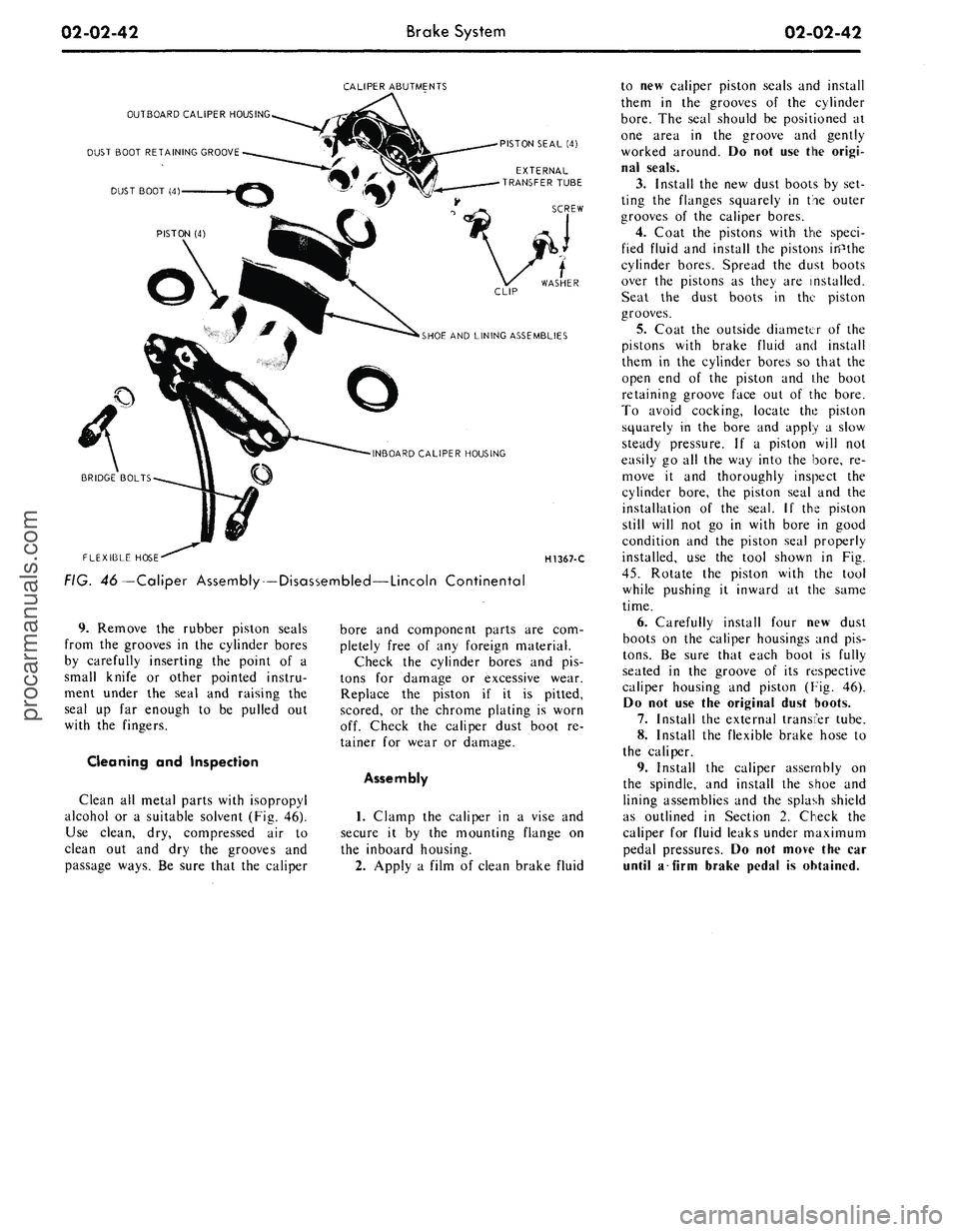
shown separated in Fig. 46 for illus-
tration purposes only.
1.
Remove the caliper assembly
from the car as outlined in Section 2.
2.
Remove the two attaching bolts
and the caliper splash shield (Fig. 46).
3.
Remove the two shoe and lining
assemblies.
4.
Remove the flexible brake hose
from the caliper.
5.
Remove the external transfer
tube.
6. Remove the four dust boots from
the caliper housings and piston
grooves.
7.
Clamp the caliper in a vise and
secure it by the mounting flanges on
the inboard housing (Fig. 45).
8. Remove the four pistons from
the cylinder bores with the special tool
shown in Fig. 45. To prevent cocking
with consequent damage to the piston
or bore, rotate the piston with the tool
while pulling it outward at the same
time.
Be careful to avoid scratching or
damaging the outside diameter surface
or dust boot retaining groove of the
piston. Such damage causes poor seal-
ing.
If a piston is so completely seized in
the cylinder bore that it can not be re-
moved with the special tool, the cali-
per housing must be replaced, by posi-
tioning two screwdrivers in the piston
dust boot retaining groove and prying
outward. To prevent cocking, tap the
end of the piston lightly around the
circumference with a hammer, while
the prying force is being applied. Be
careful to avoid damaging the dust
boot retainer in the caliper housing
(Fig. 46). If this method of removal is
used, the pistons must be replaced.
If the caliper dust boot retainer or
retaining groove is damaged or
scratched, pry the retainer out of the
caliper housing with screwdrivers.
Too/-T65P-2
J
18- A
H 1652-A
FIG. 45—Removing or Installing
Pistons —
Lincoln
Continentalprocarmanuals.com
Page 61 of 413
02-02-42
Brake System
02-02-42
CALIPER
ABUTMENTS
OUTBOARD
CALIPER HOUSING
DUST
BOOT RETAINING GROOVE
DUST
BOOT (4)
PISTON
SEAL (4)
EXTERNAL
TRANSFER
TUBE
SCREW
INBOARD
CALIPER HOUSING
FLEXIBLE
HOSE-^
H1367-C
FIG. 46—Caliper Assembly — Disassembled—Lincoln Continental
9. Remove the rubber piston seals
from the grooves in the cylinder bores
by carefully inserting the point of a
small knife or other pointed instru-
ment under the seal and raising the
seal up far enough to be pulled out
with the fingers.
Cleaning and Inspection
Clean all metal parts with isopropyl
alcohol or a suitable solvent (Fig. 46).
Use clean, dry, compressed air to
clean out and dry the grooves and
passage ways. Be sure that the caliper
bore and component parts are com-
pletely free of any foreign material.
Check the cylinder bores and pis-
tons for damage or excessive wear.
Replace the piston if it is pitted,
scored, or the chrome plating is worn
off. Check the caliper dust boot re-
tainer for wear or damage.
Assembly
1.
Clamp the caliper in a vise and
secure it by the mounting flange on
the inboard housing.
2.
Apply a film of clean brake fluid
to new caliper piston seals and install
them in the grooves of the cylinder
bore.
The seal should be positioned at
one area in the groove and gently
worked around. Do not use the origi-
nal seals.
3.
Install the new dust boots by set-
ting the flanges squarely in the outer
grooves of the caliper bores.
4.
Coat the pistons with the speci-
fied fluid and install the pistons inPthe
cylinder bores. Spread the dust boots
over the pistons as they are installed.
Seat the dust boots in the piston
grooves.
5.
Coat the outside diameter of the
pistons with brake fluid and install
them in the cylinder bores so that the
open end of the piston and ihe boot
retaining groove face out of the bore.
To avoid cocking, locate the piston
squarely in the bore and apply a slow
steady pressure. If a piston will not
easily go all the way into the bore, re-
move it and thoroughly inspect the
cylinder bore, the piston seal and the
installation of the seal. If the piston
still will not go in with bore in good
condition and the piston seal properly
installed, use the tool shown in Fig.
45.
Rotate the piston with the tool
while pushing it inward at the same
time.
6. Carefully install four new dust
boots on the caliper housings and pis-
tons.
Be sure that each boot is fully
seated in the groove of its respective
caliper housing and piston (Fig. 46).
Do not use the original dust boots.
7.
Install the external transfer tube.
8. Install the flexible brake hose to
the caliper.
9. Install the caliper assembly on
the spindle, and install the shoe and
lining assemblies and the splash shield
as outlined in Section 2. Check the
caliper for fluid leaks under maximum
pedal pressures. Do not move the car
until a firm brake pedal is obtained.procarmanuals.com
Page 71 of 413
03-01-06
Suspension — Steering, Wheels And Tires — General Service
03-01-06
SUSPENSION UPPER
ARM MOVEMENT
Front Bolt Outboard
Rear Bolt Outboard
Front Bolt Inboard
Rear Bolt Inboard
CASTER CHANGE
Tilt Backward
Increase Positive Caster
or
Decrease Negative Caster
Tilt Forward
Decrease Positive Caster
or
Increase Negative Caster
Tilt Forward
Decrease Positive Caster
or
Increase Negative Caster
Tilt Backward
Increase Positive Caster
or
Decrease Negative Caster
CAMBER CHANGE
Tilt Outward
Increase Positive Camber
or
Decrease Negative Camber
Tilt Inward
Decrease Positive Camber
or
Increase Negative Camber
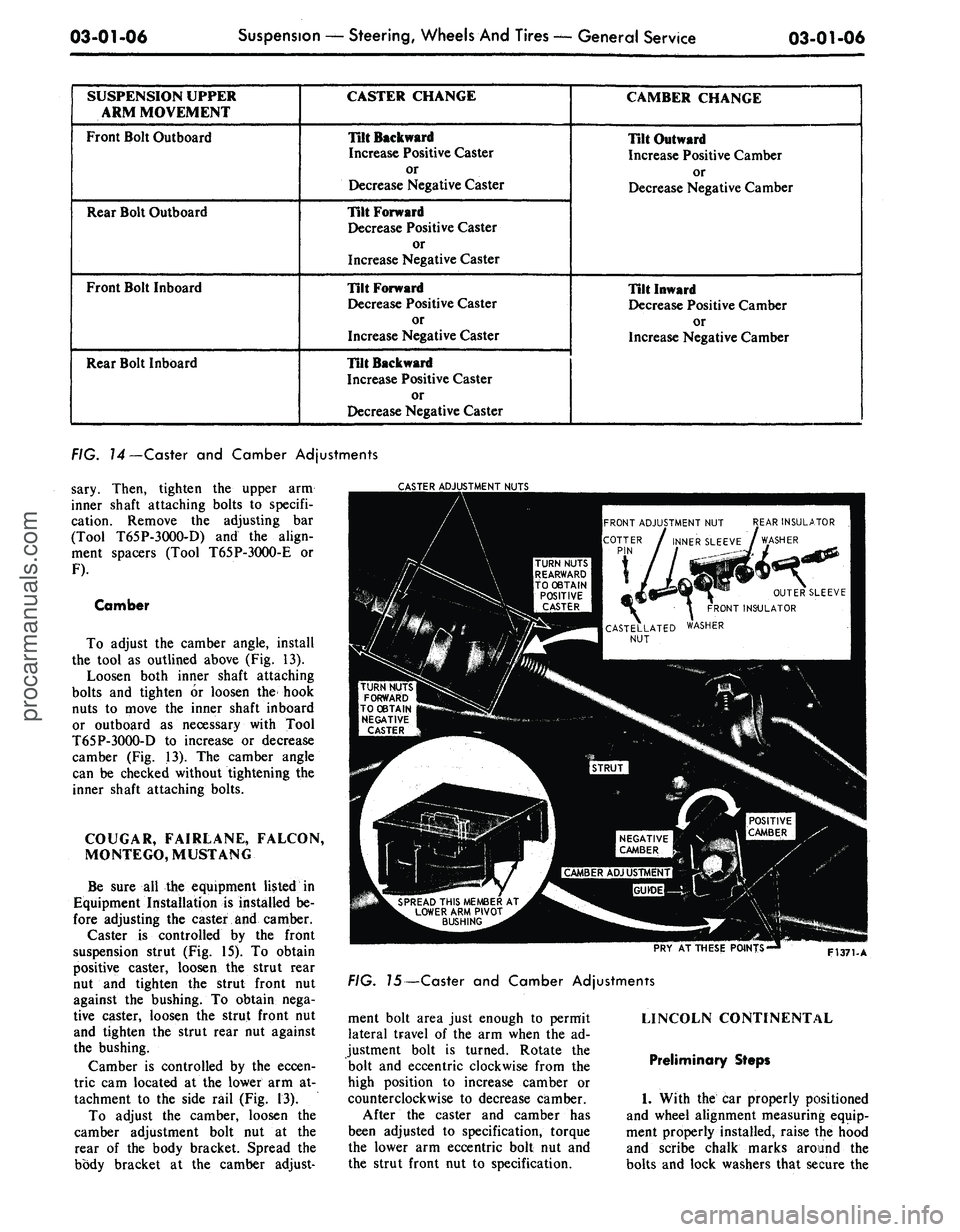
FIG. 14—Caster and Camber Adjustments
sary. Then, tighten the upper arm
inner shaft attaching bolts to specifi-
cation. Remove the adjusting bar
(Tool T65P-3OOO-D) and the align-
ment spacers (Tool T65P-3O00-E or
F).
Camber
To adjust the camber angle, install
the tool as outlined above (Fig. 13).
Loosen both inner shaft attaching
bolts and tighten or loosen the hook
nuts to move the inner shaft inboard
or outboard as necessary with Tool
T65P-3OOO-D to increase or decrease
camber (Fig. 13). The camber angle
can be checked without tightening the
inner shaft attaching bolts.
COUGAR, FAIRLANE, FALCON,
MONTEGO, MUSTANG
Be sure all the equipment listed in
Equipment Installation is installed be-
fore adjusting the caster and camber.
Caster is controlled by the front
suspension strut (Fig. 15). To obtain
positive caster, loosen the strut rear
nut and tighten the strut front nut
against the bushing. To obtain nega-
tive caster, loosen the strut front nut
and tighten the strut rear nut against
the bushing.
Camber is controlled by the eccen-
tric cam located at the lower arm at-
tachment to the side rail (Fig. 13).
To adjust the camber, loosen the
camber adjustment bolt nut at the
rear of the body bracket. Spread the
body bracket at the camber adjust-
TER ADJUSTMENT NUTS
EAR INSULATOR
WASHER
FRONT ADJUSTMENT NUT
INNER SLEEVE
TURN NUTS
REARWARD
TO OBTAIN
POSITIVE
CASTER
OUTER SLEEVE
RONT INSULATOR
WASHER
CASTELLATED
NUT
TURN NUTS
FORWARD
TO OBTAIN
NEGATIVE
CASTER
NEGATIVE
CAMBER
SPREAD THIS MEMBER AT
LOWER ARM PIVOT
BUSHING
PRY AT THESE POINTS'
F1371-A
FIG. J5—Caster and Camber Adjustments
ment bolt area just enough to permit
lateral travel of the arm when the ad-
justment bolt is turned. Rotate the
bolt and eccentric clockwise from the
high position to increase camber or
counterclockwise to decrease camber.
After the caster and camber has
been adjusted to specification, torque
the lower arm eccentric bolt nut and
the strut front nut to specification.
LINCOLN CONTINENTAL
Preliminary Steps
1.
With the car properly positioned
and wheel alignment measuring equip-
ment properly installed, raise the hood
and scribe chalk marks around the
bolts and lock washers that secure theprocarmanuals.com
Page 76 of 413
03-01-11
Suspension — Steering, Wheels And Tires — General Service
03-01-11
3.
Inspect the rotor, rollers, cam
ring, pressure plate, cover, and bush-
ing in the pressure plate for wear or
scoring. If damaged, replacement of
the pump (less housing) is required.
4.
Make sure the inner faces of the
cover and the housing are free of
paint, nicks, or burrs. Check all fluid
passages for restrictions.
5.
Inspect the valving surfaces
(areas where the rotor and rollers con-
tact) for wear or scoring. Replace the
pressure plate or the cover if worn or
scored. Inspect the bushing in the
pressure plate for wear or scoring, and
replace the plate if necessary.
6. Inspect the control valve for
scores, nicks, or burred edges. Re-
place the valve if damaged. Do not dis-
assemble the valve. Check the valve
for free movement in the housing
bore.
7.
Inspect the tube seat in the hous-
ing. If damaged, remove it with an
E-Z-Out and install a new seat.
SHOCK ABSORBER CHECKS
All vehicles are equipped with hy-
draulic shock absorbers of the direct-
acting type and are nonadjustable and
nonrefillable. They cannot be repaired.
Before replacing a shock absorber,
check the action of the shock absor-
bers as follows:
ON VEHICLE TESTS
1.
Check the shock absorber to be
sure it is securely and properly in-
stalled. Check the shock absorber in-
sulators for damage and wear.
Replace any defective insulators and
tighten attachments to the specified
torque (on a shock absorber which in-
corporates integral insulators, replace
the shock absorbers).
2.
Inspect the shock absorber for
evidence of fluid leakage. A light film
of fluid is permissible. Be sure any
fluid observed is not from sources
other than the shock absorber.
Replace the shock absorber if leak-
age is severe.
3.
Disconnect the lower end of the
shock absorber. Extend and compress
the shock absorber as fast as possible,
using as much travel as possible.
Action should become smooth and
uniform throughout each stroke.
Higher resistance on extension than
on compression is a normal condition.
Faint swish noises are also normal.
Remove the shock absorber for a
bench test if action is erratic. If the
action is smooth, but the shock absor-
bers are suspected of being weak fol-
low step 4:
4.
Repeat step 3 on the mating
shock absorber installed on the oppo-
site side of the vehicle, and compare
results of both tests. If the action is
similar, it is unlikely that either shock
absorber is defective. Reconnect both
shock absorbers.
Replace the shock absorber having
the lower resistance. Ensure that the
part number of the replacement is the
same as that of the original shock ab-
sorber. The replacement shock absor-
ber resistance will appear to be higher
than either original due to initial fric-
tion of the rod seal.
BENCH TEST
With the shock absorber right side
up (as installed in vehicle), extend it
fully. Then turn the shock absorber
upside down and fully compress it.
Repeat this procedure at least three
times to ensure that any entrapped air
has been expelled. Now place the
shock absorber right side up in a vise,
and hand stroke the shock absorber as
described in On Vehicle Tests, step 3.
If action is not now smooth and uni-
form, install a new shock absorber.procarmanuals.com
Page 87 of 413
03-02-11
Suspension
03-02-11
nuts to specification. Make sure that
the joint is completely filled with the
specified lubricant.
9. Guide the ball joint stud into the
spindle. Install the stud nut and tor-
que it to specification. Continue to
tighten the nut to line up the cotter
pin hole. Install the cotter pin.
10.
Install the wheel and tire. Tor-
que the wheel nuts to specification.
STABILIZER REPAIR
FORD, MERCURY,
METEOR, THUNDERBIRD,
CONTINENTAL MARK III
To replace the end bushings on each
stabilizer link, use the following pro-
cedure.
1.
Raise the vehicle on a hoist.
2.
Remove the nut, washer and in-
sulator from the lower end of the sta-
bilizer bar attaching bolt.
3.
Remove the bolt and the remain-
ing washers(3) insulators (3) and the
spacer.
4.
Assemble a flat washer and a
new insulator on the bolt.
5.
Insert the bolt through the stabi-
lizer bar then install a new insulator
and a flat washer on it.
6. Install the spacer, flat washer
and another new insulator on the bolt
(Fig. 1).
7.
Insert the bolt through the lower
arm and install a new insulator and a
flat washer. Install and torque the at-
taching nut to specification.
COUGAR, FAIRLANE,
FALCON, MONTEGO,
MUSTANG
1.
Raise the vehicle high enough to
provide working space, and place sup-
ports under both front wheels.
2.
Disconnect the stabilizer from
each link. Disconnect both stabilizer
attaching brackets, and remove the
stabilizer.
3.
Coat the necessary parts of the
stabilizer with RUGLYDE or a com-
parable lubricant, and slide new insu-
lators onto the stabilizer.
4.
Secure each end of the stabilizer
bar to the lower arm making sure that
the bolt head is at the top (Fig. 2) to
eliminate interference with the brake
hose.
5.
Remove the supports and lower
the vehicle.
FRONT SUSPENSION LOWER
ARM STRUT AND/OR
BUSHING
FORD, MERCURY,
METEOR, THUNDERBIRD,
CONTINENTAL MARK III
1.
Remove the cotter pin from the
lower arm strut at the frame front
crossmember and remove the nut,
washer, and bushing from the strut.
2.
Remove nuts, washers, and bolts
attaching the strut and rubber bumper
to the lower arm (Fig. 1).
3.
Pull the strut from the frame
crossmember.
4.
Remove the crossmember rear
side bushing and washer from the
strut.
5.
Place the crossmember rear side
washer and bushing on the strut and
position the strut to the frame and
lower arm.
6. Position the rubber bumper on
the strut and install the bolts, washer,
and nuts attaching the strut to the
lower arm. Torque the nuts and bolts
to specification.
7.
Install the bushing, washer, and
nut on the strut at the front cross-
member. Tighten the nut and install
the cotter pin.
8. Check caster, camber, and toe-in
and adjust if necessary.
LOWER ARM STRUT AND/OR
BUSHING REPLACEMENT
COUGAR, FAIRLANE,
FALCON, MONTEGO,
MUSTANG
1.
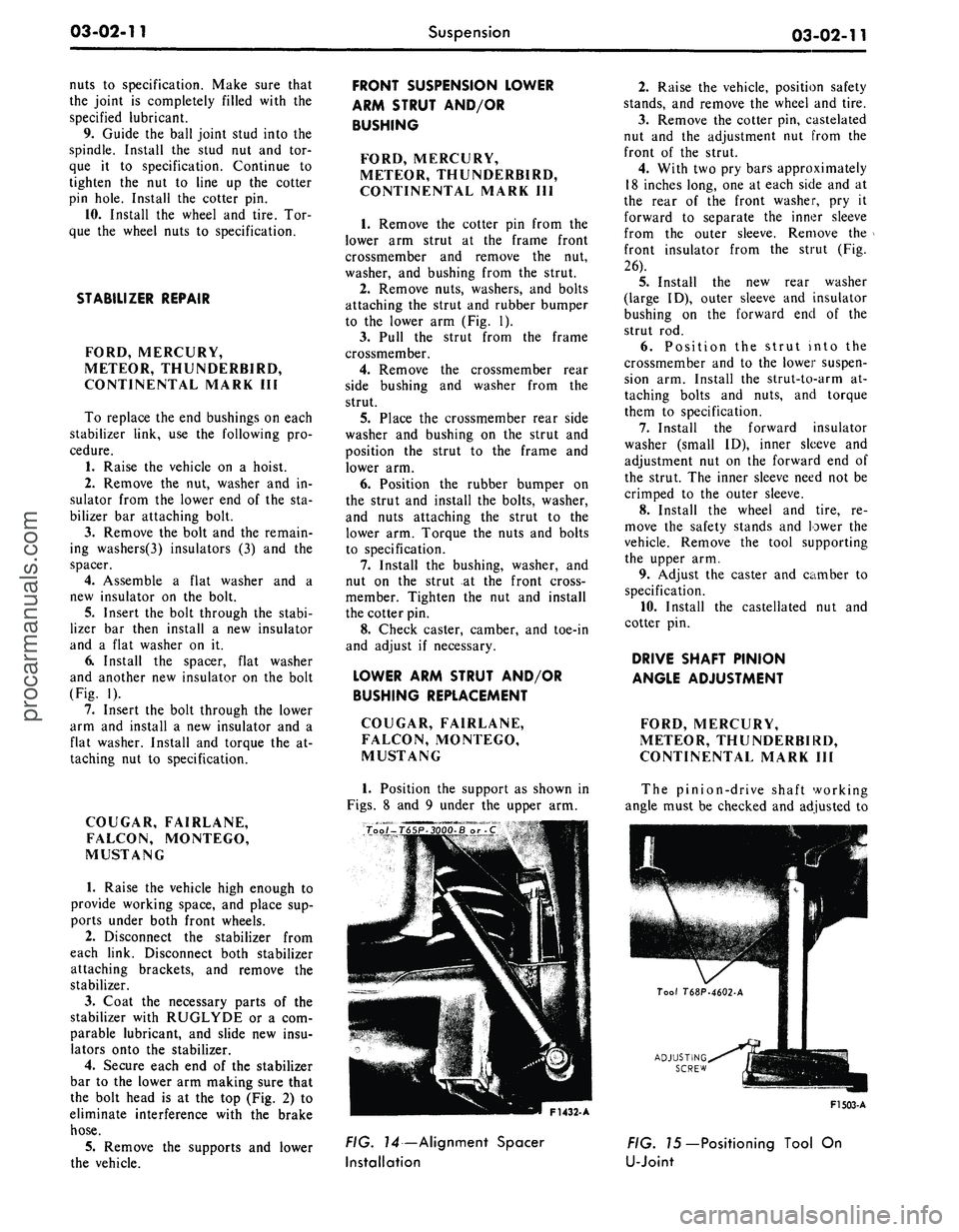
Position the support as shown in
Figs.
8 and 9 under the upper arm.
2.
Raise the vehicle, position safety
stands, and remove the wheel and tire.
3.
Remove the cotter pin, castelated
nut and the adjustment nut from the
front of the strut.
4.
With two pry bars approximately
18 inches long, one at each side and at
the rear of the front washer, pry it
forward to separate the inner sleeve
from the outer sleeve. Remove the
front insulator from the strut (Fig.
26).
5.
Install the new rear washer
(large ID), outer sleeve and insulator
bushing on the forward end of the
strut rod.
6. Position the strut into the
crossmember and to the lower suspen-
sion arm. Install the strut-to-arm at-
taching bolts and nuts, and torque
them to specification.
7.
Install the forward insulator
washer (small ID), inner sleeve and
adjustment nut on the forward end of
the strut. The inner sleeve need not be
crimped to the outer sleeve.
8. Install the wheel and tire, re-
move the safety stands and lower the
vehicle. Remove the tool supporting
the upper arm.
9. Adjust the caster and camber to
specification.
10.
Install the castellated nut and
cotter pin.
DRIVE SHAFT PINION
ANGLE ADJUSTMENT
FORD, MERCURY,
METEOR, THUNDERBIRD,
CONTINENTAL MARK III
The pinion-drive shaft working
angle must be checked and adjusted to
ADJUSTING
SCREW
F1432- A
F1503-A
FIG. 14—Alignment Spacer
Installation
FIG. 75—Positioning Tool On
U-Jointprocarmanuals.com
Page 89 of 413
03-02-13
Suspension
03-02-13
BALL JOINT BOLT HEAD
STABILIZER
F1370-A
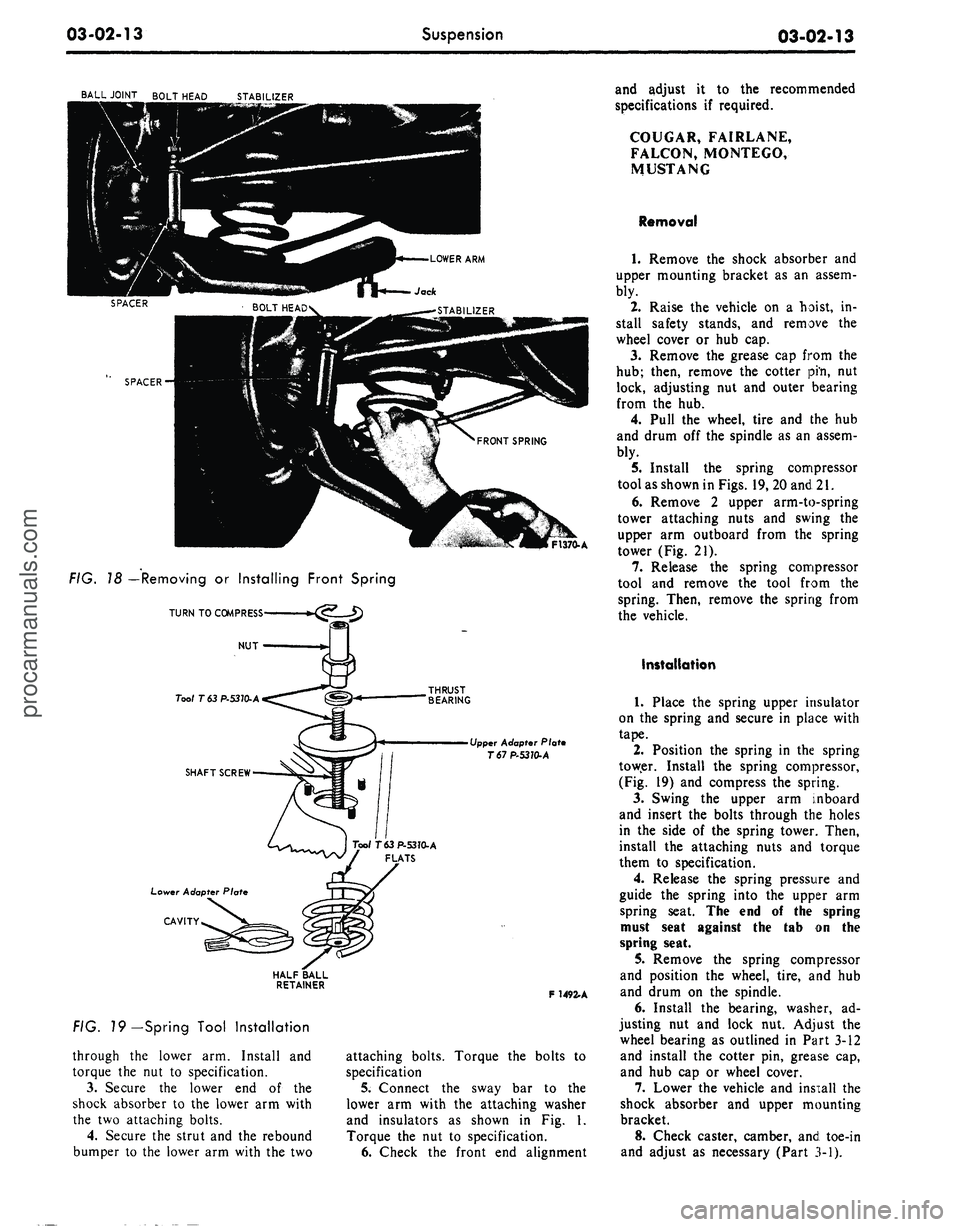
FIG. 18 —Removing or Installing Front Spring
TURN TO COMPRESS
NUT
•
Tool T 63 P-53J0-A
SHAFT SCREW
Lower Adapter Plate
CAVITY
Upper Adapter Plate
T67P-5370-A
FIG. 79—Spring Tool Installation
through the lower arm. Install and
torque the nut to specification.
3.
Secure the lower end of the
shock absorber to the lower arm with
the two attaching bolts.
4.
Secure the strut and the rebound
bumper to the lower arm with the two
F
1492.
A
attaching bolts. Torque the bolts to
specification
5.
Connect the sway bar to the
lower arm with the attaching washer
and insulators as shown in Fig. 1.
Torque the nut to specification.
6. Check the front end alignment
and adjust it to the recommended
specifications if required.
COUGAR, FAIRLANE,
FALCON, MONTEGO,
MUSTANG
Removal
1.
Remove the shock absorber and
upper mounting bracket as an assem-
bly.
2.
Raise the vehicle on a hoist, in-
stall safety stands, and remove the
wheel cover or hub cap.
3.
Remove the grease cap from the
hub;
then, remove the cotter pin, nut
lock, adjusting nut and outer bearing
from the hub.
4.
Pull the wheel, tire and the hub
and drum off the spindle as an assem-
bly.
5.
Install the spring compressor
tool as shown in Figs. 19, 20 and 21.
6. Remove 2 upper arm-to-spring
tower attaching nuts and swing the
upper arm outboard from the spring
tower (Fig. 21).
7.
Release the spring compressor
tool and remove the tool from the
spring. Then, remove the spring from
the vehicle.
Installation
1.
Place the spring upper insulator
on the spring and secure in place with
tape.
2.
Position the spring in the spring
tower. Install the spring compressor,
(Fig. 19) and compress the spring.
3.
Swing the upper arm inboard
and insert the bolts through the holes
in the side of the spring tower. Then,
install the attaching nuts and torque
them to specification.
4.
Release the spring pressure and
guide the spring into the upper arm
spring seat. The end o! the spring
must seat against the tab on the
spring seat.
5. Remove the spring compressor
and position the wheel, tire, and hub
and drum on the spindle.
6. Install the bearing, washer, ad-
justing nut and lock nut. Adjust the
wheel bearing as outlined in Part 3-12
and install the cotter pin, grease cap,
and hub cap or wheel cover.
7.
Lower the vehicle and install the
shock absorber and upper mounting
bracket.
8. Check caster, camber, and toe-in
and adjust as necessary (Part 3-1).procarmanuals.com