oil FORD MUSTANG 1969 Volume One Chassis
[x] Cancel search | Manufacturer: FORD, Model Year: 1969, Model line: MUSTANG, Model: FORD MUSTANG 1969Pages: 413, PDF Size: 75.81 MB
Page 308 of 413
07-01-17
General Transmission Service
07-01-17
PRESSURE REGULATOR
(FMX TRANSMISSION)
1.
Inspect the regulator body and
cover mating surface for burrs.
2.
Check all fluid passages for ob-
structions.
3.
Inspect the control pressure and
converter pressure valves and bores for
burrs and scores. Remove all burrs
carefully with crocus cloth.
4.
Check free movement of the
valves in their bores. The valves
should fall freely into the bores when
both the valve and bore are dry.
5.
Inspect the valve springs and
spacers for distortion.
CONTROL VALVE BODY
1.
Clean all parts thoroughly in
clean solvent, and then blow them dry
with moisture-free compressed air.
2.
Inspect all valve and plug bores
for scores. Check all fluid passages for
obstructions. Inspect the check valve
for free movement. Inspect all mating
surfaces for burrs or distortion. In-
spect all plugs and valves for burrs
and scores. Crocus cloth can be used
to polish valves and plugs if care is
taken to avoid rounding the sharp
edges of the valves and plugs.
3.
Inspect all springs for distortion.
Check all valves and plugs for free
movement in their respective bores.
Valves and plugs, when dry, must fall
from their own weight in their respec-
tive bores.
4.
Roll the manual valve on a flat
surface to check it for a bent condi-
tion.
GOVERNOR
1.
Inspect the governor valves and
bores for scores. Minor scores may be
removed from the valves with crocus
cloth. Replace the governor if the
valves or body is deeply scored.
2.
Check for free movement of the
valves in the bores. The valves should
slide freely of their own weight in the
bores when dry. Inspect fluid passages
in the valve body and counterweight
for obstructions. All fluid passages
must be clean.
3.
Inspect the mating surfaces of
the governor body and governor dis-
tributor (C4 or C6 Automatic) for
burrs and distortion. Mating surfaces
must be smooth and flat.
4.
Check the mating surface of the
governor valve and the counterweight
on a FMX transmission for burrs or
scratches.
5.
When cleaning the governor as-
sembly (C4 Automatic), the oil screen
should be removed from the collector
body and thoroughly blown out with
compressed air.
FRONT SERVO (FMX)
AND INTERMEDIATE
SERVO (C4 AND C6
AUTOMATIC)
1.
Inspect the servo bore for cracks
and the piston bore and the servo pis-
ton stem for scores. Check fluid pas-
sages for obstructions. Replace seals
that are damaged.
2.
On an FMX transmission, check
the actuating lever for free movement,
and inspect it for wear. If necessary to
replace the actuating lever or shaft,
remove the retaining pin and push the
shaft out of the bracket.
Inspect the adjusting screw threads
and the threads in the lever for dam-
age.
3.
Check the servo spring and servo
band strut(s) for distortion.
4.
Inspect the cover seal and gasket
cover sealing surface for defects.
REAR SERVO (FMX)
AND LOW-REVERSE SERVO
(C4 TRANSMISSION)
1.
Inspect the servo body for cracks
and the piston bore for scores.
2.
Check the fluid passages for ob-
structions.
3.
Inspect the band and the struts
for distortion. Inspect the band ends
for cracks.
4.
Inspect the servo spring for dis-
tortion.
5.
Inspect the band lining for exces-
sive wear and bonding to the metal
band.
6. On an FMX transmission, check
the servo body to case mating surface
for burrs. Check the accumulator pis-
ton and the check valve for freedom
of movement. Check the actuating
lever socket for scores.
7.
Replace seals that are damaged.
CASE
Inspect the case for cracks and
stripped threads. Inspect the gasket
surfaces and mating surfaces for
burrs.
Check the vent for obstructions,
and check all fluid passages for ob-
structions and leakage (Figs. 10, 11
and 12).
Inspect the case bushing for scores.
Check all parking linkage parts for
wear or damage.
ONE-WAY CLUTCH
1.
Inspect the outer and inner races
for scores or damaged surface area
where the rollers contact the races. If
the outer race on the C6 transmission
is damaged, the low-reverse clutch hub
must be replaced.
2.
Inspect the rollers and springs
for excessive wear or damage.
3.
Inspect the spring and roller case
for bent or damaged spring retainers.procarmanuals.com
Page 309 of 413
07-02^01
C4 Automatic Transmission
0702-01
PART 7-2 C4 Automatic
Transmission
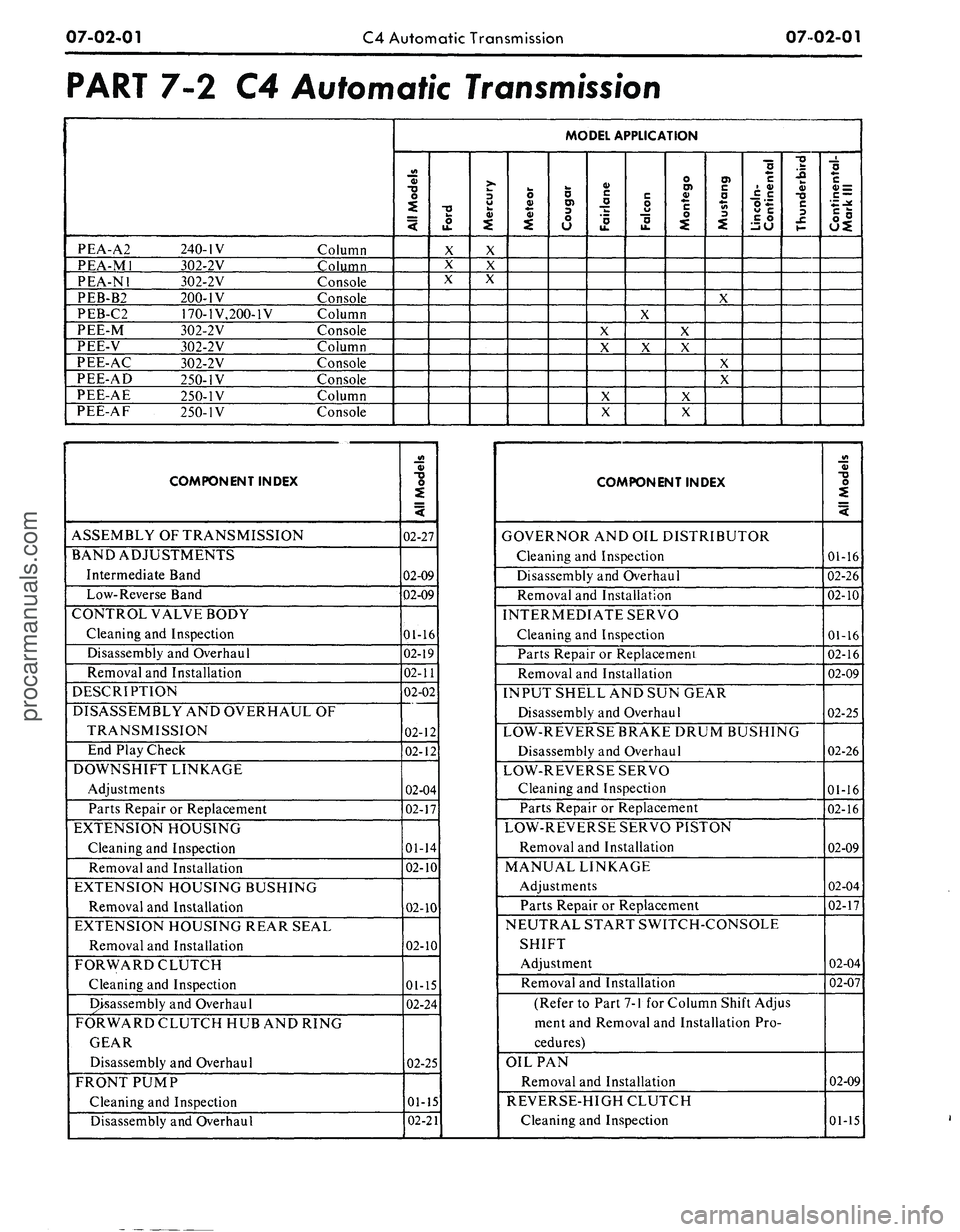
PEA-A2 240-1V Column
PEA-MI 302-2V Column
PEA-N1 3O2-2V Console
PEB-B2 200-1V Console
PEB-C2 17O-1V,2OO-1V Column
PEE-M 302-2V Console
PEE-V 302-2V Column
PEE-AC 302-2V Console
PEE-AD 250-1V Console
PEE-AE 250-1V Column
PEE-AF 250-1V Console
MODEL APPLICATION
All
Models
Ford
X
X
X
Mercury
X
X
X
Meteor
Cougar
Fairiane
X
X
X
X
Falcon
X
X
Montego
X
X
X
X
Mustang
X
X
X
Lincoln-
Continental
Thunderbird
Continental-
Mark
III
COMPONENT INDEX
ASSEMBLY OF TRANSMISSION
BAND ADJUSTMENTS
Intermediate Band
Low-Reverse Band
CONTROL VALVE BODY
Cleaning and Inspection
Disassembly and Overhaul
Removal and Installation
DESCRIPTION
DISASSEMBLY AND OVERHAUL OF
TRANSMISSION
End Play Check
DOWNSHIFT LINKAGE
Adjustments
Parts Repair or Replacement
EXTENSION HOUSING
Cleaning and Inspection
Removal and Installation
EXTENSION HOUSING BUSHING
Removal and Installation
EXTENSION HOUSING REAR SEAL
Removal and Installation
FORWARD CLUTCH
Cleaning and Inspection
Disassembly and Overhaul
FORWARD CLUTCH HUB AND RING
GEAR
Disassembly and Overhaul
FRONT PUMP
Cleaning and Inspection
Disassembly and Overhaul
All
Models
02-27
02-09
02-09
01-16
02-19
02-11
02-02
02-12
02-12
02-04
02-17
01-14
02-10
02-10
02-10
01-15
02-24
02-25
01-15
02-21
COMPONENT INDEX
GOVERNOR AND OIL DISTRIBUTOR
Cleaning and Inspection
Disassembly and Overhaul
Removal and Installation
INTERMEDIATE SERVO
Cleaning and Inspection
Parts Repair or Replacement
Removal and Installation
INPUT SHELL AND SUN GEAR
Disassembly and Overhaul
LOW-REVERSE BRAKE DRUM BUSHING
Disassembly and Overhaul
LOW-REVERSE SERVO
Cleaning and Inspection
Parts Repair or Replacement
LOW-REVERSE SERVO PISTON
Removal and Installation
MANUAL LINKAGE
Adjustments
Parts Repair or Replacement
NEUTRAL START SWITCH-CONSOLE
SHIFT
Adjustment
Removal and Installation
(Refer to Part 7-1 for Column Shift Adjus
ment and Removal and Installation Pro-
cedures)
OIL PAN
Removal and Installation
REVERSE-HIGH CLUTCH
Cleaning and Inspection
All
Models
01-16
02-26
02-10
01-16
02-16
02-09
02-25
02-26
01-16
02-16
02-09
02-04
02-17
02-04
02-07
02-09
01-15
procarmanuals.com
Page 311 of 413
07-02-03
C4 Automatic Transmission
07-02-03
CONVERTER
FORWARD CLUTCH
PRIMARY GOVERNOR
CONVERTER
CHECK VALVE
ONE-WAY
CLUTCH
DRAIN-BACK
VALVE
FRONT LUBE
CONVERTER
PRESSURE
RELIEF VALVE
LOW AND
REVERSE
SERVO
AND DIRECT
CLUTCH
L
SECONDARY
GOVERNOR
INTERMEDIATE
BAND
ACCUMULATOR
VALVE
CUT-BACK
VALVE
2-3
BACK-OUT
VALVE
MAIN
REGU-
LATOR
VALVE
MANUAL
LOW
VALVE
1-2 SHIFT
VALVE
D2
VALVE
THROTTLE
MODULATOR
VALVE
THROTTLE
BOOST VALVE
PRESSURE
BOOSTER
VALVE
DOWNSHIFT VALVE
LINE
COASTING
BOOST
VALVE
ENGINE
MANIFOLD
VACUUM
LESS THAN
20
INCHES
PRIMARY
THROTTLE
VALVE
(CASE)
VACUUM
DIAPHRAGM
OIL
SCREEN
I) 1724-E
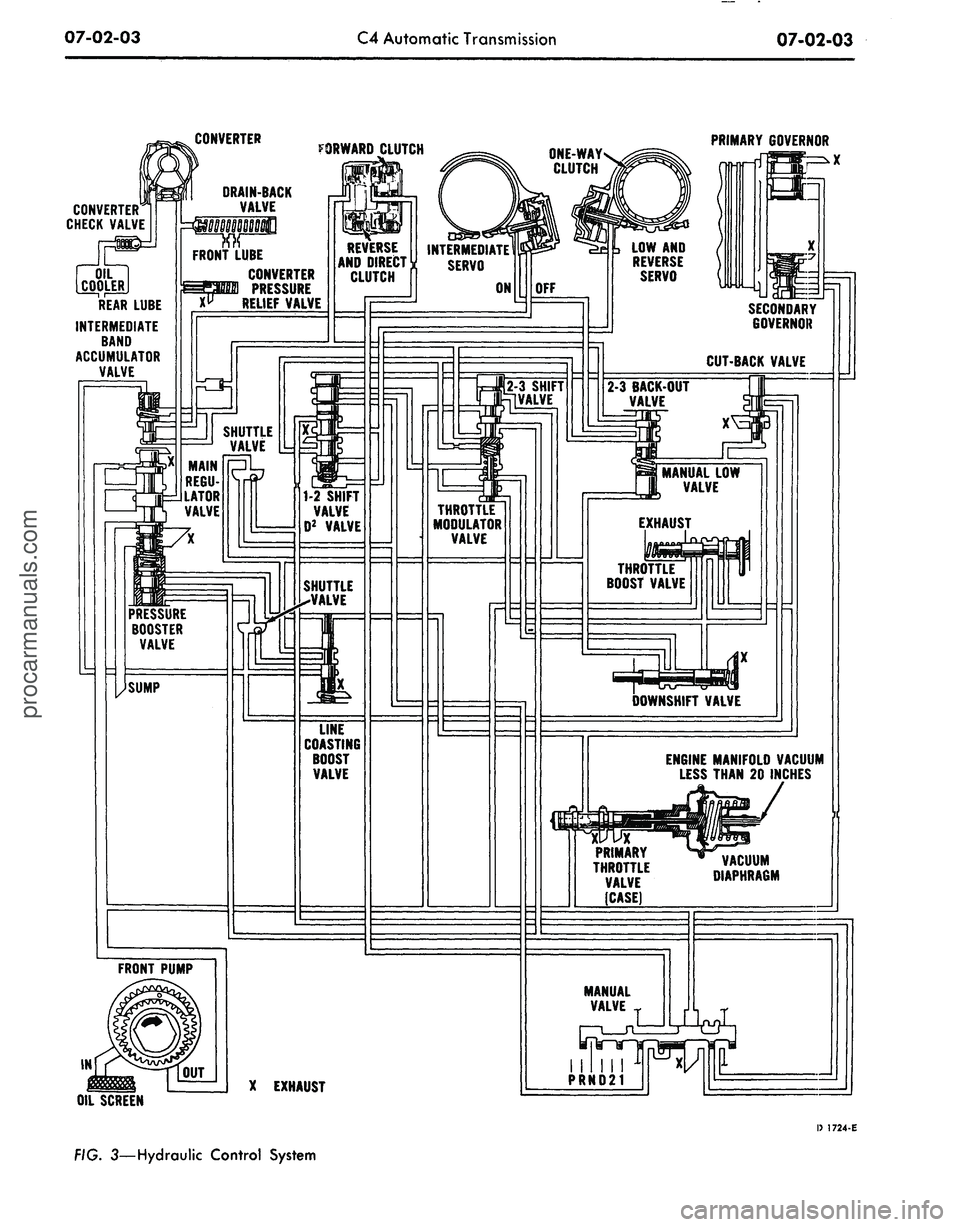
FIG. 3—Hydraulic Control Systemprocarmanuals.com
Page 315 of 413
07-02-07
C4 Automatic Transmission
07-02-07
2.
Remove the selector lever handle
from the lever.
3.
Remove the trim panel from the
top of the console.
4.
Remove the cover and dial indi-
cator as an assembly.
5.
Remove the four screws that se-
cure the selector lever retainer to the
selector lever housing. Lift the retainer
from the housing.
6. Loosen the two combination
starter neutral and back-up light
switch attaching screws (Fig. 10).
7.
Move the selector lever back and
forth until the gauge pin (No. 43 drill)
can be fully inserted into the gauge
pin holes (Fig. 10).
8. Place the transmission selector
lever firmly against the stop of the
neutral detent position.
9. Slide the combination starter
neutral and back-up light switch for-
ward or rearward as required, until
the switch actuating lever contacts the
selector lever.
10.
Tighten the switch attaching
screws and remove the gauge pin.
Check for starting in the park posi-
tion.
11.
Turn the ignition key to the
ACC position and place the selector
lever in the reverse position and check
the operation of the back-up lights.
Turn the key off.
12.
Position the selector lever re-
tainer to the selector lever housing.
Install the four attaching screws.
13.
Install the cover and dial indi-
cator.
14.
Install the trim panel on the top
of the console. Install the selector
lever handle.
MUSTANG
1.
With the manual lever properly
NEUTRAL
START
SWITCH
(D1439-A
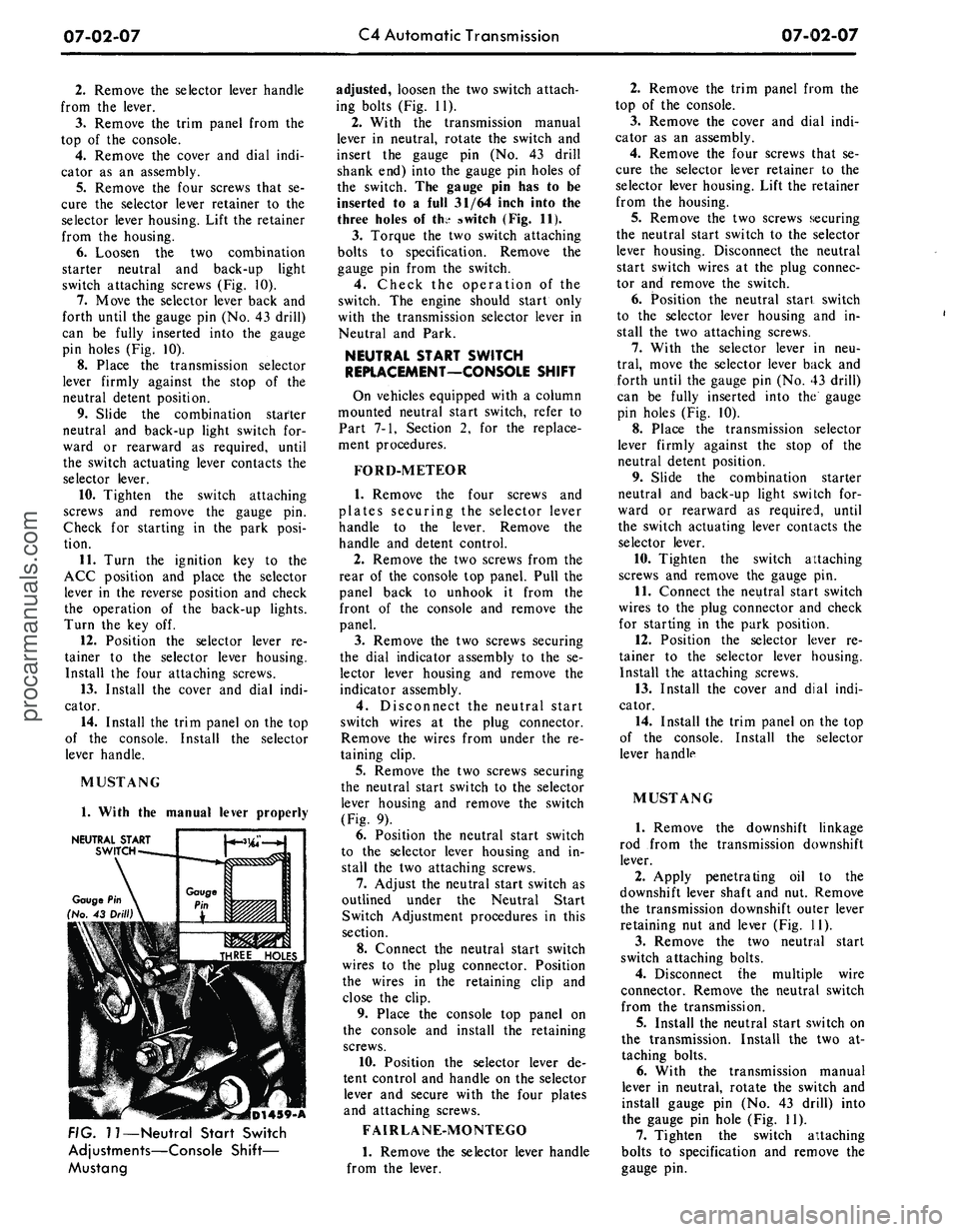
FIG. 11—Neutral Start Switch
Adjustments—Console Shift—
Mustang
adjusted, loosen the two switch attach-
ing bolts (Fig. 11).
2.
With the transmission manual
lever in neutral, rotate the switch and
insert the gauge pin (No. 43 drill
shank end) into the gauge pin holes of
the switch. The gauge pin has to be
inserted to a full 31/64 inch into the
three holes of the switch (Fig. 11).
3.
Torque the two switch attaching
bolts to specification. Remove the
gauge pin from the switch.
4.
Check the operation of the
switch. The engine should start only
with the transmission selector lever in
Neutral and Park.
NEUTRAL START SWITCH
REPLACEMENT—CONSOLE SHIFT
On vehicles equipped with a column
mounted neutral start switch, refer to
Part 7-1, Section 2, for the replace-
ment procedures.
FORD-METEOR
1.
Remove the four screws and
plates securing the selector lever
handle to the lever. Remove the
handle and detent control.
2.
Remove the two screws from the
rear of the console top panel. Pull the
panel back to unhook it from the
front of the console and remove the
panel.
3.
Remove the two screws securing
the dial indicator assembly to the se-
lector lever housing and remove the
indicator assembly.
4.
Disconnect the neutral start
switch wires at the plug connector.
Remove the wires from under the re-
taining clip.
5.
Remove the two screws securing
the neutral start switch to the selector
lever housing and remove the switch
(Fig. 9).
6. Position the neutral start switch
to the selector lever housing and in-
stall the two attaching screws.
7.
Adjust the neutral start switch as
outlined under the Neutral Start
Switch Adjustment procedures in this
section.
8. Connect the neutral start switch
wires to the plug connector. Position
the wires in the retaining clip and
close the clip.
9. Place the console top panel on
the console and install the retaining
screws.
10.
Position the selector lever de-
tent control and handle on the selector
lever and secure with the four plates
and attaching screws.
FAIRLANE-MONTEGO
1.
Remove the selector lever handle
from the lever.
2.
Remove the trim panel from the
top of the console.
3.
Remove the cover and dial indi-
cator as an assembly.
4.
Remove the four screws that se-
cure the selector lever retainer to the
selector lever housing. Lift the retainer
from the housing.
5.
Remove the two screws securing
the neutral start switch to the selector
lever housing. Disconnect the neutral
start switch wires at the plug connec-
tor and remove the switch.
6. Position the neutral start switch
to the selector lever housing and in-
stall the two attaching screws.
7.
With the selector lever in neu-
tral,
move the selector lever back and
forth until the gauge pin (No. 43 drill)
can be fully inserted into the gauge
pin holes (Fig. 10).
8. Place the transmission selector
lever firmly against the stop of the
neutral detent position.
9. Slide the combination starter
neutral and back-up light switch for-
ward or rearward as required, until
the switch actuating lever contacts the
selector lever.
10.
Tighten the switch attaching
screws and remove the gauge pin.
11.
Connect the neutral start switch
wires to the plug connector and check
for starting in the park position.
12.
Position the selector lever re-
tainer to the selector lever housing.
Install the attaching screws.
13.
Install the cover and dial indi-
cator.
14.
Install the trim panel on the top
of the console. Install the selector
lever handle
MUSTANG
1.
Remove the downshift linkage
rod from the transmission downshift
lever.
2.
Apply penetrating oil to the
downshift lever shaft and nut. Remove
the transmission downshift outer lever
retaining nut and lever (Fig. 11).
3.
Remove the two neutral start
switch attaching bolts.
4.
Disconnect the multiple wire
connector. Remove the neutral switch
from the transmission.
5.
Install the neutral start switch on
the transmission. Install the two at-
taching bolts.
6. With the transmission manual
lever in neutral, rotate the switch and
install gauge pin (No. 43 drill) into
the gauge pin hole (Fig. 11).
7.
Tighten the switch attaching
bolts to specification and remove the
gauge pin.procarmanuals.com
Page 317 of 413
07-02-09
C4 Automatic Transmission
07-02-09
11.
Remove the handle from the se-
lector lever.
12.
Install the selector housing and
lever assembly as shown in Figure 8.
Torque the attaching bolts 4-6 ft-lbs.
13.
Connect the dial indicator light.
14.
Install the pointer back-up
shield on the housing and lever assem-
bly.
15.
Install the dial housing and
tighten the attaching screws.
16.
Install the selector lever handle
and tighten the attaching screw.
17.
Position the selector lever in the
D position.
18.
Raise the vehicle. Install the
transmission manual lever rod to the
selector lever. Adjust the manual link-
age.
19.
Lower the vehicle and check the
transmission operation in each selo:c-
tor lever detent position.
BAND ADJUSTMENT
INTERMEDIATE BAND
1.
Clean all the dirt from the band
adjusting screw area. Remove and dis-
card the locknut.
2.
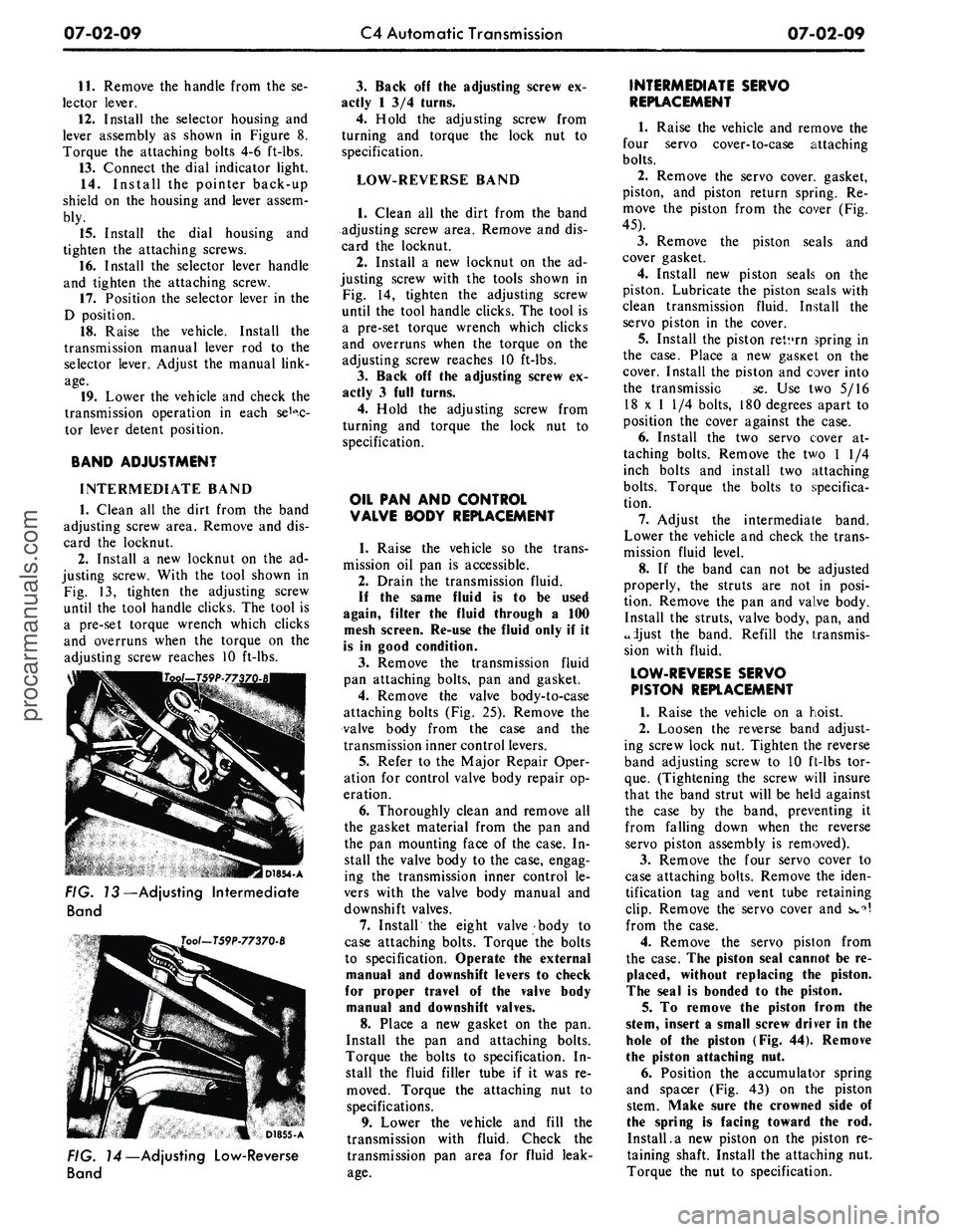
Install a new locknut on the ad-
justing screw. With the tool shown in
Fig. 13, tighten the adjusting screw
until the tool handle clicks. The tool is
a pre-set torque wrench which clicks
and overruns when the torque on the
adjusting screw reaches 10 ft-lbs.
I D1854-A
FIG. 13—Adjusting Intermediate
Band
Tool-T59P-77370-B
D1855-A
FIG. 14—Adjusting Low-Reverse
Band
3.
Back off the adjusting screw ex-
actly 1 3/4 turns.
4.
Hold the adjusting screw from
turning and torque the lock nut to
specification.
LOW-REVERSE BAND
1.
Clean all the dirt from the band
adjusting screw area. Remove and dis-
card the locknut.
2.
Install a new locknut on the ad-
justing screw with the tools shown in
Fig. 14, tighten the adjusting screw
until the tool handle clicks. The tool is
a pre-set torque wrench which clicks
and overruns when the torque on the
adjusting screw reaches 10 ft-lbs.
3.
Back off the adjusting screw ex-
actly 3 full turns.
4.
Hold the adjusting screw from
turning and torque the lock nut to
specification.
OIL PAN AND CONTROL
VALVE BODY REPLACEMENT
1.
Raise the vehicle so the trans-
mission oil pan is accessible.
2.
Drain the transmission fluid.
If the same fluid is to be used
again, filter the fluid through a 100
mesh screen. Re-use the fluid only if it
is in good condition.
3.
Remove the transmission fluid
pan attaching bolts, pan and gasket.
4.
Remove the valve body-to-case
attaching bolts (Fig. 25). Remove the
valve body from the case and the
transmission inner control levers.
5.
Refer to the Major Repair Oper-
ation for control valve body repair op-
eration.
6. Thoroughly clean and remove all
the gasket material from the pan and
the pan mounting face of the case. In-
stall the valve body to the case, engag-
ing the transmission inner control le-
vers with the valve body manual and
downshift valves.
7.
Install the eight valve body to
case attaching bolts. Torque the bolts
to specification. Operate the external
manual and downshift levers to check
for proper travel of the valve body
manual and downshift valves.
8. Place a new gasket on the pan.
Install the pan and attaching bolts.
Torque the bolts to specification. In-
stall the fluid filler tube if it was re-
moved. Torque the attaching nut to
specifications.
9. Lower the vehicle and fill the
transmission with fluid. Check the
transmission pan area for fluid leak-
age.
INTERMEDIATE SERVO
REPLACEMENT
1.
Raise the vehicle and remove the
four servo cover-to-case attaching
bolts.
2.
Remove the servo cover, gasket,
piston, and piston return spring. Re-
move the piston from the cover (Fig.
45).
3.
Remove the piston seals and
cover gasket.
4.
Install new piston seals on the
piston. Lubricate the piston seals with
clean transmission fluid. Install the
servo piston in the cover.
5.
Install the piston retvrn spring in
the case. Place a new gasicet on the
cover. Install the piston and cover into
the transmissic se. Use two 5/16
18 x 1 1/4 bolts, 180 degrees apart to
position the cover against the case.
6. Install the two servo cover at-
taching bolts. Remove the two 1 1/4
inch bolts and install two attaching
bolts.
Torque the bolts to specifica-
tion.
7.
Adjust the intermediate band.
Lower the vehicle and check the trans-
mission fluid level.
8. If the band can not be adjusted
properly, the struts are not in posi-
tion. Remove the pan and valve body.
Install the struts, valve body, pan, and
adjust the band. Refill the transmis-
sion with fluid.
LOW-REVERSE SERVO
PISTON REPLACEMENT
1.
Raise the vehicle on a hoist.
2.
Loosen the reverse band adjust-
ing screw lock nut. Tighten the reverse
band adjusting screw to 10 ft-lbs tor-
que.
(Tightening the screw will insure
that the band strut will be held against
the case by the band, preventing it
from falling down when the reverse
servo piston assembly is removed).
3.
Remove the four servo cover to
case attaching bolts. Remove the iden-
tification tag and vent tube retaining
clip.
Remove the servo cover and s»»^
from the case.
4.
Remove the servo piston from
the case. The piston seal cannot be re-
placed, without replacing the piston.
The seal is bonded to the piston.
5. To remove the piston from the
stem, insert a small screw driver in the
hole of the piston (Fig. 44). Remove
the piston attaching nut.
6. Position the accumulator spring
and spacer (Fig. 43) on the piston
stem. Make sure the crowned side of
the spring is facing toward the rod.
Install.a new piston on the piston re-
taining shaft. Install the attaching nut.
Torque the nut to specification.procarmanuals.com
Page 319 of 413
07-02-11
C4 Automatic Transmission
07-02-11
REMOVAL AND INSTALLATION
An oil impregnated plastic grommet
is incorporated in the end of the man-
ual shift linkage lever arm on all col-
umn shift vehicles. A special tool
T67P-7341-A is required to install the
grommet in the manual lever, and to
install the manual linkage rod into the
grommet. Refer to Part 7-1, Section
2,
for the grommet replacement pro-
cedures.
TRANSMISSION REMOVAL
1.
Raise the vehicle and remove the
converter cover attaching bolts, at the
lower front side of the converter hous-
ing. Remove the cover.
2.
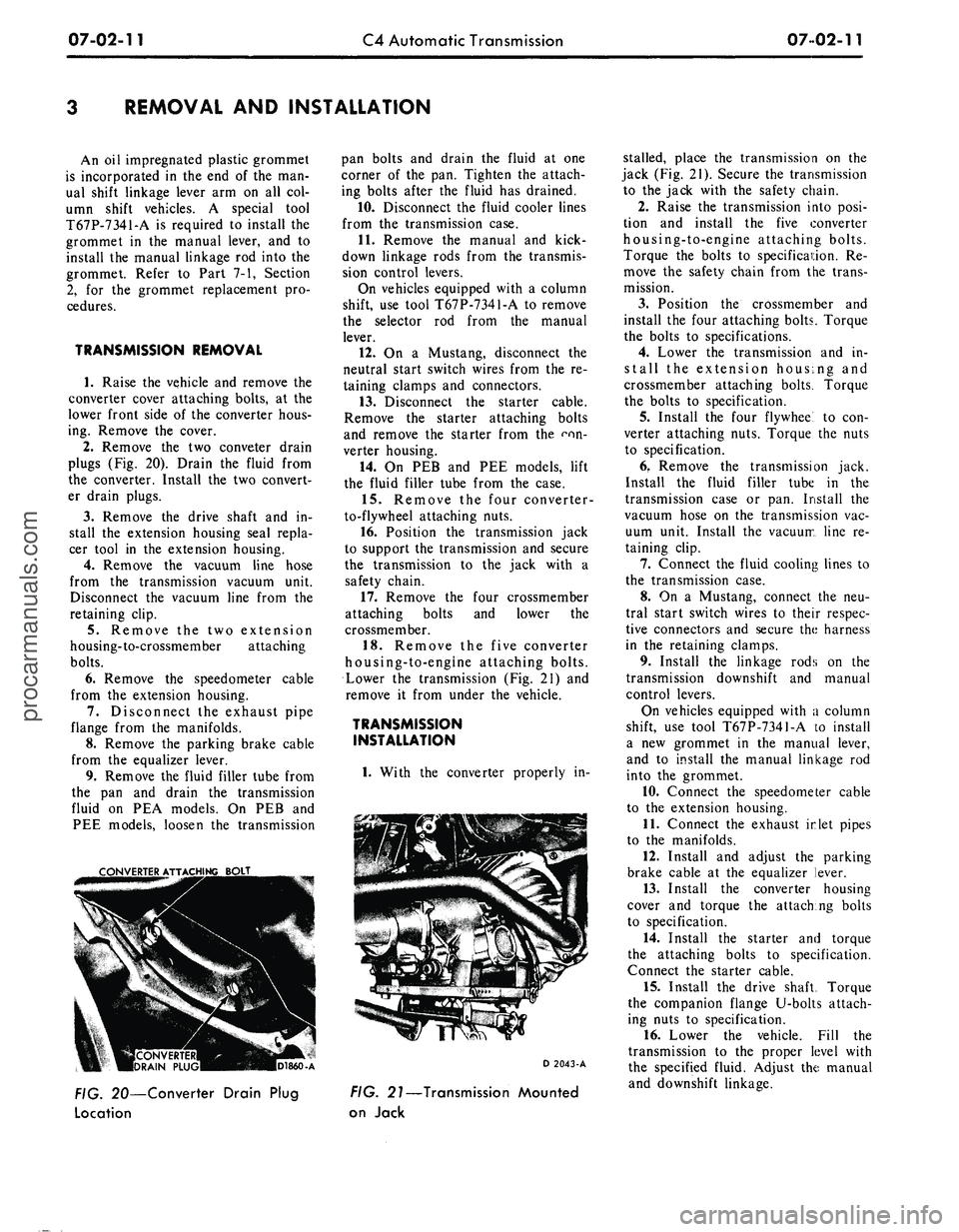
Remove the two conveter drain
plugs (Fig. 20). Drain the fluid from
the converter. Install the two convert-
er drain plugs.
3.
Remove the drive shaft and in-
stall the extension housing seal repla-
cer tool in the extension housing.
4.
Remove the vacuum line hose
from the transmission vacuum unit.
Disconnect the vacuum line from the
retaining clip.
5.
Remove the two extension
housing-to-crossmember attaching
bolts.
6. Remove the speedometer cable
from the extension housing.
7.
Disconnect the exhaust pipe
flange from the manifolds.
8. Remove the parking brake cable
from the equalizer lever.
9. Remove the fluid filler tube from
the pan and drain the transmission
fluid on PEA models. On PEB and
PEE models, loosen the transmission
CONVERTER A
ATT,
pan bolts and drain the fluid at one
corner of the pan. Tighten the attach-
ing bolts after the fluid has drained.
10.
Disconnect the fluid cooler lines
from the transmission case.
11.
Remove the manual and kick-
down linkage rods from the transmis-
sion control levers.
On vehicles equipped with a column
shift, use tool T67P-7341-A to remove
the selector rod from the manual
lever.
12.
On a Mustang, disconnect the
neutral start switch wires from the re-
taining clamps and connectors.
13.
Disconnect the starter cable.
Remove the starter attaching bolts
and remove the starter from the con-
verter housing.
14.
On PEB and PEE models, lift
the fluid filler tube from the case.
15.
Remove the four converter-
to-flywheel attaching nuts.
16.
Position the transmission jack
to support the transmission and secure
the transmission to the jack with a
safety chain.
17.
Remove the four crossmember
attaching bolts and lower the
crossmember.
18.
Remove the five converter
housing-to-engine attaching bolts.
Lower the transmission (Fig. 21) and
remove it from under the vehicle.
TRANSMISSION
INSTALLATION
1.
With the converter properly in-
D 2043-A
FIG. 20—Converter Drain Plug
Location
FIG. 21—Transmission Mounted
on Jack
stalled, place the transmission on the
jack (Fig. 21). Secure the transmission
to the jack with the safety chain.
2.
Raise the transmission into posi-
tion and install the five converter
housing-to-engine attaching bolts.
Torque the bolts to specification. Re-
move the safety chain from the trans-
mission.
3.
Position the crossmember and
install the four attaching bolts. Torque
the bolts to specifications.
4.
Lower the transmission and in-
stall the extension housing and
crossmember attaching bolts. Torque
the bolts to specification.
5.
Install the four flywheel to con-
verter attaching nuts. Torque the nuts
to specification.
6. Remove the transmission jack.
Install the fluid filler tube in the
transmission case or pan. Install the
vacuum hose on the transmission vac-
uum unit. Install the vacuum line re-
taining clip.
7.
Connect the fluid cooling lines to
the transmission case.
8. On a Mustang, connect the neu-
tral start switch wires to their respec-
tive connectors and secure the harness
in the retaining clamps.
9. Install the linkage rods on the
transmission downshift and manual
control levers.
On vehicles equipped with a column
shift, use tool T67P-7341-A to install
a new grommet in the manual lever,
and to install the manual linkage rod
into the grommet.
10.
Connect the speedometer cable
to the extension housing.
11.
Connect the exhaust inlet pipes
to the manifolds.
12.
Install and adjust the parking
brake cable at the equalizer lever.
13.
Install the converter housing
cover and torque the attaching bolts
to specification.
14.
Install the starter and torque
the attaching bolts to specification.
Connect the starter cable.
15.
Install the drive shaft. Torque
the companion flange U-bolts attach-
ing nuts to specification.
16.
Lower the vehicle. Fill the
transmission to the proper level with
the specified fluid. Adjust the manual
and downshift linkage.procarmanuals.com
Page 320 of 413
07-02-12
C4 Automatic Transmission
07-02-12
MAJOR REPAIR OPERATIONS
Before removing
any of the sub-
assemblies, thoroughly clean
the out-
side
of the
transmission
to
prevent dirt
from entering
the
mechanical parts.
During
the
repair operations, refer
to
Part 7-1
for
common adjustments
and
repairs
or
cleaning
and
inspection
pro-
cedures.
During
the
transmission disassem-
bly
or
assembly operations,
ten
thrust
washers located between
the sub-
assemblies must
be
removed
and in-
stalled.
It is
important that each
thrust washer
be in the
correct posi-
tion during
the
assembly operation.
To properly locate
and
identify
the
thrust washers,
the
various positions
of
the
thrust washers
are
shown
in the
illustrations
and are
numbered
1
through
10. No. 1 is at the
first thrust
washer located
at the
front pump.
The
last thrust washer,
No. 10, is
located
at
the
parking pawl ring gear.
DISASSEMBLY
OF
TRANSMISSION
1.
Remove
the
converter from
the
transmission front pump
and
convert-
er housing.
2.
Remove
the
transmission vacuum
unit with
the
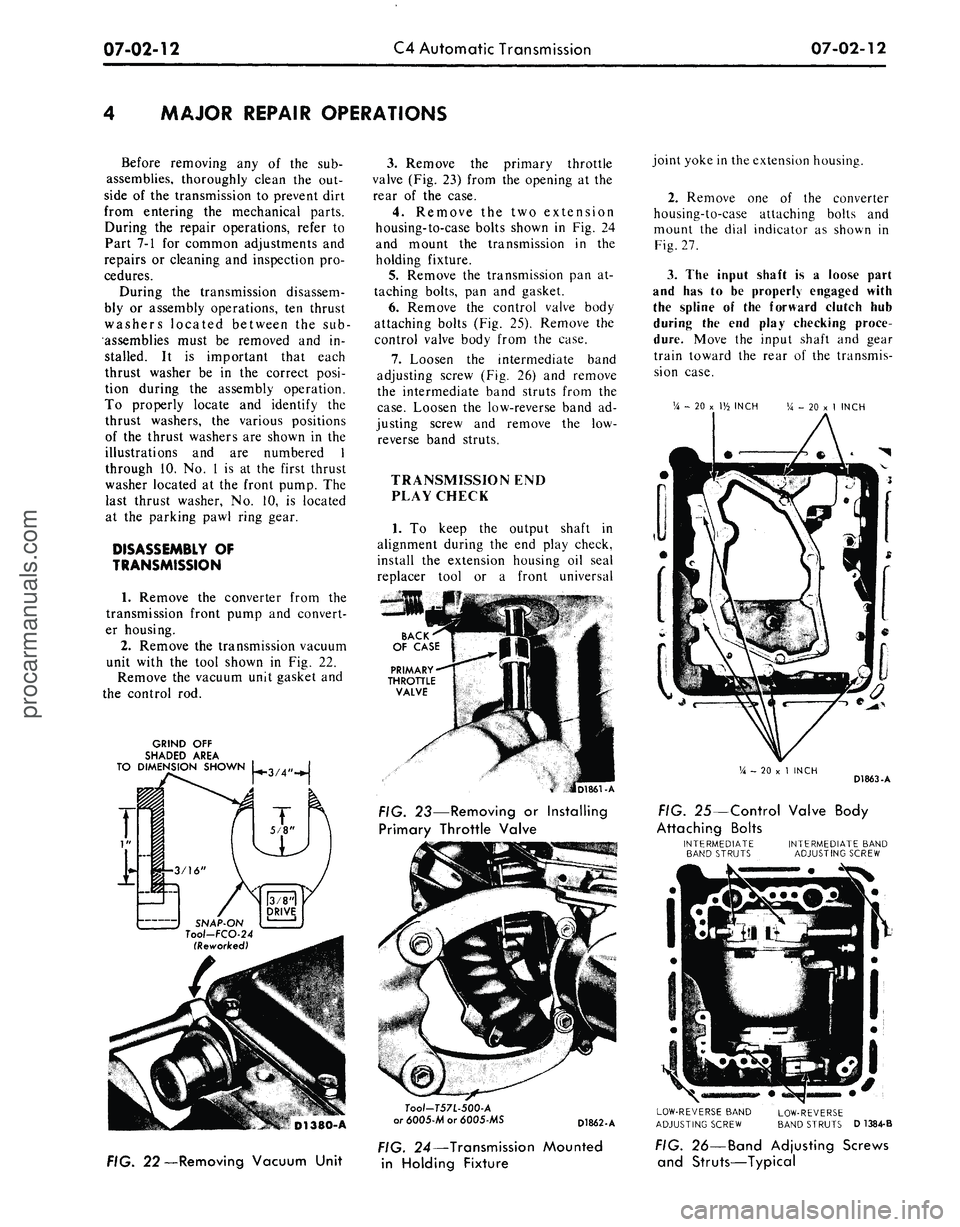
tool shown
in Fig. 22.
Remove
the
vacuum unit gasket and
the control
rod.
GRIND OFF
SHADED AREA
TO DIMENSION SHOWN L .
SNAP-ON
Tool-FCO-24
(Reworked)
D1380-A
FIG. 22—Removing Vacuum Unit
3.
Remove
the
primary throttle
valve (Fig.
23)
from
the
opening
at the
rear
of the
case.
4.
Remove
the two
extension
housing-to-case bolts shown
in Fig. 24
and mount
the
transmission
in the
holding fixture.
5.
Remove
the
transmission
pan at-
taching bolts,
pan and
gasket.
6. Remove
the
control valve body
attaching bolts (Fig.
25).
Remove
the
control valve body from
the
case.
7.
Loosen
the
intermediate band
adjusting screw
(Fig. 26) and
remove
the intermediate band struts from
the
case.
Loosen
the
low-reverse band
ad-
justing screw
and
remove
the low-
reverse band struts.
TRANSMISSION END
PLAY CHECK
1.
To
keep
the
output shaft
in
alignment during
the end
play check,
install
the
extension housing
oil
seal
replacer tool
or a
front universal
D1861-A
FIG. 23—Removing
or
Installing
Primary Throttle Valve
Tool-T57L-500-A
or 6005-M or 6005-MS
D1862-A
joint yoke in the extension housing.
2.
Remove
one of the
converter
housing-to-case attaching bolts
and
mount
the
dial indicator
as
shown
in
Fig. 27.
3.
The
input shaft
is a
loose part
and
has to be
properly engaged with
the spline
of the
forward clutch
hub
during
the end
play checking proce-
dure.
Move
the
input shaft
and
gear
train toward
the
rear
of the
transmis-
sion case.
V*
- 20 x
V/7 INCH
V*
- 20 x 1
INCH
V*
- 20 x 1
INCH
D1863-A
FIG. 25—Control Valve Body
Attaching Bolts
INTERMEDIATE
BAND STRUTS
INTERMEDIATE BAND
ADJUSTING SCREW
I
LOW-REVERSE BAND
ADJUSTING SCREW
LOW-REVERSE
BAND STRUTS
D
1384-B
FIG.
24—Transmission
Mounted
in Holding Fixture
FIG. 26—Band Adjusting Screws
and Struts—Typicalprocarmanuals.com
Page 325 of 413
07-02-17
C4 Automatic Transmission
07-02-17
Vehicle
Ford,
Meteor
Fairlane,
Montegc,
Falcon,
Mustang
Ford,
Meteor
Fairlane,
Montego,
Mustang
Mustang
Falcon
Engine
302-2V
302-2V
240-IV
250-1V
200-1V
170-1V
200-1V
Transmi ssion
PEA-MI,
Nl
PEE-M,
V, AC
PEA-A2
PEE-AD,
AE,
AF
PEB-B2
PEB-C2
Servo Piston
Dia.
A
3.7875
3.7875
3.3265
Dia.
B
2.8265
2.7065
2.4865
Servo Cover
Dia.
C
None
None
3.340
Dia.
D
2.840
2.975
2.500
Spring
Free Length
(Inches)
2.480
2.480
2.480
Color
Cniif
White
White
White
D 1800-D
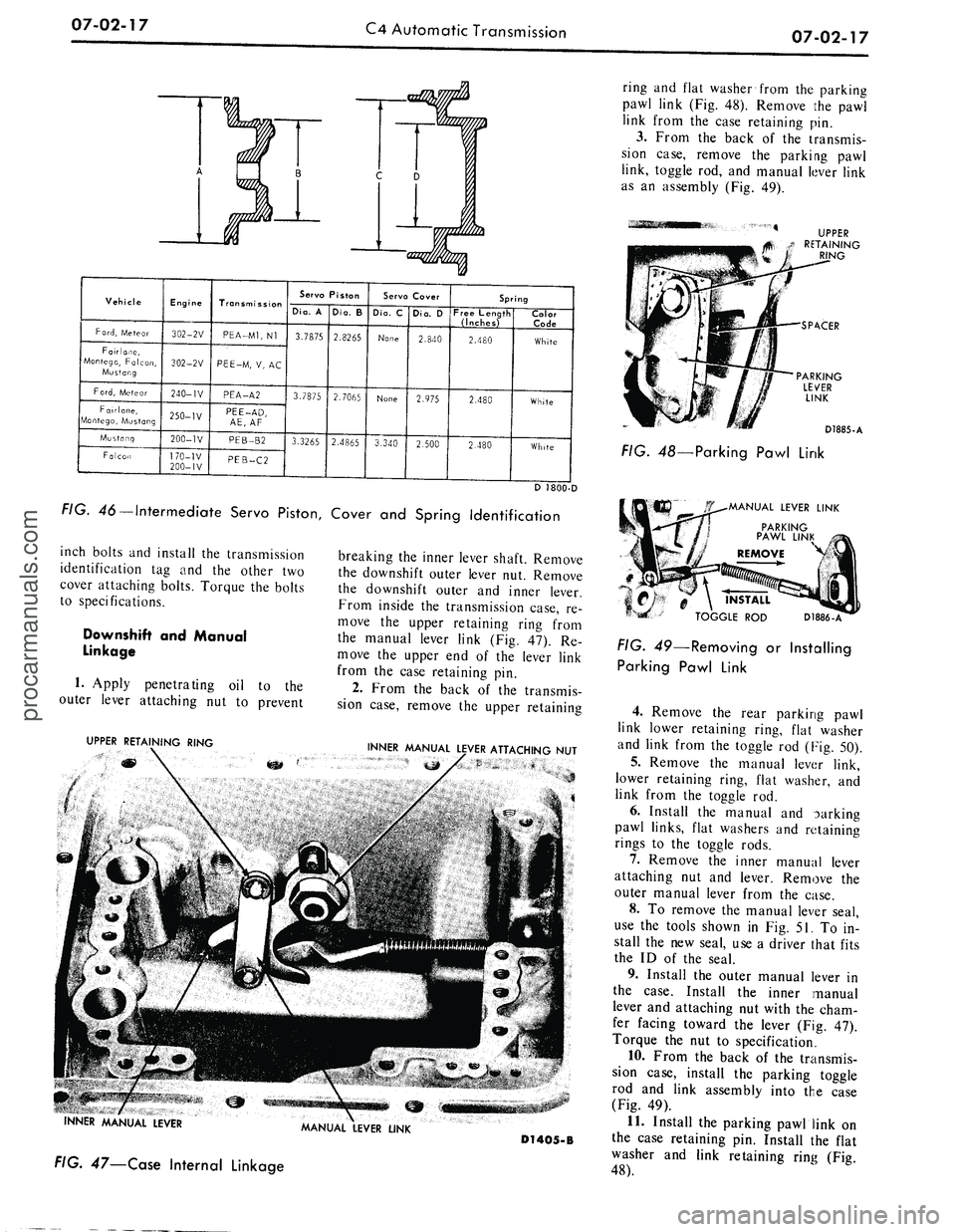
FIG. 46—Intermediate Servo Piston, Cover and Spring Identification
inch bolts and install the transmission
identification tag and the other two
cover attaching bolts. Torque the bolts
to specifications.
Downshift and Manual
Linkage
1.
Apply penetrating oil to the
outer lever attaching nut to prevent
UPPER RETAINING RING
breaking the inner lever shaft. Remove
the downshift outer lever nut. Remove
the downshift outer and inner lever.
From inside the transmission case, re-
move the upper retaining ring from
the manual lever link (Fig. 47). Re-
move the upper end of the lever link
from the case retaining pin.
2.
From the back of the transmis-
sion case, remove the upper retaining
INNER MANUAL
'ER ATTACHING NUT
mmMm
INNER MANUAL LEVER MANUAL LEVER LINK
FIG. 47—Case Internal Linkage
ring and flat washer from the parking
pawl link (Fig. 48). Remove the pawl
link from the case retaining pin.
3.
From the back of the transmis-
sion case, remove the parking pawl
link, toggle rod, and manual lever link
as an assembly (Fig. 49).
UPPER
r RETAINING
RING
D1885-A
FIG. 48—Parking Pawl Link
/7^-MANUAL LEVER LINK
D1405-B
FIG. 49—Removing or Installing
Parking Pawl Link
4.
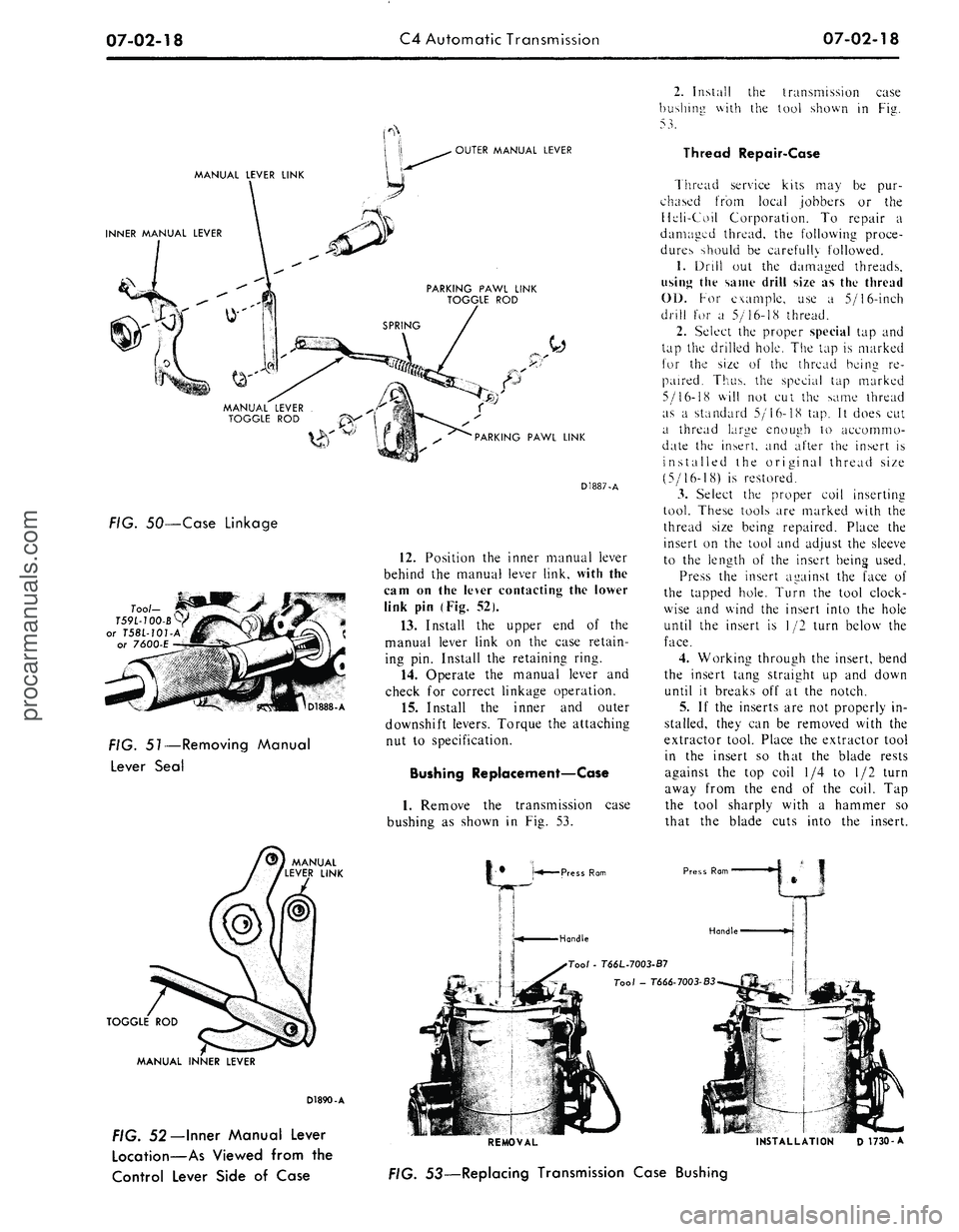
Remove the rear parking pawl
link lower retaining ring, flat washer
and link from the toggle rod (Fig. 50).
5.
Remove the manual lever link,
lower retaining ring, flat washer, and
link from the toggle rod.
6. Install the manual and marking
pawl links, flat washers and retaining
rings to the toggle rods.
7.
Remove the inner manual lever
attaching nut and lever. Remove the
outer manual lever from the case.
8. To remove the manual lever seal,
use the tools shown in Fig. 51. To in-
stall the new seal, use a driver that fits
the ID of the seal.
9. Install the outer manual lever in
the case. Install the inner manual
lever and attaching nut with the cham-
fer facing toward the lever (Fig. 47).
Torque the nut to specification.
10.
From the back of the transmis-
sion case, install the parking toggle
rod and link assembly into the case
(Fig. 49).
11.
Install the parking pawl link on
the case retaining pin. Install the flat
washer and link retaining ring (Fig.
48).procarmanuals.com
Page 326 of 413
07-02-18
C4 Automatic Transmission
07-02-18
OUTER MANUAL LEVER
MANUAL LEVER LINK
INNER MANUAL LEVER
PARKING PAWL LINK
TOGGLE ROD
PARKING PAWL LINK
FIG. 50—Case Linkage
D1888-A
FIG. 51—Removing Manual
Lever Seal
TOGGLE ROD
D1887-A
12.
Position the inner manual lever
behind the manual lever link, with the
cam on the lever contacting the lower
link pin (Fig. 52).
13.
Install the upper end of the
manual lever link on the case retain-
ing pin. Install the retaining ring.
14.
Operate the manual lever and
check for correct linkage operation.
15.
Install the inner and outer
downshift levers. Torque the attaching
nut to specification.
Bushing Replacement—Case
1.
Remove the transmission case
bushing as shown in Fig. 53.
Press Ram
Handle
MANUAL INNER LEVER
D1890-A
FIG. 52— Inner Manual Lever
Location—As Viewed from the
Control Lever Side of Case
2.
Install the transmission case
bushing with the tool shown in Fig.
53.
Thread Repair-Case
Thread service kits may be pur-
chased from local jobbers or the
Heli-Coil Corporation. To repair a
damaged thread, the following proce-
dures should be carefully followed.
1.
Drill out the damaged threads,
using the same drill size as the thread
01).
For example, use a 5/16-inch
drill for a 5/16-18 thread.
2.
Select the proper special tap and
tap the drilled hole. The tap is marked
for the size of the thread being re-
paired. Thus, the special tap marked
5/16-18 will not cut the same thread
as a standard 5/16-18 tap. It does cut
a thread large enough to accommo-
date the insert, and after the insert is
installed the original thread size
(5/16-18) is restored.
3.
Select the proper coil inserting
tool. These tools are marked with the
thread size being repaired. Place the
insert on the tool and adjust the sleeve
to the length of the insert being used.
Press the insert against the face of
the tapped hole. Turn the tool clock-
wise and wind the insert into the hole
until the insert is 1/2 turn below the
face.
4.
Working through the insert, bend
the insert tang straight up and down
until it breaks off at the notch.
5.
If the inserts are not properly in-
stalled, they can be removed with the
extractor tool. Place the extractor tool
in the insert so that the blade rests
against the top coil 1/4 to 1/2 turn
away from the end of the coil. Tap
the tool sharply with a hammer so
that the blade cuts into the insert.
Press Rom
Handle
Too/
- T66L-7003-B7
Tool - T666-7003-B3
REMOVAL INSTALLATION D 1730-A
FIG. 53—Replacing Transmission Case Bushingprocarmanuals.com
Page 327 of 413
07-02-19
C4 Automatic Transmission
07-02-19
Tool-T64P-7A128-A
OIL
SCREEN
LOWER
VALVE BODY
-,
-^L*«^M*if
GASKET
UPPER
VALVE BODY
D1891-A
FIG. 54—Upper and Lower Valve Bodies Disassembled
MANUAL VALVE
D1892-A
FIG. 56—Removing Manual Valve
Exert downward pressure on the tool
and turn it counterclockwise until the
insert is removed.
CONTROL VALVE BODY
Disassembly
1.
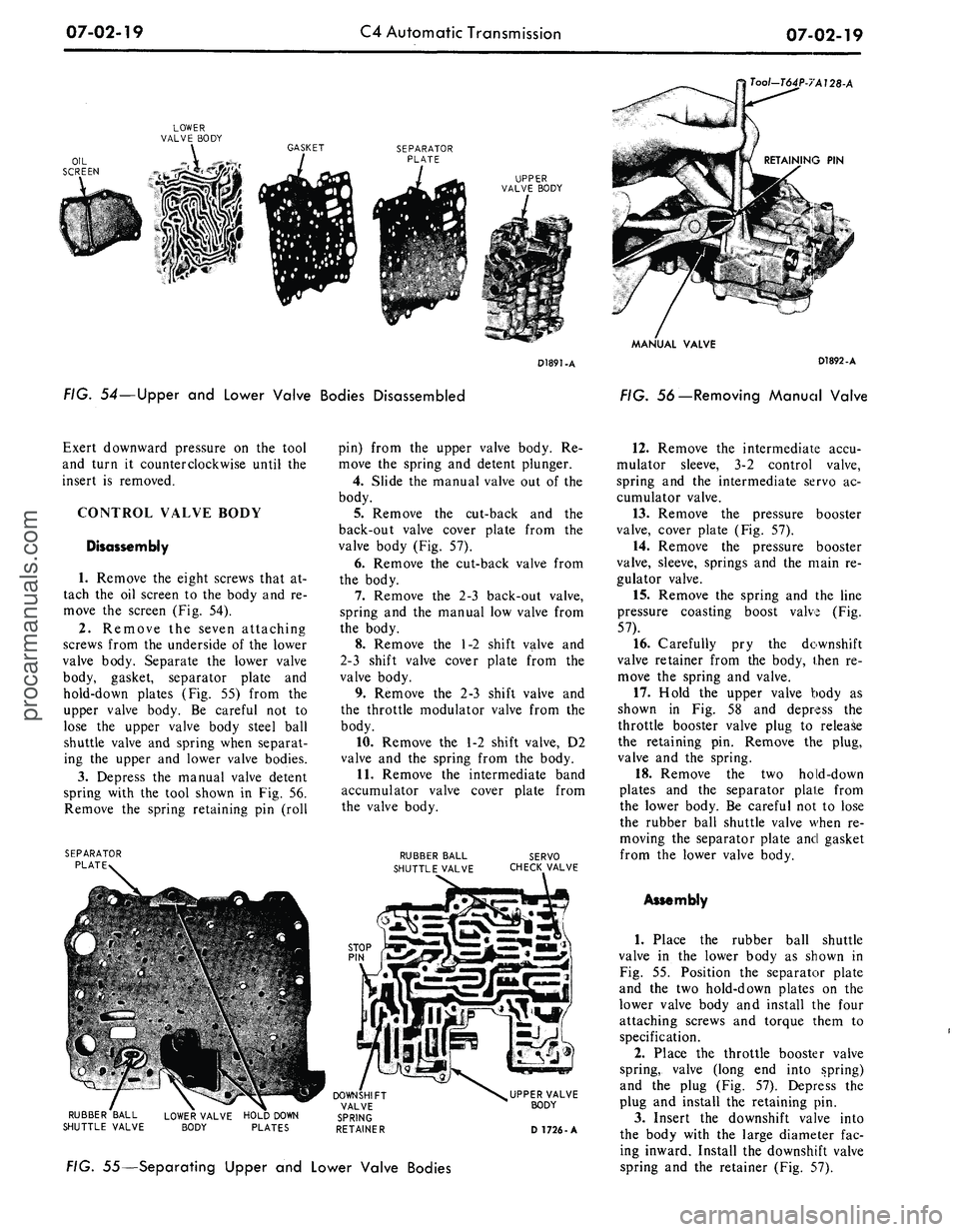
Remove the eight screws that at-
tach the oil screen to the body and re-
move the screen (Fig. 54).
2.
Remove the seven attaching
screws from the underside of the lower
valve body. Separate the lower valve
body, gasket, separator plate and
hold-down plates (Fig. 55) from the
upper valve body. Be careful not to
lose the upper valve body steel ball
shuttle valve and spring when separat-
ing the upper and lower valve bodies.
3.
Depress the manual valve detent
spring with the tool shown in Fig. 56.
Remove the spring retaining pin (roll
SEPARATOR
PLATE
pin) from the upper valve body. Re-
move the spring and detent plunger.
4.
Slide the manual valve out of the
body.
5.
Remove the cut-back and the
back-out valve cover plate from the
valve body (Fig. 57).
6. Remove the cut-back valve from
the body.
7.
Remove the 2-3 back-out valve,
spring and the manual low valve from
the body.
8. Remove the 1-2 shift valve and
2-3 shift valve cover plate from the
valve body.
9. Remove the 2-3 shift valve and
the throttle modulator valve from the
body.
10.
Remove the 1-2 shift valve, D2
valve and the spring from the body.
11.
Remove the intermediate band
accumulator valve cover plate from
the valve body.
RUBBER BALL
SHUTTLE VALVE
SERVO
CHECK VALVE
RUBBER BALL
SHUTTLE VALVE
UPPER VALVE
BODY
D 1726-A
FIG. 55—Separating Upper and Lower Valve Bodies
12.
Remove the intermediate accu-
mulator sleeve, 3-2 control valve,
spring and the intermediate servo ac-
cumulator valve.
13.
Remove the pressure booster
valve, cover plate (Fig. 57).
14.
Remove the pressure booster
valve, sleeve, springs and the main re-
gulator valve.
15.
Remove the spring and the line
pressure coasting boost valve (Fig.
57).
16.
Carefully pry the downshift
valve retainer from the body, then re-
move the spring and valve.
17.
Hold the upper valve body as
shown in Fig. 58 and depress the
throttle booster valve plug to release
the retaining pin. Remove the plug,
valve and the spring.
18.
Remove the two hold-down
plates and the separator plate from
the lower body. Be careful not to lose
the rubber ball shuttle valve when re-
moving the separator plate and gasket
from the lower valve body.
Assembly
1.
Place the rubber ball shuttle
valve in the lower body as shown in
Fig. 55. Position the separator plate
and the two hold-down plates on the
lower valve body and install the four
attaching screws and torque them to
specification.
2.
Place the throttle booster valve
spring, valve (long end into spring)
and the plug (Fig. 57). Depress the
plug and install the retaining pin.
3.
Insert the downshift valve into
the body with the large diameter fac-
ing inward. Install the downshift valve
spring and the retainer (Fig. 57).procarmanuals.com