tow bar FORD MUSTANG 1969 Volume One Chassis
[x] Cancel search | Manufacturer: FORD, Model Year: 1969, Model line: MUSTANG, Model: FORD MUSTANG 1969Pages: 413, PDF Size: 75.81 MB
Page 58 of 413
02-02-39
Brake System
02-02-39
MAJOR REPAIR OPERATIONS
BRAKE DRUM REFINISHING
Minor scores on a brake drum can
be removed with sandpaper. A drum
that is excessively scored or shows a
total indicator runout of over 0.007
inch should be turned down. Remove
only enough stock to eliminate the
scores and true up the drum. The refi-
nished diameter must not exceed 0.060
inch oversize.
Check the inside diameter of the
brake drum with a brake drum mi-
crometer (Tool FRE-14^1).
If the drum diameter is less than
0.030 inch oversize after refinishing^
standard lining may be installed. If
the drum diameter is 0.030—0.060
inch oversize after refinishing, oversize
lining must be installed.
After a drum is turned down, wipe
the refinished surface with a cloth
soaked in clean denatured alcohol. If
one drum is turned down, the opposite
drum on the same axle should also be
cut down to the same size.
ROTOR REFINISHING
Rotunda Disc Brake Attachment,
FRE-2249-2, is the only recommended
tool to refinish the disc brake rotors.
The step-by-step resurfacing procedure
provided with the tool must be ad-
hered to.
The finished braking surfaces of the
rotor must be flat and parallel within
0.0007 inch; lateral runout must not
exceed 0.003 inch total indicator read-
ing, and the surface finish of the brak-
ing surfaces are to be 80/15 micro
inches. The minimum limiting dimen-
sions (Figs. 11 and 12, Part 2-1) from
the inboard bearing cup to the out-
board rotor face and from the inboard
bearing cup to the inboard rotor face
must be observed when removing ma-
terial from the rotor braking surfaces.
On all models except Lincoln Con-
tinental, the limiting dimensions are to
be measured with a ball and gage bar
(Rotunda Kit FRE-70160).
BRAKE SHOE RELINING
Brake linings that are worn to with-
in 1/32 inch of the rivet head or are
less than 0.030 inch thick (bonded lin-
ing) or have been contaminated with
brake fluid, grease or oil must be re-
placed. Failure to replace worn linings
will result in a scored drum. When it
is necessary to replace linings, they
must also be replaced on the wheel on
the opposite side of the vehicle.
Inspect brake shoes for distortion,
cracks, or looseness. If this condition
exists,
the shoe must be discarded. Do
not attempt to repair a defective brake
shoe.
1.
Wash the brake shoes thoroughly
in a clean solvent. Remove all burrs
or rough spots from the shoes.
2.
Check the inside diameter of the
brake drum with a brake drum mi-
crometer (tool FRE-1431). If the di-
ameter is less than 0.030 inches over-
size,
standard lining may be installed.
If the diameter is 0.030—0.060 inches
oversize, oversize lining should be in-
stalled.
3.
Position the new lining on the
shoe.
Starting in the center, insert and
secure the rivets, working alternately
towards each end. Replacement lin-
ings are ground and no further grind-
ing is required.
4.
Check the clearance between the
shoe and lining. The lining must seat
tightly against the shoe with not more
than 0.008 inch clearance between any
two rivets.
RETAINER - 2B245
DUAL MASTER CYLINDER
DISASSEMBLY
1.
Clean the outside of the master
cylinder and remove the filler cover
and diaphragm. Pour out any brake
fluid that remains in the cylinder. Dis-
card the old brake fluid.
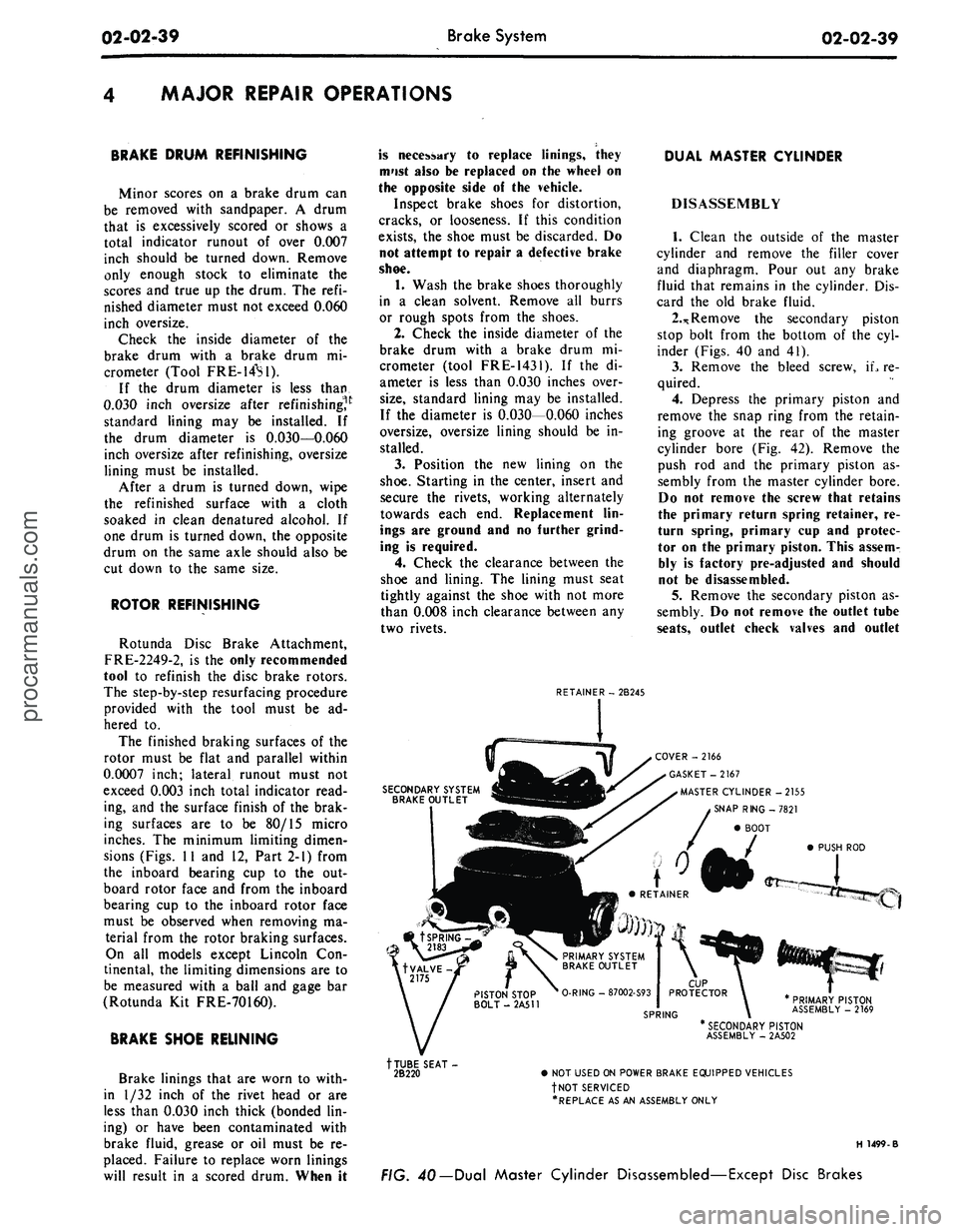
2.*
Remove the secondary piston
stop bolt from the bottom of the cyl-
inder (Figs. 40 and 41).
3.
Remove the bleed screw, iL re-
quired.
4.
Depress the primary piston and
remove the snap ring from the retain-
ing groove at the rear of the master
cylinder bore (Fig. 42). Remove the
push rod and the primary piston as-
sembly from the master cylinder bore.
Do not remove the screw that retains
the primary return spring retainer, re-
turn spring, primary cup and protec-
tor on the primary piston. This assem-
bly is factory pre-adjusted and should
not be disassembled.
5.
Remove the secondary piston as-
sembly. Do not remove the outlet tube
seats,
outlet check valves and outlet
SECONDARY SYSTEM
BRAKE OUTLET
COVER -2166
GASKET-2167
MASTER CYLINDER -2155
SNAP RING -7821
BOOT
PUSH ROD
PRIMARY PISTON
ASSEMBLY - 2169
tTUBE SEAT-
2B220
* SECONDARY PISTON
ASSEMBLY - 2A502
• NOT USED ON POWER BRAKE EQUIPPED VEHICLES
fNOT SERVICED
•REPLACE AS AN ASSEMBLY ONLY
H 1499-B
FIG. 40— Dual Master Cylinder Disassembled—Except Disc Brakesprocarmanuals.com
Page 89 of 413
03-02-13
Suspension
03-02-13
BALL JOINT BOLT HEAD
STABILIZER
F1370-A
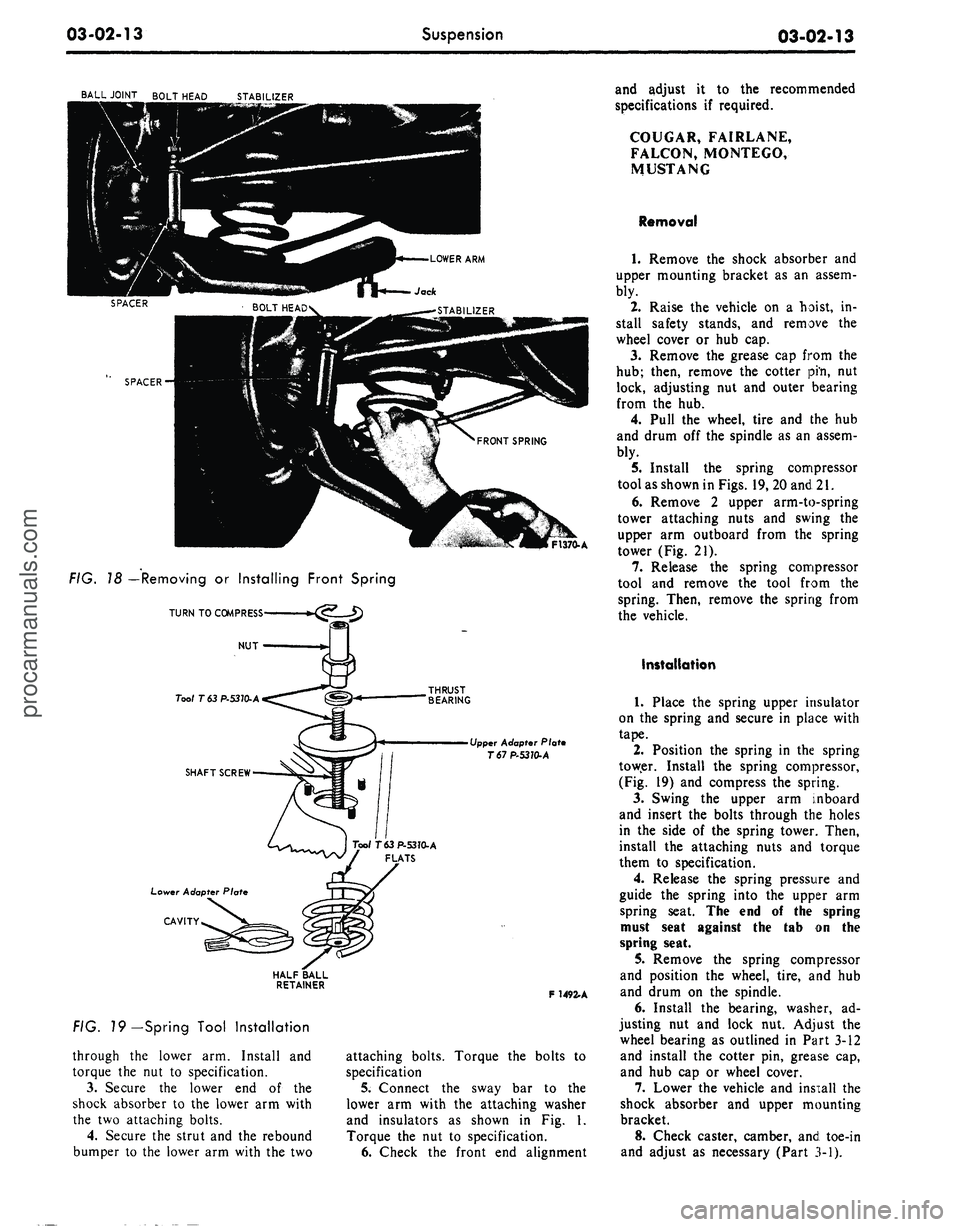
FIG. 18 —Removing or Installing Front Spring
TURN TO COMPRESS
NUT
•
Tool T 63 P-53J0-A
SHAFT SCREW
Lower Adapter Plate
CAVITY
Upper Adapter Plate
T67P-5370-A
FIG. 79—Spring Tool Installation
through the lower arm. Install and
torque the nut to specification.
3.
Secure the lower end of the
shock absorber to the lower arm with
the two attaching bolts.
4.
Secure the strut and the rebound
bumper to the lower arm with the two
F
1492.
A
attaching bolts. Torque the bolts to
specification
5.
Connect the sway bar to the
lower arm with the attaching washer
and insulators as shown in Fig. 1.
Torque the nut to specification.
6. Check the front end alignment
and adjust it to the recommended
specifications if required.
COUGAR, FAIRLANE,
FALCON, MONTEGO,
MUSTANG
Removal
1.
Remove the shock absorber and
upper mounting bracket as an assem-
bly.
2.
Raise the vehicle on a hoist, in-
stall safety stands, and remove the
wheel cover or hub cap.
3.
Remove the grease cap from the
hub;
then, remove the cotter pin, nut
lock, adjusting nut and outer bearing
from the hub.
4.
Pull the wheel, tire and the hub
and drum off the spindle as an assem-
bly.
5.
Install the spring compressor
tool as shown in Figs. 19, 20 and 21.
6. Remove 2 upper arm-to-spring
tower attaching nuts and swing the
upper arm outboard from the spring
tower (Fig. 21).
7.
Release the spring compressor
tool and remove the tool from the
spring. Then, remove the spring from
the vehicle.
Installation
1.
Place the spring upper insulator
on the spring and secure in place with
tape.
2.
Position the spring in the spring
tower. Install the spring compressor,
(Fig. 19) and compress the spring.
3.
Swing the upper arm inboard
and insert the bolts through the holes
in the side of the spring tower. Then,
install the attaching nuts and torque
them to specification.
4.
Release the spring pressure and
guide the spring into the upper arm
spring seat. The end o! the spring
must seat against the tab on the
spring seat.
5. Remove the spring compressor
and position the wheel, tire, and hub
and drum on the spindle.
6. Install the bearing, washer, ad-
justing nut and lock nut. Adjust the
wheel bearing as outlined in Part 3-12
and install the cotter pin, grease cap,
and hub cap or wheel cover.
7.
Lower the vehicle and install the
shock absorber and upper mounting
bracket.
8. Check caster, camber, and toe-in
and adjust as necessary (Part 3-1).procarmanuals.com
Page 90 of 413
03-02-14
Suspension
03-02-14
FRONT SPRING AND
LOWER ARM
LINCOLN CONTINENTAL
Removal
1.
Raise the vehicle. Place a sup-
port under each underbody side rail to
the rear of the lower arm in the lifting
pad area.
2.
Remove the wheel and tire from
the hub.
3.
Remove 2 bolts and washers that
attach the caliper to the spindle. Re-
move the caliper from the rotor and
wire it to the underbody to prevent
damage to the brake hose.
4.
Remove the hub and rotor from
the spindle.
5.
Loosen the splash shield to pro-
vide clearance at the end of the arm
when it is lowered.
6. Remove the shock absorber.
7.
Disconnect the stabilizing strut
(drag strut) from the lower arm.
8. Disconnect the stabilizer bar
from the suspension bar.
9. Remove the cotter pin from the
slotted nut attaching the lower ball
joint to the end of the spindle boss.
Loosen the nut one to two turns.
10.
Place a box wrench over the
lower end of the ball joint remover
tool, and position the tool as in Fig.
13.
The tool should seat firmly against
the ends of both studs, and not
against the lower stud nut.
11.
Turn the wrench until both
studs are under tension, then, tap the
spindle with a hammer near the lower
stud to loosen it from the spindle. Do
not loosen the stud with tool pressure
alone.
12.
Place a jack under the outer
end of the lower arm and raise the
arm several inches.
13.
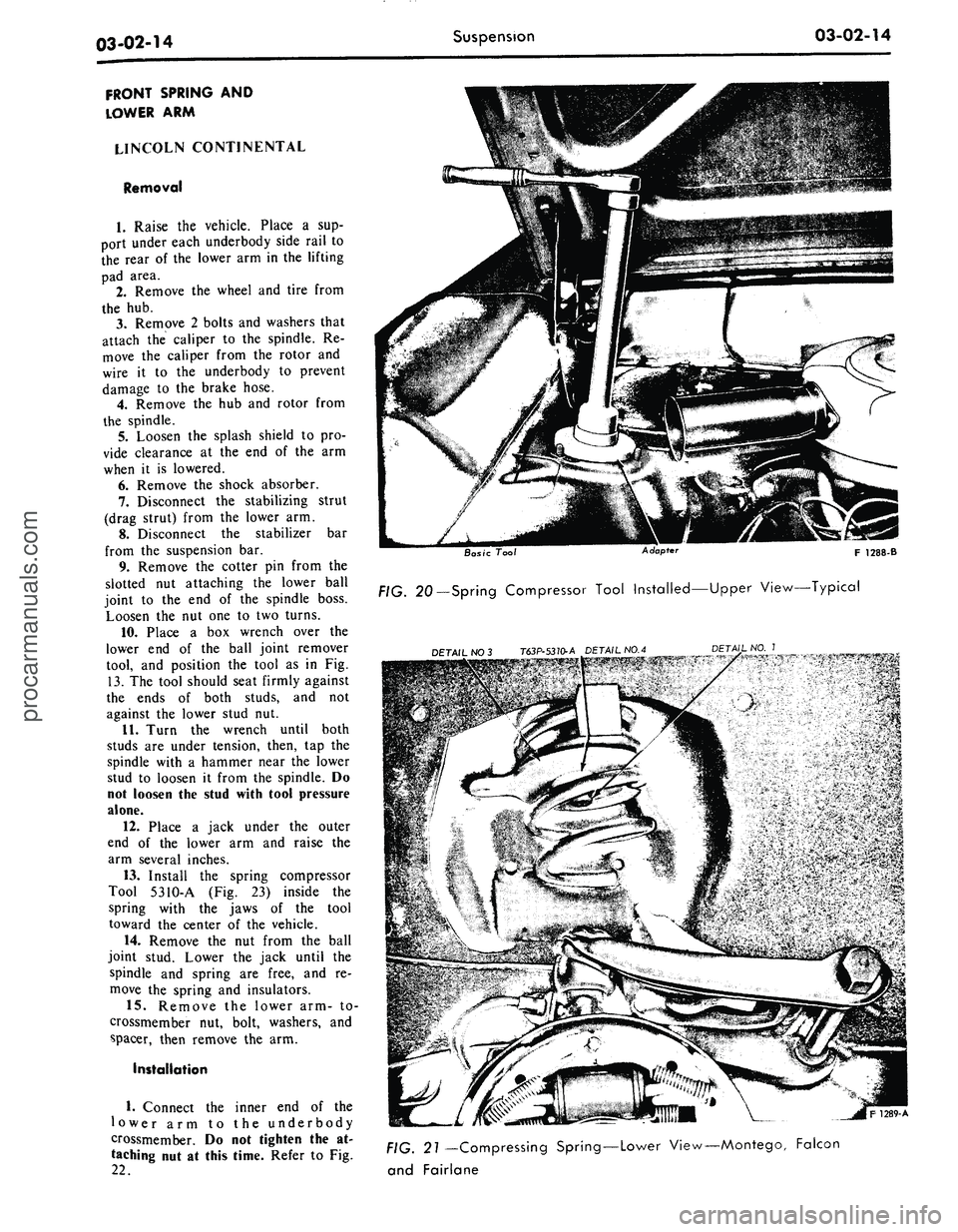
Install the spring compressor
Tool 5310-A (Fig. 23) inside the
spring with the jaws of the tool
toward the center of the vehicle.
14.
Remove the nut from the ball
joint stud. Lower the jack until the
spindle and spring are free, and re-
move the spring and insulators.
15.
Remove the lower arm- to-
crossmember nut, bolt, washers, and
spacer, then remove the arm.
Installation
1.
Connect the inner end of the
lower arm to the underbody
crossmember. Do not tighten the at-
taching nut at this time. Refer to Fig.
22.
Basic Tool Adapter F 1288-B
FIG. 20—Spring Compressor Tool Installed—Upper View—Typical
DETAIL NO 3 T63P-5310-A DETAIL NO.4
DETAIL
NO.
I
21 —Compressing Spring—Lower View—Montego, Falcon
and Fairlaneprocarmanuals.com
Page 159 of 413
03-09-07
Saginaw Design Integral Power Steering Gear
03-09-07
VALVE SPOOL
DAMP EN
ERO-RING
TORSION BAR
G 1633-A
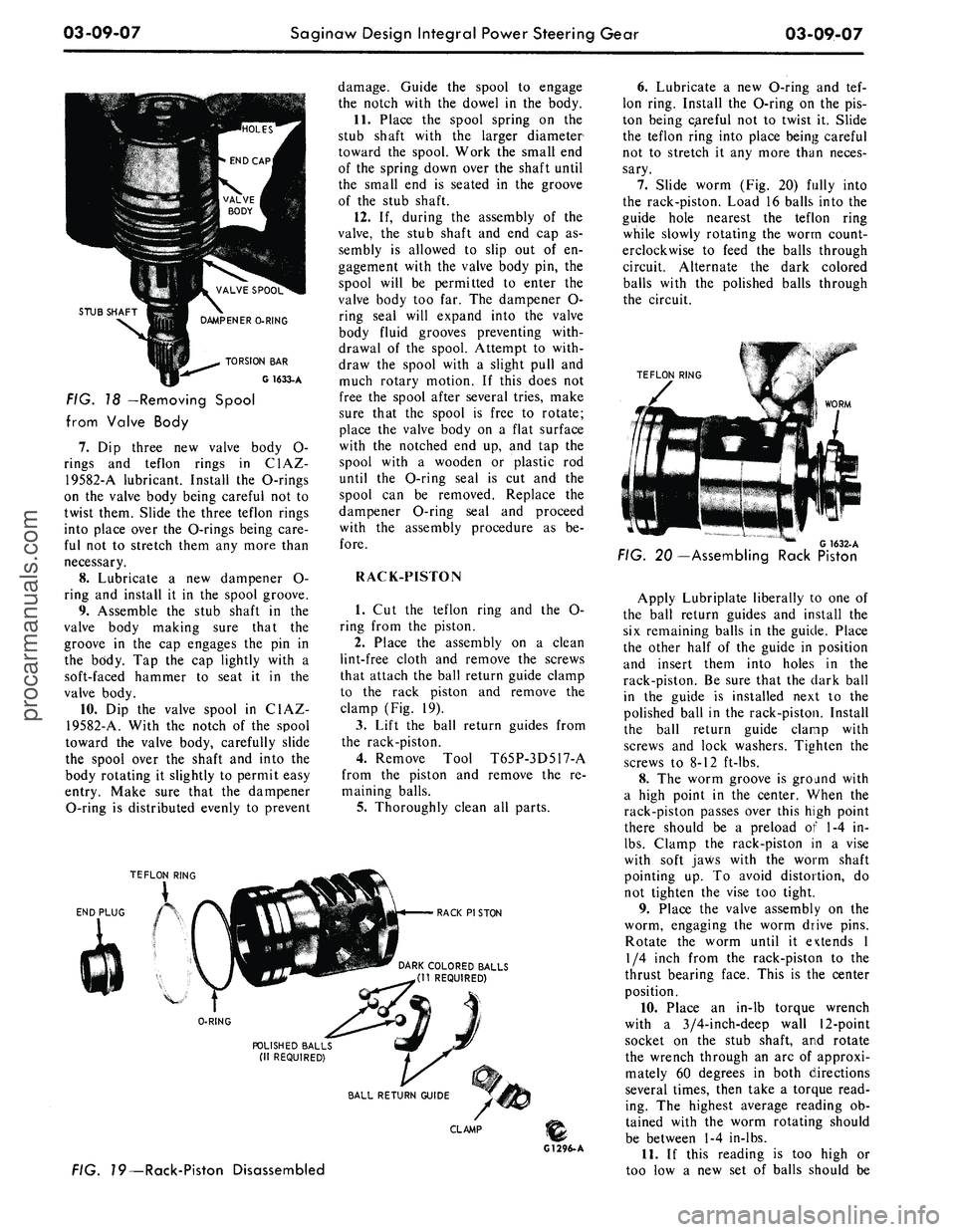
FIG. 18 —Removing Spool
from Valve Body
7.
Dip three new valve body O-
rings and teflon rings in C1AZ-
19582-A lubricant. Install the O-rings
on the valve body being careful not to
twist them. Slide the three teflon rings
into place over the O-rings being care-
ful not to stretch them any more than
necessary.
8. Lubricate a new dampener O-
ring and install it in the spool groove.
9. Assemble the stub shaft in the
valve body making sure that the
groove in the cap engages the pin in
the body. Tap the cap lightly with a
soft-faced hammer to seat it in the
valve body.
10.
Dip the valve spool in C1AZ-
19582-A. With the notch of the spool
toward the valve body, carefully slide
the spooi over the shaft and into the
body rotating it slightly to permit easy
entry. Make sure that the dampener
O-ring is distributed evenly to prevent
TEFLON RING
damage. Guide the spool to engage
the notch with the dowel in the body.
11.
Place the spool spring on the
stub shaft with the larger diameter
toward the spool. Work the small end
of the spring down over the shaft until
the small end is seated in the groove
of the stub shaft.
12.
If, during the assembly of the
valve, the stub shaft and end cap as-
sembly is allowed to slip out of en-
gagement with the valve body pin, the
spool will be permitted to enter the
valve body too far. The dampener O-
ring seal will expand into the valve
body fluid grooves preventing with-
drawal of the spool. Attempt to with-
draw the spool with a slight pull and
much rotary motion. If this does not
free the spool after several tries, make
sure that the spool is free to rotate;
place the valve body on a flat surface
with the notched end up, and tap the
spool with a wooden or plastic rod
until the O-ring seal is cut and the
spool can be removed. Replace the
dampener O-ring seal and proceed
with the assembly procedure as be-
fore.
RACK-PISTON
1.
Cut the teflon ring and the O-
ring from the piston.
2.
Place the assembly on a clean
lint-free cloth and remove the screws
that attach the ball return guide clamp
to the rack piston and remove the
clamp (Fig. 19).
3.
Lift the ball return guides from
the rack-piston.
4.
Remove Tool T65P-3D517-A
from the piston and remove the re-
maining balls.
5.
Thoroughly clean all parts.
END PLUG
RACK PI STON
DARK COLORED BALLS
(11 REQUIRED)
V
0-RING
POLISHED BALLS
(II REQUIRED)
BALL RETURN GUIDE
CLAMP
B
G1296. A
6. Lubricate a new O-ring and tef-
lon ring. Install the O-ring on the pis-
ton being qareful not to twist it. Slide
the teflon ring into place being careful
not to stretch it any more than neces-
sary.
7.
Slide worm (Fig. 20) fully into
the rack-piston. Load 16 balls into the
guide hole nearest the teflon ring
while slowly rotating the worm count-
erclockwise to feed the balls through
circuit. Alternate the dark colored
balls with the polished balls through
the circuit.
TEFLON RING
FIG. 19—Rack-Piston Disassembled
G 1632-A
FIG. 20—Assembling Rack Piston
Apply Lubriplate liberally to one of
the ball return guides and install the
six remaining balls in the guide. Place
the other half of the guide in position
and insert them into holes in the
rack-piston. Be sure that the dark ball
in the guide is installed next to the
polished ball in the rack-piston. Install
the ball return guide clamp with
screws and lock washers. Tighten the
screws to 8-12 ft-lbs.
8. The worm groove is ground with
a high point in the center. V/hen the
rack-piston passes over this high point
there should be a preload of 1-4 in-
lbs.
Clamp the rack-piston in a vise
with soft jaws with the worm shaft
pointing up. To avoid distortion, do
not tighten the vise too tight.
9. Place the valve assembly on the
worm, engaging the worm drive pins.
Rotate the worm until it extends 1
1/4 inch from the rack-piston to the
thrust bearing face. This is the center
position.
10.
Place an in-lb torque wrench
with a 3/4-inch-deep wall 12-point
socket on the stub shaft, and rotate
the wrench through an arc of approxi-
mately 60 degrees in both directions
several times, then take a torque read-
ing. The highest average reading ob-
tained with the worm rotating should
be between 1-4 in-lbs.
11.
If this reading is too high or
too low a new set of balls should beprocarmanuals.com
Page 208 of 413
04-02-11
Rear Axle — Removable Carrier Type
04-02-11
If the axle housing is new, install a
new vent. The hose attaching portion
must face toward the front of the ve-
hicle.
2.
If leather-type wheel bearing ser-
vice seals are to be installed, soak the
new rear wheel bearing oil seals in
SAE 10 oil for 1/2 hour before instal-
lation. Wipe a small amount of an oil
resistant sealer on the outer edge of
each seal before it is installed. Do not
put any of the sealer on the sealing
lip.
Install the oil seals in the ends of
the axle housing with one of the tools
shown in Fig. 10 and 12.
3.
Position the replacement axle
housing under the vehicle, and raise
the axle with a hoist or floor jack.
Connect the suspension lower arms to
their mounting brackets on the axle
housing with pivot bolts and nuts. Do
not tighten the bolts and nuts at this
point.
4.
Position the suspension upper
arm in its mounting bracket on the
axle housing, and install the adjusting
bolt, eccentric washers, lock washer
and nut. Leave the bolt and nut loose
at this point.
5.
Position the brake lines to the
axle housing, and secure with the re-
taining clips.
6. Install the brake backing plates
on the axle housing flanges.
7.
Connect the track bar to the
mounting stud, install the washer and
attaching nut, and torque to specifica-
tions.
8. Position the rear coil springs and
insulators in the pockets provided.
9. Connect the lower studs of the
two rear shock absorbers to the
mounting brackets on the axle hous-
ing. Install the attaching nuts, and
torque to specifications.
10.
Connect the vent tube to the
vent on the housing. If axle housing is
new, install a new vent.
11.
Clean the mating surfaces of
the axle housing and differential car-
rier. Position the carrier on the
mounting studs on the housing using a
new gasket between carrier and hous-
ing. Install the copper washers and the
carrier-to-housing attaching nuts, and
torque to specifications.
12.
Make sure that both the front
and rear pivot bolts of the upper and
the two lower arms are loose, and
then raise the axle assembly to con-
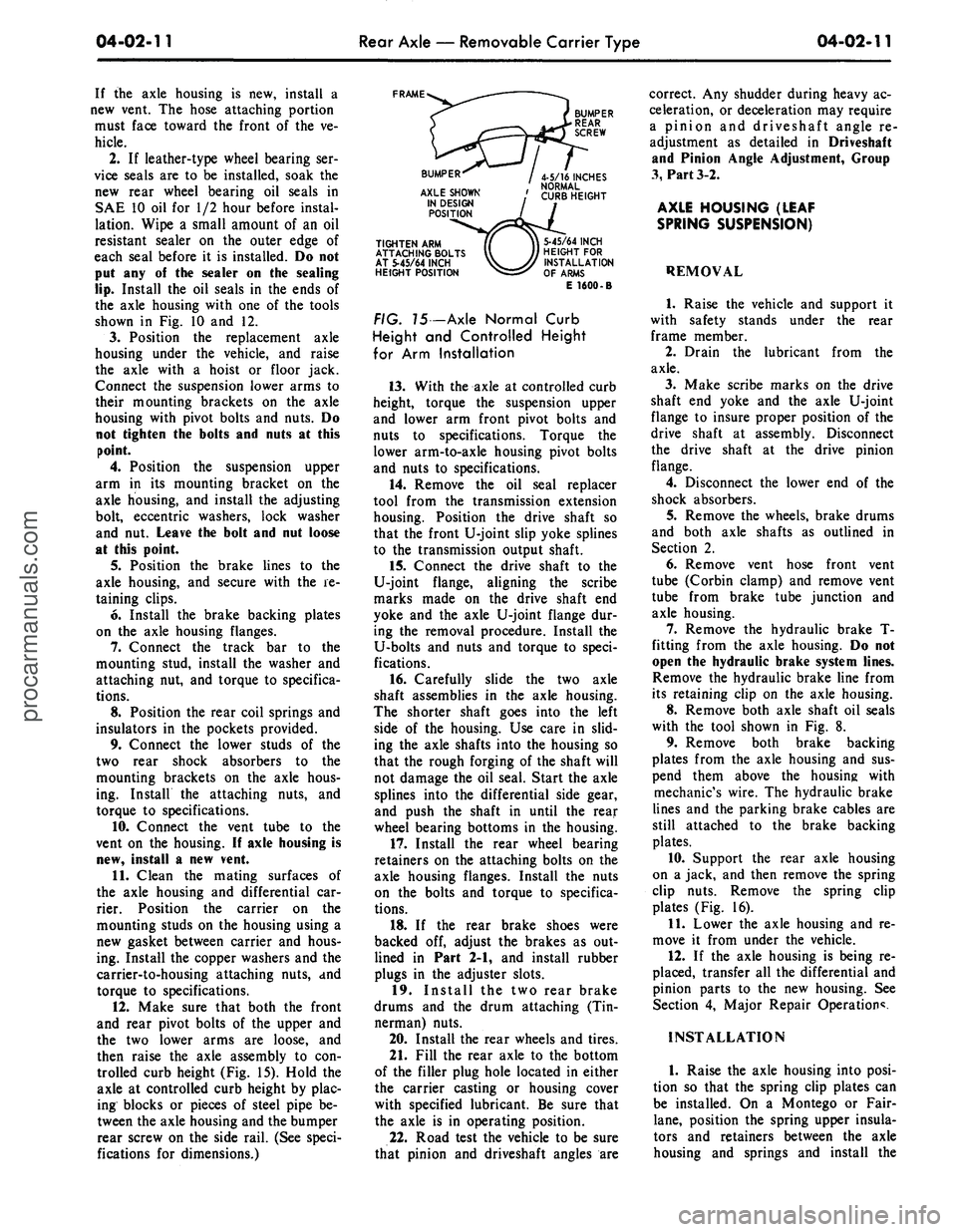
trolled curb height (Fig. 15). Hold the
axle at controlled curb height by plac-
ing blocks or pieces of steel pipe be-
tween the axle housing and the bumper
rear screw on the side rail. (See speci-
fications for dimensions.)
FRAME
TIGHTEN ARM
ATTACHING BOLTS
AT 5-45/64 INCH
HEIGHT POSITION
5-45/64 INCH
HEIGHT FOR
INSTALLATION
OF ARMS
E 1600-B
FIG. 75 -Axle Normal Curb
Height and Controlled Height
for Arm Installation
13.
With the axle at controlled curb
height, torque the suspension upper
and lower arm front pivot bolts and
nuts to specifications. Torque the
lower arm-to-axle housing pivot bolts
and nuts to specifications.
14.
Remove the oil seal replacer
tool from the transmission extension
housing. Position the drive shaft so
that the front U-joint slip yoke splines
to the transmission output shaft.
15.
Connect the drive shaft to the
U-joint flange, aligning the scribe
marks made on the drive shaft end
yoke and the axle U-joint flange dur-
ing the removal procedure. Install the
U-bolts and nuts and torque to speci-
fications.
16.
Carefully slide the two axle
shaft assemblies in the axle housing.
The shorter shaft goes into the left
side of the housing. Use care in slid-
ing the axle shafts into the housing so
that the rough forging of the shaft will
not damage the oil seal. Start the axle
splines into the differential side gear,
and push the shaft in until the rear
wheel bearing bottoms in the housing.
17.
Install the rear wheel bearing
retainers on the attaching bolts on the
axle housing flanges. Install the nuts
on the bolts and torque to specifica-
tions.
18.
If the rear brake shoes were
backed off, adjust the brakes as out-
lined in Part 2-1, and install rubber
plugs in the adjuster slots.
19.
Install the two rear brake
drums and the drum attaching (Tin-
nerman) nuts.
20.
Install the rear wheels and tires.
21.
Fill the rear axle to the bottom
of the filler plug hole located in either
the carrier casting or housing cover
with specified lubricant. Be sure that
the axle is in operating position.
22.
Road test the vehicle to be sure
that pinion and driveshaft angles are
correct. Any shudder during heavy ac-
celeration, or deceleration may require
a pinion and driveshaft angle re-
adjustment as detailed in Driveshaft
and Pinion Angle Adjustment, Group
3,
Part 3-2.
AXLE HOUSING (LEAF
SPRING SUSPENSION)
REMOVAL
1.
Raise the vehicle and support it
with safety stands under the rear
frame member.
2.
Drain the lubricant from the
axle.
3.
Make scribe marks on the drive
shaft end yoke and the axle U-joint
flange to insure proper position of the
drive shaft at assembly. Disconnect
the drive shaft at the drive pinion
flange.
4.
Disconnect the lower end of the
shock absorbers.
5.
Remove the wheels, brake drums
and both axle shafts as outlined in
Section 2.
6. Remove vent hose front vent
tube (Corbin clamp) and remove vent
tube from brake tube junction and
axle housing.
7.
Remove the hydraulic brake T-
fitting from the axle housing. Do not
open the hydraulic brake system lines.
Remove the hydraulic brake line from
its retaining clip on the axle housing.
8. Remove both axle shaft oil seals
with the tool shown in Fig. 8.
9. Remove both brake backing
plates from the axle housing and sus-
pend them above the housing with
mechanic's wire. The hydraulic brake
lines and the parking brake cables are
still attached to the brake backing
plates.
10.
Support the rear axle housing
on a jack, and then remove the spring
clip nuts. Remove the spring clip
plates (Fig. 16).
11.
Lower the axle housing and re-
move it from under the vehicle.
12.
If the axle housing is being re-
placed, transfer all the differential and
pinion parts to the new housing. See
Section 4, Major Repair Operation*.
INSTALLATION
1.
Raise the axle housing into posi-
tion so that the spring clip plates can
be installed. On a Montego or Fair-
lane,
position the spring upper insula-
tors and retainers between the axle
housing and springs and install theprocarmanuals.com
Page 235 of 413
04-04-04
Rear Axle — Ford Light-Duty (WER)
04-04-04
REMOVAL AND INSTALLATION
AXLE HOUSING
Refer to Fig. 7.
REMOVAL
1.
Raise the vehicle on a hoist.
2.
Remove the wheels and tires
from the brake drums.
3.
Position a drain pan and loosen
the rear axle cover to housing attach-
ing bolts. Drain the housing.
4.
Remove the attaching (Tinner-
man) nuts that secure the brake drums
to the axle shaft flanges, and then re-
move the drums (Fig. 7).
5.
Remove the axle housing cover
bolts,
cover and gasket. Discard the
gasket. Remove the drain pan.
6. Disconnect the drive shaft at the
drive pinion companion flange. Re-
move the drive shaft from the trans-
mission extension housing. Install an
oil seal replacer tool in the transmis-
sion housing to prevent leakage. Refer
to the transmission group for the ap-
propriate tool.
7.
Disconnect the lower end of the
shock absorbers at the mounting
brackets.
8. Disconnect the track bar from
the axle housing stud. If the axle
housing is to be replaced, transfer the
stud to the new housing.
9. Position safety stands under the
rear frame members. Lower the vehi-
cle with the hoist and allow the axle
to lower far enough to relieve rear
spring tension.
10.
Remove the pinion shaft lock
bolt and pinion shaft (Fig. 2), differ-
ential pinion gears and thrust washers.
11.
Push the axle shaft(s) inward
toward the center of the axle housing.
Remove the C-locks from the inner
ends of the axles (Fig. 3). Remove the
axle shafts from the housing. Extreme
care must be used to avoid contacting
the axle shaft seal lip with any portion
of the axle shaft other than the seal
journal.
12.
Disconnect the vent hose from
the rear vent tube and remove all
brake lines from the axle housing re-
taining clips.
13.
Remove the brake backing
plate attaching nuts and the plates
from the axle housing. Suspend the
plates above the axle housing with
mechanics wire. The hydraulic brake
lines and the parking brake cables will
remain attached to the brake backing
plates.
14.
Support the rear axle housine
on a jack.
15.
Remove the right and left rear
springs and insulators.
16.
Remove the nuts, washers and
pivot bolts that connect the suspension
lower arms to the axle housing. Dis-
connect both arms from the axle
housing.
17.
Disconnect the upper suspen-
sion arm from the axle housing by re-
moving the pivot bolt, nut, lock wash-
er and two eccentric washers.
18.
Lower the rear axle to the floor
with the jack and remove the axle
from under the vehicle.
19.
Remove the wheel bearings and
oil seals with the tool shown in Fig. 4.
20.
If the axle housing is being re-
placed, transfer all the differential and
pinion parts to the new housing. Refer
to Section 4, Major Repair Operation
for the procedure.
INSTALLATION
1.
Lightly coat the wheel bearing
rollers with axle lubricant. Install
wheel bearings in the axle housing
with the tool shown in Fig. 5. The
bearings should seat firmly against the
shoulder.
2.
Wipe all lubricant from the oil
seal bore before installing the seal. If
axle housing is being replaced, new
seals must be installed.
3.
Inspect the original seal for
nicks,
scuffs or abnormal wear, and
replace if necessary. New seals are
pre-packed with lubricant and do not
require an oil soak.
4.
Install the seal with the tool
shown in Fig. 6. Installation without
the use of the proper tool will distort
the seal and cause leakage.
5. Raise the rear axle into position
under the vehicle with a hoist or floor
jack. Connect the suspension lower
arms to their mounting brackets on
the axle housing with pivot bolts and
nuts.
Do not tighten the mounting
bolts at this point.
6. Position the suspension upper
arm in its mounting bracket on the
axle housing and install the adjusting
bolt, eccentric washers, lock washer
and nut. Do not tighten the mounting
bolt at this point.
7.
Place the rear coil springs and
insulators into position in the pockets
provided.
8. Place the brake backing plates
on the axle housing flanges, install 4
attaching bolts and nuts and torque
them to specifications.
9. Position the brake lines to the
axle housing and secure them with the
retaining clips. If the axle housing is
new, install a new vent. When install-
ing the new axle vent apply a small
amount of Locktite (C5AZ-19554-B)
to prevent oil leakage between vent
and axle housing. Connect the vent
tube to the vent.
10.
Install the pinion side gears and
thrust washer.
11.
Slide the axle shafts into place
in the axle housing. Exercise care that
splines or any portion of the axle
shafts do not damage the oil seals and
that they engage with the splines of
the differential side gears.
12.
Install the axle shaft C-lock O-
ring and C-lock on the inner end of
the shaft and push the shaft outward
so that the shaft lock seats in the
counterbore of the differential side
gear.
13.
Position the pinion differential
gears and thrust washers 180 degrees
apart to the differential side gears.
Revolve the gear assembly until the
holes in the differential case are al-
igned with the pinion gears.
14.
Position the differential pinion
shaft through the case and pinions, al-
igning the hole in the shaft with the
lock bolt hole. Install the lock bolt
and tighten it to specification.
15.
Clean the gasket mounting sur-
face of the rear axle housing and the
cover. Install a new cover gasket,
cover and the attaching bolts. Torque
the bolts to specification.
16.
Raise the rear axle on a hoist
and remove the safety stands.
17.
Connect the track bar to the
mounting stud. Install the washer and
nut. Torque the nut to specification.
18.
Connect the two rear shock ab-
sorbers to the mounting brackets on
the axle housing and torque the at-
taching nuts to specification.
19.
Make sure that both the front
and rear pivot bolts of the upper and
the two lower arms are loose, then
raise the axle assembly to the con-
trolled height (Fig. 8). Hold the axle
at the controlled height by placing
blocks or pieces of steel pipe between
the axle housing and the bumper rear
screw on the side rail.procarmanuals.com