maintenance FORD MUSTANG 2003 4.G User Guide
[x] Cancel search | Manufacturer: FORD, Model Year: 2003, Model line: MUSTANG, Model: FORD MUSTANG 2003 4.GPages: 256, PDF Size: 2.4 MB
Page 180 of 256
trucks which are within the terms of any applicable
written new vehicle warranty are eligible for review,
except those involving:
•a non-Ford product
•a non-Ford dealership
•sales disputes between customer and dealer
except those associated with warranty repairs or
concerns with the vehicle’s performance as
designed
•a request for reimbursement of consequential
expenses unless a service or product concern is
being reviewed
•items not covered by the New Vehicle Limited
Warranty (including maintenance and wear items)
•alleged personal injury/property damage claims
•cases currently in litigation
•vehicles not used primarily for family, personal or
household purposes (except in states where the
Dispute Settlement Board is required to review
commercial vehicles)
•vehicles with non-U.S. warranties
Concerns are ineligible for review if the New Vehicle
Limited Warranty has expired at receipt of your
application and, in certain states eligibility is
dependent upon the customer’s possession of the
vehicle.
Eligibility may differ according to state law. For
example, see the unique brochures for California,
West Virginia, Georgia and Wisconsin
purchasers/lessees.
Board membership
The Board consists of:
•Three consumer representatives
•A Ford or Lincoln Mercury dealership
representative
Consumer candidates for Board membership are
recruited and trained by an independent consulting
Customer Assistance
180
Page 181 of 256

firm. The dealership Board member is chosen from
Ford and Lincoln Mercury dealership management,
recognized for their business leadership qualities.
What the Board needs
To have your case reviewed you must complete the
application in the DSB brochure and mail it to the
address provided on the application form. Some
states will require you to use certified mail, with
return receipt requested.
Your application is reviewed and, if it is determined
to be eligible, you will receive an acknowledgment
indicating:
•The file number assigned to your application.
•The toll-free phone number of the DSB’s
independent administrator.
Your dealership and a Ford Motor Company
representative will then be asked to submit
statements.
To properly review your case, the Board needs the
following information:
•Legible copies of all documents and maintenance
or repair orders relevant to the case.
•The year, make, model, and Vehicle Identification
Number (VIN) listed on your vehicle ownership
license.
•The date of repair(s) and mileage at the time of
occurrence(s).
•The current mileage.
•The name of the dealer(s) who sold or serviced
the vehicle.
•A brief description of your unresolved concern.
•A brief summary of the action taken by the
dealer(s) and Ford Motor Company.
•The names (if known) of all the people you
contacted at the dealership(s).
•A description of the action you expect to resolve
your concern.
Customer Assistance
181
Page 194 of 256
SERVICE RECOMMENDATIONS
To help you service your vehicle:
•We highlight do-it-yourself items in the engine
compartment for easy location.
•We provide a scheduled maintenance guide which
makes tracking routine service easy.
If your vehicle requires professional service, your
dealership can provide the necessary parts and
service. Check yourWarranty Guide/Owner
Information Guideto find out which parts and
services are covered.
Use only recommended fuels, lubricants, fluids and
service parts conforming to specifications. Motorcraft
parts are designed and built to provide the best
performance in your vehicle.
PRECAUTIONS WHEN SERVICING YOUR
VEHICLE
Be especially careful when inspecting or servicing
your vehicle.
•Do not work on a hot engine.
•When the engine is running, keep loose clothing,
jewelry or long hair away from moving parts.
•Do not work on a vehicle with the engine running
in an enclosed space, unless you are sure you
have enough ventilation.
•Keep all lit cigarettes, open flames and other lit
material away from the battery and all fuel related
parts.
If you disconnect the battery, the engine must
“relearn”its idle conditions before your vehicle will
drive properly, as explained in theBatterysection in
this chapter.
Working with the engine off
•Automatic transmission:
1. Set the parking brake and ensure the gearshift is
securely latched in P (Park).
Maintenance and Specifications
194
Page 195 of 256
2. Turn off the engine and remove the key.
3. Block the wheels to prevent the vehicle from
moving unexpectedly.
•Manual transmission:
1. Set the parking brake.
2. Depress the clutch and place the gearshift in 1
(First).
3. Turn off the engine and remove the key.
4. Block the wheels to prevent the vehicle from
moving unexpectedly.
Working with the engine on
•Automatic transmission:
1. Set the parking brake and ensure the gearshift is
securely latched in P (Park).
2. Block the wheels to prevent the vehicle from
moving unexpectedly.
Note:Do not start your engine with the air cleaner
removed and do not remove it while the engine is
running.
•Manual transmission:
1. Set the parking brake, depress the clutch and
place the gearshift in neutral.
2. Block the wheels to prevent the vehicle from
moving unexpectedly.
Note:Do not start your engine with the air cleaner
removed and do not remove it while the engine is
running.
The cooling fan is automatic and may come
on at any time. Always disconnect the
negative terminal of the battery before working
near the fan.
Maintenance and Specifications
195
Page 196 of 256
OPENING THE HOOD
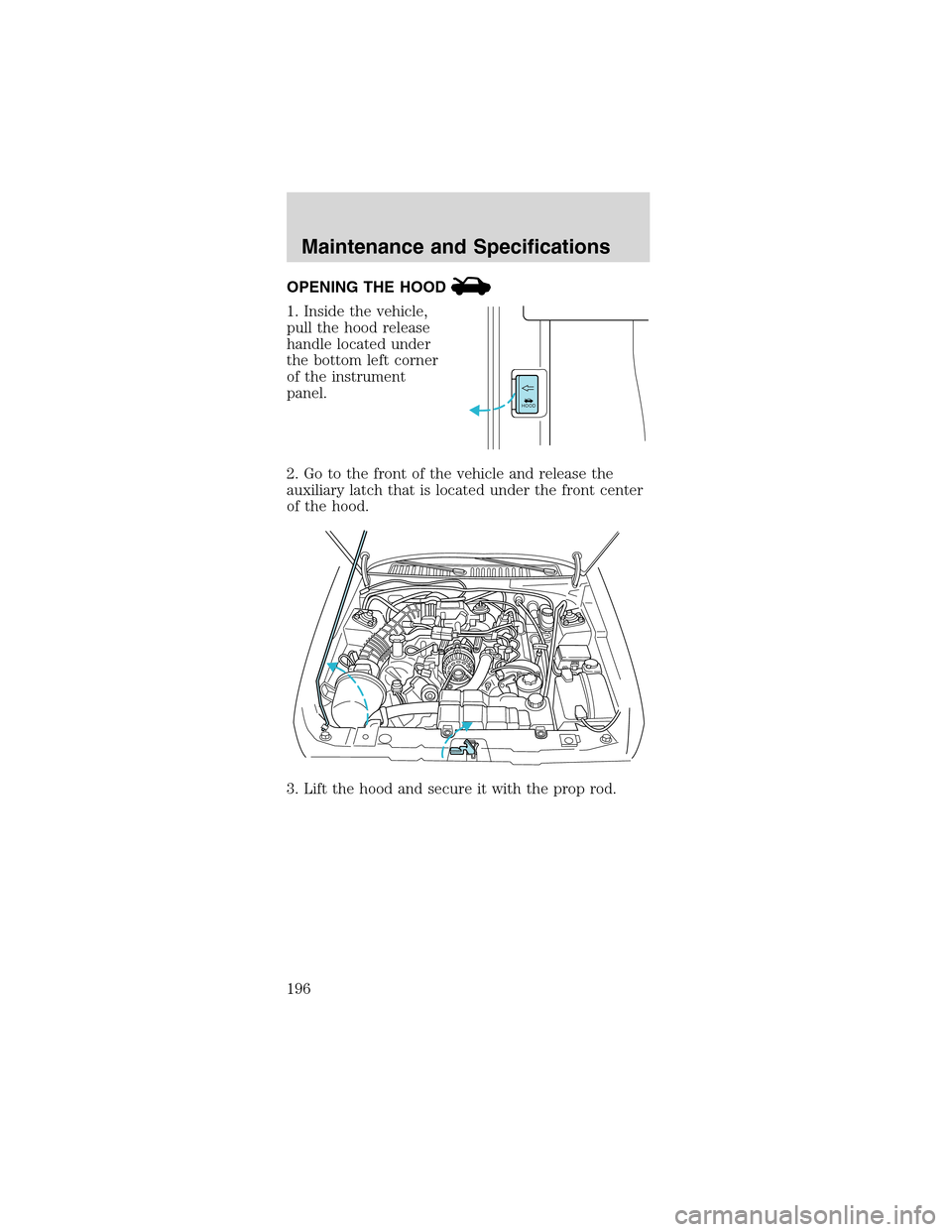
1. Inside the vehicle,
pull the hood release
handle located under
the bottom left corner
of the instrument
panel.
2. Go to the front of the vehicle and release the
auxiliary latch that is located under the front center
of the hood.
3. Lift the hood and secure it with the prop rod.
HOOD
Maintenance and Specifications
196
Page 197 of 256
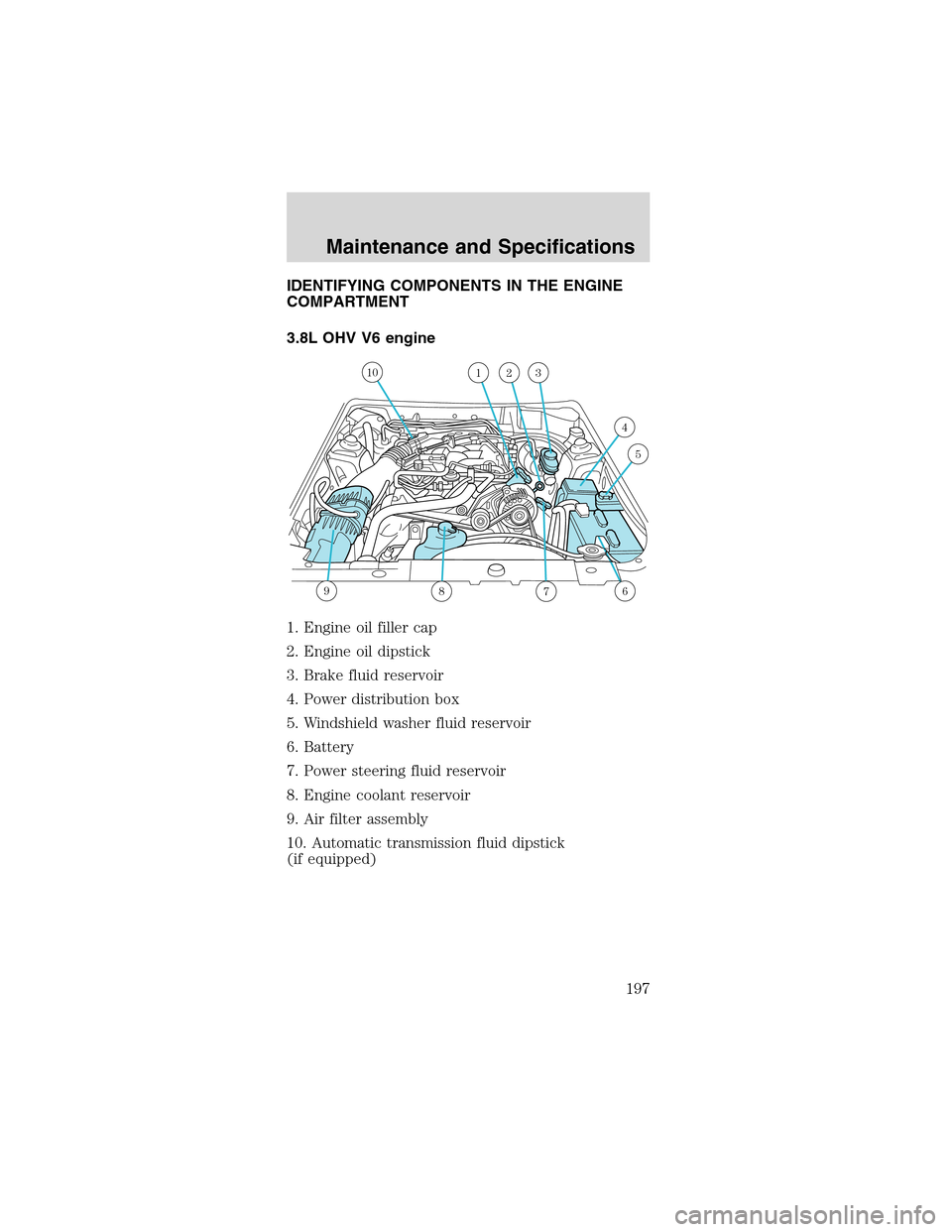
IDENTIFYING COMPONENTS IN THE ENGINE
COMPARTMENT
3.8L OHV V6 engine
1. Engine oil filler cap
2. Engine oil dipstick
3. Brake fluid reservoir
4. Power distribution box
5. Windshield washer fluid reservoir
6. Battery
7. Power steering fluid reservoir
8. Engine coolant reservoir
9. Air filter assembly
10. Automatic transmission fluid dipstick
(if equipped)
6
1023
4
5
789
1
Maintenance and Specifications
197
Page 198 of 256
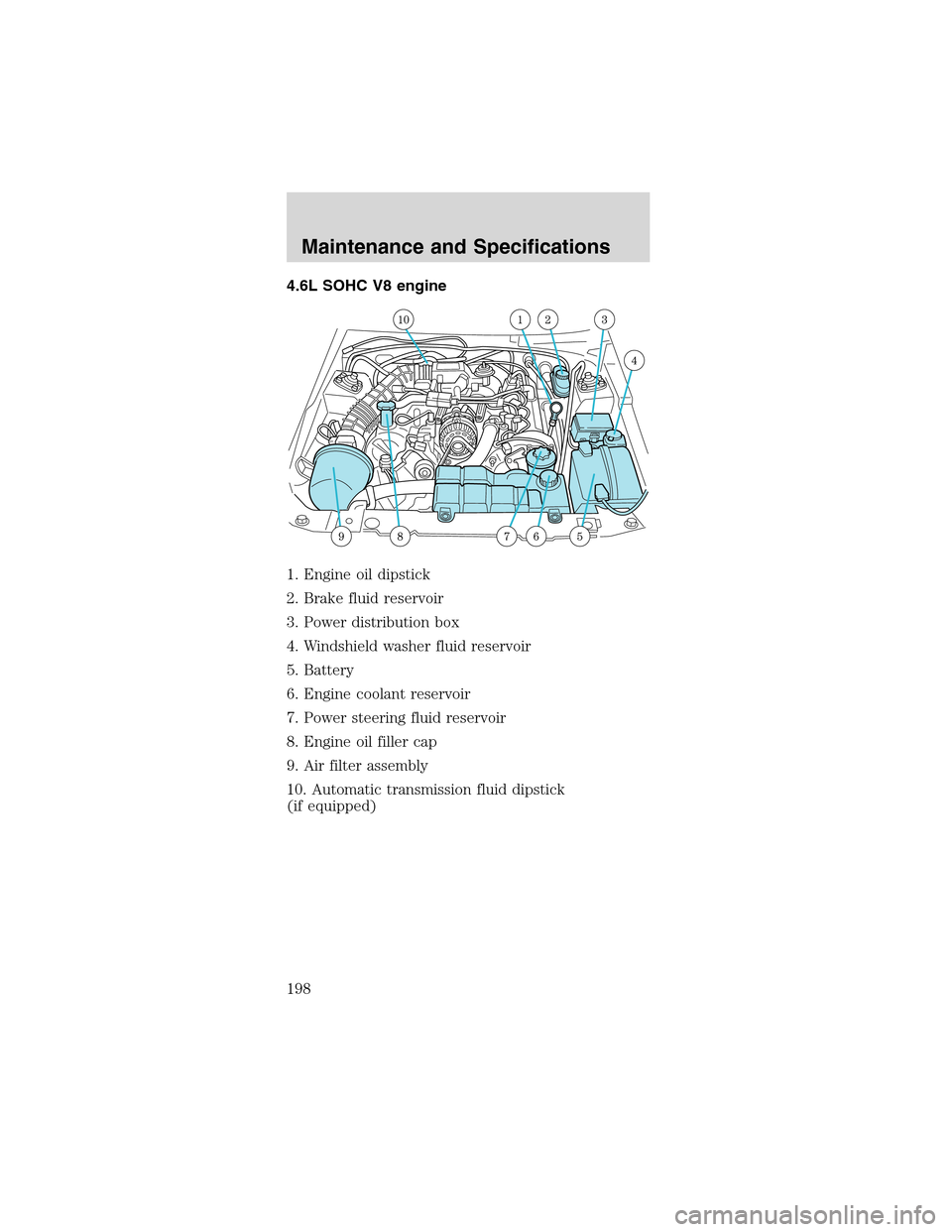
4.6L SOHC V8 engine
1. Engine oil dipstick
2. Brake fluid reservoir
3. Power distribution box
4. Windshield washer fluid reservoir
5. Battery
6. Engine coolant reservoir
7. Power steering fluid reservoir
8. Engine oil filler cap
9. Air filter assembly
10. Automatic transmission fluid dipstick
(if equipped)
Maintenance and Specifications
198
Page 199 of 256
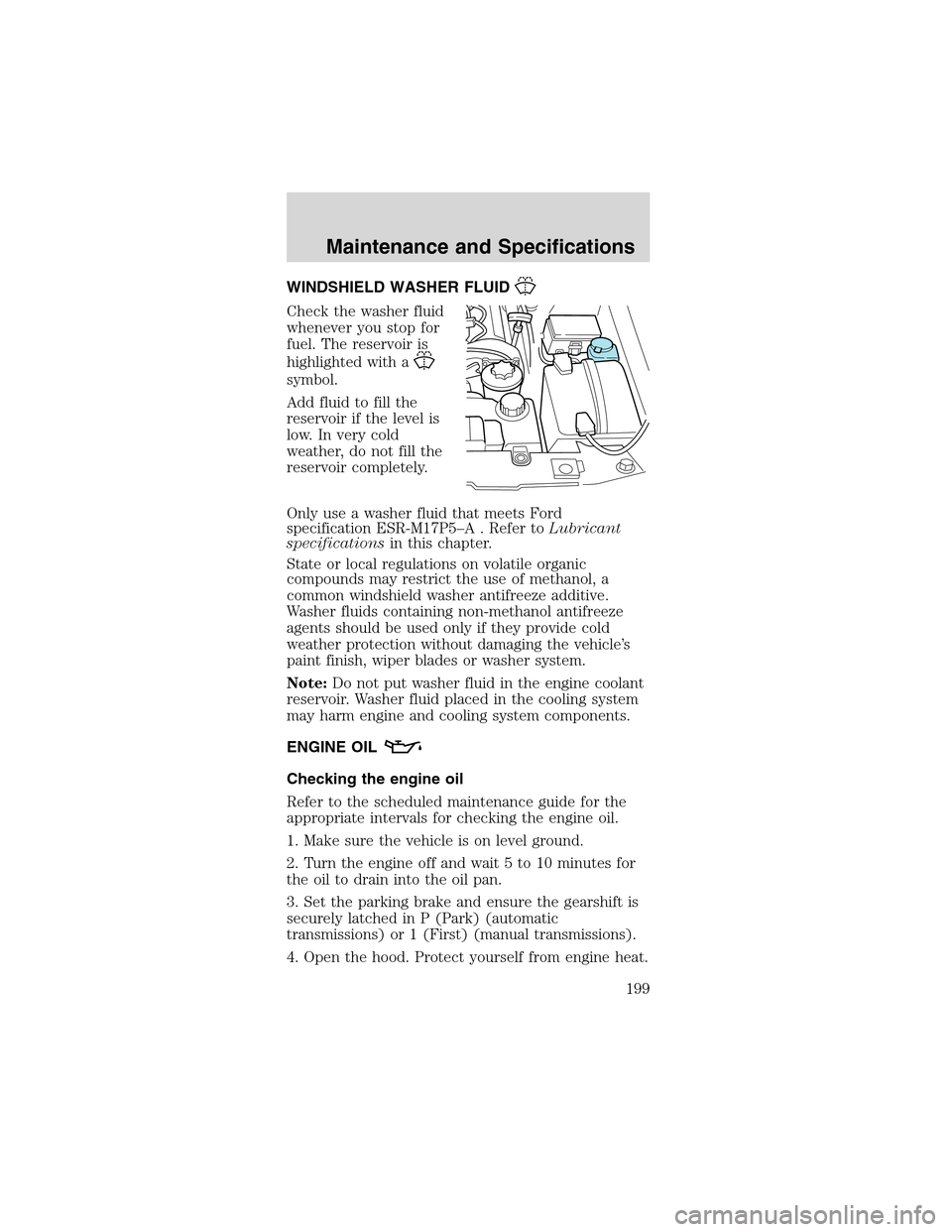
WINDSHIELD WASHER FLUID
Check the washer fluid
whenever you stop for
fuel. The reservoir is
highlighted with a
symbol.
Add fluid to fill the
reservoir if the level is
low. In very cold
weather, do not fill the
reservoir completely.
Only use a washer fluid that meets Ford
specification ESR-M17P5–A . Refer toLubricant
specificationsin this chapter.
State or local regulations on volatile organic
compounds may restrict the use of methanol, a
common windshield washer antifreeze additive.
Washer fluids containing non-methanol antifreeze
agents should be used only if they provide cold
weather protection without damaging the vehicle’s
paint finish, wiper blades or washer system.
Note:Do not put washer fluid in the engine coolant
reservoir. Washer fluid placed in the cooling system
may harm engine and cooling system components.
ENGINE OIL
Checking the engine oil
Refer to the scheduled maintenance guide for the
appropriate intervals for checking the engine oil.
1. Make sure the vehicle is on level ground.
2. Turn the engine off and wait 5 to 10 minutes for
the oil to drain into the oil pan.
3. Set the parking brake and ensure the gearshift is
securely latched in P (Park) (automatic
transmissions) or 1 (First) (manual transmissions).
4. Open the hood. Protect yourself from engine heat.
Maintenance and Specifications
199
Page 200 of 256
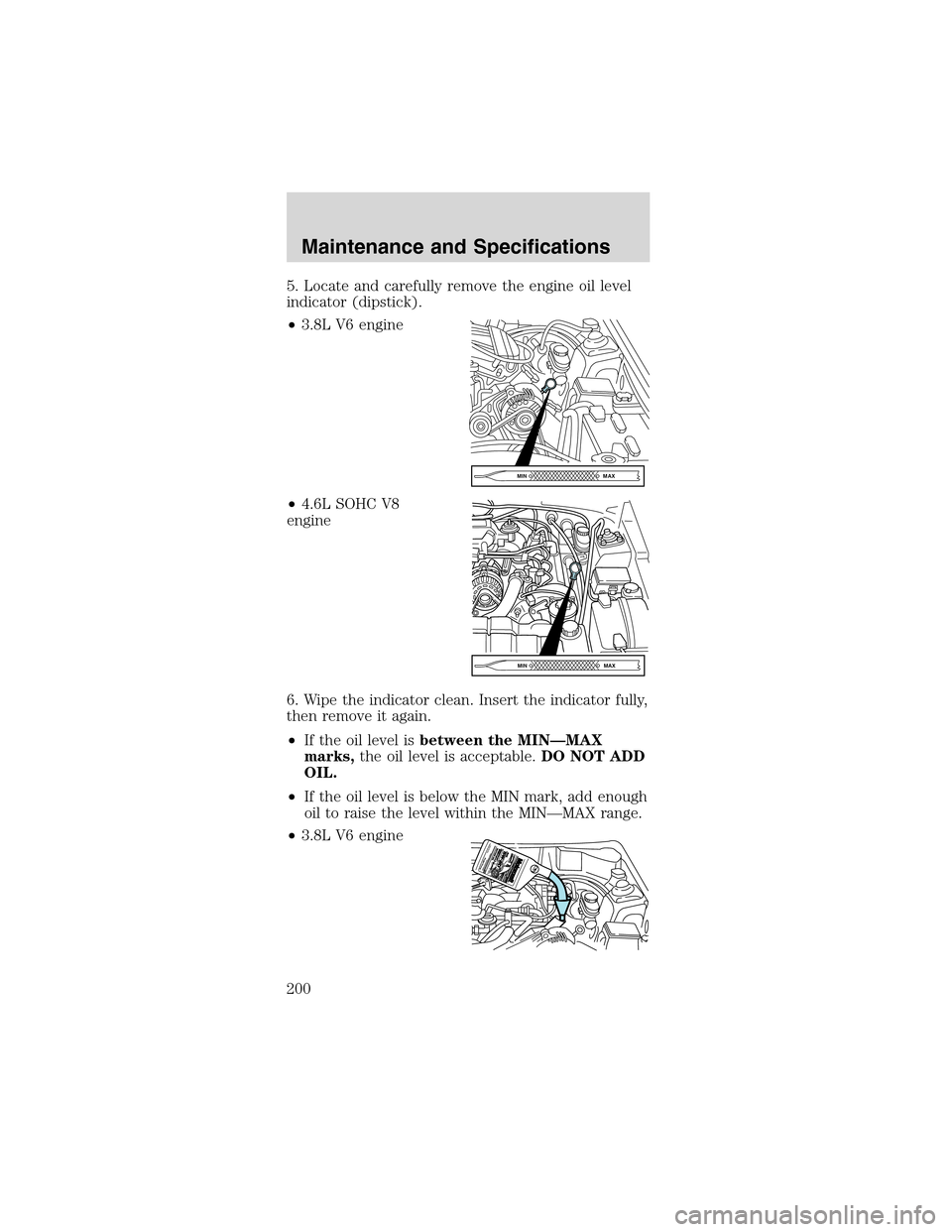
5. Locate and carefully remove the engine oil level
indicator (dipstick).
•3.8L V6 engine
•4.6L SOHC V8
engine
6. Wipe the indicator clean. Insert the indicator fully,
then remove it again.
•If the oil level isbetween the MIN—MAX
marks,the oil level is acceptable.DO NOT ADD
OIL.
•If the oil level is below the MIN mark, add enough
oil to raise the level within the MIN—MAX range.
•3.8L V6 engine
MAX MIN
MAX MIN
Maintenance and Specifications
200
Page 201 of 256
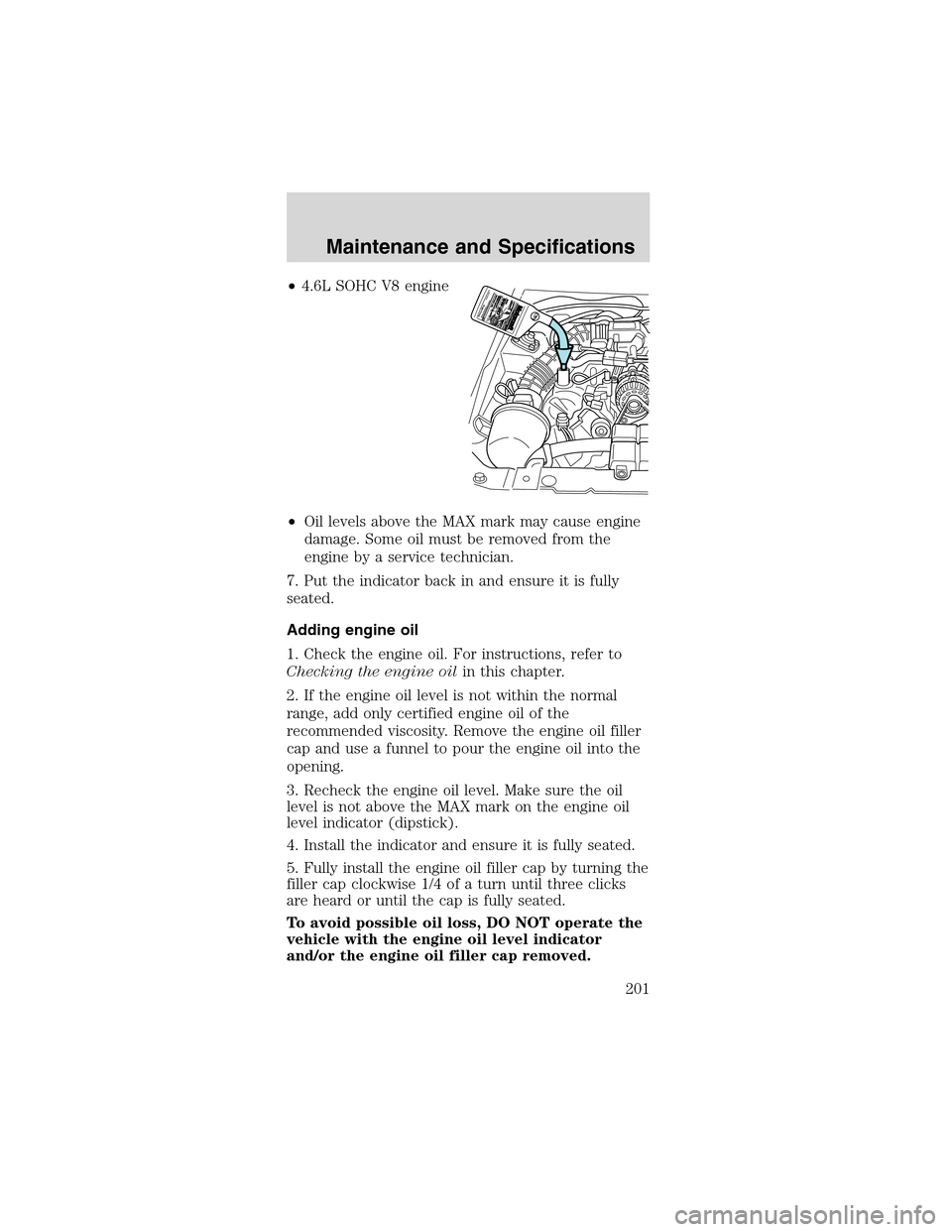
•4.6LSOHCV8 engine
•Oil levels above the MAX mark may cause engine
damage. Some oil must be removed from the
engine by a service technician.
7. Put the indicator back in and ensure it is fully
seated.
Adding engine oil
1. Check the engine oil. For instructions, refer to
Checking the engine oilin this chapter.
2. If the engine oil level is not within the normal
range, add only certified engine oil of the
recommended viscosity. Remove the engine oil filler
cap and use a funnel to pour the engine oil into the
opening.
3. Recheck the engine oil level. Make sure the oil
level is not above the MAX mark on the engine oil
level indicator (dipstick).
4. Install the indicator and ensure it is fully seated.
5. Fully install the engine oil filler cap by turning the
filler cap clockwise 1/4 of a turn until three clicks
are heard or until the cap is fully seated.
To avoid possible oil loss, DO NOT operate the
vehicle with the engine oil level indicator
and/or the engine oil filler cap removed.
Maintenance and Specifications
201