oil GEELY CK 2008 Repair Manual
[x] Cancel search | Manufacturer: GEELY, Model Year: 2008, Model line: CK, Model: GEELY CK 2008Pages: 392, PDF Size: 38.86 MB
Page 114 of 392

107Section 4 Front Strut AssemblyComponents:WasherMount CoverShock Absorber Mount SupportBig WasherThrust Ball BearingSpring Upper SeatFront Coil Spring
Upper InsulatorFront Coil SpringLeft Brake Assembly ABS Sensor Wire HarnessFront Brake Hose Stabilizer Bar Left
Link Rod AssemblyLF Shock Absorber AssemblyFront Coil Spring Lower InsulatorFront BumperFront Shock Absorber
Protecting Sleeve
Page 115 of 392

108Replacement1. Remove the front wheel.
2. Remove the ABS sensor from the steering knuckle. Separate the sensor and signal wire from the wire
harness bracket on the front shock absorber.
3. Separate the front brake hose
Remove 2 clips and separate the front brake hose from the front shock absorber bracket.
4. Remove the stabilizer bar link rod assembly
Remove the nut connecting the stabilizer bar link rod assembly and the shock absorber.
5. Remove the front shock absorber with the coil spring
(1) Remove the nuts and bolts connecting the shock absorber and brake.
(2) Remove the 4 nuts connecting the front shock absorber and vehicle body.
Notice: reliable object shall be used to support the brake assembly!
Page 116 of 392
1096. Disassemble the front strut assembly
(1) Remove the nut on the shock absorber.
Notice: the elasticity of the spring is recovered!
(2) Remove the washer, collar, shock absorber mount seat and big washer.
(3) Remove spring upper seat, front coil spring , front shock absorber boot, front dumper, front coil spring
lower insulator.
7. Assemble the front strut assembly
The assembly of the front strut assembly is in the reverse order of disassembly.
Notice:
(1) Use special fixture when installing the nut on the shock absorber piston rod, be
careful not to let the spring rebound. Torque: 80~90 N.Sm.(2) Install the 4 bolts attaching the front strut assembly to the body. Torque: 25~30N.m.(3) Install the 2 bolts and nuts of the front strut assembly and the brake.
Torque: 90~100N.m.
(4) Install the attaching nuts on the stabilizer bar link rod assembly and shock absorber.
Torque: 50~60N.m.
(5) Install the ABS sensor and secure the signal wire.
Page 123 of 392
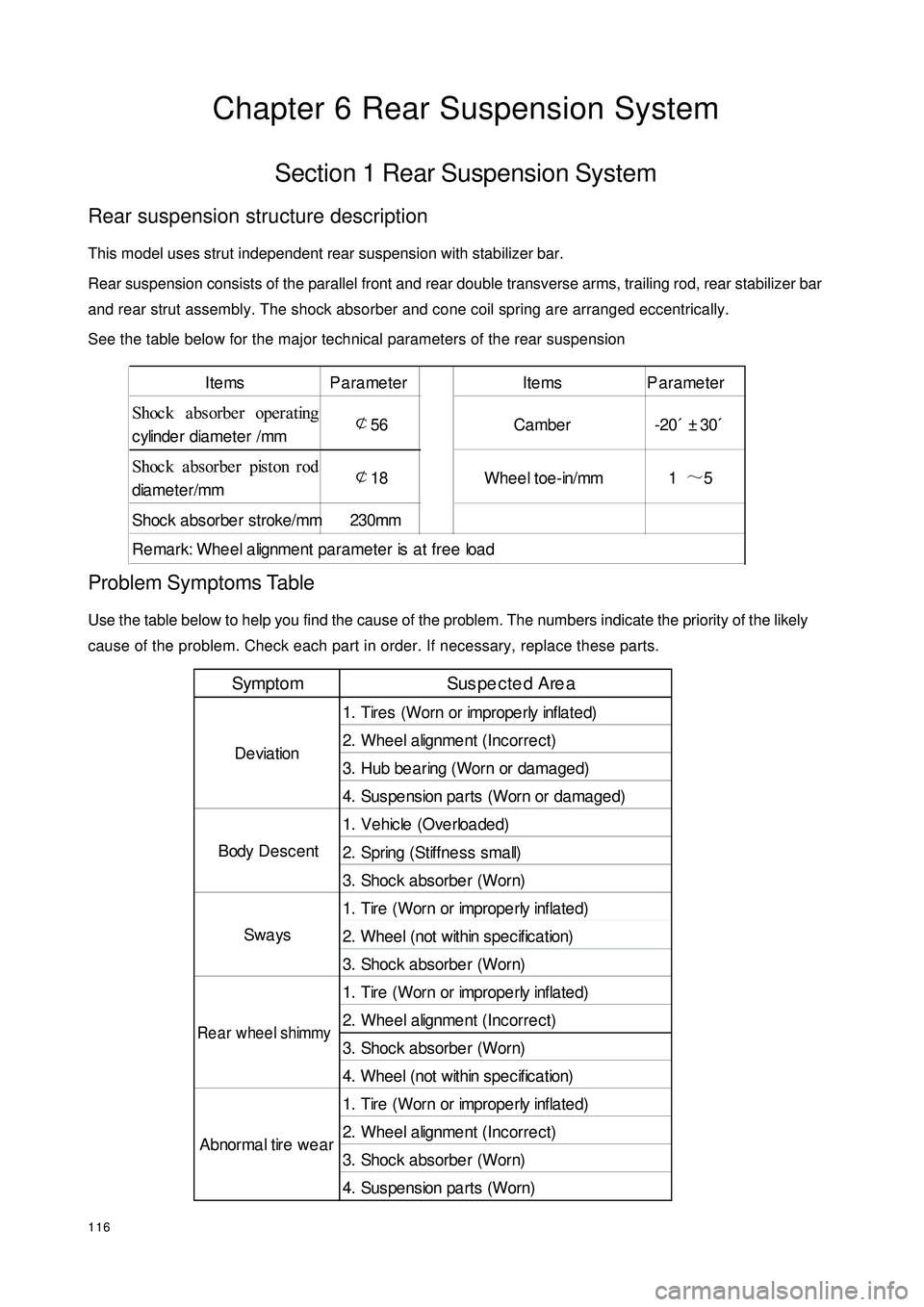
116Chapter 6 Rear Suspension SystemSection 1 Rear Suspension SystemRear suspension structure descriptionThis model uses strut independent rear suspension with stabilizer bar.
Rear suspension consists of the parallel front and rear double transverse arms, trailing rod, rear stabilizer bar
and rear strut assembly. The shock absorber and cone coil spring are arranged eccentrically.
See the table below for the major technical parameters of the rear suspensionProblem Symptoms TableUse the table below to help you find the cause of the problem. The numbers indicate the priority of the likely
cause of the problem. Check each part in order. If necessary, replace these parts.Items Parameter Items Parameter
Shoc k a bsorbe r operating
cylinder diameter /mm¢
56 Cambe r -20´±30´
Shoc k a bsorbe r piston rod
diameter/mm¢
18 Wheel toe-in/mm 1~
5
Shoc k absorbe r stroke/mm 230mm
Remark: Wheel alignment parameter is at free loadSympto m Sus pe cte d Are a
1. Tires (Worn or imprope rly infla te d)
2. Wheel alignment (Incorrect)
3. Hub be a ring (Worn or da ma ge d)
4. Suspe nsion pa rts (Worn or da ma ge d)
1. Ve hic le (Ove rloa de d)
2. Spring (Stiffness small)
3. Shoc k a bsorbe r (Worn)
1. Tire (Worn or imprope rly inflate d)
2. W he e l ( not w it hin s pe c if ic a t ion)
3. Shoc k a bsorbe r (Worn)
1. Tire (Worn or imprope rly inflate d)
2. Wheel alignment (Incorrect)
3. Shoc k a bsorbe r (Worn)
4. W he e l ( not w it hin s pe c if ic a t ion)
1. Tire (Worn or imprope rly inflate d)
2. Wheel alignment (Incorrect)
3. Shoc k a bsorbe r (Worn)
4. Sus pe nsion pa rts (Worn) Abnormal tire wearDeviation
Body Desc ent
SwaysRear wheel shimmy
Page 136 of 392
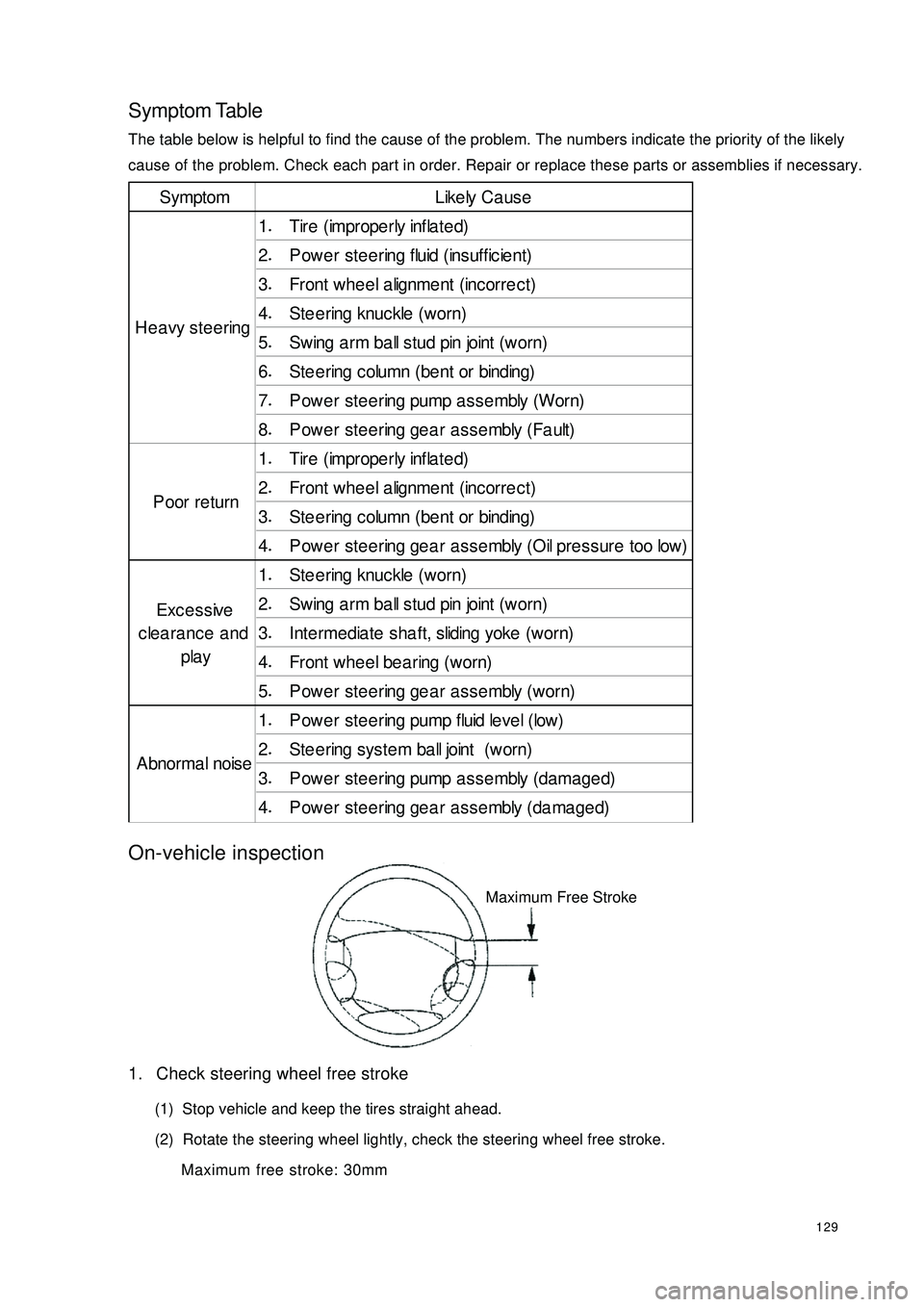
129Symptom TableThe table below is helpful to find the cause of the problem. The numbers indicate the priority of the likely
cause of the problem. Check each part in order. Repair or replace these parts or assemblies if necessary.On-vehicle inspection1. Check steering wheel free stroke
(1) Stop vehicle and keep the tires straight ahead.
(2) Rotate the steering wheel lightly, check the steering wheel free stroke.
Maximum free stroke: 30mmSymptom Like ly Ca us e
1.
Tire (imprope rly infla te d)
2.
P owe r ste ering fluid (insuffic ie nt)
3.
Front whe e l a lignme nt (inc orre c t)
4.
Ste e ring knuckle (worn)
5.
Swing a rm ba ll stud pin joint (worn)
6.
St e e r ing c olumn ( be nt or binding)
7.
P owe r ste ering pump a ssembly (Worn)
8.
Power steering gear assembly (Fault)
1.
Tire (imprope rly infla te d)
2.
Front whe e l a lignme nt (inc orre c t)
3.
St e e r ing c olumn ( be nt or binding)
4.
Power steering gear assembly (Oil pressure too low)
1.
Ste e ring knuckle (worn)
2.
Swing a rm ba ll stud pin joint (worn)
3.
Inte rmediate sha ft, sliding yoke (worn)
4.
Front whe e l be a ring (w orn)
5.
P owe r ste ering ge a r asse mbly (worn)
1.
P owe r ste ering pump fluid leve l (low)
2.
St e e r ing s ys t e m ba ll joint ( w or n)
3.
Power steering pump assembly (damaged)
4.
Power steering gear assembly (damaged) He avy ste eringPoor returnExcessive
clearance and
play
A bnor ma l nois eMaximum Free Stroke
Page 142 of 392
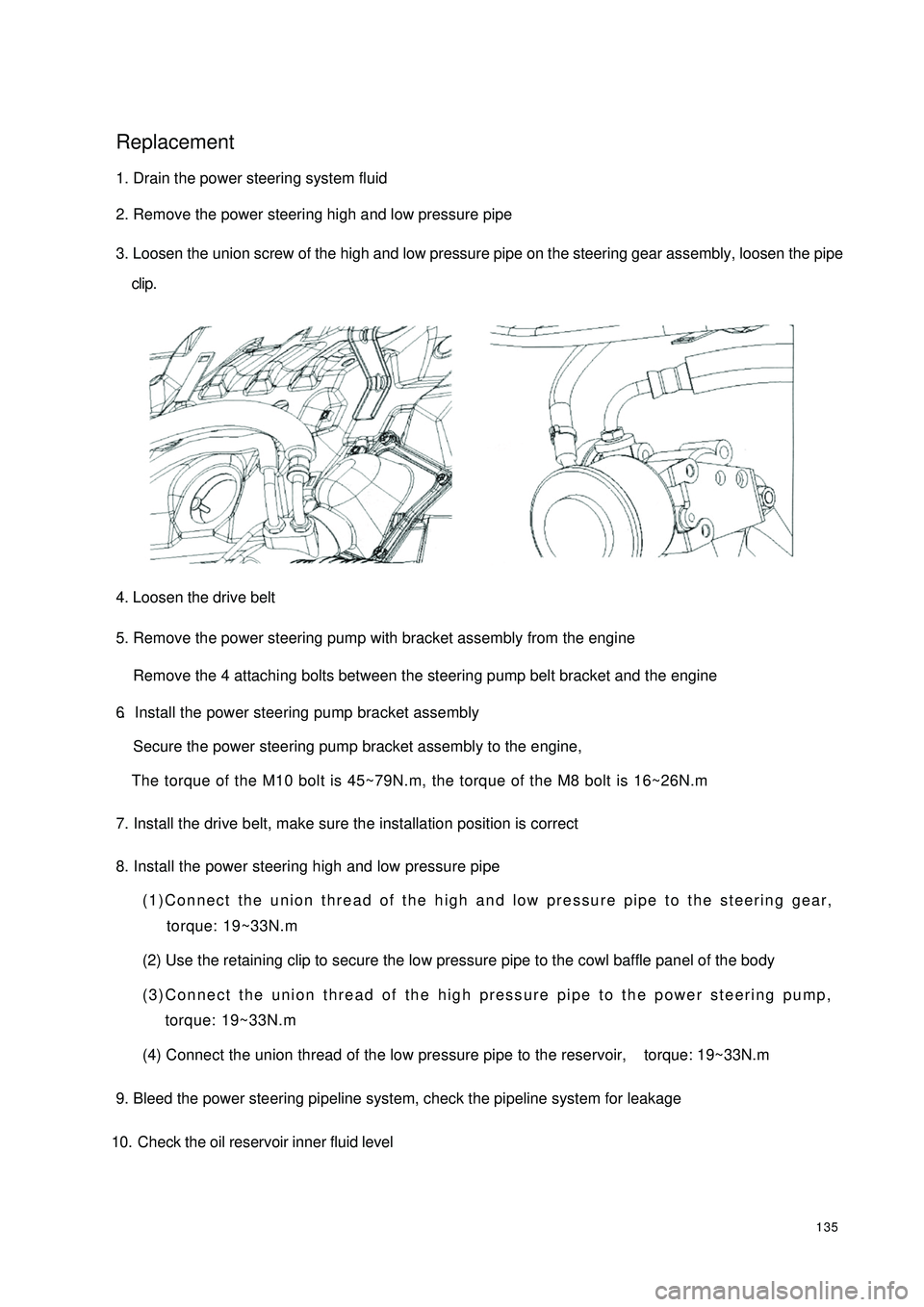
135Replacement1. Drain the power steering system fluid
2. Remove the power steering high and low pressure pipe
3. Loosen the union screw of the high and low pressure pipe on the steering gear assembly, loosen the pipe
clip.
4. Loosen the drive belt
5. Remove the power steering pump with bracket assembly from the engine
Remove the 4 attaching bolts between the steering pump belt bracket and the engine6.Install the power steering pump bracket assemblySecure the power steering pump bracket assembly to the engine,
The torque of the M10 bolt is 45~79N.m, the torque of the M8 bolt is 16~26N.m7. Install the drive belt, make sure the installation position is correct
8. Install the power steering high and low pressure pipe(1)Connect the union thread of the high and low pressure pipe to the steering gear,
torque: 19~33N.m
(2) Use the retaining clip to secure the low pressure pipe to the cowl baffle panel of the body
(3)Connect the union thread of the high pressure pipe to the power steering pump,
torque: 19~33N.m
(4) Connect the union thread of the low pressure pipe to the reservoir, torque: 19~33N.m
9. Bleed the power steering pipeline system, check the pipeline system for leakage
10. Check the oil reservoir inner fluid level
Page 146 of 392

139Chapter 9 Brake SystemSection 1 Brake SystemPrecaution1. It's very important to keep the parts and area clean when repairing the brake system.
2. Care must be taken to replace each part properly as it could affect the performance of the brake
system and result in a driving hazard.
3. Do not let brake fluid remain on a painted surface when repairing any parts. Wash it off
immediately.
4. If any work is done on the brake system or air in the brake pipelines is suspected, bleed the
system of air.
5. Check the brake system for leakage after repairing the brake system.
6. Use specified brake fluid. Do not mix with other brand of brake fluid.Problem symptoms tableUse the table below to help you find the cause of the problem. The numbers indicate the priority of the likely
cause of the problem. Check each part in order. If necessary, replace these parts.Symptom Cause
1. Brake system (fluid leaks)
2. Brake system (air in)
3. P iston Cup in Sub-pump (worn or dama ge d)
4. Rear brake shoe clearance (out of adjustment)
5. Master cylinder (faulty)
6. Booste r push rod (out of a djustme nt)
7. Brake shoe or lining (oily)
8. Disc/Drum scratched
1. Brake pe dal free stroke is too small
2. P a rking brake le ver stroke (out of a djustme nt)
3. P a rking brake ca ble (stic king)
4. Rear brake shoe clearance (out of adjustment)
5. Brake pa d or lining (c rac ked or distorte d)
6. Wheel cylinder piston (stuck or frozen)
7. Return spring (faulty)
8. Va cuum booster (faulty)
9. Brake master cylinder (faulty) Low Brake P edal
Brake Stagnation
Page 147 of 392

140Section 2 Brake FluidBleeding1. Fill brake reservoir with brake fluid
Brake fluid: JG4 GB10830
2. Bleed brake pipeline system
(1) Connect the vinyl pipe to the wheel cylinder bleeder plug port
(2) Depress the brake pedal several times, and then loosen the bleeder plug with the pedal held down.
(3) At the point when fluid stops flowing out, tighten the bleeder plug, and then release the brake pedal.
(4) Repeat (2) and (3) until all the air in the fluid has been bled out.
(5) Repeat the above procedure to bleed the brake pipeline of the air for each wheel cylinder.
Notice: Fill brake fluid into the reservoir all the time when bleeding.
3. Check fluid level in reservoir
Check the fluid level and fill fluid if necessary.Symptom Suspe ct a re a
1. Whee l cylinder piston (stuck)
2. Bra ke shoe lining (oily)
3. Disc (scratched)
4. Bra ke shoe s or lining (c ra cke d or distorte d)
5. Whee l hub be a ring (worn or da mage d)
Tire pressure (not as specified)
1. Bra ke shoe lining (da mage d)
2. Insta lla tion bolt (loose )
3. Disc (scratched)
4. Bra ke shoe (ba d in qua lity)
5. Bra ke shoe s lining (oily)
6. Sound isolating shim da mage d
7. Hold spring of bra ke shoe (da mage ) Brake Deviation
Noise from brake
Page 152 of 392

145Remove 2 boots from the brake cylinder support bracket.
7. Remove the brake cylinder guide boot
Remove the clip and boot with screwdriver.
8. Remove the bleeder screw
9. Remove the front brake piston
(1) Put a piece of soft cloth between the brake cylinder and piston.
(2) Blow the piston out from the brake cylinder with the compressed air
Notice: Be careful not to put your finger in front of the piston when blowing
the compressed air. Be careful of the splashed brake fluid
10. Remove the piston oil seal
Remove the oil seal from the brake cylinder with a screwdriver
11.Check the brake cylinder and piston
Check the cylinder wall and piston for rust and damage
12. Check the thickness of the brake pad
Measure the thickness with a ruler: Standard thickness: 10mm,
Minimum thickness: 1mm
13. Check the front brake alarm plate
Make sure the alarm plate has enough elasticity, and is not cracked
or worn. Clean all rust, dirt and foreign materials
14. Check disc thickness
Measure the disc thickness with micrometer:
Standard thickness: 11mm
Minimum thickness: 10mm
Page 153 of 392

14615. Remove the front disc
16. Installation is in the reverse order of the above-mentioned procedure
Notice:
(1) The maximum lateral runout of the disc surface should be no more than 0.05mm
(Measured 10mm from the brake disc outside edge)
(2) Be careful not to install the brake cylinder guide boot in the reverse direction
(3) Make sure the cylinder and the piston oil seal are clean before installing the
piston oil seal in the brake cylinder. Apply lithium soap base glycol grease to
the piston surface. Never rotate the piston into the brake cylinder by force.
(4) Install the brake caliper to tighten the bolt torque: 85~90 N.m
(5) Replace the noise insulator when replacing the worn brake pad. Make sure the
clip plate is in normal status. Otherwise, replace the floating clip plate
(6) Make sure the brake pad and disc surface are clean. Oil or grease is not attached.
(7) Install the brake hose. Uion thread torque: 16~20N.m
(8) Bleed the air in the brake system. Check the brake system for leakage.
(9) Install the front wheel. The tire nut torque: 95~115 N.msimultaneously.floating