maintenance GREAT WALL FLORID 2008 Service Manual
[x] Cancel search | Manufacturer: GREAT WALL, Model Year: 2008, Model line: FLORID, Model: GREAT WALL FLORID 2008Pages: 281, PDF Size: 43.97 MB
Page 181 of 281
Downloaded from www.Manualslib.com manuals search engine GWFLORID Maintenance Manual174
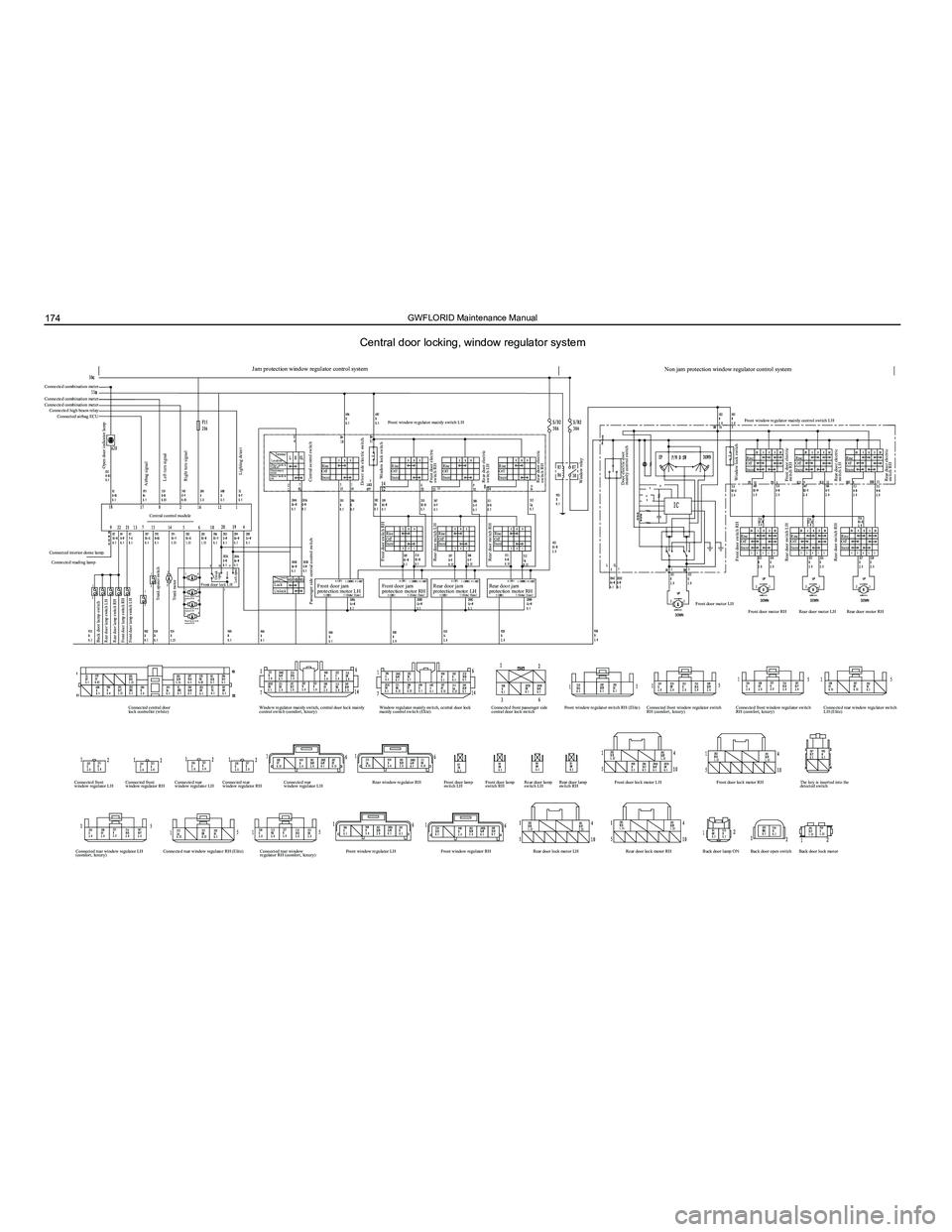
Central door locking, window regulator system
Rise
Off
Descend
Rise
Off
Descend
Rise
Off
Descend
Front door switch RH
Rear door switch LH
Rear door switch RH
Jam protection window regulator control system
Front window regulator mainly switch LH
Front door jam
protection motor LHFront door jam
protection motor RHRear door jam
protection motor LH Rear door jam
protection motor RH
Connected combination meter
Connected combination meter
Connected combination meter
Connected high beam relay
Connected airbag ECU
Central control module
Connected interior dome lamp Connected reading lamp
Open door indicator lamp
Airbag signal
Back door lamp switch
Rear door lamp switch LH
Rear door lamp switch RH
Front door lamp switch RH
Front door lamp switch LH
Trunk opener switch
Trunk motor
Unlock
signal
Lock signalFront door lock LH Lock
UnlockRise
Off
Descend
Rise
Off
Descend
Rise
Off
Descend
Rise
Off
Descend
Rise
Off
Descend
Rise
Off
Descend
Rise
Off
Descend
Rise
Off
Descend
Rise
Off
Descend
Rise
Off
DescendDoor lock is
locked
Stationary
state
Door lock is
on
Front door lock
motor RH
Rear door lock
motor LH
Rear door lock
motor RH
Left turn signal
Right turn signal
Lighting detect
Passenger side central ocntrol switch Central ocntrol switch
Driver side electric switch Window lock switch
Front door electric
switch RH
Rear door electric
switch LH
Rear door electric
switch RH
Window relay
Window lock switch
Front door switch RH
Rear door switch LH
Rear door switch RH Door electric door
mainly control switch
Front door electric
switch RH
Rear door electric
switch LH
Rear door electric
switch RH
Non jam protection window regulator control system
Front door motor LH
Connected central door
lock controller (white)
Connected front
window regulator LH Connected rear window regulator LH
(comfort, luxury) Connected rear window regulator RH (Elite)
Connected rear window
regulator RH (comfort, luxury)Front window regulator LH
Rear door lock motor LHRear door lock motor RHBack door lamp ONBack door open switch Back door lock motor
Front window regulator RH
Connected front
window regulator RH
Connected rear
window regulator LHConnected rear
window regulator RH Connected rear
window regulator LH Rear window regulator RH
Front door lamp
switch LHFront door lamp
switch RHRear door lamp
switch LHRear door lamp
switch RH Front door lock motor LH
Front door lock motor RHThe key is inserted into the
detected switch
Window regulator mainly switch, central door lock mainly
control switch (comfort, luxury) Window regulator mainly switch, central door lock
mainly control switch (Elite)Connected front passenger side
central door lock switchFront window regulator switch RH (Elite)
Connected front window regulator switch
RH (comfort, luxury) Connected front window regulator switch
RH (comfort, luxury)Connected rear window regulator switch
LH (Elite)
Front door motor RH
Rear door motor LHRear door motor RH
Front window regulator mainly control switch LH
Terminal
Location
Terminal
Location
Page 183 of 281
Downloaded from www.Manualslib.com manuals search engine GWFLORID Maintenance Manual176
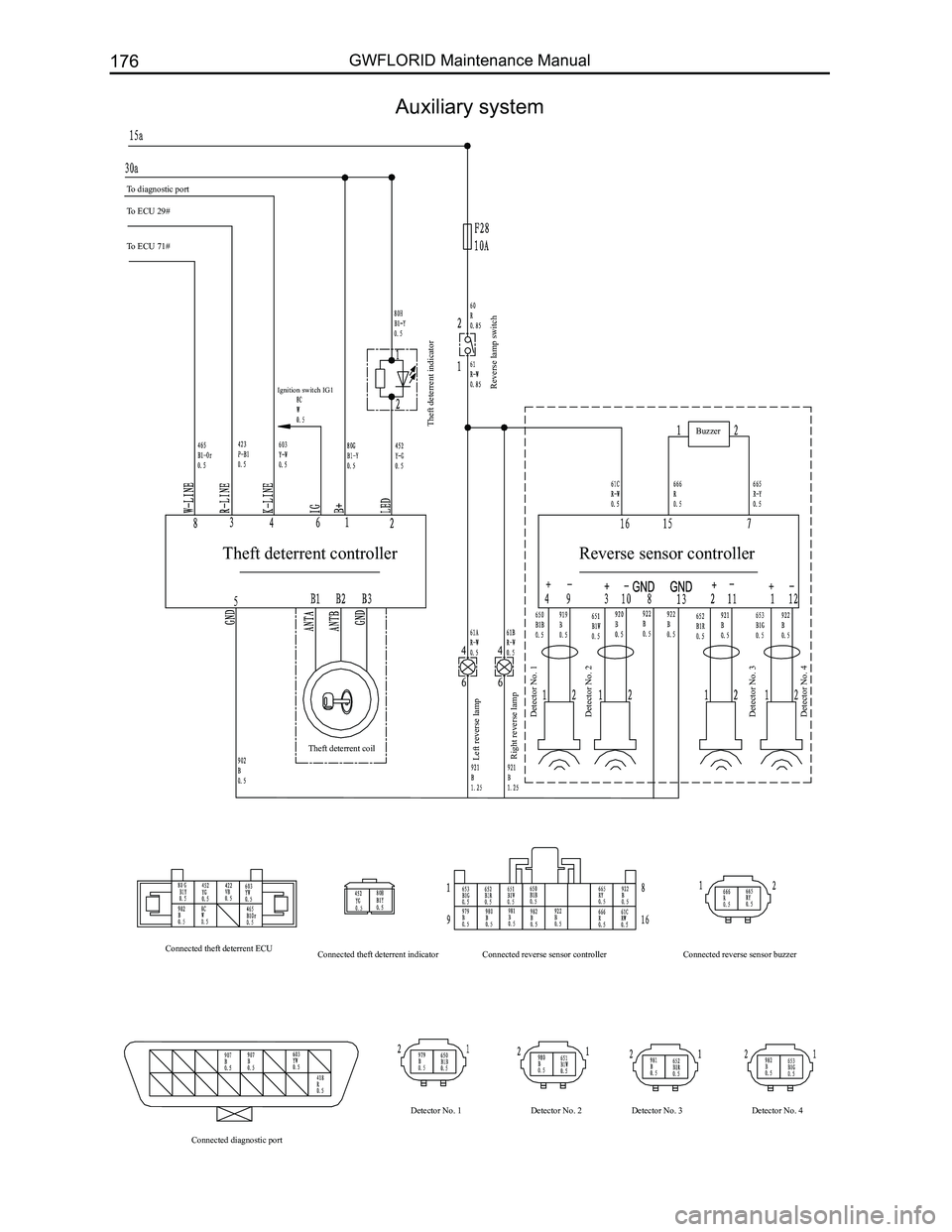
Auxiliary system
To diagnostic port
To ECU 29#
To ECU 71#
Theft deterrent indicatorReverse lamp switch
Left reverse lamp
Right reverse lamp Detector No. 1
Detector No. 2
Detector No. 3
Detector No. 4
Theft deterrent coil
Connected theft deterrent ECU Connected diagnostic port Detector No. 1
Detector No. 2Detector No. 3 Detector No. 4
Connected theft deterrent indicator
Connected reverse sensor controller Connected reverse sensor buzzerBuzzer
Ignition switch IG1
Theft deterrent controller
Reverse sensor controller
Page 185 of 281
Downloaded from www.Manualslib.com manuals search engine GWFLORID Maintenance Manual178
Reverse Sensor
Reverse sensor operation (ultrasonic wave distance-measurement)
Sound is a kind of wave. Sound frequency that can be heard by human beings range from 20 Hz to 20 KHz.
Those that exceed 20 KHz are called ultrasonic waves. Since an ultrasonic wave is also a kind of sound, its
velocity in the air also equals the sound velocity of 340 m/s. Part of the ultrasonic wave will rebound when it
encounters an obstacle. So the distance between the sound source and the obstacle can be calculated according
to the sonic speed and the time difference between the emission of sound and the receipt of sound.
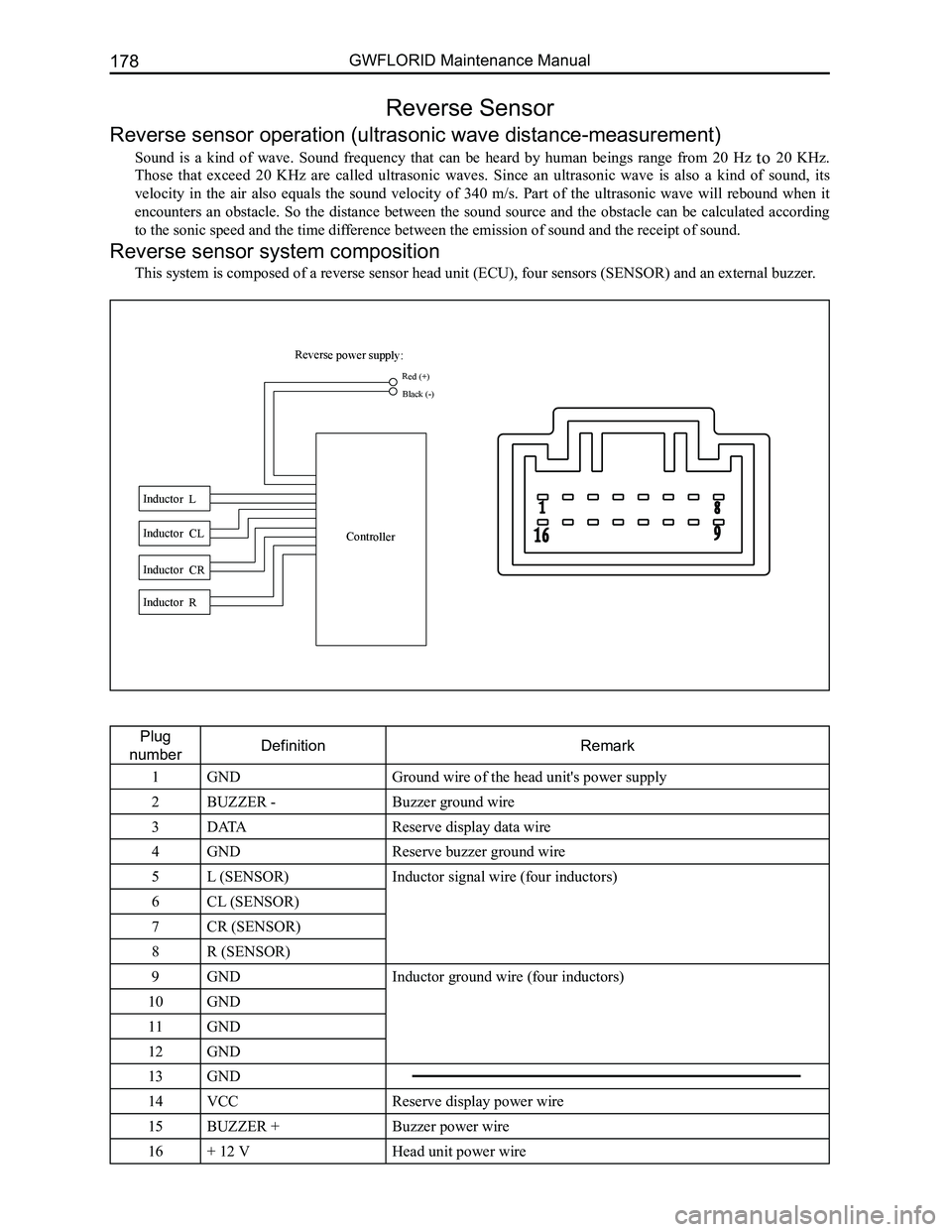
Reverse sensor system composition
This system is composed of a reverse sensor head unit (ECU), four sensors (SENSOR) and an external buzzer.
Plug
numberDefinitionRemark
1GNDGround wire of the head unit's power supply
2BUZZER -Buzzer ground wire
3DATAReserve display data wire
4GNDReserve buzzer ground wire
5L (SENSOR)Inductor signal wire (four inductors)
6CL (SENSOR)
7CR (SENSOR)
8R (SENSOR)
9GNDInductor ground wire (four inductors)
10GND
11GND
12GND
13GND
14VCCReserve display power wire
15BUZZER +Buzzer power wire
16+ 12 VHead unit power wire
Reverse power supply:
Inductor L Inductor CL
Inductor CR Inductor R Controller
Red (+)
Black (-)
Page 187 of 281
Downloaded from www.Manualslib.com manuals search engine GWFLORID Maintenance Manual180
Combination Meter
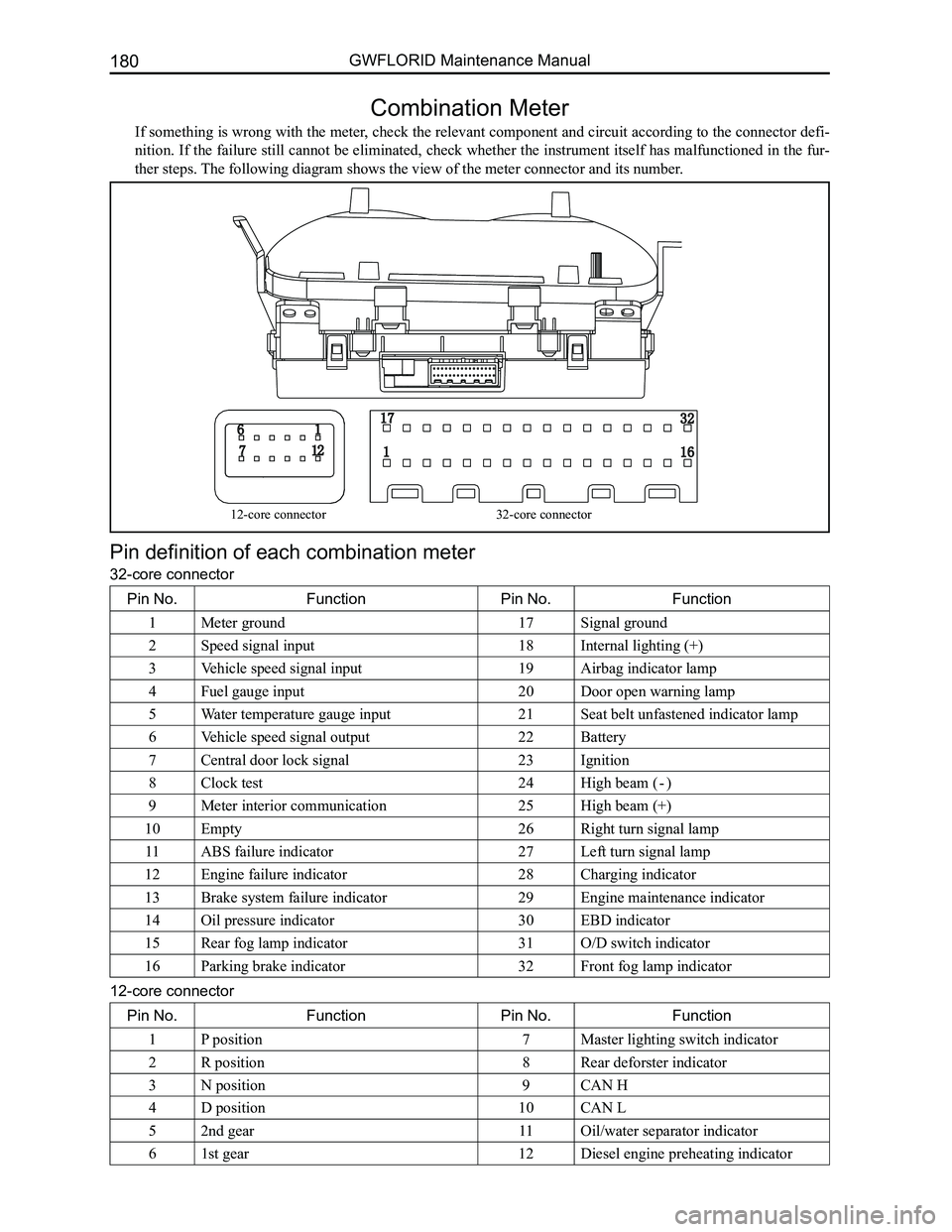
If something is wrong with the meter, check the relevant component and circuit according to the connector defi-
nition. If the failure still cannot be eliminated, check whether the instrument itself has malfunctioned in the fur-
ther steps. The following diagram shows the view of the meter connector and its numb\
er.
Pin definition of each combination meter
32-core connector
Pin No.FunctionPin No.Function
1Meter ground17Signal ground
2Speed signal input18Internal lighting (+)
3Vehicle speed signal input19Airbag indicator lamp
4Fuel gauge input20Door open warning lamp
5Water temperature gauge input21Seat belt unfastened indicator lamp
6Vehicle speed signal output22Battery
7Central door lock signal23Ignition
8Clock test24High beam ( - )
9Meter interior communication25High beam (+)
10Empty26Right turn signal lamp
11ABS failure indicator27Left turn signal lamp
12Engine failure indicator28Charging indicator
13Brake system failure indicator29Engine maintenance indicator
14Oil pressure indicator30EBD indicator
15Rear fog lamp indicator31O/D switch indicator
16Parking brake indicator32Front fog lamp indicator
12-core connector
Pin No.FunctionPin No.Function
1P position7Master lighting switch indicator
2R position8Rear deforster indicator
3N position9CAN H
4D position10CAN L
52nd gear11Oil/water separator indicator
61st gear12Diesel engine preheating indicator
12-core connector32-core connector
Page 189 of 281
Downloaded from www.Manualslib.com manuals search engine GWFLORID Maintenance Manual182
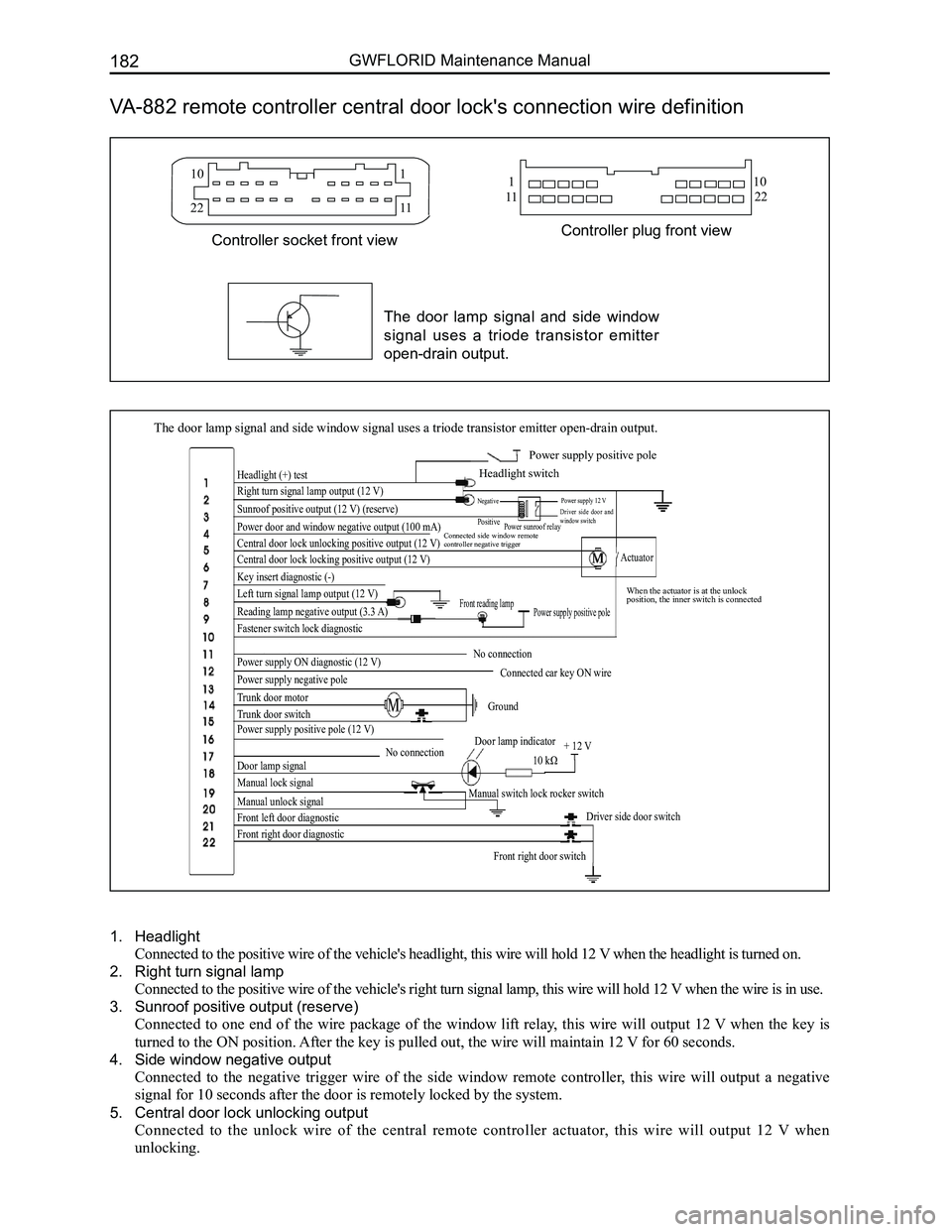
VA-882 remote controller central door lock's connection wire definition
The door lamp signal and side window signal uses a triode transistor emi\
tter open-drain output.
Headlight (+) test
Right turn signal lamp output (12 V)
Sunroof positive output (12 V) (reserve)
Power door and window negative output (100 mA)
Central door lock unlocking positive output (12 V)
Central door lock locking positive output (12 V)
Key insert diagnostic (-)
Left turn signal lamp output (12 V)
Reading lamp negative output (3.3 A)
Fastener switch lock diagnostic
Power supply ON diagnostic (12 V)
Power supply negative pole
Trunk door motor
Trunk door switch
Power supply positive pole (12 V)
Door lamp signal
Manual lock signal
Manual unlock signal
Front left door diagnostic
Front right door diagnostic
Front right door switch
Driver side door switch
Manual switch lock rocker switch
No connectionDoor lamp indicator
10 kΩ + 12 V
Ground
Connected car key ON wire
No connection
Power supply positive poleFront reading lamp
Actuator
When the actuator is at the unlock position, the inner switch is connected
Connected side window remote controller negative trigger
Power sunroof relay
Power supply 12 VDriver side door and window switch
Negative
Positive
Power supply positive pole
Headlight switch
10
22
110
1122
1
11
Controller plug front viewController socket front view
The door lamp signal and side window
signal uses a triode transistor emitter
open-drain output.
1. Headlight
Connected to the positive wire of the vehicle's headlight, this wire will hold 12 V when the headlight is turned on.
2. Right turn signal lamp
Connected to the positive wire of the vehicle's right turn signal lamp, this wire will hold 12 V when the wire is in use.
3. Sunroof positive output (reserve)
Connected to one end of the wire package of the window lift relay, this wire will output 12 V when the key is
turned to the ON position. After the key is pulled out, the wire will maintain 12 V for 60 seconds.
4. Side window negative output
Connected to the negative trigger wire of the side window remote controller, this wire will output a negative
signal for 10 seconds after the door is remotely locked by the system.
5. Central door lock unlocking output
Connected to the unlock wire of the central remote controller actuator, this wire will output 12 V when
unlocking.
Page 191 of 281
Downloaded from www.Manualslib.com manuals search engine GWFLORID Maintenance Manual184
Power Windows
The GWFLORID electric power window actuator consist of a motor and module. Its functions include: jam
protection, centralized control rise, soft-stop, characterized by easy control, long life, etc.
The functions of electric power window actuator
1. Jam protection
Power windows have an jam protection function when manually or automatically rising after it has been
initialized. There is no limit on the amount of jam protections. When room temperature is 25±5oC, wire
resistance 150 mΩ and 14.5 V working voltage, the jam protection force risen glass is less than 100 N. When the
window is manually or electrically rising, once it encounters a force greater than the jam protection force, the glass
will immediately stop rising and make the motor rotate in reverse. Rever\
se rotation distance is about 125 mm.
2. Centralized control rise
The central door lock controller provides four lifters with a low level signal. The power windows will close until
they are completely closed. This enables the two power window actuators to start separately, which can avoid
hitting peak currents if they start up at the same time. As long as the centralized controller's rising pin receives
the low level signal, the motor will close the window until it is comple\
tely closed.
3. Soft-stop
If the motor suffers from an impacting block when the window is rolled all the way up or all the way down, it
would shorten the power window actuator's use life. In order to avoid this, the soft-stop function must be used,
in which both manual and automatic rolling up and down should have this \
function.
(a) Soft close function:
When the window is about to get to the top, that is to say, when it's rising to the soft-stop point, the engine's
power will cut off to make the motor stop working, meanwhile the rising inertia will continue to roll the
window up to the top. The soft-stop point is about 2 mm under the top limiting position.
(b) When the window is about to lower to the bottom, that is to say, when it's lowering to the soft-stop point,
the engine's power will cut off to make it stop working, meanwhile the lowering inertia will continue to roll
the window down to the bottom. The soft-stop point is about 12 mm above the bottom limiting position.
(c) Zero position calibration: This position takes the top limiting position as the zero position. In order to
guarantee reliable and safer system operation while in use, the zero pos\
ition will need constant calibration.
Manual calibration: When the window stops at the rising soft-stop position after rising for a period,
press the rise button so it will rise to the limiting position. Zero cal\
ibration is then complete.
Automatic calibration: After the motor runs forward and reverse more than 20 times, it will undergo
zero position calibration one time. That is to say, when it completely starts or stops operating, the motor will
be blocked one time. Currently, there is no soft close or start-up function. Zero position calibration is com-
pleted when the window is completely closed to the limiting position.
4. Motor locked protection
The control module will cut off the power supply to stop the motor from working within 250 ms of the l\
ocking.
5. Motor temperature protection
When the control module is powered on, the initial temperature of the motor is set at 40oC. There are two
temperature limits for the motor's thermal protection function. If the temperature of the coil exceeds the first
temperature limit (170oC), the motor will not respond to any new operation input, but it will still complete the present
operation. If the motor's temperature exceeds the first temperature limit during its operation, it will keep working until
the temperature of the motor coil reaches the second temperature limit (190oC), then the motor will not be limited by
the second temperature's threshold while reversing, so as to guarantee the safety of the users. Once the temperature of
the motor has lowered below the temperature limit, the motor will work normally.
6. Self-diagnostic protection function
So as to guarantee the system's reliability while improving the system's average non-failure time, self-diagnostic
protection measures are used: If the power supply voltage exceeds 16 V, the control module will close the auto-
rising function.
(a) Switch contact point adhesion:
If it is detected that the switch contact point adhesion has reached up to 10 m input instructions will no
longer be received. If later the switch contact is detected to be disconnected again, it's function will return
to normal.
(b) Relay contact point adhesion:
The power window actuator is controlled by two contact point relays.
After a shutoff command is sent to one of the relays, if the system detects that this relay is still on, then
the system will choose this relay contact point for adhesion. Thereupon, the system will send out another
command to make the other electric relay switch on as well, so as to guarantee the motor's power supply is
Page 192 of 281
Downloaded from www.Manualslib.com manuals search engine 185Electrical Accessories
Front door window regulator LHFront door window regulator RH
Rear door window regulator LHRear door window regulator RH
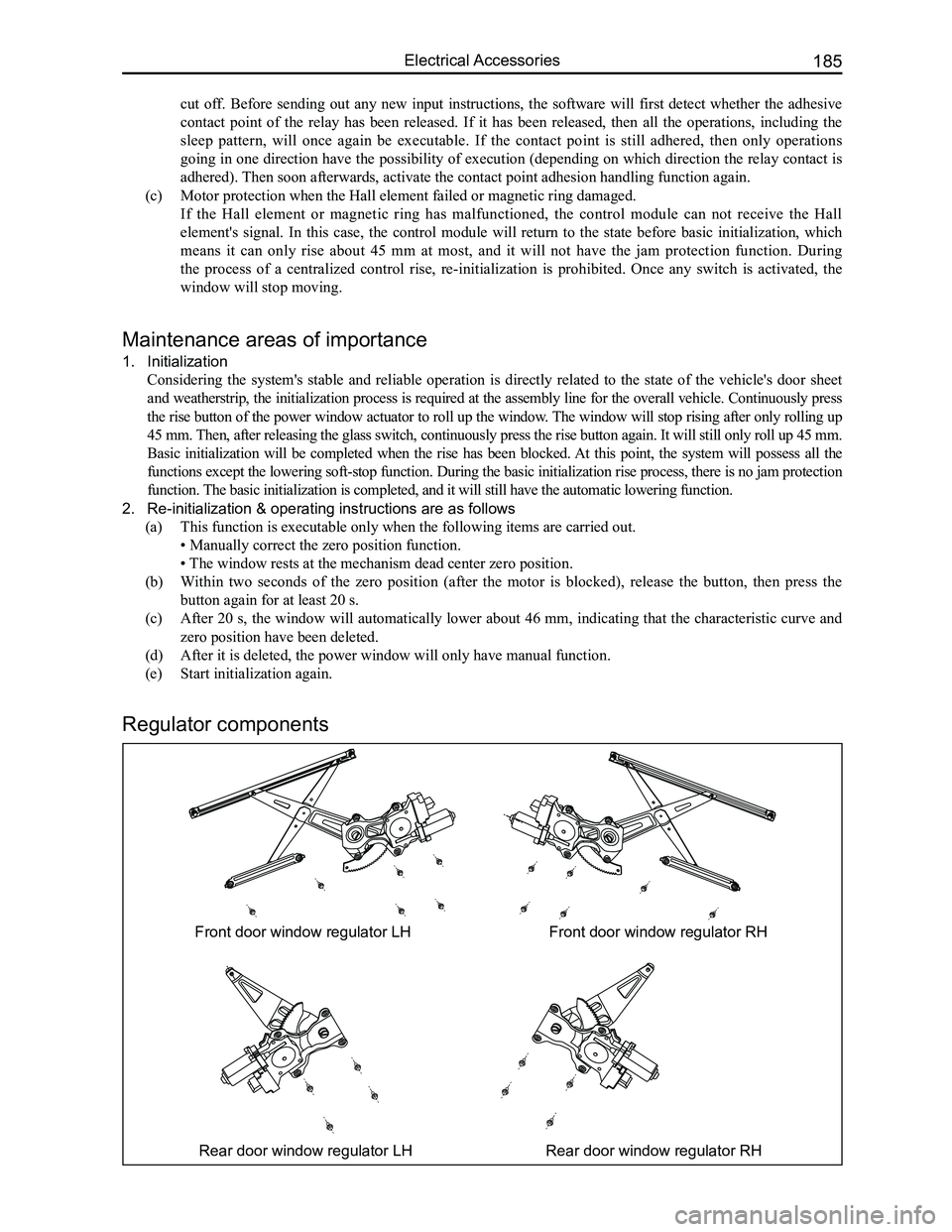
Regulator components
Maintenance areas of importance
1. Initialization
Considering the system's stable and reliable operation is directly related to the state of the vehicle's door sheet
and weatherstrip, the initialization process is required at the assembly line for the overall vehicle. Continuously press
the rise button of the power window actuator to roll up the window. The window will stop rising after only rolling up
45 mm. Then, after releasing the glass switch, continuously press the rise button again. It will still only roll up 45 mm.
Basic initialization will be completed when the rise has been blocked. At this point, the system will possess all the
functions except the lowering soft-stop function. During the basic initialization rise process, there is no jam protection
function. The basic initialization is completed, and it will still have the automa\
tic lowering function.
2. Re-initialization & operating instructions are as follows
(a) This function is executable only when the following items are carried out.
• Manually correct the zero position function.
• The window rests at the mechanism dead center zero position.
(b) Within two seconds of the zero position (after the motor is blocked), release the button, then press the
button again for at least 20 s.
(c) After 20 s, the window will automatically lower about 46 mm, indicating that the characteristic curve and
zero position have been deleted.
(d) After it is deleted, the power window will only have manual function.
(e) Start initialization again.
cut off. Before sending out any new input instructions, the software will first detect whether the adhesive
contact point of the relay has been released. If it has been released, then all the operations, including the
sleep pattern, will once again be executable. If the contact point is still adhered, then only operations
going in one direction have the possibility of execution (depending on which direction the relay contact is
adhered). Then soon afterwards, activate the contact point adhesion handling funct\
ion again.
(c) Motor protection when the Hall element failed or magnetic ring damaged.
If the Hall element or magnetic ring has malfunctioned, the control module can not receive the Hall
element's signal. In this case, the control module will return to the state before basic initialization, which
means it can only rise about 45 mm at most, and it will not have the jam protection function. During
the process of a centralized control rise, re-initialization is prohibited. Once any switch is activated, the
window will stop moving.
Page 193 of 281
Downloaded from www.Manualslib.com manuals search engine GWFLORID Maintenance Manual186
Immobilizer System
Immobilizer system composition
This vehicle's engine immobilizer system consists of a theft deterrent ECU assembly, a theft deterrent coil as-
sembly, and two theft deterrent converter assemblies. The theft deterrent coil assembly is put on the head of
ignition lock cylinder, with the other end connected to the theft deterrent ECU assembly. The two theft deterrent
converter assemblies are separately installed inside the plastic handles\
of the two keys.
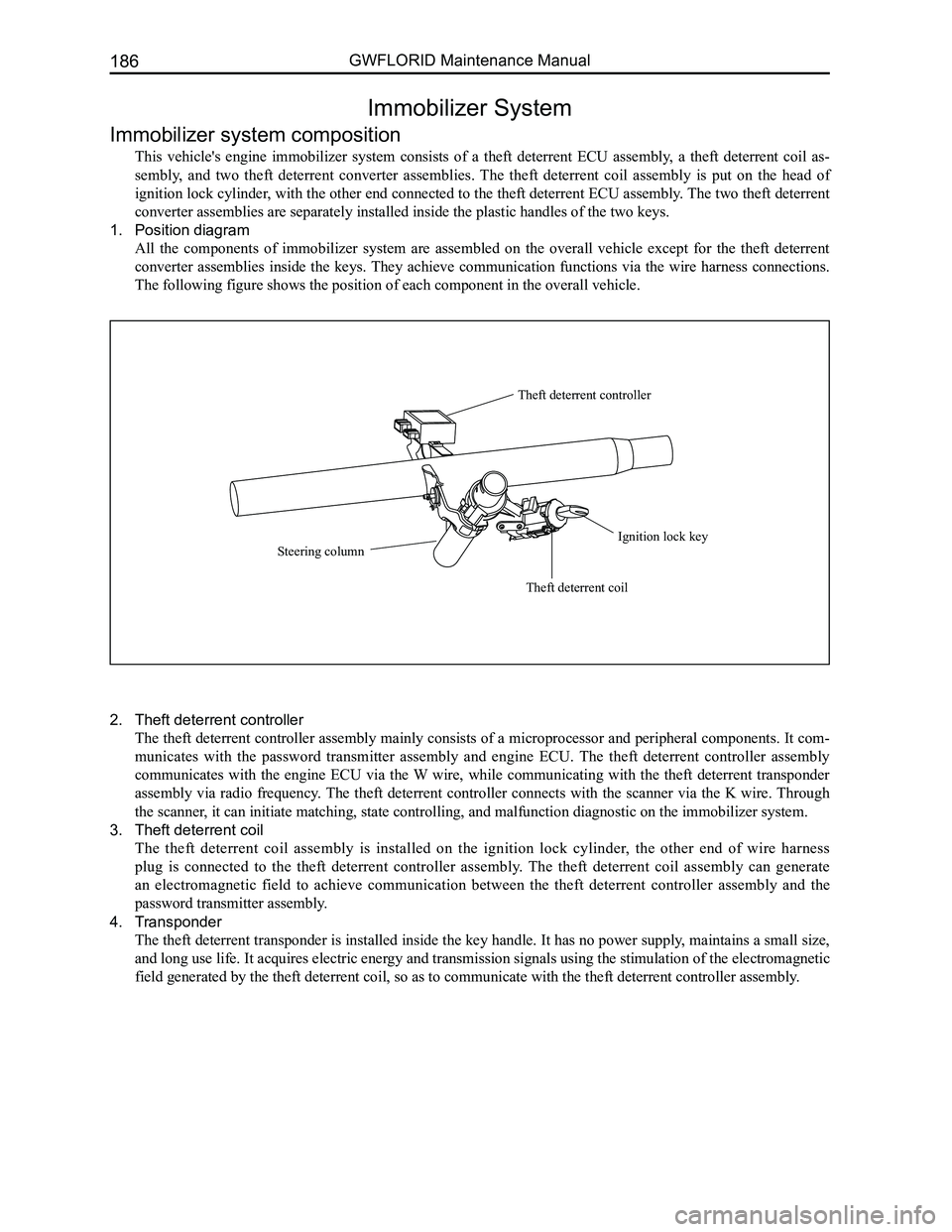
1. Position diagram
All the components of immobilizer system are assembled on the overall vehicle except for the theft deterrent
converter assemblies inside the keys. They achieve communication functions via the wire harness connections.
The following figure shows the position of each component in the overall\
vehicle.
Theft deterrent controller
Ignition lock key
Theft deterrent coil
Steering column
2. Theft deterrent controller
The theft deterrent controller assembly mainly consists of a microprocessor and peripheral components. It com-
municates with the password transmitter assembly and engine ECU. The theft deterrent controller assembly
communicates with the engine ECU via the W wire, while communicating with the theft deterrent transponder
assembly via radio frequency. The theft deterrent controller connects with the scanner via the K wire. Through
the scanner, it can initiate matching, state controlling, and malfunction diagnosti\
c on the immobilizer system.
3. Theft deterrent coil
The theft deterrent coil assembly is installed on the ignition lock cylinder, the other end of wire harness
plug is connected to the theft deterrent controller assembly. The theft deterrent coil assembly can generate
an electromagnetic field to achieve communication between the theft deterrent controller assembly and the
password transmitter assembly.
4. Transponder
The theft deterrent transponder is installed inside the key handle. It has no power supply, maintains a small size,
and long use life. It acquires electric energy and transmission signals using the stimulation of the electromagnetic
field generated by the theft deterrent coil, so as to communicate with t\
he theft deterrent controller assembly.
Page 195 of 281
Downloaded from www.Manualslib.com manuals search engine GWFLORID Maintenance Manual188
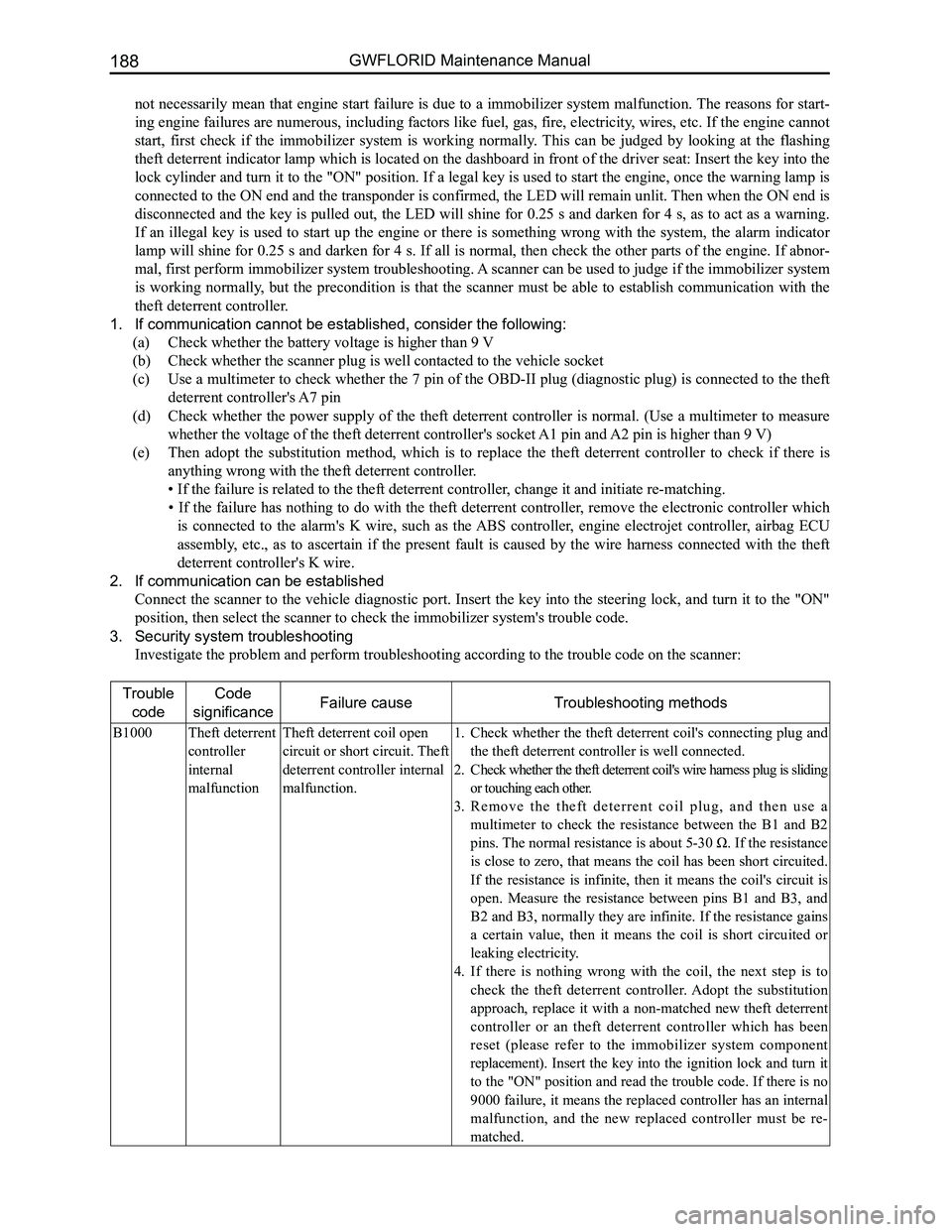
not necessarily mean that engine start failure is due to a immobilizer system malfunction. The reasons for start-
ing engine failures are numerous, including factors like fuel, gas, fire, electricity, wires, etc. If the engine cannot
start, first check if the immobilizer system is working normally. This can be judged by looking at the flashing
theft deterrent indicator lamp which is located on the dashboard in front of the driver seat: Insert the key into the
lock cylinder and turn it to the "ON" position. If a legal key is used to start the engine, once the warning lamp is
connected to the ON end and the transponder is confirmed, the LED will remain unlit. Then when the ON end is
disconnected and the key is pulled out, the LED will shine for 0.25 s and darken for 4 s, as to act as a warning.
If an illegal key is used to start up the engine or there is something wrong with the system, the alarm indicator
lamp will shine for 0.25 s and darken for 4 s. If all is normal, then check the other parts of the engine. If abnor-
mal, first perform immobilizer system troubleshooting. A scanner can be used to judge if the immobilizer system
is working normally, but the precondition is that the scanner must be able to establish communication with the
theft deterrent controller.
1. If communication cannot be established, consider the following:
(a) Check whether the battery voltage is higher than 9 V
(b) Check whether the scanner plug is well contacted to the vehicle socket
(c) Use a multimeter to check whether the 7 pin of the OBD-II plug (diagnostic plug) is connected to the theft
deterrent controller's A7 pin
(d) Check whether the power supply of the theft deterrent controller is normal. (Use a multimeter to measure
whether the voltage of the theft deterrent controller's socket A1 pin and A2 pin is higher than 9 V)
(e) Then adopt the substitution method, which is to replace the theft deterrent controller to check if there is
anything wrong with the theft deterrent controller.
• If the failure is related to the theft deterrent controller, change it and initiate re-matching.
• If the failure has nothing to do with the theft deterrent controller, remove the electronic controller which
is connected to the alarm's K wire, such as the ABS controller, engine electrojet controller, airbag ECU
assembly, etc., as to ascertain if the present fault is caused by the wire harness connected with the theft
deterrent controller's K wire.
2. If communication can be established
Connect the scanner to the vehicle diagnostic port. Insert the key into the steering lock, and turn it to the "ON"
position, then select the scanner to check the immobilizer system's trou\
ble code.
3. Security system troubleshooting
Investigate the problem and perform troubleshooting according to the tro\
uble code on the scanner:
Trouble
code
Code
significanceFailure causeTroubleshooting methods
B1000Theft deterrent
controller
internal
malfunction
Theft deterrent coil open
circuit or short circuit. Theft
deterrent controller internal
malfunction.
Check whether the theft deterrent coil's connecting plug and 1.
the theft deterrent controller is well connected.
Check whether the theft deterrent coil's wire harness plug is sliding 2.
or touching each other.
R e m o v e t h e t h e f t d e t e r r e n t c o i l p l u g , a n d t h e n u s e a 3.
multimeter to check the resistance between the B1 and B2
pins. The normal resistance is about 5-30 Ω. If the resistance
is close to zero, that means the coil has been short circuited.
If the resistance is infinite, then it means the coil's circuit is
open. Measure the resistance between pins B1 and B3, and
B2 and B3, normally they are infinite. If the resistance gains
a certain value, then it means the coil is short circuited or
leaking electricity.
If there is nothing wrong with the coil, the next step is to 4.
check the theft deterrent controller. Adopt the substitution
approach, replace it with a non-matched new theft deterrent
controller or an theft deterrent controller which has been
reset (please refer to the immobilizer system component
replacement). Insert the key into the ignition lock and turn it
to the "ON" position and read the trouble code. If there is no
9000 failure, it means the replaced controller has an internal
malfunction, and the new replaced controller must be re-
matched.
Page 197 of 281
Downloaded from www.Manualslib.com manuals search engine GWFLORID Maintenance Manual190
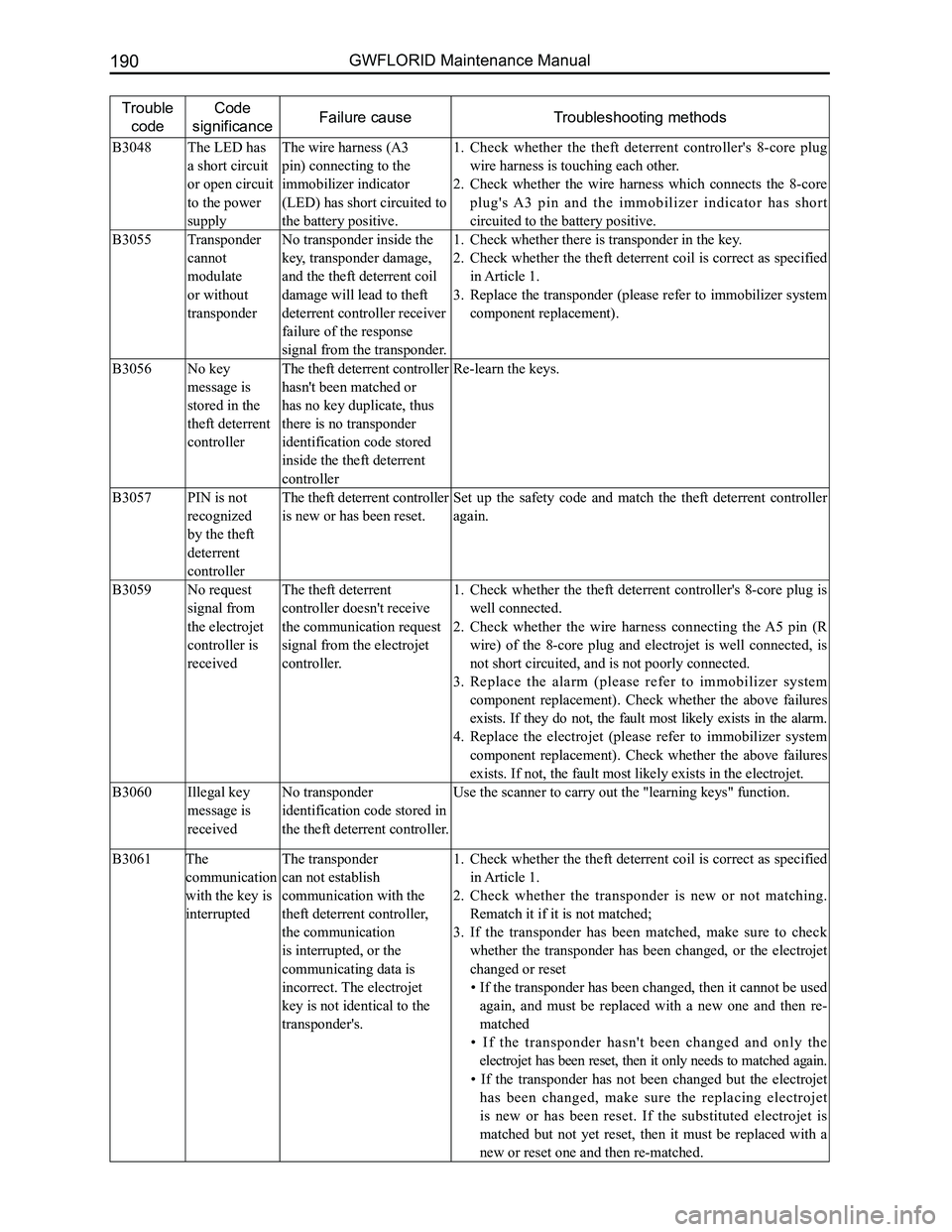
Trouble
code
Code
significanceFailure causeTroubleshooting methods
B3048The LED has
a short circuit
or open circuit
to the power
supply
The wire harness (A3
pin) connecting to the
immobilizer indicator
(LED) has short circuited to
the battery positive.
Check whether the theft deterrent controller's 8-core plug 1.
wire harness is touching each other.
Check whether the wire harness which connects the 8-core 2.
plug's A3 pin and the immobilizer indicator has short
circuited to the battery positive.
B3055Transponder
cannot
modulate
or without
transponder
No transponder inside the
key, transponder damage,
and the theft deterrent coil
damage will lead to theft
deterrent controller receiver
failure of the response
signal from the transponder.
Check whether there is transponder in the key.1.
Check whether the theft deterrent coil is correct as specified 2.
in Article 1.
Replace the transponder (please refer to immobilizer system 3.
component replacement).
B3056No key
message is
stored in the
theft deterrent
controller
The theft deterrent controller
hasn't been matched or
has no key duplicate, thus
there is no transponder
identification code stored
inside the theft deterrent
controller
Re-learn the keys.
B3057PIN is not
recognized
by the theft
deterrent
controller
The theft deterrent controller
is new or has been reset.
Set up the safety code and match the theft deterrent controller
again.
B3059No request
signal from
the electrojet
controller is
received
The theft deterrent
controller doesn't receive
the communication request
signal from the electrojet
controller.
Check whether the theft deterrent controller's 8-core plug is 1.
well connected.
Check whether the wire harness connecting the A5 pin (R 2.
wire) of the 8-core plug and electrojet is well connected, is
not short circuited, and is not poorly connected.
Replace the alarm (please refer to immobilizer system 3.
component replacement). Check whether the above failures
exists. If they do not, the fault most likely exists in the alarm.
Replace the electrojet (please refer to immobilizer system 4.
component replacement). Check whether the above failures
exists. If not, the fault most likely exists in the electrojet.
B3060Illegal key
message is
received
No transponder
identification code stored in
the theft deterrent controller.
Use the scanner to carry out the "learning keys" function.
B3061The
communication
with the key is
interrupted
The transponder
can not establish
communication with the
theft deterrent controller,
the communication
is interrupted, or the
communicating data is
incorrect. The electrojet
key is not identical to the
transponder's.
Check whether the theft deterrent coil is correct as specified 1.
in Article 1.
Check whether the transponder is new or not matching. 2.
Rematch it if it is not matched;
If the transponder has been matched, make sure to check 3.
whether the transponder has been changed, or the electrojet
changed or reset
• If the transponder has been changed, then it cannot be used
again, and must be replaced with a new one and then re-
matched
• If the transponder hasn't been changed and only the
electrojet has been reset, then it only needs to matched again.
• If the transponder has not been changed but the electrojet
has been changed, make sure the replacing electrojet
is new or has been reset. If the substituted electrojet is
matched but not yet reset, then it must be replaced with a
new or reset one and then re-matched.