wheel HONDA INTEGRA 1998 4.G Owners Manual
[x] Cancel search | Manufacturer: HONDA, Model Year: 1998, Model line: INTEGRA, Model: HONDA INTEGRA 1998 4.GPages: 1681, PDF Size: 54.22 MB
Page 778 of 1681
.,i
,I
Anti-lock Brake SYstem (ABS)
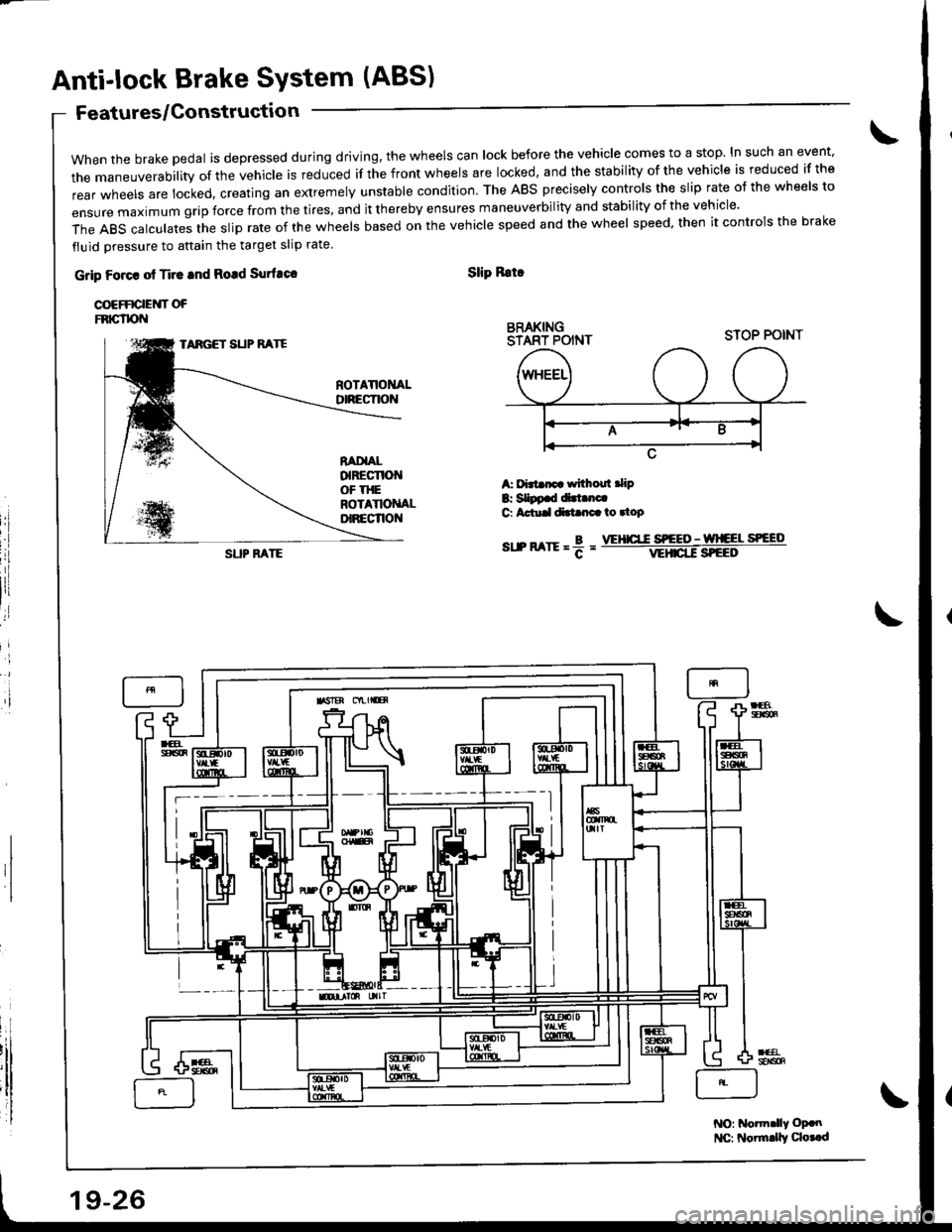
when the brake pedal is depressed during driving, the wheels can lock before the vehicle comes to a stop. In such an event.
the maneuverability of the vehicle is reduced if the front wheels are locked, and the stability of the vehicle is reduced if the
rear wheels are locked, creating an extremely unstable condition. The ABS precisely controls the slip rate o{ the wheels to
ensUre maximum grip force from the tires, and it thereby ensures maneuverbiIity and stabiIity of the vehicIe.
The ABS calculates the slip rate of the wheels based on the vehicle speed and the wheel speed. then it controls the brake
fluid oressure to attain the target slip rate
Features/Gonstructio n
Grip Foact ot Ti.c tnd Rotd Surfuco
COEFFICIEUT OFFNIG"TPN
Slip Rrtr
BRAKINGSTART POINT
i'l
A: f'3t rp withoul .lip
B: SIDp.d dirt.nc.G Actu.ldtt nc.io.top
sr.n arrr = f =
STOP POINTTARGET SUP RATE
SUP FATEVEHICT.C S'EEO - wlCEL SPEED
NO: Notm.lly oP.n
l{C: Noirnrly qo..d
19-26
Page 779 of 1681
IABS Control
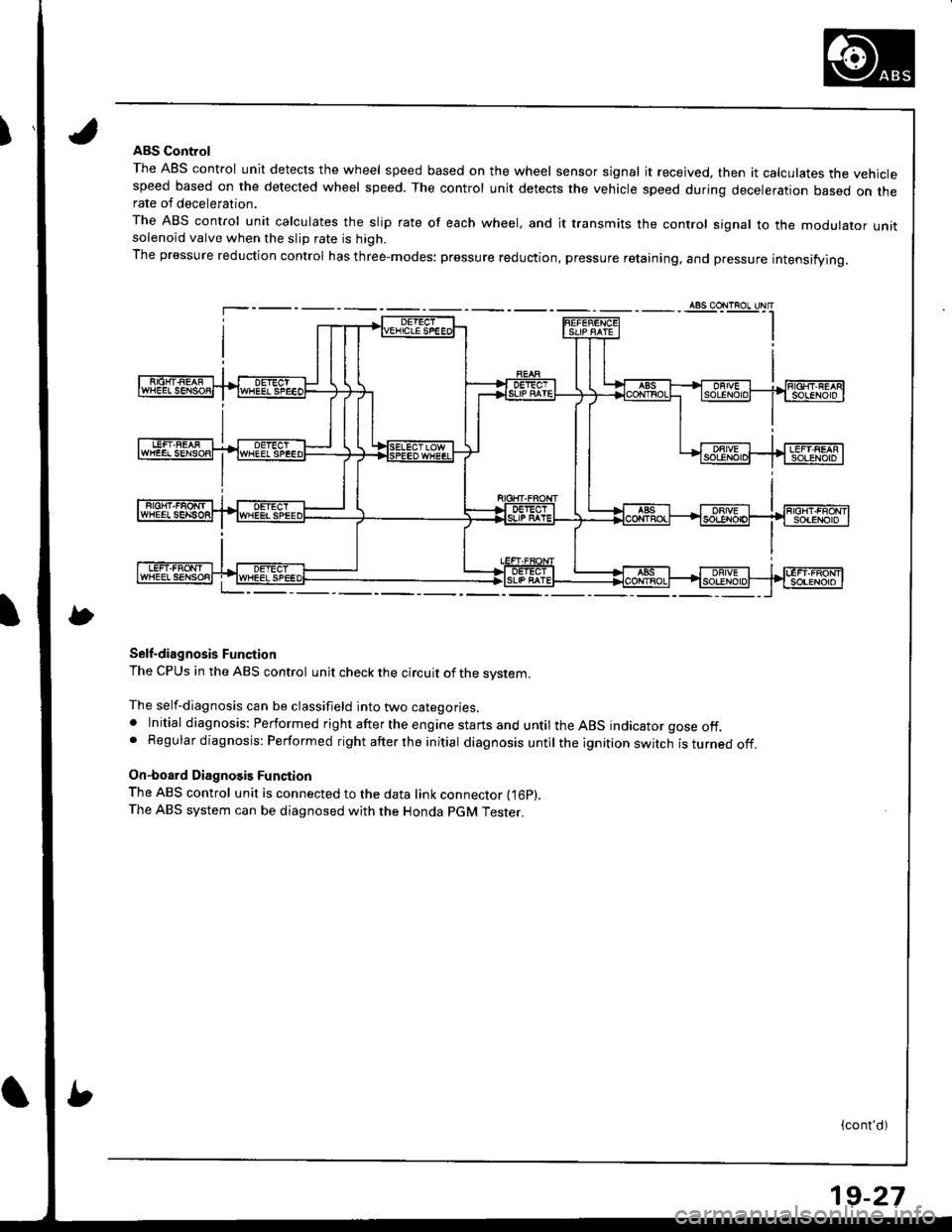
The ABS control unit detects the wheel speed based on the wheel sensor signal it received, then it calculates the vehiclespeed based on the detected wheel speed. The control unit detects the vehicle speed during deceleration based on therate of deceleration.
The ABS control unit calculates the slip rate of each wheel, and it transmits the control signal to the modulator unitsolenoid valve when the slip rate is high.
The pressure reduction control has three-modes: pressure reduction, pressure retaining, and pressure intensifying.
Self-diagnosis Function
The CPUS in the ABS control unit check the circuit of the system.
The self-diagnosis can be classifield into two categories.. Initial diagnosis: Performed right after the engine starts and until the ABS indicator gose off.. Regular diagnosis: Performed right after the initial diagnosis until the ignition switch isturnedoff.
On-board Diagnosis Function
The ABS control unit is connected to the data link connector fi6p).The ABS system can be diagnosed with the Honda PGM Tester.
(cont'd)
19-27
Page 780 of 1681
Anti-lock Brake System (ABS)
Features/Construction (cont'd)
ABS Modulatol
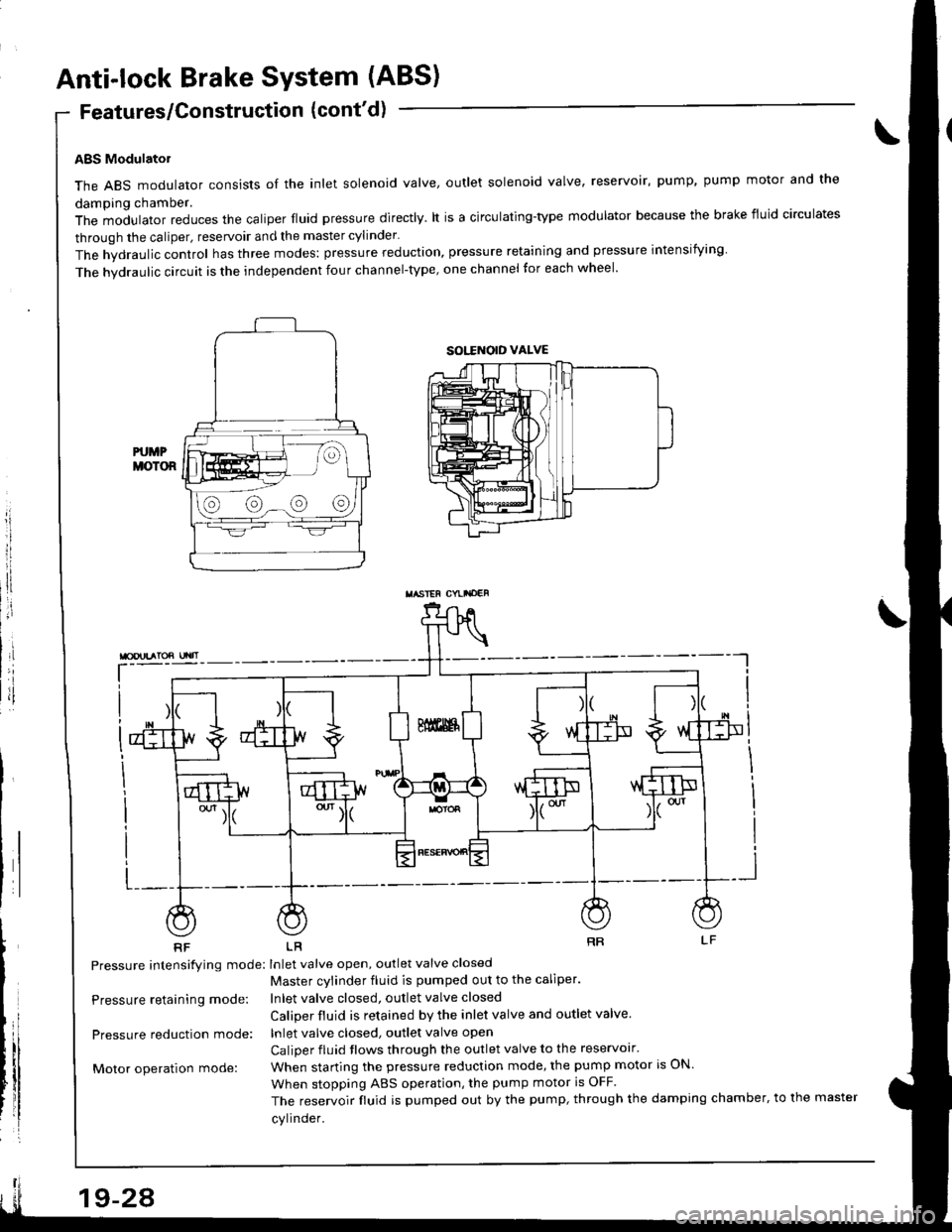
The ABS modulator consists of the inlet solenoid valve, outlet solenoid valve, reservoir, pump, pump motor and the
damping chamber.
The modulator reduces the caliper fluid pressure directly. lt is a circulating-type modulator because the brake fiuid circulates
through the caliper, reservoir and the master cylinder.
The hydraulic control has three modes: pressure reduction, pressure retaining and pressure intensiiying
The hvdraulic circuit is the independent four channel-type, one channel tor each wheel'
L-__
RF LR
Pressure intensifying mode: Inlet valve open, outlet valve closed
Master cvlinder fluid is pumped out to the caliper.
Inlet valve closed, outlet valve closed
Caliper fluid is retained by the inlet valve and outlet valve.
lnlet valve closed, outlet valve open
Caliper fluid flows through the outlet valve to the reservolr'
When starting the pressure reduction mode, the pump motor is ON.
When stopping ABS operation, the pump motor is OFF.
The reservoir fluid is pumped out by the pump, through the damping chamber, to the master
cylinder.
\
Pressure retaining mode:
Pressure reduction mode:
Motor operation mode:
sott orD vALvE
@@-@@
TASIEF CYLI'OEF
19-24
Page 781 of 1681
Wheel Speed and Modulator Control
OUTLETVALVE oN
OFF
INLETVALVE ON
OFF
MOTOR
ON
OFF
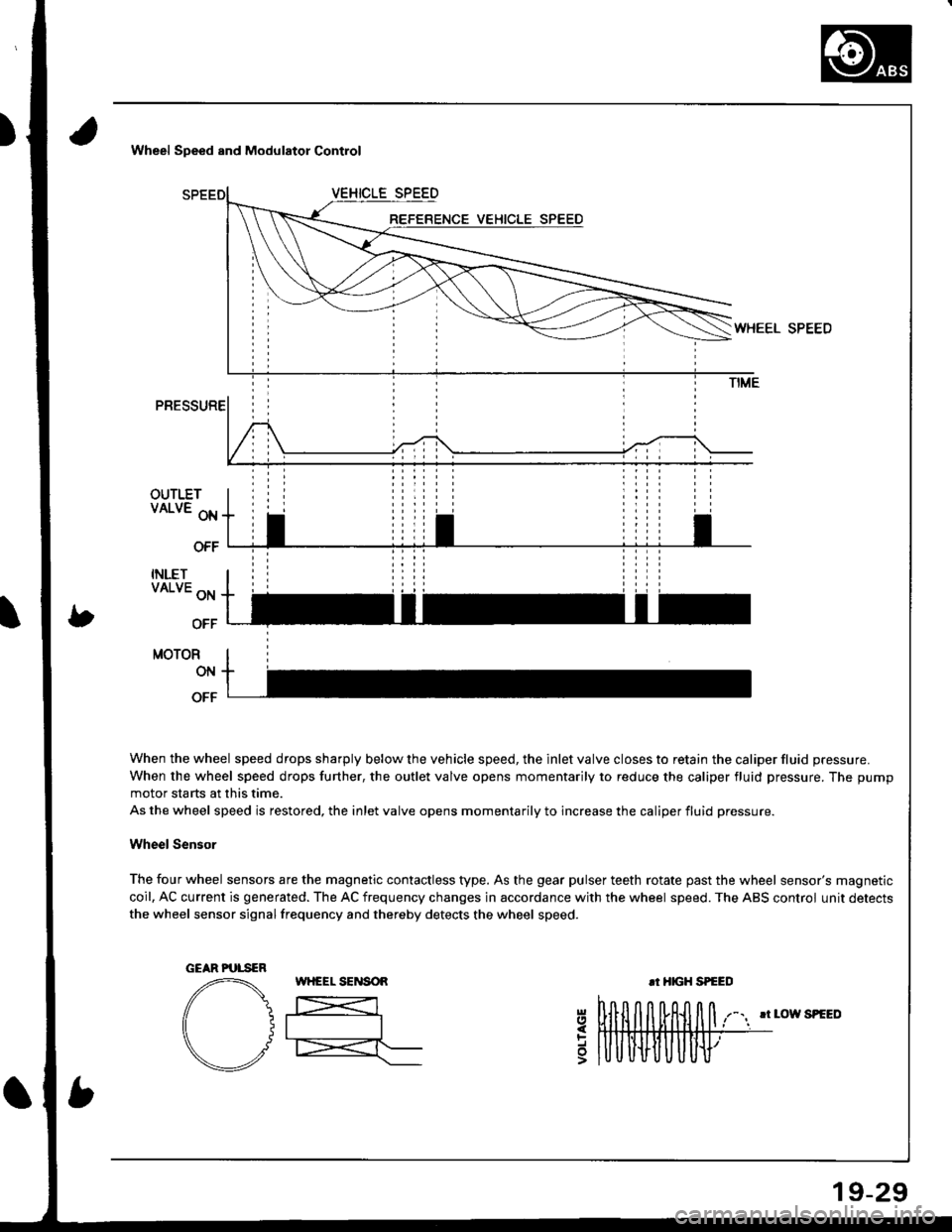
When the wheel speed drops sharply below the vehicle speed, the inlet valve closes to retain the caliper fluid pressure.
When the wheel speed drops further, the outlet valve opens momentarily to reduce the caliper fluid pressure. The pump
motor starts at this time.
As the wheel speed is restored, the inlet valve opens momentarily to increase the caliper fluid pressure.
Wheel Sensor
The four wheel sensors are the magnetic contactless type. As the gear pulser teeth rotate past the wheel sensor's magnetic
coil, AC current is generated. The AC frequency changes in accordance with the wheel speed. The ABS control unit detects
the wheel sensor signalfrequency and thereby detects the wheel speed.
rr LOW SPEED
5
GEAR PUTSER
19-29
Page 783 of 1681
![HONDA INTEGRA 1998 4.G Owners Manual SEFVCECfiEC{CONMCIOF (2P)
Ecgq f too..,I dinFD OITA LrNiLTILU i -- CoNr€CToF Lr6P)8LU!Lsru-6J;:--l
8AN/OJ( ltx
44cli1 c2o]_crol
IIHEEI SENSOf,-------61,^r
,--Ej.*
ABS CONTROL UNIT22P CONNECTOR{O](/img/13/6069/w960_6069-782.png "HONDA INTEGRA 1998 4.G Owners Manual SEFVCECfiEC{CONMCIOF (2P)
Ecgq f too..,I dinFD OITA LrNiLTILU i -- CoNr€CToF Lr6P)8LU!Lsru-6J;:--l
8AN/OJ( ltx
44cli1 c2o]_crol
IIHEEI SENSOf,-------61,^r
,--Ej.*
ABS CONTROL UNIT22P CONNECTOR{O")
SEFVCECfiEC{CONMCIOF (2P)
Ecgq f to'o..,I dinFD OITA LrNiLTILU i -- CoNr€CToF Lr6P)8LU!L'sru-6J;:--l
8AN/OJ( ltx
44c'li1 c2o]_crol
IIHEEI SENSOf,-------61',^r
,--Ej.*
ABS CONTROL UNIT22P CONNECTOR{O numbedWHEEL SENSONCONNECTOR
FRONTJEIL.rGT;-r\
REAR
lr 2l
SERVICE CHECKCONNECTOR (2P)
1t 1l
ABS CONTROL UNIT 12P CONNECTOR(l number)n t=l
lr 2 3l4ls 6l
lrl Bl;iiltilld
618910tl
t2'14161llt9202122
DATA LINK CONN€CTOR{16P)
121315
19-31
Wire sids ot lemale tsrminals
Page 784 of 1681
![HONDA INTEGRA 1998 4.G Owners Manual ABS Gontrol Unit Terminal Arrangement
ABS CONTROL UN]T 22P CONNECTOR
Wire side oI female t6rminals
Terminal
numbel
Wire
Golor
Terminsl sign
{Terminal
namet
Description
Measurgmgnt
TerminalConditions
{](/img/13/6069/w960_6069-783.png "HONDA INTEGRA 1998 4.G Owners Manual ABS Gontrol Unit Terminal Arrangement
ABS CONTROL UN]T 22P CONNECTOR
Wire side oI female t6rminals
Terminal
numbel
Wire
Golor
Terminsl sign
{Terminal
namet
Description
Measurgmgnt
TerminalConditions
{")
ABS Gontrol Unit Terminal Arrangement
ABS CONTROL UN]T 22P CONNECTOR
Wire side oI female t6rminals
Terminal
numbel
Wire
Golor
Terminsl sign
{Terminal
namet
Description
Measurgmgnt
TerminalConditions
{lgnition swhch ON {ll}}Voltage
1BLK/WHTGND3(Ground 3)
Ground1.GNDBelow 0.3 V
4GRN/REDPARK
{Parking)
Detects parking brake
switch signal4-GNDParking
brake
PulledBelow 0.3 V
Battery voltage
LT GRN/
BLK
FLW (-)
{FronLleft
wheel negative)
Detects left-front wheel
sensor srgnal
0.053 V or
above
0sci\oscope:
0.15 Vp-p or
above
7GBN/ORN
FLW (+)
(Front-left
wheel positive)- | Turn wheel at
E
1 turntsecona
l'GRN
FRW (-)
(Front-right
wheel negative)
Detects right-f ront wheel
sensor slgnal
8-9
1 FR\N (+)
I \GRN/BLK (Front-right
I I wheelpositiveStops0.25 - 1.15 V
10GRN/WHTSTOPDetects brake switch signal1O.GNDBrake pedalDepressedBaftery voltage
ReleasedBelow 0.3 V
11BLK/TELtG2
(lgnition 2)
Power source for activating
the system11-GNDlgnition
switch
oN {I)Battery voltage
Start (lll)Below 0.3 V
19-32
Page 785 of 1681
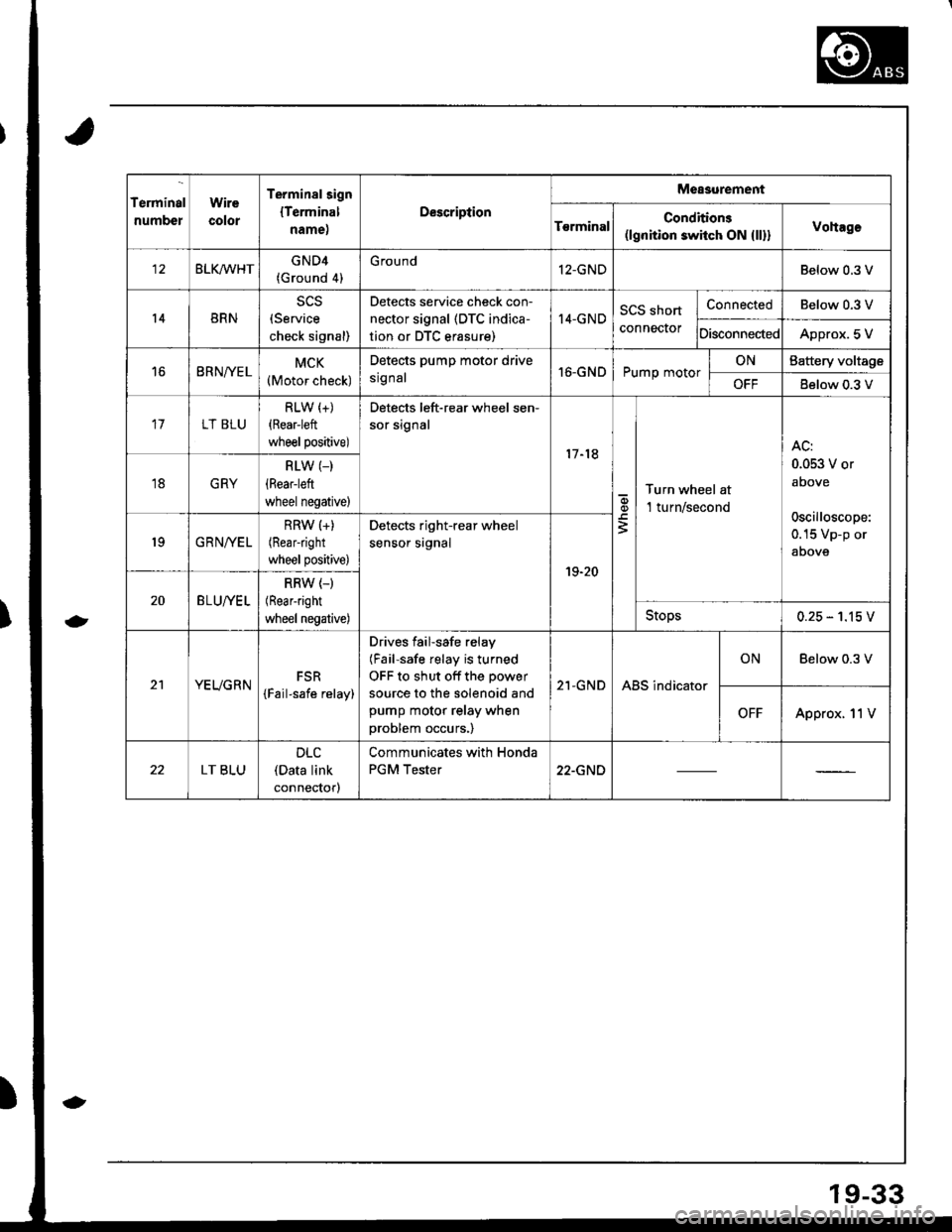
Terminal
numbel
Wire
color
Terminalsign
lTerminal
name,
Description
Measurement
T€rminalConditions(lgnition switch ON {ll}}Vohage
BLKMHTGND4(Ground 4)
G round12-GNDBelow 0.3 V
14BRN(Service
check signal)
Detects service check con-
nector signal (DTC indica-
tion or DTC erasure)
I4-GNDSCS short
connector
ConnectedBelow 0.3 V
DisconnectedApprox. 5 V
16BRNfYELMCK(Motor check)
Detects pump motor drive
srg nal16-GNDPump motorONBattery voltage
OFFBelow 0.3 V
17LT BLU
RLW (+)
{Rear-left
wheel positive)
Detects left-rear wheel sen-
sor signal
17-18
q,
3
Turn wheel at
l turn/second
AC:
0.053 V or
above
oscilloscope:
0.15 Vp-p or
aoove
18GRY
RLW (_)
(Rear-left
wheel negative)
19GRNIVEL
RRW (+)
(Rearright
wheel positive)
Detects right-rear wheel
sensor srgnal
19-20
20BLU//EL
RRW (-)
(Rear-right
wheel negative)Stops0.25 - 1.15 V
21YEUGRNFSR
{Fail-safe relay)
Drives failsafe relay
(Fail-safe relay is turned
OFF to shut off the power
source to the solenoid and
pump motor relay when
problem occurs.)
21-GNDABS indicator
ONBelow 0.3 V
OFFApprox. 11V
LT BLU
DLC(Data link
connectorl
Communicates with Honda
PGM Tester22-GND
19-33
Page 787 of 1681
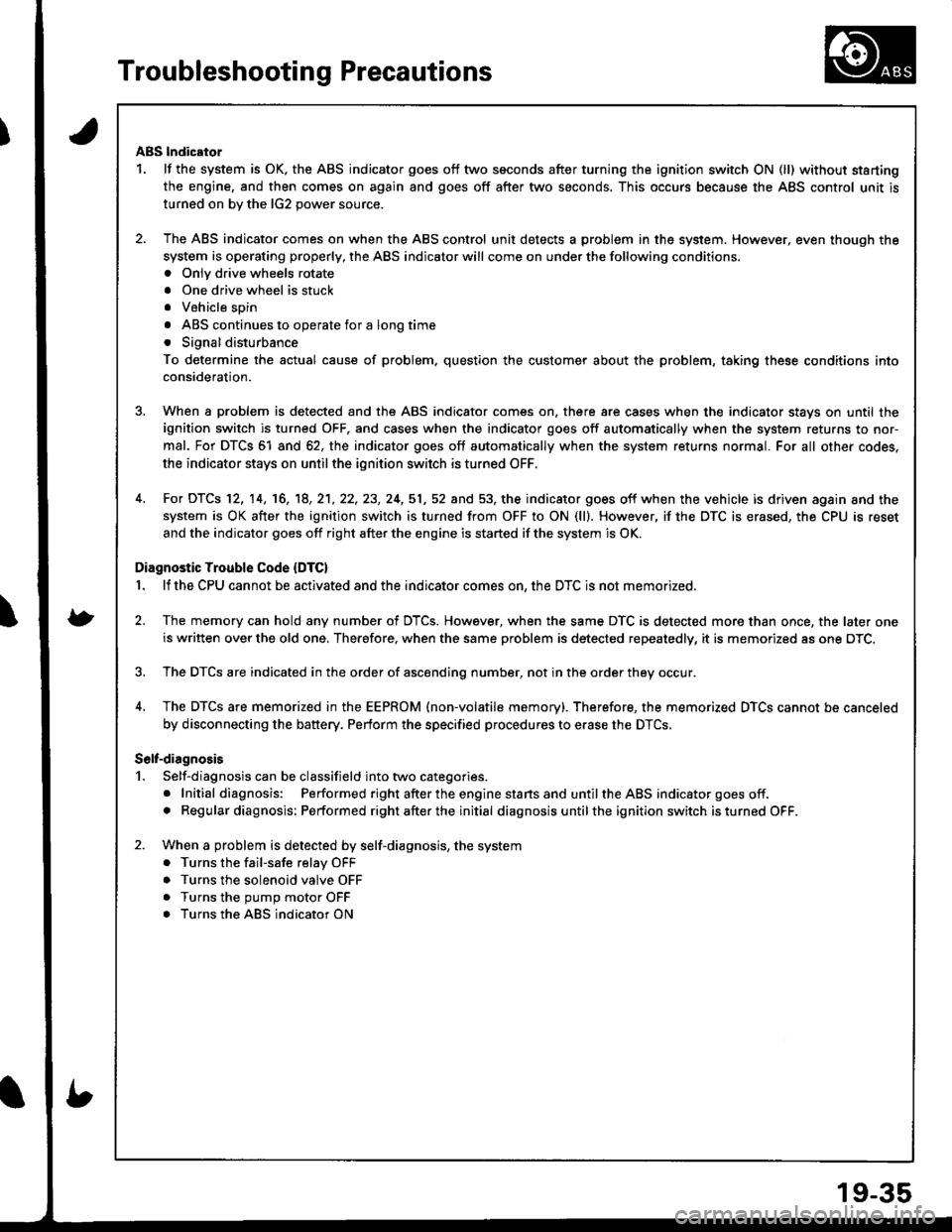
Troubleshooting Precautions
ABS lndicator
1. lf the system is OK. the ABS indicator goes off two seconds after turning the ignition switch ON (ll) without starting
the engine, and then comes on again and goes off after two seconds. This occurs because the ABS control unit is
turned on bv the lG2 oower source.
2. The ABS indicator comes on when the ABS control unit detects a problem in the system. However, even though the
system is operating properly, the ABS indicator will come on under the following conditions.. Onlv drive wheels rotate
. One drive wheel is stuck
. Vehicle spin
. ABS continues to operate for a long time
. Signal disturbance
To determine the actual cause of problem. question the customer about the problem, taking these conditions into
consideration.
3. When a problem is detected and the ABS indicator comes on, there are cases when the indicator stays on until the
ignition switch is turned OFF, and cases when the indicator goes off automatically when the system returns to nor-
mal. For DTCS 61 and 62, the indicator goes off automatically when the system returns normal. For all other codes.
the indicator stays on until the ignition switch is turned OFF.
4. For DTCS 12, 14, 16, '18, 2'1,22, 23, 24,51,52 and 53, the indicator goes off when the vehicle is driven again and the
system is OK after the ignition switch is turned from OFF to ON (ll). However, if the DTC is erased, the CPU is reset
and the indicator goes off right after the engine is started if the system is OK.
Diagnostic Trouble Code (DTC)
1. lf the CPU cannot be actlvated and the indicator comes on, the DTC is not memorized.
2. The memory can hold any number of DTCS. However, when the same DTC is detected more than once, the later one
is written over the old one. Therefore, when the same problem is detected repeatedly, it is memorized as one DTC.
3. The DTCs are indicated in the order of ascending number, not in the order they occur.
4, The DTCS are memorized in the EEPROM (non-volatile memory). Therefore, the memorized DTCS cannot be canceled
by disconnecting the battery. Perform the specified procedures to erase the DTCS,
S6lt-dirgnosis
1. Self-diagnosis can be classifield into two categories.
. Initial diagnosis: Performed right afterthe enginestansand untiltheABS indicator goes off.. Regular diagnosis: Performed rightafterthe initial diagnosis untilthe ignition switch isturned OFF.
2. When a problem is detected by self-diagnosis, the system
. Turns the fail-safe relay OFF
. Turns the solenoid valve OFF
. Turns the oumo motor OFF
. Turns the ABS indicator ON
Page 788 of 1681
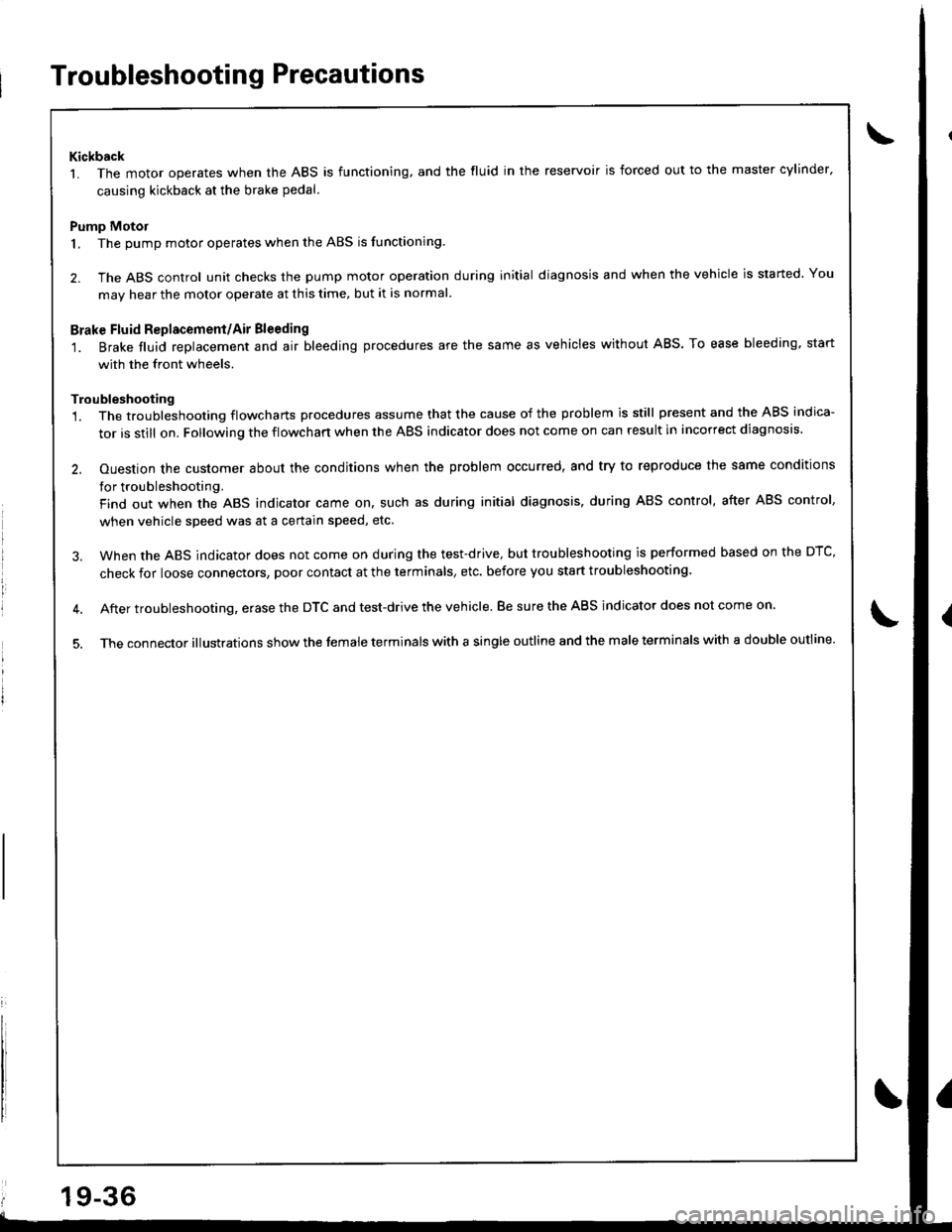
Troubleshooting Precautions
Kickback
L The motor operates when the ABS is functioning, and the fluid in the reservoir is forced out to the master cylinder,
causing kickback at the brake pedal.
Pump Motol
1. The pump motor operates when the ABS is functioning.
2. The ABS control unit checks the pump motor operation during initial diagnosis and when the vehicle is started. You
mav hear the motor operate at this time, but it is normal
Brake Fluid Replacement/Air Bleeding'1. Brake fluid replacement and air bleeding procedures are the same as vehicles without ABS. To ease bleeding, start
with the front wheels.
Troubleshooting
1. The troubleshooting flowcharts procedures assume that the cause of the problem is still present and the ABS indica-
tor is still on. Following the flowchart when the ABS indicator does not come on can result in incorrect diagnosis.
2. Ouestion the customer about the conditions when the problem occurred, and try to reproduce the same conditions
for troubleshooting.
Find out when the ABS indjcator came on. such as during initial diagnosis. during ABS control, after ABS control,
when vehicle speed was at a certain speed, etc.
3, When the ABS indicator does not come on during the test-drive, but troubleshooting is performed based on the DTC,
check for loose connectors, poor contact at the terminals, etc. before you start troubleshooting'
4. After troubleshooting, erase the DTC and test-drive the vehicle. Be sure the ABS indicator does not come on.
5. The connector illustrations show the female terminals with a single outline and the male terminals with a double outline.
Page 791 of 1681
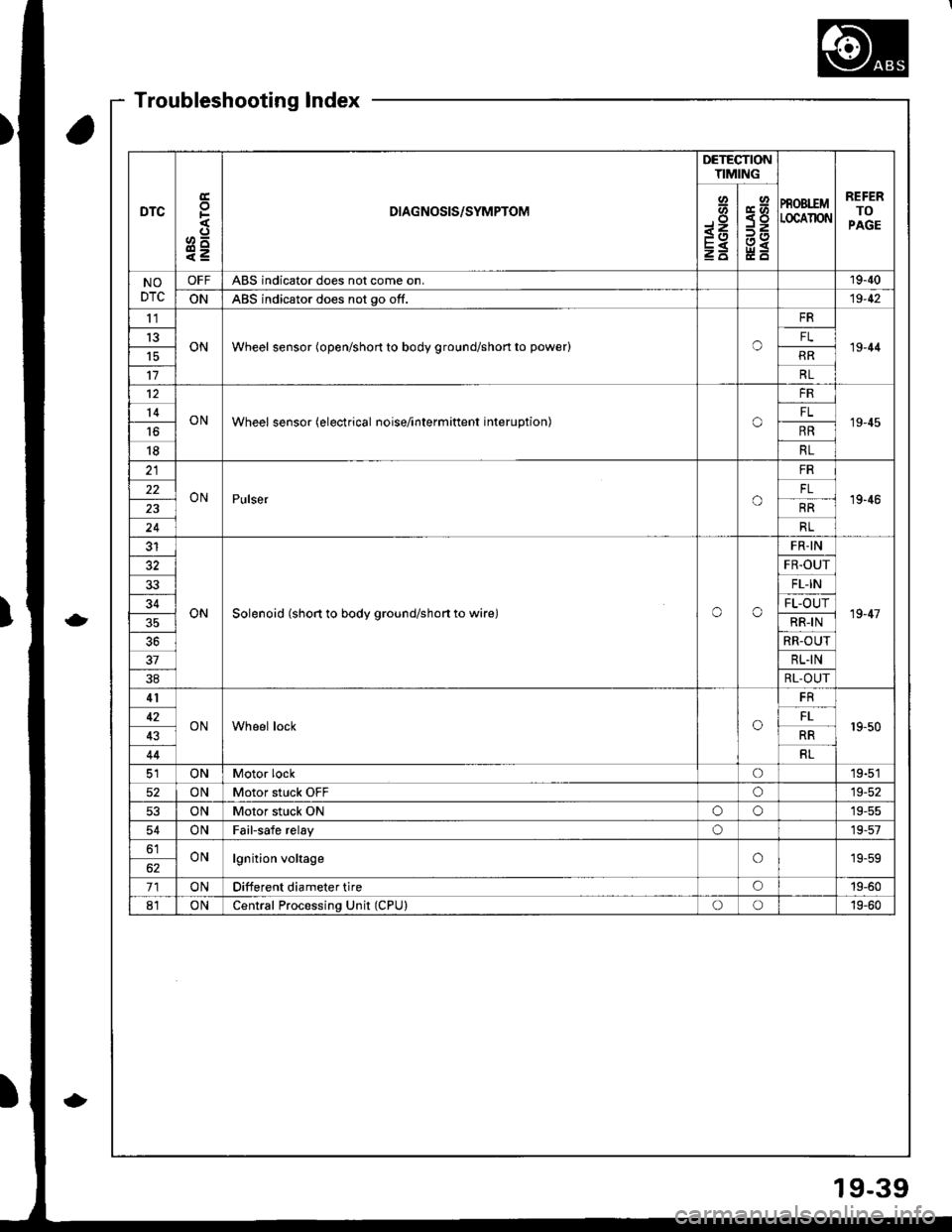
DTC
E
F
o^
e=
DIAGNOSIS/SYMPTOM
DETECTIONTIMING
PROBIEMLOCAIION
REFERTOPAGE
Io-<1
E
Y<
NODTC
OFFABS indicator does not come on.19-40
ONABS indicator does not go off.19-42
tl
ONWheel sensor (open/short to body ground/shon to power)o19-44t3FL
RR
17RL
12
ONWheel sensor (electrical noise/interminent interuption)o
FR
19-4514FL
16RR
18RL
ONPulsero
FR
19'4622
RR
24RL
ONSolenoid (short to body ground/shon to wire)oo
FR-IN
19-47
FR.OUT
33FL-IN
34FL-OUT
RR-IN
RR-OUT
37RL.IN
38RL-OUT
41
ONWheel locko19-5042FL
43RR
44RL
ONMotor locko19-51
52ONMotor stuck OFFo19-52
53ONMotor stuck ONoo19-55
54ONFailsafe relayo19-57
61ONlgnition voltageo19-59
71ONDifferent diameter tireo19-60
81ONCentral Processing Unit (CPU)oo19-60
Troubleshooting Index
19-39