lock HONDA PRELUDE 1992 Repair Manual
[x] Cancel search | Manufacturer: HONDA, Model Year: 1992, Model line: PRELUDE, Model: HONDA PRELUDE 1992Pages: 225, PDF Size: 2.1 MB
Page 182 of 225
Changing a Flat Tire
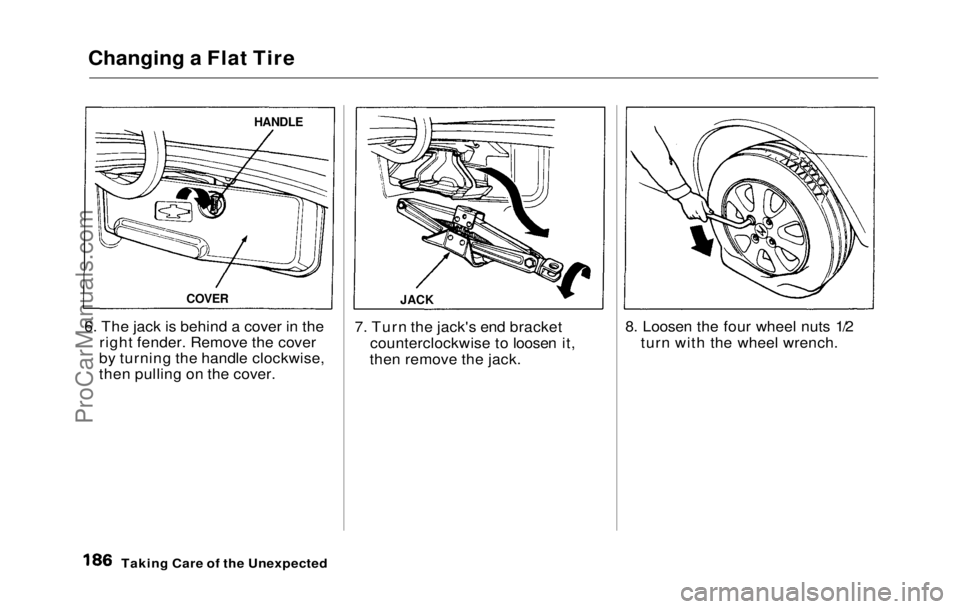
6. The jack is behind a cover in the right fender. Remove the cover
by turning the handle clockwise,
then pulling on the cover. 7. Turn the jack's end bracket
counterclockwise to loosen it,
then remove the jack. 8. Loosen the four wheel nuts 1/2
turn with the wheel wrench.
Taking Care of the Unexpected
HANDLE
COVER JACKProCarManuals.comMain Menu Table of Contents s t
Page 183 of 225
Changing a Flat Tire
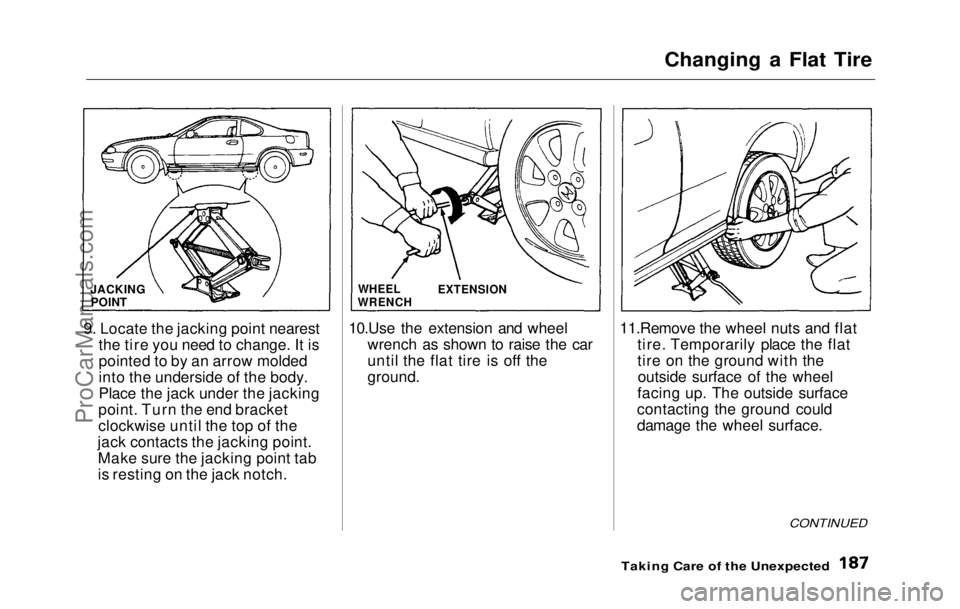
9. Locate
the jacking point nearest
the tire you need to change. It is
pointed to by an arrow molded
into the underside of the body.
Place the jack under the jacking
point. Turn the end bracket
clockwise until the top of the
jack contacts the jacking point. Make sure the jacking point tab
is resting on the jack notch. 10.Use the extension and wheel
wrench as shown to raise the car
until the flat tire is off the
ground. 11.Remove the wheel nuts and flat
tire. Temporarily place the flat
tire on the ground with theoutside surface of the wheel
facing up. The outside surface
contacting the ground could
damage the wheel surface.
Taking Care of the Unexpected
CONTINUED
EXTENSION
JACKING
POINT
WHEEL
WRENCHProCarManuals.comMain Menu Table of Contents s t
Page 185 of 225
Changing a Flat Tire
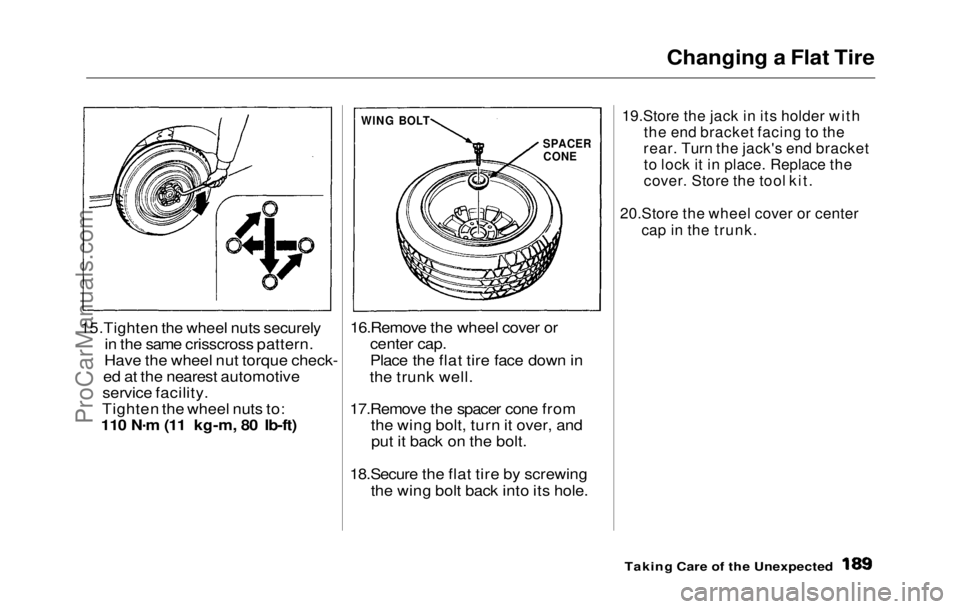
15.Tighten the
wheel nuts securely
in the same crisscross pattern.
Have the wheel nut torque check-
ed at the nearest automotive
service facility.
Tighten the wheel nuts to:
110 N .
m (1
1 kg-m, 80 Ib-ft)
16.Remove the wheel cover or
center cap.
Place the flat tire face down in
the trunk well.
17.Remove the
spacer cone from
the wing bolt, turn it over, and
put it back on the bolt.
18.Secure th e
flat tire by screwing
the wing bolt back into its hole.
19.Store th
e
jack in its holder with
the end bracket facing to the
rear. Turn the jack'
s end bracket
to lock it in place. Replace the
cover. Store the tool kit.
20.Store th e
wheel cover or center
cap in the trunk.
Taking Car
e
of the Unexpected
WING BOLT
SPACERCONEProCarManuals.comMain Menu Table of Contents s t
Page 186 of 225
If Your Engine Won't Start
Diagnosing why your engine won't
start falls into two areas, depending
on what you hear when you turn
the key to START (III): You hear nothing, or almost
nothing. The engine's starter
motor does not operate at all, or
operates very slowly.
You can hear the starter motor
operating normally, but the
engine does not start up and run. Nothing Happens or the
Starter Motor Operates Very
Slowly
When you turn the ignition switchto START (III), you do not hear the
normal noise of the engine trying to
start. You may hear
a clicking
sound or series of clicks, or nothing
at all.
Check these things:
Check the
transmission interlock.
If you have a 5-speed, the clutch
pedal must be pushed all the way
to the floor or the starter will not operate. With an automatic
transmission, it must be in Park
or Neutral.
Turn the ignition switch to ON
(II). Turn on the headlights and
check their brightness. If the
headlights are very dim or don't
light at all, the battery is dis-
charged.
See Jump Starting on
page 191
.
Turn the ignition switch to
START (III). If the headlights do
not dim, check the condition of
the fuses. If the fuses are OK,
there is probably something
wrong with the electrical circuit
for the ignition switch or starter
motor. You will need a qualified
technician to determine the
problem. (See Towing on page
202.)
If the headlights dim noticeably
or go out when you try to start
the engine, either the battery is
discharged or the connections
are corroded. Check the condi-
tion of the battery and terminal
connections (see page 153 ). You
can then try jump starting the
car from a booster battery (see
page 191).
Taking Care of the UnexpectedProCarManuals.comMain Menu Table of Contents s t
Page 190 of 225
If Your Engine Overheats
6. Look for any obvious coolant
leaks, such as a split radiator
hose. Everything is still extreme-
ly hot, so use caution. If you find
a leak, it must be repaired before
you continue driving (see
Towing on page 202 ).
7. If
you don't find an obvious leak,
check the coolant level in the
radiator reserve tank (see page
139). If the level is below the
MIN mark, add coolant to half-
way between the MIN and MAX
marks.
8. I f
there was no coolant in the
reserve tank, you may also have
to add coolant to the radiator. Let the engine cool down until
the temperature gauge registers
below the midpoint, or lower,
before checking the radiator. 9. Using gloves or a large heavy
cloth, turn the radiator cap
counterclockwise, without
pushing down, to the first stop.
This releases any remaining
pressure in the cooling system.
After the pressure releases, push down on the cap and turn it until
it comes off.
10.Start th e
engine and set the
heater control lever to maximum.
Add coolant to the radiator up to
the base of the filler neck. If you
do not have the proper coolant
mixture available, you can add
plain water. Remember to have
the cooling system drained and
refilled with the proper mixture as soon as you can.
11.Put the radiato
r cap back on
tightly. Run the engine and
watch the temperature gauge. If
it illuminates the red marker
again, the engine needs repair.
(See Towing on page
202.)
12.If th e
temperature stays normal,
check the coolant level in the
radiator reserve tank. If it has
gone down, add coolant to the MAX mark. Put the cap back on
tightly.
Taking Care of the Unexpected
Removing the radiator cap
while the engine is hot can
cause the coolant to spray out, seriously scalding you.
Always let the engine and radiator cool down before
removing the radiator cap.ProCarManuals.comMain Menu Table of Contents s t
Page 196 of 225
Fuses
Checking and Replacing
Fuses
If something electrical in your car
stops working, the first thing you
should check for is a blown fuse.
Determine from the chart on the
fuse box cover or inside the fuse
box which fuse or fuses control
that component. Check those fuses
first, but check all the fuses before deciding that is not the cause.
Replace any blown fuses and check
the component's operation.
1. Turn the ignition switch to LOCK (0). Make sure the head-
lights and all other accessories
are
off.
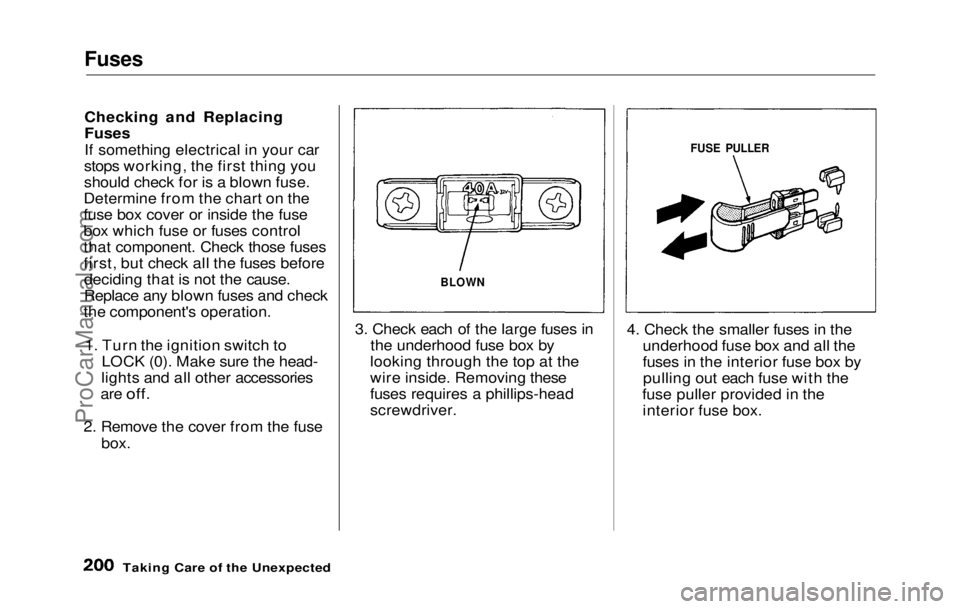
2. Remove the cover from the fuse box. 3. Check each of the large fuses in
the underhood fuse box by
looking through the top at the
wire inside. Removing these
fuses requires a phillips-head
screwdriver. 4. Check the smaller fuses in the
underhood fuse box and all the
fuses in the interior fuse box bypulling out each fuse with the
fuse puller provided in the interior fuse box.
Taking Care of the Unexpected
BLOWN
FUSE PULLERProCarManuals.comMain Menu Table of Contents s t
Page 199 of 225

Technical Information
The diagrams in this section give
you the dimensions and capacities
of your Honda, and the locations of
the identification numbers. The explanations of several electronic
and mechanical systems on your Honda are for the more technically-
oriented owner. Identification Numbers............... 204
Specifications................................ 206
Anti-lock Brake System ............. 208
Supplemental Restraint
System........................................ 209
Four Wheel Steering ................... 210
Emission Controls......................... 211 The Clean Air Act.................... 211
Crankcase Emission Control
System.................................... 211
Evaporative Emission Control
System.................................... 211
Exhaust Emission Controls.... 212 PGM-FI System.................... 212
Ignition Timing Control
System................................ 212
Exhaust Gas
Recirculation..................... 212
Catalytic Converter............. 212
Replacement Parts................... 212
Catalytic Converter..................... 213
Technical InformationProCarManuals.comMain Menu s t
Page 201 of 225
Identification Numbers
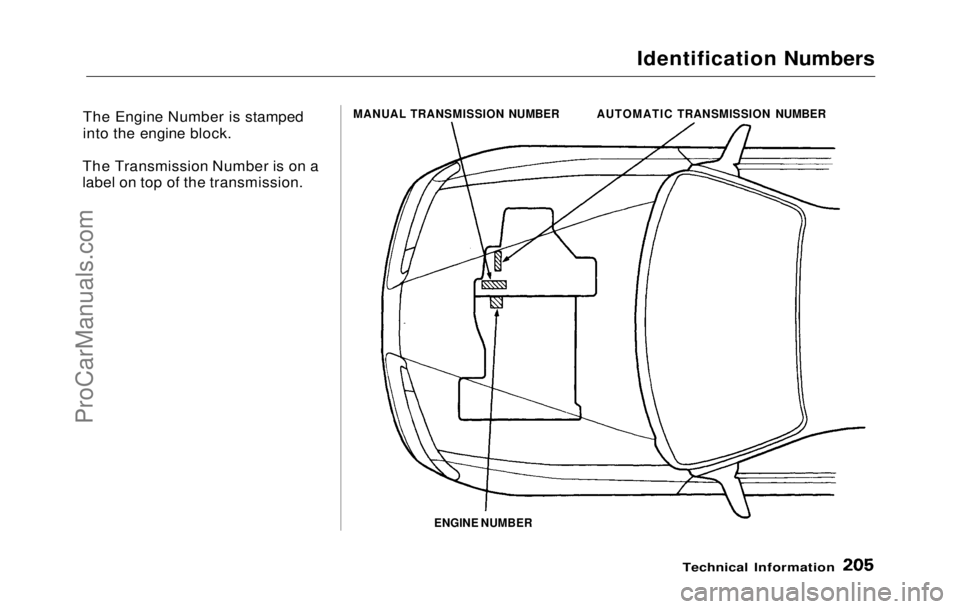
The Engine Number is stamped
into the engine block.
The Transmission Number is on a
label on top of the transmission.
ENGINE NUMBER
Technical Information
MANUAL TRANSMISSION NUMBER
AUTOMATIC TRANSMISSION NUMBERProCarManuals.comMain Menu Table of Contents s t
Page 204 of 225

Anti-lock Brake System
The Anti-lock Brake System (ABS) is standard equipment on the
Prelude Si, Si 4WS sold in the U.S.
and SR, SR 4WS sold in Canada. It
is not available on any other models.
The ABS works by measuring how
fast the wheels are turning during
braking and comparing their speed.If any wheel is rotating much
slower than the others (on the
verge of locking up and skidding),
the system reduces hydraulicpressure to that wheel's brake
caliper. When that wheel's speed
matches the other wheels, the
system applies normal hydraulic pressure. This can take place
several times per second at each
wheel. You feel the ABS working as rapid pulsations in the brake
pedal.
Each wheel has a wheel speed
sensor assembly. As the wheel
rotates, the sensor sends electrical
pulses to the ABS control unit. The
pulse frequency varies with the
wheel speed.
The electrical output of the ABScontrol unit is connected to the
modulator/solenoid unit. During
braking, the ABS control unit monitors the pulse frequencies
from the four wheels. When the control unit detects a wheel locking
up, it energizes the appropriate
solenoid in the modulator/solenoid
unit. There are three solenoids: one
for each front wheel, and one for
the rear wheels. The energized solenoid reduces hydraulic pres-
sure to one side of a modulator
valve. This, in turn, reduces hydrau- lic pressure in the brake line going
to the affected wheel. When that
wheel speeds up because of the re- duced braking effort, the control unit de-energizes the solenoid. This
builds hydraulic pressure on the
modulator valve. The pressure in-
creases in the hydraulic line to the
wheel.
For the system to react quickly, the
modulator/solenoid unit must have
brake fluid under high pressure.
This is supplied by an accumulator
that is pressurized by an electric pump. A pressure-sensing switch
on the accumulator controls this
pump.
The control unit also contains error detection circuitry. It monitors the
operation of the wheel sensors, solenoids, pump, and electronics. If
the control unit detects any faults,
it shuts off power to the pump
motor and solenoids. The light on
the instrument panel comes on.
The brakes then work like a conventional system without anti-
lock capabilities.
Technical InformationProCarManuals.comMain Menu Table of Contents s t
Page 205 of 225

Supplemental Restraint System
The Honda
Supplemental Restraint
System (SRS) is standard on all
Preludes sold in the U.S. and the
SR, SR 4WS sold in Canada.
The SRS includes the steering
wheel airbag assembly, sensors in the dashboard, and a control unit
with sensors behind the center
console.
(On Si 4WS model)
The system also has a dashboard-
mounted airbag assembly for the
passenger.
The sensors are decelerometers,
set to trigger in a frontal impact that generates more force than a 10
mile per hour barrier crash. For the
SRS to activate, at least two sen-
sors must trigger. This duplication
is to prevent accidental activation. When the control unit receives
trigger signals from at least two
sensors, it sends voltage to the
airbag. The control unit stores this
charge in capacitors to insure
reliability even if a severe impact damages the car's battery or
electrical connections.
The electrical charge sent to the
airbag assembly ignites its propel-
lant, which burns instantaneously.
The gas produced by the burning propellant inflates the airbag in
about 40 milliseconds (1/25 of a
second).
The airbag is vented so it stays inflated for only an instant and
does not block the driver's vision.
Smoke from the burned propellant
comes out of the airbag and into
the car's interior. This is normal
and does not mean there is a fire.
The airbag collapses onto the driver's lap. The airbag unit can inflate only one
time. After use, your Honda dealer
must check the complete Supple-
mental Restraint System and re-
place the airbag assembly.
To ensure long-term reliability, the
SRS uses gold-plated electrical
connections throughout. Exposed
components are sealed with epoxy.
The control unit monitors the SRS circuitry whenever the ignition is
ON (II). If the control unit senses
any faults, it turns on the SRS
indicator light on the instrument
panel. Take the car to your Honda
dealer to diagnose and repair the system as soon as possible.
The SRS needs no regular mainte-
nance other than an inspection by
your Honda dealer ten years after
manufacture.
Technical InformationProCarManuals.comMain Menu Table of Contents s t