change time Hyundai Coupe 2002 User Guide
[x] Cancel search | Manufacturer: HYUNDAI, Model Year: 2002, Model line: Coupe, Model: Hyundai Coupe 2002Pages: 140, PDF Size: 1.45 MB
Page 91 of 140
3-3
IN CASE OF EMERGENCY
SD060A1-E IN THE EVENT OF A PUNCTURE If a puncture occurs whilst driving the vehicle:
1. Bring the car to rest as soon as it is safe to do so and with the minimum amount ofbraking required which will assist in main- taining the maximum amount of control. The vehicle should be parked wherever possible upon firm level ground to facilitate wheel changing.
2. If the vehicle is creating a hazard and the road conditions do not permit the wheel to bechanged safely, assistance should be sought.
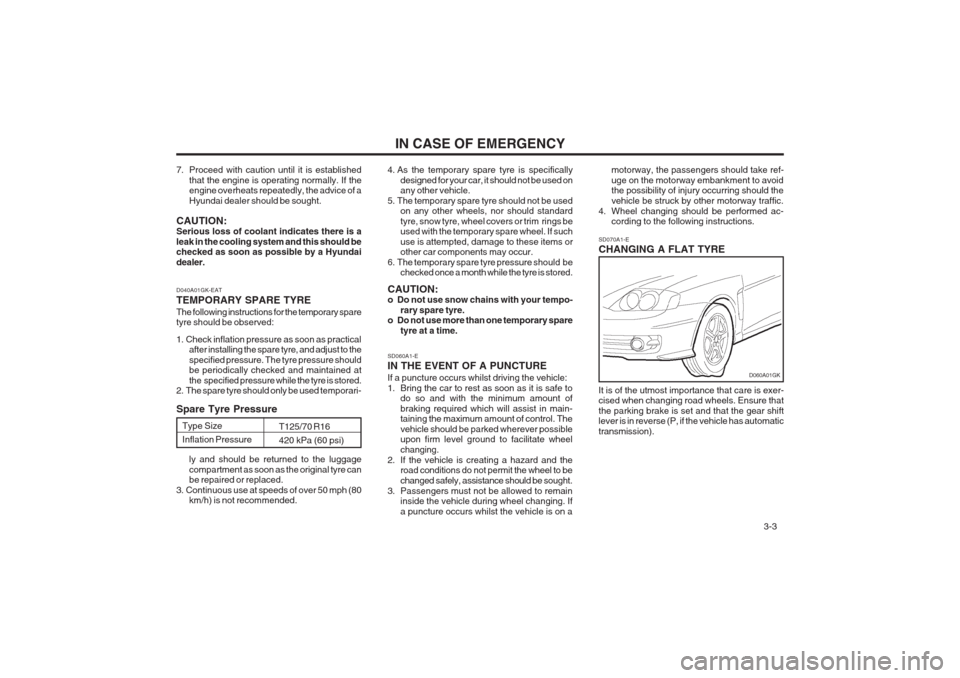
3. Passengers must not be allowed to remain inside the vehicle during wheel changing. Ifa puncture occurs whilst the vehicle is on a SD070A1-E CHANGING A FLAT TYRE
7. Proceed with caution until it is established
that the engine is operating normally. If the engine overheats repeatedly, the advice of a Hyundai dealer should be sought.
CAUTION: Serious loss of coolant indicates there is a leak in the cooling system and this should be checked as soon as possible by a Hyundai dealer.
It is of the utmost importance that care is exer- cised when changing road wheels. Ensure that the parking brake is set and that the gear shift lever is in reverse (P, if the vehicle has automatic transmission).
D040A01GK-EAT TEMPORARY SPARE TYREThe following instructions for the temporary spare tyre should be observed:
1. Check inflation pressure as soon as practical
after installing the spare tyre, and adjust to the specified pressure. The tyre pressure should be periodically checked and maintained at the specified pressure while the tyre is stored.
2. The spare tyre should only be used temporari-
ly and should be returned to the luggagecompartment as soon as the original tyre can be repaired or replaced.
3. Continuous use at speeds of over 50 mph (80 km/h) is not recommended. 4. As the temporary spare tyre is specifically
designed for your car, it should not be used onany other vehicle.
5. The temporary spare tyre should not be used on any other wheels, nor should standard tyre, snow tyre, wheel covers or trim rings be used with the temporary spare wheel. If such use is attempted, damage to these items or other car components may occur.
6. The temporary spare tyre pressure should be checked once a month while the tyre is stored.
CAUTION:
o Do not use snow chains with your tempo- rary spare tyre.
o Do not use more than one temporary spare
tyre at a time.
Spare Tyre Pressure
Type Size Inflation Pressure T125/70 R16420 kPa (60 psi)
motorway, the passengers should take ref- uge on the motorway embankment to avoid the possibility of injury occurring should the vehicle be struck by other motorway traffic.
4. Wheel changing should be performed ac- cording to the following instructions.
D060A01GK
Page 111 of 140
OWNER MAINTENANCE
6-6 CAUTION: The oil being drained from the engine will be hot. Care should be exercised to prevent scalding.
4. When the oil has drained from the sump,
replace the drain plug using a new washer ensuring that the plug is not over tightened.
Tightening torque :
4.5 ~ 4.0 kgf.m (1.6/2.0L)4.5 ~ 3.5 kgf.m (2.7L)
5. Remove the oil filter by rotating counterclock- wise, using a proprietary oil filter removal toolif necessary. Note that the oil filter will contain approximately 0.5 litres of oil and this should be collected in a suitable receptacle.
6. Install a new oil filter having smeared the
sealing ring with clean oil and rotating clock- wise until the filter contacts the mounting and then a further one half turn. Do not over- tighten. Tightening torque: 1.2 ~ 1.6 kgf.m.
7. Pour the specified quantity of the recom- mended oil into the engine and replace the filler cap. Start the engine and ensure that no oil leaks exist. Turn off the engine and after a couple minutes, recheck the oil level.
WARNING: Prolonged and repeated contact with used engine oils may result in serious skin disor- ders including dermatitis and cancer. Avoid contact with skin as far as possible and al-
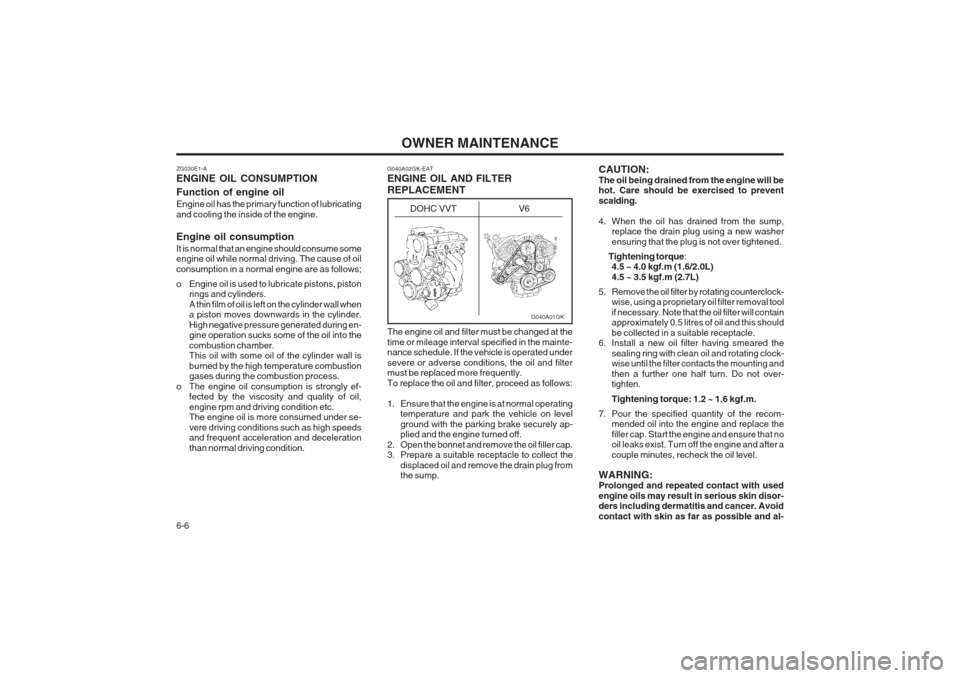
G040A02GK-EAT ENGINE OIL AND FILTER REPLACEMENT The engine oil and filter must be changed at the time or mileage interval specified in the mainte- nance schedule. If the vehicle is operated under severe or adverse conditions, the oil and filter must be replaced more frequently. To replace the oil and filter, proceed as follows:
1. Ensure that the engine is at normal operating
temperature and park the vehicle on level ground with the parking brake securely ap- plied and the engine turned off.
2. Open the bonnet and remove the oil filler cap.
3. Prepare a suitable receptacle to collect the displaced oil and remove the drain plug fromthe sump.
ZG030E1-A ENGINE OIL CONSUMPTION Function of engine oil Engine oil has the primary function of lubricating and cooling the inside of the engine. Engine oil consumption It is normal that an engine should consume some engine oil while normal driving. The cause of oil consumption in a normal engine are as follows;
o Engine oil is used to lubricate pistons, piston
rings and cylinders. A thin film of oil is left on the cylinder wall when a piston moves downwards in the cylinder. High negative pressure generated during en- gine operation sucks some of the oil into the combustion chamber. This oil with some oil of the cylinder wall is burned by the high temperature combustion gases during the combustion process.
o The engine oil consumption is strongly ef- fected by the viscosity and quality of oil, engine rpm and driving condition etc. The engine oil is more consumed under se- vere driving conditions such as high speeds and frequent acceleration and deceleration than normal driving condition.
G040A01GK
DOHC VVT V6
Page 112 of 140
OWNER MAINTENANCE 6-7
ways wash thoroughly after any contact. Keep used oils out of reach of children. It is illegal to pollute drains, water courses and soil. Use only authorized waste collection facilities including civic amenity sites and garages for the disposal of used oil and oil filters. If in doubt, contact the local authority for dis- posal instructions. SG050A1-E ENGINE COOLANT CHECKING AND REPLACING WARNING: Do not remove the radiator cap when the engine is hot, since the system is pressurized and coolant may be ejected from the radiator resulting in scalding. SG050B1-E Coolant recommendations
Only ethylene glycol based coolant with a corro- sion inhibitor suited to aluminium alloy engine components should be used in the cooling sys- tem. No further additives or inhibitors should be used. The coolant specific gravity should be checked as prescribed in the maintenance sched- ule to ensure adequate frost and corrosion pro- tection. In addition, the engine coolant must be replaced at the specified interval since the corro- sion inhibitor properties deteriorate with time. It is important to note that whilst an increase in the concentration of anti freeze gives an increase in the level of frost protection, a solution which is in excess of 65% anti freeze will result in reduced frost protection and engine overheating. There- fore the recommended concentration of 50% should not be exceeded for general use. The use of methanol based anti freeze com- pounds may result in engine overheating and will invalidate the vehicle warranty. NOTE: It is imperative that vehicles fitted with an air conditioning system have a coolant concen- tration of the recommended strength at all times. The use of the air conditioning system when the cooling system is filled with water only will result in the heater matrix freezing and subsequently bursting.SG050C1-E Engine Coolant Level The engine coolant level may be observed through the side of the plastic coolant reservoir (expansion tank) when the engine is cold. If the level is below the "LOW" mark, add coolant of the correct concentration until the level is between the "LOW" and "Full" marks. If the level falls below the "LOW" mark on a regular basis despite being topped up, consult a Hyundai dealer. SG050D1-E To Change the Engine Coolant The engine coolant should be changed at those intervals specified in the vehicle maintenance schedule in Section 5. NOTE: Care should be taken to ensure that coolant is not allowed to spill onto the paintwork since the finish may become damaged. If coolant spillage occurs, the affected area should be rinsed thoroughly with water.
1. Park the vehicle on level ground and ensure
that the parking brake is firmly applied, and the engine allowed to cool. DO NOT ATTEMPT THIS OPERATION WHILST THE ENGINE IS HOT SINCE BURN-ING OR SCALDING MAY RESULT.
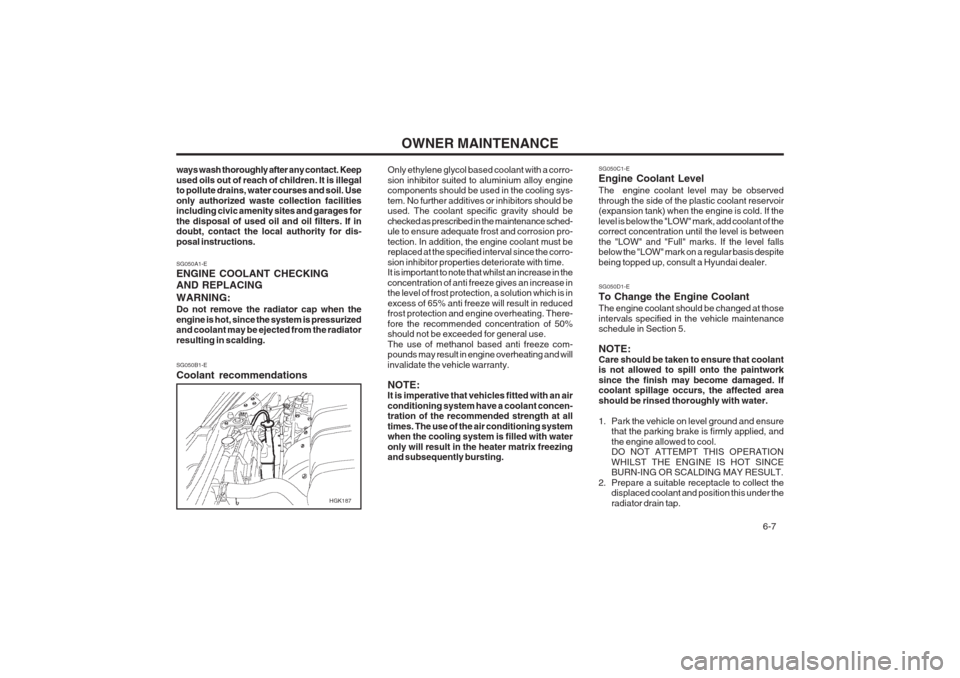
2. Prepare a suitable receptacle to collect the displaced coolant and position this under the radiator drain tap.
HGK187
Page 113 of 140
OWNER MAINTENANCE
6-8 CAUTION: Sparking plugs must only be cleaned using purpose designed equipment. Wire brushing may damage the centre electrodeinsulator causing mis-firing to occur. Only the correct grade of sparking plug should be used. Use of an incorrect grade may result in serious engine damage.
3. With the heater temperature control set to the
"HOT" position, remove the radiator cap and open the radiator drain tap.
4. When the engine coolant has drained com- pletely, close the drain tap ensuring that this is not over tightened.
5. Prepare a suitable quantity of new engine
coolant (refer to section 9) and pour this into the radiator.
6. Start the engine with the radiator cap still removed and continue to add coolant as the level decreases as air is expelled from the system. When the level remains constant, replace the radiator cap and replenish the coolant reservoir.
7. When the engine is hot, check to ensure that no coolant leaks are present.
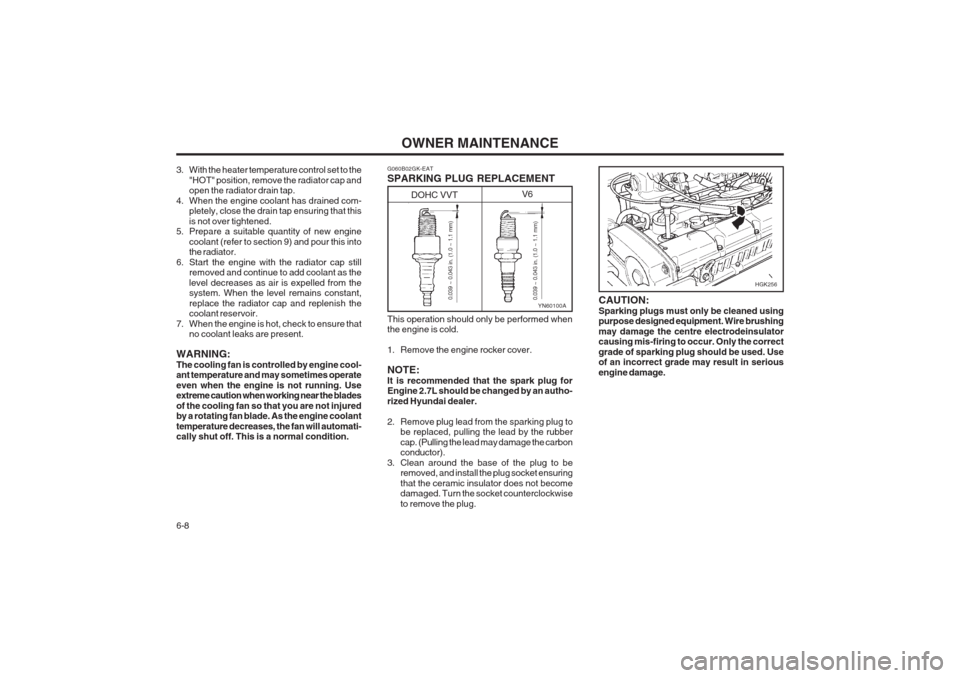
WARNING: The cooling fan is controlled by engine cool- ant temperature and may sometimes operate even when the engine is not running. Use extreme caution when working near the blades of the cooling fan so that you are not injured by a rotating fan blade. As the engine coolant temperature decreases, the fan will automati- cally shut off. This is a normal condition. G060B02GK-EAT SPARKING PLUG REPLACEMENT This operation should only be performed when the engine is cold.
1. Remove the engine rocker cover.NOTE: It is recommended that the spark plug for Engine 2.7L should be changed by an autho- rized Hyundai dealer.
2. Remove plug lead from the sparking plug to
be replaced, pulling the lead by the rubber cap. (Pulling the lead may damage the carbon conductor).
3. Clean around the base of the plug to be removed, and install the plug socket ensuring that the ceramic insulator does not become damaged. Turn the socket counterclockwise to remove the plug.
YN60100A0.039 ~ 0.043 in. (1.0 ~ 1.1 mm)
0.039 ~ 0.043 in. (1.0 ~ 1.1 mm)
DOHC VVT V6
HGK256
Page 115 of 140
OWNER MAINTENANCE
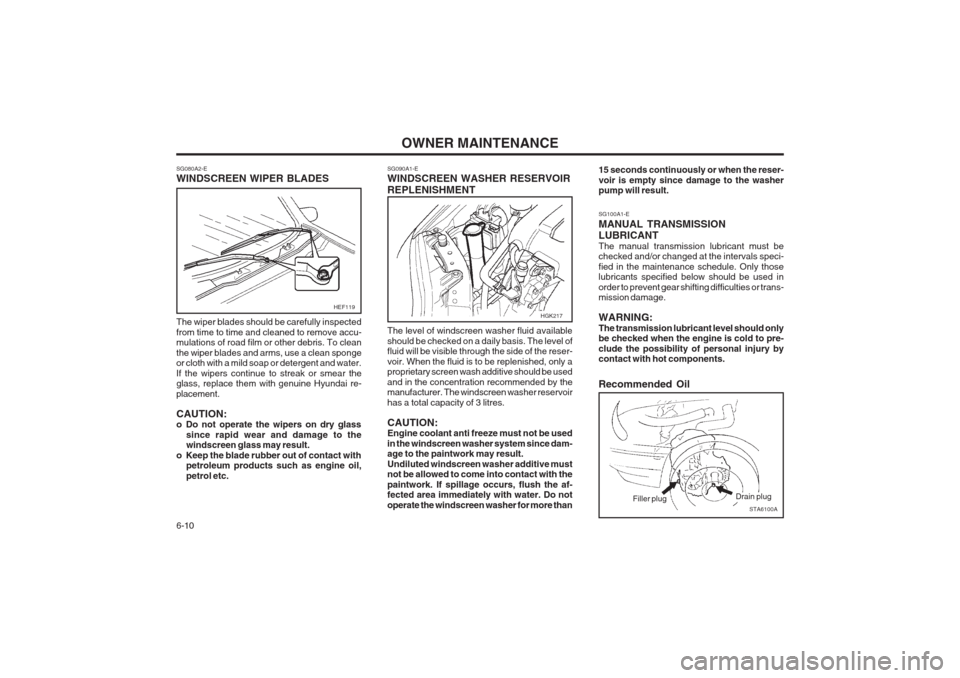
6-10 15 seconds continuously or when the reser- voir is empty since damage to the washer pump will result. SG100A1-E MANUAL TRANSMISSION LUBRICANT The manual transmission lubricant must be checked and/or changed at the intervals speci- fied in the maintenance schedule. Only those lubricants specified below should be used in order to prevent gear shifting difficulties or trans- mission damage. WARNING: The transmission lubricant level should only be checked when the engine is cold to pre- clude the possibility of personal injury by contact with hot components.
Filler plugDrain plug
STA6100A
Recommended Oil
SG080A2-E WINDSCREEN WIPER BLADES
SG090A1-EWINDSCREEN WASHER RESERVOIR REPLENISHMENT
The wiper blades should be carefully inspected from time to time and cleaned to remove accu- mulations of road film or other debris. To clean the wiper blades and arms, use a clean sponge or cloth with a mild soap or detergent and water. If the wipers continue to streak or smear the glass, replace them with genuine Hyundai re- placement. CAUTION:
o Do not operate the wipers on dry glass since rapid wear and damage to thewindscreen glass may result.
o Keep the blade rubber out of contact with petroleum products such as engine oil, petrol etc. The level of windscreen washer fluid availableshould be checked on a daily basis. The level of fluid will be visible through the side of the reser- voir. When the fluid is to be replenished, only a proprietary screen wash additive should be used and in the concentration recommended by the manufacturer. The windscreen washer reservoir has a total capacity of 3 litres. CAUTION: Engine coolant anti freeze must not be used in the windscreen washer system since dam- age to the paintwork may result. Undiluted windscreen washer additive must not be allowed to come into contact with the paintwork. If spillage occurs, flush the af- fected area immediately with water. Do not operate the windscreen washer for more than
HGK217HEF119
Page 118 of 140
OWNER MAINTENANCE 6-13
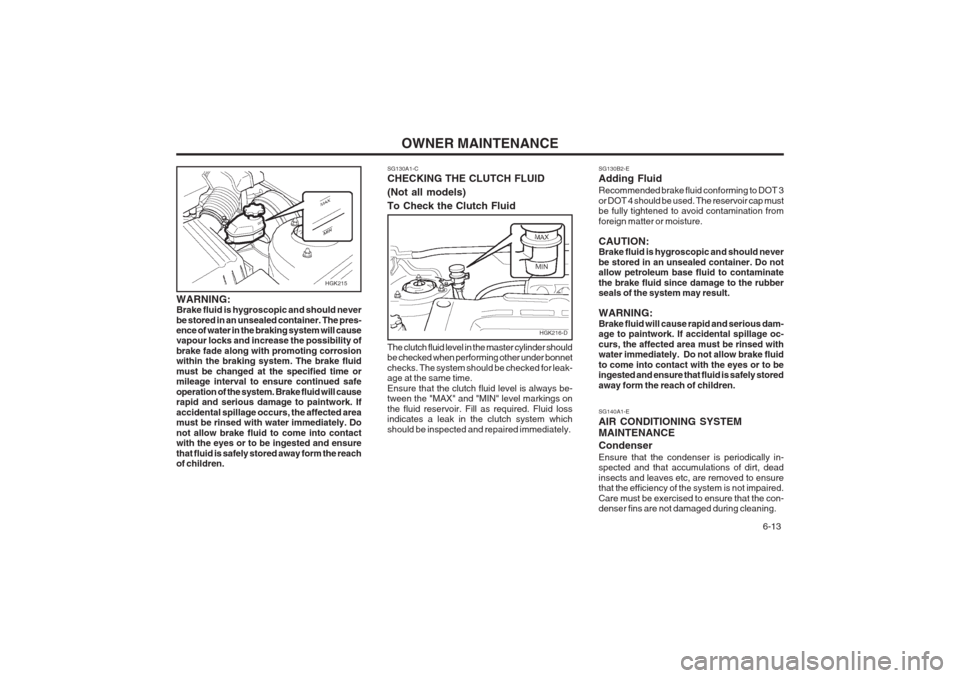
WARNING: Brake fluid is hygroscopic and should never be stored in an unsealed container. The pres- ence of water in the braking system will causevapour locks and increase the possibility of brake fade along with promoting corrosion within the braking system. The brake fluid must be changed at the specified time or mileage interval to ensure continued safe operation of the system. Brake fluid will cause rapid and serious damage to paintwork. If accidental spillage occurs, the affected area must be rinsed with water immediately. Do not allow brake fluid to come into contact with the eyes or to be ingested and ensure that fluid is safely stored away form the reach of children. SG130A1-C CHECKING THE CLUTCH FLUID (Not all models)To Check the Clutch Fluid The clutch fluid level in the master cylinder should be checked when performing other under bonnet checks. The system should be checked for leak- age at the same time. Ensure that the clutch fluid level is always be- tween the "MAX" and "MIN" level markings on the fluid reservoir. Fill as required. Fluid loss indicates a leak in the clutch system which should be inspected and repaired immediately.
SG130B2-E Adding Fluid Recommended brake fluid conforming to DOT 3 or DOT 4 should be used. The reservoir cap must be fully tightened to avoid contamination from foreign matter or moisture. CAUTION: Brake fluid is hygroscopic and should never be stored in an unsealed container. Do not allow petroleum base fluid to contaminate the brake fluid since damage to the rubber seals of the system may result. WARNING: Brake fluid will cause rapid and serious dam- age to paintwork. If accidental spillage oc- curs, the affected area must be rinsed with water immediately. Do not allow brake fluid to come into contact with the eyes or to be ingested and ensure that fluid is safely stored away form the reach of children. SG140A1-E AIR CONDITIONING SYSTEM MAINTENANCE Condenser Ensure that the condenser is periodically in- spected and that accumulations of dirt, dead insects and leaves etc, are removed to ensure that the efficiency of the system is not impaired. Care must be exercised to ensure that the con- denser fins are not damaged during cleaning.
HGK215
HGK216-D