tow HYUNDAI I30 2023 Workshop Manual
[x] Cancel search | Manufacturer: HYUNDAI, Model Year: 2023, Model line: I30, Model: HYUNDAI I30 2023Pages: 533, PDF Size: 59.13 MB
Page 440 of 533
7-9
7
Maintenance
S SC
CH
HE
ED
DU
UL
LE
ED
D
M
MA
AI
IN
NT
TE
EN
NA
AN
NC
CE
E
S
SE
ER
RV
VI
IC
CE
ES
S
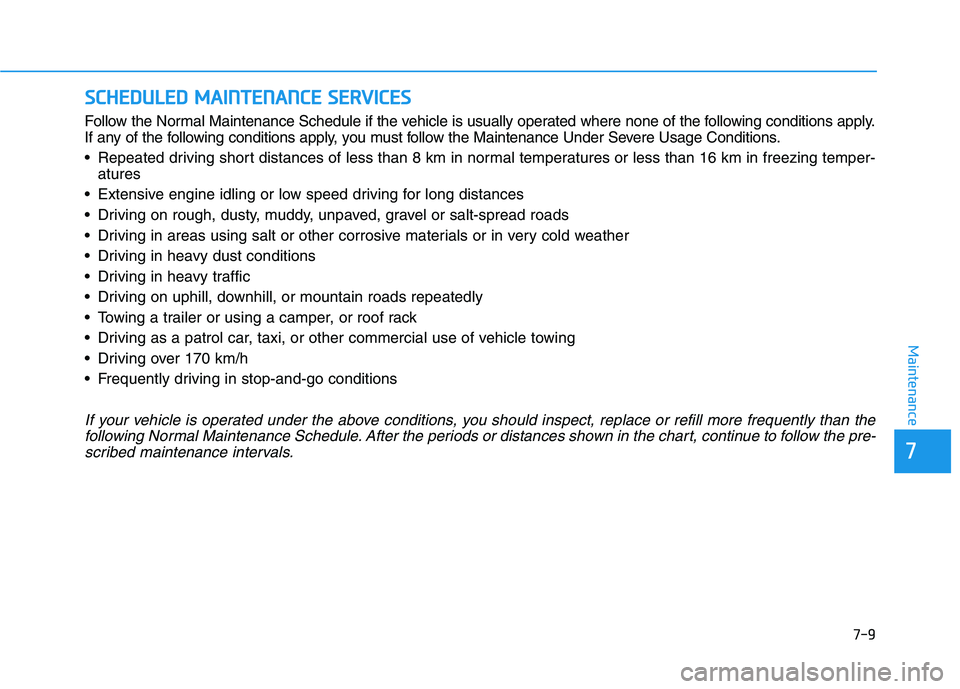
Follow the Normal Maintenance Schedule if the vehicle is usually operated where none of the following conditions apply.
If any of the following conditions apply, you must follow the Maintenance Under Severe Usage Conditions.
Repeated driving short distances of less than 8 km in normal temperatures or less than 16 km in freezing temper-
atures
Extensive engine idling or low speed driving for long distances
Driving on rough, dusty, muddy, unpaved, gravel or salt-spread roads
Driving in areas using salt or other corrosive materials or in very cold weather
Driving in heavy dust conditions
Driving in heavy traffic
Driving on uphill, downhill, or mountain roads repeatedly
Towing a trailer or using a camper, or roof rack
Driving as a patrol car, taxi, or other commercial use of vehicle towing
Driving over 170 km/h
Frequently driving in stop-and-go conditions
If your vehicle is operated under the above conditions, you should inspect, replace or refill more frequently than the
following Normal Maintenance Schedule. After the periods or distances shown in the chart, continue to follow the pre-
scribed maintenance intervals.
Page 445 of 533
Maintenance
7-14
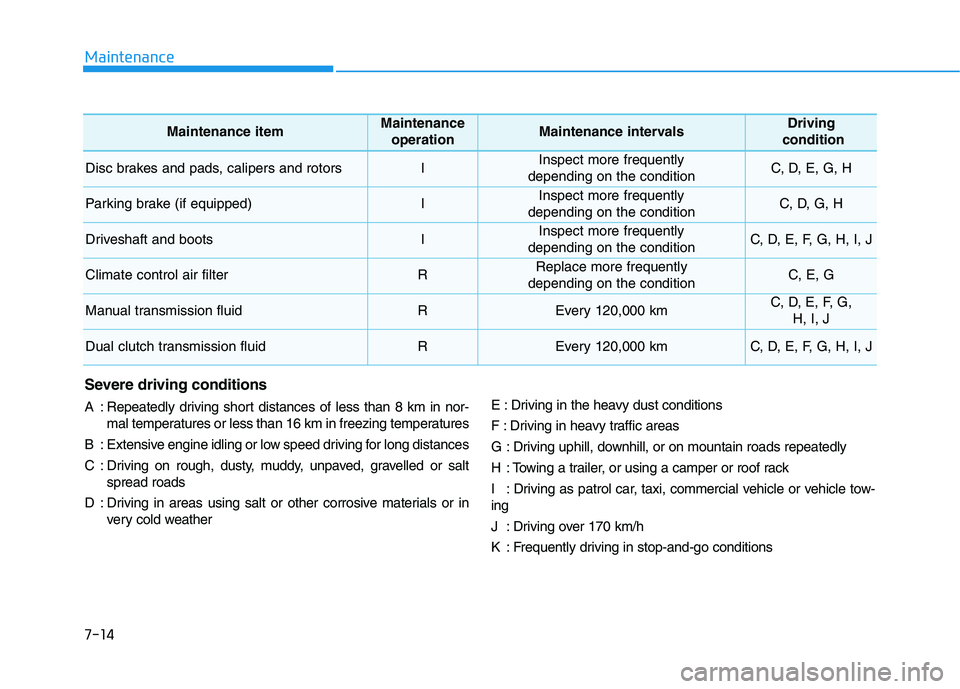
Maintenance itemMaintenance
operationMaintenance intervalsDriving
condition
Disc brakes and pads, calipers and rotorsIInspect more frequently
depending on the conditionC, D, E, G, H
Parking brake (if equipped)IInspect more frequently
depending on the conditionC, D, G, H
Driveshaft and bootsIInspect more frequently
depending on the conditionC, D, E, F, G, H, I, J
Climate control air filterRReplace more frequently
depending on the conditionC, E, G
Manual transmission fluidREvery 120,000 kmC, D, E, F, G,
H, I, J
Dual clutch transmission fluidREvery 120,000 kmC, D, E, F, G, H, I, J
Severe driving conditions
A : Repeatedly driving short distances of less than 8 km in nor-
mal temperatures or less than 16 km in freezing temperatures
B : Extensive engine idling or low speed driving for long distances
C : Driving on rough, dusty, muddy, unpaved, gravelled or salt
spread roads
D : Driving in areas using salt or other corrosive materials or in
very cold weatherE : Driving in the heavy dust conditions
F : Driving in heavy traffic areas
G : Driving uphill, downhill, or on mountain roads repeatedly
H : Towing a trailer, or using a camper or roof rack
I : Driving as patrol car, taxi, commercial vehicle or vehicle tow-
ing
J : Driving over 170 km/h
K : Frequently driving in stop-and-go conditions
Page 450 of 533
7-19
7
Maintenance
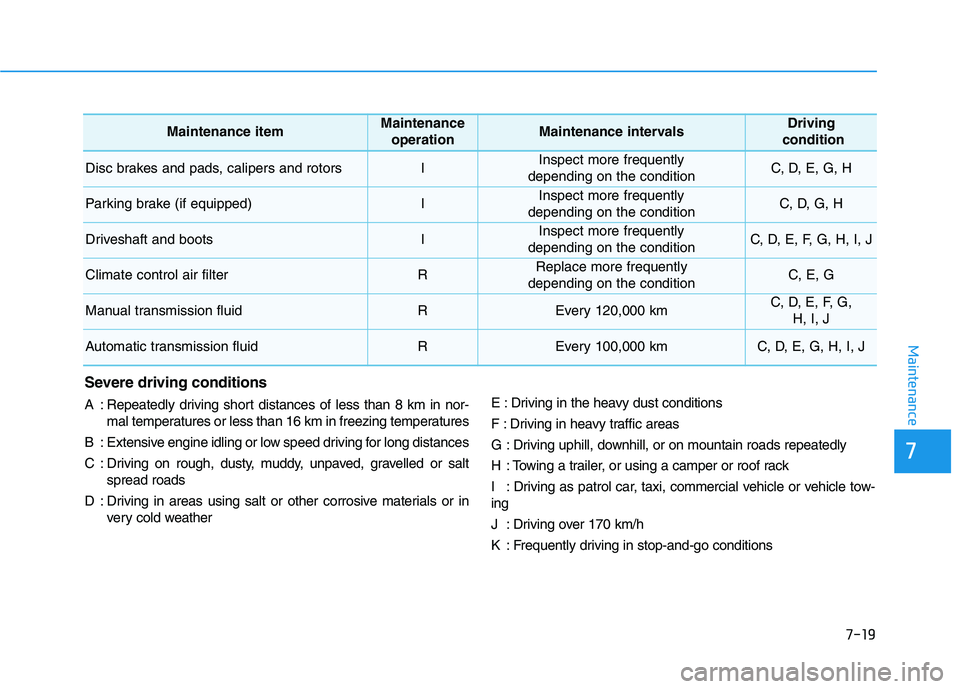
Maintenance itemMaintenance
operationMaintenance intervalsDriving
condition
Disc brakes and pads, calipers and rotorsIInspect more frequently
depending on the conditionC, D, E, G, H
Parking brake (if equipped)IInspect more frequently
depending on the conditionC, D, G, H
Driveshaft and bootsIInspect more frequently
depending on the conditionC, D, E, F, G, H, I, J
Climate control air filterRReplace more frequently
depending on the conditionC, E, G
Manual transmission fluidREvery 120,000 kmC, D, E, F, G,
H, I, J
Automatic transmission fluidREvery 100,000 kmC, D, E, G, H, I, J
Severe driving conditions
A : Repeatedly driving short distances of less than 8 km in nor-
mal temperatures or less than 16 km in freezing temperatures
B : Extensive engine idling or low speed driving for long distances
C : Driving on rough, dusty, muddy, unpaved, gravelled or salt
spread roads
D : Driving in areas using salt or other corrosive materials or in
very cold weatherE : Driving in the heavy dust conditions
F : Driving in heavy traffic areas
G : Driving uphill, downhill, or on mountain roads repeatedly
H : Towing a trailer, or using a camper or roof rack
I : Driving as patrol car, taxi, commercial vehicle or vehicle tow-
ing
J : Driving over 170 km/h
K : Frequently driving in stop-and-go conditions
Page 455 of 533
Maintenance
7-24
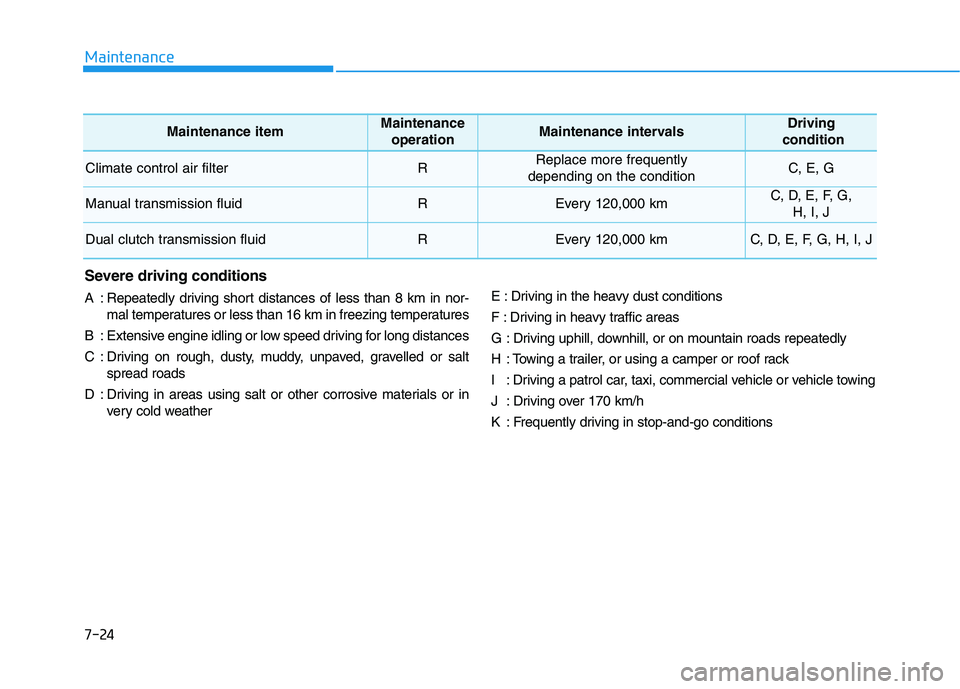
Maintenance itemMaintenance
operationMaintenance intervalsDriving
condition
Climate control air filter RReplace more frequently
depending on the conditionC, E, G
Manual transmission fluidREvery 120,000 kmC, D, E, F, G,
H, I, J
Dual clutch transmission fluidREvery 120,000 kmC, D, E, F, G, H, I, J
Severe driving conditions
A : Repeatedly driving short distances of less than 8 km in nor-
mal temperatures or less than 16 km in freezing temperatures
B : Extensive engine idling or low speed driving for long distances
C : Driving on rough, dusty, muddy, unpaved, gravelled or salt
spread roads
D : Driving in areas using salt or other corrosive materials or in
very cold weatherE : Driving in the heavy dust conditions
F : Driving in heavy traffic areas
G : Driving uphill, downhill, or on mountain roads repeatedly
H : Towing a trailer, or using a camper or roof rack
I : Driving a patrol car, taxi, commercial vehicle or vehicle towing
J : Driving over 170 km/h
K : Frequently driving in stop-and-go conditions
Page 463 of 533
7-32
Maintenance
The electric motor for the cooling fan
is controlled by engine coolant tem-
perature, refrigerant pressure and
vehicle speed. As the engine coolant
temperature decreases, the electric
motor will automatically shut off. This
is a normal condition. If your vehicle
is equipped with GDI, the electric
motor for the cooling fan may begin
to operate at any time and continue
to operate until you disconnect the
negative battery cable.The electric motor for
the cooling fan may
continue to operate
or start up when the
engine is not running
and can cause serious injury.
Keep hands, clothing and tools
away from the rotating fan blades
of the cooling fan.
WARNING
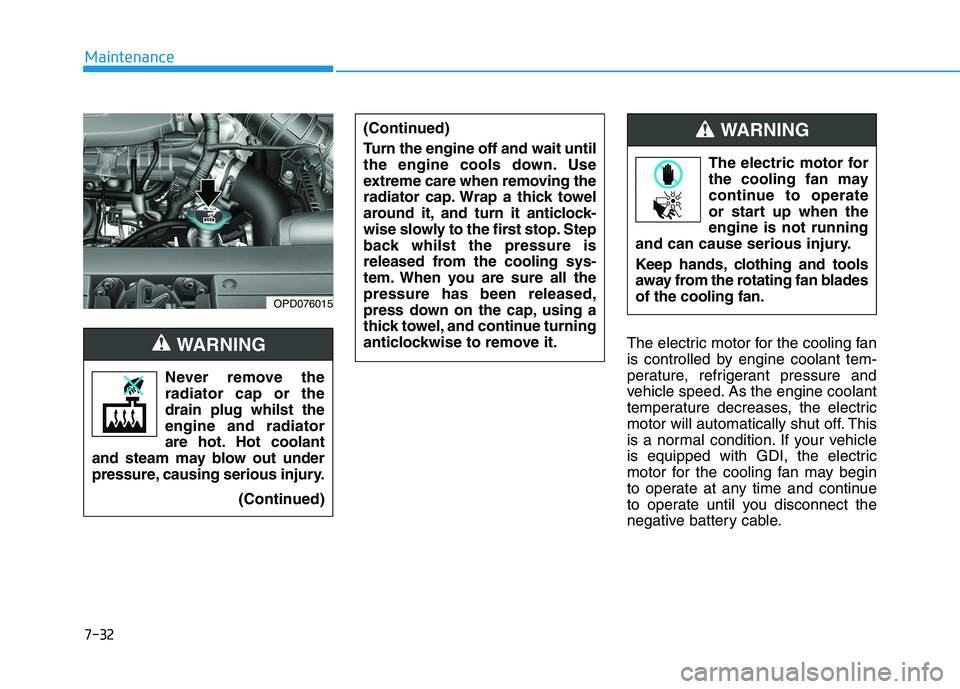
Never remove the
radiator cap or the
drain plug whilst the
engine and radiator
are hot. Hot coolant
and steam may blow out under
pressure, causing serious injury.
(Continued)
WARNING
OPD076015
(Continued)
Turn the engine off and wait until
the engine cools down. Use
extreme care when removing the
radiator cap. Wrap a thick towel
around it, and turn it anticlock-
wise slowly to the first stop. Step
back whilst the pressure is
released from the cooling sys-
tem. When you are sure all the
pressure has been released,
press down on the cap, using a
thick towel, and continue turning
anticlockwise to remove it.
Page 464 of 533

7-33
7
Maintenance
Recommended engine coolant
When adding coolant, use only dis-
tilled (deionised) water for your
vehicle and never mix hard water in
the coolant filled at the factory. An
incorrect coolant mixture can result
in serious malfunction or engine
damage.
The engine in your vehicle has alu-
minium engine parts and must be
protected by an ethylene-glycol
with phosphate based coolant to
prevent corrosion and freezing.
DO NOT USE alcohol or methanol
coolant or mix them with the spec-
ified coolant.
Do not use a solution that contains
more than 60% antifreeze or less
than 35% antifreeze, which would
reduce the effectiveness of the solu-
tion.For mixture percentage, refer to the
following table.
Information
If in doubt about the mix ratio, a 50%
water and 50% antifreeze mix is the
easiest to mix together as it will be the
same quantity of each. It is suitable to
use for most temperature ranges of
-35°C (-31°F) and higher.
Changing the engine coolant
We recommend that the coolant is
changed by an authorised HYUNDAI
dealer according to the Maintenance
Schedule at the beginning of this
chapter.
To prevent damage to engine parts,
put a thick towel around the radia-
tor cap before refilling the coolant
to prevent the coolant from over-
flowing into engine parts, such as
the alternator.
NOTICE
i
Ambient
TemperatureMixture Percentage
(volume)
Antifreeze Water
-15°C (5°F) 35 65
-25°C (-13°F) 40 60
-35°C (-31°F) 50 50
-45°C (-49°F) 60 40
Do not use engine coolant or
antifreeze in the washer fluid
reservoir.
Engine coolant can severely
obscure visibility when sprayed
on the windscreen and may
cause loss of vehicle control
resulting in an accident.
Engine coolant may also cause
damage to paint and body trim.
WARNING
Page 509 of 533
7-78
Maintenance
High-pressure washing
When using high-pressure washers,
make sure to maintain sufficient dis-
tance from the vehicle.
Insufficient clearance or excessive
pressure can lead to component
damage or water penetration.
Do not spray the camera, sensors or
its surrounding area directly with a
high pressure washer. Shock
applied from high pressure water
may cause the device to not operate
normally.
Do not bring the nozzle tip close to
boots (rubber or plastic covers) or
connectors as they may be dam-
aged if they come into contact with
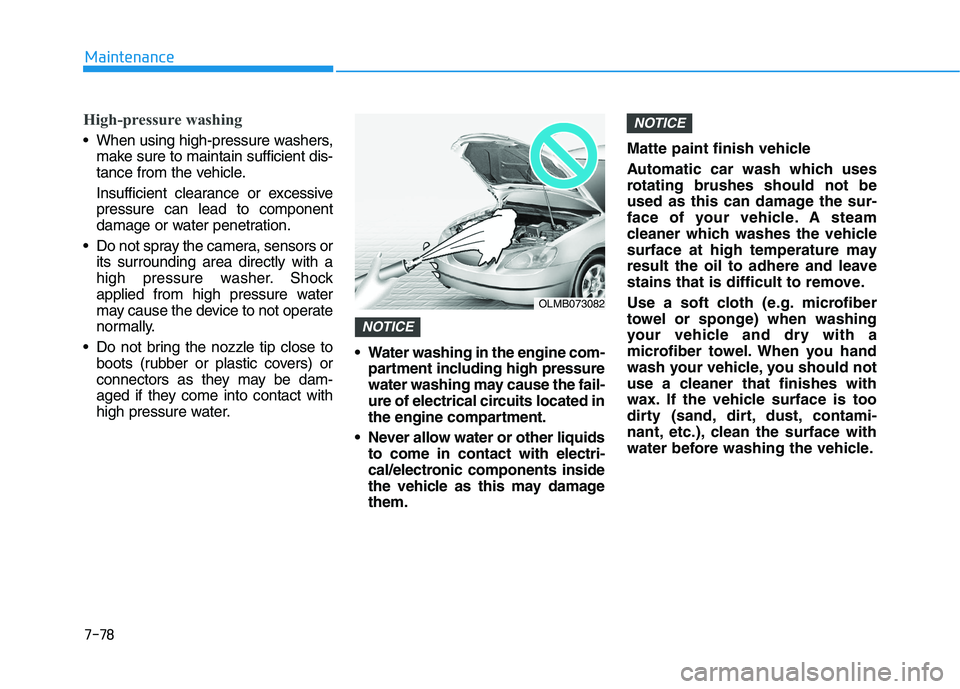
high pressure water. Water washing in the engine com-
partment including high pressure
water washing may cause the fail-
ure of electrical circuits located in
the engine compartment.
Never allow water or other liquids
to come in contact with electri-
cal/electronic components inside
the vehicle as this may damage
them.Matte paint finish vehicle
Automatic car wash which uses
rotating brushes should not be
used as this can damage the sur-
face of your vehicle. A steam
cleaner which washes the vehicle
surface at high temperature may
result the oil to adhere and leave
stains that is difficult to remove.
Use a soft cloth (e.g. microfiber
towel or sponge) when washing
your vehicle and dry with a
microfiber towel. When you hand
wash your vehicle, you should not
use a cleaner that finishes with
wax. If the vehicle surface is too
dirty (sand, dirt, dust, contami-
nant, etc.), clean the surface with
water before washing the vehicle.
NOTICE
NOTICE
OLMB073082