ignition HYUNDAI I800 2016 User Guide
[x] Cancel search | Manufacturer: HYUNDAI, Model Year: 2016, Model line: I800, Model: HYUNDAI I800 2016Pages: 419, PDF Size: 9.23 MB
Page 76 of 419

Features of your vehicle
2 4
Record your key number
The key code number is
stamped or printed on
the bar code tag
attached to the key set.
Should you lose your
keys, we recommend that you contact a
HYUNDAI authorised repairer.
Remove the key code tag and store it in
a safe place. Also, record the code num-
ber and keep it in a safe and handy
place, but not in the vehicle.
Key operations
Used to start the engine, lock and unlock
the doors.
KEYS
WARNING
We recommend that you use parts
for replacement from a HYUNDAI
authorised repairer.
If an aftermarket key is used, the
ignition switch may not return to
ON after START. If this happens,
the starter will continue to operate
causing damage to the starter
motor and possible fire due to
excessive current in the wiring.
WARNING - Ignition key
Leaving children unattended in a
vehicle with the ignition key is dan-
gerous even if the key is not in the
ignition switch is ACC or ON posi-
tion. Children copy adults and they
could place the key in the ignition
switch.
The ignition key would enable chil-
dren to operate power windows or
other controls, or even make the
vehicle move, which could result in
serious bodily injury or even death.
Never leave the keys in your vehicle
with unsupervised children, when
the engine is running.
procarmanuals.com
Page 77 of 419
43
Features of your vehicle
Immobiliser system
Your vehicle may be equipped with an
electronic engine immobiliser system to
reduce the risk of unauthorised vehicle
use.
Your immobiliser system is comprised of
a small transponder in the ignition key
and electronic devices inside the vehicle.
With the immobiliser system, whenever
you insert your ignition key into the igni-
tion switch and turn it to ON, it checks
and determines and verifies if the ignition
key is valid or not.
If the key is determined to be valid, the
engine will start.
If the key is determined to be invalid, the
engine will not start.
To deactivate the immobiliser sys-
tem:
Insert the ignition key into the key cylin-
der and turn it to the ON position.
To activate the immobiliser system:
Turn the ignition key to the OFF position.
The immobiliser system activates auto-
matically. Without a valid ignition key for
your vehicle, the engine will not start.
✽NOTICE
The immobiliser system detects the
presence of a key in the ignition switch.
To ensure the system performs correct-
ly, the keys should be separated after
delivery of the vehicle so that only one
key is near the ignition switch when
using the vehicle. The engine may not
start or may stop shortly after starting if
more than one key is near the ignition
switch.
✽NOTICE
If you need additional keys or lose your
keys, we recommend that you consult a
HYUNDAI authorised repairer.
CAUTION
The transponder in your ignition
key is an important part of the
immobiliser system. It is designed
to give years of trouble-free service,
however you should avoid expo-
sure to moisture, static electricity
and rough handling. Immobiliser
system malfunction could occur.
CAUTION
Do not change, alter or adjust the
immobiliser system because it
could cause the immobiliser sys-
tem to malfunction.We recommend
that the system be serviced by a
HYUNDAI authorised repairer.
Malfunctions caused by improper
alterations, adjustments or modifi-
cations to the immobiliser system
are not covered by your vehicle
manufacturer warranty.
CAUTION
Do not put metal accessories near
the ignition switch.
The engine may not start for the
metal accessories may interrupt the
transponder signal from normally
transmitting.
WARNING
In order to prevent theft of your
vehicle, do not leave spare keys
anywhere in your vehicle. Your
immobiliser password is a cus-
tomer unique password and should
be kept confidential. Do not leave
this number anywhere in your vehi-
cle.
procarmanuals.com
Page 79 of 419
45
Features of your vehicle
Transmitter precautions
✽NOTICE
The transmitter will not work if any of
following occur:
• The ignition key is in ignition switch.
• You exceed the operating distance
limit (about 30 feet [10 m]).
• The battery in the transmitter is
weak.
• Other vehicles or objects may be
blocking the signal.
• The weather is extremely cold.
• The transmitter is close to a radio
transmitter such as a radio station or
an airport which can interfere with
normal operation of the transmitter.
When the transmitter does not work
correctly, open and close the door with
the ignition key. If you have a problem
with the transmitter, we recommend
that you contact a HYUNDAI autho-
rised repairer.
(Continued)(Continued)
• If the transmitter is in close proximity
to your cell phone or smart phone, the
signal from the transmitter could be
blocked by normal operation of your
cell phone or smart phone. This is
especially important when the phone
is active such as making call, receiving
calls, text messaging, and/or sending/
receiving emails. Avoid placing the
transmitter and your cell phone or
smart phone in the same pants or
jacket pocket and maintain adequate
distance between the two devices.
CAUTION
Keep the transmitter away from
water or any liquid. If the keyless
entry system is inoperative due to
exposure to water or liquids, it will
not be covered by your manufactur-
er vehicle warranty.
CAUTION
Changes or modifications not
expressly approved by the party
responsible for compliance could
void the user’s authority to operate
the equipment. If the keyless entry
system is inoperative due to
changes or modifications not
expressly approved by the party
responsible for compliance, it will
not be covered by your manufactur-
er’s vehicle warranty.
CAUTION
Keep the transmitter away from
electromagnetic materials that
blocks electromagnetic waves to
the key surface.
procarmanuals.com
Page 81 of 419
47
Features of your vehicle
THEFT-ALARM SYSTEM (IF EQUIPPED)
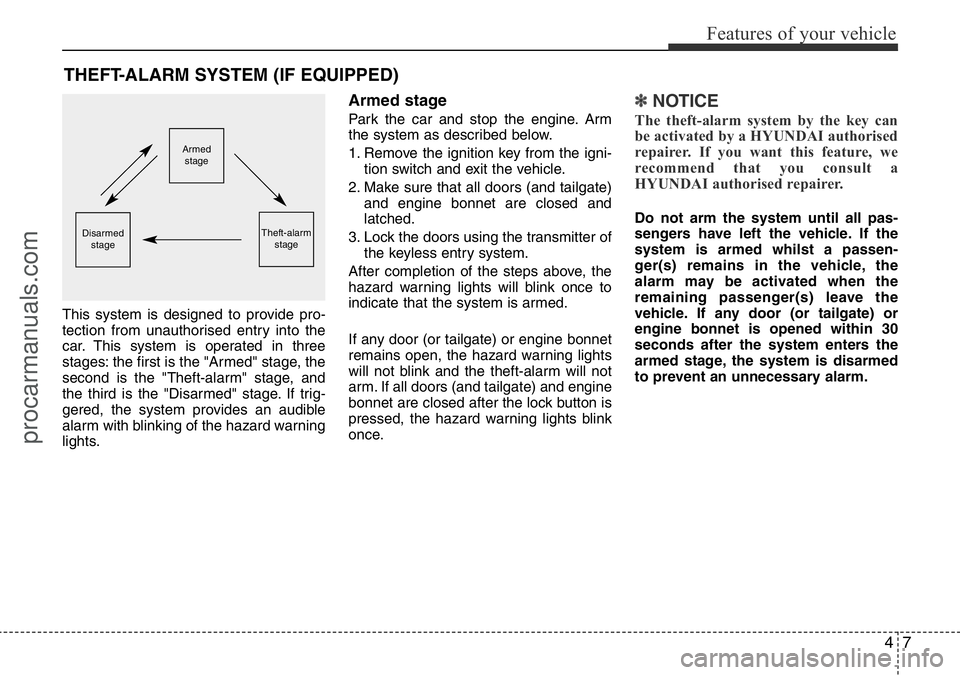
This system is designed to provide pro-
tection from unauthorised entry into the
car. This system is operated in three
stages: the first is the "Armed" stage, the
second is the "Theft-alarm" stage, and
the third is the "Disarmed" stage. If trig-
gered, the system provides an audible
alarm with blinking of the hazard warning
lights.
Armed stage
Park the car and stop the engine. Arm
the system as described below.
1. Remove the ignition key from the igni-
tion switch and exit the vehicle.
2. Make sure that all doors (and tailgate)
and engine bonnet are closed and
latched.
3. Lock the doors using the transmitter of
the keyless entry system.
After completion of the steps above, the
hazard warning lights will blink once to
indicate that the system is armed.
If any door (or tailgate) or engine bonnet
remains open, the hazard warning lights
will not blink and the theft-alarm will not
arm. If all doors (and tailgate) and engine
bonnet are closed after the lock button is
pressed, the hazard warning lights blink
once.
✽NOTICE
The theft-alarm system by the key can
be activated by a HYUNDAI authorised
repairer. If you want this feature, we
recommend that you consult a
HYUNDAI authorised repairer.
Do not arm the system until all pas-
sengers have left the vehicle. If the
system is armed whilst a passen-
ger(s) remains in the vehicle, the
alarm may be activated when the
remaining passenger(s) leave the
vehicle. If any door (or tailgate) or
engine bonnet is opened within 30
seconds after the system enters the
armed stage, the system is disarmed
to prevent an unnecessary alarm.
Armed
stage
Theft-alarm
stageDisarmed
stage
procarmanuals.com
Page 82 of 419
Features of your vehicle
8 4
Theft-alarm stage
The alarm will be activated if any of the
following occurs whilst the system is
armed.
• A front or rear door is opened without
using the transmitter.
• The tailgate is opened without using
the transmitter.
• The engine bonnet is opened.
The horn will sound and the hazard
warning lights will blink continuously for
approximately 30 seconds. To turn off the
system, unlock the doors with the trans-
mitter.
Disarmed stage
The system will be disarmed when the
doors (and tailgate) are unlocked with the
transmitter.
After depressing the unlock button, the
hazard warning lights will blink twice to
indicate that the system is disarmed.
After depressing the unlock button, if any
door (or tailgate) is not opened within 30
seconds, the system will be rearmed.
✽NOTICE
• If the system is not disarmed with the
transmitter, insert the key into the
ignition switch and start the engine.
Then the system will be disarmed.
• If you lose your keys, we recommend
that you consult a HYUNDAI autho-
rised repairer.
CAUTION
Do not change, alter or adjust the
theft-alarm system because it could
cause the theft-alarm system to
malfunction. We recommend that
the system be serviced by a
HYUNDAI authorised repairer.
Malfunctions caused by improper
alterations, adjustments or modifi-
cations to the theft-alarm system
are not covered by your vehicle
manufacturer warranty.
procarmanuals.com
Page 84 of 419
Features of your vehicle
10 4
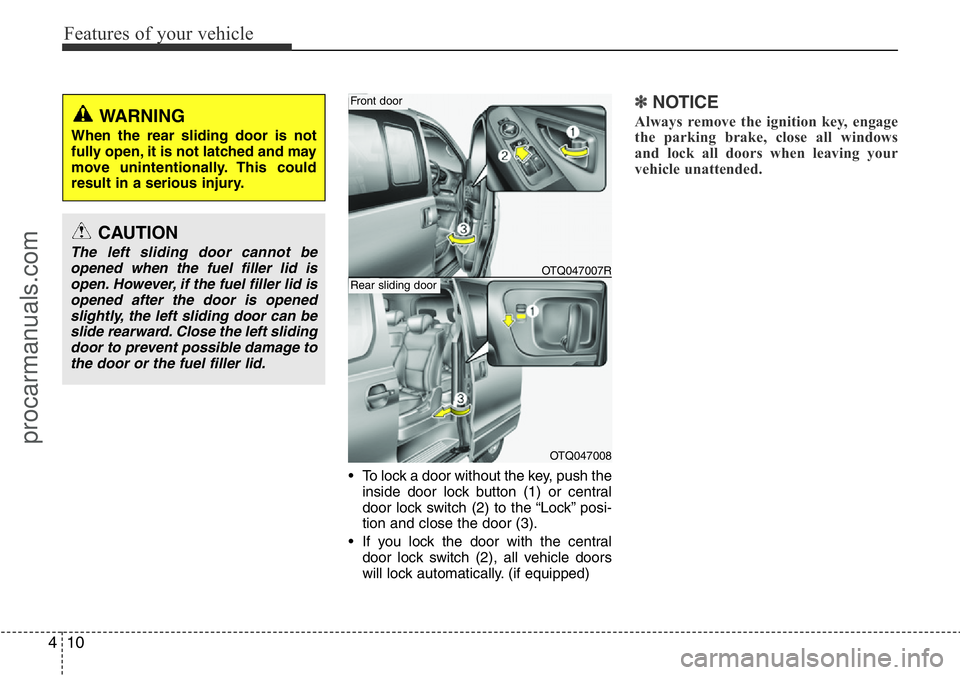
• To lock a door without the key, push the
inside door lock button (1) or central
door lock switch (2
) to the “Lock” posi-
tion and close the door (3).
• If you lock the door with the central
door lock switch (2), all vehicle doors
will lock automatically. (if equipped)
✽NOTICE
Always remove the ignition key, engage
the parking brake, close all windows
and lock all doors when leaving your
vehicle unattended. WARNING
When the rear sliding door is not
fully open, it is not latched and may
move unintentionally. This could
result in a serious injury.
CAUTION
The left sliding door cannot be
opened when the fuel filler lid is
open. However, if the fuel filler lid is
opened after the door is opened
slightly, the left sliding door can be
slide rearward. Close the left sliding
door to prevent possible damage to
the door or the fuel filler lid.
OTQ047007R
Front door
OTQ047008
Rear sliding door
procarmanuals.com
Page 85 of 419
411
Features of your vehicle
Operating door locks from inside
the vehicle
With the door lock button
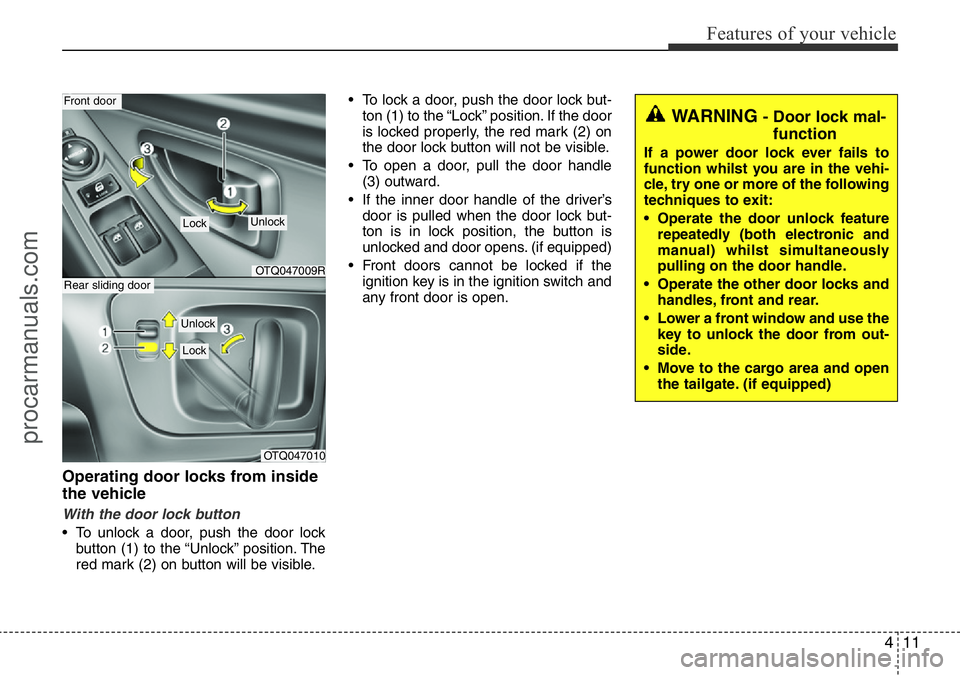
• To unlock a door, push the door lock
button (1) to the “Unlock” position. The
red mark (2) on button will be visible.• To lock a door, push the door lock but-
ton (1) to the “Lock” position. If the door
is locked properly, the red mark (2) on
the door lock button will not be visible.
• To open a door, pull the door handle
(3) outward.
• If the inner door handle of the driver’s
door is pulled when the door lock but-
ton is in lock position, the button is
unlocked and door opens. (if equipped)
• Front doors cannot be locked if the
ignition key is in the ignition switch and
any front door is open.
OTQ047009R
Front door
OTQ047010
Rear sliding door
Unlock
Unlock
Lock
Lock
WARNING - Door lock mal-
function
If a power door lock ever fails to
function whilst you are in the vehi-
cle, try one or more of the following
techniques to exit:
• Operate the door unlock feature
repeatedly (both electronic and
manual) whilst simultaneously
pulling on the door handle.
• Operate the other door locks and
handles, front and rear.
• Lower a front window and use the
key to unlock the door from out-
side.
• Move to the cargo area and open
the tailgate. (if equipped)
procarmanuals.com
Page 86 of 419
Features of your vehicle
12 4
With central door lock switch
(if equipped)
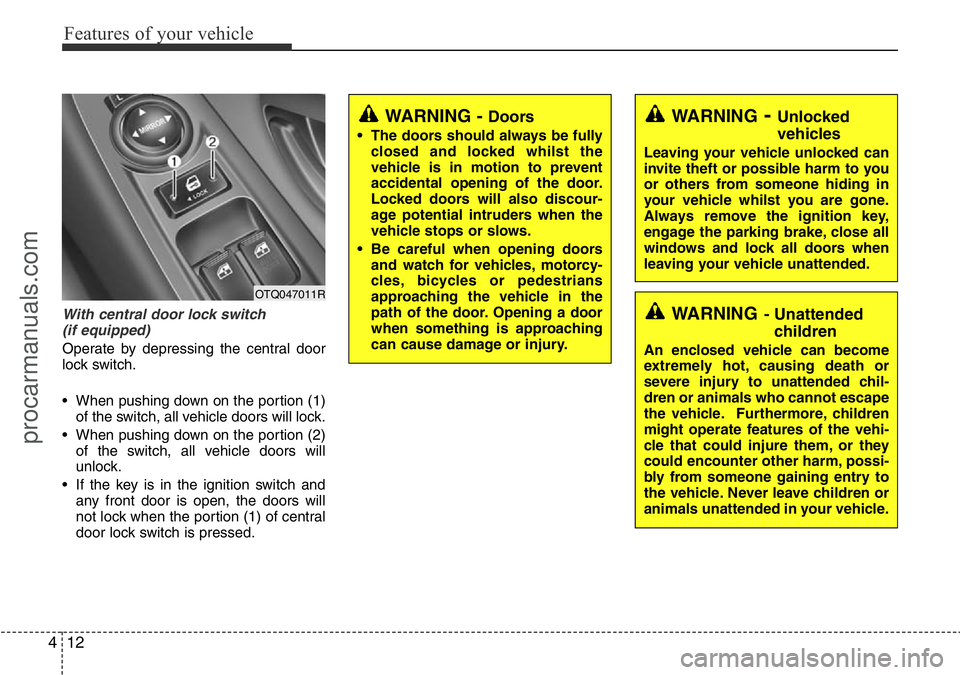
Operate by depressing the central door
lock switch.
• When pushing down on the portion (1)
of the switch, all vehicle doors will lock.
• When pushing down on the portion (2)
of the switch, all vehicle doors will
unlock.
• If the key is in the ignition switch and
any front door is open, the doors will
not lock when the portion (1) of central
door lock switch is pressed.
OTQ047011R
WARNING- Unlocked
vehicles
Leaving your vehicle unlocked can
invite theft or possible harm to you
or others from someone hiding in
your vehicle whilst you are gone.
Always remove the ignition key,
engage the parking brake, close all
windows and lock all doors when
leaving your vehicle unattended.
WARNING- Unattended
children
An enclosed vehicle can become
extremely hot, causing death or
severe injury to unattended chil-
dren or animals who cannot escape
the vehicle. Furthermore, children
might operate features of the vehi-
cle that could injure them, or they
could encounter other harm, possi-
bly from someone gaining entry to
the vehicle. Never leave children or
animals unattended in your vehicle.
WARNING - Doors
• The doors should always be fully
closed and locked whilst the
vehicle is in motion to prevent
accidental opening of the door.
Locked doors will also discour-
age potential intruders when the
vehicle stops or slows.
• Be careful when opening doors
and watch for vehicles, motorcy-
cles, bicycles or pedestrians
approaching the vehicle in the
path of the door. Opening a door
when something is approaching
can cause damage or injury.
procarmanuals.com
Page 87 of 419
413
Features of your vehicle
Impact sensing door unlock sys-
tem (if equipped)
All doors will be automatically unlocked
when the impact is delivered to impact
sensors whilst the ignition switch ON.
However, the doors may not be unlocked
if mechanical problems occur with the
door lock system or battery.
Speed sensing door lock system
(if equipped)
When the speed of the vehicle keeps
above 25 mph (40 km/h) for 1 second, it
will automatically lock all doors. For acti-
vation of this fearture, we recommend
that you contact a HYUNDAI authorised
repairer.
✽NOTICE
A HYUNDAI authorised repairer can
select some auto door lock/unlock fea-
tures as follows;
• Speed sensing auto door locking
• Auto door unlock when the ignition
key is removed from the ignition
switch
If you want to select a door lock/unlock
feature, we recommend that you consult
a HYUNDAI authorised repairer.
Child-protector rear door lock
The child safety lock is provided to help
prevent children from accidentally open-
ing the rear doors from inside the vehicle.
The rear door safety locks should be
used whenever children are in the vehi-
cle.
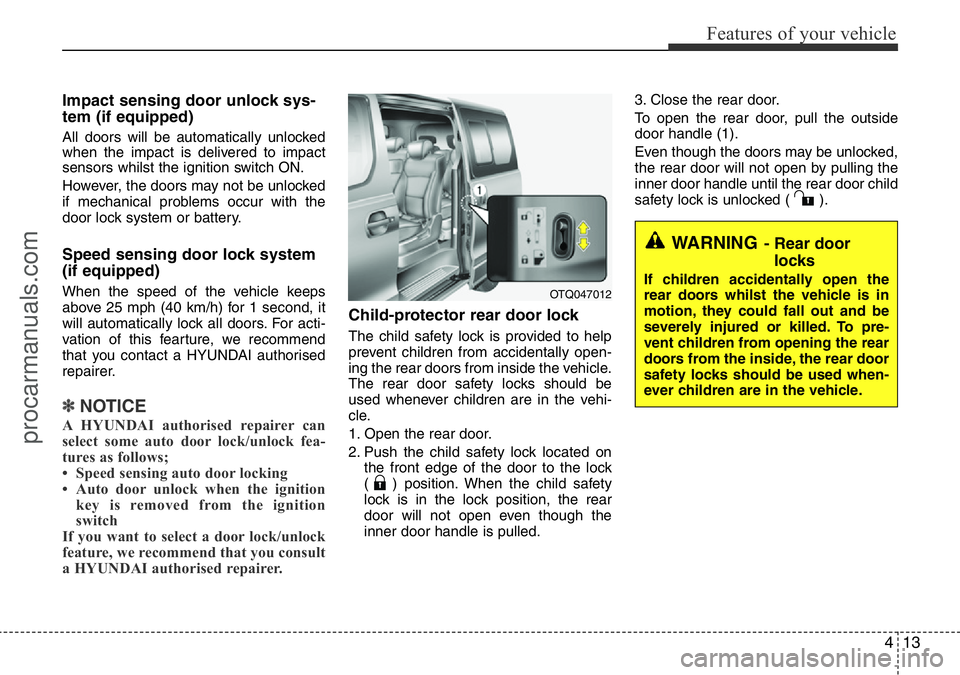
1. Open the rear door.
2. Push the child safety lock located on
the front edge of the door to the lock
( ) position. When the child safety
lock is in the lock position, the rear
door will not open even though the
inner door handle is pulled.3. Close the rear door.
To open the rear door, pull the outside
door handle (1).
Even though the doors may be unlocked,
the rear door will not open by pulling the
inner door handle until the rear door child
safety lock is unlocked ( ).
WARNING- Rear door
locks
If children accidentally open the
rear doors whilst the vehicle is in
motion, they could fall out and be
severely injured or killed. To pre-
vent children from opening the rear
doors from the inside, the rear door
safety locks should be used when-
ever children are in the vehicle.OTQ047012
procarmanuals.com
Page 92 of 419
Features of your vehicle
18 4
Power windows (if equipped)
The ignition switch must be in the ON
position for power windows to operate.
Each door has a power window switch
that controls the door's window. The driv-
er has a power window lock switch which
can block the operation of passenger
windows. The power windows can be
operated for approximately 30 seconds
after the ignition key is removed or turned
to the ACC or LOCK position. However, if
the front doors are opened, the power
windows cannot be operated within the
30 second period after the ignition key
removal.
✽NOTICE
Whilst driving, if you notice buffeting
and pulsation (wind shock) with either
side window open, you should open the
opposite window slightly to reduce the
condition.
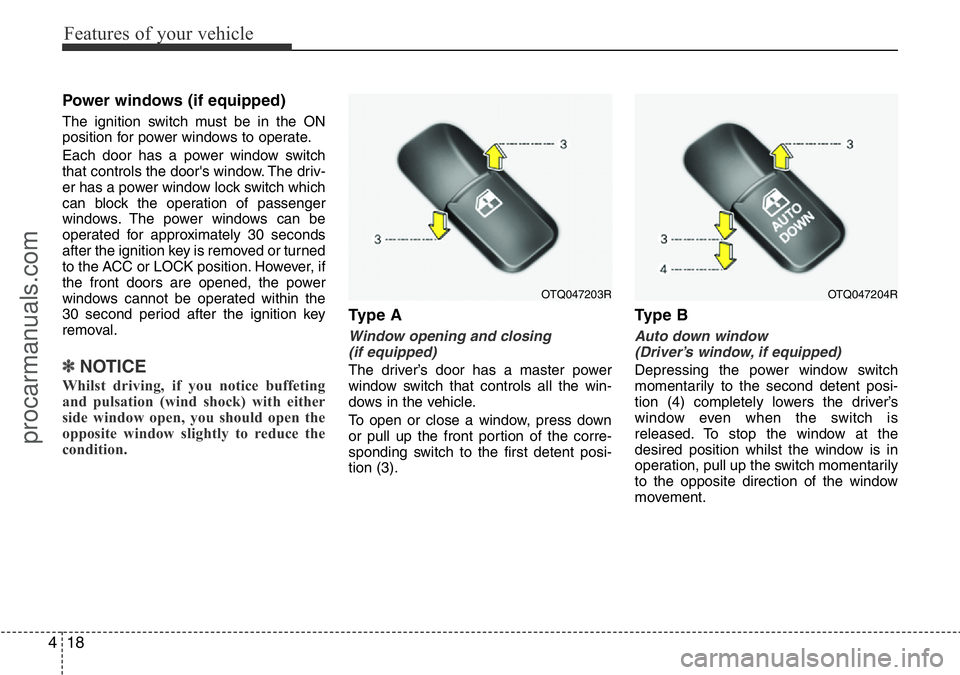
Type A
Window opening and closing
(if equipped)
The driver’s door has a master power
window switch that controls all the win-
dows in the vehicle.
To open or close a window, press down
or pull up the front portion of the corre-
sponding switch to the first detent posi-
tion (3).
Ty p e B
Auto down window
(Driver’s window, if equipped)
Depressing the power window switch
momentarily to the second detent posi-
tion (4) completely lowers the driver’s
window even when the switch is
released. To stop the window at the
desired position whilst the window is in
operation, pull up the switch momentarily
to the opposite direction of the window
movement.
OTQ047203ROTQ047204R
procarmanuals.com