ignition HYUNDAI I800 2016 Manual PDF
[x] Cancel search | Manufacturer: HYUNDAI, Model Year: 2016, Model line: I800, Model: HYUNDAI I800 2016Pages: 419, PDF Size: 9.23 MB
Page 271 of 419
525
Driving your vehicle
✽NOTICE
When you jump start your vehicle
because of a drained battery, the engine
may not run as smoothly and the ABS
warning light may turn on at the same
time. This happens because of the low
battery voltage. It does not mean your
ABS is malfunctioning.
• Do not pump your brakes!
• Have the battery recharged before
driving the vehicle.
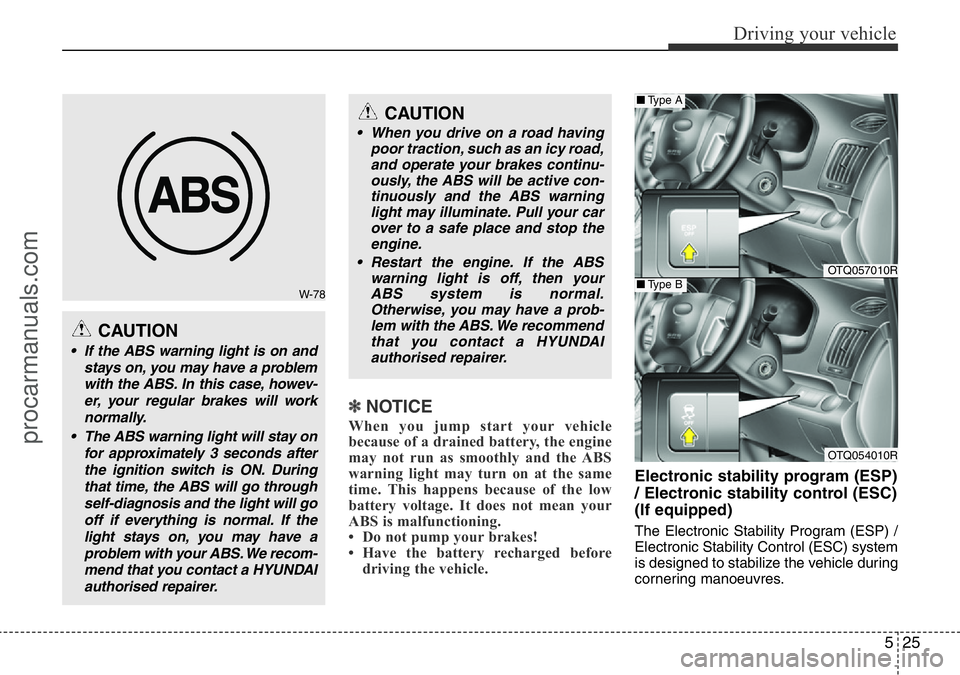
Electronic stability program (ESP)
/ Electronic stability control (ESC)
(If equipped)
The Electronic Stability Program (ESP) /
Electronic Stability Control (ESC) system
is designed to stabilize the vehicle during
cornering manoeuvres.
W-78
CAUTION
• If the ABS warning light is on and
stays on, you may have a problem
with the ABS. In this case, howev-
er, your regular brakes will work
normally.
• The ABS warning light will stay on
for approximately 3 seconds after
the ignition switch is ON. During
that time, the ABS will go through
self-diagnosis and the light will go
off if everything is normal. If the
light stays on, you may have a
problem with your ABS. We recom-
mend that you contact a HYUNDAI
authorised repairer.
CAUTION
• When you drive on a road having
poor traction, such as an icy road,
and operate your brakes continu-
ously, the ABS will be active con-
tinuously and the ABS warning
light may illuminate. Pull your car
over to a safe place and stop the
engine.
• Restart the engine. If the ABS
warning light is off, then your
ABS system is normal.
Otherwise, you may have a prob-
lem with the ABS. We recommend
that you contact a HYUNDAI
authorised repairer.
OTQ057010R
OTQ054010R
■Type A
■Type B
procarmanuals.com
Page 272 of 419
Driving your vehicle
26 5
ESP (ESC) checks where you are
steering and where the vehicle is actually
going.
ESP (ESC) applies the brakes at
individual wheels and intervenes in the
engine management system to stabilize
the vehicle.The Electronic Stability Program (ESP)/
Electronic Stability Control (ESC) system
is an electronic system designed to help
the driver maintain vehicle control under
adverse conditions. It is not a substitute
for safe driving practices. Factors
including speed, road conditions and
driver steering input can all affect
whether ESP (ESC) will be effective in
preventing a loss of control. It is still your
responsibility to drive and corner at
reasonable speeds and to leave a
sufficient margin of safety.
When you apply your brakes under con-
ditions which may lock the wheels, you
may hear a “tik-tik’’ sound from the
brakes, or feel a corresponding sensation
in the brake pedal. This is normal and it
means your ESP (ESC) is active.
✽NOTICE
A click sound may be heard in the
engine compartment when the vehicle
begins to move after the engine is start-
ed. These conditions are normal and
indicate that the Electronic Stability
Program (Electronic stability control)
System is functioning properly.
ESP (ESC) operation
ESP (ESC) ON condition
• When the ignition is turned
ON, ESP (ESC) and ESP
(ESC) OFF indicator lights
illuminate for approximately 3
seconds, then ESP (ESC) is
turned on.
• Press the ESP (ESC) OFF
button for at least half a sec-
ond after turning the ignition
ON to turn ESP (ESC) off.
(ESP (ESC) OFF indicator
will illuminate). To turn the
ESP (ESC) on, press the
ESP (ESC) OFF button (ESP
(ESC) OFF indicator light will
go off).
• When starting the engine,
you may hear a slight ticking
sound. This is the ESP (ESC)
performing an automatic sys-
tem self-check and does not
indicate a problem.
WARNING
Never drive too fast for the road
conditions or too quickly when cor-
nering. Electronic stability pro-
gram (ESP) / Electronic stability
control (ESC) will not prevent acci-
dents. Excessive speed in turns,
abrupt manoeuvres and hydroplan-
ing on wet surfaces can still result
in serious accidents. Only a safe
and attentive driver can prevent
accidents by avoiding manoeuvres
that cause the vehicle to lose trac-
tion. Even with ESP (ESC)
installed, always follow all the nor-
mal precautions for driving - includ-
ing driving at safe speeds for the
conditions.
-
procarmanuals.com
Page 273 of 419
527
Driving your vehicle
When operating
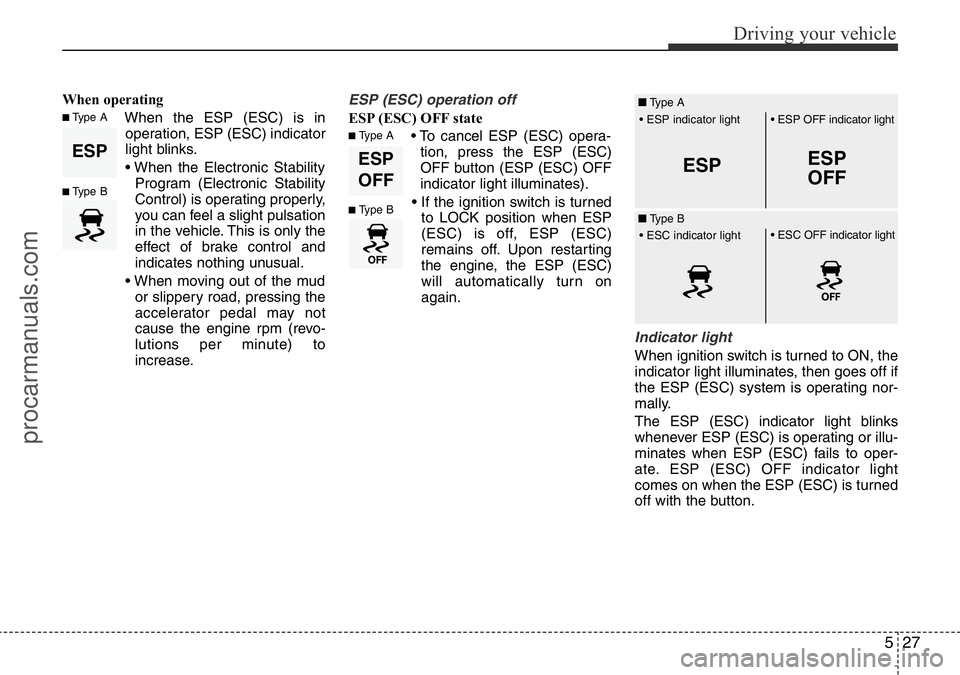
When the ESP (ESC) is in
operation, ESP (ESC) indicator
light blinks.
• When the Electronic Stability
Program (Electronic Stability
Control) is operating properly,
you can feel a slight pulsation
in the vehicle. This is only the
effect of brake control and
indicates nothing unusual.
• When moving out of the mud
or slippery road, pressing the
accelerator pedal may not
cause the engine rpm (revo-
lutions per minute) to
increase.ESP (ESC) operation off
ESP (ESC) OFF state
• To cancel ESP (ESC) opera-
tion, press the ESP (ESC)
OFF button (ESP (ESC) OFF
indicator light illuminates).
• If the ignition switch is turned
to LOCK position when ESP
(ESC) is off, ESP (ESC)
remains off. Upon restarting
the engine, the ESP (ESC)
will automatically turn on
again.
Indicator light
When ignition switch is turned to ON, the
indicator light illuminates, then goes off if
the ESP (ESC) system is operating nor-
mally.
The ESP (ESC) indicator light blinks
whenever ESP (ESC) is operating or illu-
minates when ESP (ESC) fails to oper-
ate. ESP (ESC) OFF indicator light
comes on when the ESP (ESC) is turned
off with the button.
ESP
■Type A
■Type B
ESP
OFF
■Type A
■Type B
ESPESP
OFF
• ESP OFF indicator light
• ESP indicator light
■Type A
■Type B• ESC OFF indicator light
• ESC indicator light
procarmanuals.com
Page 274 of 419
Driving your vehicle
28 5
✽NOTICE
After reconnecting or recharging a dis-
charged battery, the ESP (ESC) indica-
tor may illuminate. In this case, turn the
steering wheel half way to the left and
right whilst the ignition switch is in the
ON position. Then, restart the engine
after the ignition is off. If the ESP (ESC)
indicator does not turn off, we recom-
mend that the system be checked by a
HYUNDAI authorised repairer.
ESP (ESC) OFF usage
When driving
• The ESP (ESC) turned on for daily
driving whenever possible.
• To turn ESP (ESC) off whilst driving,
press the ESP (ESC) OFF button
whilst driving on a flat road surface.
Never press the ESP (ESC) OFF button
whilst ESP (ESC) is operating (ESP
(ESC) indicator light blinks).
If ESP (ESC) is turned off whilst ESP
(ESC) is operating, the vehicle may slip
out of control.
✽NOTICE
• When operating the vehicle on a
dynamometer, ensure that the ESP
(ESC) is turned off (ESP (ESC) OFF
light illuminated). If the ESP (ESC) is
left on, it may prevent the vehicle
speed from increasing, and result in
false diagnosis.
• Turning the ESP (ESC) off does not
affect ABS or brake system operation.
CAUTION
Driving with varying tyre or wheel
sizes may cause the ESP (ESC) sys-
tem to malfunction. When replacing
tyres, make sure they are the same
size as your original tyres.
WARNING
The Electronic Stability Program
(Electronic stability control) system
is only a driving aid; use precau-
tions for safe driving by slowing
down on curved, snowy, or icy
roads. Drive slowly and don’t
attempt to accelerate whenever the
ESP (ESC) indicator light is blink-
ing, or when the road surface is
slippery.
procarmanuals.com
Page 278 of 419
Driving your vehicle
32 5
✽NOTICE
• During normal cruise control opera-
tion, when the SET switch is activated
or reactivated after applying the
brakes, the cruise control will ener-
gize after approximately 3 seconds.
This delay is normal.
• To activate cruise control, depress the
brake pedal at least once after turning
the ignition switch to the ON position
or starting the engine. This is to check
if the brake switch which is important
part to cancel cruise control is in nor-
mal condition.
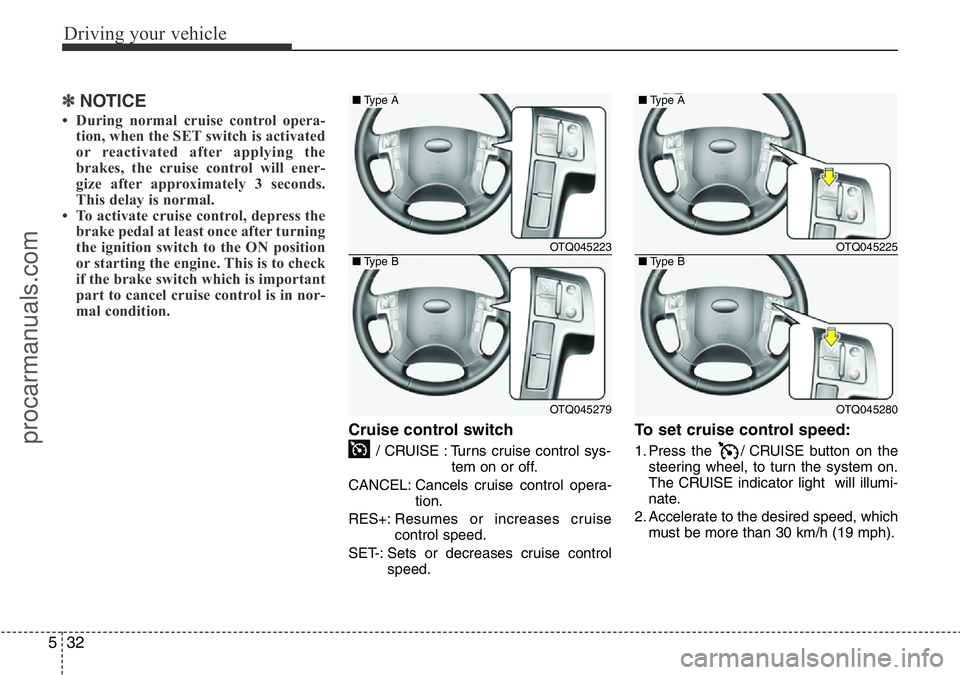
Cruise control switch
/ CRUISE : Turns cruise control sys-
tem on or off.
CANCEL: Cancels cruise control opera-
tion.
RES+:Resumes or increases cruise
control speed.
SET-: Sets or decreases cruise control
speed.
To set cruise control speed:
1. Press the / CRUISE button on the
steering wheel, to turn the system on.
The CRUISE indicator light will illumi-
nate.
2. Accelerate to the desired speed, which
must be more than 30 km/h (19 mph).
OTQ045223
OTQ045279
■Type A
■Type BOTQ045225
OTQ045280
■Type A
■Type B
procarmanuals.com
Page 282 of 419
Driving your vehicle
36 5
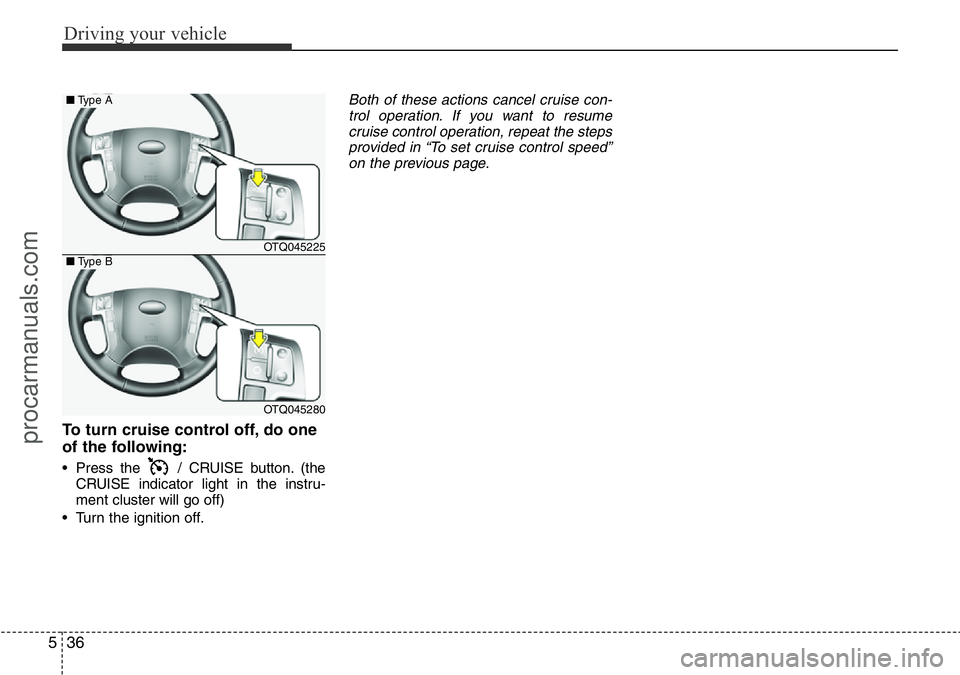
To turn cruise control off, do one
of the following:
• Press the / CRUISE button. (the
CRUISE indicator light in the instru-
ment cluster will go off)
• Turn the ignition off.
Both of these actions cancel cruise con-
trol operation. If you want to resume
cruise control operation, repeat the steps
provided in “To set cruise control speed”
on the previous page.
OTQ045225
OTQ045280
■Type A
■Type B
procarmanuals.com
Page 285 of 419
539
Driving your vehicle
• Use your air conditioning sparingly.
The air conditioning system is operat-
ed by engine power so your fuel econ-
omy is reduced when you use it.
• Open windows at high speeds can
reduce fuel economy.
• Fuel economy is less in crosswinds
and headwinds. To help offset some of
this loss, slow down when driving in
these conditions.
Keeping a vehicle in good operating con-
dition is important both for economy and
safety. Therefore, we recommend that the
system be serviced by a HYUNDAI
authorised repairer.
WARNING - Engine off dur-
ing motion
Never turn the engine off to coast
down hills or anytime the vehicle is
in motion. The power steering and
power brakes will not function
properly without the engine run-
ning. Instead, keep the engine on
and downshift to an appropriate
gear for engine braking effect. In
addition, turning off the ignition
whilst driving could engage the
steering wheel lock resulting in
loss of vehicle steering which
could cause serious injury or
death.
procarmanuals.com
Page 293 of 419
547
Driving your vehicle
Use high quality ethylene glycol
coolant
Your vehicle is delivered with high quality
ethylene glycol coolant in the cooling
system. It is the only type of coolant that
should be used because it helps prevent
corrosion in the cooling system, lubri-
cates the water pump and prevents
freezing. Be sure to replace or replenish
your coolant in accordance with the
maintenance schedule. Before winter,
have your coolant tested to assure that
its freezing point is sufficient for the tem-
peratures anticipated during the winter.
Check battery and cables
Winter puts additional burdens on the
battery system. Visually inspect the bat-
tery and cables as described in section
7. We recommend that the system be
checked by a HYUNDAI authorised
repairer.
Change to "winter weight" oil if
necessary
In some climates it is recommended that
a lower viscosity "winter weight" oil be
used during cold weather. See section 9
for recommendations. If you aren't sure
what weight oil you should use, we rec-
ommend that you consult a HYUNDAI
authorised repairer.
Check spark plugs and ignition
system
Inspect your spark plugs and replace
them if necessary. Also check all ignition
wiring and components to be sure they
are not cracked, worn or damaged in any
way.
WARNING- Tyre chains
• The use of chains may adversely
affect vehicle handling.
• Do not exceed 20 mph (30 km/h)
or the chain manufacturer’s rec-
ommended speed limit, whichev-
er is lower.
• Drive carefully and avoid bumps,
holes, sharp turns, and other
road hazards, which may cause
the vehicle to bounce.
• Avoid sharp turns or locked-
wheel braking.
CAUTION
• Chains that are the wrong size or
improperly installed can damage
your vehicle's brake lines, sus-
pension, body and wheels.
• Stop driving and retighten the
chains any time you hear them
hitting the vehicle.
procarmanuals.com
Page 307 of 419
63
What to do in an emergency
IN CASE OF AN EMERGENCY WHILST DRIVING
If the engine stalls at a crossroad
or crossing
• If the engine stalls at a crossroad or
crossing, set the shift lever in the N
(Neutral) position and then push the
vehicle to a safe place.
• If your vehicle has a manual transmis-
sion not equipped with a ignition lock
switch, the vehicle can move forward
by shifting to the 2(second) or 3(third)
gear and then turning the starter with-
out depressing the clutch pedal.
If a puncture occurs whilst driv-
ing the vehicle
1. Bring the car to rest as soon as it is
safe to do so and with the minimum
amount of braking required which will
assist in maintaining the maximum
amount of control. The vehicle should
be parked wherever possible upon firm
level ground to facilitate wheel chang-
ing.
2. If the vehicle is creating a hazard and
the road conditions do not permit the
wheel to be changed safely, assis-
tance should be sought.
3. Passengers must not be allowed to
remain inside the vehicle during wheel
changing. If a puncture occurs whilst
the vehicle is on a motorway, the pas-
sengers should take refuge on the
motorway embankment to avoid the
possibility of injury occurring should
the vehicle be struck by other motor-
way traffic.
4. Wheel changing should be performed
according to the following instructions.
If engine stalls whilst driving
1. Reduce your speed gradually, keeping
a straight line. Move cautiously off the
road to a safe place.
2. Turn on your emergency flashers.
3. Try to start the engine again. If your
vehicle will not start, we recommend
that you consult a HYUNDAI autho-
rised repairer.
procarmanuals.com
Page 308 of 419
What to do in an emergency
4 6
IF THE ENGINE WILL NOT START
If engine cannot be cranked
1. If your car has an automatic transmis-
sion, be sure the gear selector lever is
in N (Neutral) or P (Park) and the
emergency brake is set.
2. Check the battery terminals and con-
nections to ensure that these are clean
and also tight.
3. If the ignition warning lights dim when
the engine is cranked and the battery
terminals have been checked, a dis-
charged battery is indicated.
4. Do not attempt to push or tow start the
vehicle, refer to "Jump Starting" for
information regarding engine starting
when the battery is discharged.
If engine turns over normally but
does not start
1. Check fuel level.
2. With the ignition switch in the LOCK
position, check all connectors at the
ignition coils and spark plugs.
Reconnect any that may be discon-
nected or loose.
3. Check the fuel line in the engine com-
partment.
4. If the engine still does not start, we
recommend that you call a HYUNDAI
authorised repairer.
WARNING
If the engine refuses to start, no
attempt should be made to push or
tow start the vehicle. Vehicles with
automatic transmission or fuel
injection will not be able to be start-
ed in this manner since no drive is
transmitted through the automatic
transmission whilst the engine is
not running, and in the case of fuel
injected derivatives, the fuel pump
will not operate under tow start
conditions. In addition, if the vehi-
cle is equipped with an exhaust cat-
alyst, damage to the catalyst may
result if the vehicle is tow started.
procarmanuals.com