charging HYUNDAI KONA EV 2022 Manual PDF
[x] Cancel search | Manufacturer: HYUNDAI, Model Year: 2022, Model line: KONA EV, Model: HYUNDAI KONA EV 2022Pages: 548, PDF Size: 49.14 MB
Page 285 of 548
06
6-5
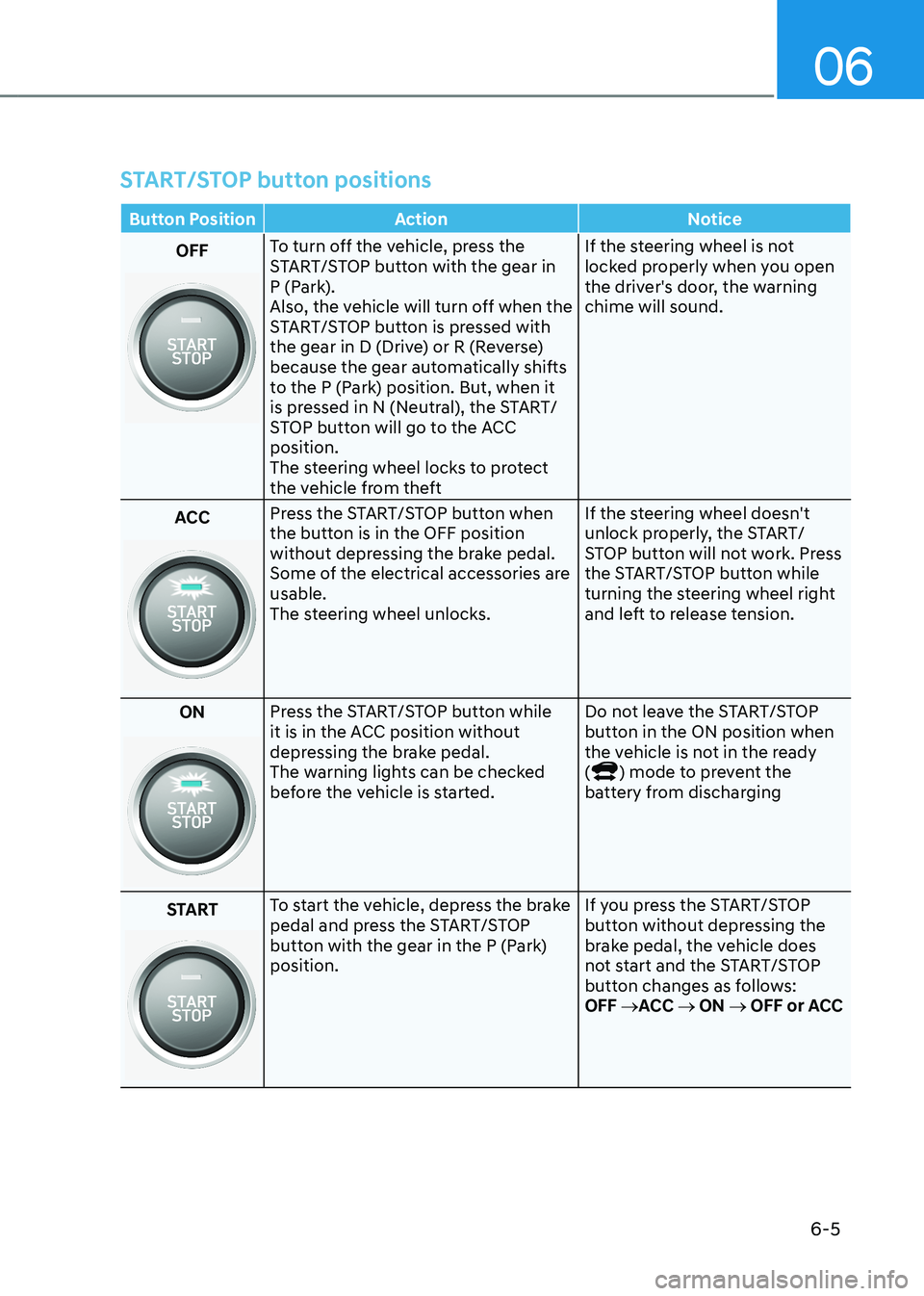
START/STOP button positions
Button Position Action Notice
OFFTo turn off the vehicle, press the
START/STOP button with the gear in
P (Park).
Also, the vehicle will turn off when the
START/STOP button is pressed with
the gear in D (Drive) or R (Reverse)
because the gear automatically shifts
to the P (Park) position. But, when it
is pressed in N (Neutral), the START/
STOP button will go to the ACC position.
The steering wheel locks to protect
the vehicle from theft If the steering wheel is not
locked properly when you open
the driver's door, the warning chime will sound.
ACC Press the START/STOP button when
the button is in the OFF position
without depressing the brake pedal.
Some of the electrical accessories are usable.
The steering wheel unlocks.
If the steering wheel doesn't
unlock properly, the START/
STOP button will not work. Press
the START/STOP button while
turning the steering wheel right
and left to release tension.
ON
Press the START/STOP button while
it is in the ACC position without
depressing the brake pedal.
The warning lights can be checked
before the vehicle is started. Do not leave the START/STOP
button in the ON position when
the vehicle is not in the ready (
) mode to prevent the
battery from discharging
START
To start the vehicle, depress the brake
pedal and press the START/STOP
button with the gear in the P (Park) position. If you press the START/STOP
button without depressing the
brake pedal, the vehicle does
not start and the START/STOP
button changes as follows:OFF
→ACC → ON → OFF or ACC
Page 289 of 548
06
6-9
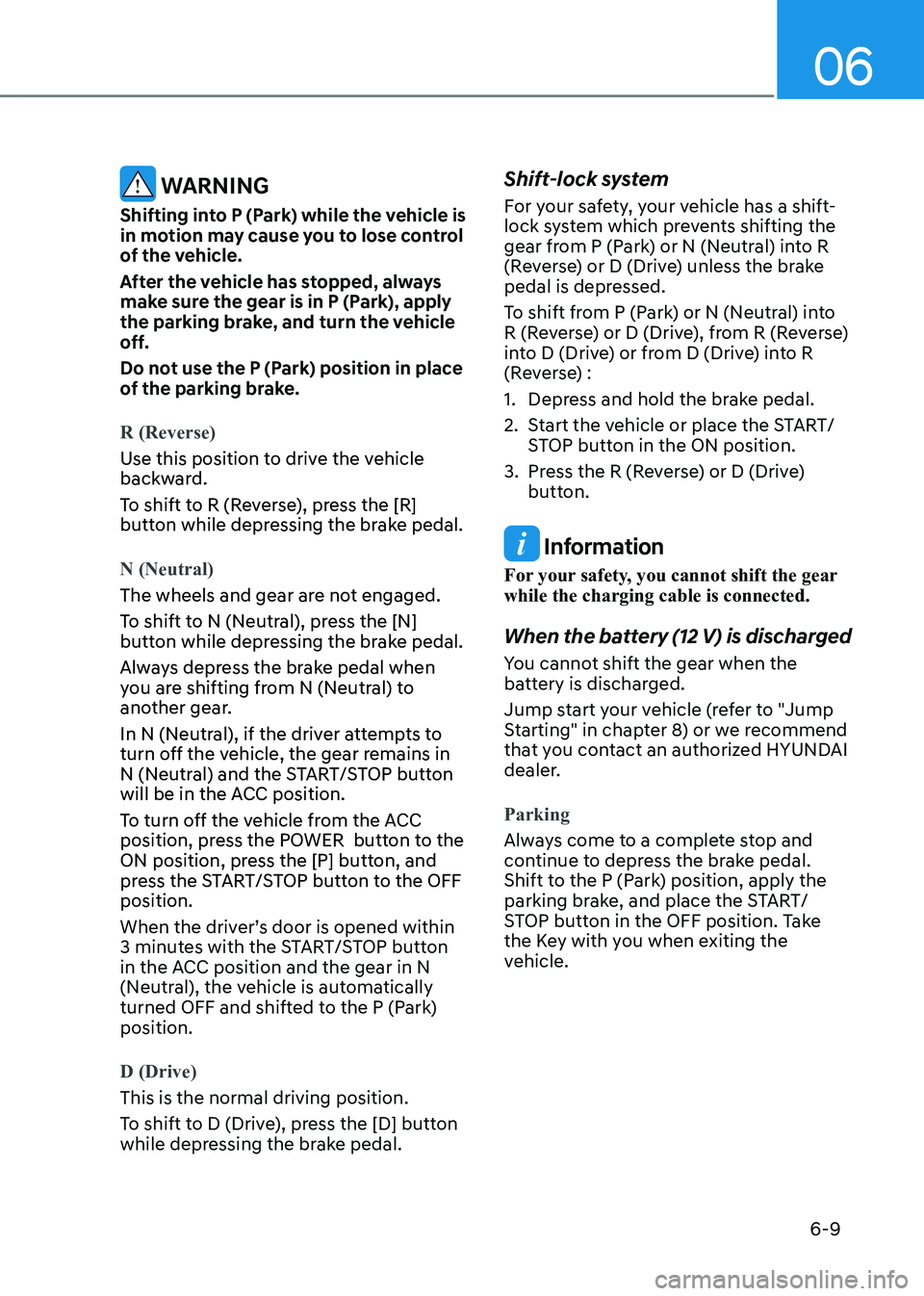
WARNING
Shifting into P (Park) while the vehicle is
in motion may cause you to lose control
of the vehicle.
After the vehicle has stopped, always
make sure the gear is in P (Park), apply
the parking brake, and turn the vehicle
off.
Do not use the P (Park) position in place
of the parking brake.
R (Reverse)
Use this position to drive the vehicle
backward.
To shift to R (Reverse), press the [R]
button while depressing the brake pedal.
N (Neutral)
The wheels and gear are not engaged.
To shift to N (Neutral), press the [N]
button while depressing the brake pedal.
Always depress the brake pedal when
you are shifting from N (Neutral) to
another gear.
In N (Neutral), if the driver attempts to
turn off the vehicle, the gear remains in
N (Neutral) and the START/STOP button
will be in the ACC position.
To turn off the vehicle from the ACC
position, press the POWER button to the
ON position, press the [P] button, and
press the START/STOP button to the OFF position.
When the driver’s door is opened within
3 minutes with the START/STOP button
in the ACC position and the gear in N
(Neutral), the vehicle is automatically
turned OFF and shifted to the P (Park) position.
D (Drive)
This is the normal driving position.
To shift to D (Drive), press the [D] button
while depressing the brake pedal. Shift-lock system
For your safety, your vehicle has a shift-
lock system which prevents shifting the
gear from P (Park) or N (Neutral) into R
(Reverse) or D (Drive) unless the brake
pedal is depressed.
To shift from P (Park) or N (Neutral) into
R (Reverse) or D (Drive), from R (Reverse)
into D (Drive) or from D (Drive) into R
(Reverse) :
1. Depress and hold the brake pedal.
2. Start the vehicle or place the START/
STOP button in the ON position.
3. Press the R (Reverse) or D (Drive) button.
Information
For your safety, you cannot shift the gear while the charging cable is connected.
When the battery (12 V) is discharged
You cannot shift the gear when the
battery is discharged.
Jump start your vehicle (refer to "Jump
Starting" in chapter 8) or we recommend
that you contact an authorized HYUNDAI
dealer.
Parking
Always come to a complete stop and
continue to depress the brake pedal.
Shift to the P (Park) position, apply the
parking brake, and place the START/
STOP button in the OFF position. Take
the Key with you when exiting the
vehicle.
Page 326 of 548
Driving your vehicle
6-46
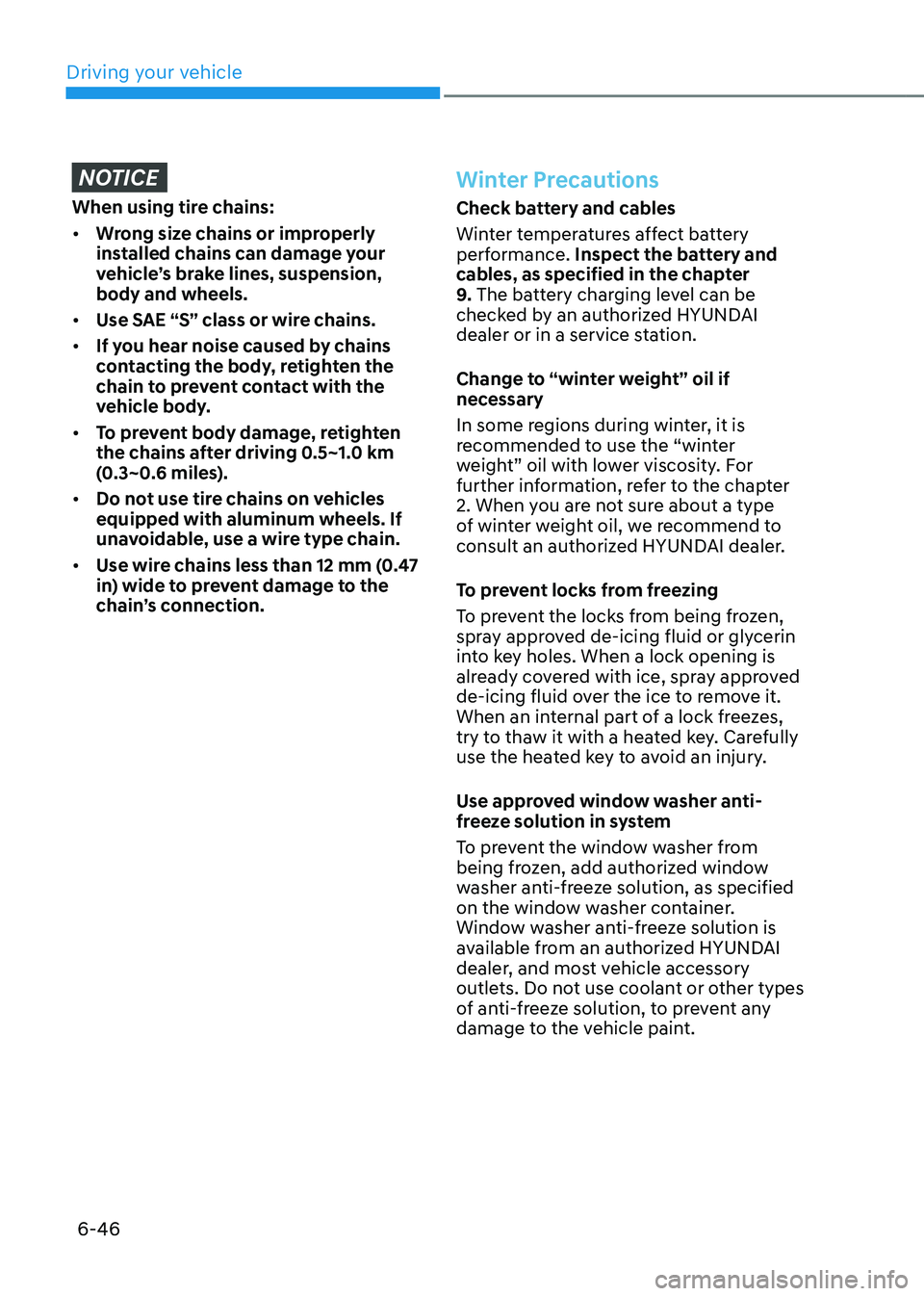
NOTICE
When using tire chains: • Wrong size chains or improperly
installed chains can damage your
vehicle’s brake lines, suspension, body and wheels.
• Use SAE “S” class or wire chains.
• If you hear noise caused by chains
contacting the body, retighten the
chain to prevent contact with the
vehicle body.
• To prevent body damage, retighten
the chains after driving 0.5~1.0 km
(0.3~0.6 miles).
• Do not use tire chains on vehicles
equipped with aluminum wheels. If
unavoidable, use a wire type chain.
• Use wire chains less than 12 mm (0.47
in) wide to prevent damage to the
chain’s connection.
Winter Precautions
Check battery and cables
Winter temperatures affect battery
performance. Inspect the battery and
cables, as specified in the chapter 9. The battery charging level can be
checked by an authorized HYUNDAI
dealer or in a service station.
Change to “winter weight” oil if
necessary
In some regions during winter, it is
recommended to use the “winter
weight” oil with lower viscosity. For
further information, refer to the chapter
2. When you are not sure about a type
of winter weight oil, we recommend to
consult an authorized HYUNDAI dealer.
To prevent locks from freezing
To prevent the locks from being frozen,
spray approved de-icing fluid or glycerin
into key holes. When a lock opening is
already covered with ice, spray approved
de-icing fluid over the ice to remove it.
When an internal part of a lock freezes,
try to thaw it with a heated key. Carefully
use the heated key to avoid an injury.
Use approved window washer anti-
freeze solution in system
To prevent the window washer from
being frozen, add authorized window
washer anti-freeze solution, as specified
on the window washer container.
Window washer anti-freeze solution is
available from an authorized HYUNDAI
dealer, and most vehicle accessory
outlets. Do not use coolant or other types
of anti-freeze solution, to prevent any
damage to the vehicle paint.
Page 460 of 548
08
8-5
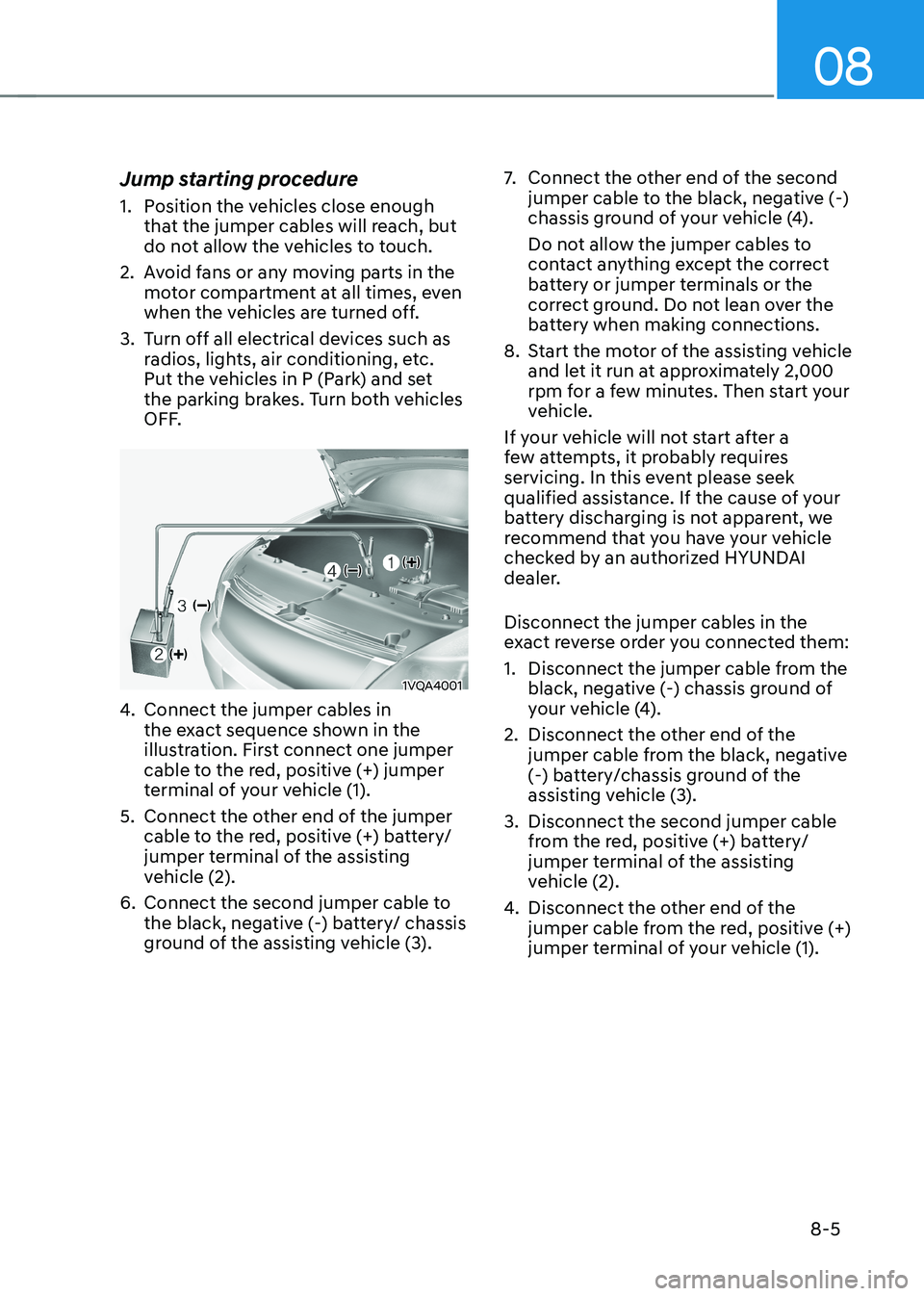
Jump starting procedure
1. Position the vehicles close enough
that the jumper cables will reach, but
do not allow the vehicles to touch.
2. Avoid fans or any moving parts in the motor compartment at all times, even
when the vehicles are turned off.
3. Turn off all electrical devices such as radios, lights, air conditioning, etc.
Put the vehicles in P (Park) and set
the parking brakes. Turn both vehicles
OFF.
1VQA4001
4. Connect the jumper cables in
the exact sequence shown in the
illustration. First connect one jumper
cable to the red, positive (+) jumper
terminal of your vehicle (1).
5. Connect the other end of the jumper cable to the red, positive (+) battery/
jumper terminal of the assisting
vehicle (2).
6. Connect the second jumper cable to the black, negative (-) battery/ chassis
ground of the assisting vehicle (3). 7.
Connect the other end of the second
jumper cable to the black, negative (-)
chassis ground of your vehicle (4).
Do not allow the jumper cables to
contact anything except the correct
battery or jumper terminals or the
correct ground. Do not lean over the
battery when making connections.
8. Start the motor of the assisting vehicle and let it run at approximately 2,000
rpm for a few minutes. Then start your
vehicle.
If your vehicle will not start after a
few attempts, it probably requires
servicing. In this event please seek
qualified assistance. If the cause of your
battery discharging is not apparent, we
recommend that you have your vehicle
checked by an authorized HYUNDAI
dealer. Disconnect the jumper cables in the
exact reverse order you connected them:
1. Disconnect the jumper cable from the black, negative (-) chassis ground of
your vehicle (4).
2. Disconnect the other end of the jumper cable from the black, negative
(-) battery/chassis ground of the
assisting vehicle (3).
3. Disconnect the second jumper cable from the red, positive (+) battery/
jumper terminal of the assisting
vehicle (2).
4. Disconnect the other end of the
jumper cable from the red, positive (+)
jumper terminal of your vehicle (1).
Page 477 of 548
9
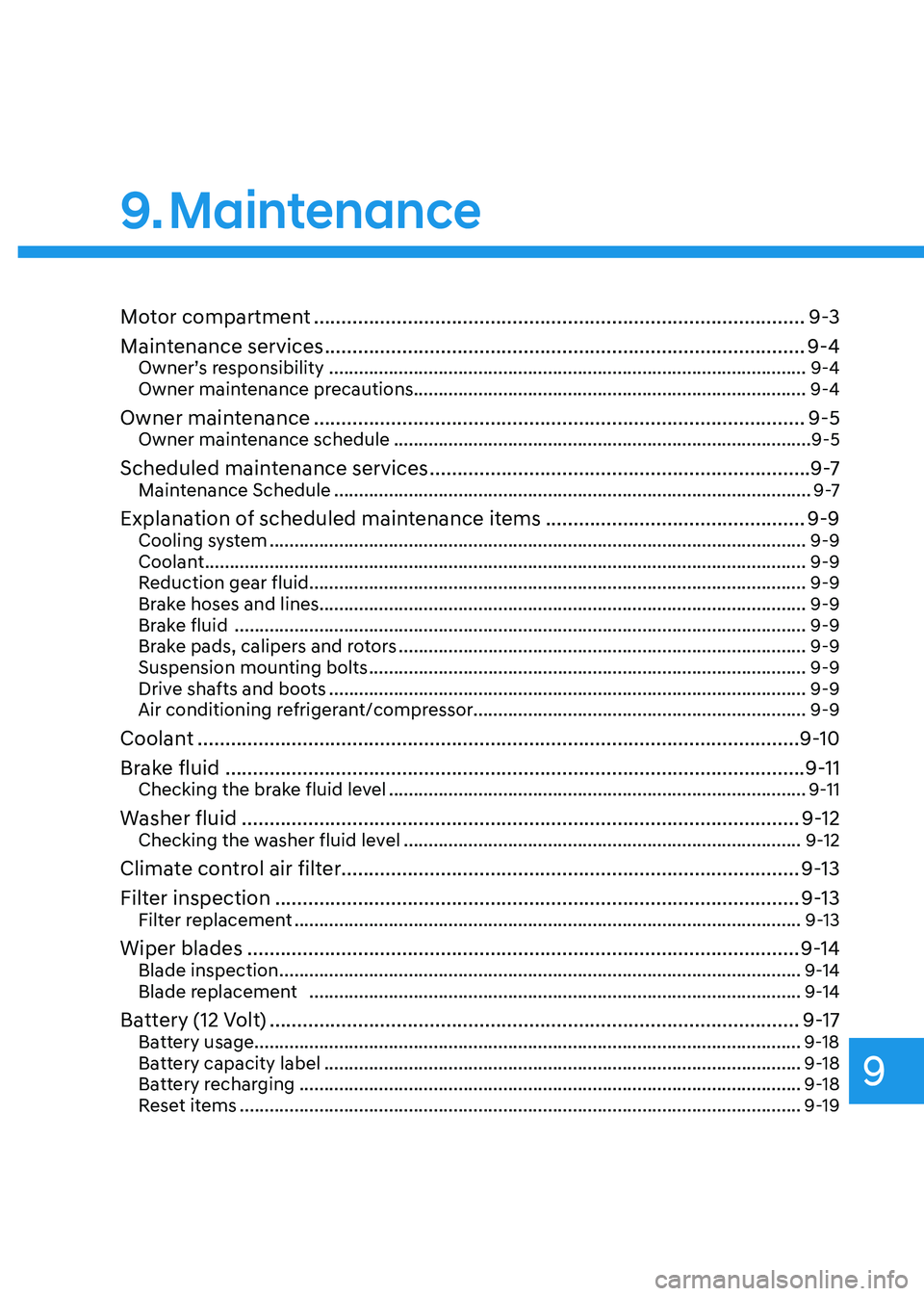
9. Maintenance
Motor compartment ......................................................................................... 9-3
Maintenance services ....................................................................................... 9-4
Owner’s responsibility ................................................................................................ 9-4
Owner maintenance precautions............................................................................... 9-4
Owner maintenance ......................................................................................... 9-5
Owner maintenance schedule .................................................................................... 9-5
Scheduled maintenance services ..................................................................... 9 -7
Maintenance Schedule ................................................................................................ 9 -7
Explanation of scheduled maintenance items ...............................................9-9
Cooling system ............................................................................................................ 9-9
Coolant ......................................................................................................................... 9-9
Reduction gear fluid.................................................................................................... 9-9
Brake hoses and lines.................................................................................................. 9-9Brake fluid ................................................................................................................... 9-9
Brake pads, calipers and rotors .................................................................................. 9-9
Suspension mounting bolts ........................................................................................ 9-9
Drive shafts and boots ................................................................................................ 9-9
Air conditioning refrigerant/compressor................................................................... 9-9
Coolant ............................................................................................................. 9-10
Brake fluid ......................................................................................................... 9-11
Checking the brake fluid level .................................................................................... 9-11
Washer fluid ..................................................................................................... 9-12
Checking the washer fluid level ................................................................................ 9-12
Climate control air filter................................................................................... 9-13
Filter inspection ............................................................................................... 9-13
Filter replacement ...................................................................................................... 9-13
Wiper blades .................................................................................................... 9-14
Blade inspection ......................................................................................................... 9-14
Blade replacement ................................................................................................... 9-14
Battery (12 Volt) ................................................................................................ 9-17
Battery usage.............................................................................................................. 9-18 Battery capacity label ................................................................................................ 9-18
Battery recharging ..................................................................................................... 9-18
Reset items ................................................................................................................. 9-19
Page 481 of 548
09
9-5
OWNER MAINTENANCE
WARNING
Performing maintenance work on a
vehicle can be dangerous. If you lack
sufficient knowledge and experience
or the proper tools and equipment to
do the work, we recommend that the
system be serviced by an authorized
HYUNDAI dealer. ALWAYS follow
these precautions for performing
maintenance work: • Park your vehicle on level ground,
shift to P (Park) position, apply the
parking brake, place the START/STOP
button in the OFF position.
• Block the tires (front and back) to
prevent the vehicle from moving.
Remove loose clothing or jewelry
that can become entangled in
moving parts.
• Keep flames, sparks, or smoking
materials away from the battery and
motor related parts.
The following lists are vehicle checks and
inspections that should be performed
by the owner or an authorized HYUNDAI
dealer at the frequencies indicated to
help ensure safe, dependable operation
of your vehicle.
Any adverse conditions should be
brought to the attention of your dealer as soon as possible.
These Owner Maintenance vehicle
checks are generally not covered by
warranties and you may be charged for
labor, parts and lubricants used.Owner maintenance schedule
When you stop for charging: • Check the coolant level in the coolant
reservoir.
• Check the windshield washer fluid
level.
• Check for low or under-inflated tires.
WARNING
Be careful when checking your coolant
level when the motor compartment is
hot. This may result in coolant being
blown out of the opening and cause
serious burns and other injuries.
Page 494 of 548
Maintenance
9-18
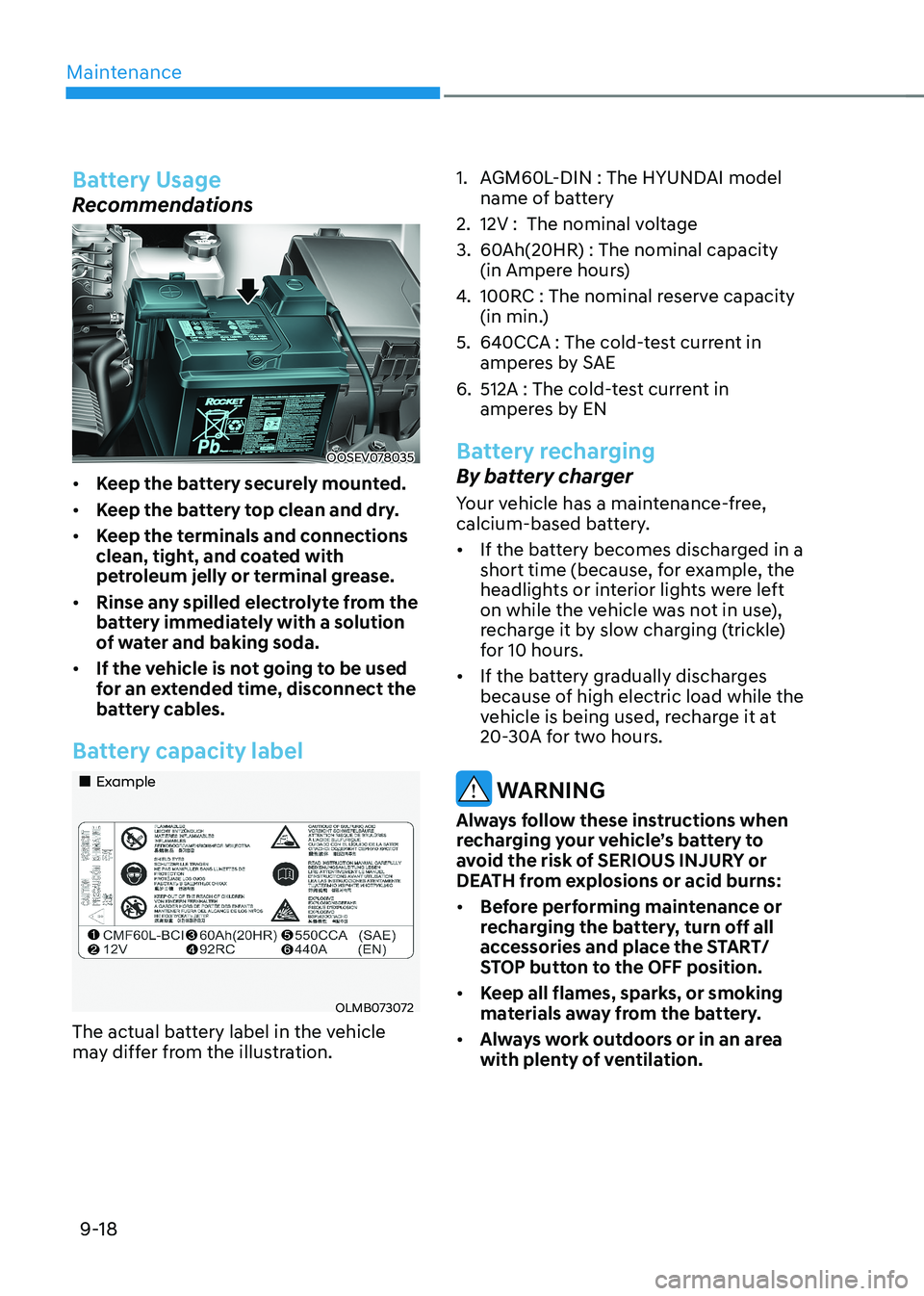
Battery Usage
Recommendations
OOSEV078035
• Keep the battery securely mounted.
• Keep the battery top clean and dry.
• Keep the terminals and connections
clean, tight, and coated with
petroleum jelly or terminal grease.
• Rinse any spilled electrolyte from the
battery immediately with a solution
of water and baking soda.
• If the vehicle is not going to be used
for an extended time, disconnect the
battery cables.
Battery capacity label
„„Example
OLMB073072
The actual battery label in the vehicle
may differ from the illustration. 1. AGM60L-DIN : The HYUNDAI model
name of battery
2. 12V : The nominal voltage
3. 60Ah(20HR) : The nominal capacity (in Ampere hours)
4. 100RC : The no minal reserve capacity
(in min.)
5. 640CCA : The cold-test current in amperes by SAE
6. 512A : The cold-test current in amperes by EN
Battery recharging
By battery charger
Your vehicle has a maintenance-free,
calcium-based battery. • If the battery becomes discharged in a
short time (because, for example, the
headlights or interior lights were left
on while the vehicle was not in use),
recharge it by slow charging (trickle)
for 10 hours.
• If the battery gradually discharges
because of high electric load while the
vehicle is being used, recharge it at
20-30A for two hours.
WARNING
Always follow these instructions when
recharging your vehicle’s battery to
avoid the risk of SERIOUS INJURY or
DEATH from explosions or acid burns: • Before performing maintenance or
recharging the battery, turn off all
accessories and place the START/
STOP button to the OFF position.
• Keep all flames, sparks, or smoking
materials away from the battery.
• Always work outdoors or in an area
with plenty of ventilation.
Page 495 of 548
09
9-19
• Wear eye protection when checking
the battery during charging.
• The battery must be removed from
the vehicle and placed in a well
ventilated area.
• Watch the battery during charging,
and stop or reduce the charging
rate if the battery cells begin boiling
violently.
• The negative battery cable must
be removed first and installed last
when the battery is disconnected.
Disconnect the battery charger in the
following order:
(1) Turn off the battery charger main
switch.
(2) Unhook the negative clamp from the negative battery terminal.
(3) Unhook the positive clamp from the positive battery terminal.
• Always use a genuine HYUNDAI
approved battery or the equivalent
specified for your vehicle when you
replace the battery. By jump starting
After a jump start from a good battery,
drive the vehicle for 20-30 minutes
before it is shutoff. The vehicle may
not restart if you shut it off before the
battery had a chance to adequately
recharge. See “Jump Starting” in chapter
8 for more information on jump starting
procedures.
Information
An inappropriately disposed of battery can be harmful to the
environment and human health.
Dispose of the battery according to your
local law(s) or regulations.
Reset items
The following items may need to be reset
after the battery has been discharged or
the battery has been disconnected. • Auto up/down window
• Sunroof
• Trip computer
• Climate control system
• Clock
• Audio system
Page 537 of 548
Index
I-2
A Accessing your vehicle .......................................................................................... 5-4
Auto door lock/unlock features ........................................................................ 5-13
Child-protector rear door locks ........................................................................ 5-14
Door locks ....................................................................................................... 5-10
Immobilizer system ............................................................................................ 5-9
Operating door locks from inside the vehicle ..................................................5-11
Operating door locks from outside the vehicle ................................................5-10
Rear Occupant Alert (ROA) ............................................................................. 5-14
Smart key .......................................................................................................... 5-4
Air bag - supplemental restraint system .............................................................. 3-42
Additional safety precautions ........................................................................... 3-64
Air bag warning labels ..................................................................................... 3-64
How does the air bags system operate? ............................................................3-47
Occupant Classification System (OCS) ...........................................................3-51
SRS care ........................................................................................................... 3-63
What to expect after an air bag inflates ............................................................3-51
Where are the air bags? .................................................................................... 3-44
Why didn’t my air bag go off in a collision? ...................................................3-57
Air conditioner compressor label......................................................................... 2-13 Air conditioning system ....................................................................................... 2-10
Appearance care................................................................................................... 9-52
Exterior care ..................................................................................................... 9-52
Interior care ...................................................................................................... 9-57
Automatic climate control system ....................................................................... 5-62
Automatic heating and air conditioning ...........................................................5-63
Manual heating and air conditioning ................................................................ 5-64
System maintenance ......................................................................................... 5-73
System operation .............................................................................................. 5-71
B
Battery (12 Volt) .................................................................................................. 9-17
Battery capacity label ....................................................................................... 9-18
Battery recharging ............................................................................................ 9-18
Battery usage .................................................................................................... 9-18
Reset items ....................................................................................................... 9-19
Page 539 of 548
Index
I-4
D
Declaration of conformity......................................................................... 2-13/7-120
Front radar ...................................................................................................... 7-120
Rear corner radar ............................................................................................ 7-122
Dimensions ............................................................................................................ 2-7
Drive mode integrated control system ................................................................. 6-38
Initial setting for each drive mode .................................................................... 6-39
Driver Attention Warning (DAW) ....................................................................... 7-54
Driver Attention Warning malfunction and limitations ....................................7-57
Driver Attention Warning operation ................................................................. 7-55
Driver Attention Warning settings ................................................................... 7-54
E Electric vehicle specifications ............................................................................... 2-7
Explanation of scheduled maintenance items ........................................................9-9
Air conditioning refrigerant/compressor ............................................................9-9
Brake fluid ......................................................................................................... 9-9
Brake hoses and lines ......................................................................................... 9-9
Brake pads, calipers and rotors .......................................................................... 9-9
Coolant ............................................................................................................... 9-9
Cooling system ................................................................................................... 9-9
Drive shafts and boots ........................................................................................ 9-9
Reduction gear fluid ........................................................................................... 9-9
Suspension mounting bolts................................................................................. 9-9
Exterior features.......................................................................................... 5-41/5-92
Charging door ................................................................................................... 5-45
Hood ................................................................................................................. 5-41
Roof rack .......................................................................................................... 5-92
Tailgate ............................................................................................................. 5-43
Exterior overview (I) ............................................................................................. 2-2
Exterior overview (II) ............................................................................................ 2-3