engine HYUNDAI SANTA FE HYBRID 2021 Owners Manual
[x] Cancel search | Manufacturer: HYUNDAI, Model Year: 2021, Model line: SANTA FE HYBRID, Model: HYUNDAI SANTA FE HYBRID 2021Pages: 598, PDF Size: 66.6 MB
Page 495 of 598

08
8-5
Jump starting procedure
Information
Your vehicle has a battery in the luggage
compartment, but when you jump start
your vehicle, use the jumper terminal in
the engine compartment.
1. Position the vehicles close enough
that the jumper cables will reach, but
do not allow the vehicles to touch.
2. Avoid fans or any moving parts in the
engine compartment at all times, even
when the vehicles are turned off.
3. Turn off all electrical devices such as
radios, lights, air conditioning, etc.
Put the vehicles in P (Park) and set the
parking brake. Turn both vehicles OFF.
4. Open the liftgate.
OTMH080011
5. Connect the jumper cables in
the exact sequence shown in the
illustration. First connect one jumper
cable to the red, positive (+) jumper
terminal of your vehicle (1).
6. Connect the other end of the jumper
cable to the red, positive (+) battery/
jumper terminal of the assisting
vehicle (2).
7. Connect the second jumper cable to
the black, negative (-) battery/ chassis
ground of the assisting vehicle (3).
8. Connect the other end of the second
jumper cable to the black, negative (-)
chassis ground of your vehicle (4).
Do not allow the jumper cables to
contact anything except the correct
battery or jumper terminals or the
correct ground. Do not lean over the
battery when making connections.
Page 496 of 598

Emergency situations
8-6
9. Start the engine of the assisting
vehicle and let it run at approximately
2,000 rpm for a few minutes. Then
start your vehicle.
10. Keep your vehicle operating for at
least 30 minutes at idle or driving to
assure your battery receives enough
charge to be able to start on its
own after the vehicle is shut off. A
complete dead battery may require
as long as 60 minutes runtime to fully
recharge it. If vehicle is run for less,
the battery may not restart.
If your vehicle will not start after a
few attempts, it probably requires
servicing. In this event please seek
qualified assistance. If the cause of your
battery discharging is not apparent, we
recommend that you have your vehicle
checked by an authorized HYUNDAI
dealer.
Disconnect the jumper cables in the
exact reverse order you connected them:
1. Disconnect the jumper cable from the
black, negative (-) chassis ground of
your vehicle (4).
2. Disconnect the other end of the
jumper cable from the black, negative
(-) battery/chassis ground of the
assisting vehicle (3).
3. Disconnect the second jumper cable
from the red, positive (+) battery/
jumper terminal of the assisting
vehicle (2).
4. Disconnect the other end of the
jumper cable from the red, positive (+)
jumper terminal of your vehicle (1).
Information
An inappropriately disposed battery can be harmful to
the environment and human
health. Dispose of the battery
according to your local law(s) or
regulations.
NOTICE
To prevent damage to your vehicle:
• Only use a 12-volt power supply
(battery or jumper system) to jump
start your vehicle.
• Do not attempt to jump start your
vehicle by push-starting.
Page 497 of 598

08
8 -7
If your temperature gauge indicates
overheating, you experience a loss of
power, or hear loud pinging or knocking,
the engine may be overheating. If this
happens, you should:
1. Pull off the road and stop as soon as it
is safe to do so.
2. Place the shift button in P (Park) and
set the parking brake
3. Make sure that there is no hot
steam gushing out of the engine
compartment. When it is safe to do
so, open the engine compartment,
and check the water-pump connector.
When the water-pump connector is
disconnected, stop the engine, re-
connect the water-pump connector,
and then re-start the engine.
4. Set the temperature and the air flow
to the maximum, and turn ON the air
conditioner.
WARNING
While the engine is running, keep hands, clothing and tools
away from the moving parts
such as the cooling fan and
drive belt to prevent serious
injury.
5. When the Service warning light ()
illuminates on the instrument cluster,
immediately stop the engine, and
we recommend that you contact an
authorized HYUNDAI dealer. When the
engine warning light (
) illuminates,
or when the coolant or hot steams
gush out of the engine compartment,
leave the engine compartment
opened, while running the engine.
This is to ventilate the engine
compartment and to cool down the
engine.
6. Check the coolant temperature
gauge on the instrument cluster to
make sure the coolant temperature is
sufficiently cooled down. Check the
coolant level. When it is insufficient,
check its connection with the radiator,
the heater hose, and the water pump
for any leakage. When there is no
leakage, add the coolant. However,
if the problems persists, such as
the illumination of the warning
lights, leakages, or the cooling-fan
malfunction, which may overheat the
engine, immediately stop the engine,
and we recommend that the vehicle
checked by an authorized HYUNDAI
dealer.
IF THE ENGINE OVERHEATS
Page 498 of 598

Emergency situations
8-8
WARNING
Never remove the engine coolant cap and/or inverter
coolant cap or the drain plug
while the engine and radiator
are hot.
Hot coolant and steam may blow out
under pressure, causing serious injury.
Turn the hybrid system off and wait until
the engine cools down. Use extreme
care when removing the engine coolant
cap and/or inverter coolant cap. Wrap
a thick towel around it, and turn it
counterclockwise slowly to the first
stop. Step back while the pressure is
released from the cooling system. When
you are sure all the pressure has been
released, press down on the cap, using
a thick towel, and continue turning
counterclockwise to remove it.
7. If you cannot find the cause of the
overheating, wait until the engine
temperature has returned to normal.
Then, if coolant has been lost,
carefully add coolant to the reservoir
to bring the fluid level in the reservoir
up to the halfway mark.
8. Proceed with caution, keeping alert
for further signs of overheating.
If overheating happens again,
we recommend that you call an
authorized HYUNDAI dealer for
assistance.
CAUTION
• Serious loss of coolant indicates a
leak in the cooling system and we
recommend the system be checked
by an authorized HYUNDAI dealer.
• When the engine overheats from
low engine coolant, suddenly adding
engine coolant may cause cracks
in the engine. To prevent damage,
add engine coolant slowly in small
quantities.
• When adding the inverter coolant,
we recommend that the vehicle
should only be serviced by trained
and certified technicians.
WARNING
Do not use water or methanol coolant or mix them with the
specified coolant.
An incorrect coolant
mixture can result in severe
malfunction or engine/hybrid
system damage.
Page 500 of 598
Emergency situations
8-10
Tire pressure monitoring system
WARNING
Over-inflation or under-inflation can
reduce tire life, adversely affect vehicle
handling, and lead to sudden tire failure
that may cause loss of vehicle control
resulting in an accident.
Each tire, including the spare (if
provided), should be checked monthly
when cold and inflated to the inflation
pressure recommended by the vehicle
manufacturer on the vehicle placard
or tire inflation pressure label. (If your
vehicle has tires of a different size than
the size indicated on the vehicle placard
or tire inflation pressure label, you should
determine the proper tire inflation
pressure for those tires.)
As an added safety feature, your
vehicle has been equipped with a tire
pressure monitoring system (TPMS)
that illuminates a low tire pressure
telltale when one or more of your tires is
significantly under-inflated. Accordingly,
when the low tire pressure telltale
illuminates, you should stop and check
your tires as soon as possible, and inflate
them to the proper pressure. Driving on
a significantly under-inflated tire causes
the tire to overheat and can lead to tire
failure.
Under-inflation also reduces fuel
efficiency and tire tread life, and may
affect the vehicle’s handling and
stopping ability.
Please note that the TPMS is not a
substitute for proper tire maintenance,
and it is the driver’s responsibility to
maintain correct tire pressure, even if
under-inflation has not reached the level
to trigger illumination of the TPMS low
tire pressure telltale.
Your vehicle has also been equipped with
a TPMS malfunction indicator to indicate
when the system is not operating
properly. The TPMS malfunction
indicator is combined with the low
tire pressure telltale. When the system
detects a malfunction, the telltale will
flash for approximately one minute and
then remain continuously illuminated.
This sequence will continue upon
subsequent vehicle start-ups as long as
the malfunction exists.
When the malfunction indicator is
illuminated, the system may not be able
to detect or signal low tire pressure as
intended. TPMS malfunctions may occur
for a variety of reasons, including the
installation of replacement or alternate
tires or wheels on the vehicle that
prevent the TPMS from functioning
properly.
Always check the TPMS malfunction
telltale after replacing one or more tires
or wheels on your vehicle to ensure that
the replacement or alternate tires and
wheels allow the TPMS to continue to
function properly.
NOTICE
If any of the below happens, we
recommend that you have the system
checked by an authorized HYUNDAI
dealer.
1. The Low Tire Pressure Telltale/TPMS
Malfunction Indicator does not
illuminate for 3 seconds when the
Engine Start/Stop button is pressed
to the ON position or when the
engine is running.
2. The TPMS Malfunction Indicator
remains illuminated after blinking for
approximately 1 minute.
3. The Low Tire Pressure Position
Telltale remains illuminated.
Page 506 of 598
Emergency situations
8-16
Changing tires
WARNING
A vehicle can slip or roll off of a jack
causing serious injury or death to you or
those nearby. Take the following safety
precautions:
• Do not get under a vehicle that is
supported by a jack.
• NEVER attempt to change a tire in
the lane of traffic. ALWAYS move the
vehicle completely off the road on
level, firm ground away from traffic
before trying to change a tire. If you
cannot find a level, firm place off
the road, call a towing service for
assistance.
• Be sure to use the jack provided with
the vehicle.
• ALWAYS place the jack on the
designated jacking positions on the
vehicle and NEVER on the bumpers
or any other part of the vehicle for
jacking support.
• Do not start or run the engine while
the vehicle is on the jack.
• Do not allow anyone to remain in the
vehicle while it is on the jack.
• Keep children away from the road
and the vehicle. Follow these steps to change your
vehicle’s tire:
1. Park on a level, firm surface.
2. Move the shift button into P (Park),
apply the parking brake, and place
the ignition switch in the LOCK/OFF
position.
3. Press the hazard warning flasher
button.
4. Remove the wheel lug nut wrench,
jack, jack handle, and spare tire from
the vehicle.
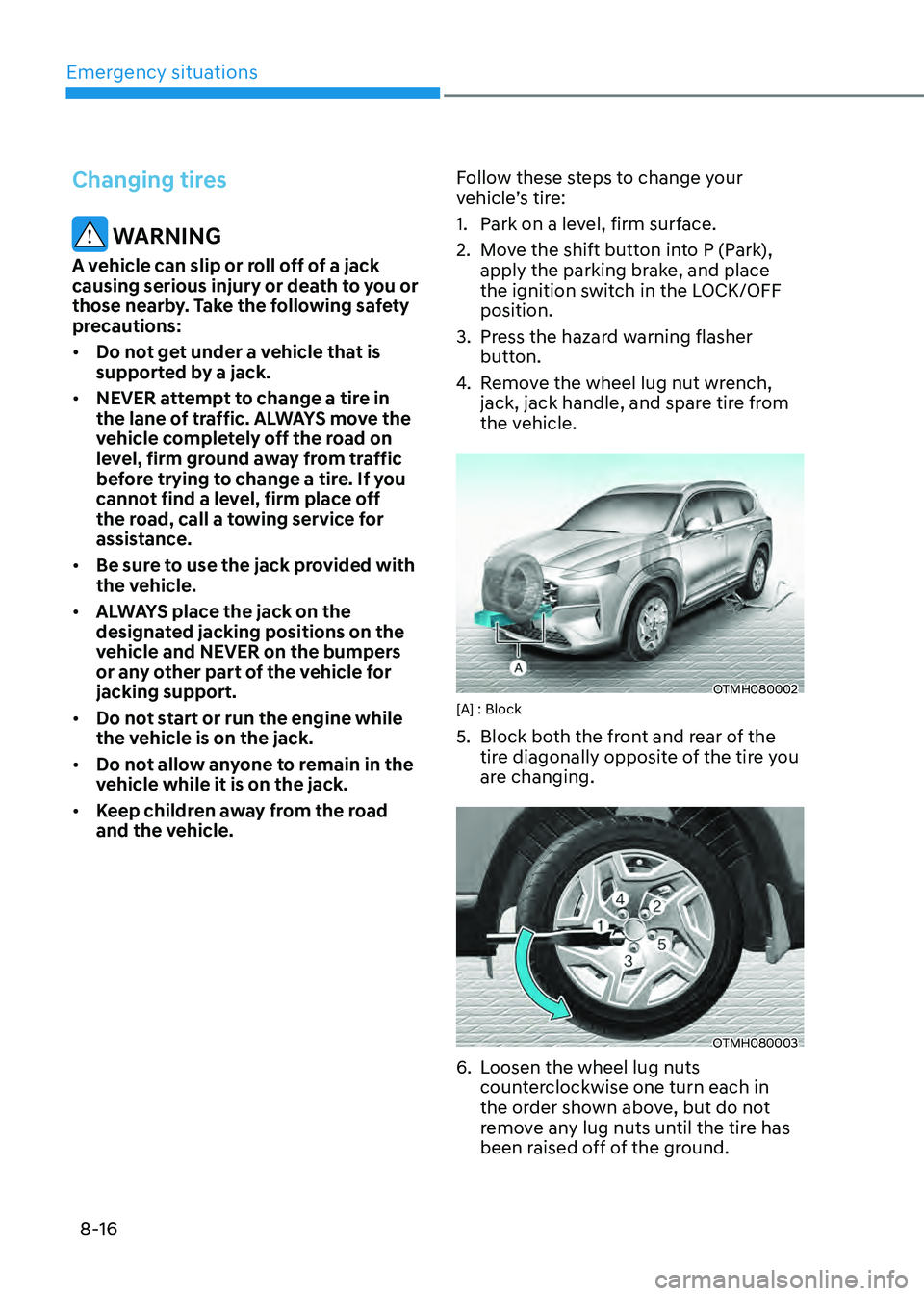
OTMH080002[A] : Block
5. Block both the front and rear of the
tire diagonally opposite of the tire you
are changing.
OTMH080003
6. Loosen the wheel lug nuts
counterclockwise one turn each in
the order shown above, but do not
remove any lug nuts until the tire has
been raised off of the ground.
Page 510 of 598

Emergency situations
8-20
Jack label
OOS067043
The actual Jack label in the vehicle may differ from the illustration.
For more detailed specifications, refer to the label attached to the jack.
1. Model Name
2. Maximum allowable load
3. When using the jack, set your parking brake.
4. When using the jack, stop the engine.
5. Do not get under a vehicle that is supported by a jack.
6. The designated locations under the frame
7. When supporting the vehicle, the base plate of jack must be vertical under the
lifting point.
8. Shift into Reverse gear on vehicles with manual transmission or shift the gear to the
P position on vehicles with automatic transmission.
9. The jack should be used on firm level ground.
10. Jack manufacture
11. Production date
12. Representative company and address
Page 511 of 598

08
8-21
Towing service
OTMH080014[A] : Dollies
If emergency towing is necessary,
we recommend having it done by
an authorized HYUNDAI dealer or a
commercial tow-truck service.
Proper lifting and towing procedures
are necessary to prevent damage to
the vehicle. The use of wheel dollies or
flatbed is recommended.
It is acceptable to tow the vehicle with
the rear wheels on the ground (without
dollies) and the front wheels off the
ground.
If any of the loaded wheels or suspension
components are damaged or the vehicle
is being towed with the front wheels on
the ground, use a towing dolly under the
front wheels.
When being towed by a commercial tow
truck and wheel dollies are not used,
the front of the vehicle should always be
lifted, not the rear.
CAUTION
OTM080013
• Do not tow with sling-type
equipment. Use wheel lift or flatbed
equipment.
OTMH080009
• Do not tow the vehicle with the front
wheels on the ground as this may
cause damage to the vehicle.
When towing your vehicle in an
emergency without wheel dollies:
• Vehicle without EPB
1. Place the ignition switch in the ACC
position.
2. Place the shift button in N (Neutral).
3. Release the parking brake.
• Vehicle with EPB
1. Release EPB before turning off the
engine.
2. Place the ignition switch to the OFF
position.
3. Change the gear to N (Neutral) while
pressing the brake pedal.
4. Place the ignition switch to the ACC
position.
CAUTION
Failure to place the shift button in N
(Neutral) may cause internal damage to
the transmission.
TOWING
Page 516 of 598

9. Maintenance
Engine compartment ........................................................................\
................9-3
Maintenance services
........................................................................\
...............9-4Owner’s responsibility ........................................................................\
........................9-4
Owner maintenance precautions ........................................................................\
....... 9-4
Owner maintenance ........................................................................\
.................9-5Owner maintenance schedule ........................................................................\
............9-5
Scheduled maintenance services .....................................................................9 -7Normal Maintenance Schedule ........................................................................\
..........9-8
Maintenance under severe usage conditions ..........................................................9-11
Explanation of scheduled maintenance items ..............................................9-13
Engine oil
........................................................................\
..................................9-15Checking the engine oil level ........................................................................\
............9-15
Checking the engine oil and filter ........................................................................\
.....9-16
Engine coolant/inverter coolant .....................................................................9-17Checking the coolant level ........................................................................\
.................9-17
Changing coolant ........................................................................\
...............................9-19
Hybrid Starter & Generator (HSG) belt ..........................................................9-20Checking the Hybrid Starter & Generator (HSG) belt .............................................9-20
Brake fluid ........................................................................\
...............................9-20Checking the brake fluid level ........................................................................\
..........9-20
Washer fluid ........................................................................\
.............................9-21Checking the washer fluid level ........................................................................\
........9-21
Air cleaner ........................................................................\
...............................9-22Filter replacement ........................................................................\
..............................9-22
Cabin air filter ........................................................................\
..........................9-23Filter inspection ........................................................................\
..................................9-23
Filter replacement ........................................................................\
..............................9-23
Wiper blades ........................................................................\
...........................9-24Blade inspection ........................................................................\
.................................9-24
Blade replacement
........................................................................\
.............................9-24
Battery ........................................................................\
......................................9-27For best battery service ........................................................................\
.....................9-28
Battery capacity label ........................................................................\
........................9-29
Battery recharging ........................................................................\
.............................9-29
Reset items ........................................................................\
........................................9-30
Maintenance
9
Page 517 of 598

Tires and wheels ........................................................................\
......................9-31Tire care ........................................................................\
..............................................9-31
Recommended cold tire inflation pressures ............................................................9-31
Check tire inflation pressure ........................................................................\
.............9-32
Tire rotation ........................................................................\
........................................9-33
Wheel alignment and tire balance ........................................................................\
....9-34
Tire replacement ........................................................................\
................................9-34
Wheel replacement ........................................................................\
............................9-35
Tire traction ........................................................................\
........................................9-35
Tire maintenance ........................................................................\
...............................9-35
Tire sidewall labeling ........................................................................\
..........................9-36
Low aspect ratio tires ........................................................................\
.........................9-39
Fuses ........................................................................\
........................................9-40Instrument panel fuse replacement ........................................................................\
.9-41
Engine compartment panel fuse replacement .......................................................9-42
Fuse/relay panel description ........................................................................\
............9-43
Light bulbs ........................................................................\
................................9-51Headlamp, position lamp, turn signal lamp, Daytime Running Light (DRL)
replacement ........................................................................\
.......................................9-52
Side repeater lamp replacement ........................................................................\
......9-53
Rear combination lamp replacement ......................................................................9-54
High mounted stop lamp replacement ....................................................................9-57
License plate lamp replacement ........................................................................\
.......9-57
Interior light replacement ........................................................................\
..................9-57
Appearance care ........................................................................\
.....................9-59Exterior care ........................................................................\
......................................9-59
Interior care ........................................................................\
.......................................9-63
Emission control system ........................................................................\
......... 9-66
California perchlorate notice
........................................................................\
.9-70
9