Water Hyundai Terracan 2003 Service Manual
[x] Cancel search | Manufacturer: HYUNDAI, Model Year: 2003, Model line: Terracan, Model: Hyundai Terracan 2003Pages: 349, PDF Size: 4.56 MB
Page 230 of 349
CONTROLS AND EQUIPMENT
1- 36
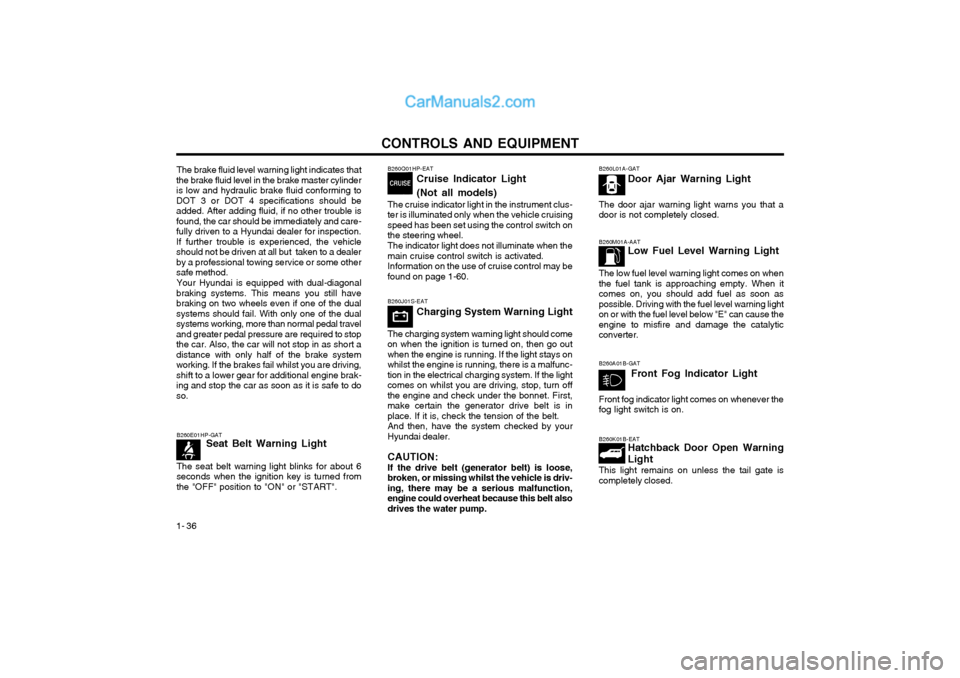
B260M01A-AAT Low Fuel Level Warning Light
The low fuel level warning light comes on when the fuel tank is approaching empty. When itcomes on, you should add fuel as soon aspossible. Driving with the fuel level warning lighton or with the fuel level below "E" can cause theengine to misfire and damage the catalyticconverter. B260K01B-EAT Hatchback Door Open Warning Light
This light remains on unless the tail gate is completely closed.
B260E01HP-GAT
Seat Belt Warning Light
The seat belt warning light blinks for about 6seconds when the ignition key is turned fromthe "OFF" position to "ON" or "START".
B260L01A-GAT Door Ajar Warning Light
The door ajar warning light warns you that a door is not completely closed.
B260A01B-GAT Front Fog Indicator Light
Front fog indicator light comes on whenever the fog light switch is on.
B260J01S-EAT Charging System Warning Light
The charging system warning light should come
on when the ignition is turned on, then go out when the engine is running. If the light stays onwhilst the engine is running, there is a malfunc-tion in the electrical charging system. If the lightcomes on whilst you are driving, stop, turn offthe engine and check under the bonnet. First,make certain the generator drive belt is inplace. If it is, check the tension of the belt. And then, have the system checked by your
Hyundai dealer.
CAUTION: If the drive belt (generator belt) is loose,
broken, or missing whilst the vehicle is driv- ing, there may be a serious malfunction,engine could overheat because this belt alsodrives the water pump.
B260Q01HP-EAT
Cruise Indicator Light (Not all models)
The cruise indicator light in the instrument clus- ter is illuminated only when the vehicle cruisingspeed has been set using the control switch onthe steering wheel. The indicator light does not illuminate when the main cruise control switch is activated.Information on the use of cruise control may befound on page 1-60.
The brake fluid level warning light indicates that
the brake fluid level in the brake master cylinderis low and hydraulic brake fluid conforming toDOT 3 or DOT 4 specifications should beadded. After adding fluid, if no other trouble isfound, the car should be immediately and care-fully driven to a Hyundai dealer for inspection.If further trouble is experienced, the vehicleshould not be driven at all but taken to a dealerby a professional towing service or some othersafe method.
Your Hyundai is equipped with dual-diagonal
braking systems. This means you still havebraking on two wheels even if one of the dualsystems should fail. With only one of the dualsystems working, more than normal pedal traveland greater pedal pressure are required to stopthe car. Also, the car will not stop in as short adistance with only half of the brake systemworking. If the brakes fail whilst you are driving,shift to a lower gear for additional engine brak-ing and stop the car as soon as it is safe to doso.
Page 232 of 349
CONTROLS AND EQUIPMENT
1- 38 B270A01A-EAT BRAKE PAD WEAR WARNING SOUND (Not all models) The front disc brake pads have wear indicators that should make a high-pitched squealing orscraping noise when new pads are needed.The sound may come and go or be heard all thetime when the vehicle is moving. It may also beheard when the brake pedal is pushed downfirmly. Excessive rotor damage will result if theworn pads are not replaced. See your Hyundaidealer immediately.
NOTE: If the engine were not started within 2 sec- onds after the preheating is completed, turnthe ignition key once more to the "LOCK"position during 10 seconds, and then to the"ON" position, in order to preheat again.
it to a complete stop in a safe location off theroadway. After starting the engine, do not drive the vehi- cle until the vacuum level is above 275 mmHgbelow atmosphere and warning light has turnedoff. If further trouble is experienced, the vehicleshould not be driven at all but taken to a dealerby a professional towing service. B265C02HP-EAT
Diesel Preheat Indication Light-amber
The indication light illuminates amber when the
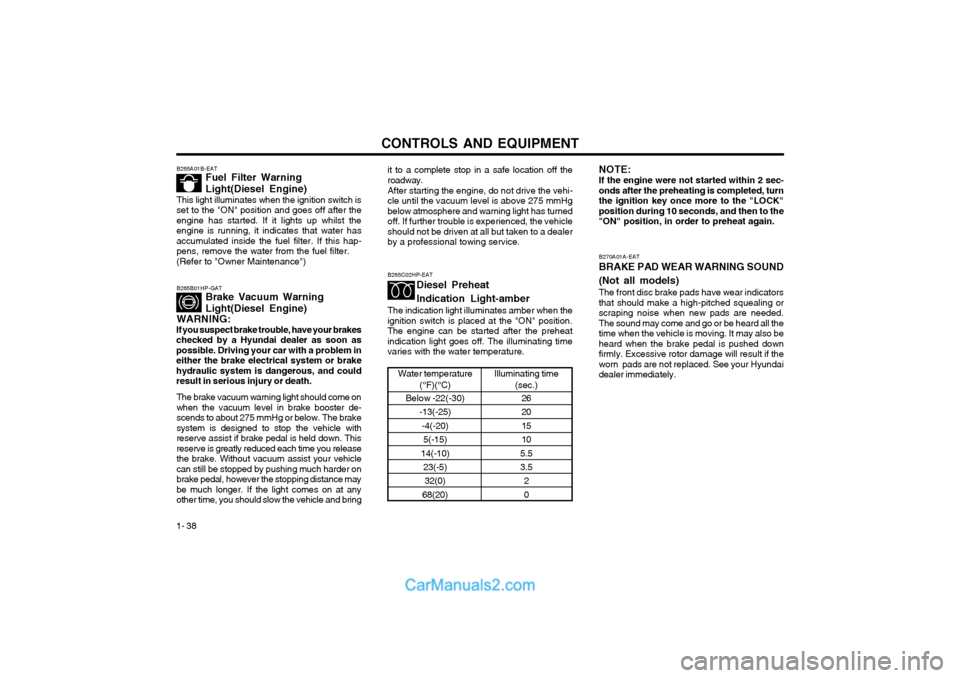
ignition switch is placed at the "ON" position. The engine can be started after the preheatindication light goes off. The illuminating timevaries with the water temperature.
B265A01B-EAT Fuel Filter Warning Light(Diesel Engine)
This light illuminates when the ignition switch is set to the "ON" position and goes off after theengine has started. If it lights up whilst theengine is running, it indicates that water hasaccumulated inside the fuel filter. If this hap-pens, remove the water from the fuel filter. (Refer to "Owner Maintenance") B265B01HP-GAT Brake Vacuum Warning Light(Diesel Engine)
WARNING:
If you suspect brake trouble, have your brakes checked by a Hyundai dealer as soon aspossible. Driving your car with a problem ineither the brake electrical system or brakehydraulic system is dangerous, and couldresult in serious injury or death.
The brake vacuum warning light should come onwhen the vacuum level in brake booster de-scends to about 275 mmHg or below. The brakesystem is designed to stop the vehicle withreserve assist if brake pedal is held down. Thisreserve is greatly reduced each time you releasethe brake. Without vacuum assist your vehiclecan still be stopped by pushing much harder onbrake pedal, however the stopping distance maybe much longer. If the light comes on at anyother time, you should slow the vehicle and bring
Water temperature (°F)(°C)
Below -22(-30)
-13(-25)-4(-20)
5(-15)
14(-10) 23(-5)32(0)
68(20) Illuminating time
(sec.)
26 201510
5.53.5 20
Page 233 of 349
CONTROLS AND EQUIPMENT1- 39
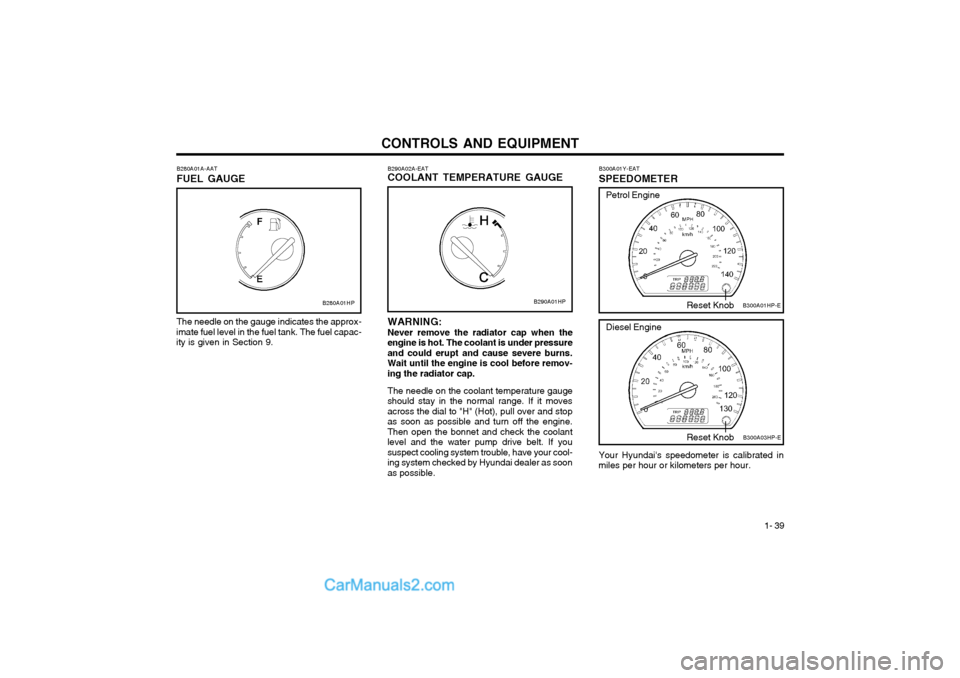
B300A01Y-EAT SPEEDOMETER Your Hyundai's speedometer is calibrated in
miles per hour or kilometers per hour. B300A03HP-EB290A02A-EAT COOLANT TEMPERATURE GAUGE WARNING: Never remove the radiator cap when the
engine is hot. The coolant is under pressure and could erupt and cause severe burns.Wait until the engine is cool before remov-ing the radiator cap.
The needle on the coolant temperature gauge
should stay in the normal range. If it movesacross the dial to "H" (Hot), pull over and stopas soon as possible and turn off the engine.Then open the bonnet and check the coolantlevel and the water pump drive belt. If yoususpect cooling system trouble, have your cool-ing system checked by Hyundai dealer as soonas possible.
B280A01A-AAT FUEL GAUGE The needle on the gauge indicates the approx-
imate fuel level in the fuel tank. The fuel capac- ity is given in Section 9.
B280A01HPB290A01HP
Petrol Engine
Reset Knob
B300A01HP-E
Diesel EngineReset Knob
Page 238 of 349
CONTROLS AND EQUIPMENT
1- 44
OB140A1-E VARIABLE INTERMITTENT WIPEFACILITY HXG198J
The variable intermittent wipe facility is operat-
ed by moving the windscreen wiper switch to the first position. The time period between wipesis adjusted by moving the rotary control on thewindscreen wiper switch barrel. This is alsovaried automatically depending on your roadspeed. NOTE:
o In icy or freezing weather, be sure the wiper blades are not frozen to the glassprior to operating the wipers.
o In areas where water freezes in winter, use windscreen washer antifreeze.
B390A01HP-EAT REAR WINDOW WIPER AND WASHER (Not all models)
B390A01HP.DAG
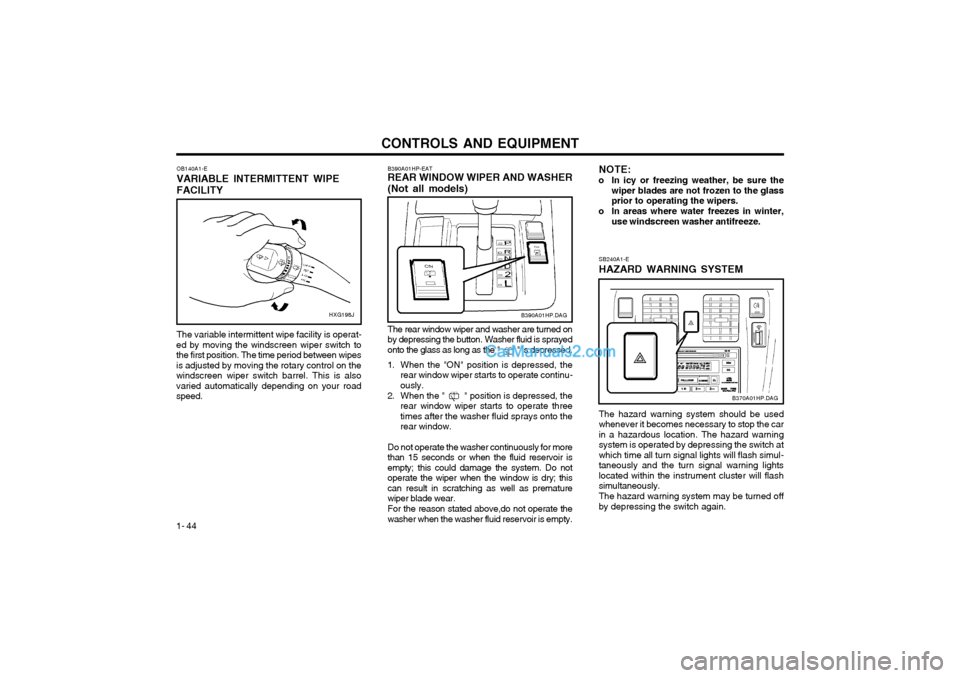
The rear window wiper and washer are turned on by depressing the button. Washer fluid is sprayedonto the glass as long as the " " is depressed.
1. When the "ON" position is depressed, the rear window wiper starts to operate continu-ously.
2. When the " " position is depressed, the rear window wiper starts to operate threetimes after the washer fluid sprays onto therear window.
Do not operate the washer continuously for morethan 15 seconds or when the fluid reservoir isempty; this could damage the system. Do notoperate the wiper when the window is dry; thiscan result in scratching as well as prematurewiper blade wear. For the reason stated above,do not operate the washer when the washer fluid reservoir is empty.
SB240A1-E HAZARD WARNING SYSTEM
B370A01HP.DAG
The hazard warning system should be used whenever it becomes necessary to stop the carin a hazardous location. The hazard warningsystem is operated by depressing the switch atwhich time all turn signal lights will flash simul-taneously and the turn signal warning lightslocated within the instrument cluster will flashsimultaneously. The hazard warning system may be turned off by depressing the switch again.
Page 243 of 349
CONTROLS AND EQUIPMENT1- 49
panel and the vehicle body whilst the sunroof is being closed.
o Do not stand up or extend any portion of your body out of the opening whilst thevehicle is moving.
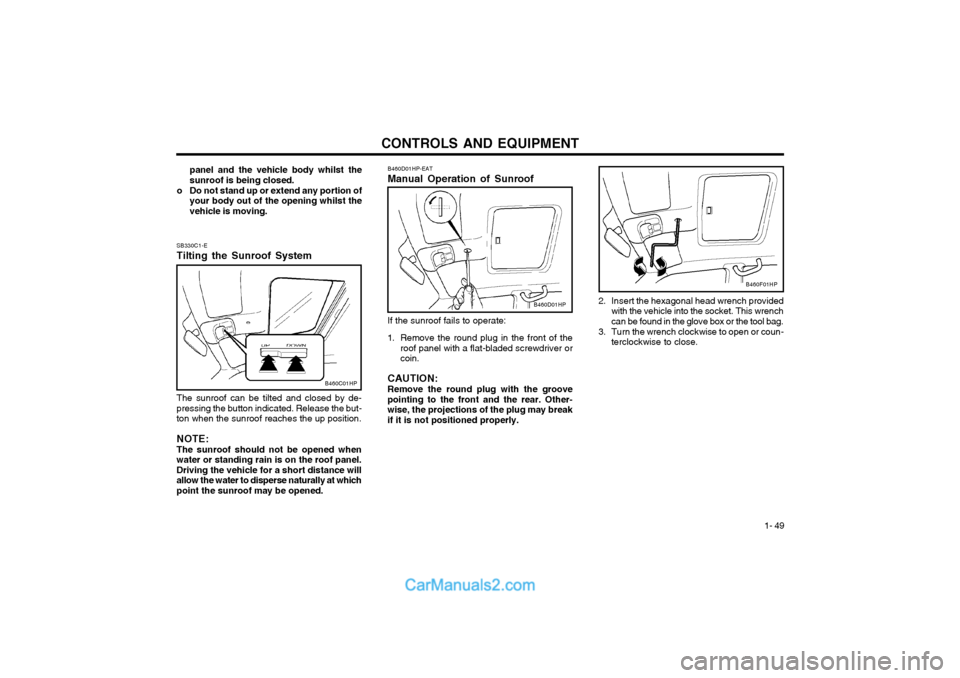
SB330C1-E Tilting the Sunroof System The sunroof can be tilted and closed by de- pressing the button indicated. Release the but-ton when the sunroof reaches the up position. NOTE: The sunroof should not be opened when water or standing rain is on the roof panel.Driving the vehicle for a short distance willallow the water to disperse naturally at whichpoint the sunroof may be opened. B460D01HP-EAT Manual Operation of Sunroof If the sunroof fails to operate:
1. Remove the round plug in the front of the roof panel with a flat-bladed screwdriver or coin.
CAUTION: Remove the round plug with the groove
pointing to the front and the rear. Other-wise, the projections of the plug may breakif it is not positioned properly.
B460C01HP
B460D01HP 2. Insert the hexagonal head wrench provided
with the vehicle into the socket. This wrench can be found in the glove box or the tool bag.
3. Turn the wrench clockwise to open or coun- terclockwise to close.
B460F01HP
Page 273 of 349
DRIVING YOUR HYUNDAI
2- 2 C020A01A-EAT
BEFORE STARTING THE ENGINE
Before you start the engine, you should always:
1. Look around the vehicle to be sure there are no flat tyres, puddles of oil or water or other indications of possible trouble.
2. After entering the car, check to be sure the parking brake is engaged.
3. Check that all windows, and lights are clean.
4. Check that the interior and exterior mirrors are clean and in position.
5. Check your seat, seatback and headrest to be sure they are in their proper positions.
6. Close all the doors.
7. Fasten your seat belt and be sure that all other occupants have fastened theirs.
8. Turn off all lights and accessories that are not needed.
9. When you turn the ignition switch to "ON" check that all appropriate warning lights are operating and that you have sufficient fuel.
10.Check the operation of warning lights and all bulbs when key is in the "ON" position. C030A01HP-EAT COMBINATION IGNITION SWITCH AND STEERING LOCK To Start the Engine
o If your Hyundai is equipped with a manual
transmission, place the shift lever in neutral and depress the clutch pedal fully.
o If your Hyundai has an automatic transmis- sion, place the shift lever in "P" (park).
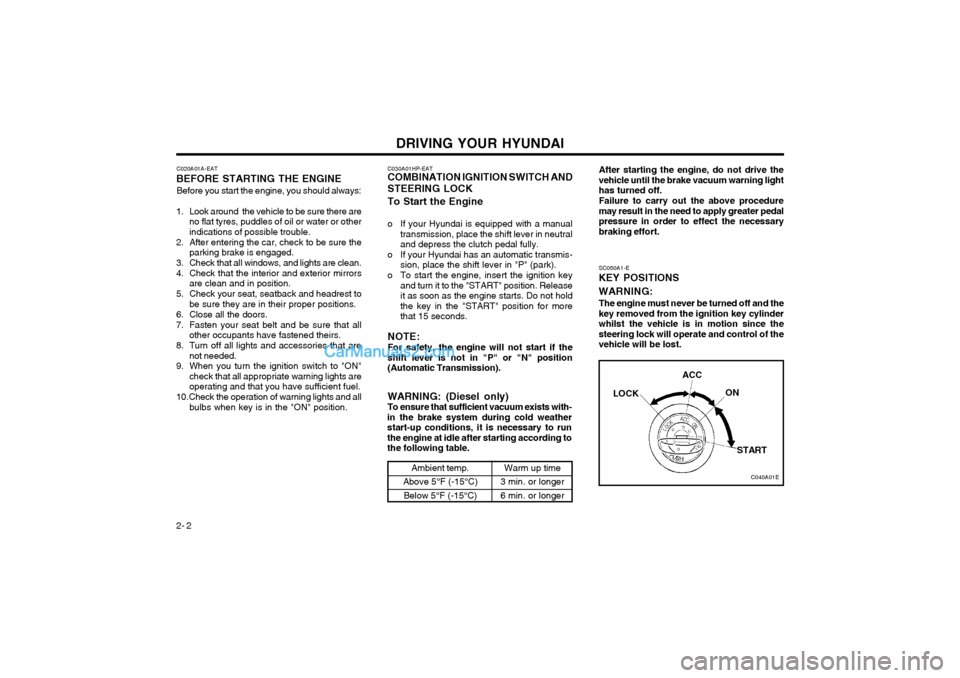
o To start the engine, insert the ignition key and turn it to the "START" position. Releaseit as soon as the engine starts. Do not holdthe key in the "START" position for morethat 15 seconds.
NOTE: For safety, the engine will not start if the shift lever is not in "P" or "N" position(Automatic Transmission). SC050A1-E
KEY POSITIONS WARNING:
The engine must never be turned off and the key removed from the ignition key cylinderwhilst the vehicle is in motion since thesteering lock will operate and control of thevehicle will be lost.
C040A01E
LOCK
ACC
ON
START
WARNING: (Diesel only) To ensure that sufficient vacuum exists with-
in the brake system during cold weatherstart-up conditions, it is necessary to runthe engine at idle after starting according tothe following table.
Ambient temp.
Above 5°F (-15°C) Below 5°F (-15°C)Warm up time
3 min. or longer 6 min. or longer After starting the engine, do not drive the vehicle until the brake vacuum warning lighthas turned off. Failure to carry out the above procedure may result in the need to apply greater pedalpressure in order to effect the necessarybraking effort.
Page 282 of 349
DRIVING YOUR HYUNDAI 2- 11
o Check your brake condition once you areout of mud or water. Press the brake several times as you move slowly until your feelnormal braking forces return.
o Four-wheel driving on flat and normal roads can result in a severe binding conditionwhen turning the steering wheel.
Driving on dry paved road and high- way Select the 2H(2WD) to drive on dry paved roads. Especially on dry highway, never selectthe 4H or 4L(4WD).
Driving on snowy or icy roads Select the 4H or 4L in accordance with the roadconditions, and then gradually depress the ac-celerator pedal for a smooth start.
Driving on sandy or muddy roads Select the 4H or 4L and then gradually depressthe accelerator pedal for a smooth start. Keepthe pressure on the accelerator pedal constantas possible, and drive at low speed.
Climbing sharp grades Select the 4L to maximize use the engine torque.
Descending sharp grades Select the 4L, use the engine brake and de-scend slowly. Driving in Water
Select the 4L mode and drive through slowly. The maximum advisable wading depth is ap- proximately 40cm.Before driving through water, such as whencrossing shallow streams, first check the depthof the water and the bottom of the river bed forfirmness. Drive slowly at the speed of 3mph(5 km/h) and avoid deep water. Take all necessary safety measures to ensure that water damage to the engine or other ve-hicle parts does not occur. Water entering the engine air intake will cause severe engine damage. Water can wash the grease from wheel bear- ings, causing rusting and premature failure, andmay also enter the axles, transmission andtransfer case, reducing the gear oil's lubricatingqualities.C355A02HP-EAT
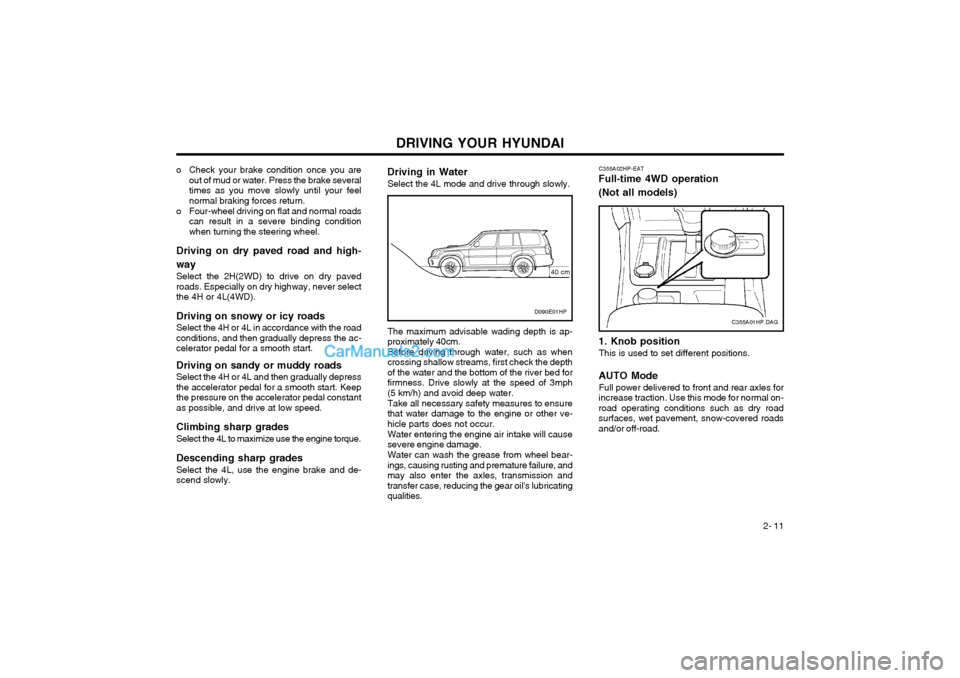
Full-time 4WD operation (Not all models) 1. Knob position
This is used to set different positions.
AUTO Mode Full power delivered to front and rear axles for
increase traction. Use this mode for normal on- road operating conditions such as dry roadsurfaces, wet pavement, snow-covered roadsand/or off-road.
C355A01HP.DAGD090E01HP
40 cm
Page 283 of 349
DRIVING YOUR HYUNDAI
2- 12 Driving 4WD Safely
(1) Be sure to wear the seat belt.
(2) Drive at lower speeds in strong crosswinds.
Because of your vehicle's high centre of gravity, its stability will be affected in cross-winds. Slower speeds ensure better vehiclecontrol.
(3) Check the brake condition after driving in wet or muddy conditions. Press the brakeseveral times as you move slowly until youfeel normal braking forces return.
(4) Do not drive the vehicle through water. (i.e. streams, rivers, lakes, etc.)
(5) The stopping distance of the full-time 4WD vehicle differs very little from that of the2WD vehicle.
When driving on a snow-covered road or a slippery, muddy surface, make sure thatyou keep a sufficient distance between yourvehicle and the one ahead of you.
(6) Since the driving torque is always applied to the 4 wheels, the performance of the full-time 4WD vehicle is greatly affected by thecondition of the tyres. Be sure to equip itwith all four tyres of the same size and type.o When replacement of any of the tyres or disc wheels is necessary, replace all ofthem.
o Rotate the tyres and check the tyre pres- sure at regular intervals.
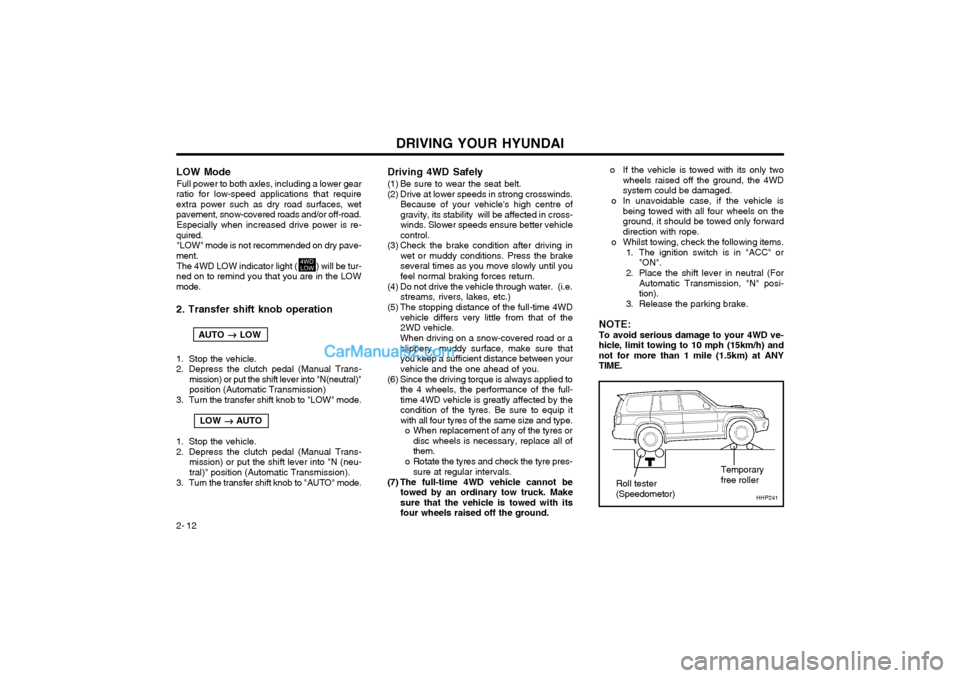
(7) The full-time 4WD vehicle cannot be towed by an ordinary tow truck. Makesure that the vehicle is towed with itsfour wheels raised off the ground. o If the vehicle is towed with its only two
wheels raised off the ground, the 4WDsystem could be damaged.
o In unavoidable case, if the vehicle is being towed with all four wheels on theground, it should be towed only forwarddirection with rope.
o Whilst towing, check the following items.
1. The ignition switch is in "ACC" or"ON".
2. Place the shift lever in neutral (For Automatic Transmission, "N" posi-tion).
3. Release the parking brake.
NOTE: To avoid serious damage to your 4WD ve- hicle, limit towing to 10 mph (15km/h) andnot for more than 1 mile (1.5km) at ANYTIME.
HHP241
Roll tester (Speedometor) Temporaryfree roller
LOW Mode
Full power to both axles, including a lower gear
ratio for low-speed applications that require extra power such as dry road surfaces, wetpavement, snow-covered roads and/or off-road.
Especially when increased drive power is re-
quired. "LOW" mode is not recommended on dry pave-
ment.
The 4WD LOW indicator light ( ) will be tur-
ned on to remind you that you are in the LOWmode. 2. Transfer shift knob operation
AUTO
LOW
1. Stop the vehicle.
2. Depress the clutch pedal (Manual Trans- mission) or put the shift lever into "N(neutral)"position (Automatic Transmission)
3. Turn the transfer shift knob to "LOW" mode.
LOW
AUTO
1. Stop the vehicle.
2. Depress the clutch pedal (Manual Trans- mission) or put the shift lever into "N (neu-tral)" position (Automatic Transmission).
3. Turn the transfer shift knob to "AUTO" mode.
Page 284 of 349
DRIVING YOUR HYUNDAI 2- 13
Driving on dry paved road and high- way
Select the AUTO to drive on dry paved roads.
Especially on dry highway, never select the LOW. Driving on snowy or icy roads
Select the AUTO or LOW in accordance with
the road conditions, and then gradually depress the accelerator pedal for a smooth start. Driving on sandy or muddy roads
Select the LOW and then gradually depress the
accelerator pedal for a smooth start. Keep the pressure on the accelerator pedal constant aspossible, and drive at low speed. Climbing sharp grades
Select the LOW to maximize use the engine
torque.Descending sharp grades
Select the LOW, use the engine brake and
descend slowly.
(8) For speedometer test or inspection/mainte- nance (I/M) program of full-time 4WD ve- hicle, use a four-wheel chassis dynamom-eter.
CAUTION: Never engage the parking brake whilst per-
forming these tests.
o In rare cases when it's unavoidable that a 4WD vehicle is to be inspected for speed- ometer test on 2WD roll tester, strictly followthe procedures next.
1. Check the tyre pressures recommended for your vehicle.
2. Place the rear wheels on the roll tester for speedometer test as shown in theillustration.
3. Release the parking brake.
4. Place the front wheels on the temporary free roller as shown in the illustration.
WARNING:Keep away from the front of the vehicle
whilst inspecting. This is very dangerous as the vehicle can jump forward and causeserious injury or death.
(9) When using tyre chains, always attach them to the rear wheels.
(10) I f the front or rear wheels get stuck in the
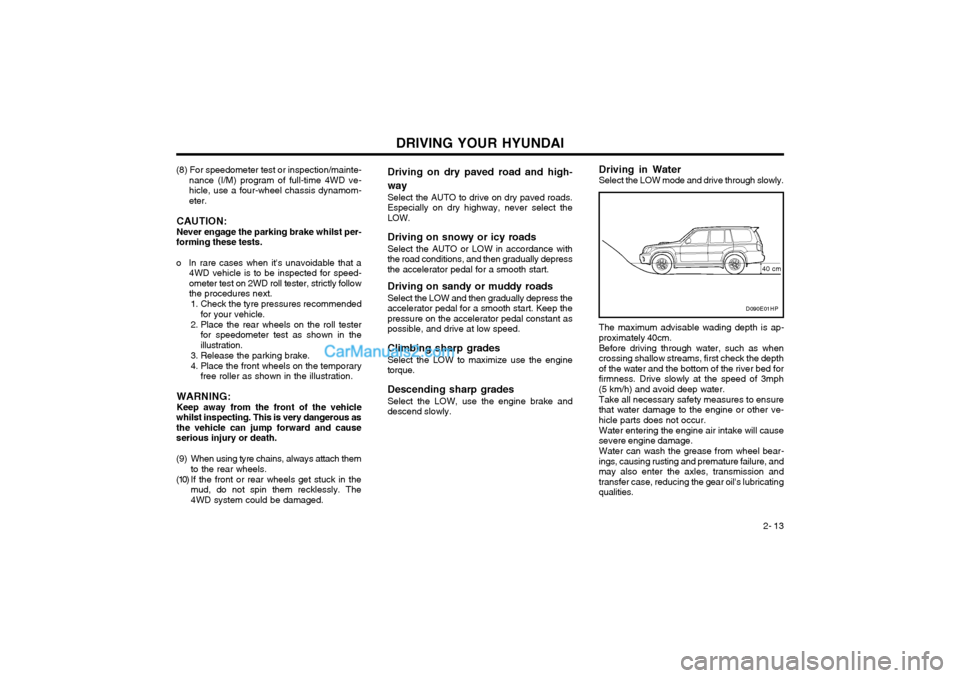
mud, do not spin them recklessly. The 4WD system could be damaged. Driving in Water Select the LOW mode and drive through slowly.
D090E01HP
The maximum advisable wading depth is ap-
proximately 40cm.
Before driving through water, such as when
crossing shallow streams, first check the depth of the water and the bottom of the river bed forfirmness. Drive slowly at the speed of 3mph(5 km/h) and avoid deep water.
Take all necessary safety measures to ensure
that water damage to the engine or other ve-hicle parts does not occur.
Water entering the engine air intake will cause
severe engine damage.
Water can wash the grease from wheel bear-
ings, causing rusting and premature failure, andmay also enter the axles, transmission andtransfer case, reducing the gear oil's lubricatingqualities.
40 cm
Page 285 of 349
DRIVING YOUR HYUNDAI
2- 14 D190A01O-EAT
LIMITED-SLIP DIFFERENTIAL (Not all models)
A limited-slip differential, if equipped, is for the
rear wheel differential only. The features of this limited-slip differential are described below:
Just as with a conventional differential, the
wheel on one side is allowed to turn at adifferent speed from the wheel on the other sidewhen the vehicle is cornering. The differencebetween the limited-slip differential and a con-ventional differential is that if the wheel on oneside of the vehicle loses traction, a greateramount of torque is applied to the rear wheel onthe other side to improve traction.
SC140A1-E
EFFECTIVE BRAKING Braking system performance and friction mate-rial life are greatly affected by the driving styleadopted. The following suggestions are madeto assist in achieving the best results from thebraking system.
o Anticipate the road and conditions ahead in order that heavy braking may be avoided.
o When descending long gradients, use the engine to assist in retarding the vehicle tominimize the possibility of brake fade occur-ring. o When trailer towing, ensure that the trailer
brakes function correctly and use enginebraking to assist the vehicle braking system.
o Use only genuine Hyundai replacement brake pads and shoes to ensure consistentfriction characteristics and wear rates.
o After driving through deep water (e.g. fording), the brakes may become wet andperformance reduced. Always check brakeefficiency after emerging from the water anddry the brakes by lightly depressing thebrake pedal several times whilst driving slow-ly.
o Apply the parking brake only when the vehi- cle is at rest.
o Since the power assistance provided by the brake servo is derived from the engine,coasting with the engine turned off or towingof the vehicle with the engine turned off willresult in greatly increased pedal pressuresbeing required to stop the vehicle.
o Do not hold the vehicle on the upgrade with the accelerator pedal. This can cause thetransmission to overheat. Always use thebrake pedal or parking brake.
CAUTION:
o Whilst the full-time 4WD vehicle is being raised on a jack, never start the engine orcause the tyres to rotate. There is the danger that rotating tyres touching the ground could cause thevehicle to go off the jack and to jumpforward.
o If one of the front or rear wheels begins to spin in mud, snow, etc., the vehiclecan sometimes be driven out by depress-ing the accelerator pedal further; how-ever, avoid running the engine continu-ously at high rpm because doing so coulddamage the 4WD system.
WARNING:
o Avoid high cornering speeds.
o Do not make quick steering wheel move- ments, such as sharp lane charges or fast, sharp turns.
o The risk of rollover is greatly increased if you lose control of your vehicle at high-way speeds.
o In a collision crash, an unbelted person is significantly more likely to die than aperson wearing a seatbelt.
o Loss of control often occurs if two or more wheels drop off the roadway and thedriver oversteers to reenter the roadway.
o In the event your vehicle leaves the road- way, do not steer sharply. Instead, slowdown before pulling back into the travellanes.